Home Blog Page 1013

MyRepublic launches 3 mobile plans, talks up customer focus

0

SINGAPORE: MyRepublic on Thursday (Jun 21) unveiled its first commercial mobile services for the Singapore market, which are being positioned as “simple and worry-free” for the consumer.

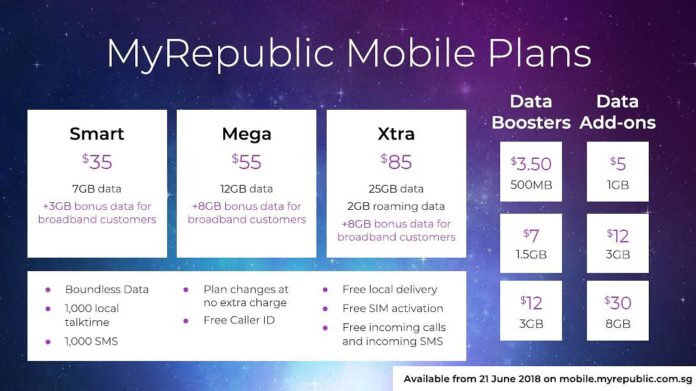
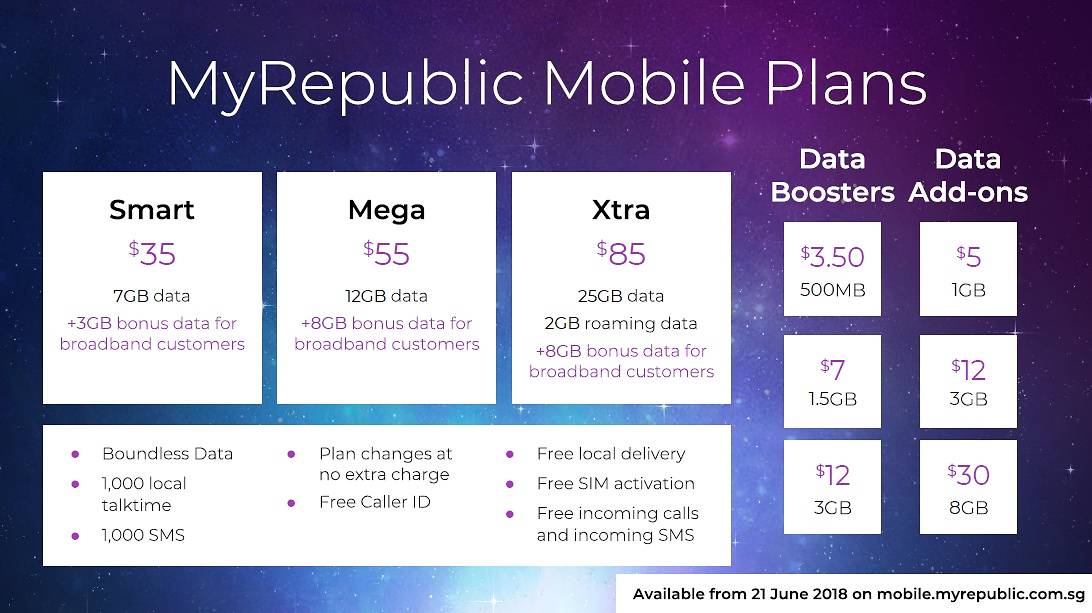
The Internet company said during a media briefing that the three plans – Smart, Mega and Xtra – will cost S$35, $55 and $85 a month for 7GB, 12GB and 25GB data, respectively.

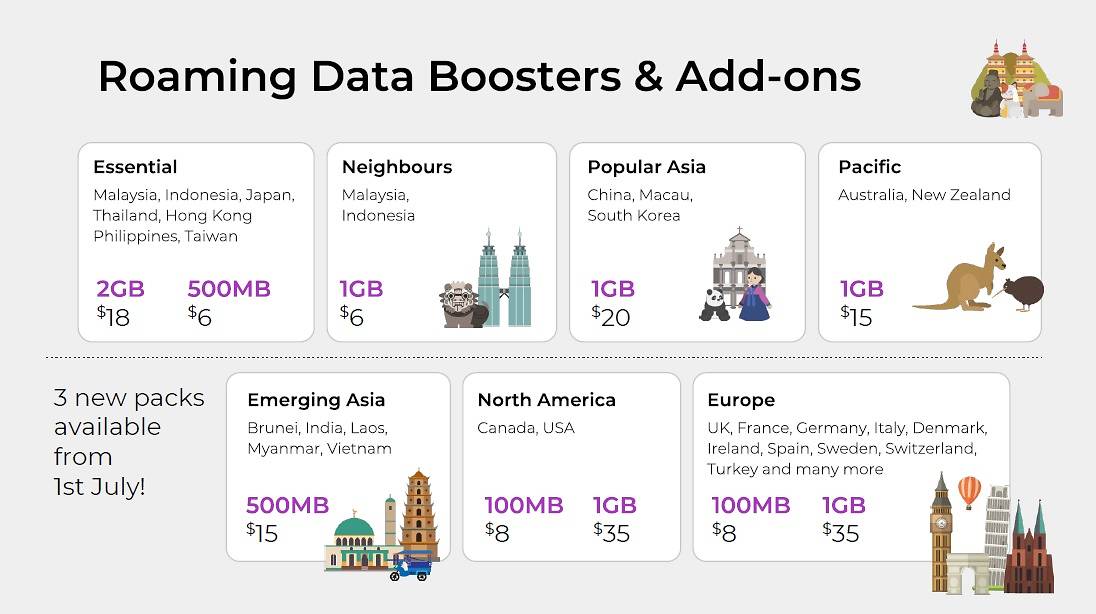
The 25GB plan for Xtra subscribers will include 2GB roaming data for seven markets, namely Malaysia, Indonesia, Japan, Thailand, Hong Kong, Philippines and Taiwan, said MyRepublic CEO Malcolm Rodrigues.

For existing broadband customers, the company is also dangling incentives for them to sign up, if they haven’t done so. They stand to get 3GB more data for the Smart plan, and 8B more for the Mega and Xtra plans.

The mobile plans all come with features like “boundless data”, which will not penalise consumers for busting their data caps with extra charges but will see surfing speeds lowered instead. This was a feature announced when they launched two mobile plans for its existing customer base back in May.
MyRepublic plans 1

(Image: MyRepublic)

MyRepublic’s chief marketing officer Shivendra Singh said during the briefing that this, among other features, are to “ensure we are trustworthy” to the consumer. Unlimited data plans, he elaborated, are “not honest” as they usually come with hidden provisos, but its boundless data plans means “customers don’t need to worry about excess data charges”.

Mr Rodrigues also told Channel NewsAsia on the sidelines that based on customer response following the launch of Uno and Ultimate for “friends of MyRepublic”, feedback has been “good”, particularly for those who have busted their data caps and had their surfing speeds managed.

“It’s like when we drop from 4G to HSPA today. You probably can’t watch a high-definition video, but you can still do stuff like send WhatsApp messages,” he said.
MyRepublic plans 2

(Image: MyRepublic)

These plans will also have 1,000 minutes of talk time and 1,000 SMS text messages, free local delivery of SIM cards and activation, the company said, adding new customers can sign up from Thursday.

Key to the user experience is the MyRepublic mobile app, available for both iOS and Android devices, said Mr Singh. Users will be able to customise their mobile plan, such as signing up for data boosters or roaming packages on the fly, and track their usage from the app.

The intention behind its design is for users to do what they need within three clicks in the app, he added.

MyRepublic team

(From left) MyRepublic Managing Director Yap Yong Teck, CMO Shivendra Singh and CEO Malcolm Rodrigues. (Photo: MyRepublic)

​​​​​​​

These on-the-go provisioning of services are enabled through the company’s “thick MVNO model”, which it said is first of its kind in Singapore. 

CEO Rodrigues said it is a “multimillion-dollar network system” that allows it greater control over the delivery of services to customers compared to traditional MVNO arrangements which sees these operators just resell products from the main telco.

This appeared to be similar to rival MVNO Circles.Life’s platform Circles-X. When asked what’s the difference, Mr Singh declined to comment on its competitor’s products.

CONSUMERS TO BENEFIT FROM LOOMING COMPETITION

Analysts Channel NewsAsia spoke to ahead of the launch on Thursday predicted a period of fierce competition in the local telecoms market, with consumers the main beneficiaries.

Mr Shiv Putcha, contributing analyst at IDC, said the Singapore market is not big enough to support four full-fledged telcos and four MVNOs.

“At roughly 8.5 million subscriptions, the Singapore market is already over-penetrated,” Mr Putcha said. “We expect a period of fierce competitive intensity and there will be some clear winners and losers, with the incumbents, especially the smaller ones, likely to cede ground and market share.”

With the pending entrance of fourth telco TPG Telecom, as well as the introduction of new MVNOs in the past year, consumers will “benefit immensely” from lowered prices, higher data bundles and flexible plans, the analyst said.

He also expects to see the telco incumbents – Singtel, StarHub and M1 – make renewed investments on customer experience.

Canalys research analyst Nguyen TuanAnh echoed similar thoughts, saying that consumers will benefit from the rise of MVNOs.

He pointed to similar developments in Japan last year which suggest that full-fledged telcos, while benefiting from leasing spectrum to MVNOs, will also reduce prices to maintain their subscriber base.

These telcos also have more tools than just reducing costs, as they can turn to digital content for growth, the Canalys analyst said

For instance, while they may not match MVNOs in attractive price packages, bundling data with content such as free streaming of Spotify or Netflix for example, is a “great way” for them to remain subscribers and improve revenue.


Source link

Southeast Asia’s vanishing sand bans are destroying the region

0


MALAYSIA’S newly elected prime minister once said that illegal sand miners were “digging up Malaysia and giving her to other people.”

During his previous term in office, he tried to fix what he viewed as an aggressive assault on Malaysia’s heritage: the selling of its sand.

To put a stop to it, Mahathir imposed a sand export ban to Singapore in 1997, which at the time was reclaiming huge swathes of new land to expand its territory. That enterprise required vast amounts of sand unavailable to Singapore, but which could be easily found in its neighbour, Malaysia.

SEE ALSO: India hosts World Environment Day as its citizens drown in plastic

However, despite Mahathir’s best efforts to protect Malaysia’s environment, it appears the ban was at best only minimally effective, and in most years completely illusory.

000_14P8Y7

Former Malaysian prime minister and opposition candidate Mahathir Mohamad celebrates with other leaders of his coalition during a press conference in Kuala Lumpur on early May 10, 2018. Source: Manan Vatsyayana / AFP

Yet the impression largely propagated by the media has been that Malaysia’s sand ban has been in place and enforced up until last year. In 2017, Malaysia’s Ministry of Natural Resources and the Environment announced that the sand ban had been lifted and that exports of sand would be permitted to Singapore on a case-by-case basis.

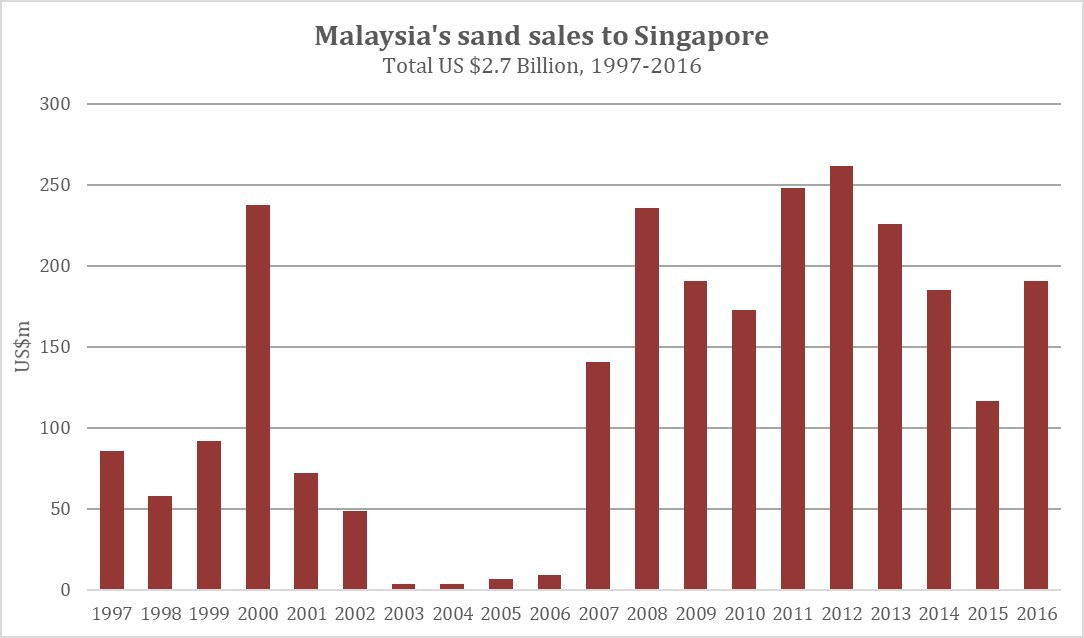
But that was rather an odd announcement considering UN Comtrade reports filed by Malaysia and Singapore over nearly twenty years that appeared to contradict the suggestion that the ban had ever been in place at all.

A recent review of Malaysia’s “stone, sand and gravel” exports to Singapore and Singapore’s purchases of those resources over two decades suggests that Mahathir’s sand ban, initiated to protect a fragile Malaysian environment, was seemingly ignored, including by his own government.

For most of those years, except for a relatively brief four-year period between 2003 and 2006, the ban appeared to be ineffectual.

For example, Malaysia reported to UN Comtrade that Singapore bought US$58 million worth of “stone, sand and gravel,” or over $9 million per year on average, between 1997 – the first year of Mahathir’s ban – and 2002.

However, Singapore reports it spent $595 million during this same period, or nearly ten times what Malaysia claims. The amount of materials exported by Malaysia to Singapore during this period don’t indicate any kind of functional ban.

Malaysia-Sand-Ban-UN-Comtrade-1

Source: UN Comtrade, Singapore report

It’s possible the ban was slow in getting started. But in 2003, the year Mahathir left office, exports of materials from Malaysia to Singapore do, in fact, radically and quickly slump — at long last.

During this period, Singapore reported purchases of $24 million; Malaysia reported exports of $7 million. These much-reduced amounts of imports and exports do, in fact, suggest that Mahathir’s ban was at last being observed, but there may be a specific reason for this.

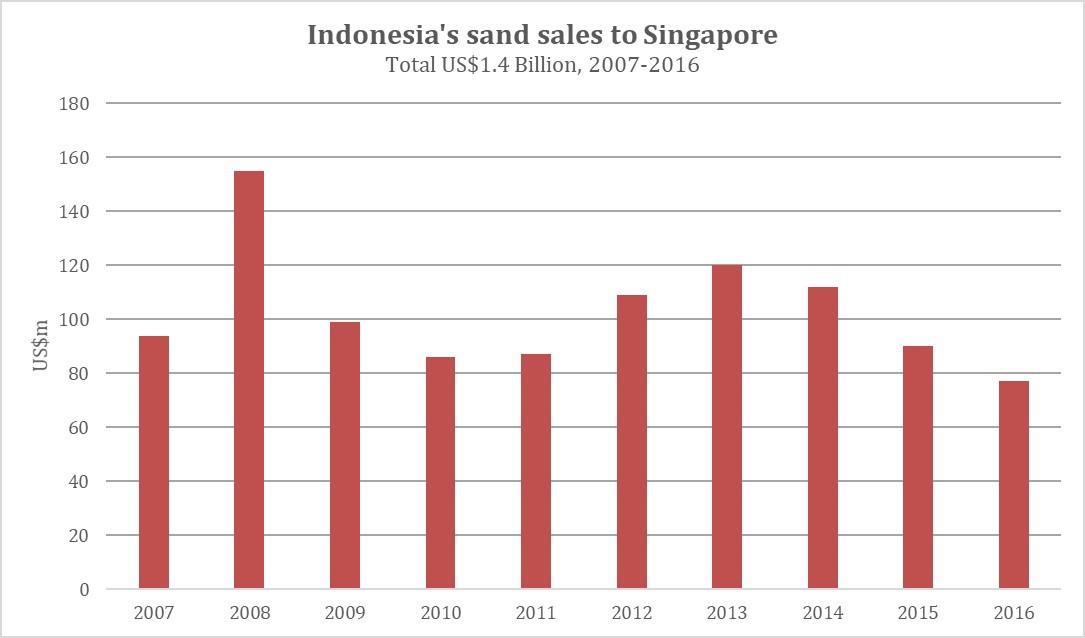
According to Singapore’s reports to UN Comtrade, in 2003 it began buying huge quantities of “stone, sand and gravel” from Indonesia.

SEE ALSO: Laos pushes ahead with Mekong dams despite environmental risks

Over the four years between 2003 and 2006, Singapore reports that it purchased a total of $338 million worth. This is the same time period that Malaysia’s exports of these same materials to Singapore precipitously dropped. In other words, the level of these new imports from Indonesia effectively replaced the annual amount of sand Singapore had been acquiring from Malaysia.

Unsurprisingly, by 2007, Indonesia had announced its own export ban of sand to Singapore, citing environmental concerns after the active sand extraction caused islands to start disappearing.

But, despite both Malaysia and Indonesia placing bans, the stream of “stone, sand and gravel” exports continued to flow.

Indonesia-Sand-sales-UN-Comtrade

Source: UN Comtrade, Singapore report

In the final years of Abdullah Ahmad Badawi’s premiership, between 2007 and 2009, Malaysia sold Singapore about $568 million worth of the product.

By 2010, the first year of Najib Razak’s leadership, sales to Singapore came in at $173 million, at least as reported by Singapore. And amazingly, over the next six years, Singapore reported buying a total of $1.2 billion in exports of this kind from Malaysia. In total, that’s a shocking $2 billion of sales to Singapore between 2007 and 2016.

It’s safe to say that’s no ban at all.

SEE ALSO: Malaysian environmentalists call for halt to Chinese-funded rail project

Is it possible that Singapore was purchasing stone and gravel, and not sand? Perhaps.

The UN Comtrade makes no distinction between these materials. But it seems unlikely at best, especially since Singapore would have spent $3 billion of public funds on just “stone and gravel” from both Malaysia and Indonesia in about ten years. That’s approximately $300 million a year on stones alone.

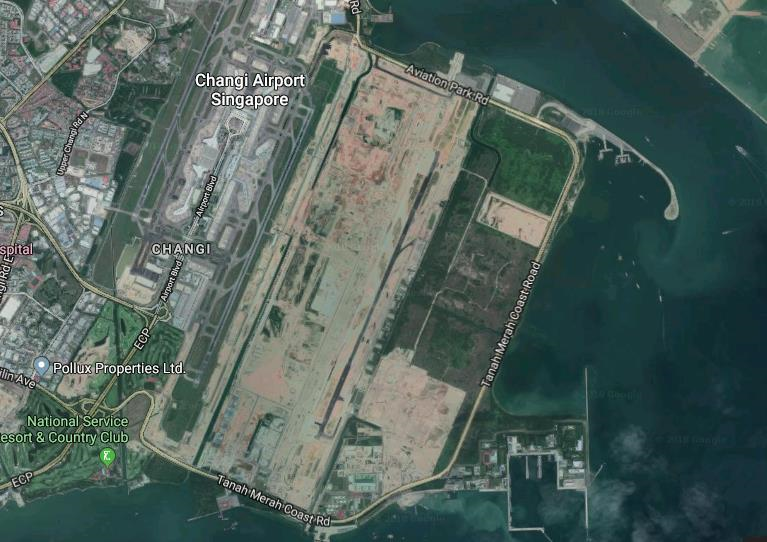
It also ignores the obvious. Between 1992 and 2004, Singapore was engaged in reclaiming vast tracts of new land. These areas included 2,000 hectares at Changi East and 3,000 hectares at Jurong Island. In addition, it was building public beaches and large waterfront areas at its Southern Islands.

Singapore-Changi-East-Google-maps

The Changi East Reclamation Project in Singapore, a multi-phase project involving the formation of 2000 ha of land by placing hydraulically filled sand on to soft seabed marine clay. Source: Google Maps

During this period, Singapore’s appetite for sand was voracious as 5,000-plus hectares of new land requires hundreds of millions of tonnes.

But whatever the quantities, Malaysia’s and Indonesia’s professed sand bans appeared to be disingenuous. It may have been the media’s reiteration of the existence of these bans that helped perpetuate the public perception that these bans were in place, but the UN Comtrade statistics tell a completely different story.

Vietnam tells a similar story. In 2009, the Southeast Asian nation also announced a ban on sand exports to Singapore. But again, the numbers show a different reality.

Between 2009 and 2016, Singapore bought $756 million of “stone, sand and gravel” from Vietnam. Only two years – 2011-2012 – show a substantial drop in imports by Singapore. Otherwise, it appears to be business as usual.

Given these huge sums over ten years, Vietnam can hardly be said to have implemented any kind of comprehensive ban at all. Curiously, there are significant discrepancies in the values reported by each country. While Singapore claims it purchased $756 million, Vietnam only reports a sale of $126 million over the same period.

Evidence suggests that these sand bans are, in effect, no ban at all, at least in any meaningful sense.

SEE ALSO: Vietnam: Climate change, dams will drastically impact Mekong region

What’s of grave importance is the damage still being done to Malaysia’s coasts and rivers, as well as those of Indonesia, Vietnam, and other Southeast Asian nations, due to incessant sand mining.

That’s the real story in UN Comtrade’s statistics.

If the sand mining continues and there are no effective multi-state sand mining bans put into place, the region will gradually lose their natural heritage and endanger native wildlife.

So perhaps now that Mahathir’s back in office, he will lead the way in Southeast Asia and demand a genuine sand ban in the name of Malaysia’s environment.

Clearly with everything we know of the intensely destructive impact that sand mining has on seashores, rivers, and inlands, Malaysia’s long-term environmental protection should be one of Mahathir’s top priorities.

Piyali Banergee is the lead writer and researcher for Nature Watch, an environmental watchdog group working in various parts of Asia to protect rivers and coasts.

Source link

Commentary: Amid rampant online deceit, consumers need to grow up and beware

0

SINGAPORE: You arrive at your hotel in a sunny resort expecting what the majority of reviewers said online – slick furnishings, 5-star bespoke amenities such as a vast pillow menu and custom toiletries and impeccable service at 3-star prices.

But what you get is horrifyingly abysmal – damp sheets, a musty stench in the air and none of the custom amenities you were promised.

Although everyone who has been through such an experience tells me vehemently that they have ceased to take reviews into account when making buying decisions, this is still not yet an uncommon story.

A recent episode of Talking Point pointed out that the prevalence of fake reviewers has risen in tandem with the online shopping boom.

READ: Army of fake reviewers being built to dupe buyers, drive online sales.

A 2016 survey by business consultancy PwC showed some 57 per cent of respondents in Singapore used social media to read reviews, compared with 45 per cent globally.

While family members and friends have the most impact on buying behaviour, data analytics lecturer Koh Noi Sian from Nanyang Polytechnic said positive online reviews have been found to increase sales by 9 per cent.

There would be nothing wrong with any of this if the reviews were authentic.

But the programme also found that the proportion of fraudulent positive reviews could be higher than many of us thought.

It’s an industry unto itself with one company saying it pays about 80,000 individuals to post such reviews for its clients’ products and services.

Most of these individuals are likely to have never tried the products or services.

This may not come as a surprise to many who already take such reviews with a pinch of salt.

But many others clearly trust, at least until they are sorely disappointed.

Thankfully, there are tools these days to help consumers analyse the authenticity of such reviews.

TP fake reviews 1

But even these aren’t absolutely accurate and telling real from fake remains challenging.

INSIDIOUS ADVERTISING COMES IN MANY FORMS

A healthy scepticism is clearly needed here and many would agree that since the early days of advertising, the term “caveat emptor” or “let the buyer beware” applied to every buying decision.

But there is something disturbingly insidious about ads made to look like genuine user reviews.

Several years ago, when social media influencers came under fire for not clearly marking their sponsored posts as ads, the Advertising Standards Authority of Singapore (ASAS) stepped in with guidelines.  

The guidelines on advertising and marketing communication on interactive and social media state that disclosures of commercial relationships and disclaimers should be made prominent, paid reviews, testimonials and endorsements have to be clearly indicated and reviews that are disguised as being from impartial sources are not permitted.

Those who fail to comply with the guidelines risk having the ads removed, the withholding of advertising space or time by media owners, or even the withdrawal of trading privileges from advertising agencies.

Many have said the penalties could be harsher and consumer protection laws need to have more teeth. 

But even then, clearly not every instance of a breach of these guidelines will be detected and acted upon.

Some online businesses have been taking steps of their own.

In 2016, in its effort to combat fake reviews on its platform, Amazon sued three of its sellers for using fake accounts to post fake reviews about their products. It also used lawsuits to discourage the buying and selling of reviews.

But while we often demand that businesses, the authorities and organisations like ASAS and the Consumers Association of Singapore (CASE) protect consumers better, we would certainly benefit from becoming more savvy ourselves.

In 2015, we learnt that even negative reviews can be fraudulent.

Social media agency Gushcloud was found to have incentivised social media influencers to complain about rival telcos as part of a campaign for Singtel.

singtel file

The Singtel logo outside its headquarters in Singapore. (File photo: AFP/Roslan Rahman) 

CONSUMER LITERACY

The morass of dubious, solicited and inauthentic reviews could leave a consumer’s head spinning.

But just as we have discussed media literacy in the context of detecting and eschewing fake news or deliberate online falsehoods, we need to become more advertising literate.

There is evidence of healthy scepticism when it comes to social media marketing. For instance, earlier this year when the Ministry of Finance tapped social media influencers to raise awareness and engagement on Budget 2018, many netizens wondered if the influencers involved had the requisite knowledge or interest to authentically execute the task.

However, consumer literacy goes beyond this.

READ: Go beyond addressing deliberate online falsehoods to encourage a thinking society , a commentary.

READ: A commentary on the use of social media influencers for Budget 2018. 

Last year, CASE reported an “alarming rise” in the amount of prepayments reported lost by consumers when businesses closed down.

Since then, CASE has been advising consumers to negotiate progressive payments instead of paying in full upfront; to find out if a business offers any insurance or escrow arrangements to protect prepayments; to choose the “pay as you use” option instead of prepaid packages; and to always ask about the refund policy for the prepayment.

Yet, we have seen similar cases recently involving travel agencies and a furniture store with consumers reporting losses of thousands of dollars.

While there might be some legal recourse under the Consumer Protection (Fair Trading) Act, recovering lost money can often be impossible.

Therefore, we would certainly do well to take precautions before parting with our money offline or online.

Misa Travel shuttered

Misa Travel’s office with its shutters drawn on May 31. (Photo: Kamini Devadass)

BUSINESSES BEWARE

Businesses also need to learn that consumers will eventually catch on.

Operating on the premise that there will be enough of us falling for such tricks online is unsustainable.

Reputable businesses would tell you that establishing your brand’s reputation by partnering a real person who is worthy of your target consumers’ trust and who gives a balanced, authentic review is key to retaining and attracting customers.

Nothing beats a proven track record. Not even an avalanche of fraudulent reviews.

For consumers, thankfully, word-of-mouth through an individual’s own network or family and friends still holds sway.

We can all wish to go back to simpler days when this and trial and error were the primary factors that determined our puchasing decisions.

But to be realistic, it is wiser to take it upon ourselves to become smarter consumers.

It is time to grow up and beware.

Bharati Jagdish is the host of Channel NewsAsia’s On The Record, a weekly interview with thought leaders across Singapore, and The Pulse, Channel NewsAsia’s weekly podcast that discusses the hottest issues of the week.​​​​​​​

Source link

Commentary: Singapore Airlines to launch world’s longest commercial flight – again

0

SINGAPORE: In 2013, Singapore Airlines (SIA) scrapped its almost 19-hour non-stop service between Singapore and the New York area, nearly a decade after it was first launched. 

The route’s demise was chalked up to a couple of key factors. 

When the service was introduced in 2004, crude oil prices were at US$50 (S$67) to US$60 per barrel. By June 2008, they had reached an all-time high of more than US$140 per barrel. 

While prices dropped to around US$50 per barrel at the end of 2008, they returned to the US$80 to US$110 per barrel range by mid-2009, where they remained till late 2014. 

This caused airlines’ fuel bills – often the largest component of their operating costs – to skyrocket. And the fact that the route was operated using the gas-guzzling A340-500 aircraft didn’t help. 

Also, SIA was initially using a two-class configuration with 117 premium economy and 64 business class seats. In 2008, this was re-configured to 100 business class seats and no premium economy cabin. 

It proved a wrong move when the financial crisis hit and business travel demand slumped. 

These circumstances combined made the route unprofitable and led the airline to finally pull the plug at the end of 2013. 

FAST FORWARD TO THE PRESENT

Fast-forward to 2018 and SIA has announced that it will be resuming its Changi-Newark non-stop service – the world’s longest commercial flight – this October, amidst a flurry of similar ultra-long-haul routes being launched by various airlines over the past couple of years. 

Some challenges remain. Fuel prices, though lower than the 2013 levels, are on the rise. 

According to the International Air Transport Association (IATA), global jet fuel prices have risen 50.3 per cent year-on-year to US$90.4 per barrel as of Jun 1. Bloomberg data shows that Singapore jet fuel prices are back up at their highest levels since 2014. 

Still, a lot has changed and there’s good reason to be optimistic that SIA will succeed.

The flight will use the long-range Airbus A350-900ULR, which will be configured to carry 67 in

The flight will use the long-range Airbus A350-900ULR, which will be configured to carry 67 in business class and 94 in premium economy. (Photo: AFP/Roslan RAHMAN)

New, fuel-efficient aircraft are improving the viability of ultra-long haul flights. In March this year, Qantas launched their Perth-London service using the Boeing 787-9 Dreamliner. 

Singapore Airlines will operate the Airbus A350-900ULR between Singapore and New York, which is expected to deliver considerably better route economics than the A340-500. 

NEW CABINS APPEAL TO BUSINESS TRAVELERS

The cabin configuration has also changed. SIA’s A350s have been fitted with 67 business class and 94 premium economy seats, compared with the post-2008 A340 configuration which had only business class seats. 

The 100 per cent premium seat mix makes sense, since business travelers are a key demographic for non-stop flights – these are the passengers who value a shorter travel time the most, and they’re willing to pay extra for this benefit.

The inclusion of premium economy will allow SIA to attract business travelers whose corporate travel policies don’t permit them to fly business class.

These flights can drastically reduce airport layovers and unfavourable scheduling. This means companies and their business travelers can make smarter budgeting decisions when comparing the higher ticket cost on an ultra-long-haul flight versus the additional hotel nights that might be necessary on a trip categorised by multi-segment flights. 

Seen in this light, companies can potentially reduce their expenditure on employee travel by including ultra-long haul options in their travel programmes.

And with better lighting, higher ceilings, and improved air quality, the new aircraft being used on ultra-long-haul routes also provide a more pleasant cabin experience that reduces fatigue and improves productivity and well-being – another big plus for business travelers. 

As a result, demand for ultra long-haul flights is growing. The number of such flights has nearly tripled to 19 over the last decade, according to air travel intelligence company OAG. 

In particular, they have generated a lot of interest from the business travel community, with many companies including these routes as part of their corporate fare negotiations with airlines.  

SIA premium economy

Premium economy seats in the revamped Singapore Airlines Airbus 380. (Photo: Singapore Airlines)

BENEFITS TO AIR HUBS LIKE SINGAPORE

For traditional hub airports like Singapore’s Changi Airport, ultra-long haul flights present both challenges and opportunities. On one hand, we could see their relevance as stopovers disappear when they are not the end-destination in themselves.  

The flipside is that business travel originating in Singapore and similar hub markets could see tremendous benefits – for example, the ability to reach both coasts of the United States from Singapore in one flight can drive business to the major airlines servicing the hubs, and thus bring greater passenger footfall to the airports. 

Changi Airport’s investment in its infrastructure looks smart in this context, and the focus it has placed on traveler experience and the swift entry and exit from the airport will likely be a major point of differentiation. 

Vibhav Singh is senior consultant at CWT Solutions Group, the consulting arm of travel management company Carlson Wagonlit Travel.

Source link

‘All I wanted was to help save a life’: Getting swindled in Singapore an expensive lesson for some

0

SINGAPORE: When Mary (not her real name) received a Facebook friend request last November from a businessman who appeared to have some acquaintances in common, she thought nothing of accepting the invitation.

That marked the start of a dizzying web of deceit which ultimately saw her lose at least S$200,000 within two months.

Claiming to be a businessman based in the Middle East, Mary’s new “friend” would send her WhatsApp messages embellished with details of his family and photographs of him with associates.

“He seemed very pleasant-looking and well-dressed,” Mary told Channel NewsAsia in a phone interview. “I thought that he was too high-profile for me.”

But within a month of them getting to know each other, the man was asking for a loan to cover “customs taxes”, as the machinery parts for his oil business was stuck at customs in Dubai. As proof of his identity, he sent Mary a photograph of his passport details. 

“It sounded credible, that’s why I gave him that first loan,” she added.  But things escalated days later when the man sent a photo of himself on a stretcher, with an oxygen mask attached to his face.

Claiming that he had blacked out and woken up in hospital, the man said he needed medical treatment and could not foot the bill as his assets were frozen by the bank.

While her instincts told her that this could be a scam, Mary was convinced by fake doctors’ reports and photographs of the man, who looked gaunt and sickly. “My heart really sank (when I saw the photographs), what if it was real?” she said.

But Mary ponying up the cash wasn’t enough, as the man claimed doctors still needed to perform an emergency procedure to save his life. With her savings running low, Mary approached well-meaning friends to raise funds, one of whom contacted the hospital and found out there was no such patient.

Moneychanger handling cash

(File Photo: AFP/Roslan Rahman)

“At the start, he was very nice,” said Mary. “But the tone in his messages changed. He asked me why I had got my friend involved and that I should be listening to him instead.”

With time running out on the scam, the man tried to turn Mary into a money mule, fishing for her bank account and passport details so that he could transfer cash from “clients” to his boss in Dubai through her, in order to pay for the operation. 

Mary said: “When he asked for passport details, it was like a flashing red light.” She stopped responding to the man’s messages before making a police report.

“The police officer told me there was nothing much they could do about it,” added Mary. “Sometimes I ask God why me? I never hurt anybody. All I wanted to do was help save a life and it turned out to be a painful and costly experience.”

PREYING ON PRECONCEIVED NOTIONS

Mary is not alone. According to the Singapore Police Force, at least S$99 million was lost to scammers last year. 

Internet love scams, in particular, hit a new high of 825 in 2017, with cases increasing by 30 per cent. To combat this, the police last October formed the Transnational Commercial Crime Task Force (TCTF) to investigate these particular scams. The police also work closely with foreign law enforcement counterparts to crack down on overseas syndicates targeting Singaporeans.

Despite the number of cases decreasing by 8.5 per cent from January to March 2018 as compared to the same period in 2017, the SPF say such scams ‘remain a concern’.

This year, apart from love scams, some of the most common scams include e-commerce and investment ruses, with the police seeing the number of cases increase by 46 per cent and 43.3 per cent respectively.

According to Dr Lim Boon Leng, a psychiatrist at Gleneagles Medical Centre, scammers have identified certain “gaps” in the thinking processes of victims and exploit these opportunities.

“We rely very much on what we believe in, our preconceived notions and what we see and hear. Sometimes, that in itself may not be entirely accurate and it can be exploited, ” said Dr Lim. 

“(In the case of love scams), scammers try to understand you and your needs, they then play to your needs …There’s a deception that is ongoing and then the individual believes this deception, assumes it to be true and complies ultimately with the act of giving up his or her money because of the emotional aspects of it – they feel very bonded to the person online and don’t want to lose them,” he elaborated.

Facebook User

(File Photo: Reuters/Dado Ruvic)

“It’s worth noting that there have been cheats and grifters for as long as people have had possessions,” added associate professor Benjamin Detenber from the Wee Kim Wee School of Communication and Information at Nanyang Technological University.

“What networked computers have done is simply extend the reach of cheats and grifters. That is, they have the capability of reaching more ‘marks’ at little or no cost. In the past, con artists had to work the ground, and now they can simply ride a keyboard,” added Prof Detenber, who has research interests in computer-mediated communications.

Having received a Facebook friend request from a scammer using the duplicate account of a church mate, John (not his real name) accepted the invitation without much thought. His “friend” claimed to be at an exhibition, and requested for John’s phone number and resultant OTP in order to “claim a prize.”

“I totally bought the whole thing. I didn’t really suspect (it was a scam) also because I was studying at the same time,” said John. While the transactions made by the scammer ultimately fell through, several others from John’s church also fell prey to the scam and ended up being charged small amounts through their phone bill.

“It is taking advantage of the friendships and the goodwill of people,” added John. “I was quite disgusted that they would make use of the trust that you have for close friends.”

STEERING CLEAR OF THE LAW

But it is not merely about being trusting. Singaporeans are also less likely to question authority, making them more susceptible to scams, added Dr Lim.

“I do think that Singaporeans are more likely to be scammed than (those who come from) other countries,’ noted Dr Lim. “We are less likely to question authority – we are a more trusting society and less questioning especially when it comes to authority… In Singapore, we are so averse to having some sort of criminal record, some sort of brushes with the law or a black mark on our life, we are very likely to then fall victim and then pay up.”

A victim of an impersonation scam, Andrea was coerced into divulging credit card information. She was contacted by a caller purporting to be from a service center who informed her that she had a package due for collection. But because the package contained an illegal substance, she had to transfer her to a ‘police’ hotline.

“When you look back on it, it seems ridiculous. You’re simply too involved in the conversation to think clearly,” said Andrea. “I thought that being scammed was something that would never happen to me.”

Credit Card Scam Story

(File Photo: AFP/Damien Meyer)

Flustered and worried after being transferred from caller to caller for more than an hour, Andrea was informed that she was also wanted in a corruption case, and told to provide her bank and credit card details. While she provided the latter, she could not get her banking information online and headed to her bank to get the information in person.

“It was while walking there that I came to my senses,” she said. “I thought of what they were telling me, checked the internet and realised it was a scam.” Andrea reported the case to the police straight after, and immediately cancelled all her credit cards to ensure that no money was withdrawn.

“We don’t concentrate very well and we don’t make good judgements when we are under time pressure, or stress,” said Dr Lim. “During those times, the anxiety is very high. The brain is trying to find a way to let go of the anxiety so people would rather give up on rationalizing the situation.”

“The police strongly urge the public to be cautious when making any form of online transactions and to exercise due vigilance when making friends over the internet,” the SPF said in a statement.

“Do not give out personal information and bank details, ATM cards, PIN codes, internet banking tokens to strangers. No government agency will ask for payment or seek banking information over the telephone. Victims should remember: Don’t panic, don’t believe, don’t give.”

“Before I received that call, I never really thought twice about scams,” said Andrea. “I was so frightened and scared. You think that Singapore is so secure and safe but it is not always the case. Some people are just good at manipulating others.”

Source link

Locally grown strawberries a first for Singapore’s farming industry

0

SINGAPORE: It was once an unthinkable feat – growing non-native temperate produce on Singapore soil. But a local urban farm has managed to do just that – growing strawberries, with the help of technology in a controlled hydroponics environment.

“We manipulate the environment to enhance the flavour profiles of our products, even down to the nutrients that run in the water,” said Benjamin Swan, co-founder of Sustenir Agriculture

“So even though it took two months to get the (strawberries) up, we spent the better part of six months understanding how we can best optimise the growth footprints we have to make the products the best we can be … by controlling the environment.”

Strawberries are the latest fruits of the vertical farm’s labour, with other temperate produce in its basket including kale and arugula. The vertical farm also has plans to explore innovations in agriculture, by setting up a research and development lab in startup complex JTC LaunchPad @ one-north.

In a visit to the 1,000 sq ft facility on Wednesday (Jun 20), Senior Minister of State for Trade and Industry Koh Poh Koon said the Government would continue supporting urban farmers in co-developing solutions with industry players, in light of challenges faced by the urban farmers.

strawberries 2

The strawberries are grown in a fully controlled environment, such as with LED lights with different wavelengths and tailored nutrient solutions. (Photo: Wendy Wong)

“The industry gave feedback that they have two challenges. One is that there is a lack of plug-and-play, cost-effective solutions for automation they can use quite quickly,” said Dr Koh. “The second challenge they face is that they may need to have more understanding of science of certain niche crop types they can grow in an indoor environment.”

“Urban farming as a movement is still fairly new globally. Therefore some of these solutions may not be readily available off the shelf,” Dr Koh said. “But we do see a lot of solution providers innovating solutions that can be adoptable.”

“They being here in LaunchPad – where a lot of innovation and entrepreneurs are – this can be a place to catalyse cocreation of solutions. And I think that would not just meet needs, but create an entirely new pillar of exportable technology for our local companies as well,” Dr Koh said. 

He cited the example of Sustenir Agriculture, which partnered with robotic solutions company PBA Hanhwa Robotics to devise a robotic arm for its seeding and transplanting process.

strawberries 3

The farm is exploring the use of robotic arms to help in its seeding and transplanting process, with the robots able to take on the workload of eight personnel, according to Mr Swan. (Photo: Wendy Wong)

Dr Koh added that the Government would continue to encourage collaboration between farmers and institutes of higher learning. “The NUS Environmental Research Institute (NERI) is already working with some of our industry to better understand the science behind growing niche crop varieties, and to look at agrotech they can co-develop together to meet those challenges.”

The vertical farm, which is expanding into Hong Kong in the third quarter of 2018, is also looking at growing “indoor grapes” – and eventually even harvesting “made in Singapore” wine among others.

“All strawberries need to be pollinated – typically that happens with bees outdoors,” said Mr Swan. “What we do right now is that we do it by hand with a forensic brush. It’s a little bit laborious and we don’t get 100 per cent success. But we are exploring bringing in bees to the room, which means we could have 100 per cent clean honey as well.”

Source link

Army combat soldiers get new uniforms that cool, dry faster

0

SINGAPORE: Army combat soldiers are now being issued with a new hybrid uniform that is more comfortable and dissipates heat faster.

The new uniform is made up of the usual Number 4 uniform pixelated fabric and a high-performance fabric, which comprises a combination of flame resistant synthetic materials and aramid, a type of fibre that is strong and heat-resistant.

It is designed to be worn under the integrated load bearing vest during combat exercises and outfield activities. Soldiers will still be required to wear the Number 4 uniform for other routine activities.

“What this means is that when our soldiers wear the load bearing vest, they will sustain better and endure longer in a combat environment,” head of the Centre of Excellence for Soldier Performance (CESP) Senior Lieutenant Colonel Yee Kok Meng said on Tuesday (Jun 19).

The new uniform was unveiled as Chief of Defence Force Major-General Melvyn Ong said the Singapore Armed Forces (SAF) was committed to equipping its solders with better equipment, like a new load bearing vest that dissipates heat better.

“All these we are doing to support the individual, and the CESP will also, especially in the area of heat injuries, get behind it,” he added.

FEATURES

The hybrid uniform’s high-performance fabric has a porous construction that allows for better air circulation, meaning it is 1.4 times as permeable as the Number 4 uniform. It also absorbs perspiration quickly and is 1.6 times as effective in drying.

The fabric is also fire-resistant and comes with “self-extinguishing abilities”. “Hence, it does not melt or drip when exposed to extreme heat,” the Ministry of Defence (MINDEF) said.

The new uniform began rolling out in January to soldiers from the Army combat units, chosen for their physically-demanding missions, with equipping to be completed by the end of this year. Each soldier will receive two pieces of the uniform.

Infantry units like 3rd and 6th Battalion, Singapore Infantry Regiment (SIR) have been fully equipped with the uniform.

saf soldiers wearing new hybrid uniform 3

Infantry soldiers doing lunges in the new uniform. (Photo: MINDEF)

Full-time national serviceman Private (PTE) Kugan Senivasan, a 4 SIR trooper, said he feels a “genuine difference” wearing the hybrid uniform during strenuous training.

“When you’re doing exercises, the Number 4 uniform drags on your body a lot, whereas this is rather smooth and comfortable,” the 18-year-old said.

The uniform will also come in handy during outfield exercises, when soldiers have “sweat and camouflage dripping down” their faces, PTE Kugan added.

saf hybrid uniform 2

4 SIR soldiers wearing the hybrid uniform during their vocation fitness training. (Photo: Aqil Haziq Mahmud)

However, MINDEF said there are no plans to distribute the new uniform to operationally-ready national servicemen during In-Camp Training as the Number 4 uniform still meets their training requirements.

“Servicemen will be able to replace their hybrid uniform at eMart outlets via credit or cash,” MINDEF said. “Stock is still being built up progressively for retail at eMart outlets.”

A HISTORY OF UNIFORMS

The hybrid uniform was conceptualised in 2011 for the Army and has undergone “extensive” trials, with input from agencies like the Defence Science Technology Agency (DSTA) and ST Logistics, MINDEF said.

“Various agencies worked together in the acquisition process, from crafting of technical specification to ensuring the quality of the final product fulfills our requirements,” it added.

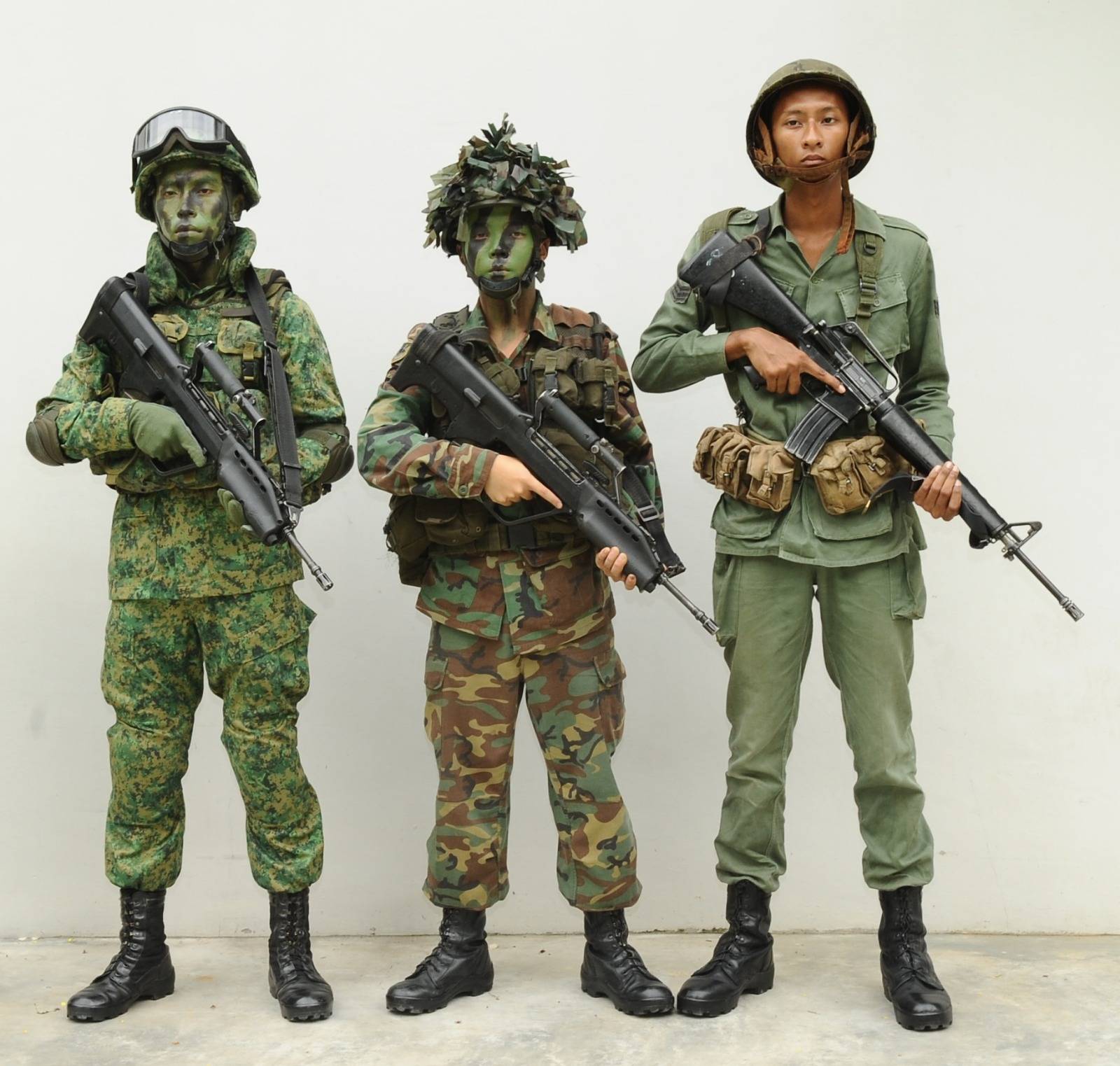
saf uniforms through the years

From left, the current pixelated uniform, the older camouflage design and the Temasek Green uniform. (Photo: Singapore Ministry of Defence)

The last major change to the Army Number 4 uniform took place in 2008, when the current pixelated design replaced its more jungle-oriented, camouflage predecessor.

Back then, a need to optimise the performance of 3rd Generation SAF soldiers in both urban and forested terrains had emerged.

saf pixelised uniform

The current uniform has better camouflaging capabilities. (Photo: Singapore Ministry of Defence)

Extensive DSTA research had revealed that the new pixelised pattern helps to generate a “quivering” effect that reduces the eye’s ability to discern recognisable shapes, defence magazine CyberPioneer reported.

“It’s safe to say we’re looking at a 30 to 50 per cent enhancement in the soldier’s camouflage capability,” then-Chief of Staff, HQ 9 Division/Infantry, Colonel Tan Chor Kiat had said.

Besides the new design and features like frontal epaulettes, the pixelated uniform also enabled better air flow and heat dissipation, drying two times faster than the old uniform.

CAMOUFLAGE AND TEMASEK GREEN

Moving further back in time, the old camouflage design, influenced by the American-developed camouflage cloth, was introduced in 1983.

“With the continuing Rambo series keeping the camo look in the forefront, the uniform became so fashionable that the SAF had to remind fashionistas that to wear it casually was an offence under the Decorations and Uniforms Act,” one Hayden Ng wrote in a MINDEF article commemorating SAF50.

saf uniforms through the years 2

The current uniform was introduced in 2008, 25 years after the camouflage design debuted. (Photo: Singapore Ministry of Defence)

Its predecessor, the first generation Temasek Green SAF combat uniform, debuted for the Army, Navy and Air Force in 1967.

“Made of thick cotton, the shirt had to be tucked in,” Mr Ng wrote. “And although it was fashionably slim cut for the sixties, it was not particularly practical to serve double duty as a parade uniform and for field training.”

Source link

Original Mr Kiasu comics re-released in box set, with toy figure

0

Individual issues will be available from Jun 29, while pre-orders for the limited-edition set start on Jun 22.

Mr Kiasu box set toy figure

The limited edition box set of the first eight Mr Kiasu comics comes with an exclusive toy figure. (Photo: Shogakukan Asia/Johnny Lau)

SINGAPORE: Is your Mr. Kiasu collection missing a few issues? Now’s your chance to complete the set.

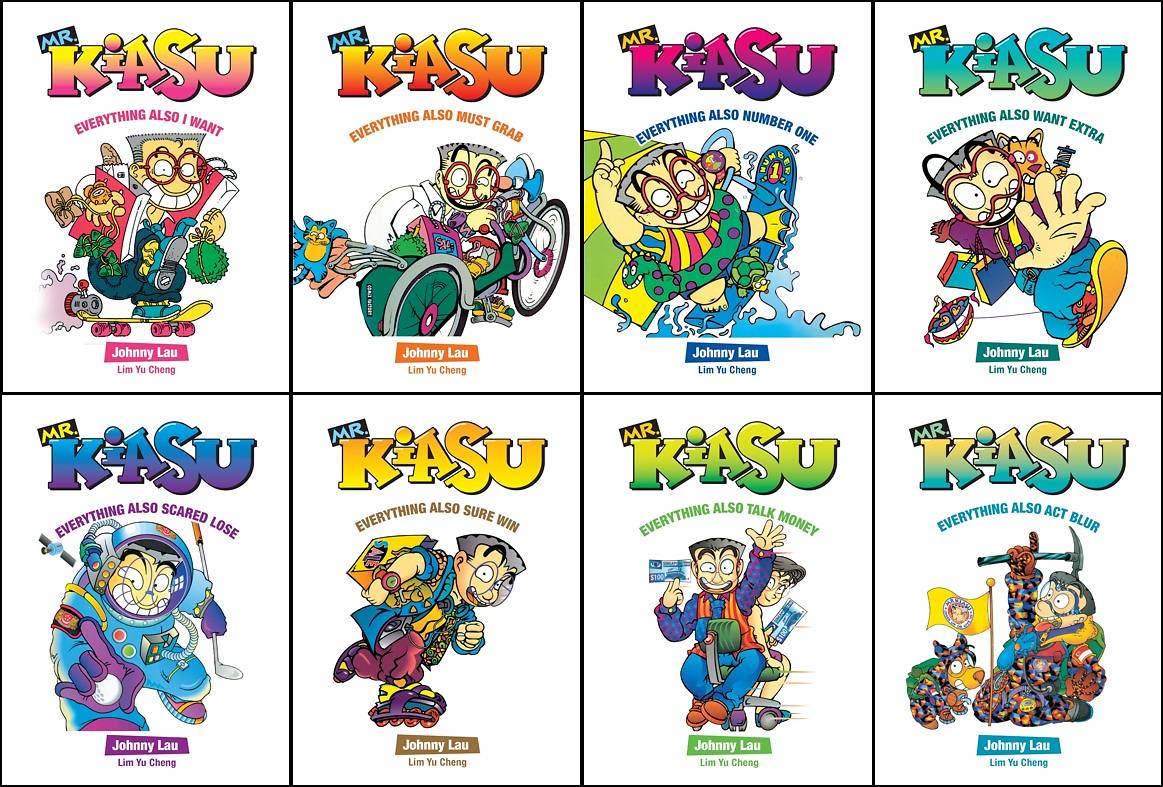
Publisher Shogakukan Asia is relaunching all eight original issues from the iconic comics series from the 1990s, as well as a limited-edition box set.

The single volume editions of the original comics by creator Johnny Lau will be available from Jun 29 at major bookstores, ActionCity and TOG. It will retail for S$10.90.

Mr. Kiasu Vol 1 - 8

The first eight volumes of Mr Kiasu will be re-released on Jun 29. (Photo: Johnny Lau/Shogakukan Asia)

Meanwhile, the Mr. Kiasu Collection comprises the eight volumes packaged in a serialized box designed by Lau – along with an exclusive three-inch Mr Kiasu figure. It retails at S$88 with pre-orders available at Kinokuniya, Popular, MPH, ActionCity and TOG beginning Jun 22. Only 500 sets will be released.

The decision to re-release earlier issues comes after last year’s successful release of the ninth volume, Mr Kiasu: Everything Also Like Real, after an 18-year hiatus. There are also plans to release a 10th issue later this year, as well as a live action adaptation in early 2019.

Mr Kiasu

Mr Kiasu: Everything Also Like Real, the series’ ninth volume, was released last year after an 18-year hiatus. (Photo: Johnny Lau/Shogakukan Asia)

Its creator, Johnny Lau, had decided to retire the popular character in the early 2000s, following adaptations into a radio show, a music album, a stage musical and TV series. Aside from Mr Kiasu, he has also produced and published close to 50 comics in collaboration with other fellow artists.

Source link

Do Michelin stars really matter in Singapore’s fine-dining scene?

0

Follow our CNA LIFESTYLE page on Facebook for more dining stories and videos

SINGAPORE: With 10 days to go, the countdown to the closure of Joel Robuchon’s restaurants has begun.

Once service ends on Jun 30, the lauded French chef’s namesake restaurant and sister outlet L’Atelier de Joel Robuchon at Resorts World Sentosa will bid adieu, along with their three and two Michelin stars, respectively.

Restaurant Joel Robuchon

Restaurant Joel Robuchon located in Sentosa is the only Singapore restaurant to have been awarded three Michelin stars. (Photo: Restaurant Joel Robuchon’s website)

This comes at the heels of the shuttering of the two-Michelin-starred Restaurant Andre, which closed earlier this year after chef-owner Andre Chiang decided to return to Taiwan.

These two huge exits have collectively caused quite a stir, not least because of their literally stellar status (“No more three-starred restaurant in Singapore? What now?”).

And with this year’s Michelin Guide set to come out on Jul 25, we wondered: Are those stars really that big a deal for our local fine-dining scene?

REACHING FOR THE STARS

It’s been a mixed bag of responses from the people CNA Lifestyle interviewed. While reaching for that star isn’t an end goal for a restaurant like Odette – which has two – having one helps a lot.

“Awards like Michelin have always been a great means of growing international recognition for a restaurant,” said Wee Teng Wen, managing partner of The Lo & Behold Group that includes Odette.

The Michelin Guide also has an impact on the places it’s at. While Hong Kong, Thailand and Singapore already have longstanding reputations as food havens, one can’t deny the additional buzz that surrounded these places once the Guides came in – a kind of extra atas sheen, if you will.

But others have pointed out that the Michelin star doesn’t mean that much anymore.

“The shine of the Michelin star is no longer what it used to be. Especially outside of France,” said a restauranteur, who doesn’t want to be named.

Michelin Guide Singapore 2017 - 3-star chefs

Three-star recipients at the launch of the Michelin Guide Singapore 2017. (Photo: Howard Law)

​​​​​​​

He pointed out that many in Asia have been left “dumbfounded” by many of the Michelin Guide’s decisions in the region.

“Japanese chefs were offended that foreigners, who have no sense of their culture and cuisine, suddenly became their judges. The Hong Kong stars, in particular, have been criticised by many.

“In Singapore, specific hawkers have been recognised and others who are equally good if not better are completely left out,” he shared candidly.

“The guide also seems to favour certain chefs who can do no wrong, and those they seem to have a prior relationship with.”

STAR BRIGHT OR STAR LITE?

Having that star also puts a strain on businesses. Another chef-restauranteur, who would only speak on the condition of anonymity, pointed out the dangers of landlords imposing higher rents in these starred institutions.

He added: “Restaurants are known to renovate, change entire menus, hire sommeliers and pay former inspectors a lot of money to learn how to earn a star.”

And then, of course, there’s the effect on us, the diners. “Once the stars are awarded, restaurants are known to increase their prices. It is only natural that restaurants will milk the star for what it is worth,” he said.

While the unnamed restauranteur said he recognises how the stars pull in the crowd for the lucky ones, it does come at a cost on a bigger scale. “Entire cities of restaurants and chefs are brought to their knees by an organisation that doesn’t even cook. That makes this organisation very powerful.”

Anthony Bourdain World Street Food Congress

Anthony Bourdain speaking at the 2017 World Street Food Congress in Manila. (Photo: Facebook/K F Seetoh)

It’s a sentiment that’s not new – the Michelin Guide has its critics that include the likes of Marco Pierre White (who, at 33, became the world’s youngest chef to be awarded three Michelin stars) and the late Anthony Bourdain.

The former has once been quoted as saying “the people giving out those stars have less knowledge than the individual behind the stove”.

Meanwhile, the much-missed Bourdain considered Michelin’s “principal enterprise” as “keeping itself in business and maintaining relevance, assuring another 10 years of chefs kissing its a**.”

CAN WE JUST SIT DOWN AND EAT?

And yet, despite such criticisms from these big guns, not a lot of industry folk in Singapore are actually willing to talk about such things openly, as was the case for this story. It would seem the Michelin Guide and its stars continue to have quite an impact here, as in many other countries.

While the debate on the importance of Michelin stars continue, some food experts maintain a more even-handed perspective of things – that at the end of the day, it really is just about the food.

Local chef-owner of Wild Rocket group Wilin Low doesn’t think a country’s fine-dining industry’s status should be dependent on any guide or list.

Wilin Low

Wild Rocket chef and founder of Mod-Sin cusine Willin Low (left) will be helming STREAT with Michelin-starred Candlenut chef Malcolm Lee to collaborate on a pop-up restaurant. (Photo: Natasha Razak)

“If the country has a vibrant fine-dining scene, its status will naturally be recognised,” he opined, before adding: “It’s also a matter of market demands. If the market needs a certain kind of restaurant scene, it will be met by market forces.”

Singapore hawker food champion and Makansutra founder KF Seetoh agrees with Low.

“No stars does not mean no hope. We were and are still fine without Michelin-starred restaurants,” he said, adding that Singaporeans are “blind” when it comes to good food.

“They won’t recognise signboards nor notice the chefs. It’s all about the food, the pleasure and the price,” he said. “Reviews on and offline never tell you the restaurant is good because they have stars. It’s good because it just is.”

Source link