SOTA lecturer Felicia Low, who is also founding director of non-profit organisation Community Cultural Development (Singapore), and founder of Post-Museum Woon Tien Wei were introduced during the community’s town hall on Sunday.
Ms Felicia Low (left), who teaches at School of the Arts, and founder of social enterprise Post-Museum Woon Tien Wei (right) introducing themselves during an open town hall to discuss potential NMP candidates for the arts community. (Photos: Arts NMP secretariat)
(Updated: )
Bookmark
SINGAPORE: The arts community in Singapore introduced two potential candidates to become their Nominated Member of Parliament (NMP) during an open town hall on Sunday (Jun 24), as current representative Kok Heng Leun prepares to step down come the end of his term in September.
Ms Felicia Low, who is a lecturer at School of the Arts’ (SOTA) Humanities and Social Sciences department and founding director of not-for-profit organisation Community Cultural Development (Singapore), was one who put her name up for consideration.
She had previously received the Outstanding Youth In Education Award 2005 and was selected for the President’s Young Talent Show 2009, according to her biography on SOTA’s website.
The other candidate was Mr Woon Tien Wei, a visual artist who founded Post-Museum. The social enterprise describes itself as “an independent cultural and social space in Singapore which aims to encourage and support a thinking and pro-active community” on its website.
Ms Low said in her introduction during the town hall meeting that one of the driving forces behind her decision to stand for nomination is a desire to make sure the arts students she is currently teaching are able to make a living from their craft.
She spoke about the need to professionalise the creative field and broaden the scope of what arts meant for the wider Singapore society and defining their value, so that artists would be able to have a sustainable livelihood.
Mr Woon, meanwhile, described himself as a “busybody” and empathetic of many communities. This can be seen by his advocacy work in heritage and conservation issues such as the Bukit Brown cemetery and Sungei Road flea market.
During the town hall session, outgoing NMP Kok took the opportunity to share about his experiences in Parliament. He said one of the challenges he faced was getting the legislative and administrative support he needed to better debate the bills proposed.
He also said many parliamentary processes, such as one where NMPs can put forward petitions, are “still not fully utilised”. He encouraged the next NMP who will represent the arts community to take every opportunity to speak up on various issues, as well as find out from parliamentary clerks the dos and don’ts of what they intend to pursue.
“We are really at the infancy stage,” Mr Kok said. “I encourage everyone, not just the NMP, to up themselves in terms of the understanding of parliamentary processes.”
Meanwhile, two current Nominated Members of Parliament, Ms Kuik Shiao-yin and Mr Azmoon Ahmad, have confirmed their intentions to step down after their terms end.
SINGAPORE: Five new species of fauna have been recorded for Singapore, the National Parks Board (NParks) said on Sunday (Jun 24).
NParks discovered the species together with the research community during field surveys at Pulau Ubin last year. They include two types of bats, an insect, a bird and a spider.
Speaking at the opening address of the seventh Ubin Day, Second Minister for National Development Desmond Lee said the discoveries are significant as they add to the diverse biodiversity at Pulau Ubin and “remind us of our role as stewards and guardians of our natural heritage”.
Migratory birds called Little Stints were spotted at the Chek Jawa wetlands in Pulau Ubin. (Photo: NParks/David Li)
The discovery of a migratory bird species called Little Stints is of particular significance, said NParks. The birds were spotted at Pulau Ubin’s Chek Jawa wetlands last September when they flew in to feed after the tide receded.
While Chek Jawa is no stranger to migratory shorebirds, NParks said that bird monitoring data collected in the past year has shown that certain species of migratory birds prefer the wetlands at Ubin over Sungei Buloh – Singapore’s other wetlands on the mainland.
“These are significant observations as they suggest that Pulau Ubin complements Sungei Buloh Wetland Reserve as another possible stopover for migratory birds along the East Asian – Australasian Flyway,” NParks said.
The Arrow Emperor dragonfly was previously discovered only recently in Malaysia and Indonesia. (Photo: NParks/Jacky Soh)
The flyway – among the world’s most important – stretches from the arctic parts of Siberia to as far south as New Zealand.
The other species recorded include insectivorous bats like the Long-winged Tomb Bat and the Big-eared Pipistrelle, which have previously been found in Southeast Asia.
The Arrow Emperor dragonfly, which was discovered only recently in Malaysia and India, along with the Raccoon Pseudo-orb Weaver spider, were also newly added to the Singapore records.
The Pseudo-orb Weaver spider. (Photo: Joseph K H Koh)
Ubin Day is part of Pesta Ubin, an annual month-long festival to celebrate the islands rustic charm, heritage and natural environment.
SINGAPORE: To the casual observer, Member of Parliament for Marine Parade GRC, Seah Kian Peng looks like an archetypal party man.
He joined politics in 2006 as a People’s Action Party candidate and his placid, good-natured demeanour could lead one to think that he routinely toes the party line.
However, upon closer scrutiny, one would realise that he has no qualms about speaking up against policies and urging the Government to effect more meaningful change.
More recently, Mr Seah’s speech in Parliament last month asking the Government to consider factors beyond economics when designing policy certainly caught the attention of many Singaporeans.
While acknowledging that the economic reasoning that the Government has applied to public policies has “stood us in good stead”, he emphasised the need “to make more room for the lexicon of morality, duty, relationships and trust”.
“WHY ARE WE DOING ALL THESE THINGS? WHO ARE WE DOING IT FOR?”
For instance, he spent years fighting for paternity leave so that fathers could be more involved in parenting, even if it involved the Government having to fund such leave.
“I became an MP in 2006. At that point there was no paternity leave at all. I remember raising it in six Committee of Supply debates. This was under the purview of the Ministry of Manpower. Each time, they said they were not ready yet and they needed to balance it out with employers’ concerns.”
Eventually, his call was heeded and paternity leave was gradually introduced. Today, fathers are granted two weeks of paid paternity leave funded by the Government.
In addition, working fathers can share up to four weeks of their wives’ 16 weeks of government-paid maternity leave.
“I think fathers have an important role to play and if it means we must spend money to help them play a more active role, we should.”
On this issue, he acknowledges there are still problems as studies show that in spite of being entitled to such leave, fathers are wary of taking time off due to anxiety that their employers will not take kindly to them being absent from work.
“I guess the practical day-to-day challenges overwhelm most of us. So, the need for all of us to step back and ask ourselves, why are we doing all these things? Who are we doing it for?”
On this, he feels the Government, being the largest employer in Singapore, can “take a greater lead and set an example for other companies”.
He reiterates that even what Singapore has today took many years to achieve.
I ask if he ever feels frustrated when the Government is slow to act.
“Many big things start small and if one has strong convictions, we should not let up. I certainly believe there are enough MPs with differing viewpoints and who are prepared to give their ideas and suggestions to ministers for their consideration.
“At the same time, I must admit it is also easier to be an MP and make speeches than to be a minister and actually make real changes and to face the consequences for good or for bad. But I have the resolve and attitude of wanting to try and not to live a life of regrets.”
Over the years, he has also spoken up for more assistance for unmarried single mothers.
In 2016, the Ministry for Social and Family Development finally announced that the Government is ready to extend the full 16-week maternity leave accorded to married mothers, to single mothers as well.
Their children also now have access to a Child Development Account, a savings scheme to help pay for childcare and healthcare costs.
MPs and women’s rights groups spent years campaigning for this and other benefits.
Mr Seah feels even more can be done to address their needs.
Unmarried mothers still do not get the Baby Bonus cash gift and parenthood tax rebates that even widows and divorcees, receive. When it comes to housing, they have to wait until they turn 35 to buy an HDB flat under the singles scheme.
“The challenges of raising children by themselves is already hard enough. But they have to still think about something as basic as housing. So on our part as a Government, how can we help?”
The Government has traditionally been cautious about equalising benefits for this group as it says doing so could send out the wrong signals. A common argument is that such a move might be seen as condoning having children out of wedlock.
“Frankly, I don’t believe in this. But even if as a result, one or two people start thinking along those lines, so be it. We shouldn’t stop ourselves from helping people just because we fear a small group could end up abusing a policy.”
This concept should apply to every policy, he says, including to how much help should be given to the low-income in society and how even means-testing to assess a person’s eligibility for assistance is conducted.
I put it to him that some have described means-testing as being overly intrusive, to the point that it discourages even the genuinely needy from seeking help.
Then there are others who claim that it is not granular enough.
“I have people telling me that just because a person lives in a three-room flat, it doesn’t mean they are poor. They can actually be very wealthy and we should scrutinise more to make sure we don’t give them rebates. It is always difficult in policy-making and it’s about striking the right balance. You also do not want to spend an inordinate amount of resources or time to administer some of these schemes. Of course, we need to make exceptions when the general proxies like housing and income are proven to be inaccurate in particular cases.”
He urges social service agencies to take a more “human” approach to those who are truly in need.
“We should not formulate policies just to make sure that one person doesn’t break the system. You end up inconveniencing the 99.9 per cent of us who are not intending to break it. Put yourself in the beneficiary or the applicants’ shoes. For many, it’s not easy to ask for help.”
HIGHER TAXES ON THE RICH
As we continue talking, he acknowledges that while he wants even greater social spending on various groups in Singapore in order to narrow inequality and increase social mobility, it’s going to cost. The economic aspect cannot be divorced from the equation entirely.
“We need to look out for the lower-income group to the extent of being deliberate in giving more help. I’m all for more progressive taxes on the top income earners. Those who have made it really ought to find ways to help others because they start life and their children start life already disadvantaged. We need to help them move up in terms of social mobility. We shouldn’t be shy about it,” he says.
For example, over the years, he has suggested the Government reconsider how scholarships are awarded. The rich should get “nominal” ones which recognise their results but come with no money. The money should be awarded instead to other deserving students from less privileged backgrounds.
He has also suggested households that own more than one car pay markedly higher additional taxes on their second and subsequent vehicles.
However, when I ask whether he thinks capital gains and wealth taxes should be introduced, he hesitates.
“The rich can afford to pay higher taxes but also, you cannot make the poor, rich by making the rich, poor. So I’m not sure about that. But I believe that in terms of luxury taxes and even income tax, more can be done.”
He thinks we should “get away from overly comparing ourselves with Hong Kong” where the tax rates are generally lower.
“Once we are fixated with that, it means the ability for us to adjust some of the taxes is very limited. We need to be competitive and we should. But as with all things, we need to look at issues holistically. There are many factors that investors would take into account – tax rates are just one such factor. But on many other factors – environmental, social, security, infrastructure, many of my friends tell me Singapore compares very favourably against Hong Kong.”
When it comes to specifics though, I’m sceptical about how bold he really is, so I ask him which countries Singapore should compare itself against instead and how much he thinks income tax on the highest income earners should increase by.
On this, he is non-committal.
“The Minister for Finance will be better-placed to pin the right numbers. The key is that for corporate tax, I think there is room for it to be adjusted upwards and the same for personal income tax for the top earners.
“I do pay quite a lot of taxes myself but I think it’s something we must be willing to do. When you have more, you should give more.”
Over the years, among other things, he has urged the Government to review the quantum of Public Assistance to the needy more regularly in order to keep pace with the cost of living.
But he clearly has an idea of what would be considered going overboard when it comes to taxes and social spending.
“I was on a business trip in Copenhagen in Denmark. So I was talking to my Danish friend. He told me the income tax goes up to almost 60 per cent and their equivalent of Goods and Services Tax (GST) was 25 per cent. He said it’s okay because at the same time they have universal education and healthcare, but the difference between employment benefits and minimum wage is not very wide, so in his opinion, the incentive to work wasn’t quite there.”
I remark that at this point, he seems to be echoing the Government’s narrative on this issue even though more liberal analysts have said Scandinavian countries such as Denmark could be a model for Singapore.
“It’s about balance,” he says with a laugh.
“Those who have made it really ought to find ways to help others… We need to help them move up in terms of social mobility. We shouldn’t be shy about it,” says Seah Kian Peng. (Photo: Facebook / Seah Kian Peng)
GST HIKE MAY STILL BE NECESSARY
While he feels the rich can afford to be taxed more, I wonder what his stance is on the impending GST hike announced in this year’s Budget. It is set to increase from 7 per cent to 9 per cent sometime between 2021 and 2025.
Would this be necessary if corporate taxes and income taxes on top earners were to be increased?
“Even if taxes on the top earners go up, we must remember that the demands on social spending are also going to go up quite a lot. Nobody likes a tax increase, but we have to be objective. We will be investing much more going forward – in our nursing homes, hospitals, roads and education. So a GST hike might be needed, but the Finance Minister has given a range. So if things work out, we may not have to increase GST so soon.”
While he acknowledges several times during our interview that he falls in the category of a high-income earner and therefore would be taxed more if his ideas materialise, he also reminds me that part of the reason he is able to empathise with the lower income is because of his own circumstances as he was growing up.
“I won’t say I’m a socialist but I’m a bit more, left-of-centre.”
A HARD CHILDHOOD
It’s partly because he still remembers what living through financial hardship was like.
He often had to make hard choices, he says. On certain days, it meant choosing between a bus ride or having a meal.
His father was a line worker in a printing firm and his mother, a housewife who took on sewing gigs to make ends meet.
He went to a neighbourhood primary school along with his three siblings. Thereafter, they all made it to top schools such as Raffles Institution and Raffles Girls’ School.
In secondary school, he took on odd jobs including as a painter and kitchen helper, during the holidays to make money.
A Colombo Plan scholarship allowed him to study at the University of New South Wales in Australia.
While there, he learnt an important life lesson.
“In Australia, every profession is respected. You could be a bricklayer and do it well and proudly and you can make a living. Whichever profession they were in, they felt dignified.”
Singapore has some way to go in that regard, he says.
He welcomes the Progressive Wage Model to elevate the status of low-income workers, but says that each of us needs to do more to instil a sense of respect for the work they do.
“In a country like Australia, almost every student will do part-time work of some sort during school holidays. They could be working in a supermarket, in a restaurant. They might also do part-time work during the school year. And this is regardless of their socio-economic background. This builds a certain sense of resilience, it builds a certain sense of appreciation. Whereas in Singapore, well-off parents will tell their children to spend their time studying or doing something else.”
Mr Seah credits his success throughout school to the people around him.
“We received help from different groups of people. Our relatives chipped in to help us get by. I was also appreciative of the clan associations that gave us a few bursary awards. What stayed with me was the fact that whenever we are in the position to help others, we should. We were fortunate to grow up in a time when social inequality was less stark and the rate of social mobility was higher because economic growth was swifter. Things are different now. Aside from taxes, we should also make charitable contributions when we can.
“Suffice to say it is a significant portion of my MP allowance and salary that I give. We all contribute in different ways – time and money and for those who are in a position to do both, it is a real privilege and blessing.”
“Let’s also not lose sight of the importance and the need to address short-term issues,” says Seah Kian Peng. (Photo: Facebook / Seah Kian Peng)
USING SINGAPORE’S RESERVES
I raise another issue that he has alluded to in the past – that the Government is sometimes too far-sighted in policy planning and does not do enough in terms of taking care of short-term problems affecting citizens.
To tackle these, he has suggested being open to dipping into our national reserves, but “for the right reasons”.
“We are worried about whether Singapore survives 10 years from now, 20 years from now. Those are important things because we always want to make sure that the next generation inherits a functioning ship, not a broken ship. I think those are the good things but it’s about striking a balance. Let’s also not lose sight of the importance and the need to address short-term issues.”
But what does he consider “the right reasons” to dip into the reserves?
He cites how the Government invested S$1.1 billion in the Bus Service Enhancement Programme in 2012 to ease crowding on buses.
“That’s one short-term issue that can be considered a “right reason”. We don’t always only have to talk about our 10-year plan to beef up the MRT network and such things.”
However, what would qualify as “the right reason” in today’s context? He isn’t able to narrow it down to anything specific.
“I think the economic clouds, the uncertainties and a lot of restructuring is taking place, creating a lot of anxiety amongst particularly the PMETs and the older groups of Singaporeans – the fear of being displaced, the fear of not being able to find a job after they’re laid off or just going through the future jobs. Are they able to hack it? I think these are the things which we need to certainly keep an eye out for.”
However, he acknowledges that through programmes such as SkillsFuture, the Government is doing something on that front and that at this point, there is no pressing need to use the country’s reserves.
“No one is able to predict with certainty what’s going to come, but I think the preparedness to act decisively is important. If it means having to go into the reserves, I think we must. There’s no sacred cow. It must be an option that’s on the table.”
NOT SHYING AWAY FROM CHALLENGES
Even though he fervently believes in continuing to make a difference in the policy landscape, when asked about the highlights of his political career so far, he goes all the way back to 2010 when he was challenged by then Community Development, Youth and Sports Minister Vivian Balakrishnan to come up with amendments to the Maintenance of Parents Act.
Mr Seah had highlighted a sharp increase in the number of parents filing applications with the Tribunal for the Maintenance of Parents and had suggested that the Commissioner of the tribunal be given more powers to obtain data on the whereabouts and financial status of children who were not supporting their parents.
“I’m not the type to shy away from a challenge, so when the minister asked me to work on it, I accepted it.”
He was a first-term MP at the time and made legislative history as the first PAP MP to propose a Bill in 36 years.
To help him with the process, he assembled a workgroup comprising three Nominated Members of Parliament and seven MPs.
Ultimately, the amendments to the Act included compulsory mediation for parents who want to claim financial support from their children before they can go to the tribunal.
Also, the tribunal’s commissioner now has access to government databases, like CPF and tax records, to help track down children and assess their ability to support their parents.
I remark this sounds intrusive and ask why he feels so strongly about legislating filial piety.
“All things said and done, they are your parents, so I think no matter what the parents have done to the children, they are still your parents.”
What about in cases where children don’t want to contribute to parents whom they deemed have failed them or abused them?
“That’s a real concern which was why in the end, we said we need to try reconciliation first, hence mediation. If there are cases where reconciliation cannot happen, then we take those reasons into account and we don’t force it.
“There are also cases where the children are really unable to support financially and we don’t force that either. But I feel we have to try.”
“For me, it’s just about deciding what kind of society we want,” says Seah Kian Peng. (Photo: Facebook / Seah Kian Peng)
WHAT KIND OF SOCIETY DO WE WANT?
I ask him if this is merely designed to ensure that the state doesn’t have to provide support for needy elderly.
“For me, it’s just about deciding what kind of society we want. Filial piety is important. Neither do we want a situation where people easily pass the buck to the state. But if you really can’t, the state will still step in.”
Indeed when it comes to family-related issues, he has made several headlines.
In 2013, then National Development Minister Khaw Boon Wan called him the “father” of the Parenthood Priority Scheme which gives housing priority to young couples with children.
Mr Seah had suggested it three years before that.
His own relationship with his family is dear to him. His father passed away last year at the age of 88.
Towards the end of his life, Mr Seah would help him shave and cut his toe nails.
He is quick to point out that his siblings and wife were very involved in looking after his dad too.
Today, his mother has dementia.
“That presents another set of issues but again, I’m fortunate that I have my siblings, my wife, helping out in caregiving.”
This is partly why he feels more needs to be done to help caregivers especially in terms of affordable professional nursing and care services and caregiver leave.
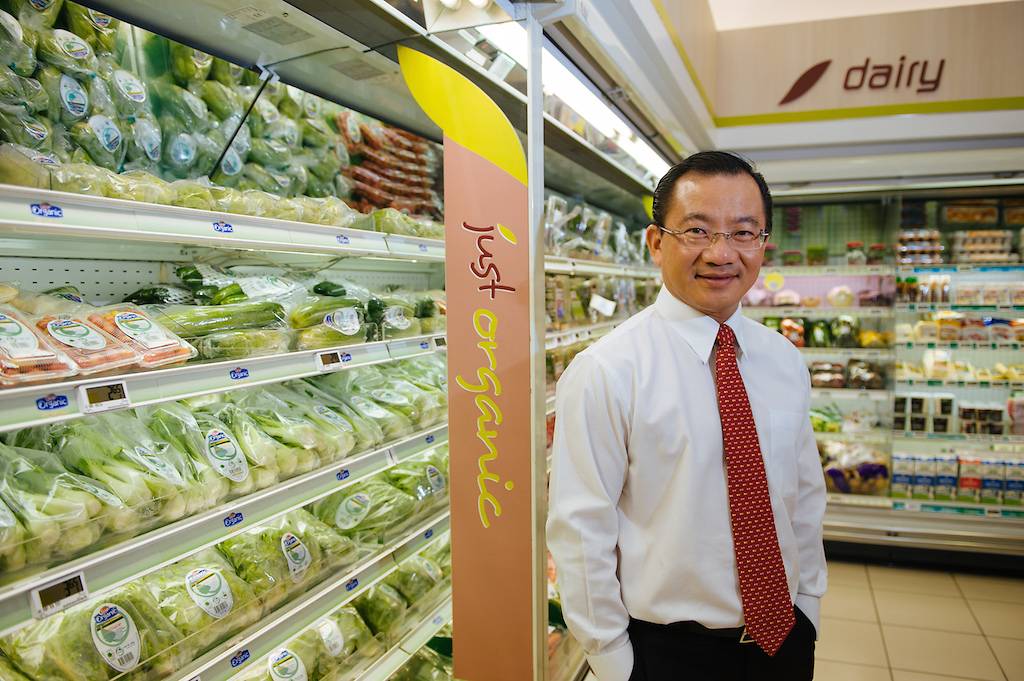
Seah Kian Peng is also Group CEO of NTUC FairPrice. (Photo: Seah Kian Peng)
SOCIAL RESPONSIBILITY IN BUSINESS
Aside from policy issues, I realise we need to talk about business as, in addition to his role as MP, Mr Seah is Group CEO of NTUC FairPrice, the supermarket chain first set up by the National Trades Union Congress in 1973 to moderate the cost of living.
He admits that while it has a focus on social responsibility, it also has to keep an eye on profits.
“It’s a very difficult thing to do, to balance the two. It is not binary or mutually exclusive. For us, doing well allows us to do more good for the community.”
FairPrice has become a “multi-format” chain. For instance, in addition to FairPrice supermarkets for the masses, there are also FairPrice Finest stores catering to customers who can afford more upscale groceries.
I wonder what he would say to customers who feel FairPrice products can afford to be cheaper.
“We try and we want to do more. Our scorecard is a balanced one. It requires us to do well on our social mission, but also on our financials so that we can continue to fulfill our social mission. We are here to stay and help our customers through difficult times as well. For example, when GST was first introduced, we absorbed it for a period of time.”
In recent years, he admits that competition is stiff especially with e-commerce retailers entering the market.
“Frankly, it’s all evolving at a much faster pace than I thought. We are the incumbent and it is the curse of many incumbent leaders that it is much easier to become complacent. Today, we are going bigger on data analytics and this is allowing us to be able to serve our customers better. If I could unwind the clock, I would have done all this a lot earlier and invested even more. But it’s not too late.”
Ultimately, he wants to be remembered for making a mark in both the business and political spheres as “someone who helped”.
“I want to be remembered for having done good for the organisation and to let people see that the team puts in effort for society at large. In politics, I get a lot of satisfaction when I’ve made a difference to an individual. When someone comes up to me and says, ‘Mr Seah, you’ve helped improve my life.’ I think that’s good enough.”
SINGAPORE: Eight-year-old Raphael Heng found himself asking all his classmates: How many siblings did they have? That’s how he figured out how unusual his family was – in the entire class, his was the biggest by far.
The middle child of seven children, and the only boy, he said: “I have more sisters than friends. (My classmates) say it’s very unfair because I have more siblings than them.”
Certainly, there’s never a dull moment in the Heng household, where simply keeping track of everyone is a miniature feat. To the extent that the family almost left home once without Raphael, when they were setting off for an outing to the swimming pool.
Harder to manage than the logistics of going out, however, are the family’s expenses. So when Raphael wants his favourite snack at the supermarket, mum Esther Heng, 40, often has to tell him to wait until another time.
“Which one is more worth it?” she asked him, pointing to his snack and a loaf of sliced bread that would feed everyone in the family for the same price of S$2.
Mum Esther Heng and Raphael, 8.
Despite the trend here towards having fewer children (or none at all), a few families like the Hengs have gone against the grain. The programme On The Red Dot spent months filming three families with large (by today’s standards) broods, to see what it takes to raise a big family in Singapore today. (Watch the series here.)
GETTING BY WITH HELP
In the case of the Hengs, it was dad David who did not want to stop at two, which was his wife’s “initial plan”. Now they have seven between the ages of three and 16.
It comes as no surprise when Mr Heng says he loves children. “Many couples would rather not have children, or they have a maximum of two,” said the 42-year-old. “I see children not as a burden but as an inheritance – as a blessing.”
He comes from a small family himself, with just two siblings.
His wife has a younger sister only, which is why she did not expect to have so many children. A secondary school teacher for a decade, she quit after her fifth child, Arielle, was born in 2011.
Raising their children on just one breadwinner’s salary, however, has not been easy.
Their monthly expenses amount to about S$3,000, which means there is nothing left to set aside as savings from Mr Heng’s income as a social service worker.
His parents help out, and the family receives assistance from the Social Service Office with things like the conservancy charges for their five-room Housing and Development Board flat. Their children are under the Education Ministry’s Financial Assistance Scheme, and the family can tap the Community Health Assist Scheme for their medical bills.
Sometimes, Mr Heng also gets a “love offering” from his church friends. “They’d drop by and bless us with groceries or even bless the children with tickets to Universal Studios,” he said. His church has gifted them with staycations and trips to Malaysia.
And “that’s how we’ve been living our lives for the last 11 years”, he said, since he left the army to work in social service.
Written on the wall of the Hengs’ flat.
To save costs, the younger children must share their toys. And grocery trips are fraught with dilemmas.
“When I buy things from the supermarket, I always have to check the prices,” said Mrs Heng, who looks for offers such as double-purchase discounts.
“Because we’re such a big family, we’ve been living minimally … We don’t get to eat out in restaurants that often. We sometimes do eat out, but it’s just at food courts and the coffee shop.”
AN OVERWORKED MUM
Since March, however, Mrs Heng has been increasingly concerned about the stability of their family income, after her husband abruptly quit his job at a children’s home.
Having coached at-risk youth, Mr Heng decided to start his own company conducting enrichment workshops for such youth and their guardians.
While waiting for his enterprise to take off, he has been working part-time on projects for children with special needs, and freelancing for another company to bring children to heritage sites. His current earnings fall short by about S$500 a month.
Despite this financial uncertainty, he felt it was the right to move shift gears. In the last two years especially, because of shift work that included nights and weekends, he’d not been spending enough time with his family.
I was doing so much for these other children (at work), but my own children didn’t even see me at home. I was an absent daddy.
“That, I think, in a way has caused some strains in the family,” he said.
David Heng putting his youngest, Isabella, 3, to sleep.
Mrs Heng’s entire day revolves around her supersized family. “I cook, I wash, I fold the laundry,” she said, her most precious ally the washing machine.
“I can do without the TV, but … if the washing machine breaks down, that would mean I have to hand-wash five to six people’s clothes every day. It’s no joke.”
She had a domestic helper once, but the family could ill-afford one after she became a stay-at-home mum. And Mrs Heng feels she has even less personal time now, than when she was working as a teacher.
Tutoring the children.
“When I’m overwhelmed with their schoolwork deadlines and then a lot of housework, or if one of them is ill, and I’ve to handle so many things … I do think about whether I’m raising them all by myself,” she said.
There are times I just want to have a meal by myself, without the children calling me every 30 seconds: ‘Mummy, I need a bowl; Mummy, I need this; Mummy, my drink spilled; I need chopsticks.’
She also wakes the children up, prepares their breakfast, walks them to school and tutors them. Her day starts at 6am and ends at 11pm.
Though her youngest, Isabella, stays with her in-laws on weekdays, Mrs Heng is still too swamped to cook on most days, so the family uses a tingkat meal delivery service.
WATCH: Life in the Heng household (4:58)
Seeing his wife take on “so many extra duties” has made Mr Heng feel guilty. “As a husband and a father, I don’t feel good,” he admitted.
Before he quit, his job had usually left him worn out when he was at home. “I’d be (lying) on the sofa and taking a nap,” he said. And so, the children often went to their mother to see to their needs, leaving Mr Heng – the disciplinarian in the family – feeling “jealous” and like a “lousy daddy”.
SIBLING DYNAMICS
He especially feels a “painful” disconnect with his oldest daughter, Samantha, who agrees that the two of them have “drifted apart”.
“After Hannah was born (in 2013 – the sixth child), he had to work harder. He wasn’t at home as much,” said the 16-year-old, who cried a little as she remembered those times she missed her dad while growing up.
While she spends more time with friends than family now, she remembers how it was when she was six and had only one sibling. “It was only Rachael and me, and Rachael was a small baby,” she said.
I miss it because, for example, it was 100 per cent about me. Now it’s 100 divided into seven portions.
Family photo.
Rachael, meanwhile, has different bothers of her own. While the 11-year-old, like her elder sister, says she dislikes having so many siblings “because they’re annoying”, she is also the most responsible among them.
She is always being asked to “help them do stuff” every day, and is the sibling the younger ones listen to – the family’s “little mother”, as she has been nicknamed by her mum.
Said Mrs Heng: “Whenever there’s a conflict, I think Rachael would be the peacemaker … She’d try and find out what happened and who’s supposed to give way.” Like the time Elisa, 10, kicked seven-year-old Arielle’s hand, and they were arguing whether it was an accident or not.
While that makes it hard for Rachael to read her books or do her homework uninterrupted, her mother has had to rely on her to help ease such tensions, given that there are seven children requiring attention.
“I tend to call on her most of the time because she’s obliging,” said Mrs Heng.
Mum’s little helper, Rachael.
GROWING PAINS
She feels guilty sometimes that her children might be growing up faster than their friends. “But I hope, as a mother, I’ve given them enough personal space when they’re growing up,” she said.
At the same time, she believes that, with so many siblings, “they do develop responsibility for each other”. It is also a good way to foster their peer engagement skills, added her husband.
One thing that Mrs Heng still feels guilty about is Hannah’s speech delay. The five-year-old can repeat words but is not speaking in sentences yet, and must be referred to a speech therapist.
Her mother frets that she may have not done enough when the girl was two years old. “I was expecting Isabella, so sometimes I wonder if it’s because I was too tired, and then I didn’t communicate enough with her,” she said.
Esther and sixth child Hannah, 5.
With all that the family has had to manage, quality bonding time has not been easy to come by, let alone getting all nine to go out together. Chinese New Year was one such rare occasion.
That is why Mr Heng recently organised an overnight stay for them at a chalet in Changi, saying it was “very much needed for us as a family”.
“This short, one-day getaway did wonders for the kids, and also I sense that it relieved certain stresses off my shoulders and Esther’s shoulders,” he said, vowing to put more effort into his family and his marriage.
One piece of good news he shared with them: He’d be returning to a full-time job, with regular hours and better pay than the S$2,600 he used to get.
Overall, how do the couple feel about having seven children – the number they have stopped at definitively?
“It’s quite enjoyable to see them grow up together,” Mrs Heng said with a smile, though she sometimes wonders how her life would have been if she’d had only two or three children.
Her husband said: “If I were to restart this whole thing, I may even have had more.”
The Hengs are one of three large Singaporean families who share their stories on On The Red Dot. The final episode of this four-part series airs on Mediacorp Channel 5 on Friday, June 29, at 9.30pm.
SINGAPORE: In recent months, increasing social mixing in public housing estates has been suggested as a way to reduce social stratification and inequality in Singapore. This can be done, for instance, by integrating HDB rental and sold flats within individual blocks.
Housing inequality mirrors wider economic inequality. Particular housing policies furthers the gap between the housing standards accessible to people with different economic capacities.
While social diversity in geographical communities is important for many reasons, it is not sufficient for reducing these real inequalities in housing experience. More direct interventions are also needed.
Social mixing is sometimes regarded as a way to avoid ghettorisation in Singapore.
Comparisons are drawn with places like the US where poverty concentration in large subsidised housing projects has been associated with neighbourhood deterioration and poor social outcomes.
But public rental housing in Singapore is thinly dispersed across many towns. Single or pairs of rental blocks are found alongside sold housing. Ghettorisation is therefore not the problem here.
Instead the main concern is the wide gap in housing resources and experiences between public rental tenants and flat owners. This housing inequality is the result of forces beyond the housing system as well as specific housing policies.
In our public housing system, market participation and performance translate directly into CPF wealth, personal savings and purchasing power.
Over the years, the steady introduction of public housing options at the top end both responded to and encouraged “upgrading” aspirations. Housing was promoted as investment for old age income security.
Over the years, housing was promoted as investment for old age income security, says assistant professor at the Lee Kuan Yew School of Public Policy, Ng Kok Hoe. (Photo: Ray Yeh)
Housing consumption therefore bears the imprint of general economic inequality resulting from the interaction of market earnings, redistributive policies and familial resources.
These forces produce the unequal groups we are now finding ways to integrate in housing estates. Housing experiences will be less uneven when society as a whole is more equal.
From the early 1980s, the construction of smaller flat types for sale stopped, to be resumed only in the 2000s. Meanwhile larger flats ceased to be offered in the public rental scheme. The profound differences in the public housing system today – smaller flats to let and larger flats for sale – are the result of these decisions.
RENTAL HOUSING POLICY MAY BE PRODUCING WORRYING SEGREGATION
Housing inequality is also felt through specific rental housing policies. People who need public rental housing face many hardships. The income ceiling of S$1,500 per month has not been raised since 2003, which means it has become much stricter in real terms.
This ceiling directly penalises families with more children because it disregards household size. Space and privacy are persistent issues, as only 1- and 2-room flats are available to rent and the single tenant is required to share a flat with another unrelated person.
Short tenancies of two years create insecurity. Although the tenancies are routinely renewed and evictions are unheard of, tenants are concerned because they have no legal basis to remain in their flats beyond the two years offered each time.
As the building of new rental flats stopped completely between 1982 and 2006, most of the rental housing stock is very old.
Old HDB flats in Singapore. (Photo: Marcus Mark Ramos)
A survey I conducted with more than 1,000 households in 2016 found that rental tenants are far more likely to report problems with their living conditions, such as with estate hygiene and maintenance, than the average HDB resident. Anxiety about housing is common.
The most worrying segregation in public housing is therefore not in the patterns of social interaction or the physical locations of rental and sold flats, but the standards and quality of the rental and ownership housing regimes.
DIRECT INTERVENTIONS TO NARROW HOUSING INEQUALITY NEEDED
Since 2014, the HDB has introduced integrated blocks that combine rental and sold housing in several BTO developments. This extends the longstanding policy of having diverse flat types within each town, and refines the grain of tenure mixing from the neighbourhood to the block level.
Living in close proximity increases opportunities for meaningful interactions that encourage mutual understanding. More diverse social networks can generate economic opportunities for the individual and build social trust.
Diversity also promotes shared access to public spaces and accords with our instinct to build a strong national identity.
However, neighbourhood diversity does not guarantee social cohesion. Studies across different countries have found that ethnic diversity within a locality can be associated with weaker social trust and withdrawal from civic participation.
Empathy and cohesion are built not just on physical co-existence but also shared experiences, including housing experiences.
The stark differences between rental and ownership in terms of housing access, quality, security, and choice will not be softened through friendly mingling with neighbours. They have to be directly addressed.
PRESSING NEED FOR BETTER RENTAL HOUSING CONDITIONS
Better access to rental housing requires reasonable income ceilings that reflect population earnings and household size, and an adequate housing supply. Although the rental housing stock has been growing since 2006, once the income ceiling fairly reflects current income standards, the eligible applicant pool is likely to increase significantly.
A larger rental housing supply that covers a higher proportion of the population has the additional advantage of drawing greater public support than the current system which may be seen as benefiting a small minority.
An HDB block in Singapore.
Housing quality should not be overlooked for people who are unable to afford ownership.
Quality may be measured against basic space standards that respect needs for privacy and dignity. The expansion of the rental housing stock will allow co-residing singles to get their own flats and provides an opportunity to introduce larger flat types for bigger families.
Security may come from longer tenancies so residents need not worry about shelter. For a start, these could be offered to families with children who will benefit from having a stable living arrangement, and persons who have very little prospect to improve their income situations due to physical and mental limitations.
As for choice, there could be more flexible options between two-year rentals and purchases of 99-year leases. A less discontinuous menu of housing options will increase the chances for mobility. The short-lease options for 2-room Flexi flats for older people is already a move in this direction.
Homeownership offers clear advantages to those who can afford it, such as housing security and asset accumulation. But it also comes with challenges.
Financing housing requires sustained, stable employment with adequate pay, which may not always be attainable.
In the CPF system, homeownership is often achieved at the expense of cash savings for retirement. Monetisation schemes address this issue but expose old-age income security to the volatility of the housing market and are further complicated by the expiry of HDB flat leases.
Therefore choice must also mean respecting that people are able to decide whether and when they are ready for homeownership, and recognising that those who need long-term rental housing have housing needs now which need to be met.
The current concern for better social mixing stems from recognition that there are two housing regimes – public renting and ownership – for people from different economic classes. These regimes offer vastly unequal experiences that are largely shaped by non-geographical factors.
Rather than maintaining this differentiation and physically co-locating the flats, housing inequality can be narrowed by better meeting every resident’s housing needs, regardless of economic resources.
In this way, housing policy can provide the foundation for a more equal society.
Ng Kok Hoe is assistant professor at the Lee Kuan Yew School of Public Policy.
SINGAPORE: Mdm Vallambal Suppiah, 87, has caught every game of the World Cup so far. While some of the names, faces and countries may be a bit of a blur, there is one figure she always keeps an eye on – the referee.
“I like to watch all the referees and what they do. Sometimes I know the mistakes they make as well,” Mdm Suppiah told Channel NewsAsia. “I feel very sad when the game starts and I see the referees there. But, I have to change my thinking and then I cheer when I watch the game.”
The reason for Mdm Suppiah’s focus on the man in the middle – and her sadness? Her late husband was the first Singaporean to officiate at the World Cup.
Mr Govindasamy Suppiah, better known as George, was the man in charge of the first round game between Poland and Haiti at the 1974 World Cup in West Germany. The Poles won the game 7-0, but Mr Suppiah was the headline act back in Singapore.
It would take another 32 years for a Singaporean to follow in his footsteps, when Shamsul Maidin refereed in Germany during the 2006 tournament.
“I didn’t understand the magnitude of the whole thing,” said his daughter Shamini, who was seven at the time. “But there was a lot of hype. I know there was a lot of talk in the newspapers, in the media and the news – everything.”
Ms Shamini recalled how neighbours would gather at their family home in Owen Road to watch football matches. Among those who lived nearby were the likes of former Singapore coach Choo Seng Quee and later, local football star Dollah Kassim.
“It was a pre-war shophouse, so the living room on the ground level was very huge. And we had lots of neighbours and not many had a television, so they would watch the games at our house,” she added.
Mr Suppiah went on to be the linesman for two more games in the tournament, Sweden against Bulgaria and Brazil against the Netherlands.
“To be truthful, I actually hated the game,” said Ms Shamini. “Only because it took dad away all the time. I knew he was busy, nothing but soccer. It was always about football. We hardly saw him during that time and I guess with the training and everything else, it helped him become a World Cup referee.
“There was a lot of time spent on this. I remember his grapefruit diet. I remember the runs he used to do to make sure that he was fit enough for the World Cup. He was always a fit person, and he was always into sports but there was a lot of extra training that went into it.”
Mdm Vallambal Suppiah holds an old photograph of her husband George. (Photo: Matthew Mohan)
A no-nonsense official, Mr Suppiah was a “strict but fair referee”, said Mdm Vallambal. A set of little drums he brought back from the tournament would serve to highlight that.
“Apparently, at one of the matches he was refereeing, it was kind of a violent crowd and they threw the drums because they weren’t happy with the decisions,” said Ms Shamini. “And he brought them back as souvenirs! So that’s always in my memory.”
Born in 1929, Mr Suppiah was an avid sportsman who swam, participated in athletics, and also played tennis, hockey, squash. But football was his first love.
The second referee in the family after his older brother Muthusamy, Mr Suppiah took up officiating before he turned 25.
“He had a lot of stories of how he did not come from a very wealthy family so he did not even have a pair of boots or shoes to play,” said Shamini. “He used to play soccer barefoot to start with, and eventually he worked very hard at becoming a referee and he excelled in it and the rest is history.”
A school teacher by trade, Mr Suppiah became a FIFA referee in 1967. He went on to referee numerous international ‘A’ matches before becoming a FIFA refereeing instructor in 1979.
A photo collage of Mr George Suppiah. (Photo: Jeremy Long)
But even after he retired from the game, Mr Suppiah was never too far from the thick of the action. He would faithfully follow World Cup matches on television, catching games together with his family.
“He would comment on the referee’s performance and took notes down,” said Ms Shamini. “Especially if there was any controversy, he would know that the next day the media would be after him to ask about comments for the radio and newspapers.”
In fact, it was his love for the World Cup that was one of the contributing factors behind his “degeneration in health”, said his daughter.
“I can’t remember if it was three or four World Cups ago that he was actually watching every single match, because they used to call from the radio station and ask him for opinions of what he thinks the game would turn out like,” said Ms Shamini.
“There was a year that he had actually done this and missed his exercising throughout the whole one month and that actually led to him losing his toe. Because he didn’t do the (daily) exercise, so there was not enough circulation and he suffered from diabetes – and that led to him losing his toe.”
But even after losing two toes, Mr Suppiah, who by then was pushing 80, would still turn up at the Farrer Park field to coach children under his charge.
He died at the age of 83 after an extended battle with diabetes.
Vallambal and Shamini Suppiah watch a World Cup match between Sweden and South Korea. (Photo: Matthew Mohan)
For members of the Suppiah family, watching the World Cup brings bittersweet memories.
“(The World Cup) means my father, that’s what it means to us. And it’s very hard to get through a season, without thinking about it and it just makes us miss him even more,” said Shamini.
“We hear his voice in the background, we hear so many things he would have said, what he would have done, when a referee makes a decision right or wrong, what he felt about it, comments about the players, what they should be doing, what’s wrong, what’s right.”
“I have to remember the World Cup. George Suppiah, I am proud of that,” added Mdm Vallambal without hesitation.
As the Suppiah family sits on the sofa, eyes trained on the ongoing Sweden-South Korea slugfest, a framed smiling caricature clad in a black FIFA outfit hangs on the living room wall opposite them – Singapore’s first World Cup referee will never be too far away from the action.
SINGAPORE: Former Singapore Athletics (SA) president Tang Weng Fei on Friday (Jun 22) announced his intention to run for president of the sport’s management committee in the upcoming biennial election – and stressed the need for a disciplined and unified team to lead the sport in Singapore.
Speaking at the Hotel Intercontinental where his proposed slate of eight candidates for the committee was unveiled, Mr Tang said that the need to instill discipline was a priority and a strong “code of conduct” vital.
The other seven members of his team are former Olympians Poh Seng Song and Ang Peng Siong, Mr Malik Aljunied, Ms Sheena Hu, Mr S Govindaraju, Mr Kenny Lim and Ms Belinda Foo.
The election is slated to be held next month – subject to an approval for a change in SA’s constitution from the Registry of Societies (ROS). Should the ROS endorse these changes, the management committee will be elected at the SA’s next annual general meeting.
The SA has been hit with internal strife and politicking between executive members in recent times, with an extraordinary general meeting being called in May 2017, 10 months after current president Ho Mun Cheong took office.
While Mr Ho has stayed on in his role, there was further conflict between members of SA’s management committee, with leaked screenshots of a WhatsApp chat which seemed to show instructions for SA staff members to land coaches in trouble.
“The code of conduct applies to the association, and the stakeholders, to instill in them the core values of what it is to be a member,” said Mr Tang.
Mr Tang, who is also an oil trader, twice held the position of SA president, serving his first stint from 2004 to 2006 and then from 2010 to 2016.
He had cited disagreements in the executive committee as well as what he called the lack of unity within the management as some of the reasons behind his departure.
Pointing to the one year suspension of top Thai sprinter Jirapong Meenapra late last year for sneaking out of a training camp, Mr Tang said that the newly elected committee would need the “gumption” to make such decisions with local athletes.
“I think we’ve got to instill (discipline) in our current crop of not only national athletes. It should be from the days when they are kids, when they are young in primary school, secondary school and progressing up the ecosystem,” he added. “But I want to extend that to not just athletes, but officials and coaches as well. A lot of coaches are not working with each other, saying I’m better than you, you’re better than me, I’m the best, and something has to be done.”
Former Singapore swimmer Ang Peng Siong is one of the slate of eight in Mr Tang’s team. (Photo: Matthew Mohan)
But Mr Tang added that it was vital to leave the past behind.
“We have to consider the past but we are not going to dwell on it which means that whether the incumbent team is good or bad is irrelevant,” said Mr Tang.
“It is important that the team which is given the responsibility of managing track and field in Singapore works together, and cohesively to help bring about improvements in the sport across multiple levels.”
SINGAPORE: A total of 1.1kg of heroin estimated to be worth more than S$78,000 was seized on Thursday (Jun 21) by the Central Narcotics Bureau (CNB).
Two suspected drug traffickers – 24-year-old Singaporean man and a 25-year-old Malaysian woman – were also arrested along East Coast Parkway (ECP), said CNB in a news release on Friday.
They were earlier spotted at a car park at Telok Blangah Crescent where the man was seen picking up the woman. Officers tailed them and both were arrested near Exit 10B of the expressway.
The 1.1kg of heroin was found in a bag in the car both suspects were in, said CNB, adding that the amount of drugs seized is enough to feed the addiction of 524 drug abusers for a week.
Digital weighing scale and numerous empty plastic sachets in residence of 24-year-old male suspect arrested in CNB operation on Jun 21, 2018. (Photo: CNB)
A subsequent search of the man’s residence in the Kampong Bahru area uncovered numerous empty plastic sachets, cut straws and a digital weighing scale, said CNB, adding that investigations are ongoing.
SINGAPORE: More could be done to prevent roadkill in the Mandai area, where an eco-tourism hub is being developed, wildlife experts told Channel NewsAsia.
The traffic accident on Thursday (Jun 21) along Bukit Timah Expressway in which a pregnant wild boar was killed, was the fifth reported roadkill in the area since development on the project started last year. Last Sunday, a wild Sambar deer was killed along the same stretch of road.
The developer of the project, Mandai Park Development (MPD) said speed bumps were put in place along Mandai Lake Road in 2016. The process of installing hoardings started at the end of 2016 before development works started in the first quarter of 2017.
But wildlife experts said more could be done.
“They need to be far more efficient and urgent than they are doing now. At the area where a pangolin and leopard cat died, there are still no hoardings even till today,” said veteran wildlife consultant Subaraj Rajathurai.
The hoardings, which prevent animals from getting onto the roads and guides them to a safer crossing, were still being installed in phases up to this year, said wildlife experts.
Channel NewsAsia understands that the hoardings were added in phases as the project progresses.
Hoardings have been installed along Mandai Lake Road to prevent animal road crossings. (Photo: Fann Sim)
When Channel NewsAsia visited the area, the hoardings were largely limited to the Mandai Lake Road area, and not along Mandai Road which flanks the northern region of the reserve.
“Due to forest clearing as part of the development, wildlife which inhabit these areas will be forced to move around and are at risk of getting on adjacent busy roads or highways where hoardings are not present,” said Anbarasi Boopal, deputy chief executive of Animal Concerns Research and Education Society’s (ACRES).
“More speed calming measures and complete barriers must be in the right places, not just with the development but the surrounding areas where the displaced animals could move to along the main roads to prevent animal crossings and roadkill,” she added.
On slowing the traffic along Mandai Lake Road, Dr Lee Hui Mien, MPD’s Vice President, Sustainable Solutions, said a series of speed reduction measures has been put in place.
The speed limit for most parts of the road has been reduced to 40km/h. This is further reduced to 20km/h for a stretch near the nature reserve which has been identified as a temporary crossing area for wildlife.
MPD said since January this year, another speed radar was installed and the number of speed humps and wildlife crossing signs increased. Road markings to indicate wildlife crossing areas were also added.
A rope bridge has also been installed along Mandai Lake Road to help arboreal animals such as squirrels and macaques move across safely, with another set currently underway, it added.
Drivers of vehicles such as taxis, private hire cars and buses that regularly ply the Mandai area have also been engaged to raise awareness on speed calming measures, said Dr Lee.
However, Lee Kong Chian Natural History Museum’s research associate Sivasothi N said that the hoardings and traffic calming plans have been up for “a very short time”.
He noted that plans for the eco-tourism park were first announced in 2014 but work only started in 2017. “That is very soon for an entity unfamiliar with development next to protected forests and the entire process has been hasty. The mitigation I’ve observed is slow and inadequate,” said Mr Sivasothi.
“The mitigations that are needed are not yet implemented,” said the vice-chair of Nature Society’s conservation committee, Ho Hua Chew.
Before the completion of the Eco-Link@Mandai overpass, crossings like this can be found around the Mandai vicinity. (Photo: Fann Sim)
PLANNED ANIMAL OVERPASS SHOULD HAVE BEEN BUILT BEFORE CONSTRUCTION STARTED
Mr Ho was referring to a planned Eco-Link wildlife bridge to help animals living in the forested areas of Mandai cross roads without danger, similar to the existing Eco-Link@BKE crossing built between Bukit Timah Nature Reserve and the Central Catchment Nature Reserve. Experts said that the bridge, which will only be ready by the end of 2019 ahead of other components of the project, could have helped prevent roadkill incidents.
Mr Subaraj, who provided consultancy on the Mandai project, said various local wildlife groups had submitted recommendations to mitigate its impact on the local fauna.
“None of the mitigation measures recommended, including wildlife crossings … to proper hoardings, everything was not in place when the developer started developing the area which shouldn’t be the case. It should all have been in place then you start the development,” said Mr Subaraj.
“That’s the normal procedure for anywhere where there is nature even more so when there is a nature reserve. That’s really unfortunate,” he added.
While the Eco-Link bridge is a “great solution” and can be used by most animals, Mr Subaraj added that installing more rope bridges will help arboreal animals that live in the rainforest tree canopy move across.
National University of Singapore’s wildlife biologist Joanna Coleman said that the most effective strategy of mitigating wildlife affected by building works are overpasses.
“Signage is probably the most common and cheapest mitigation measure implemented worldwide,” said Dr Joanna Coleman. But a recent study showed they are ineffective, the wildlife biologist at the National University of Singapore added.
“If drivers in Singapore are generally more cautious or more likely than drivers elsewhere to obey road signs, then perhaps signage could work better here than elsewhere,” Dr Coleman added.
Big mammals can cause significant damage to humans when a vehicular strike happens. (Photo: Fann Sim)
DANGEROUS NOT JUST FOR ANIMALS, BUT ALSO FOR HUMANS
“When a large mammal strays onto a road, there’s always a chance that it will cause a collision, resulting in human injury or death,” Dr Coleman said.
Three cars were involved in the accident with the pregnant wild boar. Last Sunday’s incident where a wild Sambar deer had to be euthanised involved a taxi, motorcycle and a car as they tried to avoid the deer. The taxi driver suffered cuts and was brought to hospital.
In May, a Malaysian motorcyclist took the Land Transport Authority and National Parks Board to court for negligence after a wild boar roadkill accident.
Vicknesh Morthy suffered serious head injuries resulting in permanent disability after crashing into the carcass of a wild boar that was left along the BKE, near Eco-Link@BKE.
Apart from Sambar deer and wild boars, the reserve is also home to pangolins, Banded Leaf Monkeys, Common Palm Civets and leopard cats.
“I think we will definitely see more encounters of this nature but what is scary is that … if you’re not very careful, it could lead to a fatality of a person on the roads. If a car hits a big Sambar deer at full pace, someone could get killed,” Mr Subaraj said.
“We need more wildlife crossings, we need speeds to be slowed down on certain roads especially along Mandai Road and Upper Thomson Road, and we need to have better understanding among the public that you are moving adjacent to a nature area and there is always a possibility of wildlife being around so let’s be a little bit considerate and alert,” he added.
SINGAPORE: More could be done to prevent road kills in the Mandai area, where an eco-tourism hub is being developed, wildlife experts told Channel NewsAsia.
The traffic accident on Thursday (Jun 21) along Bukit Timah Expressway in which a pregnant wild boar was killed, was the fifth reported roadkill in the area since development on the project started last year. Last Sunday, a wild Sambar deer was killed along the same stretch of road.
The developer of the project, Mandai Park Development (MPD) said speed bumps were put in place along Mandai Lake Road in 2016. The process of installing hoardings started at the end of 2016 before development works started in the first quarter of 2017.
But wildlife experts said more could be done.
“They need to be far more efficient and urgent than they are doing now. At the area where a pangolin and leopard cat died, there are still no hoardings even till today,” said veteran wildlife consultant Subaraj Rajathurai.
The hoardings, which prevent animals from getting onto the roads and guides them to a safer crossing, were still being installed in phases up to this year, said wildlife experts.
Channel NewsAsia understands that the hoardings were added in phases as the project progresses.
Hoardings have been installed along Mandai Lake Road to prevent animal road crossings. (Photo: Fann Sim)
When Channel NewsAsia visited the area, the hoardings were largely limited to the Mandai Lake Road area, and not along Mandai Road which flanks the northern region of the reserve.
“Due to forest clearing as part of the development, wildlife which inhabit these areas will be forced to move around and are at risk of getting on adjacent busy roads or highways where hoardings are not present,” said Anbarasi Boopal, deputy chief executive of Animal Concerns Research and Education Society’s (ACRES).
“More speed calming measures and complete barriers must be in the right places, not just with the development but the surrounding areas where the displaced animals could move to along the main roads to prevent animal crossings and roadkills,” she added.
On slowing the traffic along Mandai Lake Road, Dr Lee Hui Mien, MPD’s Vice President, Sustainable Solutions, said a series of speed reduction measures has been put in place.
The speed limit for most parts of the road has been reduced to 40km/h. This is further reduced to 20km/h for a stretch near the nature reserve which has been identified as a temporary crossing area for wildlife.
MPD said since January this year, another speed radar was installed and the number of speed humps and wildlife crossing signs increased. Road markings to indicate wildlife crossing areas were also added.
A rope bridge has also been installed along Mandai Lake Road to help arboreal animals such as squirrels and macaques move across safely, with another set currently underway, it added.
Drivers of vehicles such as taxis, private hire cars and buses that regularly ply the Mandai area have also been engaged to raise awareness on speed calming measures, said Dr Lee.
However, Lee Kong Chian Natural History Museum’s research associate Sivasothi N said that the hoardings and traffic calming plans have been up for “a very short time”.
He noted that plans for the eco-tourism park were first announced in 2014 but work only started in 2017. “That is very soon for an entity unfamiliar with development next to protected forests and the entire process has been hasty. The mitigation I’ve observed is slow and inadequate,” said Mr Sivasothi.
“The mitigations that are needed are not yet implemented,” said the vice-chair of Nature Society’s conservation committee, Ho Hua Chew.
Before the completion of the Eco-Link@Mandai overpass, crossings like this can be found around the Mandai vicinity. (Photo: Fann Sim)
PLANNED ANIMAL OVERPASS SHOULD HAVE BEEN BUILT BEFORE CONSTRUCTION STARTED
Mr Ho was referring to a planned Eco-Link wildlife bridge to help animals living in the forested areas of Mandai cross roads without danger, similar to the existing Eco-Link@BKE crossing built between Bukit Timah Nature Reserve and the Central Catchment Nature Reserve. Experts said that the bridge, which will only be ready by the end of 2019 ahead of other components of the project, could have helped prevent roadkill incidents.
Mr Subaraj, who provided consultancy on the Mandai project, said various local wildlife groups had submitted recommendations to mitigate its impact on the local fauna.
“None of the mitigation measures recommended, including wildlife crossings … to proper hoardings, everything was not in place when the developer started developing the area which shouldn’t be the case. It should all have been in place then you start the development,” said Mr Subaraj.
“That’s the normal procedure for anywhere where there is nature even more so when there is a nature reserve. That’s really unfortunate,” he added.
While the Eco-Link bridge is a “great solution” and can be used by most animals, Mr Subaraj added that installing more rope bridges will help arboreal animals that live in the rainforest tree canopy move across.
National University of Singapore’s wildlife biologist Joanna Coleman said that the most effective strategy of mitigating wildlife affected by building works are overpasses.
“Signage is probably the most common and cheapest mitigation measure implemented worldwide,” said Dr Joanna Coleman. But a recent study showed they are ineffective, the wildlife biologist at the National University of Singapore added.
“If drivers in Singapore are generally more cautious or more likely than drivers elsewhere to obey road signs, then perhaps signage could work better here than elsewhere,” Dr Coleman added.
Big mammals can cause significant damage to humans when a vehicular strike happens. (Photo: Fann Sim)
DANGEROUS NOT JUST FOR ANIMALS, BUT ALSO FOR HUMANS
“When a large mammal strays onto a road, there’s always a chance that it will cause a collision, resulting in human injury or death,” Dr Coleman said.
Three cars were involved in the accident with the pregnant wild boar. Last Sunday’s incident where a wild Sambar deer had to be euthanised involved a taxi, motorcycle and a car as they tried to avoid the deer. The taxi driver suffered cuts and was brought to hospital.
In May, a Malaysian motorcyclist took the Land Transport Authority and National Parks Board to court for negligence after a wild boar roadkill accident.
Vicknesh Morthy suffered serious head injuries resulting in permanent disability after crashing into the carcass of a wild boar that was left along the BKE, near Eco-Link@BKE.
Apart from Sambar deer and wild boars, the reserve is also home to pangolins, Banded Leaf Monkeys, Common Palm Civets and leopard cats.
“I think we will definitely see more encounters of this nature but what is scary is that … if you’re not very careful, it could lead to a fatality of a person on the roads. If a car hits a big Sambar deer at full pace, someone could get killed,” Mr Subaraj said.
“We need more wildlife crossings, we need speeds to be slowed down on certain roads especially along Mandai Road and Upper Thomson Road, and we need to have better understanding among the public that you are moving adjacent to a nature area and there is always a possibility of wildlife being around so let’s be a little bit considerate and alert,” he added.