SINGAPORE: Despite a “healthy supply” of private housing in the pipeline, the Singapore Government said on Wednesday (Jun 27) it will not cut its supply of land for homes in the second half of this year.
About 20,000 private homes are expected to be built from Government Land Sales (GLS) and en-bloc sites that are pending planning approval, and another 24,000 unsold units from projects that have received planning approval.
Additionally, more than 30,000 existing private homes are still vacant, the Ministry of National Development (MND) said in a press release.
But the supply of land for private housing under the second half of the GLS programme will be kept at about the same level as that of the first half, as there continues to be strong demand for land from developers, the ministry said.
Transaction volumes are also rising, it added.
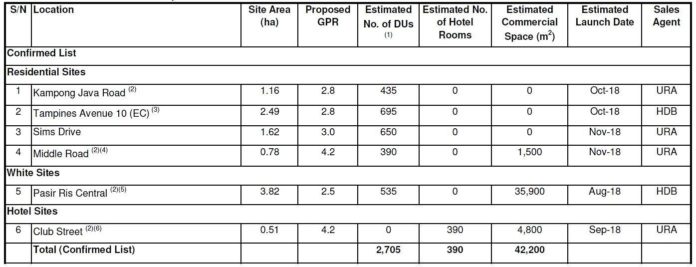
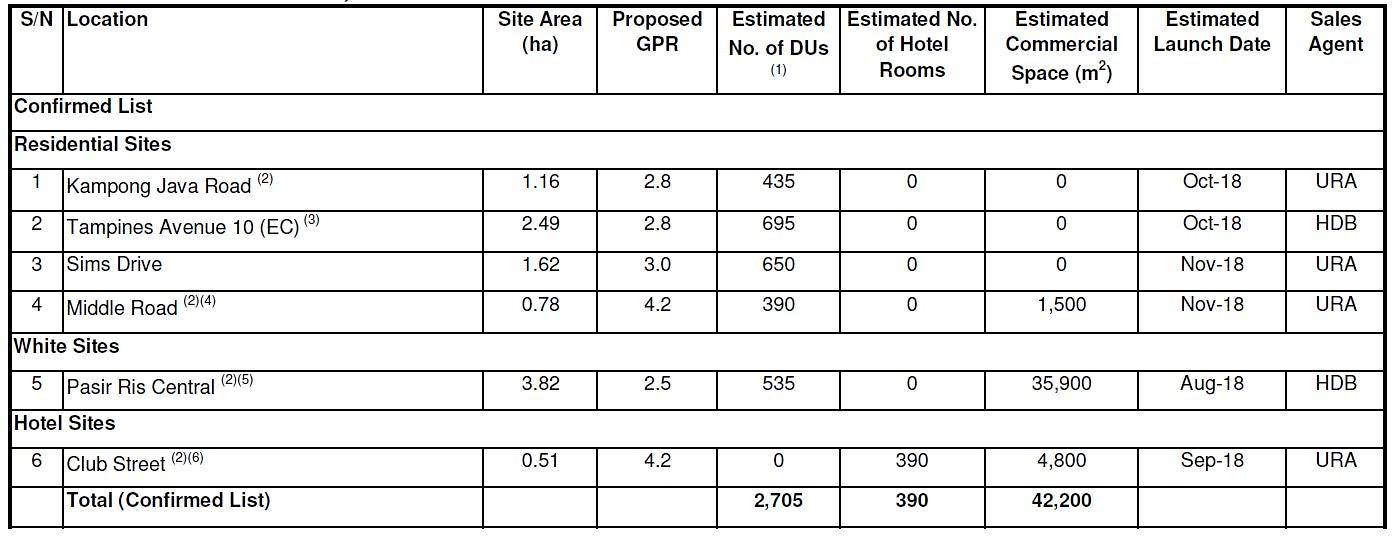
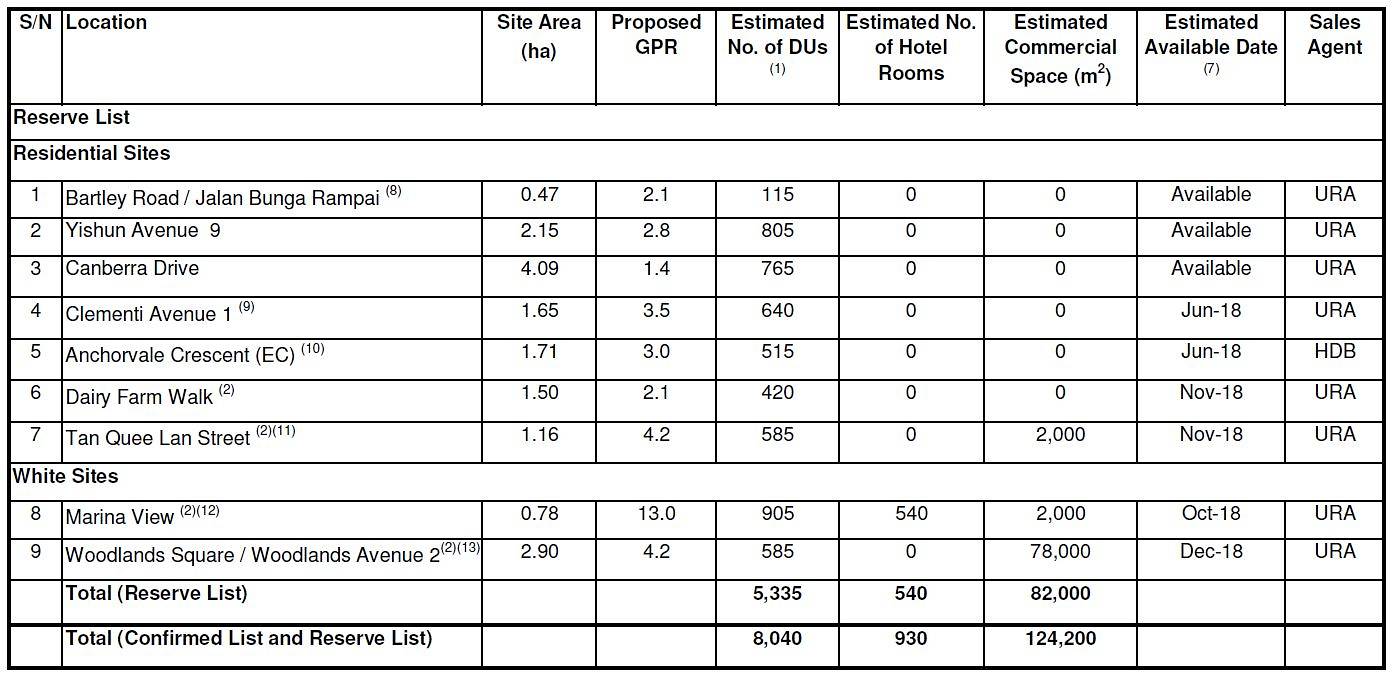
Six land sites and another nine reserve sites will be released as part of the GLS programme in the second half of this year. These 15 sites can yield up to 8,040 private homes and 124,200 sq m of commercial space.
“Taken together, the total supply in the pipeline will be able to meet home buyers’ demand over the next one to two years, and to meet our population’s housing needs,” MND said.
RESIDENTIAL SITES AT TAMPINES, SIMS DRIVE ON CONFIRMED LIST
The six sites on the Confirmed List comprise four private residential sites including an Executive Condominium (EC), one “white” or mixed-use site and a hotel site that can yield 2,705 private homes, including 695 EC units, 42,200 sq m of commercial space and 390 hotel rooms.
The Reserve List comprises seven private residential sites (including one EC site) and two mixed-use sites. The seven sites can yield 5,335 private homes (including 515 EC units) and 82,000 sq m of commercial space and 540 hotel rooms.
The confirmed sites are in areas like Tampines Avenue 10, Kampong Java Road, Sims Drive and Middle Road, while the reserve sites are in areas such as Clementi Avenue 1, Dairy Farm Walk, Tan Quee Lan Street and Yishun Avenue 9.
A mixed-use site in Pasir Ris Central will also be released. Other mixed-use sites on the Reserve List are in Marina View and Woodlands Square/Woodlands Avenue 2.
The Woodlands mixed-use site will “help to sustain the development momentum of Woodlands Regional Centre as a major commercial node outside the city”. This is in line with the authorities’ objective of decentralising employment centres to bring job opportunities closer to home, MND said.
It also noted that the Singapore Tourism Board is optimistic about the country’s tourism prospects, with a 6.2 per cent growth in international visitor arrivals last year. The Club Street and Marina View sites are expected to help provide additional hotel rooms to meet the demand.
SINGAPORE: Costing more than S$1 billion to build, the Tuaspring Integrated Water and Power Plant was the landmark project that marked water treatment icon Hyflux’s foray into the energy business in 2011.
Hailed as the first water plant in Asia to be integrated with a power generator, it was expected to boost efficiency levels and reduce desalination costs among other things.
But for all the ambitions that it embodied, the Tuaspring project struggled to turn a profit and according to some market observers, eventually became the “noose” around Hyflux’s neck.
At the court hearing on Jun 19 for its application of a six-month moratorium, Hyflux’s lawyers from WongPartnership stressed that Tuaspring still holds “significant value” and time was what the company needed to seal a deal for no less than a book value of S$1.3 billion.
This would help pay off secured project finance lender Maybank in full and leave about S$900 million for other debt and project investments, said Hyflux founder-CEO Olivia Lum in a Jun 14 affidavit.
However, with Tuaspring being placed on the market since last February and scheduled for a separate court hearing next month on its moratorium request, the question one might ask is: Can a buyer be found and if yes, at what price?
BLEEDING ON WEAK ELECTRICITY PRICES
To be sure, the Tuaspring desalination plant – the largest in Singapore – is a critical asset supplying 70 million gallons of desalinated water a day under a 25-year service concession agreement signed with PUB. The concession period expires in 2038.
However, the on-site gas turbine power plant, which produces electricity for the desalination plant and sells the excess to the national grid, has no such supply contracts. With an oversupply in the local power market weighing down electricity prices, Hyflux’s plan for “profits generated from the energy production facilities of the Tuaspring IWPP to comprise the bulk of the operating revenue” fizzled.
“With negative spark prices enduring across 2016 and 2017 except certain irregular spikes, the Tuaspring IWPP’s revenue was not able to cover its operating costs, much less the financing costs in relation to the Tuaspring loan,” said Ms Lum in the affidavit submitted to court.
The difference has been met by drawing from Hyflux Group’s cash, which in turn caused cash flow issues for other projects, according to another affidavit dated May 22.
For the full year ended Dec 31, 2017, Tuaspring registered a net loss of S$81.9 million and contributed in a big way to the company’s first annual loss since listing in 2001. As of April 30, 2018, its total liabilities amounted to S$537 million.
Being mired in the red will likely have dampened investor interest in the integrated plant and even if there were, bids may have been way lower than what Hyflux was willing to accept, observers said.
“If your asset is loss-making, you won’t get optimal pricing for it,” said investment specialist S. Nallakaruppan. “Given how Tuaspring has been a noose around their neck, a divestment would have helped a lot so I’d be surprised if they rejected bids that were marginally below what they wanted.”
“ENCOURAGING DEVELOPMENT”?
But things could be in for a change, at least according to Ms Lum.
Spark spreads, which refer to the difference between the price received for electricity produced and the cost of natural gas needed to produce that electricity, have increased to a positive amount since February and have stabilised through May unlike previous spikes, she said in her affidavit.
Though still unable to cover financing costs, Tuaspring has been generating sufficient revenue to cover short-run marginal costs since March.
Ms Lum described the positive movement of spark spreads as an “encouraging development”, alongside projections for growing electricity demand and decreasing supply with the retirement of steam plants here.
With that, she wrote that she is confident “the Tuaspring IWPP can be divested at a price around or above its present S$1.3 billion book value to a suitable purchaser” if given sufficient time.
Hyflux is currently in talks with four parties on a private and confidential basis, she added.
(Photo: Jeremy Long)
This optimism, however, is not shared by analysts Channel NewsAsia spoke to.
Describing book value as “backward-looking”, Associate Professor Mak Yuen Teen said Hyflux needs to be “realistic” and should “maintain some flexibility” with its expectations.
“The company has been so firm on divesting at book value… which does not take into account factors like the losses of Tuaspring, market conditions and uncertainty in electricity prices,” said the accounting professor from the National University of Singapore (NUS). “Perhaps a re-evaluation could open up more potential buyers.”
Echoing that, Assoc Prof Lawrence Loh from the NUS Business School said: “The proposed sale of Tuaspring will determine the recovery values for Hyflux’s stakeholders but for the bidders, it’s not going to be a charity show.”
That said, Tuaspring, with its value as a strategic water asset, is not without suitors.
“Logical guesses”, according to Assoc Prof Loh, would include foreign and local companies that can “derive synergy and extract value” from the purchase. In Singapore, this could be Sembcorp and Keppel which have dipped their toes into the water and energy industries.
The other scenario is a holding company, such as state investment firm Temasek Holdings, stepping in to make the purchase. Given that Hyflux is involved in the strategic water sector, Assoc Prof Loh said “that option cannot be ruled out” though it should not send the “wrong signal of a bailout”.
“We cannot send the message that if you are in a strategic industry, you can by all means go and take high risks and if things go down, there will be a sugar daddy to bail you out. That is not how businesses are run in Singapore.”
MORE FUNDAMENTAL ISSUES
Beyond Tuaspring, Hyflux has also been trying to sell the smaller Tianjin Dagang Desalination Plant in China. It is similarly working to secure a S$200 million cash injection that would help fund construction for its ongoing TuasOne and Qurayyat projects.
But while asset divestments and seeking new sources of liquidity would help to fix Hyflux’s cash crunch, the fundamental problem that it needs to deal with ahead lies in its business model.
Assoc Prof Loh said the company has been “burning (itself) through a very highly-leveraged approach towards running the business”.
“The liquidity is not at all well-managed,” he said, citing how Hyflux has a debt burden that is way more than its available cash position.
In Ms Lum’s Jun 14 affidavit, she mentioned that the total bank debt for the entire Hyflux Group stands at about S$1.84 billion with subordinated debt of S$900 million. This excludes S$265 million of medium-term notes.
On the other hand, Hyflux and its four subsidiaries placed under moratorium hold a cash balance of S$18.6 million as of Jun 4, 2018.
Agreeing, iFast’s senior fixed income analyst Ang Chung Yuh cited how the former star company has been operating in a negative operating cash flow situation since 2010.
“After all these years of running huge cash outflows, it is probably clear that their business model of building up assets then monetising them is not profitable,” he said. “This will be something that they need to rethink if they can implement their restructuring.”
For Assoc Prof Mak, Hyflux would also need to “pick and choose” when it comes to its involvements in future projects and overseas markets.
Citing the design-build-own-operate (DBOO) model of Tuaspring, he explained: “Hyflux tends to be involved in all parts of the value chain but moving forward, they can look at where their strengths are and focus on that. You don’t necessarily have to be involved in the entire supply chain.”
Having expanded overseas aggressively, Hyflux will also need to start scrutinising its risk management practices, which ties in with the adequacy of corporate governance, added Prof Mak.
The corporate governance hawk said “red flags” include the practice of giving share options to independent directors and having former employees sitting on the board. Some independent directors have also “stayed for far too long”.
“All these tell us of a board that the founder is very comfortable with and not people with different viewpoints. But boards need people who will challenge decisions constructively.”
Prof Mak also questioned if Ms Lum, who is also executive chairman and heads the board’s investment committee, has taken on too many hats.
“Sometimes, founders find it difficult to let go. By all accounts, Ms Lum is a brilliant entrepreneur and has been recognised for her engineering acumen but you can’t be good at everything,” the NUS professor told Channel NewsAsia.
“Maybe moving forward, she will need to rethink her role in the company. Instead of taking on so many roles, she can focus on what she is really good at.”
SINGAPORE: There has been a sharp increase in the number of complaints against bike-sharing operator oBike, following its announcement that it has ceased operations in Singapore, the Consumers Association of Singapore (CASE) confirmed on Tuesday (Jun 26).
From 5pm on Monday to 4pm on Tuesday, CASE received 232 complaints against oBike. Prior to that, the association had received just 27 since the start of the year, it said in response to queries from Channel NewsAsia.
According to the watchdog, consumers mostly complained that they “did not receive a refund for their deposits” from oBike despite requests.
Channel NewsAsia reported on Monday that oBike users seeking refunds of their mandatory deposits – S$19 and S$49 for students and other users respectively – were left in the lurch following the company’s announcement.
Some said the “refund deposit” option on the oBike app was removed, and had trouble with internet connection when they tried to access the app.
CASE told Channel NewsAsia it will “follow up with oBike” on the deposit refunds and urged consumers with unresolved disputes to contact the consumer watchdog for further assistance.
It added that consumers who made payment via credit card to oBike within the last 120 days “can consider lodging a chargeback claim with their card issuer as soon as possible”.
In its statement to Channel NewsAsia on Monday, the Land Transport Authority (LTA) said affected consumers should make a request for the refund of their deposits or subscription fees with oBike if they have not already done so.
oBike has not responded to queries from Channel NewsAsia.
oBIKE OFFICE EMPTY, SIGN TAKEN DOWN
When Channel NewsAsia visited the oBike Asia headquarters at Commonwealth Lane on Tuesday afternoon (Jun 26), the office was locked and looked vacant.
The oBike Asia headquarters at Commonwealth Lane was empty on Tuesday afternoon (Jun 26). (Photo: Amir Yusof)
The only indication that the office was previously occupied by oBike was the company’s cardboard poster that was placed against one of the windows.
The empty oBike office at Commonwealth Lane. (Photo: Amir Yusof)
Two people who worked at offices adjacent and opposite oBike’s unit told Channel NewsAsia that the oBike sign outside the door was removed about a month ago.
One of them added that the oBike office was previously occupied by 10-12 people, who were mostly interns.
“I was friendly with one of the women working there and she told me that only two employees were working full-time. The rest were all student interns,” said an offshore ship broker who declined to be named.
In a report released on Tuesday afternoon, Mediacorp’s TODAY quoted oBike’s co-founder Edward Chen as saying that “he has left matters to the local team and also the legal team and (liquidator)”.
On whether oBike would offer refunds on the users’ deposits, the report quoted Mr Chen, who is based in Shanghai, as saying that there was an “existing plan for the whole process”.
TODAY added that Mr Chen declined to elaborate, and referred the news outlet to oBike’s Singapore-based team and lawyers.
LTA said on Monday it “will be engaging oBike” on its “exit plans”, including the removal of shared bicycles from public places.
SINGAPORE: Hard-pressed for cash, Linda took out an instalment plan with a retailer for a laptop, a washing machine, a sofa and a bed totalling about S$3,000 back in 2010.
It turned out to be a mistake. She is still paying for those items today, but the value of her debt has ballooned to S$30,000 over the years.
“It has really hit me. I think, for now, if I don’t have the money, I won’t buy the thing. I’ll save up,” said a regretful Linda, who declined to use her real name.
She is among a group of people who have bought on hire purchase from electronics and furnishing retailers in Singapore, lured by the low monthly repayments.
But few realise that the interest rate can be as high as 33.99 per cent per annum, as the programme Talking Point discovers. And that does not include late-payment charges. (Watch the episode here.)
While there are interest-free instalment plans, consumers need a credit card and must spend a minimum of S$500. Those who do not qualify might turn to the retailers’ payment plans for their big-ticket items – without doing their sums.
NO FINANCIAL SENSE?
One furnishing store, for example, offers an instalment plan with 26.9 per cent interest per annum, plus a 1 per cent late-charge interest per day. An employee from the store said that those who take these plans “don’t have money”.
GYC Financial Advisory vice president William Cai, who helped Talking Point to calculate the final amount consumers would be paying for some items at 26.9 per cent interest, does not think these instalment plans make financial sense.
A television that costs S$399 would eventually cost some S$720 based on repayments of S$20 over 36 months. That is 80 per cent more than its original price.
A refrigerator that retails at S$899 would set you back S$2,108, if you pay S$35 a month for five years – a 134.5 per cent price jump.
“What I’d rather do is to look for a really cheap brand or really cheap second-hand product. Or if I can’t afford it, I’d get one of my friends to … help me out,” said Mr Cai. “It’s better than paying so much on interest.”
But are retailers offering unfair interest rates?
“These types of loans are unsecured, like credit cards … Based on that as a reference, it’s fair,” said Mr Cai, who noted that credit card interest rates typically range between 24 and 26 per cent.
Consumer products also depreciate fast. “The value could go to nearly zero in a short period of time, and the retailers face quite a high risk getting involved in such a business. So I’d say it’s pretty fair,” he added.
When presented with hire purchase plans, how many people work out the real cost?
What he would like to see, however, is more clarity for consumers, whereby retailers compute everything for them so that they know the total amount of interest they would be paying.
In a Talking Point street poll, most of those surveyed said they would not take out these instalment plans if they knew how much they could be paying.
But one respondent reasoned: “An air-conditioner is probably a necessity because of our hot weather … so to pay, like, S$100-plus a month with a monthly salary of, say, S$1,600, I think makes sense to (people whose income isn’t high).”
‘MEETING BASIC FAMILY NEEDS’
Courts Singapore said it offers zero per cent instalment tie-ups with the major bank credit cards, but recognises that such options typically have a minimum income threshold, which not all consumers can meet.
“Courts’ intention is to serve such customers who need to purchase big-ticket items that meet basic family and living needs,” said the retailer, which offers them interest rates ranging from zero per cent to 33.99 per cent per annum.
Courts’ credit card repayment plan with zero per cent interest is distinct from its other FlexiPlans.
When asked if its interest rates were fair, it said the rates are benchmarked against the consumer credit market and “assessed based on verification of the risk profile of the customer, through reference and credit bureau checks”.
The company said its staff would ensure that customers “have the full details they need to make an educated financial decision” during the application process.
Should customers face financial difficulties during the repayment process, the retailer works with them on a “suitable repayment plan”, including restructuring their repayments into lower monthly instalments “to keep within the customer’s budget”.
Courts added that non-repayments form “a very small percentage” of its FlexiPlan customers, and they are handled on a case-by-case basis.
Another retailer, Gain City, offers instalment plans for air-conditioners, with interest rates of up to 18 per cent, but only 1 per cent of its customers are on this plan.
Gain City said it does not specifically push for hire purchase plans, and advises customers on what is available in-house if they walk in and ask about such plans.
Gain City senior manager (special projects) Sheena Hu said this caters for those who “genuinely” need help buying an air-conditioner, such as families with seniors, children or persons with skin allergies.
She said the retailer offers the lowest rates in the market and keeps “all aspects of the hire purchase fees low vis-a-vis other retailers”. It has only had one default case so far, owing to its “prudent assessment” of applications.
We don’t have any cases, to date, of customers who are unable to pay up for the remaining payments because our customers are … utilising hire purchase due to a genuine need and not for frivolous reasons.
“And our approach to potential default cases is conciliatory,” said Ms Hu.
She added that staff would contact the customers if there are any failed Giro deductions and follow up on the expected payment date, the penalty and late interest to be incurred. But it does not send monthly statements unless requested.
Ms Sheena Hu with Talking Point host Daniel Martin.
FALLING ON TROUBLED TIMES
Most of these instalment plans would work if the buyer has a steady income, but what happens in troubled times, when making those repayments is a struggle?
The Debt Advisory Centre, which helps individuals with debt problems, said that about 20 per cent of its cases are related to payments by instalment. Out of this 20 per cent, about 65 to 75 per cent are from the low-income segment.
Mr Saiful Nizam Jemain, the centre’s social services manager, said: “The retailers provide credit facilities that don’t discriminate against income levels. So these low-income earners are attracted to them because … they’re able to get these items within their means.
While some retailers indicate the item’s cost at the end of the payment period, many do not inform the consumer of the penalty charges for defaulting on payments, or provide monthly statements, he added.
“If you own a credit card, you’d get a statement at the end of every month, (telling you) how much you owe and, if you had paid late for the last month, the penalty charges,” he noted.
Mr Saiful Nizam Jemain.
It is hard to say how many people in Singapore use instalment plans, as retailers Talking Point approached did not give exact figures.
In December, the Monetary Authority of Singapore said that since January last year, an average of 4,000 borrowers a month have increased their unsecured debts to above 12 times their monthly income from the previous month.
But, it added, “the vast majority of unsecured borrowers” are prudent.
For Linda, who could make her monthly payments at the beginning, things changed after her husband met with an accident. “He wasn’t working for almost a year. So from that moment in time, I started to default,” she explained.
She has almost S$20,000 left to pay, which includes late-payment charges, and has received letters from the retailer’s lawyer demanding payment and SMSs from a debt collector warning that if she defaults again, debt collectors would go to her home.
She had asked one of the salespersons about the interest incurred if she were to default. “He only told me, ‘Only a little bit – never mind, we can understand,’” she said ruefully.
Watch this episode of Talking Point here. New episodes every Thursday at 9.30pm on Mediacorp Channel 5.
SINGAPORE: Mr Alex Kwok grew up in one of the four rainbow-coloured Housing and Development Board blocks which make up Rochor Centre, but as demolition work began on Tuesday (Jun 26), he was stoic about the iconic flats being torn down.
“There’s nothing we can do,” said Mr Kwok, who owns an optical shop on the first floor of Sim Lim Tower. “Things have to change. We cannot keep thinking about the past, but now it’s time to think about the future. The old will have to go.”
According to Mr Kwok, business has not been affected by the demolition and he expects loyal customers to keep returning.
Demolition work begins at Rochor Centre on Tuesday (Jun 26). (Photo: Matthew Mohan)
When Channel NewsAsia visited the estate on Tuesday morning, parts of the yellow and blue-coloured blocks were covered by hoardings.
Despite the incessant rain, work was already underway, with an excavator spotted tearing down part of the building and some noise emanating from within. Construction workers were also seen entering and leaving the site.
The facade of Rochor Centre on Tuesday (Jun 26) as demolition work begin. (Photo: Matthew Mohan)
The blocks will make way for the construction of the North-South Corridor (NSC) and demolition is slated to be finished by April next year.
“It’s not something new (to happen) and we’ve been expecting it,” said a 70-year-old retiree, who only wanted to be known as Bernard. “When you expect it to happen, there’s no feeling, but when you don’t expect it, you say: ‘Wow, what a waste.'”
Demolition work begin at Rochor Centre on Tuesday (Jun 26). (Photo: Matthew Mohan)
Bernard, who has frequented the area for more than 50 years, said that his friends who used to stay at the estate still meet up at the nearby Albert Food Centre.
“We still have breakfast together,” he added. “I was just asking them about their new place this morning.”
Residents in Rochor Centre were told to move out by the end of 2016 andwere offered relocation benefits similar to those offered under the Selective En Bloc Redevelopment Scheme (SERS).
A construction worker stands behind a barrier at an overhead bridge linking Fu Lu Shou Complex and Rochor Centre. (Photo: Matthew Mohan)
They had the opportunity to move to a new, 99-year lease home and were given a package comprising compensation and rehousing benefits. As part of the acquisition package, they were also assured of a replacement flat at Kallang Trivista.
“I will miss the place,” said a retiree at Albert Food Centre, who only wanted to be known as Mr Tan. “But life has to go on and it can’t be helped.”
SINGAPORE: There has been close to a 10-fold increase in the number of complaints against bike-sharing operator oBike, following its announcement that it has ceased operations in Singapore, the Consumers Association of Singapore (CASE) confirmed on Tuesday (Jun 26).
From 5pm on Monday to 4pm on Tuesday, CASE received 232 complaints against oBike. Prior to that, the association had received just 27 since the start of the year, it said in response to queries from Channel NewsAsia.
According to the watchdog, consumers mostly complained that they “did not receive a refund for their deposits” from oBike despite requests.
Channel NewsAsia reported on Monday that oBike users seeking refunds of their mandatory deposits – S$19 and S$49 for students and other users respectively – were left in the lurch following the company’s announcement.
Some said the “refund deposit” option on the oBike app was removed, and had trouble with internet connection when they tried to access the app.
CASE told Channel NewsAsia it will “follow up with oBike” on the deposit refunds and urged consumers with unresolved disputes to contact the consumer watchdog for further assistance.
It added that consumers who made payment via credit card to oBike within the last 120 days “can consider lodging a chargeback claim with their card issuer as soon as possible”.
In its statement to Channel NewsAsia on Monday, the Land Transport Authority (LTA) said affected consumers should make a request for the refund of their deposits or subscription fees with oBike if they have not already done so.
oBike has not responded to queries from Channel NewsAsia.
oBIKE OFFICE EMPTY, SIGN TAKEN DOWN
When Channel NewsAsia visited the oBike Asia headquarters at Commonwealth Lane on Tuesday afternoon (Jun 26), the office was locked and looked vacant.
The oBike Asia headquarters at Commonwealth Lane was empty on Tuesday afternoon (Jun 26). (Photo: Amir Yusof)
The only indication that the office was previously occupied by oBike was the company’s cardboard poster that was placed against one of the windows.
The empty oBike office at Commonwealth Lane. (Photo: Amir Yusof)
Two people who worked at offices adjacent and opposite oBike’s unit told Channel NewsAsia that the oBike sign outside the door was removed about a month ago.
One of them added that the oBike office was previously occupied by 10-12 people, who were mostly interns.
“I was friendly with one of the women working there and she told me that only two employees were working full-time. The rest were all student interns,” said an offshore ship broker who declined to be named.
In a report released on Tuesday afternoon, Mediacorp’s TODAY quoted oBike’s co-founder Edward Chen as saying that “he has left matters to the local team and also the legal team and (liquidator)”.
On whether oBike would offer refunds on the users’ deposits, the report quoted Mr Chen, who is based in Shanghai, as saying that there was an “existing plan for the whole process”.
TODAY added that Mr Chen declined to elaborate, and referred the news outlet to oBike’s Singapore-based team and lawyers.
LTA said on Monday it “will be engaging oBike” on its “exit plans”, including the removal of shared bicycles from public places.
SINGAPORE: Four people were arrested and more than S$78,000 worth of drugs seized in an operation by the Central Narcotics Bureau (CNB) on Monday (Jun 25) night.
Two suspected traffickers – a 38-year-old and a 44-year-old, both males – were arrested by CNB officers at the junction of the exit of the Pan-Island Expressway leading onto Paya Lebar Road, said CNB in a news release on Tuesday.
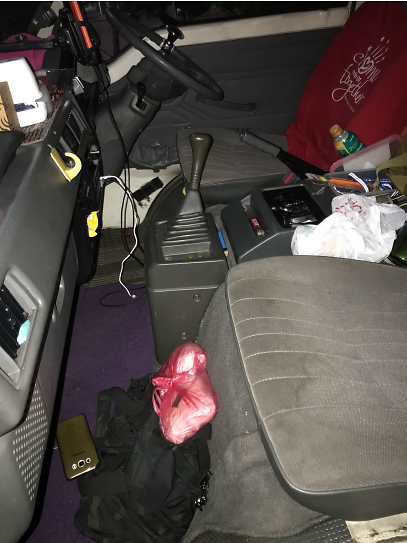
The authorities found 938g of heroin, packed into two bundles and placed inside a red plastic bag, inside the van the suspects were travelling in.
The van in which the heroin was recovered from during the CNB operation on Monday (Jun 25). (Photo: CNB)
Heroin packed into two bundles and placed inside a red plastic bag was found inside the van by CNB officers. (Photo: CNB)
Two raids subsequently conducted at the hideouts of the 38-year-old in Circuit Road and Balam Road by CNB officers saw 53g of heroin, 90g of Ice and a bottle containing methadone seized.
A 36-year-old woman and a 48-year-old man were arrested in the unit at Circuit Road. All four suspects are Singaporeans, said CNB.
Investigation into the drug activities of all the suspects are ongoing, CNB added.
SINGAPORE: How can data be used to address a real-life issue like road rage and its impact on the road safety conditions in one’s country?
That was the problem statement oil company Shell put forward to communications company Edelman in 2017, as it tried to tackle road rage in Malaysia where statistics showed that an average of 18 people die every day in road accidents, said Mr Yeelim Lee, general manager of Edelman Predictive Intelligence Centre, during a recent interview with Channel NewsAsia.
In order to understand some of the causes for road rage among drivers, wearable tracking devices were handed to 300 volunteer drivers during a two-week period last April. These emotion tracking wristbands measured biometric information such as heart and breath rate, mood, sleep and exercise, said Mr Lee.
“This was to understand their peak stress periods,” he explained, adding that such data was meshed with other data sets such as the weather, traffic conditions as well as driving behaviour like acceleration and braking via the Shell Motorist app.
In total, the study captured more than 150,000 data points from various sources, he added.
Having mined the insights, Shell was then informed enough to send its service staff in Malaysia to undergo hospitality training that could mitigate against road rage. The executive also said certain foods were also recommended to various service outlets at petrol kiosks as a result of the information collected.
For example, in the profile of a “smooth and steady driver”, Shell said such motorists have a daily coffee, stays hydrated and carries a bottle of water in the car and eats a portion of fruit and two portions of vegetables each day.
(Infographic: Shell)
The outlets would then be stocked with the relevant products to encourage such a driver profile among its visitors, Mr Lee explained.
“The aim of the campaign was to gain insights which could inform motorists of what factors affect them on the road,” he said. “Empowered with this knowledge, they would be better equipped to make positive behavioural choices to improve their journeys.”
Shell, in turn, also saw an increase in their social reach, brand preference and sales, said the executive, but was not able to disclose exact figures.
Yet, the communications agency was keen to stress that their methods of enhancing a brand’s public reach does not cross the threshold of alarming customers, who are the recipients of any possible campaign.
Its global COO Matt Harrington, who was at the same interview, shared that the data it analyses is always anonymised. The datasets are used to identify and understand how consumers are behaving, rather than targeting a specific user for any specific instance, he added.
“It is not micro-targeting,” he asserted.
The act of micro-targeting users has taken on a negative connotation in recent times, following news of how UK data analytics firm Cambridge Analytica reportedly harvested private information from more than 50 million Facebooks users and used it to profile individual users and targeted them with personalised political advertisements during the 2016 US presidential elections.
ALIGNED INTERESTS
This collaboration with the oil company is an example of how Edelman wants to unlock the inherent potential of data sitting in one’s business and use it for good, Mr Harrington said.
The Edelman Predictive Intelligence Centre (EPIC) in Singapore was launched last week, in partnership with the Singapore Economic Development Board. It is a three-year strategic collaboration to research and develop new approaches to communications marking planning using predictive and intelligent technologies, the company said then.
Assistant managing director at the Singapore Economic Development Board Kelvin Wong (left) and global COO of Edelman Matt Harrington at the launch of the Edelman Predictive Intelligence Centre. (Photo: Edelman)
This is the communications firm’s first such centre of excellence, and it is currently staffed with 13 people. There are plans to increase the headcount to 24 by 2021.
Mr Lee, who oversees the centre, said the planning and research work is done here even if the companies it is working with are based elsewhere.
Asked why Edelman decided to house its predictive intelligence centre here, Mr Harrington said there are “aligned interests” between both parties. For one, Singapore has expressed interest in being a safe data harbour for the region while Edelman is compliant with industry standards around data privacy such as Europe’s General Data Protection Regulation (GDPR), which kicked in last month.
Singapore has also been strong proponents of data science and artificial intelligence, meaning there’s a pipeline of talent coming through here.
“With our centre of excellence, these graduates will have the platform to practice what they’ve learnt,” Mr Harrington said.
These sentiments were echoed by Mr Kelvin Wong, assistant managing director of EDB, who said the new centre is a boost to the country’s efforts to grow data-enabled marketing innovation capabilities.
“This is in line with the professional services industry transformation map launched in January this year, which seeks to equip the workforce with specialised skillsets in high-growth areas such as data science, analytics, and artificial intelligence,” Mr Wong added.
Former Ambassador-at-Large Bilahari Kausikan also suggested that Prime Minister Mahathir Mohamad is raising the water issue only as a diversionary tactic in preparation to ask for a waiver or reduction of the compensation due to Singapore if Malaysia formally cancels the high-speed rail project.
File photo: Water pipelines (R) run across the causeway between Singapore and Malaysia’s Johor Bahru. (AFP/ROSLAN RAHMAN)
(Updated: )
Bookmark
SINGAPORE: Legally binding positions are important to keep things professional and impartial, said Speaker of Parliament Tan Chuan-Jin.
He posted the comment on Facebook on Tuesday (Jun 26) after Malaysia Prime Minister Mahathir Mohamad said on Monday that his government needs to renegotiate the water supply agreement with Singapore describing it as “too costly”.
The 1962 Water Agreement is an agreement guaranteed by both governments in the 1965 Separation Agreement which was registered with the United Nations.
The terms of the agreement give Singapore full and exclusive rights to draw up to a maximum of 250 million gallons (mgd) of water per day from the Johore River.
In return, Johor is entitled to buy treated water of up to 2 per cent of the raw water extracted by Singapore on any given day, or about 5 mgd if Singapore draws its full entitlement of water from the Johor River. Singapore pays 3 sen per thousand gallons of raw water and sells treated water to Johor at 50 sen per thousand gallons.
In a Channel NewsAsia interview, Dr Mahathir called the price of water being sold to Singapore is “ridiculous”.
“I think it is manifestly ridiculous that we should sell water at 3 sen per thousand gallons. That was okay way back in the 1990s or 1930s. But now what can you buy with 3 sen? Nothing,” he told Channel NewsAsia in an exclusive interview.
In his Facebook post, Mr Tan said: “As a friend and neighbour, we do what we can. But being friendly and supportive doesn’t mean that we should accede to whims and fancies to show sincerity.
“When one wants his way and doesn’t get it, it isn’t because we aren’t friendly. It’s because it needs to be fair, equitable and consistent for our people. That’s the basis on which equals conduct business.”
A DIVERSIONARY TACTIC
In his Facebook post on Monday, former Ambassador-at-Large Bilahari Kausikan suggested that Prime Minister Mahathir is raising the water issue only as a diversionary tactic in preparation for asking for a waiver or reduction of the compensation due to Singapore if Malaysia formally cancels the high-speed rail project between the two countries.
Mr Kausikan is also a former Permanent Secretary at the Ministry of Foreign Affairs.
He said Dr Mahathir’s “intention is to make the Singapore government look unreasonable hoping, first, that Singaporeans will pressure our government on his behalf, and, second, to set up an alibi with his own people.”
The Malaysian Prime Minister “knows full well that the price of water was set by an international agreement under the terms of which Malaysia also buys treated water from Singapore at a low price, and buys considerably more than it is entitled to buy under the terms of the agreement”, Mr Bilahari added.
He said Malaysia would not agree to the terms of the agreement unless it is getting a good deal.
“We have gone through this umpteen times when he was last PM. He knows we are not going to change our position,” Mr Bilahari said.
“The reason is simple: if we allow Malaysia to change the terms of solemn international agreements anytime the terms of the agreement become inconvenient to them, where will it end?”
“All this is out of Dr M’s standard play-book. Singaporeans should not be deceived. Good neighbourliness ought to be a two-way street,” Mr Bilahari added.
SINGAPORE: This year’s National Day Parade (NDP) funpacks will for the first time feature designs by students from special education schools.
Thirty-eight students from 18 schools used their artistic talents to create designs for the funpacks, which comes in the form of tote bags this year.
The artworks, featuring imagery such as the Singapore skyline and ordinary Singaporeans, are expressions of what Singapore means to the students and their hopes for the country as it celebrates its 53rd birthday.
There funpacks come in 18 different designs, with names such as Concrete Jungle, Harmony in Diversity and Mao Shan Wang.
More NDP funpack designs. (Photo: Aqil Haziq Mahmud)
“It is really wonderful to me that this year’s National Day, we also incorporate students from the special needs school,” President Halimah Yacob said on Tuesday (Jun 26) at the unveiling of the funpacks.
“That’s really significant because … these funpacks are going to thousands of Singaporeans. That spreads the message and that’s really heartwarming.”
Madam Halimah said she hopes the involvement of special education students is not a one-off.
“I hope that this is a strong message sent throughout society for everyone to play their part to support our special needs community, because they do have talents,” she added.
“It’s not a question of we just want to showcase them. No, they have special talents and capabilities that many of us don’t have.”
President Halimah Yacob talking to a student artist. (Photo: Noella Chye)
For Nurin Qurratu’ain Sukor, a hotel and accommodation services student from APSN Delta Senior School, the design process took three “painstaking” sessions.
The 19-year-old, who designed Concrete Jungle, started with a pencil sketch, then added water colours in red and blue, and finally outlined it with a black marker.
Qurratu’ain chose the Marine Bay Sands and Gardens by the Bay because it made up Singapore’s skyline, and a fighter jet because it reminded her of last year’s NDP.
The items in this year’s NDP funpack. (Photo: Aqil Haziq Mahmud)
This year’s funpack comprises 22 items, including a light bubble and a placard that spectators can use to participate in the parade.
Spectators can express themselves by writing messages on the placards, which have red and white sides and will be used in a “massive” audience formation during the show.
The various artworks on the funpack bags. (Photo: Aqil Haziq Mahmud)
The funpack also comes with a souvenir magazine filled with fun facts about NDP 2018, and an art booklet showcasing all 18 funpack artworks, the artists’ stories and the inspirations behind their designs.
“We wanted to bring everyone on board,” said logistics and finance chairman Senior Lieutenant Colonel Quek Yew Sing, who also emphasised out that involving special education students is in line with this year’s NDP theme of representing Singaporeans from all walks of life.
The various artworks on the funpack bags. (Photo: Aqil Haziq Mahmud)
“Given that the funpacks are well sought-after, it will raise awareness and bring recognition to our young talent.”
As for the snacks in the funpacks, Khong Guan biscuits and salted egg yolk chips make a comeback from last year. There is also a muffin and cream bun.
The funpacks this year come in the form of a zip tote bag with a shoulder sling and an additional long sling.
A total of 252,000 funpacks will be distributed at collection points at The Float @ Marina Bay.