Friday night’s show will kick off a three-day cultural festival from Jun 29 to Jul 1 at Asian Civilisations Museum celebrating 50 years of ties between the two countries.
The Kreatif Connections’ opening concert will feature Indonesian and Singaporean music talents (from left) Aisyah Aziz, Adrian Khalif, Isyana Sarasvati and Jasmine Sokko. (Photos: Courtesy of the artists)
SINGAPORE: This weekend, you don’t need to visit Indonesia to experience its culture – just drop by the Asian Civilisations Museum (ACM).
As part of the Kreatif Connections cultural festival, Indonesian and Singaporean artists will be collaborating for a series of performances and workshops from Jun 29 to Jul 1.
The three-day event organised by the Ministry of Culture, Community and Youth wraps up the ongoing RISING50 celebrations commemorating 50 years of bilateral ties between the two countries.
Indonesia’s Pamenang Dance Community will be among the groups performing in Cupu Manik Astagina: The Sacred Jewel Box. (Photo: Pamenang Dance Community)
It kicks off with an outdoor pop concert at the Empress Lawn on Friday evening, with performances from Indonesia’s Isyana Sarasvati and Adrian Kahlif, and Singapore’s Aisyah Aziz and Jasmine Sokko.
The Bandung-born singer-songwriter Sarasvati, an alumnus of the Nanyang Academy Of Fine Arts and former opera singer, has two albums under her belt as well as a couple of hit singles, with her YouTube videos garnering millions of views. Meanwhile, hip-hop artist Khalif won the Best Hip Hop award at the Anugerah Musik Indonesia last year.
Singapore’s Peneroka Daya Tari will be performing in Cupu Manik Astagina: The Sacred Jewel Box. (Photo: Peneroka Daya Tari)
Homegrown singer Aisyah Aziz, meanwhile, established herself in the region with her debut single Mimpi, which won for Best Collaboration Song at Anugerah Planet Muzik in 2014. Fellow Singaporean, electronic musician Sokko, released her debut EP last year, with her single 600D catching fire on Spotify’s charts in Mexico, Latvia, Sweden and Singapore.
Those keen for something more traditional can catch Cupu Manik Astagina: The Sacred Jewel Box, which combines wayang kulit, fusion gamelan music, modern dance, and animation to tell the story based on the Ramayana. Performers include the Angger Gamelan and Pemenang Dance Community from Indonesia, and Gamelan Asmaradana and Peneroka Daya Tari from Singapore.
Aside from these performances, there will be an art and sound installation inside ACM – a work by husband-and-wife artist team Budi Agung Kuswara from Indonesia and Samantha Tio from Singapore. Their installation focuses on families living between both countries and was inspired by the folk tune Dayung Sampan.
The art installation The Current/s We Call Home | Arus Berlabuh Kita by artist-couple Budi Agung Kuswara of Indonesia and Samantha Tio of Singapore. (Photo: Kabul and Mintio)
Over the weekend, there will also be workshops on gamelan playing, batik painting, wayang kulit puppet making, leather crafting, tea blending, and drumming.
Kreatif Connections runs from Jun 29 to Jul 1 at Asian Civilisations Museum and Empress Lawn. For more details, visit http://bit.ly/KreatifConnections.
SINGAPORE: This year’s National Day Parade (NDP) committee aims to get Singaporeans out and about to explore different parts of the country – with a new app named NDP Jalan!
“We’re hoping that Singaporeans will be excited to participate while exploring Singapore, and at the end of it feel like they were part of the celebration rather then just being an audience (member),” said Lieutenant-Colonel Mikail Kalimuddin at the launch of the app on Thursday (Jun 28).
The location-based, augmented reality mobile game is the first interactive app launched in conjunction with the parade. Previous apps have largely been aimed at disseminating information.
“We decided that given what we want to do … we would make it an activity app to enable people to go out and do something,” added LTC Kalimuddin, who is the deputy chairman of the NDP organising committee’s branding and publicity team.
The NDP Jalan! app makes use of location-based technology. (Photo: Matthew Mohan)
The app was created by the NDP 2018 Organising Committee as well as SKY Optimum Technology, in collaboration with partners such as the National Arts Council and the Singapore Botanic Gardens.
Using the app, players can explore three thematic trails – the Arts and Culture trail at the Civic District, the Nature trail at the Botanic Gardens, as well as the National Day Parade trail at The Float @ Marina Bay and its surrounding areas.
The trails will be “live” in two-week intervals from Jun 29 to Aug 9, and will consist of quests, which range from quizzes to interactive AR mini games.
For every five quests completed, players can redeem discount vouchers for purchases at selected food and beverage as well as retail outlets. Those who complete 20 quests per theme also stand to win NDP tickets.
The app also includes an AR Viewer mode which can be used in conjunction with the A-OK newsletter, distributed to all Primary 5 students. Members of the public can also use the same mode at interactive exhibitions which will be launched islandwide from Jul 5.
NDP Jalan! will be available for download on both the iOS App Store and Google Play, with the first thematic trail launched on Friday.
SINGAPORE: Singapore on Thursday (Jun 28) opened its third desalination plant, boosting the country’s desalination capacity from 100 to 130 million gallons a day (mgd).
The Tuas Desalination Plant, which can produce 30 million gallons of drinking water a day, will help to meet up to 30 per cent of Singapore’s current water demand.
Spanning just 3.5ha – the size of three rugby fields – Tuas Desalination Plant is the country’s smallest plant to date.
A model of the Tuas Desalination Plant. (Photo: Vanessa Lim)
Despite its size, the plant can produce the same amount of drinking water as SingSpring Desalination Plant, Singapore’s first such plant.
SingSpring occupies 6.3ha, nearly double the footprint of Tuas Desalination Plant.
Both plants can produce up to 30mgd of drinking water, which is enough to supply to 200,000 households.
The first to be owned and operated by PUB, the Tuas plant will also be used to test new energy-saving technologies.
The plant is also the first in Singapore to adopt an advanced pre-treatment technology, which combines two existing filtration methods – dissolved air floatation and ultrafiltration.
Reverse osmosis membranes for seawater desalination. (Photo: Vanessa Lim)
This will help to reduce membrane fouling when treating seawater of varying water quality, as well as to prolong the lifespan of a membrane.
To reduce the plant’s carbon footprint, a 1.2MWp solar photovoltaic (PV) system will be installed on more than half of the plant’s roof surface by the end of the year.
Covering more than 7,000 sq m, the solar PV system will be able to generate 1.4 million kWh of clean energy a year, which will be used to power the plant’s administrative building.
With Singapore’s water demand projected to double from the current 430mgd by 2060, two more desalination plants are in the pipeline.
Slated to be completed in 2020, Marina East Desalination Plant and a fifth desalination plant at Jurong Island will bring the total daily water production in Singapore to 190mgd in two years’ time.
INVESTMENTS IN WATER NETWORK “HEAVY BUT NECESSARY”: MASAGOS
Speaking at the opening of the plant, Minister for Environment and Water Resources Masagos Zulkifli pointed out the need for Singapore to continually expand and enhance its water supply network.
He cited examples of cities like Cape Town in South Africa and Sao Paulo in Brazil. In Sao Paulo, a severe drought had caused the stock level of its main reservoir fall below 4 per cent, and its 21 million inhabitants had at one point less than 20 days of water.
“We are laying more pipes to reach the population and industries in new growth nodes while maintaining and renewing existing water infrastructure,” said Mr Masagos.
He added that all these are “heavy, but necessary investments”, and take time. These investments must also be made ahead of time and demand, so Singaporeans will not face the same problems as Sao Paulo and Cape Town, the minister said.
“This is made possible by right-pricing water to reflect the long-run marginal cost of producing our next drop of water, which is likely to come from NEWater and desalinated water.”
There are other worries regarding upwards inflationary pressures on petrol prices harboured by car owners.
A lesser known impact, however, is its effect on electricity tariffs, which is expected to increase in the third quarter of the year and should be announced before the end of June.
Much of Singapore’s energy needs are driven by oil imports. The consumption of petroleum products in both the industry and transport sector recorded a total of 9.7 million tonnes of oil equivalent, making up more than 63 per cent of total energy use in 2015, according to the 2017 Singapore Energy Statistics.
Given oil’s role in driving Singapore’s economy, it is natural for businesses and consumers to fret when its prices exhibit unusual volatility or show signs of impending hikes in response to supply-demand dynamics, or other driving forces such as geopolitics and trade wars.
While nowhere near those sky-high prices of more than US$100 a barrel from a few years ago, oil prices have surged recently to US$70 a barrel for West Texas Intermediate (WTI) crude oil in May 2018 – the first time it has seen such levels in more than three years.
Coordinated supply cuts by the Organisation of the Petroleum Exporting Countries (OPEC), and to a lesser extent, the US’s decision to impose sanctions on Iranian oil exports may have contributed to the rise.
The logo of the Organisation of the Petroleum Exporting Countries (OPEC) is seen at OPEC’s headquarters in Vienna, Austria June 19, 2018. (File Photo: REUTERS/Leonhard Foeger)
We can expect to see improvements in the immediate future given Russia and OPEC’s recent commitment to increase combined production of up to 1 million barrels a day.
To what extent is this commitment sustainable remains to be seen given that only Saudi Arabia within the OPEC group and Russia have the technical capacity to increase production quickly while other OPEC members such as Venezuela and Iran are faced with political instabilities and export sanctions respectively.
WHY YOUR BILLS MIGHT GO UP
Some observers may question the correlation between oil prices and their own energy bills. A few questions are in order.
First, why are oil prices still affecting electricity tariffs despite electricity mainly generated from natural gas in recent years? Second, will electricity tariffs continue to rise in tandem with oil prices?
In Asia, purchased gas imports are typically pegged to oil price changes by pre-determined formulas due to the lack of an established pricing benchmark for gas trade. This nexus between oil and gas prices could weaken though, as more gas is being traded with greater flexibility in the future.
As tariffs are set on a quarterly basis, they can only be adjusted based on historical oil prices, leading to a lag.
This adjustment makes sense if oil prices were averaged from a previous quarter, with the result then utilised to set electricity tariffs for the following quarter. Hence, in Singapore, changes in tariffs are often one quarter behind changes in oil prices.
Based on this, electricity tariffs, adjusted in line with historical oil prices and factoring in the increase over the last quarter, could rise to beyond 23 cents per kWh for this upcoming quarter. What this means is households and businesses should prepare for yet another quarter of an increase in electricity tariffs – since oil prices already started to move up since mid-2017.
Households already saw increases in electricity tariffs to 22.15 cents per kWh from April to June this year, from 21.56 per kWh in the first quarter of this year and 20.30 cents per kwh from October to December 2017.
Crude oil price and residential tariffs. The increase in oil prices over the last quarter mirrors the steep increase seen in April to June 2016. (Graph: Authors. Sources of data: WTI Oil Price – US Energy Information Administration, Electricity Tariffs – Singapore Power website)
Adjusted quarterly crude oil prices and residential tariffs. (Graph: Authors. Sources of data: WTI oil price – US Energy Information Administration, electricity tariffs – Singapore Power website)
SUNNIER OUTLOOK FOR THE LONG TERM
If Singapore households anticipate that electricity prices will continue to rise, then they should plan to conserve energy to save on their utility bills in the coming future. But this could be a hassle for some depending on lifestyles and preferences.
Another option is for consumers to switch to an alternative electricity provider once the rest of Singapore opens to retail liberalisation in the second half of 2018.
The very nature of retail competition will guarantee sizeable discounts off the current default Singapore Power (SP) bills. But it does not mean electricity prices will no longer be affected by oil prices, as alternative offers will have to reasonably reflect the cost of producing electricity from fossil fuels.
For example, if households or businesses choose a discount-off pricing plan which offers a fixed discount off the regulated tariff set, prices will still move up and down over time, but remain at lower levels compared to SP tariffs.
Other types of pricing plans including fixed price plans or peak or off peak price plans may be more suitable, depending on one’s consumption patterns.
Those selecting hybrid plans with a percentage share of solar energy will enjoy smaller discounts off SP tariffs at present moment, as the cost of producing solar energy is still higher than the raw cost of generating electricity from fossil power plants.
File picture of solar panels on Southeast Asia’s first Zero Energy Building in Singapore. (Photo: TODAY)
However, this will change in the foreseeable future, with manufacturing costs of panels growing cheaper over time.
Singapore households and businesses can expect further reductions in electricity costs as more solar power can be more reliably used to meet national demand, once large-scale energy storage systems can be fully harnessed to fill up electricity supply-demand shortfalls reliably.
In short, electricity prices are currently still driven by oil price movements.
Given that electricity retail liberalisation can potentially reduce electricity tariffs and at the same time offer cleaner sources of electricity for those more concerned about the environment, it is best for us consumers to seriously consider switching to alternative electricity providers to enhance our well-being.
Allan Loi and Nur Azha Putra are research associates at the National University of Singapore’s Energy Studies Institute.
SINGAPORE: Singapore Olympic champion swimmer Joseph Schooling launched his own swimming school at the Our Tampines Hub on Wednesday (Jun 27).
Called Swim Schooling, the school will start with an eight-stage progressive learn-to-swim programme for children aged between three and 11.
As part of the launch, a small group of children joined the Olympic champion in the pool for a short training session. Lessons will begin on Jul 2 at the Tampines pool, and the school has already seen some advance sign-ups.
“My own father almost drowned twice, so that’s why he put me in swim school,” said Schooling. “Who would have thought that swimming would define who I am? Swim Schooling is all about empowering kids to be water-safe and to be confident in the water.”
Joseph Schooling at the launch of Swim Schooling. (Photo: Ben Ho)
The school has plans to expand to a “few more venues” in Singapore and in the Southeast Asia region. Future courses will include teacher development training for swim coaches.
However, the 22-year-old Schooling will not be teaching full-time at the school.
Instead, he will be “running a couple of things” with his mother, May Schooling, who serves as one of the school’s directors.
Said Schooling: “First and foremost, my priority is my training – getting ready for the Asian Games, or Tokyo 2020. I will be here as much as I can, see the kids and maybe get in the water with them.”
In the meantime, trained coaches employed by the school will conduct its courses.
Joseph Schooling giving instruction to the children. (Photo: Swim Schooling)
The launch comes on the back of the Singapore National Swimming Championships that ended on Jun 23. Schooling bailed out of several events and only managed a bronze at the 100m freestyle finals.
When asked about his performance, he said: “Timing-wise it may not have looked that good, but my goals going into that meet (were) … dusting off the cobwebs, I haven’t raced long course since Worlds last year.”
Taking the experience in his stride, Schooling said that he was on track for the upcoming 18th Asian Games in Indonesia this August.
“I definitely (feel) more comfortable racing after this weekend. It’s all about repetition right, you got to get as many reps as you can in, and so this weekend just got me to feel the pain, feel the racing pain, get back in the swing of things,” he said.
“I am feeling very comfortable and very confident heading into the Asian Games. I think it’s going to be a good one,” he added.
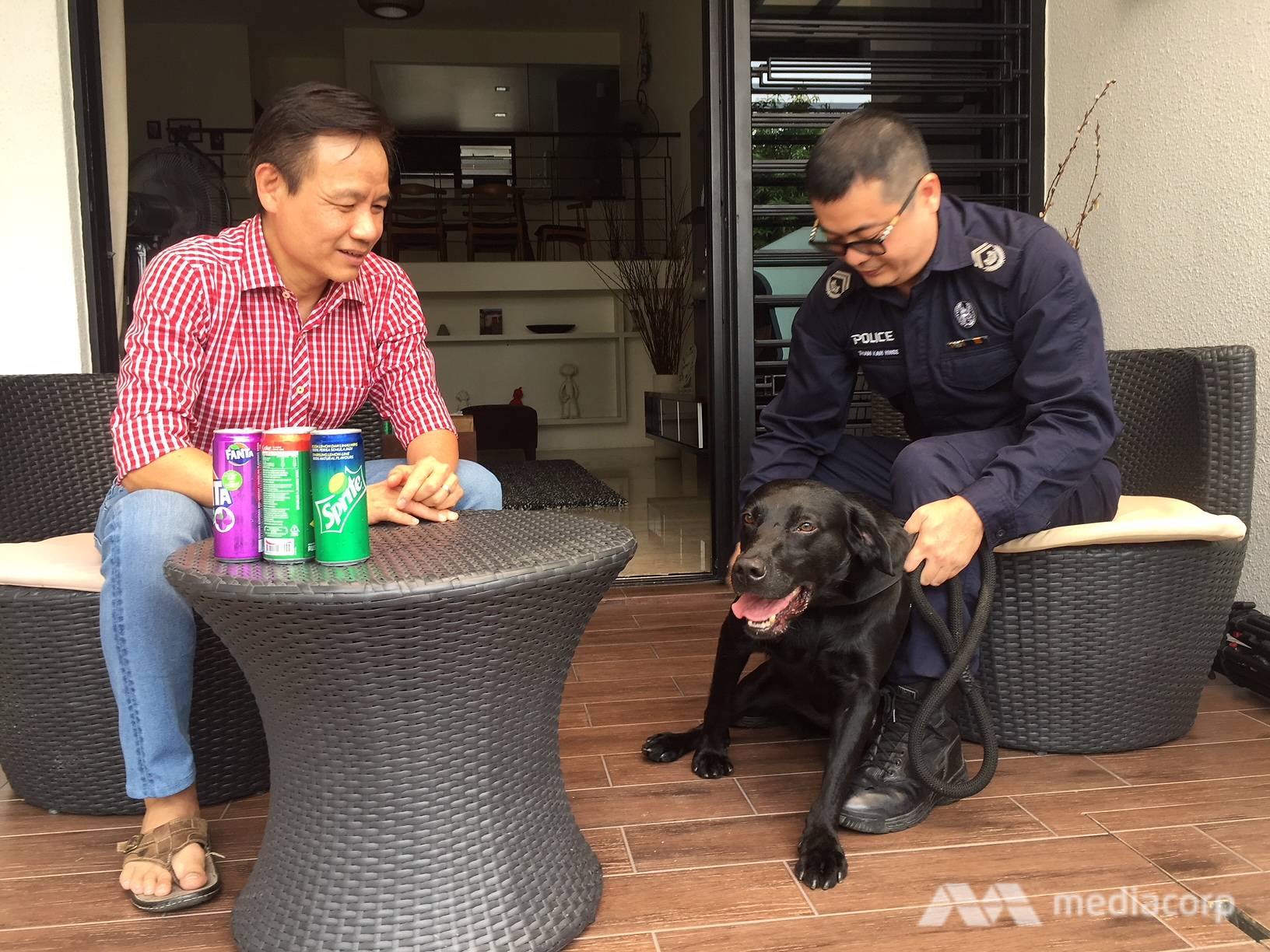
SINGAPORE: Seven-year-old Zam is a calm and friendly Labrador, who gets easily excited when it comes to “food and playing ball”, his owner Maurice Chua joked.
In February, the 57-year-old retiree adopted Zam – a retired sniffer dog that served in the Singapore Police Force K-9 unit for five years as an explosive detector dog.
Zam is a retired sniffer dog that served in the Singapore Police Force K-9 unit for five years as an explosive detector dog. (Photo: Wendy Wong)
Zam’s K-9 handler, who had trained him and was deployed with him on patrols, reunited with the Labrador for the first time in two years on Tuesday (Jun 26).
“I feel very happy that he’s found a home for himself after we’ve been fighting crime for the past five years,” station inspector Tham Kah Hwee said. “And he finally found a home that’s very caring for him.”
Retiree Maurice Chua adopted Zam earlier this year, a few months after his Jack Russell died. “I’ve always loved dogs. My wife suggested let’s adopt a dog, so we said why not a police dog? Since they’re retired, give them a good life after that.” (Photo: Wendy Wong)
However, under an expanded initiative by the Ministry of National Development (MND), retired sniffer dogs like Zam can now be adopted by their handlers living in public housing flats.
Previously, sniffer dogs could only be adopted by those living on landed property – be it their handlers or members of the public – due to size and breed regulations set by the Housing and Development Board (HDB).
Since the expanded Project ADORE was launched last June, 13 dogs have been rehomed with their handlers, including sniffer dogs such as Labradors, pointers and cocker spaniels from the Singapore Police Force and Singapore Civil Defence Force.
One dog from the Singapore Armed Forces Military Working Dog Unit was also adopted by its handler.
Station inspector Tham Kah Hwee was reunited with Zam for the first time after two years. (Photo: Wendy Wong)
Project ADORE was first launched in 2012 and has rehomed 834 mixed breed dogs in public housing flats, with adopters allowed to keep one dog per flat.
Such dogs, which weigh up to 15kg and are 50cm in height, were not allowed to live in HDB estates previously.
To ensure that the dogs do not cause any nuisance to neighbours, adopters must abide by strict ownership conditions, such as sterilising, microchipping and enrolling their dogs for obedience training courses.
According to MND, the initiative has since been “well-received”, with the expanded pilot project currently being reviewed.
“How do we ensure that new technologies do not undermine our collective security?” Defence Minister Ng Eng Hen said in his welcome speech at the inaugural Singapore Defence Technology Summit.
Defence Minister Ng Eng Hen speaking at the inaugural Singapore Defence Technology Summit.
(Updated: )
Bookmark
SINGAPORE: Research and development (R&D) programmes in the defence arena have produced applications that have improved the lives of society at large, but even as the pace of innovation increases, security risks and moral dilemmas remain, said Defence Minister Ng Eng Hen on Wednesday (Jun 27).
Dr Ng, in his welcome speech at the inaugural Singapore Defence Technology Summit here, cited the example of the United States government’s ARPANET programme in 1969 as one that has made such a mark. The ARPANET was a network built to be resilient in the event of nuclear attacks, yet has evolved to become the Internet as we know it today, he said.
He also pointed to the huge investments being made in technology, both by Government and the private sector. In fact, private sector funding in R&D hit a record high of S$702 billion last year, more than how much governments spent.
In the US and Europe, the ratio of private to public sector investments in R&D is about 2:1, while the ratio in China is 3:1. In terms of geographical spread, Asian companies’ R&D spending has “more than quadrupled over the past decade”, while China now has the second-largest R&D spending in the world, the Defence Minister added.
“The discovery and application of new technology are shifting to new epicentres from the US and Europe, to the Middle East and Asia,” Dr Ng noted.
Singapore, too, has participated in the trend. He said that the Defence Science and Technology Agency (DSTA) and manufacturers like Airbus and Boeing are collaborating in digital technologies like 3D printing and data analytics.
The Singapore Armed Forces is also deploying artificial intelligence in, for instance, its unmanned watch towers that monitor key installations like Jurong Island, he added.
However, while these changes spell good news for the private sector, there are also risks and dilemmas to confront, the minister said.
“How do we ensure that new technologies do not undermine our collective security?” Dr Ng said.
He pointed to terrorists using encrypted messenger apps to orchestrate plots and data privacy violations by social media platforms as some of the challenges society has to deal with as a result.
“These are tough questions and moral dilemmas to address, with often no easy or cost-free answers,” the minister said, adding that he hopes the summit will play a role in helping countries deal with the “many blessings and challenges” technological disruptions will bring in their wake.
EVER since the inauguration of US President Donald Trump in early 2017, the term “fake news” has become deeply entrenched in the global socio-political landscape and Southeast Asia is no exception to the phenomenon.
And while Trump often uses the term to condemn news that is critical of him, the pace at which undisputable disinformation is being spread on social media has posed a headache for policymakers, traditional media, and tech companies all across the globe.
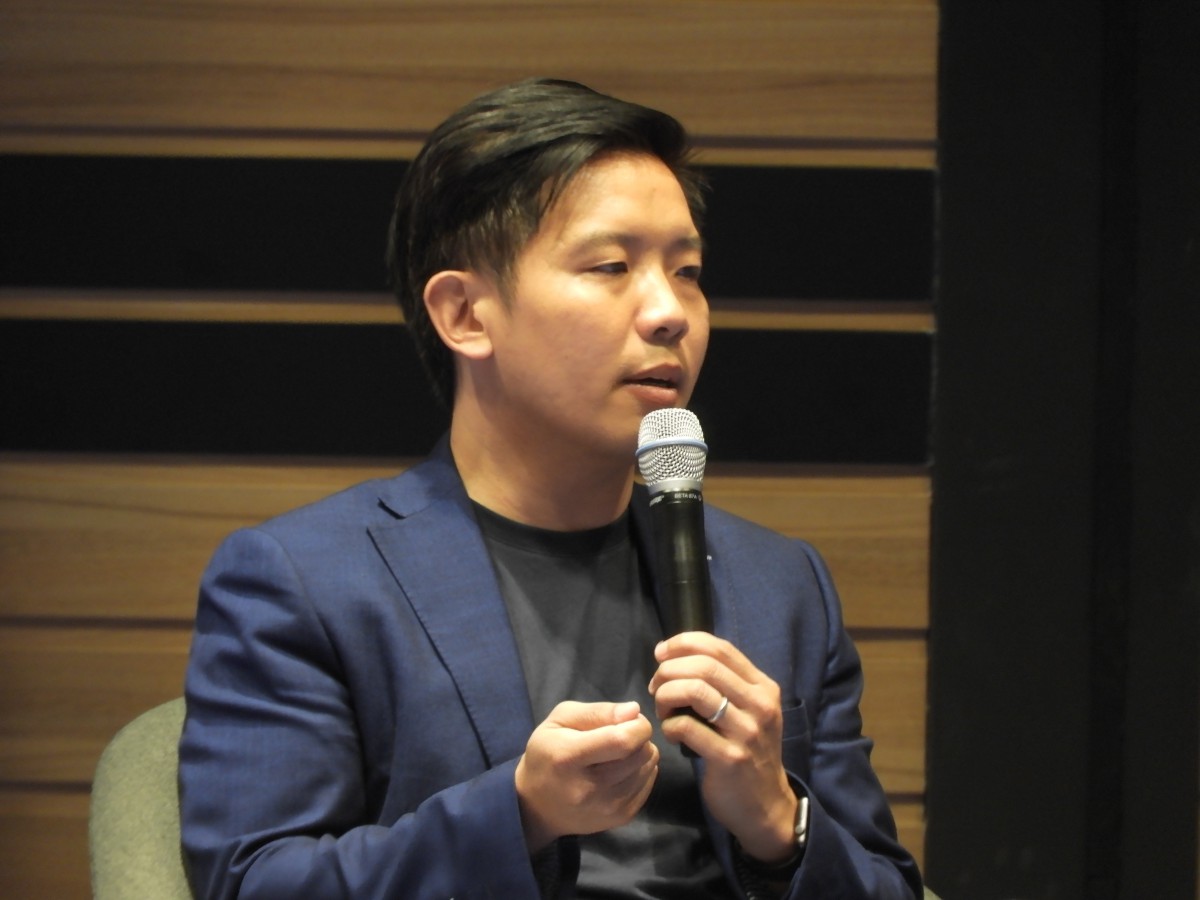
On Monday, several stakeholders who convened at the East-West Center International Media Conference in Singapore, joined a panel to discuss ways to combat such disinformation.
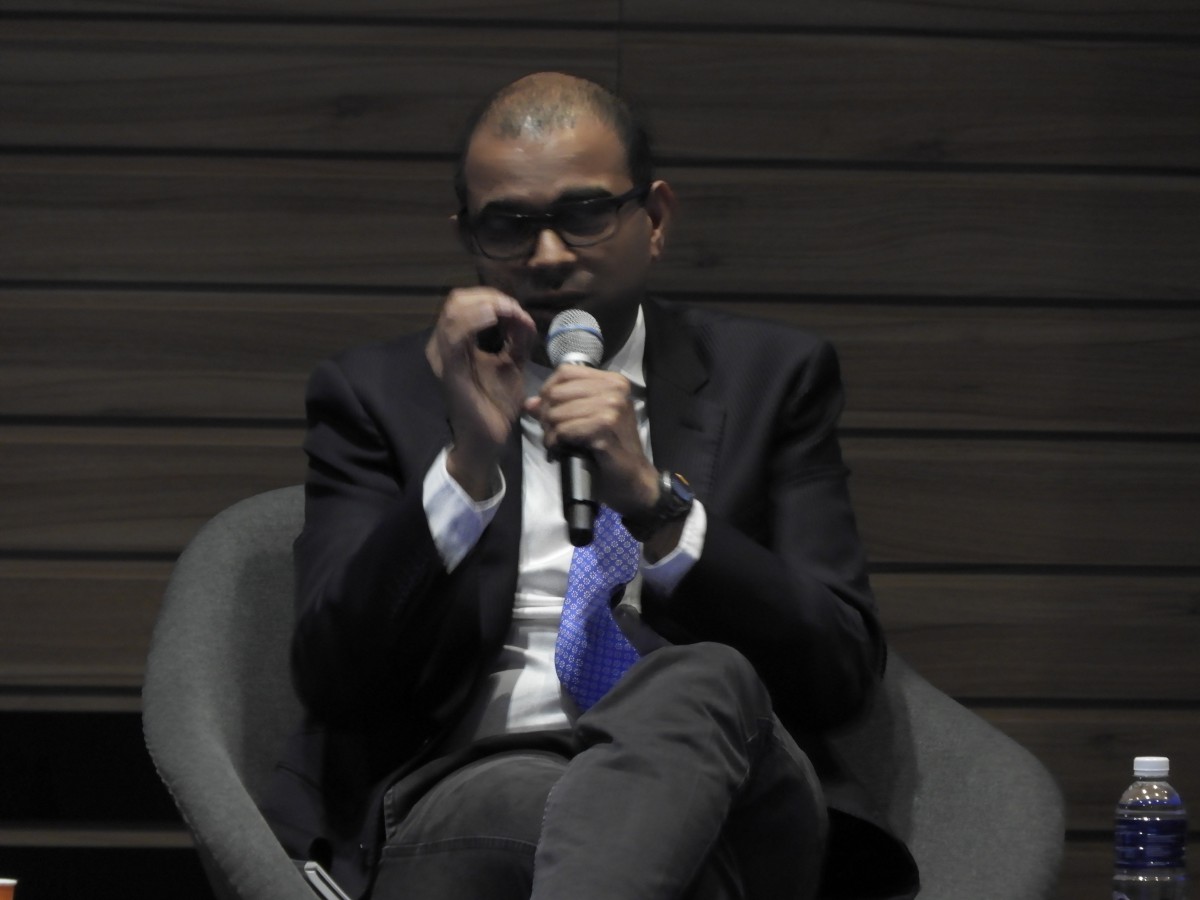
One of those on the panel, Communications and Information Senior Minister Dr. Janil Puthucheary, said providing truthful information is the personal responsibility for all stakeholders, including governments, academics, the traditional press, social platforms, and citizens.
Dr. Janil said even though the governemt was looking to introduce the new law, tackling Fake News should take on multifaceted approach. Source: A. Azim Idris
In recent months, Singapore has also mulled legislating fake news but the plans to impose new laws on the matter had no timeline or deadline.
“Legislation alone is not going to be sufficient in preventing people from trying to exploit the (media) space because the payoffs for successful exploitation are so great,”
“If legislation is to be considered, it must be part of a multifaceted approach that addresses the whole issue, from how people consume news right all the way to how people profit from the news.”
Defining “fake news” as the intention to spread misinformation, Singapore’s The Straits Times Editor Warren Fernandez, said the term must be clearly distinguished from comedy, satire, analysis, opinion, and commentary.
Straits Times editor Warren Fernandez said fake news must be clearly distinguished from comedy, satire, analysis, opinion, and commentary. Source: A. Azim Idris
Fernandez said The Straits Times launched a media literacy initiative that provides schoolteachers with news content that will provoke classroom discussion. This is part of an effort to achieve the “ultimate solution” of creating a public that has sceptical and inquisitive minds.
The paper’s initiative also falls in line with the Singaporean government’s new school curriculum to help students engage with media literacy and critical thinking.
Facebook’s head of public policy in Southeast Asia, Alvin Tan, says the social media platform does a lot of work countering violent extremism around region, adding 99.8 percent of terrorist groups Islamic State and Al-Qaeda related content was removed before they were flagged by users.
Another way Facebook combats fake news is by removing fake accounts – the company has removed 583 million fake accounts in the first quarter of the year.
“If you look at the scale, about 2.2 billion monthly users on Facebook 583 million accounts are removed at registration and that is quite a significant number,” he said, adding it has removed 700 million instances of spam.
The company, Alivn said, also has big plans to expand its third-party fact-checking service beyond countries like the Philippines and Indonesia.
Professor Cherian George, of the Department of Journalism at Hong Kong Baptist University, said the term “fake news” carried extremely dangerous consequences if the public becomes cynical about all news sources and reliability of information.
But even before Trump turned “fake news” into a buzzword, Cherian suggested the term is not new, pointing out that without such disinformation in 2003, American politicians would not have accepted the then President Geroge Bush’s assertions that Iraq harboured weapons of mass destruction, possibly saving thousands of lives.
SINGAPORE: A total of 20 K-pop acts will perform at the Singapore Indoor Stadium in September as part of HallyuPopFest.
Ticket details for the three-day mega festival were announced on the event’s Facebook page on Wednesday (Jun 27).
Slated for Sep 7 to Sep 9, HallyuPopFest will feature seven-member group BTOB, who recently released their 11th mini album This is Us, Girls’ Generation vocalist Taeyeon and girl band AOA.
Girl band AOA. (Photo: Facebook/HallyuPopFest)
The artist line-up also includes groups Apink, Dreamcatcher, EXID, Gugudan, Momoland, Myteen, NCT 127, ONF, Snuper, UNB, Victon and Wanna One, as well as soloists Heize, Yu Seungwoo, Jeong Sewoon, Superstar K2 winner Huh Gak and Eric Nam, who performed sold-out shows in the US last August.
Each event day will see two afternoon showcases, a red carpet event, an evening concert, as well as auditions with three top South Korean entertainment companies, Cube Entertainment, Jellyfish Entertainment and Starship Entertainment.
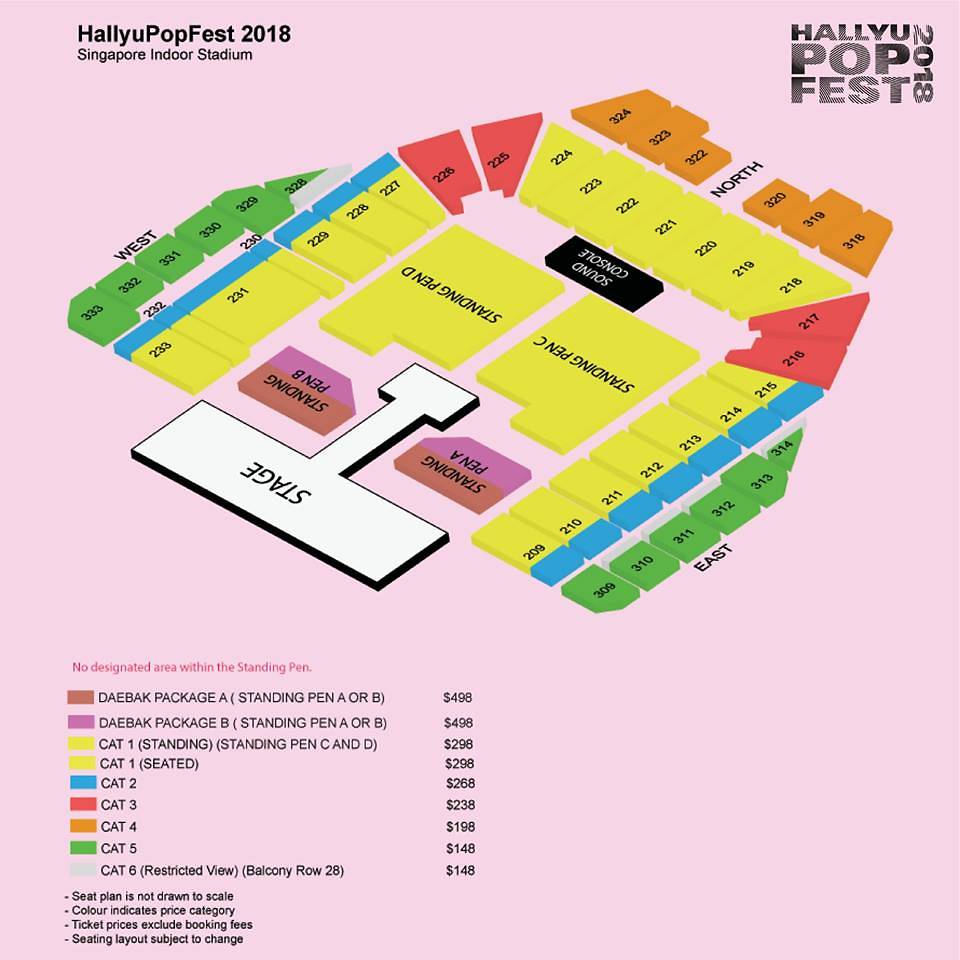
The tickets are split into eight categories and priced at S$148 (Cats 5 and 6), S$198 (Cat 4), S$238 (Cat 3), S$268 (Cat 2), S$298 (Cat 1 seated and standing in Pen C and D), and S$498 for the Daebak Packages A or B, which are standing.
Daebak pass-holders will receive priority access to the afternoon showcases and evening concerts, access to the Daebak VIP standing zone at the evening concert, a place at the special zone at the red carpet, as well as a goodie bag.
They will also get a “hi-touch” session and group photo with one act. Don’t get too excited, though – you can’t actually select which act to take a photo with as these will be “allocated randomly”.
Three-day packs are also available.
Tickets go on sale from Jul 7, 10am online at sportshubtix.sg, as well as at the Singapore Indoor Stadium box office, Scotts Square concierge, The Star Performing Arts Centre box office and all SingPost outlets.