Mr Arasu Duraisamy, 50, is also an elected member of the NTUC Central Committee and has been with the union for 25 years.
File photo of Mr Arasu Duraisamy, general secretary of the Singapore Port Workers’ Union. (Photo: NTUC)
(Updated: )
Bookmark
SINGAPORE: The National Trades Union Congress (NTUC) on Friday (Jun 29) announced that it has nominated long-time union leader Arasu Duraisamy to be the next Labour Nominated Member of Parliament (NMP), as current NMP K Thanaletchimi prepares to step down in September.
In a press release, NTUC said Mr Arasu, 50, is an elected member of its Central Committee as well as general secretary of the Singapore Port Workers’ Union (SPWU). He first joined SPWU as a member in 1993 and elected to his current position in October 2014.
Mr Arasu was also in the National Wages Council and represented the workers’ perspective in terms of formulating wage guidelines. He also represents NTUC in the Public Transport Council and provides perspectives as both a commuter and worker, it added.
On the global front, Mr Arasu is a member of the International Transport Workers’ Federation, Dockers Section, and is a “proud advocate” of Singapore’s tripartism, according to the press release.
“In my view, a Nominated Member of Parliament should be passionate about serving the people,” Mr Arasu said in the press release. “As a Labour NMP, it is also about bringing across feedback and concerns from our workers to the Parliament so that pertinent issues can be resolved and changes can be made for the good our workers and economy.
“The NMP must be able to engage the ground and be trusted upon by our workers to place their interests as top priority,” he added.
Commenting on the nomination, NTUC president Mary Liew said the union is confident Mr Arasu will bring value by speaking up for workers’ interests and welfare in Parliament.
“Coming from a union that has very strong labour-management relation with the management, he understands the true benefits of how such a foundation can be a win-win for both the company and its workers,” she said.
If his nomination is successful, Mr Arasu will take over from current NMP K Thanaletchimi, who will be stepping down once her term ends in September. He will be the 12th union representative since 1992 to be nominated, the press release said.
SINGAPORE: A woman alleged to have cheated several people who raised money on crowdfunding platforms is being investigated by the police for possible criminal offences, and has been barred by the Commissioner of Charities (COC) from raising funds for charitable purposes.
Ashlee Chua Jermaine, also known as Ashley Lee or Ian Ian, is linked to a Facebook closed group known as Ian Free Milk Blessing, which currently has more than 1,700 members.
The group is known to reach out to needy families that do not have the financial means to purchase sufficient formula milk, or have children suffering from chronic or congenital illness.
Ashlee allegedly cheated at least three beneficiaries of charity campaigns conducted on the GIVE.asia crowdfunding platform, said The Office of the Commissioner of Charities in a press statement on Friday (Jun 29). The beneficiaries had reported that Ashlee became uncontactable after they transferred money to her.
A screencap of the Ian Free Milk Blessing Facebook group on Jun 29, 2018.
Ashlee is also alleged to be behind a fundraising appeal conducted by the Ian Free Milk Blessing group on GIVE.asia, said COC.
“The funds raised from the fundraising appeal were purportedly transferred to Ashlee, who has not provided any accountability on how these funds have been used,” said the COC.
COC also said that Ashlee has yet to comply with an order it issued under the Charities Act earlier this year for information about the Ian Free Milk Blessing Facebook group, and faces an offence for it.
Ashlee, who is an undischarged bankrupt, is also being investigated by the Singapore Police Force for suspected criminal offences.
“The COC is satisfied that Ashlee is not a fit and proper person to conduct fundraising appeals for charitable, benevolent or philanthropic purposes and that it is in the public interest to prohibit Ashlee from conducting such fundraising appeals,” it said.
“The COC has therefore decided to prohibit Ashlee from conducting any fund-raising appeals with effect from Jun 29, 2018,” it added.
SINGAPORE: Bicycle-sharing firm Mobike has waived the deposit for its Singapore users, four days after its former competitor oBike shut down and customers complained that they were unable to get refunds for their deposits.
Like oBike, Mobike users were also required to place a S$49 deposit. Mobike said it introduced the deposit to encourage the proper use of the bicycles.
The deposit will now be waived because the company has “determined that Mobikes are widely used consciously in Singapore”, the Beijing-based firm said in a press release on Friday (Jun 29).
“We would like to thank our riders in Singapore for helping to cultivate a healthy and enjoyable bike-sharing experience for all,” said Ms Sharon Meng, the country manager of Mobike Singapore.
“In our show of appreciation, we are waiving deposits for Singapore-registered users,” she added.
Both existing and new users who have registered a Mobike account using a local Singapore phone number will not need to pay the deposit.
Existing users can request a refund by logging into the mobile app and selecting the refund button on My Wallet page.
Mobike said it will start the refund process immediately upon receiving the request. The S$49 will then be refunded into the user’s account within 10 working days.
Screenshot of deposit refund page in the Mobike app.
Following its announcement, there was a sharp increase in the number of complaints against the company.
According to the Consumers Association of Singapore, the majority of complaints were from customers who did not get their deposits refunded from oBike despite requests.
Some said the “refund deposit” option on the oBike app was removed, and some had trouble connecting to the app.
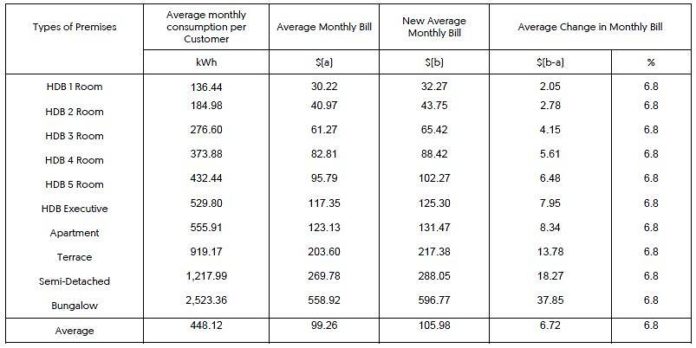
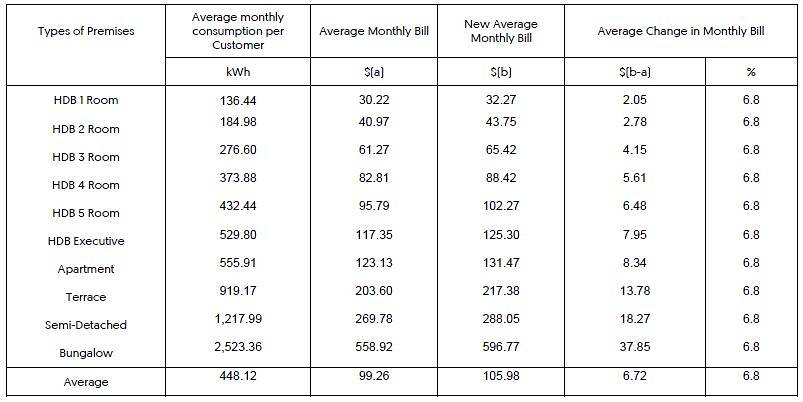
SINGAPORE: Electricity tariffs will increase by an average of 6.9 per cent or 1.50 cents per kWh from Jul 1 to Sep 30 this year, compared to the previous quarter, SP Group announced on Friday (Jun 29).
This is mainly due to the higher cost of natural gas for generating electricity.
For households, the electricity tariff will increase from 22.15 to 23.65 cents per kWh. The average monthly electricity bill for families living in four-room HDB flats will increase by S$5.61.
SP Group reviews the electricity tariffs quarterly based on guidelines set by the Energy Market Authority (EMA), the electricity industry regulator.
Table showing the average monthly electricity bills of domestic customers; tariff with effect from Jul 1. (Table: SP Power)
SINGAPORE: Singapore’s water supply has come under the spotlight this week, following comments from Malaysian Prime Minister Mahathir Mohamad that his government needs to discuss with Singapore the price at which water is being sold.
For years, dry spells in Johor and difference of opinions between Singapore and Malaysia, have raised periodic concerns about the nation’s water resources among people in Singapore.
A handful also do not rule out the possibility of water rationing, even though the last time water rationing in the country was actually carried out was in the 1960s.
In 1995, in an unusual campaign that lasted six days, an islandwide water rationing exercise was conducted involving 30,000 households.
During this period, the water supply was interrupted for 14 hours on each day. The objective was to remind Singaporeans, especially youths, about the importance of water.
How has the Singapore situation changed since then?
GREATER DEMAND BUT INCREASED CAPACITY FOR WATER COLLECTION
Since 1965 when Singapore became independent, the country has reinvented itself many times while amassing more water resources.
It has increased its size by about 25 per cent through land reclamation; but has developed 17 reservoirs from the three in 1965. The land area from which it is possible to collect water has increased to more than 67 per cent from 11 per cent.
Generic photo of Lower Seletar Reservoir. (Photo: PUB)
Singapore has become the leading country in producing reused water with NEWater covering up to 40 per cent of daily demand. Desalination produces up to 25 per cent of daily requirements.
Singapore has also invested, and continues investing, in research and development, education and training when it comes to water. It also has one of the most efficient water utilities in the world – so much such that the Public Utilities Board (PUB) is better known as Singapore’s national water agency.
On the demand side, water prices were adjusted in 2017 after 17 years to much public ruckus.
Yet, under the new pricing scheme effected in two phases over 2017 and 2018, potable water tariffs will increase by only S$0.04 per cubic metre compared to 2016’s prices for consumption of 40 cubic metres or less of water each month and S$0.12 per cubic metre if consumption is more than 40 cubic metres, on top of increases to the water conservation tax.
Meanwhile, support for one- and two-room HDB flats in the form of vouchers has increased.
With the objective to conserve and reduce water use, PUB has also developed efficiency measures for several sectors.
Those of us living in Singapore have to give more credit to PUB for its performance for the last several decades, where it has made our lives more secure as we have access to clean water on a permanent basis.
Sometimes the issue might ironically be one of too much water, where torrential rains have threatened to flood places in Singapore – including MRT tunnels – but efforts to address flooding risks and enhance drainage infrastructure have been underway.
File photo of rainy weather in Singapore.
IMPORTANCE OF WATER CONSERVATION
Even though there is no threat of water rationing as yet, it is essential for Singapore residents, businesses and industrial sectors to realise the importance of water conservation.
There are imponderables such as climate change that are affecting the entire world. In Southeast Asia, the region has been hit by more frequent and intense floods in recent decades.
In Singapore, more robust water sources that do not depend on the climate have been springing up. There are now five NEWater plants and three desalination plants, of which one was opened just this week. There is one more under construction and a final one at the planning stage.
However, no system is perfect. What is the Achilles’ heel in the case of Singapore’s water supply? Climate change? The water supply from Johor? Public inertia to water waste? It is all of the above.
Between 2014 and 2015, water consumption in Singapore increased from 150 to 151 litres per person per day. One litre may not seem like much, but this translates into an additional 150 million litres of water consumed a month.
If it still sounds insignificant, consider how much more electricity needed to treat and distribute water has been consumed.
Energy to treat water varies from about 0.2 kWh per cubic metres for water from local catchments or Johor, to 1.0 kWh per cubic metres for NEWater, and 3.6 kWh per cubic metres for desalination. Saving water means saving energy as well.
Thankfully water consumption in Singapore has since decreased to 148 litres per person each day in 2016 and 143 litres in 2017.
While some have attributed the decrease in water consumption to the increase in water prices, does this mean that the price of water should increase every year, as it is the case with electricity, for people to be more conscious of its use? Surely, we can all modify habits without the need for a stick?
A NEWater plant in Singapore. (File photo: TODAY)
Others have pointed to PUB’s development of a “smart shower programme” to study the effect of shower devices that tell people about how much water they have consumed and measure how much water is subsequently used.
But if we depend on a device to decide how much water to use, are we relegating our sense of responsibility to devices?
As is the case every year, I have just been interviewed by students interested in water conservation and how to make this a sustainable practice among their families and youths their age. These intelligent, forward-looking students from Catholic Junior College and Raffles Institute had worked on initiatives that are not only commendable but should also be examined by authorities to see how they can be implemented and scaled up.
More also can be done to understand at what point a young person, who is aware of the importance of water conservation and other similar ethical behaviours when it comes to the environment, forgets what they have internalise.
It could pave the way for more inclusive, long-term educational programmes that ingrains an environmentally conscious attitude into the minds of our young.
This way, waste of water and energy, food waste and littering could be a problem of the past. And Singapore’s water Achilles’ heel would be less vulnerable.
Cecilia Tortajada is senior research fellow at the Institute of Water Policy, Lee Kuan Yew School of Public Policy, and Editor-in-Chief, International Journal of Water Resources Development.
RESIDENTS of Indonesia are among the people that most secure from crime and trust in local police, according to a new global survey.
The 2018 Global Law and Order Report released by US-based pollster Gallup found that internationally, 69 percent of people said that they had confidence in their local police and 68 percent said they feel safe while walking home at night where they live.
Just 5 percent of respondents were assaulted or mugged in 2017.
Researchers conducted interviews with more than 148,000 people across 142 countries and areas in 2017, who were asked:
In the city or area where you live, do you have confidence in the local police force?
Do you feel safe walking alone at night in the city or area where you live?
Within the last 12 months, have you had money or property stolen from you or another household member?
Within the past 12 months, have you been assaulted or mugged?
Singapore had a Law and Order Index score of 97, the highest in the world above Norway, Iceland and Finland. Hong Kongers also feel very safe in their hometown with a score of 91, with Indonesia scoring 89 and China 88.
The security score for the entire regions of Southeast Asia, East Asia and South Asia all improved from 2016 to 2017.
Venezuela shared the “least secure” country along with Afghanistan with scores of 44 and 45, respectively. Latin America was the region where citizens feel most at risk and the least trust in police.
Countries elsewhere in the Asia Pacific generally had high ratings including Japan (85), India (85), Burma (85), Laos (83), Australia (82), South Korea (82) and the Philippines (82).
ROSTOV-ON-DON, Russia: Adly Azamin will remember 2018 for a long time to come. It is the year he turned 50, his son Adly Azizi reached 18, and together they ticked a major one off the bucket list by attending the football World Cup in Russia.
“I’ve wanted to go to a World Cup since I saw the 1978 one on TV, held in Argentina and won by Argentina,” said Azamin, who has been a fan of La Albiceleste since.
The financial planner and his son were buzzing after catching the first of three matches they’d bought tickets to – Iceland vs Croatia in Rostov-on-Don on Jun 26.
“The fans were awesome,” said Azizi. “Everyone did the Viking clap, regardless of which team they supported.”
A total of 3,241 match tickets have been allocated to Singaporeans. Also watching her first-ever World Cup in the flesh after “postponing for many years” was finance manager Zuraida, 55.
The long-time Brazil fan was delighted to be in the stands with her husband as her team beat Costa Rica in Saint Petersburg.
Zuraida poses with Brazilian fans ahead of the game against Costa Rica. (Photo courtesy of Zuraida)
“I want to watch all the games but unfortunately due to work commitments, I can watch one only this time,” she said. “But I had a great time in St Petersburg – everyone is very helpful, their metro is very easy to follow and it’s been a wonderful experience.”
“The good experience is definitely the coming together of fans of all over the world,” said Elamaran, who was also in Brazil for the 2014 World Cup. “We took pictures and conversed with people from France, Russia, Peru, Mexico, Brazil, Portugal.
“They all had a unique take on football and it was just an electrifying and amazing atmosphere.”
Elamaran Natarajan inside Sochi’s Fisht Stadium for the Portugal-Spain encounter. (Photo courtesy Elamaran Natarajan)
Seasoned World Cup spectator Vishaal Bhardwaj, 40, also had kind words for Russia’s organisation of the quadrennial football spectacle.
Having attended the last three events dating back to 2006, he said it would be hard to match expectations with the exuberant party that was Brazil in 2014.
“But Russia is doing as well as Germany in 2006,” offered Vishaal, who was in Moscow to catch the Germany-Mexico match with a group of 11, including family and friends.
“So many locals have stopped us to ask if we need help,” he said, echoing Zuraida’s point.
“The trains and their stations are art pieces unto themselves. The cleanliness even reminds me of Singapore.”
Vishaal added it was surreal to be in Russia having fun with his parents Pushpinder Mohan, 66 and Nelam Lata, 63.
“My only gripe is the lack of accessibility for older folks,” he said, pointing to Russia’s preference for staircases over elevators both around town and at the stadiums.
Nelam Lata, her husband Pushpinder Mohan Bhardwaj and son Vishaal outside the Luzhniki Stadium in Moscow ahead of the Germany and Mexico game. (Photo: Justin Ong)
Elamaran also said that, to a certain extent, the language barrier made public transport in Sochi difficult.
“There were volunteers to help fans but not enough signage and not many people are able to help us because most don’t speak English,” he commented.
Nonetheless all agreed that the experience of being at “The Greatest Show on Earth” was priceless overall.
“Between my son’s studies and my work, I’m just glad to find bonding time,” said Azamin. “Otherwise we’d just be playing FIFA at home!”
SINGAPORE: The Singapore Mint has launched new medallions to commemorate the historic summit between US President Donald Trump and North Korean leader Kim Jong Un in Singapore.
The second medallion issue comes after “overwhelming interest” in the first issue, said the Singapore Mint on its website.
Commemorative medallions carrying the inscription “World Peace” were issued ahead of the historic summit on Jun 12, which saw the two leaders hold a bilateral meeting and sign a joint statement.
The second issue will feature a new design for both the gold and silver medallions.
“The obverse design features the national flags of USA and (North Korea) in vibrant colours,” said the Singapore Mint.
The reverse will feature an “affirmative handshake” and the signed joint agreement between the two leaders “which was actualised at the Singapore Summit”, it added. The summit date and venue will also be featured.
The medallions will also come in silver. (Image: Singapore Mint)
The medallions are available for “priority pre-order” from now until Jul 8, and are by invitation only for those who had placed orders for the first issue of the medallions. These customers are guaranteed one gold and one silver medallion.
The indicative mintage – which may be adjusted according to demand – is 5,000 pieces for the gold medallion and 15,000 pieces for the silver one.
Orders place before the closing date will be fulfilled progressively from October onwards.
Professor Hugh Durrant-Whyte, chief scientific adviser for UK’s Ministry of Defence, highlights that artificial intelligence is actually targeting jobs like accountants and lawyers rather than those like cleaning and delivery.
National University of Singapore graduates at a commencement ceremony. (Photo: Lionel Lin)
(Updated: )
Bookmark
SINGAPORE: The rise of artificial intelligence (AI) and its impact on jobs and people’s livelihoods, especially those on the lower end of the skills spectrum, is an often-discussed issue, but one government official from the United Kingdom said the technology may actually be affecting graduates more.
Professor Hugh Durrant-Whyte, chief scientific adviser with the United Kingdom’s Ministry of Defence, said today’s developments in AI are automating processes in jobs like accountancy and law. These are things that tertiary institutions are currently teaching graduates, who might be the most affected by the emergence of the technology, he added.
He was speaking during a plenary session at the inaugural Singapore Defence Technology Summit on Thursday (Jun 28).
“We are not losing jobs (to AI), but the job market is being polarised,” said Prof Durrant-Whyte.
The jobs that are being created are at the “bottom end”, such as the delivery of food or cleaning services – tasks and skills that are actually quite difficult to automate, he explained.
AI FREES PEOPLE UP FOR INTERESTING JOBS: SENSETIME FOUNDER
Another panellist, SenseTime founder Tang Xiao’ou, had a different take on the situation.
SenseTime is a Chinese AI unicorn that in April raised US$600 million in funds from investors like Alibaba Group and Singapore state fund Temasek, and touts itself as the world’s most valuable company focused on computer vision and deep learning technologies.
Prof Tang shared that the jobs AI may be used to replace them with are “not really interesting jobs”, like product labellers.
“Farmers used to do everything manually, before machines came in and did those jobs. I don’t think these farmers are unhappy (about that),” he added.
The freed-up worker who may, for example, be a former tennis expert will be able to then pursue a job like training his children to play the sport, he added.
“There are jobs being created,” Prof Tang asserted. “(On our end,) we’re finding it difficult to hire software engineers.”
To this, Prof Durrant-Whyte replied: “There are jobs being created but they aren’t (all for) software engineers.”
For its part, Singapore launched its industry transformation map (ITM) for the professional services sector in January this year, during which it said thousands of jobs for professionals, managers, executives and technicians (PMETs) are being created in new roles like cybersecurity consultants, data engineers and legal tech experts.
At the heart of this roadmap are initiatives to drive innovation and equip the workforce with skills like data science and AI over the next five to 10 years, the Economic Development Board said then.