SINGAPORE: The police have seized about S$1.2 million in cash in an islandwide operation against illegal football betting during the World Cup.
Thirty-one men, aged between 22 and 74, were arrested, said the police in a news release on Tuesday (Jul 3).
The police arrested 31 men aged between 22 and 74. (Photo: SPF)
Authorities raided multiple locations simultaneously on Monday. They included Tampines, Ang Mo Kio, Chinatown, Balestier, Sengkang, Hougang, Bukit Batok, Boon Lay, Jalan Sultan, Sembawang and Orchard Road.
An array of computers, mobile phones and other documents such as betting records were seized as well.
Illegal bets worth more than S$4 million were believed to have been placed and received by the suspects in the past two weeks, said police.
During the operation, about S$1,250,000, in cash was seized, in addition to several computers, mobile phones and documents. (Photo: SPF)
Investigations against all the suspects are ongoing.
If convicted of providing unlawful remote gambling services, they each face a jail term of up to five years and a maximum fine of S$200,000.
“This operation was conducted as part of the police’s ongoing efforts to stamp out unlawful remote gambling, especially during the ongoing FIFA World Cup,” said Deputy Commissioner of Police (Investigation and Intelligence) Florence Chua.
“Police take a serious view against such activities and will continue to take tough enforcement actions against those who flout the law, including those who assist remote gambling syndicates in any way.”
NANNING, Guangxi: Singapore and the southern Chinese region of Guangxi have reaffirmed their strong economic links.
This comes as Singapore’s Deputy Prime Minister Teo Chee Hean met Chairman of the Guangxi Zhuang Autonomous Region Chen Wu on Tuesday (Jul 3) in Nanning, as part of a nine-day visit to China.
According to Singapore’s Trade and Industry Ministry, both parties also discussed Guangxi’s role in China-ASEAN relations.
Guangxi is a key node in the Southern Transport Corridor, which through building land and sea links, aims to provide a new, more direct trade route connecting southwest China with Southeast Asia.
It is part of Singapore’s third joint project with China, known as the Chongqing Connectivity Initiative.
Earlier on Tuesday, Mr Teo also visited the Qinzhou port in Guangxi.
Singapore’s Deputy Prime Minister Teo Chee Hean at the Qinzhou port in Guangxi. (Photo: Ministry of Communications and Information)
Located near China’s border with Vietnam in the Beibu Gulf and with 24 domestic and foreign shipping routes, the port plays a key role in trade between China and Southeast Asia.
The port handled 39.09 million tonnes of cargo in the first half of 2017, up 14.7 per cent year-on-year.
Also on the trip is Senior Minister of State for Trade and Industry Koh Poh Koon, who is leading a delegation of Singapore business leaders and entrepreneurs.
“During my trip, we had productive meetings with the Guangxi leadership,” said Dr Koh.
“We highlighted Singapore companies’ contribution to the development of the (Chongqing Connectivity Initiative-Southern Transport Corridor) and discussed new areas of collaboration.”
SINGAPORE: As the clock ticks down to the Wednesday deadline (Jul 4) for oBike to clear its fleet of 70,000 abandoned bicycles off the streets of Singapore, many of the company’s bicycles remain strewn on pavements, sidewalks and other open spaces.
When Channel NewsAsia visited areas in the east and west of Singapore on Tuesday, some of the iconic yellow-grey bicycles were seen stacked haphazardly. Others had seats and chains missing.
A pile of abandoned oBikes at East Coast Park on Tuesday (Jul 3) morning. (Photo: Desmond Tong)
Apart from the Land Transport Authority’s (LTA) directive to clear the bicycles by Wednesday, oBike users are seeking refunds for their mandatory deposits, and town councils have issued more than S$118,000 in fines.
These were for previous offences of leaving the bicycles abandoned after a stipulated time, said some town councils contacted by Channel NewsAsia.
According to Dr Teo Ho Pin, coordinating chairman of the 15 town councils under the People’s Action Party, notices and summons have been issued to all bike-operators since the signing of a Memorandum of Understanding in 2017 with these firms to cut the irresponsible use of such bicycles.
It appears oBike received the most number of summons from Bishan-Toa Payoh Town Council, with 172 notices of offences worth S$86,000 in fines, according to the town council’s manager of corporate communications Fen Ng.
Ms Ng said the notices were delivered to oBike’s abandoned office at Commonwealth Lane on Tuesday.
When Channel NewsAsia visited the office on Wednesday morning, there were nine stacks of notices from Bishan-Toa Payoh Town Council pasted on the office window, and a 10th stack wedged at the door handle.
The 10 stacks of notices from Bishan-Payoh Town Council outside oBike’s vacant office. (Photo: Amir Yusof)
Ms Ng told Channel NewsAsia that the town council served the notices as it was “protocol”. She added that the town council has tried contacting oBike through calls and emails, but has not received a response.
Two other town councils – Marine Parade and Tanjong Pagar – said that they have issued oBike with summons for offences, mainly for failing to remove indiscriminately parked bicycles from common areas.
This abandoned oBike was found along Telok Kurau Road. (Photo: Amir Yusof)
Marine Parade Town Council said a total of eight summons, amounting to S$2,600, were issued to oBike for offences committed between October 2017 and May 2018.
Chairman for Tanjong Pagar Town Council Melvin Yong told Channel NewsAsia that oBike owes the town council about S$30,000 worth of fines.
“Our town council staff emailed and called oBike’s management to pay up but they have not done so and are now uncontactable. We will work with LTA and consult our lawyers on the next legal steps to take,” said Mr Yong.
Town councils for Marine Parade, Tanjong Pagar, Nee Soon and Aljuined-Hougang told Channel NewsAsia that they will be awaiting instructions from LTA if oBike does not remove their bicycles by Wednesday.
Meanwhile, Dr Teo said the town councils will continue to issue summons to bike-sharing firms for bicycles that are “parked indiscriminately on common property”.
“So as and when (indiscriminate parking) happens, we serve notice to the company and if they don’t move it, we will remove it,” said Dr Teo.
“We are exercising the law, and we will act in the interest of our residents safety and convenience. Any bike companies operating the shared bikes will have to comply with our by-laws, and if they don’t, we have to take action,” he added.
oBike’s founding investor and chairman Shi Yi told Channel NewsAsia on Tuesday that any fees imposed by LTA if it fails to remove its bicycles by the deadline might affect its ability to refund customers.
The couple, who administered CPR and saved a man’s life last week, urged others to have “courage” to take action like they did.
Mr Muhammad Faizal Ibrahim (from left), commander Lim Boon Hwee (centre) and Ms Noor Hafawati Othman (right) met at the SCDF first division headquarters on Tuesday (Jul 3rd) for the Community Lifesavers award ceremony. (Photo: Noella Chye)
(Updated: )
Bookmark
SINGAPORE: A “hero”. That is what the colleagues of Mr Muhammad Faizal Ibrahim have taken to calling him, after the 26-year-old and his girlfriend revived a man who had collapsed outside Sim Lim Tower on Wednesday (Jun 27).
Mr Faizal and Ms Noor Hafawati Othman, 28, were on their way to supper when they saw a man fall to the ground from across the road. They ran over to the man’s side, and found him unconscious and not breathing.
“I didn’t know what was going to happen next,” Mr Faizal recounted.
Mr Faizal, an emergency response specialist and firefighter performed cardiopulmonary resuscitation (CPR), and asked the 20 or so passersby to call for an ambulance.
His partner, Ms Hafawati said Mr Faizal was “very, very nervous”. She recalled him that his hands were shaking and he asked her repeatedly if he was “doing it right”.
Mr Muhammad Faizal Ibrahim and Ms Noor Hafawati Othman came forward to help and perform CPR on a man who had collapsed outside Sim Lim Tower. (Photo: Facebook/Aaron Chua)
Ms Hafawati, a nurse at Thomson Medical Centre, has faced similar situations at work, but Mr Faizal – while trained in CPR – has never administered it in practice.
She guided him through the process and checked on the victim’s breathing, Mr Faizal said. He added: “I don’t know what would have happened if she wasn’t there.”
They noticed a passerby filming them as they helped the man, and had hoped it would not be posted online because they did not want the attention.
The videos posted on Facebook by user Aaron Chua were circulated widely.
The couple woke up the next day to see almost 100 notifications from “cousins, family, friends” informing them that their good deed had gone viral.
At least “we went viral in the good way,” Mr Faizal joked. Colleagues at work called him a “hero”.
The victim, who was taken to Tan Tock Seng Hospital, is recovering and Mr Faizal and Ms Hafawati have arranged to visit him soon.
Looking back, Ms Hafawati said: “I’m very thankful that the man is still alive.” She added: “We just happened to be in the right place at the right time.”
“One of his family members commented on my Facebook,” Mr Faizal said. The victim’s sister wrote to thank him for saving her brother’s life.
The pair were honoured with the Community Lifesaver Award on Tuesday (Jul 3) by the Singapore Civil Defence Force (SCDF).
Mr Lim Boon Hwee, commander of the SCDF’s first division who presented the award, described it as “thoroughly deserved”.
“The man had suffered a cardiac arrest, and was unconscious and not breathing when the couple attended to him,” the SCDF added in a Facebook post. ” Their timely intervention saved the man’s life.”
Ms Hafawati urged those who find themselves in similar situations to take action, even if just to call the ambulance hotline. “Operators on the line will provide guidance,” she said.
She added: “It takes courage for someone to step up … Don’t be scared, just help however you can help.”
SINGAPORE: Singaporeans born in 1979 or earlier and are not severely disabled will receive “participation incentives” to encourage them to join CareShield Life from 2021, a year after the new national severe disability insurance scheme is launched.
The group, aged at least 42 in 2021, will receive between S$500 and S$2,500 over 10 years, depending on their age cohort, with the older getting more.
This will be used to offset the annual premiums. To qualify for the incentives, they will have to join CareShield Life in the first two years from 2021. Even those who have pre-existing medical conditions can join the scheme, but underwriting criteria will be tightened after two years.
CareShield Life will provide higher payouts for life compared to ElderShield, where payouts are fixed at $300 or $400 a month, and capped at up to six years, depending on their scheme.
To make joining CareShield Life more convenient, Singapore Residents born in1970 to 1979 or aged 41 to 50 in 2020 will be auto-enrolled into the scheme the next year, if they are insured under the ElderShield 400 scheme and are not severely disabled, the Ministry of Health said on Monday (Jul 2).
They have up to Dec 31, 2023 to opt out and have their CareShield Life premiums refunded.
While there is no upper age limit for CareShield Life, older Singaporeans will have to pay higher premiums, with premiums increasing till they reach the age of 67.
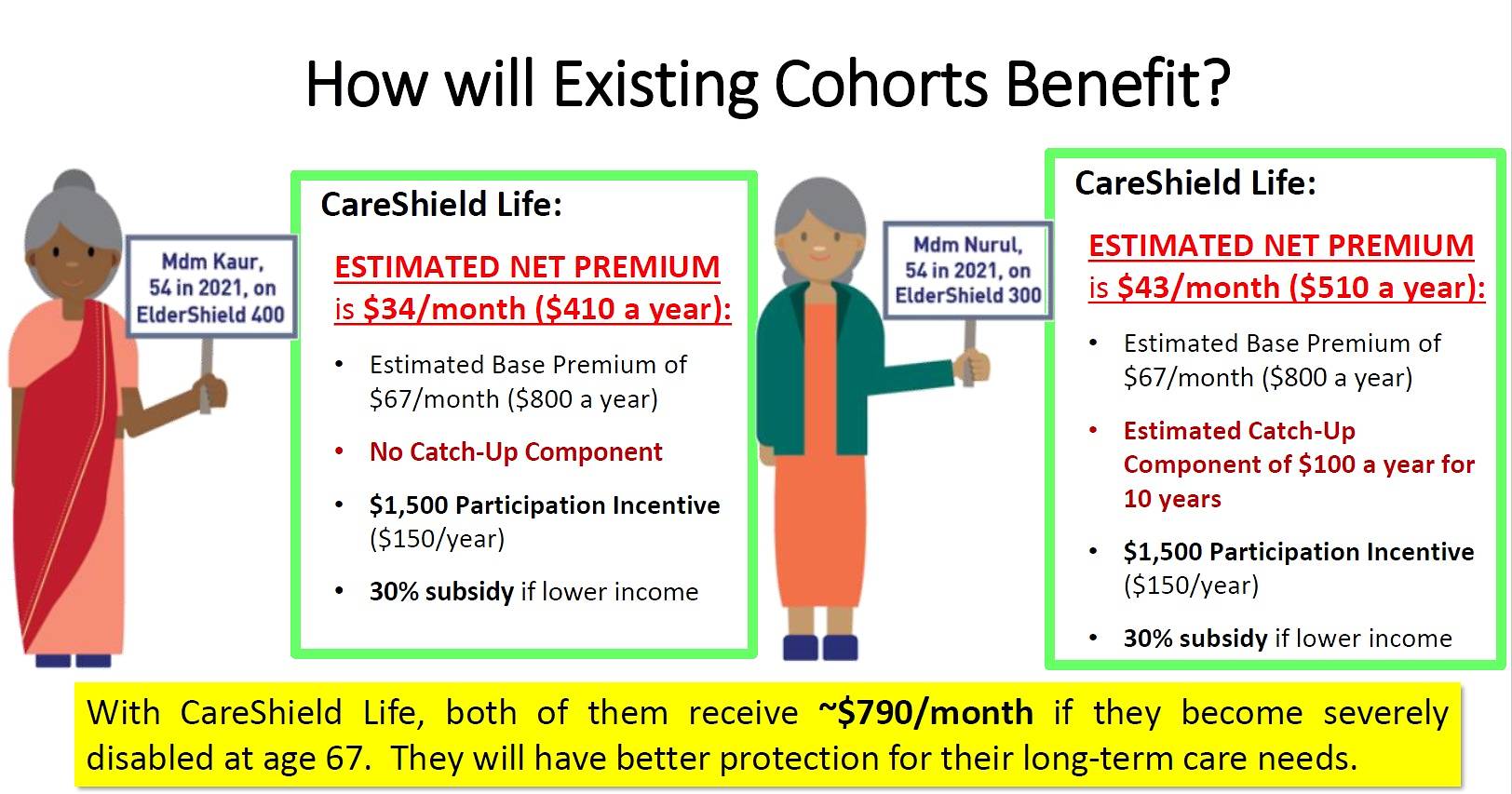
ElderShield 400 policy members who never opted out will have to pay just the base premium for CareShield Life, while others, like those on ElderShield 300 and those not on ElderShield, will have to pay an additional flat “catch-up” component.
Base premiums and “catch-up” component costs have not been fixed.
Illustration: MOH
For example, a 54-year- old woman on ElderShield 400 is estimated to have to pay an annual premium of S$410 in 2021. This is after receiving a participation incentive of S$150 for that year, and only if she receives a permanent means-tested premium subsidy of 30 per cent based on monthly per capita household income and annual value of their residence.
A woman of the same age and profile but on ElderShield 300, however, would have to pay an additional S$100 for that year as the “catch-up” component.
A 54-year-old woman who is not on ElderShield can expect to pay an even higher“catch-up” component.
Of the existing cohorts, 38 per cent are on ElderShield 400, 26 per cent are on ElderShield 300, while 36 per cent are not on ElderShield.
Those with pre-existing chronic conditions will benefit most from the CareShield Life upgrade, said Assistant Professor at the Lee Kuan Yew School of Public Policy, Dr Joelle Fong.
“They are at higher risk of transiting into severe disability, and may otherwise not be able to obtain coverage from private insurers with strict underwriting criteria,” she said.
Ms Sarah Liew, 61, a part-time bank associate is one such candidate. She said she will be joining CareShield Life despite knowing it can “quite expensive”. Ms Liew, who is currently on ElderShield 300, will have to pay a “catch-up” component along with premiums that will be considerably high because of her age.
She was unable to upgrade to ElderShield 400 due to an illness, but will be able to join CareShield Life as it does not take into account pre-existing conditions. Ms Liew said that since these can be paid through Medisave, she finds the scheme affordable.
Ms Liew’s 86-year-old mother suffers from dementia and is considered severely disabled, as she is unable to independently perform three of six activities of daily living. These activities are washing, dressing, feeding, using the toilet, moving around and the ability of transferring oneself from a bed to a chair. Her mother is also on ElderShield 300.
She said S$300 is not enough to cover for disability. While she and her eight siblings are able to provide for her mother, her situation will not be the same.
“I only have one daughter. All the burden will be on her, so I’d better get myself protected,” she said.
SINGAPORE: SAFRA Mount Faber will be transformed into an “executive lifestyle club” by next year, the club for operationally ready national servicemen said on Tuesday (Jul 3).
The 4-storey club at Telok Blangah Way will get a new facade and facilities that cater to a growing number of professionals, managers and executives among NSmen, SAFRA said.
The enhancement works will begin later in July.
One of the new facilities: A co-working space, the first of its kind among SAFRA clubs, where members can work, conduct group discussions or host networking events.
An artist’s impression of the new SAFRA Mount Faber lobby. (Image: SAFRA)
“It will be fully equipped with high-speed Internet and Wi-Fi, projectors and video conferencing capabilities with other common workplace amenities,” SAFRA said in its media release.
“Regular talks by industry professionals will also be organised in this space, where invaluable insights and ideas can be freely shared among NSmen.”
The refurbished club lobby will be able to host live entertainment such as stand-up comedy shows. Party World KTV will also be setting up an outlet at the club.
“New food and beverage outlets will also be brought on board to offer alfresco dining and stage live band performances at the club’s entertainment wing,” SAFRA said.
American burger chain Fatburger will also be setting up its first drive-through, and the third outlet in Singapore, at the club.
An artist’s impression of a Fatburger outlet with a drive-through at the new SAFRA Mount Faber. (Image: SAFRA)
A new dance studio will be added where courses such as Zumba, Pilloxing and yoga will be organised.
This is in addition to the club’s existing recreational facilities including a gym, swimming pool, bowling centre, futsal court, badminton courts and an outdoor multi-purpose court.
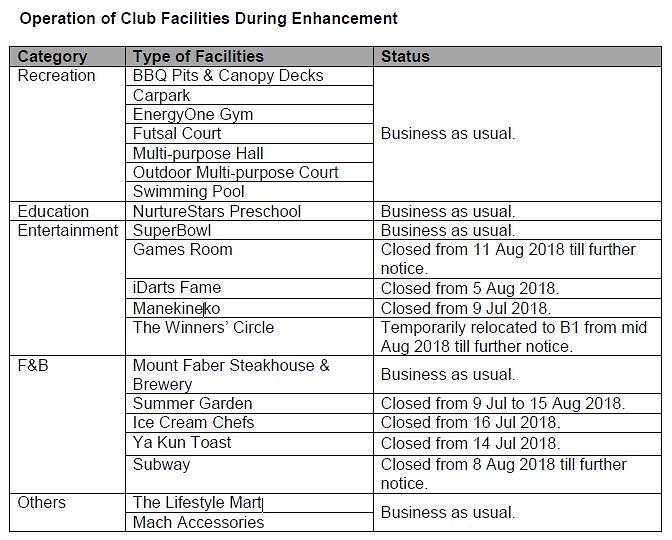
These will remain open during the club’s renovation, along with a preschool within its premises and the Mount Faber Steakhouse & Brewery.
A few other eateries, including Summer Garden and Ya Kun Kaya Toast, will be closed from mid-July.
LTC (NS) Kelvin Tan, chairman of the SAFRA Mount Faber executive committee said: “The enhanced club will be a vibrant and convenient destination at the fringe of the city centre where NSmen can come to unwind, network, or bond with their families.
“If they need to attend to some urgent work in-between, they can easily get it done at the co-working space without the hassle of having to travel elsewhere. Having all these facilities housed in one location will make it easier for our busy NSmen to juggle their work-life commitments.”
ARE you scheduled to go to Singapore anytime soon? Then you may need to get all the required jabs.
According to the country’s health authorities, the country may start turning back foreign travellers who aren’t vaccinated.
The island city-state is a popular tourist destination, receiving 17.4 million visitors in 2017. However, this makes the tightly-controlled country prone to infectious diseases.
In 2003, its nation of 5.6 million people was hit hard by the Severe Acute Respiratory Syndrome (SARS) outbreak, a disease that began in the Guangdong province of China, which borders on Hong Kong.
Singapore’s outbreak began in February 2003 when a young Singaporean woman returned from Hong Kong, where she had been infected. Because of Singapore’s small size and openness, it didn’t take long for the disease to go out of hand.
She set off a series of transmissions that spread the SARS virus to 238 people, of which 33 died, including her parents.
After the implementation of various stringent measures, including home quarantine, blanket screening of incoming travelers and school closures, the outbreak in Singapore was finally contained in May 2003.
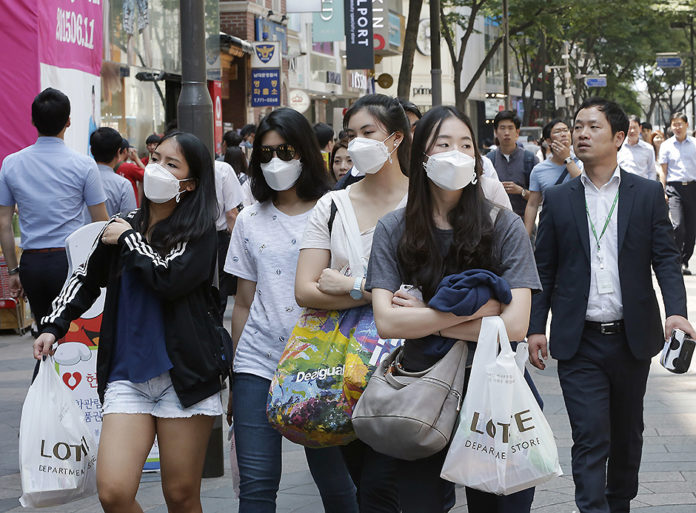
Chinese tourists wear masks as a precaution against the MERS (Middle East Respiratory Syndrome) virus as they walk on the Myeongdong, one of the main shopping districts, in Seoul, South Korea, Thursday, June 4, 2015. Source: AP Photo/Ahn Young-joon
The health crisis inflicted major losses on the economy and dramatically decreased the number of international visitors. Besides Singapore, more than 20 other countries also reported SARS cases during this global epidemic.
The Middle East Respiratory Syndrome (MERS), Avian Influenza (bird flu), and Ebola are serious public health threats globally.
Singapore’s move would safeguard the city-state from having to witness another SARS-like episode.
“As a major global trade and travel hub, it is imperative that we remain vigilant to public health threats, and safeguard the health of Singaporeans by protecting the community against new and emerging infectious diseases, both locally and overseas,” Singapore’s Ministry of Health said in a statement.
Unvaccinated travelers could be subjected to vaccination, isolation or surveillance. Those who refuse to comply could be turned away and returned to their place of embarkation.
By Singapore laws, anyone entering Singapore must be vaccinated against Yellow Fever if their point of origin is an at-risk country. This is in line with international regulations.
That having said, the ministry could require vaccinations against more disease in the future, as and when needed depending on the health situation at the time.
This article originally appeared on our sister site Travel Wire Asia.
SINGAPORE: Solar energy firm REC Group wears its award-winning “TwinPeak” solar modules like a badge of honour.
Made in Singapore, these modules can harness more sunlight than the standard module by using half-cut polysilicon cells, for example.
Their split sections also allow continuous generation of electricity in shaded areas.
The modules have been a popular choice among customers in the United States, said the Norwegian firm which bases its operational headquarters here.
However, the modules are now among thousands of products targeted in a wide swathe of tariffs imposed by the US.
More than seven months since it launched an appeal with the US Trade Representative, REC Group — which is the only manufacturer of solar panels in Singapore — has still not been granted an exemption from the tariffs.
The firm’s spokesman said it will continue to work on the process with the relevant authorities “inside and outside the US”, including the US Trade Representative and the Singapore Government.
As the US levies tariffs on goods from China, Europe and elsewhere — and retaliation in kind follows from the affected countries — there are fears that Singapore’s economy could suffer collateral damage, given the complexity of global supply chains and the increasingly inter-linked nature of world trade.
Thus far, Singapore has been minimally impacted, the Ministry of Trade and Industry (MTI) said in response to media queries.
Indeed, just as some firms such as REC have been hurt in the tariff tit-for-tat, others stand to gain.
But one thing is for sure: If a full-blown trade war erupts, Singapore, even if not directly targeted, stands to suffer because it is so plugged into the global economy.
An MTI spokesperson said the Government’s economic agencies are in “close contact” with firms in Singapore that may be adversely affected by the tariffs.
“Singapore has also registered our concerns with the relevant US and China departments and is continuing to engage them,” said the spokesperson, who did not respond to a query on the number of firms affected.
In January, US President Donald Trump’s administration fired its opening salvo at imported washing machines and solar panels, on the basis that these foreign products are a “substantial cause of serious injury to domestic manufacturers (in the US)”.
While targeted primarily at China and South Korea, the tariffs on solar panels and washers — as well as those imposed on aluminium and steel last month — punish firms worldwide, except those that have been granted exemptions.
Within a few months, the number of products affected by the US-China trade war has grown to now stand at over 1,500, amounting to a combined US$100 billion worth of trade between the two economic superpowers.
At the same time, the White House is also waging other trade wars with Canada, Mexico and the European Union (EU).
The MTI spokesperson said that the ongoing trade war between the US and China has had “limited” direct negative impact on Singapore’s economy to date.
The ministry estimates that a “modest” 0.1 per cent of the Republic’s domestic exports are affected by the tariffs.
Still, the Government remains “concerned” by the tariff measures taken by the world’s two biggest economies, and the mounting trade tensions between them.
“These can have negative spillover effects on global supply chains and dampen investor and consumer confidence, in turn weighing on global growth … We hope that countries will exercise restraint and avoid further escalation of tensions,” said the spokesperson.
The Stars and Stripes flutters alongside the EU flag at the AgroSevilla facility, but farmers like Juan de Dios Segura fear getting vaught up in a trade war. (Photo: AFP/JORGE GUERRERO)
‘NOT ALL DOOM AND GLOOM’
Nevertheless, how the trade disputes could impact Singapore firms will vary, depending on their products, the role in the value chain, and their primary markets, among other factors.
While REC Group, for example, may see shrinking revenue streams from its US market, other players in the solar industry here — which are typically involved in assembling rather than manufacturing solar panels — see some opportunities as a result.
If consumption of China-made solar panels in the US falls, the Chinese manufacturers would have a surplus of supply, hence driving prices down for other export markets.
This could in turn allow Singapore firms to extend better discounts to its customers.
“The tariffs dispute actually benefits solar developers like ourselves,” said Mr Frank Phuan, chief executive officer and co-founder of sustainable energy firm Sunseap.
If the tariffs make Chinese exporters less competitive, they could also allow Southeast Asian companies to make inroads into the American economy, said trade economists.
While the term “trade wars” often ignite negative sentiments, they may not be all doom and gloom, said DBS economist and executive director Irvin Seah.
He noted that Singapore may benefit from “trade diversion”, if Chinese firms currently operating in the US relocate their operations to South-east Asian countries such as Vietnam and Thailand, where production costs are low.
“These firms may not produce their goods in Singapore, but could set up regional headquarters here, given that we are known to be good for trade financing … Hence, Singapore could benefit from this reshuffling of the global supply chain,” said Mr Seah.
However, if more products get pulled into the trade disputes, experts said Singapore firms that are involved as upstream suppliers in the value chain could see their order books take a hit.
Already, Singapore-listed commodity and agribusiness firms, such as Wilmar International, have seen their stock prices fall in April following the tariff announcements.
A broader cause of concern is how mounting trade tensions have led to greater levels of uncertainty across the world.
“This will lead to postponed investments. Companies are likely to adopt a wait-and-see attitude to see if tensions resolve and a grand bargain can be found … Given that global trade is so interconnected, all economies will be impacted. No one is going to be immune,” said Mr Eduardo Pedrosa, Secretary-General of the Pacific Economic Cooperation Council (PECC).
Ships ply the Straits of Malacca and Singapore. (Photo: AFP/Roslan Rahman)
WHAT SPARKED THE TRADE WAR
Since his presidential campaign in 2016, Mr Trump has favoured a protectionist trade policy, an approach which he says is aimed at reviving the US domestic industry.
In particular, his country’s widening trade deficit with China drew the president’s ire, prompting him to impose tariffs on US$50 billion of Chinese imports over 1,100 product lines, ranging from consumer electronics, agricultural products to sporting equipment.
These are expected to set in this coming week.
After Beijing responded in kind on Jun 16, announcing that it would impose its own tariffs on 545 categories of US products worth US$34 billion, Mr Trump threatened three days later to slap more tariffs on another US$200 billion worth of Chinese goods.
Washington’s trade deficit with Beijing — which refers to the excess of the US’s imports over its exports for goods and services — rose to a record high of US$375 billion last year.
Apart from narrowing the trade imbalance, Mr Trump wants to restrict Chinese investment in the US, as “punishment” for what the White House alleged to be China’s “theft” of American intellectual property.
According to US trade officials’ seven-month investigation into China, directed by Mr Trump, China imposes foreign-ownership restrictions to compel American firms to share technology with Chinese companies, in exchange for access into China’s vast and growing market.
While China may be its prime target, the US has not spared the rest of the world.
The US’s overall trade deficit in goods and services with the world has also spiked 12.1 per cent to US$566 billion last year, the largest gap since 2008.
In January, it imposed steep tariffs on all imported washing machines (up to 50 per cent) as well as solar cells and panels (30 per cent) on the basis that both types of imports “are a substantial cause of serious injury to domestic manufacturers”.
From June, the US also slapped tariffs on steel (25 per cent) and aluminum (10 per cent) imports from Canada, Mexico and the EU, in the interest of “national security”. The global oversupply of these commodities has “weakened (the US’s) internal economy” and “threaten to impair national security”, the Trump administration had said.
Mr Trump also called for the re-negotiation of the North American Free Trade Agreement — the world’s largest free trade bloc comprising the US, Canada and Mexico — labelling it “the worst trade deal the US has ever signed”.
China swiftly retaliated by imposing “equal” tariffs on US products following a decision by Donald Trump to slap duties on US$50 billion of Chinese products. (Photo: AFP/Brendan SMIALOWSKI)
COMPLEX IMPACT
While small states such as Singapore may not be on the front lines of the Sino-American tit-for-tat, the Republic will inevitably suffer collateral damage as an economy highly dependent on trade.
China and the US are Singapore’s top and fourth trading partners, respectively.
The MTI spokesperson cautioned: “Should there be a significant impact on global trade and global growth, both big and small economies alike will be affected.”
Trade economists agreed that Singapore, as one of the world’s top transshipment hubs, could be negatively hit by growing economic uncertainty and lower investor confidence worldwide.
Firms here that supply component parts for assembly in China could also see their order books take a momentary hit, they said.
Broadly speaking, they expect impact on firms here to be “minimal” to “moderate”.
Forecasting the extent of impact on each sector is a tall order, said observers.
They noted that it depends on the product, how much demand changes in response to price hikes, and whether substitutes are readily available, among other factors.
According to the United Nations’ Comtrade Database, the Republic’s exports to China last year amounted to S$54 billion, up 22 per cent from the previous year.
Singapore’s exports to the US totalled up to S$24.2 billion last year, up 7 per cent from the previous year.
Electrical machinery, industrial machinery, oil and mineral fuels, and precision instruments are among the most traded goods in Singapore.
File photo of a robot production facility launched by Singapore precision engineering firm PBA Group and a Korean industrial robot company. (Photo: Brandon Tanoto)
While observers were divided on the extent of harm the trade spat can “indirectly” cause to Singapore, they agree that the dampening of global sentiments could act as a “drag” on the Republic’s trade-driven economy.
“Products and services are often no longer made in any one place. They are made of raw materials processed in different locations around the world, and then assembled before reaching consumers … Singapore is a key transshipment hub in the world, and lower trade volumes (across the world) will have a knock-on effect on that,” said the PECC’s Mr Pedrosa.
Mr Frank Debets, managing partner of PricewaterhouseCoopers’ Worldtrade Management Services, reiterated that it is hard to ascertain how “badly hit” Singapore may be when there are many moving parts. “Although Singapore is an open economy and relies on international trade for a significant portion of its Gross Domestic Product (GDP), it is also strong in other economic areas that are not so affected by the current trade tensions.”
It may be better to analyse impact on specific firms or industries, rather than countries as a whole, said Mr Debets.
‘NEGLIGIBLE’ IMPACT FOR NOW, SAY SINGAPORE FIRMS
Firms in the solar and electronics sectors said they expect the impact to be negligible in the short run.
Most firms that deal with solar cells here — with the exception of REC Group — do not manufacture them, and are thus not directly hit by the tariffs.
Mr Christophe Inglin, managing director of renewable energy installer Energetix, said the tariffs on non-US solar manufacturers could actually benefit his business slightly.
“We source some equipment from the US, but not much … Tariffs imposed by the Trump administration will reduce imports to the US, leaving manufacturers with more capacity to supply to non-US markets, which could slightly reduce market prices in Asia,” he said.
Like Energetix, Phoenix Solar — which primarily integrates photovoltaic systems — does not have extensive dealings with the US.
Mr Alvin Yogaraj David, the firm’s former vice-president, echoed Mr Inglin’s views:
While sales of solar components to the US may go down, Chinese suppliers still have to maintain a certain sales volume.
“This may result in a decrease in price of solar modules exported to Asia … Reports have also shown that China has excess inventory (of solar components) and is expected to reduce prices to clear its stock.”
REC Group — which has launched an appeal with the US Trade Representative to exempt two made-in-Singapore crystalline silicon photovaltic products from the tariffs — declined to share how much of its products are exported to the US.
According to REC’s report of its performance in the fourth quarter last year, it was one of the five most popular brands of solar panel for homes in the US.
Apart from the US, REC also has “very strong relationships” with customers in Europe and Asia Pacific, said its spokesperson.
Business owners from the electronics industry — which accounts for over a quarter of Singapore’s manufacturing GDP — were unperturbed about potential spillover effects from a reduction in American demand for various goods, such as automobiles.
File photo of a manufacturing facility in Singapore. (Photo: AFP/Roslan Rahman)
“I feel these trade tariffs have not affected Singapore heavily, or at least not yet. The impact would be larger if the US expands the products taxed,” said a member of the Association for Electronics Industry in Singapore, who declined to be named.
“The electronics and semiconductor clusters exports semi-finished goods to neighbouring countries for full assembly, so we are not significantly affected (by the tariffs).”
Still, he acknowledged that the sector may “slow down” its investments into new product lines due to the uncertainty, he said.
LONG-TERM FALLOUT: A BROKEN MULTILATERAL SYSTEM?
Some observers, nevertheless, are calling for firms here to take action to mitigate effects of a global trade slowdown, such as by exploring alternative sources or destination countries for their products or ship them before the tariffs kick in.
“Doing nothing in the hope that it will blow over would not be a prudent option,” said Mr Debets.
Singapore Business Federation (SBF) chief executive Ho Meng Kit urged the industry to “be watchful over this”.
“We should be very concerned,” he said.
“Currently, Singapore is not directly targeted as the US has a trade surplus with us. But we will suffer collateral damage because of the integration of the global value chain … Our companies should let us know if they are impacted.”
Consumers here may also have to bear higher prices of some American exports, said Associate Professor Pradumna Bickram Rana from the S Rajaratnam School of International Studies.
From blue jeans to motorbikes and whiskey, the EU’s hit-list of products targeted for tariffs with the US includes many emblematic American exports. (Photo: AFP/JOE RAEDLE)
“For instance, faced with higher costs of raw materials like steel and aluminum, manufacturers of automobiles and computers in the US would face higher costs of production and thus have to mark-up prices when they export,” said Assoc Prof Rana, who coordinates a programme on international political economy at the school’s Centre for Multilateralism Studies.
Perhaps what is of greater concern, said National University of Singapore economist Davin Chor, is the “broader chill” this episode could cast on international trade.
“The invoking of ‘national security’ concerns by the US to justify their use of tariffs (on steel and aluminum) has set a bad precedent,” said Assoc Prof Chor.
“It is much harder for countries to dispute what constitutes ‘national security’ concerns at the World Trade Organisation, which raises the spectre that this justification could be used with unchecked frequency.”
SBF’s Mr Ho warned that much as people wish for the current tit-for-tat to be no more than “high-stake negotiation tactics”, they could instead be pointing to something more permanent — the start of a “dysfunctional relationship between US and China as their interests and values collide on the world stage”.
As a small country dependent on a multilateral, rules-based trading system, it is important for Singapore to work with stakeholders of like-minded countries to counter this negative development, Mr Ho urged.
“We should diversify and lock ourselves in preferential trading arrangements with other regions such as through the Comprehensive and Progressive Agreement for Trans-Pacific Partnership, the Regional Comprehensive Economic Partnership and the EU-Singapore Free Trade Agreement. We must be nimble enough to capitalise on changes in global trade flows,” he said.
Even within the US, some firms that Mr Trump had said will benefit from his trade policies are now bearing the brunt of protectionism.
Motorcycle manufacturer Harley-Davidson, for instance, announced last week that it will move some of its bike production overseas to avoid the “tremendous cost increase” due to the EU’s retaliatory tariffs.
A Harley-Davidson motorcycle pictured in Germany, where the EU has retaliated with tariffs on the legendary American brand. (AFP/John MACDOUGALL)
Almost two weeks ago, the EU hit back against Mr Trump’s steel and aluminum tariffs with penalties on US$3.2 billion worth of American products, including bourbon, orange juice, and Harley-Davidsons.
American automaker General Motors warned on Friday that Mr Trump’s proposal to launch another wave of tariffs, which would include cars and car parts, could backfire and drive vehicle prices up by thousands of dollars.
This would result in “less investment, fewer jobs and lower wages” for its employees, said the multinational firm.
Until cooler heads prevail, trade-dependent nations are in for a bumpy ride amid waves of uncertainty, said Assoc Prof Chor.
The escalation of trade wars will be a significant threat to the rules-based multilateral trading system that has over the decades provided stability and predictability for businesses to invest, said PECC’s Mr Pedrosa. He said:
I’m worried that the recovery we are seeing could stall as investors wait on the sidelines.
“We are already seeing jittery financial markets around the world. Tit-for-tat retaliations will only increase the volatility.”
SINGAPORE: The world we know today is a function of productivity gains over time.
Productivity is at the core of the story of growth. It is productivity improvements driven by innovation, technology and skills which explain the global growth story since the industrial revolution in the eighteenth century. With this growth, has come the uplifting general welfare of wide swathes of the global population.
However today, despite all the hype and excitement on the promise of a digital future, productivity has been in secular decline since the 1990s for all advanced economies.
For Singapore, lifting productivity has been a central tenet of economic strategies dating back to the early 2000s and received intensified emphasis in both the Economic Strategies Committee or ESC plans in 2010 and the more recent Committee of Future Economy’s 23 Industry Transformation Maps or ITMs.
THE PRODUCTIVITY PUZZLE
Explaining why productivity growth levels have been falling and remain at low levels of 1 to 2 per cent even for strong economies has challenged economists.
There are variety of possible explanations. Standard measures of productivity may not be taking into account the full impact of digitalisation.
It may also be that digitalisation has a very long cycle and the productivity gains are back-loaded and will be realized further into the future.
It may also be that we need a fundamental rethink about how to conceptualise productivity. The most pessimistic view is that at long last, after 250 years, the march of innovation is petering out.
File people of people ordering food. (Photo: Wong Ruyi)
The upshots of the productivity puzzle are twofold. First, that it is not unique to any one economy.
Second, that a better understanding of what is happening to productivity is critical to sustaining growth in the future, making it an urgent priority for all economies. For every country, particularly those on the lower rungs of the development ladder, that imperative is crucial to enabling the well-being of their people.
A more global effort to lift productivity matters because only by doing so can we aggregate resources, learning and share best practices sufficiently to match the scale, complexity and diversity of the challenge.
Low productivity is not only a challenge for advanced economies nor only for industrialised sectors. Boosting productivity in agricultural regions will be critical to confidence in the long-term prospects of feeding a rising global population without excessively depleting finite natural resources and polluting the environment.
THREE SHIFTS NEEDED
There are three major shifts which are needed.
First, there needs to be a greater recognition and sense of urgency on the need to understand productivity and to deploy effective policies to sustain its gains into the future.
Second, there must be a higher sense of national and collective ownership of this challenging task. No one country can do it alone but all countries will benefit from the understanding achieved and solutions developed.
Third, there must be willing leaders to champion the cause of productivity for the broader good. Strong and advanced economies such as Singapore would be natural candidates. They have the fiscal capacity to invest in research, test out innovative policies and facilitate the sharing of knowledge.
Automation has transformed the productivity of manufacturing since industrial robots first started painting, cutting, welding and assembling in the 1960s. AFP/OLI SCARFF
Less affluent countries, with limited resources, must in turn be willing to be committed to learning, applying and notwithstanding the support of others, must to their utmost extent, contribute willingly and ably to efforts to improve their own productivity levels.
Productivity improvements are something that has been taken for granted for too long. It has been assumed as axiomatic that with technological change will come productivity gains. This comfortable and convenient assumption is not holding true. All economies have a stake in understanding why this is so and what needs to be done about it.
CHAMPIONING PRODUCTIVITY
Singapore is the current Chair of ASEAN. This, together with its economic strengths, place it in an ideal position to take the lead in championing productivity in ASEAN.
Singapore should demonstrate that its interests extend beyond its parochial sovereign boundary and that it is prepared to play a role as a leading, responsible and effective regional and global citizen
If Singapore steps forward as a role model, there is every chance that other Asian advanced economies such as Japan, Korea, Hong Kong and Taiwan will be inspired to join forces to achieve critical mass in productivity targeted research, policy and programme efforts.
Singapore’s impact need not be limited to Asia. Singapore has a history of taking the lead globally. Singapore made a critical contribution to the 1982 United Nations Convention of the Law of the Sea (UNCLOS) and in 2015, it was designated the Asian venue for the International Tribunal for the Law of the Sea.
In the early 1990s, Singapore was the moving force behind the United Nations Forum for Small States (FOSS) which in 2017 marked its 25th anniversary. From 2000 to 2002, Singapore served as non-permanent member of the United Nations Security Council (UNSC), with the added distinction of acting as President of the Council in January and May 2002.
More applicably to the topic of productivity, Singapore’s Deputy Prime Minister and Coordinating Minister for Economic and Social Policies Mr Tharman Shanmugaratnam, served as Chairman of the International Monetary and Financial Committee (IMFC) from 2011 to 2015. There is scope for Singapore to propose and take the lead to spearhead a Productivity Task Force (PTF) within the International Monetary Fund (IMF).
The future is a shared space and there is no better panacea for peace and stability than broadly distributed and sustained growth and the positive economic and social knock-on effects that flow from it.
Productivity and peace are conjoined twins. Not only are both worth nurturing, but one cannot be sustained without the other.
SINGAPORE: A total of 7,484 cartons of duty-unpaid cigarettes were seized from two Malaysia-registered cargo trucks at Tuas Checkpoint last Thursday (Jun 28).
The first truck was directed for checks at about 2am, said the Immigration and Checkpoints Authority (ICA) in a news release on Monday.
It added that duty-unpaid cigarettes were found in black polythene boxes which were hidden under the floorboard of the truck.
Less than an hour later, at 2.50am, cartons of cigarettes were found hidden in the same manner, in another unladen cargo truck.
The duty-unpaid cigarettes were found concealed under the floorboard of the trucks. (Photo: ICA)
The total duty and Goods and Services Tax (GST) evaded amounted to more than S$750,000, said ICA.
It added that the two truck drivers, Malaysian men aged 35 and 42, were handed over to Singapore Customs for further investigations. The vehicles may also be forfeited.
“The ICA will continue to conduct security checks on passengers and vehicles at the checkpoints to prevent attempts to smuggle undesirable persons, drugs, weapons, explosives and other contraband,” said the authority.