Home Blog Page 1002

Public service must pick up new skill sets to transform itself: Chan Chun Sing

SINGAPORE: The Moments of Life initiative, which bundles services and information for citizens when they need it, represents a “fundamental shift” in the public service’s mindset, Minister-in-charge of the Public Service Chan Chun Sing said on Wednesday (Jul 4).

The initiative, which was first announced last year as one of five Smart Nation strategic national projects, was one of the examples cited by Mr Chan on how the public service has continuously sought to improve its services to citizens.

“All these projects show a gradual but definite shift in the public service – that today, increasingly so, as we organise ourselves, our mindset is not how we serve our organisational needs, but how we serve the people,” Mr Chan said during the Public Sector Transformation Awards ceremony.

Chan Chun Sing awards 3

Minister-in-charge of the Public Service Chan Chun Sing gives the opening address at the Public Sector Transformation Awards ceremony. (Photo: Facebook/Chan Chun Sing)

“The people are at the centre of all that we do. This is the mindset that encourages me a lot when I see the public service in action because it tells us that we have the correct people with the correct values.”

ADOPTING NEW SKILL SETS

Addressing a crowd of about 900 attendees, including public service officers, Mr Chan highlighted the importance of continuously adopting new skill sets. These include building digital capabilities, designing policies and services from the people’s perspective, and coming up with whole-of-Government solutions. 

Mr Chan said new programmes to help upgrade the digital literacy of public servants will be rolled out over time.

“Increasingly, the types of problems we face will be inter-disciplinary and inter-agency,” said Mr Chan, who cited the example of the Housing and Development Board (HDB). “Today, when HDB designs towns, it is not just designing flats and precincts for housing needs. HDB also looks at it from a social perspective – how do we design our towns to enable and enhance interaction and mixing? How do we design our estates such that today’s need for privacy do not lead to social isolation when people grow old?”

Chan Chun Sing awards 2

Minister-in-charge of the Public Service Chan Chun Sing at the Public Sector Transformation Awards ceremony. (Photo: Facebook/Chan Chun Sing)

Mr Chan also emphasised the importance of collaboration both within and across agencies, as well as with society: “Collaboration starts from the basic premise that we have the humility to admit and accept that we can’t do it alone, and we do not always have the best ideas within our agencies.”

“It may sound daunting that we have all these new things to do, but we do not need to be afraid,” said Mr Chan. “If we can do these things progressively, module by module, and expose our officers to these new skills, I’m quite confident that we will continue to remain at the forefront.”

“We have reached a high level and are respected throughout the world for many of the things we do, but we are never satisfied just because of where we are. We know that many other cities are trying to copy what we do, and perhaps even overtake us. And this is why we can never be complacent about being the best.”

George Lim operations manager at CHIJ Kellock

Mr George Lim redesigned the trolley to include an extra wheel and foot pedal – serving as a lever – to help transport tables and chairs with less strain, with his team “very happy” using it. (Photo: Wendy Wong)

During the ceremony, 400 awards were given out to individuals and teams in recognition of their excellent service and innovation. One of them was Mr George Lim, operations manager at CHIJ Kellock, who was honoured for his innovations at his workplace. 

The 56-year-old had redesigned a trolley used to move tables and chairs to include an extra wheel and foot pedal, for the benefit of his team of operations support officers – many of whom are aged between 60 and 80. 

“We saw a lot of staff moving tables and chairs using a simple trolley. And they have to literally manhandle the trolley itself – lifting it by muscle and pushing it from point A to B,” said Mr Lim. 

“Each time they carry heavy tables and chairs – I’m talking about 40 to 50kg of weight. And every time they carry about 400-500 tables and chairs.

“At the end of an hour, they will be so tired (with) muscle back pain. This cannot carry on, so we had to think of something that can make it easy for them to transport all these equipment from point to point without injuring themselves,” he said.

For his innovation, Mr Lim was awarded with a distinguished star service award, which recognises public officers with high standards of service excellence.

Source link

Need more water? PUB aims to produce more with same amount of resources

SINGAPORE: Every time you go to the toilet, your waste enters the sewers as used water, gets treated at a water reclamation plant, then processed into NEWater or released into the sea.

The treatment process also produces sludge, a mud-like mixture of solid and liquid bits that goes into the incinerator and then dumped in the landfill.

Sounds simple enough, but there’s a problem: It’s not just a bit of mud. 

Singapore consumes 430 million gallons of water a day (mgd), enough to fill 782 Olympic-sized swimming pools, and generates 300,000 tonnes of sludge a year, equivalent to the weight of 3,000 buses.

These figures are not about to go down. By 2060, when Singapore is set to use twice the amount of water it does now, it will generate 600,000 tonnes of sludge annually.

This presents a challenge, as Semakau Landfill is projected to run out of space by 2035 at the current rate waste is being generated and burnt.

Enter national water agency PUB, which is trying to recycle more of the sludge into biogas, an important source of energy.

PUB is already turning some of the sludge into biogas, which means its four water reclamation plants are 25 per cent energy self-sufficient.

This is because its plants have digestors that convert the organic matter in sludge into biogas, which can in turn power generators.

Changi Water Reclamation Plant

Pump shafts in the Deep Tunnel Sewerage Sytem pumping station at the Changi Water Reclamation Plant in 2009. (Photo: Don Wong / TODAY)

But within the next decade, PUB wants its plants to be fully energy self-sufficient. This means turning even more sludge into biogas through technological innovations.

One way is through a thermal hydrolysis process (THP), which pre-treats sludge using high temperature and pressure to improve its breakdown rate in digestors. This allows more organic content to be converted to biogas.

PUB is testing this technology at a demonstration plant at the Jurong Water Reclamation Plant. The demonstration plant can treat up to 70 tonnes of sludge a day.

The agency is also testing a “novel combination” of processes, including a biologically enhanced treatment facility and energy-efficient membrane bioreactor (MBR) that helps shorten the treatment process, reduce energy use and maximise biogas production.

This combination is being validated at the Ulu Pandan wastewater treatment demonstration plant, which uses 40 per cent less energy than a typical plant.

WHAT’S THE BIG DEAL?

Besides extending landfill lifespans, how will reducing the energy and waste footprint of treating used water benefit people?

As PUB explains, used water treatment is the “backbone” of NEWater production, which currently supplies up to 40 per cent of Singapore’s water demand. By 2060, NEWater will supply up to 55 per cent.

NEWater plant

File photo of NEWater plant. (Photo: PUB)

The same goes for desalinated water, another national tap that will be stretched by rising demand.

“Meeting future water demand with today’s technologies will see PUB’s energy footprint quadruple to 4,000GWh/year and the amount of sludge generated double to over 600,000 tonnes a year by 2060,” PUB said on Tuesday (Jul 3). “This is unsustainable and can only be overcome by leveraging technological innovations.”

That energy footprint would have been enough to power 686,000 5-room Housing and Development Board flats for a month.

“The price of energy is going to go up,” PUB’s assistant chief executive (future systems and technology) Harry Seah said. “If you don’t do anything today, the cost of producing water is going to go up.”

WATER PRICES

When asked if the technological innovations would help keep water prices stable, Mr Seah said “we do our part through efficiency to drag it (out) as long as possible, that’s the best I can do”.

Since July, the price of water has gone up 30 per cent following a two-step increase. The hike was in line with the rising costs of producing water.

Tap water (2)

File photo of tap water. (Photo: AFP/Yoshikazu Tsuno)

“Whether the price will go up, I don’t know, but we can try our best to make our water affordable to the public,” he added, highlighting that it would also depend on other factors like manpower. 

“Basically, we have to look at it from the point of view of sustainability, besides dollar and cents.”

INVESTING IN R&D

And so PUB’s target is clear: Produce double the amount of water to meet 2060 demand, but with the same energy and waste footprint.

To do this, it has – together with partners – invested an average of S$30 million a year in water technology research and development (R&D), enabling technologies like THP and MBR to progress beyond proof-of-concept.

electro-desalination facility 3

The electro-deionisation process that separates salt from seawater takes place in these modules. (Photo: Aqil Haziq Mahmud)

For instance in desalination, PUB has invested in electro-deionisation (EDI) technology, which uses an electric field to extract dissolved salts from seawater.

In contrast, desalination is currently done by reverse osmosis (RO), which involves pushing seawater through membranes that filter out salts and impurities.

The fact that EDI revolves around extracting a small component out of a larger base, as opposed to other way round in RO, means it consumes less energy.

electro-desalination facility 2

The electro-desalination facility in Tuas is being used to demonstrate that the technology works, before it is transferred to the new Tuas Desalination Plant. (Photo: Aqil Haziq Mahmud)

While current desalination technology uses 3.5kWh/m3, an EDI demonstration plant in Tuas is consuming 2.4kWh/m3 to process 3,800m3 of water a day.

The target is to bring this down to 1.8kWh/m3 by the end of the year, while there are also plans to further validate the technology at 10,000m3 of water a day at the new Tuas Desalination Plant.

Beyond EDI, PUB is pouring resources into other water technologies ranging from electrical fields to cell membranes, all in the name of reducing energy consumption.

REDUCING WATER DEMAND

While these bode well for boosting the efficiency of water supply, Mr Seah insisted that managing water demand is equally important.

“Even when I say water demand is doubled, I’m going to try ways and means to impede the rate of increase of the demand,” he said.

Mr Seah said the PUB has been “quite aggressive” in encouraging industries to recycle their processed water, in a bid to reduce demand by 3mgd every year. 

pub smart water meter

A family living in Punggol testing out the new smart water meters that aim to drive water efficiency within households. (Photo: Facebook/PUB, Singapore’s National Water Agency)

As for consumers, Mr Seah said the automated meter reading (AMR) project will help PUB monitor efficiency and energy savings, as well as calibrate demand and supply.

In 2016, PUB piloted the project to provide some 500 households in Punggol with “timely” information on water consumption.

“Most important, it is to change the behaviour of consumption,” Mr Seah added. “If you turn it into a behavioural change, if a member of the public thinks it’s the last drop, then you will be very careful using water.”

Source link

New Seletar Airport passenger terminal to open by end-2018

SINGAPORE: The new passenger terminal at Seletar Airport which costs S$80 million will be operational by the end of 2018, said Changi Airport Group (CAG).

The two-storey, 10,000 sq m terminal can handle 700,000 passenger movements a year – about 26 times more than the number of passengers it saw in 2016, according to CAG.

The departure area will house four check-in counters, six immigration lanes, two security screening stations and a gate holdroom that can accommodate 200 passengers.

Seletar Airport check-in counters

Artist’s impression of Seletar Airport check-in counters. (Image: Changi Airport Group)

“This new terminal will provide Seletar Airport with the capacity it needs to handle the upcoming growth in aviation activities in the years ahead,” said Mr Khoh Su Lim, Deputy General Manager of the airport.

“It’s going to provide our passengers with a more efficient process flow for both scheduled as well as non-scheduled passengers.”

Managed by CAG, the terminal will also have three aircraft parking stands next to it.

That will increase the efficiency and convenience of boarding the planes, the management team said.

A private area, known as the Seletar Business Aviation Centre, will also be set up for those travelling on chartered business flights and private jets.

But the terminal will not have any retail outlets, except for one food & beverage stall.

Malaysian carrier Firefly will shift its operations from Changi Airport to Seletar when the terminal opens.

It will continue running its 20 daily turboprop flights – to and from Subang, Ipoh and Kuantan.

Changi Airport Group said relocating these “smaller and slower aircraft operations” to Seletar would help “optimise the use of resources to meet growing capacity demands” at Changi.

Observers say that this move would benefit certain segments of the market.

“Some consumers who fly between Singapore and Kuala Lumpur will benefit as they might appreciate the convenience of a very small airport that’s easy to go through,” said Mr Brendan Sobie, Chief Analyst at CAPA Centre for Aviation.

Another plus for consumers is that fares could go down if more players enter the market.

“We expect competition on the route, which hasn’t been possible until the opening of this airport. Malindo Air may now be able to compete with Firefly on the market – which should drive down the fares, which are relatively high between Changi and Subang. What that will do is potentially stimulate initial demand,” added Mr Sobie.

However, he also said that the new terminal may not move the needle on Singapore’s passenger arrivals. Its capacity is about 1 per cent the size of Changi Airport’s 62 million passenger arrivals last year.

The upgrade marks the latest step in the redevelopment of Seletar Airport which started in 2008.

Since then, the airport has undergone several enhancements, such as the lengthening of its runway and the construction of a new control tower and fire station. 

Source link

Singapore-China ties: DPM Teo Chee Hean meets Chongqing Party Secretary

CHONGQING: The developments in China have been tremendous since the country began its reform and opening up policy 40 years ago, said Singapore Deputy Prime Minister Teo Chee Hean as he met Chongqing Party Secretary Chen Min’er on Wednesday (Jul 4).

“China and Singapore have a very long relationship, which goes back to the time of Mr Deng Xiaoping and Mr Lee Kuan Yew,” said Mr Teo, who noted that both leaders had also met 40 years ago.

“When they met, they could see how China and Singapore could work together to contribute to China’s development and growth.” 

Singapore and China are currently working on their third joint project – the Chongqing Connectivity Initiative – which aims to better link Chongqing to Western China, as well as the rest of China and the world.

Earlier on Wednesday, Mr Teo visited the Guoyuan Port, located at the upper reaches of the Yangtze River.

TCH at Guoyuan port

Singapore Deputy Prime Minister Teo Chee Hean visits the Guoyuan Port. (Photo: Ministry of Communications and Information

The port is key in connecting the Yangtze River economic belt, as well as regions along China’s Belt and Road.

It is also one of the sites where Singapore is working with China to introduce multi-modal and logistics solutions – to connect roads, as well as rail and maritime nodes.

For example, one possibility it is looking into is an automated airlifting system to better transport containers between the port and rail station.

Chongqing has aspirations to become an inland international logistics hub, as well as a multimodal transport and logistics centre for Western China.

Source link

MAS’ net profit declines to S$5.3 billion due to strong Sing dollar

SINGAPORE: The Monetary Authority of Singapore (MAS) made a net profit of S$5.3 billion in the previous financial year, according to its annual report for FY2017/18 released on Wednesday (Jul 4). 

The figure, which excludes a S$1.1 billion contribution to the Consolidated Fund, is lower than last year’s record net profit of S$24.3 billion as negative currency translation effects partially offset interest income and investment gains. 

For the year that ended Mar 31, 2018, MAS made a gain of S$8.5 billion from the investments of its official foreign reserves (OFR). 

While the OFR recorded “strong” gains of S$22.3 billion as global markets continued to rally, S$13.8 billion of negative currency translation effects was incurred as the Singapore dollar strengthened against the US dollar and the Japanese yen. 

This compared with the investment gain of S$30.1 billion made during FY2016/17, helped by higher investment returns and the depreciation of the Sing dollar against some major currencies.

MAS FY2017-2018 reserves management infographic

(Photo: Monetary Authority of Singapore)

“Investment gains … are inherently volatile,” said MAS managing director Ravi Menon. 

“The best way to interpret the number is to look at the 10-year average (which is a) good judgment of the kinds of investment gains that MAS is making over a long-term period. Year to year, there will be fluctuations.”

Over the last 10 financial years, investment gains, derived after stripping out currency translation effects, averaged S$12.1 billion per annum, according to the annual report. 

At the end of Mar 2018, MAS held S$376.5 billion of OFR on its balance sheet. This is invested in a well-diversified portfolio, comprising different asset classes across various geographies, for good long-term returns and resilience across market conditions. 

About three-quarters of the MAS’ portfolio are denominated in the US dollar, euro, yen and British pound, with the greenback forming the bulk. Investment-grade bonds in the advanced economies form the largest allocation in the portfolio, said the central bank.

Source link

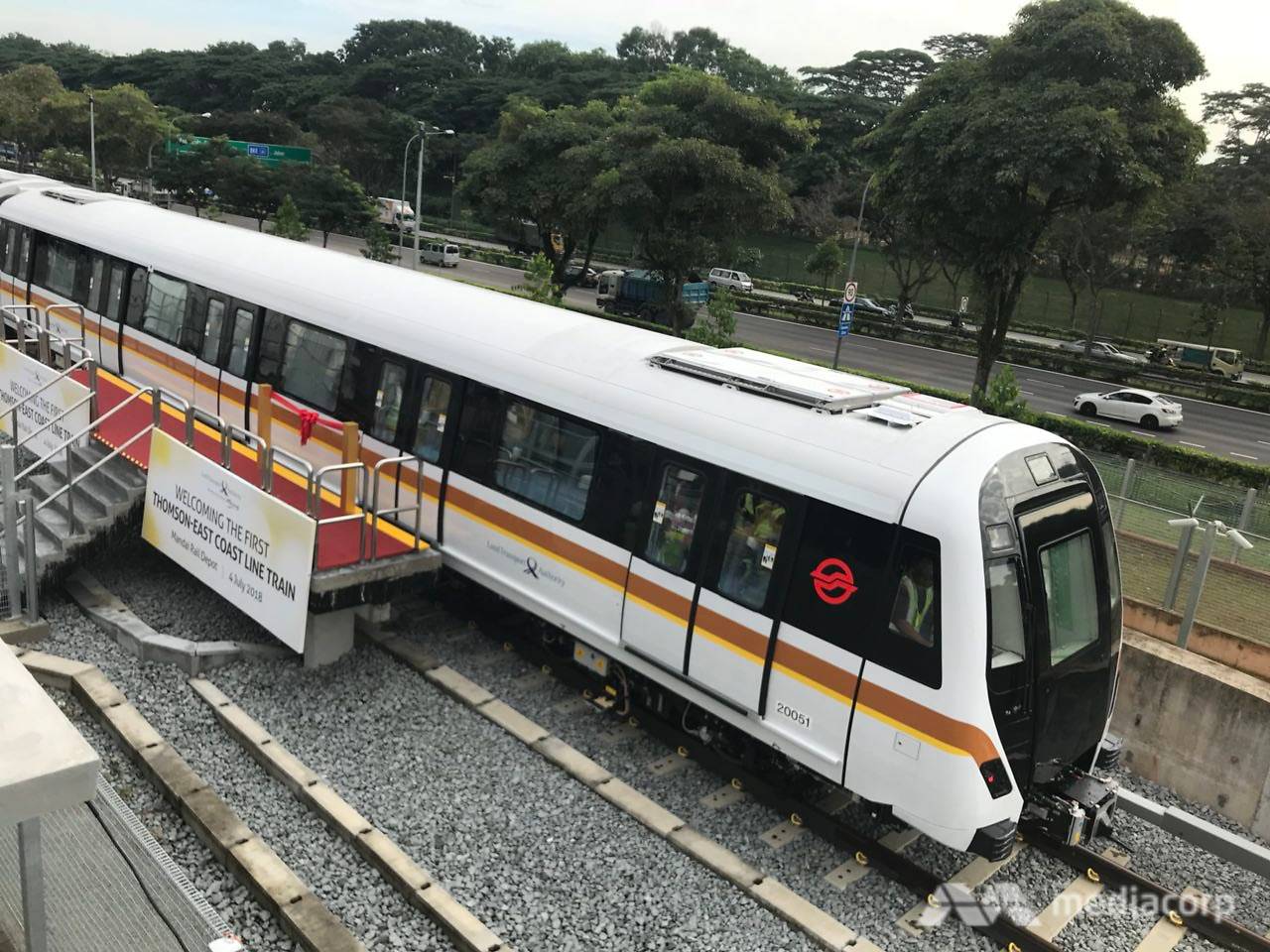
Thomson-East Coast Line trains to feature tip-up seats, LCD route maps

SINGAPORE: Trains on the upcoming Thomson-East Coast Line (TEL) will feature tip-up seats, route maps on LCD displays, automated track inspection systems and additional doors, the Land Transport Authority said on Wednesday (Jul 4). 

The TEL, which is set to open progressively from 2019, will feature 91 four-car trains. The first train arrived in May while the remaining 90 will be delivered from August, with about two trains arriving a month, LTA said.

During the unveiling of the line’s first train on Wednesday, LTA showcased some of the new features that were announced.  

Khaw Boon Wan Janil Putucheary TECL

Transport Minister Khaw Boon Wan and Senior Minister of State for Transport Janil Puthucheary are briefed on the TEL train. (Photo: Amir Yusof) 

Minister for Transport Khaw Boon Wan and Senior Minister of State for Transport Janil Puthucheary toured the train, along with LTA officials and members of the media. 

The group was introduced to the train’s LCD dynamic route map display, which was installed to inform commuters where they are on the line’s network map as well as which side of the train the doors will open or close.  

TECL LCD route map

Unlike the LED display used on other lines, the LCD dynamic route map display on the TEL is easily configurable. (Photo: Amir Yusof)  

The graphics to illustrate these elements will be used by passengers for “more intuitive navigation”, LTA said. It added that the LCD display is easier to configure than the LED display currently used on other lines. 

“For example, tasks such as adding new stations can be achieved without the need for hardware changes. This is particularly useful for TEL, which will roll out operations over several stages,” added LTA. 

In addition, 60 TEL trains will feature tip-up seats. The seats were launched on the new North-South and East-West Line trains earlier this year to create more standing space for commuters during peak hours.

Two of the new TEL trains will also be installed with an automated track inspection system of cameras, lasers and sensors to detect any rail defects or faults. 

Khaw Boon Wan TEL train

Transport Minister Khaw Boon Wan inspecting the first Thomson-East Coast Line train. (Photo: Amir Yusof) 

LTA said the line cameras are able to detect defects such as rail cracks, missing fasteners or foreign objects. 

“If any anomaly is detected, the maintenance team can intervene early and assess the next course of action, which in turn helps to improve rail reliability,” LTA said. 

As previously announced, the TEL trains are the first in Singapore with five doors on the side of each car. This will facilitate smoother boarding and alighting of passengers, LTA said.  

The trains, which have a brown livery representing the TEL, will undergo further testing in preparation for passenger service when the first stage of the line opens in end-2019. The remaining trains will progressively arrive between now and 2022. 

TEL train

The first Thomson-East Coast Line train. (Photo: Amir Yusof) 

LTA said it purchased the 91 TEL trains for about S$749 million in May 2014 from a consortium made up of Japan’s Kawasaki Heavy Industries and China’s CSR Qingdao Sifang . 

The 43km, 31-station TEL will connect commuters living in the eastern part of Singapore such as Bedok and Marine Parade to the city centre, as well as to areas in Thomson and Woodlands. It is expected to be fully operational in 2024.

Source link

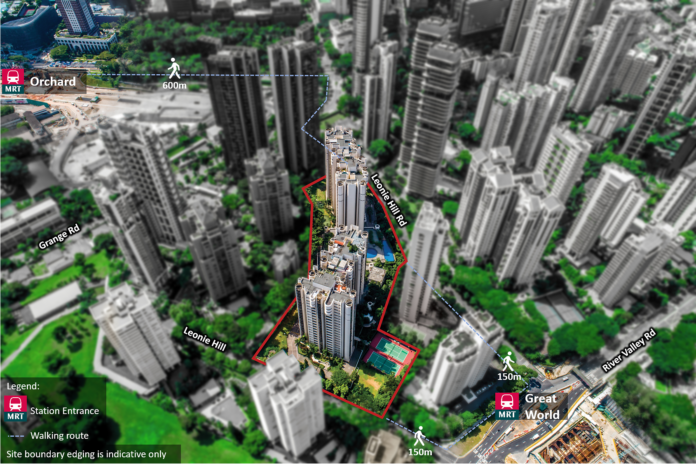
Horizon Towers at Leonie Hill launched for sale by tender for S$1.1 billion

SINGAPORE: Horizon Towers at Leonie Hill has been launched for sale, with the owners setting a reserve price of S$1.1 billion, said marketing agent JLL on Wednesday (Jul 4) in a news release.

This translates to about S$1,964 per sq ft per plot ratio after factoring in the lease top-up premium estimated to be in the region of S$220 million.

JLL added that as there is no development charge or differential premium for the intensification of the site, the reflected unit land rate is S$1,786 per sq ft per plot ratio

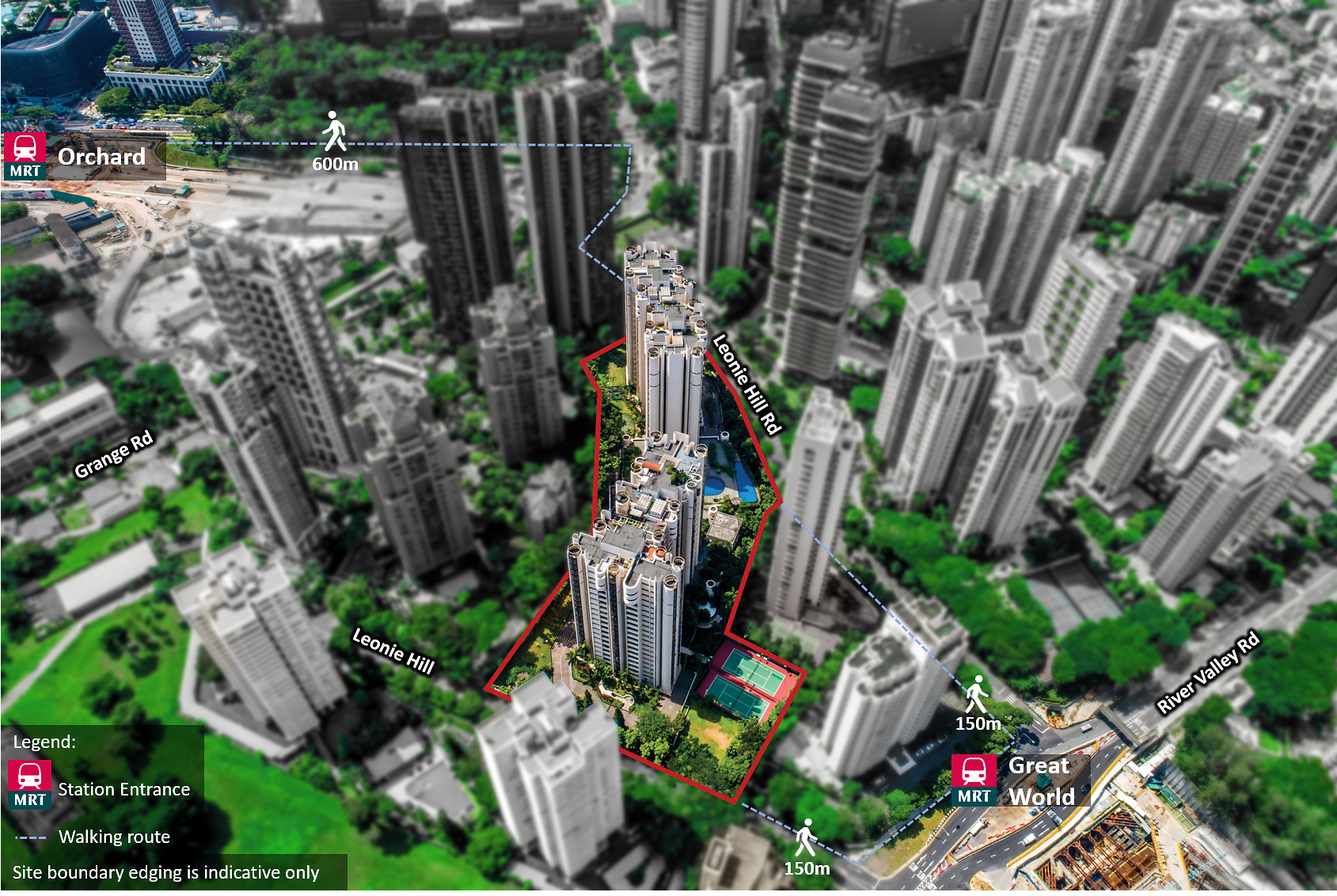
aerial shot of horizon towers

Horizon Towers and the area surrounding it. (Photo: JLL)

The 99-year leasehold Horizon Towers comprises 211 units in two towers and is close to River Valley Primary School, and areas like Robertson Quay.

The development occupies a 1.9 ha site and is zoned “Residential” in the 2014 Master Plan with an allowable height of up to 36 storeys.

The tender for Horizon Towers closes on Aug 7 at 3pm.

Source link

Singtel customers experience Internet connectivity issues on Wednesday morning

SINGAPORE: Singtel customers across the island experienced Internet connectivity issues on Wednesday (Jul 4) morning as they took to social media to express their frustration.

In an update on its Facebook page at 9.03am, Singtel said its customers “may be experiencing difficulty” accessing the Internet and added that its engineers were investigating the issue.

“We will provide updates as more information comes in. Thank you for your patience,” read the post.

By 10.55am on Wednesday, Singtel updated the Facebook post stating that Internet access for residential customers was being “progressively restored”.

It later added that services were “fully recovered” and that the Internet access for all customers was restored.

“We apologise for the disruption and thank you for your patience,” said Singtel.

The original Facebook post has garnered over 400 comments as of 10.45am on Wednesday, with the majority of the comments coming from disgruntled Singtel customers.

Based on comments on the Facebook post, the Internet connectivity issue seemed to have affected customers in areas such as Ang Mo Kio, Bukit Panjang, Woodlands, Bedok, Sengkang, Toa Payoh, Clementi, Punggol and Tampines.

Some users also lamented the lack of help from Singtel’s technical support, claiming that they had waited more than 30 minutes to no avail. 

One Singtel user told Channel NewsAsia that he first discovered the problem at 8.30am. He added that he was told through an automated message upon contacting Singtel that he may be experiencing difficulty with connectivity.

singtel customer
singtel customer 2

Channel NewsAsia readers also chimed in claiming that they experienced intermittent Internet connectivity issues.

singtel customer cna comment

singtel customer cna comment

Some added that their SingNet emails were also affected.

A few Singtel users claimed that they did not experience any issues.

singtel customers no issue

singtel customer no issue

Singtel’s website was also inaccessible, according to some users. This was the case when Channel NewsAsia attempted to access the site at 10.05am. 

Singel website down

A screenshot of Singtel’s home page when it was accessed at 10.05am on Wednesday (Jul 4).

Singtel’s home page seemed to be functioning again at 11.35am.

Channel NewsAsia has reached out to Singtel for more details.

Source link

More undergrads opt for overseas internships to stay competitive

SINGAPORE: More undergraduates in Singapore are expanding their portfolios by doing overseas internships, as competition heats up in the job market.

Darick Chen, a fresh graduate from Nanyang Technological University (NTU), secured a full-time offer from Goldman Sachs Singapore after completing internships with the firm in London and Hong Kong.

intern6

Darick Chen with his colleagues in Goldman Sachs London.  (Photo Credit: Darick Chen)

“In larger markets like London and Hong Kong, you’re exposed to more financial deals and more complex deals that are going on. These things definitely boost our technical competencies,” he told Channel NewsAsia.

But it wasn’t all smooth sailing, as he found himself having to work extra hard to prove himself.

“I think it’s only natural for people to question – if you’re new to this country, you might be foreign to how this country is run, foreign to how business is run.”

So in Hong Kong, he hunkered down and practised his Mandarin in order to deliver presentations to Chinese clients.

And it was this mix of soft skills and technical competencies that he said gave him a better standing in the job market.

At Mr Chen’s alma mater, an average of 130 students from the graduating cohort have gone for overseas internships and work attachments each year in the last three years.

Eight in 10 NTU undergraduates have at least one overseas exposure during the course of their studies.

A handful have received job offers from the overseas companies they interned with, and others from companies located in Singapore.

Over at the National University of Singapore (NUS), students completed close to 490 internships in over 40 countries between August 2016 and July 2017.

The school has seen a 22 per cent year-on-year increase in overseas internships completed in the last three academic years.

NUS Senior Vice-Provost (Undergraduate Education), Professor Bernard Tan, said this is largely due to greater interest among students to gain global exposure as well as the university’s efforts to expand internship opportunities abroad.

Meanwhile, Singapore Management University (SMU) has made it mandatory for all its students to attain some form of overseas exposure before they can graduate, starting from this August. This can be in the form of exchange programmes and internships.

About 150 to 250 SMU students each year have gone on an overseas internship in the last five years.

Cultural intelligence expert and associate dean at NTU’s Nanyang Business School, Professor Guido Gianasso, said students with overseas internship experience are more attractive for employers.

“The decision of going abroad for an internship indicates a number of personality traits; attitudes which are very important for employers. For example, the openness to experience, intellectual curiosity, extraversion. Also the courage and ability to adapt to different environments,” he said.

Professor Guido added that these are indicators of leadership potential, which employers look for.

EMERGING MARKETS

The universities have also expanded overseas programmes in Southeast Asia, China, India and the Middle East to tap their high growth potential.

Professor Guido said Vietnam and Cambodia are particularly keen on young finance professionals from Singapore who are bilingual, as they can manage Chinese investors.

At NUS, a third of overseas internships completed in the last academic year were in Southeast Asia, while another one-third were in East Asia.

NUS graduate Stephanie Lam was one of those who opted for an internship in the region instead of a traditional destination like the US or Europe.

intern2

Stephanie with her line manager (man in blue shirt and jeans) from the Knorr team in the Philippines, along with local influencers and the team from the media agency that she worked with during her three months in the Philippines. (Photo Credit: Stephanie Lam)

The marketing intern at Unilever Philippines told Channel NewsAsia that she had to navigate cultural nuances while overseas – an experience she wouldn’t have had in Singapore.

intern3

Stephanie with the Singapore team in London participating in the Unilever Future Leaders’ League 2016. (Photo Credit: Unilever)

“If I were to do an internship with a consumer-facing role in Singapore, the market is significantly smaller as opposed to if I did one in the Philippines or in a regional Southeast Asian market. I think this market is also exceptionally interesting because it’s still developing and growing very fast. Because of that, there are many changes and nuances that people haven’t caught onto yet, and I really wanted a bite of that.”

One cultural difference she observed was how the market in the Philippines emphasised relationships.

“So we really had to go down to talk to people, engage with them and build stronger relationships before working on a project. And that made the projects more meaningful.”

Like Mr Chen, though she initially struggled to adapt to a foreign environment, the experience made her stronger – and helped her land a job at the firm’s Singapore office.

“It’s definitely helped that the projects are very autonomous. So we have control, as compared to having a lot of hand-holding in Singapore. So because it’s more hands-on, lessons that we learn – maybe small mistakes we make and we fix – are a lot closer to heart,” she said.

An annual survey of graduates from NUS, NTU and SMU found that 78.4 per cent of students secured full-time positions within six months of graduation last year.

This was a slight dip from 79.9 per cent in 2016.

While the Manpower Ministry has projected labour demand to expand this year, it warned that this will be uneven across sectors.

Wanting to remain competitive was one reason Mr Chen and Ms Lam applied for internships abroad.

And these attachments have also given them the confidence to venture abroad for longer postings in the future.

“The teams from the regional markets are largely similar to the place that I interned at in the Philippines. So having experienced how it’s like to work in those local markets will help me understand where my colleagues will be coming from when I work in a regional office,” Ms Lam said.

Source link

Singtel customers experience Internet connectivity issues

SINGAPORE: Singtel customers across the island experienced Internet connectivity issues on Wednesday (Jul 4) morning as they took to social media to express their frustration.

In an update on its Facebook page at 9.03am, Singtel said its customers “may be experiencing difficulty” accessing the Internet and added that its engineers were investigating the issue.

“We will provide updates as more information comes in. Thank you for your patience,” read the post.

Based on comments on the Facebook post, the Internet connectivity issue seems to have affected customers in areas such as Ang Mo Kio, Bukit Panjang, Woodlands, Bedok, Sengkang, Toa Payoh and Tampines.

Some users also lamented the lack of help from Singtel’s technical support, claiming that they had waited more than 30 minutes to no avail. 

One Singtel user told Channel NewsAsia that he first discovered the problem at 8.30am. He added that he was told through an automated message upon contacting Singtel that he may be experiencing difficulty with connectivity.

singtel customer
singtel customer 2

Singtel’s website was also inaccessible, according to some users. This was the case when Channel NewsAsia attempted to access the site at 10.05am.

Singel website down

A screenshot of Singtel’s home page when it was accessed at 10.05am on Wednesday (Jul 4).

Source link