Home Blog Page 1000

Commentary: Government transfers and social assistance – Who deserves them? Who doesn’t?

SINGAPORE: Recent discourse about inequality, social mobility, higher social spending and higher taxes has generated debate in some quarters over the ideal quantum of Government transfers and social assistance, and how such funds can be disbursed effectively.

Some analysts argue that low-income families should receive more social assistance with fewer conditions so that they can more successfully break out of poverty and their children can thrive to experience greater social mobility.

Others suggest that what we have today is sufficient and raise the issue of whether we’re willing to deal with the trade-offs of greater social spending with fewer conditions. Among the trade-offs – higher taxes.

Whatever one’s stance on the issue, few would disagree government transfers, subsidies and social assistance need to reach the right people to meet their needs and improve societal outcomes in general.

Key to this is the criteria Government agencies use to determine how and how much government transfers are disbursed.

WHO IS DESERVING? WHO IS NOT?

When it comes to U-Save rebates and Service and Conservancy Charges rebates for instance, the quantum is based on housing type.

This has been a point of contention for some including Members of Parliament who have raised the issue for discussion several times over the years.

More recently, MP for Marine Parade GRC, Seah Kian Peng said in an On the Record interview that among his residents, it is an emotive issue.

Seah Kian Peng _1

Seah Kian Peng is MP for Marine Parade GRC (Photo: Facebook / Seah Kian Peng)

“I have people telling me that just because a person lives in a three-room flat, it doesn’t mean they are poor. They can actually be very wealthy and we should scrutinise more to make sure we don’t give them rebates. Likewise, if I live in a five-room or executive flat, it doesn’t mean I’m okay.”

Mr Seah himself called this “nitpicking”. He believes in a “give and take” approach. 

“It is always difficult in policy-making and it’s about striking the right balance. You also do not want to spend an inordinate amount of resources or time to administer some of these means tests to make it even more precise. I think the general levers they use – income and household type as a proxies work fairly accurately for most.”

If you want it to be so precise, you need to be even more intrusive. There will be outliers here and there, but for those who are in that group who actually don’t need it, what they should do is find ways to help others.

This is the hope, but clearly there are no guarantees.

At the other end of the spectrum are others like MP and now Senior Minister of State for Law and Health, Edwin Tong, who feel means testing should be more “detailed”.

“Today, they look at your address for example and if you live in a private estate, you’re out. One may have a home that is bought in the 60s. It might be worth more now, but you can’t expect an old couple to sell their home and then live on that in a different estate, where they’re dislocated from their own friends and society.”

When I put it to him that surely the Government can’t be giving finite resources to those who own million-dollar or multi-million dollar homes at the expense of those who might not be able to afford a modest home or even a meal, he conceded this argument was “fair enough”.

But he presented other scenarios.

“But what about those who live in private estates, but are squatting with their siblings or with a friend. They may not be paying rent but they are there on goodwill and the goodwill could end at any point. So I think we should be more granular on it, go beyond just the address, go beyond just what the income is. What about those with dependants who have health problems? Their financial burden will be heavier.”

hdb flats (2)

A view of an HDB block of flats in Singapore. (Photo: TODAY/file photo)

Presented with the possibility that this would mean more administrative resources being needed, he said “it’s well worth the effort” if it means getting a “fairer, better application” of “finite” funds.

Opinions clearly differ on how the system can identify people with the greatest needs and make sure fewer fall through the cracks.

READ: Three stories show why tackling poverty requires active listening, a commentary.

THE IDEAL CRITERIA

During last year’s Committee of Supply debate, then-Senior Minister of State for Finance Indranee Rajah said that household income remains the best measure to determine who qualifies for government social assistance schemes.

She pointed out that many social assistance programmes – such as the Community Health Assist Scheme and ComCare schemes – factor gross total monthly household income or monthly household income per capita in eligibility criteria.  

Those with no income are assessed on the annual value of their home.

But based on this criterion, a person who lives with wealthier family members or with a big family in one house may be excluded from schemes even though he doesn’t receive monetary assistance from them. 

If household income or housing type aren’t accurate gauges, what is?

Some say why not just disburse to a segment we all agree needs help – like seniors.

Yet, in 2014, when it was announced that pioneers would not be means-tested for benefits under the Pioneer Generation Package, some MPs and members of the public took issue with it.

It had to be emphasised that the intent of the package was to honour and recognise the contributions of all pioneers in Singapore’s nation building journey, regardless of their financial status.

While this has been generally accepted as a condition of a special package for a special group, questions clearly remain about how other transfers are disbursed – even when these aren’t meant to fulfil social assistance goals.

pioneer generation (PGP)

An elderly couple looking at a Pioneer Generation Package brochure. (File photo: TODAY/Don Wong)

This year, when it was announced that Singaporeans aged 21 and above will get a one-off SG Bonus of up to S$300 each based on their assessable income, some members of the public questioned why the wealthy should get anything all. Why not give those with lower incomes more instead?

CONSIDER THE TRADEOFFS TO FORMULATE A BETTER SYSTEM

With any policy, there will be trade-offs. The question is what are the most acceptable trade-offs.

By not being more precise with who gets more social transfers, is their impact merely being diffused?

Yet there are also costs to being precise. Some analysts have pointed out that those who apply for social assistance schemes are often asked overly intrusive questions to determine their eligibility.

Being more precise when it comes to means testing might, in fact, intensify this.

But, once a person’s status and needs are determined, it could mean greater leeway in terms of funds to help them break out of poverty.

However, can administrative costs and bureaucratic hurdles be kept sufficiently in check as well?

As the conversation on inequality and social mobility continues, it seems we need to go beyond whether we are willing to pay higher taxes to fund social spending, to discuss how tax payers’ contributions can be more efficiently spent.

Bharati Jagdish is the host of Channel NewsAsia’s On The Record, a weekly interview with thought leaders across Singapore, and The Pulse, Channel NewsAsia’s weekly podcast that discusses the hottest issues of the week.

Source link

Car dealers dangle discounts to attract buyers after emissions scheme raised concerns

SINGAPORE: With some buyers showing concern over the full implementation of the Vehicle Emissions Scheme (VES), dealers are throwing together attractive packages to entice them back into the showrooms this weekend.

The VES, which was fully implemented on Sunday (Jul 1), was a factor behind the steep decline in COE premiums, experts said.

“Before the VES kicked in, some buyers could have felt that certain cars were affordable,” said transport researcher Professor Lee Der-Horng. “Different buyers target different price ranges. So when the vehicle you’d like to buy is being affected, certain groups of buyers will be affected and this might be a reason for the drop in COE premiums.

COE premiums for small cars (Category A) fell to their lowest in more than eight years, closing at S$25,000, down from S$34,110 in the previous exercise. This was the lowest since Mar 10, 2010, when premiums were S$20,802.

Prices for larger and more powerful cars in Category B also dipped to S$31,000 from S$33,900. Open category COEs, which can be used for any vehicle type but end up being used mainly for large cars, fell to S$31,001 from S$34,400.

The VES measures all new cars, taxis and newly-imported used cars for levels of tailpipe pollutants they produce – namely carbon dioxide, carbon monoxide, hydrocarbons, nitrogen oxides and particular matter. Particular matter was only measured after Jul 1.

The amount of rebate given or surcharge levied on the vehicle is determined by the worst-performing pollutant.

Given that their new vehicles could face surcharges after the full VES implementation, some opted to purchase vehicles before the deadline. One of whom was Mr Lim Chai Seng, who bought a Toyota CH-R two weeks ago.

“When I visited the showroom, there was a promotion for this particular car – a discount of about 20 to 25 per cent,” said Mr Lim. “It was too good to pass up. If I didn’t buy it then, I would have to pay extra under the VES.”

But dealers are optimistic that the crowds will now return, given that COE premiums have fallen.

“Since the COE (premiums) have fallen by close to S$10,000, the demand for cars will still be there,” managing director of CarTimes Automobile, Mr Eddie Loo, told Channel NewsAsia. “Certain cars are also not affected by the VES, so people will also be encouraged to enter the market.” 

“Each time there is a price drop, we expect to see more coming into the showroom,” said Mr Ricky Tay, managing director of RTMT Motor. 

To entice them, car dealers whom Channel NewsAsia spoke to plan to put together attractive packages, in preparation for the weekend crowd. Renault is slashing prices by S$5,000. Hyundai is offering S$2,000 discounts on all models. 

“In a few months time, people would have gotten used to the VES,” said Mr Raymond Tang, managing director of Yong Lee Seng Motor. “If you need to use a car, you will still get a car. Since VES is there and implemented, it will be there to stay.”

singapore traffic coe

File photo of traffic in Singapore. (Photo: Jeremy Long)

In fact, there continued to be demand for cars which incur a VES surcharge, said Mr Tang, who has received more inquiries for them since news of the lower COE premiums broke.

Indeed, for most buyers, the deal breaker would be COE premiums and not the VES surcharge.

“The VES situation does not affect my decision on whether to buy a car or not,” said Mr Jeremy Lim, who is considering buying a new car instead of a secondhand one because of the drop in COE premiums. “It is not a game changer.”

Source link

Large hotels recycling less, can manage waste better: NEA

SINGAPORE: Large hotels can do better when it comes to managing their waste, the National Environment Agency (NEA) said, indicating they still have some way to go four years after a mandatory waste reporting exercise was implemented.

This comes as latest figures from the exercise revealed that large hotels – defined as those with more than 200 rooms – recycled less in 2016 compared with two years before. In 2016, their average recycling rate was 5.5 per cent, a 0.5 percentage point cent drop from 2014.

“A large proportion of hotel waste consists of types of waste such as food, paper and plastic bottles, which can be segregated and recycled,” NEA told Channel NewsAsia in June. “Thus the NEA is of the view that the average recycling rate is low and can be improved.”

The mandatory waste reporting exercise, introduced in 2014, aims to draw greater management attention to the amount of waste produced by large commercial premises like shopping malls and hotels.

NEA determines how well hotels perform by tracking how much of each major type of waste is recycled compared to the total waste generated.

CHALLENGES OF RECYCLING

Senior tourism lecturer at Ngee Ann Polytechnic Michael Chiam said some hotels could find it difficult to recycle due to logistical challenges.

According to an NEA guidebook for hotels, recycling bins should be easily accessible to staff and guests, match the type of recyclable waste produced at that location, and be placed together with general waste bins to prevent misuse. Ideal bin locations include rooms, kitchens and housekeeping areas.

The hotel should also buy its own recycling bins to be placed at the front-of-house, as those provided by the waste contractor are more appropriate for back-of-house or bin centres.

These guidelines mean “more resources are needed to support the recycling initiatives”, Dr Chiam said.

worker sorting waste

FIle photo of a worker separating waste for recycling. (Photo: AFP/Toshifumi KITAMURA)

In addition, Dr Chiam said an effective recycling programme requires “a lot of education, especially in changing the ways people work”.

“Housekeeping staff in the past may just dispose of the half-used bottles of shampoo and replace them with new ones. With the new recycling approach, they no longer need to throw away the shampoo bottles, but to replenish them,” he said, highlighting the extra workload.

Dr Chiam also pointed out the additional costs involved.

“Besides the direct recycling processing costs, like acquiring the machines, haulage fees and processing fees, hotels need to incur other costs to oversee the implementation of the recycling programmes,” he said.

This includes the manpower costs of having staff sort out recyclables and prevent contamination, and storage costs from bin spaces to hold the waste.

TURNING BOTTLES INTO APRONS

But one hotel is overcoming these challenges. The Grand Hyatt near Orchard Road said it recycled 20,519kg of waste last year, though it did not reveal its recycling rate.

“There are no internal challenges since we try to organise the steps and location (of recycling bins) carefully,” its stewarding manager Vijay Sivarajah told Channel NewsAsia.

grand hyatt singapore

Grand Hyatt Singapore. (Photo: Facebook/Grand Hyatt Singapore)

There are recycling bins on each level at the back of the house, including kitchens, restaurants and offices. On designated floors, there are recycling bins for housekeeping staff to sort waste that come from guest rooms.

Mr Sivarajah said the hotel recycles “as many items as possible”, including aluminium cans, metals, papers and glass bottles. It also sends PET plastic bottles to be recycled into uniforms, aprons and napkins.

hotel staff hyatt

Hyatt hotel staff take part in a soap recycling programme. (Photo: Grand Hyatt Singapore)

Soaps, shampoos and other toiletries left by guests are collected and recycled into new bars that are distributed to families living in high-risk areas for hygiene-related illnesses.

“However, we face the problem of recycling companies not being willing to collect waste such as vacuum packaging for meat,” Mr Sivarajah added.

The manager also admitted that recycling programmes might come with high costs and investments in the short term. But in the long run, the savings are apparent. Grand Hyatt has saved S$100,000 a year by recycling its food waste.

food digester hyatt

The biomax thermophilic digester in the Hyatt hotel. (Photo: Grand Hyatt Singapore)

Instead of going into the bin, food waste is put in an on-site digester that converts scraps like vegetable, poultry and egg shells into organic fertilisers. This is then used for landscaping at the hotel.

“Due to our waste management system, we have the advantage of reduced haulage fees and trips,” Mr Sivarajah said, pointing out that the food waste initiative has earned the hotel a S$250,000 NEA grant.

CHALLENGES OF REDUCING

Some hotels are also trying to reduce the amount of waste that could be recycled, although NEA’s reporting exercise showed only a slight drop in average waste produced from 2014 to 2016.

According to data from the exercise, the 97 hotels that participated in 2016 produced 66,000 tonnes of waste, equivalent to the weight of two buses. This means that each room produced 4.1kg of waste a day.

Food waste

File photo of food waste products. (Photo: AFP/JEAN-CHRISTOPHE VERHAEGEN)

An industry sustainability guide published by the Green Hotelier said luxury serviced hotels that produce more than 2kg of waste per guest per day need to buck up. “A figure greater than this is excessive and illustrates poor waste management practices,” it said.

“Manpower constraints and the difficulty of getting stakeholders, for example their tenants, guests and hotel staff across departments, to participate are some of the main challenges hotel operators face when trying to reduce waste,” NEA said.

NO MORE PLASTIC STRAWS

Still, the zero-waste movement is gaining momentum in hotels.

In May, the Millennium Hotels and Resorts (MHR) group pledged to eliminate single-use plastics from all six of its Singapore hotels by June next year. Given the hotels produce an average of 67kg of plastics weekly, the move will save almost S$500,000 a year in spending on plastic products.

m social singapore

M Social Singapore. (Photo: Facebook/M Social Singapore)

One of MHR’s hotels, M Social, has replaced plastic straws with paper alternatives, and is using environmentally-friendly packaging, like paper boxes and wooden cutlery, for its takeaway service.

The group’s Orchard Hotel and Studio M are also in the midst of replacing plastic toiletry containers with dispensers in hotel rooms.

MHR’s pledge follows Hilton’s announcement in the same month that it will stop using plastic straws across its 23 managed hotels in Asia-Pacific by the end of this year.

“More hotel operators have implemented improved waste management systems and 3R initiatives, such as going paperless and installing on-site food waste digesters, which have helped to reduce the waste generated,” NEA said.

m social food

M Social uses environmentally-friendly packaging for its food. (Photo: Millennium Hotels and Resorts)

However, MHR vice-president of operations (Southeast Asia) Lee Richards acknowledged that the process was tedious.

“A comprehensive analysis needs to be done, from reviewing our plastic consumption and inventory list of each hotel; the timeframe it would take to complete the existing stock; the overall costs involved if we were to replace with dispensers,” he told Channel NewsAsia.

“Plastic products are almost entirely about convenience for most people and commercially convenient as these items are generally inexpensive or lower in cost compared to other materials.”

When asked if he was concerned about losing guests who might prefer using their own toiletry bottles to dispensers, Mr Richards said “we believe the majority of our customers will support the initiative”.

“In the long term, reducing plastic use will benefit the environment, reduce staff time and overall cost, and also show our customers we care about the environment,” he added.

MORE ECO-FRIENDLY TOURISTS?

Ngee Ann Polytechnic’s Dr Chiam said eco-friendly hotels will benefit from tourists who might perceive them as “forward-looking brands which attempt to do their part in saving the environment”.

“Some tourists are more conscious of protecting the environment, and they may make a conscious effort to choose hotels which are more eco-friendly,” he said.

parkroyal on pickering walkway

Parkroyal on Pickering uses solar-powered systems and rain harvesting to minimise energy and water usage. (Photo: Aqil Haziq Mahmud)

However, Dr Chiam suggested that corporate travellers are more likely to stay in eco-friendly hotels as compared to leisure travellers, at least for now.

This is because eco-friendly companies are likely to pick like-minded hotels for their staff on business trips, he added. “These corporate travellers will over time adopt the same standards when they book hotels for their family holiday.”

Globally, the trend seems to have picked up. A Booking.com sustainable travel report published in 2016 revealed that 68 per cent of 10,000 responders said they would be more likely to choose an accommodation if they knew it was eco-friendly.

ROLE OF GUESTS

Nevertheless, Singapore Environment Council executive director Jen Teo said the average guest has a part to play, though the onus remains on the hotel.

If a hotel has proper recycling education and provides reusable utensils, for example, guests should comply with the recycling programme and not use disposables, she said.

“Most guests are generally open to supporting the recycling movement provided it is not unnecessarily inconvenient,” Dr Chiam said. “The key is to make recycling programmes as seamless as possible.”

Ms Teo added that hotels form a major industry in Singapore, and thus have a “big part to play” in helping the country achieve its goal of becoming a zero-waste nation.

parkroyal on pickering entrance

A guest entering the Parkroyal on Pickering. (Photo: Aqil Haziq Mahmud)

While only large hotels, which generate more waste, need to report their waste statistics to NEA, the agency said it will review if this should be extended to hotels with fewer rooms at a “later stage”.

Singapore Hotel Association executive director Margaret Heng believes that more hotels will start going green.

“This is because hotels are working on a holistic approach by engaging staff, suppliers and guests in their waste minimisation practices,” she said. “The pledge by MHR group is a big win for sustainability.”

Source link

Commentary: Help with disability costs welcomed but allowing withdrawal of Medisave may not benefit all

SINGAPORE: What will you live on if you meet with severe disability?

A national insurance scheme, CareShield Life, will be launched from 2020. You pay premiums and in return you get payouts for life if you are assessed to be severely disabled. Premiums for CareShield Life can be paid from Medisave.

Older Singaporeans already on ElderShield will be encouraged to upgrade to CareShield Life, with cash incentives, if they sign up within two years of 2021.

Additionally, Singaporeans will be allowed to withdraw monthly cash from Medisave for their severe disability needs. Those still in need of help with severe disability costs may be eligible for aid from a newly formed ElderFund.

GOVERNMENT AS BACKSTOP

This appears to be consistent with how the Government structures the 3M system (Medisave, Medishield Life, MediFund) in healthcare. In this system, the Government is trying to shape shared responsibilities in paying for one’s healthcare, consistent with its approach to involving individuals first, families second, and then Government as a backstop.

Medisave is enforced individual savings and can be used to pay for approved purposes, including chronic illness medication, health and eldercare insurance. It can also be used to co-pay hospital charges in the deductible and co-insurance portions of MediShield Life coverage.

Families can top up a family member’s Medisave or help to pay their medical fees directly.

MediShield Life is essentially meant for covering catastrophic illnesses and the resulting large hospitalisation bills. Individuals will pay cash or from Medisave first before claiming from MediShield Life.

Finally, MediFund will help those who do not have the means to pay for healthcare, assessed on a case-by-case basis.

The Government has modelled severe disability care on this system. But severe disability support, as defined by an inability to carry out three of six activities in daily living (ADL), is much simpler and can be taken care of slightly differently.

elderly wheelchair disabled file

An elderly man in a wheelchair. (File photo: TODAY)

THE CASE FOR CARESHIELD

CareShield Life, like MediShield Life, is an insurance scheme. Like all insurance schemes, this is a risk-sharing scheme. A simplified illustration of risk sharing versus individual risk is as follows:  

Take for example, 20 persons in a population. Half will be disabled for different lengths of time before passing away. One may be disabled for one year before passing away, but another may be disabled for 12 years.

If subsidised monthly nursing costs are S$1,000 a month, then lifetime disability costs will range from zero for those not disabled to S$144,000 for those who live 12 years after disability.

This can be scary since you do not know who will be disabled and for how long. This is individual risk without insurance.

What if each of the 20 people pay S$8,000 each into a pooled fund that promises to pay S$600 a month for life if you get disabled? That way, everyone is assured that a part of their disability costs is covered regardless of your disability state or how long you live, at the expense of a fixed payment up front.

Risk-sharing is about converting all or part of an uncertainty into a certainty, spread out among all participants.

READ: Strengthening our disability care system, a commentary.

READ: Enrolling on the severe disability scheme at 30 should be sobering news, a commentary.

DEALING WITH ADVERSE SELECTION, MORAL HAZARD

In insurance, there is the issue of adverse selection. If the insurance is not mandatory, you may feel that you are healthy and will not be hit by disability. Or perhaps you are rich enough that disability costs are not a concern. So you opt out.

The insurance does not get your premium and costs increase for those still in it.

One way to tackle this is to make the premiums mandatory like CareShield Life.

healthcare in singapore 1

A hospital ward in Singapore.

Another issue is moral hazard. This is most well-known in healthcare insurance where zero co-payment schemes may have led medical establishments to over-prescribe and people to over-consume services. This leads to higher premium costs for others who make moderate claims, or to insurers suffering losses.

This is less of an issue with CareShield Life, where the claims criteria is a simplified three out of six ADLs, and the payout is in a fixed cash amount, not for services.

CARESHIELD LIFE VERSUS MEDISAVE WITHDRAWALS

CareShield Life can be viewed as a kind of collective saving. Every participant contributes to a pool of funds. The fund accumulates interest, and individuals can withdraw from it when they are hit with the insured event.

It offers the most economically efficient route to partially supporting and sharing the severe disability needs of the population, after mitigating the two issues of adverse selection and moral hazard. 

While it avoids inter-generational funding, it features intra-generational funding – within an age cohort, healthier people, who do not claim as much, effectively help out less healthy people.

The Government now says that Medisave can be withdrawn for severe disability needs. Health Minister Mr Gan Kim Yong says that this will give people more flexibility since it is cash, and that it avoids an inter-generational subsidy, where younger tax payers pay for the care of an older generation, for example through subsidised nursing care.

But this is what CareShield Life does as well. It gives cash and avoids an inter-generational subsidy.

When you run out of individual savings, including in your Medisave, you may have to plan to go “cap in hand” to apply to ElderFund or MediFund, with no certainty of disbursement. The uncertainty can cause anxiety.

When you share the risk with others with CareShield Life, you are reducing this uncertainty by the amount you are insured for. The lower-income to middle-income class in particular should welcome a reduction in the uncertainty about eldercare coverage. Reducing anxiety about costs is something to be desired.

FILE PHOTO - An electronic patients chart is shown on the wall to a hospital room in San Diego, Cal

FILE PHOTO – An electronic patients chart is shown on the wall to a hospital room in San Diego, California April 17, 2017. REUTERS/Mike Blake

MORE CARESHIELD PAYOUTS INSTEAD

Instead of allowing individuals to withdraw from Medisave when they are disabled, why not commit extra funds from Medisave, when most are still in the prime of working life, to additional CareShield Life premiums to get higher payouts instead?

The sharing element of CareShield is to be desired, particularly for lower-income individuals, as it provides greater certainty over a potentially catastrophic end of life event. Better off individuals have more alternatives over how they meet this event.

Individuals with low or precarious income, who would have difficulty coming up a regular flow of extra premiums are likely to have trouble coming up with sufficient Medisave balances to tide them through any future severe disability and would need help then. The ability to withdraw from Medisave would be of little use.

Instead, the Government should help them with premiums now instead of later.

The 3M system for healthcare essentially spreads responsibility for healthcare among individuals, family, the intra-generational community and the Government.

In adopting a similar system for severe disability with its slightly different characteristics, the Government can tweak it to increase the intra-generational sharing responsibility of the system and simplify this new healthcare scheme.

Tan Jin Meng is a postgraduate from the Lee Kuan Yew School of Public Policy with an interest in social policy and economics.

Source link

Fire engulfs terrace house near Little India

SINGAPORE: A “massive” fire broke out at a terrace house near Little India on Friday (Jul 6) night. 

The Singapore Civil Defence Force made a Facebook post at 10pm, saying that they were alerted to a “residential fire incident at 82 Sing Avenue involving a private landed house”.

“Upon SCDF’s arrival, the house was fully engulfed in flames. SCDF resources are currently conducting firefighting operations,” they said. 

In a subsequent update 17 minutes later, SCDF said that firefighting operations were still “in progress”. 

A video, sent to Channel NewsAsia by reader Eric Ong, showed flames engulfing a unit while firefighters battled the fire. 

Alarms could be heard ringing in the background.

In a second video taken by Mr Ong, a man could be heard asking bystanders to “cooperate” as he tried to usher people away from the fire. 

A subsequent photo showed that the road was cordoned off by police tape. At least one fire engine could be seen on scene. 

Sales manager Chew Boon Yeow told Channel NewsAsia that he was having dinner nearby when the fire started. 

“I was having dinner and then some people shouted ‘fire’. The fire was quite big. There were two fire engines and about four police cars,” the 42-year-old said. 

Mr Chew added that the fire was at a house that was under construction, and he saw some scaffolding as well. 

Little India fire 5

(Photo: Channel NewsAsia reader) 

Twitter user Elizabeth Davis said in a tweet that “lots of emergency vehicles” were at the scene. She called it a “massive fire”. 

The 30-year-old content editor told Channel NewsAsia that she saw at least six emergency vehicles on site from her room at the One Farrer Hotel. Ms Davis, who is from London, is on holiday in Singapore.

“There are still emergency services around, but the fire looks like it’s been put out now. There’s just smoke visible there now,” she told Channel NewsAsia at about 10.30pm.

Isabel Areglo, a staff nurse who lives nearby at Mergui Road, told Channel NewsAsia that she saw the fire at about 8.52pm. 

“I was on the balcony having a phone call and then I realised smoke was coming from the building,” she said. “I told my housemates and we were thinking what it could be. Then we saw the fire get bigger with a cloud of dark smoke.” 

Another Channel NewsAsia reader who lived nearby said that there was a “burning smell” in the air. 

“When I looked out of my window some 10 minutes later, I saw smoke and a big fire,” said the reader, who requested to remain anonymous.

Source link

Seoul has the fastest 4G internet in Asia


WHEN it comes to the internet, the world is increasingly going mobile. Long gone are the days of requiring a broadband connection at home in order to go online.

This is particularly the case in Asia, where mobile internet has provided internet access to millions more people each and every year. Data recently released by Syniverse showed that 4G data usage in the Asia Pacific had increased by a whopping 300 percent over the past year.

OpenSignal, a company which specialises in wireless coverage mapping, has crunched the numbers on which cities in East Asia perform the best when it comes to 4G speeds, 4G being the fourth generation of cellular network technology.

SEE ALSO: In Malaysia, internet access may become a constitutional right

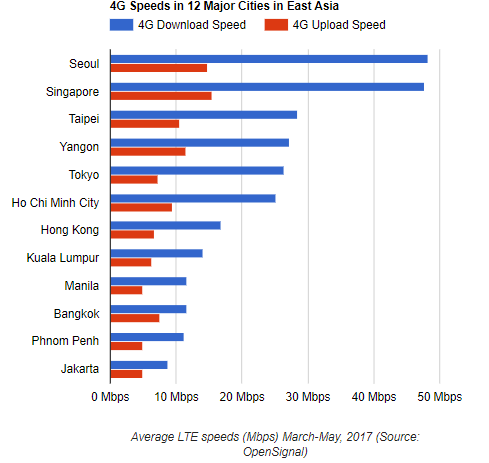
Of the 12 cities it analysed for speeds between March and May 2017, South Korea’s capital Seoul was home to the fastest 4G in the region with average download speeds of more than 25 megabit per second (Mbps).

Seoul marginally outdid Singapore, which enjoys similarly “awe-inspiring” super-fast mobile internet, according to the company. “That makes them not just the fastest cities in East Asia, but among the fastest cities in the world,” wrote OpenSignal.

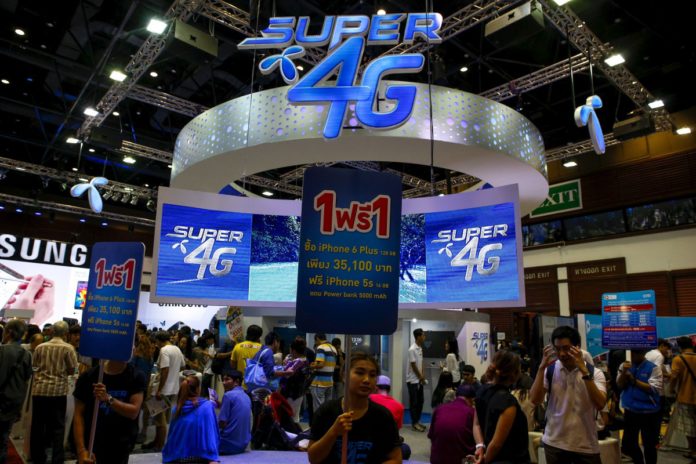
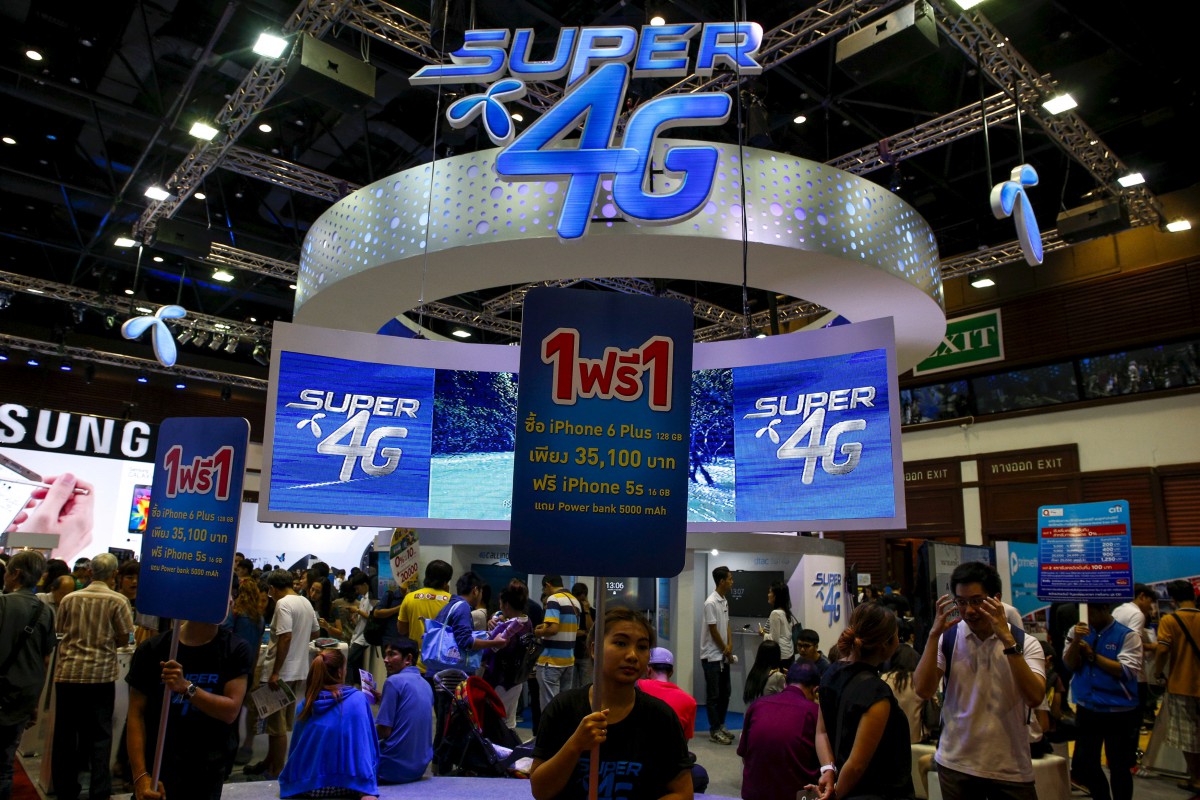
2018-06-15T064912Z_1190593339_RC1DBD4AC690_RTRMADP_3_THAILAND-TELECOMS-DTAC

4G signs are pictured at a DTAC shop during the mobile expo 2016 at a convention centre in central Bangkok, Thailand, February 12, 2016. Picture taken February 12, 2016. Source: Reuters/Athit Perawongmetha

Taipei in Taiwan came in third, somewhat surprisingly followed by the largest city in Burma (Myanmar) – Yangon.

“While we would expect Taipei and Tokyo to be LTE powerhouses, given their early adoption of 4G, Yangon and Ho Chi Minh City are holding their own,” said the company.

“Both Vietnam and Myanmar only launched commercial 4G services within the last two years, which perhaps explains why they’re delivering such fast connections. As consumers adopt 4G phones and 4G service plans, they begin filling up those networks, causing speeds to gradually decline.”

Burma’s digital population has grown drastically in recent years, with the number of internet users growing by 97 percent in the year to January 2017. Some 70 percent of these new users were on mobile internet.

4G-speeds

Source: OpenSignal

A number of Asian cities considered had 4G download speeds at or below the global average of 16.9 Mbps, including Hong Kong, Kuala Lumpur, Manila, Bangkok, Phnom Penh and Jakarta.

As one of the largest online markets globally, Indonesia’s 4G networks are highly concentrated with users. Greater Jakarta alone has some 31 million people, most of whom are using mobile internet.

SEE ALSO: Smart cities can improve quality of life by up to 30pc

“A notable trend we’re tracking in the region is the intense focus on 4G availability over 4G speed,” according to OpenSignal. “As 4G connections are far superior to 3G connections, Southeast Asia’s operators seem intent on making LTE services accessible to the vast majority of their customers before they turn their attention to raw speed.”

When it came to upload speeds, there was less disparity across the region.

Singapore’s upload speed of 15.4 Mbps was not massively faster than the slowest cities Phnom Penh and Jakarta, which averaged 4G upload speeds of 4.9 Mbps.

Source link

Artificial Intelligence platform launched to help doctors crunch patient data, make better diagnoses

SINGAPORE: Imagine stepping into a hospital outpatient clinic or polyclinic and skipping the long wait, just by looking into a camera.

It is a facial recognition device which is able to match a patient to his or her medical and personal data. There is no manual registration or paperwork to be done. A text message will tell the patient which consultation room to head to, and the medical bill could even be sent directly to the patient’s home or email address. 

This could soon become a reality at hospitals under the National University Health System (NUHS), with an artificial intelligence healthcare system called Discovery AI which incorporates different AI tools to make sense of the huge amount of hospital data. 

Launched at the NUHS Healthcare AI Datathon and Expo on Friday (Jul 6), Discovery AI has been test-bedded at the National University Hospital (NUH).

The system is expected to be deployed in phases in the coming years, across NUHS institutions including NUH and Ng Teng Fong General Hospital and Jurong Community Hospital.

“A lot of time is needed to pull out patient data, collate it, review it, and then decide what to do. With artificial intelligence, we can have tools which can be automated to pull out and collate data and present them in ways which make it much easier for health professionals to make decisions for patients,” said Professor Tan Chorh Chuan, who is executive director at the Ministry of Health’s Office for Healthcare Transformation. 

“What this means, of course, is that health professionals will have more time on direct patient care.”

Another use for the raw data that Discovery AI processes is through a Command Centre – an intricate map of patient data that gives doctors an overview of every single patient in a hospital. 

Each patient is represented by a concentric circle, which contains information such as a patient’s age, medical condition, medication, length of stay, ward class and even a breakdown of hospital fees. Doctors just need to pull up the patient’s circle to gain instant access to the data. 

Command centre

The Command Centre shows an intricate map of patient data. (Photo: Cheryl Goh)

It is so powerful it can even predict the probability of a patient being re-admitted. This means doctors can follow up more closely to prevent it from happening, and help them make better decisions.

“Discovery AI is a production level sandbox to build and implement AI tools for healthcare. So it addresses the issue of privacy of the patients’ data, security that’s required to use the data in a fair and equitable way, and it gives hospital administrators and leaders an oversight of how the data is going to be used throughout the healthcare continuum,” said Dr Ngiam Kee Yuan, NUHS’ group chief technology officer. 

But doctors have also pointed to the one crucial thing that AI cannot replace – the human touch. 

“It makes us better, more efficient, more precise. I must emphasise that none of the tools that we build are to replace doctors, they are all to help us become better at what we do to improve the accuracy of doctors making diagnoses,” said Dr Ngiam.

Prof Tan added: “Many patients like the personal touch with their care providers, patients expressed a preference for artificial intelligence to be used to augment their care teams as opposed to replacing them. 

“So in the future, I think we will see artificial intelligence replacing some of the more tedious, repetitive tasks that health professionals need to do, and allow them to have more time to have more personal and face to face interaction with patients.”  

AI health

Contactless vital signs monitor being tested at the launch of Discovery AI system on Jul 6, 2018. (Photo: Cheryl Goh)

Another state-of-the-art AI technology that could soon make its way into local hospitals is a contactless vital signs monitor, which reads a patient’s heart rate and blood pressure remotely. This device will save nurses time when making their rounds. It can even monitor a patient during his sleep, without the need to wake him. 

Source link

Singaporean woman involved in US Navy’s worst corruption scandal sentenced to 33 months’ jail

SINGAPORE: A Singaporean woman who was involved in the largest and most extensive bribery and fraud conspiracy in the history of the United States Navy was on Friday (Jul 6) sentenced to two years and nine months’ jail. 

Gursharan Kaur Sharon Rachael, 57, was charged more than two years ago with corruption. The court heard that she received more than S$130,000 in bribes from Leonard Glenn Francis, the Malaysian CEO of maritime services company Glenn Defense Marine (Asia) (GDMA), in exchange for sensitive US Navy information. 

Gursharan committed the offences while she was a former lead contract specialist with the US Navy and based in Singapore. Before she resigned in 2015, she had been an employee of the US Government for more than 25 years.

Her role with the US Navy included managing ship husbanding contracts worth millions of dollars, with duties such as drafting contract requirements, as well as negotiating and evaluating bids.

The bribes she received from Francis included S$100,000 in cash for a condominium apartment down payment and a Prudential policy. 

She also accepted more than S$30,000 worth of stays in luxury hotels like Ritz-Carlton in Bali and Dubai, as well as the Shangri-La Hotel in Jakarta.

Francis, nicknamed Fat Leonard, is in custody in the US and faces a maximum custodial term of 25 years for defrauding the navy of more than US$35 million (S$48 million). 

The scandal has also resulted in the arrest and conviction of several navy officials in the US.

Leonard Glenn Francis

File photo of Leonard Glenn Francis. (Facebook/Leonard Francis)

Between 2006 and 2013, Gursharan disclosed non-public information from the US Navy to Francis, which helped GDMA clinch 11 contracts worth a total of about US$48 million, out of 14 contracts that the company bid for.

The information she provided included pricing strategies, price information of GDMA’s competitors and questions that the contracts review board had posed to GDMA’s competitors, according to investigations by Singapore’s Corrupt Practices Investigation Bureau (CPIB)

The fraud was uncovered after GDMA became the focus of investigations in the US in 2012.

HIGH LEVEL OF PREMEDITATION, LARGE GRATIFICATION SUMS

Sentencing Gursharan to jail for three charges of corruption and one charge of dealing with benefits of criminal conduct, District Judge Shaiffudin Saruwan said there was “flagrant abuse of trust and authority” by Gursharan. 

There was also “a high level of premeditation”, with steps taken to avoid detection, a sustained period of offending of seven years and a “high amount of gratification” by the accused. 

Responding to defence lawyer Suresh Damodara’s point that Gursharan was in remission from cancer and that prison was a high-stress environment that may cause a relapse, the judge said that Gursharan is not currently suffering from terminal illness and that she would be provided medical care while incarcerated.

The judge disagreed with the prosecution’s point that the incident could cause a loss of confidence in Singapore’s public administration, saying that the transactions were for private contracts, albeit involving the US Navy.

He also ordered that the S$130,278.34 surrendered by Gursharan to the CPIB to be forfeited to the anti-corruption agency.

For her corruption charges, Gursharan could have been jailed for up to five years and fined up to S$100,000.

For acquiring, possessing, using, concealing or transferring benefits of criminal conduct, she could have been jailed for up to 10 years and fined up to S$500,000. 

OTHER US NAVY PERSONNEL HAULED UP TO COURT

The other people involved in the broader fraud and bribery investigations have been charged or sentenced.

Francis, who pleaded guilty and is awaiting sentence in the US, has agreed to forfeit US$35 million in personal assets.

He had also bribed other US Navy personnel in order to secure lucrative ship-husbanding contracts to supply US Navy vessels at ports in Southeast Asia and the Pacific.

Twelve US Navy officials pleaded guilty in the US, while the highest-ranking official involved, Rear Admiral Robert Gilbeau, was sentenced to 18 months’ jail for making false statements to investigators.

Source link

Help pours in for family of nine living on under S$3,000 a month

SINGAPORE: Offers of free music lessons for the children, a rocking horse for the youngest child, a hamper of bread goodies – and brickbats online. These are some of the responses this family have received in the past fortnight.

And the Hengs are touched by the generosity shown, as well as a tad upset by the criticisms, since the publication of CNA Insider’s story and video about them raising seven children on a monthly income of less than S$3,000.

The Hengs, one of Singapore’s rare big families nowadays when couples are having fewer children, were featured initially on the programme On The Red Dot.

And the financial, logistical and parenting challenges faced by the family struck a chord with readers and viewers online, who wrote in offering items like toys, books, and bicycles as well as food vouchers and help with groceries.

In response, dad and sole breadwinner David Heng, 42, said: “These can all be useful in many ways. But what I value most is the heart behind the offers.”

WATCH: Life in the Heng household (4:58)

STUNG BY COMMENTS AT FIRST

Appreciative as he is now, however, he admitted that he was “disturbed and hurt” at first by the negative reactions on social media.

The main issues raised included the question of whether having a large family is unfair to the children if affordability is a struggle and whether it is irresponsible to fall back on state assistance.

The Hengs receive help under schemes such as the Education Ministry’s Financial Assistance Scheme and the Health Ministry’s Community Health Assist Scheme, as well as from the Social Service Office for things like their service and conservancy charges.

Now that he has “calmed down” since the initial sting of some of the comments, Mr Heng wonders: “Has anyone never needed help? Help can come in many forms.”

And it’s an opportunity to teach my children never to forget to pay it forward.

His wife and stay-at-home mum Esther added that the family does not depend on such help for their daily expenses, which her husband still pays for, “but since there’s financial assistance, we can make good use of it”.

“What goes around comes around. My children are young now. In the end, when you grow old in Singapore, you may need assistance too,” said the 40-year-old.

OTRD full house hengs 4

FINANCES AREN’T EVERYTHING

The couple do not think their children are being short-changed either. Mrs Heng has asked them, for example, whether they wanted to have tuition at the Chinese Development Assistance Council, “but they weren’t keen”.

They may not go to “exotic” places overseas, but they enjoy holidays in Malaysia, which sometimes her parents treat them to, she said. “We don’t ask (my parents), but they choose to help us.”

Mr Heng cited his social work with children who have done well “without a strong financial background”, and he added: “Physical resources contribute a percentage of how they turn out, but what’s more important is the non-material input.”

While their children may be more mature than their peers and have more sibling responsibilities, Mr Heng does not think this is a bad thing. His wife added:

When it comes to changing diapers, bathing them and taking them to the playground, I’d always do it.

What Mr Heng has realised is that “time is the biggest commodity”, which is why he just started a new job as a church executive, freeing up his evenings and weekends to spend with his children, unlike before.

He took four months to decide on leaving his previous job at a children’s home, which he “loved”, before he tendered and told his family.

OTRD full house hengs 3

David Heng putting his youngest, Isabella, 3, to sleep.

FROM A SCOOTER TO A MEAL

Even as the couple say they do more to provide for their children than what others saw or read about, they have already received messages of support.

Mr Heng subscribes to the point made in the commentary “Raising 7 children on S$3,000 a month in Singapore, and a tale of constructive parenting” that big families benefit from practising values like saving on food and necessities.

“My children understand the values of delayed gratification and of gratitude,” he said.

This is one of the reasons that Gardenia gave the family a hamper, loaves of bread and an assortment of cream rolls and buns this week.

“Mr and Mrs Heng have instilled family values of trust, responsibility and love in his children, and we’re very touched when we can see a loving, big family,” said Gardenia Foods marketing manager Carrie Tan.

“We hope that our little gesture can bring some joy to the children.”

(dp) Hengs follow-up 1

Besides a hamper, Gardenia gave bags of other products and bread snacks. (Photo credit: David Heng.)

One member of the public, who wanted to remain anonymous, contacted CNA to offer the Hengs a scooter and some toys because their story “resonated” with her as the youngest of seven siblings in her family.

In the case of food and beverage businessman James Peck, he hopes to treat the Hengs at one of his company’s eateries after reading that they seldom dine outside together.

“Growing up, my family didn’t always have a chance to have a meal together because my parents were always working. And when we went out to eat, they had to work within a really tight budget,” he said. “I sort of know what the children are feeling.”

Mr and Mrs Heng plan to respond to all the offers of help in due course, so that they are nor overwhelmed by donations coming in at one go.

Read the Hengs’ story here, and about another family, the Lims, who started a family of 7 at the age of 21.

Source link

Meet the Navy’s new ‘mothership’ that fights with unmanned drones and vessels

SINGAPORE: Not long ago, a warship’s superiority was defined by how powerful the guns on its deck were. Then, as weapons evolved, how far its missiles could go.

Now, with wars increasingly being fought hundreds of kilometres apart, it has become a case of spotting the enemy before it spots you.

“We are reaching a stage where who sees first, who sees fastest, actually wins,” Republic of Singapore Navy (RSN) head of naval operations Cheong Kwok Chien told Channel NewsAsia in an exclusive interview on Saturday (Jun 30).

And so the RSN saw an opportunity for change.

The Victory-class missile corvettes, for over two decades the “backbone” of the RSN’s strike capabilities, are entering their twilight years. They will hit the end of their operational life in 2025.

Enter the multi-role combat vessel (MRCV), a type of “mothership” that will work in tandem with unmanned machines to see farther and respond quicker. These mission-configurable warships will be introduced after 2020.

“If we have certain areas we want to watch closely, we can be triggered early to respond,” Rear-Admiral (RADM) Cheong said. “These ships allow us to put eyes forward.”

These “eyes” are actually a network of unmanned drones and vessels that respectively carry cameras and weapons.

“The suite of weapons and sensors that can spread itself over a large area effectively turns the ship from being a point source to an area type of umbrella capability,” RADM Cheong added.

A typical strike package will possibly comprise a pair of MRCVs that each carries three unmanned aerial vehicles (UAV), so there’s one in the air at all times, and two unmanned surface vessels.

rsn missile corvette

The RSN’s missile corvette is the fastest ship in its fleet. (Photo: Facebook/Republic of Singapore Navy)

But the RSN has not laid down specific configurations. There are physical limits to how much the MRCV can carry, and then there’s the cost factor of buying too many unmanned systems.

“Technology is allowing unmanned systems to get smaller, and it helps,” RADM Cheong said. “But there are physical limits to size because out there the wind is quite strong, so you can’t fly a typical hobbyist drone.”

Still, he added that the MRCV will allow the RSN to “bring a CCTV out to sea”. “If you have a whole network of eyes and shooters, you really expand the effective influence of the vessel.”

ALL-ROUND VIEW 

While current UAVs can extend a ship’s field of vision by 100km because of their range, RADM Cheong said it’s likely that those on the MRCV can go farther.

“In the future, this range will increase because the control capabilities will improve,” he added. “It’s not very far-fetched to say that easily the ship will have awareness of maybe 150km around it.”

The high-definition capability of the UAV’s camera also adds a whole new dimension to surveillance, far beyond beeping blips on traditional radars. “You can see the colour of the hair of the guy you’re looking at 150km away; that’s possible,” RADM Cheong said.

multi role combat vessel graphic

The multi-role combat vessel will replace the RSN’s missile corvettes.

It doesn’t stop there. The RSN wants to hear and recognise him as well.

“The other breakthrough that we will go for is to be able to see different dimensions,” he added. “If you put together facial recognition, voice recognition and sense recognition, not many people can run away from that.”

With information from multiple UAVs and cameras, as well as intelligence from other assets, the RSN intends to put it all together on a single screen. 

“More than flying cameras around, it’s quite important for us to stitch together the picture and make sense of it fast,” RADM Cheong said. “No point staring out at beautiful scenery without knowing what you’re looking for.”

“This technology is not earth-shattering,” he continued. “It just takes deliberate effort to make it happen.”

Beyond its superior strike and surveillance capabilities, the MRCV is also more versatile and can go farther than the missile corvette, which was purpose-built for its warfighting capabilities.

For example, the MRCV can undertake counter-terrorism as well as humanitarian assistance and disaster relief (HADR) missions, because it can carry mission-specific cargo like counter-terrorism forces and medical aid.

JOINT MULTI MISSION SHIP

But the RSN’s ship of choice when it comes to HADR is the landing ship tank (LST), which has been deployed at several humanitarian assistance operations including the Aceh tsunami in 2004.

This is because the 141m-long, 6,000-tonne LST is the RSN’s largest ship, with the capacity to carry up to 18 tanks, 20 vehicles and bulk cargo. It also has two 25-foot deck cranes for loading and unloading of cargo.

rsn landing ship tank

The RSN’s landing ship tank is the largest ship in its fleet. (Photo: Facebook/Republic of Singapore Navy)

But the RSN wants to go bigger.

“What we have learnt from a lot of disaster relief missions is that our first wave of aid and supplies that go in really make the difference,” RADM Cheong said. “It’s not about building a conveyor belt, the first guy who reaches there, the first box that you open must save lives. That’s why we need to carry more.”

With that, the RSN will replace the LST with a larger joint multi mission ship (JMMS) that can carry twice the amount of cargo and discharge it better. The JMMS will also be introduced after 2020.

“When you reach the area, you must always remember that there’s no beautiful port for you to come alongside and put the staircase down,” he added. “So, the design of the ship is also how you can bring it to an area with no access.”

joint multi mission ship graphic

The Joint Multi Mission Ship will replace the RSN’s Landing Ship Tank.

This extra space and accessibility are also important during counter-piracy operations. In the Gulf of Aden, Singapore regularly deploys the LST for international anti-piracy patrols.

To that end, the JMMS will be able to carry more and bigger boats to transport boarding teams that repel pirates and keep merchant ships safe.

“When the sea is rough, and the boat you carry is so small, you can’t launch your boys and say please carry on,” said RADM Cheong, who has led counter-piracy operations at the Gulf of Aden.

“Even for a big ship which can carry three to four boats, it’s never enough. It’s always the feeling that you want to do more than what you have brought along.”

Besides boats, the JMMS can also carry larger UAVs and unmanned vessels to do surveillance and fend off pirates. Its longer flight deck also means it can carry multiple helicopters, as opposed to the LST which could only carry two.

As RADM Cheong concluded: “It’s more than just a pick-up lorry.”

BETTER AND SHARPER

Along with the Type 218SG submarine, RADM Cheong said the RSN’s three new vessels bode well for Singapore’s future.

singapore navy fleet

Part of the RSN’s fleet.

“We have built in a confidence and belief in the younger generation to see that with each generation, we modernise the Navy to make it better and sharper,” he said. 

Each acquisition is “very deliberate”, he added, with a lot of hard work going into designing, operating and maximising it. “We are always maximising limited resources, and we never back off from any challenge.”

Source link