Home Blog Page 4487

From shunned CCA to trendy crowd-puller

0

When Mr Mike Chiang, 43, took over as the conductor of Nanyang Polytechnic’s (NYP) Chinese orchestra in 2003, he was surprised to find out that it had just 10 members.

“I turned up and asked the students, ‘So many people aren’t here?’ But they said that that was all of them,” he recalled.

But the tables have turned since then – sign-up lists for the co-curricular activity (CCA) stretch to more than 200 names, with some students choosing to enrol in NYP for this Chinese music group. It now has 160 members, with alumni regularly performing at concerts alongside the rest of the orchestra.

The orchestra shot to fame in 2010 when a YouTube video of it playing a medley of Korean pop songs at Yfest 2010, held during the Youth Olympic Games in Singapore, went viral, garnering more than 200,000 hits in two weeks.

It has since become known for its bold approach of using traditional Chinese instruments like the erhu or guzheng to play different music genres, including hits by rock bands like Bon Jovi and AC/DC, and soundtracks from video game series like Final Fantasy and Street Fighters.

PLAYING TO SOLD-OUT CROWDS

Mr Chiang said students were initially sceptical when he first mooted the idea of playing pop music. “But they trusted my intuition,” he said.

Handbag designer Quek Li Hui, who graduated from the polytechnic in 2012, said her friends had a different impression of Chinese music after attending the concerts.

“They thought that it was a very ancient type of thing but they were ‘wowed’ by the fact that even Chinese orchestras can play pop songs and different genres,” said the 23-year-old, who plays the electric bass guitar, on top of percussion instruments, for the orchestra.

For the past five years, the orchestra’s annual concert at the Esplanade has played to sold-out crowds of 1,600 each time. An alumni orchestra was also set up in 2013, with about 50 members focusing on playing traditional music.

The orchestra has won accolades, such as perfect scores from the entire panel of international adjudicators at the Australian International Music Festival in 2007 – the first group to do so since the festival started in 1989.

In 2011, it clinched a gold medal at the Asia Pacific Chinese Music Exchange and Competition in Taiwan.

There are differences in how pop music and traditional Chinese music should be played on their instruments, thus every detail is very important, said Ms Siti Farah Mohd Jaffar, 25, a retail management trainee who graduated from NYP in 2010.

For example, pop songs have more complex rhythms that need to be mastered so that the tune sounds authentic. Different techniques are used for the suona – sometimes called the Chinese trumpet and known for its loud high-pitched sounds – such that the sound it produces is more subtle and mellow.

As all the members are amateurs, they need to put in extra time and effort to make sure they perform the best.

“In the run-up to concerts, we stay back late to practise to make sure that every one gets their part right,” said Ms Siti Farah. “My mother asks me why I’m still going back to school when I’m already working now, but you just need to manage your time well to achieve the things that you want.”

Ms Chloe Quek, 18, who was the orchestra’s vice-president last year, said the work that she does for her CCA gives her a headstart in her business management course at NYP, where she is specialising in events management and human resource management.

“We learn how to plan logistics for events and concerts, and manage people,” she said.

Mr Chiang now thinks his decision to experiment with new genres was the right move.

He said, “Most of the younger generation would not even consider joining a traditional Chinese orchestra nowadays. But they are still keen on joining this orchestra because we are different – it’s a way to keep the tradition alive while trying out new things.”

yuensin@sph.com.sg


This article was first published on March 21, 2016.
Get a copy of The Straits Times or go to straitstimes.com for more stories.

Image: 
Category: 
Publication Date: 
Monday, March 21, 2016 – 17:00
Send to mobile app: 
Source: 


Story Type: 
Others

Source link

'Virtual world is no substitute for real one'

0

She might have had a hand in building one of today’s social media behemoths, but nobody is doing any Facebooking around Ms Randi Zuckerberg’s dinner table.

“At dinner time, there are no devices in the room at all,” she told The Straits Times.

Parents here might be familiar with this ground rule. Like them, Ms Zuckerberg, a mother of two boys – aged four years and one year – sets firm rules for her children.

She was Facebook’s director of marketing and one of its earliest employees, but the 34-year-old feels strongly that too much social media is bad for everyone, especially children.

“My four-year-old will sit there at the table and say, ‘Ugh, what are we gonna do?’ We’re going to have a conversation… We’re not going to use any emojis. We’re actually going to talk,” she said.

Ms Zuckerberg was in town for the Women of Wealth and Abundance seminar earlier this month. She is the sister of Facebook co-founder Mark Zuckerberg, who is among the 25 richest men in the world.

She spoke to The Straits Times on the sidelines and shared some of her tips on parenting with technology. For starters, she set limits on “screen time” for her children, and sets an example in front of them too.

“I try in my life to use social media purposefully, and not just snack on it like junk food throughout the day,” she said, noting that children learn how to behave with technology by observing their parents.

In 2013, Ms Zuckerberg wrote Dot Complicated, a book that touches on the perils of social media.

After she left Facebook in 2011, she set up Zuckerberg Media, a boutique marketing firm and production company.

She has an estimated net worth of US$100 million (S$136 million).

The self-professed professional technologist points out that technology was designed to bring people closer together, but the way many use it, “it comes up like a wall between us and the people we love”.

But technology is neither inherently good nor bad – it is how people use it that matters, she said.

So when it comes to her children, she does not plonk them in front of an iPad with a video, when she needs that “15 minutes of down time”. Instead, she occupies them with games and apps that either exercise their imagination, teach them things like a foreign language or music, or even imbue in them a love for coding.

For instance, her son, Asher, plays with a robot that he can command and control through an iPhone.

“So at four years old, my son is basically learning how to code without knowing it. He’s teaching this robot how to do things,” she said.

She also allows her son to earn his screen time – so when he behaves well, such as when he makes his bed or is nice to his brother – he earns minutes that he can use to watch shows or play with his robot.

“So for us, screen time is a privilege that you earn, not just something you are given,” she said.

Having said that, she stresses that the virtual world is no replacement for the real one.

“Kids have a lot of years to keep their head down in front of a computer screen,” she said, adding that there was nothing that could replace interacting with the real world.

“Get outside, we live in a beautiful world,” said Ms Zuckerberg.

dansonc@sph.com.sg


This article was first published on March 21, 2016.
Get a copy of The Straits Times or go to straitstimes.com for more stories.

Image: 
Category: 
Publication Date: 
Monday, March 21, 2016 – 17:00
Send to mobile app: 
Source: 


Story Type: 
Others

Source link

Man jailed 10 months for attacking friend with a chopper

0

March 21, 2016 1:53 PM

SINGAPORE – Angry at a friend who told him to leave a coffee shop for being too noisy, a man returned home to get a chopper and attacked the victim.


Source link

Fewer identify as Buddhists or Taoists

0

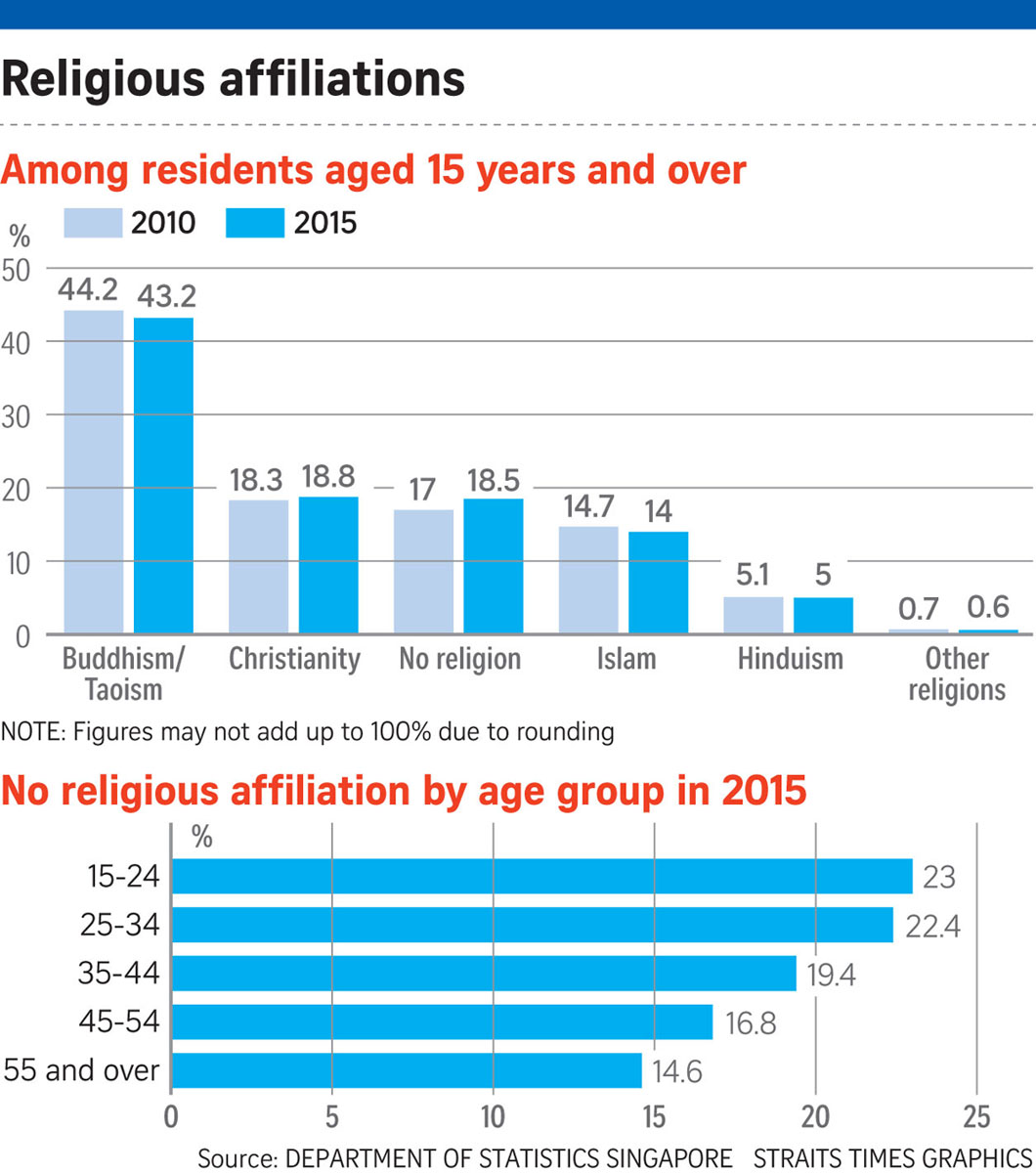
The number of Singapore residents who identify as Buddhists or Taoists has dropped from 44.2 per cent in 2010 to 43.2 per cent last year.

But the Singapore Buddhist Federation (SBF) and Taoist Federation told The Straits Times that they are not worried about the decline, which was outlined in the latest General Household Survey released on March 9.

They said their religions do not require devotees to declare their faiths, and temples have no membership criteria, unlike churches.

Venerable Seck Kwang Phing, SBF president, said: “Buddhists and Taoists are more fluid. Sticking to one religion is a Western concept.”

The Taoist Federation added that the survey’s data do not reflect what its management has observed on the ground.

Its administrator, Master Wei Yi, said the temple-going crowd has taken on a more youthful face.

He said of the lot, many might not necessarily declare themselves as Taoists – a plausible reason behind the survey’s figures. For instance, he said a good number who visit Taoist temples at the start of a year for blessings are free-thinkers.

The Taoist Federation started ramping up activities and publicity to increase awareness about the religion about a decade ago. It has assembled a pool of about 20 young Taoists priests below age 35.

They act as the religion’s ambassadors to drive home the point that “you can be young to pick up the scriptures”, said Master Wei Yi.

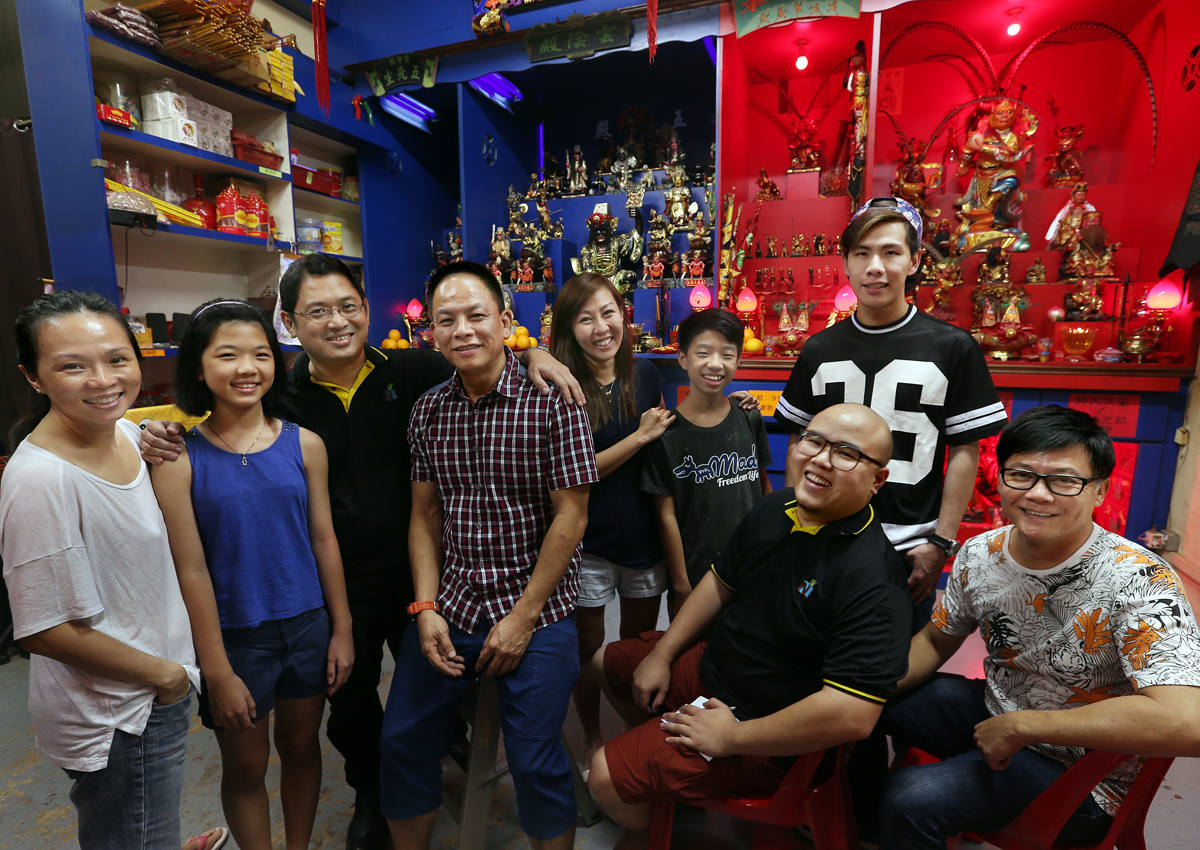
He cited the example of youth taking the lead in the case of Yun Yin Dian temple in Bedok North. It was set up in 2009 by Mr Joel Tan, 45, self-employed, and aircraft engineer Steven Goh, 35, and has more than 20 members under its youth wing. Among them is Secondary 2 student Josiah Tan, 14, who plays the drums for temple activities, including its trance rituals.

The temple also organises community outreach programmes such as providing free tuition to needy students. “Taoism is not just for old people. There are activities that are interesting and appealing to the young which can also benefit the wider community,” said Josiah.


This article was first published on March 21, 2016.
Get a copy of The Straits Times or go to straitstimes.com for more stories.

Image: 
Category: 
Publication Date: 
Monday, March 21, 2016 – 17:00
Send to mobile app: 
Source: 


Story Type: 
Others

Source link

Youth shunning religion

0

Having prayed to Buddha as a child and after spending her early teens worshipping Jesus, copywriter Hannah Jasmine Kok, 23, no longer believes in the divine.

She said she left the Buddhist faith at 13 as she could not relate to rituals she performed with her parents, and dropped out of church after three years because she “didn’t think it was going anywhere”.

Now an atheist, she said: “I think it is highly improbable that any god exists. There is no evidence for it.”

Ms Kok is one of a growing number of young people here with no religious affiliations.

The Department of Statistics’ General Household Survey 2015 report released earlier this month found that those who said they had no religious affiliation constituted 18.5 per cent of the resident population last year – up from 17 per cent in 2010.

Of this group, many were young. About 65 per cent were aged between 15 and 44, and about 23 per cent between 15 and 24, compared with 14.6 per cent among residents aged 55 and above.

The religious composition as a whole remained relatively stable – 43.2 per cent of the resident populace identified as Buddhists or Taoists, 18.8 per cent as Christians, 14 per cent as Muslims and 5 per cent as Hindus. The number of Christians increased marginally, while other religions experienced slight declines.

FACTORS BEHIND GROWTH IN THE NON-RELIGIOUS

Academics and religious leaders The Straits Times spoke to said the trend of non-religious affiliation is in tandem with an increasingly educated populace, some of whom might move away from religion if it does not connect with their lives and needs.

The Institute of Policy Studies’ senior research fellow Mathew Mathews said this is more common for individuals who grew up in families where religion was already nominally practised.

The Catholic Church said traditional religions have also been slow to engage young people and help them appreciate their faith.

Singapore Buddhist Federation president Seck Kwang Phing believes the youthful face of the non- religious group ties in with a change in attitudes among the young, who have become more independent in their thinking.

He said: “They ask and argue and do not simply allow their parents to select their faiths on their behalf.”

Young people today are also exposed to a range of ideologies, which results in a spectrum of views within the non-religious category. The segment therefore includes atheists and agnostics; humanists and secularists; as well as free-thinkers and other individuals who might not necessarily be anti-religion.

National University of Singapore political science undergraduate Bertrand Seah, 21, grew up Christian in a Methodist school environment, but began doing his own research on religion in junior college.

He became influenced by religious critics and scientific scepticism advocates such as American Sam Harris.

Like the other youth The Straits Times spoke to, Mr Seah said he believes in a “rational” approach. “I don’t think I need divine guidance to make a right or wrong decision. Reason alone can guide such decision-making,” he said.

Experts said the relative stability of a country also means there is less concern about the future because the present is “non-threatening”.

When this is the case, there is less incentive to look to religion for divine intervention or for security.

Young people might also be doing their own research before eventually committing to a particular faith, experts said.

Some suggested that the multi- religious make-up of Singapore and the open-door policy of religious institutions here facilitate “shopping” for a religion.

Some young people could also be identifying more with liberal ideologies that clash with religious teachings on topics such as homosexuality.

Social anthropologist Lai Ah Eng of the National University of Singapore (NUS) said this group might therefore find religions “variously limiting, irrational, oppressive, unreasonable and unscientific”.

Youth and religious experts interviewed noted the high-profile failures of institutional religions to uphold their credibility as a moral voice, which may also have turned some people away from religion.

Some cited high-profile incidents such as the City Harvest case, where church leaders were found guilty of misusing around $50 million in church funds.

POSSIBLE IMPLICATIONS

Several religious leaders said they are concerned about the shift.

Reverend Father Jude David, co-chaplain of the Catholic Church’s Office for Young People, believes that without religion “Singapore would certainly lose a part of her soul or spirit”.

Reverend Dominic Yeo, the general superintendent of the Assemblies of God of Singapore, agreed. He said religion teaches its followers to be moral, adding: “We need to guard our nation, our children and the next generation against moral decadence.”

Others are concerned about solidarity in households where the parents or grandparents are deeply religious. NUS sociologist Paulin Straughan said disparities in religious ideology could result in intergenerational fault lines and a widening gap “because religion, when it is functional, pulls families together”.

Ultimately, the consensus among the various groups is for the need for more dialogue to understand “mutual concerns and find ways to negotiate potential tensions”, said Dr Mathews. They said this should be backed by more research to understand the specific make-up of Singapore’s non-religious segment.

Communication channels already exist. For instance, the Humanist Society – set up to represent Singapore’s non-religious population – has been involved in discussions organised by the Inter-Religious Organisation of Singapore and the Inter-Racial and Religious Confidence Circles.

Executive committee member Pearl Lin said the society’s role is to provide a voice for the non-religious, whom she said tend to be excluded and forgotten.

But the Buddhist Federation’s Venerable Seck is not worried about the growing pool of non-religious Singaporeans. To him, good values and morals are more important.

He said: “As long as there is moral education and the ability to differentiate between what is right and wrong, there will always be common ground among the religious and non- religious.”

melodyz@sph.com.sg

xueqiang@sph.com.sg

kenggene@sph.com.sg


This article was first published on March 21, 2016.
Get a copy of The Straits Times or go to straitstimes.com for more stories.

Image: 
Category: 
Publication Date: 
Monday, March 21, 2016 – 17:00
Send to mobile app: 
Source: 


Story Type: 
Others

Source link

Budget 2016: SMEs look to incentives, help for expansion

0

Small and medium-sized enterprises (SMEs) hope the upcoming Budget will contain more incentives and help for expanding overseas, according to a new survey.

Respondents to the poll conducted by UOB also called for more government-backed financing schemes and measures to encourage investment in technology, amid an ongoing economic slowdown that has depressed incomes and margins for many firms.

The local lender polled 100 SMEs across industries including professional services, infocomm and media, retail, and food and beverage.

While 26 per cent of those polled want the Budget on Thursday to contain more incentives for overseas expansion, just 5 per cent of respondents said they are hoping for subsidies to hire and train older employees.

About 11 per cent are asking for the foreign worker levy to be reduced.

Finance Minister Heng Swee Keat has indicated that this year’s Budget will focus on the economy and should offer some relief to firms hit by the ongoing slowdown.

But economists have pointed out that the broader themes of economic restructuring and longer-term challenges like shifting demographics remain key.

UOB economist Francis Tan said the issues flagged by firms in the poll are not new and noted that there are already a wide range of government schemes targeted at SMEs.

“Perhaps more needs to be done to raise awareness of these schemes…There has been a lot of help available for SMEs for many years,” said Mr Tan.

He added that moves aimed at encouraging firms to raise productivity and become more innovative, such as the popular Productivity and Innovation Credit (PIC) scheme, have traditionally been “blanket measures” which have had mixed success.

“The measures should be made more targeted to focus on industries or even occupational roles that will be important for Singapore, and help them tide over this current downturn,” he added.

Survey respondent Joe Anitha, the senior finance manager of IT solutions firm Computer Infotech, said setting up a presence outside Singapore is at the top of the company’s agenda for this year.

However, Mr Anitha said the firm has been told it does not qualify for available government grants and schemes aimed at helping companies go abroad.

He added that these schemes usually require participating firms to move into completely new markets, while Computer Infotech is keen on establishing a stronger presence in areas it is already exporting to.

These include Dubai in the Middle East, some markets in Africa, and closer to home, Indonesia and Malaysia.

“(The schemes) have the right recipes but need to be more tailored,” he added. Computer Infotech recorded sales of $23 million last year and employs 15 staff.

A separate poll also by UOB, which polled 150 respondents in senior management positions at local SMEs, showed that top reasons for expanding abroad include rising costs here, limited growth in the domestic market, and a shortage of skilled labour.

“Despite the cautious economic outlook, many of our SME customers tell us they want to tap new markets to access a larger consumer base and a bigger pool of skilled labou,” said Mr Mervyn Koh, UOB’s head of business banking in Singapore.


This article was first published on March 21, 2016.
Get a copy of The Straits Times or go to straitstimes.com for more stories.

Image: 
Category: 
Publication Date: 
Monday, March 21, 2016 – 14:00
Keywords: 
Send to mobile app: 
Source: 


Story Type: 
Others

Source link

BMW driver runs red light, knocks down dog at Hougang pedestrian crossing

0

A BMW driver alelgedly fled the scene after running a red light and knocking down a dog at Hougang Avenue 7.

A clip taken on the dashboard camera of a taxi at the scene was posted online by facebook user Tammy Tang.

In her post, she explains that impact sent the dog, named kyla, flying quite a distance.

She also said that the driver scolded the two ladies who were walking the dog and accused them of crossing when the light was green in his favour.

Tammy said that the driver then gave his phone number but refused to wait for the police to arrive, saying that he did not want any trouble as his son’s wedding was taking place in Thailand the next day.

According to the post, the driver agreed to pay for everything but wanted to leave as he was supposedly feeling breathless and had heart problems.

And the driver also allegedly said he did not bring his licence and IC along with him, so they were unable to take down his particulars.

The post details that when the police arrived on the scene and tried to call the BMW driver back to the scene, he did not pick up and his phone was switched off.

The case was reported to the neighbourhood police post, explained the facebook post.

“Kyla has a fractured rib, and has to be kept for observation because physical trauma like this can lead to delayed internal bleeding,” said Tammy in her facebook post.

“Apparently we also cannot force him to pay for the vet bills.

“It has to be an agreement between us and the driver.

“So… yay. Another few hundred / couple thousand gone because of some stupid person.”

just watch from 0.50 onwards.Driver of an old BMW ran the red light at a pedestrian crossing and hit Kyla (Golden…

Posted by Tammy Tang on Thursday, 17 March 2016


Visit STOMP for more stories.

Image: 
Category: 
Publication Date: 
Monday, March 21, 2016 – 13:11
Keywords: 
Send to mobile app: 
Source: 


Story Type: 
Others

Source link

90's art market to be held at Tanjong Pagar Railway Station on Good Friday

0

SINGAPORE – Tanjong Pagar Railway Station (TPRS) will once again be open to public this coming Good Friday (March 25), from 9am to 9pm.

A 90’s themed art market with over 100 art, retail and food stalls organised by The Local People will be held from 3pm to showcase crafts made by local young artists.

In addition, Food from the Heart (FFTH), a voluntary welfare organisation that collects unsold bread and non-perishable food items for charity will be setting up a booth to recruit volunteers and collect non-perishable food items from the public.

Drawings of the station will be collected at the former ticketing counter of the station as usual. These drawings may be displayed at the station when it is open to public in future.

ljessica@sph.com.sg

Image: 
Category: 
Publication Date: 
Monday, March 21, 2016 – 13:11
Send to mobile app: 
Source: 


Story Type: 
Others

Source link

How does Singapore look like from space?

0

A fascinating image of Singapore taken from space caught the interest of netizens after US astronaut Tim Kopra tweeted the photo on Saturday (March 19).

It shows an intricate network of yellow lights glittering from the island at night, with several large areas and the Central Catchment Nature Reserve covered in darkness.

Kopra, 52, is the current commander of the orbiting International Space Station (ISS) and snapped the picture from the station.

His tweet which came with the hashtag #CitiesfromSpace, has been retweeted 980 times, attracting over 2,600 likes.

Kopra made his third career spacewalk in January with British stronaut Tim Peake to undertake a difficult mission to replace an electrical unit while under cover of darkness.

The ISS space laboratory has been orbiting Earth at about 28,000 kilometres per hour (17,000 miles per hour) since 1998.

chenj@sph.com.sg

Image: 
Publication Date: 
Monday, March 21, 2016 – 13:18
Send to mobile app: 
Source: 


Rotator Image: 
Story Type: 
Others

Source link

Clearing the air on Mount Emily villa

0

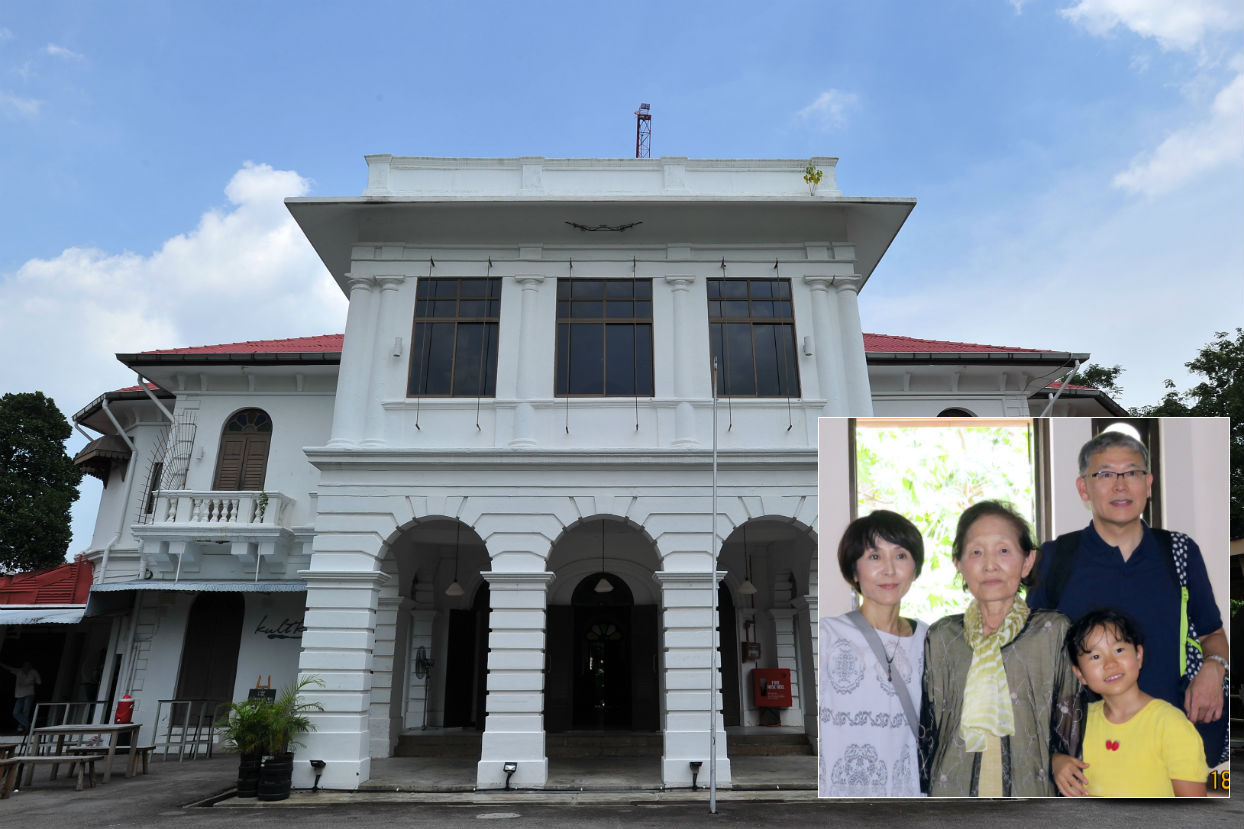
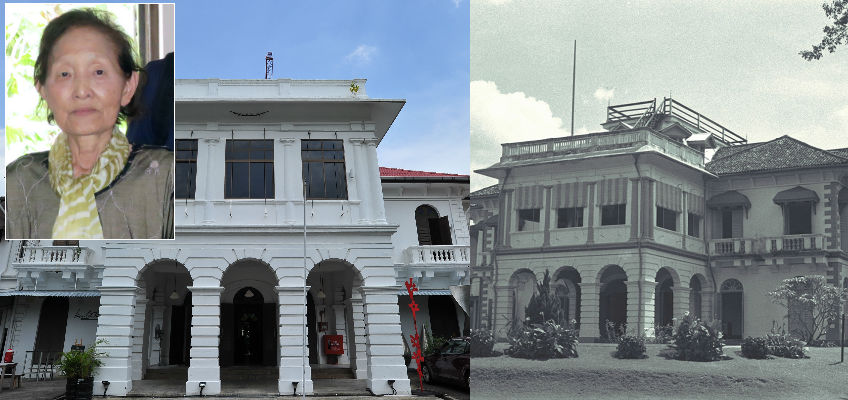
The mystery behind the origins of a century-old colonial villa on top of Mount Emily has been solved.

Known for decades as Osborne House and now a home to arts groups, its early history had stumped most experts.

It has been suggested by some, such as heritage blogger Jerome Lim, that the two-storey structure at 11, Upper Wilkie Road, had been developed in the late 19th century by Syed Hashim Kassim, the Sultan of Siak, a place in Indonesia.

What is known, however, is that it was eventually bought by Singapore-based Japanese dentist Jukichi Ikeda.

Little else was known about him and how he had become its owner – until last year.

His descendant, 83-year-old Miyoko Yoshida, returned to Singapore last September to revisit her childhood home and shed more light on her granduncle and how the family came to own the house.

Her experience was documented in Chinese language daily Lianhe Zaobao earlier this month.

Mr Ikeda came to Singapore in the early 1920s and had a clinic in Hill Street. Ms Yoshida’s father was a young dentist who worked at the clinic. Mr Ikeda, who was fond of the young man, introduced him to his niece.

The two married and lived with Mr Ikeda and his wife. By 1935, the younger couple had three children. Ms Yoshida is their second child.

To cater to the growing family, Mr Ikeda forked out $22,000 on the 86,439 sq ft Mount Emily property in 1935. Ms Yoshida was four years old when she moved in and had a room on the second storey.

She told The Straits Times that it was an “exciting life”.

“There were maids and cooks who were very friendly to me. I spoke Malay with them. I also remember perspiring while I ate hot curry that a cook had prepared for me. There was a banana tree in the garden and a view of the cityscape and seascape which I still remember today.”

At the foot of the hill, pre-World War II Middle Road was home to a Japanese enclave known as Little Japan.

Architectural historian Lai Chee Kien found that the community had set up its own school, clubhouse, cemetery and even its own newspaper – the Nanyo Shimpo.

By 1939, the family had moved out of the bungalow to make way for the Japanese consulate-general. The family moved to a shophouse down the hill, where Ms Yoshida remembers the bells of the Convent of the Holy Infant Jesus ringing daily.

On the location of the consulate-general, Dr Lai said it was chosen as it was near the colonial British Government House and “paralleled” Japan’s colonial ambition.

The Japanese community was repatriated after the war and Ms Yoshida did not return to her childhood home for more than 70 years.

She said although Singapore has changed drastically, most of the original features of the bungalow have stayed the same.

“I was very glad to visit the bungalow because Singapore is the place I was born and where I grew up and have always thought of as my hometown,” she said.

After the war, the building changed hands several times. It was first used by the then Ministry of Social Affairs’ Social Welfare Department. The Mount Emily Girls’ Home took over the space in 1969, followed by the Wilkie Road Children’s Home in the 1980s. It was used as a counselling centre for drug addicts before the Nanyang Academy of Fine Arts moved in.

Non-profit arts organisation Emily Hill Enterprise is currently leasing the space from the Singapore Land Authority.

Blogger Mr Lim said the structure should be conserved: “It was significant to the pre-war Japanese community, which established themselves at Middle Road. It is also the oldest structure on Mount Emily.”

melodyz@sph.com.sg

Additional reporting by Walter Sim


This article was first published on March 21, 2016.
Get a copy of The Straits Times or go to straitstimes.com for more stories.

Image: 
Category: 
Publication Date: 
Monday, March 21, 2016 – 14:00
Send to mobile app: 
Source: 


Rotator Headline: 
Japanese woman, 83, remembers life growing up in Mount Emily villa
Rotator Image: 
Story Type: 
Others

Source link