Home Blog Page 282

Commentary: The truth behind returning wildlife is less feel-good than you think

SINGAPORE: If the past few weeks have not been bewildering enough, for some it may seem like wildlife is “reclaiming the streets”.

Our local otters have dropped by some koi ponds for a premium snack. You may have also heard of the king cobra slithering towards Marsiling MRT and the herd of boars scavenging for food in Pasir Ris.

Around the world, there have been stories about sheep cavorting in children’s playgrounds in Wales, sika deer taking to the streets near Japan’s Nara Park and kangaroos bounding down the streets of Adelaide.

Could an outcome of this pandemic be the inadvertent rewilding of our world?

READ: Commentary: The wonder of clear skies and returning wildlife is our new climate problem

LISTEN: Repairing and recycling to reduce e-waste: A pipe dream in Singapore?

A WELCOME DISTRACTION

This scenario should be welcome news for a conservationist like me, whose work aims to restore natural environments and biodiversity.

The truth, however, is probably simpler. While some wildlife could be emboldened by our absence, in most cases, these animals are searching for food.

With disruption in public activity, usual sources of food for urbanised wildlife may suddenly become less available. Naturally, they start roaming a larger territory in search of food, probably helped by reduced human traffic and city noise.

Such stories are a welcome distraction at this time, but they are not unique to a world in pandemic. The wildlife we notice now is less of a resurgence, than the realisation that we live in a shared space.

wild boar 2

Wild boars spotted around the Punggol reservoir area. (Photo: Mr Koh)

In Singapore, we share our urban environment with local macaques, reptiles, birds and other wildlife. As with every shared living environment, conflict may sometimes seem inevitable – just ask the people who we’ve been cooped up with at home.

A typical reaction to the presence of wildlife in our living environment is “Not in my backyard!” Wildlife encounters have been met with hostility.

In Singapore, snakes have been beaten to death simply for being in a garden. Elsewhere, elephants have been poisoned for venturing into plantations, raiding and trampling crops.

But while we discuss the phenomena of returning wildlife, we risk ignoring a larger irony. Wildlife in urban environments may be a passing curiosity, but human encroachment on wildlife habitat is the very reason we are in lockdown battling the COVID-19 pandemic.

There is considerable speculation about the origins of COVID-19 but scientists are certain it is a zoonotic disease, caused by a human being coming into contact with an animal, whether a bat or another animal that carried the coronavirus.

READ: Wuhan lab had three live bat coronaviruses: Chinese state media

READ: Commentary: What’s really behind the China coronavirus cover-up theory

LINK TO ZOONOTIC DISEASES

Closer and more frequent contact with wildlife increases the spillover of pathogens from wildlife to humans.

Previous pandemics have started in similar ways: Whether due to wild meat consumption (ebola); direct interaction with live wildlife; intermediate hosts such as civets (SARS), or domestic animals such as poultry (avian influenza).

With its suspected origins in a wildlife market, COVID-19 is no exception.

Tropical forests are home to millions of species including microbes and host animals. When intact, they act as a buffer protecting us from zoonotic diseases.

When these forests are destroyed, this natural buffer disappears. It is no surprise then that a third of emerging infectious diseases are linked to deforestation.

In spite of the knowledge we have about the impacts of deforestation, 16 million hectares of forest are cut down annually with no sign of a slowdown.

Charred trunks are seen on a tract of Amazon jungle

Charred trunks are seen on a tract of Amazon jungle, that was recently burned by loggers and farmers, in Porto Velho, Brazil Aug 23, 2019. (Photo: REUTERS/Ueslei Marcelino)

From Southeast Asia to Brazil, we are clearing land to feed our demand for timber, soy, palm oil, beef and rubber. Likewise in Singapore and many growing cities, we clear land to make way for roads and buildings.

Put bluntly, our staggering assault on nature may have created an infectious disease breeding ground over which we have no control.

ROLE OF WILDLIFE TRADE

Pandemic risk is linked not just to habitat loss, but also to the exploitation of wildlife for trade and consumption.

How exactly COVID-19 was transmitted remains uncertain. What’s certain though, is that wildlife trade brings together animals (dead or alive) of varying species and sources into close proximity, especially in wildlife markets.

READ: Commentary: Singapore’s ivory trade ban tackles elephant in room but work ahead a mammoth task

Weak to no enforcement of laws in these markets, coupled with the absence of any veterinary controls, increase the risk of pathogens being transmitted to humans.

The illegal wildlife trade affects more than 7,000 animal and plant species worldwide. As a global transhipment hub, Singapore has inadvertently facilitated the illegal trade of wildlife.

Over 2019, Singapore authorities seized an unprecedented amount of pangolin scales and elephant ivory, worth more than S$170 million in total. A few of the seizures that year were among the largest the world has seen.

READ: Singapore seizes record haul of ivory alongside pangolin scales in S$66m shipment

Allowing illegal wildlife trade to continue sets up a lose-lose situation for us: The loss of biodiversity, and increased transmission risk of new viruses anywhere along illegal trade routes.

A CHANCE TO BUILD SOMETHING BETTER

Many are asking how life will look like after the pandemic. Our relationship with nature has shaped the situation we currently find ourselves in. We cannot return to normal, when normal led us to this.

The coronavirus disease (COVID-19) outbreak in Singapore

Office workers wearing face masks take their lunch break at the central business district amid the coronavirus disease (COVID-19) outbreak in Singapore June 2, 2020. REUTERS/Edgar Su

There are three things that we must do differently to ensure this does not happen again.

First, we must take steps to protect intact ecosystems and restore degraded forests globally. Only with strong legislation and effective enforcement can we protect our remaining natural spaces.

Striking a balance between development needs and protecting nature has never been an easy choice in Singapore.

But our experience with this pandemic must teach us that nature is intrinsic to our survival and economic welfare and must be a cornerstone for any development planning.

In Singapore and beyond, we need to demand for the sustainable production of commodities like palm oil, rubber, soy, pulp and paper. This ensures the products we use are deforestation-free and not made at the expense of the natural environment.

READ: COVID-19: Why saving our forests can help stop the next pandemic

READ: Commentary: Saving the orangutans shouldn’t be this complicated

Second, where poaching and consumption of wildlife still thrive, we must crack down on illegal trade and close unregulated markets.

Recognising the origin of COVID-19, China declared on Feb 24 a comprehensive ban on wildlife trade and the consumption of wild animals.

In Singapore, we applaud the recent changes to the now renamed Wildlife Act, which strengthens protection of local wildlife by addressing threats such as the poaching and feeding of wildlife.

This must come together with a move to shut down transnational illegal trade via Singapore’s ports and airport.

HDB blocks, with solar panels affixed to the roof of some blocks, in Singapore

A view of public housing blocks, with solar panels affixed to the roof of some blocks, in Singapore on Jun 27, 2019. (File photo: Reuters/Kevin Lam)

Third, we need to acknowledge that preserving nature is key to economic recovery post-pandemic.

According to the WEF’s New Nature Economy Report released in January, more than half of the world’s GDP is moderately or highly dependent on nature. For instance, the global US$2.5 trillion agriculture sector is dependent on pollination, water quality and a stable climate.

COVID-19 has brought carbon-intensive industries to a grinding halt – we can make use of this momentum by shifting investments to and creating new jobs in sustainable businesses.

Here in Southeast Asia, the shift has already begun. Clean energy industries in this region could create up to 2.2 million jobs by 2030.

READ: Commentary: That low-carbon future for Singapore isn’t so far-fetched

READ: Commentary: Reaching net-zero emissions will be ‘very challenging’. But watch Singapore try anyway

Our health is intricately linked to the health of all life on Earth. As we rebuild our economy after COVID-19, we need to acknowledge the damage we have done and work on repairing our relationship with nature.

This is the only way we can better protect ourselves and loved ones from future health and climate crises.

Elizabeth Clarke is Conservation Director of the World Wide Fund for Nature Singapore.
Source link

Contactless service and cleaning robots: Here’s what your next travel experience may be like

SINGAPORE: Imagine this – while sipping your welcome cocktail at a hotel lobby, you get surgical masks, gloves and hand sanitisers along with your room key. At breakfast, there are no buffets and you order a meal electronically. Want to head to the pool or the gym? Book first and wait for your turn so it doesn’t get too crowded. 

These are some of the scenarios that await travellers in what could be the “new normal” of travel. 

When travelling becomes feasible again after COVID-19 dies down, the experience is unlikely to be the same. The global tourism industry, which has been one of the worst-hit by the coronavirus pandemic, will go through a fundamental shift, said experts.

“The industry will never be the same again: The industry will have to adapt and respond to the new normal and people working in this industry will likewise will have to adapt and change,” said Mr Michael Chiam, senior lecturer in tourism at Ngee Ann Polytechnic.

COVID-19: Phase 2 of post-circuit breaker reopening could begin before end-June, says Lawrence Wong

Operators of hotels and attractions in Singapore see a few emerging trends – hygiene would be top of the mind for travellers; an aversion to crowds means a change in how many leisure activities will be conducted; and technology will play a significant part in this transformation.

Marina Bay Sands post COVID-19 travel misting sanitisation

Marina Bay Sands employee using a misting machine to clean and disinfect the room and hard-to-reach places. (Photo: Marina Bay Sands)

Marina Bay Sands (MBS) – one of the popular destinations for travellers to Singapore – told CNA that the guest experience when it reopens will be “quite different”.

“Since the COVID-19 pandemic began, we have explored ways to boost our business resiliency and enhance public health,” said a spokesperson.

“Some 40 task forces have been set up during this period to explore how to improve operations in the post-COVID world, from reimagining our processes and venue set-ups to designing masks and goggles that seek to protect both staff and guests.”

It is not the only hospitality business that is rethinking its processes.

DISINFECT, SANITISE, STERILISE

Hotels CNA spoke to said that hygiene and sanitation will be stepped up, and items like masks, hand sanitisers and disinfecting wipes will become part of the amenity kits given to guests upon check-in. 

Besides telling new guests the room Wi-Fi password, hygiene protocols and safe distancing rules will be part of the briefing moving forward.

Marina Bay Sands key cards sanitise COVID-19 measures

Hotel key cards being sanitised. (Photo: Marina Bay Sands)

Hotels such as MBS and Marriot International said that key cards will be sanitised before they are reused, and hospital-grade disinfectants will be used for cleaning.

“We see safety and hygiene as ‘the new amenity’ when booking hotels, and we are taking this very seriously,” said Mr Rajeev Menon, president of Asia Pacific (excluding Greater China) at Marriott International.

For Banyan Tree, a SafeSanctuary programme is being rolled out from June to all its properties. This includes a reboot of protocols in more than 40 areas, from protective gear to sanitisation and disinfecting protocols, as well as safe distancing.

There will be hourly cleaning of high-touch areas around its resorts, and bed linen will be steamed when they are changed. The role of their hygiene managers will be expanded to implement and reinforce these new measures.

Ms Kwee Wei-Lin, president of the Singapore Hotel’s Association, agreed that rapid technology adoption will take place to minimise physical contact and raise hygiene standards.

“Hotels will start to introduce electrostatic sprays to deep-sanitise surfaces, for example in hotel rooms as well as public areas, as well as the use of ultraviolet light technology for sanitising guestroom keys and devices shared by employees,” said Ms Kwee.

Furama Singapore and other hotels are also looking into robot cleaners for their properties. Far East Hospitality, which runs 24 hotels and serviced residences in Singapore, said it will use robots to increase the frequency of cleaning in lobbies and lounges.

“Other technology adoptions include thermal scanners and contact-tracing bracelets. There will also be an increase in adoption of contactless technology such as check-ins and check-outs via mobile devices,” said Mr Arthur Kiong, CEO of Far East Hospitality.

An autonomous mobile robot that disinfects surfaces with ultraviolet light, known as Sunburst UV Bo

An autonomous mobile robot that disinfects surfaces with ultraviolet light, known as Sunburst UV Bot, is deployed at Northpoint City shopping mall amid the coronavirus disease (COVID-19) outbreak in Singapore May 20, 2020. REUTERS/Edgar Su

This focus on cleanliness is not just for the tourism industry – the Singapore Government had launched the SG Clean campaign in February, to rally businesses and members of the public to do their part. 

Said the Singapore Tourism Board (STB): “These measures must be in place to give consumers the confidence and assurance to visit Singapore when travel restrictions are gradually lifted.”

“Health and safety will become the top priority of travellers, at least in the short- and mid-term,” said Dr Wong Kin Yin, lecturer at the Nanyang Business School.

He added that digital and automated technologies will be more widely deployed to reduce human-to-human contact. “Singapore, with its Smart Nation initiative, could take this as an opportunity for the travel industry to undergo digital transformation,” he said.

ZOOM-BA?

In this age of social distancing, fitness classes, cooking sessions and other activities may be conducted privately in your hotel room, or on video-conferencing platforms such as Zoom. Alternatively, access to common facilities will be capped to avoid overcrowding.

For example, MBS will be limiting capacity at its Infinity Pool and staggering check-in and check-out timings to prevent crowds gathering, it said.

Instead of a “personal touch”, guests will be getting touch screens and hotel staff will have to get used to imposing some of these new rules to keep people apart as a safety measure against COVID-19.

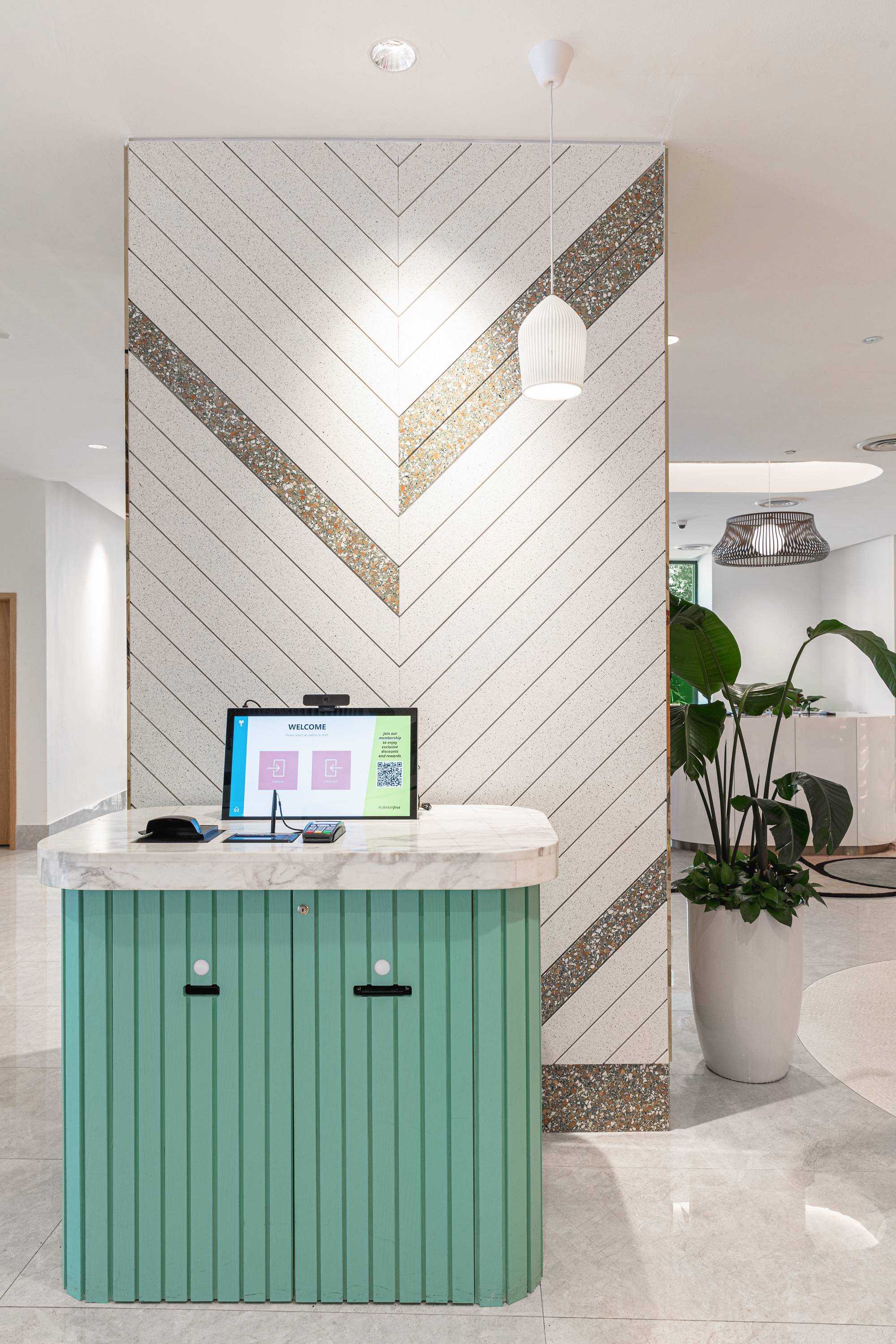
Furama Singapore self-check in kiosk post COVID-19 travel

A self check-in kiosk installed at Furama Singapore hotel. (Photo: Furama Singapore)

Self-check-in kiosks at airports and hotels, contactless payment and virtual tours of attractions will become more prevalent, said Dr Wong. 

Check-in forms, restaurant menus and attraction tickets can all be digitalised. When dining, for example, guests may call up the menu on their own devices by scanning a QR code, said Banyan Tree. MBS is looking at smart control of lights and appliances in its rooms, it said.

Furama Singapore said it intends to start an unmanned retail stop at hotel lobbies to reduce the interaction between staff members and guests. This is on top of measures such as QR-code ordering, online payments and other tech solutions to clean their hotels.

Said Ngee Ann Poly’s Mr Chiam: “The industry must be ready to embrace new digital solutions. The big question is how to incorporate the human touch into technology.”

STAYCATIONS, BUSINESS TRAVEL

The tourist demand for hotels in Singapore remains at zero for now, but experts said business travel and domestic tourism will be the first to pick up as virus outbreak gets under control. 

Last week, authorities said that Singapore is in talks with various countries to implement “green lanes” for essential travel, catering to businesses that require their employees to make trips.

READ: Business and official travellers on Singapore-China ‘fast lane’ arrangement must get COVID-19 swab tests

Singapore’s first “fast lane” travel arrangement is with China. Approved travellers have to take swab tests before departure and upon arrival. They also must adhere to a controlled itinerary that is supervised by the host company or government agency for the first 14 days,

Travellers are required to use contact tracing mobile app TraceTogether for the duration of their stay, while Singapore residents travelling into China will have to use the country’s local Health QR code during their stay. 

READ: Singapore to gradually reopen borders, plans to resume essential travel among countries with low COVID-19 transmission rate

“Such arrangements could become the new norm in international travel amidst the ongoing COVID-19 situation,” the Ministry of Trade and Industry had said. 

“We could start on a limited scale, focusing on transit passengers and essential business travel that support our global supply chains, and scale up to include more groups of travellers when the situation allows for it.”

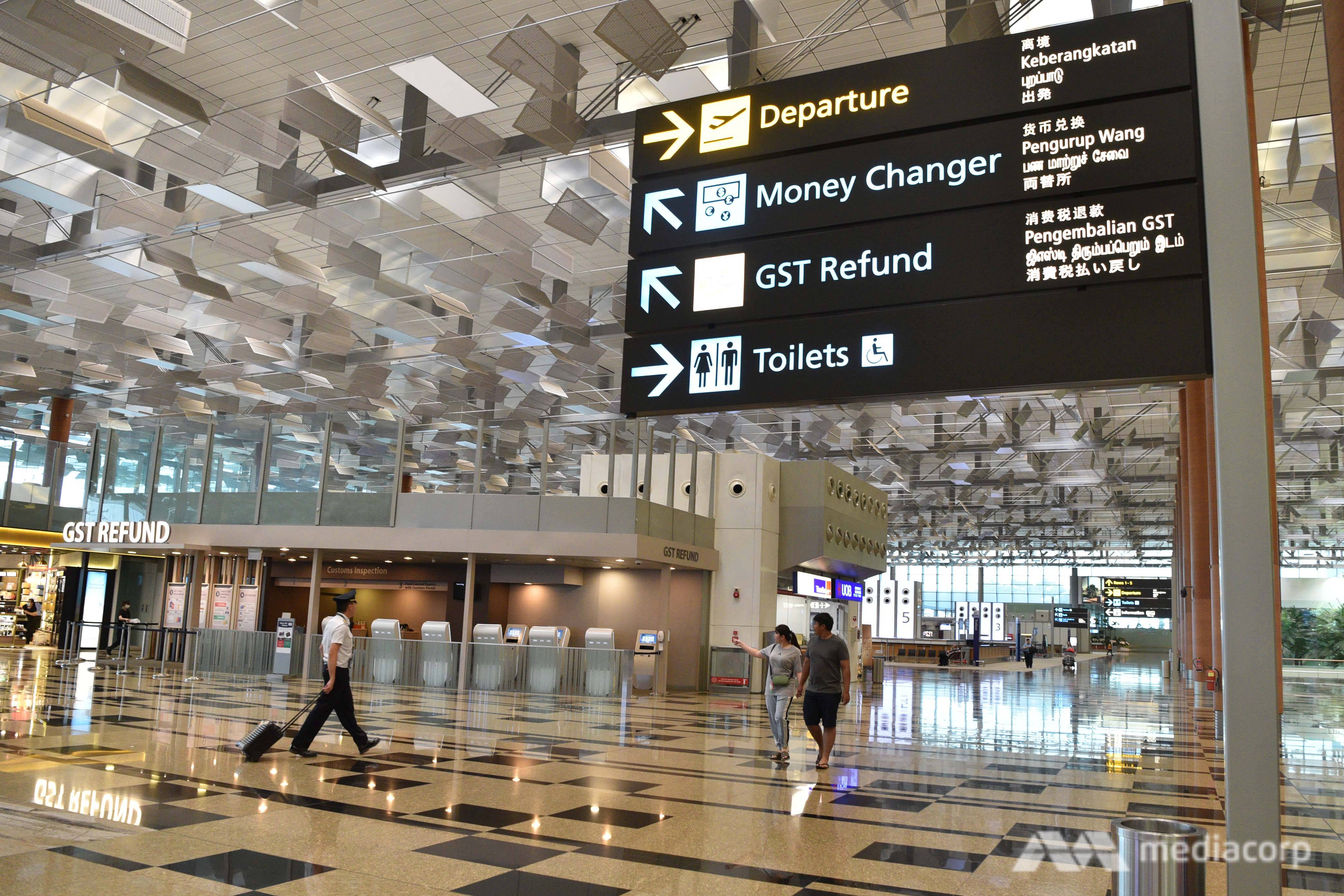
Changi Airport 09

Changi Airport Terminal 3 has seen fewer visitors amid the COVID-19 outbreak. (Photo: Jeremy Long)

Mr Chew Kian Beng, an expert in hospitality and tourism management from Temasek Polytechnic, said that business travellers in this first wave of travel could present an opportunity for Singapore.

“With social distancing and additional hygiene measures, travellers will need to pay a premium for tourism services, which can be absorbed as company expense. Also, business travellers would not quibble over flying in earlier to observe the quarantine period before their event,” he said.

“Being renowned as a clean city, Singapore would be in a good position to market hygiene-certified tourism services and long-stay lodging packages.”

READ: Travellers allowed to transit through Changi Airport from Jun 2

For leisure travellers, Dr Wong of NTU recommended that Singapore promote its eco-tourism and wellness offerings, to alleviate possible negative impressions of the country being a densely populated city with a high number of COVID-19 cases.

“We may want to focus more on the ‘garden’ instead of ‘city’ aspect based on our City in a Garden positioning,” he said.

PREPARING FOR DOMESTIC TOURISM

While STB initially anticipated a 25 to 30 per cent decline in international arrivals this year, in the first three months of 2020, the drop in arrivals was much higher at 43 per cent.

“With travel restrictions remaining in place in Singapore and around the world, we expect the visitor arrivals to decline further,” said STB chief executive Keith Tan.

STB told CNA that when there are signs of improvement, the agency will encourage Singaporeans to support the local tourism industry, which employed around 65,000 workers in 2019.

jewel changi empty covid19

Jewel Changi Airport, where F&B business have been affected by the COVID-19 crisis. (Photo: Raj Nadarajan/TODAY)

Singapore attractions are preparing for this. Jewel at Changi Airport said that it will focus its marketing efforts on Singapore residents, given travel restrictions on foreign visitors.

“For Phase 2 and Phase 3, we hope that more businesses such as F&B dine-in and retail outlets can be opened,” a spokesperson said.

READ: Going the extra mile to keep Gardens by the Bay neat and tidy during the COVID-19 circuit breaker

READ: More time with the fish: Behind the scenes at the SEA Aquarium during the circuit breaker

Garden by the Bay is exploring the development of an app for visitors to buy time-stamped tickets to indoor attractions and get real-time updates on crowds at the gardens. 

While it has stepped up cleaning of common areas and reduced the capacity of enclosed attractions like the Cloud Forest and Flower Dome, it is further reviewing safety protocols ahead of its reopening.

Gardens by the Bay pruning

Irene and Grace pruning against a backdrop of the Marina Bay Sands. (Photo: Jeremy Long)

“There is a role for a national garden to play regardless of whether it is a typical day or a pandemic period. At Gardens by the Bay, we have always believed in the power of nature and that there is respite to be sought in flora and fauna,” said a spokesperson, adding that there are still about 5,000 Singapore residents exercising daily at the outdoor gardens.

BOOKMARK THIS: Our comprehensive coverage of the coronavirus outbreak and its developments

Download our app or subscribe to our Telegram channel for the latest updates on the coronavirus outbreak: https://cna.asia/telegram

Source link

Commentary: Why we should send our children back to preschool?

SINGAPORE: Come Monday (Jun 8), younger preschool children are set to return to school, following the heels of their K1 and K2 seniors who resumed classes this week.

However, this may be easier said than done as parents of these younger ones find themselves caught between a rock and a hard place.

Up until recently, preschool-linked COVID-19 cases were still emerging.

After the initial celebratory moment when partial and staggered school re-opening was announced, the unspoken question of how to keep our children safe flooded our minds.

READ: Commentary: Don’t expect your kids to return to school seamlessly

There are competing factors at play. On one hand, parents would love to reclaim some personal time, even if it’s just for three hours a day.

On the other hand, the safety of our offspring cannot be ignored even if preschools are going the extra mile to assure us that all precautions have been taken.

Getting our kids to adhere to these social distancing measures is another consideration. How many two or three-year olds can have a mask on their faces for three hours or more?

Parents have their work cut out for them in getting their kids social distance-ready for school.

MAKING A CALL

In the first few hours of the news breaking that circuit breaker will be ending and schools re-opened, many parents were busy texting friends and fellow parents, checking to see what everyone’s plans were.

Some also started shopping for child-sized disposable masks and face shields online.

Preschool reopen pats schoolhouse outdoor playground

The outdoor playground at Pat’s Schoolhouse @ Claymore.  (Photo: Anne-Marie Lim)

There are also parents who are adopting a more cautious, wait-and-see approach.

A friend whose child in Nursery 2 (N2) has a pre-existing heart condition, will not be sending him to school.

READ: Commentary: Don’t stress over your kids’ education this circuit breaker. There are other ways they are learning

She has calculated the risks and rewards involved and figured that it will not be worthwhile.

Some parents will similarly choose to opt out of school for now, which is understandable given that there is less academic learning at stake for younger preschoolers.

However, she acknowledged that it will be a matter of time, and the final decision of when to resume school will be dependent on the number of community cases and the peace of mind from knowing what the preschool is doing to maintain safe distancing measures.

She elaborated, “Knowing that the school has a plan that is communicated well and implemented effectively helps.”

For parents with similar considerations in not sending their young ones to preschool for a prolonged period of time, they need to bear in mind that there are implications.  

Although the younger ones may not do much academic learning at this stage, it is the overall development and growth that they get during this period that matters.

According to UNESCO (United Nations Educational, Scientific and Cultural Organization), the period from birth to eight years old in a child’s life “is a time of remarkable growth, with brain development at its peak.”

“Early childhood care and education (ECCE) is more than preparation for primary school. It aims at the holistic development of a child’s social, emotional, cognitive and physical needs in order to build a solid and broad foundation for lifelong learning and well-being.”

READ: Commentary: Perhaps now, stay-home mums will get the credit they deserve

Moreover, there is also the consideration for our children’s need for socialisation and normalcy.

As Minister for Education Ong Ye Kung puts it, “COVID-19 will be with us for some time…We can’t keep our kids at home for so long. It will severely impact their socio-emotional well-being and their whole person development.”

PRESCHOOLS DOING ALL THEY CAN

To ensure that our little ones are kept safe during this risky period, preschools are doing the necessary, with some going the extra mile.

For example, another friend shared that her child’s preschool has rejigged the curriculum to focus more on outdoor activities and learning, in the interest of social distancing.

Having prepared masks for her N2 child, she is not overly worried about any perceived health risks and is choosing to focus on the things she can do such as reminding her child that his school experience will now include new habits of wearing a mask and washing his hands more often.

Spending more curriculum time outdoors makes sense if the physical environment allows for different groups of children to be outdoors at different timings.

Studies have indicated that coronaviruses do not thrive in hot and humid environments, though these are not conclusive. They are also less likely to spread in well-ventilated areas.

disinfecting toys preschool

A pre-school staff from My First Skool places toys inside an industrial toy steriliser. (Photo: Gaya Chandramohan)

Most preschools have also adopted staggered reporting and dismissal timings. They have also tried to space out their children through using long tables and larger spaces such as the assembly hall.

So far it seems like the slightly elder children are coping well.

Jasmine Koh, Centre Director of MapleBear Hillview, said, “Surprisingly, majority of the K1 and K2 children are happy to wear their masks for the entire time that they are in school. They do remove it during mealtimes, nap times and active playtimes and hence, we have taken time to practise safely removing and storing the mask.”

“We have also provided a MapleBear face shield for children to use when they are uncomfortable or need a breather, which will also come in handy for the younger children who may need a little more time to adjust to the change.”

EVERYONE HAS A PART TO PLAY

Schools are doing their best to implement safe distancing and stringent hygiene practices, but to be clear, everyone is treading new and unfamiliar ground here. So we can’t fault parents for their apprehension.

While the government has provided guidelines, it is still up to each school to translate these new rules into clear protocols that work in their day-to-day operations and interactions.   

A friend of mine noticed on the first day of dropping off her K2 child that a teacher was using gloved hands to pull down her child’s mask to do an oral check, a standard procedure to guard against HFMD.

She immediately raised a red flag, suggesting instead that each child be allowed to pull down their own mask. This minimises the risk of a staff unknowingly passing on germs from child to child.

So apart from teaching our kids how to don and keep a mask properly, as well as how to wash their hands and sanitise them, parents need to be alert to any unsafe practices that we see around us and provide constructive feedback.

CHILDREN WILL ADAPT IF PARENTS LEAD THE WAY

As we prepare to send our youngest ones out of our nest, it will undoubtedly be a tentative and quivering step into the unknown.

We may find ourselves like a broken recorder, repeating the new rules of COVID-19 life again and again – “hands away from your face”, “wash your hands”, “keep your mask on at all times”.

READ: Commentary: Confinement without help during COVID-19 – Mums, you’re stronger than you know

Preschools would do well to help ease some of the anxieties by communicating regularly and implementing their measures diligently.

It is a formidable task ahead for teachers so parents also need to respond with patience.

Preschoolers may struggle with wearing a mask for the entire duration of school but they do have strengths that will help set them up for success: Adaptability.

Preschool reopen pats schoolhouse classroom

At Pat’s Schoolhouse, classrooms will be split into two sections, with one group per section. (Photo: Anne-Marie Lim) 

They may be young but they are amazingly adaptable to changes in the environment, given some practice and encouragement.  

If we keep a positive outlook, and partner our children’s schools effectively, we may find our kids more receptive to change.

But we must first shore up sufficient mental and practical resources and manage our own anxieties well. Only then will our children stand a good chance at adapting and thriving – even amidst this crisis.

June Yong is a mother of three, an educational therapist and owner of Mama Wear Papa Shirt, a blog that discusses parenting and education in Singapore.

Source link

Commentary: When gyms finally reopen, can we get rid of toxic gym culture?

SINGAPORE: I love going to the gym as much as the next normal person — which is to say, I couldn’t think of a worse punishment. 

But I willingly put myself through the torture. 

It started in my mid-twenties when I hauled myself to the gym regularly. From monthly packages at high-intensity interval training gyms to occasional classes at boutique boxing gyms, I happily left home before dawn to pump myself with enough endorphins before tackling my to-do list at work. 

There was nothing that motivated me like getting sweaty in the company of others who found equal pleasure in suffering together — and the collective guilt of having already forked out an exorbitant amount for a membership.

Never mind that chaining myself to machines in a pungent space with perspiring strangers felt disturbingly dystopian, especially since I’d head straight to another slavish factory to do work on another machine after my hour-long gym session to earn enough money so I could persist with this routine relentlessly each week

Along with the simultaneous proliferation of gyms, yoga studios, indoor cycling studios and other similar fitness centres, I was officially sucked into the cult of fitness. 

READ: Commentary: Exercise addiction, when life dangerously revolves around your fitness schedule

READ: Commentary: Obsessing over how many steps you’ve clocked can be unhealthy

Thanks to COVID-19, the circuit breaker has put a dampener on my gym regime for the near future. 

Singapore aims to allow retail, dining-in and fitness facilities to resume business under plans to lift more restrictions in Phase 2. That could come as early as end-June but it’s hard to see how gyms will resume business as usual after the circuit breaker lifts, since customers share the same equipment in small places. 

Frankly, I’m in no rush to return.

Getting the most out of your gym membership

(Photo: Unsplash/rawpixel)

SAVE GYMS, BUT DITCH GYM CULTURE

Much has been said about how the pandemic has exposed certain structural issues and problems stewing beneath the facade of our pristine national image, from the lack of digital literacy in lower-income households to poor living conditions for migrant workers.

Similarly, on an individual level, the sudden absence of gyms and fitness studios, coupled with the security of distance and the power of 20/20 hindsight, have got me thinking about the more insidious reasons I was previously addicted to religiously patronising them. 

While I did strive to be healthy, I also bought into the glamorised gym culture that focused on a specific ideal of wellness — one that probably placed more value on looking good than inner well-being. 

Like many gym goers I suspect, I would visit the gym partly because I was committed to “self-optimisation”. I wanted to perfect the ultimate “fitspo” lifestyle and become the proverbial woman who “has it all”.

I would blame peer pressure. After all, I felt accountable to those crossfit classmates who would surely notice if I didn’t turn up every week.

READ: Commentary: COVID-19 stress is affecting your health and mood – but exercise can help

READ: Commentary: You can enjoy jogging even by yourself

But a lot of the tension was from within. I’d already sunk a huge sum of money on that annual gym membership, surely I couldn’t let that go to waste? Worse still, I wouldn’t want to send the message that I don’t take my health seriously. 

And it wasn’t enough that I led a healthy lifestyle, I had to look the part. I was excessively self-conscious about displaying flawless form in the gym, in case other seasoned gym goers were watching. 

Outside the gym, I would plan my meals so stringent that counting calories became second nature. When I looked at my medium-rare ribeye, all I could see were the kilometres I had to run off. Whenever I indulged in fast food, I would castigate myself and swear to work doubly hard the next day as penance.

Convinced this obsessive practice was only making me fitter, leaner, toner, and ultimately the much better person I aspired to be, I continued hacking away like a maniacal energizer bunny.

But being away from the gym for several months due to COVID-19 helped me realise the performative aspects of gym culture don’t exist in a vacuum.

Trainer Wang Kai teaches a class that is being livestreamed at a gym, as the country is hit by an o

Trainer Wang Kai teaches a class that is being livestreamed at a gym, as the country is hit by an outbreak of the new coronavirus, in Beijing, China, on Feb 14, 2020. (Photo: REUTERS/Carlos Garcia Rawlins)

They’re buttressed by our broader culture of hustle porn and hyperproductivity, where our sense of self-worth is attached to our tangible output.

Workism in American society, according to The Atlantic, is “the belief that work is not only necessary to economic production, but also the centerpiece of one’s identity and life’s purpose”. Along the same vein, presenteeism in the Singaporean workplace regards employees working till 11pm as hardworking models worth emulating.

READ: Commentary: Hello COVID-19 remote working, goodbye cult of presenteeism

READ: Commentary: Let’s face it. Zoom meetings are exhausting

When it comes to physical fitness, this culture of hyperproductivity translates into extreme image consciousness. We think it’s only natural to work out in order to fit into society’s conventional standards of physical beauty.

Unfortunately, when our interests are mainly built on external factors, such as having to show up at a physical gym or rely on the attention and validation of fellow fitness fanatics to feel good, there is little intrinsic motivation to continue once these external factors cease to exist.

It is why, I suspect, many people possess pricey memberships that collect dust after only being used for a few gym sessions — just one reminder that the pressure to perform in a certain way seemingly crucial to your identity can make you squander unnecessary money or even affect your mental wellbeing. 

A MORE MINDFUL MODEL OF PHYSICAL WELLNESS 

Since the circuit breaker kicked in, the curious thing is my workout sessions have gotten more sparse and erratic, ranging from twice a day to once a fortnight. 

Yet, I don’t feel an ounce of guilt for “slacking”.

work from home photo: Mimi Thian Unsplash

(Photo: Mimi Thian/ Unsplash) 

This period of compulsory downtime has stripped us of life’s frills. When everyone is simply trying to cope with perennial anxiety and fatigue over an uncertain future, prioritising being in tip-top shape suddenly seems trivial in comparison.

These days, I do what I can with what I have, based on what feels good for myself. That means turning down all invites to Zoom workout sessions for a start. Otherwise, I’d merely be replacing one performance in the gym for another in my home to a live digital audience. 

I exercise within the parameters of my room, which usually entails having YouTube fitness gurus scream at me to “push through” because “no pain, no gain”. And I allow myself to collapse wheezing after barely 20 minutes or hit pause on a strenuous workout without any shame.

Alternatively, I jog around my neighbourhood when I conjure enough self-discipline to overcome my inertia and cabin fever, taking in the fresh air and limitless personal space that a gym lacks

READ: Commentary: Eating disorders are about emotional pain – not food

And instead of punishing myself for indulging in sinful foods, I look at the possible stressors that compel me to indulge in the first place, then tackle them. 

I understand gym rats who yearn to work out with a like-minded community again. I, too, occasionally miss the enforced discipline of exercising in a gym. 

But we shouldn’t squander the opportunities that COVID-19 has granted us to question longstanding ways of living. 

We can no longer ignore the bigger conversation that needs to happen about how gym culture affects both physical and mental well-being. Let’s start with dismantling the pernicious culture of fitness, where self-image, identity, and productivity feel so enmeshed, the desire to stay fit became a toxic obsession.

If we do return to the gym, we must develop a healthier relationship with our bodies independent from what society or the mirror in the gym tell us.

LISTEN: How Singapore businesses and workers can thrive in a post-pandemic new normal

BOOKMARK THIS: Our comprehensive coverage of the coronavirus outbreak and its developments

Download our app or subscribe to our Telegram channel for the latest updates on the coronavirus outbreak: https://cna.asia/telegram

Grace Yeoh is a senior journalist at CNA Insider.

Source link

‘I eat one meal a day’: Some Malaysians who lost their jobs in Singapore left stranded and cash-strapped

SINGAPORE: A Malaysian construction worker who wished to be known only as Muhd Hassan, was left in the lurch after he received a termination letter from his company late last month.

The 31-year-old Johor resident had been working for a Singapore-based company over the last three years, but suddenly found himself out of a job.

“It all happened so quickly. My supervisor called me over the phone to tell me that the company was not doing well and I had to be let go,” said Muhd Hassan.

Muhd Hassan is among some Malaysian workers who are left stranded in Singapore after losing their jobs, and are struggling to make ends meet.

The work permit holder has chosen to live in Singapore since Malaysia’s movement control order (MCO) was imposed on Mar 17 and cross-border travel restricted between both countries.

Up until the MCO took effect, Muhd Hassan shuttled across the Causeway daily. He has not seen his wife and two daughters, who live in Pasir Gudang, for more than 75 days.

“I decided not to go home before the MCO because my work situation was uncertain. I did not want to be stuck in Johor if there was work to do in Singapore. I needed to keep earning,” he told CNA.

Unfortunately for Muhd Hassan, construction projects were halted when Singapore entered the “circuit breaker” period on Apr 7. He was placed on unpaid leave and later sacked on May 29.

CANNOT AFFORD MANDATORY HOTEL QUARANTINE 

What has troubled him the most is his financial situation. He has less than S$200 in savings, having transferred a large chunk of his money to his family back in Johor for household expenses.

“I know Ramadan has ended but in order to save money, I just continued fasting. I eat one meal a day to save money. It’s enough,” said Muhd Hassan.

He rented a room with his friend in a flat in Yishun, so that he can find another job in another construction firm while he is here.  

Muhd Hassan has considered heading back home but with his savings depleted, he decided that he could not afford it.

Putrajaya has announced that from Jun 1, Malaysian residents returning home will have to pay for their compulsory COVID-19 hotel quarantine costing RM75 (S$24.60) a day. Thus, for a typical 14-day quarantine, Muhd Hassan would have to fork out RM1,050. He does not have enough money.  

Crowds after crossing Causeway ahead of Malaysia's COVID-19 travel restrictions

People at Woodlands Checkpoint waiting for private transport after crossing the Causeway ahead of Malaysia’s new travel restrictions. (Photo: Try Sutrisno Foo)

“I hope to get another job and hopefully when we can travel back and forth again without the need for quarantine, life will be back to normal,” he said.

COVID-19’s impact on the economy and labour market has affected the thousands of Malaysians who work in Singapore, many of whom, like Muhd Hassan, commute across the Woodlands Causeway and Tuas Second Link daily.

In a Facebook post on Jun 3, Singapore Senior Minister Tharman Shanmugaratnam said due to “sheer uncertainty” as to how long COVID-19 will last, the Singapore economy “will have far fewer new job openings than jobs being lost” over the next year, and possibly beyond that.

READ: National Jobs Council will open pathways to jobs amid COVID-19 pandemic, says Josephine Teo

“MY BOSS CANNOT AFFORD TO PAY MY SALARY”

Like Muhd Hassan, another fellow Johor resident who wanted to be known only as Roy, also recently lost his job in Singapore.

Roy worked in a factory in Tuas until May 1 when his employer asked him to resign.

“My boss said he could not afford to pay for my salary anymore, so he asked me to resign by mutual consent. He said he will consider rehiring me when the situation improves,” the 36-year-old told CNA.

“I was not the only person getting sacked, two other Malaysians were also let go,” he added.

He said his supervisor explained that the company was losing money as the factory had halted production during the circuit breaker period.

“Yes, I read that the Singapore government is trying to help companies pay their foreign workers but my boss said this was simply not enough,” said Roy.

To help companies alleviate costs, the Singapore government introduced a foreign worker levy waiver and rebate for businesses in the construction, marine and offshore and process sectors.

Deputy Prime Minister and Finance Minister Heng Swee Keat had announced on Apr 6 that, as part of the Solidarity Budget, he will waive the levy due in April and give employers a rebate of S$750 for each work permit or S pass holder, based on previous levies paid in 2020.

Crowds after crossing Causeway ahead of Malaysia's COVID-19 travel restrictions 5

Commuters boarding a public bus outside Singapore’s Woodlands Checkpoint shortly after midnight Wednesday (Mar 18), after crossing the Causeway ahead of Malaysia’s new travel restrictions.
(Photo: Try Sutrisno Foo)

On May 26, Mr Heng announced that the waiver will be extended to 100 per cent in June and 50 per cent in July, while the rebate will be extended to S$750 in June and S$375 in July.

READ: Singapore’s circuit breaker and beyond: Timeline of the COVID-19 reality

However, Roy noted that some subsidies to help companies pay their local employees did not extend to foreigners.

For instance, as part of measures to help firms cope with the impact of Singapore’s circuit breaker, Mr Heng announced as part of the Jobs Support Scheme that firms in all sectors will receive a 75 per cent wage subsidy for Singapore citizens and permanent residents. However, this scheme does not cover foreigners, including Malaysian work permit holders.

Singapore Malaysia Causeway Mar 18, 2020 - 5

The Causeway at around 7am as dawn breaks on Mar 18, 2020. (Photo: Try Sutrisno Foo)

In spite of this, Roy is determined to stay in Singapore to find another job. He is currently staying with his cousin’s family in their Woodlands HDB flat.

“I think another opportunity will come and I want to grab it. Going home now could mean that I would never be able to come back to Singapore this year, especially if the COVID-19 (border) restrictions continue,” said Roy.

Roy has not seen his wife, who lives in Johor Bahru, since March. However, he said that he talks to her regularly through online video calls.

“I have not told her that I got sacked, I think she would worry a lot. When I do get to go home, I want to do so with a job in hand so that I can support her and my parents,” said Roy.

READ: ‘We have to ration our meals’ – Malaysians share their struggles after COVID-19 left them jobless

MISSING THEIR FAMILIES

Besides Roy, another Malaysian citizen who lost her job recently also shared how she misses her family.

Chee Li Ya, who worked for a tourism agency, told CNA that she has not seen her father for more than four months.

The permanent resident was sacked in late February, eight months after she joined the company as a digital marketing and communications manager.

“They told me: ‘We can’t keep you around anymore.’ I didn’t see it coming, but I knew there was a danger of me losing my role with COVID-19 affecting travel,” said Ms Chee.

FILE PHOTO: Commuters wait for a transport to leave the Woodlands Causeway across to Singapore from

FILE PHOTO: Commuters wait for a transport to leave the Woodlands Causeway across to Singapore from Johor, hours before Malaysia imposes a lockdown on travel due to the coronavirus outbreak March 17, 2020. REUTERS/Edgar Su

She presently lives with her partner, a Malaysian citizen who works in healthcare. She said she is lucky because her partner is able to pay rent, so she can get by financially.

However, she maintained that being away from her father since Chinese New Year has been “really hard” on her.

“When the Malaysian government announced the lockdown, I did consider going back. But it was hard because I was looking for another job. I didn’t know if I could come back to Singapore and if I had to be quarantined and so I decided to stay, because I knew that my dad had people looking out for him,” said the 30-year-old.

Moreover, Ms Chee, Roy and Muhd Hassan all expressed hope that both the Singapore and Malaysia governments could come up with a solution soon to allow work permit holders to cross the border and commute between their families and work.

Ms Chee said: “There are so many Malaysians who commute back and forth, I wish they would allow this but provided they have doctor letters to ensure that they are well.”

At the end of May, Singapore’s National Development Minister Lawrence Wong said during a Ministry Task Force press conference that Singapore was in discussion with Malaysia on issues related to workers who want to commute daily through both land crossings.

He added that although both countries have stricter travel measures to curb the spread of COVID-19, eventually both sides will have to see how best they can accommodate the workers.

Meanwhile, in a Facebook post on Jun 4, Johor Chief Minister Hasni Mohammad said that he held discussions with Malaysian Senior Minister Ismail Sabri Yaakob to work towards allowing Johor residents commute to Singapore for work. 

“God willing, we are working to expedite this. Many issues need to be considered and various implementation methods are being refined to ensure the safety and health of all residents.”

On this, Roy said he hoped something would be announced soon to facilitate movement of workers. However, his priority now was to find another job as soon as possible.

“I hope that when the spread of COVID-19 slows, my old company would rehire me,” said Roy. “Then I can go home to my wife knowing that we are financially secure.”

BOOKMARK THIS: Our comprehensive coverage of the coronavirus outbreak and its developments

Download our app or subscribe to our Telegram channel for the latest updates on the coronavirus outbreak: https://cna.asia/telegram

Source link

Singapore reports 25th COVID-19 death, 344 new cases

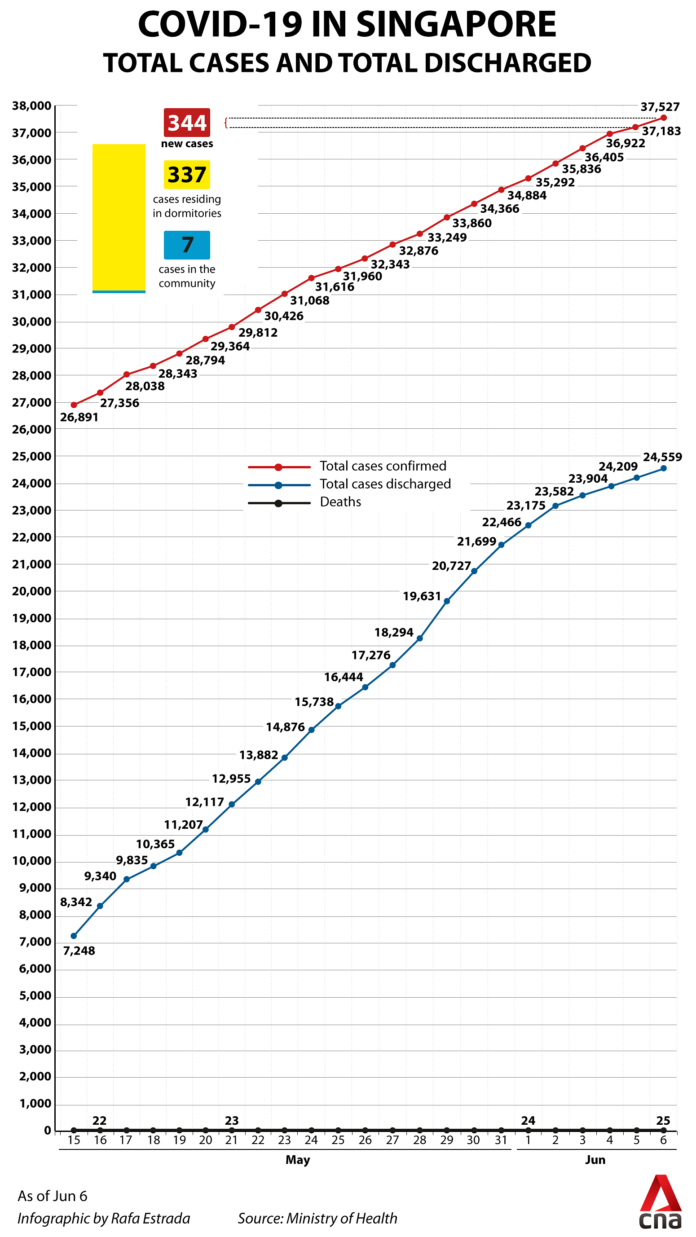
SINGAPORE: Singapore reported 344 new COVID-19 cases as of noon on Saturday (Jun 6) and recorded on more death, according to the the Ministry of Health (MOH).

This takes the total number of coronavirus infections in Singapore to 37,527, with the number of fatalities at 25.

A 41-year-old male Chinese national, known as Case 11714, died on Thursday, more than two weeks after being discharged. 

He was confirmed to have COVID-19 on Apr 22, had recovered from the infection and was discharged on May 17, MOH said.

“He collapsed on Jun 4 and the coroner has certified that the cause of death was massive pulmonary thromboembolism following SARS-CoV-2 infection,” the health ministry added.

He is the youngest person to die from complications due to COVID-19.

EXPLORE OUR INTERACTIVE: COVID-19 CASES IN FOREIGN WORKER DORMS

SEVEN COMMUNITY CASES

Seven of the new cases were in the community – two Singaporeans, a permanent residents and four work permit holders.

Out of the seven cases, five were asymptomatic, but were swabbed as part of MOH’s proactive surveillance and screening.

The permanent resident is a family of a previously confirmed case and had already been quarantined earlier. 

One of the Singaporeans is a cleaner at the pre-school section of an international school, and was tested as part of MOH’s proactive screening of pre-school staff. 

Epidemiological investigations are ongoing for the other Singaporean case.

MOH added that all four work permit holders had been picked up as a result of proactive screening. 

Of these, three were tested as part of efforts to screen workers in essential services, and one was tested as part of MOH’s screening of migrant workers deployed at public healthcare institutions.

He had been doing building maintenance works at Khoo Teck Puat Hospital and had not interacted with hospital staff or patients, the health ministry said.

MOH COVID-19 gfx Jun 6

The cases in the community are aged between 27 and 51, and include  Singaporeans, as well as nationals from Malaysia, India and Bangladesh.

“Overall, the number of new cases in the community has increased, from an average of five cases per day in the week before, to an average of seven per day in the past week,” MOH said. “The number of unlinked cases in the community has remained stable at an average of two per day in the past two weeks. We will continue to closely monitor these numbers, as well as the cases detected through our surveillance programme.” 

NEW CASE IN PUBLIC HEALTHCARE SECTOR, 2 NEW CLUSTERS

There was also a new case in the public healthcare sector – a 27 year-old Singaporean who is a physiotherapist at Tampines Polyclinic.

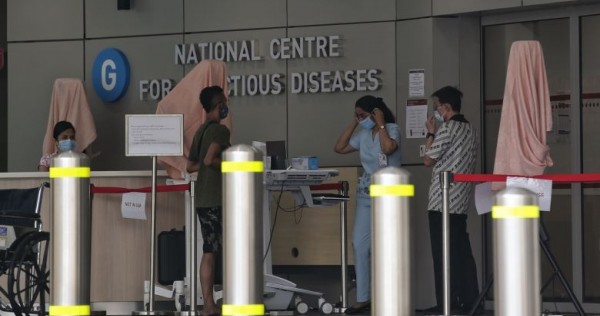
He was confirmed to have the virus on Jun 5 and is currently warded at the National Centre for Infectious Diseases. 

He had not gone to work since the onset of symptoms. The man also has no recent travel history to affected countries or regions. 

MAP: PLACES VISITED BY COVID-19 PATIENTS

A total of 337 of the new cases involved work permit holders residing in dormitories.

Two new clusters were also identified – at a dormitory at Beyond Tuas South Boulevard and at a dormitory at 10 Kwong Min Road.

In addition, an NTUC FairPrice outlet at Hougang Mall was newly listed as a public place visited by community cases during their infectious period. MOH specified the date to be May 30 between 11.10am and noon.

MOH has advised that people who have been to such places during the specified times should monitor their health closely for 14 days from their date of visit.

“There is no need to avoid places where confirmed cases of COVID-19 have been,” it added. 

“The National Environment Agency will engage the management of affected premises to provide guidance on cleaning and disinfection.”

MOH reported that 350 more COVID-19 patients have been discharged from hospitals or community isolation facilities. 

In all, 24,559 have fully recovered from the infection and have been discharged from hospitals or community care facilities.

There are currently 308 confirmed cases who are still in hospital. Of these, most are stable or improving, and four are in a critical condition in the intensive care unit. 

A total of 12,635 cases are isolated and cared for at community facilities. These are  people who have mild symptoms, or are clinically well but still test positive for COVID-19.

PARLIAMENT PASSES FORTITUDE BUDGET

To help businesses and residents tide over the COVID-19 economic downturn, Parliament on Friday passed the S$33 billion Fortitude Budget, the fourth tranche of relief measures this year.

Wrapping up the debate on the Budget, Deputy Prime Minister Heng Swee Keat said that Singapore may take years to recover from the effects of the COVID-19 pandemic.

“The road to recovery will be long, as we deal with persistent economic impact on workers, jobs, and business. Beyond economic costs, there will be immense human and social costs,” he said in Parliament.

Earlier on Friday, Minister-in-charge of the Smart Nation initiative Vivian Balakrishnan said the Government is developing and will soon roll out a portable and wearable contact tracing device.

If the device works, it may be distributed to everyone in Singapore, he said.

BOOKMARK THIS: Our comprehensive coverage of the coronavirus outbreak and its developments

Download our app or subscribe to our Telegram channel for the latest updates on the coronavirus outbreak: https://cna.asia/telegram

Source link

AsiaOne is hiring!

[ad_1]

If you have it, don’t just flaunt it. Join AsiaOne’s growing editorial, video production and social media teams. We have permanent, temporary, trainee, intern and freelance positions to fill.

AsiaOne is a leading digital content site that gives readers a fresh perspective on news that matter to our readers.

We deliver the latest trending topics on news, entertainment and lifestyle, delivering content across Southeast Asia to an audience of four million readers monthly. Our video formats give viewers a first-hand experience of places and things, through our lens.

AsiaOne is now a joint venture between mm2 Asia and Singapore Press Holdings, both mainboard-listed media and entertainment companies in Singapore.

PERMANENT POSITIONS

Content Strategist (News/Lifestyle) Multiple Positions Available!
TEMPORARY POSITIONS – ONE-YEAR CONTRACT

[ad_2]

Source link

Coronavirus: 344 new cases reported in Singapore

[ad_1]

The Ministry of Health (MOH) has reported 344 new coronavirus cases in Singapore on Saturday (June 6). 

Of these, seven cases are from within the community — three Singaporeans/PRs and four Work Pass holders, with a vast majority of cases being Work Permit holders residing in foreign worker dormitories, said MOH.

The total number of cases in Singapore currently stands at 37,527 with 24 deaths.

For the latest updates on the coronavirus, visit here.

[ad_2]

Source link

PM Lee, Cabinet ministers to deliver series of national broadcasts on Singapore’s post-COVID-19 future

SINGAPORE: Prime Minister Lee Hsien Loong, along with several Cabinet ministers, will deliver a series of national broadcasts from Jun 7 to Jun 20.

In a press release on Saturday (Jun 6), the Prime Minister’s Office (PMO) said that the national broadcasts will see the ministers explain “what a post-COVID-19 future looks like for Singapore, and lay out plans to see the country through the storm and emerge stronger”.

READ: Parliament passes Fortitude Budget, 4th package of COVID-19 relief measures this year

The broadcasts will be delivered by Prime Minister Lee Hsien Loong, Deputy Prime Minister Heng Swee Keat, Senior Ministers Teo Chee Hean and Tharman Shanmugaratnam, Trade and Industry Minister Chan Chun Sing and National Development Minister Lawrence Wong.

The ministers will talk about:

  • What Singaporeans must do to live with COVID-19 for the long haul to go about their daily lives safely
  • How Singaporeans can maintain relevance on the world stage as the geopolitical situation changes
  • How to keep Singapore’s economy competitive so that businesses can prosper and create good jobs for Singaporeans
  • How to create promising opportunities for all Singaporeans to succeed, and care for the more vulnerable
  • How Singaporeans can work together to emerge stronger from this crisis.

READ: S$33b Fortitude Budget aimed at providing jobs, supporting workers and firms through ‘difficult period’ of COVID-19

READ: Real risk of resurgence in COVID-19 cases, clusters if too many activities resume too quickly: Gan Kim Yong

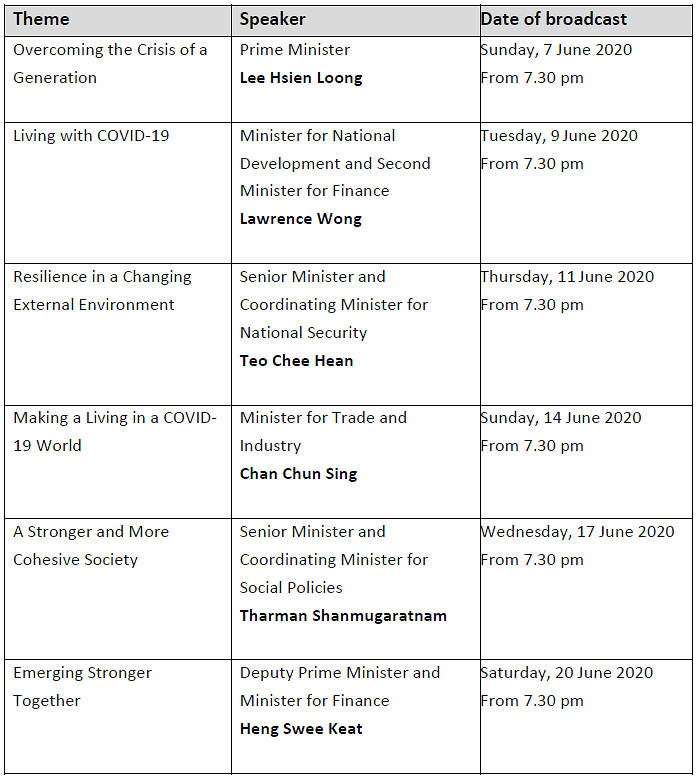
Mr Lee will launch the series on Jun 7, with the rest of the ministers speaking according to this schedule.

national broadcasts (1)

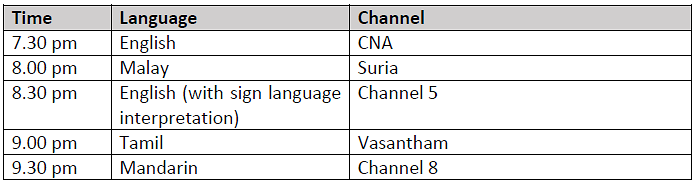
All speeches will be broadcast at the following times on these TV channels on the
respective dates.

national broadcasts

The speeches will also be available on the Gov.sg website, Facebook page, YouTube channel and Twitter.

Mr Lee’s and Mr Heng’s speeches will be published on their respective Facebook pages, as well as on the PMO YouTube channel.

The Singapore Government has passed four Budget packages of COVID-19 relief measures so far this year, bringing the total expenditure of such measures to S$93 billion.

More than S$72 billion, or close to 80 per cent of the S$93 billion for COVID-19 support measures, is committed to helping workers stay in their jobs, supporting businesses and their employees, “which in turn support social resilience”, said Mr Heng on Friday.

READ: Singapore’s circuit breaker and beyond: Timeline of the COVID-19 reality

Singapore emerged from a “circuit breaker” period and entered its first phase of reopening on Tuesday, with certain businesses that operate in settings with lower transmission risks resuming operations

Phase 2 could start before the end of June if the number of COVID-19 transmissions in the community remains low and stable, said Minister for National Development Lawrence Wong on May 28.

BOOKMARK THIS: Our comprehensive coverage of the coronavirus outbreak and its developments

Download our app or subscribe to our Telegram channel for the latest updates on the coronavirus outbreak: https://cna.asia/telegram

Source link

NDP2020: Wet blankets and party poopers not needed

[ad_1]

Picture this: It’s Ah Ma’s 70th birthday this year, but thanks – or rather, no thanks – to Covid-19 and the Circuit Breaker, the entire extended clan can’t be together under one roof to eat, drink, and make IG stories.

So, you take the trouble to coordinate everyone’s schedules for a Zoom gathering, and order cakes and bubble tea online to be delivered to all your uncles’ and aunties’ homes, so that everyone can still have a semblance of Ah Ma’s usual birthday celebrations.

Then, two of your cousins (the irritating ones you’ve never liked) kick up a fuss and go all Eco Warrior on you and start flooding the family WhatsApp group chat with a barrage of comments that start off with “Why are you wasting money on all this food and delivery?!” “Do you know what a large carbon footprint is being left behind by all the food deliveries being made from this?!” and escalate to “Zoom is not secure!” “I hate parties! So fake!” and eventually, “CANCEL THE PARTY LAH!! NO MOOD LIAO 🙄”

[ad_2]

Source link