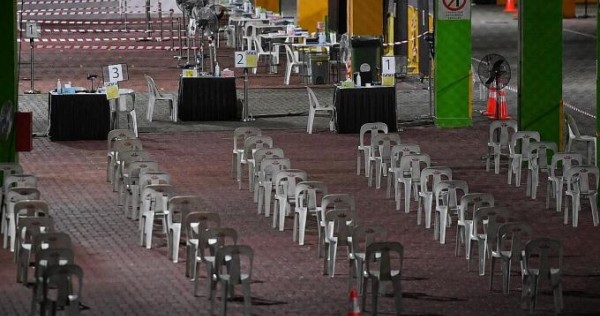
Regional screening centres will be set up progressively across the island to support increased Covid-19 testing needs, Health Minister Gan Kim Yong said yesterday.
These centres, which will be set up by the Health Promotion Board (HPB), will be used to carry out active testing for target groups, and will be located in places that are easily accessible, the Ministry of Health (MOH) said in a press release.
Speaking at a press conference, Mr Gan said many of the community cases in the past week came from active case finding, and with increased interaction among people, a rise in the number of cases is expected.
Mr Gan said: “What is important for us is to mitigate the risks, with basic hygiene practices and precautions, and ring-fencing cases quickly with timely contact tracing so that large clusters do not form.
“Testing is a key enabler of our overall efforts to safely re-open.”
Two of the regional centres at the Old Police Academy and The Float @ Marina Bay started up last Tuesday, and two more centres, one at the Bukit Gombak sport hall and Bishan sport hall, were set up yesterday.
There is no need to worry about going to venues that Covid-19 patients have visited as these places are safe, Health Minister Gan Kim Yong said yesterday.
He added that the Government releases information about these venues to encourage people who went to these places to watch out for symptoms.
Those who wish to visit these places – which have included supermarkets, offices, malls and Mustafa Centre – can do so as these places would have been thoroughly disinfected, Mr Gan said at a news conference by the multi-ministry task force he co-chairs.
“Once we identify the patient, and when there is a risk at the venue… we will do a thorough deep cleaning at the affected places to render them safe so that workers and family members can go back,” he said.
“So, for places like Mustafa Centre or shopping centres that he has been to, there is generally no risk… because (the patient is) no longer there.”
SINGAPORE: Contractor PQ Builders’ Peh Ke-Pin has had little luck sourcing for Singaporean workers.
About 90 per cent of the company’s team that does ground construction work are made up of foreigners. The Singaporeans who are part of the team are in supervisory roles.
Bringing in foreign workers is not as cheap as people think, he said. A construction worker typically earns about S$800 a month in basic pay, but each worker costs at least double that, if you count the levy, accommodation and food expenses, as well as overtime pay.
“It’s not that much more expensive to hire a local,” Mr Peh said. He is willing to pay between S$2,000 to S$3,000 for a local, but there are still no takers when he puts out the job advertisements.
This may be due to the current notion of what construction work entails.
Some Singaporeans CNA spoke to said that with higher pay and career advancement, they might consider working in the construction industry, but they admitted that most people here see the job as menial, and even dangerous.
Samuel Goh, 35, said that he once trained as a workplace safety officer but he switched to a sales job after realising that the starting salary of less than S$2,000 was insufficient to provide for his family.
Roadworks being carried out in Singapore. (Photo: Gaya Chandramohan)
“If the salary was the same, then I will join the (construction) industry,” said Mr Goh, who is now driving a taxi as he needs flexible hours to care for his children. “Driving a taxi, you are trading your time for money. If you want to earn more, you can work 16 or 18 hours a day.”
Grab driver Ian Chan, 31, said that if the pay was similar, he would still prefer to be a private-hire driver: “It’s less dirty, and you won’t get injured. Construction will be more tiring than driving.”
Similarly, the level of interest among Singaporeans to take up jobs for technicians and technologists is low due to perceptions of these jobs being meant for foreign workers and the lack of recognition and career progression, said Mr Joseph Goh, deputy chairman of the Mechanical and Electrical Engineering Technical Committee for the Institution of Engineers (IES).
The cost of hiring a skilled foreigner worker, including the levy as well as accommodation, laundry and insurance is comparable to hiring a local tradesman, he said. “This means that the issue for some employers might not be budget constraints, but the lack of local applicants.”
DEBATE ON FOREIGN LABOUR REVIVED
Their views come amid a debate that was recently re-ignited as COVID-19 cases in the workers’ dormitories surged.
Members of the public and political observers alike have questioned Singapore’s continued demand for lower-cost foreign workers, and whether local companies could and should reduce their reliance on them.
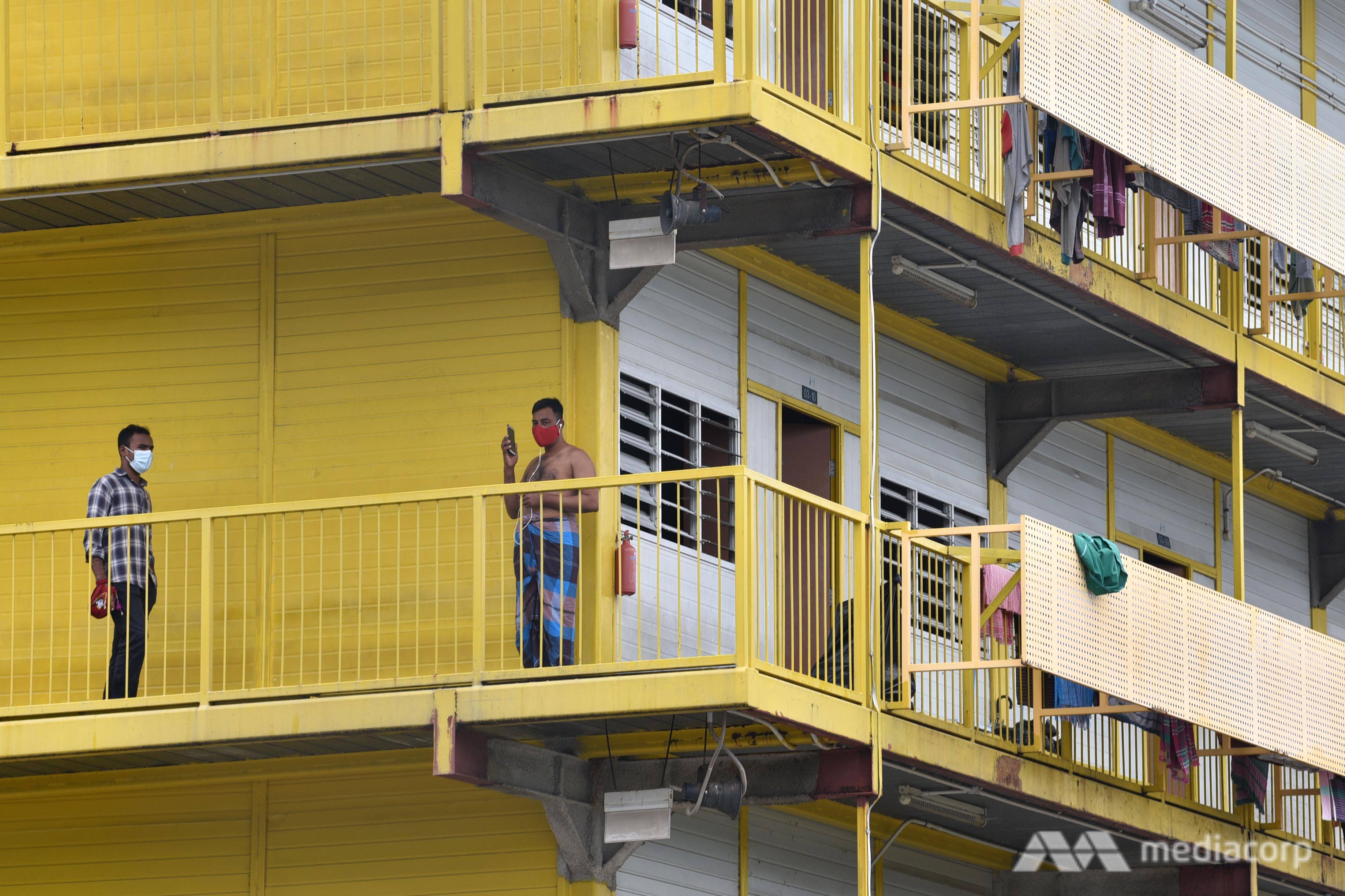
Foreign workers at the common corridor in Tuas View Dormitory on May 6, 2020. Tuas View Dormitory has been gazetted as an isolation area to curb the spread of COVID-19. (Photo: Jeremy Long)
Singapore has recorded more than 37,000 COVID-19 cases, with the vast majority being migrant workers.
During a panel discussion on the COVID-19 pandemic in May, former nominated member of parliament Viswa Sadasivan, said that officials should rethink Singapore’s economic growth model that has long hinged on these low-wage workers, causing productivity to remain low.
Another panellist, National University of Singapore sociologist Chua Beng Huat, said that the country’s dependence on foreign workers has depressed the wages of low-income workers.
About a week and a half later, trade bodies and associations released a joint statement declaring that Singapore’s economy will suffer without foreign workers, and result in fewer jobs for Singaporeans in the long run.
Several Government ministers, from Minister for Trade and Industry Chan Chun Sing to Deputy Prime Minister Heng Swee Keat, have reiterated during recent media interviews that while Singapore should depend less on foreign workers by automating processes, the country can never eliminate its need for them.
File photo of a cleaner at an HDB estate.
Foreign workers fill the low-wage, manual labour jobs that Singaporeans are unwilling to do in areas like construction, security and cleaning, they said, while Singapore’s small and shrinking domestic population means it is increasingly tougher to find the people who will take up these roles.
And unlike other countries that spend a longer time to finish a project due to manpower constraints, construction companies here cannot afford to take a similar route, Mr Chan argued.
“For a small country without natural resources, we compete on the basis that we are a good place for people to do business. If we lose out in that relative game compared to other people, then, unfortunately, I think the future of Singapore will not be what we expect it to be,” he had said.
BALANCE IS KEY
So should Singapore curb its intake of foreign workers? Or are current levels necessary to keep the economy running smoothly?
Experts say that while Singapore needs a certain proportion of foreign workers, getting the balance right is key.
Singapore’s 1.42 million foreign workforce today makes up close to a quarter of the country’s population of 5.7 million people. Aside from the close to 400,000 foreign professionals holding either an Employment Pass or S-Pass, nearly all the rest are work permit holders in low-wage, low-skilled positions.
Mr Gino Wong (centre) and his team of aircon specialists resume operations on Tuesday (Jun 2), the first day of Phase 1 of businesses reopening after Singapore’s circuit breaker period. (Photo: Jeremy Long)
The proportion of the foreign workforce relative to total employment varies from about 78 per cent in construction to about 56 per cent in manufacturing, and around 30 per cent in services, said Nominated Member of Parliament and economist Walter Theseira.
“There is evidence from other countries that migrant workers do have a positive effect on improving employment and income for locals, in higher skill positions,” he told CNA.
But this also comes with negative effects on local labourers who compete with foreign workers for the same types of jobs: “So the question is whether the net effect is positive – it probably is – and after that, how do you mitigate any harms on local workers who are substitutes for foreign workers?”
Associate Professor Daniel Wong Hwee Boon, Department of Building at the National University of Singapore, said that finding the right balance is critical: “The Government has incorporated many initiatives to control the number of migrant workers and this is already a fair quantum.”
“Without migrant workers, we may inadvertently hollow out skilled Singaporeans in (the construction) sector who may not return to projects and facilities management and (Singapore will) lose talent in an essential industry,” he added.
OCBC chief economist Selena Ling said that Singapore’s ageing population and low fertility rate means that it does need migrant workers.
“Foreign workers also complement Singaporeans, both in terms of skills, experience and cost differentiation at a general level. However, the question may be one of what quality of foreign workers and the appropriate numbers which are judgemental depending on who you ask,” she said.
They agreed that the Government has to take the lead if change is required.
“As long as you have a good supply of low-cost labour, it is not really in the incentive of firms to switch away from that labour,” said Assoc Prof Theseira. “That’s why I think there is a role for Government coordination, so that the industry can move together.”
Said Ms Ling: “There may be some industries and/or companies that have become accustomed to affordable foreign workers and need a nudge or more to change. That’s where policy comes in.”
For the companies CNA spoke to in the construction, manufacturing or food & beverage industries, they have had no choice but to bring in foreigners.
All of them had shared the same sentiment: That it is almost impossible to hire Singaporeans, because most of them are unwilling to take on the long hours, low pay and weekend shifts that are required in these industries.
At precision engineering manufacturer Rexadvance Technologies, nearly all its machine operators are S-Pass or Work Permit holders, its founder Jessie Chen said.
Workers in these roles are paid S$2,500 to S$3,000, but the amount is still not enough to attract local applicants.
Workers at a manufacturing facility in Singapore. (File photo: TODAY)
“No one wants to get their hands dirty,” she said. There are 10 local workers among Rexadvance’s 25 employees; all of them are either administrative and delivery driver roles.
Three years ago, Ms Chen used to have 35 employees. But without enough local applicants to replace those who resign, she could not meet the foreign worker quota. With fewer employees, she scaled her business down and dropped several clients.
Under manpower laws, manufacturing firms must hire about four locals for every six foreign workers.
Likewise, Asiawide Print’s chief executive Stephanie Fang has struggled to get new blood into her office of 50 people. For example, she said, none of her past interns applied for full-time positions. They even mentioned to her after their stints that they do not think this is the “right industry” for them.
As interns, they rotate between graphic designing and operating the printing machine. Ms Fang thinks it is the latter stage when they are on the printing floor that drives them away.
No one wants to get their bodies or their clothes stained with ink, she said. “Dealing with printing machines is just not sexy.”
So how about paying the locals more to attract them? They cannot afford to, some companies say. They are small businesses with tight cash flow.
“The consumer has to be willing to pay more (if we hired locals and increased wages),” said Ming Tan, the founder of restaurant group Jam and Toast. The F&B industry, he noted, is infamous for its razor-thin profit margins.
HOW ABOUT TECHNOLOGY?
The current crisis is a reminder that certain industries, like the construction sector, needs to evolve with technology and skills rather than manpower, said Assoc Prof Wong.
“The industry needs time to adjust to this new reality and perhaps this pandemic may also be the paradigm shift to operations and maintenance,” he said.
Mr Goh of IES said that the industry is working closely with the Government and industry stakeholders to enhance recognition of technicians and technologists in Singapore, with the aim of encouraging more locals to join the industry.
He acknowledged that if fewer foreign workers are employed, many companies will face huge challenges in finding locals to replace them, leading to reduced capacity to take on more projects in the short term.
“In severe situations, there may be no firms to perform the required works thus causing inconveniences such as downtimes due to lack of maintenance and repair works,” he said. “However, in the long term, increased automation will help to reduce overall costs.”
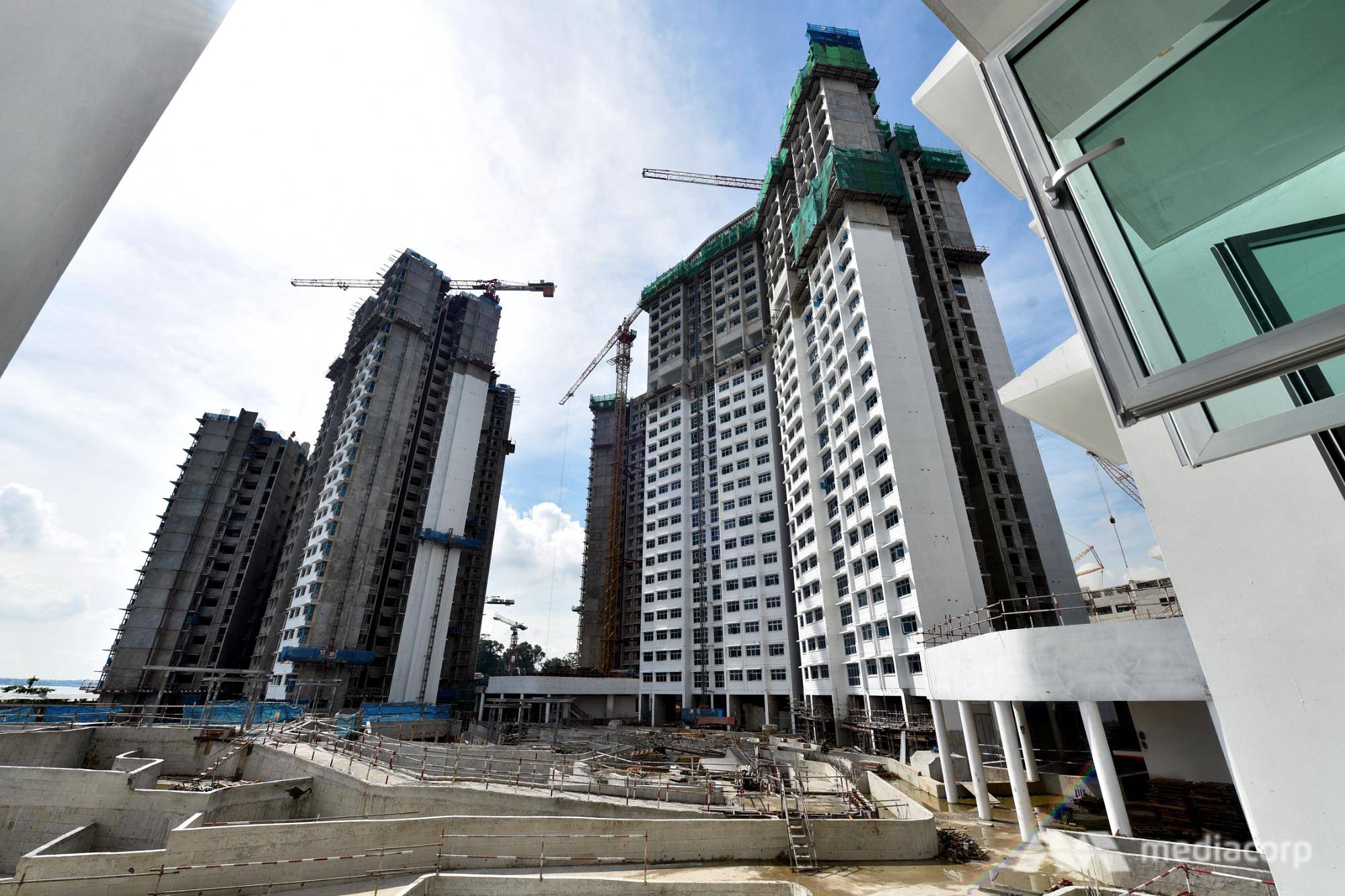
HDB BTO flats under construction. (Photo: Jeremy Long)
But some employers said technology has its limitations.
Kenneth Loo, the executive director of Straits Construction, said that while there are building methods that are supposed to reduce construction time and the workers needed on a project, such as prefabricated prefinished volumetric construction, or using precast concrete, the way contracts are commissioned makes it difficult to maximise how technology is employed.
He explained that in the building industry, the architects and developers dictate what the design of the building should be. Since every design has a different requirement, the components contractors manufacture will differ from building to building.
“(This means) everything is tailor-made,” he said. “We can’t automate (and) cut workers.” The process would be more efficient if there were a set of common building designs so that contractors could mass produce the components, he said.
That said, Mr Loo acknowledged that with better coordination and machinery over the past 10 to 15 years, his company managed to reduce the average number of workers he needs per project by half.
Meanwhile, F&B players say space constraints and a business model that relies on the human touch make tapping on technology unrealistic.
“Rent is already so high. We cannot afford to lease more space to install machines in our small kitchen,” said Angeles Herrero, the owner of restaurant KAZBAR.
Even using more compact types of technology, like robotic cooking arms or tablets for customers to order from, differs from the dining experience a restaurant aims to offer.
“It’s not just about food – you can get that at a supermarket,” she said. “It’s about hospitality.”
“Technology cannot be able to replace the human interaction or the taste of hand-crafted food we seek by going to a restaurant,” she added.
“Restaurants create a social environment that brings families and communities together. It’s why we exist,” she added.
Machines also do not make sense if their Singapore customer base is limited, said Pine Garden’s managing director Wei Chan.
“I can have an automated cream puff machine that produces thousands of cream puffs in an hour, but I only need 200 to 300 puffs a day,” he said. “The Singapore consumer volume is not there.”
And, he added: “We are here to offer a handmade product, not a machine-made one.”
MAKE THESE TRADES ATTRACTIVE TO LOCALS
A part of the solution, in Ms Herrero’s view, is to shift the focus away from insisting that companies reduce their need for foreign workers, but to make the jobs more enticing to locals instead.
For one, the image that a member of the waiting staff or a cook is unskilled labour has to change, she said. “People need to recognise the value of the job we do…It’s a mindset issue.”
Martin Seah works at the cashier at a McDonald’s restaurant outlet in Singapore December 19, 2018. REUTERS/Edgar Su/Files
This is a view shared by former Non-constituency Member of Parliament and Workers’ Party member Yee Jenn Jong, who wrote a lengthy blog post on this issue.
He feels that it is not just about the pay – the lack of a pathway for progression makes the construction industry unattractive for Singaporeans, he told CNA.
Drawing parallels with the nursing and pre-school education sector, he said that Singaporeans may not see construction work as a viable trade to go into.
“(We need) to show people that there is a career progression, just like they did with nurses and with pre-school teachers. People can see there’s a pathway now, I can aspire to become a manager of a chain of schools or an executive principal,” he said.
Hopefully the use of technology itself will draw people into these labour-intensive industries, Asiawide Print’s Ms Fang said.
In the fourth quarter of last year, she launched a 3D printing division with four people in the department, which she is looking to expand while she tries to work with more companies overseas.
Employees in this arm work in a sterile room environment and print the likes of medical devices, shipping components and military vehicle parts. She is optimistic this new branch of manufacturing will attract and retain younger jobseekers.
“It’s still dealing with machines, but it’s a machine that could change the way things are done,” she said. “I think there are better chances of luck getting Singaporeans on board in this field.”
GROWTH VS RESILIENCE
Relying less on foreign workers might also be a matter of survival in the long-run.
Debating the Fortitude Budget in Parliament on Thursday, Assoc Prof Theseira said that Singapore’s current economic model is “akin to running an army only with sergeants and officers”.
“We will face the question in the coming months of how to restructure our economy and society for a more sustainable and resilient future … we must resist the temptation to use our reserves to simply preserve the economic model of the past, in the hopes that we can return to it once the COVID-19 outbreak subsides,” he said.
The pandemic has shown that a highly specialised foreign versus local workforce can be a weakness as well as a strength, he said in his response to CNA.
“In good times, it helps us punch well above our weight, but … if foreign workers are withdrawn or numbers reduced for any reason, we will quickly find that we don’t have the local skills or capabilities to take their place – numbers notwithstanding.”
OCBC’s Ms Ling said that both economic and socio-economic considerations should be part of the calculus.
“It’s all about trade-offs – between cost and growth and maybe also our societal aspirations. The COVID-19 experience has probably revealed that it cannot be simply a calculation of dollars and cents. And what happens to the foreign workers on Singapore shores can impact the Singapore economy both positively and negatively.”
Acting on multiple complaints and reports, the police have arrested a 19-year-old Temasek Polytechnic student who made several alarming and offensive posts against Muslims on his Instagram account.
In a time of heightened sensitivities about race and bigotry, the student went on Instagram Stories sometime yesterday (June 7) to write about an alleged dream he had in which he went on a shooting spree in an office building and killed Muslims with an AR-15 assault rifle.
“NOT GONNA LIE IT FELT F***ING GREAT GUNNING DOWN ANYONE THATS RELATIVELY BROWN OR NON CHINESE LOOKING (sic),” he posted, adding sickening details such as how the victims in his dream were “begging for mercy” before they were gunned down.
“It actually feels good aiming down the sights aimlessly gunning down Muslims,” he wrote, somehow associating the act of massacring people to the rush he feels when weightlifting.
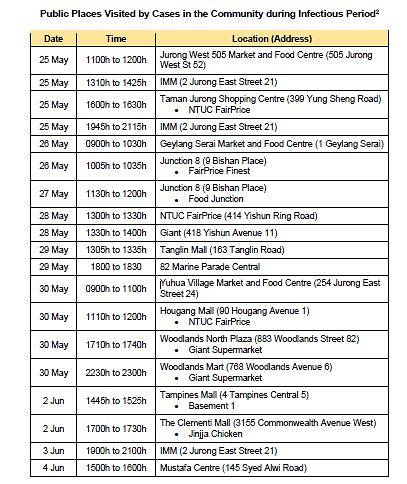
SINGAPORE: IMM, Clementi Mall, Woodlands Mart, Woodlands North Plaza, Yuhua Village Market and Food Centre, Tanglin Mall and a Housing Development Board (HDB) block at 82 Marine Parade Central were on Monday (Jun 8) added to the list of public places visited by COVID-19 cases during their infectious period.
People who were at these locations during the specified timings should monitor their health closely for 14 days from the date of their visit, said the Ministry of Health (MOH).
Confirmed cases had visited IMM on May 25 and Jun 3, the Jinjja Chicken restaurant at Clementi Mall on Jun 2, Yuhua Village Market and Food Centre and the Giant supermarkets at Woodlands Mart and Woodlands North Plaza on May 30, and Tanglin Mall and an HDB block at 82 Marine Parade Central on May 29.
These public places were visited by COVID-19 cases for more than 30 minutes while they were infectious, said MOH on May 26 when it first released the list.
The list does not include the cases’ residences, workplaces, healthcare facilities visited and public transport places.
It will be updated on a rolling 14-day basis, which covers one incubation period and as epidemiological investigations progress.
People who have been at these places during the specified timings should see a doctor promptly if they develop symptoms of acute respiratory infection (such as cough, sore throat and runny nose), as well as fever and loss of taste or smell, and inform the doctor of their exposure history.
“There is no need to avoid places where confirmed cases of COVID-19 have been. The National Environment Agency will engage the management of affected premises to provide guidance on cleaning and disinfection,” said MOH.
Singapore reported 386 new COVID-19 cases as of noon on Monday, including two infections in the community.
One community case is a 26-year-old Singaporean while the other is a 59-year-old work pass holder from Switzerland. The two cases were symptomatic and were tested after they sought treatment at public health preparedness clinics, said MOH.
Singapore could call for the general elections soon, with voters going to the polls as early as July, political observers have speculated.
Last month, Parliament passed a law to allow special and temporary arrangements to be implemented in order to protect voters, candidates and election officials, should the next election take place during the Covid-19 pandemic.
The Elections Department (ELD) has since drawn up contingency plans for safety measures during polling proceedings, they announced today (June 8).
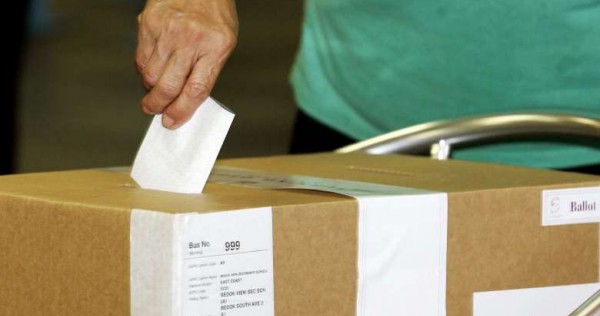
Here’s how polling day would be like with the new safety measures.
Step 1: Temperature screening
All voters would be subjected to temperature screening to identify anyone with a fever or respiratory systems.
A decision on whether they would be allowed to vote would be made later, based on the prevailing coronavirus situation.
A 41-year-old man died from complications due to Covid-19 more than two weeks after being discharged, the Ministry of Health (MOH) said on Saturday (June 6). The case is Singapore’s youngest Covid-19 casualty.
Singapore’s youngest Covid-19 casualty
The Chinese national, identified as case 11714, died on Thursday (June 4) and is the 25th person in Singapore to die from complications due to Covid-19.
According to MOH, the man had recovered from the infection and was discharged on May 17. He collapsed on June 4 and the coroner has certified that the cause of death was massive pulmonary thromboembolism following SARS-CoV-2 infection. SARS-CoV-2 is the strain of coronavirus that causes coronavirus disease 2019 (Covid-19).
With Covid-19 being in the spotlight recently, the equally serious phenomenon of dengue fever in Singapore has taken a back seat.
However, the National Environment Agency (NEA) warned that dengue cases may reach historical highs if current trends are recurrent.
“We’ve had more than 9,000 dengue cases so far this year. We have not seen such figures for the same period since 2013, the largest outbreak year for Singapore in recent history. Last week, the weekly number of cases rose to 735 – the highest since 2013 and 2014. This is quite worrying for all of us,” noted Minister for Environment and Water Resources, Masagos Zulkifli, in a Facebook post on June 3.
With NEA further warning that cases might rise to a historical high of 891 cases in a single week in the near future, and with 291 people been infected since May 31, we take a look at the personal account of one woman, Amanda Poh, who recently caught dengue fever in Singapore.
SINGAPORE: The Elections Department (ELD) has issued contingency plans on how the next General Election (GE) will be held amid the COVID-19 outbreak.
Safety measures include dedicated time-bands for seniors to vote, setting up more polling stations and having voters wear gloves before entering polling booths.
The date of the polls is still not known but an election must take place by Apr 14, 2021.
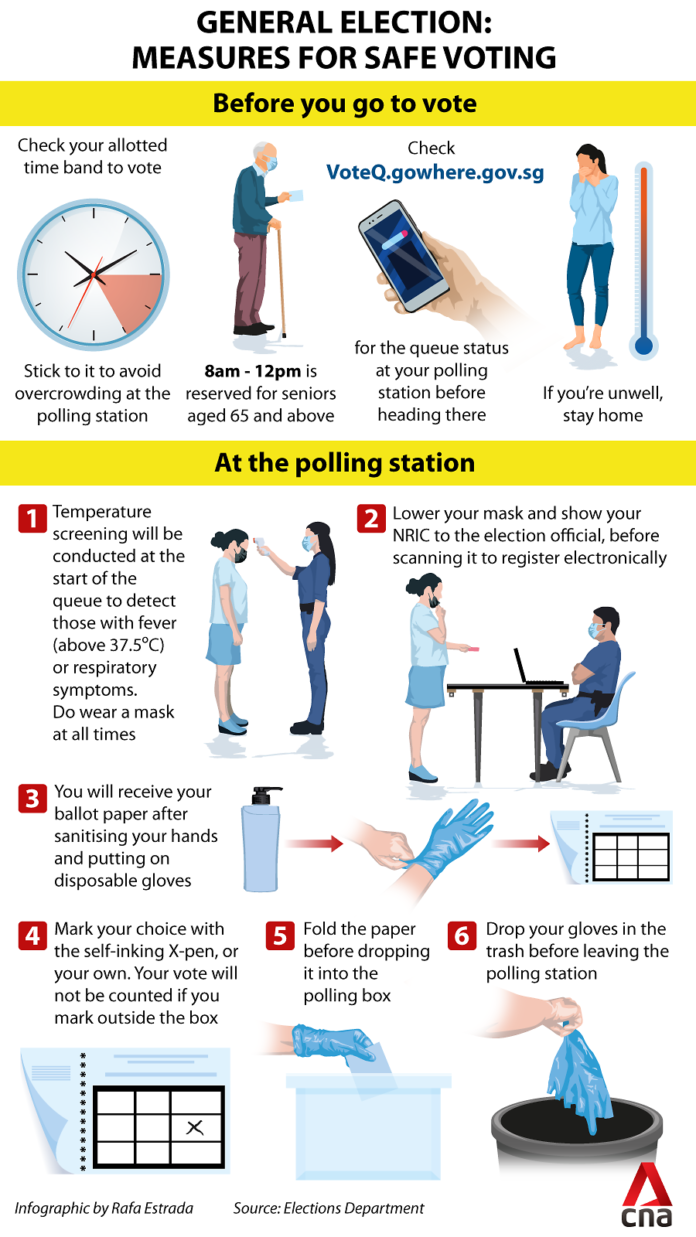
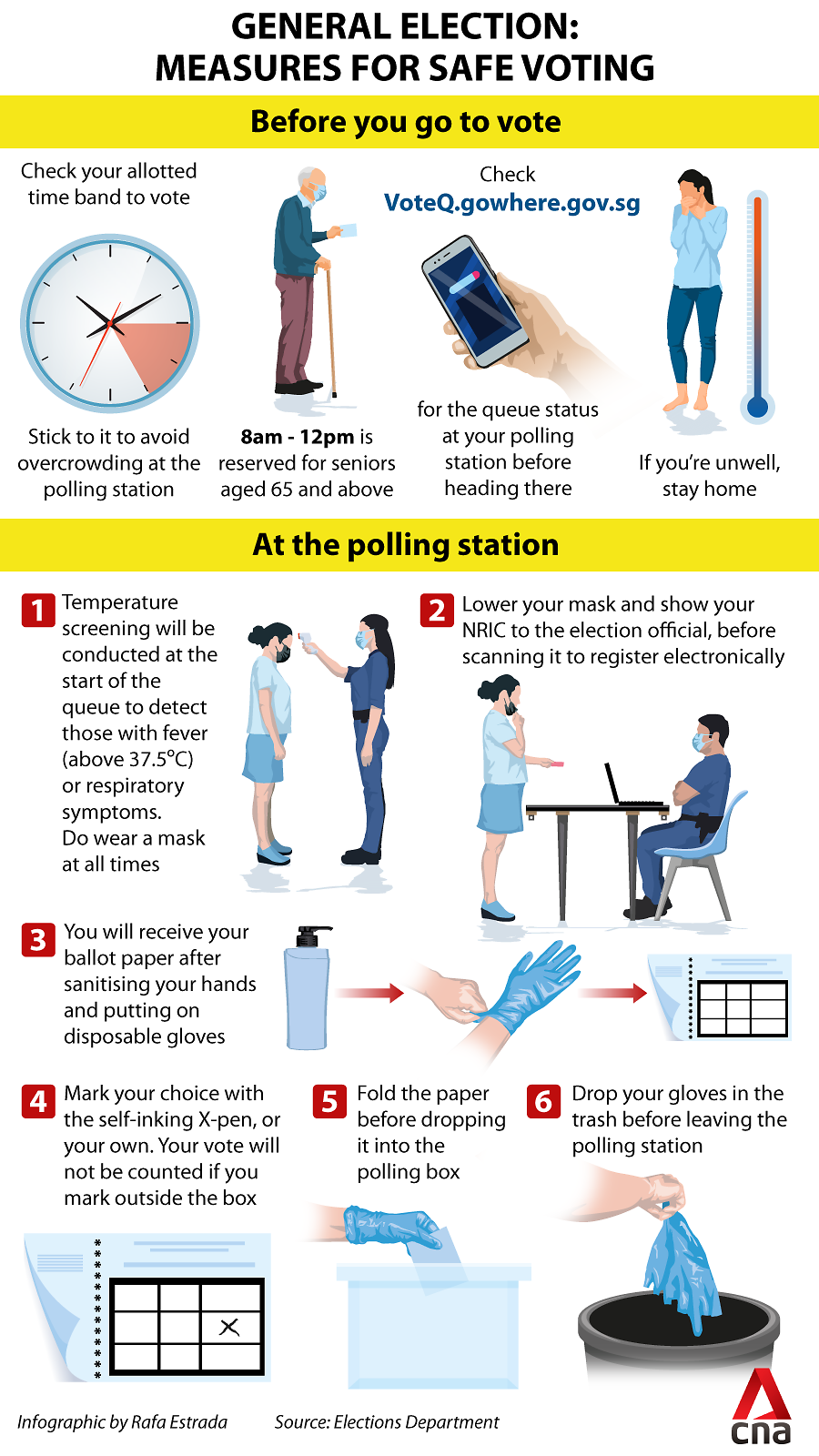
Check the recommended time for voting allotted to you. Voters will be given a recommended two-hour voting time-band, which will be indicated on the poll card and e-Poll card on the SingPass mobile app. This is to spread out voters across polling hours.
Senior voters aged 65 and above will be allotted recommended voting time-bands from 8am to noon. Senior voters who require assistance may be accompanied by one household member. Senior voters who are unable to vote during their allotted time-bands in the morning can still do so at other times of the day when they will be able to join priority queues.
Can’t make your slot? While voters are encouraged to stick to their allotted time-bands, they may vote at any time the polling stations are open. Younger voters who show up in the morning may have to wait longer, says ELD.
The number of polling stations will increase – from 880 to 1,100. This will cut the average number of voters per polling station from 3,000 to 2,400.
Use http://VoteQ.gowhere.gov.sg to check the queue situation before setting off to vote. Voters should not bring non-voters, such as children, to polling stations.
REGISTERING TO VOTE
All voters will be screened for fever and respiratory symptoms at the start of the queue. A decision on whether they will be allowed to vote will be made later based on the COVID-19 situation closer to polling day.
e-Registration means machines, not humans, will verify voters against the electoral roll at polling stations. This eliminates contact with election officials.
Voters must wear face masks and should lower them only when election officials need to verify their identity.
Unlike polling agents and candidates, voters need not use the SafeEntry app to check in and check out. The e-Registration system records when voters register at the polling station and can be used for contact tracing if necessary.
AT THE POLLING STATION AND VOTING
Voters are to stay 1m away from others while waiting to enter polling stations and within polling stations.
They need to sanitise their hands and wear disposable gloves before receiving a ballot paper. After voting, they are to dispose of their gloves at the exit.
Voters may also bring their own pens to mark the ballot papers. This will minimise the risk of contaminating the self-inking “X” pen, which will be used by other voters or ballot papers, which will be handled by counting assistants.
Cleaners will be deployed to clean common touch-points, such as polling booths and self-inking “X” pens, within the polling area at least once every half hour. After polls close, cleaners will thoroughly disinfect the polling stations.
Five minutes – the amount of time a voter should spend at a polling station. This includes registration, hand sanitisation, wearing of gloves and voting, ELD says.
OTHER MEASURES
Voters on stay-home notices at designated facilities will vote at special polling stations away from other voters.
When the Writ of Election is issued, ELD will consult the Ministry of Health to assess the public health risks of allowing other affected voters to vote, and decide based on the prevailing COVID-19 situation at that time. This includes those on quarantine orders, those serving stay-home notices at home, or those on medical leave for acute respiratory symptoms.
ELD urged voters who are unwell not to vote. After the election, they can apply to be restored to the register of electors without paying a S$50 penalty.
ELD also said on Jun 8 that whether overseas voters can vote depends on the health advisory where they are located. A decision will only be taken nearer Polling Day.
SINGAPORE: Measures, safeguards and precautions have to be put in place before travel can resume between Singapore and Malaysia, said National Development Minister Lawrence Wong on Monday (Jun 8).
Mr Wong, who co-chairs the COVID-19 multi-ministry task force, was responding to media queries after Putrajaya said that talks are under way to allow Malaysians in Johor Bahru to commute to Singapore and back for work.
Speaking at a press conference, Mr Wong said that negotiations with Malaysia was part of ongoing discussions with different countries.
“The same principle will apply … we will welcome these travellers. We want to see the resumption of travel, but it has to be done in a safe way. And that would mean looking at testing protocols in place on both sides,” he said.
National Development Minister Lawrence Wong speaking at the MTF COVID-19 virtual press conference on Mar 31, 2020.
He said that before such travel can resume, testing may have to be carried out, a quarantine period may have to be imposed, or a combination of both measures.
“Measures, safeguards and precautions have to be put in place to ensure the resumption of safe travel between Singapore and Malaysia, so we are discussing all these with our Malaysian counterparts, (including) exactly how many people, what kinds of protocols will be put in place and which industries (will be involved),” said Mr Wong.
However, he noted that the volume of travel would not be as high as before.
“I think we are quite clear. It is not going to be back to where we were before the circuit breaker or before COVID-19 hit us. We are not talking about large volumes of daily commuters coming in and out freely,” Mr Wong said.
“We are talking about resumption of travel, but in a controlled manner and in a safe manner for both sides. That’s in our mutual interest.”
PUTRAJAYA SAYS IT IS READY TO ENSURE TRAVELLERS TAKE COVID-19 TESTS
Earlier in the day, Malaysian Senior Minister Ismail Sabri Yaakob said the special ministerial meeting on the implementation of movement control order (MCO) has agreed to allow Malaysians to travel to and fro for work between Johor Bahru and Singapore.
“We are ready to ensure that they take COVID-19 tests … If that is the condition required by the Singaporean government, that they take swab tests, we agree,” he said.
Malaysia’s Senior Minister Ismail Sabri Yaakob giving a daily briefing on Jun 8, 2020. (Photo: Bernama)
However, he said that the implementation will only start after the secretary-general of Malaysia’s Ministry of Foreign Affairs and his Singaporean counterpart wrap up their negotiations.
“If we can, we will approve the conditions they propose, and then only Malaysian workers who commute between Johor Bahru and Singapore can resume working again. We are still waiting,” said Mr Ismail Sabri.
The senior minister said with industries in Singapore operating again, they have requested for their Malaysian employees, who are in Johor Bahru, to commute to Singapore for work. Singapore exited the “circuit breaker” on Jun 1, with most economic sectors resuming operations.
Mr Ismail Sabri added that Sultan Ibrahim Johor Foundation and two Singaporean companies Temasek and Thomson Medical Group have stepped forward to contribute two COVID-19 mobile labs and COVID-19 test kits.
Malaysia has imposed the MCO since Mar 18 to restrict domestic and international travel due to the COVID-19 pandemic. Similarly, Singapore also entered the circuit breaker period from Apr 7 to Jun 1, which tightened border controls.
To break the infection chain, both governments mandated a 14-day quarantine for people entering the countries. These measures made it impossible for Malaysians, who reside in Johor but work in Singapore, to travel across the strait.
On Sunday, Prime Minister Muhyiddin Yassin said that the MCO will enter a “recovery phase” beginning Jun 10 until Aug 31. Under the recovery MCO, “almost all” social, educational, religious and business activities, as well as economic sectors will reopen in phases, with standard operating procedures to be adhered to.
While interstate travel is permitted, Malaysia’s borders will remain closed.