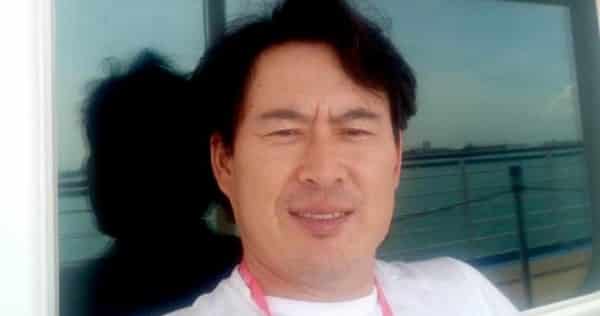
“It felt like I was drowning and I couldn’t breathe. It was the scariest thing to ever happen to me.”
For one 67-year-old man, his battle with Covid-19 caused him so much suffering that he wanted to pull the plug on himself. He would have done it too had it not been for his grandchild.
He was one of the 407 cases discharged last Wednesday (June 3).
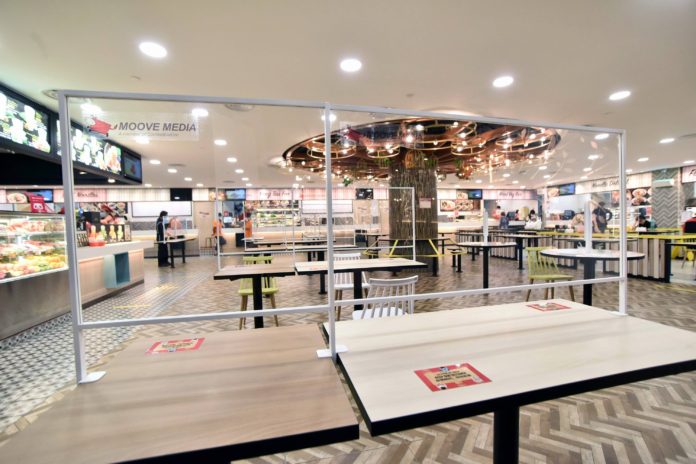
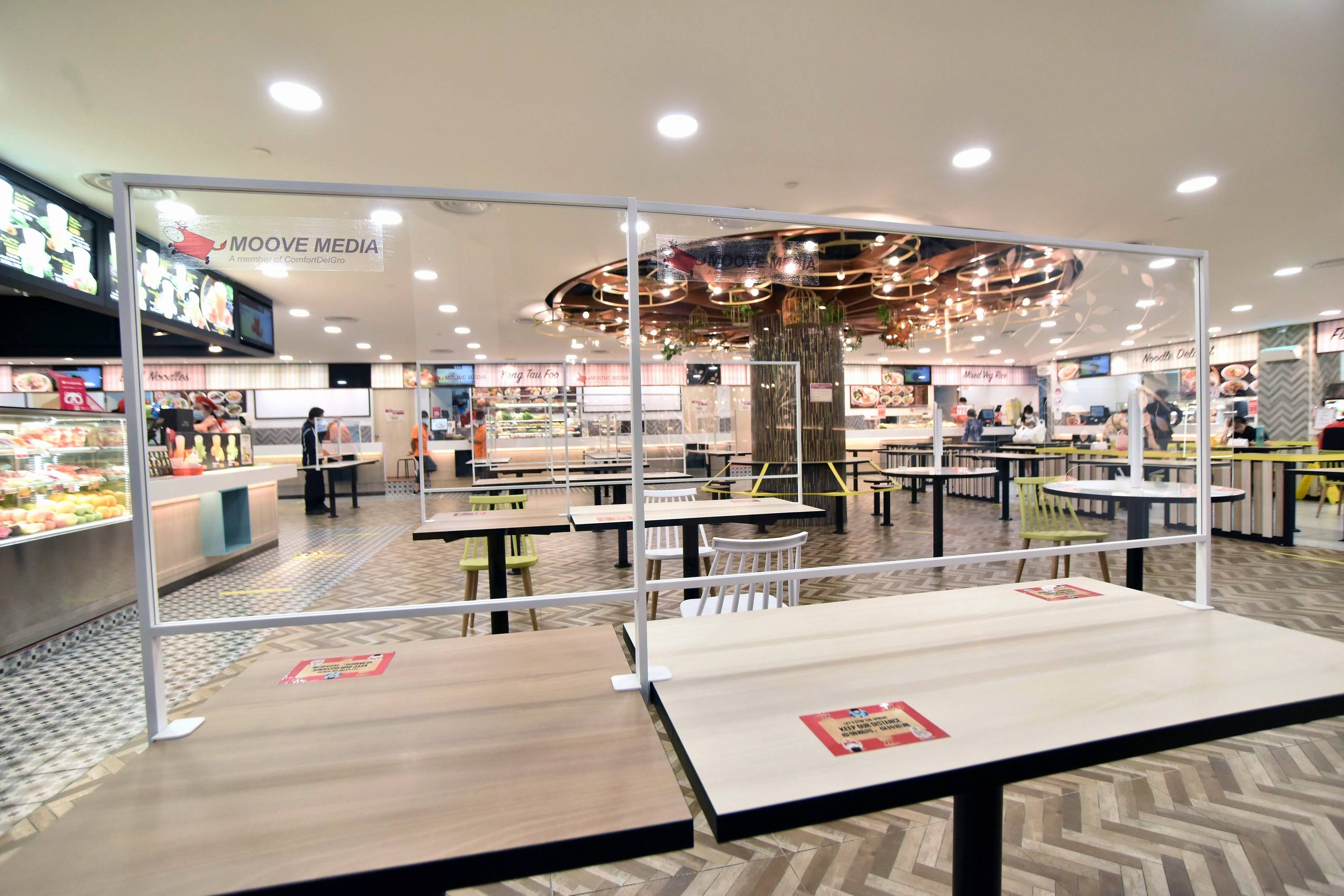
SINGAPORE: Tables at Koufu food court at Thomson Plaza will soon have shields installed on them, as part of a trial to create a safe way for people to dine in at eateries during Phase 2 of Singapore’s post-circuit breaker period.
The 3mm acrylic shields are “fully customisable to fit tables of different shapes and sizes”, said ComfortDelGro in a media release on Wednesday (Jun 10).
Under the month-long trial, 50 tables at Koufu’s Thomson Plaza food court will be outfitted with the shields.
For rectangular-shaped tables, the shields will be housed in aluminium frames and clamped across the middle of each table.
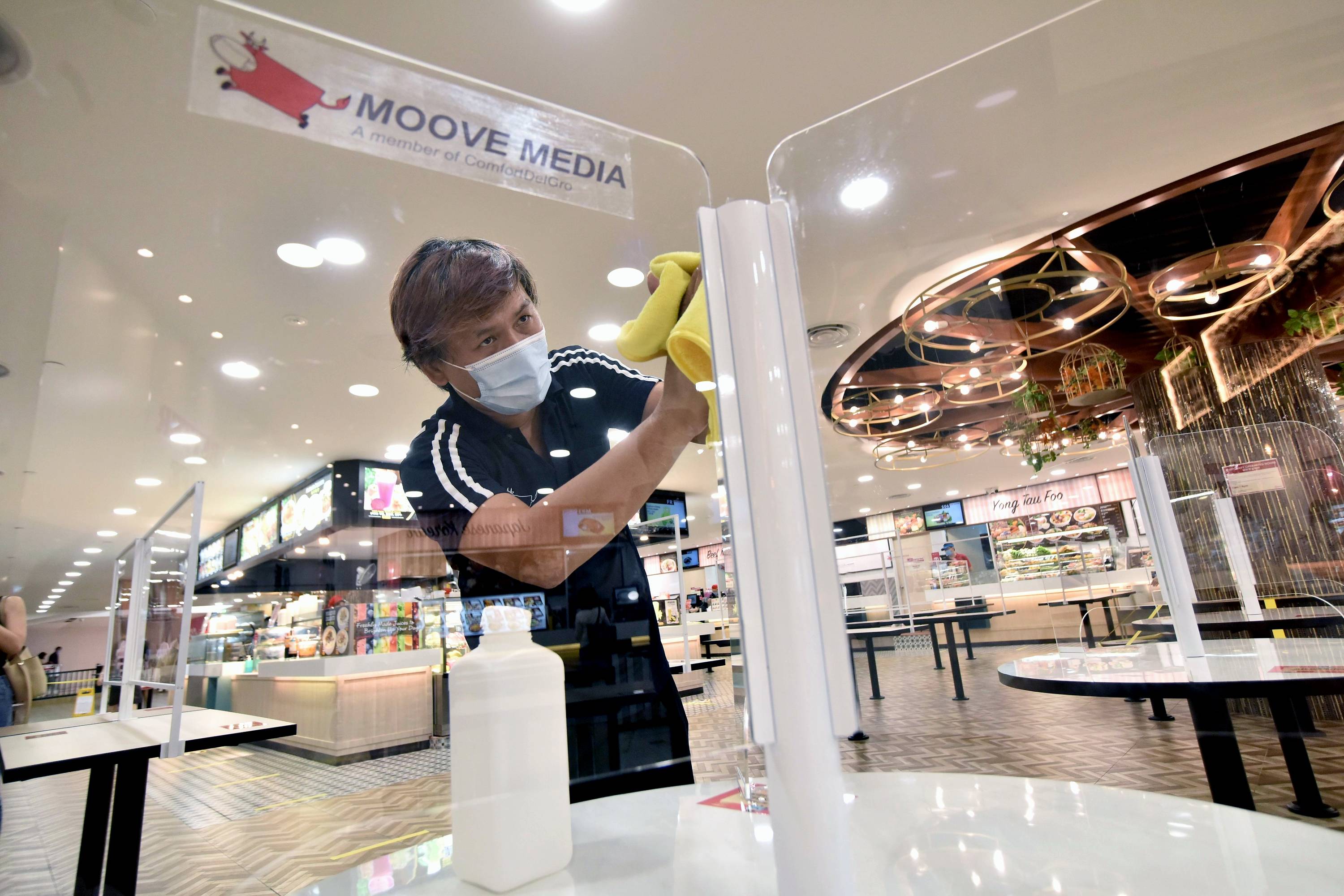
“The shield itself does not rest on the table so cleaners can wipe the tabletop without having to remove it,” said ComfortDelGro.
Tables at the Thomson Plaza Koufu food court will be outfitted with acrylic shields when dining in is allowed again in Phase 2 of Singapore’s post-circuit breaker period. (Photo: ComfortDelGro)
Round tables will be outfitted with three separate shields in a cylindrical aluminium structure, providing a partition for each diner.
There is also a cut-out at the bottom of each partition that allows for easy cleaning, said ComfortDelGro.
Round tables at Koufu Thomson Plaza will be outfitted with three separate shields in a cylindrical aluminium structure, providing a partition for each diner. (Photo: ComfortDelGro)
Moove Media, a wholly owned subsidiary of ComfortDelGro, owns the trademark for the shield and will sponsor the shields at the food court.
Moove Media CEO Jayne Kwek said the company looked at how the shields in taxis could be applied to other environments to minimise the spread of COVID-19.
“In our discussions with Koufu, we started exploring the possibility of trialling the V-Shield on dining tables as a safe solution for patrons to eat in comfort and safety once dining-in is allowed in Phase 2 of reopening,” Mrs Kwek added.
Koufu chief operating officer Choo Teck Chuan said the trial will allow the food court operator to “evaluate the effectiveness of the shield and to address operational issues such as maintenance and cleanliness”.
Moove Media said that if the shields are well-received by diners during the trial, it will work with Koufu and possibly other food court operators to install the shields on more tables.
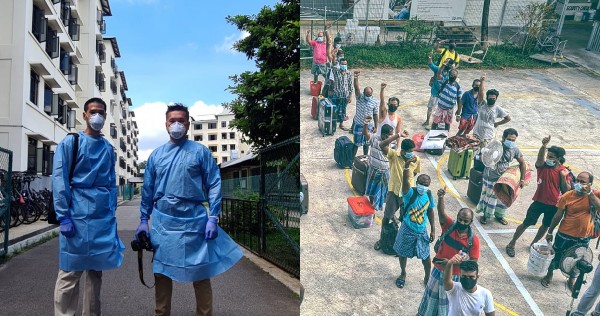
While “not in my backyard” syndrome is sadly still common in Singapore, this career soldier is countering the vitriol against migrant workers, one Facebook post at a time.
Meet Alex Chua, 48, a lieutenant-colonel in the Singapore Armed Forces (SAF) and a self-described “photography hobbyist” in his free time.
At least, before a deployment to a migrant worker dormitory saw both worlds collide — and the birth of #storiesfromthefrontline on Facebook.
Following a spike in Covid-19 cases in migrant worker dormitories, Manpower Minister Josephine Teo had announced on April 9 that forward assurance support (Fast) teams comprising officers from SAF, the Singapore Police Force, and the Ministry of Manpower would be deployed to purpose-built worker dormitories nationwide.
Chua was in one of the first teams deployed to Woodlands Lodge 1 the next day.
SINGAPORE – Every day foreign worker Wu Liyou would make a video call to Feidong county in Anhui province to chat with his family.
The 41-year-old China national had been doing it since April.
But last Thursday (June 4), his call did not come.
Instead, his family received a call from his Singapore employer, informing them that Mr Wu had died.
They were stunned, speechless with grief and in disbelief, as he did not tell them he had been infected by the coronavirus nor did they have any hint that he was ill.
Mr Wu, who had worked in Singapore for the past 10 years, became the youngest person in Singapore to succumb to Covid-19 last Thursday.
He died of complications two weeks after he was discharged, and was cremated on Tuesday. The coroner certified the cause of death as a massive pulmonary thromboembolism following the Covid-19 infection.
Mr Wu’s son Feixiang told The Straits Times over the phone from China that his father looked healthy in all their video conversations, and had never mentioned having any health problems.
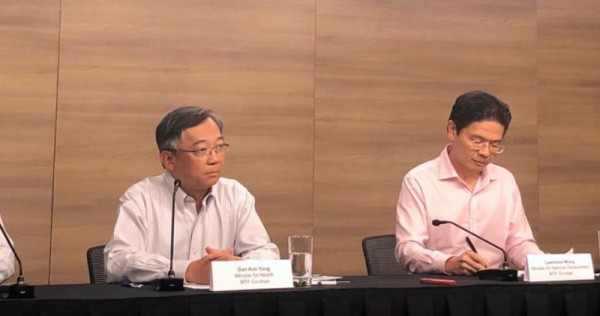
At least half of Singapore’s coronavirus cases show no symptoms, the co-head of the government’s virus task force said on Monday, reinforcing the city state’s decision to ease lockdown restrictions very gradually.
Singapore has one of the highest infection tallies in Asia, with more than 38,000 cases, because of outbreaks in cramped dormitories housing thousands of migrant workers.
It reopened schools and some businesses last week after a near two-month lockdown, but many residents are still required to work from home and mix socially only with their families.
“Based on our experience, for every symptomatic case you would have at least one asymptomatic case,” said Lawrence Wong, adding that the discovery was made in recent weeks as Singapore ramped up testing. “That is exactly why we have been very cautious in our reopening plans.”
Singapore has not previously disclosed how many asymptomatic cases it has recorded. Wong did not reveal the number of asymptomatic cases in Singapore, which has reported 6,294 infections in the last two weeks, mainly among migrant workers.
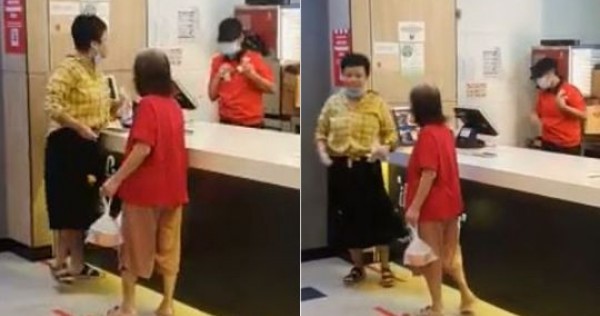
A 42-year-old Singaporean woman will be charged in court today (June 10) for abusive and non-compliance of safe distancing measures during the circuit breaker.
In video clips circulating on social media, she was seen verbally abusing and spitting at a service staff at a KFC outlet at NEX shopping centre on April 22.
The woman was reported to have had an argument with the fast-food outlet staff after she was told to wait for her order.
Although she left before the police arrived at the scene, the police established her identity and subsequently arrested her on April 24.
The woman will be charged for several offences:
– Intentional harassment under Section 3(2) of the Protection from Harassment Act
– Use of criminal force under Section 352 of the Penal Code
– Breach of safe distancing measures under regulation 3A(1)(a) of the Covid-19 (Temporary Measure) (Control Order) Regulations 2020.
The police said they take a serious view of such abusive and irresponsible behaviour, especially in the current Covid-19 situation.
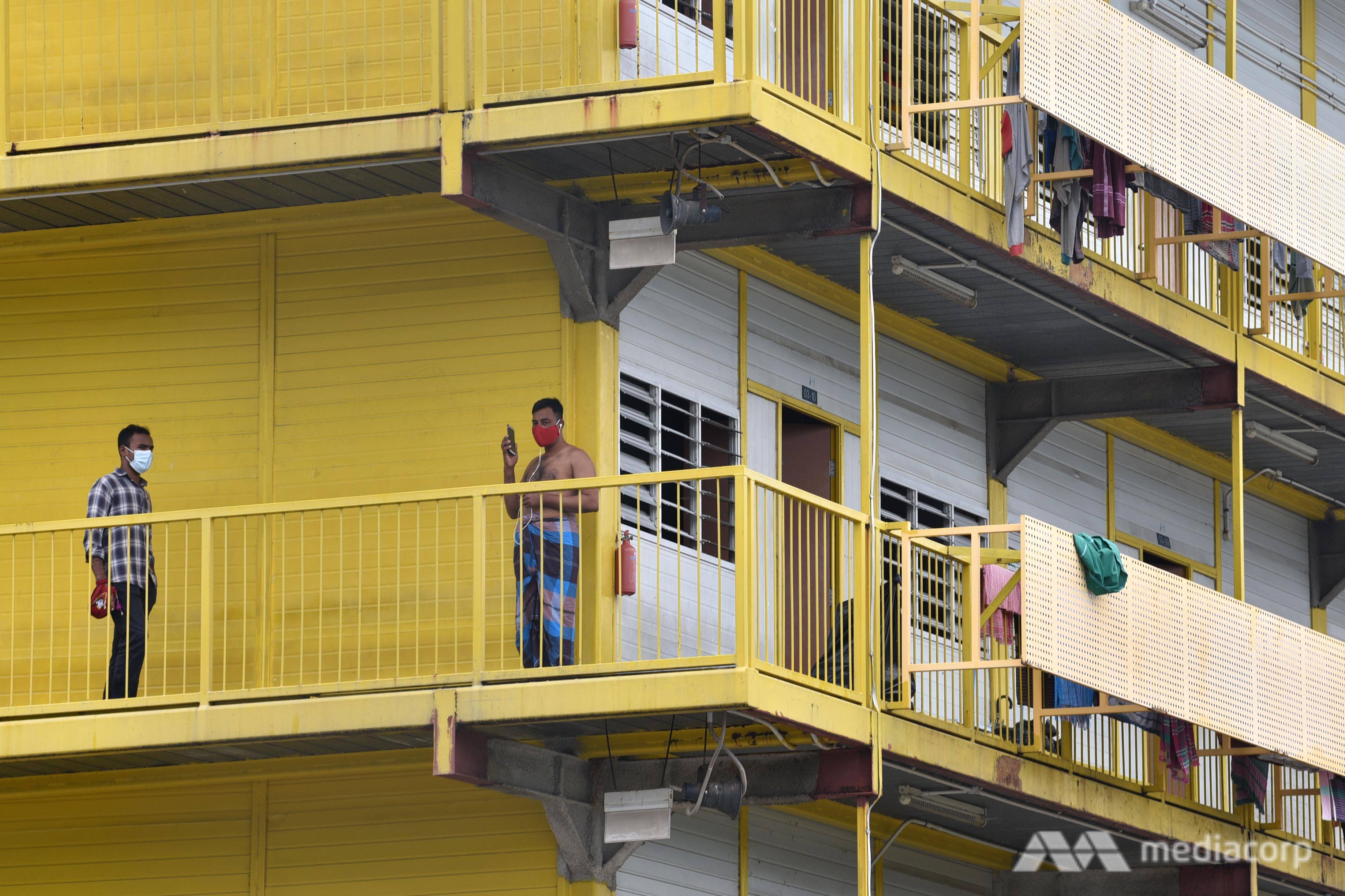
SINGAPORE: The decision to build new migrant worker dormitories to reduce the current living densities following the spread of COVID-19 at these facilities is a step in the right direction, said various groups focusing on migrant workers’ welfare.
In light of the current situation, the key consideration observed in the new standards “are the safe distancing measures to provide better protection for the migrant workers residing there,” said the Migrant Workers’ Centre.
But even with new dorms that have improved living space, there are other aspects to living conditions which could be considered, said representatives from the groups.
Speaking to CNA, Mr Alex Au, vice president of Transient Workers Count Too (TWC2), said the organisation is happy the Government is moving in this direction.
“Of course it would have been better if action had been taken early on, but at least they are moving in a direction which we think is the right way to go, which is to spread (the workers) out more and reduce the densities in each location,” Mr Au said.
“It’s very encouraging and definitely a move in the right direction,” agreed Ms Dipa Swaminathan, founder of migrant worker welfare group It’s Raining Raincoats.
Migrant workers living in these dorms are the hardest-hit demographic in Singapore during the COVID-19 pandemic. Currently, about 94 per cent of the 38,514 COVID-19 infections in Singapore are linked to these living quarters, according to the Ministry of Health.
As part of long term arrangements to help migrant workers, the authorities announced last week plans for new purpose-built dormitories with improved standards over the next few years to house up to 100,000 workers.
Before that, the Government aims to pilot the improved set of standards at temporary Quick Build Dormitories (QBDs) first, including more living space per resident, a smaller occupancy in each room, fewer workers sharing wet facilities, and more sick bay beds and isolation facilities.
“THE OLD DORM IS VERY SMALL”
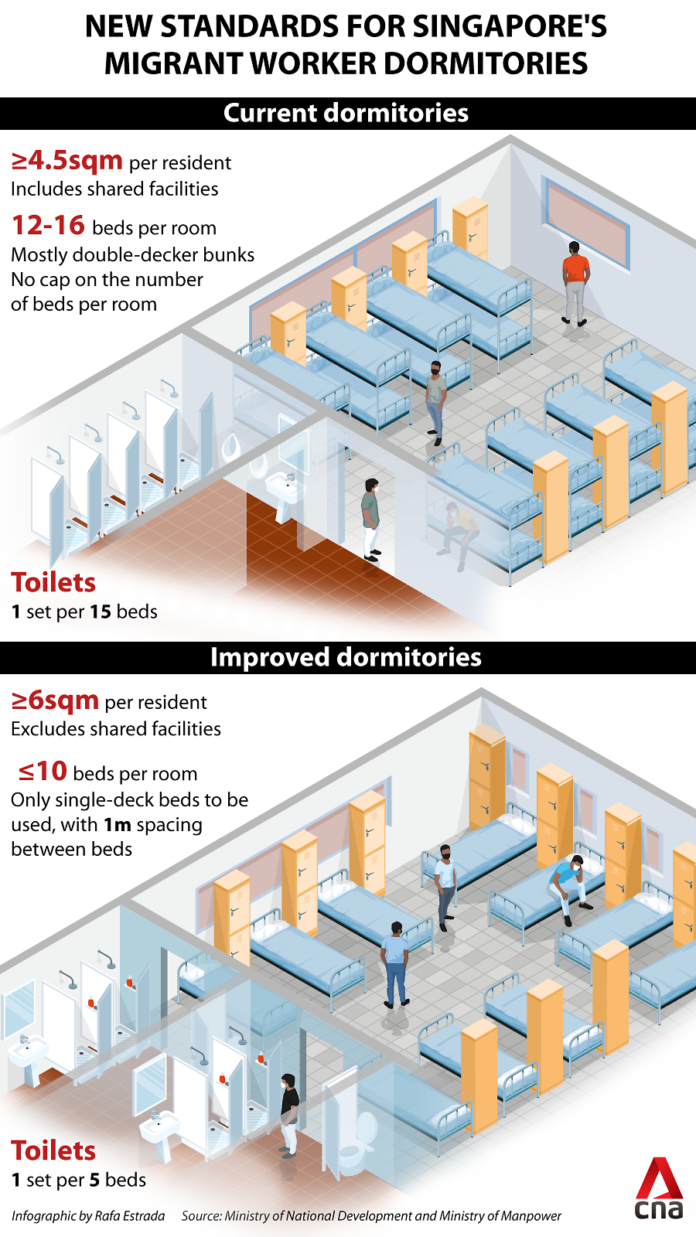
Under the improved standards, there will be at least one toilet, bathroom and sink for every five dormitory residents. Previously there was a minimum of one set, with a urinal, to 15 beds.
Ms Dipa said this was “better than what it is now” and Mr Au expressed a similar view saying the changes to toilet facilities were “quite reasonable”.
“We are proposing four, but five is quite reasonable. There is definitely an improvement there,” he said, explaining the current “barrack style” design, where potentially hundreds of people sharing wet facilities has proven to be a problem during the coronavirus pandemic.
Ms Dipa continued: “I think if we can come up with a solution where they don’t need to queue up, that will be a big help.”
When the new standards are piloted, each resident will have minimum of 6 sq m of living space, up from the current 4.5 sq m. There will also be a maximum of 10 beds in a room when there were no limits previously.
Mr Au said that countries like Qatar have also implemented a minimum of 6 sq m for each resident, but are still facing infection problems.
“This tells us that 6 sq m per person is not good enough,” Mr Au said, proposing 7.5 sq m instead.
At the same time, workers CNA spoke to from a dorm in Toh Guan welcomed the idea of having fewer men in the room and more space for each person, including a move away from bunk beds.
“The changes are very good because the old dorm very small,” said one resident who did not want to be named.
“It is enough to have six or seven people in a room. The rooms now have double decker beds with people sleeping on top and below. When the person sleeping on the top (bunk) rotates, it disturbs those on the bottom (bunk). It’s a problem.”
Foreign workers having their meals in their rooms at Toh Guan dormitory, which is under isolation. (Photo: Ministry of Manpower)
As Singapore embarks on a reassessment of how foreign workers should be housed, the NGOs suggested that other issues like laundry, cross ventilation, better transport and well-being facilities could also be addressed.
Improving well-being, Ms Dipa said, can be as easy as dedicating a small space within the dorm for a desk and chair.
“It would be great if there was medical facilities … I’m not saying a major clinic … maybe a doctor that is available for a few hours every week and it doesn’t have to be every day.
“They’re human beings as well. If they have a fever, a toothache, some muscle pain, there’s somebody they can go to hopefully free-of-charge.”
She went on to explain that this space does not only need to be for medical access. It could also be used by an information provider, doctor, pro bono lawyers or even a counsellor.
“It’s not much to ask for, but it would make a huge difference,” she said.
Food, Mr Au said, is also a “very major part of a sense of well-being”, suggesting more kitchenettes in the new dorms would be welcome.
A meal that was distributed at Toh Guan Dormitory. (Photo: MOM)
In terms of laundry and ventilation, when workers hang their wet clothes in the rooms to dry, it makes the rooms very humid as well, he said. To fix this, he suggested having a back balcony for laundry away from where they sleep.
Cross ventilation also helps make rooms more comfortable with a draft of air, and for this, there should be windows on opposite sides.
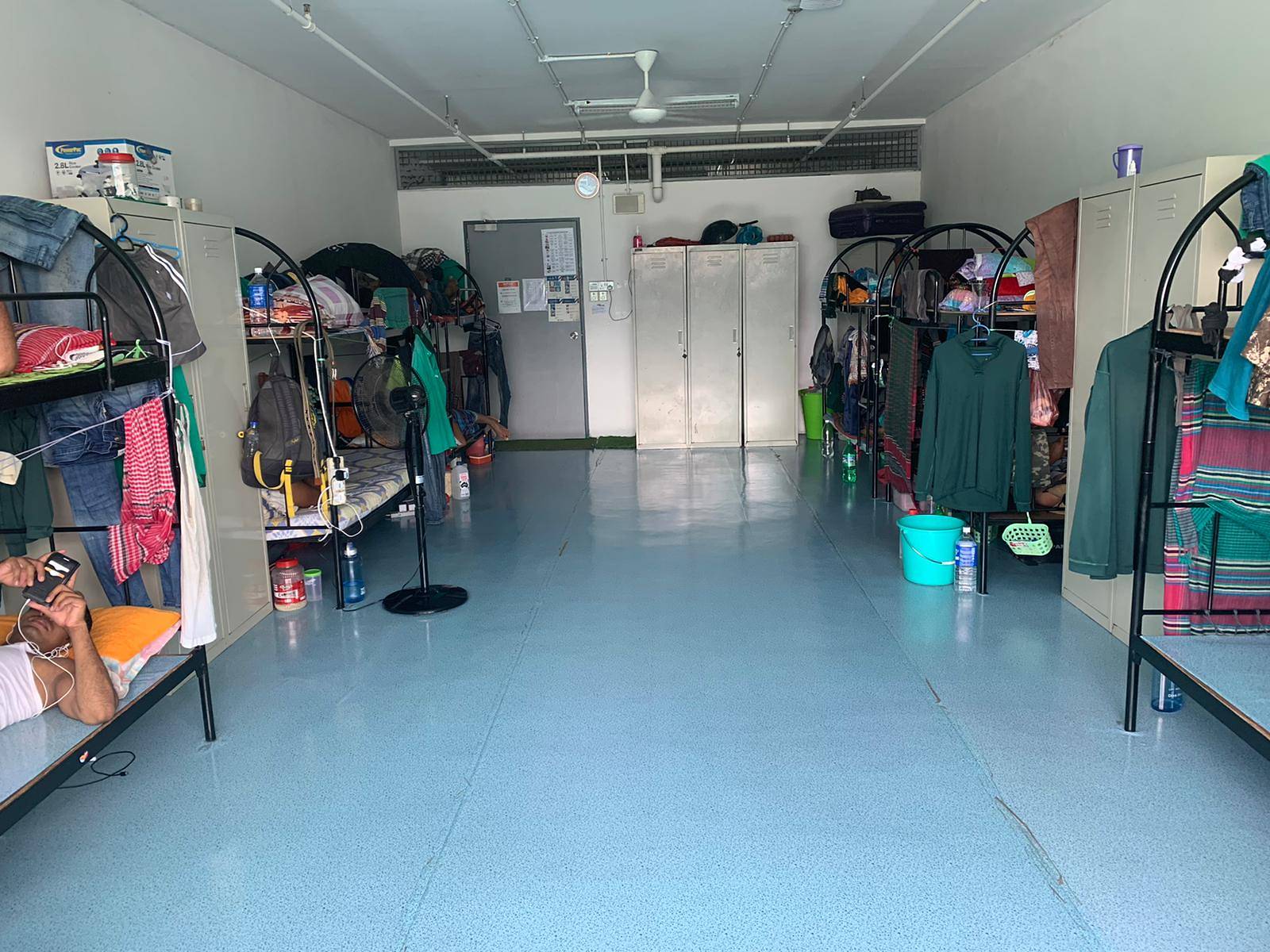
A room at Sungei Tengah Lodge. (Source: ‘Pangkil’)
Transport access could be improved on too, he said.
“A fairly constant complaint is that transport access to the dormitories in the far flung regions of Singapore is difficult because they choose to build them in the industrial estate.
“A lot of workers are complaining that access is very difficult and what we would suggest is that it should be part of a dormitory operator’s contract to also provide regular shuttle services to the nearest MRT station.”
In the short-term, authorities have stated that “some dormitories will inevitably be located closer to residential areas” because of land constraint issues.
In turn, the Government urged Singaporeans to reject the “not in my backyard” mindset as well, an issue that was highlighted online as push back mounted from people who cited “cleanliness” concerns and “cultural” differences as reasons against bringing dorms closer to residential areas.
“I think this is born out of lack of interaction with migrant workers and I think people are reacting based on stereotypes. Very few Singaporeans have ever met them, talked to them, worked alongside them … they’re just like you and me,” said Mr Au.
Ms Dipa added: “Just think of them as neighbours. They are human beings and they are here to help build Singapore.”
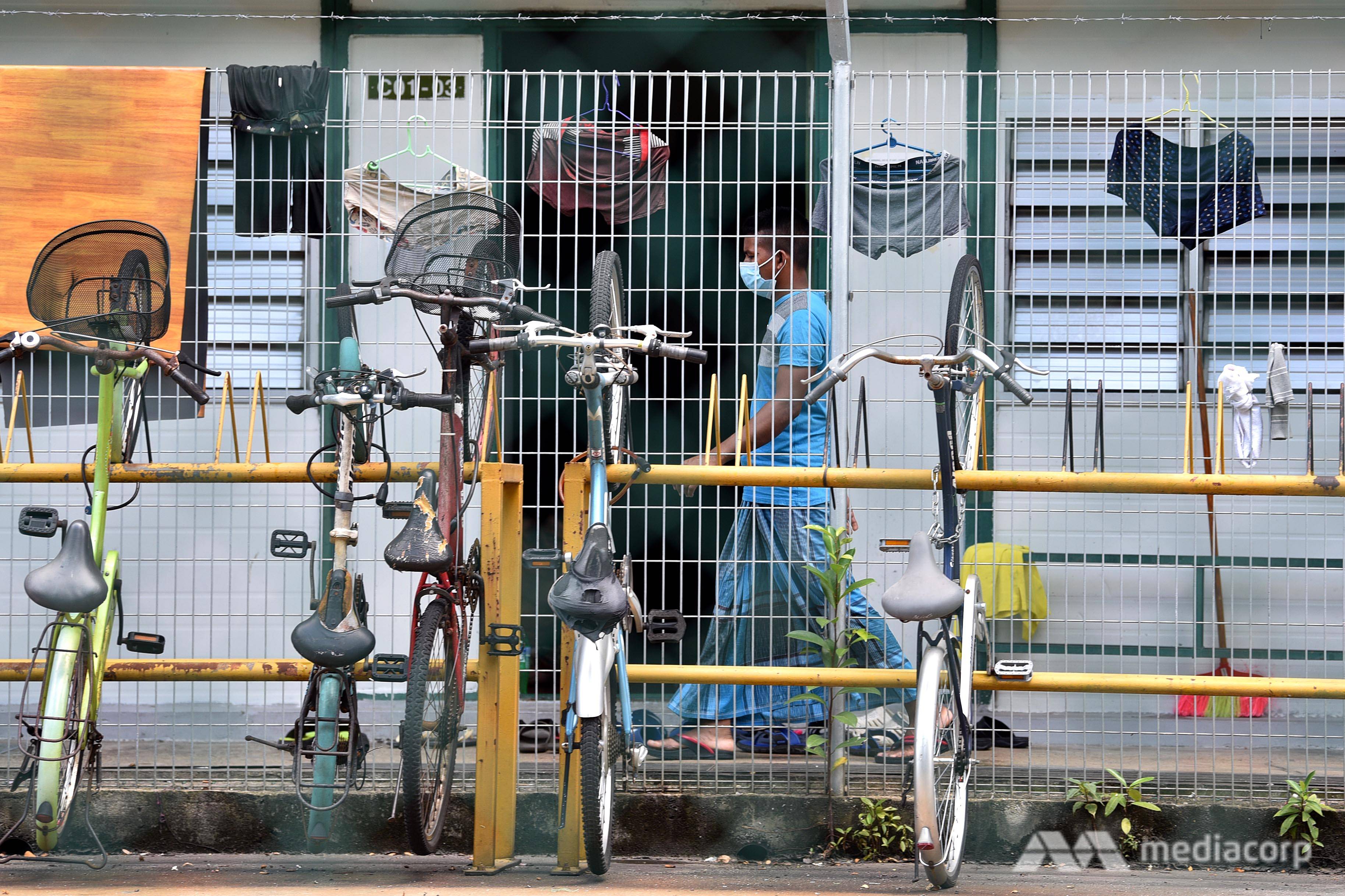
A resident is seen at Cochrane Lodge dormitory. (Photo: Jeremy Long)
As these new standards are to be piloted at the short-term Quick Build Dormitories (QBD) first, the Migrant Workers’ Centre hopes this can be a learning opportunity.
“The actual operation of QBDs with these new standards can provide learning points and highlight shortcoming that would be useful in the drafting of a more comprehensive set of standards for the new (Purpose Built Dormitories), said Chairman of the Centre Mr Yeo Guat Kwang said.
“Hence, it is still too early to deem if the changes proposed are adequate or lacking as there are still other areas like management standards that are not addressed yet.”
“The MWC would be glad to contribute to the discussion in the drafting of the new migrant workers housing standards.”
Foreign workers at the common corridor in Tuas View Dormitory on May 6, 2020. Tuas View Dormitory has been gazetted as an isolation area to curb the spread of COVID-19. (Photo: Jeremy Long)
With the new standards soon to be piloted, Mr Au added he would like to see more consultation between the Government and non-governmental organisations (NGOs). This would allow for communication channels where different views are expressed.
Aside from just the Government and NGOs, Ms Dipa said migrant workers themselves should be part of the conversation to give feedback on issues with the existing living arrangements.
A disgruntled landlord has taken to Facebook to complain about a tenant who’s renting a room in his house. The situation, according to him, has gotten so bad that he has labelled the saga as ‘Nightmare from Elms Street [sic]”.
Instead of garnering consolation for his post on the Complaint Singapore Facebook page, many have commented instead that he is being a wee bit overbearing and unreasonable.
Clement Chia wrote all about his issues with a “devil from hell” tenant, who is described as a 28-year-old Malaysian Chinese woman with “high education”.
According to him, the contract they agreed upon indicated that the tenant is not allowed to cook anything else other than “simple Maggie mee” in his home. As for the usage of the air conditioner, she can only switch it on at night, can only leave it on for no longer than eight-and-a-half hours, and the temperature cannot go anywhere under 24 degrees Celcius.
Chia noted that the tenant has since breached the agreement. Among the things she allegedly did:
There’s no doubt that the coronavirus and circuit breaker in Singapore has thrown our lives into disarray. But for better or worse, we’ve learnt, or are still learning, to make peace with the situation. For me, this new reality means that I’ve gained a new co-worker — my four-year-old son.
And boy is he one loud and clingy colleague who doesn’t know to pipe down when I’m in the middle of a meeting. This is where having someone, in the form of a babysitter or caregiver, can help. But during this time, physical help is the one thing money can’t buy.
The good news for parents out there who may be just as frazzled as me is that you can get temporary relief from parenting duties in the form of remote babysitting. In a time period when almost everything has gone online, babysitting is no different. The business has pivoted to one where children can be engaged from the other side of a screen.
SINGAPORE – Every Singaporean who needs it will have access to a Covid-19 vaccine should one become available, said National Development Minister Lawrence Wong on Tuesday (June 9).
Outlining Singapore’s strategy to control the spread of the coronavirus in a national broadcast, he pledged that if and when a vaccine is ready, “we will make sure that every Singaporean who needs it gets it, and at an affordable price.”
Mr Wong said that a vaccine is an important part of the long-term solution to the crisis.
Singapore, which has a pharmaceutical industry and research capabilities in biomedical science, is involved in a “massive global effort” to develop a vaccine, said the minister, who is co-chair of the multi-ministry task force tackling the pandemic.
There are now at least 130 vaccine candidates being developed globally, including in Singapore.
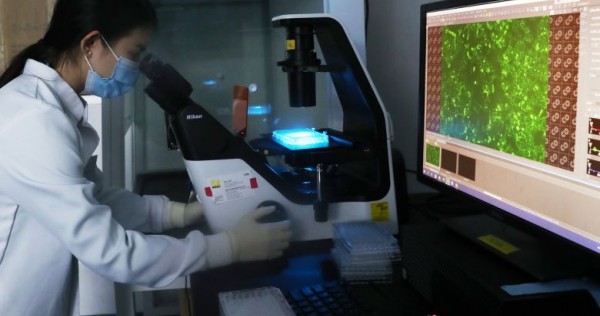
Duke-NUS Medical School is working with US firm Arcturus Therapeutics on a vaccine, which involves getting the human body to produce part of Sars-CoV-2, the name of the virus that causes Covid-19.