SINGAPORE – Local tourist attraction KidZania Singapore is closing its doors for good after four years, the company announced on Tuesday (June 16).
In a Facebook post, the company said its theme park in Sentosa will not be reopening upon the lifting of circuit breaker measures and other social restrictions. It did not elaborate on the reasons for its closure in its post.
“We’ve had the pleasure of being here for four years. We’ve had the joy of entertaining and educating one million kids,” the company said.
“We thank you for joining and helping us build a billion memories. ZanK-U and good-bye,” it said, using a term it often uses – a play on “thank you” and “KidZania” – to express its appreciation.
Singapore enters the second phase of its reopening after the circuit breaker period on Friday, but tourist attractions, both indoor and outdoor, have still not been given the green light to reopen.
The Straits Times has contacted KidZania for comment.
The KidZania theme park gives children a taste of different careers such as firefighting, window washing, medicine and journalism through role-playing in an interactive mini-city.
SINGAPORE: About nine months ago, doctors in the UK told Oscar Saxelby-Lee’s parents there was nothing more they could do for him – all treatment options had been exhausted and there was only palliative care left for the little boy.
But after coming to Singapore for anexperimental treatment for acute lymphoblastic leukaemia, Oscar is now almost ready to go home after receiving news on Monday (Jun 15) he has been free of cancer for almost six months.
Since he was diagnosed in December 2018, he has undergone rounds of chemotherapy, months in isolation, several stem cell transplants and a treatment in Singapore that only one other child in the world has received.
The six-year-old is set to undergo a check up later this week, and will hope to be given the all clear to fly home, his mother Olivia told CNA.
“He’s like our little miracle. It’s incredible, I couldn’t express to you the feelings we’re feeling now,” she said.
“As long as all is okay and nothing needs to happen, or nothing needs to be changed, then we should be ready to go (home), which is incredible and for Oscar, is everything.
“He’s a little boy … who wants to experience life and to most of all, be with his family. He is really excited about it.
Oscar Saxelby-Lee is 6 months cancer free and getting ready to go home. (Photo: Family)
On Apr 9, Oscar was discharged from the National University Hospital (NUH), where he had been undergoing compassionate treatment – which means it is not even in the medical trial stage yet.
Going home will bring its own difficulties.
“It is a huge step to go back. Singapore is our security net, and that’s why it’s so hard for us as parents to kind of pack up and go and leave,” Olivia explained.
“I say a security net for us because when we go home, if anything were to happen to Oscar … we are kind of worried because if anything did happen, where would you go?
“But to just see our family again … we are desperate just to get home to see people, just to see them.
“I know at the moment it is difficult, but just to have a cuddle, or you know, some support in front of us rather than over the phone or virtually … it’s a real hard situation to be in.”
The treatment at NUH was Oscar’s last hope. In the UK, doctors had battled for months to rid his body of the cancer.
But despite a stem cell transplant and four rounds of chemotherapy that left him very weak, the leukaemia kept coming back. Doctors told his parents there was no other treatment, and that the cancer would take his life.
Oscar Saxelby-Lee is in Singapore for treatment for acute lymphoblastic leukaemia. (Photo: Family)
The little boy from Worcester, England flew to Singapore after the family crowdfunded £500,000 (S$885,000) for a new form of treatment, in which immune cells from a patient’s blood is drawn and equipped with a Chimeric Antigen Receptor (CAR-T).
The receptor binds itself to a specific protein on the cancer cell and activates the CAR-T cells to kill the cancer cells.
This particular form of CAR-T treatment is different and more difficult because the leukaemia cells resemble Oscar’s immunity system, Associate Professor Allen Yeoh, head of paediatric oncology at NUH, explained previously.
Oscar started treatment on Christmas Eve last year and three weeks later, was given the best news that there were no detectable cancer cells in his body – the first major step. But there were always concerns the cancer could make a comeback, as it did previously.
“Diseases like Oscar’s are really reluctant to give up, they’re quite vile,” Olivia said. “It gets progressively nasty.”
“IT HAS BEEN RELENTLESS”
Over the last few months, Oscar has battled several conditions as a result of complications and undergone more surgeries and transplants.
He was diagnosed with both Graft versus host disease (GvHD) and Thrombotic microangiopathy (TMA) that caused him shaking spells, pain and weakness.
Oscar Saxelby-Lee is still smiling despite undergoing cancer treatment in Singapore. (Photo courtesy of Oscar’s family)
Brain damage also caused him problems with his mobility, and he uses a frame or needs a hand to walk.
Some of the side effects of the treatment have been “relentless”, Olivia said, adding that Oscar suffers from sickness, diarrhea, mood swings and mobility issues.
“He’s had really bad tremors since he was diagnosed with brain damage post CAR-T (treatment). But he has done amazingly well with it,” she said.
“He’s had numerous side effects. It goes from something as simple as hair loss to, you know, real damage to the body. Oscar has struggled immensely from his mobility.
“He’s very frail, his legs are very weak. He is only just managing to walk without a (walking) frame.”
Oscar dressed as Spider Man and learning to use a frame to walk. (Photo: Family)
Oscar was discharged just days after Singapore implemented a “circuit breaker” to curb the spread of COVID-19, and he has been battling the tremors while staying in.
“He’s walking with a parent’s hand, or just about, maybe taking a couple of steps. It’s like training a toddler again, and it’s really hard.
“He’s come so far but yet he’s got so much to cope with on top. It’s so hard.”
But for Oscar, battling to get back on his feet is not new. When he first arrived in Singapore in November last year, he was so weak from the rounds of chemotherapy and months in isolation that bruises developed on his legs when he walked.
“He manages to plow through, he’s such a trooper. He really is in an inspiration to us.”
It is a “huge mountain of accomplishment” for the six-year-old boy, Olivia said. “We continue to remind him everyday of how far he’s come, and how far he will go.”
Olivia said they are “so grateful” to the medical staff at NUH for saving Oscar’s life.
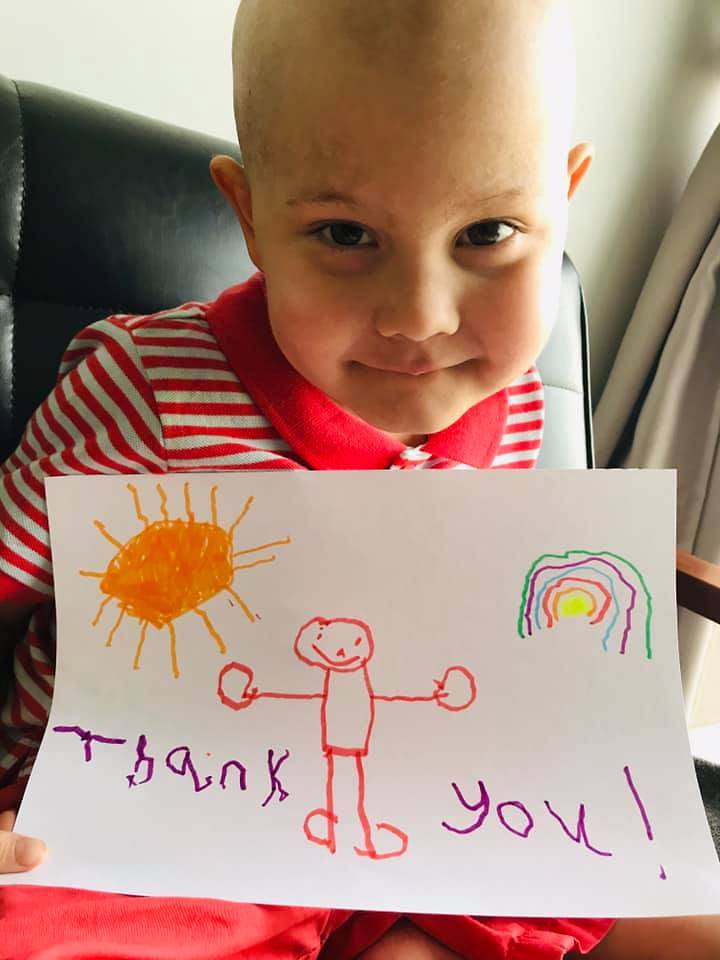
Oscar’s thank you note to healthcare workers. (Photo: Family)
“The teams have been incredibly strong with us, and they’ve supported our every decision,” she said. “They are just incredible.”
She thanked Dr Frances Yeap, a consultant in paediatric oncology at the hospital and Prof Yeoh, who “actually made us come here and forget about everybody else’s opinion”.
The nurses in Ward 8B at the hospital have also been a source of support for them, Olivia said.
“They are a great team and the nurses. The consultants and the team have never doubted Oscar. We are so grateful. They have saved Oscar’s life.”
SINGAPORE: For all the stewing fears of coronavirus dismissals since the pandemic caught economies by surprise, this week may have seen the unemployment monster finally begin to rear its ugly head in Singapore.
Amid the worst jobs numbers in a decade and an economist consensus of a projected second quarter contraction of 11.8 per cent, it was the announcement that super app titan Grab would be laying off about 5 per cent of staff that really caught people by surprise.
Southeast Asia’s most valuable unicorn backed by SoftBank and last valued at US$14 billion, Grab announced the layoffs at a townhall led by CEO and founder Anthony Tan on Tuesday (Jun 16).
Around 360 people will be affected across Southeast Asia. While Mr Tan assured staff that “this will be the last organisation-wide lay-off this year”, it is unclear whether the firm’s announced restructuring to eliminate non-core projects and consolidate functions will lead to more cuts in specific business units down the road.
BREWING CONCERNS
The writing was on the wall when co-founder Tan Hooi Ling warned last month of a “long winter”. Grab also announced a limit to its performance-based commission rebate to 18,000 drivers and had even asked employees to go on voluntary no-pay leave.
It was also barely a week ago that Grab Singapore head Yee Wee Tang told CNA the growth in food deliveries was insufficient to cover the sharp decline in its ride-hailing business, after coming under fire for high commission fees charged to eateries.
To be fair, Grab’s latest round of retrenchments have been rather muted, when you compare their 5 per cent layoff rate to Uber’s letting go of 14 per cent of its global workforce last month and Deliveroo’s 25 per cent cut to its Singapore staff.
If anything, this latest announcement provides insight into the overall health of the private car-sharing sector and its adjacent verticals including food delivery, suggesting this sector is on shaky ground.
People wait for the start of Grab’s fifth anniversary news conference in Singapore June 6, 2017. (File photo: REUTERS/Edgar Su)
Prolonged lockdowns around the world and people’s subsequent hesitation of being out and about even after restrictions are lifted, combined with the likely continuation of work-from-home arrangements for the foreseeable future have delivered a double whammy to this class of platform titans and strained their balance sheets.
The disrupters have been disrupted by the ultimate agent of havoc: The coronavirus.
GRAB HAS CHANGED OUR LIVES – MOSTLY FOR THE BETTER
When news of the layoffs broke yesterday, many were concerned loved ones working in the ride-hailing giant might have been impacted and their livelihoods endangered.
But the news astonished more, because Grab has come to be an intractable part of Singapore’s social and economic fabric, changing the way we pay, roam and eat.
Laying aside controversy over the high commission fees, few eateries can imagine making the wholesale migration to e-commerce and food deliveries, much less reaching this broad a customer base.
Grab might have been an expensive platform and marketing firm to get on, but in the time of COVID-19, F&B microenterprises might prefer at least having this option.
The private car-sharing app has also reshaped the taxi industry for the better. Long gone are the days where it took forever and a minute more to find a cab.
For cab drivers, having to drive around looking for passengers to no avail must seem like a distant dream (at least before the coronavirus struck).
For better or worse, Grab has inextricably fused itself into the daily lives of Singapore residents. They say a brand has made it when people start using it as a “verb” in their daily lexicon and don’t we know it.
In this dog-eat-dog world of commerce, Grab has risen above its competitors in Southeast Asia. Uber threw in the towel after years of a bloodbath for a controlling market share in Southeast Asia.
Roy Lee. (Photo: Grab)
Even Go-Jek’s growth has primarily been concentrated in Indonesia, the largest addressable market size in Southeast Asia.
CAPITALISM SHAKEN TO ITS CORE
While Grab has stoked debate and raised eyebrows in the course of its unruly journey these past years, few, if any, would want to see Grab continue losing revenues and laying off people.
In the good old days, we consumers enjoyed the perks of deep discounts on rides and food deliveries. If we were offered a S$5 off coupon, we would snap it up.
Even when we knew deep down within this business model that doled out ridiculously priced bargains was in no way sustainable, we applauded Grab for being an innovative, revolutionary firm that transformed the transport landscape and more.
When the Singapore Government provided the legislative space recognising Grab’s value, with a new point-to-point transport bill implicitly acknowledging the criticality of this new business model in 2019, it surely did so after a hard-nosed calculation that Grab was on the whole beneficial for the Singapore economy and was contributing to economic growth.
The firm was providing jobs in a burgeoning digital technology sector, including aiding people to get back on their feet with gigs as drivers or deliverers when their going got tough.
But now when the cards are down, we worry that these layoffs augur a rougher ride ahead. Perhaps we have been in as much denial as Softbank. We wanted to believe companies like Grab would grow so big, they would eventually turn profitable on their own.
One thing is for certain: COVID-19 has shaken capitalism to its core.
In the business world, there is growing talk of the “Economics of Mutuality”, championed by Mars Incorporated Chief Economist Bruno Roche, which urges businesses to consider a model that “offers maximum freedom to realise optimal, sustainable, long-term success for business, people, the communities they operate in and our planet”.
Firms are encouraged to focus on delivering value to people, considering the interests of stakeholders across the value chain and long-term sustainability.
A man walks past a Grab office in Singapore. (Photo: Reuters/Edgar Su)
“The signs from these past months are encouraging and show that businesses have begun to rethink risks and reimagine their role and purpose in society,” National Volunteer and Philanthropy Centre chief Melissa Kwee said in a CNA commentary.
Mr Tan’s address to Grabbers on Tuesday suggest he knows this too. “Our commitment to our customers in Southeast Asia is unwavering. We are deeply rooted here and we continue to stay true to our mission of driving Southeast Asia forward,” he said.
Grab may not be out of the woods yet. But the hope is that Grab can turn things around, especially if demand in ride-hailing picks up as Singapore shifts into Phase 2 of its reopening come Friday.
It can be reassuring to know that someone has got your back, no matter what. And sometimes, it’s just what you need to pull through difficult situations.
Tasked to order her own food
Activities that seem like a piece of cake for many adults, such as ordering food or being sent to run an errand, can be an overwhelming experience for a young child.
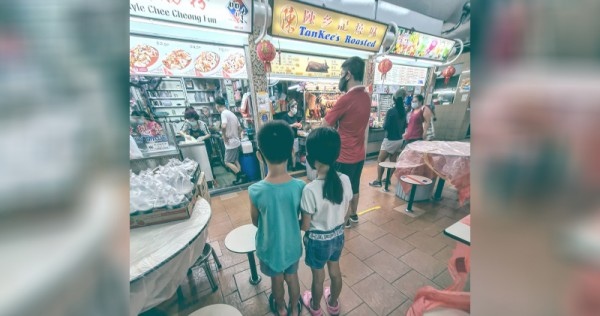
Just like this little girl who was tasked by her dad to order her own food, detailed in a Facebook post shared by Alex Chua on June 13.
Chua was queueing for his breakfast at Pek Kio Market and Food Centre and overheard the conversation between the girl and her father. Her dad also passed her a $5 note alongside his instruction.
According to Chua, she appeared nervous and kept looking around after her father had left.
When her brother joined her in the queue moments later, she calmed down.
Brother to the rescue
The girl grabbed onto her brother’s hand tightly and leaned closer to him, as though seeking courage.
SINGAPORE – There are 151 new coronavirus cases confirmed as of Tuesday noon (June 16), the lowest daily figure in more than two months.
They include two community cases, both work pass holders, said the Ministry of Health (MOH). There are no Singaporeans or permanent residents among the cases.
Migrant workers living in dormitories make up the vast majority of the other cases, said the MOH.
Tuesday’s new patient figure of 151 is the lowest since the 142 cases in April 8, and takes the total number of people here diagnosed with Covid-19 to 40,969.
More details will be announced on Tuesday night.
On Monday, 12 staff members from St Anthony’s Canossian Secondary School, who had been in close contact with a student from the school confirmed with the virus, were cleared of the infection.
Their test results have all come back negative, said the MOH on Monday.
This comes after the Ministry of Education said on Sunday that all 47 students who had been in contact with the Secondary 4 student are also well.
SINGAPORE – Southeast Asian ride-hailing and payments firm Grab said on Tuesday it will lay off more than 300 employees due to the impact of novel coronavirus, in the latest setback to major backer SoftBank Group Corp.
Southeast Asia’s most valuable startup with a valuation of $14 billion (S$19 billion) informed staff of the cuts at a townhall meeting, according to people with knowledge of the matter.
CEO Anthony Tan told staff in a note which was shared with Reuters the company would cut about 5 per cent of its headcount or about 360 employees.
Singapore-based Grab, which is active in eight countries, did not face capitalisation issues and would be “sunsetting non-core projects, consolidating teams and pivoting to focus on deliveries”, a spokeswoman said.
Grab currently has $3 billion in reserves, according to a source with knowledge of the matter.
The layoffs are the latest restructuring at a SoftBank Group Corp portfolio company.
SINGAPORE: Politicians who have appeared as guests on OKLETSGO said this week that the remarks made about women were wrong, while some of the popular podcast’s sponsors have expressed concern over the saga that prompted its hosts to issue an apology.
Over the past few days, the podcast has received widespread backlash for its content, which often included derogatory remarks about women. On Monday, President Halimah Yacob criticised the podcast for its misogynistic content and urged that its hosts apologise to women.
Hosts and former radio DJs Dzar Ismail, Dyn Norahim and Raja Razie, issued an apology later that day.
In a Facebook post on Tuesday, Law and Home Affairs Minister K Shanmugam said remarks objectifying women go “beyond poor taste” and are “plain wrong”.
Mr Shanmugam had appeared on the podcast to discuss laws on falsehoods and religious harmony in an episode aired on Tuesday.
“There is an opportunity here for hard but necessary conversations on this,” he wrote. “OKLETSGO will need to play its part, to build bridges. I hope they learn, and grow from this,” the minister added in his Facebook post.
Environment and Water Resources Minister Masagos Zulkifli, who touched on the Malay/Muslim community collaboration M3 in an episode last June, said “there is no place” for derogatory comments towards women or any group in society.
“The strong criticism expressed towards the incident shows that our community values respect for women,” he wrote, adding he is glad that the hosts have apologised.
“As influential personalities in media, it is imperative that they hold themselves to high standards of conduct and convey values that are aligned with what we stand for as a community.”
Minister of State for Manpower Zaqy Mohamad, who spoke in a March episode about how the COVID-19 pandemic presented an opportunity for skills upgrading, said “everyone agrees that insensitive and disrespectful voices towards women have no place in our society”.
“Unsavoury comments against women is a line that should never be crossed,” he wrote. “Nobody has the right to offend others’ sensibilities.”
Nevertheless, Mr Zaqy said the podcast has raised awareness of various schemes that can benefit the community and used creative ways to engage the community on difficult issues.
“Social media influencers like OLG can set the tone on how they can be responsible influencers in upholding ethics and be exemplary in how they conduct themselves online,” he added. “I believe that OLG can do better.”
Senior Parliamentary Secretary for Home Affairs Amrin Amin also wrote on Facebook, saying it is important to build a conducive culture that supports women.
“Jokes can also hurt, enforce stereotypes or mislead people into thinking that it’s okay to objectify women.”
“This is wrong, and as a society we should point this out to put things right. We must also give space for people to grow and learn. Misogynistic comments on women on OKLETSGO podcasts were wrong,” he added.
Mr Amrin said he personally knows the podcast’s hosts, adding that they are “talented and good-hearted people”.
“I hope they will grow from this,” he said. “Our words and action have impact. They can sting. The true test of character is to admit our mistakes and learn from them.”
SPONSORS EXPRESS CONCERN
Some of the podcast’s sponsors have also expressed concern.
OKLETSGO’s partners include government agencies, health products and financial advisors. They get a mention during episodes and their representatives sometimes appear as guests to speak about related topics.
The Health Promotion Board (HPB) told CNA on Tuesday evening that it had a “one-off engagement” with OKLETSGO that ended on May 27, and did not have further engagements planned.
“This one-off project was about keeping healthy during the Ramadan and Hari Raya period, and the engagement was made after reviewing their ability to deliver content provided by HPB on healthy living,” it said.
“Each episode of content was reviewed by HPB before it was released publicly.”
HPB said remarks made on the podcast over the first two weeks of June came after its engagement ended. It did not say what these remarks were.
“In HPB’s public education efforts, the intent is to convey messages that positively encourage healthy living,” it added.
“We believe in the need to be responsible and sensitive when putting out these messages, and will continue to carry out our efforts with sensitivity and care.”
Mr Qayyim Isa, founder of financial advisor group TAQ Wealth Associates, told CNA that the group will not proceed with recording the remaining two of the four planned episodes in June.
Mr Qayyim said he expressed his concerns to the podcast hosts, who said they understood and would “work on it”.
“We may consider other platforms, but at this time we have a very professional agreement with OKLETSGO,” he said, adding that the podcast has allowed his group to reach the masses.
“In terms of the approach and everything, we will review again looking at how they will position themselves in the upcoming projects.”
CNA has contacted several other sponsors, including Workforce Singapore and Foodpanda, for comment. Property agent group Sitimuszaideanbatisahbros declined comment.
OKLETSGO hosts (from left) Dyn Norahim, Dzar Ismail and Raja Razie. (Photo: Qashrul Hidafi via Facebook/OKLETSGO)
Another sponsor Nur Insan, which offers free Islamic classes, said in a Facebook post on Monday evening that parents had been approached to withdraw their children from the classes.
“This is a deeply concerning issue,” it wrote. “We understand the sentiments in the current climate, however, we urge the community to refrain from allowing emotions to cloud our perspectives.”
Nur Insan urged people to consider its asatizah’s efforts in teaching the classes, adding that it partnered the podcast to share knowledge with a wider community.
In another Facebook post on Tuesday, Nur Insan said it has addressed parents’ concerns and confirmed that none of its students have withdrawn from classes.
Self-help group Yayasan MENDAKI posted on Facebook on Monday that “every individual must be respected and acknowledged as a contributing member of society”.
“We believe that such discourse and conversation can and must be carried out responsibly with dignity and mutual respect,” it wrote. “In a truly mature, frank and productive conversation, we need not transgress social norms.”
AWARE RESPONDS
In a Facebook post on Monday, women’s rights group AWARE denounced the podcast’s “misogynistic language” and expressed support for the women who called it out.
“Talking on air about your favourite female body parts (vis-à-vis sexual positions) is textbook sexual objectification,” said AWARE, referring to some of the language used by the hosts.
“Telling a female guest that you can’t pay attention to what she’s saying because her cleavage is too distracting is not only objectification, it’s sexual harassment.”
AWARE said it does not make sense to frame “tragically outdated” views on gender as boundary-pushing conversation, adding that this points to patriarchy.
However, AWARE acknowledged that the podcast has taken “laudable steps” to feature marginalised individuals, including transgender activist Sherry Sherqueshaa.
“Yet when she was brought on the show, she was subject to the aforementioned verbal harassment concerning her cleavage,” it said.
AWARE encouraged the podcast’s hosts to continue condemning the actions of fans who harass critics and to produce an episode on examining their perspectives on gender.
“Commit to more nuanced, sensitive, trauma-informed discourse in all future content – whether or not the President is listening,” said the group.
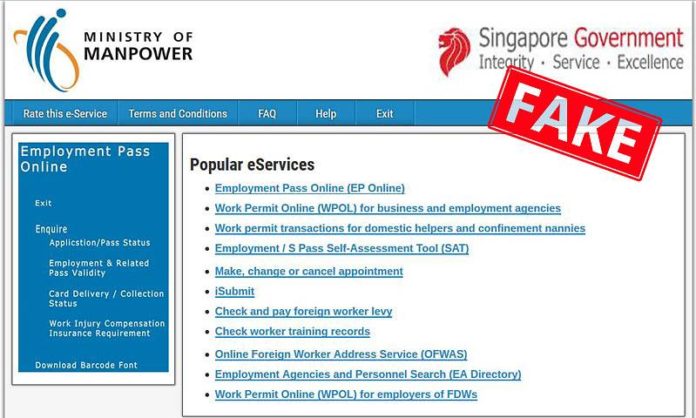
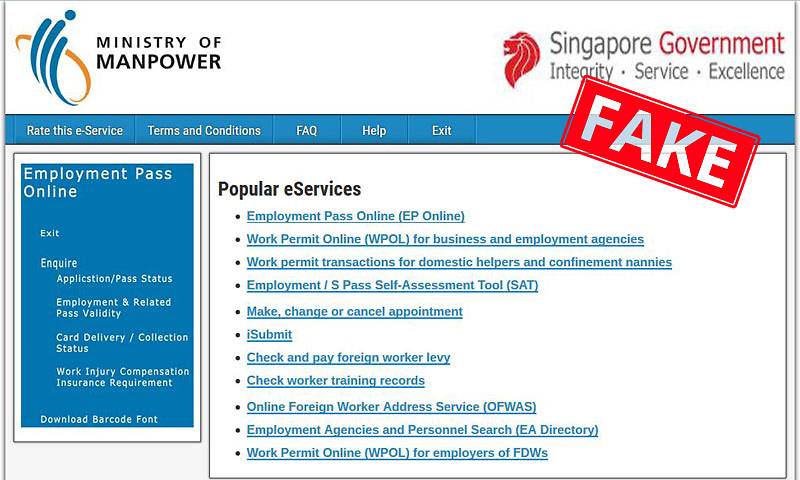
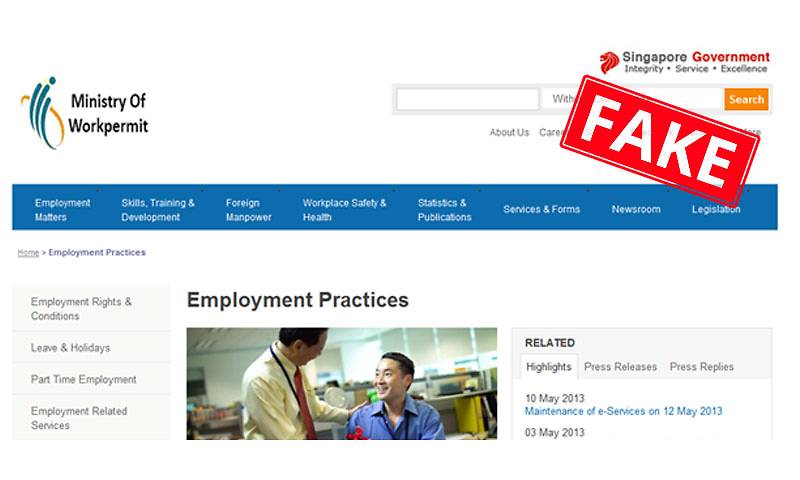
SINGAPORE: A website has been masquerading as the Ministry of Manpower’s (MOM) website and phishing for personal information, said MOM in a Facebook post on Tuesday (Jun 16).
The fake website – http://eponline-sg.com – is one of several that the ministry has uncovered. All of them have “similar but different URLs”, said MOM in a note on its website.
To determine the authenticity of an MOM website, the public can look at its domain name.
“Official MOM websites and eServices’ URLs will always contain ‘.mom.gov.sg’,” said the ministry.
It listed some examples of fake websites that it has found:
http://www.mom-sg.org
http://mom-gov.com
http://ministryofmanpower.net
http://wponlinemomgov.sg.com
“These looked very similar to our official URL, but do not have ‘.mom.gov.sg’.
“Some may even try to embed ‘.mom.gov.sg’ into their URLs but their domain name won’t end with ‘.mom.gov.sg’,” said the ministry.
Such fake websites may even “try to look official and mimic the official MOM website”, it added.
(Image: MOM)
(Image: MOM)
MOM in its Facebook post said it will continue to look for such fake websites and take them down.
“We also remain committed to keeping the official MOM website unaffected and your data safe,” it added.
There has been a spike in the number of phishing scams, with a 30-fold increase in the number of cases reported in the first five months of 2020, compared to the same period last year.