Home Blog Page 254

Heavier penalties from Jul 15 for households with repeated mosquito breeding offences and multiple breeding habitats: NEA

0

SINGAPORE: Households with repeated mosquito breeding offences and multiple breeding habitats will soon face harsher penalties, after more than 1,000 weekly dengue cases were reported earlier this month. 

Currently, households are issued a composition sum of S$200 for mosquito breeding detected at their residential premises, regardless of the number of breeding habitats detected, said the National Environment Agency (NEA) on Monday (Jun 22). 

Offenders are sent to court for the fourth offence.

These will change starting Jul 15, said NEA in a press release.  

First-time offenders will be penalised with a S$200 fine for a single instance of mosquito breeding, and S$300 for multiple breeding instances during the same inspection or mosquito breeding detected after a legal notice has been served. 

Repeat offenders will also be given heftier penalties or sent to court.

The enhanced penalties are as follows:
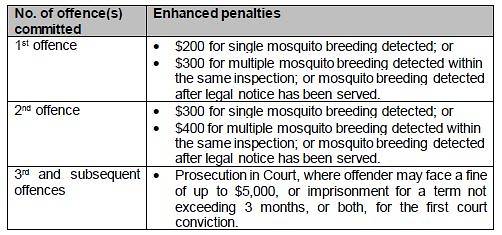
households dengue

(Source: NEA)

In homes specifically, there has been a “significant increase” in mosquito breeding, with the breeding incidence rates in homes up by 50 per cent in the last three years compared to in the preceding three years, said NEA. 

There was a five-fold increase in the incidence of Aedes mosquito larvae detected in homes and common corridors at residential areas during the two-month-long COVID-19 “circuit breaker”, compared to in the two months prior.

“This is despite more people staying home and being in a position to upkeep their premises better, and comes after years of educational outreach on the prevention of mosquito breeding habitats at home,” said NEA. 

nea officer dengue

Officer checking flower pots and plates at a residential home. (Photo: NEA)

“The majority of mosquito breeding is found in residential homes,” Minister for the Environment and Water Resources, Mr Masagos Zulkifli, said in the press release. 

“Even as NEA continues to conduct home inspections and educate residents on what they can do to protect themselves and to prevent mosquito breeding at home, the number of dengue cases has continued to rise.

“This places about 325,000 households living in over 200 dengue clusters islandwide at higher risk of dengue transmission.”

READ: Weekly number of dengue cases in Singapore surpasses ‘historical high’

The composition sums will also be raised for mosquito breeding at construction sites, said NEA, adding that although there has been “steady improvement” in the number of mosquito breeding habitats detected at construction sites, they continue to be uncovered. 

From Jul 15, first-time offenders will be fined S$3,000, up from the current S$2,000. Repeat offenders will also face more severe penalties.
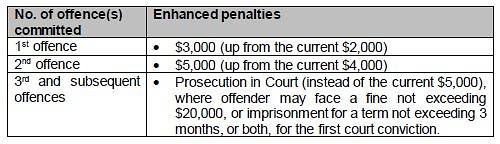
construction dengue

(Source: NEA)

NEA said it will also tighten enforcement for town councils for mosquito breeding found in common habitats such as drains and gully traps.  

Currently, town councils may be fined up to a maximum of S$5,000 for mosquito breeding detected in dengue cluster areas.

nea officer drain dengue

Officer checking drain at a residential home. (Photo: NEA)

READ: Spike in dengue cases: Why Singapore may see worst outbreak in years

MORE THAN 200 ACTIVE DENGUE CLUSTERS IN SINGAPORE

As of Jun 19, 254 active dengue clusters have been reported in Singapore, NEA said.

The five largest dengue clusters are located at Woodleigh Close, Leicester Road, Aljunied Road, Tampines Avenue 7 and Chu Lin Road.

Some dengue clusters also have a faster rate of dengue transmission, said NEA. 

These include the 157-case cluster at Leicester Road, 146-case cluster at Aljunied Road, 120-case cluster at Potong Pasir Avenue 1, 115-case cluster at Broadrick Road and 91-case cluster at Bukit Panjang Ring Road, with an average of about two to four cases reported per day in the past two weeks.

While 904 out of the 1,158 dengue clusters notified have closed since the start of the year, there are some errant clusters.

“Repeated mosquito breeding is still being detected at residential premises at the Woodleigh Close and Aljunied Road dengue clusters,” NEA said.

“There are also premises with multiple mosquito breeding detected in common breeding habitats, such as pails, dish trays, containers and flower pot plates, despite NEA’s constant reminders in our outreach materials to check these common habitats.”

The agency said it will step up outreach efforts at dengue cluster areas, with volunteers and poster walkers augmenting such efforts. SG Clean Ambassadors will also distribute dengue prevention checklists at hawker centres, to reach out to the general community.

READ: Dengue cases this year could surpass 2013 peak unless urgent action taken: NEA

OVERALL DENGUE SITUATION IN SINGAPORE

The heavier penalties come after Singapore faced a weekly “historical high” earlier this month.

In the week ending Jun 13, the number of weekly dengue cases exceeded 1,000 – the highest number for the same period of the year since 2013 when the largest outbreak year was recorded in Singapore’s history, NEA added.

nea dengue

Ultra-Low Volume (ULV) misting at a residential home. (Photo: NEA)

As of Monday, there have been 12,542 reported dengue cases this year. At least 12 people have died from dengue in 2020, with the victims aged between 56 and 80.

“Vector control is a key strategy given that our population will continue to have low immunity and we have limited control over other factors, like warmer weather, which is conducive for the faster multiplication of the Aedes mosquito and dengue virus,” said NEA. 

“There are three main components in the transmission of dengue: The dengue virus, the Aedes mosquito and the human host. Removing any one of these components will halt the spread of dengue.”

In anticipation of the surge in dengue cases this year, NEA has initiated several new efforts including enforcement and vector control measures.

At dengue clusters, there is continuous surveillance of Aedes mosquito populations through the deployment of Gravitraps, a regime of regular inspections of potential mosquito breeding habitats and removal of mosquito breeding sources through intensive search-and-destroy operations.

Gravitrap surveillance system monitors the Aedes mosquito population at residential areas, and has detected a 20 per cent increase in the Aedes aegypti mosquito population in May 2020, compared to in April 2020.
Source link

SIA passengers from some cities in China, Japan and South Korea can transit through Changi Airport

0

SINGAPORE: Singapore Airlines (SIA), SilkAir and Scoot passengers flying from selected cities in China, Japan and South Korea can now transit through Changi Airport.

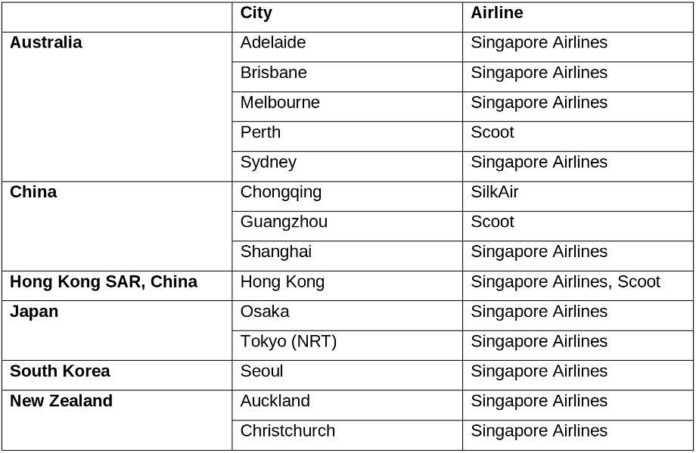
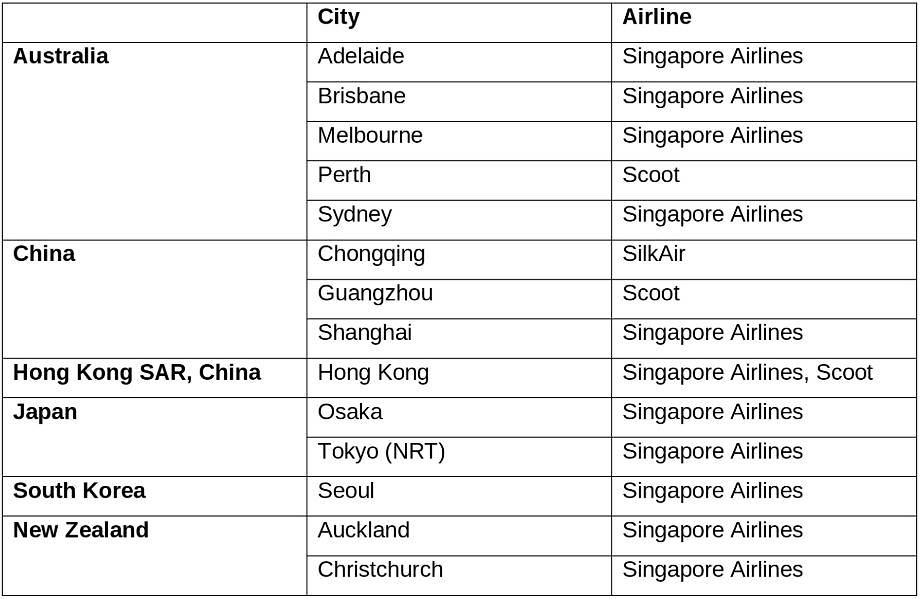
The approved cities are Hong Kong, Chongqing, Guangzhou and Shanghai in China, Osaka and Tokyo (Narita International Airport) in Japan, and Seoul in South Korea, SIA announced on its website on Saturday (Jun 22).

This is in addition to transit flights from selected cities in New Zealand and Australia that were announced on Jun 11.

The updated list of approved cities is as follows:

SIA flights (Jun 22)

(Table: Singapore Airlines)

SIA announced on its website that the transit flights are only for outbound journeys from the approved cities.

“Passengers will not be able to transit from other points in the SIA Group network through Singapore into these cities.”

Transfers in Singapore are also only allowed on flights between airlines within the SIA Group, namely SIA, SilkAir and Scoot.

Currently, transfers to and from flights operated by other airlines are not permitted.

SAFE TRANSIT

SIA had on Jun 11 announced that transit and non-transit passengers will be kept apart at Changi Airport “to ensure the health and safety of our customers and staff”.

Transit passengers will receive wristbands indicating their access to the designated transit holding area.

READ: Safety measures in new transit holding areas in Changi Airport

If the transit time is less than 75 minutes, passengers will be ushered directly to their boarding gate.

“For transit times of more than 75 minutes, they will be ushered to a designated transit holding area at their departure terminal before boarding their connecting flight,” said SIA. 

The passengers will not be able to make any stops along the way and will have to stay within the transit holding area at all times.

When boarding the plane, transit passengers will first board the aircraft, followed by non-transit passengers. 

SIA added that on the plane, there will be dedicated seating zones to separate the transit and non-transit passengers. 

“Passengers should remain in their designated zone throughout the flight,” said the airline.  

“Upon arrival, non-transit passengers will disembark first followed by transit passengers.”

READ: Singapore Airlines, SilkAir reinstate flights for some destinations in June and July

Source link

Otter family makes Istana their staycation spot

0

[ad_1]

Looks like our local otters have gotten even more bodacious during the Covid-19 pandemic.

After making their presence felt in areas like KK Women’s and Children’s Hospital and Bishan-Ang Mo Kio Park, the four-legged critters have done what no Singapore resident ever did, apart from the country’s president.

They’ve gone for a staycation in the Istana.

Earlier today (June 22), Prime Minister Lee Hsien Loong posted a photo of seven otters gallivanting across a well-manicured lawn and making their way towards a pond.

He wrote: “It’s been a while since the Istana welcomed any visitors or dignitaries, because of Covid-19.

“But that hasn’t stopped a family of seven otters from paying a visit! They have been busy exploring the Istana grounds for the past six days, under the watchful eyes of NParks.

[ad_2]

Source link

Woman unhappy her boyfriend made her take the MRT, treated her to Haidilao

0

[ad_1]

One man’s trash is another man’s treasure, or in this case, it’s the other way around.

A woman’s anonymous complaint about her boyfriend giving her a Louis Vuitton wallet recently went viral. Guess what, she’s back again.

Despite well-meaning advice from netizens the previous time, she said she had tried her best not to compare her boyfriend with her sister’s but “what happened today really made [her] cannot take it.”

[ad_2]

Source link

The dummy's guide to Singapore's political parties: The SDP edition

0

[ad_1]

Unless you’ve been living under a rock, you should have some inkling of the People’s Action Party (PAP) and the Workers’ Party (WP).

But what about RP? Or PSP? Or SDP? If these acronyms mean nothing to you, then you’re in the right place.

In this series — a cheat sheet of sorts — we sieve out the facts you ought to know about Singapore’s 13 registered political parties.

By the end of this, you should have a better idea of the parties which may be contesting in the upcoming general election and what they’re all about.

The party we’re looking at today has been a regular fixture in Singapore politics since the 80s.

Singapore Democratic Party

When were they formed?

SDP was founded in 1980 by Chiam See Tong to act as a check against the one-party government at the time.

[ad_2]

Source link

NTUC extends seniors' discounts, price freeze on daily essentials

0

[ad_1]

The social enterprise arm of the National Trades Union Congress (NTUC) on Monday said it will continue to keep prices unchanged for 100 daily essentials under its FairPrice house brand and extend discounts for the elderly, till Dec 31 this year.

These are part of NTUC Enterprise’s latest S$50 million support package for this year – which also includes Covid-19 relief measures and new deals for NTUC Union members – meant to help Singaporeans manage the cost of living amid the Covid-19 pandemic.

The S$50 million figure includes estimated savings to shoppers, and is more than double the value of its S$20 million in support last year.

DISCOUNTS VALID TILL END-2020

NTUC Enterprise said the FairPrice house brand range of products, which are priced at least 10 per cent cheaper compared to leading brands, have helped defray daily expenses for Singaporeans over the years.

[ad_2]

Source link

Got people stay there meh? Even Singapore's Coney Island and Pulau Tekong belong to GRCs

0

[ad_1]

With all signs pointing to an impending general election, now’s probably a good time to find out which GRC you belong to. 

Group Representation Constituencies or GRCs were created 1988, with the purpose of ensuring that Singapore’s parliament will aways be multiracial in composition and representation.

This means that at least one of the candidates in a group contesting for a GRC has to belong to a minority racial community, which is defined as either Malay, Indian or other minority communities such as the Eurasians.

[ad_2]

Source link

Singapore not using steroid dexamethasone to treat COVID-19 patients

0

SINGAPORE: Steroids are not routinely recommended in the care of COVID-19 patients in Singapore because they are known to causeharmful effects, a local expert has said. 

Dr Shawn Vasoo, clinical director at the National Centre for Infectious Diseases (NCID), was responding to queries from CNA after researchers from the University of Oxford found that the steroid dexamethasone was the first drug to significantly reduce the risk of death among severe COVID-19 cases.

The findings were hailed as a “major breakthrough” in the fight against the disease, with the inexpensive drug normally used to treat a range of allergic reactions, such as rheumatoid arthritis and asthma.

Daily doses of the anti-inflammatory steroid could prevent one in eight ventilated patient deaths and save one in 25 patients requiring oxygen only, the UK team found.

READ: Ebola drug remdesivir conditionally approved for COVID-19 treatment in Singapore

“Prior studies with reported benefits in COVID-19 have been non-randomised controlled studies and confounded by concurrent treatments,” said Dr Vasoo. 

Historically, steroids have also been known to cause deleterious effects such as bacterial or fungal superinfection – a lesson drawn from the 2003 SARS outbreak, he added. 

“Steroids will also delay viral clearance and as such were recommended to be avoided unless there are other reasons for their use such as exacerbation of asthma, chronic obstructive lung disease and refractory septic shock in COVID-19 patients,” Dr Vasoo told CNA.

Some COVID-19 patients in Singapore have received steroids due to other indications such as shock, low blood pressure or inflammatory conditions secondary to the disease, he said.   

FILE PHOTO: An ampoule of Dexamethasone is seen in this picture illustration

File photo of an ampoule of Dexamethasone taken on Jun 17, 2020. (Photo: Reuters/Yves Herman)

Until the recent “preliminary data” shared by the UK researchers, steroids have not been shown to have “specific benefits” in battling COVID-19 infection, Dr Vasoo said. 

“The evidence has been somewhat conflicting.”

While steroids may “have a role” in select patients who are more ill with COVID-19, such as those on ventilators, doctors here are still “looking forward” to more detailed data so it can review the recommendations on using steroids for coronavirus patients.

“Dexamethasone is a commonly used drug, low cost and easy to administer. There will be further discussion on how this finding will influence and modify current treatment approach,” the clinical director said.

CNA has contacted the Ministry of Health (MOH) for more information.

READ: Singapore scientists discover 5 antibodies that can combat COVID-19, human trials to commence in coming months

DEXAMETHASONE GIVEN TO UK, US PATIENTS

The UK trial, carried out by the RECOVERY research group that is searching for effective COVID-19 treatments, administered the drug to more than 2,000 patients. The trial included a control group of 4,000 patients who did not receive the drug.

“Dexamethasone is the first drug to be shown to improve survival in COVID-19. This is an extremely welcome result,” said Peter Horby, professor of Emerging Infectious Diseases in the Nuffield Department of Medicine, University of Oxford.

“Dexamethasone is inexpensive, on the shelf and can be used immediately to save lives worldwide.”

Britain’s Health Secretary Matt Hancock said the country’s patients would start to receive the drug.

The trial results were described as being “particularly promising” as around 40 per cent of COVID-19 patients who require a ventilator end up dying, often because of the body’s uncontrolled inflammatory response to the virus. For those receiving the new treatment, the mortality rate dropped to less than 30 per cent.

However, the UK trial showed dexamethasone to be ineffective in treating patients with milder forms of COVID-19.

READ: Commentary: The road to a COVID-19 vaccine is long and narrowing

Shortly after the UK trial results were released, the head of the World Health Organization’s (WHO) emergencies programme Mike Ryan warned that dexamethasone should be reserved only for serious cases in which it has been shown to provide benefits.

Doctors in some parts of the world, such as Denmark and the US, have started prescribing the steroid to COVID-19 patients.

But medical experts in other countries, including South Korea, Switzerland and Italy, have urged caution and asked for more results.

In the US, several hospitals faced with fresh surges of COVID-19 cases have started treating their sickest patients with dexamethasone.

The University of Florida’s Gainesville hospital updated its COVID-19 treatment guidelines as of last Tuesday to include using dexamethasone. It previously used the steroid sparingly for those patients.

AdventHealth, which has nearly 50 hospitals in nine states, has been using dexamethasone for COVID-19 patients on ventilators with success since early April, said Eduardo Oliveira, executive medical director for critical care for AdventHealth’s central Florida region.

At its eight hospitals in the Orlando area, Dr Oliveira said the mortality rate for patients requiring ventilators was about 26 per cent, “lower than almost every other reported mortality in the literature right now”.

He noted it was difficult to know whether that success was due to the use of steroids.

BOOKMARK THIS: Our comprehensive coverage of the coronavirus outbreak and its developments

Download our app or subscribe to our Telegram channel for the latest updates on the COVID-19 outbreak: https://cna.asia/telegram

Source link

COVID-19: NTUC FairPrice further extends price freeze of 100 housebrand products

0

SINGAPORE: NTUC FairPrice will continue to freeze the prices of 100 housebrand items at its supermarkets until the end of the year as part of a S$50 million package to alleviate living costs for households amid the COVID-19 pandemic.

The items include daily essentials and groceries like rice, oil, beverages, as well as batteries, toiletries and household cleaners, said NTUC Enterprise in a media release on Monday (Jun 22).

Diapers, UHT milk, bread and detergent are also included in the list.

NTUC Enterprise said that the initiative is part of a S$50 million package aimed at “providing holistic support for Singaporeans and helping them manage the cost of living in 2020”.

“The package reaffirms the commitment and timeliness of NTUC Enterprise to support Singaporeans, especially during difficult times,” it said.

The price freeze initiative, which was launched in March 2019, was supposed to run until Jun 30 this year. It will now be extended until Dec 31.

“This six-month extension helps cushion Singaporeans against potential price increases, regardless of changes in supply, socio-economic factors and external factors that could affect food prices, especially during the current volatile and uncertain climate,” said the company.

The initiative was initially supposed to run for 15 months and provide shoppers with savings of approximately S$17.8 million. The extension will provide an additional S$6.7 million in savings.

NTUC Enterprise added that this price freeze will also act as “a benchmark for prices in general of everyday essentials”, ensuring they remain affordable.

The company said that in 2019, the costs of 38 of the 100 housebrand items saw increases of up to 10 per cent. This amounted to more than S$350,000 which FairPrice has absorbed.

EXTENSION OF DISCOUNTS FOR ELIGIBLE SENIORS

NTUC Enterprise also announced that it will extend the validity of its various programmes to provide cost savings for eligible seniors for another six months until Dec 31.

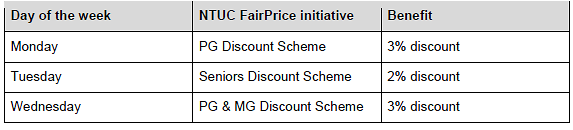
This includes existing Monday to Wednesday discounts at FairPrice for Merdeka Generation (MG), Pioneer Generation (PG) and Senior Citizens, and discounts on insurance, personal home care services and day centre services for MG and PG members.

NTUC discounts for seniors

NTUC discounts for seniors (Table: NTUC Enterprise)

The extension of both the PG and MG Discount Schemes is estimated to provide savings of S$7.9 million this year.

Savings from the Seniors Discount Scheme are also estimated to exceed S$2.5 million, bringing the total estimated savings for all seniors to S$10.4 million in 2020, said NTUC Enterprise.

From July 2020, FairPrice will add another five mobile grocery vans to bring daily essentials closer to seniors, reducing their time spent outdoors. Seniors visiting these vans may use their PG, MG and Senior discounts.

The initiative FairPrice on Wheels will have 10 vans providing basic essential items at selected mature estates with a higher concentration of low-income seniors.

READ: COVID-19: Supermarkets launch dedicated shopping hours for ‘vulnerable segments’ of community

NTUC Enterprise Group CEO Mr Seah Kian Peng said that it has been a “challenging year” for Singaporeans heavily impacted by COVID-19.

“In times like these, our resolve to serve Singaporeans has only deepened,” said Mr Seah.

“We have put in additional resources to ensure that daily essential products and services … remain accessible and affordable for all,” he said.

“Through this comprehensive support package, we reaffirm our commitment to moderate the cost of living for all Singaporeans.”

BOOKMARK THIS: Our comprehensive coverage of the coronavirus outbreak and its developments

Download our app or subscribe to our Telegram channel for the latest updates on the coronavirus outbreak: https://cna.asia/telegram

Source link

Jail, caning for doctor who assaulted girlfriend, causing multiple facial fractures

0

[ad_1]

SINGAPORE – A doctor who was convicted in March of assaulting his then-girlfriend, causing multiple facial fractures, pleaded guilty in court on Monday (June 22) to two more assault charges involving the woman.

Clarence Teo Shun Jie was sentenced to three years, six months and two weeks’ jail with four strokes of the cane. He was also fined $4,000.

On March 9 after a trial, District Judge Toh Han Li found Teo, 35, guilty of one count each of causing grievous hurt to Ms Rachel Lim En Hui in his Redhill flat in August 2017 and of wrongfully confining her.

On Monday, Teo admitted that he assaulted Ms Lim on two separate occasions in March that year.

An online search reveals that he is still a medical practitioner.

Teo had told the court during the trial that he worked as a locum – or stand-in doctor – at clinics.

The court heard that Teo was “drunk… happy and tipsy” when Ms Lim, 27, who worked in the communications industry, met him at his flat on March 12, 2017.

The pair were in his bedroom later that day when he suddenly brought up her past relationships and yelled at her.

[ad_2]

Source link