The Workers’ Party (WP) looks to have set its sights on five constituencies in the upcoming general election, half the number it contested in 2015.
Its slate of 20 candidates will likely also sport fewer new faces compared with its last outing at the polls.
In the last election, the leading opposition party contested 10 constituencies, fielding 28 candidates, 16 of them newcomers. That was its largest contingent since 1988.
While the party continued to cover the ground in most of these areas in the past five years, it has narrowed its focus as the deadline for the coming election drew nearer.
Party members who spoke on condition of anonymity said the WP leadership has decided to contest Aljunied, East Coast, Marine Parade group representation constituencies, Hougang single-member constituency, as well as the new Sengkang GRC, in an attempt to consolidate its position in the east.
Since movement restrictions were relaxed after the end of Singapore’s coronavirus circuit breaker period, the party’s volunteers have, along with prospective candidates, hit housing estates in these areas.
SINGAPORE – The Singapore Democratic Alliance (SDA) had a scare during a walkabout in Pasir Ris on Monday night (June 22) when one of its members felt faint and had to be taken to hospital.
About 45 minutes into the walkabout Mr Harminder Pal Singh, 48, who ran in the last two general elections, could not continue and had to sit down while a party member called for an ambulance.
He was later taken to hospital accompanied by a party member, while the rest of the group carried on with the walkabout. SDA president Desmond Lim Bak Chuan said his team had been keeping late nights as they prepare for the election, sleeping at 3am the past few days. He added that Mr Harminder had leftovers from lunch the day before for dinner.
He told The Straits Times at 10.30pm that Mr Harminder’s condition was stable.
During the walkabout, Mr Lim said the SDA would be returning to contest Pasir Ris-Punggol GRC at the next election and that he would be leading the team again.
“I won’t run away,” Mr Lim, who campaigned alongside Mr Harminder in GE2015, said, even as he did not reveal the other candidates that the party would be fielding.
SINGAPORE – Electronic Road Pricing (ERP) charges at all gantries will stay suspended for at least another month until July 26, after which new rates might take effect.
The first review of ERP rates by the Land Transport Authority (LTA) after the circuit breaker period showed that road conditions did not warrant road charges to be reinstituted.
The transport authority said upon the review’s completion on Monday (June 22): “Based on LTA’s monitoring of traffic conditions, traffic speeds on expressways and arterial roads in early June have remained optimal.
“ERP rates at all gantries will therefore remain at zero until the next ERP rate review.”
The outcome of the next ERP rate review will be announced in the fourth week of July and new rates, if any, will take effect on July 27.
ERP gantries have been switched off since April 6, as activity across the island was slowed down by circuit breaker regulations to curb the spread of the coronavirus.
Traffic volume shrank by an average of 60 per cent since January between April and May.
Accidents had also fallen by more than 40 per cent since April 7 by May.
SINGAPORE – Lawyer and opposition politician Lim Tean is facing two pending bankruptcy claims totalling about $1.45 million, a Straits Times check has found.
One of the applications, filed by DBS Bank in October last year over a debt of $549,378, was heard in the High Court on Monday (June 22) in chambers via video conference.
The case has been adjourned for three weeks.
DBS declined to comment, as the case is still ongoing in court.
Mr Lim, who represented himself, did not respond to phone calls seeking comment.
The other application was filed by a trading company, Sing Wing (I & E), in May this year.
Records show that the company is seeking to make Mr Lim a bankrupt over a debt of about $905,000. A hearing for this application is scheduled on July 16.
Mr Lim is founder and secretary-general of Peoples Voice party, which had its registration approved in October 2018.
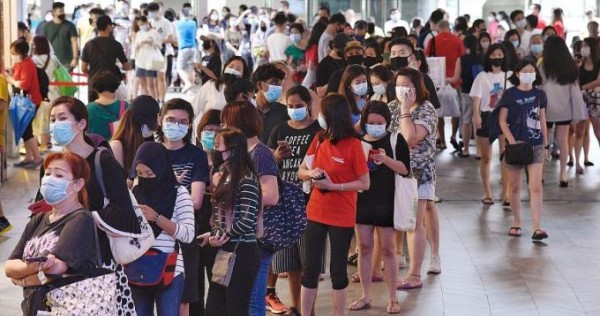
A large crowd of shoppers stand shoulder to shoulder while waiting for their turn to enter a mall.
In Holland Village, Lorong Mambong, a pedestrian mall from evening till dawn, was reopened to vehicular traffic to prevent people from gathering.
Similar scenes were played out across the island over the weekend as people emerged from their homes to enjoy the outdoors during phase two of the economy reopening.
This has led some medical experts to warn of a likely rise in Covid-19 community cases over the next few weeks, with the possibility of certain restrictions being reinstated in the event of a significant surge.
Dr Asok Kurup, an infectious disease expert who runs a private practice in Mount Elizabeth Medical Centre, said: “People think that just because they are wearing masks, they are safe, but that is not the case. It gives a false sense of security.
“We know that the disease can also be transmitted via surfaces, and people touching their faces and adjusting their masks (when they go out to eat) could increase the risk of infection.”
SINGAPORE: This year is a record-breaking year for dengue in Singapore. This year, of course, is also a record-breaking year for COVID-19 in Singapore.
What are the similarities and differences between the transmissions of these two diseases, how have COVID-19 and dengue interacted in Singapore, and what should we expect in the coming months?
We are all very familiar with the COVID-19 situation in Singapore. Case numbers have been high over the last few months but have been coming down in recent weeks.
After a period of restricted movement, we are now entering Phase 2, and more activities are allowed, but with still a considerable number of public health measures in place.
Dengue transmission varies in Singapore from year to year.
Going into 2020, higher than usual case numbers suggested we might be heading for a big year. In the last few weeks, we have seen the explosion of cases that we hoped would not happen.
The number of cases and active clusters have been increasing rapidly, and the National Environment Agency (NEA) are stepping up their control efforts. According to NEA data, two weeks ago Singapore reported 1,158 cases – a 33 per cent increase from the previous week and a record number of weekly cases in the country.
As of Jun 18, there were 258 active dengue clusters in Singapore.
The big difference between the two diseases is that COVID-19 is spread from person-to-person, and dengue is spread from human-to-mosquito-to-human.
The circuit breaker has reduced our person-to-person contact, and so we have seen decreases in COVID-19 and diseases like influenza during this period, but the reduction in contact during the circuit breaker has not led to reductions in dengue cases.
There is much discussion about why we are seeing a record-breaking year for dengue. There will be much research in the coming months and years, including my own, to understand this. However as with everything in dengue, I think it is complicated.
For dengue, a number of factors come together to lead to transmission and cases being higher or lower in different places and at different times.
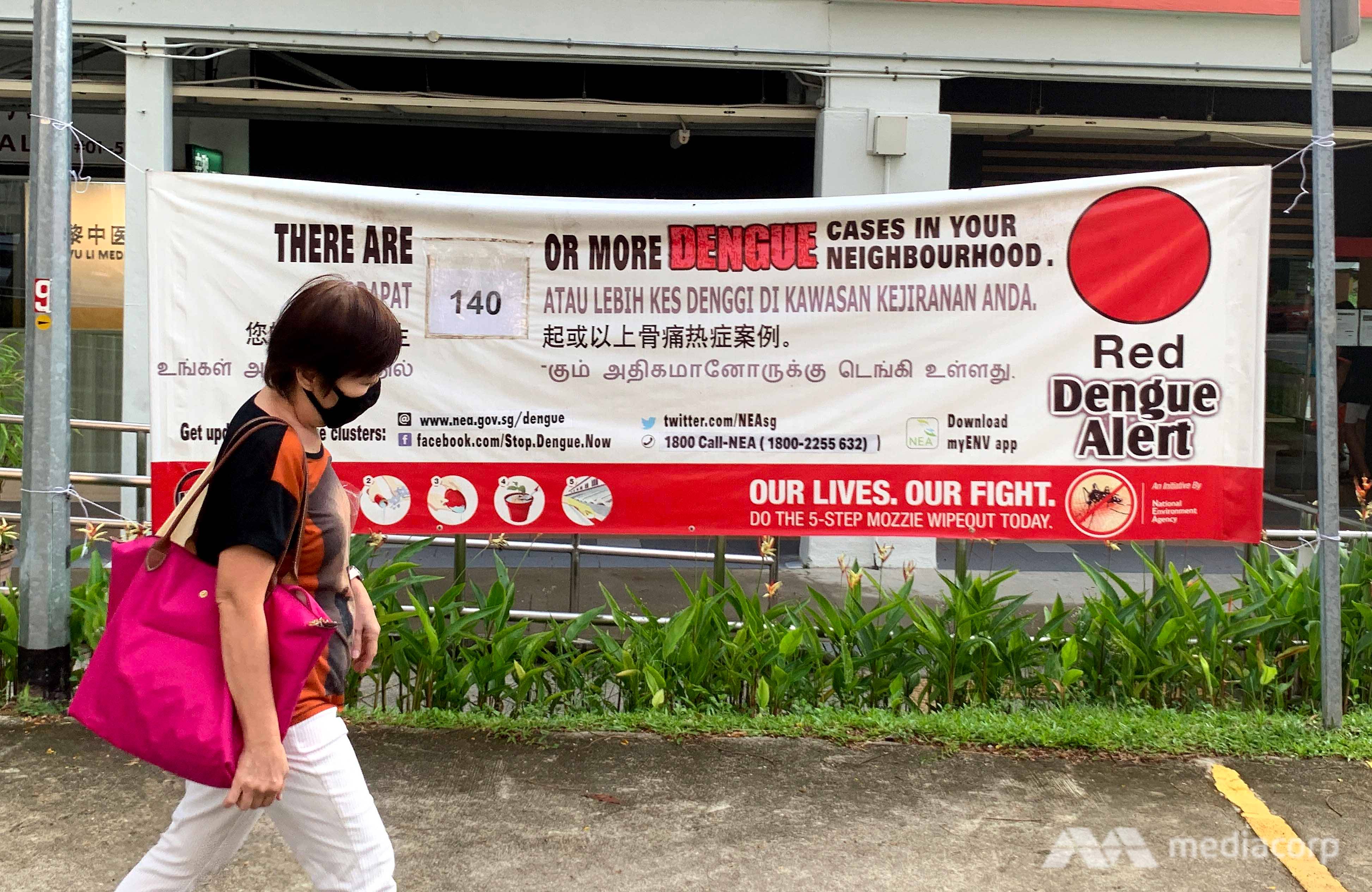
A Red Dengue Alert signage in Potong Pasir, on Tuesday (Jun 16). Dengue cases have been on the rise ever since early May, during Singapore’s COVID-19 circuit breaker period (Photo: Jeremy Long)
These factors include the weather, numbers of mosquitoes, human exposure to mosquitoes, virus serotypes and population immunity.
This year in Singapore we have seen a number of these factors change compared to previous years: More mosquitoes as found by NEA inspections, changes in exposure as people are spending more time at home, as well a different serotype compared to previous years.
The mosquitoes that spread dengue tend to bite during the day. Therefore, where people are during the day is important as it impacts their risk of getting bitten.
NEA inspections have revealed many mosquitoes and clusters at home, therefore being at home more during the day could be leading to more exposure to mosquito bites and dengue cases.
For a short-term response, we need to understand what we can about the drivers and then to focus on what can be changed now.
The main outcome being aimed for is a reduction in the numbers of bites people get from mosquitoes. This reduction can be brought about by reductions in mosquito numbers, as well as reduction in exposure to mosquitoes.
PERSONAL AND PUBLIC RESPONSES IMPORTANT
For both dengue and COVID-19, public health responses will lead to changes in our surroundings, with the aim of reduction transmission, but there are also actions we are being asked to take ourselves in our homes and workplaces.
We all know very well for COVID-19 the public health actions that are on-going, and how workplaces and public places are responding currently.
For dengue, NEA has for many years had in place responses, rules and regulations with the aim of reducing mosquito numbers through activities like fogging and breeding site removal.
In addition, over the last few years, Wolbachia mosquitoes have been released as part of a suppression strategy with the aim of reducing mosquito numbers.
Moreover, the actions we are being encouraged to take ourselves can make a difference to transmission.
For COVID-19 those individual actions are the things we have heard a lot about over the last few months, including wearing masks, washing hands and having fewer physical interactions with other people.
For those actions it is quite easy to see how they reduce the spread of COVID-19 by reducing the number of contacts or the risk of infection given a contact.
For dengue, because the spread is via mosquitoes, the relevant actions may feel further removed.
NEA dengue inspection officer checking for mosquito breeding at the roof top of residential premises. (Photo: National Environment Agency)
However, they are not any less integral to reducing transmission. For example, clearing breeding sites in our homes and wearing mosquito repellent works to reduce the numbers of contacts with mosquitoes or the risk of an infectious contact via a bite from a mosquito.
These in turn therefore reduce the spread of dengue.
COVID-19 and dengue also both likely have asymptomatic or pre-symptomatic transmission, this is partly why we are advised to take these actions pre-emptively and not just when we have symptoms.
We are also of course asked to take these actions so as to reduce the risk of getting infected in the first place.
In addition, for both COVID-19 and dengue, we are advised to take focused actions when we know transmission is near, like when people have been contact-traced for COVID-19 and therefore have to quarantine, or the stepping up of preventive measures in the house or workplace when these are in a red or orange zone for dengue.
CHALLENGES OF HAVING BOTH DISEASES
For Singapore in 2020, one of the big worries with having both COVID and dengue at the same time is that there will be large numbers of patients seeking care leading to an overwhelmed healthcare system thus affecting hospitals’ capacities to provide other services.
As we have seen so far, through a combination of expanding healthcare capacity and bringing in population measures like the circuit breaker, Singapore has dealt well with mitigating and dealing with increases in COVID-19 cases.
I’m sure this will continue to be the case with dengue and COVID-19, but the question will be, depending on how much spread there is of both in Phase 2, how much does the healthcare system need to adapt, and what public health measures will also need to be in place.
So, what should we expect over the next few months? As our lives change again with Phase 2 we expect to see COVID-19 cases increase, but with the knowledge that there are measures in place that aim to limit transmission as well as detect and deal with these cases when they arise.
For dengue, with more people going back to work, and spending more time outside the home, exposure will be changing again.
Therefore, the focus will be on reducing mosquito numbers and exposure to mosquitoes in the places where people are now spending more time.
The NEA will be continuing surveillance and reporting so we will know where dengue transmission is happening to enable us to respond.
However, we are currently in a phase of rapid growth of dengue cases, and given the weather currently, growth can unfortunately be predicted to continue, and this must be planned for.
As always in public health, hopefully our actions mean that this prediction will be wrong.
Download our app or subscribe to our Telegram channel for the latest updates on the coronavirus outbreak: https://cna.asia/telegram
Hannah Clapham is an assistant professor at the Saw Swee Hock School of Public Health at the National University of Singapore and was previously the head of modelling at the Oxford University Clinical Research Unit in Ho Chi Minh City.
SINGAPORE: The Singapore Ministry of Manpower has issued new guidelines on foreign domestic workers’ (FDWs) movements after Phase 2 of the post-circuit breaker reopening begins.
During Phase 1, FDWs were advised to “stay at home” during their rest days except when they had to run essential errands. These excursions had to be as short as possible.
Now, with Phase 2, the rules have been relaxed slightly but FDWs are still encouraged to stay at home during their rest day. Like everyone else in Singapore, FDWs can spend their rest day outside, but they need to first seek their employers’ consent and they have been “strongly encouraged” by the Government to schedule them on a weekday rather than the weekend.
On the one hand, this makes sense from a public health point of view and is in line with the other Phase 2 regulations issued that limit social gatherings to groups of five or less, and encourage working from home wherever possible.
On the other hand, these guidelines give employers leeway to impose harsh restrictions on their FDWs’ movements and freedom.
They come on top of already weak labour protections regarding FDWs’ rest days, and so are likely to make a bad situation even worse.
REST-LESS IN SINGAPORE
The International Labour Organisation’s Domestic Workers Convention proposes that domestic workers be treated like all other workers in a country in terms of their hours of work, overtime compensation, rest periods, annual leave and sick leave provisions.
Although FDWs in Singapore are entitled to a weekly rest day, there is no legal requirement that their rest day should constitute “one whole day” or a continuous 24-hour period of rest.
In Singapore, the Employment Act stipulates that workers must receive at least “one whole day” of rest in each week, but the Act does not cover domestic workers.
Even though the Ministry of Manpower (MOM) rules stipulate that FDWs are entitled to a weekly rest day, it is not uncommon to read NGO reports of FDWs being given only a few hours off during their rest day (if they even get one) and asked to complete various household tasks either before or after they go out on their rest day.
A foreign domestic worker at work (Photo: Channel NewsAsia)
Employers and FDWs are allowed to negotiate over the number of the rest days workers receive in a month, as long the FDW is paid compensation amounting to one day’s wages, usually about about S$21.50 for wages of S$560 a month.
Yet, we still hear stories of Myanmarese and Indonesian FDWs, and also FDWs on their first contract, “giving up” their weekly rest days to win their employer’s goodwill.
WORRIES OVER WORKING FROM HOME
If the work-from-home restrictions during the circuit breaker have taught us anything, it is that regular rest is essential, and that the blurring of work and home life can cause significant mental stress to workers.
Some of this mental stress comes from the inability to physically disconnect from work because one is always “on”. It is also caused by the social isolation that comes from not being able to mingle and bond with co-workers.
The lack of personal space in the home setting can also be debilitating, especially for individuals who do not have a private room to which they can retreat when they need a break.
FDWs were “working from home” long before the circuit breaker. Their place of work – their employer’s home – is also their place of residence. For these reasons, NGOs and migration scholars have long pointed out that live-in domestic work is inherently stressful, and needs more attention from lawmakers.
Even FDWs who are treated like family by their employers understand the reality that their contracts can be terminated at any time by their employer. Live-in domestic work can be extremely isolating because FDWs are not part of a team and do not have co-workers to joke and share responsibilities with.
If live-in domestic work was challenging for FDWs before the coronavirus pandemic, imagine how much harder it is now.
In the past, FDWs could look forward to quiet moments in each day when no one else was at home, to catch a break. This becomes harder if their employers are stuck indoors as well. This leaves only their rest days as a chance to leave their workplace and socialise with friends.
It is understandable that the MOM has encouraged employers to consider giving their FDWs rest days on weekdays, so that FDWs can avoid potentially crowded shopping malls and public spaces on the weekends when the vast majority of Singapore will be out.
But what we should watch for is if an employer forbids their FDW from having a rest day at all, arguing that they do not trust their worker to maintain social distancing, even as the employer now has the freedom to go out whenever they want.
Some 250,000 foreign domestic workers work in Singapore as of June 2018. (File photo)
These double standards can breed frustration and resentment among FDWs who may feel that they have to operate under a different set of rules from their employers.
How can we resolve these inequities in a sustainable and fair manner given that we are going to be living in a COVID-19 world for a while?
RESTFUL SOLUTIONS FOR FDWS IN A COVID-19 WORLD
There are concrete steps that can reduce the stress and strain FDWs face. These include policy actions the Government can take to improve the legal protections for FDWs, as well as actions individual employers can take to improve the work environment for their own FDW.
Jeanette Lim, a Clinical Psychologist at the Department of Psychology, Institute of Mental Health, recently suggested a series of actions which office workers can take to reduce their mental stress as they work from home, and many of her suggestions can be extended to how employers treat their FDWs.
Lim emphasises the importance of staying connected via video/phone calls to make up for the fact that you cannot see friends and colleagues in person.
If FDWs have to spend more time at home, then employers should ensure that their FDWs have access to a phone or internet so that they can communicate with their friends in Singapore and relatives overseas on a daily basis.
FDWs should be allowed to coordinate their rest days with their friends so they can try to meet up on a weekday instead.
Lim also stresses the importance of self-care, including “eating well, sleeping enough, exercising and engaging in leisure activities” on a daily basis. Employers should be required to give their FDWs clearly demarcated rest periods each day when FDWs should be allowed to leave the home and go for a walk even if it is just around the neighbourhood estate.
Many Singaporeans were already doing this, for instance, by relieving their elderly parents’ FDWs on the weekends so that the worker could take the day off. But if FDWs are not allowed to take their rest days on weekends, then employers should ensure alternative relief arrangements are made for weekdays, rather than leaving the worker without rest.
Meanwhile, the Government should implement a 24-hour period of continuous rest rule for FDWs so that their weekly rest “day” is not reduced to a rest “period” or a rest “hour.”
Finally, Lim suggests that “finding reasons to be grateful” and “managing changes with kindness” can improve our mental health.
Employers can build goodwill if they find concrete ways to show their appreciation for the extra carework their FDWs have been providing. An open conversation about how both sides are coping would also help. For the last few months, FDWs have witnessed firsthand the stress their employers are experiencing over job insecurity, reduced paychecks, fears of falling ill, and other disruptions. Talking openly about these challenges will help FDWs understand their employers better.
Meanwhile, most FDWs in Singapore are from Indonesia and the Philippines where coronavirus cases are rising rapidly, and they too are under significant strain as they worry about loved ones who may be sick or unemployed.
And yet, they are here in Singapore, looking after Singapore’s loved ones. Treating them as the essential workers they are would go a long way towards making Singapore a more caring society in the post-COVID-19 future.
Download our app or subscribe to our Telegram channel for the latest updates on the COVID-19 outbreak: https://cna.asia/telegram
Anju Mary Paul is an associate professor of sociology and public policy at Yale-NUS College in Singapore. Her research specialises in labour migration patterns in Asia and care work policies.
SINGAPORE: Television host Steven Chia has a confession to make: He has not allowed his children, in Primary Four and Secondary Two, to use public transport since the start of the COVID-19 outbreak.
“I’m just fearful that they might come into contact with someone who is infected, especially during the peak hours,” he said.
He is not alone in feeling that way. A poll he created on Instagram found that 72 per cent of roughly 100 respondents felt that it was a “valid concern”, while 28 per cent thought it was “just paranoia”.
So far, there has been no conclusive evidence of the coronavirus spreading on public transport.
A city like Milan, which is among the hardest hit, has not seen infection clusters emerge from reopening its transit system. Neither has Japan, which has some of the world’s busiest rail networks.
WATCH: How COVID-safe is public transport? Buses, trains and the coronavirus (3:00)
In Singapore, the Health Ministry’s investigations have not established epidemiological links between the 14 public transport staff who caught COVID-19 and the passengers with whom they may have come into transient contact.
But states are taking no chances and have responded with different strategies to manage risks. In New South Wales, Australia, passengers are capped at 12 to 25 per bus, and 23 to 36 per train carriage.
South Korea made wearing of masks compulsory on public transport to reduce the risk of a second wave of infection. So too has Singapore, where commuters are also urged to avoid talking.
Since the “circuit breaker” here ended on June 1, morning peak ridership on public transport has doubled and is expected to increase further in the current Phase Two of reopening.
With the authorities saying that safe distancing on public transport is potentially impossible, commuter safety has got to be bolstered by other measures like cleaning.
The programme Talking Point gains access to the enhanced cleaning regime on trains and buses to find out if it is good enough to put any worries to rest. (Watch the episode here.)
FAST TURNAROUND ON TRAINS
When it comes to cleaning at stations and interchanges, common touch points like seats, queue rails and escalator handrails are wiped down with disinfectant about once every two hours.
Where the cleaners must be super-fast, however, is on the trains as they swoop in during service loops.
At the Circle Line (CCL) terminal stations, for example, a team of five to six cleaners have as little as five to eight minutes to wipe down the train interior before passengers are loaded up for the next ride.
And they do it while the train is moving. At HarbourFront station, where the track makes a loop, the CCL trains terminate at one platform before crossing over to the other platform.
So this gives SMRT the window of opportunity to give some trains an extra clean during off peak hours, without affecting the service frequency. The operator implemented this after Singapore’s Disease Outbreak Response System Condition was raised to orange level.
“To do that, we’ve had to increase our cleaning manpower, probably by about five to eight per cent,” said SMRT vice-president (building and facilities) Siu Yow Wee.
“But the main cleaning … is (conducted) before we launch the train from the depot.”
This daily overnight cleaning is when his cleaners “thoroughly clean the entire train’s internal touch points”. Trains disinfected in the depot are also treated with antimicrobial solution, which is the rage now.
Antimicrobial coatings have been applied to Housing and Development Board lift buttons and automated teller machines. And they have been progressively applied to the interior of trains and buses in a ramp-up of cleaning efforts in public transport since the circuit breaker.
The coating works like a shield. When in contact with bacteria and viruses, its compounds puncture the membranes, killing them.
Without this protection, the coronavirus can last on different types of surfaces for a long time as studies have suggested: Up to three days on plastic and stainless steel; and up to four days on glass.
Over at SBS Transit, its bus support division head, Yeo See Peng, has overseen the application of antimicrobial coating since the end of last month, with nearly all its 3,500 buses coated in time for Phase Two of reopening.
This is done using a spray gun, instead of wiping down surfaces, for a more thorough application of the antimicrobial solution, he explained. And the “special disinfectant” used, called SD Pro, “can last about 180 days”, or about six months.
Using a spray gun in a process called Electrostatic Disinfectant Spray.
“Obviously, because we’re now still doing testing and measurement every month, if we feel that its effect has gone down, we can always (recoat) faster than six months,” said Yeo.
BUS POLES NOT SO CLEAN
One of the companies producing antimicrobial coating is jMedGuard, and co-founder Thomas Teh, who is in charge of product development, cautions that it is not foolproof — there are “limitations”.
Citing an example of somebody whose hands are covered with chocolate and who happens to “soil the surface” of a grab pole, he says: “You’re blocking the surface coating from acting against these viruses or bacteria.
“Or imagine … some (people) wearing rings or holding something — a hard object. They’d definitely scratch off the coating, and the coating wouldn’t last on these surfaces for (the usual) period of time.”
To put the coating to the test, Talking Point collected 36 swab samples from the poles, hanging handles, buttons and windows in nine buses where it has been applied.
Talking Point host Steven Chia collecting a swab sample.
The samples were put through an Adenosine Triphosphate test, which measures the volume of micro-organisms found. While it cannot directly identify traces of coronavirus, the lower the micro-organism count, the less likelihood of the coronavirus being on the surface.
The results showed that the average readings for buttons, windows and handles were below 30, which is the cleanliness benchmark for critical touch points in hospitals.
But the grab poles had an average reading of 101, in the cautionary range. “We should probably do something about that surface,” said Teh.
“The frequency of touch there would be higher, and the chances of wearing (away) this coating on these surfaces are also higher. So any microbial coating that may be there may lose its effectiveness over time.
“This is something we should continuously monitor … To say that this coating can last 180 days for all surfaces would be incorrect.”
An Adenosine Triphosphate reader.
This is why the coating and current cleaning regime must go hand in hand.
Still, the pole readings are “well below” the 200 mark — anything above this is considered dirty, while one’s smartphone touch-screen is typically in the “very dirty” range of 501 to 1,000.
“So we probably shouldn’t be that fearful of a grab pole,” Teh added. While acknowledging that the readings would be higher if tests were done in Phase Two, he pointed out that commuters “have to use the grab pole”.
“The operators are doing their best to do the coating (and) daily disinfection, but we as individuals should … keep up our personal hygiene. I think that’s the best way we should be (moving) forwards.”
That includes wearing one’s mask properly — covering the nose and mouth — as “the poorer the compliance, the greater the virus would spread”, stressed infectious diseases specialist Leong Hoe Nam.
“If everyone sticks to this rule, we don’t need the safe distancing,” he said. “We’d be as good as 99.7 per cent effective in preventing COVID spread.”
Watch this episode of Talking Point here. New episodes on Channel 5 every Thursday at 9.30pm.
With a weighing scale, a timer, and some durians, a daring merchant has been hawking his wares online at spooky spots around Singapore.
29-year-old Elvin Xie set up shop before a row of tombstones in Choa Chu Kang cemetery on June 17, pulled his face mask to his chin, and called for bids on Mao Shan Wang durians over Facebook Live.
He sold 10 durians for $600 that night, Lianhe Wanbao reported.
The unusual location soon drew ire from netizens, with some commenting that it was a disrespectful act while others pointed out possible breaches of public health measures.
The video, recorded during phase 1 of Singapore’s reopening, has racked up over 58,000 views and led Xie to explore other haunted locations.