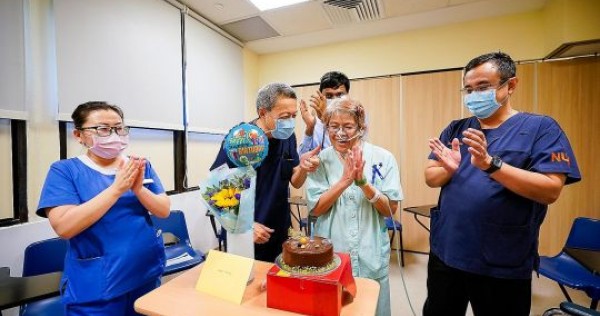
Grandmother Choy Wai Chee has more reason than most to celebrate her birthday today given she has been in a life-and-death fight against Covid-19 for the past four months.
At one point, doctors told her distressed family they had to be prepared for her demise.
But she pulled through and marks her 58th birthday today in the National University Hospital (NUH), where she is its longest-staying Covid-19 patient.
Madam Choy was in high spirits when The Sunday Times visited yesterday, even though she was unable to talk for long as she had a tube in her throat.
She gesticulated animatedly and conversed by writing her responses on a piece of paper, noting: “Doctors saved me.”
Madam Choy, who was diagnosed with Covid-19 after returning from overseas in March, said she was “not scared” of being in hospital as she had spent a year in one when she was 12 to fix her curved spine.
“Hospital is like my second home,” she joked, adding that she has also given birth four times. Her children are aged between 19 and 31 and she has a two-year-old granddaughter.
SINGAPORE: Ever since personal finance blog The Woke Salaryman put out its first article last year — about the most important things to do to save S$100,000 by the age of 30 — its rise in Singapore’s personal finance landscape has been meteoric.
And it started with an observation by one of its co-founders, He Ruiming, when he was working in advertising.
“(My industry peers) were going to claw machines, buying sneakers, indulging in S$7 coffee every day,” he recalls. “Many creative people like to spend money on stuff that we wear as badges of identity — like, ‘oh this is me, I drink cold brew every morning.’”
Whenever He shared articles on personal finance with these creative folk, he was told the articles from established voices on the scene, such as the Seedly community, were “so boring”.
That was when he realised there needed to be a “really low bar” for personal finance — a platform “so accessible” that “even if you were a coffee-drinking, sneaker-buying person from advertising, you’d be able to relate (to it)”.
But when The Woke Salaryman was born, even he and co-founder Goh Wei Choon, both 31, were taken by surprise by the “insane” reaction to their first post, which received 6,000 shares on Facebook within a few days.
Today, The Woke Salaryman commands around 171,000 followers on Facebook and 114,000 on Instagram.
One of the illustrations found in The Woke Salaryman.
It was the same with Dawn Cher, who runs SG Budget Babe. She first rose to prominence with her blog entry about saving S$20,000 in her first year of work on a monthly salary of S$2,500.
During the past few months, bloggers like them have noticed an increased interest in investment-related topics. And with Singapore sinking into recession owing to the COVID-19 pandemic, personal finance platforms like theirs have never seemed more pertinent, especially to millennials.
FINANCIAL LITERACY, WHERE ART THOU?
Two in three working Singaporeans do not have sufficient savings to last them beyond six months if they were to get retrenched now, according to an OCBC survey conducted during the “circuit breaker”.
In such cases, they might “roll over credit card debt and default mortgage loans to some extent”, which would be “the worst thing that can happen, because credit card debt is the most expensive debt you can have”, says OCBC executive director of investment strategy Vasu Menon.
The survey, which polled 1,000 working adults aged 21 to 65 and earning S$2,000 and above per month, also found that 40 per cent of respondents planned to pare down their investment portfolio.
“A crisis is the best time to ask questions, because the crisis is a stress test to some extent. And this will come through in the survey results,” adds Menon.
The seeming lack of financial prudence among Singaporeans, however, does not mean a lack of curiosity about personal finance.
Menon receives occasional questions about the markets from “eager” undergraduates on LinkedIn. Personal finance bloggers might satiate their “thirst for knowledge”, he says, as these bloggers “have the ability to write things in a more engaging way”.
But for everyone to benefit, the Davids and Goliaths of the finance ecosystem must work together. The banks’ role, he adds, is to “offer a sanity check”, ensuring these bloggers write sense.
Similarly, according to MoneySense, the Monetary Authority of Singapore does not shy away from working with financial blogs such as Dollars and Sense, and even lifestyle platforms like The Smart Local.
These efforts complement MoneySense, which infuses financial education into schools, from primary and secondary levels all the way to the Institute of Technical Education and polytechnics.
Bloggers are also able to provide nuanced insights about their readers, which can come in handy for financial institutions during a crisis.
“The larger the ecosystem, the better the awareness of financial literacy. If these sites keep saying financial literacy is very important, we can (even reach) the unconverted,” says Alvin Chow, 36, the founder of financial education company Dr Wealth.
“It’s also a reflection of demand and supply. When you have endless blogs about finance, it means there’s demand.”
KEEP IT SIMPLE, KEEP IT REAL
With the gamut of personal finance blogs and platforms at one’s fingertips, those that cut through the noise have replaced stuffy branding with illustrations or snazzy stock images, quirky videos, sleek layouts and a conversational tone.
But the rebranding is not merely aesthetic. Firstly, successful blogs like The Simple Sum manage to simplify jargon.
With 85 per cent of its target audience ranging from 20 to 34, its podcasts and comics aim to empower them through casual language. For instance, deciding whether to get a credit card should not be overcomplicated.
“Find a card that won’t make you upgrade your lifestyle. (If) you’re spending money to save money, does that make sense?” says Xu Yuanduan, the platform’s content lead.
Secondly, maintaining accessibility requires some degree of transparency about one’s personal circumstances, although this leaves others room to pass judgement. Cher, for example, took flak from disbelieving readers when she shared her saving efforts in her first post.
But Cher says she goes Dutch with her husband (then boyfriend), gives her parents an allowance, handles their insurance and makes her own coffee.
Whether readers think her stingy or not, she continues to dish out “timeless” tips that apply to everyone, such as making sure that one has a well-covered insurance plan.
“Whether you’re my fan or sceptical of what I say, you can’t deny that you need to be insured. If you go ahead and choose not to have hospitalisation insurance, when you’re hospitalised, you’ll have to (take) the consequences,” she says.
Finally, “keeping it real” requires bloggers to understand the layman so they do not write in a void.
Understanding, for example, that people were looking for ways to make money while at home during the circuit breaker, Cher blogged about how to earn side income. It garnered about 18,000 views, making it one of her more popular posts.
The Woke Salaryman’s co-founders think up their ideas, but they also “look within the community” or “ask friends who know someone working within specific industries”, because they “don’t want to pull anything out of (their) asses”, says He.
NOT JUST ABOUT MONEY
Successful finance blogs also help readers realise that personal finance does not revolve solely around dollars and cents.
Jeraldine Phneah, 29, blogs about issues impacting her generation, like the cost of living, work-life balance, lessons she learnt during her first five years working as well as the environmental and financial benefits of embracing minimalism.
The 29-year-old, who runs JeraldinePhneah.com outside her full-time job in technology, has also received COVID-related career questions: Whether it is the right time to switch jobs and how people can future-proof themselves.
During the circuit breaker, she conducted a webinar on how millennials can optimise their LinkedIn profile to be found by recruiters, and another on networking tips for beginners and introverts.
She also discussed how her readers aged 25 to 34 can navigate a job market “disrupted by technology”.
“Many people tend to associate IT skills with big data and coding. But it’s more about understanding where your industry is headed and how you can align yourself accordingly so you add value to employers,” she says.
This could mean exploring a new software that is specific to one’s industry and improves one’s productivity.
Essentially, financial advice is life advice.
On any personal finance journey, keeping one’s mental health intact is important, shares He. If a job causes severe distress and you can afford a break, he recommends living off your savings for a while before starting the job search.
As a result of The Woke Salaryman’s non-judgemental approach, He and Goh get younger readers opening up to them about issues like racking up debts through purchases in online games.
Recently, a post of theirs about moving out in one’s 20s gained them 10,000 Instagram followers within a week.
The Woke Salaryman’s values are aspirational, they clarify, lest there be any fear that one must adopt a spartan life. “We’re normal people. We don’t eat instant noodles every day or eat only rice and beans,” says He.
ACKNOWLEDGING PRIVILEGE
He and Goh are well aware that privilege underscores an individual’s perspective towards money. Putting the “woke” in The Woke Salaryman, they have no qualms about addressing how inequality influences personal finance.
They acknowledge that “a portion of Singaporeans won’t find (their) content helpful” because “systemic poverty makes it harder for them to overcome their circumstances”.
“You can tell people to save 20 per cent, spend 50 per cent and use 30 per cent for your needs or whatever, but not everyone’s created equal,” says He. “These ratios won’t apply to everyone.”
Goh adds: “We always preach … long-term decisions, but not having enough money in the household makes it extremely difficult to make such decisions.”
For their largely middle-class readership, The Woke Salaryman advocates the “right mindset”, which can be developed with “emotional maturity and discipline”.
But the idea of wealth “shouldn’t be monopolised by a few classes”, adds He, who would like to see, say, a graphic designer be financially free one day.
In a similar vein, Providend chief executive officer Christopher Tan, 50, says knowing his clients’ background helps him to better understand their relationship with money.
“If someone comes from a family that’s been destroyed by poor financial decisions like investing in the stock market … naturally they’d (view the stock market through) certain lenses,” he cites.
“I’ve also spoken to clients who came from very poor families but are financially wealthy today. They don’t dare to spend a single cent, because they’re afraid of not having money again. And that affects their way of investing. They become very conservative and put all their money in a bank.”
Although Providend mainly handles clients in their 50s who do not turn to personal finance bloggers, more of them have approached him to speak with their millennial children about the importance of “financial resilience” for the road ahead.
He has similar advice on perusing personal finance blogs. “We need to … take into context (the bloggers’) upbringing,” he says.
ARE MILLENNIALS ACTUALLY SOLD?
Some millennials, however, have not bought into the hype surrounding personal finance bloggers, even as they understand the need for financial literacy.
“They’re a useful source of information, but I don’t think anyone should treat their advice as gospel,” says Wu Bingyu, who works in a production company.
The 29-year-old turns to his mother for financial advice because she used to work for the Inland Revenue Authority of Singapore. But he also does his own research for a more well-rounded understanding.
Likewise, if theatre director Adeeb Fazah is not seeking financial advice from his peers who share similar circumstances, he sieves through information on his own.
“As a freelancer, CPF and IRAS are things I need to figure out. Starting was hard because … it felt like I was plunged into a deep whirlpool of information,” says the 28-year-old. “I’m getting the hang of it.”
However, The Woke Salaryman, whose initial target demographic would have included creative folk like Adeeb, does not quite cut it for him.
“As long as I don’t fit into their version of a working person, which I definitely don’t, then the advice won’t be suitable, and I’d only feel bad about not hitting the goals they set,” he reasons.
“It makes me feel like an awfully unaccomplished fool.”
Those who see the benefit of personal finance bloggers make it clear that it is important to do one’s homework as well.
Whenever 28-year-old Alexander McColl seeks financial advice, his research process begins with “a billion tabs” open on his web browser because “it’s useful to build up your ‘google-fu’ to know where to find answers”.
“If I think I’ve got a pretty good sense of things, then I go ahead and do what my well-fed intuition tells me,” he says. “If there’s still a feeling of uncertainty, I’d go to friends who seem to know their stuff.”
It helps him to think of personal finance as “compulsory”, because it is like “a test you have to pass on the road of adulthood”.
For a blogger, the mark of effectiveness could still be in getting creative folk — the ones who inspired The Woke Salaryman and embody the cliche that creative people hate numbers — to be engaged.
For example, filmmaker Cheng Chai Hong considers himself “fairly financially illiterate” because he never saw wealth accumulation as a goal. But the most useful financial advice the 30-year-old received was from He of The Woke Salaryman.
“He said saving money isn’t solely for wealth accumulation. The more money you save and have in passive investment, the easier you can say no to bad deals or unhealthy workplaces,” says Cheng.
Then there is Jemimah Wei, a writer and Master of Fine Arts (MFA) student at Columbia University. She knew she wanted to be a writer, which “doesn’t make bank”, so she planned for the long term.
“You don’t need to go abroad for higher education, nor is an MFA a prerequisite to be a writer, but I very desperately wanted that kind of mentorship and writing community (at Columbia),” says the 28-year-old.
“I didn’t think I could afford an education abroad, so I worked towards the specific scholarships that would make that reality possible.”
Despite being goal-oriented, she felt that money talk was reserved for the realm of bankers and business whizzes. But bloggers like SG Budget Babe and The Woke Salaryman helped her “bridge that gap between the garble of financial literature and layman understanding”.
“Many artists don’t want to deal with the money, the business side of things, but not dealing with it is a kind of mental shackle as well. It’s directly linked to stress and opportunity and time, which affects the quality and production of your work,” Wei says.
“Money, more than anything, is mental freedom and time that you can devote to the work you want to do.”
SINGAPORE: In the wee hours of last Friday (Jul 10) night, while staying up to watch the results of Singapore’s 2020 General Election, I suddenly felt a range of conflicting emotions coursing through me as I watched footage of Workers Party supporters celebrating in Hougang.
First, I cheered on the joy in their expressions as supporters waved flags and inflatable hammers in the air. After all, watching happy people is infectious (in a good way). I almost wanted to make my way over so I could soak in the festivities in person.
Then, a horrified thought popped into my head: Where is the safe distancing?
Each time I spotted someone without a mask or people making fist bumps and giving high fives, I cringed a little inside as I thought of how they were surely exchanging all sorts of germs with each other. All thoughts of going out were immediately abandoned.
TOO MUCH, TOO SOON?
That weekend, just like almost every weekend since Singapore moved into DORSON Orange, I stayed in as much as possible.
I am aware we are currently in phase 2 of the post-circuit breaker period where there are fewer restrictions on being out and some social activity is allowed but a part of me is not quite ready yet.
For many, the relaxation of rules is a welcome relief. More people can now resume work. After months of having to stay within the small confines of their homes, many are probably glad for the opportunity to spend time elsewhere.
I can identify with that restless feeling of being cooped up. A few weeks ago, for a change in scenery, my partner and I decided to spend Friday evening in the Duxton neighborhood.
As our Grab car passed through Tanjong Pagar, however, my eyes widened as I noticed many queuing in close proximity to each other outside various restaurants.
People queue to enter a mall, as mall capacity is regulated in a series of safe distancing measures to curb the outbreak of COVID-19 in Singapore Mar 27, 2020. (Photo: Reuters/Edgar Su)
Elsewhere in the district, restaurant patrons would congregate on the street to smoke and chat. I was relieved we had made a reservation at a small eatery so we could avoid these hordes but even more relieved when we finally returned home.
My experience is probably not an isolated one. One can easily find images and videos of crowded spots around the country, such as malls and popular F&B districts on social media. One cannot help but wonder, where are the safe distancing ambassadors?
Worryingly, infection numbers are slowly creeping up. For the past two weeks, Singapore has averaged about 13 to 14 community cases each day. The number of unlinked cases seem to be on a small uptick.
The list of places visited by COVID-19 cases during their infectious period is also broadening in scope. Initially, most locations were essential businesses like supermarkets or wet markets.
Now, the list includes popular malls like Marina Bay Sands, Bugis Junction, Sim Lim Square as well as F&B outlets such as The Daily Scoop and The Guild. While it is not necessary to avoid places where confirmed cases have been, experts say these indicate the presence of “hidden reservoirs” of the virus still circulating in the community.
For now, I have made the choice to minimise my time spent outside home for the sake of my health and mental wellbeing. In many ways, staying in has been a pleasure.
In the BC (before COVID-19) days, my days were packed with work events, yoga classes and dinners. It was a relief to cut some commitments, especially unnecessarily long meetings, outings with people I’m not too keen on and boring networking events, where I would have to subject myself to awkward small talk, which I am terrible at.
I have used this newfound free time to do things I had long been putting off – repaying my sleep debt, decluttering my overstuffed wardrobe, reading unread books and cooking creative meals to clear out my pantry.
Interestingly, I have not felt disconnected from human interaction. Instagram Stories has become my diary to record musings, observations and fears about life under the shadow of a pandemic and it has brought me immense comfort when friends and acquaintances respond with kind words and helpful recommendations.
My Whatsapp group and individual chats have evolved into spaces for thoughtful and measured conversations that are much more engaging than the mass forwarding of memes. In a way, it almost feels like the old school practice of letter writing has been revived via technology and I have grown closer to some friends because of this.
And once, when cabin fever got too much to bear, I took a day off work to hike the Southern Ridges on a weekday when fewer people are out and about.
Of course, there are things I miss about the good old days. Life is duller without the visceral pleasure of live arts performances such as concerts and theatre shows. For now, I have tried my best to stay engaged by checking out virtual performances.
A Zoom bingo session conducted by local theatre company Andsoforth provided a lighthearted fun, while the supernatural murder mystery by Sight Lines Entertainment spooked me out.
MAKING A COMPROMISE
Still even for someone with introverted tendencies, I recognise I cannot keep myself confined forever.
People in protective face masks are seen at a mall, as mall capacity is regulated in a series of social distancing measures to curb the outbreak of coronavirus disease (COVID-19), in Singapore March 27, 2020. REUTERS/Edgar Su TPX IMAGES OF THE DAY
Neither can any country, Singapore included, be on circuit breakers indefinitely, even if we may have to get used to a cycle of tightening and loosening restrictions to keep potential outbreaks under control.
So, I am taking baby steps. Like celebrity chef Nigella Lawson, who declared she would be adopting a social 5:2 diet of going out only two days a week, I am gradually adding appointments to my calendar.
On occasion, I schedule small group meals at carefully chosen establishments where we are assured of fewer crowds, such as under-the-radar or less popular restaurants. And I have no qualms making a last-minute change of plans if a place I intend to visit seems too packed.
Hopefully more people pay greater attention to the recommended preventive measures so as to curb transmission rates. While it is now compulsory to wear masks outside the home, I still see individuals with their noses sticking out or their masks under their chins on any given corner.
It would also help if more people exercised common sense restraint such as by not lingering in jam packed places or choosing alternative, less crowded locales.
We all want life to go on. Chances are, this will only be possible when everybody cooperates in helping to keep the virus at bay.
SINGAPORE: Staycation packages with more perks and safety measures that are part of a “new normal” have been put in place by coronavirus-battered hotels in Singapore, after being given the green light to reopen their doors this month.
Hotel operators that CNA reached out to say they have seen positive demand for staycations from the local crowd so far.
Hotels in Singapore have had to stop taking in guests since authorities imposed a “circuit breaker” in early April to curb the coronavirus outbreak. The circuit breaker restrictions ended on Jun 1 after nearly eight weeks, setting Singapore on a phased and gradual reopening of its economy.
As part of the second phase of the reopening, the Singapore Tourism Board (STB) said on Jul 3 that hotels will be able to resume two activities – providing accommodation to guests for leisure purposes such as staycations, and opening recreation areas for children – after getting approval from the authorities.
Since then, STB has received applications from more than 100 hotels. Thirty-five hotels have been approved to resume staycations as of Wednesday (Jul 15), a spokesperson said.
That includes Sofitel Singapore Sentosa Resort and Spa, which said that it has received 1,000 calls and emails on “days with higher volume of enquiry” since announcing its reopening on Jul 10.
But the hotel is capping its occupancy at 50 per cent for the time being to comply with mandatory safety requirements for both its staff and hotel guests, said general manager Piotr Kupiec. With that, it is now fully booked for most weekends until mid-August.
Far East Hospitality, whose hotels such as Oasia Hotel Downtown have been approved by authorities, is also limiting occupancy to no more than 50 per cent during peak periods such as weekends.
It has seen “more than 80 enquiries per day” across its various platforms and an increase in bookings, especially from couples and families looking to celebrate special occasions like anniversaries, said CEO Arthur Kiong.
Hotel Yan, a boutique hotel located along Tyrwhitt Road, said it saw around 90 bookings within a day after it announced its reopening.
As part of safety requirements, the hotel is releasing up to 20 per cent of its 59 rooms for staycation guests, and is now fully booked “for the month of July and some dates from August”.
“Given the approval from STB that only came in earlier this week, we are strongly encouraged with the number of bookings received,” said a hotel spokesperson.
With travel restrictions still in place, people unable to travel overseas will opt for short stays in local hotels “as a means of a short getaway”, she added. “This might indicate a strong demand for staycation among Singaporeans.”
Hotels that reopen for staycations will have to follow the safe management measures laid down by the authorities.
According to the STB’s advisory, these include the screening of every individual before allowing them into the hotel premises, requiring everyone to wear a mask and implementing the SafeEntry digital check-in system.
As part of reducing capacity and intermingling at hotel lobbies, they have to ensure staggered check-in and check-out timings for different groups of guests and limit occupancy to no more than 1 person per 10 sqm in public spaces accessible to guests at any point in time.
Hotels also have to keep the records of guests for at least 28 days after they check out.
Other mandatory safety measures include rigorous cleaning and disinfecting regimes throughout the property. For instance, hospital-grade disinfectants have to be used when cleaning frequently-touched areas and equipment in the guest rooms.
Even after getting an approval, STB said hotels will be subject to continued checks and are required to submit weekly updates.
Such strict safe-management measures will be ‘part of the new normal” for hotels, said the STB spokesperson.
Hotels reopening said they have these in place, with some like Sofitel Singapore Sentosa Resort and Spa taking it a step further by leaving guest rooms vacant for at least 24 hours in between occupants.
“Contactless” services are also available at several hotels. For example at Marina Bay Sands (MBS), payments, as well as the delivery of luggage and other hotel amenities, will be “contactless” so as to minimise physical interactions.
Guests may also have to make reservations and adhere to time limits at facilities such as spas, gyms and pools.
At Oakwood Premier AMTD Singapore, a maximum of five people are allowed to use its outdoor infinity pool at any given time, meaning that guests will have to pre-register for their preferred slots. A similar rule applies for its fitness centre where only three people will be allowed at any point in time.
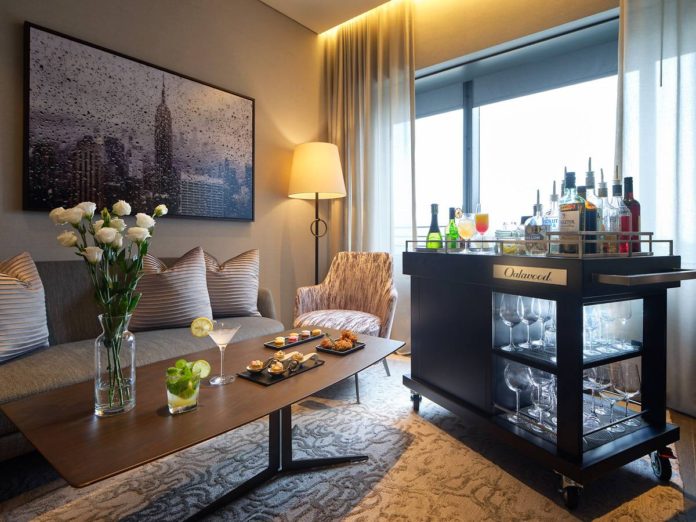
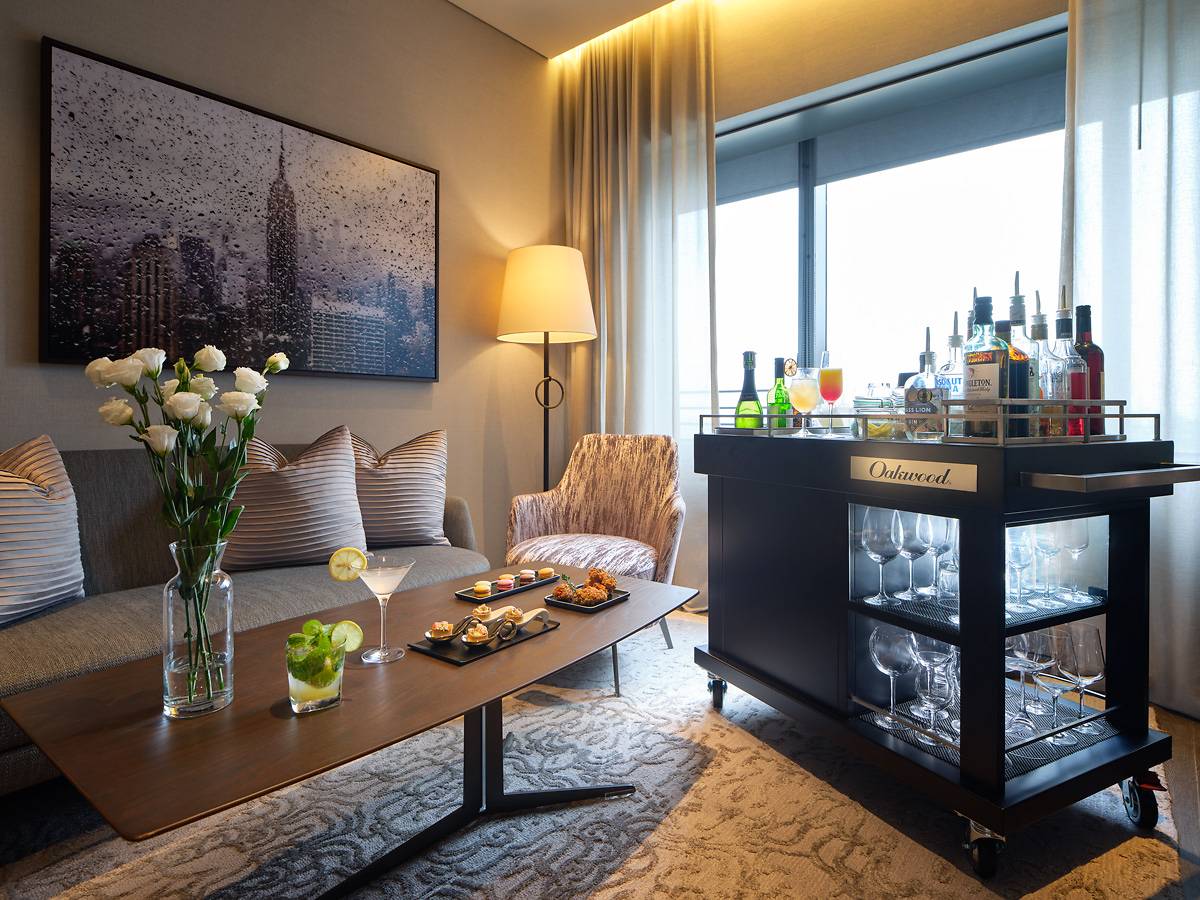
The hotel located in Chinatown has also added a new room service called the Oakwood Mobile Bar, which allows hotel guests to enjoy cocktails and canapes in their rooms.
“We believe having a satisfying stay begins from a safe sanctuary that you can trust,” said regional general manager Roy Liang who oversees Oakwood’s hotel properties in Malaysia, Singapore and Vietnam.
A mobile bar that allows guests to enjoy free-flow cocktails and canapés in their rooms is being offered at Oakwood Premier AMTD Singapore. (Photo: Oakwood Premier AMTD Singapore)
The list of approved hotels also includes those that are used as dedicated facilities for individuals serving their 14-day stay-home notices.
These hotels have in place “strict protocols” to segregate those on stay-home notices from the other guests, STB said. This includes housing individuals who are there because of COVID-19 on segregated blocks or floors.
“The first-hand experience gained by handling various accommodation needs over the past few months has been invaluable for our hotels and their staff. They are now familiar with areas such as infection controls and sanitisation – skills which will help them lead the way in safe hospitality,” STB added.
One of these hotels is MBS, which has been housing guests on stay-home notices in its hotel towers 2 and 3. They are required to stay inside their designated rooms at all times, and are not allowed to use common facilities in the property.
MBS said in a press release that its reopening will begin with “a limited number of rooms” in tower 1, with a hoarding to be set up in the hotel lobby.
DISCOUNTS AND OTHER PERKS
Hotel operators have also come up with a slew of staycation packages that include attractive discounts and various perks targeting families and couples.
Singapore Marriott Tang Plaza Hotel, for example, has three packages with one being priced at a close to 50 per cent discount. The “Blissful Escapes” package, usually priced at S$720++, now costs S$380++.
Other perks include flexible check-in and check-out timings, credits that can be used at the hotel’s food and beverage (F&B) outlets and for in-room dining, as well as complimentary parking, said the hotel’s director of sales and marketing Alvin Lim.
At Far East Hospitality, its Oasia Hotel Downtown is targeting wellness-conscious guests with a package that includes a one-hour fitness session, while those staying at the Barracks Hotel, which is housed in a colonial house on Sentosa, can enjoy a personalised tea tailoring experience.
Smaller hotels are also ramping up their offerings to fight the competition.
Apart from attractive room rates, Hotel Yan is in the midst of planning tour itineraries with travel operators for its staycation packages.
Hotel Yan positions itself as Singapore’s first industrial chic and boutique hotel. (Photo: Hotel Yan)
A LIFELINE?
Latest figures from the STB showed international visitor arrivals plummeted 43.2 per cent to 2.7 million in the first three months of 2020. January alone accounted for about 1.7 million tourists, as arrivals plunged to 732,757 in February and 239,899 in March.
This has pummeled the hotel industry, with average occupancy rate down 27.2 percentage points to 58.6 per cent in the first quarter. Gazetted hotel room revenue for the same quarter fell 30.9 per cent year-on-year to S$687.3 million.
These figures are likely to fall even more for the second quarter going by the latest monthly tourist arrival figures from the STB.
A ban on short-term visitors that took effect on Mar 24 have taken the monthly arrival figure to a historic low of 748 in April before rising slightly to 880 in May.
“With global travel restrictions still in force, domestic tourism will give a much-needed financial boost to hotels in Singapore,” said Ms Kwee Wei-Lin, president of the Singapore Hotel Association.
“As we gradually prepare for the return of international travellers, staycations will pave the way to better the financial health of our industry,” she added.
Hotel operators said they are glad to be able to reopen for staycations but they also recognise that this is only a short-term survival strategy.
Mr Kiong from Far East Hospitality said: “Unless international travel is able to resume fully soon, depending on staycations to uplift the industry is neither realistic nor sustainable. This reliance will close hotels and cripple our tourism infrastructure and capabilities over the long run.”
Even with encouraging figures at the moment, it will “be hard-pressed to match the figures” it saw before the outbreak. “In 2019, 10 per cent of our total room nights were made up of staycations, equating to almost S$8 million in revenue,” he added.
Similarly, the Singapore Marriott Tang Plaza Hotel said it sees “strong demand” for staycations for now, given the packages rolled out by hotel players and a “pent-up demand” for travel among Singaporeans. However, it is “unable to predict the demand in the long run”.
As part of its other survival plans, it is looking at boosting its F&B revenue through takeaways and bento catering, as well as organising virtual conferences and small-scale solemnization ceremonies.
“As the situation is constantly evolving, we are constantly reviewing our strategies and initiating new plans,” said Mr Lim.
Several hotel players also said they are looking forward to receiving business travellers who will be entering Singapore under the “green lane” arrangements.
“We are hopeful on several fronts, especially to welcoming business travellers who are coming into Singapore for essential travel as well as continuing to accommodate local guests,” said Mr Kiong, noting that Far East Hospitality will still be going ahead with the opening of a new hotel in November.
SINGAPORE: The Elections Department (ELD) said on Saturday (Jul 18) that it will be conducting a survey to gather feedback from voters on their experience at polling stations.
ELD was responding to Singapore Democratic Party (SDP) chairman Paul Tambyah’s media release on Thursday calling for the department to reveal how many “irregular events” happened during the polling for the General Election.
He also called for an independent inquiry into the conduct of the election with a particular focus on issues such as the use of tendered ballot slips which he claimed were not counted in this election.
“This inquiry should be reviewed by all the political parties who took part in this election,” Dr Tambyah said.
On Polling Day on Jul 10, a presiding officer at a polling station had tried to register a woman, known only as Madam Lum, several times but failed.
Mdm Lum, a voter in Holland-Bukit Timah GRC which was contested by the SDP, was told that she had already voted when, in fact, the presiding officer was using the wrong module in the e-Registration system to process her registration.
She reportedly filled out a tendered ballot slip, which was not counted in the final result.
The People’s Action Party (PAP) team won the four-member GRC with 66.36 per cent of the vote against the SDP team.
In response to the incident, ELD confirmed that Mdm Lum had been given a tendered ballot paper.
“As mentioned in ELD’s Handbooks for Polling Agents and Counting Agents, and as set out in the Parliamentary Elections Act, ‘tendered ballot papers’ are issued to persons who apply to cast their vote after the Presiding Officer has informed the voter that according to the register, he has already voted.
“In this instance, this was due to human error and we have since explained the situation and apologised to Mdm Lum,” ELD said.
Voters forming a queue to enter the polling station at Bukit Merah Secondary School on Jul 10, 2020. (Photo: Ruth Smalley)
Dr Tambyah also listed other issues, including long queues at several counting stations, a change of instructions on the use of disposable gloves when voting and the “sudden and unexpected announcement” about the extension of polling hours.
“This election has been fraught with missteps, mistakes and misdirections,” he said.
In their reply, ELD thanked Dr Tambyah for his feedback and said it will be taken into consideration during its ongoing review to “understand why there were long queues at some polling stations on Polling Day”.
It added that despite the issues at some polling stations, voter turnout was close to 96 per cent – higher than the 2015 and 2011 General Elections.
This “(reflected) the high level of confidence in the COVID-19 precautionary measures to protect the health and safety of voters, candidates and election officials, and voters were able to cast their votes in secret”, ELD said.
It added the survey aims to help the department “do better for future General Elections”.
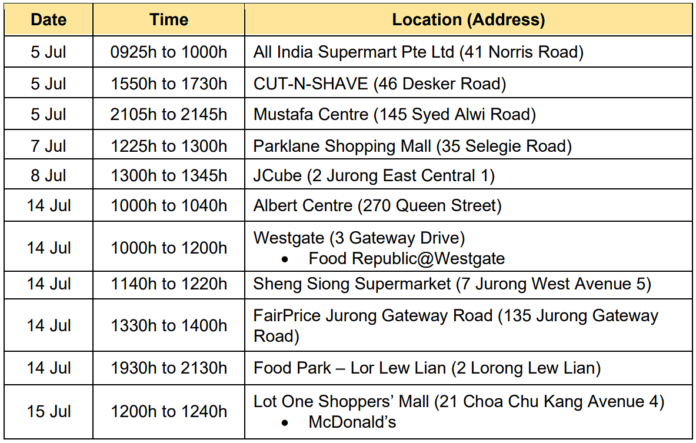
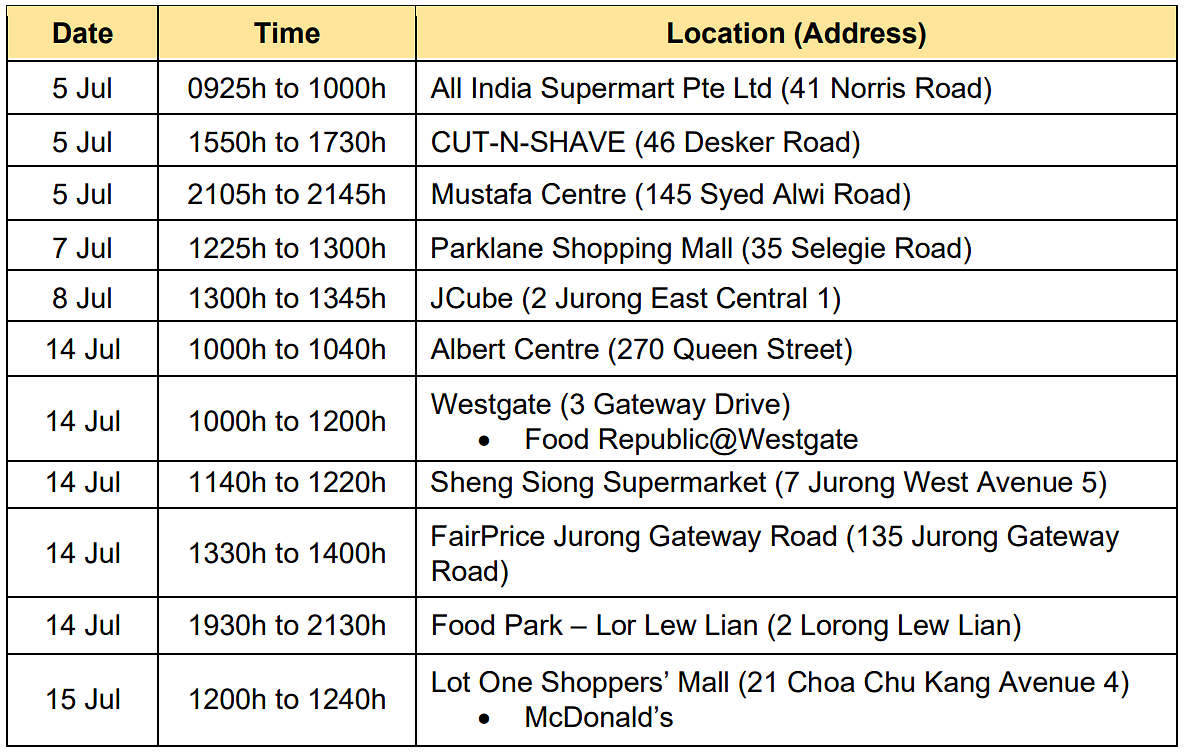
SINGAPORE: More locations have been added to a list of public places visited by COVID-19 cases in the community during their infectious period, the Ministry of Health (MOH) said on Saturday (Jul 18).
The new locations include Parklane and JCube shopping centres, as well as Albert Centre, Lot One and Westgate.
The Sheng Siong supermarket in 7 Jurong West Avenue 5 and the FairPrice outlet at 135 Jurong Gateway Road were also added to the list.
Those identified as close contacts of COVID-19 cases would have been notified by MOH, said the ministry.
People who have been at these locations during the specified timings should monitor their health closely for 14 days from their date of visit.
“They should see a doctor promptly if they develop symptoms of acute respiratory infection (such as cough, sore throat and runny nose), as well as fever and loss of taste or smell, and inform the doctor of their exposure history,” said MOH.
“There is no need to avoid places where confirmed cases of COVID-19 have been.”
The National Environment Agency will also engage the management of affected premises to provide guidance on cleaning and disinfection.
Singapore reported 202 new cases of COVID-19 on Saturday, bringing the total number of cases in the country to 47,655.
Seven of the new cases are community infections, involving four Singaporeans, a permanent resident, a work permit holder and a student’s pass holder.
There were also eight imported cases, seven of whom were placed on stay-home notices upon arrival in Singapore.
The remaining case arrived in Singapore from the Philippines on Thursday, and was taken directly to the National Centre for Infectious Diseases as he was symptomatic. He tested positive for COVID-19 on Friday.
The 40-year-old sailor holds a Special Pass and will join a vessel that called into Singapore’s port, said MOH.
The remaining new cases reported on Saturday were work permit holders residing in foreign worker dormitories.
SINGAPORE: The People’s Action Party (PAP) will do more to address the economic pain of voters in their 40s and 50s, and work on appealing to young voters, said Minister for National Development Lawrence Wong on Saturday (Jul 18).
Sharing a preliminary assessment of the election results with PAP activists and the media, Mr Wong said that the popular vote share of 61.2 per cent was within expectations, albeit at the lower end of the 60 to 65 per cent anticipated.
The GE2020 outcome was about “four percentage points less” than the party had hoped for but it still received “a clear mandate” from voters that they want a PAP government, Mr Wong said to activists in a virtual meeting.
“It is not a very good result, but it is within the range of expectations and we have been here before.
“The expectation that the PAP should have had a result at the top end this time, I think has coloured the outcome as a setback,” he said.
The PAP retained a firm hold on power with 83 out of 93 parliamentary seats and 61.24 per cent of the popular vote in the Jul 10 General Election. But opposition parties improved from their GE2015 showing.
In particular, the Workers’ Party (WP) won four seats in Sengkang Group Representation Constituency (GRC), while improving its margin over the PAP in Aljunied GRC and Hougang Single Member Constituency (SMC).
In addition, the narrative that the PAP had lost the support of young voters nationally did not hold true when the results were examined in more detail. The party received majority support in many polling districts with young families and young voters, he said.
Rather, a swing occurred among middle-aged Singaporeans, who make up the majority of voters, and this could be due to the economic challenges of the COVID-19 pandemic.
“So the swing against the PAP was not concentrated solely amongst the young and it was not just about unhappiness about the PAP style of campaigning or how we talk about race or POFMA (Protection from Online Falsehoods and Manipulation Act),” he said.
“In particular, there was a fall in support among those in their 40s, 50s and perhaps even in their early 60s. These were due primarily to the economic pain they have suffered.”
He added that first-time voters between the age of 21 and 24 make up less than 10 per cent of the electorate, while 70 per cent of voters are 40 years old and above.
The PAP also saw a fall in support among several private landed and condominium dwellers, which Mr Wong said could also be related to economic issues.
“In 2015, this segment had swung towards the PAP, but this time, the support was not as strong. Perhaps because they felt they were not sufficiently supported during the crisis,” he said.
“They might be business owners, they might be SME (small- and medium-size enterprises) owners, and they will be facing considerable economic difficulties.”
SANDWICHED GROUP AND YOUNG VOTERS
The party will do a thorough review of the General Election as it usually does, Mr Wong said, but he highlighted two areas that it will need to focus on – understanding and connecting with young voters, and addressing the economic pain of the “sandwiched group” in their 40s and 50s.
The PAP recognised that members of the older group, who have both elderly parents and young children to care for, faced difficulties even before the COVID-19 outbreak, and these were then exacerbated by the crisis, he said.
“Many of the schemes and programmes in the four Budgets this year were aimed at this group. Unfortunately, no amount of help will be enough in a crisis of this magnitude,” he said.
“So we will continue to review and update our policies, and we will do whatever we can to address their anxieties and pain during this difficult period.”
He also said that the PAP needs to “build trust and a new social compact with younger Singaporeans”.
“They have different aspirations, hopes and expectations. The issues they care about are different from the older generation and older Singaporeans, and they also look at existing issues differently,” he said.
The party also aims to attract more young people to its ranks, and mobilise them to serve the community, he added.
“In fact, quite a few of our MPs, especially the new ones, are young Singaporeans themselves, who have come up the hard way and feel passionate about helping others to succeed. We will need to get more young people like them to identify with the PAP as a party that provides hope and a path to the future and build our bonds with a new generation of voters,” he urged activists.
When asked if the PAP’s handling of police reports against WP’s Raeesah Khan had alienated young voters like those in Sengkang GRC, Mr Wong emphasised that the party had seen support in many districts with similar demographics. But he said that the party will also review its style of campaigning.
“Whether or not we can improve, do better in terms of the style of campaigning, in terms of the approach, in terms of the conduct of the campaign and how we go about highlighting falsehoods that may arise during the course of the campaign or issues that we think are of concern … that’s something we do want to review and see how we can improve and do better in the future.”
PAP DID NOT EXPECT “REPEAT OF 2015”
Mr Wong also told PAP activists that they should expect future elections to be tougher than this one, while elaborating on the party’s interpretation of the GE2020 results and its implications.
“Subsequent General Elections will be much tougher than this one. And as I said, we are unlikely to exceed 65 per cent of the votes in future … the desire for diversity in Parliament, for checks and balances, is permanent. It’s here to stay and we must be prepared for this new reality,” he said.
“For now, Singaporeans want to see the PAP in power but they also want a credible opposition check on the PAP.”
He said that Prime Minister Lee Hsien Loong had warned it would not be an easy election due to the pain and anxiety that Singaporeans are experiencing during the crisis.
“Neither PM nor anyone in the Central Executive Committee expected a repeat of 2015 but many pundits and commentators thought that we would get above 70 per cent, and the opposition capitalised on this and claimed that they feared a wipeout,” he said.
He added that the PAP had got close to 70 per cent of the vote cast in only two out of the last nine General Elections – in 2015, when the popular vote was 69.9 per cent, and in 2001, after the September 11 attacks, when the PAP got 75.3 per cent. Those two elections were outliers, he said.
“Indeed, in four out of these nine races, we got 63 per cent or less,” he added. “So this year’s 61.2 per cent is the third-worst outcome over nine GEs across 36 years.”
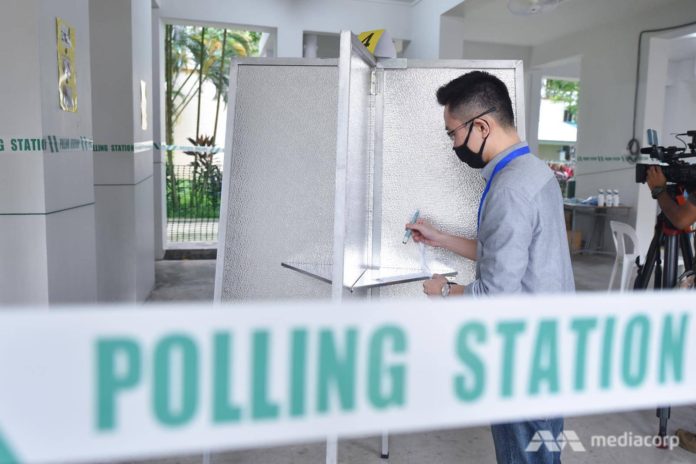
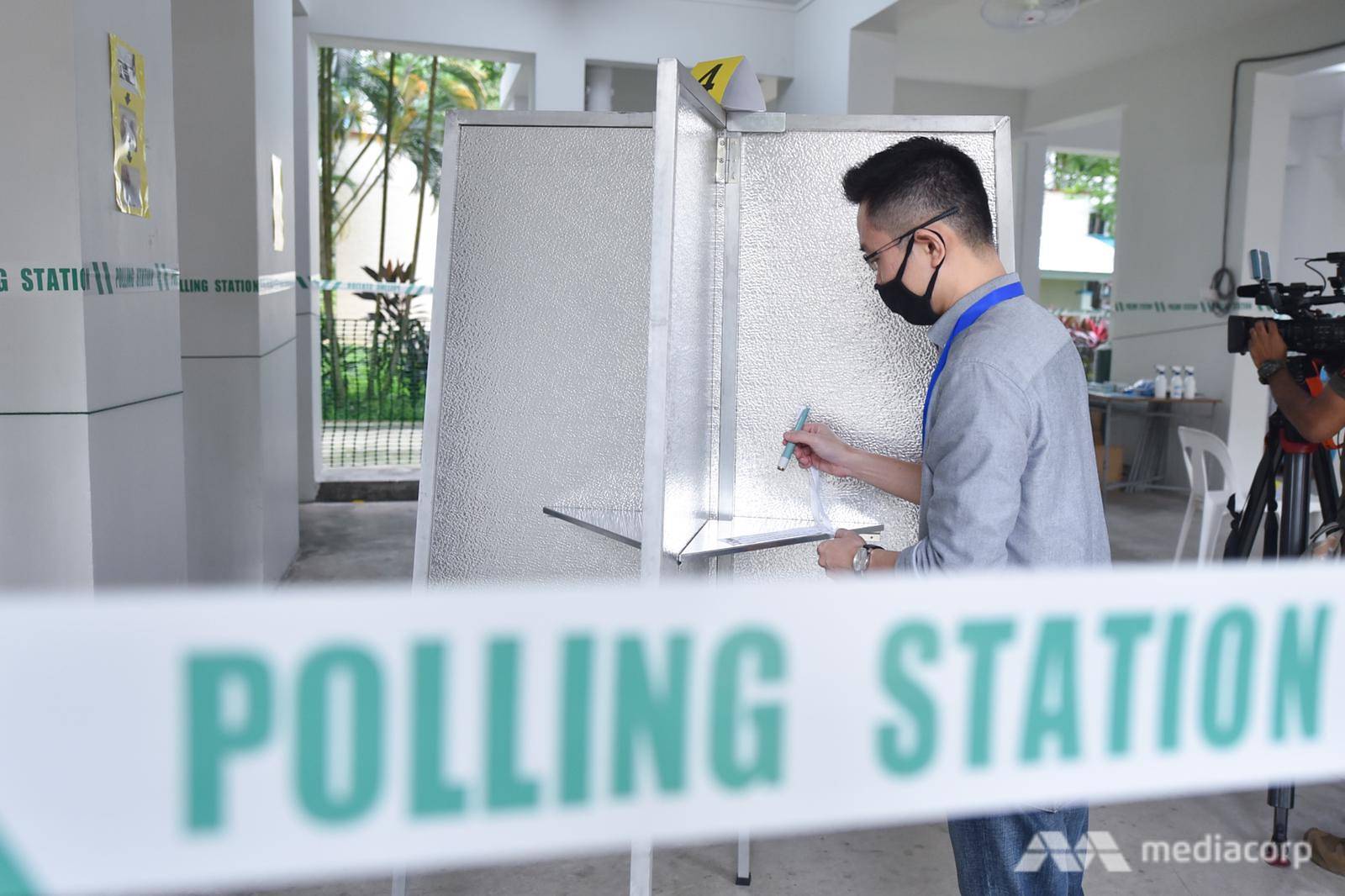
Demonstrating voting inside the ballot booth. (Photo: Gaya Chandramohan)
The PAP’s worst-ever performance at the polls was in 2011 when it garnered 60.1 per cent of the votes, and its second-lowest vote share – 61 per cent – was in the 1991 General Election. Its vote share also fell to 63.2 per cent in the 1988 elections.
REASONS POPULAR VOTE WAS AT LOWER END OF EXPECTATIONS
Besides the swing towards the opposition in the segments, Mr Wong highlighted other reasons why the PAP vote share was at the lower end of its expectations in this election.
He said that the Workers’ Party ran a good campaign that spoke to Singaporeans’ desire for checks and balances on the Government, while the Progress Singapore Party (PSP) emerged to challenge the PAP in constituencies in the west and north of Singapore.
“(The Workers’ Party’s) call to give the PAP government ‘no blank cheque’, I think resonated with many people who wanted more opposition voices in Parliament. Second, we saw the emergence of a new party – PSP with strong appeal in some parts of Singapore, cutting into our strongholds, in the west in particular,” he said.
WP and PSP were the two opposition parties which performed the best in the election. In West Coast GRC, a PSP team led by secretary-general Tan Cheng Bock lost narrowly to the PAP team lead by Communications and Information Minister S Iswaran, and the party will have two Non-Constituency Members of Parliament from that team in the House.
Mr Wong added: “Now that the Workers’ Party has more MPs in Parliament, they cannot just continue asking the Government questions. It is also the duty to put forward serious policy alternatives to be scrutinised and debated.”
He also admitted that the PAP did not do as well when campaigning in the digital realm, which was necessary in this election due to COVID-19 safe distancing regulations.
“We tried our best, we produced a lot of good content online but not all of this connected with netizens, especially on newer platforms like Instagram and Telegram,” he said. “And as with a normal campaign, the negative messages carry further reach than positive messages, and this is further accentuated on the Internet.”
He added that the PAP’s online campaign improved from the last two elections, but “obviously more needs to be done”.
WHY PAP RETAINED 61%
He also said that while the party did not do as well as hoped for, it had received a clear mandate.
“We also need to ask ourselves, why did the PAP manage to retain 61 per cent? In fact, the PAP has never gone below 60 per cent all these years, and that’s because the base kept faith with the PAP knowing that the PAP kept faith with this base,” he said.
“What is this base? They are the working class, the middle class, the heartland of Singapore and the PAP must continue to keep faith with our base.”
He added: “Our policies must always tilt in favour of the less fortunate and vulnerable. This is in the PAP’s roots and DNA. We must never waver in our commitment to social justice, to preserve social mobility for all Singaporeans and to build a more fair and just society.”
Rallying the activists, he said: “Remember, the right to leadership cannot be inherited. Just because the PAP has governed Singapore since independence doesn’t mean that it always will govern Singapore … We must continue to strive to win the trust of our people.”
“We have five years to overcome the problems, consolidate on the ground and show voters what we can do. Comrades, the work to win GE2025 starts now.”
SINGAPORE: Each Singaporean and permanent resident household will be able to collect one Singapore Together Pack, if they wish to, from community centres/clubs (CCs) and residents’ committee (RC) centres starting Monday (Jul 20).
Residents must present their NRIC at the collection counter for verification and can do so between 10am to 6pm daily, except on public holidays.
The packs will be available at all CCs from Jul 20 to Aug 2, and at all RCs from Jul 20 to Jul 26.
Households are also encouraged to display the Singapore flag outside their homes in the lead-up to National Day on Aug 9, the NDP2020 executive committee and People’s Association said in a news release on Saturday (Jul 18).
“Those who need a State Flag may ask for one at the collection centres.”
In light of the ongoing COVID-19 pandemic, households are encouraged to send one member to the collection points. There will be safe distancing measures and temperature-taking implemented at the centres to “ensure the safety and well-being of the public, volunteers and staff”.
The public can visit this website to find the nearest CCs or RCs to collect the Singapore Together Pack, according to the press release.
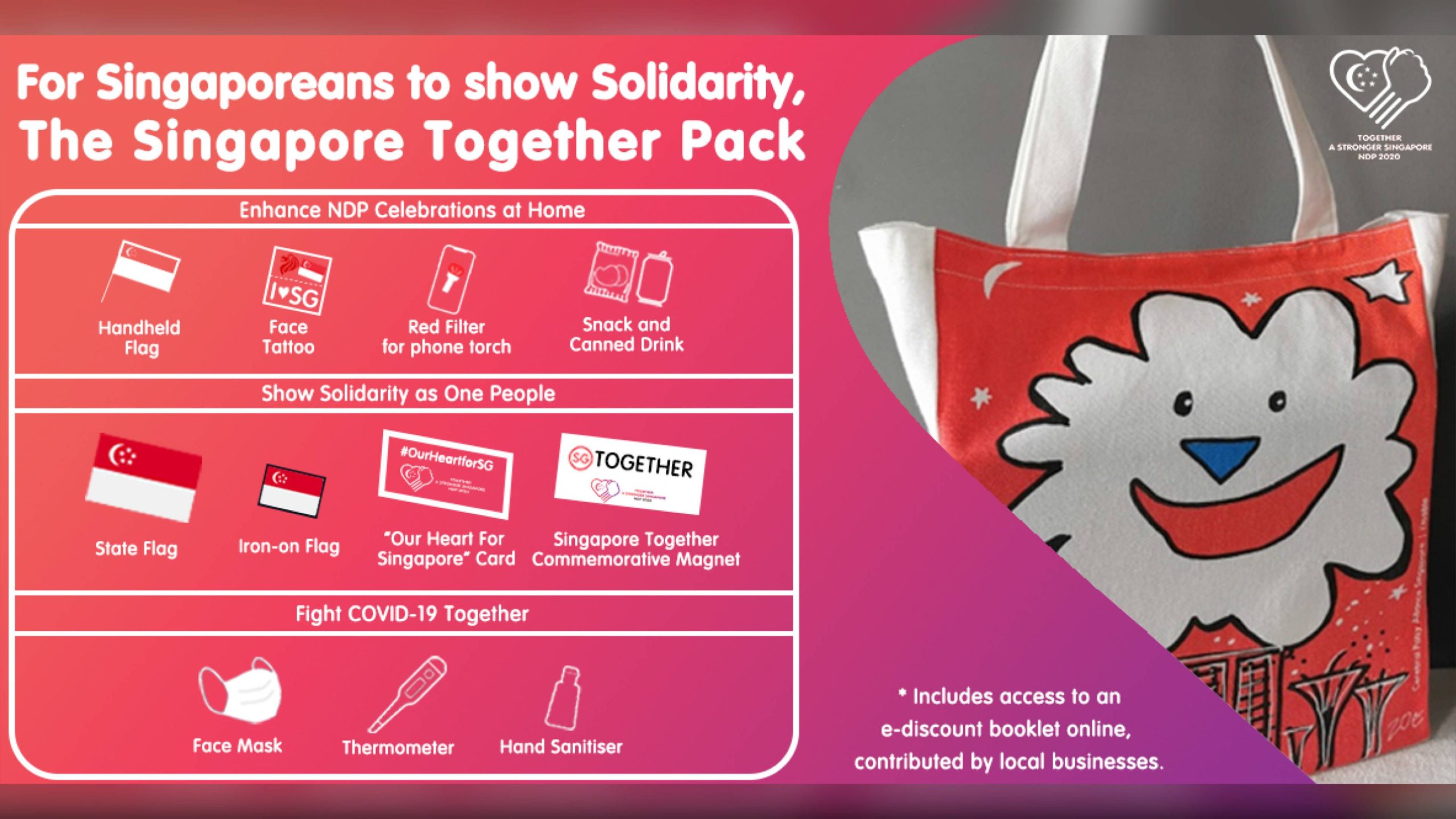
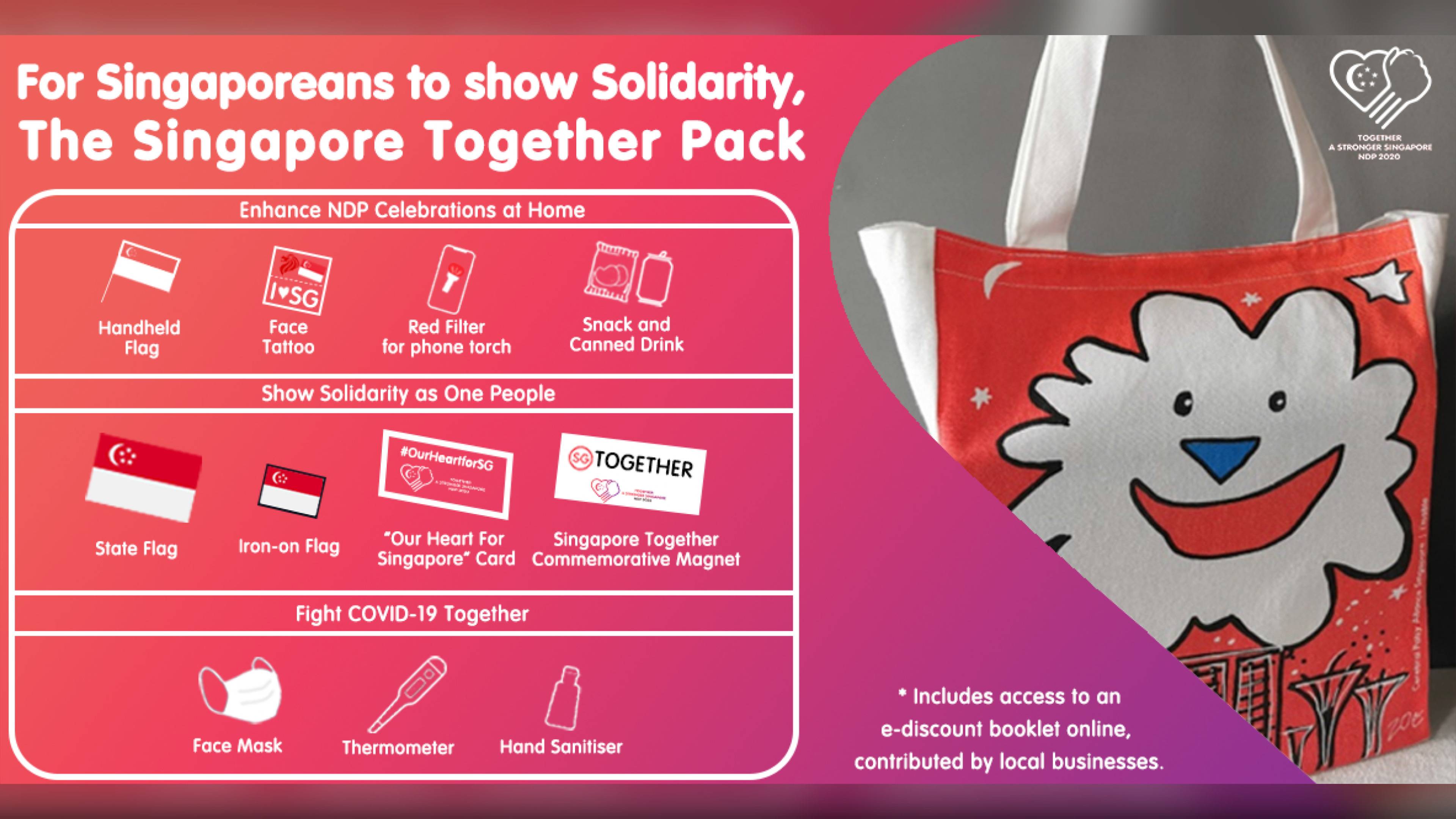
The Singapore Together Pack will contain 12 items. (Photo: NDP2020 executive committee)
This year, the NDP Singapore Together Pack will contain a full-sized national flag and a handheld one, as well as iron-on patches, a pledge card and a face tattoo.
Hand sanitisers, a thermometer and a face mask will be included, alongside an e-discount booklet of vouchers.
There will also be a snack, a canned drink, a red filter for phone torches and a commemorative magnet.
Each bag will feature one of 20 artworks done by artists with disabilities – in partnership with SG Enable – and Primary 5 students who were among the close to 1,200 who had participated in a competition held during the circuit breaker period.
There will be 12 items in each pack, compared to 20 to 25 items in a typical NDP pack.
The Ministry of Health (MOH) has reported 202 new coronavirus cases in Singapore today (July 18).
Of these, seven cases are from within the community — five Singaporeans/PRs and two Work Pass holders, with a majority of cases being Work Permit holders residing in foreign worker dormitories.
There are also eight imported cases that have been placed on stay-home notice (SHN) upon arrival in Singapore.
For the latest updates on the coronavirus, visit here.
Singaporeans are unlikely to be able to travel for leisure this year, though essential business travel will be possible.
At a virtual press conference yesterday, National Development Minister Lawrence Wong said: “Our overall advisory, it remains for everyone in Singapore, is not to travel, to avoid all travel.”
He added that even though the virus situation is dynamic and constantly changing, the multi-ministry task force tackling Covid-19 – which he co-chairs – does not see things improving any time soon.
“Looking at the situation, the Covid-19 infection around the world is unlikely to go away. At the end of the year, it will continue to be with us, even till next year.
“So, it is unlikely that we will see improvement in the situation in the near term, which means that our travel advisory position is unlikely to change in the near term as well,” he said.