SINGAPORE: There have been “no reports” of Singaporeans affected by the blasts in Beirut on Tuesday (Aug 4) that left more than 100 dead and thousands wounded, the Ministry of Foreign Affairs (MFA) said in a statement on Wednesday, as it extended its condolences to those affected.
“The Singapore Government is saddened by the tragic loss of lives in the explosion in Beirut, Lebanon on Aug 4, 2020,” the ministry said.
“Our condolences go out to the families of the victims and the people of Lebanon during this difficult time.”
The ministry added that it had reached out to Singaporeans in Lebanon who were e-registered with it and has “ascertained their safety”.
“There have been no reports of Singaporeans affected by the blast in Beirut.”
The twin blasts in the city left more than 4,000 injured and more than 100 dead, the Lebanese Red Cross said earlier on Wednesday, adding that search and rescue operations were still underway.
The blast in Beirut’s port area sent a huge plume of smoke into the sky. (Photo: AFP/Anwar Amro)
Video footage of the second blast showed an enormous orange fireball that dwarfed nearby buildings and sent a devastating tornado-like shockwave ripping through the city.
Hundreds of people who were injured in the Beirut port blast were taken to hospitals but many remain trapped in homes damaged by the explosion, the head of the Lebanese Red Cross said.
A woman is evacuated from the partially destroyed Beirut neighbourhood of Mar Mikhael on Aug 5, 2020 in the aftermath of a massive explosion in the Lebanese capital. (Photo: AFP/Patrick Baz)
Singapore is among the countries that have responded to the tragedy. Leaders from Israel, Egypt, Iran, France and Russia have offered support and condolences to Lebanon as well following the devastating blasts.
Singaporeans in Lebanon who require consular assistance can contact the MFA duty office by calling +65 6379 8800 or +65 6379 8855, or emailing mfa_duty_office@mfa.gov.sg.
A migrant worker allegedly slit his throat on Sunday morning at a dormitory in Sungei Kadut. The 36-year-old was seen lying bloodied at a staircase landing in the dorm.
A police spokesman said they were alerted to the incident at Block 53 Sungei Kadut Loop at about 7.30am and apprehended the man under the Mental Health (Care and Treatment) Act.
A spokesman for the Ministry of Manpower (MOM) said it was aware of the incident and that the man was attended to quickly.
He said: “The dormitory operator and Fast Team (Forward Assurance and Support Team) on site reacted quickly and treated his injuries. He is now in a safe and stable condition.”
Further checks by MOM found that he did not have salary arrears and there were no indications he was in distress prior to the incident.
His food and accommodation were also provided for.
Standing on window ledge
Last Friday, another worker was also apprehended by the police under the Mental Health (Care and Treatment) Act after he was seen standing on a window ledge at The Leo dormitory in Kaki Bukit.
Hiring a chauffeur to drive you around in a Lexus? Not many Singaporeans would relate to that experience at all, especially at the tender age of 19.
Local entrepreneur Gabriel Wong, however, did just that. But as he recounted in a now-viral Facebook post, getting a car in Singapore in the first place has been “one of [his] worst decisions”.
The marketing agency founder expressed his regret in purchasing a Lexus sedan nearly 10 years ago, which he first bought when he was 19 years old. This was even before he had a license to drive it, but after finding some success in business, he bought the car and hired a driver because he “wanted to look like a baller”.
Wong went on to share how much he spent having private transport every month. He estimates that he could have more than $500,000 in liquid assets if he had saved on the price of the car, road tax, insurance, maintenance, repairs, parking and the salary of his chauffeur, which he employed for two years.
At one point of time, the same car was towed away in front of his then-girlfriend when he was not able to pay for it during a bumpy business period.
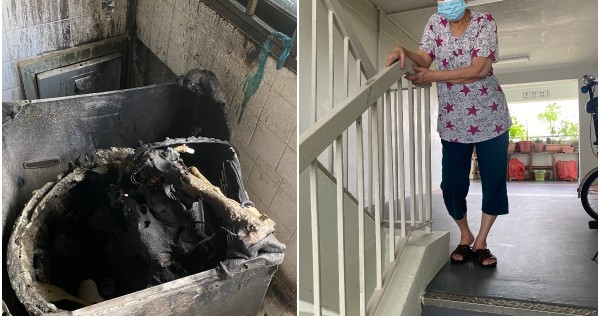
She had been lounging in her living room watching television when a pungent burnt smell filled the air. The elderly woman hobbled to her kitchen, only to be greeted with thick smoke billowing outside her window. From the unit across her window, she heard her neighbour yelling: “The unit below yours is on fire!”
The fire had broken out on Monday (Aug 3) in a four-room flat at 370 Bukit Batok Street 31. The inhabitants were a 70-year-old retiree and her two sons, aged 35 and 31.
Without a second thought, the 77-year-old woman headed down the stairs, not to escape, but to check on the family in the unit.
Despite having just been discharged from the hospital not too long ago after a bout of asthma, she was more worried that her neighbours may have been trapped in the fire.
“At that moment, I couldn’t care that much. I just had to get downstairs,” she told Lianhe Wanbao.
Due to her age, the elderly woman found it difficult to make her way downstairs and was sweating profusely by the time she reached her neighbour’s door.
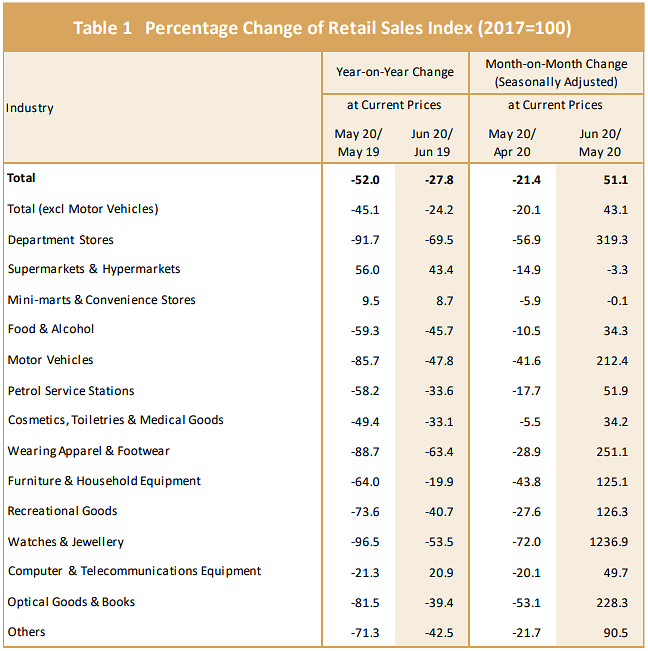
SINGAPORE: Retail sales in Singapore fell at a slower pace of 27.8 per cent year-on-year in June as the country exited its COVID-19 “circuit breaker” period and retail outlets resumed operations under Phase 2 of the city’s reopening.
This is an improvement from the record 52 per cent plunge in May, when physical stores were closed for the entire month, said the Department of Statistics (SingStat) on Wednesday (Aug 5).
Excluding motor vehicles, retail sales fell 24.2 per cent year-on-year, figures released by SingStat showed.
Singapore imposed a circuit breaker period from Apr 7 in a bid to curb the spread of COVID-19, shutting non-essential workplaces and implementing home-based learning for students.
The circuit breaker ended on Jun 1, with the Government planning to reopen the economy in three phases.
Singapore is currently under Phase 2 which started on Jun 19, with retail outlets allowed to reopen and dining-in at food and beverage (F&B) outlets allowed to resume.
However in comparison to May, seasonally adjusted retail sales saw a large improvement, increasing 51.1 per cent month-on-month.
Excluding motor vehicles, seasonally adjusted retail sales increased 43.1 per cent.
(Source: SingStat)
“The month-on-month growths were mainly attributed to the low base in May 2020 when physical stores were closed for the entire month during the circuit breaker period,” said SingStat in its release.
The estimated total retail sales value in June was about S$2.6 billion, with online retail sales making up an estimated 18.1 per cent.
Online retail sales of computer and telecommunications equipment, furniture and household equipment, as well as supermarkets and hypermarkets industries made up 69.9 per cent, 45.6 per cent and 10.7 per cent of the total sales of their respective industries.
F&B SECTOR FELL 43.5%
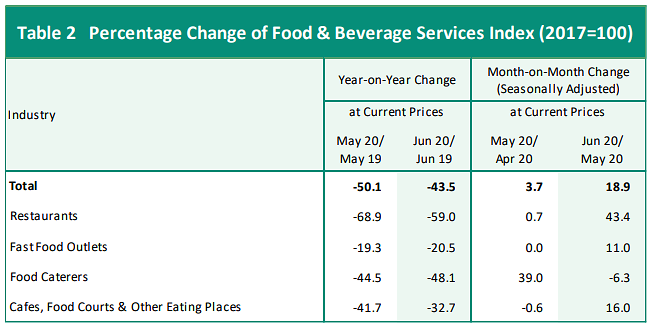
Sales of F&B services fell 43.5 per cent year-on-year, compared to the 50.1 per cent decline in the previous month, said SingStat.
On a seasonally adjusted basis, sales of F&B services increased 18.9 per cent in June over the previous month.
This comes amid the resumption of dine-in services in Phase Two of the post-circuit breaker reopening.
The total sales value of F&B services in June was estimated at S$496 million, with online F&B sales making up an estimated 32.7 per cent, added SingStat.
The turnover of restaurants and food caterers declined 59 per cent and 48.1 per cent respectively in June this year compared to June 2019.
“Similarly, cafes, food courts and other eating places and fast food outlets recorded lower sales of 32.7 per cent and 20.5 per cent respectively during this period,” the SingStat added.
On a seasonally adjusted basis, turnover of restaurants, cafes, food courts and other eating places as well as fast food outlets grew by between 11 per cent and 43.4 per cent compared to the previous month.
When it comes to caring for young children—especially toddlers who tend to be more active—we can never be too careful. This was especially true for Edwin Ng whose 19-month-old daughter suffered an injury resulting in a cut on her forehead at her Playgroup class at Maplebear Moulmein.
In a Facebook post (July 31), Edwin Ng shared his child’s harrowing experience having to undergo two day-surgeries where she was placed under general anaesthesia just a couple of weeks apart.
The distraught father also claimed that her toddler, whom he calls Little L, experienced “recurring nightmares since the surgeries.”
First incident took place on July 3
According to Ng, the Principal called on 3 July morning to inform him that Little L “fell and suffered a cut on her forehead.”
“The Principal said she was unable to tell us the actual condition (how deep or wide) of the cut as the blood was flowing out continuously from the cut“. Ng immediately rushed down to take his daughter to see a paediatrician (PD).
Singapore researchers have developed “electronic skin” capable of recreating a sense of touch, an innovation they hope will allow people with prosthetic limbs to detect objects, as well as feel texture, or even temperature and pain.
The device, dubbed ACES, or Asynchronous Coded Electronic Skin, is made up of 100 small sensors and is about 1 sq cm in size.
The researchers at the National University of Singapore say it can process information faster than the human nervous system, is able to recognize 20 to 30 different textures and can read Braille letters with more than 90 per cent accuracy.
“So humans need to slide to feel texture, but in this case the skin, with just a single touch, is able to detect textures of different roughness,” said research team leader Benjamin Tee, adding that AI algorithms let the device learn quickly.
A demonstration showed the device could detect that a squishy stress ball was soft, and determine that a solid plastic ball was hard.
“When you lose your sense of touch, you essentially become numb… and prosthetic users face that problem,” said Tee.
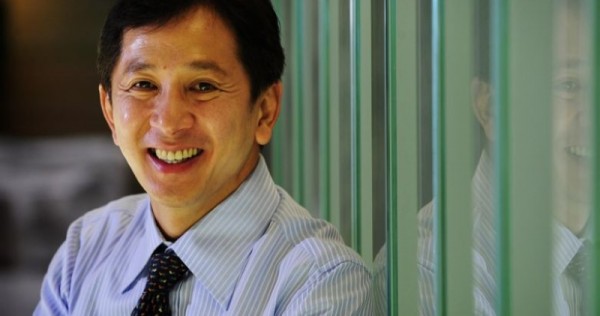
SINGAPORE – It was an anonymous letter by a whistle-blower accusing Fuji Xerox Singapore managing director Bert Wong of “bribery and criminal breach of trust” that triggered a special audit in 2017.
But even though a three-month investigation by external auditors found no evidence of fraud on the part of Mr Wong, who was nearing retirement, he was sacked and denied a retirement payout of close to $1.3 million.
On Tuesday (Aug 4), the start of a High Court hearing into his wrongful dismissal suit, his lawyers contended that high-level executives within the Japan-headquartered multinational corporation had “orchestrated Mr Wong’s summary dismissal at the doorstep of his retirement”.
Mr Wong, 64, who started out as a photocopier salesman in 1980 and rose through the ranks over 38 years, is claiming a total of more than $1.5 million, comprising his retirement payout and other remuneration.
“This is a case of corporate betrayal,” said his lawyers, Mr Wendell Wong and Mr Jared Chen, in their opening statement.
SINGAPORE – It was an anonymous letter by a whistle-blower accusing Fuji Xerox Singapore managing director Bert Wong of “bribery and criminal breach of trust” that triggered a special audit in 2017.
But even though a three-month investigation by external auditors found no evidence of fraud on the part of Mr Wong, who was nearing retirement, he was sacked and denied a retirement payout of close to $1.3 million.
On Tuesday (Aug 4), the start of a High Court hearing into his wrongful dismissal suit, his lawyers contended that high-level executives within the Japan-headquartered multinational corporation had “orchestrated Mr Wong’s summary dismissal at the doorstep of his retirement”.
Mr Wong, 64, who started out as a photocopier salesman in 1980 and rose through the ranks over 38 years, is claiming a total of more than $1.5 million, comprising his retirement payout and other remuneration.
“This is a case of corporate betrayal,” said his lawyers, Mr Wendell Wong and Mr Jared Chen, in their opening statement.
SINGAPORE: “It’s gotten so bad that I don’t feel like I’m working from home, I feel like I’m living in my office,” said one of my clients recently over a Zoom call, complaining about the new world of virtual work.
We talked about the importance of good boundaries in preventing burn-out. Then I said goodbye, and without leaving my desk, wolfed down a bowl of ramen, replied to four emails, did my weekly grocery shopping online, whatsapped my kids a couple of reminders and prepped for my next meeting. All in eight minutes.
This left me feeling bloated, slightly dizzy and stretched as thin as a paper prata. Not a good look for the workshop I was running that afternoon on Resilience and Well-being for Leaders.
So I made a decision to free up time by closing my individual coaching business last week. When I announced this, many people told me they too were struggling with balance and boundaries.
In an age of coronavirus, Singapore’s always-on culture has reached new heights. We forget boundaries between work and life serve an important purpose.
Boundaries are a way of creating space, whether they be physical, mental or emotional space between you and others, that allows us to flourish.
Boundaries are also important signifiers that show the world how you expect to be treated. Boundaries are about self-worth and self-identity. And they make you more effective in every area of your life.
One pattern I’ve noticed in the course of my work is that Asians often struggle with boundaries, as we are a collectivist society.
Office professionals at work. (File photo: Unsplash/Mimi Thian)
It doesn’t come easily to us to express our emotions or set clear boundaries for fear of upsetting others.
Famed dutch psychologist Professor Geert Hofstede has led extensive research on how values in the workplace are influenced by culture. His cultural survey suggests Singapore is a very collectivistic society, scoring just 20 on the Individualism scale, as compared to the US with a score of 91, Australia at 90, Germany at 67. Even Japan, a developed Asian economy, scores more than double at 46.
We are conditioned to talk in “we” terms rather than “me” terms, to do what others expect of us and comply to social norms for the sake of harmony.
One of the biggest problems leadership teams I coach say they face in coping with COVID-19 is staff burning out and quietly leaving, rather than asserting their boundaries.
“We only find out when it’s too late and they resign, because people are overworked but not speaking up. I’ve worked in so many countries in the world, and I feel people in Singapore are the most uncomfortable advocating for their needs or career aspirations.” said one senior leader to us last week.
“Staff in Singapore almost expect their manager to be a combination of mind-readers and parents, and ‘take care’ of their needs and career progression. In the US and Europe, every day people let you know that they can’t join conference calls because the timing doesn’t suit them, or that they can’t take on more work, but I have almost never had anyone push back in Singapore in the years I have worked here,” another senior leader shared.
We need to be able to advocate for ourselves and create appropriate boundaries to function effectively.
We need to be able to say no. We must choose what is good for us and what to let into our lives, without fear of upsetting others or toxic guilt. Although empathy and consideration for others is important, this must be coupled with healthy boundaries for our well-being.
Even healthcare experts find this challenging. Suicide rates for physicians in the US are 40 per cent are higher for men and 130 per cent higher for women than the general public, with researchers concluding that this is due to physicians sacrificing their own well-being to help others and being reluctant to seek help.
One study published in the British Medical Journal in 2008 found 20 per cent of US medical residents met the criteria for depression and 74 per cent met the criteria for burn-out.
PUTTING YOUR VALUES BEFORE WHAT OTHERS THINK
Good boundaries signify self-respect.
(Photo: Mimi Thian/ Unsplash)
Although people might not like them, what you may lose in cheap popularity points, you gain in the respect and dignity department, which lead to more effectiveness and ultimately, more success in the workplace.
When I was searching for a house, my property agent casually mentioned she lived in the neighbourhood.
“Oh? Which number is your house?” I asked her, and she said to me, very elegantly, “I’m sorry, I have a policy of not revealing where I stay because I value my privacy”.
Wow, that’s fair enough, I thought. My opinion of her actually went up a couple of notches. I liked her clarity and frankness. I ended up trusting her advice and buying the house.
HOW TO CREATE BETTER BOUNDARIES
How can we, living in the age of COVID-19, set better boundaries for ourselves, especially when it comes to work?
My husband is my role model. He’s a practising clinical psychologist who wrote a doctorate thesis about boundaries.
I’ve observed him like David Attenborough watching endangered species of animals during this crisis, trying to figure out how he copes so well, even though he spends hours a day counselling people, talking about heavy problems while juggling a whole other consultancy business. Here’s what I’ve learnt.
First, get an early start to your day. You want to begin on your own terms yet most of us wake up, grab the phone and start the morning by looking at what I call “OPP” – Other People’s Priorities.
Emails from people who want things from you? OPP. Replying to Whatsapps? OPP. Being tagged in Instagram challenges? Definitely OPP.
Instead, carve out the morning and treat it as sacred time to define what your top three priorities are for the day. Do not neglect what is important but not urgent. Book some time in your diary to write that book, go for physiotherapy or work on a side project that brings you joy.
Second, be explicit about your work policy. Working from home can turbocharge presenteeism and leave people feeling like they have to up their visibility by scheduling back-to-back meetings or replying to emails late at night.
This is also where leadership can play a role. Leaders should set clear expectations and reassure their staff they are trusted to fulfil their work.
A laptop seen as a man works from home. (Photo: Unsplash/Christopher Gower)
Tell your stakeholders how long your turnaround and response time will be. Help them understand how you work the best.
Workers too must be realistic about how much work you can handle and be comfortable with saying no, pushing back and prioritising where possible.
Some companies have started instituting “no meeting” days so people can get work done. Others have a policy of not sending non-urgent emails on weekends, or letting employees know they are not expected to reply on weekends and off-hours.
Third, create physical boundaries. If you’re working from home, try to create a separate space for your work. Even if you don’t have a dedicated office, can you move a bookcase to divide your workspace, and put your back against a wall to maintain privacy?
Studies suggest when we work with our backs towards an open room, some part of our brain is always alert and scanning for potential danger as we do not feel as safe subconsciously.
Fourth, have a winding-down ritual. Signal that your day is done so your brain can start to relax and move into rest mode.
If your computer is on the dining table and always in view, cover it with a cloth when you’re done for the day.
Greg even also goes as far as to shout “Goodbye! I’m done!” when he wraps up.
Another hack I learnt from my therapist is to end off with a “Ta Da!” list – the opposite of a to-do list. Take a minute to jot down a few things you’ve achieved in the day, big or small, to give yourself a sense of closure.
Fifth, tackle over-functioning and “over-responsibility”. Another important boundary is knowing what your responsibility is, and when to support or coach someone instead of doing things for them.
COVID-19 has forced many companies to adopt flexible and remote working arrangements. (Photo: Unsplash/Priscilla Du Preez)
We often see people who are stressed when they take on roles that aren’t theirs and try to rescue everyone else, instead of working in a way that helps and empowers others to solve their own challenges.
It is far better to support others by lending them a listening ear, and gently asking them what options they are able to think of, rather than jumping into problem-solving.
This mass migration to remote-working was supposed to usher in a new age of flexible work arrangements that help us be more focused and less distracted at work.
We need to find new ways of coping to ensure burn-out doesn’t wipe out productivity gains from this effort.
Good boundaries don’t just make us happier, more resilient and effective in the long term. They also teach us and others who we are, and who we choose to become.
Download our app or subscribe to our Telegram channel for the latest updates on the COVID-19 outbreak: https://cna.asia/telegram
Crystal Lim-Lange is co-author of the bestselling book Deep Human– Practical Superskills for a Future of Success and the co-founder of Forest Wolf, a leadership training and talent development consultancy.




.jpg "20200805_labresearch_reuters-1.jpg")