Home Blog Page 158

Singapore’s biggest COVID-19 cluster closes – a timeline

0

SINGAPORE: The COVID-19 cluster at the S11 dormitory @ Punggol – the biggest cluster in Singapore – has closed, the Ministry of Health (MOH) reported on Saturday (Aug 8).

The S11 dormitory recorded its first case more than four months ago and the last time a new case was linked to the cluster was on Saturday – with two additional cases linked. It took the total case count there to 2,846 – the largest COVID-19 cluster in Singapore.

Eleven other dormitory clusters were also closed on Saturday

“The inter-agency task force has completed the clearing of dormitories through aggressive testing of workers,” said MOH. 

“The following dormitories have been cleared, and now house only recovered individuals and those who have recently tested negative for COVID-19 infection. As such, the clusters have now been closed.”

The clusters that have now been closed on Saturday are:
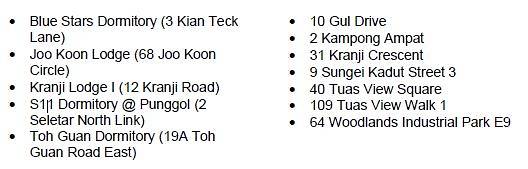
dorm clusters closed in Singapore on Aug 8

It was at the S11 dormitory where one of Singapore’s first dormitory clusters was identified.

Cases at dormitories form the bulk of Singapore’s COVID-19 cases, with 51,993 infections as of noon on Saturday.

On Jul 18, MOH announced the closure of the second biggest COVID-19 cluster, at Sungei Tengah Lodge. On Jul 21, the Ministry of Manpower (MOM) said Sungei Tengah Lodge was clear of COVID-19.

READ: COVID-19: Dormitory with Singapore’s second largest cluster among 69 more dormitories cleared

HOW THE S11 CLUSTER GREW TO SINGAPORE’S BIGGEST

The first two patients linked to the S11 dormitory – Cases 826 and 829 – tested positive for COVID-19 on Mar 28. The Bangladeshi and Indian nationals were admitted to Khoo Teck Puat Hospital, where they were treated.

Two days later, two more cases were linked, and MOH identified the dormitory as a new cluster.

The number of cases at the S11 dormitory would go up quickly, reaching 63 cases less than a week later on Apr 5.

A room in the S11 Dormitory @ Punggol (Source: Amin Mohamad Al)

A room in the S11 Dormitory @ Punggol, which is Singapore’s biggest COVID-19 cluster. 

The dormitory was gazetted as an isolation area, and together with Westlite Toh Guan, became the first two dormitories to have all workers quarantined in their rooms.

Manpower Minister Josephine Teo said then that the measures were put in place to ensure the health and well-being of “everyone”.

“Not just Singapore citizens, but also foreign workers who are here, helping our economy, and their employers. We want to give foreign workers the assurance that these measures are taken in their interests, and their well-being,” Mrs Teo added.

READ: COVID-19: Battling fear and boredom, migrant workers grapple with isolation in dormitories

Living conditions in dormitories became a talking point, as the cases continued to rise quickly. The Migrant Workers’ Centre, a non-government organisation linked to the National Trades Union Congress and the Singapore National Employers’ Federation, said the living conditions at the dormitory had “stabilised”, while MOM added that living conditions were improving. 

On Apr 8, less than two weeks after the first cases were identified, there were 118 cases at the S11 dormitory. Other dormitories were also put into isolation as clusters grew.

 A day later, the number of cases at the S11 dormitory more than doubled, to 283. About a week later, there were nearly 1,000 cases there.

It was also around then that MOH announced that medical teams comprising doctors and nurses from hospitals and polyclinics would be deployed to all dormitories, in a bid to curb the spread of COVID-19.

Ng Eng Hen at S11 Dormitory @ Punggol

Minister Ng Eng Hen being briefed by AMS personnel deployed at S11 Dormitory @ Punggol during his visit on Thursday, Apr 9 2020.  (Photo: MINDEF)

ANOTHER 1,000 CASES IN LESS THAN A WEEK

On Apr 17, there were 1,123 COVID-19 cases linked to the S11 dormitory. Less than a week later, on Apr 21, the number of cases climbed to 2,143.

On that day, migrant workers staying in dormitories were ordered to stop work and to stop moving in and out of dormitories until May 4. About 10,000 essential workers were transferred out of dormitories and housed separately.

Mrs Teo said this was something the Government “had planned for”, and that the workers were potential channels for infections in both directions when they moved in and out of dormitories.

READ: COVID-19: Movement in and out of dormitories to stop as all migrant workers to suspend work

On Apr 22, there was a sharp dip in the number of daily cases at the S11 dormitory, with 71 new cases linked to the cluster – compared to the 166 the day before.

By Apr 25, the number of daily new cases at the cluster had dropped to just six, the first single-digit increase in nearly three weeks. The tally on that day was 2,268.

The increase at the S11 cluster remained stable, with small spikes over the next week, bar a 134-case jump on Apr 29.
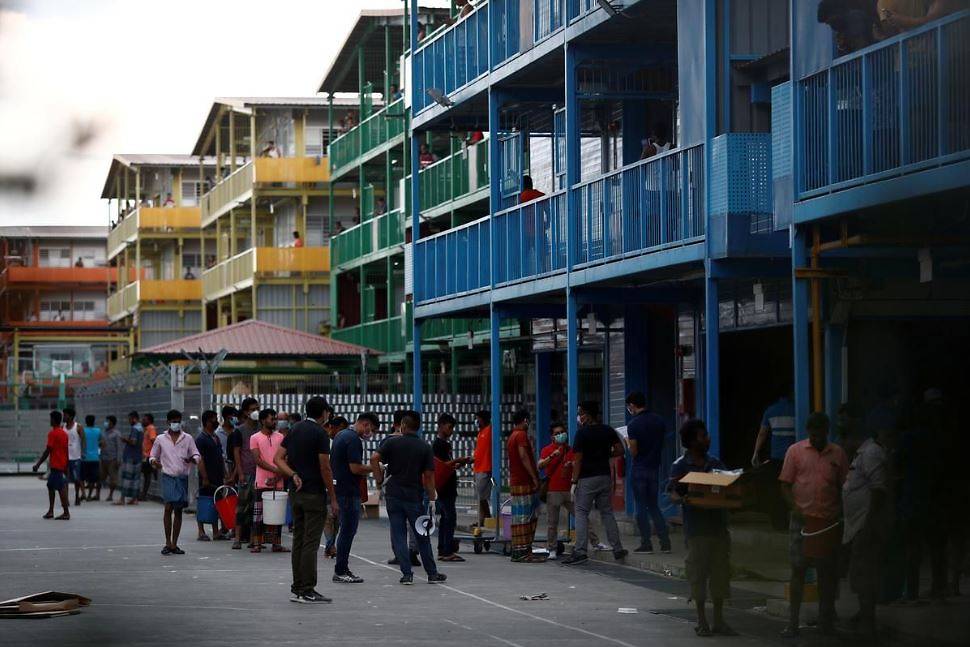
S11 Dormitory @ Punggol

Workers queue for food at S11 Dormitory @ Punggol on Apr 6, 2020. (Photo: Reuters / Edgar Su) 

Health Minister Gan Kim Yong said on Apr 27 the rate of testing for migrant workers had not slowed and that MOH was increasing the capacity of testing of migrant workers.

By May, the cluster at the S11 dormitory had swelled with new cases every day for a month, but the rate of infection slowed dramatically to single-digit increases in late April.

Mrs Teo told Parliament on May 4 the situation within larger dormitories was mostly stable. The suspension of work and movement for all migrant workers in dormitories was extended to Jun 1, as clusters continued to grow in other dormitories.

Six days later, on May 10, MOH reported there were no new cases linked to the S11 dorm – the first time that had happened since the start of April.

READ: No new cases linked to Singapore’s biggest COVID-19 cluster for first time since Apr 1

CONSECUTIVE DAYS OF NO NEW CASES AT S11

The cluster continued to see small increases in the number of cases all through May, with the exception of May 24, when 88 new cases were linked to the S11 dormitory.

With increasing testing capacity, isolation of migrant workers in dormitories, and stay-home notices for work permit and S pass holders in the construction sector, the number of new cases started to fall.

Before May was up, MOH reported three consecutive days – from May 27 to May 29 – when no new cases were linked to the S11 cluster.

Between Jun 7 and Jun 11, the cluster again experienced consecutive days without new cases, but on Jun 12, 15 more cases were linked to the cluster.

S11 Punggol dormitory (1)

Foreign workers stand along the corridor of their rooms in the S11 Dormitory @ Punggol, in Singapore on Apr 6, 2020. (Photo: AFP/Roslan Rahman)

Less than two weeks later – from Jun 22 to Jun 27 – the health ministry recorded no new cases at the dormitory for six consecutive days.

Over July, the number of cases held steady, with small increases in the first week and second week – mostly in the single digits.

There were no new cases at the S11 dormitory between Jul 16 and Jul 26 – 11 days – its longest stretch with no new cases linked.

With new infections sporadically linked over the next week and a half, the latest two cases were added on Saturday, bringing the total number of confirmed cases linked to the cluster to 2,846.

The order declaring the dormitory an isolation area under the Infectious Diseases Act was revoked on Saturday.

BOOKMARK THIS: Our comprehensive coverage of the coronavirus outbreak and its developments

Download our app or subscribe to our Telegram channel for the latest updates on the coronavirus outbreak: https://cna.asia/telegram

Source link

240 couples in Singapore tie the knot on auspicious Aug 8 despite Covid-19 restrictions

0

[ad_1]

SINGAPORE – For Ms Zhuang Yaqi and Mr Ryan Liu, getting married on Aug 8 had been in the works for over a year – 0808 is “auspicious” and it is the day before National Day.

“It just feels like it’s an extra festive period, and the date is also very easy to remember. We liked it from the start,” said Ms Zhuang, 30, an account manager.

The couple decided to go ahead with their wedding plans on Saturday (Aug 8) despite the restrictions brought on by the ongoing pandemic.

They were among 240 couples who tied the knot on the special date, up from the 44 couples who did so on Aug 8 a year ago, a Thursday.

Mr Liu, 26, a teacher, said: “When Covid-19 first broke in January, we considered postponing the wedding date, but as the months went on, and the pandemic looked like it would stay, we decided to stick to the original plan.

[ad_2]

Source link

11 dim sum promotions and deals in Singapore

0

[ad_1]

Har kaw, siew mai, lor bak gou, dim sum so good you just can’t say no! 

Little morsels of deliciousness, carefully wrapped in paper-thin dough, topped with chives and cooked to perfection, dim sum (点心: dian xin) holds a special place in our hearts (and tummies).

A hearty exchange of ‘inspirational’ life anecdotes, over these bite-sized goodness and sipping Chinese tea at a traditional Chinese dim sum restaurant with family or friends — that’s our kind of perfect afternoon. 

If that sounds like something you might want to plan for the coming weekend, here’s the ultimate list of Chinese restaurants in Singapore (complete with promotions), which serve up quality dim sum while being easy on your wallet. 

 Dim sum promotions and deals are subject to change without prior notice.

[ad_2]

Source link

Singapore coronavirus cases to 'taper down significantly' as migrant workers' testing ends

0

[ad_1]

Singapore ’s daily coronavirus case count is set to dip significantly in the coming weeks, authorities say, turning a corner as the testing of some 300,000 migrant workers living in cramped dormitories – once the epicentre of the city state’s outbreak – is completed.

From a peak of 1,426 new cases in one 24-hour period on April 20, Singapore now records between 200 and 400 new infections each day, on average. Occasional spikes, such as the 908 cases reported on Wednesday, have been caused by a greater proportion of workers being infected in some dormitories than others, according to the government.

As of Friday, the only migrant workers still needing to be tested for Covid-19 were the 9,700 or so who had been in close contact with other sick workers, the health ministry said. These workers are currently in quarantine facilities and will be tested before being allowed to return to work at the end of their 14-day isolation periods.

[ad_2]

Source link

Van driver punches man's and onlooker's cars at Jurong West carpark, police investigating

0

[ad_1]

The police are investigating an incident in which a man allegedly punched two vehicles during a dispute at a multi-storey carpark in Jurong West.

Stomp contributor DeathKnight2210 said the incident occurred at Block 346A Kang Ching Road on Sunday (Aug 2), at around 1.05pm.

According to DeathKnight2210, the dispute started when he honked at a BlueSG car to signal his own intention to reverse.

This apparently upset a van driver at the scene, who allegedly hit DeathKnight2210’s car window. The two men also got into an altercation.

The BlueSG car then tried to stop the van driver by honking, but this earned him a punch on his car window too.

[ad_2]

Source link

Standby, people: Timings for all the NDP2020 heartland highlights

0

[ad_1]

With this year’s NDP coming to the heartlands, it’s easy to get excited and rush down for prime viewing spots. But even during this celebration, we must still adhere to #SocialDistancing.

“The concept of this year’s NDP is to bring the NDP into the homes of Singaporeans. As such, many of the NDP events will be brought to the heartlands, and each of these events will be broadcast live on television,” says COL Lek Seng Khoon, Deputy Chairman of the NDP2020 Executive Committee and Chairman of the NDP2020 Safety and Security Committee.

“We encourage Singaporeans to celebrate National Day with their families at home. In the event that Singaporeans wish to go out to participate in the event outdoors, we urge that you put on a mask, and observe safe distancing.”

ALSO READ: Home wasn’t written for NDP. Here’s how our National Day songs have evolved

[ad_2]

Source link

New dorm cluster found; GV Jurong Point and Sheng Siong at Woodlands visited by Covid-19 patients while infected

0

[ad_1]

SINGAPORE – A new coronavirus cluster – a dormitory at 66 Tech Park Crescent in Tuas – was announced on Friday (Aug 7).

The cluster includes four previous cases, said the Ministry of Health (MOH).

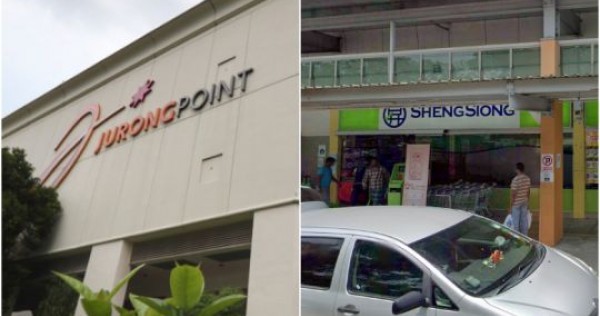
Meanwhile, Golden Village Jurong Point, ABC Brickworks Market and Food Centre at Jalan Bukit Merah, Tang Tea House at Jurong West and Sheng Siong Supermarket at Woodlands Industrial Park were added to the list of places visited by infectious coronavirus patients.

The ministry provides the list of locations and the times the Covid-19 patients visited them for at least 30 minutes to get those who were at these places at specific periods to monitor their health closely for two weeks from the date of their visit.

The full list of locations and times can be found on MOH’s website.

It has said that close contacts would already have been notified and there is no need to avoid these places as they would have been cleaned, if necessary.

A total of 242 new Covid-19 patients were confirmed on Friday by the ministry, taking Singapore’s total to 54,797.

[ad_2]

Source link

He’s a ‘foster parent’ raising baby birds by hand, helping to save threatened species

0

SINGAPORE: Mark Rusli remembers the time a baby bird died in his care.

Three months into his job as a junior animal care officer in the Jurong Bird Park, he had been hand-feeding a chick and mistook the signs it was displaying.

“He was probably trying to take in a breath of air, instead of wanting to eat. But I gave him papaya — it was a little too wet, so maybe instead of trying to swallow the papaya, he inhaled the water,” recalled the 33-year-old.

“A couple of seconds later, it turned pale and died.”

It was a mistake he vowed never to make again. And in the two years since, he has been able to keep his word.

Jurong Bird Park hand-rearer Mark Rusli feeding a baby bird formula milk with a syringe.

Rusli feeding a baby bird formula milk with a syringe.

“When I’m feeding a bird, I know now to take my time, not rush it and just watch the bird carefully,” he said.

Rusli is one of the park’s four hand-rearers, which means it is his job to raise baby birds by hand. It is, he said with a grin, much like being a foster parent to a newborn.

The birds come to him even before they are hatched, as his duties include hatching the eggs besides monitoring their growth until they are old enough to join the larger aviaries.

“They’re helpless and naked, and we need to feed them, sometimes every two hours when they’re really young,” he said.

A blue-eyed cockatoo hatchling at Jurong Bird Park. It will be raised by the park's hand-rearers.

A blue-eyed cockatoo hatchling.

Smaller species like pigeons and passerines, which are perching birds, require a high level of care for six to eight weeks, while the process can take up to eight months or more for larger species like macaws.

Some chicks the team receives are injured or have been abandoned by the parents.

But most of their efforts go into raising birds that have conservation value. In these cases, the team removes the first few batches of eggs laid to incubate them artificially, to increase their chances of survival and, ultimately, raise their numbers.

“Sometimes the parents aren’t very experienced, so they might raise just one chick out of a clutch of three,” he said. “If we were to remove all the three eggs and raise them, they’d all have a higher chance of surviving.”

An egg being checked at Jurong Bird Park to see if it is fertile.

Checking an egg to see if it is fertile.

This makes his role key to the park’s conservation efforts. According to Wildlife Reserves Singapore (WRS), which manages the Jurong Bird Park, Singapore Zoo, Night Safari and River Safari, more than 100 chicks have hatched so far this year.

READ: Jurong Bird Park’s conservation breeding efforts soar with more than 100 new hatchlings

One fifth are threatened species. They include a pair of red-fronted macaws — with an estimated wild population of only 200. The park is also one of two zoological institutions in the world breeding the blue-eyed cockatoo.

Beyond conservation, Rusli and his team also function as a support unit for the rest of the park, helping to take the load off other keepers.

“If the other keepers find eggs and chicks, they don’t have to worry about them. They can send them here and worry about their own aviaries,” he said.

‘WE GET REALLY EXCITED ABOUT A POO’

Rusli’s day can begin as early as 6am, and it starts with him checking on the birds housed in the park’s breeding and research centre. There are currently about 40 birds, but the number can go up to 60.

His priority is to make sure that they are all alive and well. “A lot can happen overnight because no one’s here for about 12 hours,” he said.

For example, chicks that had been abandoned by their parents could have fallen out of their nests and suffered internal injuries that might not be immediately obvious.

Once he has checked that the birds are fine, the feeding process begins.

First, he prepares the food for the chicks in nurseries, carefully stirring in the right amount of formula — the birds’ version of babies’ milk, he said with a chuckle — and ensuring that the temperature is right so as not to burn them.

Preparing food — in this case, bits of hairless baby rodents — for birds that may need more protein.

Preparing food — in this case, bits of hairless baby rodents — for birds that may need more protein. (Photo: Wayne Liu)

Care is also needed as he feeds the youngest chicks with a syringe, picking them up gingerly and holding them in the palm of his hand.

“When I first started, I was definitely scared of crushing these jelly-bean-like things,” he recalled. “Then I realised they’re not as fragile as a lot of people think they are.”

Still, he must be patient; feed them too much milk, and fluid could go into their lungs.

Once he is done feeding and weighing the youngest chicks, he moves on to the weaning rooms, which are much noisier and where older birds that are fully feathered are kept.

Jurong Bird Park hand-rearer Mark Rusli hand-feeding a bird in a weaning room. (Photo: Wayne Liu)

Hand-feeding a bird in a weaning room. (Photo: Wayne Liu)

These birds being weaned off formula on to solid food are also given a bigger space to help them develop their muscles.

Besides feeding and charting their growth, Rusli has other tasks that invite comparisons to a parent of a newborn, such as monitoring the poo of particular birds — with the accompanying delight of watching a young one doing it successfully.

“A few of us have mentioned that we get really excited about a poo,” he said, chuckling.

Whichever their shift — 6am to 3.30pm or 8.30am to 6pm — he added that the moments of excitement for the team, when they would be on high alert, are also when a rare chick or egg is in the nursery.

Hand-rearer Mark Rusli with a young blue-eyed cockatoo in the nursery at Jurong Bird Park.

A young blue-eyed cockatoo in the nursery. (Photo: Wayne Liu)

“We’re always texting each other … on how it’s developing and what to look out for,” he said.

While he has not had a sleepless night over a chick, he knows some of his teammates have. “When I’m at home, I’ll spend some time worrying about the valuable birds,” he said. “But I think I sleep pretty easily!”

NOT INITIALLY WHAT HE HAD IN MIND

Rusli’s day-to-day routine is very different, however, from what it could have been. His first degree was in a completely unrelated field: Sociology. “Halfway through, I realised that I didn’t really want to work in sociology,” he said.

He took up a part-time job in the Night Safari, working mostly with mammals and reptiles, before he graduated and joined WRS full-time for two years until he left to study wildlife science in Australia.

After his studies, he rejoined WRS and assumed that he would be working with animals as before. But events took an unexpected turn when his then boss pitched the idea to him about being a hand-rearer.

“It was very funny because when he threw this (idea) to me, he was kind of cautious about it … like he thought I was going to flat-out reject it,” Rusli recalled. “But I thought it would be an interesting challenge.”

Hand-rearer Mark Rusli preparing to weigh birds in a weaning room at Jurong Bird Park.

Preparing to weigh birds in a weaning room. (Photo: Wayne Liu)

He was not averse to the idea, but he acknowledged that birds were “not an interest” to him at that time.

“There’s a lot more popular interest in things like mammals because they’re cuter and bigger … Generally, people aren’t as interested in birds because they’re not as charismatic,” he said. “But there are definitely a lot of cool birds out there.”

He did have previous experience with birds while at the Night Safari, where he was once — as he quipped wryly — “that person helping people to take pictures with parrots”.

“They didn’t have enough staff then, but the whole experience helped me bond with the birds and realise that they’re not as boring … as I thought,” he said.

A BOND BETWEEN MAN AND BIRDS

Working with baby birds, however, initially “rather intimidated” Rusli, who described the posting as “probably one of the most stressful areas in the bird park to work”.

But he also pointed to the satisfaction he feels when he sees a bird he has raised thriving in the aviaries, particularly if it comes from a threatened species.

“We’re breeding a lot of threatened species, and being involved in the process and contributing to conservation efforts is meaningful,” he said.

Jurong Bird Park's conservation breeding efforts soar with more than 100 new hatchlings (2)

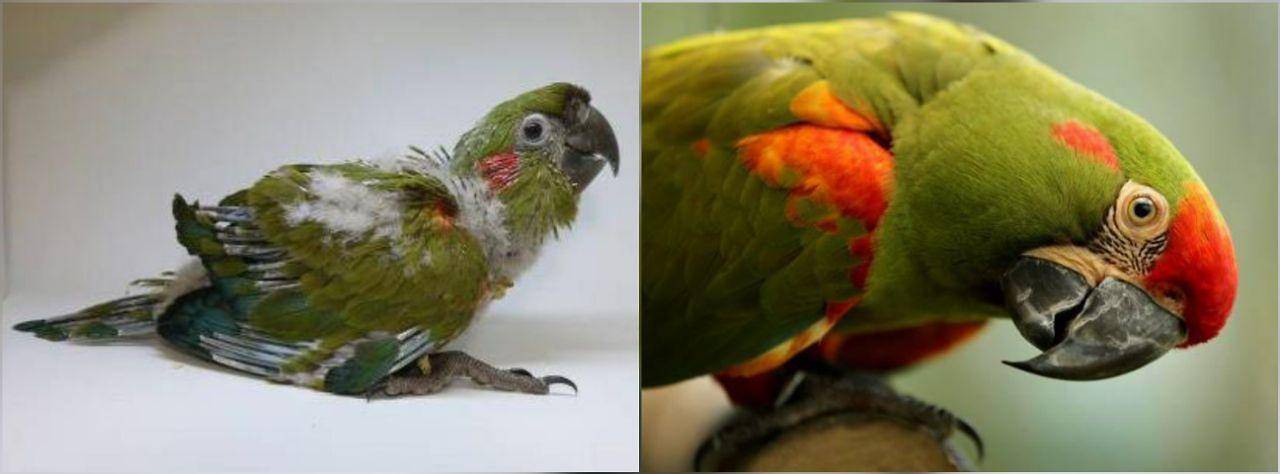
A red-fronted macaw at 46 days old (left) hatched in Jurong Bird Park’s Breeding and Research Centre and a fully grown adult of the same species (right). Threatened by habitat loss and poaching, breeding the critically endangered species under human care is crucial for their continued survival. (Photo: Wildlife Reserves Singapore)

Satisfaction also comes from the relationships he has built with the various birds that have come through in his care. There is no better way to see this than to follow him in one of the walk-in aviaries.

As he enters, colourful birds of all sizes fly to him, some landing on his head while others peck at his name badge. “I’ve broken a lot of name tags over these guys,” he said with a laugh.

As he greets them, his tone changes, despite previously insisting that he is “not a person who usually makes baby noises”. “Ow! Why’d you do that? Naughty!” he chides one of them.

While he recognises some of them as birds he had hand-reared, others also have a place in his heart — like Jaya the palm cockatoo, which was hand-reared years earlier but was trained as an ambassador bird by a team including Rusli.

Jurong Bird Park hand-rearer Mark Rusli with Jaya the palm cockatoo. (Photo: Wayne Liu)

Rusli with Jaya the palm cockatoo. (Photo: Wayne Liu)

“Look at the size of his beak,” he said as he scratched the top of Jaya’s head affectionately. “He could probably break my fingers if he wanted to.

“The bonding process took a lot of patience, but we got along.”

Over the years, he has grown familiar with the body language and emotions of different birds, and learnt a lot of “cool things, like how parrots can use their feet as an extra pair of hands to break something open”.   

“Birds are definitely underrated,” he said. “It’s not just the mammals that people should pay attention to — there are so many interesting things about birds you can learn.”

Mark Rusli is one of the Jurong Bird Park's four hand-rearers. (Photo: Wayne Liu)

(Photo: Wayne Liu)

Source link

Rise in firms offering mental health support for staff but more can be done, say experts

0

SINGAPORE: After graduating from university in 2015, Ann (not her real name) joined a non-governmental organisation (NGO) as an events executive.  

Her supervisor, she claimed, was prone to mood swings.  

“One moment she can be very upbeat and jolly with you, and the next moment she will scold you and be very moody – once or twice she shouted at me in front of everybody. So you have to adapt to her mood, which is very stressful and toxic,” said Ann, who is now 27.

“When I first joined I thought it was because I had done something wrong that’s why she was treating me like that.”

Towards the end of her four-month stint, Ann started to see a counsellor. 

“When you’re in your job from nine to six, it’s the biggest part of your life, so whoever you interact with most would definitely affect you,” said Ann, who left the company because she was beginning to feel depressed.

Communications executive Mary, 27, who has depression, generalised anxiety disorder and post-traumatic stress disorder, is somewhat in a better position as she can be open about her conditions at her workplace.

But she feels this is only because her condition does not affect her work output and she is able to look after herself.

Even then, Mary sometimes faces what she calls “colour-blind” comments – words that are hurtful, considering that her colleagues know about her illnesses. Once, during a review, her boss told her “you need to learn to relax”.

“And I have to tell them, ‘well, it’s because I have an anxiety disorder’,” Mary said. “They make such remarks often so you have to remind them constantly.”

Both Ann and Mary declined to reveal their identities for fear of reprisal.

In recent years, awareness about mental health at the workplace has grown, both in the public and private sector.

Mental health advocate Anthea Ong said she has seen more large organisations taking workplace mental wellbeing seriously in the last two years.

Citing the WorkWell Leaders Workgroup which she is part of, Ms Ong said that the group has grown from having 25 C-suite professionals to more than 40 today. The circle, which includes executives from DBS, Aviva and the public service, meets quarterly to discuss inclusive practices and the need for mental health insurance. 

The group published an e-guide in May that offers companies and workers tips on adjusting to work-from-home arrangements that could take a toll on some people due to the change and social isolation. 

COUNSELLING INCLUDED IN WELFARE BENEFITS

More companies have also adopted an Employee Assistance Programme (EAP) as part of their welfare benefits. This typically involves access to individual counselling sessions that employees can claim for, as well as other services such as mental health workshops.

Two EAP providers said there has been an uptick in the number of companies signing up to offer counselling to their employees. 

Counselling and Care Centre, for instance, has seen the number of client organisations double from 10 in 2017 to 20 in 2019, said the centre’s partnerships manager Anu Cherian.

Meanwhile the Singapore Anglican Community Services (SACS) has seen a tenfold increase in the number of client organisations since it launched the EAP in late 2017, a spokesperson said. 

Sometimes an individual has family and grief issues to talk through. Very often, employees want to deal with what is happening in the workplace such as the long hours, stress or when the company undergoes restructuring, said Ms Cherian.

Companies which have adopted EAP know that social and psychological wellbeing affects productivity, said the service providers. 

A National Council of Social Service (NCSS) study in 2017 found that for every S$1 invested in a “workplace adjustment” like flexi-work arrangements and means to get counselling, a company is able to generate an average of S$5.60 in returns as workers were more productive and made fewer medical claims. 

READ: COVID-19: Worries about pandemic see more calls to mental health helplines

In the public service, some of the latest efforts to address mental health include iWorkHealth, an online tool that allows employers and workers to identify factors of workplace stress. It was piloted last October and the aim is to launch the programme later this year. 

In January, the Tripartite Alliance for Fair and Progressive Employment Practices announced that people with mental health conditions no longer need to declare this information in job application forms. 

And in March, the Ministry of Manpower said it will be issuing an advisory to help employers take steps to improve mental wellbeing in the workplace by the end of 2020. 

READ: Government to publish advisory to help improve mental wellbeing in the workplace

The advisory will lay out what companies can do, which could include access to anonymised external counselling services, or training supervisors to identify mental health symptoms early.

CHANGING MINDSETS, MENTAL HEALTH-FRIENDLY CULTURE NEEDED

While observers in this field lauded the progress made, they said there is still room for improvement in changing mindsets.

“Mental healthcare in Singapore is not culturally supported and integrated into communities as with other developed nations,” said Dr Tracie Lazaroo, a clinical psychologist at Inner Light. “Our main goal should be to develop a more open and accepting culture.”

She noted that despite the initiatives, most of her clients who struggle with work-related burnout said that their firms do not prioritise mental health. 

The stigma against mental health issues creates a belief that they will be judged as weak if they were to voice their distress openly, Dr Lazaroo added.

What needs to be done, she said, is to create a “mental health-friendly culture”, where employers go for mental health awareness training, conduct workshops to manage burnout, provide avenues for workers to seek help, as well as create non-discriminatory policies. 

READ: Employers, workers can take steps to support mental wellbeing during COVID-19 pandemic: MOM

They could also look at improving the office environment, for instance, by having a well-stocked pantry and rooms where employees can use for work discussions or for time-outs, said Yvonne Low, the head of Singapore Association for Mental Health’s MINDSET Learning Hub. 

Companies stand to lose much from neglecting employee mental healthcare, Dr Lazaroo added, as it could result in negative behaviour in the office like resentment between colleagues, shouting matches and unnecessary tension. These could lead to early resignations.  

Similarly, Ms Ong listed other actions employers can take, such as allaying fears that career progression and performance are linked to one’s mental health, or have managers share their struggles so that it normalises mental distress.

READ: Public service committed to provide ‘inclusive and mental health-friendly’ workplace: Chan Chun Sing

Ann, for one, wished she had access to mental health services like the EAP at her previous company.

“I think it’s a top thing,” she said. “If the person on top actually understands what mental wellbeing at work is, makes it known and introduces official policies as evidence, then I actually feel like it is a safe place.

“Rather than say, harping on the fact that you are so mental health-oriented when you don’t have procedures in place for people to talk about workplace mental health issues in confidence.”

One company that has put in place measures to deal with mental health is social enterprise The Social Space, which operates two lifestyle stores at Chinatown and Marina One. It decided to make flexible work hours a given when it started in 2018. 

“We knew the individuals we hired came with their own unique set of challenges that would require flexibility,” said co-owner Daniel Yeow. The cafe it runs has 15 employees, 12 of whom have mental health illnesses.

The Social Space owners

Daniel Yeow and his wife Cheryl Ou started the business in 2018, which now has two outlets – one in Chinatown and the other in Marina Bay. Mr Yeow said that flexible work hours were very much in place since the beginning to meet the needs of the people they hired. (Facebook/The Social Space)

The medication they take to manage their conditions like obsessive compulsive disorder, depression and bipolar disorder makes them tired easily and impossible to work regular working hours, he said. 

Workplace policies aside, Mr Yeow said he has had to spend time reaching out to his employee’s support network – family members, doctors and social workers – to make sure they are taken care of. 

Once, they closed for half a day on a Saturday – their busiest day of the week – to let employees resolve disputes they had among themselves. 

These measures have affected productivity and consequently profits, he said. But Mr Yeow believes that “by doing the right thing, we will attract customers that appreciate what we stand for and … continue to support us”.

POLICIES TO NORMALISE NEED FOR MENTAL HEALTH CARE

More policies that normalise mental wellness should be legislated, said observers. 

Ms Ong pointed to laws in other countries that Singapore could follow. In Germany, employers are legally required to carry out workplace risk assessments – with countermeasures in place – that account for psychosocial hazards, not just physical ones. 

In Australia, workers can make claims for psychological injuries or mental disorders that are work-related.

In Singapore, mental illnesses are covered under the Work Injury Compensation Act if they are linked to a work accident, according to Mr Zaqy Mohamad in Parliament last year during the debate on the Work Injury Compensation Bill.

The Government could also provide grants for companies to carry out mental health programmes and present awards to those who promote mental wellness at the workplace, said Porsche Poh, the executive director of Silver Ribbon (Singapore).

The COVID-19 crisis has made the need to address mental health struggles all the more pertinent, added Ms Ong. 

She referenced a study done by Qualtrics between end-March and early-April across Australia, France, Germany, New Zealand, Singapore, the UK and the US, which found that 41.6 per cent of more than 2,000 respondents said that their mental health has declined since the outbreak.

READ: Commentary: Our approach to mental health needs to change. COVID-19 will force us to

In Singapore, EAP providers also said they saw interest in their programme go up at the start of the COVID-19 “circuit breaker”. SACS saw a 67 per cent rise in enquires on the EAP service in April, it said.

“Presumably (with) the work-from-home situation and the changes a lot of employees had to get adapted to … more employers might be looking at taking care of their employees,” said Ms Cherian.

Ms Ong said it is urgent for employers and government leaders to prioritise mental health, especially during the time of pandemic.

The United Nations had warned in May of a global mental health crisis due to COVID-19, as millions of people face death, disease, isolation, poverty and anxiety, and urged governments to put the issue front and centre as they tackle the pandemic. 

“Social isolation, employment uncertainty, and the virus itself have combined to shock the health and wellbeing of employees around the world,” she said. 

“In a time of COVID-19, mental health is (what) contributes to our social and psychological resilience as a people.”

Source link

Commentary: How ready are Singapore universities to start the new term as COVID-19 rages on?

0

SINGAPORE: The COVID-19 pandemic created much tumult. There will surely be more when the new semester begins in August in some Singapore universities. 

But while the rush to online teaching was a nasty shock in March, universities all over the world have since had considerable time to prepare for the next semester. Sadly, most have made poor use of this time. 

Many universities are going completely online, but few instructors will take advantage of this opportunity to change their instructional style. 

Most will deliver the same lectures in the same monotones, only they will be facing a webcam instead of a classroom of students. 

Most students will watch the same lectures as their predecessors, but at home, on a screen, and at twice the speed. They will absorb less material, interact less with each other and have a far inferior experience.

LISTEN: Home-based learning: Good, bad, terrible … but mostly good?

READ: Commentary: Home-based learning is strange, new ground. But we can conquer that too

A HYBRID MODEL

At NUS-Business, we are trying a different approach.  All our teaching will be 100 per cent available online. 

Part of this has been driven by necessity. Some of our students are stuck outside the country and can’t get to NUS; others can’t or won’t go to campus, for instance because they are worried about infecting an elderly relative. 

Yet something is lost when education moves online wholly and therein lies the spark in education that choice and autonomy can bring. So we have made plans to teach our students face-to-face to the maximal extent possible. 

That is, all our teaching will be a hybrid; students can attend class in person, online, or both, including watching the class recording afterwards.

Even getting here hasn’t been easy. To be able to teach hybrid effectively, we have had to re-educate all of our teaching staff. Like TV show hosts, lecturers have to both address students in the classroom and cater to remote students watching the lecture live.

But you may be amazed at the allies you can make who can offer new capabilities that turbocharges change. In a wonderful irony, we took opportunistic advantage of a terrific instructor: A student.

NUS Business School

NUS Business School, taken in 2014. (File photo: NUS Business School)

After demonstrating her technical mastery and considerable teaching skills, our Masters of Science in Management student Kerstin Hoeger has led hybrid classes to over one hundred of our instructors, before engaging with each of them one on one, to ensure that they are comfortable with the new hybrid approach.

Students in some classes will only be allowed to attend in person on a rotating basis. 

We think this hybrid approach to teaching gives a far superior experience to students.  They are engaged with their lecturers, and crucially, with each other, far more when they actually see each other face to face. 

Of course, we have to do our face-to-face teaching safely, with social distancing, mask-wearing, even an app that allows our staff and students to declare their temperature and health status easily. 

HOW TO OFFER STUDENTS OPTIONS

We are working hard to maintain and raise the level of social capital, so that we minimise the odds of coronavirus spread within the NUS community. 

We are delighted to do so, since there is a near-universal consensus that purely online teaching, to use a technical expression, … sucks. 

Our hybrid approach isn’t easy. Because of the importance of social distancing, no more than 50 students can attend a class face-to-face. This affects many of our classes and students. 

As we have to split up some large classes numbering hundreds into smaller sessions of not more than 50, a huge amount of planning goes into rearranging timetables, classrooms and other logistics.

READ: Commentary: How to sabotage your child’s future – five dangerous notions about life, careers and education

READ: Commentary: COVID-19’s education revolution – where going digital is just half the battle

Teaching is going to have to be at odd times: We will be teaching from 8am through 10pm Mondays through Fridays, as well as Saturdays and Sundays. 

We have to do that since we simply don’t have enough large classrooms (because of social distancing) to fit all our teaching into conventional school hours. 

With the sheer number of ongoing classes, teaching may also be in odd spaces. We will be using all our classrooms, even old and windowless ones that haven’t been used for years.   

Even so, not everyone will be able to go to attend class in person; we simply don’t have the capacity.

So, we have established priorities: First, to our new students, who have never been to NUS before; and second to our graduating students, who will be leaving NUS soon.

That is why students and parents in institutions all over the world are asking for discounts. Pure online teaching, which is ironically more expensive than face-to-face instruction, is simply not up to the task yet.

EVERY CRISIS AN OPPORTUNITY

Every crisis is an opportunity and we’ve taken advantage of the pandemic to raise the bar for instruction.

NUS hall

Screengrab from Google Street View of 21 Lower Kent Ridge Road.

I am extremely proud the NUS-Business faculty unanimously voted in June to raise our teaching standards, a first for us.

We have decided to enforce these transparently, by making student feedback scores on each course available to our entire community.

This is another first at NUS. All faculty staff and students can now see students’ opinions of instructors, module by module. 

Our faculty have always expected our students to be accountable in their coursework. For the first time ever, we now also expect our students to hold us accountable to high standards as instructors.

COVID-19 has brought about many constraints. Of course, there are many challenges. Lecturers have to adjust to a new mode of teaching. Besides more preparatory work, they may find it difficult to gauge students’ understanding or to encourage class participation during online classes.

However, some have reflected that they generally have some requisite skills to do e-teaching, and plan to take more courses to hone these skills further. We did not choose this pandemic, but we can choose how to respond to it.

READ: Commentary: COVID-19 has shown Singapore digital arts and humanities are quite the essential service

READ: Commentary: We’ve grown closer to co-workers during the coronavirus pandemic

Meanwhile, students may find it hard to stay engaged during online classes, but they have found it useful when lecturers engaged them through interactive tasks, breakout sessions, or simply asked them thought-provoking questions.

The weeks, even months, ahead will test educators’ response and ability to evolve further as new teaching demands and student feedback surface.

Universities around the world, especially those with high numbers of foreign students, will have to adapt to low numbers and fewer tuition payments, ensuring students remain safe when they do return, while grappling with the collapse in executive education and a host of other pecuniary issues.

A big lesson from COVID-19 is that we cannot predict the future. But we can get through this together. What we can do as universities is to be prepared to adjust and move with the situation, with our staff’s and students’ safety as the guiding principle.

This includes complying with safety measures such as keeping to designated campus zones to minimise intermingling of students, temperature declaration and safe distancing.

LISTEN: What next for Malaysian workers stuck there and Singapore businesses who hire them here?

BOOKMARK THIS: Our comprehensive coverage of the coronavirus outbreak and its developments

Download our app or subscribe to our Telegram channel for the latest updates on the coronavirus outbreak: https://cna.asia/telegram
Distinguished Professor Andrew Rose is the Dean of National University of Singapore Business School.

Source link