Home Blog Page 157

NDP 2020: At downsized Padang parade, frontline and essential workers get salute

0

SINGAPORE: Over the years, the National Day Parade contingents usually reserve their salute for two individuals: The Prime Minister and then the President. 

But on Sunday morning (Aug 9), the Padang played host to a different type of National Day Parade, one that has been downsized and adapted for the COVID-19 pandemic. And so it was only apt that a certain group received a salute too. 

Against the backdrop of the National Gallery, 16 frontline and essential workers stepped onto the road to face parade commander Lieutenant-Colonel (LTC) Nicholas Ong. Among the workers were a nurse, ambulance driver and supermarket cashier. 

“Hormat senjata!” LTC Ong roared. 

NDP frontline workers at Padang 2

Frontline workers watching the National Day Parade at the Padang on Aug 9, 2020. (Photo: Gaya Chandramohan)

President Halimah Yacob watched on as officers in the contingents thrust their rifles to the front as a mark of respect, creating a soft rattle in the largely empty field. 

The frontline workers turned to applaud the watching crowd, which waved little Singapore flags in return. The salute was dedicated to all frontline and essential workers who have helped Singapore battle the coronavirus.

NDP frontline workers at Padang 6

A salute at the National Day Parade on Aug 9, 2020 was dedicated to all frontline and essential workers who have helped Singapore battle the coronavirus. (Photo: Gaya Chandramohan)

SMALLER CONTINGENTS

To comply with safe distancing, the normally sizeable parade contingents were only made up of personnel from the Singapore Armed Forces and Singapore Police Force. The size of each contingent was halved from the usual 72. 

Absent were the thousands of spectators singing along to their favourite songs, and tanks and five-tonners rumbling past the National Gallery. Neither were there men and women with parachutes landing with a whoosh. 

NDP celebration at the Padang 8

One of four Guard of Honour contingents participating in the National Day Parade at the Padang on Aug 9, 2020. (Photo: Gaya Chandramohan)

A total of 150 people, including ministers and incoming Members of Parliament as well as representatives from the general public, watched the parade. The mobile column and Red Lions were moved to the heartlands, as organisers urged the public to watch the celebrations at home.

The parade kicked off a full day of festivities across the island, which will include a maritime sail-past at the Marina Barrage and Marina South Pier, as well as fireworks at 10 locations including Bishan, Punggol, Tampines and Woodlands. 

Back at the Padang, the contingents marched in under the morning sun, wearing the usual smart white uniforms and matching white masks. They stood at least 1m apart, instead of the normal 0.5m. 

The grandest entrance was accorded to the President. Mdm Halimah alighted and waved to spectators, wearing a brooch and white scarf that were co-created by artists with disabilities and local brands under an SG Enable initiative.

As Mdm Halimah stood on the podium for the National Anthem, the Public Warning System siren rang through the rest of Singapore, a signal for people to sing along in what organisers dubbed the “anthem moment”. 

President Halimah at NDP Padang 5

President Halimah Yacob attends NDP celebrations at the Padang on Aug 9, 2020. (Photo: Gaya Chandramohan)

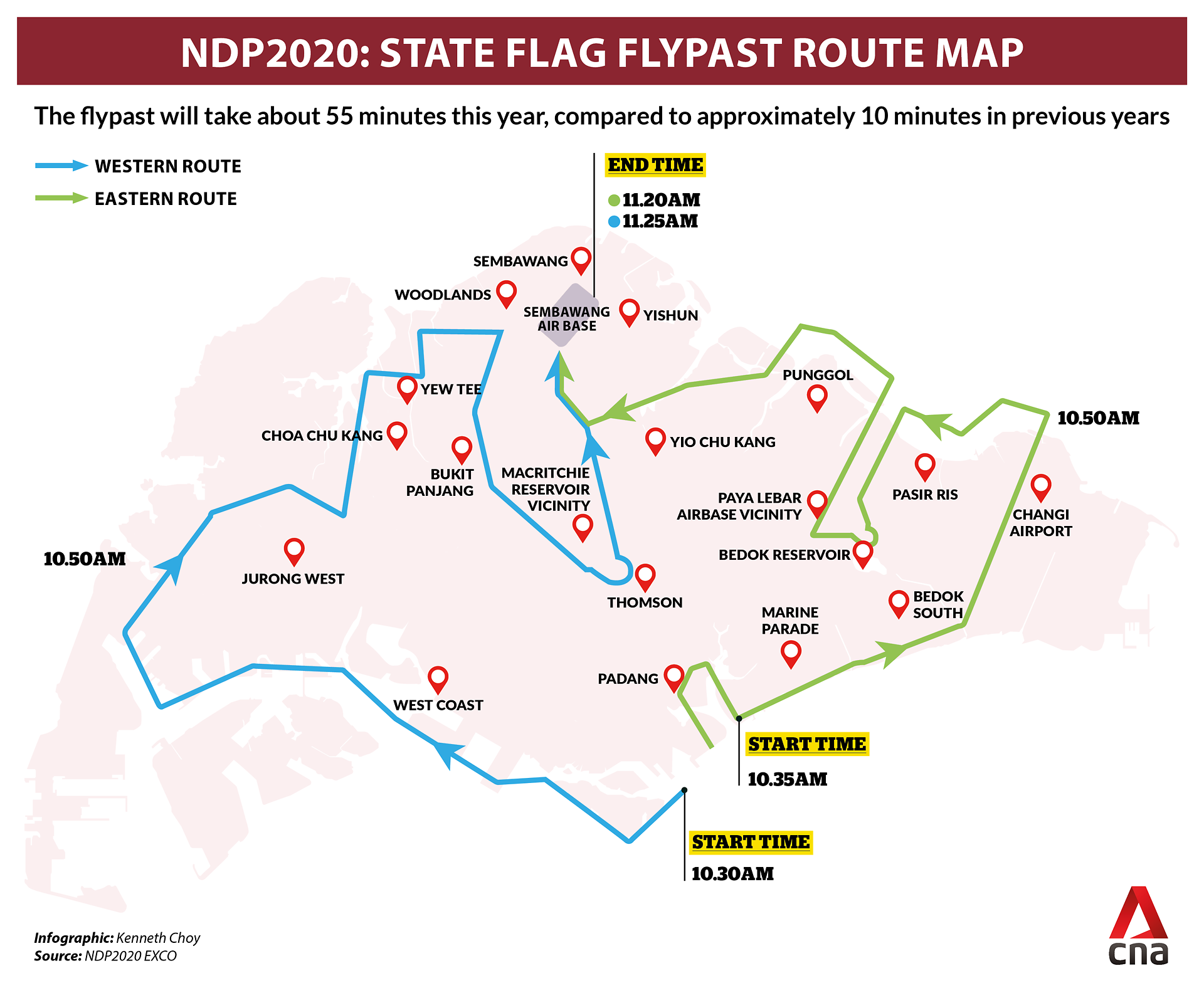
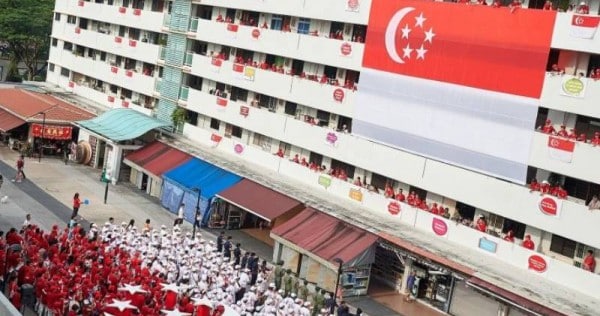
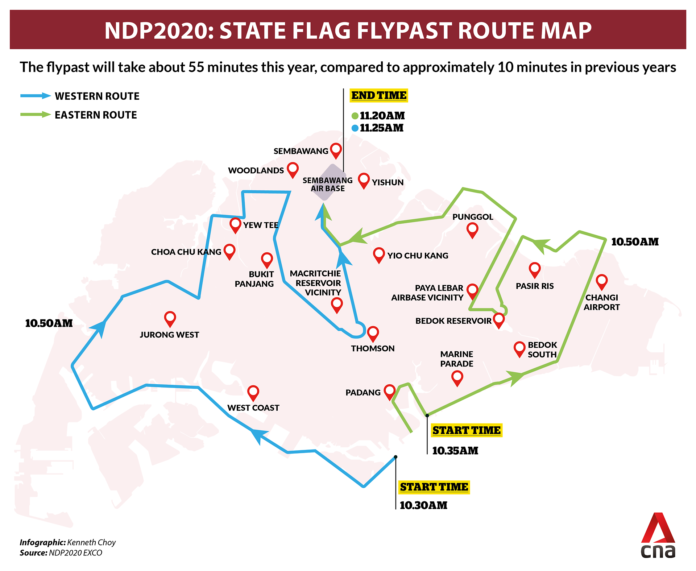
The Singapore flag was raised concurrently in seven other locations representing key national sectors. A Chinook helicopter carried the state flag over the Padang, its first stop in a 55-minute route that includes eastern neighbourhoods like Marine Parade, Bedok and Pasir Ris. 

While Mdm Halimah inspected the parade, 25-pounder guns on the other side of the field volleyed raucously and covered the Padang in white smoke, the first time that this has taken place at this venue. 

ROAR OF UNITY

But perhaps the biggest tribute, again dedicated to frontline workers, came from the sky. 

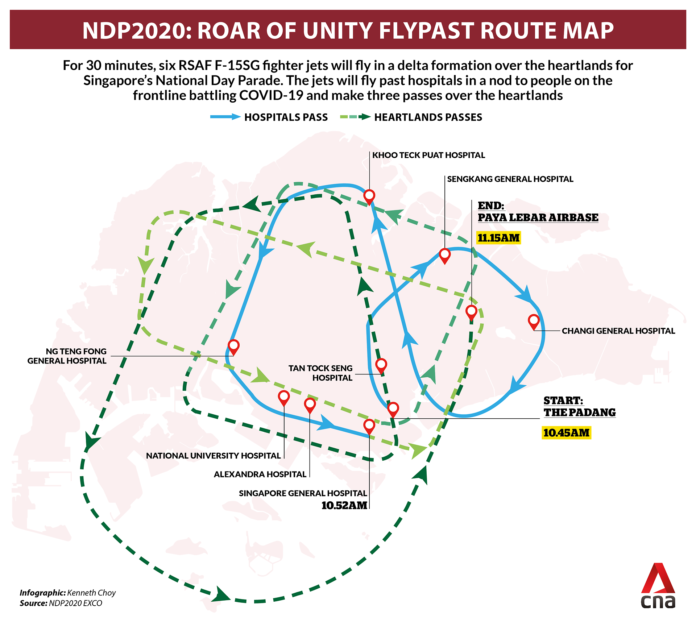
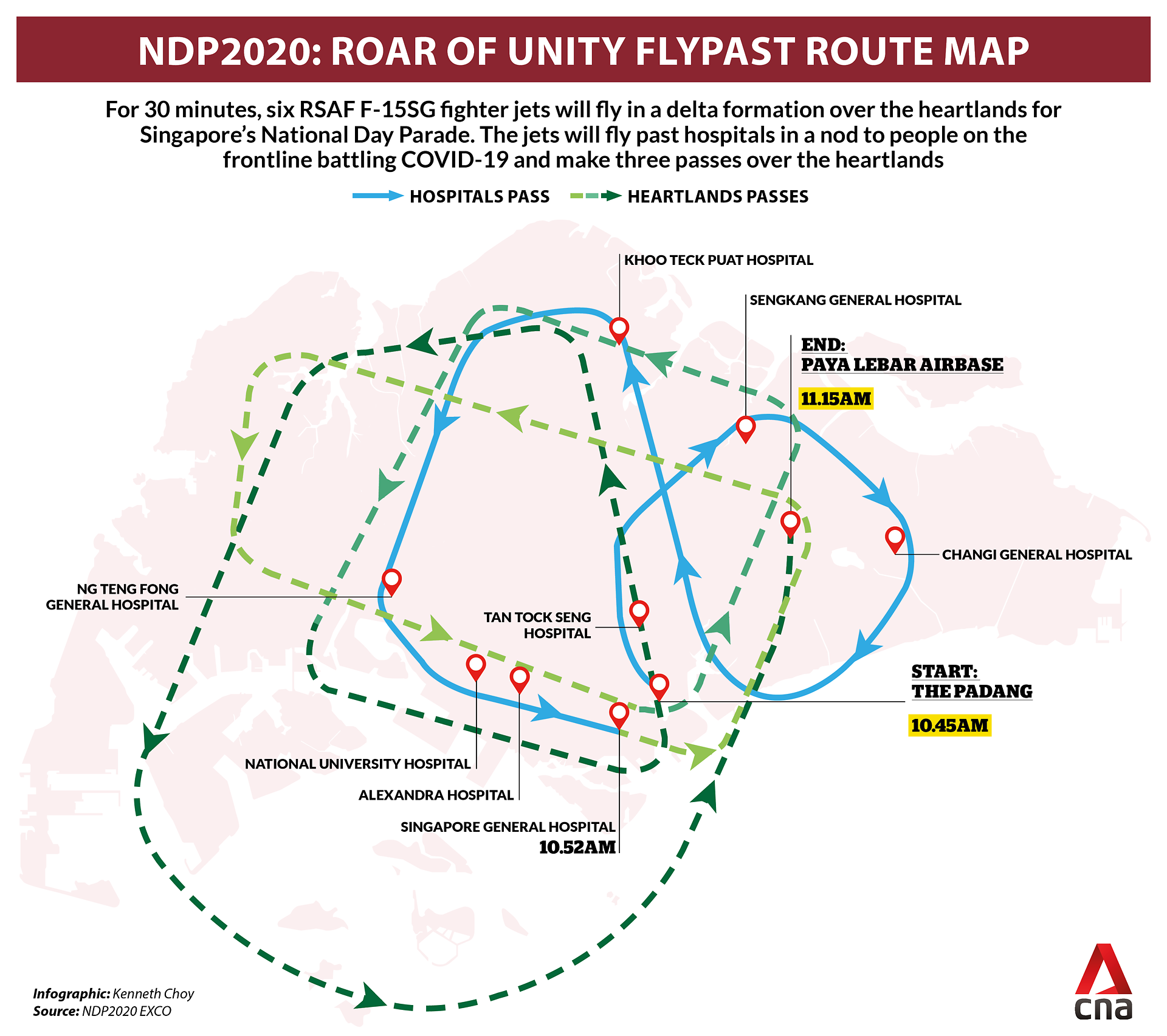
Six F-15SG fighter jets soared in a tight delta formation over the Padang, their afterburners booming in what organisers called a “roar of unity”. These jets would also go on to make tribute passes around eight hospitals. 

NDP Padang 2

The state flag fly-past over the Padang during NDP celebrations on Aug 9, 2020. (Photo: Gaya Chandramohan)

Ms Nirmala Nair, a head nurse at Ang Mo Kio polyclinic, said it was an honour to attend her first ever National Day Parade and receive the salute. 

“The way that the salutation this day was done, I’m very touched, privileged and grateful that there’s an honour and recognition given to the frontliners,” said the 62-year-old, who has been a nurse for 40 years. 

“It’s a special moment, and we will treasure this for many years to come.” 

nirmala at NDP Padang

Ms Nirmala Nair, head nurse at Ang Mo Kio polyclinic, sees patients with symptoms of acute respiratory infection. (Photo: Aqil Haziq Mahmud)

Ms Nair, who attends to potential COVID-19 patients showing respiratory symptoms at the polyclinic, said her family and colleagues were watching the parade at home. 

“I’m very proud of them because I’m here to represent nursing, and it’s such an honour to be here on behalf of them,” she added. 

“We have a lot of people who are quietly working behind the scenes, but always never been projected up front and maybe recognised, and I think it is never going to be the same after this year because we know many out there have been keeping our country safe.” 

‘MANY MORE WHO MADE SACRIFICES’

Mr Muhammad Ferdauz Abdul Kadir, 39, who ferries COVID-19 patients in buses from hospitals to isolation facilities, said he wishes that his colleagues could be at the parade too. 

Mr Ferdauz was one of the first to volunteer for the job amid concerns from his family, and slept in a different room at the start to reduce the risk of infection. 

muhammad ferdauz NDP Padang

Mr Muhammad Ferdauz Abdul Kadir , an ambulance driver at Lentor Ambulance, ferries COVID-19 patients from hospitals to isolation facilities. (Photo: Aqil Haziq Mahmud)

So he said he was very humbled to receive the salute, calling it an “indescribable feeling”. 

“There’s a lot more people who actually contributed a lot more and made sacrifices,” he said. “If only they could be here.” 

Both Ms Nair and Mr Ferdauz spoke to Prime Minister Lee Hsien Loong before he left the parade, stating that Mr Lee thanked them for their work. 

“I don’t think that is anything more rewarding than to see all of us here put our heart and passion upfront,” Ms Nair said. “Because nothing can trade off the saving of lives.”

Source link

Watch: NDP 2020 celebrations, a full day affair from the Padang to the heartlands

0

[ad_1]

Celebrate Singapore’s 55th birthday with a full day of festivities from the comfort of your couch. 

Stay tuned for the livestream of the morning segment of the parade at 10am and the evening segment at 7pm. 

Here’s what else to expect today: 

[ad_2]

Source link

Watch: 2020 National Day message and morning parade

0

SINGAPORE: Singapore marks 55 years of independence on Sunday (Aug 9). CNA broadcast Prime Minister Lee Hsien Loong’s National Day message, where he urged Singaporeans to unite and be resilient in the face of the COVID-19 crisis. ​​​​​​​His televised message was followed by the morning portion of the National Day Parade at the Padang and across the heartlands. ​​​​​​​

In light of the COVID-19 pandemic, tributes to frontline and essential workers featured heavily in the parade. The event is a smaller affair, split into morning and evening segments and with fewer than 300 participants for each portion.

Traditional favourites for the parade such as the Republic of Singapore Air Force (RSAF) flypast involving F-15SG fighter planes, the state flag flypast and the mobile column made their way through the heartlands so people could catch a glimpse of them in their neighbourhoods as well.

The F-15SG flypast:

EMB 6.30PM route map

The state flag flypast:

NDP 2020 flag flypast graphic

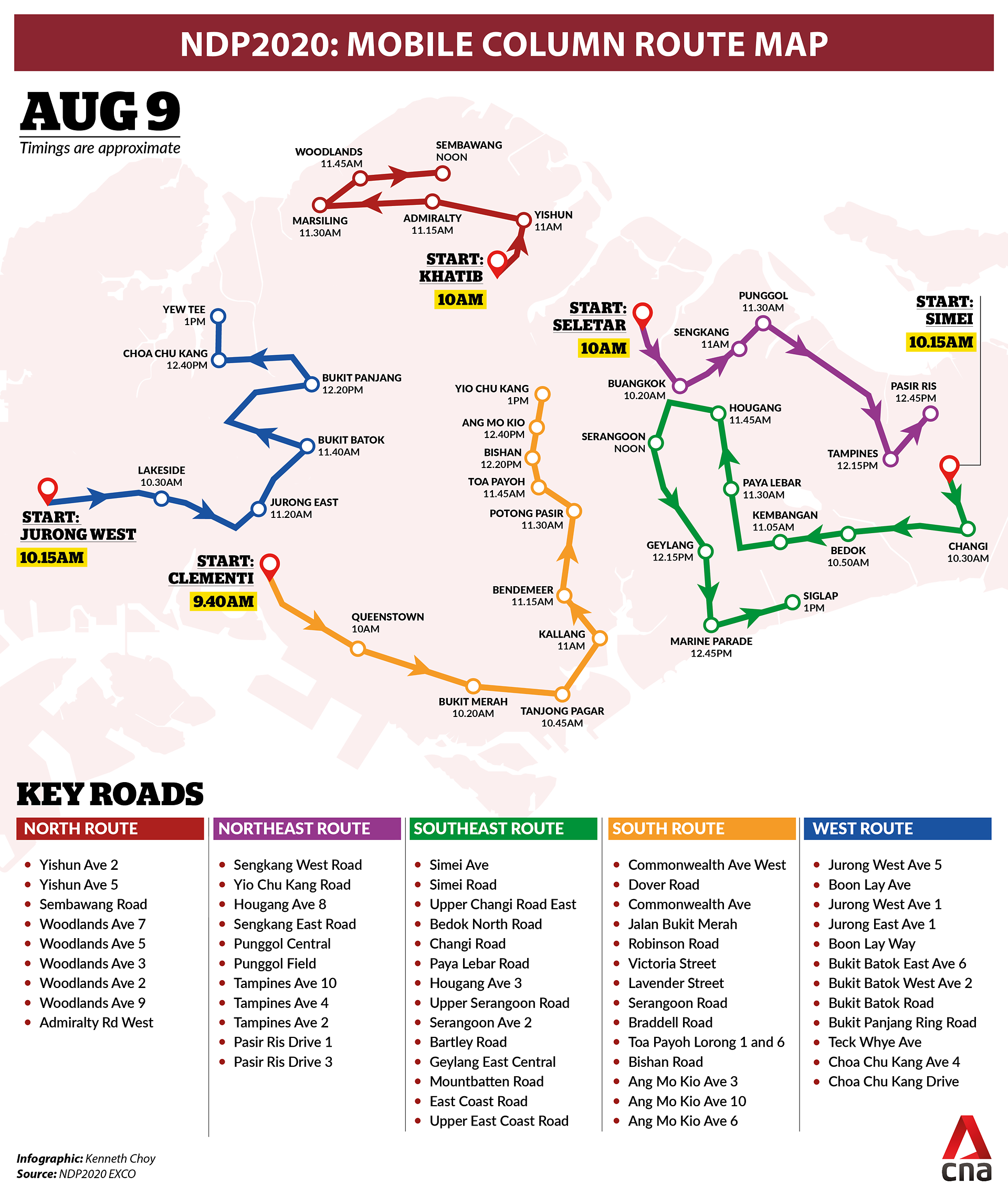
The mobile column featuring hardware and other assets from the Singapore Armed Forces, the Singapore Police Force and the Singapore Civil Defence Force:

singapore mobile column ndp 2020

The evening’s events will be capped off with fireworks in several locations: Ang Mo Kio, Bishan, Buona Vista, Jurong Lake Gardens, Marina Reservoir, Punggol, Sembawang, Tampines, Woodlands and Yew Tee.

Source link

NDP 2020: Upcoming NS Square at Marina Bay will be 'central focus' of new downtown, says PM Lee

0

[ad_1]

SINGAPORE – The upcoming NS Square, set to replace the Marina Bay floating platform, will be the central focus of the new downtown area, said Prime Minister Lee Hsien Loong in his National Day message on Sunday (Aug 9).

The project, due to be completed by end-2025, will continue to host future National Day Parades, as well as a gallery dedicated to national servicemen, PM Lee added as he unveiled its design for the first time.

PM Lee was giving his National Day message in a televised broadcast ahead of a parade at the Padang as part of this year’s scaled down, decentralised National Day Parade (NDP), held in the midst of the Covid-19 pandemic.

NS Square is set to be a permanent space for large-scale national events, possibly seating up to 35,000 spectators, compared to the current capacity of The Float @ Marina Bay of 27,000.

It will also feature community sports facilities, such as a swimming pool and water sports centre, as well as a new waterfront promenade that will improve pedestrian connectivity in the area, forming a loop around Marina Bay.

[ad_2]

Source link

First look at NS Square, the ‘red dot’ of downtown Singapore

0

SINGAPORE: The NS Square, which will replace The Float @ Marina Bay, will become a “red dot” and the “central focus” of Singapore’s downtown, announced Prime Minister Lee Hsien Loong in his National Day message on Sunday morning (Aug 9). 

Revealing visuals of the area for the first time, Mr Lee said the development will be aligned on a central axis, with The Promontory on the opposite side of Marina Bay.

Photo 2_NS Square

Artist’s impression of NS Square. (Image: MINDEF, MND and WOHA Architects)

“The platform will become a red dot, shining bright in our city. NS Square will be the central focus of our new downtown. We will build a gallery there to showcase our National Service story, and honour the contributions of national servicemen past and present.

“NS Square will also be a community space for everyone, young and old, to enjoy. And of course, we will continue to hold our National Day Parades there.”

Mr Lee had announced in 2017 that The Float @ Marina Bay would be redeveloped into a permanent space to commemorate national service, renamed NS Square and serve as the primary venue for the National Day Parade.

Photo 4_NS Square

Artist’s impression of NS Square. (Image: PMO, MINDEF and MND) 

After completing their basic military training (BMT), national service recruits hold their passing out parade at the Float, said Mr Lee. 

“It helps them to understand what they are defending, and why generations of national servicemen have been willing to serve and sacrifice, to defend this metropolis that we have built together, and also the society that created all this: Our families. Our friends. Our lives. Our future.”

Photo 3_NS Square

Artist’s impression of NS Square. (Image: MINDEF, MND and WOHA Architects)

In July, the Ministry of National Development and the Ministry of Defence announced that the redeveloped floating platform will house a water sports centre, a swimming pool and a National Service-themed gallery when it is completed by 2025. 

The design consultancy tender for the redevelopment of The Float @ Marina Bay was awarded to a team led by WOHA Architects, with works scheduled to start in March 2022.

Photo 5_NS Square

Artist’s impression of NS Square. (Image: MINDEF, MND and WOHA Architects) 

Apart from hosting National Day parades, the redeveloped venue could also be used to stage large-scale national and community events such as River Hongbao and the Marina Bay Singapore Countdown, the ministries said.

The Marina Bay floating platform was built in 2007 as a temporary stage while the National Stadium was being reconstructed. It was originally slated to be the venue for this year’s National Day Parade, but NDP 2020 has since been scaled down in line with COVID-19 guidelines

Source link

What it means to be Singaporean: We ask people in their teens through to their 60s

0

[ad_1]

As we celebrate Singapore’s 55th birthday in this very different year that 2020 has been, we ask Singaporeans of different ages just what being Singaporean means to them.

It’s our habits that make us
PHOTO: The Straits Times fileBeing born in Singapore and as a Singaporean, you learn to respect different cultures as we are all connected to one another in different ways.

Singaporeans also have many unique habits, such as chope-ing seats in the hawker centre with tissue paper packets, using a lot of Singlish and being very kiasu.

Lui Jieh Ing, 12, Student

[ad_2]

Source link

Watch live at 10am: National Day message and morning parade

0

SINGAPORE: Singapore marks 55 years of independence on Sunday (Aug 9). Watch Prime Minister Lee Hsien Loong’s National Day message to Singaporeans at 10am on CNA. This will be followed by the morning portion of the National Day Parade from 10.20am. 

In light of the COVID-19 pandemic, tributes to frontline and essential workers will feature heavily in the parade. The event will also be a smaller affair, split into morning and evening segments and with fewer than 300 participants for each portion.

Traditional favourites for the parade such as the Republic of Singapore Air Force (RSAF) flypast involving F-15SG fighter planes, the state flag flypast and the mobile column will make their way through the heartlands so people can catch a glimpse of them in their neighbourhoods as well.

Where you can catch the F-15SG flypast:

NDP 2020 flag flypast graphic

Where you can watch the state flag flypast:

NDP 2020 flag flypast graphic

And where you can check out the mobile column featuring hardware and other assets from the Singapore Armed Forces, the Singapore Police Force and the Singapore Civil Defence Force:

singapore mobile column ndp 2020

READ: Staying in this National Day? Here’s what to expect from the NDP 2020 festivities on TV

The evening’s events will be capped off with fireworks in several locations: Ang Mo Kio, Bishan, Buona Vista, Jurong Lake Gardens, Marina Reservoir, Punggol, Sembawang, Tampines, Woodlands and Yew Tee.

Source link

Commentary: This National Day, let’s celebrate Singaporeans too

0

SINGAPORE: I woke up this morning at 6am, and my husband and I went for our daily 10km walk. This is part of our new norm now. This period of working from home allowed us to prioritise our health and well-being.

We will be celebrating National Day with family, and we treasure this very much.

Since the circuit breaker in April, when so many daily activities we took for granted were off limits, we have come to appreciate social relations. 

READ: Commentary: This circuit breaker is making us yearn for human interaction more

Family gatherings, the privilege of eating together with extended family, and just simply spending time with loved ones are now much valued.

The pandemic also rendered visible the inequalities in our community. The social isolation suffered by older adults living alone, and who are not digitally connected.

Students in unconducive home environments for whom home-based learning was extremely challenging. 

READ: Commentary: COVID-19 has revealed a new disadvantaged group among us – digital outcasts

While many of us had the privilege of working from home this period, not all have the resources to manage this productively.  And not all were able to work from home because they are in essential services.

We were also alerted to the plight of our migrant workers, whose living conditions put them at higher risk for contracting infectious diseases. 

The stalled construction projects, long grass in our parks and neighbourhoods, and slowdown in some essential services all point to the significant roles these workers play in our communities. 

It seems like suddenly, without warning, our world turned upside down. 

REASONS TO BE OPTIMISTIC

So this National Day, when our country celebrates 55 years of independence, it is an opportunity to reflect how significant Aug 9 is for us this year. 

In the midst of this global pandemic, I believe Singaporeans have much to be grateful for as we celebrate nationhood.

First, I imagine many of us will be grateful that, being in Singapore riding out the pandemic, we have sensible, compassionate and strong leaders to guide us as we struggled to comprehend this generational disruption. 

READ: Commentary: This is the face of Generation COVID-19

When masks were scarce, we were all given disposable as well as reusable masks. Swift measures were announced to protect all in Singapore, and assurances were announced every night on the evening news – on our supply chains and how they are augmented, as well as the adequacy of our stockpile of essentials. 

Most significant were the daily reminders that we must protect our older adults as they are more vulnerable to infectious diseases. 

READ: Commentary: Here’s how our elderly can better protect themselves against COVID-19

Then there were the government assistance schemes to help businesses, families and individuals tide over as well as protect jobs.

Residents get free face masks from a vending machine by scanning their identification card, set up

Residents get free face masks from a vending machine by scanning their identification card, set up by the government as part of the effort to halt the spread of the COVID-19 in Singapore AFP/ROSLAN RAHMAN

In addition to the national budget on Feb 18, Deputy Prime Minister Heng Swee Keat introduced the Resilience Budget on Mar 26, the Solidarity Budget on Apr 6, and the Fortitude Budget on May 26 amounting close to S$100 billion drawn from our national reserves to provide some fiscal reprieve from the impact of COVID-19 on the economy.

Many Singaporeans will appreciate the hard work of those who came before us who ensured that we have sufficient in our national reserves to support us in these times of crisis.

CELEBRATING SINGAPOREANS AND NOT JUST SINGAPORE

But perhaps most important is the response from Singaporeans.

There were many Singaporeans who donated their S$600 Solidarity Payment to those who needed it more. There are those who received much needed assistance, and pledged to help others because they were helped.

I was very touched when my favourite fruit stall propriety in Ghim Moh Market rounded down my bill one day because she was so grateful that her rental was waivered.  She felt that she should share the blessings she received with her customers. In addition, she donated fruits from her stock to the migrant workers’ dorms. 

We also learnt of the many acts of kindness of ordinary Singaporeans – delivering meals to the vulnerable in our community, reaching to neighbours in need, and simply encouraging each other on as we strive to overcome the challenges of this global crisis. 

READ: Commentary: COVID-19 has shown that we can be gracious. How do we make it last?

READ: Commentary: Uptick in corporate giving during COVID-19 is much more than just a PR exercise

The pandemic made us realise how vulnerable a small nation state like Singapore is.  COVID-19 does not discriminate and no country is spared its impact. 

As I reflect on Singapore’s response to the pandemic, I am very proud of my fellow citizens – how we rallied together, abided by the rules of social distancing and adorned masks to protect each other.

So on this National Day, while I am very proud to be a Singaporean, it is also important to remember that we shouldn’t just celebrate Singapore but also Singaporeans – people from all walks of life that have defined our collective ethos. 

As we celebrate 55 years of nation-building, and I see clearly the Singaporean core that stands together in the midst of a global pandemic. 

Medical staff wait to cross the street to the National Centre for Infectious Diseases building

Medical staff wait to cross the street to the National Centre for Infectious Diseases building at Tan Tock Seng Hospital in Singapore on Jan 31, 2020. (Photo: AFP/Roslan Rahman)

In our youth, I see grit and determination, as they adapt to the new norm of everyday life and also deal with the economic and job prospect uncertainty that lies ahead.

I see too the resilience of many Singaporeans, whose jobs are disrupted by the pandemic. They take on alternative assignments cheerfully, determined to stay economically engaged.

Among the older Singaporeans, I see courage and tenacity as many strived to embrace digitisation so that they will not be left behind. 

READ: Commentary: Older workers vulnerable to rising tide of retrenchment as ageist mindsets persist

READ: Commentary: Soon you may be competing with talent globally. The Fortitude Budget is a wake-up call​​​​​​​

The many front line professionals and service personnel embody the Spirit of Singapore.  They suffered risks everyday in their respective jobs, so that the rest of us will be safe as we work from home.

A DEMOCRACY OF DEEDS

Due to COVID-19, this National Day is also different from others. There will be no central parade to display national pride and cohesion. 

Instead, we will be celebrating in our own homes, with family and friends, and united in spirit. 

To make up for the usual collective activities to celebrate this milestone, there are national efforts to get Singaporeans to recite the pledge and sing our national anthem at specified times, regardless of wherever we are then.

These efforts can be very powerful acts in reminding us that we are not alone and that together, as one people, we will overcome this crisis.

Singaporeans at NDP

Singaporeans reading the pledge at a National Day Parade. 

Such exercises of solidarity also helps strengthen national cohesion and resilience as we remind ourselves of the wider purpose of nation and community that brings us together – a useful reminder in the middle of the pandemic.

But beyond such symbolic gestures of solidarity and a “thrust of the heart”, much more can be done to also strengthen our “hand thrust” as a society because, after all, we do aspire to be a democracy of deeds, as one of our founding leaders, S Rajaratnam, called for.

Therefore this National Day, I urge all Singaporeans to step up to play our part to ensure that Singapore will survive COVID-19.  This pandemic has rendered visible inequalities that we must attend to if we want to strive forward as one Singapore. 

The well-being of our vulnerable families, older adults who are socially isolated, and our migrant workers. The digital gap must be plugged, and we must encourage each other to embrace upskilling and reskilling to stay economically relevant.

While government interventions are important, it is equally important that ground-up initiatives continue to augment and inform policy.

As we celebrate Singapore, each of us must also pledge to play our part in protecting our fellow Singaporeans.

Paulin Tay Straughan is Dean of Students and Professor of Sociology at the Singapore Management University.

Source link

Commentary: A case for making plastic bags in Singapore ugly – or even embarrassing

0

SINGAPORE: It only seems like yesterday Singapore made a strong bid to stem the use of plastic bags.

Last November, NTUC FairPrice rolled out a S$0.20 plastic bag charge to 25 outlets; a move its CEO said is “not a small step for Singapore”.

Yet after months of a deadly coronavirus, talk about kicking that addiction has gone silent. Did our guilty conscience about how many plastic bags we used for take-outs and deliveries during the circuit breaker silence us into complicity?

READ: Commentary: Here’s what months of food deliveries and takeaways have taught us

READ: Commentary: The enormous growth of plastic packaging as take-outs and food deliveries surge must stop

MOUNTING GLOBAL AWARENESS

No doubt there is mounting global awareness of the environmental impact of our addiction to plastic. Flimsy single-use plastic bags in particular have been labelled as one of the biggest polluters, and Singapore, one of the world’s biggest offenders.

According to one recent study, more than 2 million plastic bags are taken from our supermarkets every day – and that’s not even counting the many millions more taken from hawker stalls, wet markets, food delivery firms and the rest.

Across the world, cities and countries have been stepping up in phasing out the use of plastic bags, either through imposing a fee or banning it.

On Jul 1, Jakarta implemented a ban on single-use plastic bags, while Japan imposed mandatory charges for them.

Since March, customers in New York City are no longer issued single-use plastic bags, and have to pay a US$0.05 fee for paper bags.

READ: Small traders, manufacturers feel the pinch as Jakarta’s single-use plastic bag ban kicks in

A worker wearing a face shield and protective mask use a tote bag to replace plastic at a supermark

Workers wearing a face shield and protective mask at a supermarket in Jakarta, Indonesia on Jul 2, 2020. (Photo: REUTERS/Ajeng Dinar Ulfiana)

However, the vast majority of countries around the world still provide plastic bags for free. Singapore has hesitated to crack the whip on single-use plastics, relying instead on corporates and people to self-regulate.

The Government has said that Singapore’s approach should account for an urbanised and high-rise living context, noting that plastic bags aren’t “single-use” when reused for disposing rubbish.

This seems like a prudent strategy when you consider that Singaporeans may not be so receptive to tougher measures. A 2019 survey revealed that just 9 per cent of Singaporeans wanted a plastic bag ban, while another 21 per cent preferred a charge.

Part of the challenge, campaigners say, is that we have come to see plastic bags as an entitlement and an expected part of the retail service.

READ: Commentary: Recycle or reduce waste? Why Southeast Asia’s ocean plastic pile has no easy answers

LISTEN: Repairing and recycling to reduce e-waste: A pipe dream in Singapore?

So if a plastic bag ban or extra chargers are out of the question, what could help us kick our addiction to plastic?

The field of behavioural economics may offer some answers. Incentives, persuasion and psychological “nudges” are some of the many tools used to change consumer behaviour – from encouraging us to eat more healthily, to saving energy or taking public transport instead of the car.

TRADITIONAL MEASURES

Economists often resort to the age-old solution of adjusting prices to shape behaviour. Increasing prices should make demand drop.

In the UK, a law introduced in 2015 requiring supermarkets to charge for bags has led to a 90 per cent drop in single use bag consumption.

But is a plastic bag charge the correct approach in Singapore? Not everyone is sensitive to small price rises. Even with Singapore’s penchant for thriftiness, many consumers who have become used to the convenience will not find a few cents a significant enough imposition to change their habits.

plastic bags

(File photo: TODAY/Chng Shao Kai)

Some may justify taking bags from the supermarket on the principle that the bag can be reused to dispose of household rubbish – although of course it inevitably ends up in landfill. At the rate we’re going, Semakau, Singapore’s only landfill, will run out of space by 2035.

What about banning plastic bags entirely? Facing growing plastic pollution in its oceans, Thailand introduced a ban on single use bags, beginning this year with large retailers but to eventually cover all shops.

READ: Commentary: Thailand gives up plastic bags yet leaves rampant consumerism intact

But whilst such measures might make governments appear decisive and tough, history tells us that banning particular products only creates other problems. The US Prohibition in 1920 did not stop the production or transportation of alcohol, but only created a black market fuelled by organised crime.

While it may seem unlikely that there would be a black market for plastic bags, Singaporeans may go online to buy them, or stockpile before the prohibition kicks in.

READ: IN FOCUS: ‘It is not easy, but it can be done’ – The challenges of raising Singapore’s recycling rate

MESSAGING AS A POSSIBLE APPROACH

Might the key to ridding us of our plastic addiction lie in making the use of plastic bags shameful? Authorities have applied such reasoning to cigarettes.

Images of lung disease and warning signs have covered cigarette packaging. Many countries mandate the use of brand-free designs, high impact health warnings and disturbing images of diseased human organs to shock or shame smokers into giving up.

Smokers too in Singapore have been relegated to smoking in yellow boxes in public spaces.

This may sound confrontational for plastic bags, which are unlikely to directly damage the health of the consumer or their family as, say, smoking does. Yet consider how widespread and effective the opposite, positive messaging has with regard to environmentally-friendly alternatives.

reusable fruit bag

(Photo: Ang Hwee Min) 

For example, reusable shopping bags frequently tout their green credentials through words and bright imagery printed on them.

Likewise, low-emission hybrid cars often display the word “hybrid” prominently on their sides, helping to convey the environmental awareness of the consumers who buy them.

Cynics may dismiss such practices as mere virtue signalling. But if it works to persuade consumers to buy a particular product, could negative messaging also be used to change their habits away from another product, even if it is “free”?

READ: Commentary: Wasteful practices of affluence must stop

As social animals, we are susceptible to and influenced by what others think of us. If our actions put us in bad light socially, we will usually try to change them.

Printing confronting messages such as “this bag is a polluter” on bags, or images of litter clogged beaches and animals that have died as a result of plastic pollution might shift behaviour and dissuade consumers from taking single-use bags.

The logistical challenge to get that done may not be insignificant, but the financial cost of such printing would be negligible. By attaching themselves to an increasingly popular social cause, supermarkets and retailers also stand to gain in the eyes of their environmentally concerned customers.

LISTEN: Repairing and recycling to reduce e-waste: A pipe dream in Singapore?​​​​​​​

NUDGING PERCEPTIONS

This is not to argue that a cigarette pack-style approach alone would be a magic bullet solution to plastic bag use. Shifting consumer behaviour away from the convenience of single-use bags will require a combination of measures to bolster awareness of plastic usage and its impact, reinforce its social unacceptability, and make its use less convenient.

Placing bags at a distance from the checkout counter, for example, and training cashiers not to offer bags unless specifically requested could also help support the message and make their use less convenient for the consumer.

plastic bags in singapore

Singapore uses about 2.5 billion plastic bags a year, which is equivalent to each person using about 452 plastic bags a year.

Together these and other measures can help raise the psychological cost of using plastic bags, adding an element of social embarrassment or shame for the consumer and nudging them towards using alternatives.

As a way of kicking our plastic bag addiction, such steps could be far more powerful and lasting than simply charging a few cents for each bag.

Sumit Agarwal is the Low Tuck Kwong Distinguished Professor of Finance, Economics and Real Estate at NUS Business School. He is also the author of Kiasunomics and Kiasunomics2. The opinions expressed are those of the writer’s and do not represent the views and opinions of NUS.

Source link

Inspired by COVID-19 restrictions, two 15-year-olds create free online learning platform for kids

0

SINGAPORE: As part of a volunteer programme to help underprivileged children, 15-year-old Mihika Mishra used to go to a two-room HDB flat every week to do fun activities with a three-year-old girl and teach her how to read.

“Because of the pandemic, obviously that programme had to shut down. I couldn’t help but wonder what she must be going through,” Mihika said, stating that the girl lived with six others in the flat.

“I wanted to create a platform that allowed children like her to have an escape, just to have some fun or explore activities.”

Mihika talked about it with Arsh Sheikh, her good friend and classmate from the Overseas Family School. They had both struggled to discover their passion growing up. So in June, the pair brainstormed how they could help children engage in new activities during the pandemic.

“I wanted to provide children a way to do this for free, considering the unfortunate conditions some children face right now,” said Arsh, 15. “I also knew that there would be other kids who wanted to pursue a passion while staying remote and safe.”

The solution they came up with was Explorexa, a platform that uses Zoom to host fun and free 45-minute lessons for children aged three to 18. The thrice-weekly sessions, ranging from art and baking to singing and dancing, are taught by fellow students who have some talent or experience in these fields.

Arsh said the instructors are aged 13 to 18 to make lessons more child-friendly and encourage questions. The co-founders will ask potential instructors to demonstrate their expertise and also tell them the dos and don’ts.

For instance, students are not required to switch on their cameras during lessons to protect their privacy. Instructors should also pause every 15 minutes to ask if there are questions. It is about getting the students excited about something, Arsh said.

“It’s not a formal classroom setting, it’s more of just an interactive environment where the kids feel safe and comfortable to ask questions and be passionate about the activity,” Mihika added.

Explorexa graffiti art

A session on graffit art includes an introduction to shading. (Screengrab: Explorexa)

The lessons can involve basic explanations, pre-recorded videos and live demonstrations. For example, a lesson on graffiti art included an introduction to sketches and pencils, as well as a how-to on drawing popular cartoon character Spongebob Squarepants.

Interested parties can visit their website for a list of upcoming activities, before filling up a registration form that asks for details like name, age and grade. They will receive a Zoom link a day before the activity. Instructors can also sign up through a separate form.

Since its July launch, Explorexa has had about 120 sign-ups across 18 lessons, including sports like football and basketball and more serious topics like programming and business. Some of those who signed up come from countries like Norway, Oman and Australia.

“Most of our audience is from international schools, but we would really like to expand to local schools, or even children who don’t have the opportunity to go to school,” Mihika said. “That’s one of our main causes.”

BUILDING FROM SCRATCH

But creating Explorexa did not come without challenges. Mihika and Arsh took quite a bit of time to decide how the lessons would be conducted, and considered starting a YouTube channel.

While some organisations like the National Heritage Board and Wildlife Reserves Singapore digitised their content and launched online activities for children during the “circuit breaker”, Mihika wanted something with a more human touch.

READ: Children bored during the COVID-19 circuit breaker? Try these family-friendly online activities

“We thought that live sessions would work best for kids since they require interactivity, and it would just be the most suitable environment for them,” she said. “Instead of just watching videos, they can ask questions and learn better.”

At the start, the pair spent hours watching online tutorials on designing websites using the online platform Wix, delving into details like picking the most suitable interface and colours for children.

“It was really time intensive because we needed to go through so many tutorials to even understand one feature. Wix is a really broad website with a lot of features,” Arsh said,

“Because of quarantine we actually don’t have anything else to do so, we just put all our effort into this one website.”

The pair used their own savings to pay for a domain name and premium Wix plan. Arsh said it was free to use Zoom to host lessons as the platform usually upgrades its time limit on meetings from 40 minutes to an hour.

Once that was done, they had to find instructors, something they acknowledged was difficult because everything would be done for free.

“We asked a couple of our friends but a lot of them were like, ‘We would like to do it for money,’” Mihika said.

“But I think the fact that we had a ‘be a leader’ page (for instructors) and we made it clear that that was free, caused us to get people who are genuinely interested in teaching. So from that we generated a lot of leaders.”

A bunch of schoolmates soon agreed to become instructors. More recently, a student from a local secondary school signed up to teach a lesson on baking chocolate chip cookies. Explorexa eventually had enough activities to last several weeks.

“We had already planned for the next three or four weeks, just to put that off our mind because we need to focus on the marketing, making a social media account and everything,” Arsh said.

SLOW START

However, Explorexa failed to attract much interest for the first round of lessons starting Jul 18. The website was only getting a maximum of 200 views. Mihika and Arash felt discouraged after putting so much into it.

“We weren’t sure whether to continue, but we had already put so much effort into it, we just decided to give it a go,” Mihika said.

The two of them ramped up publicity efforts on social media, including getting their parents and friends to share it with others from across the globe. In the second week, Explorexa saw a spike in sign-ups.

“That actually filled us with a lot of confidence,” Arsh said, adding that they thought it would be at least a month before interest picked up. “It just inspired us to do more work, putting in as much effort as we can during this (COVID-19) season.”

Explorexa classical singing

An instructor explaining musical notes in a session on classical singing. (Screengrab: Explorexa)

A few weeks in, Mihika said she is “pretty proud” of the feedback so far, although she encouraged more parents and students to give reviews. Students can also suggest what lessons they would like to see.

Still, Arsh expects to see a dip in sign-ups when COVID-19 restrictions are eventually lifted, but insisted that they will continue to run Explorexa. The platform, like learning through YouTube videos, will remain relevant, he predicted.

Nevertheless, Mihika and Arsh admitted that it is a lot of work. They have to search for new instructors and activities, sit in for lessons to ensure everything runs smoothly, respond to feedback and manage the social media accounts.

Mihika is optimistic as the lessons are usually conducted after school or on weekends. If things start to get really hectic, she plans to get more volunteers on board. Some of her friends have already expressed interest.

“We can launch clubs in our school where people can actually volunteer to help us maintain the website,” Arsh said.

GRAND PLANS

Nevertheless, the pair have lofty ambitions for Explorexa. They are currently working on issuing certificates to instructors, and finding more variations of popular activities like arts and sports.

This includes introducing lesser-known sports like rounders, which is similar to baseball.

Explorexa basketball

A session on basketball showing a pre-recorded video. (Screengrab: Explorexa)

Down the road, they hope to launch an Explorexa app and a one-to-one tutoring function for subjects taught in school. They also discussed adding in-depth “masterclasses” taught by older and more seasoned instructors.

But one thing will remain constant: That the platform is free to use.

“For starters, we definitely hope to grow in Singapore and neighbouring Southeast Asian countries, as I know they’ve been hugely affected (by COVID-19),” Mihika said, adding that the aim is to get as many students as possible.

“I think the main goal of what we believe is that we need to keep it free, because the main goal is just to help out kids, it’s never to make a profit.”

Source link