SINGAPORE – Zoom Video Communications has opened a new data centre in Singapore, its first in Southeast Asia, it said on Tuesday.
Use of Zoom’s video conferencing services has surged as huge numbers of people across the world work from home because of coronavirus curbs, but the company has also come under fire over privacy and security issues.
The Singapore data center, through which the company’s users in Southeast Asia can connect, brings its total to 18 sites globally.
The company also plans to hire more Singapore employees, including engineers and sales staff, said Abe Smith, Head of International at Zoom.
Security researchers this year discovered that Zoom rerouted some calls through its servers in China, even if those calls were placed outside China.
Linksys, one of the earliest adopters of mesh Wi-Fi for everyday users, is here with another tempting router for blazing Wi-Fi 6 speeds.
Linksys MR9600 (AX6000)
The wireless connectivity brand just launched the Linksys MR9600 (AX600) mesh router that offers up to 6Gbps of speed and 3,000sqft coverage (more than double of the average five-room HDB flat).
As a dual-band router that supports the Wi-Fi 6 (802.11ax) standard, it offers 1,147Mbps on the 2.4GHz band and 4,804Mbps on its 5GHz band.
According to its makers, the MR9600 can support more than 40 connected devices simultaneously with “without any interference for continuous 8K video streaming and advanced gaming”.
It can also be a master or child node with any earlier or newer Linksys mesh Wi-Fi product since it’s supported by the brand’s proprietary Intelligent Mesh Technology.
Each MR9600 features two USB 3.0 ports , and a total of five Gigabit Ethernet ports ( one WAN, four LAN ). There’s no shortage of connectivity alternatives for most home networking needs.
If there’s one thing that many of us can agree on, it’s that ever since the circuit breaker hit Singapore, we’ve felt more stressed than usual — coping with new restrictions and work situations, as well as dealing with a pandemic at hand.
And these changes, which took most of us by surprise, have taken its toll.
A survey done by the National University Health System Mind Science Centre (NUHS MSC) showed that more than 60 per cent of those who were working from home (WFH) reported feeling stressed at work.
What’s surprising though is that only 53 per cent of the those working at the frontline, referring to those who still went out to work during circuit breaker, were feeling stressed at work.
The survey was done with 1,407 respondents — 114 of them frontline workers and 1,074 who work from home.
And perhaps because of the lack of differentiation between home and work environments for those WFH, 51 per cent were stressed at home, compared to just 32 per cent for frontliners.
More than 300,000 workers in Singapore have seen their salaries shrink by over 10 per cent because of the Covid-19 pandemic, with lower income groups hit the hardest and workers aged 35-44 increasingly vulnerable to the economic fallout, according to DBS.
The island nation’s largest bank revealed the data on Tuesday, after parsing anonymised March-May account data from 1.2 million customers who had their salaries credited into DBS accounts. About a third of the 300,000 affected workers saw wages plummet by more than 50 per cent, and a quarter saw incomes fall between 31 to 50 per cent.
Income deterioration was most severe for customers between the ages of 35 and 44, with more than half suffering a reduction of more than 30 per cent.
In the initial group of affected workers, more than half were under the age of 55, while about 50 per cent earned less than S$3,000 (US$2,190) a month.
DBS senior economist Irvin Seah, lead author of the report, said the bank did not know the residency status of those affected since the data was aggregated to protect customers’ identities, but that most would be Singaporeans and permanent residents.
After she gave birth to a baby in the toilet, she put her breathing child into a plastic bag, tied it and threw it down a rubbish chute.
Then she cleaned up the bloody mess, had a shower and went back to sleep.
Yesterday, the 27-year-old woman was jailed for 18 months for trying to kill her newborn.
The accused, who cannot be named due to a court order to protect the identity of her son, pleaded guilty to attempted culpable homicide by throwing him down the rubbish chute from the third storey of a Housing Board block of flats in Bedok North at 6.15am on Jan 7.
She claimed that until she gave birth, she was not aware that she was pregnant.
The court heard that the woman, who was working two part-time jobs as a waitress and a cleaner, was at home with her brother when she experienced discomfort in her abdomen and went to the toilet.
Deputy Public Prosecutor Yan Jiakang told the court: “Although the accused had not had her usual menstrual cycle for many months and did wonder whether she might be pregnant on occasion, she had chosen not to dwell on it further.”
SINGAPORE: In early August, Singapore’s multi-ministry COVID-19 task force announced that the number of cases will drop significantly by the end of the month due to the effectiveness of the 55-day circuit breaker and other safety measures, and as the testing for foreign worker dormitories complete. And indeed it has.
The past week has seen 100 or so new cases each day. The number of new community cases each day has also remained stable and in the low single digits.
Such was the context in which Deputy Prime Minister (DPM) and Finance Minister Heng Swee Keat delivered his ministerial statement on Monday (Aug 17) where he outlined plans to support Singapore’s next phase of getting people back to work safely and restarting the economy.
The S$8 billion worth of measures come on the back of Singapore reporting its worst quarterly contraction on record with GDP shrinking 13.2 per cent from a year earlier.
But while those figures are sobering, hope that the Singapore economy has bottomed out springs eternal.
After all, the second quarter was when the country was in the eye of the economic storm, facing the circuit breaker and we have reopened for business for some time since.
Mr Heng’s package is intended to support jobs and create new ones, provide support for the hardest hit sectors and position the economy for future growth in this new normal.
One difference between this latest package and the four prior budgets is that this one is not drawing down on the strategic reserves but a reallocation of funds from projects that have been delayed due to COVID-19.
This is an important distinction as the Government may be signaling that it does not need to draw down anymore from the reserves and that they are looking ahead to economic growth instead of another stimulus to bail firms and workers.
PRAGMATISM AT ITS BEST
Many countries are trying to figure out how best to move to the next phase and are taking different approaches. Some are even split politically, with divisions stalling national action.
(Photo: AFP / Roslan Rahman)
In the United States, the Democrats believe that they should keep giving citizens money so low-income earners do not endanger themselves by continuing to work, sometimes in close proximity, while the Republicans want to incentivise workers to return by minimising handouts.
There are a handful that try to find a middle ground but the polarised debate, including between the federal government and state governors, has hampered government policy.
In this fluid situation, the Singapore Government is considered in its plan on how to incentivise employers and workers to quickly guide the economy out of this COVID-19 recession. What DPM Heng has announced is a practical approach to get Singapore back on its feet.
While partisan politics in the US weighs welfare against a more ruthless approach, Singapore is aiming to strike a balance between mitigating unemployment and overly relying on employment benefits.
Hence the COVID-19 Support Grant’s conditionality of proof of a job search, and the Workfare Special Package’s expansion to include workers who found new employment in 2020 incentivises that return to work.
The nation’s stance has focused on how to get workers back to work quickly, considering factors such as age, reskillability, upskillability, and the ability to find jobs, versus others who need more protection and support.
Older workers, vulnerable to long-term unemployment when laid off, will hence get more wage support in high-growth sectors under the Jobs Growth Incentive, and be given a second shot in firms that might enjoy an uplift when the winds of recovery pick up in biomedical sciences, financial services and infocommunications technology.
Mr Heng is placing his bets on those sectors to boost employment.
He has also laid out a very detailed data-driven plan that classifies industries into three tiers based on the projected recovery of that industry.
File photo of an older office employee.
The classification channels the Job Support Scheme funding towards the most vulnerable industries and to gradually remove the support from the industries projected to recover over the next seven months.
THE MULTIPLIER EFFECT
But Mr Heng also acknowledges the critical help needed by the aerospace, aviation, tourism and built environment sectors – strategic sectors for Singapore with its aviation hub ambitions that will provide a stronger uplift when the global economy eventually recovers.
These measures include an additional S$187 million for the aviation sector, the redeployment of workers to other areas of need, and S$320 million in tourism credits to spur domestic tourism.
The added support will boost the confidence of investors and domestic consumers in Singapore. Success in bolstering these industries will reduce job losses in these sectors while stimulating employment and consumption in other sectors, which are part of their value chain.
Besides the multiplier effect, it is also worth noting that aviation and aerospace are crucial industries that enable a small but open and connected economy like Singapore to thrive.
With the S$8 billion package, Singapore is now moving forward in stimulating economy growth. As the COVID-19 situation evolves rapidly, only time will tell whether these measures will be successful.
Singapore Airlines flight attendants wearing masks at Changi Airport Terminal 3’s arrivals hall. (Photo: Jeremy Long)
At the very least, they help to cushion people against these turbulent times.
But the litmus test is in whether businesses can make full use of the various schemes and initiatives to retool for the future and find new opportunities in digitalising and pivoting, and whether workers can find it in themselves to reskill for tasks, even new jobs they had not considered in the past.
The storm is calming but this national effort cannot let up.
Sumit Agarwal is the Low Tuck Kwong Distinguished Professor of Finance, Economics and Real Estate at NUS Business School. He is also the author of Kiasunomics and Kiasunomics2, which will be published in September 2020. The opinions expressed are those of the writer’s and do not represent the views and opinions of NUS.
SINGAPORE: Given that Singapore’s economy is now expected to shrink from 5 per cent to 7 per cent in 2020, with a record high second-quarter year-on-year contraction of 13.2 per cent, retrenchment numbers are expected to continue to soar.
Total employment in the second-quarter declined by 121,800, which is the largest recorded quarterly decline in Singapore.
Retrenchments during these three months more than doubled to 6,700 from 3,220 in the first-quarter, and is almost triple the retrenchment rate Singapore witnessed over the same period last year.
Retrenchments in the second-quarter rose across broad industry sectors, most significantly in retail and air travel.
This trend of rising retrenchments looks set to continue as the ripple effect of COVID-19 wipes out years of economic progress and continues to undermine business and consumer confidence in the face of an uncertain future.
JOBS SUPPORT SCHEME
Can the extension of the Jobs Support Scheme (JSS) announced by Deputy Prime Minister (DPM) Heng Swee Keat in his Ministerial Statement on Aug 17 prevent, or at least defer, further retrenchment exercises?
DPM announced a calibrated extension of JSS for up to 7 months covering wages until March 2021, based on the projected recovery of various industry sectors, with aerospace, aviation and tourism industries receiving the largest percentage of JSS support.
The extension of JSS adopts a more modest and targeted sectorial approach, demonstrates flexibility in adapting to the evolving pandemic.
DPM Heng indicated that it would be fiscally unsustainable to extend the JSS at the current levels of payout, which have seen over S$16 billion being disbursed to 2 million workers in over 150,000 companies.
Deputy Prime Minister Heng Swee Keat delivers a ministerial statement on Aug 17, 2020. (Photo: Ministry of Communications and Information)
JSS measures, initially announced in the Unity Budget in February, and expanded over the remaining three Budgets, were generally well-received by companies as they provided timely assistance in defraying the direct cost of employee salaries during the pandemic and has helped them retain staff to the extent possible.
RETRENCHMENTS ARE ALREADY OCCURING
From a timing perspective, one wonders if this announcement of the extension of the JSS beyond August 2020 comes a little too late for companies which have been battling for survival the last few months?
In the Fortitude Budget announced on May 26, JSS was extended for a final month to cover August 2020, to be paid out in October 2020.
In anticipation of the JSS wage subsidy grinding to a halt in August 2020, and given that companies often strategically plan manpower pipelines in advance to account for notice period pay, it is conceivable that certain companies may indeed have already implemented salary reductions and conducted retrenchment exercises by calculating backwards from the anticipated end of JSS support for August 2020 wages.
This leads us to question whether the announcement of the extension of JSS a month or so earlier would have made a difference in preventing retrenchments, or would it have just kicked this retrenchment can down the road?
RESPONSIBLE RETRENCHMENT
Notwithstanding temporary economic buffers in the form of the extended JSS wage subsidies and other governmental support measures, mass retrenchment looms large on the horizon. Industry observers have predicted a spike in retrenchments once JSS comes to an end.
It is therefore critical to devote attention to not only minimising retrenchments, which can be stemmed only to a limited degree, but more so to ensure that where such retrenchments are inevitable, they are carried out fairly.
To this end, the Government and Tripartite partners have repeatedly exhorted companies to implement retrenchment as a last resort and to conduct such exercises responsibly.
DPM Heng announced an upcoming revision to the Tripartite Advisory on Managing Excess Manpower and Responsible Retrenchment to assimilate the National Trade Unions Congress’ (NTUC) Fair Retrenchment Framework (FRF) released on Aug 12.
In Singapore, where trade in goods and services accounts for over three times of its GDP, the impact of the pandemic was almost immediate. (File photo: AFP/Simin Wang)
The FRF is premised on three core pillars – protecting the Singaporean core (Singapore citizens and permanent residents); preserving jobs; and providing job support. The FRF is laudable in its drive to protect jobs and preserving the Singaporean core.
This complements the spate of recent actions taken by the Ministry of Manpower (MOM) and the other Tripartite partners that demonstrates greater scrutiny of unfair hiring and firing practices, and a harsher stance taken towards holding errant employers accountable.
In June 2020, Manpower Minister Josephine Teo announced in Parliament that employers who disguise retrenchments may be penalised by having work pass privileges suspended and JSS support withdrawn.
Given the extension of JSS till March 2021, this ongoing threat of punishing employers for attempting to disguise retrenchments remains an active deterrent.
More recently, a mere five days after the NTUC proposed its FRF, the unions were given an opportunity to put the FRF into action by boldly halting an unfair retrenchment exercise undertaken by Eagle Services Asia.
The unions probed into key details of the planned retrenchment and ultimately brokered an outcome where Singaporeans to be retrenched dropped from 56 per cent to 44 per cent, with a fair compensation package secured for retrenched employees.
COVID-19 has threatened the livelihoods of business owners and employees alike.
Given the bleak reality that retrenchments look set to rise, the increased oversight and crackdown by the Tripartite Partners on sharp employment practices to safeguard the interests of our workforce is welcome.
CONTINUED SUPPORT FOR JOBS
Minimising retrenchments goes hand in hand with ensuring that displaced employees are able to find suitable alternative employment to swiftly get back on their feet
A multi-pronged approach has been adopted to help workers secure employment, with strong government support for upskilling and reskilling to develop core competencies, and for the creation of new job opportunities.
Growing industry sectors identified by DPM as biomedical sciences, financial services, infocomm technology, public health and long-term care will need more workers.
Efforts are being made to connect job seekers with opportunities through redeployment and the setting up of 24 satellite career centres in the heartlands for career matching and advice.
The recently created National Jobs Council has demonstrated some success by curating 92,000 committed public and private opportunities, with 24,000 job seekers actively placed into these opportunities by end-July.
Singapore’s biomedical sector
Similarly, some 10,000 local residents have found jobs through the Workforce Singapore (WSG) career matching services in the first half of this year. It is commendable that the number of placements is similar to that in the same period last year, given the significant adverse impact of COVID-19 on the labour market.
JOBS GROWTH INITIATIVE
Significantly, DPM Heng introduced the new Jobs Growth Initiative (JGI) geared at supporting the government’s efforts to create new jobs for workers, with a sharp focus on local workers and mature workers.
S$1 billion was committed to support firms that increase their headcount of local workers over the next six months.
The government has committed to co-pay up to 25 per cent of the salaries of all new local hires for one year, and up to 50 per cent for workers over 40, subject to a cap to be announced.
The clear priority shining through the JGI and the amalgamation of the NTUC’s FRF into the Tripartite Advisory is safeguarding the interests of the Singaporean core in hiring and firing decisions.
While protecting Singaporeans’ job security is clearly critical in this crisis, it is undeniable that Singapore’s meteoric rise to success on the global stage is attributable in part to our carefully curated efforts to court multinational companies and the best and brightest foreign talent.
Foreign investments, companies and talent have been at the cornerstone of our exponential growth as a nation.
They remain important components of Singapore maintaining its competitive edge in Asia and on the global stage in the long-term and in the post-pandemic world order.
While retrenchments may be inevitable, a delicate balance should be struck between protecting job security, and yet retaining the vibrancy and diversity of our workforce, which makes Singapore one of the most competitive and effective economies in the world.
Amarjit Kaur is a Partner at Withers KhattarWong in its litigation and arbitration team. She has been noted for her expertise in labour and employment law in the 2020 edition of The Legal 500: Asia Pacific.
SINGAPORE: When his daughter was aged 30 and single, G Raju sought help from a traditional matchmaker to find her a life partner.
Within six months of a successful match in 2017, his daughter got married; he is now the proud grandfather of a two-year-old girl.
“In Singapore, we’re very open-minded, and we want our kids to find their own partner. But she was getting older, so we decided to help her,” said the 67-year-old. “Matchmaking is just an option … We got her permission of course.”
He acknowledged that she may have had difficulty finding a partner as his family were very protective towards her.
“Because of this, there were (fewer) chances of her getting to know the other gender. Women (these days) are also more educated and are working, so they may have less time to find a partner,” he added.
This practice of engaging traditional matchmakers continues among Indian communities here, even with the availability of modern options for meeting people, like dating apps.
But it is not all like the trending Netflix series in which Mumbai-based matchmaker Sima Taparia tries to find partners for the participants.
Aparna Shewakramani (left), one of the participants in Netflix’s Indian Matchmaking, on a baking date. (Photo: Netflix)
The show, Indian Matchmaking, gives audiences a glimpse into the world of arranged marriages in Indian culture.
It has also stirred up controversy over its representation of the importance of physical appearance, and its purported perpetuation of fair-skin obsession and casteism.
While matchmakers tell CNA Insider things are different in Singapore and more in sync with what society feels is acceptable, times are tough for them, with the numbers of Indian matchmakers and their clients having shrunk considerably.
And they think it will not be long before the practice goes the way of matchmaking traditions in other ethnic communities here — all but dying out.
A potential couple, Shekar and Nadia, going on a date in Netflix’s Indian Matchmaking. (Photo: Netflix)
TOPIC OF CASTE SELDOM MENTIONED
In Singapore, the traditional matchmakers are largely women, which makes M Govindaraju, who is known by his nickname Mago, somewhat of a rare breed.
The former army officer has been in this industry for 40 years, hooking up some 400 couples and counting.
Matchmaker Meenachi Suppiah, on the other hand, has been doing this part-time for six years and has made 25 matches so far.
Both of them, who have not seen the Netflix show, said the topic of caste hardly comes up as a selection criterion.
Date night for another prospective couple in Indian Matchmaking, which is getting flak for caste discrimination as one of its themes. (Photo: Netflix)
“It’s something that, in Singapore, isn’t so strong,” said Meenachi, who is in her 40s. “Maybe two or three per cent of the people would say that ‘I want (someone) of the same caste’ or something like that.”
Raju, who has not seen the show either, felt that caste has no place in Singapore.
“Our priority is a strong bond between them (the couple), and that the boy has a stable job, a stable income and (has) a good character,” he said.
Defence executive officer Gitanjali, who got married last month with help from Meenachi, said caste may be important to the older generation but is irrelevant to her.
Gitanjali and her husband, Vijaya Kumar, on their big day. (Photo credit: Gitanjali)
“I’m more concerned about the character of the person, how responsible he is, and his career,” said the 43-year-old, who was previously in a “love marriage” and remarried another divorcee.
Typically in Singapore, education, profession and health are what clients are more particular about, said Mago, who helped Raju find his daughter her match.
Some clients insist that their prospective partner should not have habits like smoking or drinking, and on top of everything else, there are some who are fixated on looks. This is Meenachi’s biggest bugbear.
“They aren’t even reading the profile; they’re just looking at the picture,” she said. “They want someone who can do everything. I tell them that they’ll have to wait quite long, or that it’s just unrealistic.”
‘WORRIED ABOUT THE GIRLS’
The two matchmakers said it is usually parents who approach them, after getting the children’s consent, and remain involved in the decision to pick suitable candidates.
These parents also place a great deal of trust in the matchmakers, who pride themselves on knowing the good or unsavoury characters in their community.
Mago, 70, said he got into this industry to help single women find love. While volunteering at grassroots events in the 1980s, he encountered many unmarried women and “wanted to do something for them”.
“I was worried about the girls, especially the girls who were going to be alone or lonely when they get older,” he said. “That’s why I started going round looking for the right people, (asking) whether they’re married or not.
“I didn’t create this (service) to make money.”
He charges S$150 for registration and S$1,000 for a successful match.
The first meeting between the couple usually takes place at a fast-food outlet “because it’s quieter”, he said, adding that he does not believe in showing them photos of each other before the meeting.
Sometimes the photo doesn’t match the face. I want to manage their expectations.
At this meeting, he usually gives the couple 15 minutes alone to talk. “If they call me after that and extend the time, it’s good news,” he added with a smile.
For widows and those with disabilities, he said he provides his services for free.
PRESSURE FROM RELATIVES
Over the years, although attitudes towards love and marriage have changed and there are dating apps like Tinder and Coffee Meets Bagel, some people prefer traditional matchmaking services.
Dating app Coffee Meets Bagel’s website. (Screengrab: Coffee Meets Bagel)
Mago said this culture is still prevalent in the Indian community as some parents feel the pressure from relatives and friends who think children should be married and start a family by a certain age.
“So the parents take a more proactive role. They feel that it’s their duty to help their children,” he said.
“Some parents are also quite conservative and protective, especially towards the daughters. So they want to have a say in choosing the partner.”
Mago said parents who approach him are not open to using dating apps or have not yet taken to the idea.
Some parents, especially those with daughters, also feel uncomfortable with posting a photograph on dating apps for all to see, said Meenachi.
“Dating sites are where people go to look out for some companionship,” she added. “People who go to Tinder aren’t usually looking for a life partner.”
A person in Singapore on Tinder. (File photo: Nisha Karyn)
OBSOLETE SOON?
The practice of matchmaking and arranged marriages in Indian culture, said Meenachi, has been passed down from generation to generation like the use of fingers and banana leaves to eat food and the wearing of the bindi.
Many families still take pride in these traditions, including their “methods of bringing up children”.
She added that while there are Westernised families who allow children to bring their boyfriend or girlfriend home, the conservative ones do not and would insist on the traditional ways “even when it comes to marriage”.
Mago foresees that in the next five to 10 years, however, no one will enlist help from matchmakers in his community, as people have more opportunities to meet now, especially in the workplace.
Last year, he managed to match only five couples, compared to the 1980s and 1990s, when he could pair off 10 to 15 couples a year.
That is good news, he said. “I feel very happy because they now have the opportunity to choose their own partner in their daily life, maybe through their working life, their own social circle or via Facebook.”
Meenachi shares his view. When she started doing this, she could pair off six couples a year resulting in marriages. But in recent years, that number has halved.
She remembers a time when bringing singles together used to be easy — and matchmakers had only to ensure that the couple’s horoscopes matched as a requirement for marriage. The bride and groom had little say in the matter.
“If (their horoscopes) match … the next time they’d meet is for the wedding. That’s about it,” she said. “The matchmaker has a 100 per cent success rate.
If the guy had a job or a business and the woman could cook, it would be a done deal. If the woman could sew, it was an added bonus … Matchmaking was such a blooming business.
FOR OTHERS, NOT BOUND BY TRADITION
Among some other communities here, matchmaking was once popular but is rarely practised today.
In the Malay/Muslim community, matchmaking services are available, albeit not in the traditional sense — with dating apps such as Muzmatch, Minder and Joompa performing the role, said Institute of Policy Studies research fellow Mohamad Shamsuri Juhari.
“You also have mosques that organise specific events with matchmaking as an objective,” added the researcher, who focuses on Malay-Muslim issues.
“Like any progressive community, young single Malay/Muslims prefer to do it on their own. And some are not preoccupied with getting married.”
Among Peranakans, professional matchmakers ceased to play a significant role in arranging marriages after World War II, according to the Peranakan Association Singapore.
They used to help families ensure that prospective spouses had matching “ba zi” (eight characters), or birth charts, in consultation with astrologers. If there was a clash, the union was not recommended.
“This reliance on astrology is no longer relevant today, as many Peranakans have moved away from traditional beliefs,” said Dawn Marie Lee, the association’s head of communications.
Arranged marriages and matchmaking may also not be relevant when most young, single Singaporeans can turn to dating apps, noted National University of Singapore sociologist Tan Ern Ser.
Or, as the matchmakers said, many people have a chance of meeting prospective partners at work or in social situations.
“I doubt they’d depend on their parents, (and) I don’t see them depending on matchmakers,” he added. “The idea is that you should be free to choose who you want to marry.”
SINGAPORE: A McDonald’s outlet and a Seoul Garden restaurant were among several locations added to a list of public places visited by COVID-19 cases in the community during their infectious period, said the Ministry of Health (MOH) on Tuesday (Aug 18).
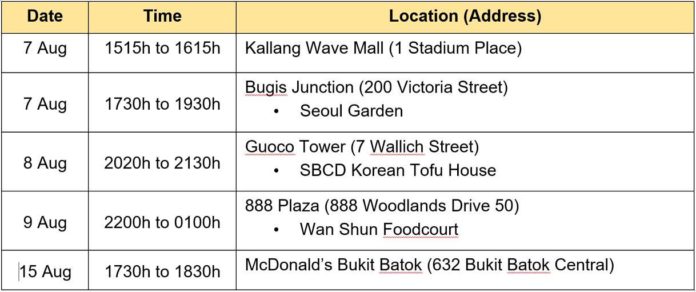
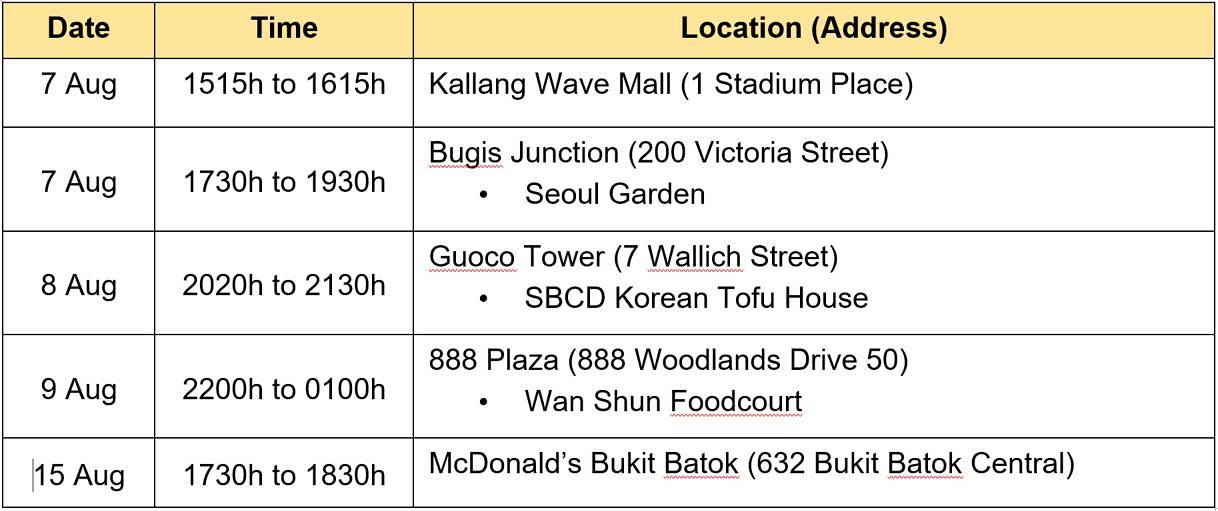
Seoul Garden at Bugis Junction was visited between 5.30pm and 7.30pm on Aug 7. The McDonald’s outlet at Bukit Batok Central was visited between 5.30pm and 6.30pm on Aug 15, said MOH.
Kallang Wave Mall, an eatery at Guoco Tower and a food court at 888 Plaza in Woodlands were also added to the list.
Kallang Wave Mall was visited on Aug 7, while the SBCD Korean Tofu House at Guoco Tower was patronised at Aug 8 and the Wan Shun Foodcourt on Aug 9.
Those who have been identified as close contacts of confirmed cases would already have been notified by MOH.
As a precautionary measure, however, individuals who were at those locations during the specified timings should monitor their health closely for 14 days from their date of visit, said MOH.
“They should see a doctor promptly if they develop symptoms of acute respiratory infection (such as cough, sore throat and runny nose), as well as fever and loss of taste or smell, and inform the doctor of their exposure history,” it added.
The ministry said there is no need for people to avoid places that have been frequented by COVID-19, and that the National Environment Agency will engage the management of the affected premises to provide guidance on cleaning and disinfection.
On Tuesday, Singapore reported 100 new COVID-19 cases, including one in the community and two imported infections. This takes Singapore’s tally of cases to 55,938, with fatalities remaining at 27.
The sole community case is a 39-year-old Singaporean man who works at a bus depot in a “non-public facing” role that does not entail interaction with commuters and bus captains, said MOH.
The man, who is currently unlinked to previous cases, was asympotomatic.
He was detected as part of MOH’s screening of all staff members in the public bus industry who work at depots and interchanges.
Meanwhile, the two imported infections are a permanent resident who returned to Singapore from India on Aug 6 and a dependant’s pass holder who arrived from India on Aug 10.
The remaining 97 cases reported on Tuesday are work permit holders living in dormitories.
SINGAPORE: After leaving travel company ezeego1 last February, Norman Chew was able to get through the year doing freelance consultancy work, organising tours and conducting interviews for a research team at the National University of Singapore (NUS).
The travel industry veteran in his 50s got a couple of job offers from headhunters and former clients, but he did not take them up as he felt they were not the right fit.
This year, however, with the NUS project put on hold and tourism gigs all but dried up because of COVID-19, Mr Chew says he has submitted about 1,000 job applications. These include submissions to companies outside the travel industry and those offering career conversion programmes through the Government.
He has not had any success in landing a new job.
“I’ve had to eat into my savings. It’s been frustrating – I can’t cut back on my expenses because I have commitments to take care of,” said Mr Chew, who had hired a maid to look after his father.
Like Mr Chew, Ms Drishti Mulani has sent out “lots of applications” – not just in her field of public relations but also in sales, recruitment and marketing.
She lost her job with HOOQ in April after the streaming service was liquidated.
“It (the job search) started slow but I feel there’s a lot more movement as of July and I’m on final round with a few companies now,” said the 32-year-old, adding that she is “extremely grateful” to be Singaporean because the situation would be much harder as a foreigner.
But it is still a challenge, she said, given the uncertainties surrounding the pandemic and the economy.
The number of job seekers hard hit by the battered labour market amid COVID-19 is growing, and more are vying for a smaller pool of positions, according to recruitment agencies.
Michael Page’s Singapore managing director Nilay Khandelwal said that his office saw a 30 per cent drop in vacancies between the first and second quarter of this year among companies they work with.
It has also taken about 20 to 25 per cent more time for a candidate to secure a job, he said, as employers have become more cautious about hiring.
“One of the reasons is the appetite has gone down, so you need more rounds to vet through a hire. The cost of mis-hiring can be quite costly,” Mr Khandelwal said, adding that the work-from-home situation also increases the time it takes for firms to go through the hiring process.
Robert Walters Singapore associate director of sales and marketing in the healthcare and supply chain sectors Wendy Heng said that she has received 15 to 20 per cent more applications per job compared to the beginning of the year.
This does not include resumes sent in through referrals, or sent to their general email inbox.
Within her portfolio, she has seen more CVs from marketers compared to sales executives, which she thinks is because companies tend to cut marketing roles first rather than frontline positions likes sales.
Data from jobs portals paint a further picture of how tough the employment market is currently.
According to a report by LinkedIn, the average number of applications per job posted on its site in July was nearly twice what it was at the start of this year, from around 40 to almost 80. Numbers began to jump in April.
And compared to pre-COVID-19 levels, the report said job seekers are more likely to apply for positions in a different industry, particularly those in the worst-hit sectors like construction and tourism.
Employment has slowed as well, noted the report, which was published on Aug 14. The hiring rate in Singapore shrunk by 5 per cent by end-July.
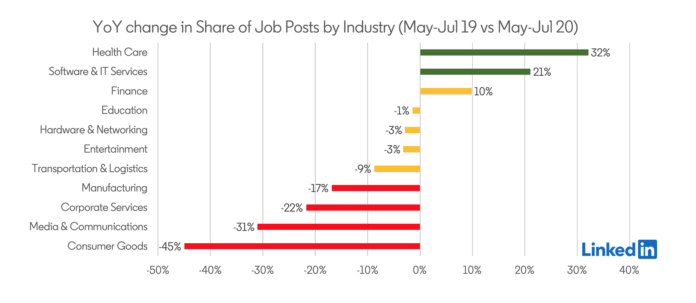
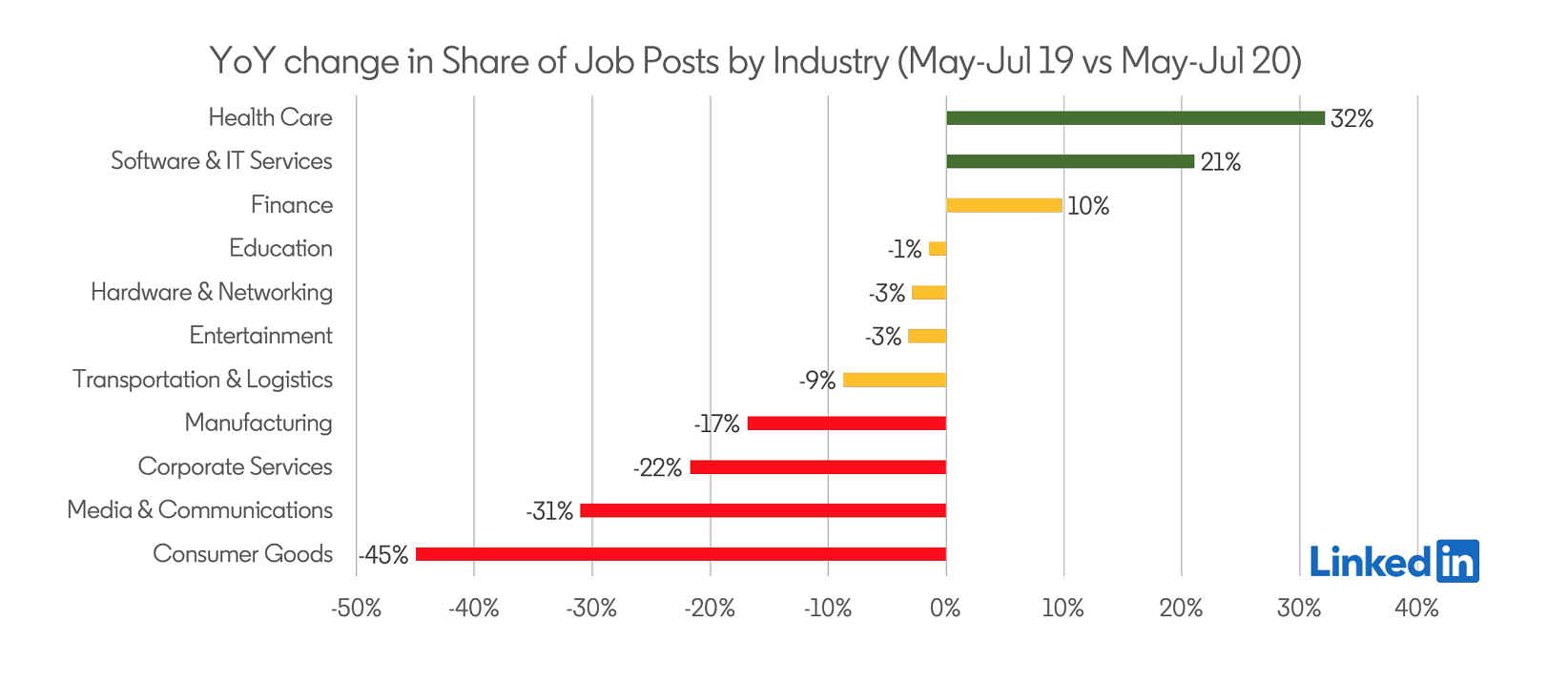
Job postings in consumer goods, media and communications, as well as corporate services saw the largest declines of -45 per cent, -31 per cent and -22 per cent respectively.
LinkedIn’s latest labour market report found that job postings in most industries have fallen.
Online jobs site Indeed has seen 35 per cent fewer job postings than what it normally expects at this time of the year, said its Asia-Pacific economist Callam Pickering.
Highly-skilled sectors like therapy, mathematics, marketing and media and communications have experienced a large fall in hiring activity as well, he noted.
“Labour market conditions in Singapore right now are the weakest we have seen since 2009,” Mr Pickering said.
“Job seekers are currently faced with the devastating combination of fewer job opportunities and greater competition for those available jobs.”
One company that has put hiring on hold is construction firm One Smart Engineering.
Its co-founder Er David Ng said it has not opened up any new positions since April, given the construction work delays and bleak industry sentiment.
But that has not stopped people from sending their resumes in. Mr Ng said the company has received applications from some engineers, including those who have lost their jobs. They have also seen more local engineers writing in compared to January.
A view of a deserted construction site in Singapore on Apr 20, 2020. (Photo: AFP/Roslan Rahman)
While his team has gone on a hiring freeze, Mr Ng said there are other contractors still looking for people and taking the opportunity to hire Singaporeans and permanent residents as more of them have entered the job market.
“Some players in the construction industry may be hiring not because business is good but more to rush to complete projects delayed by the circuit breaker and some new projects,” said Mr Ng, who is also a council member of The Institution of Engineers, Singapore.
Amid the soft labour market, some job seekers are turning to temporary positions.
Peter (not his real name) took on a six-month contract role at the end of July in a small architectural studio after a futile hunt for a permanent position.
Unhappy with the culture are his previous company, the architect left his job in February, certain that he would find another firm.
“I wasn’t very confident I would find something immediately, but I knew I wouldn’t be unemployed. I just never thought it would take such a long time,” the 38-year-old said.
He had sent out between 40 and 50 applications – each tailored to the company’s job description – and went for about 20 interviews, never getting any offers except for the role he is currently in.
Peter, who has been in the field for about a decade, is still looking. He has found himself lowering his expectations as the months drag on, applying for positions that require half the numbers of years of experience he has and of a lower pay grade.
Sometimes, he puts down a lower salary figure than what he used to get, for fear that he comes across as being over-qualified and “too expensive” for the position.
“You definitely find days when you question your self-worth … it can be overwhelming,” he said.
A former Resorts World Sentosa (RWS) employee, who wanted to be known only as JC, is working as a Lalamove delivery driver after being laid off in July from his support services role of nine years.
Apart from deliveries, the 39-year-old has been helping his parents with their preserved flowers business JC Everlasting Flora, which has also been doing poorly during this period, he said.
Income is one quarter of what he used to earn, JC added.
As a father of two children, aged two months and one-and-a-half years, with a car loan to service, JC said he is worried about his family’s future finances, although his wife, who is on maternity leave, is still on a payroll.
Peter and JC asked that their names be withheld as they are afraid their former employers would take action against them for divulging any information about the companies.
Singapore’s jobless rate, which surged to 2.9 per cent in the second quarter of this year, is set to rise further as both economists and the Government warn that conditions for workers will get worse.
Retrenchments more than doubled in the second quarter, while employment saw its sharpest quarterly contraction on record.
BRIGHT SPOTS
While general employment prospects are in the doldrums, there are a few sectors still hungry for manpower.
Both Mr Khandelwal and Ms Heng noted that technology specialists – the likes of software developers, data analysts and user experience designers – are still very much in demand, perhaps even more so as digital functions become more important during COVID-19.
Family offices, chipmakers and Chinese companies – as China is the first country to have stabilised the coronavirus outbreak – are other places that are more likely to hire right now, Mr Khandelwal said.
Openings can also be found in e-commerce and logistics, Ms Heng said, although most of them are looking for temporary couriers and packers than executives.
Similarly, LinkedIn found that job postings in healthcare and software & IT services have gone up – 32 per cent and 21 per cent respectively – year-on-year between May and July. This is likely driven by the need for additional medical staff due to the pandemic, and the faster pace digital transformation among businesses, said LinkedIn.
Robotics start-up Solustar is one employer still on the lookout for engineers to help develop one of its virus-related products.
“We are hiring because we have created a self-cleansing disinfectant robot called the Solubots Disinfectant Robot to support the fight against the COVID-19 pandemic,” co-founder and chief executive Louis Loo said, adding that he has seen more demand for disinfectant robots during this period.
They currently have four engineering and one administrative position to fill.
Fortunately, it has become easier for them to meet their headcount since February, Mr Loo said, adding that more applicants and candidates are now open to salary negotiations.
He has also seen applications increase tenfold. During this time last year, he used to receive only two to three applications from university graduates. Now there are 30 applications from those fresh out of school.
100,000 JOB OPPORTUNITIES
With business sentiment expected to remain dim for the rest of the year, the Government decided to step in with a job and career development strategy.
Announced in May during the fourth Budget, the SGUnited Jobs and Skills Package is a S$2 billion programme aimed at creating 100,000 job, attachment and training openings.
Under the initiative, individuals are encouraged to go for six- to 12-month courses to boost their employability, with a S$1,200 allowance to cover their expenses.
Mid-career individuals gets even more money – S$1,500 – if they study for sectors that will probably have job opportunities as the economy recovers, such as in technology and manufacturing.
Companies are offered a hiring incentive if they take in a person who underwent a re-training programme.
But Ms Heng said that a mid-career switch “is not so straightforward” for roles that require technical know-how.
“I think the government grants obviously help because if not companies would definitely not be open in the first place,” she said.
“But there’s only so much transferable skills set in my view, (and) I don’t necessarily think that you can look into switching in like a six-month time frame. You’re just not going to have the skill set nor the experience to do it.”
Some, like Zach (not his real name), will also not be keen to take it up despite the inability to find a full-time job.
The 32-year-old returned to Singapore from Australia last December after graduating from university as a mature student.
He has been getting by on temporary jobs and his freelance photography gigs since February, after he was laid off a month into an architecture firm when COVID-19 forced his bosses to prematurely end a project he was on.
But Zach is not about to give up his goal of becoming an architect.
“I won’t change careers right now because I know what I want,” he said.
Whether or not one needs help getting work right now, manpower industry players said that aside from being digitally savvy, soft skills like creativity and high emotional intelligence are all the more vital right now.
“When working in the digital space, soft skills are now even more important, as we need to work, collaborate and manage teams remotely,” said Feon Ang, LinkedIn Asia-Pacific vice-president of talent and learning solutions.
“Being open to reselling and upskilling in these areas will help professionals gain transferable skills that might be useful for the future, whether they are looking for a job, or adapting to working in their current one.”