Singaporeans may be getting used to Phase 2 life and the gradual lifting of restrictions, but we aren’t out of the woods just yet.
You’d never have guessed it from a video of a Sengkang coffee shop which has been making its rounds online though.
Reminiscent of pre-Covid-19 life, the 30-second clip, uploaded by a Facebook user on Tuesday (Aug 18) showed a gaggle of diners at the newly opened Food Hub at 455 Sengkang West Avenue.
A number of them were chatting with their masks off and appeared to be mingling between tables.
Also caught on camera was a group of four who were seated talking up a storm with three other men who were standing over their table. PHOTO: Screengrab/FacebookWriting that the diners were having a “Covid Party — Singapore style”, the user sarcastically added that they would “build herd immunity” and even tagged the police in his post.
SINGAPORE – The People’s Action Party on Wednesday (Aug 19) announced that it has reappointed Dr Janil Puthucheary as Party Whip and Ms Sim Ann as Deputy Party Whip.
Dr Janil has served as Party Whip since June 6 last year, having taken over the role from Trade and Industry Minister Chan Chun Sing, who was the previous Whip since September 2015.
He is currently Senior Minister of State for Health and Communications and Information, and an MP for Pasir Ris-Punggol GRC.
Ms Sim is currently Senior Minister of State for Communications and Information and National Development, and an MP for Holland-Bukit Timah GRC.
The role of a Party Whip is to ensure good communication in the party ranks, contribute to the smooth running of its parliamentary machinery and serve as disciplinarian.
The Whip also ensures the party’s MPs vote according to the party’s position. But at times, the Whip can “lift the Whip”, allowing party members to vote according to their conscience.
Separately, the Government Parliamentary Committees (GPCs) have also been formed, the PAP said in a press release.
In retail banks’ local functions, Singapore citizens account for seven in 10 of senior management roles, according to the Monetary Authority of Singapore’s (MAS) estimates.
However, across the country’s entire financial sector, Singaporeans make up about 43 per cent of senior management.
This reflects Singapore’s role as an international financial centre, MAS managing director Ravi Menon wrote in response to a letter to The Straits Times Forum page.
“As our financial sector attracts more regional and global HQ (headquarter) functions, it creates more good jobs and opportunities for Singaporeans.
“But it also means a higher proportion of foreigners in senior management in these functions as FIs (financial institutions) understandably draw from a global talent pool to fill these positions,” he added.
Even so, a “good number” of Singaporeans have assumed regional leadership roles, Mr Menon noted. More citizens are also taking on overseas positions, which is typically a prerequisite for such leadership positions.
In retail banks’ local functions, Singapore citizens account for seven in 10 of senior management roles, according to the Monetary Authority of Singapore’s (MAS) estimates.
However, across the country’s entire financial sector, Singaporeans make up about 43 per cent of senior management.
This reflects Singapore’s role as an international financial centre, MAS managing director Ravi Menon wrote in response to a letter to The Straits Times Forum page.
“As our financial sector attracts more regional and global HQ (headquarter) functions, it creates more good jobs and opportunities for Singaporeans.
“But it also means a higher proportion of foreigners in senior management in these functions as FIs (financial institutions) understandably draw from a global talent pool to fill these positions,” he added.
Even so, a “good number” of Singaporeans have assumed regional leadership roles, Mr Menon noted. More citizens are also taking on overseas positions, which is typically a prerequisite for such leadership positions.
SINGAPORE: A fall from height in June 2018 left J P Thanumadhya with multiple fractures in her spine, pelvis and ankles.
It took a year-and-a-half before her doctor gave her the green light to go back to work. But there was another hurdle to overcome.
“Even before the COVID thing, I was actually trying to go for interviews (but I) got rejected so many times,” said the 27-year-old. “Like (they would say) ‘okay, I’ll call you back’. But then I call them or message them back (and they would tell me) ‘sorry the position is closed’.”
She had applied for front-desk or receptionist roles, some of which required her to walk around at times.
Due to her injuries, Ms Thanumadhya cannot stand for too long, but she said this does not hinder her ability to work.
“I can still (walk), just not standing stationary at one place. Other than that I can do normal stuff. So I was actually a bit sad that I couldn’t get that kind of job,” she said.
She wanted to find work so she could be independent and depend less on her family members, especially since she has younger siblings her parents need to look after.
Finally, Ms Thanumadhya got a job in July as a call centre operator at Certis, working four days a week on a 12-hour shift as part of a 110-person team which phones people under quarantine to check on their temperature.
She was referred to the job by SPD, a charity serving people with disabilities in Singapore.
“After (I) got into Certis, I was actually a bit afraid (because if I sit for) too long I’m scared my leg will swell up,” said Ms Thanumadhya. “But actually it’s okay because they know my situation, so at times I tend to walk around then I come back and sit, so actually it helps the blood circulate.”
“So far it’s been very good, because the (people) here are very good, friendly and … I don’t have to strain (myself) so much when I’m working,” she added.
“I think it’s actually a very good start to come out from your own shell. I mean if you’re not going to help yourself, no one is going to help you.”
Ms Thanumadhya is one of two disabled individuals working at Certis, best known for its auxiliary policing services, under the security firm’s new disability campaign called “Breaking Barriers” launched on Wednesday (Aug 19).
Certis, which has 16,000 employees in Singapore, has existing disabled workers in other roles like aviation security operations and cash management.
Under the new initiative, Certis will work with SPD to employ disabled people and train security officers – many of whom patrol commercial buildings and transit hubs – on how to deal with disabled members of the public.
It will also conduct activities such as exercise classes online for Certis employees and SPD beneficiaries.
Certis’ senior vice-president and head of group human resources, corporate planning, communications and marketing Tan Toi Chia said his organisation had been working with SPD for about two years as part of its corporate social responsibility programme, and were discussing how they could work with each other.
Speaking during a virtual press briefing, he said the new initiative was the company’s way of encouraging mindsets towards disabilities to change and promoting more diverse hiring.
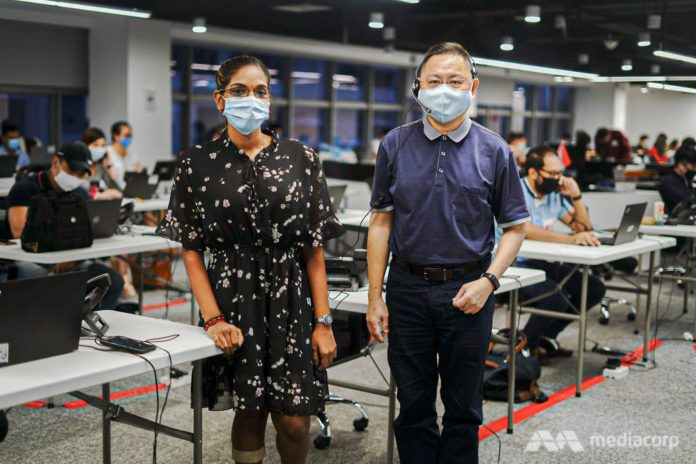
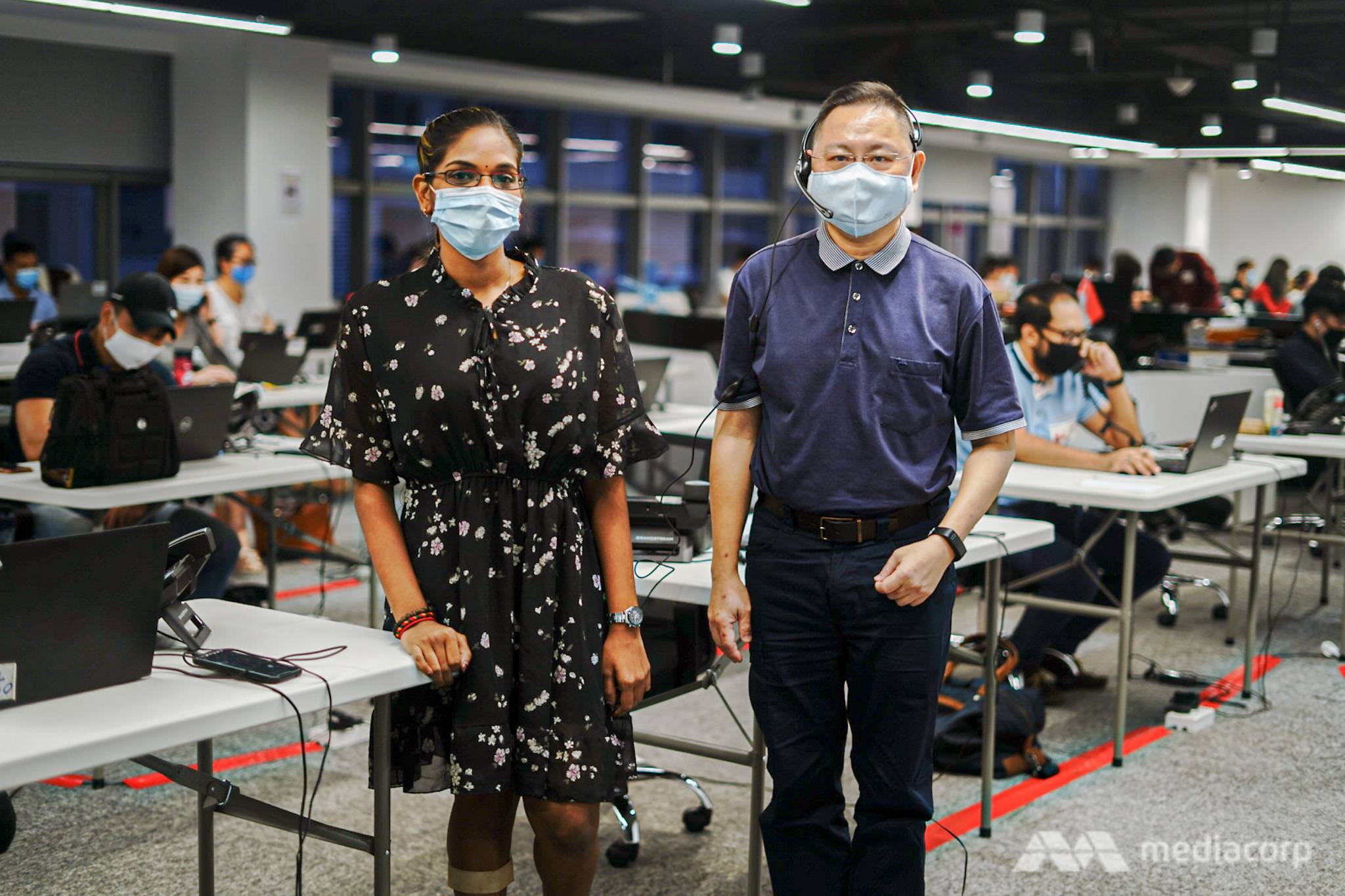
Ms Thanumadhya and Mr Loo are two job seekers who were hired as part-time call centre operators at Certis through the security firm’s partnership with SPD. There are 110 call centre operators in Certis. (Photo: Rachel Phua).
Ms Thanumadhya’s colleague Loo Poh Thye also took on his role as a Certis call centre operator through SPD.
The former sundry goods company manager suffered a stroke in May 2017 that affected the left side of his body.
Through SPD, Mr Loo initially found work as a part-time fulfilment packer last year, but he was laid off in April as the company’s bottom line was affected by COVID-19. He was brought into Certis in July.
The job, which pays S$12 to S$15 an hour, is about a fifth of what Mr Loo used to earn, but he said this was not an issue as both his children are grown up, and his wife works as a therapy assistant.
“As long as I can have a normal life …. I’m contented,” he said.
Both Ms Thanumadhya and Mr Loo were referred to SPD while undergoing rehabilitation at Tan Tock Seng Hospital.
So far, they are the only two who have gotten a job at Certis under the new initiative, but Mr Tan said they aim to hire more people with disabilities, and to offer them permanent positions.
This includes finding Ms Thanumadhya and Mr Loo fixed positions elsewhere in Certis once the call centre operations end.
“I think this next step we are taking with SPD … it’s really for us to completely rethink our jobs, when we hire, when we design jobs, that we allow for absolutely permanent hiring that is inclusive,” said Mr Tan.
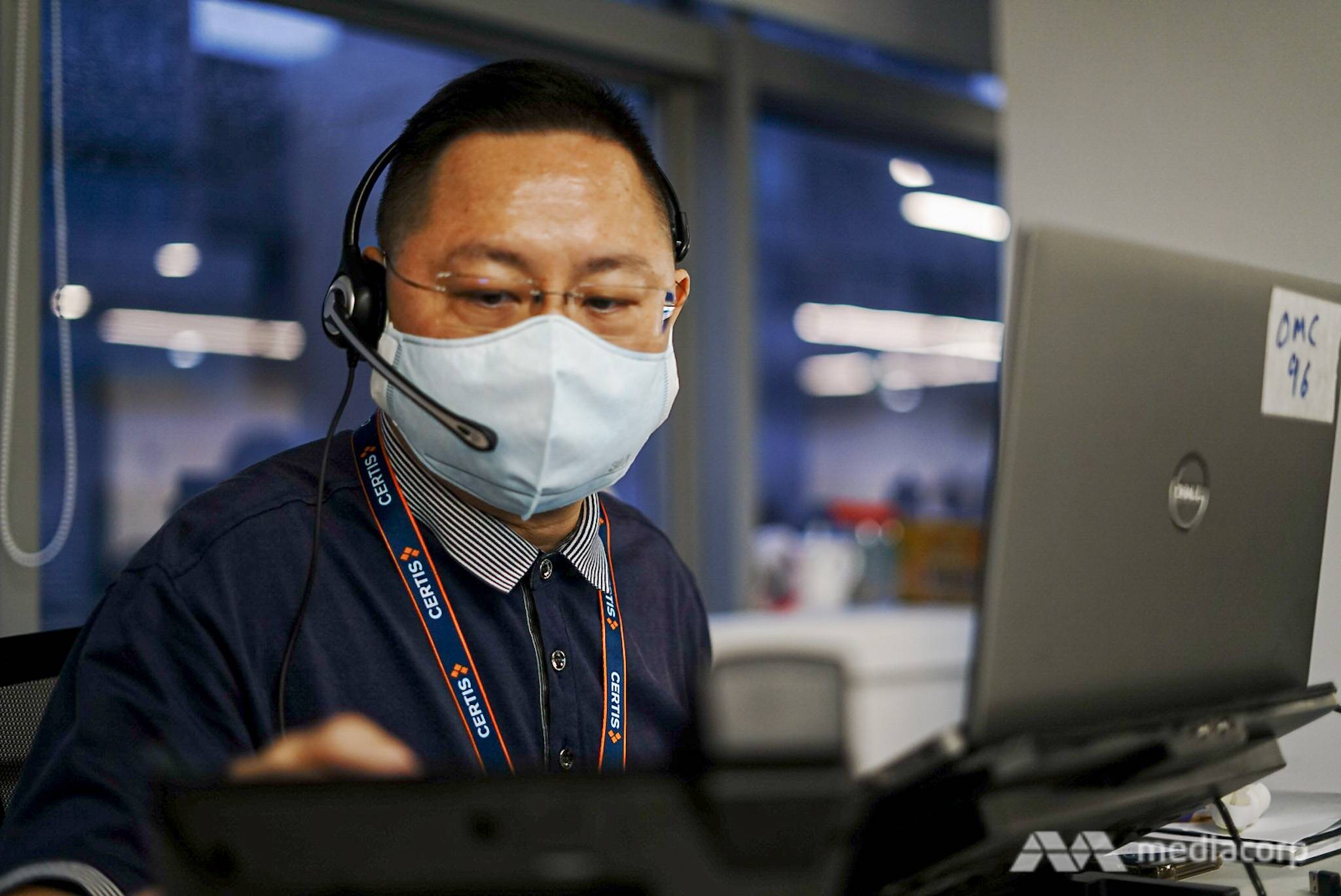
Loo Poh Thye was previous a part-time fulfilment packer but was off in April due to COVID-19. SPD found him this job at Certis. (Photo: Rachel Phua).
Mr Tan did not commit to a target regarding how many permanent roles would be created for people with disabilities.
He said: “If we insist on working on targets, what I’m very concerned about is we end up filling numbers for the sake of filling numbers.
“And we miss out on what truly matters – and that’s treating and giving opportunities for persons with disabilities to do the jobs with pride, confidence and positivity.”
Disabled job seekers face three types of barriers to employment, said SPD’s chief executive Abhimanyau Pal: The ability to commute to work, biased employers and access to technology.
COVID-19 has made it tougher for their beneficiaries to find jobs, he said, as companies are not prepared to accommodate them while everyone is working from home.
SPD is also having to address issues such as helping clients navigate virtual interviews, as they may not have the tools or know-how to handle them, added Teo Pek Wan, an acting director at SPD who oversees its adult and elderly services.
But COVID-19 could bring about some benefits as well, said Mr Abhimanyau.
“(It) makes us blind to disability because we are all working from home, we are accommodating to our new norms. So this probably will open new doors for our community.”
The Tripartite Alliance for Fair and Progressive Employment Practises (Tafep) is investigating an incident involving a part-time promoter at a pop-up booth that was located within Tangs department store after she was allegedly told by the staff to remove her hijab before she was allowed to work.
The incident was brought to light after her employer, Raine Chin, posted about the exchange on her Facebook on July 29.
So I just met a v unfair discrimination. With this department store everyone respects.
SINGAPORE: All dormitories have been declared cleared of COVID-19 as of Wednesday (Aug 19), including the standalone blocks in purpose-built dormitories serving as isolation or quarantine facilities.
All residents in the standalone blocks have either completed their isolation or quarantine, or been moved to other government facilities depending on their health status, the Ministry of Manpower (MOM) said in a press release.
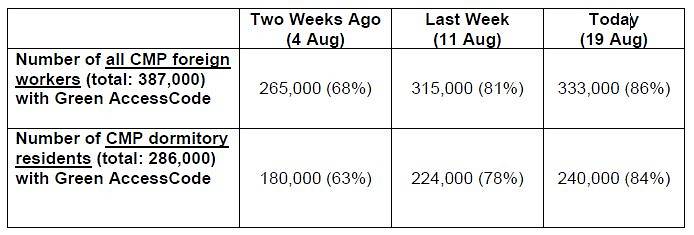
About 86 per cent of foreign workers in the construction, marine and process sectors have been allowed to resume work, up from the 81 per cent announced last week.
These are workers who have received the Green AccessCode indicating that they can return to their jobs.
“We expect the recently cleared dormitories to soon complete all the necessary preparations, with an additional 20,000 residents expected to have Green AccessCode,” said MOM.
“Half of these residents currently have Red AccessCode as their addresses are not updated. Reminders will be sent to dormitory operators and employers to update workers’ addresses accordingly.”
(Image: Ministry of Manpower)
Moving forward, MOM said it expects that there will always be a proportion of workers who have a Red AccessCode. This is due to several reasons such as a worker recently testing positive for COVID-19 and is undergoing treatment, or if the worker is a close contact of a positive case and placed under quarantine.
Workers may also have a Red AccessCode if they are placed on precautionary quarantine while authorities establish their exposure to a positive case, if they no longer have the TraceTogether app installed on their mobile device, or if they are required to undergo rostered routine testing (RRT) but did not do so.
“These occurrences are part of the overall system of ensuring compliance with RRT, and that any cases detected are contained, with contacts traced and the block or level of the dormitory isolated,” said MOM.
Rostered routine testing is among the measures authorities are taking to prevent a second wave of infections in cleared dormitories.
More than 100,000 migrant workers have started this routine testing, which is conducted biweekly, said MOM and the Ministry of Health on Tuesday in response to CNA’s queries.
Other measures include grouping migrant workers in dormitories according to the type of industries they work in, implementing safe distancing measures and conducting contact tracing once a new case is detected.
“Sector agencies will work closely with the employers to assess the risk at the workplaces and put in place safety timeouts if necessary,” said MOM, adding that “aggressive testing operations” will also be conducted when a new case is detected.
Whether there’s a pandemic or not, it is considered a blessing to have loved ones by our side to enjoy the good, as well as weather through tough times together.
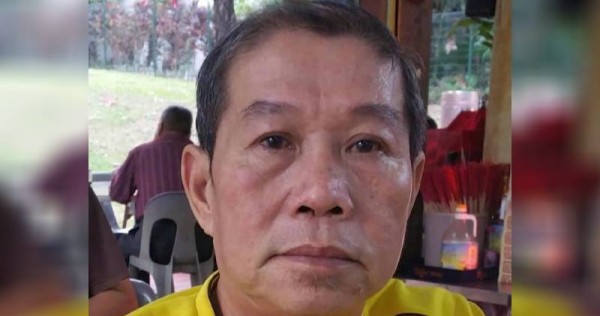
Some might not be as fortunate, like David Lim who recently died at his rented room alone.
A family friend who had passed on
Referring to the deceased as ‘Uncle David’, Alvin Ng recounted in a Dear all,
It is with deep regret that this uncle of mine, a close family friend to my family, had passed on at his…Posted by Alvin Ng on Friday, August 14, 2020″>Facebook post (Aug 15) that Lim was a close friend to his family.
A common source of aggravation for those seeking to rent in Singapore is the fact that some landlords are explicitly discriminatory along racial lines.
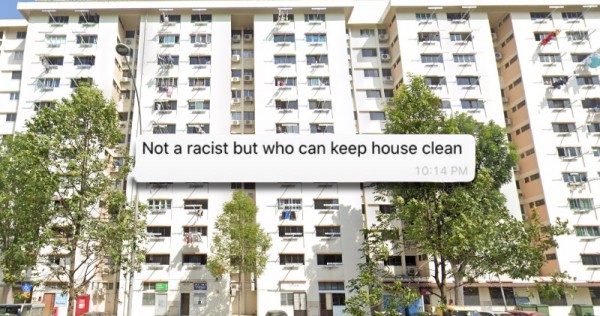
A woman who recently faced brazen bias while enquiring about a flat in Ang Mo Kio took to Twitter on Aug 16 to raise awareness about the issue after the property agent implied that Indians and Malays can’t keep houses clean.
This, despite the woman stating that she and her fellow renters consist of two Chinese and two Eurasian folks, all of whom are Singaporean.
The group had been interested in renting the entire four-room flat for a year — an abode that came fully-furnished and would cost $2,300 a month.
The property agent, however, first asked if they were of Chinese ethnicity as the landlord “rejects Indians and Malays”.
SINGAPORE: A new nature park network covering more than 400ha, triple the size of the existing Sungei Buloh Wetland Reserve, will be established in the northern part of Singapore, the National Parks Board (NParks) announced on Wednesday (Aug 19).
The Sungei Buloh Nature Park Network will comprise the Wetland Reserve, the Kranji Marshes, nature parks and eco-corridors, and nature areas such as Jalan Gemala and Kranji Reservoir.
The Mandai Mangrove and Mudflat will also be part of the network and projected to be completed in end 2022.
The network will be complemented by the upcoming recreational Round-Island-Route, which will connect the various green areas through trails and park connectors.
The nature park network will also include a new 18ha Lim Chu Kang Nature Park to the west of the Wetland Reserve, linking it to the Lim Chu Kang mangroves which is expected to be established by early 2022.
Artist’s impression of the terrace at Cashin House, which will be located in the new Lim Chu Kang Nature Park. (Photo: NParks)
The new nature park, formerly referred to as the Western Extension, will feature outdoor nature-play spaces to encourage children and youths to “spend more time outdoors and reconnect with nature” said NParks in a press release.
Cashin House, also located in the nature park, will be “enhanced sensitively for both natural and built heritage” and will be used for educational programmes. It will include new facilities such as an exhibition space, seminar rooms for workshops and a seaview terrace.
NParks will call a tender for works on Cashin House and its surrounding areas shortly, with construction expected to commence in the fourth quarter of this year and will be completed in early 2022, subject to the COVID-19 situation.
Artist’s impression of the visitor gallery at Cashin House, which will be located in the new Lim Chu Kang Nature Park. (Photo: NParks)
With the new nature park network, more than 15km of nature trails will also be open to the public.
In a virtual media briefing on Wednesday, NParks’ group director of conservation Adrian Loo said: “The Sungei Buloh Nature Park Network will be very important in extending our natural capital in our ‘City in Nature’ vision.”
“The network itself will extend the habitats available for wildlife, importantly for wildlife such as birds that migrate globally and use Sungei Buloh Wetland Reserves as a stopover.”
“It also allows for our park users and our residents to actually enjoy more parks and be close to nature, without impacting the core areas too much,” said Dr Loo, adding that the new network will help reduce the visitor pressure to the Sungei Buloh Wetland Reserve and Kranji Marshes, as well as Mandai Mangrove and Mudflat.
“Especially during the COVID-19 period, people are seeking solace or safe recreation in our parks as we have safe distance measures within these areas,” said Dr Loo.
Minister for National Development Mr Desmond Lee had announced in March that by 2030, there will be another 200ha of nature parks, which will act as complementary habitats and buffer nature reserves from urbanisation.
In the press release on Wednesday, NParks said that the decision to safeguard buffer zones and complementary wetland habitats around the Sungei Buloh Wetland Reserve was determined through “extensive research that established the ecological connectivity and complementarity between the sites”.
Kranji Marshes, a core habitat in the Sungei Buloh Nature Park Network, is one of Singapore’s largest remaining freshwater wetland. (Photo: Facebook/NParks)
For example, the Wetland Reserve and the Mandai Mangrove and Mudflat Nature Park are important refuelling sites for migratory shorebirds along the East Asian-Australasian Flyway.
“Wetland habitats also provide a wide variety of goods and services such as serving as a food source and nursery ground for numerous marine organisms, storing carbon and mitigating coastal erosion,” said NParks.
A total of 279 species of birds have been recorded in the Wetland Reserve and the surrounding complementary habitats, and conserving these “ecologically inter-dependent” areas in the nature park network will enhance the conservation of these birds and the associated ecosystems, it added.
.jpg "sengkang-4.jpg")