Home Blog Page 135

IN FOCUS: How urbanised Singapore is learning to live with its wildlife

0

SINGAPORE: On the way to dinner one Sunday evening, this journalist spotted five hornbills flitting across a road junction to rest in some trees – as much a part of the city landscape as the Velocity@Novena Square mall behind them and the lanes of traffic below.

In the housing estate just across the mall, oriental pied hornbills preening their black-and-white plumage and chomping on fruit with their curved bills are a regular sight. The large bird with a distinctive casque on its beak is hard to miss but for nearly a century, they were a rare sight in Singapore.

They vanished from Singapore in the late 19th century and the first recorded return of wild oriental pied hornbills was on Pulau Ubin in 1994. Dr Ho Hua Chew, a long-time conservationist, was among the Nature Society Singapore (NSS) members who spotted the birds back then.

“The bird is a spectacular species and being regarded as extinct in Singapore up to that date, it was a thrilling experience to see a comeback for such large forest species – especially two birds at that,” he said.

Dr Ho said the hornbill sighting instilled hope in him for nature conservation in Singapore, which for decades was “all gloom and doom” with the country’s nonstop construction and development.

Hornbill on Ubin

An oriental pied hornbill on Pulau Ubin. (Photo: Yong Ding Li) 

But following a conservation project to bring back the birds, hornbill sightings have become far more common.

By installing nest boxes in trees for the birds to breed in, the Singapore Hornbill Project’s collaborators, who include the National Parks Board (NParks), Wildlife Reserves Singapore (WRS) and researchers, got visiting birds from neighbouring countries to settle here and raise their babies.

The hornbills are an eye-catching example of the many projects in Singapore aiming to preserve what is left of its biodiversity in an urbanised landscape – a movement that has grown gradually over the last couple of decades. 

These include not just species recovery initiatives, but also efforts to restore habitats and connect them through nature ways – routes planted with specific trees and shrubs to facilitate the movement of animals. Many of these projects are part of Singapore’s continually updated green master plans.

Hornbills in Novena

An oriental pied hornbill rests on a tree near a condominium in Novena. (Photo: Guy Hoh)

Dr Yong Ding Li, ornithologist and scientific adviser for the Nature Society’s bird group, estimates that the population of oriental pied hornbills here has been expanding steadily in the last two decades and now number in the “low hundreds”.

The birds, which live on the forest fringes, have established themselves sufficiently and there is now no need to intervene, according to Mr Lim Liang Jim, group director of NParks’ National Biodiversity Centre. NParks’ greening efforts have contributed to this, as there are now enough mature trees for birds which nest in tree holes – like the hornbills and parrots – to breed in.

Dr Yong added: “I think there’s a role that greening has played in allowing hornbills to recolonise the main island. Now the interesting thing is that on mainland Singapore, the hornbills are largely not in our central nature reserves.”

OTTERS RETURN

Otters Singapore

A family of otters in Singapore. (Photo: Facebook/OtterWatch/Tan Yong Lin)

The return of such wildlife is a side effect of policies that can be traced back to founding Prime Minister Lee Kuan Yew’s vision to green Singapore and clean up its waterways – efforts which were meant to improve the welfare of the island’s human inhabitants and to enhance Singapore’s reputation abroad.

Environmental activist and National University of Singapore biology lecturer N Sivasothi said that the city’s smooth-coated otters found that Singapore’s clean waterways, some of which have been naturalised, also suited them.

“So the river cleanup was not about supporting wildlife, it was about providing clean water for people,” he said. “Although otters were missing in Singapore for a few decades, as we cleaned up for people … suddenly they were seen.”

But not every species can thrive in an environment built for people, and as Singapore continues to develop, will there be room for wildlife?

Asian small-clawed otters, part of the 14 birthed at the Singapore Zoo and Night Safari, gather dur

Asian small-clawed otters, part of the 14 birthed at the Singapore Zoo and Night Safari, gather during feeding time during a media tour to showcase newborn animals at the Singapore Zoo January 11, 2018. REUTERS/Edgar Su

For instance, the urbanised smooth-coated otters’ prominence is in contrast to the fate of its rural cousin, the small-clawed otter.

“(The small-clawed otter is) a small mangrove stream-dwelling kind of animal. The modified environment it can deal with is maybe padi fields, but it can’t deal with modified urban environments, so its fate is hanging in balance in (Pulau) Ubin and Tekong,” said Mr Sivasothi.

Much of Singapore’s wildlife are hidden in the pockets of forest that remain in the heart of Singapore, and some, like small-clawed otters, persist on the north-east islands.

“What happens is the urban adapted species are prominent but the ones that cannot hack it, you don’t see,” said Mr Sivasothi. 

“If you talk about wildlife conservation, ultimately what must you do is conserve habitat. We should invest a lot of effort into restoring, recovery and then connecting (them).”

READ: Sungei Buloh Nature Park Network to be established, includes new Lim Chu Kang Nature Park

READ: Singapore to plant 1 million trees, develop more gardens and parks by 2030

That effort to conserve, restore and connect natural habitats is a major part of the City in Nature vision, announced by National Development Minister Desmond Lee in March.

On Wednesday, NParks announced new plans to create a 400ha nature park network that will envelop the Sungei Buloh Wetland Reserve, the Kranji Marshes and other nature areas – in another step to protect Singapore’s four nature reserves.

Kranji Marshes are part of Sungei Buloh Nature Park Network

Kranji Marshes, a core habitat in the Sungei Buloh Nature Park Network, is one of Singapore’s largest remaining freshwater wetland. (Photo: Facebook/NParks)
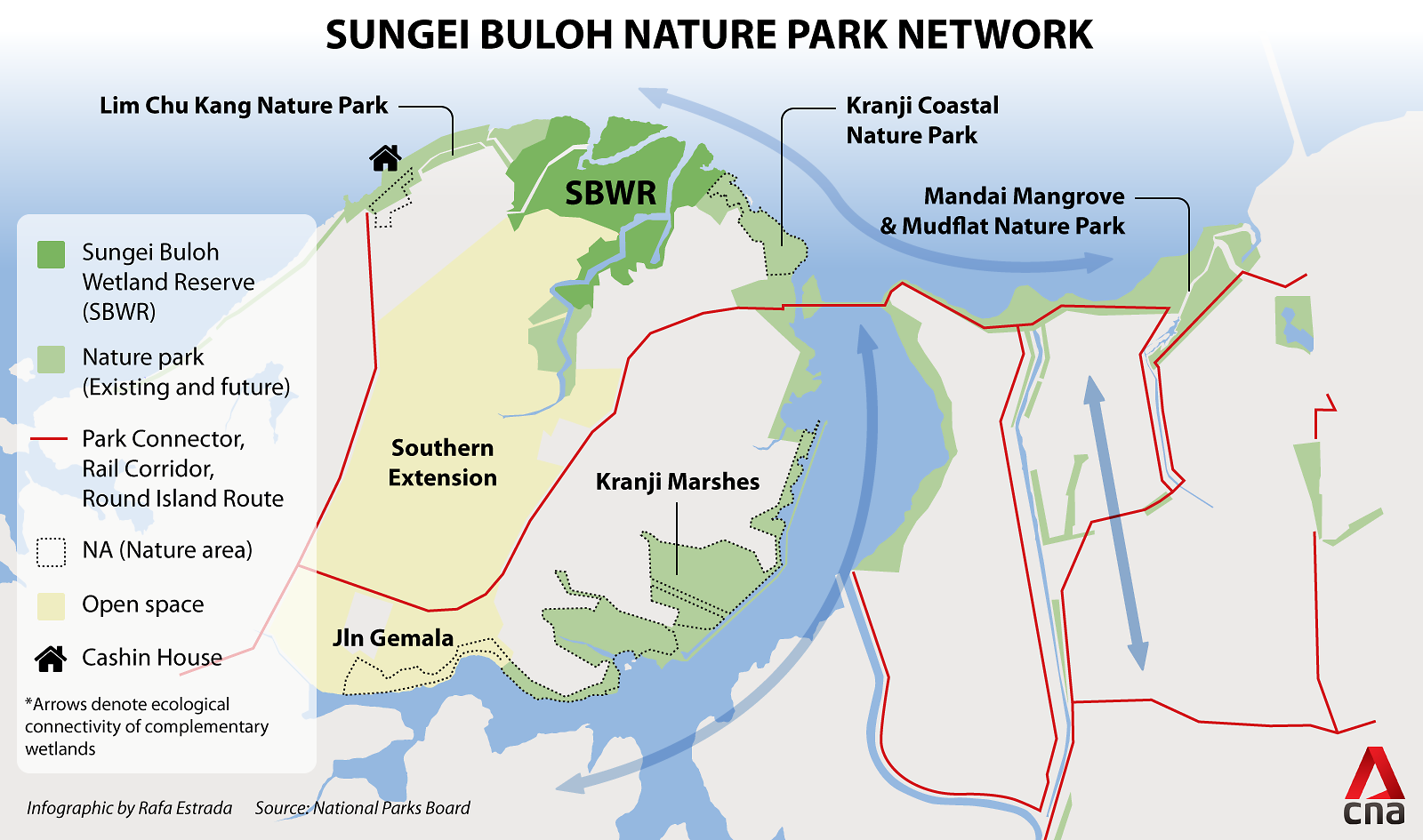
Sungei Buloh Nature Park Network infographic

(Infographic: Rafa Estrada)

A network of buffer parks has already been added to Singapore’s Central Catchment and Bukit Timah Nature Reserves. These buffers protect the central nature reserves from developments that abut them and give the public alternative green spaces to visit so as to ease pressure on the reserves.

The development plans for Sungei Buloh take into account its role as a key node for migratory waterbirds along a flyway that stretches from the arctic to New Zealand – a science-based and ecologically friendly approach that is increasingly evident as Singapore tries to protect what is left of its natural heritage.

“IF YOU LOSE THEM HERE, YOU LOSE THE WHOLE WORLD’S POPULATION”

As the sky lightened and the forest awakened, bird calls and macaques’ chatter punctuated the keening of cicadas at the Bukit Timah Nature Reserve. In ever-changing Singapore, this patch of primary rainforest is a reminder of what much of the island looked and sounded like 200 years ago.

On any given day, the park is filled with hikers and panting joggers labouring up and down its slopes, but few see most of the flora and fauna that call it home.

One of them – the Johora Singaporensis, freshwater crabs found only in Singapore – infamously made it onto a list of the 100 most endangered species in the world. Its tiny population of a few hundred is found in fast-flowing streams on hills, of which there are only a handful here.
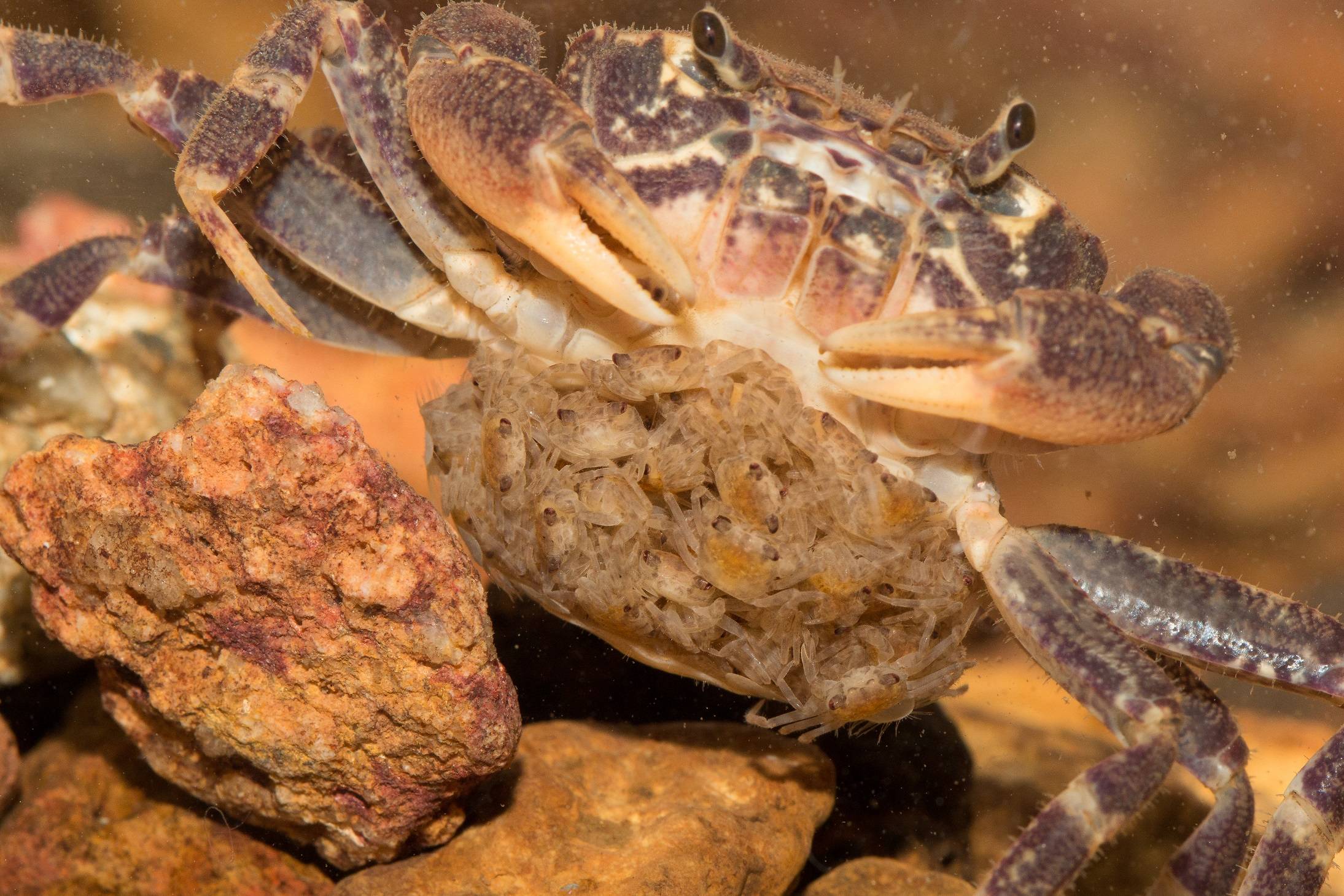
Singapore freshwater crab Johora Singaporensis

A female Singapore freshwater crab (Johora singaporensis) carrying a brood of crablets. The species is critically endangered. (Photo: National Parks Board)

The Singapore freshwater crab has already vanished from a hill stream in Bukit Timah Nature Reserve where it was first discovered in the 1980s, a turn of events that sounded the alarm for researchers years back.

“They’re unique to Singapore. That means, if you lose them here, you lose the whole world’s population,” said Associate Professor Darren Yeo, a freshwater ecology expert at the National University of Singapore’s (NUS) department of biological sciences.

READ: Babies of critically endangered Singapore Freshwater Crab hatched in captivity

A concerted effort to save the pebble-sized invertebrate was mounted in 2015 by NParks, WRS and NUS, leading to more than 100 crabs being released in the wild. The crab population has likely increased in recent years due to successful breeding programmes and translocations, said NParks.

But the fate of the species remains precarious because its habitats are so limited. Research on its ecology is now ongoing to investigate possible threats to the species in the wild, such as stream acidification and drought, possibly due to climate change, said Assoc Prof Yeo.

The crab, described by Assoc Prof Yeo as a “little brown thing” more comfortable scuttling under rocks than being the centre of the media spotlight, is one of the lucky ones.

“A HERCULEAN EFFORT”

A 2003 study found that Singapore had already lost about 28 per cent, or 881 of 3,196 recorded species, in 200 years without much fanfare. The main reason was habitat loss, after more than 95 per cent of the island’s forest cover was lost to agriculture and later, urban development.

Bukit Timah Nature Reserve

File photo of Bukit Timah Nature Reserve. 

As many species here could have been lost before ever being documented, by referencing species found in Malaysia, the study’s authors inferred that the true extinction rate could have been as high as 73 per cent.

The study also estimated that forest reserves covering only 0.25 per cent of Singapore’s area hold more than 50 per cent of the native biodiversity left.

READ: 40 species potentially new to Singapore discovered in Bukit Timah Nature Reserve survey

READ: 150 hatchlings born last year at Singapore’s only turtle hatchery: NParks

But efforts to conserve Singapore’s biodiversity has come some way since, and hundreds of plants and animals have been discovered or rediscovered here since 2013, as surveys of wildlife proliferated.

“It’s really a Herculean effort to bring all this back … Before we know what to bring back, we realised that we had to first find out what’s there,” said NParks’ Mr Lim, Over the last seven years, surveys have discovered or rediscovered more than 500 new species, he said.

Numerous projects to conserve key species, including the Singapore freshwater crab, sea turtles and indigenous plants like the Singapore ginger, were also started over the years.

Then, the 2003 study’s authors called some surviving species the “living dead” – including the white-bellied woodpecker, the cream-coloured giant squirrel and the banded leaf monkey – as their numbers were deemed too small to be viable in the long term.

READ: ‘Can’t wait until it’s too late’: Wildlife Reserves Singapore ramps up breeding efforts for endangered species

The cream-coloured giant squirrel has not been sighted here since 1995, and Dr Yong told CNA that he last saw the white-bellied woodpecker – Singapore’s largest woodpecker – in 2001. The presence of the white-bellied woodpecker and a diverse woodpecker community are indications of forest health, as they need good forests with tall trees to survive, he added.

“The majority of forest animals will be in decline just because the forests are too small, but we can help by trying to create corridors to connect the different forest fragments.”

An aerial shot of the Eco-Link@BKE, the first ecological bridge of its kind in Southeast Asia

An aerial shot of the Eco-Link@BKE, the first ecological bridge of its kind in Southeast Asia. (Photo: NParks)

He calls the Eco-Link – a highway for animals built in 2013 – one of the most important conservation actions that Singapore has ever taken, as it connects the Bukit Timah Nature Reserve and the Central Catchment Nature Reserve, which were bifurcated by the Bukit Timah Expressway (BKE) in 1986.

WHEN WILL THEY REACH THE “TIPPING POINT”?

Despite the challenges, primatologist Andie Ang is trying to bring the banded leaf monkey, also known as the Raffles’ banded langur, back from the brink of extinction.
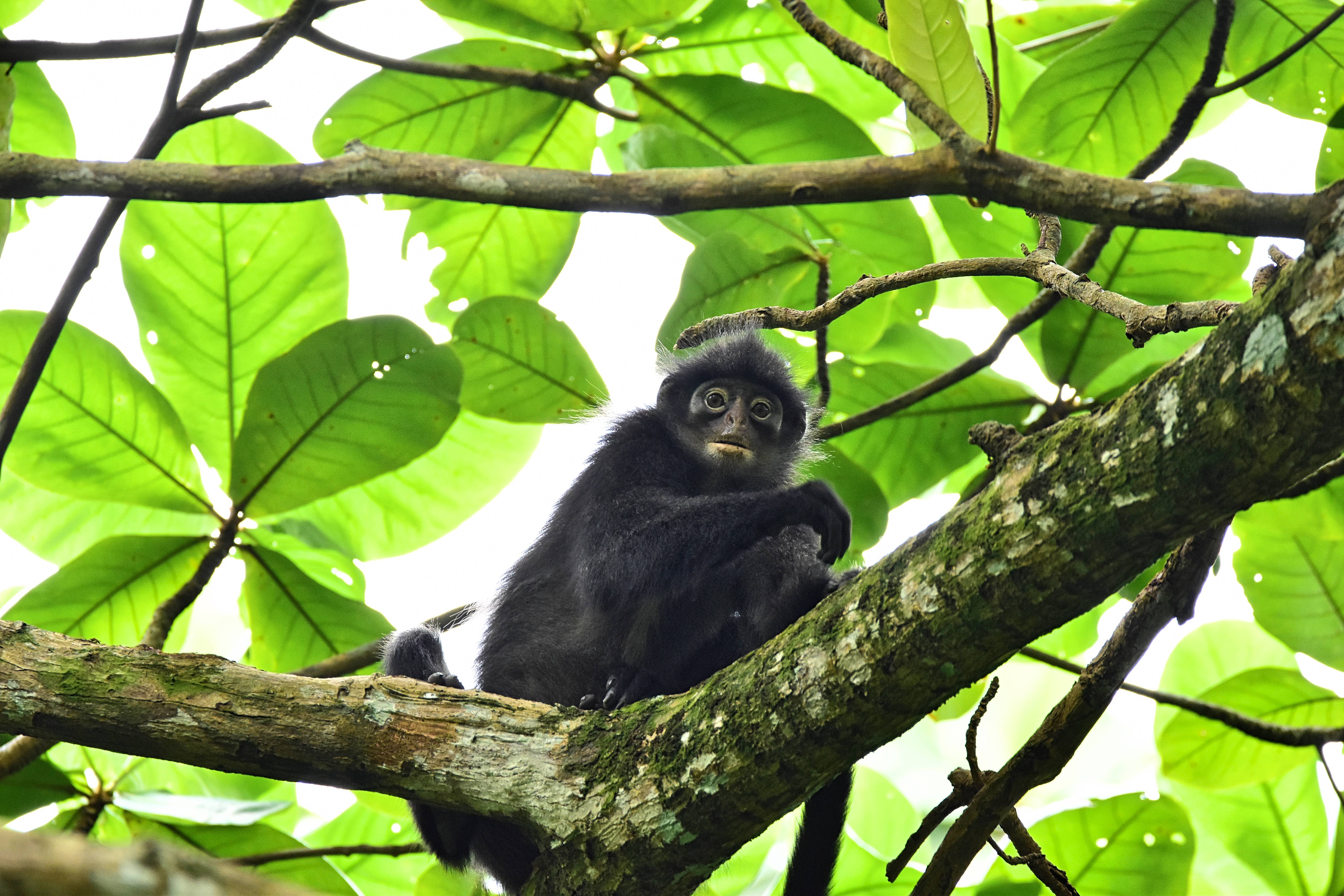
Raffles’ Banded Langur

There are only about 60 Raffles’ banded langurs left in Singapore. (Photo: Jeanne Tan)

Up until the 1920s, the langur was found in many parts of Singapore, including Tuas, Bukit Timah and Changi, before development claimed most of its habitats. Unlike the more common long-tailed macaque, the shy creatures have found it hard to adapt to a Singapore with little forest cover.

The last banded leaf monkey in the Bukit Timah Nature Reserve was believed to have been mauled to death by a pack of dogs in 1987, leaving the Central Catchment Nature Reserve as the last stronghold for the primates. Studies on them were few and far between but in 2008, a survey found about 40 langurs left here.

Twelve years on, Dr Ang, who leads research and conservation efforts for the banded leaf monkeys, estimates that their numbers have increased to more than 60 in Singapore.

Raffles' banded langur

A Raffles’ banded langur leaping from a tree near Thomson. (Photo: Bernard Seah)

With the slight increase in population, a group of bachelor monkeys tried to make their way back to Bukit Timah a few years back but one died in a road accident on BKE. While other animals have used the Eco-Link that now connects the two forested areas, the monkeys have yet to figure this out, said Dr Ang, a research scientist at the WRS Conservation Fund. 

“They’re always facing pressure in terms of where they can go and where they can remain,” she added.

Given their small numbers, just one catastrophic incident, such as a heavy storm or a fire, can eliminate all the langurs. A disease or inbreeding may also wipe out the population, which DNA analysis has shown to have low genetic variability.

“With an inbred population, it takes time for signs to show and it also takes time before the population would crash suddenly, so I’m just afraid when they are reaching that tipping point,” said Dr Ang.
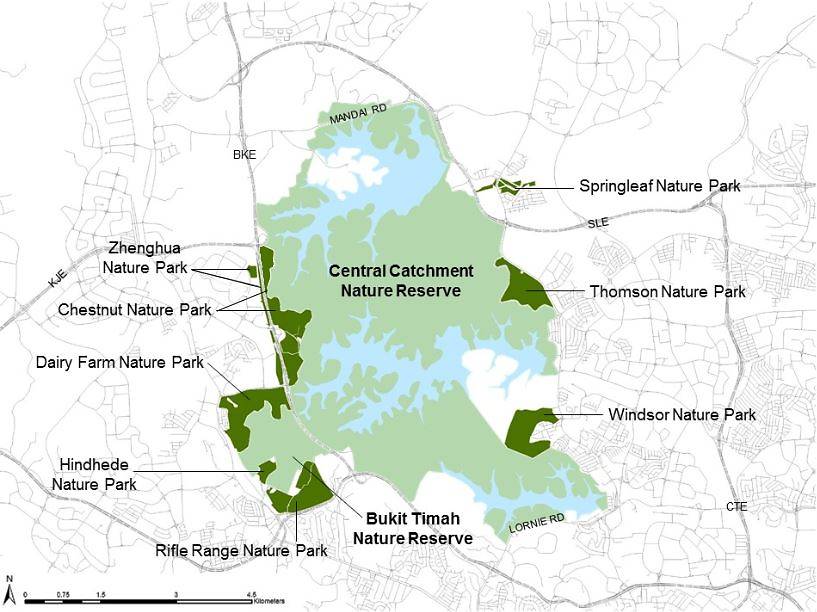
Central Catchment Nature Reserve and buffer parks

Buffer parks around the Central Catchment Nature Reserve. (Image: National Parks Board)

The bachelor group of monkeys has settled in Windsor Nature Park, one of the buffer parks created on the edges of the nature reserves to protect the core areas from further disturbance.

READ: NParks unveils 10-year action plan to make Singapore’s rainforests more resilient

READ: Three coastal areas proposed for conservation in Singapore Blue Plan

But Dr Ang fears that they will be affected by works for the upcoming Cross Island Line, which would lead to the clearing of a part of their habitat which is not protected as it is outside the nature reserve.

Discussions with the Land Transport Authority (LTA) are ongoing to safeguard the flora and fauna in the area when construction of the line begins, the authority said.

SMALL FORESTS, HIGH STAKES

That discussion is a continuation of an engagement process that has been going on since 2013 when plans for the MRT line – which could have gone under or around the Central Catchment Nature Reserve – were first announced.
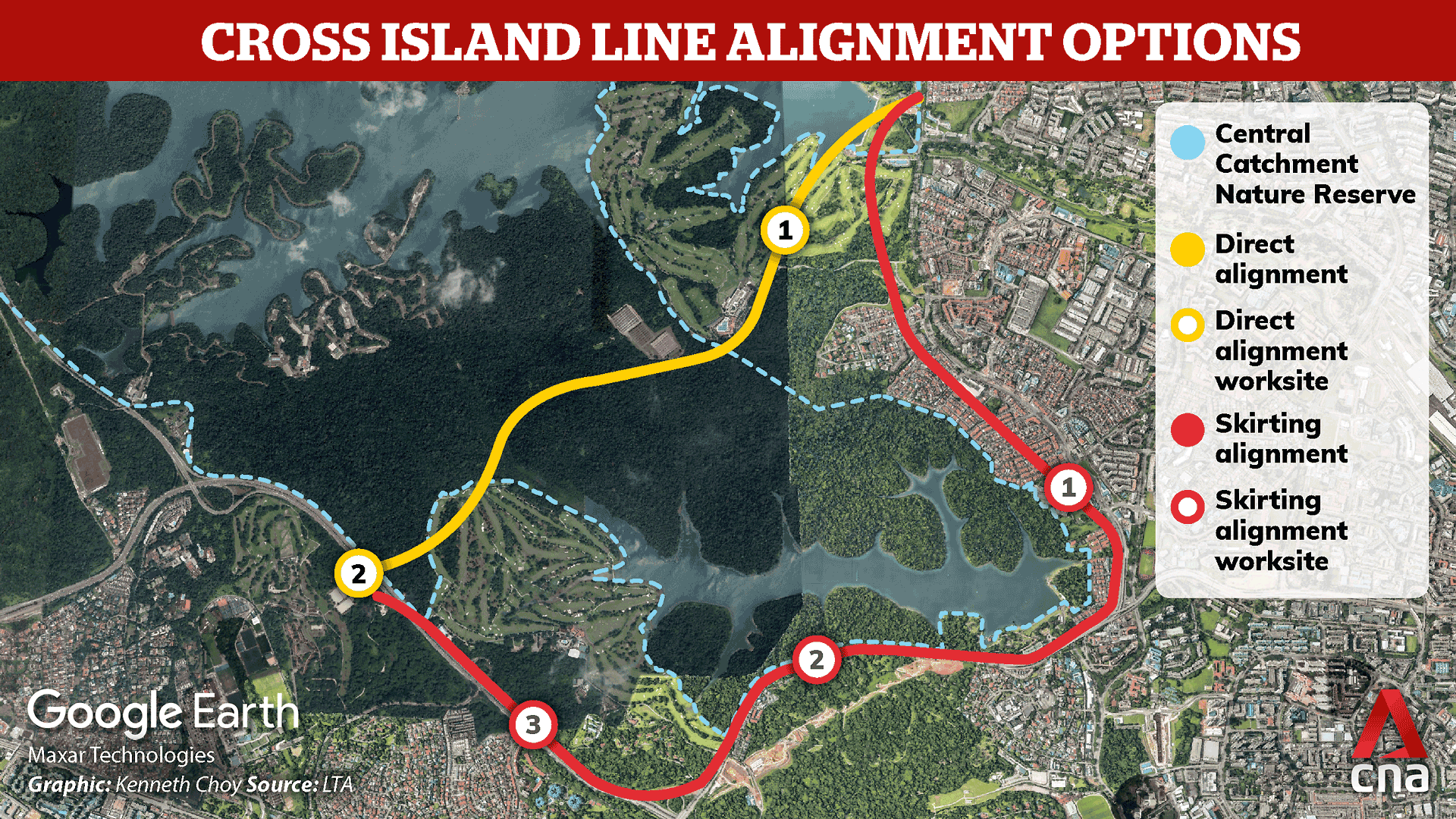
Cross Island Line proposed alignments - map

Proposed alignment options for Singapore’s Cross Island Line.

Said Mr Sivasothi, who has been actively involved in the engagement: “Our local species are all locked up in the nature reserves, which is why we are so energetic when it comes to engagement because you make one slip-up – the damage, the impact is extremely high.”

Highlighting the fragility of the nature reserve, Mr Sivasothi said that when environmental impact studies were being conducted, the companies employed were not used to the small size of Singapore’s forests and the minor disturbances that could tip the balance.

“The scale at which we are telling them they have to take into account – they’ve never really faced before – it’s like a macro-scale to a nano-scale,” he said.

After years of debate and consultation, it was announced in December 2019 that the line will tunnel under the nature reserve but go 70m deep, instead of the usual 20 to 30m. There will be no surface work sites in the nature reserve to ensure that flora and fauna will not be affected.

READ: Cross Island Line to take direct route under Central Catchment Nature Reserve

READ: Six years in the making – how the Cross Island Line’s direct route was decided

While not everyone was satisfied with the final decision, there was a definite desire for a constructive outcome and a “willingness to listen”, said Mr Sivasothi.

Nature Society president Shawn Lum credits the LTA for committing to a long engagement with nature groups early on and being open to trying new technology to get the MRT line built while reducing the impact on the nature reserve.

“They, of course, had certain constraints on how that line could be built, but the fact is that, really, through the engagement LTA … changed the way they did much of their work and so the nature reserve was able to escape from the worst kind of impact,” he said.

It is a stark example of how Singapore’s conservation plans have to face the concrete reality of its limited space, the need to accommodate more than 5 million people and the relentless race for economic growth. The process also highlights the tussle between conservation and urban development that has played out over the years in the give-and-take between authorities and environmental activists.

FROM CONSERVATION TUSSLES TO ACTIVE ENGAGEMENT

Sungei Buloh Wetland Reserve birds

A pair of great-billed herons at the Sungei Buloh Wetland Reserve. More than 270 species of birds have been recorded in the reserve and the surrounding habitats. (Photo: Bernard Seah)

The kernel of the Sungei Buloh Nature Park Network started in 1989, when a group of birdwatchers and nature lovers successfully lobbied the Government to set it aside as a nature park. It was the first time Singapore had set aside land for nature conservation since its independence – but it was the exception rather than the norm for many years to come.

Dr Ho, who has been involved in conservation work since the mid-80s, was among those who helped save Sungei Buloh. He recalls how a petition with 25,000 signatures a few years later in the early 1990s could not budge the authorities’ resolve to build Housing Board flats in Sembawang over the Senoko Wetlands – then home to endangered resident and migratory birds.

The freshwater pond at Sungei Buloh Wetland Reserve's visitor centre

The freshwater pond at Sungei Buloh Wetland Reserve’s visitor centre. (Photo: Facebook/NParks)

But despite such setbacks, continued pressure from nature activists convinced the authorities to take them seriously, even as popular support for nature and cultural heritage conservation grew over the years, Dr Ho said.

READ: Bill to amend Wild Animals and Birds Act introduced in Parliament

READ: Strong support for tougher wildlife protection laws in Singapore: Survey

There were two big conservation tussles which he believes helped to turn the course of the engagement process with the authorities – the Chek Jawa wetlands on Pulau Ubin and the Bukit Brown cemetery.

“What followed from these two fierce/heated tussles was that the authorities became more friendly and willing more to listen and understand our positions,” he said in an email.

Dr Lum said that there has been a more systematic effort to include feedback from various communities, including the nature groups, on major infrastructural projects in the last decade or so. While there was always a pipeline for feedback, it used to be more informal.

Besides the Cross Island Line, he cites the development of the Rail Corridor as an example of how the Urban Redevelopment Authority took on the community as a partner in developing plans for railway land that was returned to Singapore in 2011.

Dr Lum believes that with more people with different backgrounds and expertise involved in the planning and urban development process, better outcomes can be reached.

“I think if you took all these great ideas, and these technically skilled people who have know-how in whatever – engineering and building, modelling and nature – we might be able to do something that no one agency or no one institution or individual could have thought possible,” he said. 

“But in order to tap into that expertise, the discussions have to start really early and not necessarily unveiled as this plan that just needs a fine touch at the end.”

EVOLUTION, NOT REVOLUTION

Mr Lim of NParks’ National Biodiversity Centre said that the change in approach over the years has been organic.

“It was very evolutionary, it wasn’t revolutionary. But essentially, there was a recognition, I think for quite some time already … that the community has to be involved,” he said.

tree planting by volunteers

Volunteers from Keppel Corporation planted trees of various wetland species, such as the Cicada Tree, Cheng Tng Tree and Abu-abu Air Tree. This photo was taken before the COVID-19 pandemic. (Photo: NParks)

It is not just the approach to engagement, the evolution in Singapore’s relationship with the natural environment can be summed up in its slogans over the years – from “Garden City” to “City in a Garden” to now, a “City in Nature”.

Explaining the significance of this, Mr Lim said: “We are now looking at nature as really being part of a very critical relationship with people … simply because we recognise now that nature – flora, fauna, habitats and ecosystems – play an important role (in) imparting resilience to the community, to human individuals, to society, to nations.”

There is now an understanding that having more natural ecosystems, rather than controlled green spaces is important for ecological and climate resilience, said Mr Lim. There is even scientific evidence that being in a more biodiverse environment improves mental well-being, he added.

Nature Way NParks

A Nature Way in Pasir Ris, which is planted with trees and shrubs to facilitate the movement of animals like birds and butterflies between green spaces. (Photo: NParks)

Of the seven strategic thrusts of the City in Nature vision, conserving and restoring natural ecosystems is the first. Other key thrusts include restoring nature into the built environment and establishing connectivity between green spaces islandwide – for humans and for wildlife. 

It has come a long way from 1967 when then-PM Lee Kuan Yew announced that Singapore was to become a “garden city beautiful with flowers and trees, and as tidy and litterless as can be”, as reported in the Straits Times.

Getting the community engaged, in particular young people, is another key thrust. Mr Lim said he is seeing more interest in nature conservation, and many people, young and old, committing their time and expertise to NParks’ community programmes.

“IT ALL BEGINS WITH UNDERSTANDING THE NATURAL WORLD”

At Commonwealth Secondary School, students have been learning in an environment which is a microcosm of Singapore’s natural habitats – from a rainforest to a wetland, and a freshwater stream. It is one of 42 schools in NParks’ Greening Schools for Biodiversity Programme, which helps schools plant native flora and create habitats for more wildlife.

The animals that stop by the school became learning opportunities, such as when a reticulated python was found in a school corridor or when a pair of olive-backed sunbirds built a nest there this year.
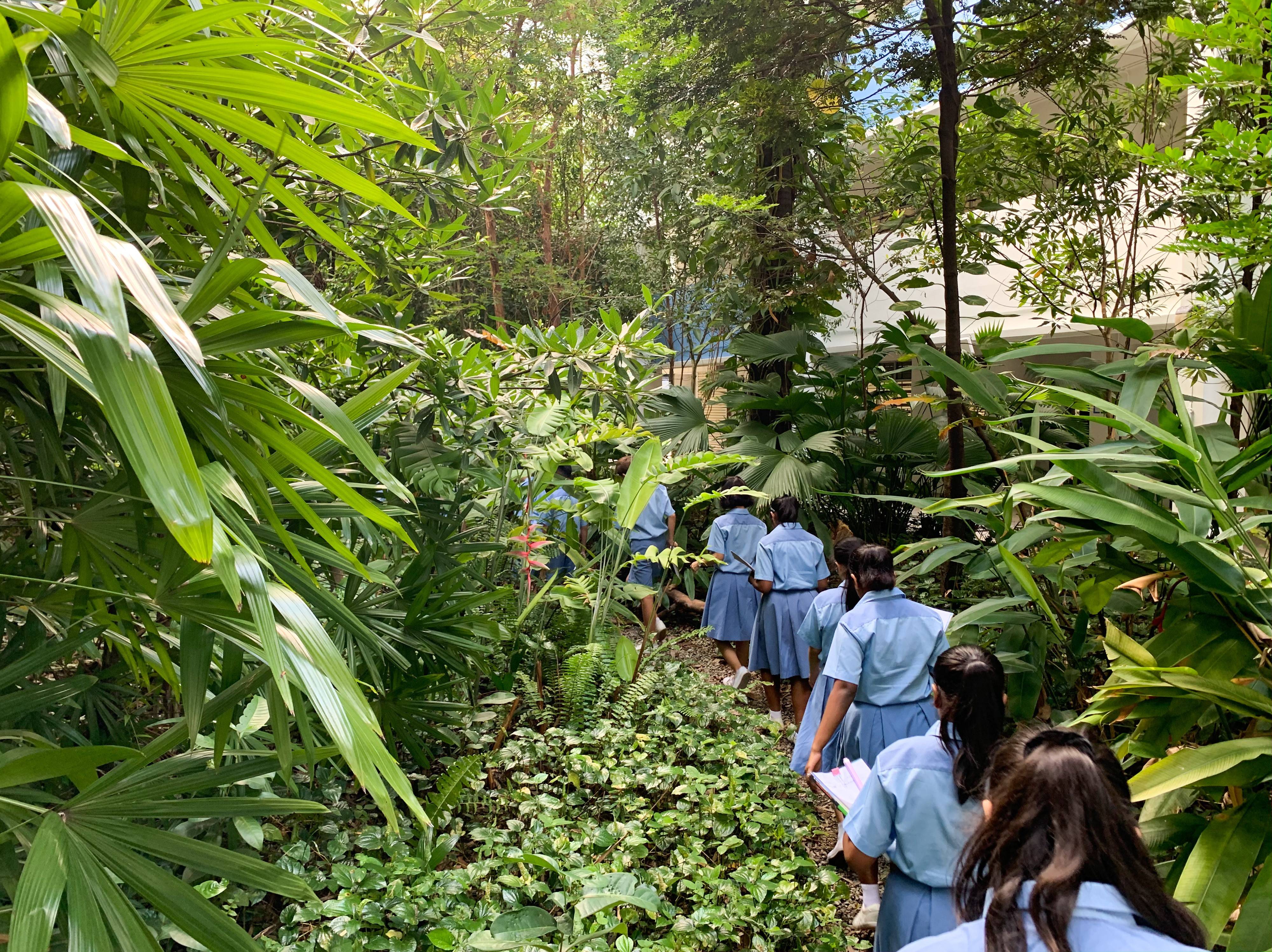
Commonwealth Secondary School forest and environmental education

Students walk through a forest habitat at Commonwealth Secondary School. (Photo: Commonwealth Secondary School)

Mr Jacob Tan, biology teacher and key driver of the school’s environmental education programme, said that the school’s geography teachers have also been using the eco-habitats to get students to link what they observe to their lessons.

“This is the generation of students who will inherit a world where these issues are really going to be a problem. As our students live in an urban environment, the opportunity that they have to get in contact with nature and biodiversity in general is very little,” he said. 

One young person whose love for nature has turned into both a job and a sideline is 26-year-old Kong Man Jing, a science teacher at a tuition centre who also runs Facebook page Just Keep Thinking, dedicated to educating people about science and the environment and has more than 63,000 followers.

Ms Kong’s alter-ego “BioGirlMJ” is the bubbly host of science and nature videos that feel like a blend of Discovery Channel and SGAG. During the “circuit breaker” period, she went on a “grassland treasure hunt”, identifying for viewers the flowers, weeds and insects that proliferated when the grass went untrimmed for months.

Ms Kong told CNA that she wants her videos to fill a gap for light-hearted content on such matters that are accessible to the masses – particularly the unconverted, who may not be that interested in green issues.

“It’d be great if everyone cares about the environment a bit more because climate change is real, but to reach there, I think it has to come from innate desire,” she said. “When you love something, you want to protect it more.”

SINGAPORE A “CRUCIBLE” FOR THE WORLD?

Most people CNA spoke to said that the issue is larger than Singapore and saving its native wildlife. 

Ornithologist Dr Yong pointed out that Singapore’s ecosystem merges into Malaysia’s and Indonesia’s, and international ecological connectivity is often overlooked.

“If you look at the Johor Straits … we cannot see the Singapore side as a ‘Singaporean ecosystem’, there’s no such thing as a Singaporean ecosystem. To animals, to plants, the border is an artificial thing,” he said, urging for more transboundary cooperation on nature conservation.
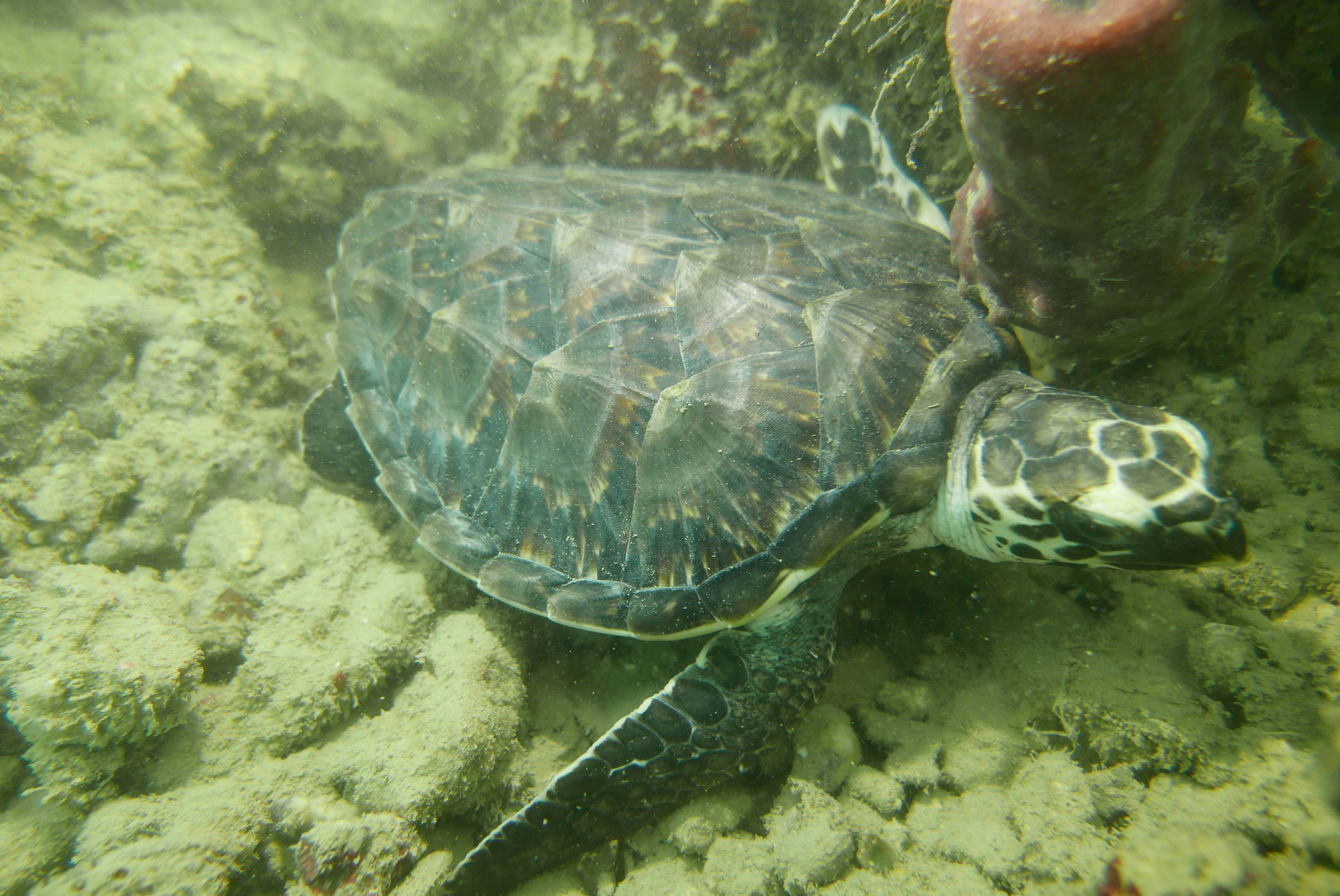
Hawksbill Turtle

A hawksbill turtle. (Photo: National Parks Board)

NParks’ Mr Lim said that Singapore can be a “test case” for other cities in the world.

“Singapore is very interesting because it is a crucible … a test case of how basically a small nation with very small hinterland – in fact zero hinterland, let’s be honest – will be able to build a matrix of greenery, of nature so that it benefits people as much as possible,” he said.

Dr Lum of the Nature Society said that he feels it is time the world draws a line on urban sprawl if it wants to enjoy the services that nature provides, like climate regulation, clean water and air. 

“I think all countries in the future would have to kind of draw a boundary: Beyond this, we just cannot develop, we have to put everything in this … And so in this sense, Singapore really becomes a test case for how creative can we be in our allocation of land.”
Source link

Commentary: COVID-19 has killed some friendships – but that’s okay

0

SINGAPORE: This pandemic will reveal your real friends. Pay attention to who reaches out. 

Even before the coronavirus strengthened its hold on Singapore in March, this sentiment was rife on social media. 

The seemingly straightforward argument parrots the platitude that crisis reveals character: These are rough times, so the people who check in are those worth keeping in our lives. 

Granted, there is a modicum of truth. Everyone treasures active, two-way friendships, where both parties work to keep the friendship going in good and bad times. These friendships should be effortless but intentional, so neither party has to worry about it fading. 

Under the circuit breaker, these friendships would’ve ideally manifested in frequent Zoom calls or increased text messages that act as temporary stand-ins for the monthly catch-up over food and drink. 

Understandably, if these supposedly solid friendships petered out when you most needed them, you might feel resentful. 

But, just so we’re on the same page, we are in the middle of a pandemic. 

PUTTING A PAUSE ON FRIENDSHIP

Considering how 2020 has upended the economy and our general lives, it’d be nice if we could collectively call for friendship timeouts.

This doesn’t mean abandoning our nearest and dearest, not least because it’s crucial to lean on each other during this time. 

But maybe we should abandon all expectations we will be there for each other with the same pre-pandemic intensity.

READ: Commentary: We cannot allow COVID-19 to disrupt our relationships too

READ: Commentary: Why I still stay home most days even though circuit breaker has been lifted

While we’re individually drowning in pools of uncertainty and anxiety every day, it’d be selfish and mildly sociopathic to test our friendships or expect the dynamics to remain the same. 

Not only should we cut our friends some slack, it’s also unrealistic to expect ourselves to continue living by these absolute standards of friendship from the Old Normal. 

I, for one, have weeks where I’m anchored in a thick mental fog that I struggle to complete any work, reinforcing the general anxiety around pandemic living. So forgive me but catching up with friends, albeit expectedly cathartic, is a tad less important than trying to keep my head above water.

Moreover, many of us conflate having time with having capacity, making us resentful when we assume reaching out or replying to a text message barely takes a few minutes.

LISTEN: Recovery, restructuring and possibly rebound? The outlook for the Singapore economy

COVID-19 Singapore River Masked Women

People with masks on walking along the Singapore River on July 17, 2020. (Photo: Try Sutrisno Foo)

Cutting ourselves some slack might mean we can feel less guilty when we can’t afford a few minutes to talk to supposedly good friends. 

In reality, checking in with a friend requires mustering up the mental and emotional bandwidth to actively listen and be there for them.

READ: Commentary: Why breaking up in the Facebook era is hard to do

Unlike family ties and romantic relationships, which come with a minimal sense of obligation, friendship is wholly opt-in. Even before COVID-19, hard work and intention were fully required to keep each other in our busy lives. 

With friendships as tough as they are, the last thing we want is another arbitrary gold standard in friendship Olympics to reach for. 

That said, it’s inevitable that a crisis will sharpen our focus over our hierarchy of priorities. Rather than begrudge certain friends for not reaching out, however, I wondered why I hadn’t reached out.

FRIENDSHIP IS A TWO-WAY STREET 

During the circuit breaker period, I decided not to ask certain friends to hang out on Zoom or make plans to see them in the New Normal. 

In the three tiers of friendship — primary, secondary, and tertiary — these friends fell into the secondary and tertiary circles. From being in the same school clique to sharing relationship struggles, we’d been there for a season but now lead vastly different lives from one another.

Even when we hung out pre-pandemic, our meetups had started veering towards superficial topics and required the distractions of a physical setting, like good food, to ease us into conversation. The current friendship hinged on guilt, obligation and shared history.

Face mask Singapore groceries shopping Cold Storage Orchard Road

People wearing face masks walk past a closed retail mall along the Orchard Road shopping belt in Singapore on May 6, 2020. (Photo: AFP/Roslan Rahman)

So the thought of being on a one-on-one video call felt unnatural and awkward. Video chats feel oddly intimate — the COVID-19 version of after-school phone calls that would stretch for hours, where we jumped from pining over crushes to complaining about family in a single session of vulnerability. 

Even texting each other simply to catch up without having plans to meet felt stilted.

With these friends who fell by the wayside, I found myself unexpectedly content with remaining distanced acquaintances or letting the friendship die a slow death, precisely because I couldn’t imagine us developing the closeness that was necessary to weather uncertain times together. 

Even after the restrictions lifted in Phase 2, I still hadn’t sought to rekindle the friendship or acquaintanceship, and neither had they.

READ: Mental well-being during COVID-19: The rise of intimate sharing sessions with strangers

READ: Commentary: In defence of baking bread, watching reality TV and other frivolous fads in the time of COVID-19

On the other hand, there were a couple of friends who’d gotten closer after the circuit breaker, because we’d made equal effort to hold onto each other through our darker days. 

In some ways, it was sad to realise COVID-19 sounded the death knell for some friendships, but I’d be lying if I said I hadn’t already felt the spark slowly burning out. 

All I needed was a global pandemic to lay bare the truths I wasn’t ready to confront — and the friends I’d willingly undergo another circuit breaker for. 

Well, maybe.

LISTEN: The COVID-19 vaccine will be the biggest product launch in history. Can we pull it off?

BOOKMARK THIS: Our comprehensive coverage of the coronavirus outbreak and its developments

Download our app or subscribe to our Telegram channel for the latest updates on the coronavirus outbreak: https://cna.asia/telegram

Grace Yeoh is a senior journalist at CNA Insider.

Source link

I want a wife, not a maid: When a man with cerebral palsy looks for love, intimacy

0

SINGAPORE: Alex still remembers the first time a girl expressed feelings for him.

It was 2007, and he was 20. He was having dinner with a friend’s sister, Jane, when the teenager told him of her feelings. His immediate response was: “Are you crazy?”

He tells CNA Insider: “I was totally shocked that a perfectly able-bodied human being would come and tell me that she has feelings for me.”

It was a response conditioned by years of feeling inadequate and unable because he was born with cerebral palsy, a condition that affects muscle control and coordination.

He has always had trouble with even the simplest of tasks, like coordinating the movement of his eyeballs, getting dressed and using the toilet. Now aged 33, he uses a wheelchair or a rollator — a walking aid — to get around.

Alex, 33, who has cerebral palsy, speaks to CNA Insider about searching for love and intimacy.

Speaking to CNA Insider. (Photo: Anne-Marie Lim)

It took him three months to give Jane a chance. But his first real relationship was brought to a tragic end when she died in a car accident. They had been together for about three years.

To this day, Alex says he will never find someone who will understand him as much as she did.

But being in the relationship changed something in him: A decade after the loss of his first love, he acknowledges that he is no less deserving than his able-bodied counterparts in the search for companionship, marriage and, ultimately, a family.

His journey, however, is as challenging as it gets.

LISTEN: Looking for love, in a wheelchair — a podcast

‘A VERY DIFFERENT CHILDHOOD’

Alex, who requested that his name and those of his loved ones be changed owing to the personal nature of his story, had always known as he grew up that he was different.

At primary school, he relied on his parents and his domestic helper to carry him up to his classroom, where he sat with only his bag for company. No one in his class, he recalls, wanted to sit beside him.

While his classmates played during recess, he remained in the classroom, copying notes and trying to catch up on lessons. The trouble he had controlling his hands had made him slower than everybody else.

“It was a very different childhood, compared to a normal child of that age,” he says. “For me, the sole reason for going to school was to study and … not to make friends or for fun.”

Alex, who has cerebral palsy, asked for a classroom on the ground floor while at primary school.

Later on at primary school, Alex asked for a classroom on the ground floor.

Things got better as the years went by, and he made friends along the way, some of whom were girls. But at secondary school, as he grew older and started having feelings for girls, he bottled them up.

“My conscious mind would tell me … ‘Better don’t go and tell them, because you have a disability,” he says. “Some of them were very close to me as friends, and I didn’t want to lose that friendship.”

No one, he recalls, ever said anything to him about not wanting to date him because of his disability. But this was the “preconceived notion” he had, a notion coupled with his experiences of being alone.

At home, he also had difficulties exploring his sexuality.

He was not allowed to lock his bedroom door or even the toilet door while he was showering or changing, and his parents would check on him periodically if they did not hear sounds coming from his room.

“My parents were naturally concerned because of my condition,” says Alex, who does not blame them as they were doing the best they could.

But he acknowledged the effect it had on the exploration of his sexuality as a teenager. He could only masturbate in the wee hours, for example, and he was always worried someone would open the door to check on him.

All these experiences, he says, shaped his attitude towards relationships and sexuality — which got shaken up when Jane made her way into his life.

THE TURNING POINT

Alex remembers agonising about whether he should give her a chance. With his disability and fear of rejection always at the back of his mind, he had never considered the idea of being in a relationship.

But Jane, he says, had known him for years, knew his character and his disability well and, despite his incredulous response, insisted that he should consider the possibility. She gave him three months to think about it.

He considered it carefully and, with the encouragement of his friends, agreed. “They told me … the least I could do is give her a chance. And I also thought, if I don’t try, I’ll never know,” he says.

Initially, however, he tended to “hold back quite a bit”. He was uncomfortable with touching her, finding it strange to hold her hand or hug her in public.

But she persevered. “She was always telling me that I didn’t have to be different just because I had a disability,” he says.

“It was a new school of thought for me … that I don’t have to be different from other guys in a relationship just because I’m in a wheelchair.”

Alex has cerebral palsy and uses a wheelchair but is not bound by it, especially in matters of love.

In a wheelchair, but not bound by it, especially in matters of love. (Photo: Anne-Marie Lim)

That was when he realised it was time to open up, emotionally and physically.

As Jane was living overseas, returning to Singapore only during semester breaks, the couple did not get much time together. They had to rely on the phone and online chats like Skype to communicate.

Slowly, however, Alex built up his comfort level with her and began to trust her more, and the couple became more intimate when they had the chance.

But Alex had flashbacks to an incident at his secondary school. A group of his classmates, tasked by his teacher to help him use the toilet, had taken his uniform while he was in one of the cubicles.

They also told him to call them if he ever needed to stand up to have sex, and they would come and hold him up.

“I was angry, and I told them that if I really had issues, I was sure my partner would have other ways to get things done,” he recounts.

Indeed, when he sensed that Jane was ready to explore that next step, they were able to work it out, proving once and for all that he was capable of having sex — using protection at all times, he adds carefully.

“I had a little bit of mixed thoughts … like, ‘What have I done, and did I do the right thing?’” he recalls. “But internally, I was also a little happy. Because it’s actually possible.”

He remembers the sinking feeling he had the day her brother called, informing him that she was involved in a car crash while driving overseas.

“It took me a very, very long time to get over her,” he says. “I still think about her a lot.

I don’t think I’ll be lucky enough to find someone who’ll be able to care for me and see the normalcy in me as much as she did.

FACED WITH QUESTIONS

He had been happy with Jane, but the relationship was not without its issues. For one thing, he had kept it from his parents.

At that point, with both youngsters studying and without serious jobs, he wanted to be sure they could “stand on their own feet” first.

“Knowing how conservative and traditional (my parents) were towards me and my disability, if I didn’t give them a complete, foolproof structure, they’d shoot it down,” he said.

While Jane’s family were aware of the relationship, her mother disapproved from the get-go.

“Whenever she got a chance to speak to my girlfriend, she’d ask to speak to me and ask me things like, ‘What are you trying to do? Are you trying to find yourself a lifetime maid?’” he recounts.

Alex has cerebral palsy. The mother of his late girlfriend disapproved of their relationship.

(Photo: Anne-Marie Lim)

Another concern raised: How likely was it that any children they have would “be like you”? “Thankfully, we were pretty strong about it,” he says. “The good thing is, I also got the support of her father and her brother.”

Years later, Alex is grappling with some of the same questions in his search for love.

While he had not actively sought a relationship in the years after Jane’s death, by the time he was 27, friends and relatives tried to make arrangements for him to meet people, including posting his profile on overseas-based matrimonial sites.

But some of the prospects and their family members had questions for him from the first meeting.

“The majority of the questions were on my condition … how I managed my condition, how much support the person I’m meeting would need to provide. That was number one.” he said. “Number two, whether I could consummate a marriage.”

He describes himself as a confident person who no longer grapples with self-esteem issues. He has been doing advocacy work and has conducted workshops on topics like sexuality and disability awareness for more than a decade.

But there are times when self-doubt creeps in, for example the times he bites the bullet and approaches women he meets through his advocacy work.

At worst, they would say no, he thinks to himself. And “most of the time”, that is the case.

“It’s just like … ‘No, I don’t think we’ll match,’” he says. “They’re not like my first relationship … someone who says, okay, let’s give it a try and see how it goes.”

What about trying a dating app, like Tinder or Bumble? His answer is no.

“Rejections are part of life, but I think I’ve heard rejections too many times for too many things, and I just don’t want to hear it for this kind of thing,” he says.

“Even if I go in there, would this person actually understand (me)?”

He has considered dating others with disabilities, but he also stresses the importance of complementing each other.

“I need a certain degree of assistance in activities of daily living,” he points out. “If my partner has a similar disability (and) needs that same amount of assistance, how are we going to help her while I’m on a wheelchair myself?

“You must be able to help each other out with your different disabilities.”

Alex has cerebral palsy. He says couples with disabilities should complement their abilities.

(Photo: Anne-Marie Lim)

BREAKING THE CHAINS OF LOVE

Many people with disabilities, however, believe they cannot have a relationship simply because of their disability — something Alex has realised through his advocacy work.

“I want to break that,” he says. This is why he is telling his story to CNA Insider.

Ariel, a close friend of Alex who also has cerebral palsy, believes that such thinking is “very common in Singapore”, whether among able-bodied people or those with disabilities.

“When I was younger, older relatives always told me that maybe I should find someone like myself, who’s disabled, because (he) would understand me best,” she says.

“But my dream has always been to be with a non-disabled person — not because I want to show off, but because I know the extent of my disability, and I know that I need someone to take care of me.”

Ariel, who is in her 30s, thinks it is “very much” a matter of self-perception.

“If you want to put your disability at the forefront, then of course things would be difficult,” she says. “But if you choose to … (be) more than your disability, then it shouldn’t be a problem.”

Alex acknowledges that his future wife would have to take on caregiving duties. But he is adamant that he is looking for far more than a carer.

“I have to respect you, and I have to give you that level of commitment and confidence that you’re my wife and not a maid who’s working for me,” he said. “That’s a different level.”

NOW IS THE TIME

He also acknowledges that he now “needs to start thinking of a serious relationship and settling down”.

“Being single is fantastic,” he says. “But the more serious thing is companionship, and I want to start my own family. I love kids.”

Thinking about friends his age who are married with children, he adds: “Maybe my life would be different if I didn’t have a disability.”

READ: ‘Why take on the extra burden?’: Parents with disabilities tackle misconceptions about raising their own families

As his parents age, he says, they are also starting to worry about how he would be able to live alone. He himself is frank in this matter: How long can he depend on a domestic helper to help with his activities of daily living?

“It’s not practical because as I age, my ability to do what I’m doing now will become even weaker,” he says. “There are certain points where only a spouse can come in to assist.”

Over the years, he has worked at building up his independence. Through therapy, which began when he was three months old, he can now handle tasks such as showering himself or bending down to pick up things.

“I need to make myself physically able to maintain all that I’ve achieved from childhood until now, for as long as I can,” says Alex, who works in the IT industry.

Recently, he has been looking to make it easier to dress himself by, for example, engaging Elisa Lim, the founder of Will and Well, a fashion label that creates clothes for people with disabilities and special needs.

READ: This 25-year-old makes clothes for the disabled. She’s still finding acceptance in the design industry

Lim says: “He wanted (me) to make clothes that are … easy for him to put on, so that when he finds a partner, he can take care of himself and not have to burden her.”

Will and Well Elisa Lim home studio

Will and Well founder Elisa Lim posing with one of her outfits in her home studio. She acknowledges that persons with disabilities have different challenges, and so recognises the need for customisation. (Photo: Aqil Haziq Mahmud)

Alex’s coordination and reflexes are weak, so he may take a long time to complete fiddly tasks like doing up buttons. Lim therefore worked on a shirt with magnetic buttons to help him.

She is now working on a pair of dressy trousers with an adjustable waistband, which will be easier for him to remove, particularly when he uses the toilet.

The two have developed a friendship that has blossomed since they began working together at the start of the year, and Lim is excited that he is thinking of a life partner.

“He’s a very determined person, so I believe if he wants something, he can achieve it,” she says.

‘WE’RE THINKING ABOUT MARRIAGE’

There is hope for Alex indeed. Some time ago, he met a woman overseas through his volunteer work. The pair chat regularly, and he is hopeful the relationship will progress further.

They had wanted to arrange for him to visit her parents, to let them know “that we’re serious and that we’re thinking about marriage … in future”, he shares.

COVID-19 has put these plans on hold. And he recognises that more challenges lie ahead for them. For example, as with his first relationship, his parents are still in the dark

“Though they want me to try and get married, they aren’t quite convinced that I won’t be a liability to my partner,” he says. “Their concern is that the caregiving role will supersede the spousal role.”

Resistance might also come from the woman’s parents. “Certain parents can be a little dominating,” he says. This might arise, he feels, from the fact that she has a disability too: She is hearing-impaired in one ear.

“If things are really going to go well, I’m someone who may not have an issue with trying to take things forward despite resistance,” he added. “But whether she’d have the guts to do that or not is another thing.”

He worries about what the future will bring. But he is determined to overcome the challenges, whether it is his parents’ overprotectiveness or the attitude of others.

“I’ve come to a stage where I’ve realised that whatever I do, the nagging, negativity and comparison is always going to be (there),” he said. “I’m just going to do what I’m going to do.”

Alex has cerebral palsy, but this makes him no less determined to get married in future.

(Photo: Anne-Marie Lim)

Source link

4 shopping malls among locations added to list of places visited by COVID-19 cases during infectious period

0

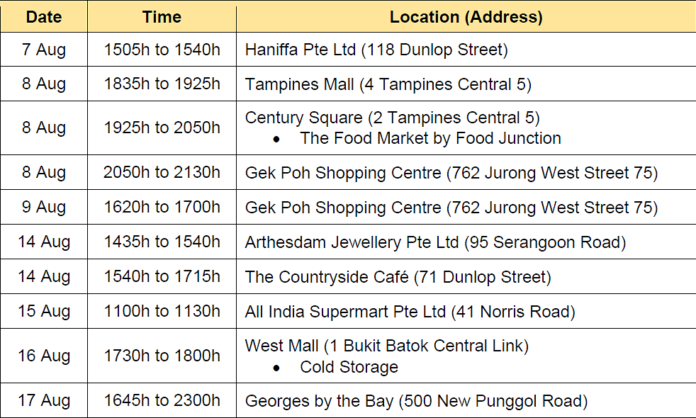
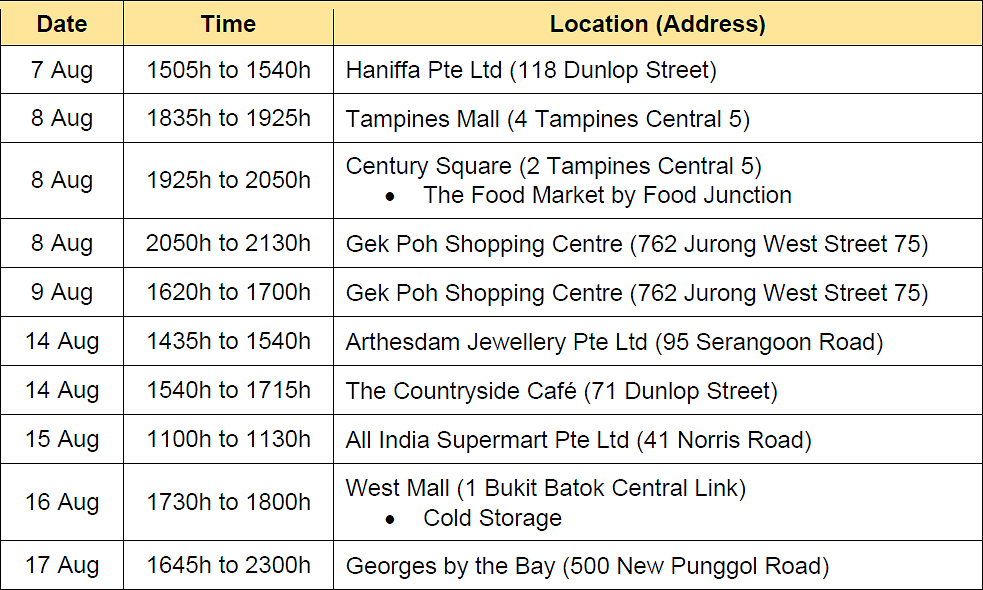
SINGAPORE: Tampines Mall, West Mall, Century Square and Gek Poh Shopping Centre were among several locations added to a list of public places visited by COVID-19 cases in the community during their infectious period, said the Ministry of Health (MOH) on Friday (Aug 21).

Tampines Mall was visited by a COVID-19 case on Aug 8, while the Gek Poh Shopping Centre at Jurong West was visited twice, on Aug 8 and Aug 9.

The Food Market food court at Century Square was also patronised on Aug 8, while the Cold Storage supermarket at West Mall was visited on Aug 16.

The remaining locations are a shop and a cafe on Dunlop Street, a jewellery shop on Serangoon Road, a supermarket on Norris Road and a restaurant on New Punggol Road.

READ: COVID-19 – Lucky Plaza, Peninsula Plaza to implement odd and even date entry restrictions on weekends

The new locations are as follows:

MOH COVID-19 public places Aug 21

(Table: MOH)

UPDATED MAP: All the places that COVID-19 community cases visited while they were infectious

Those who have been identified as close contacts of confirmed cases would already have been notified, said the ministry.

As a precautionary measure, however, individuals who were at those locations during the specified timings should monitor their health closely for 14 days from their date of visit, said MOH.

“They should see a doctor promptly if they develop symptoms of acute respiratory infection (such as cough, sore throat and runny nose), as well as fever and loss of taste or smell, and inform the doctor of their exposure history,” it added.

The ministry said there is no need for people to avoid places that have been frequented by COVID-19 cases, and that the National Environment Agency will engage the management of the affected premises to provide guidance on cleaning and disinfection.

READ: Singapore to waive stay-home notice for New Zealand and Brunei travellers, will test them for COVID-19 on arrival

READ: Households with more than 5 people may book more than 1 table in F&B outlets; more exercise classes in open spaces

Singapore reported 117 new COVID-19 cases on Friday, including six in the community and 13 imported infections.

This brings the country’s tally of cases to 56,216, with fatalities remaining at 27.

Three of the six new community cases are Singaporeans. They include a 61-year-old man who went to work at SLR Revolution at Excelsior Shopping Centre. The date of his onset of symptoms was Aug 17, according to MOH. He is not linked to other COVID-19 cases.

The two other Singaporeans are a 47-year-old woman who was asymptomatic and not linked to other cases, and a 14-year-old boy who is a contact of two previously confirmed cases. The date of his onset of symptoms was Aug 15.

The other community cases are a 45-year-old Malaysian man, a 27-year-old man from India and a 37-year-old Bangladeshi man. MOH reported that all were asymptomatic.

The 13 imported cases reported on Friday had arrived from the Philippines, India and the UK between Aug 7 and 10. All of them were placed on stay-home notice when they arrived in Singapore. They were asymptomatic and tested while serving their notice.

BOOKMARK THIS: Our comprehensive coverage of the coronavirus outbreak and its developments

Download our app or subscribe to our Telegram channel for the latest updates on the coronavirus outbreak: https://cna.asia/telegram

Source link

GE2020 expenses: PAP candidates spent nearly S$7 million, while opposition candidates used S$2.2 million

0

SINGAPORE: Candidates from the People’s Action Party (PAP) spent S$6.97 million on the 2020 General Election last month, while opposition candidates spent S$2.19 million.

In all, the 192 candidates who contested the General Election spent a total of S$9.16 million, with the bulk of the money going towards advertising, according to records released by the Elections Department (ELD) on Friday (Aug 21).

This is about 30 per cent more than the S$7.1 million spent during the previous General Election in 2015.

All 93 seats in 31 constituencies were contested by 191 candidates from 11 political parties and one independent candidate.

The PAP won 83 seats in the election and garnered 61.2 per cent of the popular vote.

An analysis of the expense submissions also showed that candidates across all parties spent significantly less than the S$4 allowed per voter.

Under the Parliamentary Elections Act, all candidates who contested in the Jul 10 polls must declare their election expenses. These are available for inspection from Friday until Feb 20, 2021.

READ: GE2020: Election expenses returns open for inspection on Aug 21

Among opposition parties, newcomer Progress Singapore Party (PSP) – which contested nine constituencies in the election – was the biggest spender at S$781,275.

The Workers’ Party (WP) came in next with S$705,647 spent in the six constituencies it ran in. The Singapore Democratic Party (SDP) spent S$323,292 contesting in five wards.

Other parties forked out between S$11,000 and slightly more than S$116,000, while the sole independent candidate, Mr Cheang Peng Wah, put in S$31,537 towards his election bid in Pioneer SMC.

One political watcher said it was not a surprise that PSP’s expenses came in higher.

“For a new party in particular, the need to get the message out there in what is a very crowded opposition space in a very short time probably necessitated that sort of higher spending,” said political analyst Eugene Tan, an associate professor of law at the Singapore Management University.

Mr Tan also said that higher spending could be attributed to the larger electorate of 2,651,435 registered electors.

READ: GE2020: 4,794 votes cast overseas, taking total voter turnout this election to 95.81%

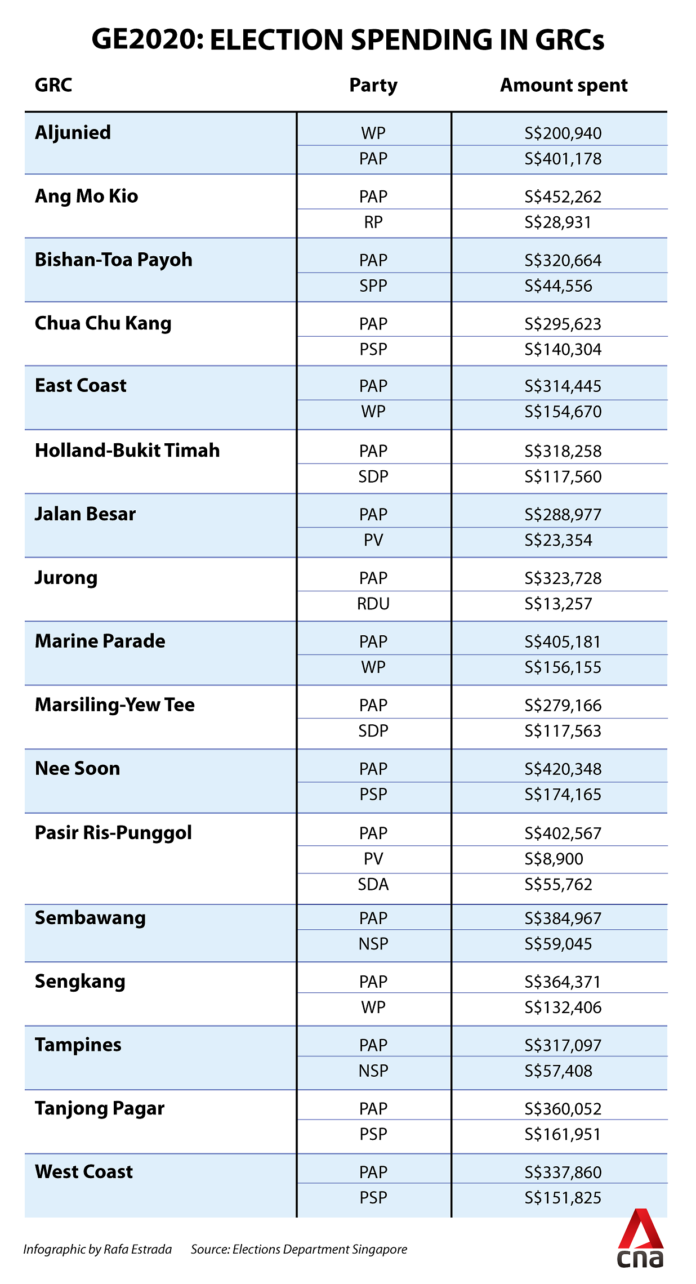
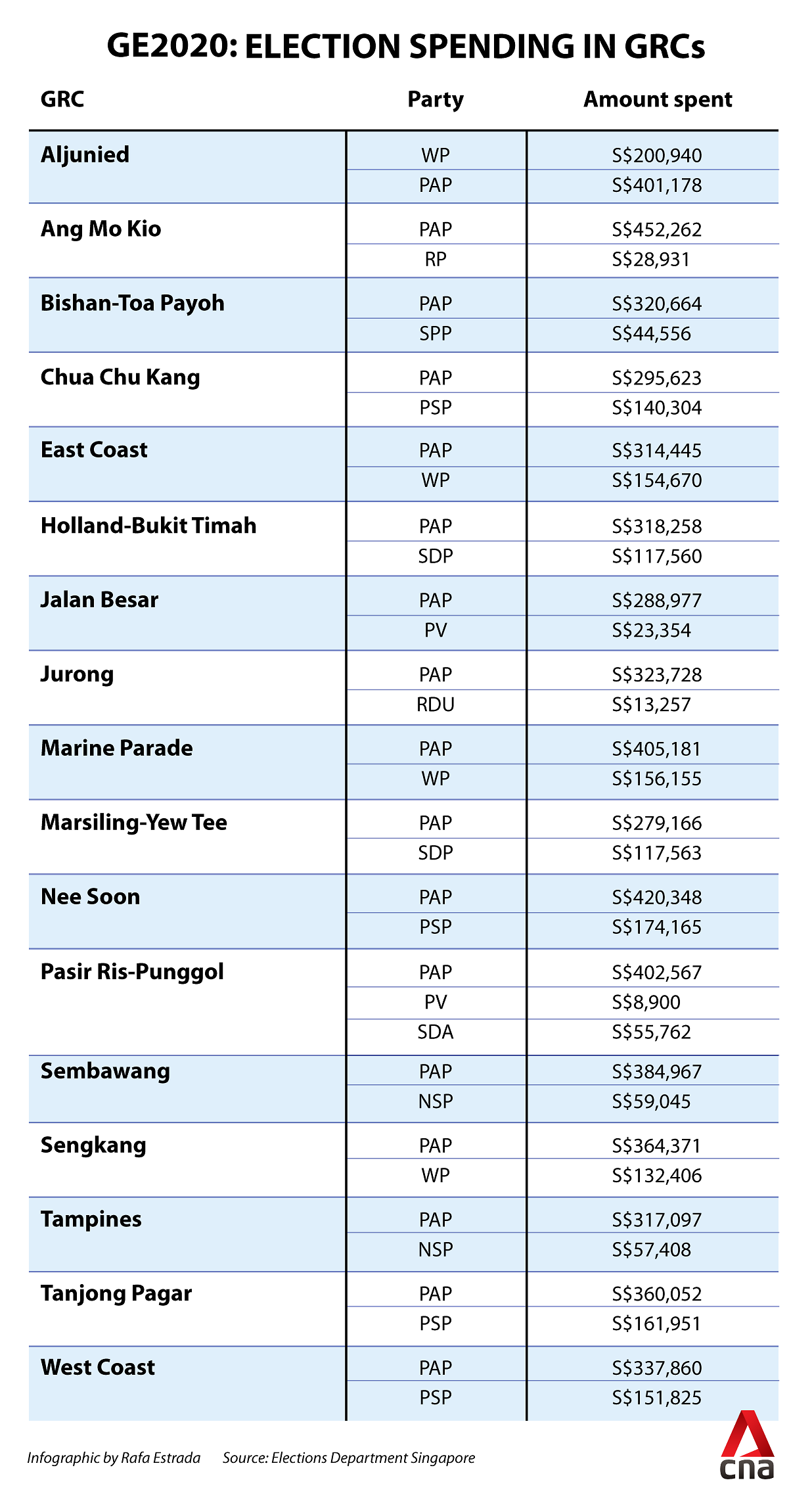
GE2020: election spending in GRCs

WHO SPENT THE MOST AND THE LEAST?

Among the Group Representation Constituencies (GRCs), the five-member PAP Ang Mo Kio GRC team led by Prime Minister Lee Hsien Loong topped the table, spending S$452,262.

There were 185,465 voters in Ang Mo Kio GRC. PAP won the ward with 71.91 per cent of the vote over a Reform Party team that spent S$28,931. Per voter, PAP spent S$2.44 in Ang Mo Kio GRC.

Averaging out cost by voter, however, the four-member PAP team in Bishan-Toa Payoh GRC spent the most – S$3.17 per elector. Bishan-Toa Payoh, with 101,366 voters, is the smallest GRC in terms of electors. PAP won with 67.26 per cent of the vote against Singapore People’s Party.

A Peoples Voice team in Pasir Ris-Punggol kept costs to S$8,900 in total – the lowest among the GRCs and the lowest per voter (S$0.05). They were in a three-cornered fight for the ward against the PAP, which spent S$402,567, and the Singapore Democratic Alliance, whose campaign cost them S$55,762. There were 166,556 electors in Pasir Ris-Punggol and it is the largest GRC.

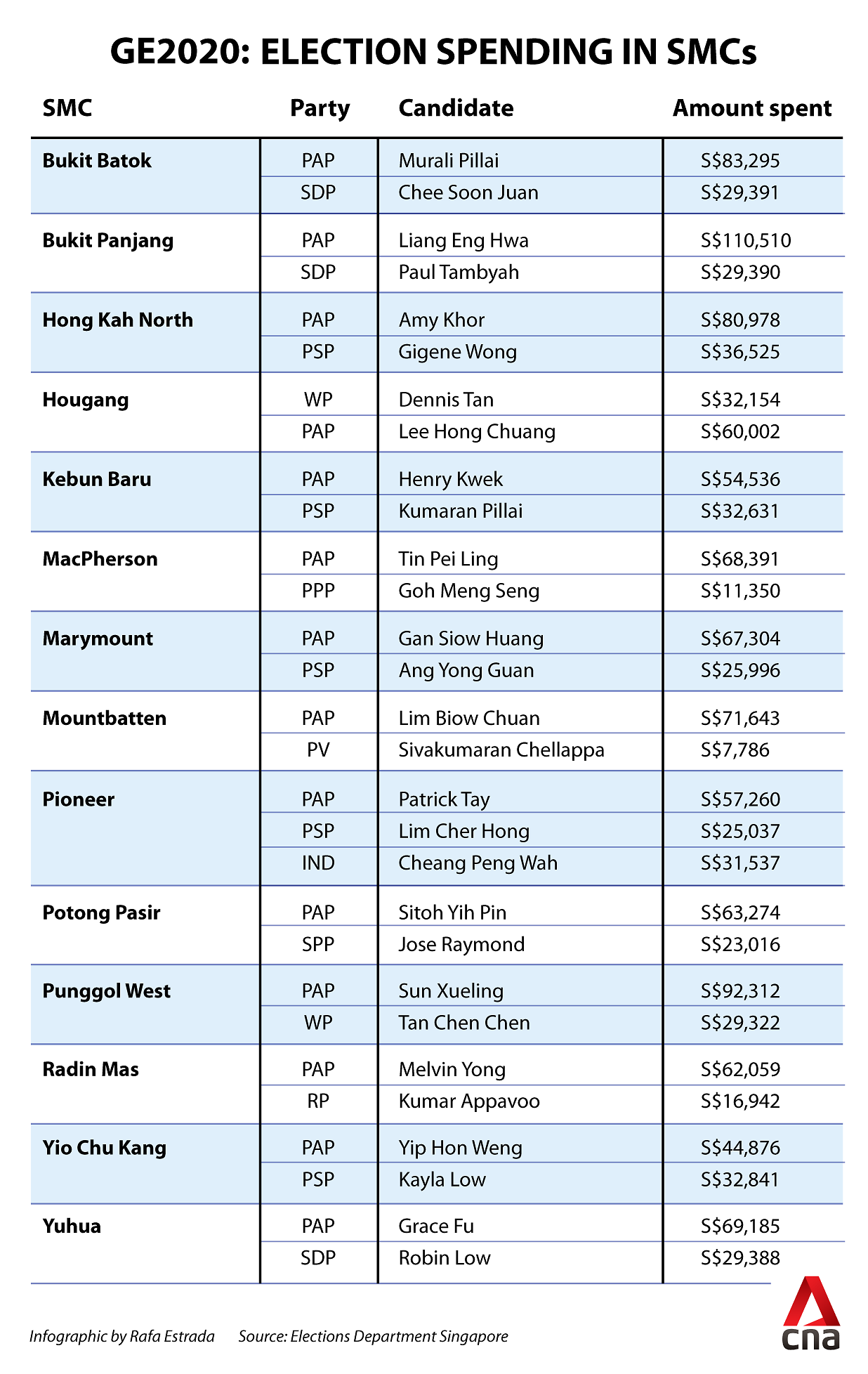
Among the Single Member Constituencies (SMCs), Mr Liang Eng Hwa of Bukit Panjang SMC had the highest expenditure of S$110,510. Most of this went to advertising on print and the Internet. His opponent, SDP’s Paul Tambyah, spent S$29,390.

With 35,437 electors, Bukit Panjang is the largest SMC and Mr Liang’s costs work out to S$3.12 per voter, lower than Punggol West SMCs’ Ms Sun Xueling’s S$3.47 per voter.

PV’s Sivakumaran Chellappa, who contested and lost in Mountbatten, spent the least among SMC candidates with S$7,786 in total, or S$0.32 per voter. There were 24,246 voters in Mountbatten.

LITTLE SPENDING ON INTERNET ADS

In all, candidates spent a combined S$7.82 million on election advertising, which is more than 85 per cent of all election expenses.

The majority of that was on print election advertising, which would include posters and banners, amounting to S$5.6 million.

While GE2020 was called an Internet election, as there were no physical rallies due to the COVID-19 pandemic, most parties spent little or nothing on Internet election advertising.

The exceptions were the PAP and SDP. Of the nearly S$2 million all parties spent on Internet election advertising, S$1.8 million was from the PAP and about S$138,000 from the SDP.

Three parties, including WP, did not spend anything on Internet advertising while each of six other parties spent between S$105 and S$6,970.

No details were provided on what specific services and items the candidates or parties purchased.

GE2020: election spending in SMCs

AMOUNT SPENT PER VOTER

The PAP spent about S$2.63 per voter across all constituencies, more than double the amount spent by opposition parties on average, but way below the S$4 cap allotted for each voter under election rules.

The WP spent S$1.21 per voter, while PSP spent S$1.19 and SDP’s expenditure was S$1.01 per voter.

The party that spent the least, at S$0.10 per voter, was Red Dot United. It spent S$13,257 to contest one constituency – Jurong GRC, losing to the PAP team led by Senior Minister Tharman Shanmugaratnam. PAP’s team had spent S$323,728 on their campaign in Jurong GRC, which had 131,058 electors, taking its per voter spend to S$2.47.

In all wards, PAP candidates outspent their opponents. Here are the figures for some hotly contested constituencies:

ALJUNIED GRC

In Aljunied, the PAP was looking to take back the seat from the WP, which it had won in the 2011 election. In 2015, PAP closed the gap, leading some to speculate it could win the GRC this time round.

However, despite replacing two veterans in its Aljunied team, WP extended its majority, winning with 59.95 per cent of votes against the PAP.

The PAP spent S$401,178 in Aljunied, which had 150,821 electors, while the WP spent S$200,940 in that contest.

EAST COAST GRC

A last-minute move by Deputy Prime Minister Heng Swee Keat made this constituency one to watch in the election, especially as WP had fielded strong candidates there.

PAP held on to the GRC but with a narrower margin than in 2015, winning 53.41 per cent of the votes.

The PAP spent S$314,445 in East Coast, which had 121,644 electors, against WP’s S$154,670.

SENGKANG GRC

Sengkang, a new GRC, became the second GRC ever to fall into opposition hands, upping the number of seats WP has in Parliament to 10. 

WP’s young team, which include lawyer He Tingru and  Dr Jamus Lim –  who emerged as a star candidate during the campaign – garnered 52.12 per cent of votes, narrowly beating the PAP team helmed by then-Minister Ng Chee Meng.

PAP had spent S$364,371 on Sengkang, which had 120,100 electors, more than twice WP’s S$132,406.

WEST COAST GRC

West Coast GRC was the narrowest win for PAP on polling night, with the team led by Minister for Communications and Information S Iswaran pulling 51.68 per cent of votes. They had faced stiff competition from PSP’s team, which was led by party chief Tan Cheng Bock.

PSP’s Hazel Poa and Leong Mun Wai will take up the two Non-Constituency Members of Parliament (NCMP) seats offered to the party.

The PAP spent S$337,860 in West Coast, which had 146,089 electors, versus the PSP’s S$151,825.

Those who wish to inspect the election expenses should make an appointment with the ELD at least one working day in advance via email to joyce_kow@eld.gov.sg and ng_hui_peng@eld.gov.sg. A fee of S$2 is charged for each record requested.

Additional reporting by Brandon Tanoto.

BOOKMARK THIS: Our comprehensive coverage of GE2020 and its developments

Download our app or subscribe to our Telegram channel for the latest updates: https://cna.asia/telegram

Source link

I visited the cemetery on the first night of Hungry Ghost festival and it was surprisingly okay

0

[ad_1]

In Chinese culture, death is a very taboo subject. Mentions of any sort are often met with knocking on a wooden surface and “choy choy choy” here in Singapore. 

As such, cemeteries are nowhere near that the top of the list of places to visit for most Singaporeans. Unless it’s Qing Ming (tomb sweeping day) perhaps. Talking about the dead (and the undead) is rare, unless it’s to spook your friends out or when it’s the Hungry Ghost month.

For me, perhaps it’s because of how inconvenient the cemeteries in Singapore are located — from the nearest public bus stop it is still a good trek away from the cemeteries — but I’ve never really properly visited a cemetery in Singapore. The columbarium, yes, as that’s where my grandparents’ ashes are, but not the cemeteries. 

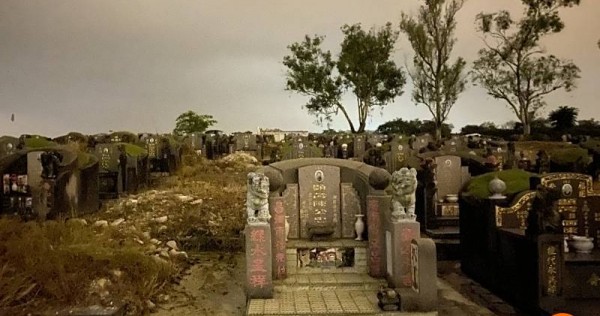
Who would have thought that my maiden visit to the local cemeteries for an assignment would be on the first day of the 7th month aka Hungry Ghost Festival? The day that “brothers and sisters” return from the afterlife to feast amongst the humans.

[ad_2]

Source link

Netizens explain why joss paper is tossed in the air, but religious leaders have urged against it

0

[ad_1]

The Hungry Ghost Festival is upon us, and Chinese devotees have already started burning joss sticks and paper as part of their observance to pay respects to the departed. 

But as local blogger Benjamin Lee noted, town estate cleaners have had their chores increased during the Seventh Month season as they clean up the unburnt offerings scattered and left behind in public spaces. 

The veteran blogger — better known by his moniker Mr Miyagi — put up a strongly worded post on Facebook on Wednesday (Aug 19) that rebuked those who “anyhowly chuck [their joss paper] all over the place and leave it for the migrant worker to tidy up [sic]”. 

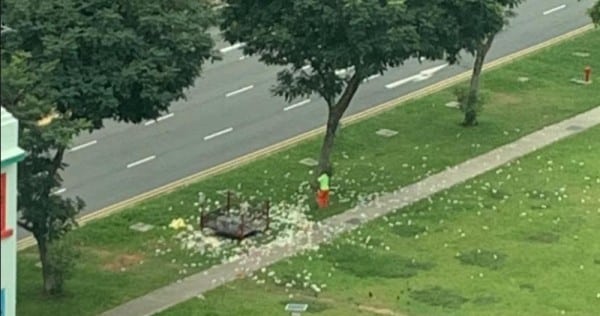
The picture that accompanied his post depicted a lone cleaner attempting to sweep up a mass of joss paper scattered on the ground near a dedicated burning container. 

Mr Miyagi’s stance changed, however, when commenters informed him that there was a reason why the offerings remain unburnt and strewn on the ground. The blogger has since updated his post to reflect what he learned.

[ad_2]

Source link

National year-end exams to proceed, students with COVID-19 or in isolation not allowed to sit for exams

0

SINGAPORE: The national year-end exams in Singapore will proceed amid the COVID-19 pandemic with safe management measures in place, but students who have COVID-19 or are in isolation will not be allowed to sit for the exams. 

“The national examinations are an integral part of teaching and learning, and we also know that the results of the national examinations are important for the progression of the students to the next phase of their educational journey,” said director-general of education Wong Siew Hoong on Friday (Aug 21).

He assured parents and students that “very strict safe management measures” will be in place during the exams.

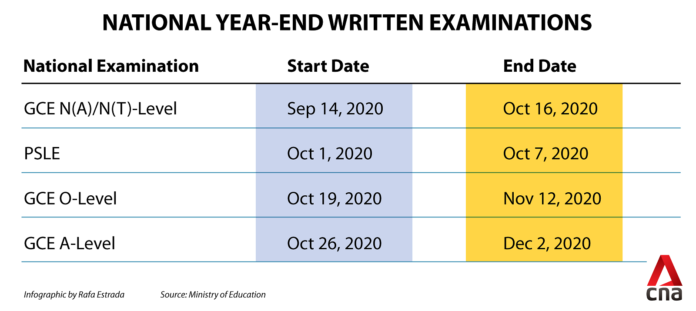
The written exams will be held from Sep 14 to Oct 16 for N-Level students, the Primary School Leaving Examination (PSLE) from Oct 1 to Oct 7, O-Levels from Oct 19 to Nov 12 and A-Levels from Oct 26 to Dec 2.

According to figures provided by MOE, about 98,000 graduating candidates will take the national year-end examinations this year. An additional 22,000 candidates who are not from graduating cohorts will also sit for their respective O-Level and A-Level examinations. 

2020 national examination calendar

FAQ: Special arrangements for the year-end national examinations

Safe management measures include temperature taking and visual screening of all candidates, designated toilets or staggered toilet breaks, as well as staggered dismissal timings and segregated entry and exit routes.

All candidates will wear face masks when reporting to the exam venue, and can replace them with face shields when seated at their desks, said the Ministry of Education (MOE) and Singapore Examinations and Assessment Board (SEAB) in a press release.

“However, they must put on the face masks when they leave the examination venue, such as for visits to the toilet or at the end of the examination,” they said.

Students will be seated 1.5m apart from one another, with up to 30 in each classroom. Larger venues like school halls will be zoned, with up to 50 candidates in each zone and at least 3m space between zones. Each venue will have a maximum of 250 candidates.

All schools have been encouraged to implement a “study break” for this year’s graduating cohort ahead of the exams, said MOE in a media briefing on Friday. This is to minimise the risk of a big number of students having to be quarantined or put on leave of absence as a result of COVID-19 cases in schools.

The length of the study break will be decided by the schools, depending on the profile and needs of the students as well as existing school practices, added the ministry.

READ: MOE’s approach to COVID-19 cases is to ‘ring-fence’ on a ‘small scale’ instead of closing schools: Ong Ye Kung

EXCEPTIONS FOR CANDIDATES IN ISOLATION ON “CASE-BY-CASE BASIS”

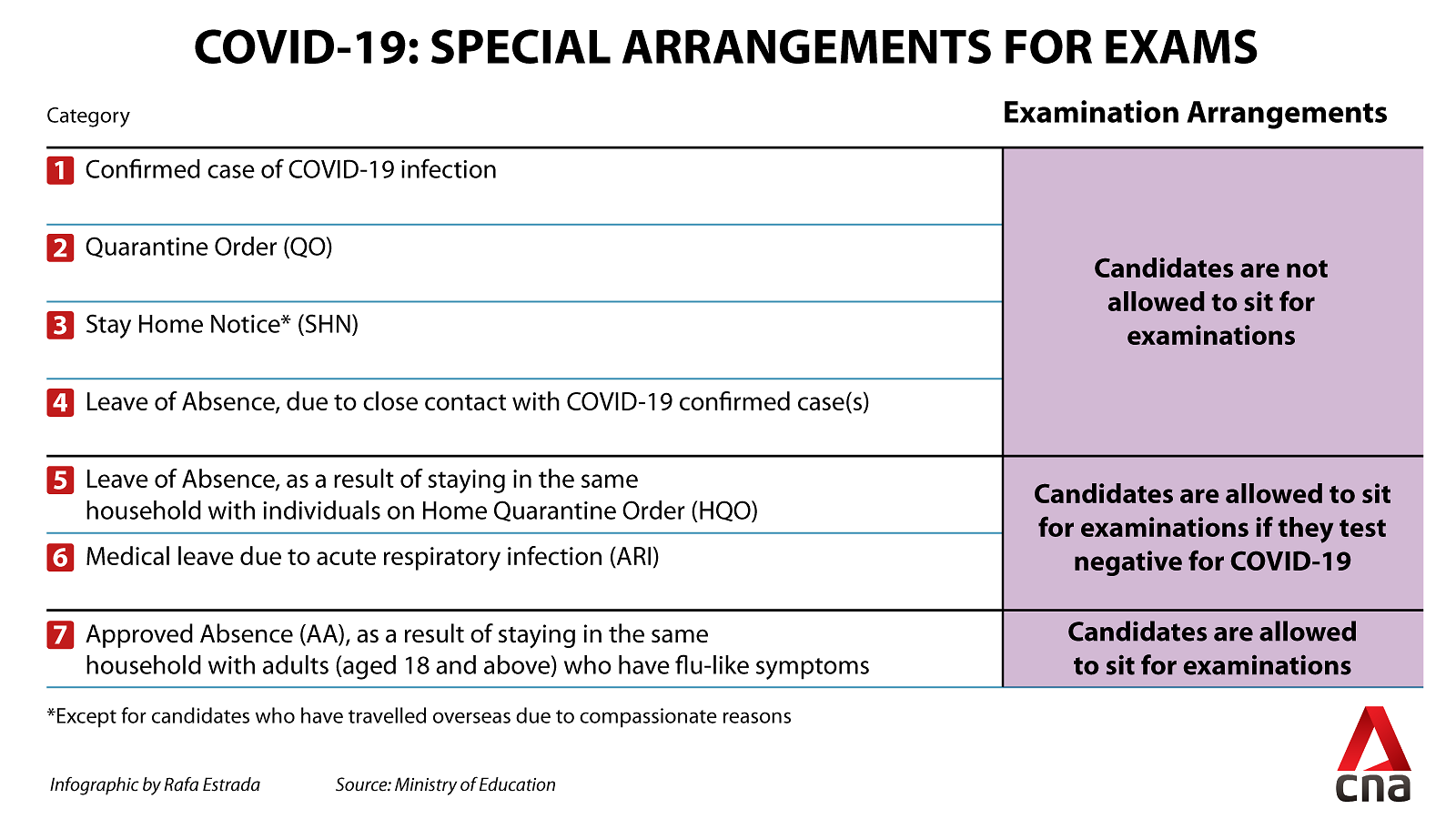
To “ensure they do not pose a risk to others”, students with COVID-19, or who have been placed on quarantine order, stay-home notice or leave of absence will not be allowed to sit for the exams, MOE and SEAB said.

Exceptions can be made “on a case-by-case basis” for those on stay-home notice who travelled out of Singapore for compassionate reasons, such as to attend a funeral or visit a critically ill next-of-kin, said the education ministry.

Those allowed to take the exams will sit for the papers in a centralised venue managed by SEAB, individually in a room and not allowed to mingle with other candidates. The room will also be thoroughly wiped down after each paper.

They will also not be allowed to take public transport to the exam venue, and will have to take their own private vehicles or pre-booked taxis, said the press release. Invigilators will be provided with personal protective equipment and will oversee the exam from outside the room to minimise contact with candidates.

READ: Secondary schools, JCs may resume ‘lower-risk’ CCAs and other school activities

Candidates who are on leave of absence due to close contact with COVID-19 cases will not be allowed to sit for the exams. However, those who are on leave of absence because they stay in the same household as someone in quarantine will be allowed to take the exams if they test negative for the coronavirus.

Other candidates who are on medical leave due to acute respiratory infections will also be allowed to sit for the examinations if they test negative.

STUDENTS WITH RESPIRATORY INFECTIONS TO BE TESTED FOR COVID-19

Currently, people aged 13 and above who are diagnosed with acute respiratory infection at first presentation to a doctor are tested for COVID-19.

From Sep 17, 14 days before the start of the PSLE written exams, students taking the papers this year will also be tested for COVID-19 at first presentation of acute respiratory infection before and during the exam period, said MOE and SEAB.

“This will allow for the early detection of candidates with an active COVID-19 infection,” they said.

Students will not have to pay for the swab tests, said MOE. The cost of the tests arising from a diagnosis of acute respiratory infection will be paid for by the Government if they visit a Public Health Preparedness Clinic (PHPC) or a polyclinic. 

“After government subsidies, students who are Singapore citizens and permanent residents will pay a flat subsidised rate of S$10, which covers the consultation, medication and investigations, including the swab,” said MOE. 

“International students will not need to pay for the swab but will need to pay for consultation and medication, subject to the charges of their chosen medical clinic.”

An exception will be made for PSLE students seeking urgent medical attention at KKH from Sep 28 to Oct 7, or just before the examinations begin and throughout the examination period, said the education ministry. MOE will bear the consultation fees as they will be significantly higher, at about S$120. 

The cost of the tests for students who are placed on leave of absence because they live with an individual on home quarantine order will also be covered by MOE.

READ: Travellers who serve stay-home notice outside of facilities after entering Singapore must wear electronic device

Students on approved absence due to staying in the same household as adults with flu-like symptoms will be allowed to sit for the exams with enhanced safe management measures in place.

These enhanced measures, which will also apply to candidates who are on leave of absence or medical leave but allowed to take the exams, include seating them in a separate room from other candidates. They will be seated at least 3m apart with a maximum of 10 candidates per room.

“Precautionary measures will also be taken to ensure that these candidates do not mingle with the other candidates, including designated toilets, separate entry and exit routes for each examination room with deconflicted arrival and departure timings,” MOE and SEAB said.

2020 national exam covid-19 arrangements

Those who miss the national examinations “with valid reasons” can apply for special consideration.

“All special consideration applications are assessed on a case-by-case basis and subjected to a rigorous review process,” the press release said.

“Special consideration is actually a post-examination adjustment of marks to the candidates who are being affected by the exam due to the adverse circumstances. What we will do is to consider multiple sources of information to make sure that these candidates will not be affected and they’ll be given a fair grade,” said SEAB chief executive Yue Lip Sin.

The board will consider evidence of the candidate’s performance from sources such as his performance in the other papers for the affected subject in the national and school-based exams, as well as the school cohort’s performance in the national and school-based exams.

“We urge all candidates and staff to continue practising good personal hygiene and exercise social responsibility,” MOE and SEAB said, adding that they will monitor the COVID-19 situation and provide updates if there are changes to the exam arrangements.

BOOKMARK THIS: Our comprehensive coverage of the coronavirus outbreak and its developments

Download our app or subscribe to our Telegram channel for the latest updates on the coronavirus outbreak: https://cna.asia/telegram

Source link

FAQ: Special arrangements for the year-end national examinations

0

SINGAPORE: The Ministry of Education (MOE) and Singapore Examinations and Assessment Board (SEAB) have announced that the national year-end exams will proceed amid the COVID-19 pandemic, with special arrangements to keep students safe.

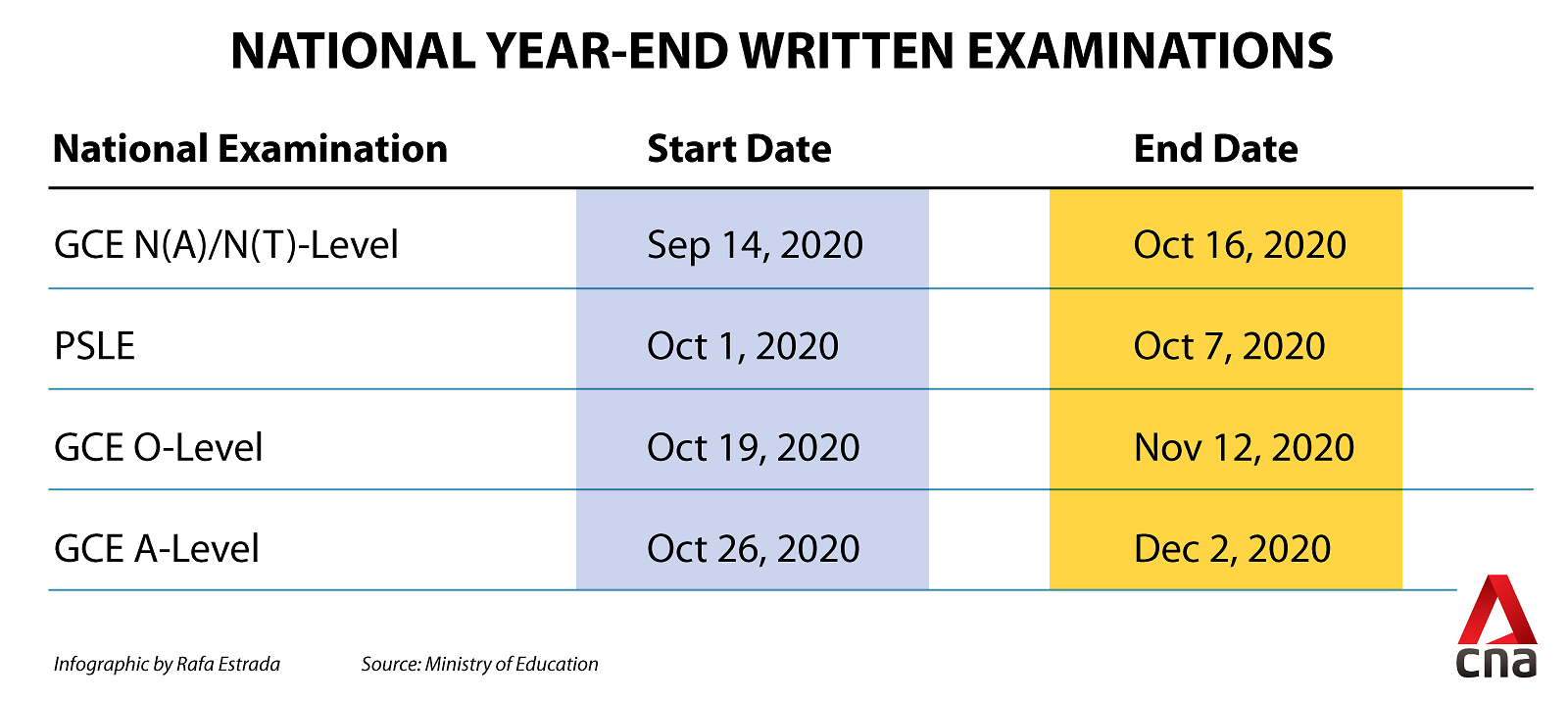
The written exams will be held from Sep 14 to Oct 16 for N-Level students, while the Primary School Leaving Examination (PSLE) will take place between Oct 1 and Oct 7. Exams for O-Levels will be from Oct 19 to Nov 12 and A-Levels from Oct 26 to Dec 2.

Safe management measures, including temperature taking and safe distancing, will be put in place for candidates taking the examinations.

2020 national examination calendar

Here are some frequently asked questions based on information released by MOE and SEAB so far. 

Q: How and where can students get tested for COVID-19? 

A: Candidates who are on leave of absence because they stay in the same household as individuals on quarantine will be allowed to sit for the examinations if they test negative for COVID-19, said MOE and SEAB on Friday.

Other candidates who are on medical leave due to acute respiratory infection will also be allowed to sit for the examinations if they test negative for COVID-19. 

Currently, individuals aged 13 and above who are diagnosed with acute respiratory infection at first presentation to a doctor are tested for COVID-19. 

From Sep 17, 14 days before the start of the PSLE written examinations, students taking the papers this year will also be tested for COVID-19 at first presentation of acute respiratory infection before and during the examination period. 

A graduating student who is unwell, especially with respiratory symptoms, should see a doctor at a General Practitioner (GP) clinic participating in the Swab-and-Send-Home (SASH) initiative, or a polyclinic.

A list of GP clinics participating in the SASH initiative can be found at www.phpc.gov.sg.

If diagnosed by the doctor to have acute respiratory infection, the student will be tested for COVID-19.

PSLE students who display symptoms close to the examination date from Sep 28 and during the examination period should seek medical attention at KK Women’s and Children’s Hospital (KKH). 

This is to ensure timely diagnosis and notification of results, should they be diagnosed with acute respiratory infection and need to be tested for COVID-19.

Students taking the N-, O- or A-Level exams who display symptoms close to the examination date, or four days before the start of their exams, should seek medical attention at polyclinics to ensure timely diagnosis and notification of results. 

While awaiting notification of the COVID-19 swab test results, students must stay home and will not be allowed to enter the examination venue. 

Students aged 16 years and younger should be accompanied by an adult for the swab test. This facilitates consent-taking and communication to both the student and accompanying adult on the precautions to take note of while awaiting the test results at home.

READ: MOE’s approach to COVID-19 cases is to ‘ring-fence’ on a ‘small scale’ instead of closing schools: Ong Ye Kung

Q: As national examinations are essential for progression, can special provisions or alternative arrangements be made, such as online invigilation for candidates who are confirmed cases or who are on stay-home notice and home quarantine order?

A: As online invigilation essentially involves candidates taking examinations at home, the fairness and integrity of the national examinations may be compromised, said MOE and SEAB. 

There are no plans for online invigilation arrangements, they added.

“It is also important for us to consider the challenges faced in the management and provision of resources for online invigilation, given that it involves the administration of the examinations in individuals’ homes.”

READ: Secondary schools, JCs may resume ‘lower-risk’ CCAs and other school activities

Q: What happens if there is a confirmed case in a school during the national examinations?

A: If there is any confirmed cases in a school during the national examinations period, all close contacts of the confirmed cases will be identified, and schools may suspend classes and activities for disinfection and deep cleaning of affected areas, as well as for contact tracing investigations to be completed. 

Special consideration will be applied for affected students to ensure that they are not disadvantaged for the national examinations. Students who are unaffected will either continue to take their examinations in another classroom block within the school, or in an examination venue managed by SEAB.

Q: Will the year-end national examinations be called off or postponed if we enter another “circuit breaker”, or if the COVID-19 situation worsens? In this case, how will candidates be assessed?

A: Postponing or cancelling the examinations would be a last resort, said MOE and SEAB.

Should the COVID-19 situation worsen considerably, and it is necessary to enter another circuit breaker, MOE and SEAB will review their plans in tandem with the national posture.

READ: Travellers who serve stay-home notice outside of facilities after entering Singapore must wear electronic device

2020 national exam covid-19 arrangements

Q: Will special arrangements be made for candidates taking the year-end Science practical examinations as well? What will be the safe management measures in place?

A: The same arrangements will apply for the year-end Science practical examinations – candidates who are confirmed cases of COVID-19 infection or on quarantine order, stay-home notice or leave of absence due to close contact with confirmed COVID-19 cases will not be allowed to sit for the practical examinations. 

Candidates who had travelled out of Singapore for compassionate reasons and were placed on stay-home notice will also not be allowed to sit for the examinations. This is because the conduct of the Science practical examinations requires unique equipment and logistics, such as a science laboratory, said MOE and SEAB. 

Candidates who miss the examinations can apply for special consideration. Similarly, candidates on leave of absence because they stay with individuals on home quarantine order or those diagnosed with acute respiratory infection will be allowed to sit for the science practical examinations if they test negative for COVID-19. 

Similar safe management measures will be implemented for the practical examinations. These candidates will take their science practical examinations in the last shift and will be assigned to a separate laboratory with a cap of 10 candidates per science laboratory, instead of 20. They will also be seated 3m apart.

The arrival and dismissal time, as well as reporting areas, will be deconflicted to reduce intermingling between different groups of candidates. 

BOOKMARK THIS: Our comprehensive coverage of the coronavirus outbreak and its developments

Download our app or subscribe to our Telegram channel for the latest updates on the coronavirus outbreak: https://cna.asia/telegram

Source link

Coronavirus: Singapore researchers discover new variant of virus

0

[ad_1]

SINGAPORE – Researchers in Singapore have discovered a new variant of Covid-19 that causes less severe infections, according to a new study in the prestigious medical journal The Lancet.

This could provide new avenues for vaccine and therapeutic development, experts say.

The latest reported variant of the Sars-CoV-2 virus which causes Covid-19 emerged in Wuhan, China early in the pandemic and was exported to Singapore and Taiwan, according to the study by researchers in various institutions, including the National Centre for Infectious Diseases (NCID) and the Duke-NUS Medical School.

It was detected in a cluster of cases here in Jan and Feb. The researchers said in the study that patients infected with the variant, which has a 382 nucleotide deletion, were observed to have had better clinical outcomes relative to those infected by viruses without this deletion.

A lower proportion of them, for example, had hypoxia (where the body is short of oxygen) requiring supplemental oxygen, when compared with those infected with the wild-type virus.

[ad_2]

Source link