SINGAPORE – A former director of the National University of Singapore (NUS) East Asian Institute (EAI) has denied all claims of sexual harassment levelled against him by his former staff as the university continues to investigate the allegations.
Multiple harassment claims had appeared on social media in the past month, with at least two users – who identified themselves as NUS or EAI staff – accusing Professor Zheng Yongnian of sexual harassment.
However, Prof Zheng “categorically denies” all allegations, whether by EAI staff or any other persons, his lawyers said in a press statement on Friday (Sept 4) evening.
They also said that the professor’s resignation from the university and EAI was unrelated to the allegations and complaint against him. Instead, they said he had accepted a new post that “allows him to focus more on research as a scholar, where his passions lie”.
The 58-year-old professor is understood to have joined the Chinese University of Hong Kong, Shenzhen, as the head of its Advanced Institute of Global and Contemporary China Studies by late August.
SINGAPORE – Preliminary data showed that 5,280 Singapore citizens were retrenched between January and June this year, Manpower Minister Josephine Teo told Parliament on Friday (Sept 4).
Responding to questions by Workers’ Party MP He Ting Ru (Sengkang), Mrs Teo added that about 11,000 citizens were placed on unpaid leave compared with 33,000 non-citizens in the same period.
Ms He also asked about Singaporeans who have had their pay cut by more than half since the start of circuit-breaker measures.
In response, Mrs Teo said that employees who had their pay reduced by more than half formed a “small minority” as of Aug 20.
Employers with more than 10 staff are required to notify the Ministry of Manpower (MOM) within one week of implementing cost-saving measures, such as shorter work hours or no-pay leave, that result in a more than 25 per cent cut in gross monthly salary for local employees or basic monthly salary for foreign employees since April 6.
Mrs Teo said: “We are not able to provide the breakdown between Singapore citizens and permanent residents as the distinction was not made in the notification by employers.”
SINGAPORE: The circuit breaker, implemented from April to June in Singapore, was designed to disrupt the spread of COVID-19.
It also severely disrupted the food and beverage (F&B) sector, forcing restaurants that were still in operation to focus on home delivery.
In the first eight weeks of this period, 1,334 tonnes of disposable cutlery and packaging – the weight of 92 double-decker buses – was produced by the sector, according to a Jun 5 study by National University of Singapore alumni.
This was in addition to the 271 million plastic items that Singaporeans would normally dispose of in an eight-week period, according to figures from the National Environment Agency.
Extraordinary times have led to extraordinary but unsustainable solutions for food vendors. Apart from the obvious and visible problem with plastic packaging, what does “sustainability” in the food services sector look like?
As with all businesses, the sustainability factor can be measured by the inputs, the outputs and the energy consumed. For the F&B sector, the inputs should ideally consist of sustainably produced food items prepared with a minimal carbon footprint.
This would focus on locally-sourced plant-based products since meat production involves heavy use of water and the expulsion of methane, not to mention heavy transportation burdens.
Clean energy (electricity from renewable sources such as solar panels) should be used for cooking, the outputs should be sustainably packaged and delivered, and all waste should be composted.
In essence, that means restaurants that produce plant-based, clean-energy crafted, locally sourced, plastic-free meals.
But ticking all these boxes is easier said than done. 90 per cent of Singapore’s food is imported and only 1 per cent of its electricity is derived from solar sources.
Yet customers would like their favourite eateries and bars to go green, according to surveys. Reducing plastic waste is not only a low-hanging fruit, but makes good business sense.
GOOD FOR BUSINESS
Local bar and restaurant operator, Tadcaster Hospitality, has shown that some simple changes can create significant reductions in plastic use.
As the owner of central business district pubs such as Molly Malones and The Exchange as well as eateries such as Café Melba and Dharmas Kebab Shop, Tadcaster’s management was concerned about the amount of single-use plastic it was generating through take-out food and drinks. In an average year, the volume was enough to fill an average condominium swimming pool.
In 2019, Adrian Houghton, director of Tadcaster, set about changing its outlets to become more sustainable. He implemented recycling systems for the 150,000 bottles that were normally put in the garbage every year.
Through finding biodegradable and compostable alternatives, Houghton was able to save the company’s annual disposal of 60,000 plastic cups and lids, 60,000 plastic straws, 21,300 plastic takeaway boxes, 10,300 plastic bag, 9,500 plastic drink stirrers and 6,300 plastic cutlery items. That’s the equivalent of what’s disposed by 167,400 Singapore residents in one day.
There was no net cost to Tadcaster for the change to biodegradable alternatives. Houghton reported that nearly all customers welcomed the change and in some cases it actually brought in extra business.
On one occasion, an office group of 18 drinking in a nearby bar moved to The Exchange after seeing its plastic-free promotion. They had asked other bars not to provide plastic straws, only to find one in each glass when their orders came. (Of course this was prior to COVID-19 restrictions limiting group sizes to five.)
CONSUMERS WANT LESS PLASTIC TOO
As Tadcaster’s management noticed, most consumers in Singapore are in favour of more sustainable F&B options.
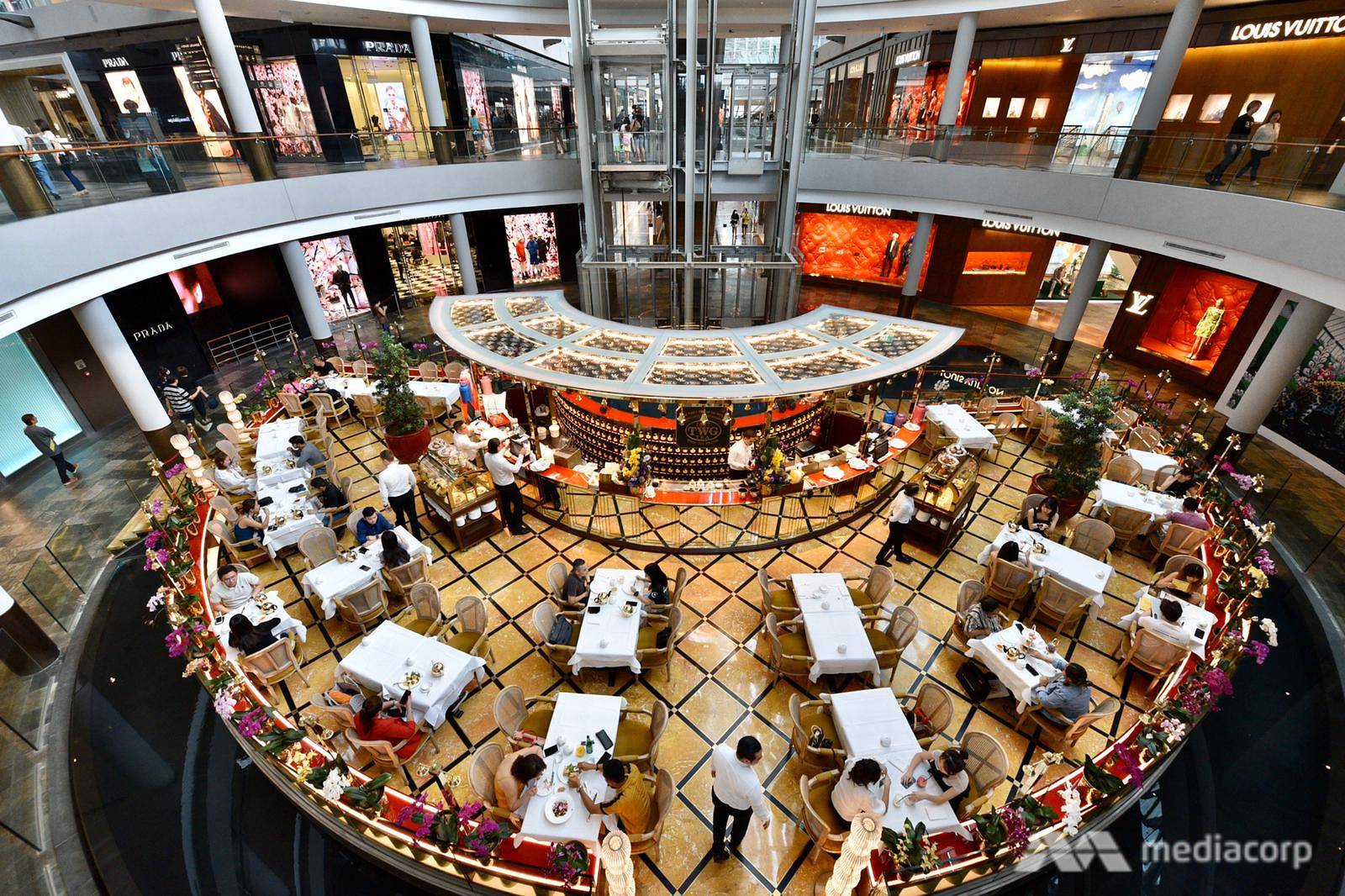
A restaurant in Marina Bay Sands with diners sitting at least 1 metre apart from each other in accordance with safe-distancing rules on Apr 4, 2020. (Photo: Jeremy Long)
A December 2019 survey of 29,000 global consumers from UK research firm GlobalData has shown how embedded the sustainability culture has become in Singapore.
For instance, 74 per cent of Singaporeans find a low carbon footprint in food and drink appealing – about 14 percentage points higher than the global average.
When it comes to menu options, 27 per cent of Singaporeans are likely to prefer a low-meat diet, 4 percentage points higher than average.
Singapore respondents are 60 per cent more likely than their ASEAN counterparts to find tap water appealing or very appealing.
For takeaway orders, nearly 30 per cent of Singapore respondents indicated that they were willing to make the change to plastic-free for environmental reasons. And the stronger the economic incentive in the nudge, the greater the change.
87 per cent of Singaporeans indicated that they would reduce or stop purchasing items that had a plastic tax surcharge – against a global average of 78 per cent. Similarly, 39 per cent of Singaporeans said they would bring their own refillable cups to food outlets if given a discount.
Food service providers have been experimenting with discounts for customers who bring their own containers.
Saladstop, a quick-service salad restaurant, claims in its 2019 sustainability report that it saved 60,000 plastic bags by putting a 10 cent surcharge on them, and a further 680kg of plastic waste through encouraging customer to bring their own bowls.
The growing popularity of this trend saw the Bring Your Own (BYO) Singapore movement grow from 430 retail outlets in 2017 to 1,120 outlets from 126 brands in February 2020.
These outlets are committed to encouraging customers to choose reusables over single-use plastics through incentives and education.
During the onset of COVID-19, global chains such as Starbucks cancelled their BYO policy in some outlets due to concerns about possible contamination from handling customers’ own cups.
However, a Jun 22 statement signed by more than 100 scientists worldwide said that reusable containers do not bring increased risks of coronavirus transmission.
This is the right message at the right time, as the pandemic threatens to undo efforts to cut plastic waste. Yet people do seem open to supporting F&B businesses serious about going green.
(Photo: AFP/Mohamed el-Shahed)
In July 2020, GlobalData polled 5,800 respondents on issues that have become more important to them as a result of COVID-19. 84 per cent said plastic-free packaging, while 87 per cent said that reducing or recycling food waste was as important, if not more important to them since the pandemic.
This increased appetite for social issues may be because of the extra time spent reading and watching news stories during lockdown.
The customer has woken up to the environmental impact of consumption habits of the past and wants change. Food service operators certainly have enough on their plates coping with the fallout from COVID-19 right now.
But as they grapple with the post-COVID normal of less dining in and more food deliveries, it makes sense to switch to a sustainable menu.
Tim Hill is a Key Accounts Director for GlobalData PLC, a provider of intelligence on the world’s largest industries.
SINGAPORE: Everyone has an opinion on everything parenting related: From co-sleeping choices to the intensity of enrichment lessons.
But there are fewer things more divisive – and morbidly fascinating – as the discussion of parenting and discipline, specifically, the relevance and role of physical punishment in disciplining a child.
To cane or not to cane, that is the question.
THE CASE AGAINST CANING
Let me draw the battle lines for you.
In one camp, which counts popular, modern day literature and research on its side is the “Caning is brutal, archaic and abusive” narrative.
An article by the American Psychological Association, tersely titled “the case against spanking” shares that studies have shown physical punishment, including spanking, hitting and other means of causing pain, can lead to increased aggression, anti-social behaviour, physical injury and mental health problems for children.
This camp also includes those who believe caning doesn’t banish misbehaviour. The same study quotes Alan Kazdin, a psychology professor and director of the Yale Parenting Center and Child Conduct Clinic that we need to give up “this horrible thing that does not work”.
Recent CNA commentaries and articles have echoed this sentiment that all parents need to do is expand their repertoire of parenting resource and they would realise they need not resort to physical punishment in raising their child.
BUT MOST PARENTS STILL CANE THEIR KIDS
Which leads us to the other side and the reality that physical punishment is still actively used in parenting today contrary to popular sentiment.
(Photo: Unsplash/National Cancer Institute)
Most parents, if you ask them, would admit — albeit in hush tones and surely not on social media — that they have on occasion smacked, spanked, hit or caned their child.
That is not just in Asian homes either. Three quarters of Americans agree or strongly agree with the statement, “It is sometimes necessary to discipline a child with a good, hard spanking” according to a 2015 study, with other surveys estimating that 80 per cent have spanked their kids at some point.
If research suggests physical punishment is detrimental, why do parent still apply a spectrum of physical punishment today?
The answer quite simply is compliance, and the role of physical discipline in getting the child to comply with a desired mode of behaviour.
In a seminal study that spans 62 years, Professor Elizabeth Thompson Gershoff of the National Center for Children in Poverty at Columbia University found a strong association between corporal punishment and increased immediate compliance on the part of the child.
It seems for all the long-term downsides physical punishment is associated with, it fulfills a real immediate, here-and-now need for compliance.
Professor Gershoff also qualifies that her findings do not imply all children who have experienced physical punishment turn out to be aggressive or delinquent.
A variety of situational factors, such as the quality of the parent-child relationship, can moderate its effects.
IT’S HOW YOU CANE?
So do we smack because it works and the ends justifies the means? This is where the study gets tricky to understand as it breaks down how the frequency and severity of the corporal punishment affect the trade-offs.
A child in pre-school. (File photo: TODAY)
The more often and more harshly a child was hit, the more likely they are to be aggressive or to have future mental health issues.
This seems to track with commonplace feedback on the matter.
Many parents who include physical punishment in disciplining their child will tell you that they themselves were on the receiving end of physical punishment and are none worse for wear.
Parents whose emotional pre-disposition may cause them to cross the line between appropriate physical punishment and physical abuse should be counselled against using physical punishment in disciplining entirely.
Yet other parents can use mild to moderate corporal punishment effectively, a study conducted in response to Professor Gershoff’s led by University of Berkeley, California’s Professor Diana Baumrind, known for her work on parenting styles, argued.
This is echoed by Dr Kim Lian Rolles-Abraham, a senior clinical psychologist in Singapore who finds it more useful and reasonable to remind parents that harsher physical punishments like caning should never be conducted in an emotionally charged environment.
This break also gives parents the chance to moderate their own emotional state.
Her big beef with physical punishment is the intent to shame. Her words reminded me of the times I witnessed my aunty purposefully caning my cousin at the back of his legs so his friends can see the “zebra cane marks” and know that he had been punished.
“This is not helpful in communicating the message that it is action that is bad, not the person,” Dr Rolles-Abraham cautions.
PARENTS IN THE SPOTLIGHT
We need a broader conversation about the place caning has in modern parenting. Most research have focused on the impact physical punishment has on the child. But there’s two parts to this crazy dance, isn’t there?
(Photo: Unsplash/Charles Deluvio)
Positive Parenting Coach Jolie Tan says we need to consider its impact on caregivers too.
“While caregivers might notice an immediate reduction in the frequency of problem behaviours, physical punishment may not result in long-term change … the use of punishment on its own does not teach children how to act appropriately.”
The problem arises if the caregiver mistakenly believes that physical punishment is effective. They may persist in the use of physical punishment when the child reverts to their problem behaviours.
Over time, the intensity and frequency of the caregiver’s use of physical discipline might escalate leading them to look less at other means of discipline, according to Ms Tan.
Elizabeth Wu, a proponent of the Parent Effectiveness Training (P.E.T.) modality also reiterates the need to include the parent as an active participant in disciplining a child.
“Parents need to become aware of their own needs and learn how to communicate these needs, become proficient at recognising and listening to their child’s needs, and be willing to negotiate solutions with the child that benefit both parent and child,” she said.
WHAT ABOUT CANING OF ADULTS?
Amidst the flurry of debate, I wonder if this blanket decrying of caning as a form of punishment might be a tad hypocritical when the greater Singapore judicial system includes caning as a form of punishment.
“Do we expect adults who have not been caned as children to accept and understand that caning is associated with punishment?” muses Dr Rolles-Abraham at the tail end of our discussion.
Perhaps a larger debate on caning as punishment meted by the state looms on the horizon.
Circling back, the reason, I’d chance, that this debate keeps resurfacing ever so often is because there is no easy solution.
The broad-strokes mantra seems to be: Good parents try not to cane, better parents go for parenting classes to try and find better, non-caning ways at discipline.
It’s a hard sell given that modern day parenting is rushed, overwhelming, demanding and everyone is a critic online and off.
Cherie Tseng is Chief Operations Officer at a local fintech company, a mother of three and editor with The Birthday Collective.
SINGAPORE: As comfort food to many Singaporeans, instant noodles tide us over on time-starved days and overtime shifts, and double up as a late-night indulgence.
Apart from the convenience, many people return to their favourite brand for its flavour. Instant noodle fans know they are not eating these quick-fix meals to reap health benefits.
In an online Nielsen poll in July, 49 per cent of the 201 respondents said they eat instant noodles for the “yummy/delicious” taste, while 35 per cent considered instant noodles to be their “comfort food”.
Only 24 per cent eat instant noodles for the healthier versions.
In the poll, 32 per cent also said instant noodles can be eaten throughout the day (breakfast, lunch, dinner).
Yet, these healthier varieties have gained in popularity, with sales increasing by about 35 per cent in the first six months of this year, compared to the same period last year, noted Singapore’s largest supermarket chain, FairPrice.
Amid the growing demand, the question remains: Are they really healthy and all they are cut out to be? The programme Talking Point finds out four things about healthier instant noodles and whether these justify jumping on the bandwagon. (Watch the episode here.)
1. WHAT’S THE HYPE?
First, healthier instant noodles are typically marketed as “non-fried”.
Prima Taste, for example, has produced air-dried wholegrain instant noodles since 2015. These noodles are known to reduce stroke, the risk of high cholesterol and the risk of heart disease, says assistant general manager Melvin Tjahaja.
“There’s no added oil in the cooking process or in the drying process. As a result of that, our noodles have very low fat content — less than two per cent,” he adds.
“From what I know, regular instant noodles, which have gone through the flash-frying process, contain 15 to 20 per cent of fat.”
Healthier instant noodles are typically marketed as non-fried.
There are also steamed and baked noodles.
2. THE INGREDIENTS CHANGE, BUT THERE’S STILL WHEAT FLOUR
Regular instant noodles are made of refined wheat, which is known to be stripped of nutrients like fibre and minerals. That is why some manufacturers might opt for raw materials other than wheat for instant noodles.
But non-wheat varieties are not exactly free of refined wheat. Take these four instant noodles, for example, as introduced by chef and food writer Sarah Benjamin Huang.
First, Bambara groundnut noodles: They contain twice as much protein as typical instant noodles and are loaded with fibre, which makes for a healthy gut. One also feels fuller for longer after eating these noodles.
Sarah Benjamin Huang introduces four healthier instant noodles to Talking Point host Steven Chia.
Second, moringa leaves noodles: These are packed with two to three times more fibre than regular wheat instant noodles.
These two instant noodles seem healthier, but the catch is that they are not 100 per cent made up of nuts or leaves. Those ingredients come in around fourth on the list, says Huang.
The thing that makes noodles and pasta “really chewy” is wheat flour.
“You need the gluten from the wheat flour to hold the noodles together,” she adds. “You do have to have that as the main component if you want that familiar slurpy texture.”
That familiar slurpy texture.
Third, aloe vera noodles: They still contain a regular amount of wheat, except aloe vera is used to replace water in the manufacturing process.
This makes these noodles healthier by increasing the amount of potassium, which works in tandem with sodium to control blood pressure.
Finally, konjac noodles: These shirataki-based noodles are Japanese noodles made from konjac yam and are low in carbohydrates and calories.
Huang says 100 grammes of regular instant noodles contain about 60g of carbohydrates and 400 calories. Konjac noodles, however, contain only 1g of carbohydrates and around 15 calories for every 100g of noodles.
This is “almost a negligible amount of carbs, so these are perfect for anyone who’s on a low-carb diet for medical reasons, or if you’re doing (the) keto (diet), which is very popular these days”, she adds.
Konjac noodles also contain a soluble fibre called glucomannan, which helps to reduce the risk of heart disease.
As healthy as these alternative versions might be, Huang maintains that as a chef, “taste is number one”.
“If these healthier options don’t taste as good, they don’t feel as good texture-wise, then it’s not going to scratch the itch of the occasional instant noodle craving,” she says.
3. THE DEVIL IS IN THE SEASONING
The stuff that gets people hooked, however, is not actually the noodles. “The soup or the sauces are the more sinful part. The noodles are just noodles,” says Ramen Lab chef consultant Jason Lim.
WATCH: Is there such a thing as healthier instant noodles? (22:29)
But how does the seasoning in healthier instant noodles compare with regular ones?
“Air-dried noodles are healthier than fried noodles in terms of the noodles itself, because they have a much lower amount of fat. But that doesn’t mean their seasoning is healthier,” says Temasek Polytechnic food science and nutrition lecturer Guo Ren.
The trick is to look at the sodium content on the packaging, he adds, citing the three instant noodle seasoning samples brought in by Talking Point.
Sample A, from fried noodles, contained 873mg of sodium per 100g. Samples B and C, from air-dried noodles, contained 742mg and 1,300mg respectively, proving that the method of cooking the noodles is unrelated to the sodium level in the seasoning.
Lecturer Guo Ren says healthier instant noodles may not necessarily have healthier seasoning.
“What does it mean? It could mean the manufacturer is trying to compensate for the lack of oil and frying,” he says. “Air-dried is nowhere near fried noodles in terms of the flavour fullness. So some would put more sodium.”
Eliminating MSG in particular does not necessarily mean healthier either, as manufacturers may add other flavourings.
“For example, things like hydrolysed vegetable protein and yeast extract. Now these are natural flavourings, but they impart that umami flavour, that … savoury flavour,” dietician Jaclyn Reutens tells Talking Point in a separate interview.
“Things like inosinate and guanylate, which are artificial flavourings, also impart that umami flavour. But they’re also really high in sodium.”
To decrease their sodium intake, consumers could use half a packet of seasoning or make their own seasoning or broth for their noodles.
Part of what goes into the seasoning to give instant noodles the umami taste.
Otherwise, one could look out for instant noodles with less than 400mg of sodium per 100g, or less than 8g of saturated fat per 100g.
4. HEALTHIER NOODLES COST MORE
Then there is the camp who turns to instant noodles because of affordability. In the Nielsen poll, 45 per cent of respondents said they eat instant noodles for this reason.
Healthier instant noodles, however, tend to be more expensive. In the long run, these few dollars and cents add up. And these noodles are not necessary, especially if one is strapped for cash, Reutens told CNA Insider.
Although they are low in calories and high in fibre, which is why they are considered healthier, one can get fibre from fruits and vegetables. One can also eat less for a lower calorie intake.
Jaclyn Reutens.
“Instant noodles are the carb portion of a meal. (You) can get the same nutrients in normal white rice. You can buy dried bee hoon or wholemeal bee hoon, which is so much cheaper. That’ll give you carbs as well as fibre,” says Reutens.
Health food marketing, she notes, tends to focus on quinoa and organic foods, which are relatively expensive.
“But you can also eat healthily on much more affordable options. I’ve seen wholemeal bee hoon selling at the same price as normal, white bee hoon. Yoghurt is cheaper than ice cream. Low-fat milk is sometimes cheaper than almond milk,” she says.
“The common misconception is that healthy foods are tasteless and more expensive. But you don’t have to spend a lot if you know how to do it.”
Where marketing gimmicks are concerned, the dehydrated corn and vegetable garnishes typically present in instant noodle seasonings are for “visual appeal”, adds Reutens. “They don’t increase the nutritional value very much because the dehydration strips away their nutrients.”
Watch this episode of Talking Point here. New episodes on Channel 5 every Thursday at 9pm.
Stay in the know with a recap of our top stories today.
1. New ‘Marina Barrage’, Jurassic Mile: 3 places Singaporeans can explore soon, even if we can’t travel
It helps to know that there are still new places we can explore on our little island… » READ MORE
2. Romeo Tan shows off his Marina One bachelor pad Instagram/Romeo TanNow, he’s finally peeling back the curtains to reveal the final look of his swanky apartment… » READ MORE
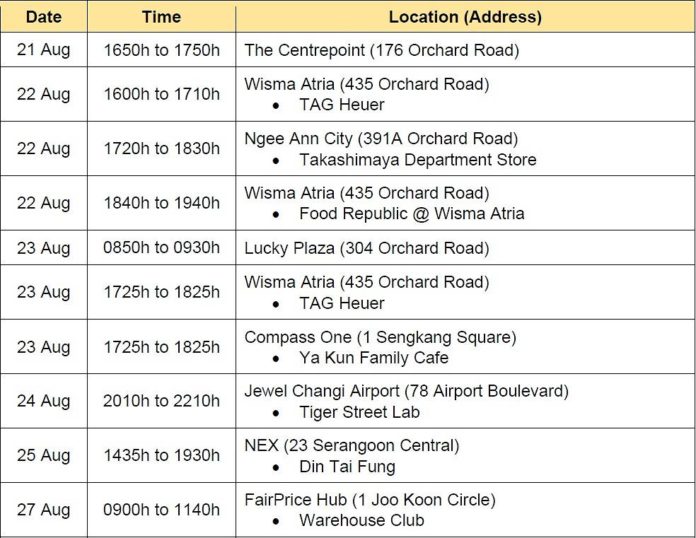
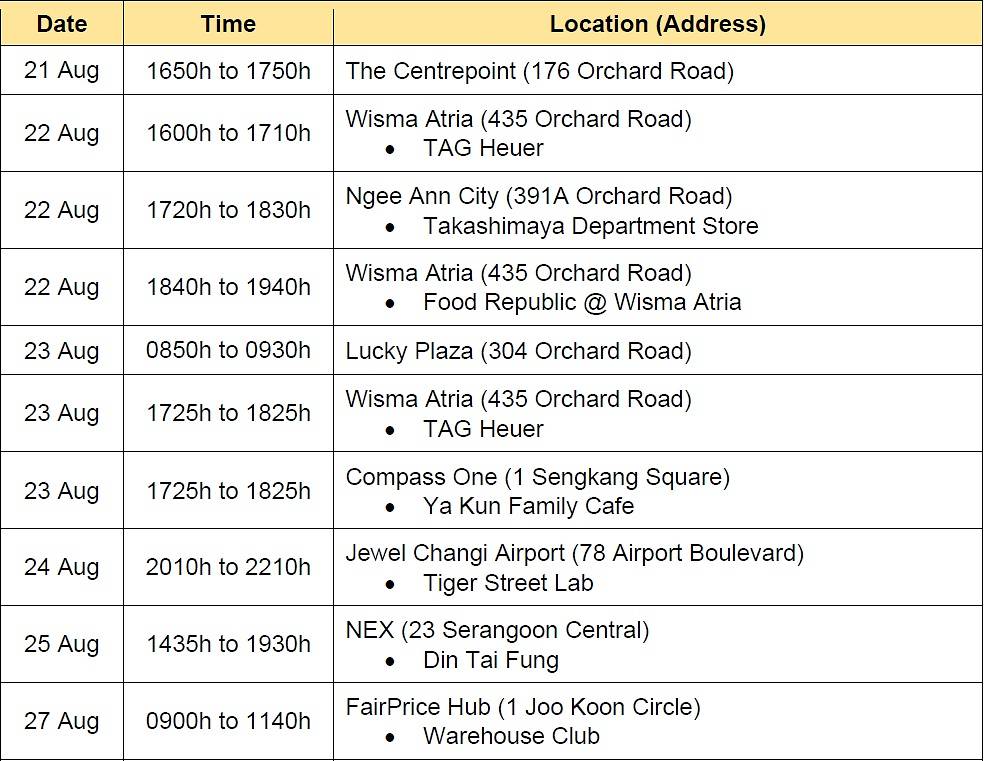
SINGAPORE: Four Orchard Road shopping centres were on Friday (Sep 4) added to the Ministry of Health’s (MOH) list of public places visited by COVID-19 community cases during their infectious period.
The Centrepoint, Lucky Plaza, Ngee Ann City and Wisma Atria were among those reported to have been visited by confirmed cases.
The TAG Heuer watch shop at Wisma Atria appeared twice on the list. The mall’s Food Republic food court was also added.
In Jewel Changi Airport, Tiger Street Lab – a concept store by Tiger Beer that serves beer and food – was visited by COVID-19 cases for two hours on Aug 24.
Other places visited by confirmed cases include eateries in Compass One and NEX, as well as the NTUC FairPrice Warehouse Club at Joo Koon.
Those who had been identified as close contacts of confirmed cases would have been notified by MOH.
As a precautionary measure, people who were at these locations during the specified timings should monitor their health closely for 14 days from the date of their visit.
“They should see a doctor promptly if they develop symptoms of acute respiratory infection (such as cough, sore throat and runny nose), as well as fever and loss of taste or smell, and inform the doctor of their exposure history,” said MOH.
There is no need to avoid places where confirmed cases of COVID-19 have been, the ministry added. The National Environment Agency will engage the management of affected premises to provide guidance on cleaning and disinfection.
Singapore reported 40 new COVID-19 cases on Friday, including three imported infections. There was no new case in the community.
All three imported cases were placed on stay-home notices upon arrival in Singapore and tested positive while isolated at dedicated facilities, said MOH.
The ministry has also contacted 254 people who visited the SLR Revolution camera shop at Excelsior Shopping Centre between Aug 15 and Aug 18, following the detection of three COVID-19 cases linked to the shop.
Of these, 250 people have tested negative for COVID-19, while the remaining four have yet to be swabbed.
SINGAPORE – The National University of Singapore retained its position as the world’s 25th best university and third in Asia, according to the Times Higher Education rankings released on Wednesday (Sept 2).
Tsinghua University, Asia’s top university, became the first university in the region to break into the global top 20 when it was ranked by the higher education publication in 20th place.
Peking University, ranked second in Asia, was placed in the 23rd position globally.
Nanyang Technological University (NTU) moved up one place to the 47th position this year.
Ang Mo Kio residents were startled by a grisly scene at a void deck last night (Sept 3).
A pool of blood was seen near a table at Block 511 Ang Mo Kio Avenue 8, with a pair of slippers lying nearby.
But it didn’t end there.
In a video clip shared on Instagram on the same night, a trail of bloodied footprints was seen going up a flight of stairs.
A netizen who claimed to have filmed the clip said: “The man’s leg was almost ‘chopped’ off.”
According to Shin Min Daily News, the man is believed to have slashed himself after drinking and lives in the neighbouring Block 508.
He left a trail of blood measuring 40 metres as he crossed the road to make his way home.
However, no one answered the door when reporters visited the flat this morning.
A neighbour who declined to be named mentioned that the man was seen walking along the common corridor last night. He appeared to be conscious at the time.
SINGAPORE: The completion of the second stage of the Thomson-East Coast Line (TEL) will see a three-month delay due to the COVID-19 pandemic, after it was originally scheduled to open by this year, Transport Minister Ong Ye Kung said on Friday (Sep 4).
The second phase of the TEL comprises six stations from Springleaf to Caldecott, with two interchange stations at Bright Hill and Caldecott.
It will now open by the first quarter of 2021, Mr Ong said in a written answer to parliamentary questions by the Workers’ Party Member of Parliament (MP) Jamus Lim.
Dr Lim had asked about the progress of the TEL given delays caused by the pandemic and if this spillover would lead to delays for other major planned MRT projects.
“The circuit breaker and phased re-opening since April this year have caused delays to the completion of the Thomson-East Coast Line Stage 2,” Mr Ong said on Friday, noting that the lost time will be made up for.
Mr Ong added that the TEL2 was “near completion and prioritised for resumption of work”.
“However, unlike the TEL2 … we will only be able to better assess the length of delays on subsequent phases of TEL and other MRT projects when construction activities have more fully resumed,” he said.
He added the Government “remains committed to significantly expand the MRT network” from the present 230km to 360km by the early 2030s.
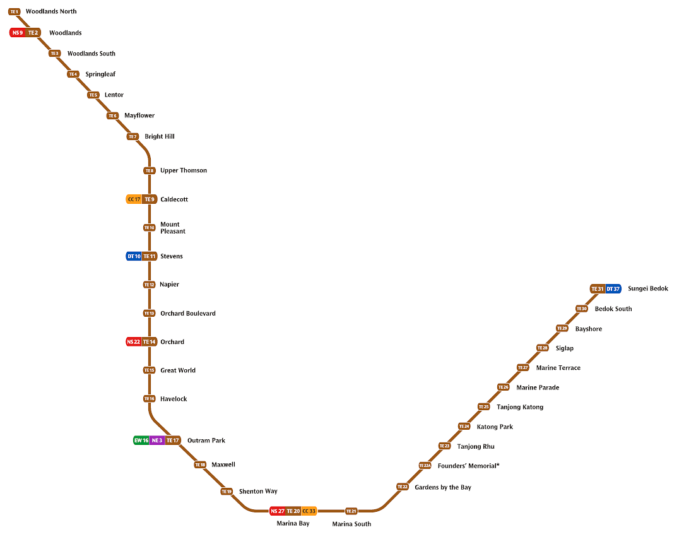
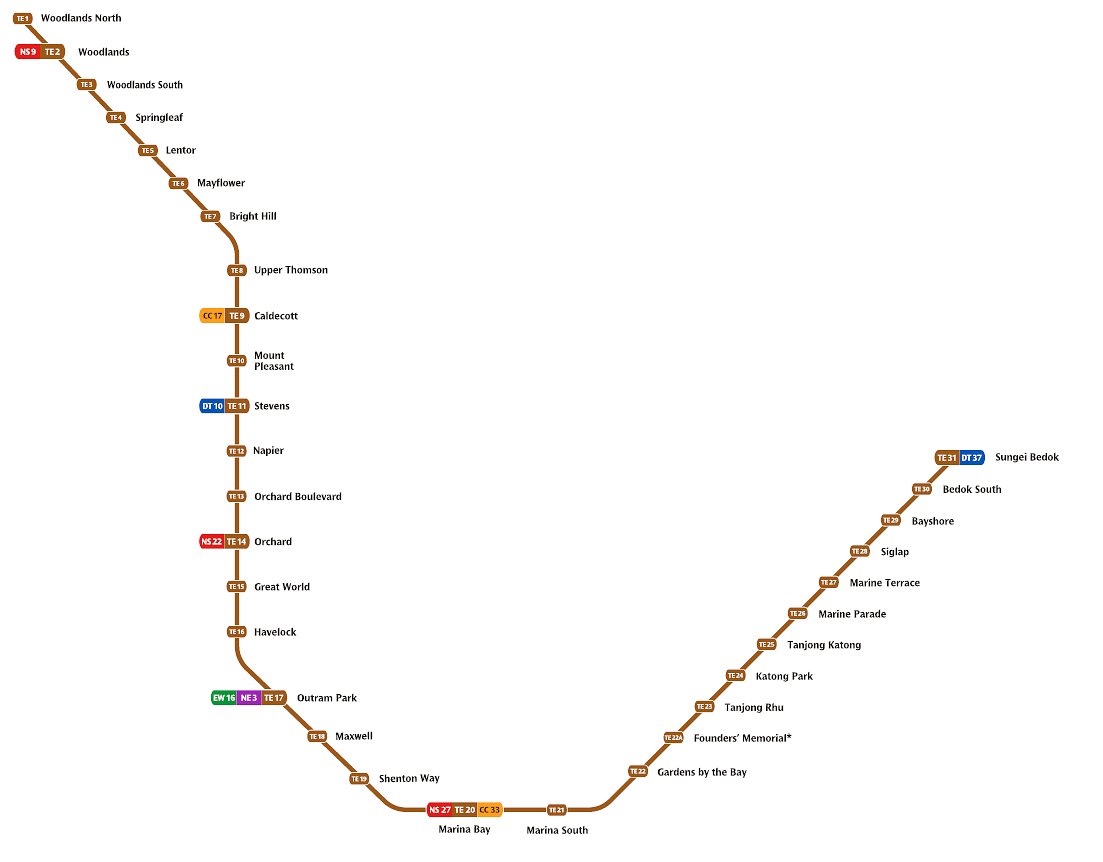
Map of Thomson-East Coast Line. (Graphic: LTA)
This includes opening the remaining stages of the Thomson-East Coast Line, completing the circle with Circle Line Stage 6, as well as building the North East Line Extension, Jurong Region Line and Cross Island Line.
The first stage of the TEL – made up of Woodlands North, Woodlands, and Woodlands South MRT stations – began taking passengers on Jan 31.
The Land Transport Authority had said in January this year that the second phase of the TEL was about 90 per cent complete.
The entire TEL line – comprising 32 stations with eight interchange stations – was initially expected to be fully operational in 2024, serving about 500,000 commuters daily in the initial years, rising to about 1 million commuters in the longer term.
All construction work in Singapore had been halted during the circuit breaker period from Apr 7 to Jun 1, as part of the Government’s measures to minimise further spread of the coronavirus.
Since then, contractors that have met the COVID-19 safety regulations for the construction sector are allowed to begin work, with priority given to critical and time-sensitive projects such as MRT works and sewerage system tunnelling projects.