Thanks to Covid-19 this year, we missed out on going overseas to Japan, Korea and Taiwan for the sakura season that takes place during spring, when the streets of the city are filled with pink blossoms everywhere you turn.
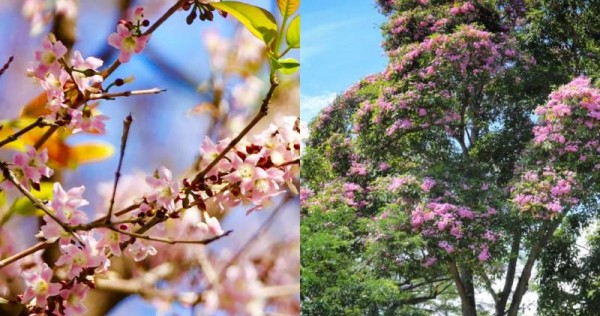
If you still are hankering for your fill of spring flowers, NParks has reported a “September spring” that is taking place across Singapore in a Facebook post yesterday (Sept 7).
#SGBlooms2020 A spectacular “September spring” is happening across Singapore! We’ve picked out just a few of the lovely…
SINGAPORE: The Ang Mo Kio Town Council said on Monday (Sep 7) it is investigating the cause of a pipe choke after fecal matter overflowed at a void deck last week.
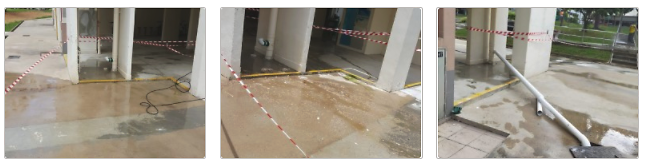
A preliminary investigation showed that an “underground pipe was choked”, said the town council, causing fecal matter to spill at the void deck of Block 639 in Ang Mo Kio Avenue 6.
The incident first started last Thursday morning, a spokesperson from the Ang Mo Kio Town Council said in response to CNA’s queries.
“The incident started with a resident who (gave) feedback that the water in his toilet was unable to flow down his gully trap,” the town council said, adding that the issue was rectified on Thursday itself.
But the next morning, it was alerted to another incident with “an overflowing of fecal matter at the void deck”.
A cordoned off area at a void deck in Ang Mo Kio following an overflow of fecal matter. (Photo: Ang Mo Kio Town Council)
In response, the town council cordoned off and cleaned up the area, the spokesperson said, noting that public safety and public health considerations were “paramount”.
“To prevent further recurrence, we have temporarily diverted the waste matters into the manhole.”
The exact cause of the choked pipe is still under investigation, the spokesperson added.
The town council said it will continue with inspection and rectification works on Monday together with the Home Improvement Programme contractor.
The affected block is currently under the Home Improvement Programme, which addresses common maintenance problems related to ageing flats.
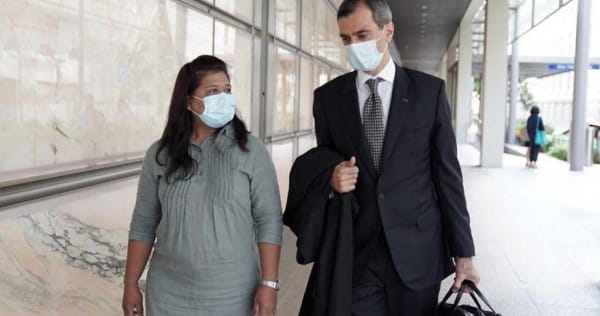
SINGAPORE – Both the Ministry of Manpower and the police are looking into the case of a former domestic worker acquitted of stealing from Changi Airport Group chairman Liew Mun Leong and his family.
In a statement on Sunday (Sept 6), MOM said that it is in consultation with the Attorney-General’s Chambers (AGC) as to whether further action, if any, ought to be taken following comments by the judge, Justice Chan Seng Onn.
The police also said on Sunday night that they would be looking into several observations of police investigations made by Justice Chan in his 100-page judgment on the case.
While the statement by police did not elaborate on what these observations were, Justice Chan had found that there was a break in the chain of custody of evidence, creating reasonable doubt as to whether some of the allegedly stolen items discovered by the family were accurately documented by the photographs taken by the police some five weeks later.
SINGAPORE – Former political office-holder and MP Amrin Amin has moved to the tech sector and will be taking up roles at two local firms, following his exit from the Government after the recent general election.
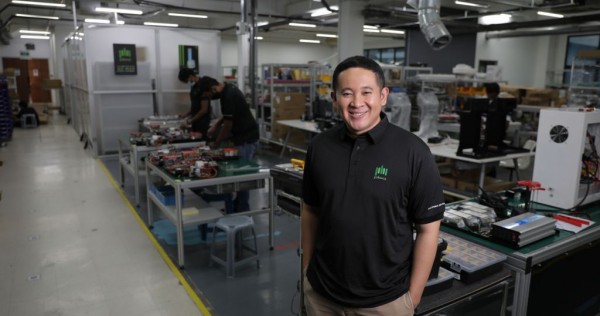
Mr Amrin, 42, has been appointed strategy director at robotics and automation firm Platform for Bots and Automation (PBA). Mr Amrin, a lawyer by training, will also take up the role of non-executive adviser at ADERA Global, a company involved in data-security, artificial intelligence (AI) and automation.
The People’s Action Party (PAP) Sengkang GRC candidate, whose team lost to the Workers’ Party in GE2020, officially starts both roles on Sept 14 but has already been attending meetings and on-boarding himself in these companies.
Mr Amrin was previously senior parliamentary secretary for Home Affairs and Health and an MP for Sembawang GRC, helming the Woodlands ward.
Speaking to The Straits Times at PBA’s office in Yishun on Friday (Sept 4), he said he started thinking about job-hunting the day after Polling Day on July 10.
SINGAPORE: Situated near the equator, Singapore is hot and humid throughout the year, making it almost necessary for Singaporeans to have an air-conditioning system.
Singapore has more air-conditioner installations per capita than any of its Southeast Asian neighbours. About 99 per cent of condominiums have air-conditioning installed.
The number of air-con installations is expected to rise with the increase in number of residential and commercial building developments, growing by 73 per cent from 2010 to 2030, according to NUS Professor Lee Poh Seng, deputy director at the Centre for Energy Research and Technology.
Household and building use of air-conditioning might sound trivial but this sector alone constitutes 19 per cent of Singapore’s carbon emissions, making it the second highest source of emissions in Singapore after the industrial sector, which accounts for 60 per cent of emissions.
Of the 19 per cent, a sizeable portion is said to be generated from air-conditioning, according to Senior Minister of State for Environment and Water Resources Dr Amy Khor in Parliament in November 2019.
Air-conditioning accounts for up to a quarter of an average Singaporean household’s electricity consumption.
A standard 2 kilowatt AC unit which can comfortably cool a room of up to 20 sq m produces about 1.4 tonnes of carbon emissions per year, assuming it is turned on 20 days a month, eight hours per day.
If there are four such AC units in an HDB household, they will generate about 5.6 tonnes of carbon emissions annually.
An air-conditioner in the home.
In comparison, a 35-inch flatscreen plasma television generates 0.25 tonnes of carbon emissions yearly assuming it is switched on for about six hours a day.
The carbon footprint of using a washing machine is much lower at 0.05 tonnes of carbon emissions assuming about 180 washes are done yearly.
The carbon emissions arising from air-conditioning in a typical HDB household clearly outstrip emissions arising from other household appliances.
In fact, annual missions generated from AC use in an HDB flat with four AC units is greater than yearly emissions generated from driving a car, which stands at about 4.6 tonnes per year.
That number goes up during periods of haze. An NUS study released in August showed Singapore condominiums switch on the air-conditioning for 10 more hours a month when PM2.5 increased by 10 micrograms per cubic metre.
Even then, the carbon emissions from Singapore’s residential units pale in comparison to those arising from commercial buildings.
Cooling systems consume about 40 to 50 per cent of a building’s energy, which contributes to the urban heat island effect.
The air in built-up areas in the Central Business District (CDB), where air-conditioning systems run non-stop pre-coronavirus is about 7 degrees Celsius hotter than in greener pastures.
Singapore’s business as usual approach to cooling is expected to contribute about 4.89 mega tonnes of carbon emissions by 2030.
While air-conditioning has enabled an entire nation to thrive and be productive at work and at home, Singaporeans know their air-con habits are problematic.
(Photo: Unsplash/Kate Sade)
A 2017 survey by Eco-Business saw 68 per cent of respondents from Singapore encountering excessive cooling of public places such as offices, shopping malls and cinemas.
This begs the question why building owners maintain indoor air-con temperatures at arctic-cold levels.
Air-conditioning settings in building should be dependent on the outside temperature and humidity. Yet they remain unchanged during periods of heavy rainfall or cooler weather in certain months of the year.
Commercial buildings are kept about 40 per cent cooler than they ought to be when building owners tend to plan for the hottest days and don’t power the air-con down during cooler days.
For Singapore to achieve its updated climate pledge of total greenhouse emissions to cease growing by 2030 and to be halved by 2050, big changes are needed to tackle its air-con addiction. This can be achieved by adopting passive building designs, more efficient technologies and supporting a culture change in cooling consumption.
The good news is a shift has been underway in recent years to set rules and regulations that turn back the tide on air-conditioning’s giant carbon footprint.
All new buildings are required to achieve established minimum standards for sustainability under Building Control regulations.
Revisions to the Green Mark Scheme passed after 2017 further encourage building owners and developers to achieve higher energy efficiency by reducing a building’s cooling demand and adopting more efficient cooling systems.
About 40 per cent of building gross floor areas have met these standards.
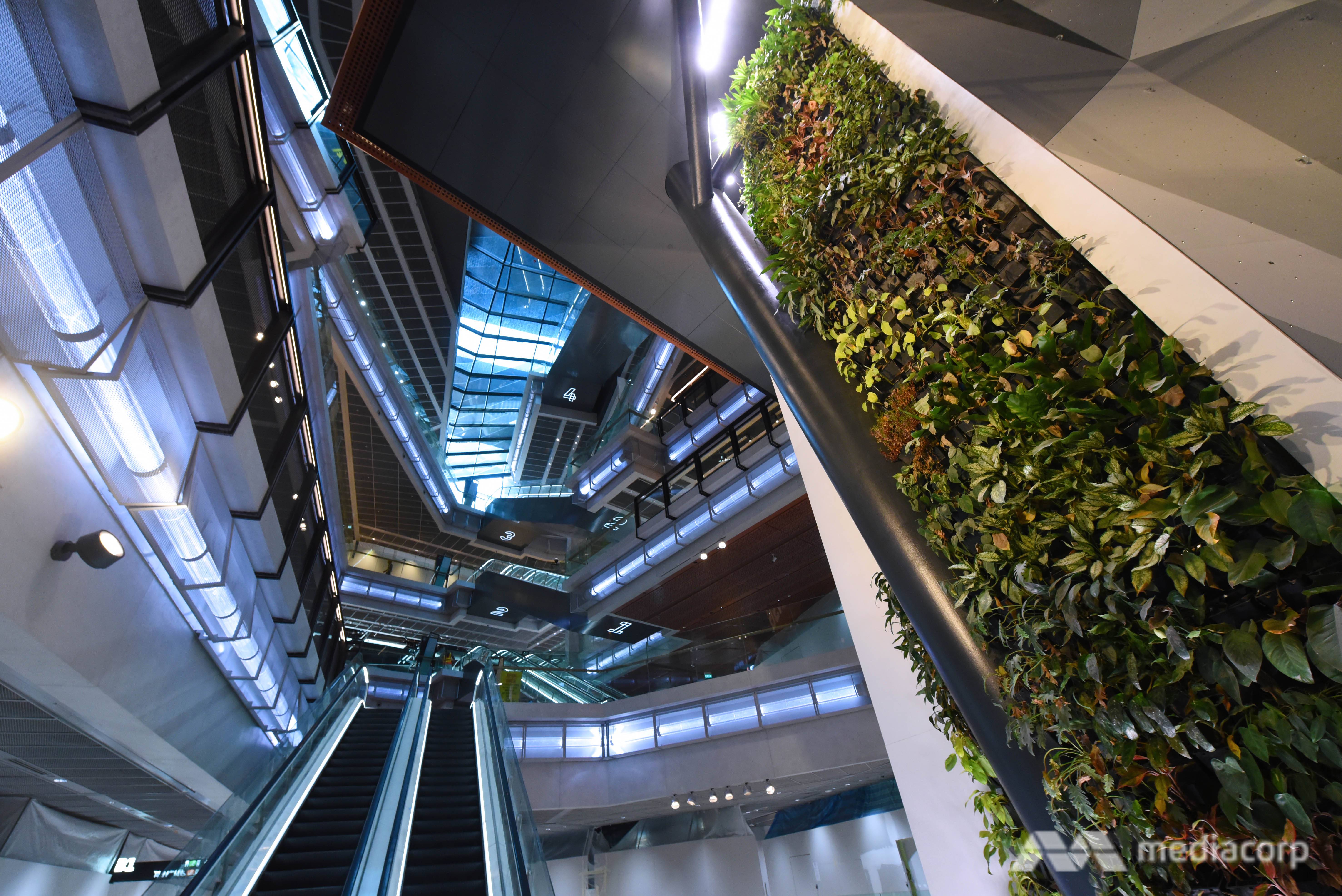
Interior of Funan Mall. (Photo: Gaya Chandramohan)
The implementation of a carbon tax will also push developers towards low-energy technologies. For instance, shopping mall Funan’s chilled water system makes use of a non-polluting refrigerant, which has saved on five kilotonnes of carbon emissions – roughly that of 1,500 cars.
Passive design, which helps buildings keep cool without air-conditioning, have also been more commonplace, whether it’s the use of industrial fans at 313 Orchard, or the use of self-shading building forms at the Singapore Management University’s Tahir Foundation Connexion.
The Mandatory Energy Labelling Scheme has been enhanced over the years – for instance, making energy labels in publicity material mandatory since November 2019. This encourages and aids consumers to purchase more energy-efficient household air-cons, much as brand and price remain primary factors in purchases.
The Minimum Energy Performance Standards complements such efforts by phasing out less efficient appliances from the market.
These efforts have been given a fresh boost after then Minister for the Environment and Water Resources Masagos Zulkifli announced in March that fridges and air-conditioners will also have a climate-friendly label, with bans on variants with high global warming potential in the last quarter of 2022.
A fresh training and certification scheme for technicians who carry out the installation, maintenance and decommissioning of household air-conditioners will also ensure refrigerates are properly handled, avoiding the leakage of hydrocarbons into the atmosphere.
Such efforts will also strengthen the recovery, reclamation and the destruction of e-waste, mandated by NEA, which will require a Toxic Industrial Waste Collector license.
While Singapore’s evolving regulatory landscape seeks to shape commercial decisions on air-conditioning, technology has also been an enabler. Presently, the compressor technology of traditional air-con units is only hitting 6 per cent to 8 per cent of theoretical maximum efficiency.
Then National Development Minister Lawrence Wong at the opening of the inaugural International Built Environment Week on Sep 4, 2019. (Photo: BCA)
But these units have the potential to be replaced by chillers that use water instead of harmful refrigerants and energy-intensive compressors.
The use of membranes and district cooling systems which save energy by pumping chilled water from a centralised plant to multiple buildings can be implemented and scaled up.
New cooling technologies using hybrid solar-thermal air-conditioners that can reduce electrical loads by 55 per cent, developed by NUS Mechanical Engineering and Ecoline Solar, are also being installed in commercial venues across Singapore.
We are already feeling the effects of climate change, and are experiencing higher temperatures and greater humidity like never before. Yet the irony is that turning on the air-con traps our world in global warming.
It is crucial that Singapore weans itself off unsustainable air-conditioning to mitigate its carbon footprint.
Until the day we can use alternative forms of energy in a wider scale or electrify entire fleets of public transport buses, turning on the air-conditioner will have a huge impact on our environment.
On our part, the only way to limit the damage is to use high energy efficient air-conditioners and to keep their use to a minimum level possible.
Kavickumar Muruganathan is a sustainability and supply chain professional in the renewable energy sector. He is also a lecturer at TUM Asia.
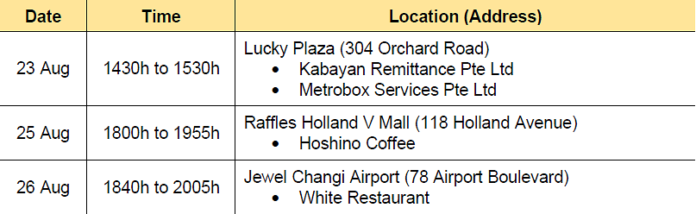
SINGAPORE: Two stores at Lucky Plaza, a cafe in Holland Village and a restaurant at Jewel Changi Airport were the locations added to a list of public places visited by COVID-19 cases in the community during their infectious period, said the Ministry of Health (MOH) on Sunday (Sep 6).
Kabayan Remittance and Metrobox Services at Lucky Plaza were among the new locations, as was Hoshino Coffee at Raffles Holland V Mall. White Restaurant at Jewel Changi Airport was also on the list.
Those who have been identified as close contacts of confirmed cases would already have been notified by MOH.
As a precautionary measure, individuals who were at those locations during the specified timings should monitor their health closely for 14 days from their date of visit, said MOH.
“They should see a doctor promptly if they develop symptoms of acute respiratory infection (such as cough, sore throat and runny nose), as well as fever and loss of taste or smell, and inform the doctor of their exposure history,” it added.
The ministry said there is no need for people to avoid places that had been frequented by COVID-19 cases, and that the National Environment Agency will engage the management of the affected premises to provide guidance on cleaning and disinfection.
SINGAPORE: A restaurant that flouted COVID-19 safe management measures and provided customers with drinking games has been ordered to “cease operations” until further notice.
Wang Zi Chu Fang, located at 191A and 199 New Bridge Road, failed to ensure that there was a safe distance of 1m between groups of customers and that group sizes did not exceed five people, said the Singapore Tourism Board (STB) on Sunday (Sep 6).
The restaurant also allowed customers to drink alcohol past 10.30pm.
Wang Zi Chu Fang was found to be non-compliant with safe management measures during a joint enforcement operation between the Singapore Tourism Board and the Singapore Police Force at 12.25am on Sep 5, 2020. (Photo: Singapore Tourism Board)
During a joint enforcement operation between STB and the police on Saturday at 12.25am, the restaurant was found to have provided customers with drinking games.
“Under the COVID-19 (Temporary Measures) (Control Order) Regulations 2020, food and beverage establishments are not permitted to provide games if they are not also an amusement centre. Further investigations are ongoing,” said STB.
The restaurant was previously fined S$1,000 on Jul 24 for failing to ensure 1m safe distancing between customers.
Two other restaurants were fined after checks by STB’s enforcement officers found that both restaurants had failed to ensure 1m safe distancing between customers.
Bistro Du Le Pin (#02-25 Orchard Plaza) and Wang Dae Bak (98 Amoy Street) were fined S$1,000 each on Friday and Saturday respectively.
Bistro Du Le Pin (#02-25 Orchard Plaza) was fined S$1,000 on Sep 4, 2020, for failure to ensure 1m safe distancing between customers. (Photo: Singapore Tourism Board)
Wang Dae Bak at 98 Amoy Street was fined S$1,000 on Sep 5, 2020, for failure to ensure 1m safe distancing between customers. (Photo: Singapore Tourism Board)
“STB has stepped up checks of tourism precincts and establishments since Singapore entered Phase 2, and will continue to deploy additional Enforcement Officers and Safe Distancing Ambassadors where required,” said the tourism authority.
“The vast majority of our local businesses have adhered to safe management measures, and STB will continue to engage our industry partners and precinct associations to help them implement these measures effectively.”
Ms Serene Tan, STB’s director of arts and cultural precincts, said while they encourage people to support local businesses, members of the public and businesses must comply with all prevailing safe management measures.
“This will help minimise transmission risks and allow our businesses to remain open,” said Ms Tan.
“STB will not hesitate to take enforcement action for non-compliance, which may include fines, closure of business or prosecution.”
SINGAPORE – There were 40 new coronavirus cases confirmed as of Sunday afternoon (Sept 6), including four community cases and 13 imported cases.
The four community cases announced on Sunday are all work pass holders, said the Ministry of Health (MOH) in its daily update.
The 13 imported cases had been placed on stay-home notice upon arrival in Singapore.
The latest increase takes Singapore’s total number of cases to 57,022.
More details on the cases will be released later on Sunday night.
On Saturday, the MOH announced three new clusters of coronavirus infections – all in dormitories.
Cochrane Lodge I, Mandai Lodge I and Tuas South Dormitory were linked to nine, 17 and 11 earlier confirmed cases respectively.
Waterway Point and The Seletar Mall were the latest to be added to the list of places visited by infectious Covid-19 patients.
The ministry provides the list of locations that infectious Covid-19 patients visited for at least 30 minutes and the times they visited them to get people who were at those places to monitor their health closely for two weeks from when they were there.
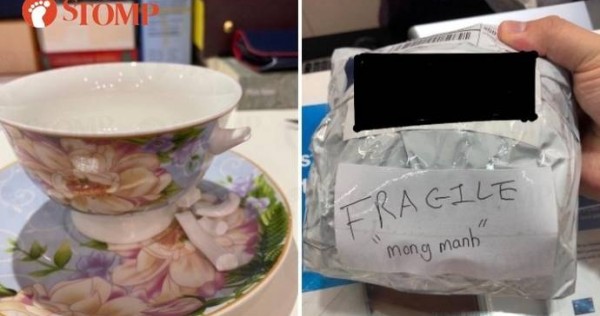
Singapore Post has responded after a customer complained that the fragile cup he sent from Singapore to Vietnam was ‘damaged during delivery’.
Stomp contributor Anonymous informed Stomp of the incident on Aug 20 and shared photos of the cup before and after the delivery.
He also shared a photo of how he packaged the cup for delivery.
“I sent out the parcel on July 21 and my friend received it on Aug 3. However, the teacup, which was a birthday gift, was damaged and in pieces,” the Stomp contributor shared.
“Several calls and emails sent to SingPost also went unanswered.”
In response to a Stomp query, a spokesman for SingPost said: “SingPost reminds the public that items for shipping should be packed tightly to prevent damage caused by shifting during the shipment process.
“This is especially applicable to fragile items shipped internationally such as glassware, as they have to weather handling by foreign customs officials and airline cargo handling crew.
“Senders are also encouraged to purchase insurance for valuable items, so that they are covered in the event of any mishaps.
The Sunday Times found at least 10 jobs touting salaries of $100,000 a month or more on the national jobs portal MyCareersFuture.sg last month.
Some of these listings have been edited as they were mistakenly reflecting annual wages and attracting dozens of applications. Several, however, remain unchanged.
Observers said such salary offers are too good to be true, especially in this uncertain economic climate.
One project manager job is listed with a $160,000 to $200,000 monthly salary. The role, which involves coming up with digital products for the financial technology market, seeks candidates with 10 years of experience. It has received some 40 applications on the portal.
Another listing for a financial services industry consultant with at least five years’ experience offers a monthly pay of between $130,000 and $200,000. It has over 30 applications. When contacted, the firm clarified that it was a typo.
These are probably entry blunders, said Mr Paul Heng, managing director of NeXT Career Consulting Group, adding that some of the salaries are per annum figures.