Home Blog Page 991

Singapore logistics firms urged to automate, adopt new technology

0

SINGAPORE: For Singapore to become a key player in the global supply chain, logistics firms here need to adopt new technologies and improve productivity, said Trade and Industry Minister Chan Chun Sing on Wednesday (Jul 18). 

“Today, a typical item that enters Singapore, either from the port, the airport or the Causeway will probably have zipped around the island a few times before it finally reaches the hands of the final consumers,” said Mr Chan, adding that it is a situation that is “highly inefficient, highly unproductive and a waste of time and money”.

Speaking at the opening of Australian logistics company Toll Group’s S$228 million logistics hub, Mr Chan said he wants to make this a thing of the past, but that requires all logistics firms to continue innovating and to utilise their resources more effectively.

“What we have today – automated vehicles picking items from the shelves and loading them onto the trucks – is just one part of our innovation in the entire supply chain,” said the minister. 

“I have a dream where all the things in the warehouse are organised overnight in the dark – picked, packed and delivered in the night to all the destinations, without holding up the traffic or fighting with the daytime logistics flow. That is how smart urban cities should look like,” he added. 

Mr Chan said this is why Singapore needs to testbed new concepts on this front, and build it into a competitive advantage. This way, Singapore can also be a role model and a testbed for many other countries, particularly in Asia.

He cited Toll Group as one of the firms that is contributing to this vision of improving Singapore’s logistics and supply chains, and which has successfully done away with labour-intensive operations through the help of automation and digitalisation.

Toll Group

Equipment such as the Automated Guided Vehicle has helped Toll Group cut manpower costs and improve efficiency. (Photo: Brandon Tanoto)

For instance, automated guided vehicles and smart shelving systems at its new hub have helped Toll Group reduce manpower costs and ramp up its efficiency by up to 30 per cent. The company is also constantly working on new solutions that will help to maximise the usage of space in its warehouses.

When asked if the use of automated equipment has displaced jobs, Toll Group’s executive vice president for global logistics, Mr Vincent Phang, told Channel NewsAsia that, on the contrary, it presents the company and its workforce with new opportunities.

Mr Phang said: “If anything, the opportunity for us to automate allows us to create new and better jobs for our workforce. 

“From an operator standpoint, it no longer is just about operating a single forklift, it could be that such an operator is operating a fleet of forklifts or being a supply chain planner, so that gives us the opportunity to upskill our talent and to create more meaningful jobs for them.”

He said the firm is able to ensure a healthy pipeline of talent through the government’s Professional Conversion Programme, as well as working closely with polytechnics to attract its graduates into the industry.

Source link

Social enterprise cafe Professor Brawn opens at Raffles Institution

0

SINGAPORE: The Autism Resource Centre (ARC) has opened its first social enterprise cafe, Professor Brawn Cafe, in a school. The outlet, which is located at Raffles Institution (RI), was officially opened by Education Minister Ong Ye Kung on Wednesday (Jul 18).

The cafe provides job opportunities for the special needs community and gives them a platform to showcase their talents and abilities. Under a partnership with Gong Cha, it also offers a selection of drinks from the popular bubble tea brand’s menu.

Five of the cafe’s 10 employees have special needs, and are paid competitively based on their job scope.

ARC’s deputy executive director Jacelyn Lim said that the centre’s main intention in setting up the cafe is to drive the message of inclusion and create jobs for those with special needs.

 “They get to learn skills, apply their skills and be productively employed,” she said. “Second, there is also dignity – work is dignity, and that’s very important. It also gives them financial independence.”

Professor Brawn Cafe was first founded in 2009 by Mr Roland Tay and his wife, ARC President and Member of Parliament Denise Phua. However, in the middle of this year, the couple decided to donate the franchise to ARC, as it has the job coaching expertise and network to expand it to benefit more people.

With the change, the brand closed its two outlets located at Novena and Boat Quay. The cafe at RI is the first to reopen under ARC’s management. 

CAFE SHOWS WHAT IT IS LIKE TO BE INCLUSIVE: ONG YE KUNG

Speaking at the opening of the cafe, Mr Ong pointed out that the model is an illustration of what it is like to be inclusive.

“You see a delicate, artistic and careful balance,” he said. “On the one hand, there’s a lot of inclusiveness because they’re in the middle of a mainstream school, where students will get to be served by them and interact with them.”

“But on the other hand, this is also a sanctuary, where they feel safe, and where people know what kind of cafe it is and calibrate their expectations,” he added.

“So it’s about striking a balance. And that’s important for the education system as well.”

professor brawn 2

Five of the cafe’s 10 employees have special needs, and are paid competitively according to their job scope. (Photo: Lianne Chia) 

WHY SET UP IN A SCHOOL?

There are obvious benefits to setting up the cafe in the school, with ARC’s Ms Lim explaining that it gives them affordable rental and a “captive crowd”. Previously, she said, the cafe functioned on a “typical commercial model”, with high overheads.

Ms Phua, who is also chair of the Government Parliamentary Committee for Education, said she has observed that in some schools, volunteer work or community involvement is not done on a daily basis.

“It’s usually done once a year, or once a term,” she said. “So having this inclusive workforce, in a mainstream setting, where the students are actively involved and engaged, is really a more effective way of involving the community in supporting them.”

She added that the RI students have helped with food tastings, publicity and even co-creating menus for the cafe. RI, she also pointed out, has been one of their earliest partners, and it was “by chance” that the school happened to have a space for them to set up the cafe after a previous tenant vacated.

Since the cafe opened for business at the start of the month, Year 5 RI student Rowena Chua has visited “multiple times”.

“I think by now, the entire school community has visited the café,” she said, describing her experience as “the same as at any other restaurant or café.”

“When we go there, we know we’re interacting with a group of people who are slightly different, so I take a bit of caution when I interact with them,” she said. “But there’s no need to possess any stereotypes or harbour any misunderstandings about them.”

“Because after a while, you get to know them, and you realise they’re pretty much the same as us.”

Moving forward, ARC also hopes to replicate their model in other places, and Ms Lim stressed that they are not limiting themselves to operating only in schools.

 “Ultimately, it’s about the message of inclusion, and that’s not confined to schools.”

Source link

Singapore’s latest Michelin award recipients try to swallow the news of their F&B honour

0

Follow our CNA LIFESTYLE page on Facebook for more dining stories and videos

SINGAPORE: One is a hip maverick nasi lemak specialty restaurant in Ann Siang Hill, the other an iconic food establishment in Little India known for its signature fish head curry. 

The Coconut Club and Muthu’s Curry couldn’t have been any more different, but the owners of both establishments shared the same reaction when they found out about their inclusion into this year’s Michelin Bib Gourmand list on Wednesday morning (Jul 18).

“We were very shocked to hear that we got the award,” said The Coconut Club co-owner Lee Chan Wai. “I think it hasn’t quite sunk in yet.”

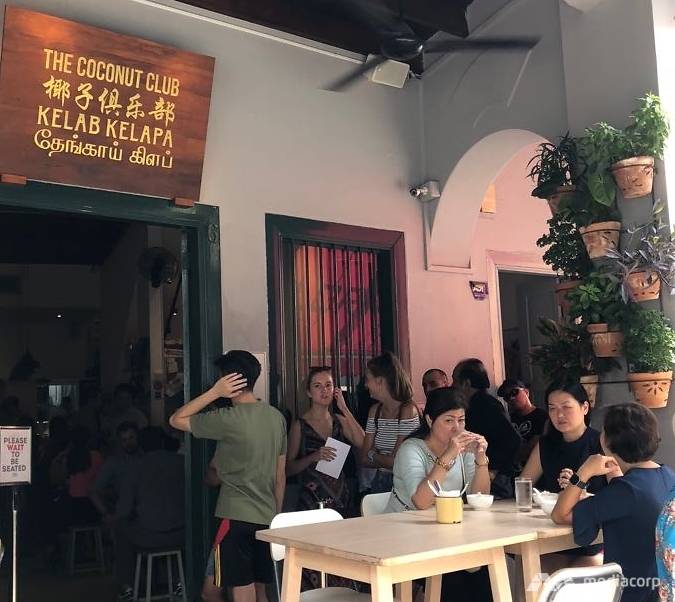
Michelin Bib Gourmand 2018 The Coconut Club

New Michelin Bib Gourmand 2018 entrant The Coconut Club at Ann Siang Hill. (Photo: Genevieve Loh)

Agreed his friend and co-owner Lee Eng Su: “I woke up to a slew of Whatsapp messages. To be honest, we are still processing the news.”

He added: “We are (operationally) about two years old. We said to each other, if we can get the Bib Gourmand award, then Muthu’s Curry ought to get the Michelin Star! They deserve it, having been around for decades.” 

There’s no star just yet for the popular Indian restaurant but Muthu’s Currinary chief executive officer Kasivishvanaath Ayyakkannu is still pleased with the accolade – even if he wasn’t aware it was happening at all.

Michelin Bib Gourmand 2018 Muthu's Curry

The folks behind Muthu’s Curry in Little India: Kasivishvanaath Ayyakkannu CEO of Muthu’s Currinary and director of operations Srinivasan A. (Photo: Genevieve Loh)

“We are so happy and quite shocked,” he told CNA Lifestyle. “It was never the intention to get on the list, so we will continue doing what we’ve always been doing, improve where we can and see how it goes”. 

The two local food establishments were among the 17 new entrants into the 50-strong list that were recognised by Michelin inspectors this year. The Bib Gourmand is given to establishments with quality food priced at no more than S$45, and a lead-up to next week’s big event, when this year’s Michelin Guide Singapore will be announced.

The Coconut Club’s owners attributed their success to having a great team of service staff. “We invest a lot in local human resource. We believe service is very important to the whole experience,” said Lee Chan Wai.

Michelin Bib Gourmand 2018 The Coconut Club (2)_mod

Nasi lemak at The Coconut Club. (Photo: Genevieve Loh)

What’s next for the restaurant? There are plans to expand their current space, as well as a menu update – plans made way before the Bib Gourmand announcements.

“We were discussing about evolving our menu and perhaps adding burung puyuh (Malay for quail) for some time already. We hope people will not think we’re making all these changes simply because of the award!” quipped Lee Eng Su.

For one of The Coconut Club’s regular patrons, 40-year-old Is, it’s a well-deserved award – even if he admitted that his first thought was “Oh no, that means the queue will get longer”.

That won’t be an issue for Srinivasan Ayyakannu, director of operations for Muthu’s Currinary, the parent company of Muthu’s Curry.

Michelin Bib Gourmand 2018 Muthu's Curry (3)

Muthu’s Curry at Little India. (Photo: Genevieve Loh)

“Hopefully it translates to sales,” he quipped. “We’ve been here for 50 years, and this Race Course Road restaurant is our flagship. Most of our old customers and regulars usually patronise this outlet so that could be one of the reasons why this is the one that got the award”.

Added  Kasivishvannath: “Now that we have the award, we have to maintain the same standard, the food quality, the service and the prices,” he said

For the last 20 years, loyal Muthu’s Curry fan and Malaysian restauranteur and marketing consultant Shankar Santhiram has been dropping by whenever he’s in town – and he’s surprised the recognition took this long.

Michelin Bib Gourmand 2018 Muthu's Curry (2)_mod

On offer at Muthu’s Curry in Little India. (Photo: Genevieve Loh)

“Muthu’s Curry is the real deal. And I would love to see them win more awards and accolades,” he said. “But like any genuine well-wisher, I’m also selfish because I don’t want the place to be jammed up. I hope that the owners of Muthu’s Curry stay true to form and not make the mistake of other restaurants by tweaking stuff once they win an award.  You don’t have to up the ante or be all fancy. Just stay true to the old dude who started it years and years ago.”

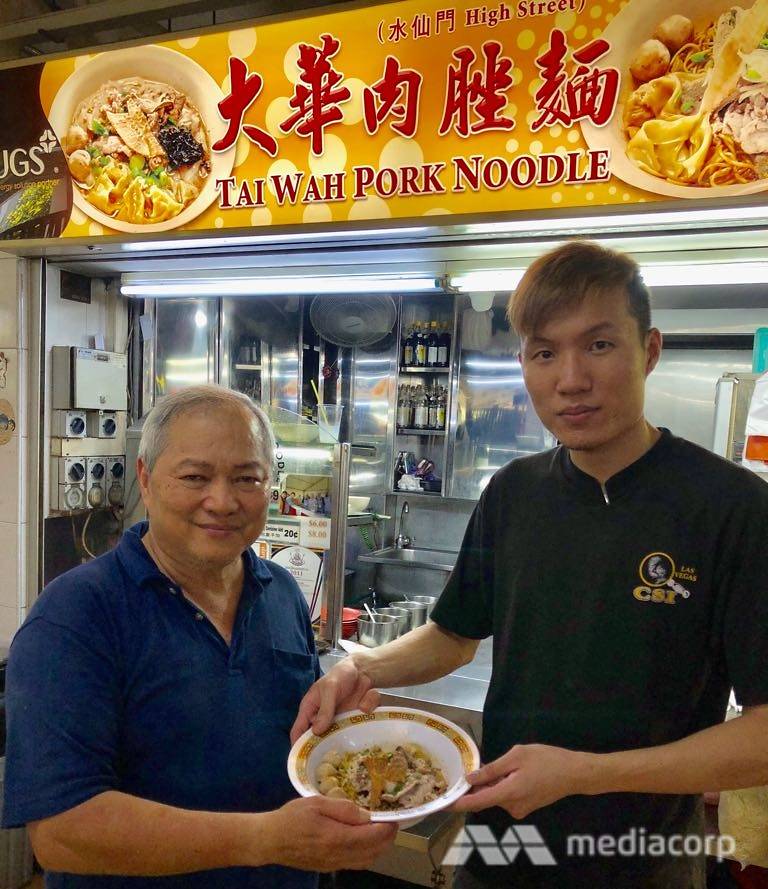
Continuity is also at the heart of Tai Wah Pork Noodle, another new Bib Gourmand entrant located at Hong Lim Market and Food Centre.

If you find the name familiar, it’s because semi-retired hawker 64-year-old Tang Chai Chye used to run Hill Street Tai Hwa Pork Noodle with his elder brother Chay Seng at Marina Square.

Michelin Bib Gourmand 2018 Tai Wah Pork Noodle (1)

Michelin Bib Gourmand 2018 new entrant Tai Wah Pork Noodle’s Tang Chai Chye, 64, and his youngest son Jason Tang, 30. (Photo: Genevieve Loh)

That store then moved to its current Crawford Lane location and has since been awarded the coveted Michelin Star.

The Hong Lim Market and Food Centre stall is now being run by Chai Chye’s sons Gerald and Jason who are 38 and 30, respectively.

And like the other new awardees, the elder Tang said he did not expect the accolade at all.

“Although this news is good for us, it might not be seen as good for my regular customers,” he joked, in Mandarin.

“Most of them are the office crowd who can’t queue for too long because they have to go back to the office.”  

Michelin Bib Gourmand 2018 Tai Wah Pork Noodle

Tai Wah Pork Noodle at Hong Lim Market and Food Centre. (Photo: Genevieve Loh)

​​Tang, who started in the business when he was 20 years old and fresh out of the army, says it’s important to keep the business in the family, whether they get awards or not.

“If we ever sell it, then my late father would be very angry,” he said. “My sons don’t need to learn how to make the noodles. They’ve been helping out since they were in primary school.”

Source link

NUS, Grab invest S$6m in AI lab for solving urban issues like traffic congestion

0

SINGAPORE: The National University of Singapore (NUS) and technology company Grab are partnering to launch an artificial intelligence (AI) laboratory here aimed at finding ways to alleviate traffic congestion and other urban transportation issues.

In a press release on Wednesday (Jul 18), both parties said the Grab-NUS AI Lab was set up with a joint initial investment of S$6 million. It represents the varsity’s first AI laboratory with a commercial partner, and the ride-hailing company’s first major AI laboratory, it added.

Minister for Education Ong Ye Kung on Wednesday also witnessed the signing of the research collaboration agreement between NUS president Tan Eng Chye and Grab CEO Anthony Tan.

Located at the NUS Institute of Data Science, the lab will use data from Grab’s platform – said to have facilitated more than two billion rides – to solve “complex, real-world challenges in Southeast Asia” such as mapping out traffic patterns and identifying ways to impact mobility and liveability in this region, they said.

The lab, which has 28 researchers, will focus on improving the efficiency and reliability of transportation on the Grab platform in Southeast Asia’s cities first, before expanding to research larger challenges such as congestion and liveability.

The research includes developing algorithms to “match drivers to the jobs they prefer and improve driving safety through better understanding of driver behaviour”. Researchers will also work on improving “precision and accuracy in mapping pick-up points and localising moving vehicles to help passengers and drivers get from point to point with greater ease and efficiency”, the press release stated.

Grab’s Mr Tan shared that its data, for example, shows that travel time from Newton to Tanjong Pagar can be “drastically improved”.

Screengrab of Grab video showing traffic pattern from Newton to Tanjong Pagar

(Image: Grab)

“If this route would be better served by more shared transport solutions such as buses, trains, GrabShuttle, GrabShare or GrabHitch, we could bring travel time during peak hour down by one-third or from 40 minutes to 28 minutes,” the CEO said.

The lab will also contribute to the development of AI talent through the training of PhD students who will be enrolled at the university, they added.

Source link

Shorter operating hours for 7 EWL stations and 3 NSL stations on some weekends from Aug to Sep

0

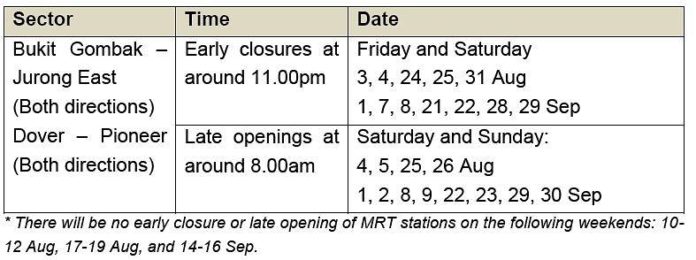
SINGAPORE: Seven stations along the East-West Line (EWL) and three stations along the North-South Line (NSL) will close earlier on some Fridays and Saturdays and open later on some Saturdays and Sundays from August to September to facilitate rail maintenance.

In a media release on Wednesday (Jul 18), the affected stations, from Dover to Pioneer and from Bukit Gombak to Jurong East, will close earlier at around 11pm on some Fridays and Saturdays, and open later at around 8am on some Saturdays and Sundays.

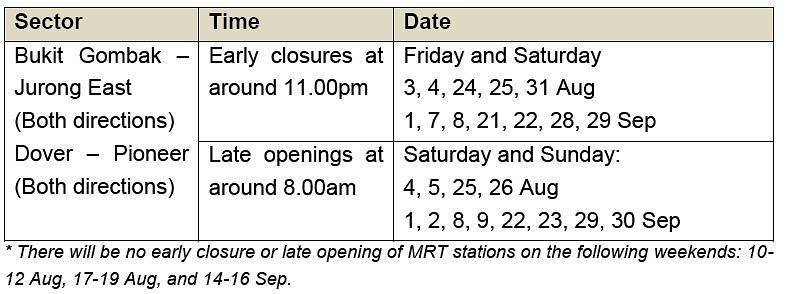
SMRT table

(Image: SMRT)

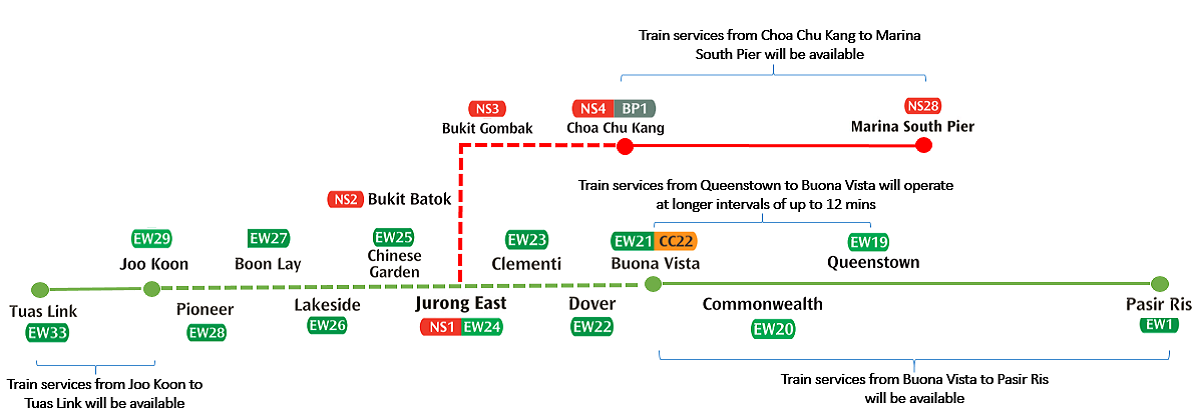
Train services from Choa Chu Kang to Marina South Pier MRT stations, and from Joo Koon to Tuas Link MRT stations will not be affected, SMRT said. 

Graphic: Early closure, late opening of NSL and EWL stations

“For the months of August and September 2018, our engineering teams will use the additional hour to continue with track maintenance and renewal works along this sector of the NSEWL,” SMRT said in the release. 

During this period, train services will operate as a bi-directional shuttle between Queenstown, Commonwealth and Buona Vista MRT Stations using a single track. This arrangement will allow train services to continue between the three stations while facilitating the turn-around of trains for the rest of the EWL, SMRT said. 

The bi-directional shuttle will also operate at a longer service interval of up to 12 minutes and commuters travelling to and from stations served only by the bi-directional shuttle will have to transfer at Queenstown MRT station to continue their journey, SMRT said. 

ALTERNATIVE TRAVEL ARRANGEMENTS 

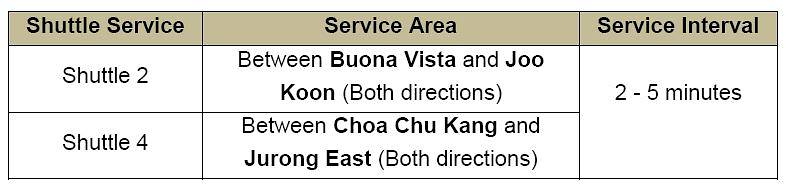
Shuttle buses will be deployed during the planned early closures. Shuttle bus service 2 will be available between Buona Vista and Joo Koon MRT stations while shuttle bus service 4 will be available between Choa Chu Kang and Jurong East MRT stations. 

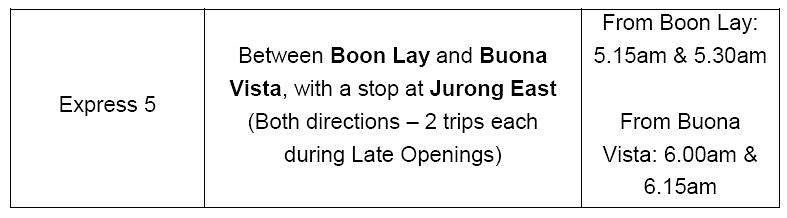
An express bus service will also be available to offer direct connections across major transport nodes along the affected EWL stretch, SMRT said. Express 5 will offer two direct trips from Boon Lay MRT station to Jurong East and Buona Vista MRT stations, and two direct trips from Buona Vista MRT station to Jurong East and Boon Lay MRT stations. 

smrt shuttle

(Image: SMRT)

smrt shuttle 2

(Image: SMRT)

Commuters are advised to check for station-specific timings on SMRT’s website and social media platforms as departing times for first and last trains at the affected stations may vary. SMRT also reminds commuters to cater for additional travel time when using the shuttle bus services. 

SMRT has carried out early closures and late openings of stations along the same western sector of the NSEWL since December 2017 to facilitate intensified testing of the EWL’s new Communications Based Train Control signalling system, which has been in use since May 28, 2018. 

Source link

All new HDB projects to feature nature-centric designs

0

SINGAPORE: Residents of new public housing projects launched from July onwards will live in more nature-centric neighbourhoods, with greenery to reduce heat and noise, as well as space for community farming.

Under the Biophilic Town Framework, all new precincts will be developed with the aim of allowing residents to connect better with nature, the Housing and Development Board (HDB) said on Wednesday (Jul 18).

“(The framework) provides a strong foundation for holistic planning and design of neighbourhood landscapes, so that our residents can enjoy a strong sense of place and well-being,” HDB CEO Cheong Koon Hean said in a speech at the International Federation of Landscape Architects World Congress.

punggol northshore

Green corridors were strategically planned and placed at Punggol Northshore District to maintain the ecological balance and promote biodiversity. (Image: HDB)

The framework, which was first developed in 2013, comprises five key elements of the neighbourhood landscape – soil, flora and fauna, outdoor comfort, water and people.

Town planners and architects will take into consideration several guiding principles when planning and designing precincts. This includes planting trees which are more effective at providing shade and absorbing heat, and constructing vegetated bioswales to treat rainwater runoff naturally.

Biodiversity surveys will also be conducted before construction to study existing natural habitats, and new habitats such as dragonfly ponds, bird sanctuaries and butterfly gardens built to attract diverse species.

punggol northshore (1)

New habitats such as dragonfly ponds will be introduced to attract diverse species and boost biodiversity in the area. (Image: HDB)

National Development Minister Lawrence Wong, who was present at the event, also stressed the importance of nature-centric design in light of rapid urbanisation worldwide. “It’s easy for cities to neglect their greenery and natural assets. We’ve seen this time and again – trees are cut down and removed, rivers are abused and covered over.

“The result is that we end up with a harsh concrete jungle, and a living environment that is stressful and alienating for all,” said Mr Wong. “So we have to change our mindsets – don’t think about urban areas as being separate from nature, but reimagine cities as being part of our natural ecosystem, and coexisting in harmony with nature.”

Punggol Northshore was the first nature-centric district when its first HDB project was launched in 2015. So far, eight Build-to-Order (BTO) projects have been launched in the precinct, comprising about 5,700 flats, which will be completed progressively from 2020.

Source link

Easy-to-use plan to help security firms adopt technology for routine, manpower-heavy tasks

0

SINGAPORE: Local security agency firms can tap on a new plan that outlines clear roadmaps to help them adopt digital technology in their work, Minister for Manpower and Second Minister for Home Affairs Josephine Teo announced at its launch on Wednesday (Jul 18). 

The Security Industry Digital Plan (IDP), developed by the Infocomm Media Development Authority (IMDA) in partnership with the Ministry of Home Affairs, identifies a list of technology solutions at different stages of their development. It is a part of the security Industry Transformation Map announced in February.

For instance, firms that have barely implemented any technological solutions will start in the first stage of the roadmap. It includes basic technology such as automated visitor management systems, mobile-enabled patrol and incident management systems, and surveillance cameras with analytics. 

Mr Kenny Ng, a senior security supervisor at a condominium which has adopted technology into its security measures, said that his job has been made easier with surveillance cameras. 

“It’s 12-hour [work] so, with this technology, it has made our job easier. We just monitor our cameras on the screen … Previously we have to chase [after] the vehicles and record the vehicles. Now our vehicle plate recognition camera will allow vehicles to enter and exit smoothly and records are automatically updated in the smart database,” said Mr Ng. 

recognition technology

A video surveillance system on display at the launch of the Security Industry Digital Plan on Jul 18, 2018. (Photo: Fann Sim)

For security agencies that are more advanced in technology adoption, the roadmaps suggest cluster guarding, robotics, artificial intelligence and immersive media to beef up existing digital technology strategies. 

SMEs can use an online self-assessment checklist to rate their digital readiness and identify digitalisation opportunities. 

To encourage local security agencies to adopt pre-approved solutions identified in the roadmap, Enterprise Singapore will set aside S$7 million through the Productivity Solutions Grant (PSG). There are seven pre-approved solution packages available, with more in the pipeline. 

The pre-approved solutions, selected by MHA and IMDA, have been proven, market-tested and are cost-effective, said Mrs Teo. It will reduce the effort needed by firms to find their own solutions and give them a peace of mind that the vendor is reliable, she added. 

PSG will help support 50 per cent of qualifying costs, capped at S$30,000 per security agency per year. A majority of security SMEs are eligible for the grant.

A guide for an “Outcome-Based Security Contract” as a “necessary first step” to guide service buyers in adopting contracts based on outcomes, as opposed to fixed headcount was also launched. The guide includes principles and templates for service buyers to adopt such contracts at every stage of the tender process. 

Mrs Teo said that many security agencies in Singapore have not adopted any technology in their work, and about 30 per cent of firms have adopted one technological update in their work.

“With these pre-approved digital solutions and support available through PSG, we aim to double the number of security agencies that adopt at least one of these three pre-approved digital solutions by 2020 … Certainly, by 2025, these basic building blocks should be the norm and no longer the exception,” she added. 

Josephine Teo at Security Industry Digital Plan

Minister for Manpower and Second Minister for Home Affairs Josephine Teo at the launch of the Security Industry Digital Plan on Jul 18, 2018. (Photo: Fann Sim)

TRAINING THE INDUSTRY’S WORKFORCE

The IDP also includes a roadmap on training to prepare the security industry’s workforce with the necessary mindset and skills to adopt and benefit from technology. 

Developed with SkillsFuture Singapore and the Security Industry Institute, the training is aligned with the Skills Framework for Security.  

Raj Joshua Thomas, president of Security Association of Singapore, said that the plan can help alleviate manpower issues in the industry. 

“At any one point of time, we have a shortage of security officers so we are helping to right-size the industry with technology. If we have to deploy less people, the shortage will just become lower and lower, and negated. So, I think we should not worry about officers being replaced by technology because structurally there is already a shortage,” Mr Thomas told Channel NewsAsia. 

patrolling device

A self-driving vehicle and surveillance drone on display at the launch of the Security Industry Digital Plan. (Photo: Fann Sim)

“The image that people have of the industry will also change because previously, people think it’s a jaga (caretaker) job but it, in fact, has already moved up to something of a higher value,” he added. 

SMEs that require more help in reviewing their business can approach the SME Digital Tech Hub for business advisors or specialists for more advance digital solutions. These consultancy services are provided free-of-charge. 

It is the fourth IDP launched to guide SMEs on their digital transformation efforts. Previously, similar IDPs were launched for the environmental services, logistics and retail sectors

A Technical Reference (TR) for video analytics systems was also announced at the launch. The TR sets requirements and specifications for the selection, installation, operation, maintenance and data interoperability of video analytics systems. 

The TR, which will be ready by end of next year, will help buyers assess the effectiveness of systems. 

Source link

Singapore Airlines named world’s best in 2018 by Skytrax

0


SINGAPORE’S flag carrier is back on top.

The airline was named Airline of the Year at the glitzy 2018 Skytrax World Airline awards ceremony, the aviation industry’s equivalent of the Oscars, in London on July 17, 2018.

It also claimed best first class, best airline in Asia, and best first class seat.

SEE ALSO: Air Asia X named cheapest international airline in the world

“Singapore Airlines is honored to be named World’s Best Airline in the Skytrax awards, and I dedicate it to the 26,000 SIA Group employees who focus every day on delivering the world’s best travel experience to our customers,” Singapore Airlines CEO Goh Choon Phong said in a statement.

“The recognition will further motivate us to improve upon the three main pillars of our brand promise – product leadership, service excellence and network connectivity – to ensure we retain our competitive advantage and continue to meet and exceed customer expectations.”

Singapore Airlines last held the honor in 2008. Prior to that, the airline also won in 2004 and 2007, making this year’s win its fourth. It knocked last year’s victor Qatar Airways into second place.

Doha-based Qatar Airways came out on top in 2017, 2015, 2012, and 2011.

Its network spans business and leisure destinations across Europe, Middle East, Africa, Asia Pacific, North America and South America. Last year, Qatar Airways unveiled its QSuite, a revolutionary take on its business class that allows the passenger to lower a partition to create a double bed.

Although the airline lost its crown this year, it still bagged Skytrax awards for best business class, best airline in the Middle East, best first class lounge, and best business class seat.

In third place is Japan’s All Nippon Airways (ANA), home to one of the world’s largest fleets of Boeing 787 Dreamliners. ANA flies to around 80 international routes and over 110 domestic routes.

Earlier this year, two ANA ground staff were filmed offloading bags from an aircraft and were highly praised for the gentle manner in which they did so. The airline was honored with the award for the best aircraft cabin cleanliness, best airline staff in Asia (well deserved), and best cabin crew in Japan as well.

2018-07-04T071555Z_1752182184_RC1DF25A59D0_RTRMADP_3_ANA-ENGINE

All Nippon Airways (ANA) Boeing 787-8 Dreamliner taxis in front of other aircraft at the Tokyo International Airport, commonly known as Haneda Airport in Tokyo, Japan January 10, 2018. Source: Reuters/Toru Hanai

In fact, Asian airlines dominate the Skytrax World Airline awards this year, taking a whopping total of nine out of top 10 spots. In fourth place is the Dubai-based Emirates, home to a fleet of more than 265 aircraft. Emirates currently flies to over 155 destinations in more than 80 countries around the world.

Coming close is Taiwanese airline EVA Air, which connects Asia and Mainland China to Europe, North America and Oceania and links more than 60 major business and tourist destinations.

SEE ALSO: These are the best airlines in the Asia Pacific

Here are the world’s top 10 airlines of 2018.

  1. Singapore Airlines
  2. Qatar Airways
  3. All Nippon Airways (ANA)
  4. Emirates
  5. EVA Air
  6. Cathay Pacific
  7. Lufthansa
  8. Hainan Airlines
  9. Garuda Indonesia
  10. Thai Airways

Other notable Asian airline accolades include China Southern Airlines for winning the world’s most improved airline and AirAsia’s continued dominance being named the world’s best low-cost airline.

A version of this article originally appeared on our sister site Travel Wire Asia.

Source link

50 Singapore eateries receive Michelin’s Bib Gourmand this year

0

The list includes 17 new entrants, while 28 of the recipients are found in hawker centres.

Michelin

50 Singapore eateries receive Michelin’s Bib Gourmand in 2018, with 28 of these found at hawker centres. (Photo: Michelin)

SINGAPORE: Michelin awarded the Bib Gourmand to 50 Singapore food establishments in 2018, a huge leap from the 38 that was given out last year.

The latest list includes 17 new establishments. Hawker food also came out tops, with 28 of the recipients found in hawker centres.

The Bib Gourmand award was established in 1997, and given to establishments selected by Michelin inspectors for their quality menu priced at no more than S$45.

***

MICHELIN’S BIB GOURMAND 2018 FULL LIST

  1. A Noodle Story
  2. Alliance Seafood
  3. Ah Er Soup (ABC Brickworks Food Centre)
  4. Balestier Road Hoover Rojak
  5. Bar-Roque Grill
  6. Bismillah Biryani
  7. Chai Chuan Tou Yang Rou Tang (Bukit Merah View Food Centre)
  8. Chey Sua Carrot Cake
  9. Chuan Kee Boneless Braised Duck (Ghim Moh Market & Food Centre)
  10. Depot Road Zhen Shan Mei Claypot Laksa
  11. Eminent Frog Porridge & Seafood (Geylang Road Lorong 19)
  12. Famous Sungei Road Trishaw Laksa
  13. Fresh Taste Big Prawn Noodle (Zion Riverside Food Centre)
  14. Heng (Newton Food Centre)
  15. Hong Heng Fried Sotong Prawn Mee
  16. Hong Kee Beef Noodle
  17. Hong Kong Yummy Soup (Alexandra Village Food Centre)
  18. Hoo Kee Bak Chang
  19. J2 Famous Crispy Curry Puff
  20. Ka-Soh (Outram Park)
  21. Kok Sen Restaurant
  22. Lagnaa
  23. Lao Fu Zi Fried Kway Teow (Old Airport Road Food Centre)
  24. Lian He Ben Ji Claypot Rice (Chinatown Complex)
  25. Liao Fan Hawker Chan (78 Smith Street)
  26. Man Man (Tanjong Pagar)
  27. Muthu’s Curry (Little India)
  28. Na Na Homemade Curry (Bukit Merah)
  29. New Lucky Claypot Rice
  30. New Ubin Seafood (Bukit Batok)
  31. Outram Park Fried Kway Teow Mee (Hong Lim Market & Food Centre)
  32. Rolina Traditional Hainanese Curry Puff (Tanjong Pagar Plaza Market & Food Centre)
  33. Shi Hui Yuan (Queenstown)
  34. Shi Wei Da (Fengshan Market and Food Centre)
  35. Sik Bao Sin (Desmond’s Creation)
  36. Sin Huat Eating House
  37. Sin Kee Famous Cantonese Chicken Rice (Holland Drive)
  38. Song Fa Bak Kut Teh (New Bridge Road)
  39. Tai Wah Pork Noodle (Hong Lim Market & Food Centre)
  40. The Blue Ginger
  41. The Coconut Club
  42. Tian Tian Hainanese Chicken Rice (Maxwell Food Centre)
  43. Tiong Bahru Hainanese Boneless Chicken Rice (Tiong Bahru Food Centre)                  
  44. Tiong Bahru Yi Sheng Fried Hokkien Prawn Mee (ABC Brickworks Food Centre)
  45. Shirokane Tori-tama
  46. True Blue Cuisine
  47. Whole Earth
  48. Yhingthai Palace
  49. Zaffron Kitchen (East Coast)
  50. Zai Shun Curry Fish Head               

Source link

Commentary: Despite flexible work arrangements, work stress has worsened

0

MELBOURNE: With technologies enabling remote working, tele-conferencing and instant email access, one would assume stress levels have reduced and work–life balance is now within reach.

Yet in a recent study by risk advisory company Willis Towers Watson, 60 per cent of employees surveyed in Singapore admitted to having above average or high levels of stress.

Another recent study by recruitment agency Robert Half showed that 25 per cent of Singaporean professionals surveyed revealed they would leave their current job for a better work–life balance.

WORK STRESS, THE WORLD’S SILENT KILLER

Regardless of our actual job or rank, we have all experienced stress at work. When managed appropriately, work stress has a positive impact on our work performance – think about the burst of adrenalin that carries you through a major project.

Work stress becomes harmful to our health and performance when the stress experience is prolonged. Factors that intensify the stress experience include working long hours in a week, facing work–family conflict (i.e., when demands at work interfere with family life and vice versa), having relatively low control over one’s work and work environment, having a lack of supervisory support, and facing high work demands such as a pressure to meet tight deadlines.

For example, prolonged intense work pressure drove an accounting lecturer at Cardiff University to commit suicide in February. His workload had increased significantly after he was made deputy section head, meaning he dedicated long hours to his work even during family time and vacation.

In studies of British, Australian and New Zealand police officers led by Professor Paula Brough at Griffith University, work stress was found to have both a physical impact (leading to difficulties with relaxing and sleeping, fatigue, migraines, stomach and heart problems) and a psychological impact (leading to people feeling constantly “on edge” or nervous, being irritable with colleagues, or perceiving core work such as assisting the public as a nuisance).

Singapore workers-raffles

A worker walks past Raffles Place MRT.

Although the stigma associated with stress is declining, many employees prefer to seek professional assistance for work stress through their own general practitioners than an employer-sponsored scheme. Many employees and managers in Singapore also tend to keep their mental health issues under wraps for fear of losing out in promotion opportunities.

READ: Why there will always be a place for the office jerk, a commentary

FLEXIBLE WORK

Technology-enabled flexible working has only exacerbated this problem. Work now extends far beyond the office.

Most people will put in time late at night, on weekends, and even on vacation. The boundaries between work and non-work are blurred as employees struggle to “switch off”.

Employees who work remotely have also been shown to have increased mental health risk, primarily due to feelings of isolation and disconnection. Employees who thrive on feedback and encouragement would also struggle with flexible working, as they require regular social interaction and connection with their supervisors and co-workers.

However, as technology continues to push into new areas, it is likely that flexible working will continue. But that doesn’t mean that work stress has to increase.

Research has shown that flexible working is not always bad. Working mothers around the world have benefited greatly from flexible working and are now able to fulfil their professional and personal responsibilities.

Increased autonomy and control over work can potentially help employees to achieve work–life balance.

There is also a difference between having technology and managing technology. Technology should be managed effectively to ensure that its benefits aren’t outweighed by increased work stress.

man writing office laptop pen paper

A man on his laptop. (Photo: Pixabay)

Employees who set boundaries set clear expectations for those around them. For example, not answering work e-mails on the weekend or on holiday reinforces the boundary between work and non-work and ensures that your time off will not be encroached upon by others.

In the healthcare industry, millennials are using technology to craft the jobs they desire, including working different shift patterns and job-sharing with colleagues.

READ: Being funny at work can be good for your career, a commentary

GIG ECONOMY NOT SO LIBERATING

The “gig economy”, comprising mainly of freelance and contracted workers, has emerged as a result of technology-enabled flexible working. The promise of being able to choose when to work is an attractive one, particularly for low-skilled workers whose jobs can be low-paid and inflexible.

Yet the “gig economy” has proven to be more inflexible than liberating. As there is no shortage of ride-sharing drivers or food delivery couriers, there are emerging reports of overworked drivers and couriers who clock in at least 12 hours a day just to get by.

The isolation and daily work stress faced by this group of workers have driven many to depression. “Gig economy” jobs that do not give workers control and offer low, unstable income are expected to be the leading cause of stress-related illnesses in the next decade.

WHAT WE CAN DO

Part of alleviating work stress comes down to changing the workplace culture. Both employers and employees have a responsibility to set parameters and actively dissuade the development of a round-the-clock work culture.

Employees need to know that taking a break and not working over the weekend is alright. Employers need to walk the talk. Seeing employers lead by example and encouraging self-care is the best way to ensure employees are comfortable taking the same liberties.

Having open, consistent dialogues about work stress and mental health will also encourage employees to speak up and share about their own experiences.

Technology can bring both benefits and possibilities, but employers and employees would have to work together to adapt. Otherwise, the advantages of technology-enabled flexible working will quickly become disadvantages.

Carys Chan is Lecturer/Assistant Professor of Management at RMIT University. Paula Brough is Professor of Organisational Psychology at Griffith University.

Source link