SINGAPORE: The formation of the Singapore Food Agency (SFA) has been welcomed by the industry, which said that the new statutory board would better support the local food sector and help boost its efficiency.
Speaking to reporters on the sideline of a visit to The Soup Spoon on Thursday (Jul 26), Minister for the Environment and Water Resources Masagos Zulkifli said the SFA would better “integrate” the food industry.
“This will bring together various parts of these agencies to look at food from farm to fork and this will integrate the industry and as well as support them in order to take advantages that’s available to our food industry.”
George Huang, chairman of the recently formed Singapore Agro-Food Enterprises Federation (SAFEF), said the formation of SFA would better facilitate the process of farmers applying for various licenses.
“From the farmers’ point of view, I think it is a very good move,” said Mr Huang. “Now we have an organisational body that covers the whole supply chain … It will be much more efficient and support entrepreneurship much more.”
“For example, Agri-Food and Veterinary Authority (AVA) (currently) takes care of farm licenses, but if for example a fish farm wants to sell fish on the farm premises, it falls under retail, which is under the NEA.”
“The issue is not getting the license – Singapore is quite efficient and so is the NEA. The thing is that the rules might not be totally aligned,” added Mr Huang. “One deals with farming and the other with retailing. There might be some grey areas or gaps in between.”
Jocelyn Chng, chief executive officer of JR Group Holdings, which operates restaurants and hot-food vending machines among others, agreed that the formation of the SFA would streamline the process of applying for the relevant licences.
JR Group vending machine cafes. (Photo: Lee Li Ying)
Currently, food retail businesses are licensed by the National Environment Agency (NEA), but those who wish to run a central kitchen require a different licence from the AVA.
“It will be more efficient, because we don’t need to go to two authorities or agencies to get clearance and approval,” she added. “With this one single agency, in terms of the regulations, the officers or the agency will be very clear in what they are offering.
“There’s also more clarity. We know where to go and which agency to approach. Thirdly, we will also get better support, assuming there are licensing officers who know our businesses well, they will be able to support us better.”
The hope is that these changes would also lead to greater savings for companies such as JR Group, Ms Chng said.
“That will be a win-win for everyone,” she added.
While Mr Shannon Lim, who operates a fish farm off Lorong Halus, welcomed the announcement, he also hoped that SFA would be able to better allocate resources, including manpower to help local farmers.
“(It’s a) good idea,” said Mr Lim, explaining that the AVA was “always stretched too thin”.
Mr Lim said that he has yet to receive a mandatory fish culture farm worker identification card for one of his employees, despite getting it approved in February.
“We tried to collect (it) at their office in June. They said it wasn’t ready yet,” he added. “A more focused agency should be able to allocate resources better.”
But apart from resource management, Mr Huang hopes that the SFA would help farmers in the export of their produce.
“We have to increase Singapore’s capabilities, such that our products are of international standards, that it is exportable – that’s where you get a higher value of Singapore branding.”
SINGAPORE: The gas tariff for households will increase by 3.78 per cent for the next three months, City Gas announced on Thursday (Jul 26).
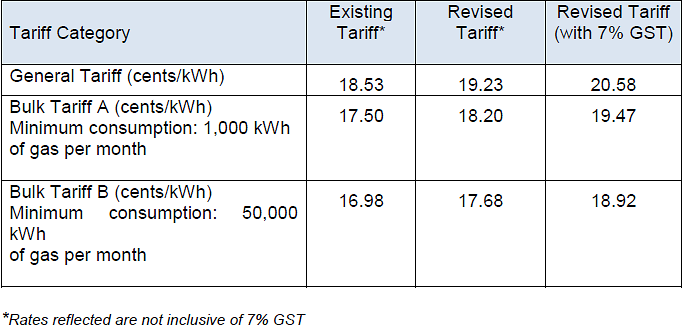
The tariff will be raised from 18.53 cents per kWh to 19.23 cents per kWh from Aug 1 to Oct 31, the company said in a media release.
This is due to increase in fuel costs compared with the previous quarter, explained City Gas, which supplies town gas to nearly 90 per cent of residents in new housing board estates and private properties.
This will be the third time that gas tariffs has increased this year.
Gas tariffs are reviewed based on guidelines set by the Energy Market Authority, the gas industry regulator.
SINGAPORE: A Singapore contingent of officers from the Singapore Armed Forces (SAF) departed for Laos on Thursday afternoon (Jul 26) to assist with flood relief efforts in Attapeu province.
Dozens of people have died and scores are missing days after a hydropower dam collapse unleashed a torrent of water, swamping several villages in the southeastern province.
The dam collapse on Monday released five billion cubic metres of water – enough to fill more than two million Olympic swimming pools.
Singapore has said it will donate US$100,000 to kickstart a Singapore Red Cross fundraising appeal. (Photo: Amir Yusof)
A Republic of Singapore Air Force C-130 aircraft carrying the officers and humanitarian supplies took off from Paya Lebar Air Base at around 4pm.
SAF and SCDF teams are joining the Laos flood relief efforts. (Photo: Amir Yusof)
The team loaded up humanitarian supplies and equipment, including tents, meal rations, bottled water, medical supplies and rubber dinghies for the relief efforts.
The team will take relief supplies and equipment to those in need. (Photo: Amir Yusof)
The SAF team was made up of officers from the Changi Regional Humanitarian Assistance and Disaster Relief Coordination Centre.
Singapore officials including President Halimah Yacob, Prime Minister Lee Hsien Loong, Deputy Prime Minister Teo Chee Hean, Defence Minister Ng Eng Hen and Foreign Affairs Minister Vivian Balakrishnan have all written letters to their Lao counterparts to express their condolences.
In addition, the Government has said it will donate US$100,000 to kickstart a public fundraising appeal by the Singapore Red Cross.
Editor’s note: An earlier version of this story said that SCDF personnel are involved in Thursday’s mission. This is incorrect: They will join subsequent relief efforts. We apologise for the error.
SINGAPORE: Parking wardens will get new uniforms to help them cope with the heat while carrying out their enforcement work, the authorities said on Thursday (Jul 26).
The new uniform of dri-fit polo shirts and cargo pants was designed with safety, durability and comfort in mind, said the Land Transport Authority (LTA), Housing and Development Board (HDB) and Urban Redevelopment Authority (URA) in a joint news release.
“The new uniform will allow the officers to perform their duties with greater efficiency in Singapore’s hot and humid weather,” the agencies said.
Parking wardens will don a new uniform of dri-fit polo shirts and cargo pants. (Photo: LTA)
NEW HOTLINE FOR PARKING-RELATED ISSUES
The agencies also announced that a new hotline will be set up for members of the public to report parking-related issues.
All parking-related issues can be reported at this common hotline – 1800-338-6622 – including offences such as illegal parking, non-display of coupons and non-activation of digital parking sessions.
Currently, these have to be reported separately to LTA, HDB and URA.
The three agencies will also appoint Certis CISCO as the service provider to carry out enforcement against parking offences on public roads, as well as in HDB and URA car parks not equipped with the Electronic Parking System (EPS). For car parks that are already equipped with EPS, the EPS service providers will continue to enforce against offenders.
The enforcement of parking offences is currently outsourced to different service providers.
This is the first time that LTA, HDB and URA have engaged a common service provider, which they hope to enable closer coordination among the agencies and help them better respond to public feedback.
The parking wardens can also be deployed more efficiently as they can carry out patrol and enforcement duties on public roads as well as HDB and URA car parks.
“This will contribute towards more effective enforcement to deter parking offences that cause inconvenience and disamenities to the public,” the agencies said.
SINGAPORE: More than S$2.1 million will be given to 12 national monuments this year to co-fund restoration and maintenance works, said the National Heritage Board (NHB) on Thursday (Jul 26).
This sum will be disbursed through the National Monuments Fund, which was set up in 2008.
Of the total sum, S$2 million will be used to co-fund restoration works at six monuments while S$113,000 will subsidise the maintenance of all 12 monuments.
One monument which has received subsidies for both restoration and maintenance works is the 164-year-old Sri Srinivasa Perumal Temple along Serangoon Road.
“This funding … is a good example of the partnership between the Preservation of Sites and Monuments division of NHB and the Hindu Endowments Board, in ensuring that the heritage we have inherited will be passed on to our future generations in a pristine condition,” said Mr Rajan Krishnan, chairman of the temple’s redevelopment committee.
The temple received about S$88,000 to offset the cost of its restoration efforts, which included sculptural restoration on its five-tiered entrance tower.
The painstaking process was carried out by eight skilled sculptors from India and took four months to complete.
The temple’s inner sanctums were also re-tiled while the chipped granite floor at the main temple was replaced.
The total cost of its restoration efforts, including other works not eligible for co-funding, was about S$700,000. The rest of the cost was covered through donations to the temple.
Sri Srinivasa Perumal Temple. (Photo: National Heritage Board)
SCOPE OF MAINTENANCE FUND EXPANDED
Another first-time recipient of the restoration fund is the Church of St Teresa at Kampong Bahru Road.
It will receive about S$1.3 million to offset its total restoration costs of about S$4.3 million.
This comes after an investigation of structural defects – funded by the board’s maintenance fund – revealed several issues.
For example, cracking on roof tiles has led to leakages, causing mould and obvious staining.
There are also cracks on the building’s walls – meaning that layers of decades-old paint will have to be stripped to examine if the faults are structural.
Mr Joseph Silverayan, a parishioner at the church, said the funds are “a boon” as it has been 13 years since the last renovation.
He said the restoration, slated for 2019, would create a “revival” by attracting more people to visit.
The four other recipients of the restoration fund this year are the Al-Abrar Mosque, Chesed-El Synagogue, Maghain Aboth Synagogue and Thian Hock Keng temple.
Maintenance funds will also be disbursed to the Armenian Church of St Gregory, Church of Saints Peter and Paul, Hajjah Fatimah Mosque, Lian Shan Shuang Lin Monastery, St George’s Church and St Joseph’s Church.
The scope of the maintenance fund was also expanded this year to include the “maintenance of vegetation” on or nearby monuments. Previously, only the removal of vegetation was qualified for co-funding.
“With their (the stakeholders’) feedback, we have constantly expanded the scope of work that may be considered to be covered by the grant, so as to ensure it is user-friendly,” said Ms Jean Wee, director of the Preservation of Sites and Monuments at the NHB.
Since its establishment in 2008, the fund has disbursed S$6.6 million for restoration and maintenance efforts.
To qualify for funding, monuments must be owned and managed by a non-profit or religious organisation, accessible to the public, and able to finance the works before applying for subsidies.
Of the 72 structures that have been gazetted as national monuments, 31 are eligible for the fund. Out of that, 27 have benefitted from it.
“I see the outcomes of the fund as a win-win situation: the community gets to worship at a restored or refreshed monument, and my team and I get a better understanding of the built material and the solutions that are tested, to ensure they will be well preserved for future generations,” added Ms Wee.
SINGAPORE: One of the seven suspects arrested over a slashing incident at Serangoon Road was taken to Lower Peirce Reservoir by the police on Thursday (Jul 26) to assist in the search for a samurai sword said to be one of the weapons used in the attack.
The suspect, believed to be 24-year-old Arjun Retnavelu, was taken to the reservoir to indicate where he had allegedly thrown the sword into the water.
The sword was one of the weapons used to slash a 27-year-old victim on the back of his head, body, hands and legs, before the suspects left in a car.
One of seven suspects arrested in a slashing incident at Serangoon Road was taken to Lower Peirce Reservoir by the police. (Photo: Jeremy Long)
A total of seven men have been arrested, the police said on Thursday. Channel NewsAsia understands that Arjun was one of six suspects arrested at Blk 26 Sin Ming Industrial Estate while the remaining suspect was arrested near Corporation Road.
Divers are setting a buoy to determine distance of the sunk samurai sword before they dive. Suspect is believed to be 24-year-old Arjun Retnavelu. pic.twitter.com/inJNcG6WX8
What I understand: Arjun is one of six suspects arrested inside a residential property at Block 26 Sin Ming Industrial Estate, the remaining suspect was arrested near Corporation Road. He was drunk when he threw the samurai sword into the reservoir at about 4PM yesterday. pic.twitter.com/UeQprWZA9N
A commercial diver stands in front of the police and one of the suspects arrested over a slashing incident at Serangoon Road. (Photo: Jeremy Long)
Two commercial divers accompanied the police and the suspect to Lower Pierce Reservoir to retrieve the sword. They were seen setting up a buoy to mark a search area before diving in.
Channel NewsAsia understands that the suspect is alleged to have wrapped the sword in an orange cloth before throwing it into the water at around 4pm on Wednesday.
Commercial divers at Lower Peirce Reservoir attempt to retrieve what was believed to be a weapon used in a slashing incident at Serangoon Road. (Photo: Jeremy Long)
All the suspects are believed to be under investigation for rioting and being armed with a deadly weapon. If found guilty, they could be jailed for up to 10 years and caned.
Additional reporting by Chan Luo Er and Jeremy Long.
SINGAPORE: Michael, a successful Singaporean senior executive at a global investment bank, got passed over for a promotion for which he believed he was more than qualified.
That dream job went to an Australian expatriate from the bank’s headquarters.
Leong, a young local manager at a global resort and hotel chain, couldn’t break into the inner circles of his Western expatriate bosses. He felt that without good personal relationships with these bosses, it would be hard for him to make much headway at the company.
Local professionals and managers working for foreign multinational companies complain about this sort of thing all the time. Each hiring and promotion decision is of course unique and involves idiosyncratic considerations. Nevertheless, many people believe foreigners often have an edge over locals in the hiring and promotion process.
Recent observations suggest that many global companies promote through internal transfers – it is not so much that these companies prefer expatriates over locals, but that foreign firms expanding in Singapore are simply bringing in staff from elsewhere.
But why do multinational corporations do this? There are several reasons.
INTERNAL STAFFERS ARE MORE EXPERIENCED
First, internal staffers tend to have a good grasp of the company’s DNA – its culture and how it operates. For a global firm, such internal staffers also have extensive experiences working for the company around the world.
Second, experienced internal staffers, especially those from headquarters, probably have an extensive social network throughout the worldwide operations that helps them to get things done. That is an advantage that a Singaporean manager who rose through the ranks locally is unlikely to be able to match.
Third, global companies often systematically develop the international experiences of their high-potential employees by posting them overseas. Hence, it is totally legitimate and reasonable for a US company to post an American executive to Singapore to get experience in Asia.
Global companies in Singapore bring in high-potential employees from overseas likely so that they could get experience in Asia. (File photo: AFP/Roslan Rahman)
Executives such as Michael often overlook these considerations and presume they are passed over because of bias against locals. In reality, companies simply make personnel decisions that managers see as being best for the organisation.
If foreign companies transfer staff from headquarters and elsewhere to Singapore for the sake of effectiveness, how should we put this practice in perspective?
Importantly, what can local executives do to increase their chances of being hired or promoted by foreign employers?
BRINGING IN EXPATS CAN BE ADVANTAGEOUS FOR LOCALS
The practice of bringing expatriate employees into Singapore, while often seen as increasing competition for locals, has the frequently overlooked advantage of developing locals themselves.
Research shows that a multicultural workplace and exposure to foreign cultures make people more creative. Foreign values, practices, and norms in viewing the world and problem-solving can help locals develop a more complex and sophisticated view of the issues they confront.
Ideas and perspectives from around the world can also be harnessed to formulate new ideas and solutions locally.
File photo of workers in Singapore’s Central Business District. (Photo: TODAY)
In one of my research works, I found that professionals whose networks comprise people from diverse cultures are more creative at solving global business problems than those whose networks are culturally homogeneous.
As businesses become increasingly globalised, a global perspective and multicultural social network developed through interactions with expatriates can help local executives become more competitive in the job market.
More broadly speaking, the influx of foreigners into local society can make Singaporeans who work with them more creative, a prized asset in today’s workplace.
LOCALS LACK SOFT SKILLS
Besides embracing and harnessing the cultural diversity that expatriates bring to the local workforce, Singaporean executives should also consider developing their own soft skills such as communication, negotiation, leadership and network-building.
Employers often observe that Singaporean graduates are strong in technical competence but less adept in people skills. In a 2016 speech, Education Minister Ong Ye Kung shared some feedback he received frequently from industry leaders:
Singapore graduates know a lot of stuff, but those can be learnt on the job. What’s more important are the practical and soft skills that can help them excel at the workplace.
Such skills are especially important in a global workplace where one must interact with colleagues with viewpoints and values that can be vastly different from one’s own. To thrive in a global firm, employees need to be able to communicate across cultures, make persuasive arguments, and perhaps even engage in self-promotion.
Education Minister (Higher Education and Skills) Ong Ye Kung.
Young managers such as Leong might be equipped with the hard skills that our education system nurtured in our youths – but success in the practical world demands more than that.
The further one goes in one’s career, the more important soft skills become. When managing a group of people, one is no longer doing the technical work, but getting work done through others.
The ability to motivate, influence and persuade others becomes critical.
TECHNICAL SKILLS ARE NOT ENOUGH
Moreover, in a competitive global environment with many foreign talents vying for the same job, the ability to promote one’s self helps.
Western expatriates may be more effective than locals because of cultural differences and exposure to education systems that emphasise soft skills and self-promotion.
Thus, it is little wonder that in a business world where soft skills are prized and competition is stiff, local employees sometimes feel handicapped and frustrated that top jobs go to foreigners – who, in their eyes may not be as technically capable as themselves.
They may be disappointed, but they are learning an important lesson: In the modern corporate world, technical skills are not enough.
Roy Chua is associate professor of organisational behaviour and human resources at Singapore Management University.
SINGAPORE: Saying no to plastic straws might feel like a conscientious effort to reduce marine litter, but this global movement does little to stem the pollution, experts said.
One industry observer told Channel NewsAsia that the real problem lies with poor waste management systems in countries that leak huge amounts of garbage into the ocean.
“The best that can be said about the collective actions to eliminate straws is that it’s good at raising awareness, but that’s not the solution,” said Mr Steven Russell, plastics division vice president at the American Chemistry Council, which represents multi-national chemical and plastic manufacturers.
Mr Russell was in Singapore earlier in July to meet with waste companies, plastic companies and consumer brands on working together to solve global waste management problems.
The anti-plastic straw movement is believed to have taken off in 2015, after a video showing a sea turtle with a straw stuck up its nose went viral.
“If you have eyes, you see the images,” Mr Russell said. “Everybody feels understandably compelled to act, so the impulse to reduce what we use is a good one.”
“ENVIRONMENTAL MALPRACTICE”
So, what exactly is the problem with the movement? Mr Russell feels it could lull companies and individuals into thinking they’ve done enough to save the ocean, given the relatively short attention such issues get.
“It would be a shame to think we’ve banned straws – we’re done,” he said, dusting off his hands. “That would be environmental malpractice to address only 0.2 per cent of the waste stream. We’re not helping the ocean.”
In a recent report on science website phys.org, a pair of Australian scientists estimated that there are up to 8.3 billion plastic straws strewn across coastlines around the world.
Plastic straws are readily available everywhere in Singapore. (Photo: Aqil Haziq Mahmud)
Seems like a big number, but even if all those straws were suddenly swept to sea, they would only make up less than 1 per cent of the 8 million tonnes of plastic estimated to enter the ocean in a given year. (Plastics make up about 80 per cent of marine litter.)
This whopping figure, derived in a 2015 study published in the journal Science, is equivalent to five normal-sized plastic bags filled with plastic entering the ocean along every 0.5m of coastline in the world.
“The only thing that is going to help the ocean is getting serious about managing waste in places where it’s not managed,” Mr Russell added.
UNCOLLECTED WASTE
These places are likely to be middle-income countries with rapidly growing economies, the study noted, as they lack the waste management systems to handle all that extra waste.
China, Indonesia, the Philippines, Vietnam and Sri Lanka were ranked as the top five producers – out of 192 countries – of mismanaged plastic waste in 2010. This was based on an analysis of people living within 50km of the coast.
Mismanaged plastic waste refers to trash that can possibly enter the ocean.
“If people in those places aren’t served by waste collection, if they don’t have a place to put their used things, these fall from their hands to the ground, river and ocean,” Mr Russell explained, highlighting the growing consumer class in such countries.
In this respect, Singapore fares much better. The city-state produced about 6,500 tonnes of mismanaged plastic waste in 2010, coming in at 114th. (China generated almost 9 million tonnes.)
A tourist walks past debris washed up on Kuta Beach in Bali on Dec 19, 2016. (Photo: AFP/Sonny Tumbelaka)
For countries that need help, Mr Russell said an upcoming initiative will see consumer brands set up a fund and offer low to no-interest loans to help communities in Asia improve their waste management. This model is similar to the Closed Loop Fund in North America.
The loans can be used to purchase new garbage bins or invest in recycling technology, for instance.
“That model is being adapted for an Asian context with a focus on Indonesia and perhaps India,” Mr Russell said, adding that the initiative will be announced in October at the Our Ocean Conference in Bali.
FISHING GEAR
While Mr Russell might be speaking as an interested party, his argument is shared by more neutral observers.
Bloomberg columnist Adam Minter wrote that “straws make up a trifling percentage of the world’s plastic products, and campaigns to eliminate them will not only be ineffective, but could distract from far more useful efforts”.
The movement, he argued, should instead pressure global seafood companies to mark their fishing nets and gear, which studies said make up a good chunk of plastic garbage in the ocean. This holds a person or company accountable when the gear is abandoned.
Ms Olivia Choong, who co-founded the environmental group Green Drinks Singapore, said the current movement is “not effective in removing marine litter because straws are only one of many things that make it to the marine environment”.
On the Northwestern Hawaiian Islands, a member of the National Oceanic and Atmospheric Administration disentangles a Laysan Albatross chick from a fishing net. (Photo: NOAA Coral Reef Ecosystem Program via Facebook/NOAA Marine Debris)
“Plastic bags, Styrofoam boxes and cigarette butts are some common things found at beaches,” she said. “Sometimes slippers too.”
Nevertheless, Ms Choong added that plastic straws are a “good starting point” when it comes to reducing single-use plastics.
“FIRST STEP”
Plastic-Lite Singapore founder Aarti Giri agreed, saying the movement is a “great first step in the right direction”.
Noting that plastic straws are among the top 10 items littered along beaches and waterways, she said cutting down on them “will definitely help” reduce plastic gunk in the ocean and its harmful effects on marine life.
“Anti-straw movements have a larger effect of creating awareness in the minds of consumers on the overall negative environmental impact of disposable plastics, not just straws,” she added.
“They also help in reducing the number of disposable plastic straws used in Singapore on a day-to-day basis, which also has a positive overall environmental impact from (saving) the energy and material resources used in the manufacturing and logistics of these straws.”
A sanitary worker picks up litter in East Coast Park. (Photo: Aqil Haziq Mahmud)
Still, Ms Giri called for the effectiveness of such campaigns to be measured using studies with statistical data. “I sincerely hope for this movement to be a progressive one and not one that terminates at plastic straws,” she stated.
WHAT YOU CAN DO
Short of starting a campaign to mark fishing gear or improve trash collection in Indonesia, what else can you do to stop marine pollution?
Ms Giri said taking part in beach clean-ups can help raise awareness on plastic pollution and develop a fondness for the environment. But this should translate to behavioural changes, like bringing your own bag and bottle when going out.
“If we cannot transfer this awareness towards being able to reduce usage of the plastics we litter pick, it will not have a positive difference,” she added.
Pieces of a Styrofoam container on East Coast Beach. (Photo: Aqil Haziq Mahmud)
In particular, Ms Giri said to avoid Styrofoam containers as they are light and easily washed into the sea. They also break up easily, making it tedious to pick up during beach clean-ups.
And then there’s the obvious. Don’t litter, said Ms Choong, especially at the beach. “There is so much trash that can be found on our shores, brought in through water currents from somewhere else, or generated by residents,” she added.
SINGAPORE: Despite standing a head shorter than most of her guests, Mdm Ng Swee Hiah held her audience’s attention as she glided around her garden.
She pointed at her mulberry plant, proclaiming that “the leaves can be used to make tea, which is good for you”.
Next, she plucked a bunch of six-petal chive flowers and thrust them under a guest’s nose. “Taste it. You can eat it raw,” insisted the 75-year-old. It tasted both sweet and garlicky. “Nice, right?” she asked.
Minutes later, in her kitchen, she bossed her guests about, ordering one to peel the potatoes and another to squeeze grated coconut.
These paying guests were attending one of her cooking classes at her terrace house, learning how to make chicken curry as part of Airbnb Experiences, a platform where locals get to share their hobbies or skills for a fee.
Almost everything was created from scratch to make that dish, from extracting the coconut milk to plucking chilli, ginger and lemongrass from the garden to make curry paste.
It took Mdm Ng’s eldest son a year to coax her out of retirement to help reinvent her family home of almost 50 years, now called One Kind House, and recreate the good old kampung days for others.
A primary school teacher for 40 years before she retired over 15 years ago, she has now become part historian, part businesswoman while bringing back the kampung spirit.
GATE ALWAYS OPENED
Mr Calvin Soh, a regional executive director of an advertising firm, had always wanted his mother to share with others, especially children, the history of the house and of Singapore as well as her recipes before they get forgotten.
Which is why the gate leading to Mdm Ng’s house at Telok Kurau is now kept unlocked. She welcomes all, not minding the security risk.
“The more you want to close the door, the more curious the robber gets,” she reasoned. “We have no valuables, only paintings. They’re so big – how to cart them away?”
Strangers have strolled uninvited past her gates to inspect her plants, while children have chased butterflies into her garden.
But by and large, Singaporeans are a polite bunch and would gesture to her from the main gate to ask whether they can enter.
From the exterior, her double-storey house seems stuck in the 1960s, with its art deco air vents set against a light turquoise facade. Sandwiched between its contemporarily designed neighbours, it looks like an oddity.
The interior has become a living museum, and Mdm Ng, known more affectionately as Mummy Soh, showcases items from the past to children.
These include an iron heated by charcoal, a black and white picture of her wedding with her late husband, and a cast-iron Singer sewing machine well over 100 years old. It was her mother’s and still works, she said.
Apart from her cooking classes for Airbnb Experiences, which attracts mainly tourists (at S$99 a person), she hosts dinners about twice a week, in a kitchen-cum-dining area that seats nearly 20.
A BUZZING HOUSEHOLD
Three years ago, however, life could not have been more different for Mummy Soh. She was on the verge of retiring to another country with a cooler climate and ample greenery, like Australia, New Zealand or Thailand’s Chiang Mai.
She had been spending her retirement years travelling, exploring Singapore and taking care of her two grandchildren. But after they went to school, there was less for her to do, said her son.
She wanted to sell the house, which has seen four generations living under the same roof. But Mr Soh persuaded her otherwise.
“I said, ‘It’s your house; you can do whatever you want with it.’ But I thought it was such a shame because the house wasn’t just a physical structure, it also contained all the memories and stories and sort of a legacy,” said the 50-year-old.
His grandparents bought it in 1969, and he remembers growing up with six uncles and five aunties in a household always abuzz with activities.
His grandfather was the sole breadwinner, and although they had the house, they were not rich.
Mr Soh’s grandfather.
“I think that’s where the seed of creativity started because my grandmother could do a lot with very little. She could reconfigure leftovers and make them taste different the next day,” recalled Mr Soh. “We were very frugal.”
Dinners were quick affairs for the big group and had to be done in two sittings. He said:
The more you talked, the less food there was on the table. So everyone ate and went off.
But the house was filled with love and community spirit, he added. They reared chickens, grew vegetables and even arranged for a farmer to collect their leftovers, to feed his pigs, in return for eggs every few months.
The house was next to kampungs with Malays, Eurasians and Chinese all living in one neighbourhood. The mothers would gather and exchange recipes while the children made friends and wandered around the kampungs, with their friendly, open-door policy.
“We looked out for one another, and you could go to the neighbour’s house to ask, ‘What did you cook for lunch?’ And the makcik (auntie) would say, ‘Oh, today I cooked nasi lemak. Bring your plate,’” Mr Soh said with a smile.
“It might be 20 cents, or we might return the favour the next time round.”
REINVENTING THE HOUSE
After his grandparents died in the 1980s, Mummy Soh ran the household, as she was the eldest. Her mother had insisted that she buy the house so the proceeds could be distributed to her siblings.
She and her husband, who had moved to a public flat about 10 years earlier, sold it to return to the house. Their eldest son was 22 then.
He bought his own place in his 30s and later invited Mummy Soh to live with him, to help look after his children. His younger brother and an uncle live in One Kind House now.
A photo of Mummy Soh, son Calvin and his two children when they were younger.
Despite all the memories, Mummy Soh eventually saw little reason to keep the house, as almost all her siblings had moved out.
“I might as well sell it,” she reasoned. “I need to spend my own money, right? I could go travelling or whatever, right? All my life I’d been working.”
That was when Mr Soh suggested reinventing the house, which would “enable my mum to sort of find dignity, purpose and something to do, and then find a way to connect with kids”. And if that failed, she could still sell it.
His idea was to create a community centre of sorts, where the young and old could exchange skills and ideas, where there would be a sense of collaboration like in the good old days.
“The old would get to pass on a lot of their traditions and knowledge, and we shouldn’t lose track of that,” he said.
“For the kids, they should learn that and understand where it came from; they’d also be able to project it going forward and evolve it into their own version of themselves.”
Using food, he reckoned, would be a “fantastic way of figuring out one’s past”. It took a year of convincing, but Mummy Soh then started out by hosting dinners, for family and friends first.
“It was out of her comfort zone. She was always in a secure place where she was in a job with a chart and a trajectory plotted out for her,” explained Mr Soh.
When she finally decided to take on the project, she thought that she would “just go with the flow”. “Then it became more complex, and then everybody liked it, and it just started,” she said.
“They tasted the food, they liked it and from there his friends went to his other friends, so it was by word of mouth.”
A DIFFERENT EXPERIENCE
Recreating that kampung feel, however, did not come cheap. Mr Soh spent about S$300,000 breaking down the walls to create an open concept, raising the ceilings to emphasise the kitchen’s importance and making the garden self-sufficient.
Mr Soh uses hydroponics, among other things, to keep the garden sustainable.
His mother bought fresh ingredients from the market and conducted the classes. To her surprise, some of the participants had only seen spice packets and packaged coconut milk, but not spices in their natural form or how coconut milk was made.
“Then when they fry the spices, they say, ‘Oh, the smell of the ingredients comes out,’” she said.
Many have also told her that her food reminded them of their childhood.
“A lot told me that they missed their home-cooked food. Nowadays, when they’re working, they always get food from outside, or they go to a restaurant. It’s a different kind of atmosphere,” she said.
By chance, an Airbnb employee attended one of the dinners and recommended that she list her services with Airbnb Experiences, launched in Singapore last year.
Mummy Soh now offers a three-course meal, which includes dishes like roast chicken, Teochew-style steamed fish, Assam prawns and blue-pea flower rice.
Many tourists have told her it was the first time they had stepped into a person’s home in Singapore and got to appreciate the decor, a step up from simply taking pictures of the Peranakan shophouses along Koon Seng Road.
“They don’t know what’s inside (those houses). Can they see how many rooms (there are)? Can they see the structure inside? So it’s a different kind of experience (here). They like it,” she said.
She appreciates the interaction with the tourists and the exchange of ideas – about food, plants and even how to create compost. One Australian group was so impressed with her salted-vegetable duck soup that they requested her recipe.
It is not the money that keeps her going, she said.
I do it more for fun and the passion. It’s about meeting people and talking. You’d feel better.
Positive reviews aside, she has received some brickbats from neighbours who were unhappy with the increased noise and traffic and who complained to the Urban Redevelopment Authority.
In 2016, the authority found that the house fulfilled the rules on home-based small businesses, except for operating a small cafe for the public, which has since been stopped, she said.
Mr Soh showing visitors round the house and garden.
Her son found some of the complaints odd, as most of the tourists who visited did not drive, using taxis or private-hire cars instead.
“I’m very used to dealing with objections and roadblocks,” he said. “When you come up with something new, you have to deal with the loneliness of shepherding something through. The initial process is always dangerous, difficult and unknown.”
INCUBATOR FOR IDEAS
More than just a venture for his mum, the house has also become an incubator for ideas for Mr Soh’s daughter Ava, 12, and son Dylan, 15. They work on their projects in one of the rooms upstairs.
Ava is a national skater who has started to sew pants for sale, at S$49 each.
Her brother gives motivational talks, has launched a few Kickstarter campaigns with his dad and is now developing an app for adults to discover their inner child.
The boy feels deeply connected to the house, as generations of his family have lived there.
He helps Mummy Soh regularly, tending to the garden, taking the guests on tours round the house and even helping to make kedondong (a tropical fruit) pesto sauce when he is free.
“(This house) inspires me to be a start-up of my own because no one’s really doing this,” he said.
“I’m not stigmatised by failure. In terms of my projects, there’s no failure, but there are setbacks. But eventually, I’ll experience failure and will have to learn from that.”
To give back to the community, the family have conducted cooking classes for children of single parents and other activities for those with mental disabilities, said Mr Soh.
However, he sees the house as having had the greatest effect on his mother, who has become more active. The exposure to different cultures as she made friends with some visitors, bonding over the meals, has also been invaluable.
As a teacher all her working life, she had never been entrepreneurial nor thought starting a business could ever be possible for her, said Mr Soh.
“But like I said, Singapore itself is a start-up. It’s in our genes. So once she had a taste, it came to her naturally. It was as if all the circuits connected. And she was like, ‘Yeah, I can do all these things,’” he added.
Suddenly she was Miss Businesswoman.
Mummy Soh admitted that opening up the house did wonders for her: She feels “healthier and happier or funnier”.
She is not planning, however, to do these dinners and cooking lessons for long. And she still wants to sell the house while she is alive, to avoid any possible conflict over the house in future.
“As long as my health is okay, I can continue. If I find it too tiring, I’d just have to stop,” she said.
FINANCE and food are unquestionably the two things Southeast Asia’s richest nation is most famous for.
While money makes the world go around, food might be taken even more seriously in the multicultural city-state of almost 6 million.
As a result, Singapore punches above its weight when it comes to the Michelin Guide’s coveted star ratings. Its latest Guide has added five more Singapore restaurants, with five more establishments serving a range of world cuisines receiving stars in 2018.
Those recognised for the first time were traditional Cantonese offering Jiang-Nan Chun; modern Australian barbecue restaurant Burnt Ends; Nouri’s open kitchen which offers “seasonal and internationally inspired cuisine”; Sushi Kimura headed by a chef trained by a Tokyo sushi master; and wine-heavy French restaurant Ma Cuisine.
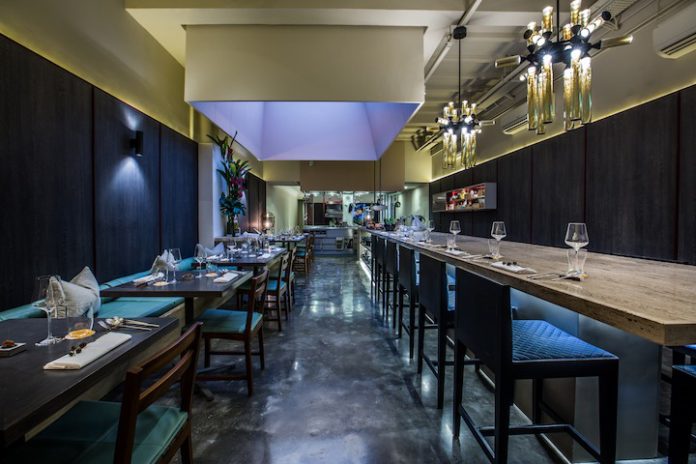
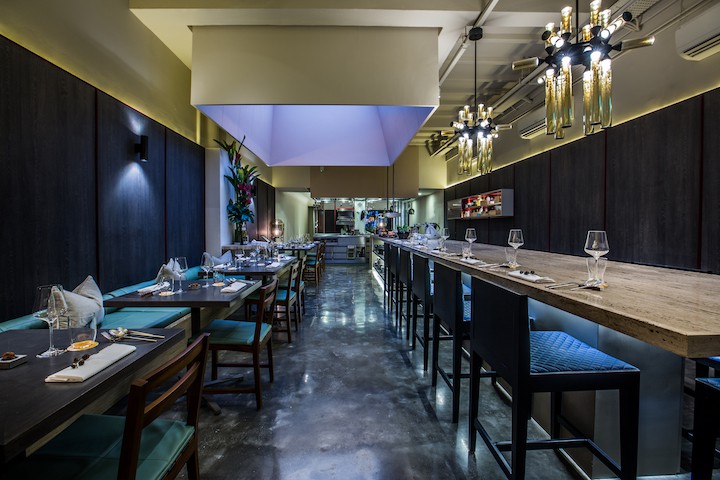
Nouri’s open kitchen. Source: Robin Thang/ Michelin Guide
“This 2018 selection is a reflection of the city of Singapore – a real cultural and economic crossroads – as it highlights both traditional and innovative restaurants that stand out for their creativity and cooking styles,” said Michael Ellis, International Director of Michelin Guides.
“It includes an extremely diverse choice, ranging from local street food to Teochew, French and Australian cuisine.”
According to the Michelin Guide, another five restaurants were again awarded 2 stars, “maintaining Singapore’s position as a gourmet destination of the first order.”
Some 34 addresses now have one-star ratings, but in 2018 no Singaporean place received the highest-order 3-star rating. Liao Fan Hong Kong Soya Sauce Chicken Rice & Noodle, a hawker stall which in 2016 famously became the first street food to be given a Michelin starring, has retained its one-star rating.
Some 50 establishments were also given a Bib Gourmand, including 17 new ones, which recognises the “quality-price ratio” of places serving a quality menu of up to 45 Singapore dollars (US$33).