JOHOR BAHRU: A working paper on the Rapid Transit System (RTS) project linking Johor Bahru to Woodlands, Singapore, will be presented to the Cabinet soon, said Malaysian Transport Minister Anthony Loke on Monday (Jul 30).
He said that although the government had agreed in principle to the implementation of the RTS project, detailed information about it is still needed to be brought to the Cabinet for approval.
“The government remains committed to implement the RTS project … in terms of cost, the Cabinet approval is needed,” he told reporters on Monday (Jul 30).
Loke said once the approval was received from the Cabinet, a joint venture company between Malaysia and Singapore would be set up to ensure the smooth implementation of the project.
His comments came after his Singapore counterpart Khaw Boon Wan said earlier this month that Singapore’s SMRT Corporation and Malaysia’s Prasarana Malaysia missed a deadline to set up a joint venture company to become the operator of the RTS.
But Loke said on Monday that the project would still be completed on schedule despite a “slight delay” due to a change of government after the 14th General Election (GE14).
“There was a delay of one, two months after GE14 but we hope it can be implemented as planned,” he said, adding that Singapore had already been informed of the delay.
“We also need to remember that Malaysia is not alone in this matter, our (rail) system also needs to be integrated with Singapore’s,” said Loke.
Despite the delay, he said the federal government would not have to pay any compensation to Singapore.
“The issue does not arise because we have not signed the agreement yet, only involves an MoU (memorandum of understanding) that demonstrates our commitment, so there is no compensation,” he said.
The RTS project, signed in January this year between Singapore and the previous Malaysian administration, was mooted to ease congestion at the land checkpoints and make it more convenient for people to travel between both countries.
Once it is completed in 2024, the RTS project will link Johor’s Bukit Chagar Station in Malaysia with Singapore’s Woodlands North Station.
It is expected to carry up to 10,000 passengers per hour in each direction, which translates to an additional capacity of 60,000 users crossing the Causeway during peak hours.
In the meantime, Loke said the ministry was looking at a proper mechanism to increase the Keretapi Tanah Melayu Berhad shuttle services’ frequency of trips from Johor Bahru to Woodlands to meet the demand of commuters.
“At the moment, there are 31 trips and any increase will require the approval from the Singapore government,” he said.
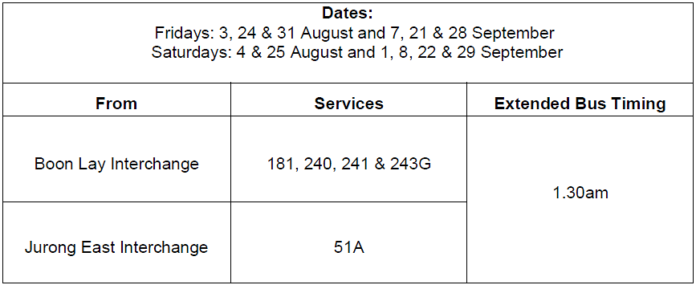
SINGAPORE: The operational hours of five SBS Transit bus services will be extended on certain days in August and September. This to serve commuters affected by the early closure of some MRT stations on the East-West Line (EWL) and North-South Line (NSL).
SBS Transit said in a news release on Monday (Jul 30) that operating hours for bus services 181, 240, 241, 243G and 51A will be extended to 1.30am on selected Fridays and Saturdays in the two months.
The extended bus hours will, however, exclude the National Day and National Day Rally weekends on Aug 10, 11, 17 and 18 as well as the Formula 1 Race weekend on Sep 14 and 15, the release added.
Rail operator SMRT announced earlier this month that seven stations along the EWL and three stations along the NSL will close earlier on some Fridays and Saturdays and open later on some Saturdays and Sundays from August to September to facilitate rail maintenance.
The affected stations, from Dover to Pioneer and from Bukit Gombak to Jurong East, will close earlier at around 11pm on some Fridays and Saturdays, and open later at around 8am on some Saturdays and Sundays.
Alternative travel arrangements announced by SMRT include shuttle buses between Buona Vista and Joo Koon MRT stations and between Choa Chu Kang and Jurong East MRT stations, as well as an express bus service providing direct connections across major transport nodes along the affected EWL stretch.
SMRT has carried out early closures and late openings of stations along the same western sector of the NSEWL since December 2017 to facilitate intensified testing of the EWL’s new Communications Based Train Control signalling system, which has been in use since May 28, 2018.
SINGAPORE: Malaysian Prime Minister Mahathir Mohamad and some of his Cabinet members called on Home Minister Muhyiddin Yassin over the weekend as he continues to recover from a surgery at a hospital in Singapore.
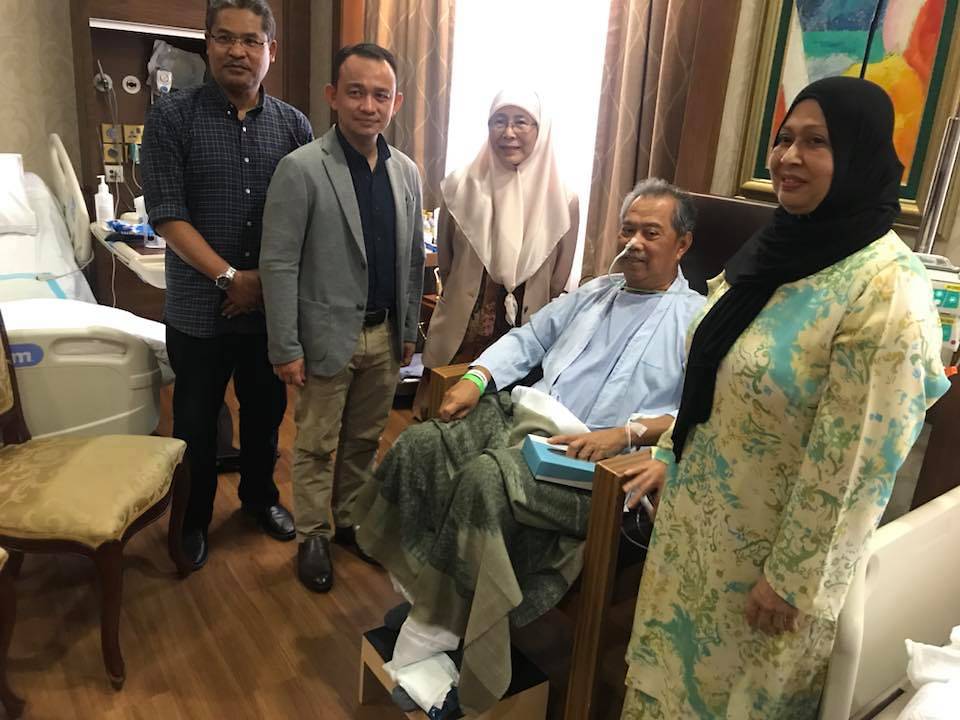
Deputy Prime Minister Wan Azizah Wan Ismail, who was among those who visited Mr Muhyiddin, told reporters this during a school visit in Malaysia on Sunday (Jul 29).
“I visited Tan Sri Muhyiddin in Singapore … I can see that he is getting stronger,” she was quoted by the New Straits Times during a visit to a school in Klang.
“As briefed (on his condition), it looks like he is recovering well. He sends his regards to all Malaysians and also those who prayed for his speedy recovery,” she added.
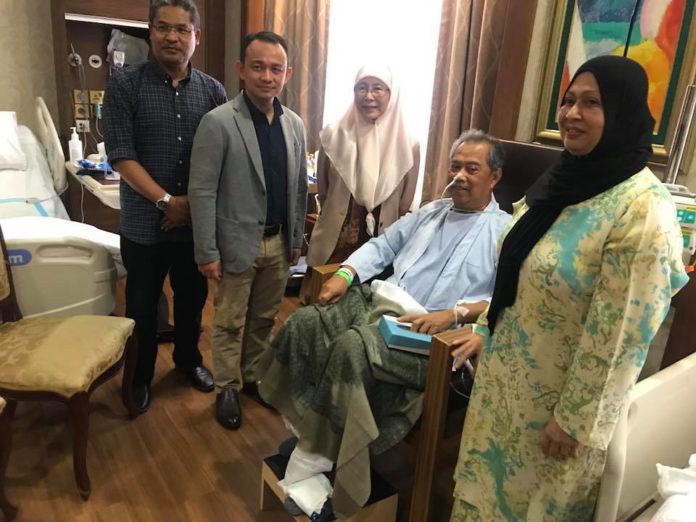
Malaysia Deputy Prime Minister Wan Azizah Wan Ismail visited Home Minister Muhyiddin Yassin at a hospital in Singapore. (Photo: Muhyiddin Yassin/Facebook)
Dr Mahathir is assuming his duties while he recovers from surgery.
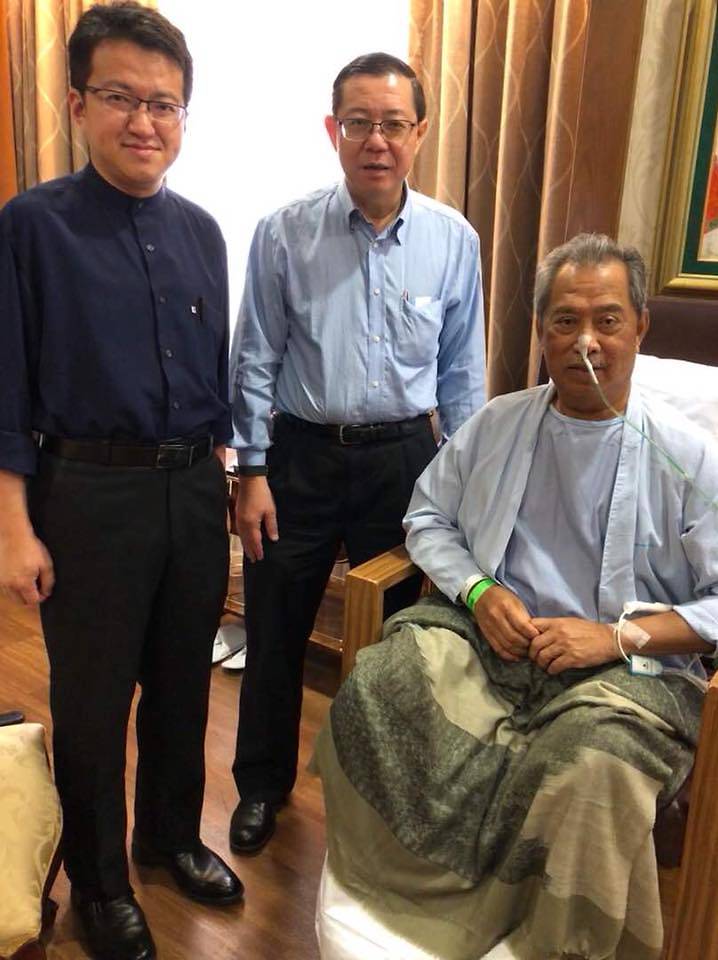
On his Facebook page, the home minister posted photos of the weekend visits by Dr Mahathir and his wife Siti Hasmah, along with Dr Wan Azizah and Finance Minister Lim Guan Eng.
Malaysia Finance Minister Lim Guan Eng (centre) visited Home Minister Muhyiddin Yassin (right) at a hospital in Singapore. (Photo: Muhyiddin Yassin/Facebook)
Mr Muhyiddin said on his page on Saturday that Dr Mahathir and his wife spent more than an hour with him at the hospital.
A statement by his press secretary Hafiz Abdul Halim on Thursday also said that Mr Muhyiddin is in good health and is recovering.
DESPITE the sharp decline of people taking their own lives in Singapore last year, the number of suicide cases among elderly people in the city-state has hit at an all-time high.
The latest government statistics given to Samaritans of Singapore (SOS), a non-profit organisation show that over a third of the nation’s suicides last year comprised those in their golden years, with counsellors suggesting there is a lapse insufficient support for the elder population.
Of the 361 cases reported last year, 129 involved the senior citizens above 60 although the total figure was 15.8 percent lower than the 429 in 2016, according to the Straits Times.
Typically, the cases in the senior age group ranged between 25 and 30 percent annually but last year’s figure reached 35.7 percent.
“It is very worrying that many of the elderly are turning to suicide as the only choice to end their pain and struggles when they should be enjoying the lustre of their golden years,” Christine Wong, executive director of SOS, was quoted as saying.
“With the elderly population in Singapore increasing steadily, suicides in this population may be expected to continue rising.”
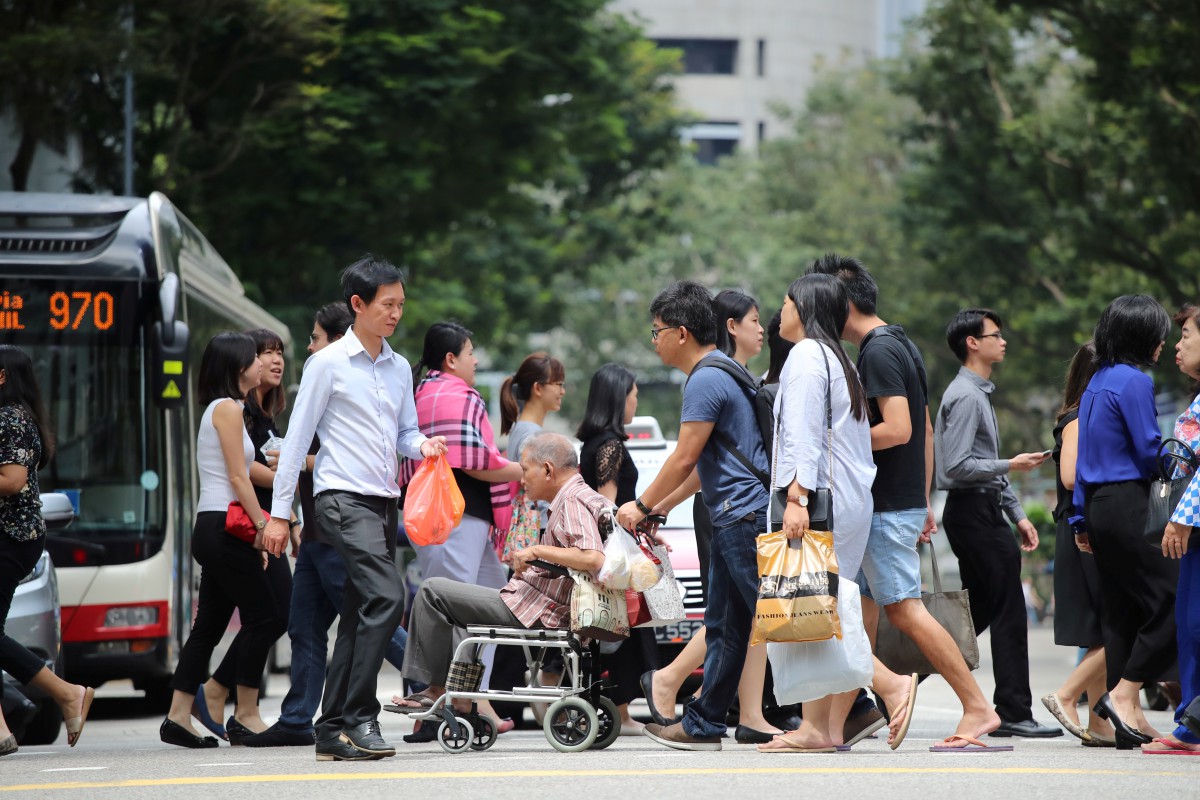
An elderly man is wheeled across a pedestrian crossing in Singapore Jan 16, 2018. Source: Reuters
SOS, which functions as a suicide prevention agency, also recorded a drop in calls made by seniors, dipping 18 percent to 5,652 in 2017 from the 6,904 made in 2016.
“We need to find out the barriers that prevent them from getting through to SOS, and if they know where and what are the other available help resources,” Wong said.
Social isolation and family burden
Dr Tan Ern Ser, a sociologist at the National University of Singapore sociologist said the profile of an elderly suicidal person was typically aged 75 or above, living alone or with a spouse, and with only primary school education.
Tan told Channel News Asia said the seniors may see life as “empty and meaningless”, while terminal illness and a lack of social support as major factors for suicide.
Asked why less elderly people were seeking help from suicide prevention hotlines, Dr Tan many were not comfortable sharing their “innermost thoughts with others or seeking help through a hotline to speak to a stranger”.
“They are also thinking that no one could understand them and their situation, let alone help them,” he said.
“They are probably living in isolation, have few or no friends, know only people who are just as ignorant about other forms of help, or do not see non-kin as a possible source of help,” Dr Tan added.
Tan added family members who “caring, supportive and attentive” could also be a form of alternative assistance.
Often times, the elderly were prone to deteriorating mental health, felt they were a burden to their families, and faced physical challenges, according to SOS.
“These concerns predisposes socially isolated elderly to depression and suicidal thoughts when struggles go undetected and unaddressed,” it said.
SINGAPORE: Perhaps you’ve noticed that top athletes are getting older.
We are seeing superstars in soccer, professional cycling, baseball, rugby and other sports performing at the highest level into their late 30s and even 40s.
Sports personalities like Francesco Totti (retired at 40) and Ryan Giggs (retired at 41) Tom Brady (41, NFL), Sylvain Chavanel (39, Tour de France cyclist), Jaromir Jagr (46, NHL ice hockey), and Tim Duncan (retired at 42, NBA) excelled for roughly a decade longer than used to be the case.
THE LONGEVITY DIVIDEND
Why is this happening? They focus on more than just athletic skills. They eat better. They take care of themselves. They rehabilitate their bodies, get excellent medical care, and prepare mentally.
As a result, they are able to reap extraordinary benefits for longer. Due to their ability and experience, older athletes provide tremendous value to their teams and huge joy to fans.
They prove that outdated ideas about age and performance no longer hold true. We, too, can excel for longer and it’s called the longevity dividend.
Former Italian football player Francesco Totti. (Photo: AFP)
Not everyone can be compared to top athletes, but there are undeniable breakthroughs in neuroscience, nutrition and adult development that enable healthy adults to extend the age-range for impactful contribution.
However, organisations rarely utilise the science-based insights — and toss-away an amazing competitive advantage.
The resource and opportunity that older workers represent is being overlooked at a time when our workforce is shrinking.
By 2030, Singapore may see a talent deficit exceeding 1 million positions according to consultancy firm Korn Ferry, with a total unrealised output of S$106.8 billion.
Add to that concerns about people living a 100-year life, cost of healthcare, and insufficient retirement savings. The challenges associated with living longer are substantial.
Singapore’s response to its ageing workforce has revolved largely around skills development. Reskilling programmes teach marketable skills to older workers. These efforts are critical at a time when an ageing workforce must also confront technology and automation that displaces workers.
Reskilling, however, is necessary but insufficient to support an ageing workforce. While we are upgrading skills, life’s natural process of cognitive decline is already underway. Starting in our 40s, research shows that people naturally experience a decline in reasoning, memory, spatial visualisation and processing speed.
The implication for Singapore is that we are asking an ageing workforce to use new skills without first addressing cognitive decline.
A food court employee in Singapore. (Photo: Gaya Chandramohan)
UNLOCKING NEW MINDSETS
Fortunately, cognitive neuroscience reveals how to help executives and leaders to get in shape mentally, delay natural ageing and even enhance cognitive performance of the body and mind.
Studies conducted at research institutions including the Centre for BrainHealth (CBH) at the University of Texas at Dallas demonstrates that cognitive training over a few months in healthy older adults can enhance the brain’s executive functions, improve innovative cognition and produce faster brain processing speeds.
Cognitive performance in older adults can be enhanced. Furthermore, science demonstrates that we develop a unique mindset and capabilities that become available only as we age.
In the later stages of adult development, exemplified by figures like Nelson Mandela, Warren Buffett, Ray Dalio, Narendra Modi or Angela Merkel, older and more experienced leaders bring a more mature mindset capable of operating at a higher plane of complexity.
Leadership researcher Keith Eigel studied executives at this highest level of adult development and found that their mature mindset correlates positively with business effectiveness.
Cognitive development programmes complement and support reskilling by enhancing the mental capabilities these newly-learned skills depend upon. A careful individual repositioning can further enhance an improved mental agility and a mature leadership strategy.
Again, think of it in terms of the sports metaphor. Why do older star athletes often score the most important goals and points in the game? Certainly not because they are faster or more aggressive than anyone else.
They score because they are smarter. They can read the game better. They know their assets and weaknesses.
Gary Neville and Ryan Giggs celebrate winning the Premiership with Manchester United in 2009 (Photo: AFP/Adrian Dennis)
While on the pitch, they can at that very moment imagine themselves as sitting in the 35th row of the arena where they have a perfect vantage point.
Investing in an ageing workforce can deliver these same types of benefits to organisations.
RESPOSITIONING ORGANISATIONS
That is what the Longevity Dividend is about in a nutshell. Organisational leaders who develop next-step cognitive abilities will know where the ball will be in a couple of moments and they will be there, too, waiting for the opportunity.
The repositioning is everything. Sometimes it may mean delegating more, pushing the workload forcefully downwards while positioning themselves more as a coach and mentor. At other times it means facilitating the talent of others at a decisive, value-creating moment.
The individual repositioning would not be enough without important changes in culture and organisation. We need to help different generations work together and the early research on multi-generational teams is promising.
Compared to more generationally homogenous teams, early research shows that the age-diverse teams deliver better decisions.
Such benefits are only achieved if all employees dispatch with the ageism and recognise the different cognitive resources that everyone brings.
Only then can we fulfil the promise of the longevity dividend and fully realise the emerging wisdom that today’s 72 is yesterday’s 58.
Dr Michael Netzley and Dr Tomas Klvana are founding partners of Extend My Runway, a consultancy start-up that focuses on extending successful careers through applied neuroscience.
SINGAPORE: There is “no specific” target for the record biggest 265 Team Singapore athletes that will be competing at the 2018 Asian Games, Minister for Culture, Community and Youth Grace Fu said on Sunday (Jul 29).
Speaking to media on the sidelines of the Team Singapore Flag Presentation Ceremony for the Asian Games, Asian Para Games and the Youth Olympic Games, Ms Fu expressed confidence that the Asian Games athletes will do Singapore proud as “they have been training very hard” and that the Government will support them in whatever way it can.
In response to a question over expectations on the team, Ms Fu said: “We don’t have any specific targets but I’m sure each of the sports will go out and really do their very best for Singapore.”
Minister Grace Fu and Speaker of Parliament Tan Chuan-Jin posing for a wefie at the Team Singapore Flag Presentation Ceremony for the Asian Games, Asian Para Games and the Youth Olympic Games. (Photo: Amir Yusof)
Singapore is set to field its largest Asian Games contingent of 265 athletes across 21 sports at the tournament in Indonesia, which will take place on Aug 18 until Sep 2.
At the official flag presentation ceremony, gymnast Hoe Wah Toon was unveiled as the flag bearer for the Asian Games squad.
Chef de Mission for Team Singapore at the Asian Games, Mr Lee Wung Yew, outlined to members of the media that the three sports renowned for delivering medals at the tournament are sailing, bowling and swimming.
However Mr Lee, who is a former national shooter who represented Singapore six times at the Asian Games and thrice at the Olympic Games, added that supporters can expect “nice surprises” in other sports, including in events that Singapore will be competing in for the first time.
Sports that will be debuting for Singapore at the Games include contact bridge, synchronised swimming, ju jit-su and paragliding.
At the previous edition of the Asian Games in Incheon in 2014, Team Singapore’s 223-strong contingent clinched five golds, six silvers and 14 bronze medals.
At the official flag presentation ceremony on Sunday, archer Nur Syahidah Alim and table tennis player Koen Pang were unveiled as flag bearers for the Singapore contingent at the Asian Para Games and the Youth Olympic Games respectively.
In October, a total of 44 Singapore para athletes will be competing across 10 sports in the Asian Para Games at Indonesia in while 15 youth athletes will be representing the country from eight sports at Argentina.
SINGAPORE: Every morning, 92-year-old Madam Lim Yee Mun can be found on the top of a multi-storey car park in Dover estate, gently moving her arms and legs through the motions of exercise, amid a lush green haven of tranquility.
Once she is done, Tai Chi Ah Ma – as she is known to other residents – gets down on her haunches and starts on her other daily routine: Weeding the rooftop garden, where countless herbs, edibles and ornamental plants grow in profusion.
“These plants keep the air fresh. The air downstairs isn’t so good,” she said, scrabbling at the soil.
Mdm Lim Yee Mun, or Tai Chi Ah Ma as she is known to other residents.
Fellow volunteer Lim Kiat Kee has been growing herbs there for over seven years. The 75-year-old has a nickname too: Bus Ah Ma, on account of being a former bus driver.
They live in the same block, on different floors – but it was in the garden where their friendship blossomed, and where many other bonds between neighbours were forged.
A unique signboard captures the open-hearted spirit that flourishes here. “Pick our herbs and spices for free,” it invites everyone, even those who did none of the gardening.
In community gardens elsewhere, fears of abuse have commonly led to locked fences and turf wars. But here at Dover Crescent, there is a special kampung spirit at work.
It needed one resident, however, to turn what was once a humdrum patch of green – so uninspiring that Tai Chi Ah Ma used to exercise on the ground floor – into something much more.
That man was Mr Benjamin Ee, and he has been guided by a simple philosophy since he became gardener number one: “You can’t call it a community garden if it doesn’t bring people together.”
CHOOSING TO BE GENEROUS
Mr Ee, who recently retired from his job as project manager in the construction industry, has always loved gardening. But this personal pet project in his estate is his first stab at a community garden.
And he has chosen not to be territorial. “Because we’re growing different types of plants, invariably we’d have people coming to ask us, ‘Can I have this? Can I have that?’ And I say, let’s be generous,” said the 60-year-old.
“Whatever we can afford to give, let’s give it to them because we want to engage the community.”
Mr Benjamin Ee.
He does not mind that some people want the produce without putting in the hard work, as he wants to “make this garden a bit different”.
What tends to be a sore point among green fingers in Singapore – the damage done to pots and plants, the pilfering and the littering – does not seem to faze him either.
“People have deliberately broken the branches, stolen the whole plant, taken the pots or broken them, taken some of the slabs and thrown them around,” he admitted.
“There are people who smoke and leave the cigarette butts here, and beer cans – not here on the paved area but on the garden ground. So we have to be gracious about those things.”
Such incidents have not detracted from his concept of an open garden, one where students come to study, foreign workers sit to have their meals and other residents have other reasons to be drawn to it.
“We’ve had people come here in the mornings to read their papers and someone reading the bible. I had a lady one evening who came here crying, to be by herself, and she asked me for some advice,” he recounted.
I’ve had neighbours from other precincts, even the condominium nearby, coming to ask for some of the edible flowers, giving them seeds. I’ve had people on wheelchairs looking around, so I gave them the water hose to spray (the plants).
“We have people, this afternoon actually, coming to discuss some serious matter. I saw the seriousness on their faces,” he added.
APPROACHED OUT OF THE BLUE
In its original state, however, the roof garden consisted of common cow grass, some palm trees, a few lime trees, a bunch of pandan shrubs, “and there was no shelter – it was just that”.
“A lot of residents said they came up here, looked at it and then went off. There was nothing to interact with,” said Mr Ee, who estimates that there are now over 80 species of plants, spices and medicinal herbs.
He may have never got involved in the garden, however, if not for another resident approaching him out of the blue.
It was December 2010, and he was having breakfast with his family at the coffee shop, with a potted plant they had bought on their table, when an elderly lady spotted him.
She had been looking for people interested in gardening, and she decided to ask him whether he would be willing to start a proper garden for the residents. After he gave it some thought, it made perfect sense.
Their estate was new, one that had just replaced several blocks at Dover Road that were chosen for the Selective En-bloc Redevelopment Scheme.
Some residents would be feeling displaced, so it would be good to start something to bring them together, he reasoned. And the name given to their estate could scarcely have been lost on him.
“When I first moved here, I saw the sign. It said we’re called Dover Gardens. But a garden needs to be something exciting,” he said, adding that “it was about time”, too, for him to give back to the community.
By the next month, he had rounded up a committee of seven, and they held their first meeting in his 40th-storey flat over coffee, biscuits and cake to start planning and preparing budgets.
Having approached the town council, via the Dover Crescent Residents’ Committee, he was then given the go-ahead in April 2011.
The roof garden at Block 28 Dover Crescent before Mr Benjamin Ee’s team took over.
They broke ground a month later on the new garden: Three plots totalling more than 200 square metres. “To me, it was like, ‘Wow. This is more than I can expect,’” he said.
NO PROPER FUNDING
While the garden may have come a long way since then, the journey has had its share of ups and downs, some unexpected.
At the outset, for example, Mr Ee’s team had to get the garden going without any funds given to them.
So one thing he did was to source for materials that could be recycled or upcycled, such as paving stones, which he secured from his contacts in the construction industry.
A photo of the early days of the garden.
These were surplus stones that contractors would have had to pay to dispose of, so he paid their workers instead to bring them to the garden, where his team laid every slab.
“Even this bench I’m sitting on is recycled by taking a number of broken benches and putting them together, and you get one that’s still useable,” he told CNA Insider.
An initial investment was still needed, however, so his team pooled S$700. “Then as the garden developed, other neighbours heard about it and started putting in money,” he said.
“When we were growing vegetables, they’d come, take their vegetables and say, ‘Okay, I’d like to give you a contribution of S$100’. I’d say S$2 is good enough, but they’d give S$100 or S$10.”
Mr Ee’s team called their community garden interest group “Petals, Greens and Friends”.
There were also those who gave in kind, including plants, seeds and fertiliser. One resident, for example, gave him some Indian lemon seeds to plant.
“She said that she’d tried for over a year but couldn’t grow any. Then I took the seeds and grew them. She said, “Woah, you’re blessed, your hands are blessed.’ I was like, ‘No, it’s nature,’” he recounted.
He estimates his own contribution over the years at S$1,000 at most.
MANPOWER WOES
Money, in the end, was not the biggest challenge. Manpower was, including managing the small team he had.
When Mr Ee was focusing on developing a flowering garden at one of the three plots, problems emerged among the committee members to whom he had handed over the vegetable garden.
“There were some relationship strains that caused some major challenges. That affected the garden, and I was often called to be the middleman, which wasn’t what I wanted to do,” he said.
The once-thriving vegetable plot, which produced almost 175 kilogrammes of harvest monthly, fell into disrepair. So in 2013, he turned it into a pallet garden for flowers, which meant less maintenance.
Despite such struggles, the roof garden won an Environmental and Biodiversity Award from the National Parks Board the next year, and with it a cash award of S$1,000. That was when Mr Ee suffered one of the biggest blows.
To use the money, his committee had to join the Dover Crescent RC. But the other members objected, as the RC had not given them funding in the first place.
They quit, leaving him to join the RC alone in the hope that he could engage more residents.
“It was very disheartening at times. There were times I was thinking, ‘Yeah, maybe I should give up,’” admitted Mr Ee, who was still working full-time then.
I was beginning to put in more and more time, and my wife would say, ‘Hey, what’s going on? You don’t have the manpower, and you’re taking so much time out of the family.’
But the plants were not in good health, and some residents even texted him to ask what was going on with the garden. “I was like, ‘Okay, this is a heavy weight on my shoulder,’” he recalled.
For a period, he would water the garden at 6.30am because of the manpower shortage and have one of his few volunteers do it on another day. Yet, he did not blame people for not volunteering.
“Most Singaporeans generally find it quite tough working under the sun. And then sometimes you get insects buzzing around. It can be quite uncomfortable,” he said.
“I think that’s the reason they’re not so keen on gardening. But they generally like the garden.”
AT THE WIFE’S SUGGESTION
Mr Ee still had people encouraging him – people like Tai Chi Ah Ma and Bus Ah Ma, who was one of his original volunteers and who would brew herbs from the garden for him.
Mdm Lim Kiat Kee, or Bus Ah Ma as she is dotingly called.
And then others joined to pick up the slack, like Mr Rahman Latiff, who loved the garden and volunteered to do the watering and cleaning while learning about Chinese herbs and doing some planting. Pushing 80, he is at the garden at least four times a week.
The turning point came early last year when Mr Ee’s wife suggested that he open up half the garden for people to take whatever is grown, and also suggested some of the possible plants.
They have not looked back since, and neither have the residents. There is Siti the domestic helper, who comes thrice a week for pandan leaves, to make a barley drink for her employer’s family.
There is Amy the 56-year-old, who discovered that the garden was a great place to practise tai chi, and picks one or two lime leaves too.
And there is a lot more they can take, but only if needed: Sweet potato leaves, lemongrass, Kaffir lime, brinjal, ladies’ fingers, chilli, Thai basil, garlic, ginger, and so on.
Throughout its several transformations, the garden has gone from strength to strength, picking up eight awards, including the Gardeners’ Cup 2018 this past week at the ongoing Singapore Garden Festival.
Its open concept even came to the attention of Temasek, which decided “in the spirit of sustainability” to donate edible herbs and plants exhibited at last month’s Temasek Ecosperity Conference to the garden.
The edible herbs and plants donated to the Dover Crescent community garden made up the exhibition centrepiece at the Temasek Ecosperity Conference. (Photo credit: Temasek)
There are now over 1,000 community gardens under NParks’ Community In Bloom initiative. A minority of them are roof gardens. But Mr Ee hopes that what he and his team are doing is extra special.
And he wants to do more, like the activities held in the garden previously when he had more manpower – for example, barbecue nights and Christmas under the stars – “so that we can build that community”.
As he noted emphatically, “The garden is all about relationships. It’s not just about plants.”
SINGAPORE: Loo Choon Chou, a member of the Singapore team for the upcoming Asian Games, trains hard for competitions.
However, his preparations don’t include the type of activities one normally associates with major sporting events, like hitting the gym or careful diet planning.
Instead, the 36-year-old spends hours analysing future opponents and pores over a playbook, familiarising himself with possible scenarios he might encounter at the games, which are being held in Indonesia next month.
As D-Day looms, Mr Loo also often checks into a hotel with the rest of his team, where they fall into a pre-competition routine. Their schedule revolves around group walks and lots and lots of practice.
A contract bridge player arranges playing cards. (Photo: Matthew Mohan)
This unusual training regime is because Mr Loo’s event requires mental rather than physical exertion: Contract Bridge.
He and his teammates are working hard to ensure that when match day comes around and Mr Loo dons his jersey, he is ready for battle – one he will fight with a hand of 13 cards.
A full-time player with a club based out of China’s Zhejiang province, Mr Loo is also one of the 266 competitors representing Singapore at the Asian Games in Indonesia next month – 24 of which are part of the bridge squad.
“Most people don’t even know what bridge is,” he told Channel NewsAsia. “The funniest question is when some ask: ‘Is this useful for going to casinos? Can you make a lot of money there (with these skills)?’ Sadly, the answer is no.”
Contract bridge, or bridge as it is commonly known, is a game played using a 52-card deck by four players in two competing partnerships.
The game begins with the bidding phase, where each player attempts to relay information about their hand to their respective partners, by bidding to win the ‘contract’.
A bid consists of a number and a suit – spades, hearts, diamonds, clubs, or no trump. The pair that win the bidding auction will attempt to earn the required number of ‘tricks’ (a sets of four cards) to meet the contract.
Points are then scored based on the number of tricks won with respect to opponents. Between 40 to 60 rounds, or ‘boards’, are usually played per day in a tournament.
A contract bridge bidding box. (Photo: Matthew Mohan)
“If I were to sum up bridge, it would be decision-making under conditions of uncertainty,” said Mr Kenneth Chan, secretary of Singapore Contract Bridge Association (SCBA). “For every board, you have to take into account the risks – like what are the potential things you can lose and the potential gains that you can get. So it’s all about risk analysis.”
There are close to 1,000 active contract bridge players in Singapore, estimates Mr Chan, who noted that many pick it up from clubs at the junior college or university level.
This year marks the first time contract bridge will be included at the Asian Games. The sport featured at the 2011 SEA Games, also in Indonesia, where Singapore finished with one gold medal, five silvers and three bronzes.
Mdm Seet Choon Cheng clinched gold in the women’s pairs event in Palembang, and seven years later, will once again be representing Singapore.
Mr Chua Gang (left) and Mdm Seet Choon Cheng (right) will be representing Singapore at next month’s Asian Games. (Photo: Matthew Mohan)
“It was a really good feeling then because the Indonesians were thinking that they would get the gold. They didn’t and so they were a little disappointed,” recalled Mdm Seet, who will be competing in the Super Mixed event with her husband Mr Chua Gang.
Sitting at a table playing cards may seem straightforward, but Mdm Seet says that hours of contract bridge can take a toll on players.
“It’s like after taking an ‘A’ level exam. It can be so tiring that you blank out while playing,” she said. “(When I play bridge) I always tell my friends and colleagues that I am going for the other type of stress.”
Mr Loo, who participates in close to ten professional tournaments a year agrees. His competitions can last up to ten days, with eight hours played per day, he said.
“There’s a lot of endurance and stamina required and at the end of the day it’s about who makes the least mistakes. It’s not about how brilliant or good you are,” he explained.
A collection of Mr Loo Choon Chou’s medals. (Photo: Matthew Mohan)
The former Hwa Chong Institution Mathematics teacher also makes it a point to keep fit as part of his regular routine, and exercises thrice a week.
“I find that it does help in the ability to concentrate,” he added.
UNITED WE STAND
Having a good contract bridge partner is also essential to a team’s success, say members of the Singapore squad.
“Bridge is not just an intellectual game, there is also a social aspect to it. You have to learn how to communicate with your partner and learn how he thinks, so that in a typical scenario, you can read each other well and that gives you an edge,” said Mr Loo, whose full-time bridge partner is Mr Poon Hua.
The pair quit their jobs to turn pro as a team in 2014.
“A good partner is very important. One of the older players told me that a good partner is like a good marriage. You have to be on the same wavelength to be able to communicate well through the bidding,” added Mr Chan, an undergraduate at the National University of Singapore.
Ms Tan Sock Ngin plays a game of contract bridge online while her daughters wait. (Photo: Matthew Mohan)
Another couple who will represent Singapore at the Asian Games are Mr Fong Kien Hoong and Mdm Tan Sock Hgin.
The pair met at the bridge club in university and have been married for 14 years.
“If your spouse too plays bridge, they will understand the demands of the game, why I have to spend so much time reading notes, writing notes and playing,” said Mr Fong, who has forked out more than S$20,000 participating in bridge competitions overseas.
Ultimately, the group aim to raise the profile of the sport in Singapore with a solid showing at the Asian Games.
Participants at the contract bridge tournament tally the total scores. (Photo: Matthew Mohan)
The general consensus is that they could be among the medals along with traditional powerhouses Indonesia, China and Japan.
“The men’s team I think we have a pretty good chance,” noted Mr Fong.
“I think a bronze is a pretty high probability, and we are trying for a silver and if we are in luck, we might even get a gold.”
SINGAPORE: Anita Fam is well-known in the social service sector as a former lawyer who, more than 20 years ago, became a full-time volunteer in the areas of disability, palliative care, family, healthcare and mental health.
Her dedication saw her recently appointed President of the National Council of Social Service (NCSS), a role she takes on formally on Aug 1.
From the get-go in our conversation she concedes that she is among the privileged few who can afford to volunteer full-time as she doesn’t have financial constraints that others do.
But she also reveals that, in a way, she has been part of the sector since she was born.
It’s a story she says she doesn’t tell very often and it’s related to the fact that she is an adopted child, something her mother disclosed to her when she was four years old.
“It’s so important to tell your kids that they are adopted,” says Ms Fam.
“If they find out one day in a way they never expected to, it could be the most devastating thing. They need to be told that they were intentionally sought out and wanted by their adoptive parents. Then, one feels special because you’re being chosen as opposed to in another situation, where they might think about it in terms of having been given up by their biological parent.”
Recently, she found her birth certificate among her parents’ belongings and it revealed more information about her birth mother.
“She was single and 19 years old at the time. The birth certificate said ‘Care of: The Salvation Army’ which is an organisation in the social service sector. I was sharing this with a fellow board member in NCSS and he was the one who said, ‘Wah, do you realise you’ve come one full circle? You started your life in the social service sector.’
“It seems divinely planned that I’ve come back into this area to give back.”
I ask if she ever felt like seeking out her birth mother. Her normally self-assured and positive voice softens as she tells me she would “rather not”.
“If you think about it, if she was single then, she probably didn’t want many people to know about it. She might be a grandmother or a great-grandmother now with her own family and the last thing she’d want is someone to come out of the blue and bring out something that she might have kept a secret all her life. I wouldn’t want to spoil someone’s life or disturb it.
“I look back now and I think that’s so brave of her to have gone through something like this at 19 and in the early 60s.”
Her adoptive parents’ love also assured her enough not to go seeking parental love elsewhere.
A POWERFUL TRANSITION
She might have had her roots in the social services sector but her conscious involvement in it came much later in life.
In her mid-thirties, she decided to take a career break from the legal sector to look after her one-year-old daughter.
A phone call from activist, Leaena Tambyah of the Asian Women’s Welfare Association (AWWA), an organisation for which Ms Fam had previously done pro bono legal work, changed everything.
Ms Tambyah, who was instrumental in setting up a playgroup for children with disabilities, which eventually grew to become the AWWA School, asked Ms Fam to be vice-chair of a mobile therapy service called Therapy and Education for Children in Mainstream Education (TEACH ME). This provided assistance to children whose parents could not afford the money or the time for therapy sessions in hospitals.
“I think she just saw me as someone who was young and had some free time on her hands,” says Ms Fam laughingly.
She is quick to add that the experience was a powerful one.
“AWWA provided multiple services in areas of eldercare, family, disability, special education and with every single area, the financing is different, the programming is different, so I was able to get a far better understanding of the intricacies of the funding and programming in these various areas.”
This led to her sitting on numerous boards over the years and spoken up passionately about society’s needs.
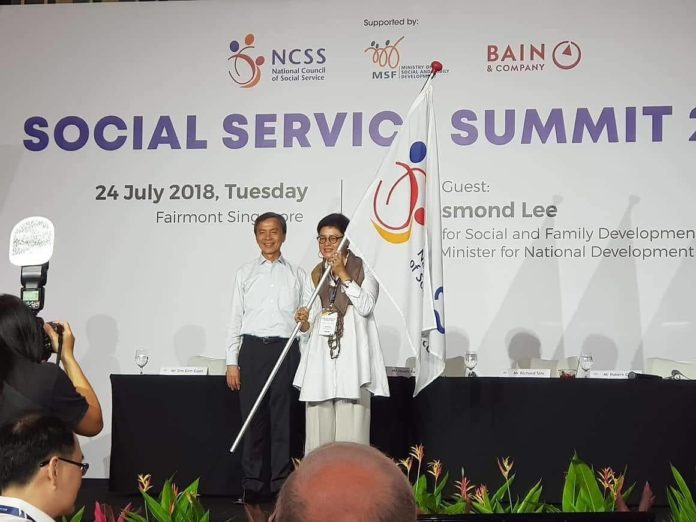
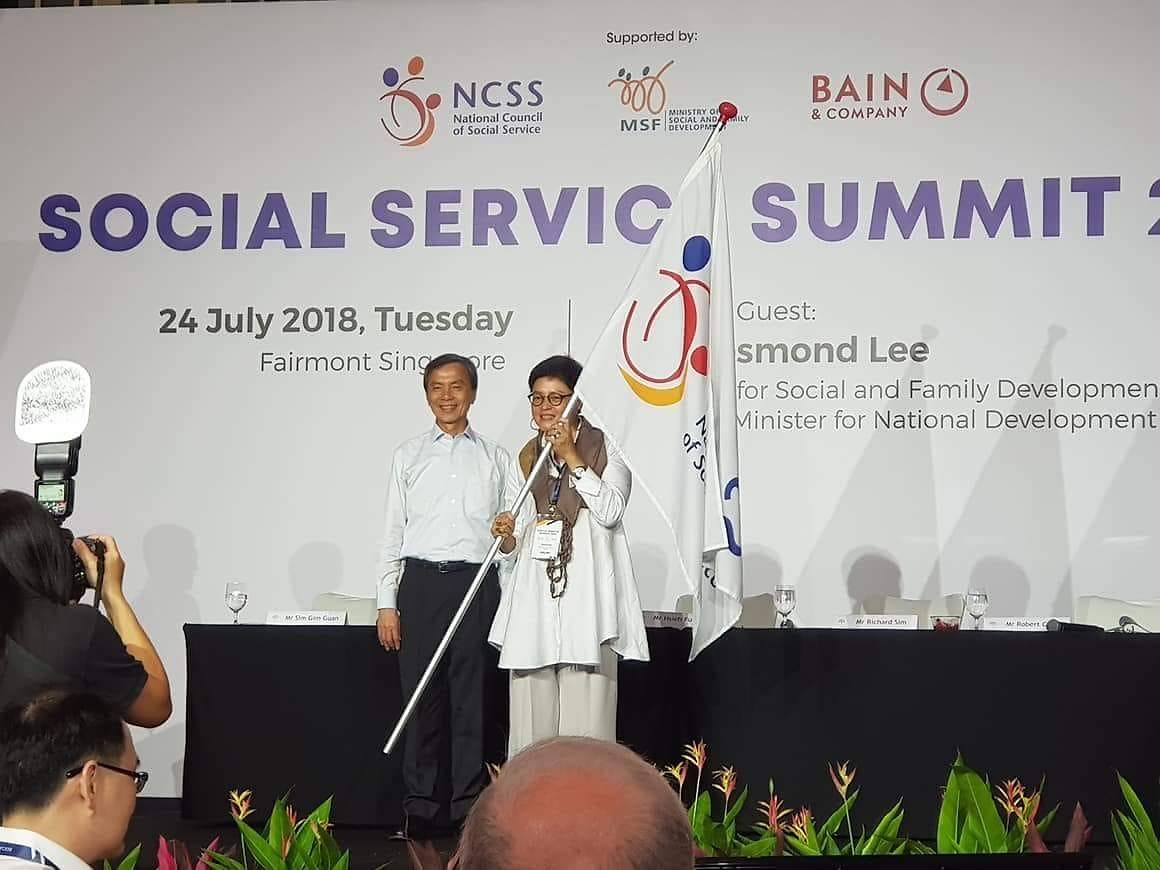
Anita Fam receiving the NCSS flag from outgoing NCSS President, Mr Hsieh Fu Hua. (Photo: NCSS)
THE SHAME OF MENTAL ILLNESS – “I FELT AS IF I WOULD EXPLODE”
One of the areas she is particularly concerned with is mental health and the stigma associated with mental illnesses.
Her own parents have, at various stages of their lives, been afflicted by depression and anxiety disorders.
“My first encounter with depression was when I was 18 years old and my dad slipped into a very deep clinical depression. In those days, no one talked about it.”
Her father, Michael Fam, was a prominent figure in Singapore society having been chairman of the Housing and Development Board, then chairman of the Mass Rapid Transit Corporation.
At that stage, he had retired and the emptiness of having no vocation was too difficult for him to handle.
“I remember my mum coming into my room and telling me not to tell a soul. She told me I was not to tell even my brother. It was a very frightening thing because I was studying for my ‘A’ levels and there was no one I could turn to. My dad used to spend a lot of time with me. He used to come into my room, sit on my bed and weep. I had to bottle this up when I was 18. I felt as if I would explode, it was awful.”
Later that year, she couldn’t handle it by herself and wrote to her brother who was studying abroad at the time. She told him what was going on.
Her father eventually sought help and counselling and medication helped him overcome his depression within six months.
“I would never have talked about this while he was alive because he would have felt the stigma, but when my father passed away in 2014, I felt by sharing it I would help others.”
Today, she hopes more would share while they are going through or recovering from such difficulties.
“We need to talk about these things more openly and realise that there’s nothing taboo about it. The problem is, sometimes there are negative consequences. There’s so much stigma attached to it that if someone knew that you’ve had a history of mental illness, they don’t want to employ you. We need to change that. Just because you’ve had a history of it, doesn’t mean that it’s going to affect your performance in the workplace.”
To help do this, NCSS has been working on a peer support scheme for persons in recovery.
“These are persons with lived experiences. They’ve actually been down the road where they’ve had mental health challenges and they’ve come out of it and they can be mentors to others in the workplace. So it helps the employers to understand because these peers can actually explain to their employers what the journey would look like and they can be a mentor for the person who’s come back into the workforce.”
Her mother too suffered from mental health issues – an anxiety disorder for most of her life and, towards the end, Alzheimer’s disease.
“I was her main caregiver. I organised everything in her life – her doctors’ visits, her activities.”
She was fortunate enough to have assistance. She hired a helper and her husband and children also played a part in “adding normality” to her mother’s life.
“You are dealing with a person whom you don’t know anymore. The elements are so different. There are no more filters and it’s an entirely different person. The advice given to me by a very dear friend who had walked on that road, a few steps ahead of me, was to enter their world. Don’t fight it. It’s their reality. Don’t try and add logic or try and say, ‘No it’s daytime’ when they think it’s night-time.
“So when she’d ask me where her mom and dad were, I wouldn’t say they died a long time ago. I’d just say that they are not here. She also used to think that I was her sister, Joyce.”
Ms Fam would embrace that role because it made her mother happy.
IMPROVING ASSISTANCE TO THOSE WHO NEED IT
The experience taught her that those who need care in whichever area – whether financial, social or healthcare assistance – need to be helped more.
“I was fortunate enough to have the ability to get help, to have the means to hire a helper for instance. For others, it may be harder. They need access to information and resources, not only for the ones whom they love, but for themselves. We need to have a one stop portal or stop for information and people to help them navigate the terrain and to know how they can help with services or with the financial aspects.”
She says that the situation has improved today with more Social Service Offices under the Ministry of Social and Family Development being set up island-wide.
But she also admits that more can be done within the social services sector to ensure that such outreach is done more effectively. One of the keys is having competent manpower.
“This is a big role that I see NCSS playing in equipping organisations so that they can manage manpower and volunteers more effectively. So it’s helping organizations with expertise in training. They also need volunteer managers and we need to train them. We need to help them with systems.”
Investing in such initiatives has helped at least one of the organisations she chairs, the Assisi Hospice.
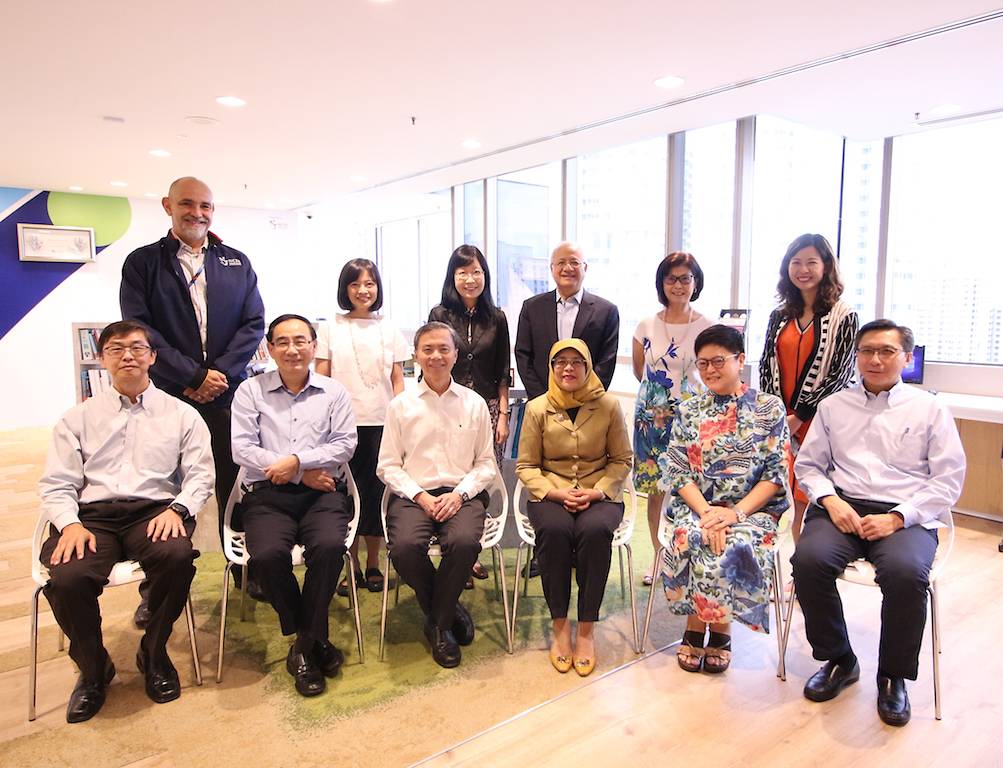
Anita Fam with President Halimah Yacob and others at an NCSS dialogue session at the Social Service Institute. (Photo: NCSS)
MANPOWER, FAIR PAY AND VOLUNTEERS
Another issue tied to manpower is salaries.
Salaries across the board in the social services sector need to be “fair”, she says.
I put it to her that some feel those working for such organisations should be doing it out of a sense of mission rather than for financial gain and there is often a concern that those at the top are paid excessively large salaries.
I ask her how she would define “fair” in this context.
“I would say market rates, private sector market rates or just a little bit below. I personally am blessed to be in that situation where I can be a full-time volunteer but many people have to have jobs to look after their families to support themselves and if you pay them very little, how are they going to live? And if the private sector is much more attractive, why would competent, qualified people come here?
“If you have good quality people who are far more effective in the way they design their programmes, their service deliveries which are far more appropriate to the beneficiaries, you probably can do things in a shorter period of time, more efficiently. It’s actually a cost-benefit approach that we are looking at.”
The principle should be applied to personnel at all levels within social service organisations, she says.
However, she concedes that competence and salaries have to be accompanied by heart.
“Those who don’t have heart won’t stay long anyway, because it can be very emotionally draining work. The CEOs of such organisations especially need to be very in touch with the ground and have the heart for it if they are to lead successfully.”
She also urges more to enter the sector as volunteers.
“I was just looking at some recent stats and now one in three Singaporeans actually volunteer. I’d say that even if you gave one or two days a year, it’s something. You might not be able to volunteer regularly, but you can volunteer sporadically. But I think especially with the millennials now, actually they are far more altruistic. They really want to do good and it is reflected in even their choice of jobs, because they actually want to go into jobs where there is some sort of social good. So I don’t think things are bleak.”
For all this to work, money to keep organisations going and to fund programmes is vital and she advocates more sustainable funding methods.
“In the US, the majority of funders now like to fund endowments. The whole concept of an endowment fund is that you preserve the capital and you spend the interest, so there is sustainability in the funding. So I may contribute an amount to the endowment fund but then I know the legacy of my capital injection will last 20 years or in perpetuity and it provides certainty to the people who use it.”
The social services sector is also looking to facilitate greater collaboration and boost service delivery with two new digital initiatives.
The first is an IT system to improve back-end processes.
Jointly developed by NCSS and Singapore Pools, iShine Cloud provides a suite of integrated IT cloud services which includes office productivity tools, shared storage, human resources and accounting packages, which voluntary welfare organisations (VWOs) can enjoy at subsidised rates.
The second initiative is the Social Service Navigator, an interactive online platform and mobile portal that consolidates information on social service providers, programmes and resources all over Singapore to help social service professionals find the resources they need to support their daily work.
“If I’m able to shape a program or service that allows more people to have a better life, especially in the area of disability or mental health or caregiving or end-of-life care, I’ll die happy,” says Anita Fam. (Photo: National Healthcare Group)
CAN THE GOVERNMENT DO MORE?
While the sector continues to evolve, I ask if she feels the Government can do more to help those who don’t have the means to access social services.
While she believes there have been tremendous improvements in this area in the last decade, she says more can be done to help more people access financial assistance and subsidies by recalibrating the eligibility criteria, especially for those in the lower-middle income group.
“When it comes to means-testing for instance. I used to call it ‘mean’ testing. It was very mean. I think it’s been carefully calibrated to a degree now that I feel it’s slightly less mean for certain families, but my personal opinion is we can be a little bit more generous in how we determine that, so maybe that’s something that Government may think about in time to come.”
“I WAS SELF-ABSORBED. I’M ASHAMED”
As we approach the end of our conversation, she tells me that her involvement in the social service sector has changed her tremendously.
She remembers what she was like before.
“I guess in those days when you were working, what do you want? You want to earn a lot of money. I was a junior partner in a law firm, I didn’t think of anyone except for myself and it didn’t seem wrong to do so. I wasn’t harming anyone. I was basically having a good time. I was self-absorbed. It never occurred to me that there were folks around me who weren’t living the sort of life that I was living.
“I’m ashamed when I look back. Especially when I was in university, I didn’t realise that my fellow classmates were having such a hard time. Some of my classmates in law school had to hold two jobs while studying. I was going to the beach, watching movies. Can you imagine someone slogging his butt off and seeing these other spoilt kids who are just driving around, being able to go to a restaurant and eat without having to count their dollars?”
What she is doing today may not fully make up for the past, but she is intent on “making a difference”.
“If I’m able to shape a program or service that allows more people to have a better life, especially in the area of disability or mental health or caregiving or end-of-life care, I’ll die happy.”
SINGAPORE: Growing up, my late grandfather was pivotal in shaping my world views.
A successful businessman, he was honoured by the Emperor of Japan and the President of the United States for his philanthropy.
He believed strongly in the dignity of all. Despite his wealth, he lived in a modest three-bedroom house for most of his life and would chat with the homeless on the streets.
People may forget his consumer electronics and dinnerware businesses, but they will remember his generosity which shaped the city of Los Angeles, and in particular, the Japanese-American community.
Later on, I attended an elite school which offered scholarships to students from developing countries as part of its vision to promote international understanding. We were proud to have talented youth, who embody our school values, be part of the community.
My siblings and I lived comfortable lives. But we had role models – family members, mentors and school leaders – who taught us we were no better or worse than anyone else. We learnt the value of being other-centred. Rather than being served, we were encouraged to use our gifts to serve others.
The issue of inequality has generated lively debate in recent months. A question that arises from the debate is whether the rich can be caring. The bigger question is whether the privileged, through poor exposure, suffer from an empathy gap and how can we close this to build a more inclusive society.
NVPC research suggests the well-heeled do serve society. The volunteerism rate among Singapore’s private housing residents is 55.6 per cent, above the national average of 35 per cent, according to our 2016 Individual Giving Survey.
Yet there is a sense that well-off Singaporeans still hold indifferent and uncaring attitudes toward the poor.
The Singapore city skyline. (Photo: AFP/Roslan RAHMAN)
My grandfather’s example shows that anyone – rich or poor – can nurture empathy. Compassion is what makes us human. But how often do we exercise this quality?
Our middle and upper classes have multiple options in life, from where they choose to stay, where their kids go to school to what kind of healthcare they want.
But with the privilege of choice comes the risk of ignorance. Some options effectively reduce exposure to society’s needs and opportunities to build compassion for others.
It was only when my mother was in the intensive care at Singapore General Hospital when she had her stroke did we experience life with other families who camped out in the halls and waiting rooms for weeks and even months. We got to know them, share, cry and pray with them.
With money, it is easy to live private and routinised lives. Today, with social media algorithms exposing us to similar people and viewpoints, we further risk becoming narrow-minded without realising it.
This sounds surprising, but the rich are often very poor: Poor in spirit and satisfaction, and rich in worry.
Wealth provides choices but doesn’t always bring happiness. A poverty of spirit comes when we view everything with a half-empty lens and nothing is ever enough or good enough.
In a 2016 parliamentary speech, Nominated Member of Parliament Kuik Shiao Yin described how Singapore has a national habit of “scarcity thinking”. We have been conditioned to think that resources are scarce in our little red dot, and there is little to go around. Money no enough, time no enough, space no enough, what to do?
When we believe that there isn’t enough, the tendency isn’t to help but to hoard.
Scarcity thinking is when we think that giving more away means less for us. It shows when we compare and complain of what we do not have, forgetting to give thanks for what we do. Without gratitude, we are truly poor no matter what our financial assets.
File photo of an elderly worker in Singapore. (Photo: TODAY)
PIONEERS AND LEADERS TODAY
Policies can change the rules by which we live, such as by encouraging mixing in housing estates. But ultimately, society shifts when values shift.
I believe a shared value of other-centredness will keep us strong and together. To do this, we need to enlarge our definition of success to include helping and serving others.
We have rich examples in Singapore’s history to draw from – especially businessmen-philanthropists like Tan Kah Kee, Govindasamy Pillai and Tan Tock Seng who stepped up as community leaders and advocated on behalf of others. Our clan associations promoted mutual aid across class borders, believing that everyone should be treated as family.
But beyond these visible examples are many invisible heroes who lived out the spirit of mutual care and common cause; the gotong royong, kampong spirit, as some call it.
I see a resurgence of this in society. Stewardship Asia advocates a spirit of stewardship to public and private companies and family businesses. Honour Singapore champions honour as what has made, and can continue to make, Singapore successful. The Singapore Kindness Movement reminds us greatness is in the power of a kind and gentle spirit.
These efforts build lasting values that complement those of economic progress and achievement.
The Air Line Pilots Association Singapore (ALPA-S) held a charity drive on May 2, 2015, to collect survival items and fly them to Nepal. (Photo: K Shanmugam/Facebook)
At NVPC, we believe volunteering can build bridges between people and foster empathy. Volunteering is not the strong helping the weak, but a chance for everyone to offer something of themselves, knowing life is not an even playing field. We need humility, a learning mindset and a chance to rediscover or relearn.
In my early days as a mentor, I remember being irritated by a girl for constantly being late for our Saturday morning session. I later discovered she worked two jobs and only came home at 4am. Meeting me at 10am took effort. I was ignorant and I needed to ask to understand.
Years later, that girl is now a breadwinner and top salesperson at her company. My journey with her made me rethink ill-informed assumptions, such as “Some people don’t work hard enough” or “You just can’t help everyone.” Through giving, I received new wisdom.
It is no wonder that NVPC’s Individual Giving Survey shows that giving begets more giving. 80 per cent of current volunteers are likely to serve again compared to those who have never volunteered before (21 per cent), and they donate more than five times that of non-volunteers.
We gain something from helping others – a sense of fulfilment, a different perspective, a fresh motivation in life; leading to a virtuous circle.
Two volunteers go over their approach to engage a senior before they begin their house visit. (Photo: Silver Generation Office)
BUILDING TRUE RESILIENCE
We tend to underestimate our ability to give and what strengths we have. In an NVPC quarterly survey of 1,053 Singapore residents this March, 69 per cent agreed that “individuals like themselves” played a major role in giving to society. This was the lowest score, compared to the role we felt the Government (84 per cent), non-profit organisations (80 per cent) and corporations (77 per cent) played.
Is it that Singaporeans think they don’t have enough to contribute – the scarcity mindset at play? Or is it a sense that others should take responsibility before us?
In either case, we must build a truly resilient society for all of us, to combat scarcity-mindedness and to focus on the gifts we do have and what is needed.
What is needed is often not complicated. We assume that the poor just need money but sometimes what people truly need is a friend, a defender to stand up for them, or a second chance when things go wrong. Anyone can offer these, which just might be more valuable than money.
If we look beyond the obvious, we may find we already have something of value.
Our car can give a lift to someone in need. Our bilingual skills can help a senior navigate a largely English-language system. Our retirement hours can be used to mentor and befriend someone, or tend a beautiful community garden.
The same applies to organisations that have or do something. How can we share this? I am Vice Chairman at Crest Secondary School, a Normal Technical specialised school in Jurong. We are not an elite school but have a great sports facility. So we share it with the community, in the spirit of being a good neighbour.
Rich or poor, we all have something to give. The more we reach out, the more we will break down barriers, and build an empathetic and truly resilient society that cares for one another.
Melissa Kwee is chief executive officer of the National Volunteer and Philanthropy Centre.