US SECRETARY of State Mike Pompeo is expected to touch down in Malaysia today where he is expected to convey President Donald Trump’s commitment to Southeast Asia, amid China’s rising influence in the region.
Malaysia will be the first stop for Pompeo during the Aug 1 and 5 trip before he visits neighbouring Singapore and Indonesia as tensions rise with Beijing over trade and maritime territorial disputes.
During a speech in Washington to business leaders from the region, Pompeo alluded to the US’ bid to assert sovereignty over disputed areas in the South China Sea.
“When we say ‘free’ Indo-Pacific, it means we all want all nations, every nation, to be able to protect their sovereignty from coercion by other countries,” he said, as quoted by the AFP.
“When we say ‘open’ in the Indo-Pacific, it means we want all nations to enjoy open access to seas and airways. We want the peaceful resolution of territorial and maritime disputes,” Pompeo said.
Pompeo’s visit to the three Association of Southeast Asian Nations (Asean) countries also comes at a time when Beijing is pouring billions in loans and investments to the region as part of its Belt and Road economic initiative.
Security and democracy
In Malaysia, Pompeo is scheduled to hold meetings with the country’s newly-elected government led by 93-year-old Dr. Mahathir Mohamad, whose party wrested federal power in a shock election victory in May that saw the downfall Barisan Nasional, the coalition that ruled the country for over 60 years.
The victory also saw the release of former opposition leader Anwar Ibrahim, who Pompeo is also expected to meet during his stay in Kuala Lumpur.
The State Department in citing “our strongly shared democratic values”, said Pompeo will be discussing several security and economic interests during the Malaysian stop.
“He will travel first to Malaysia to discuss strengthening the Comprehensive Partnership and advancing common security and economic interests,” the State Department said.
‘Partnership economics’
Pompeo told attendees of the US Chamber of Commerce on Monday that President Trump’s team will “oppose” China’s effort to dominate the Indo-Pacific through a model of “partnership economics”.
This was part of the US’ plan to provide an alternative to Beijing “predatory” lending to its neighbors.
“The great theme of our engagement is this: Where America goes, we seek partnership, not domination,” Pompeo said.
“The United States of America does not invest for political influence, but rather practices partnership economics.”
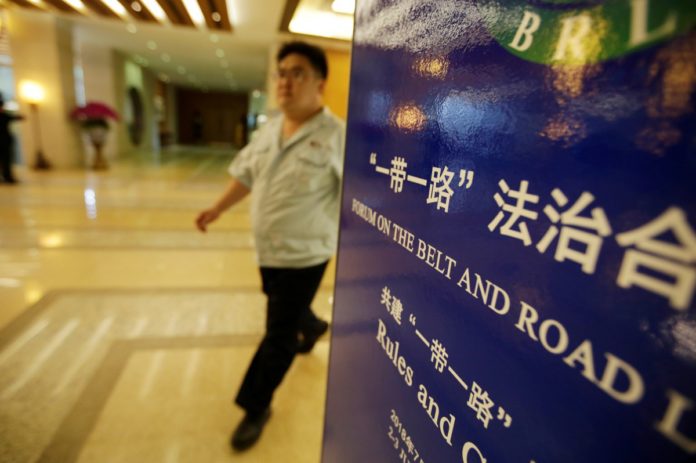
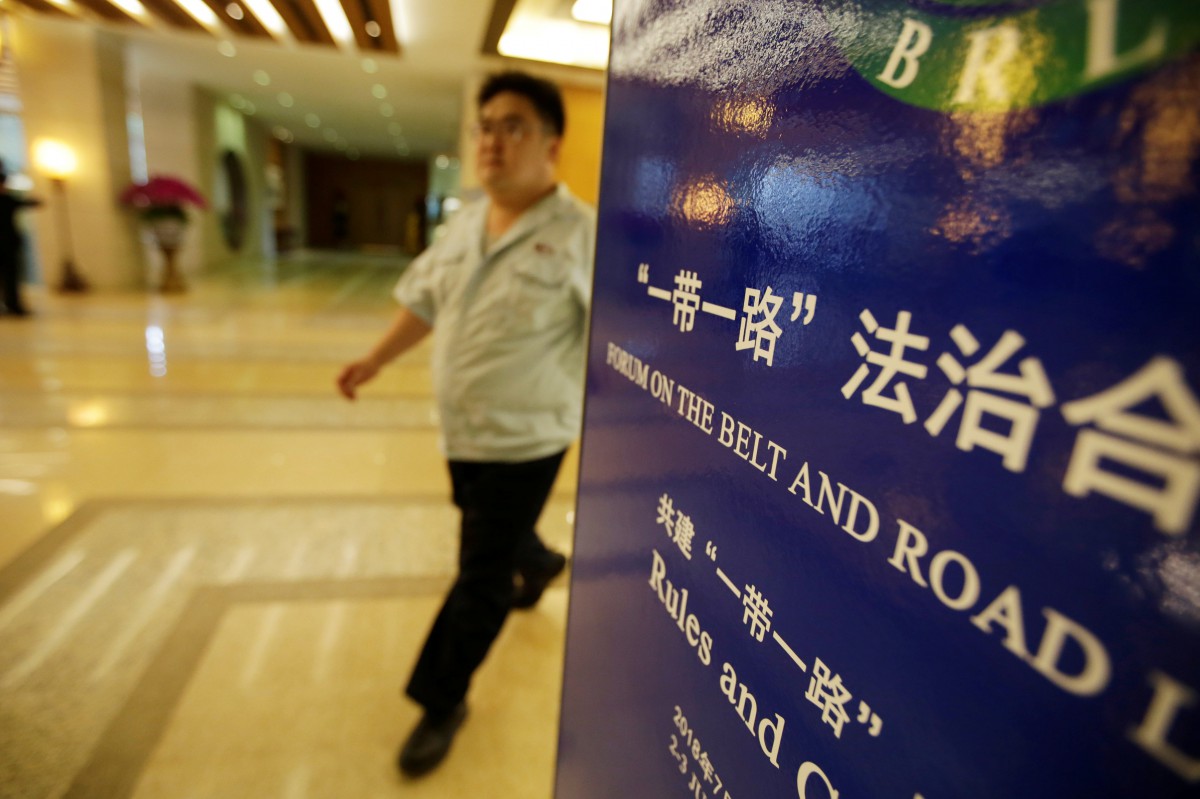
The sign of an international forum on the “Belt and Road” Legal Cooperation is pictured in Beijing, China July 2, 2018. Source: Reuters
At the event, Pompeo announced US$113 million in new technology, energy and infrastructure initiatives, saying Washington wants a “free and open” Asia not dominated by any one country, an apparent reference to China’s growing economic clout, according to Reuters.
Pompeo sought to define the economic aspect of President Donald Trump’s “Indo-Pacific” strategy, which aims to cast the United States as a trustworthy partner in the region.
“Like so many of our Asian allies and friends, our country fought for its own independence from an empire that expected deference,” Pompeo said.
“We thus have never and will never seek domination in the Indo-Pacific, and we will oppose any country that does.”
“These funds represent just a down payment on a new era in US economic commitment to peace and prosperity in the Indo-Pacific region,” Pompeo said.
US officials said the American strategy does not aim to compete directly with China’s Belt and Road Initiative, which involves dozens of countries in an estimated US$1 trillion of mostly state-led infrastructure projects linking Asia, parts of Africa and Europe, but rather to offer a more sustainable alternative by encouraging private-sector investment.
Critics of Beijing’s Belt and Road Initiative have said it is more about spreading Chinese influence and hooking countries on massive debts. Beijing has said it is simply a development project that any country is welcome to join.
SINGAPORE: Should creativity be a national priority?
Many associate creativity solely with the arts, and in doing so underestimate its crucial importance for businesses in general – and, by extension, the country’s economy.
I get it. Creativity is one of those ambiguous terms that means different things to different people. But at its heart it implies the consideration of, and experimentation with, new ideas and perspectives.
For businesses that are creative, small and large, this often means operating in a significantly different manner from the norm – be it because of needed changes to their internal structure, business model or processes.
Creating an environment that encourages employees to think differently can be daunting at first, but might be necessary for companies to survive, grow or even exist.
Take Singapore’s VendCafes. They serve food entirely through vending machines and are a great example of the way a daunting idea can translate into a successful business model.
HOW CREATIVE IS SINGAPORE?
As Oscar Wilde once put it:
An idea that is not dangerous is unworthy of being called an idea at all.
This motto doesn’t seem to have reached all of us in Singapore yet. The nation ranked third in this year’s Bloomberg Innovation Index, surpassing the technology manufacturing powerhouse, Germany.
Imagine what Singapore could achieve if we equal our strong focus and success in STEM (science, technology, engineering and mathematics) disciplines with creativity.
An artist’s impression of an Engineering Laboratory at PSB Academy’s new campus for its science, technology, engineering and mathematics (STEM) courses. (Photo: PSB Academy)
While the local education system has been long reputed for producing academically outstanding students, it has also been accused of over-emphasising rote learning and high-pressure examinations.
A guaranteed-results-orientated culture may be contributing to the development of a populace unused to taking risks; a mindset people might likely adopt in the office.
At least that’s what I have noticed having worked with many small business owners in Singapore. They can be less open to change compared to their counterparts in Asia, even if the market requires it.
In particular, many told me they lacked the manpower or money to challenge the status quo. The Singapore Government needs to help them gain the confidence, skills and guidance to make sound business decisions that ensure their legacy lives on.
Instilling creativity into the workforce can make this vision a reality. How? By focusing on two of the biggest pain points.
Firstly, creating an education system that fosters creative thinking from the ground up. And secondly, developing government support beyond monetary incentives when it comes to enabling businesses to grow, scale and adapt to change.
Finland’s renowned education system is one Singapore should consider. Avoiding examinations, Finland allows students to lead investigations into real-life situations, with teachers acting as facilitators rather than steering students towards a specific answer. This encourages creativity and experimentation.
Luckily, the Singaporean Government has started evolving its education system, with two particularly noteworthy initiatives already in progress. Its Applied Learning Programmes in schools, designed to help students apply their learning to the real world, will certainly help to develop innovative thinking.
A primary school student reading in the school hall. (File photo: MOE)
In addition, schools are looking to technology to encourage collaboration and critical thinking in the classroom, and I look forward to seeing how this might help children develop in ways unimaginable by cohorts of years past.
At the same time, more must be done to ensure that children have a proper school-life balance. I empathise greatly with June Yong, a mother who says the intense curriculum doesn’t leave her children enough time to play and be creative on their own terms. She writes:
In the name of owning a rigorous education system that is the envy of the world, and in the name of helping our children reach their fullest potential, what costs are we paying as a society?… Research has shown that kids with overly tight schedules are significantly less likely to score well on tests that require creative thinking.
The Singapore Government has also poured significant resources into helping businesses evolve with the times. Multiple Industry Transformation Maps show the Government’s vision for updating – which often means digitalising – various economic sectors.
Financial aid, such as the Productivity Solutions Grant and the Enterprise Development Grant announced in this year’s Budget, are part of this blueprint particularly designed to equip our businesses with the tools to implement change.
Yet more needs to be done to encourage them to step out of their creative comfort zones, so Singapore can remain an internationally-competing economy.
This starts with the core of any organisation: Its employees. The first thing that often springs to mind is the playground-like offices of famous US technology companies that offer music rooms (LinkedIn), slides (Google) or hammocks (Facebook) designed to make people feel creative and bear ideas which might even change the world, such as bringing live-navigation to people via Google Maps.
Like many tech companies, google uses open-plan offices. (Photo: Tang See Kit)
But that’s not the only approach. Companies need to find a way to make employees feel more invested in the work they do, day in and day out.
By creating a culture which encourages the contribution of creative ideas, supported by employee training to develop soft skills to help foster collaboration and a fluid exchange of ideas, organisations will naturally see employees start to challenge the norm.
Ultimately, no creative idea will change the world if it stays an idea. Businesses also need the means to execute creative ideas in the first place: funds. This is a challenge that keeps small business owners awake at night.
In fact, a Xero study found that nine out of 10 small businesses in Singapore have clients who pay late, which negatively affects their cash flow. If businesses struggle to break even, they might freeze non-essential business investments – which often includes those related to fostering creativity.
On the other hand, a healthy cash flow provides a financial cushion that allows businesses to invest, experiment – and fail. Luckily, entrepreneurs can increasingly turn to technology to help stay on top of cash flow, with features like invoice reminders and online payment options working to reduce payment times for small businesses.
Admittedly, igniting a creative spark is no small feat, but it’s increasingly necessary for businesses in Singapore to ensure that they continue to thrive in a rapidly transforming landscape.
Kevin Fitzgerald is regional director for Asia at Xero.
SINGAPORE: More of our personal data and financial information are moving online as Singapore moves forward to a digital-first, Smart Nation environment. Yet, recent cyberattacks here have planted seeds of doubts in some people’s minds about the ability of institutions to safeguard such data and, more tangibly, money.
Meanwhile, the Securities Investors Association (Singapore) this month realised it was a victim of a data breach that saw about 70,000 members’ personal particulars illegally accessed and copied in 2013 – about five years after the fact.
Experts say cyberattacks are here to stay, and that reality has slowly, but surely, crept into the mainstream consciousness of people living in a globally connected city.
It’s a threat that has been looming for years. To better understand what businesses were dealing with, Nanyang Technological University (NTU) launched its Cyber Risk Management (CyRIM) project in May 2016. It was supported by the Monetary Authority of Singapore, Cyber Security Agency of Singapore and five partners from the insurance industry.
The project aims to use the data generated to understand how the insurance industry here is able to offer cyber insurance products that could help underwrite the risks involved, the varsity said then.
And the man leading the CyRIM project, Professor Shaun Wang, is not surprised that the number of cyberattacks is growing.
Professor Shaun Wang is from Nanyang Business School’s Division of Banking & Finance, and heads up the Cyber Risk Management (CyRIM) project. (Photo: NTU)
Channel NewsAsia spoke to the academic to find out more on his thoughts about cybersecurity, risk management and why it is prudent – and not at all counter-intuitive – for people to still keep some cold, hard cash stashed away for a rainy day.
Q: Why do you think there is a rise in cyberattacks today?
Prof Wang: We used to have people rob banks. Why? Because that’s where the money is. Nowadays, people don’t actually have to go and physically rob a bank. They can do that online and there are lots of people out there – we don’t see them – that are very active (in doing so).
In fact, if someone physically robs a bank, it is pretty much captured through video, CCTV and all that. Online stealing, or cyberattack, or hacking – these leave very little trace. And it’s cross-border, making such cases hard to pin down.
And because of the very low enforcement rates in catching these hackers, there’s a mushrooming, flourishing underground market … especially in parts of the world where people don’t have other means of making a living.
Prof Wang: The Bangladesh bank case, where hackers got away with US$81 million, actually spoke very loudly that cybersecurity is a very global issue and is also cross-border (in nature).
Singapore, like other countries, is not immune from such attacks.
That said, the financial sector as a whole has learnt from such incidents. Going back to the Bangladesh bank heist, the money was subsequently transferred to the casinos in Philippines and some money was recovered. Big fines were also imposed on Philippines banks involved in the hack.
This shows the financial sector has learnt from its mistakes. People don’t have to panic because the system – especially for money transfers – is now more resilient and there is a waiting period before money is released on request.
Singaporean consumers, in particular, don’t have to worry about their bank accounts getting hacked and emptied as there are layers of protection to prevent such attempts.
The banking system here is very strong, for instance, in terms of multi-factor authentication, and that is actually very effective to reduce risk because it’s not just having a password but you also have to have your phone with you.
Q: Are you sure we don’t have to turn to a very low-tech life hack: Hiding our money in Milo tins?
Prof Wang: No. There’s no need to go to that extreme.
However, I would recommend every household to have some cash on hand. Because one scenario is not so much the hacking of bank accounts and stealing of money, but it’s business disruption. That’s a more realistic scenario.
If you have a major disruption – this might not be in Singapore but from other places – and in order to avoid confusion and panicking, people having money at hand will make life a lot easier.
One way of reducing risk is to build redundancy. Redundancy means yes, we’re moving into digital payments, but in order to have redundancy, I want to make sure there’s a hard copy of my bank account stored in a safe, so that I don’t forget them. And also to have some cash, so if there are a few days of business disruption, I still have money to buy bread.
That would actually be helpful for the country, as it would mean avoiding a lot of unnecessary stress.
Q: Much stock has been put into teaching our young to use the Internet safely and, in doing so, increase the overall awareness of online risks. Do you think enough is being done?
Prof Wang: I have to say that Singapore is quite advanced in terms of equipping young people in cybersecurity skills.
One thing to note, though: Singaporeans are very responsible. Elsewhere, not so much. People can go and be a hacker themselves, just to try. Here, it’s not easy to do that.
Israel, for example, is very strong in cybersecurity, and the people there think there’s nothing wrong to explore things (like their system networks) – that’s part of national defence.
Q: Would teaching young children how to hack create a more resilient people in today’s digital world then?
Prof Wang: From a business point of view, and from the effectiveness of education stance, that’s very good. I think we should do that. But I think it should be supervised.
For young kids, the best way of learning is to learn by doing.
However, we want to make sure that the kids, once they learn a skill, that they will actually do responsible things, rather than try and move to the (dark) side. So, yes, they need to be 100 per cent supervised, but (hacking) is an essential skill and, in a global environment, one that would give them a competitive edge.
Singapore is quite proactive in terms of supporting education programmes, but it’s also about culture: How do we empower students to be more creative?
There’s no such thing as here are the things (to note for cybersecurity), and once you know it, you know how to defend.
Cybersecurity is a game between defender and attacker, and the best defenders, they have to be creative. There isn’t a kind of guidebook that says if you do these things, then you’re all set. The best talents in cybersecurity are those people who are very creative and explore new things.
It’s like police and thief in the digital age – the best ones know how to think like criminals.
SINGAPORE: Healthy eating may not come to mind when one orders a plate of nasi padang – a Malay meal consisting of steamed rice with a variety of side dishes that are rich in coconut and gravy.
But at Rumah Makan Minang, a restaurant in Kampong Glam, there are now five healthier dishes to choose from, prepared with healthier oil and fewer coconut ingredients. Customers can also choose red rice over white rice in a menu launched on Tuesday (Jul 31).
The restaurant is the first nasi padang outlet to be endorsed by the Health Promotion Board (HPB) under its Healthier Dining Programme, which recognises eateries that offer lower calories meals and beverages with less sugar as a prominent part of their menus.
Rumah Makan Minang is first nasi padang outlet to join HPB’s Healthier Dining Programme. (Photo: Tan Si Hui)
The healthier nasi padang meal contains only 400 calories per serving, compared to the 700 to 900 calories per serving that a regular plate of nasi padang would typically have.
Rumah Makan Minang director Hazmi Zin said it took three to four months to conceptualise the dishes and he was initially hesitant about the idea.
“To cater to what HPB wanted was a challenge because we’ve been doing a routine every day,” said Mr Hazmi.
In addition, he felt that red rice might not suit the taste of the other side dishes. He had initially wanted to serve 20 healthier option dishes.
Red rice has been used to substitute white rice in the nasi padang meal. (Photo: Tan Si Hui)
But after doing a survey with his customers, he found out that a majority of them had liked the healthier option dishes that came with red rice.
Mr Hazmi said: “At the start, people who ate red or brown rice said it tasted funny. But after constantly eating it, it’s like eating white rice.”
He was eventually convinced to make healthier options available after being regularly persuaded by Senior Parliamentary Secretary for Health Amrin Amin.
Mr Amrin, who was present at the launch of the new menu, said it is not just the Malay community that needs to exercise healthier choice options, but the entire Singaporean community, across all races. He noted that habits take time to change, especially those that have formed over time.
“It cannot just be the part of the government. I think it has to be a truly community effort. Families play a big part, as well as retailers,” said Mr Amrin.
Hawker food chain Yu Kee Duck Rice has already been on board the Healthier Dining Programme for five weeks. It now offers healthier dishes – braised duck kway teow, noodle and porridge.
Yu Kee Group director Seah Qin Quan said over the five weeks, they have seen 60 per cent of customers who ordered braised duck noodle opting for wholegrain noodles.
Yu Kee Duck Noodle uses wholegrain noodle for its braised duck noodle dish.
“The feedback from them is that it doesn’t vary so far from the normal noodles. Sometimes they don’t even know it’s whole grain noodles,” said Mr Seah.
The hawker food chain has already rolled out the healthier option food choices to all of its 29 outlets.
According to the HPB, the number of healthier meals sold in Singapore has increased to 50 million in March this year, up from 7.5 million in 2014.
Customers who want healthier food options can look out for the Healthier Dining Programme sticker on the store front of food and beverage outlets.
SINGAPORE: Madam Nur Syamsiah was sleeping when she received a call on Sunday (Jul 29) morning with news that made her freeze. Lombok, where her 20-year-old daughter was, had been hit by an earthquake.
Ms Ruhil Imani, was in Labuan Pandan on the Indonesian island with 19 others as part of a National University of Singapore (NUS) Muslim Society trip to provide environmental and social aid. They had left Singapore on Jul 23 and were due to be back on Aug 5.
Her 51-year-old mother turned on the television and called relatives in Surabaya, Indonesia to find out more, but she heard no word on her daughter.
“I could not do anything – want to eat also cannot. I just cried and prayed. I was holding my phone and took it everywhere,” she said.
At least 16 people have been killed and more than 330 injured in the 6.4 magnitude quake on Sunday.
It was only when her daughter called about three hours later that Madam Syamsiah calmed down. The group cut short their trip and returned to Singapore on Tuesday.
CHEERS, TEARS, HUGS
There were cheers, tears and hugs as the group emerged from the Changi Airport arrival area at about 3.30pm.
While Madam Syamsiah was in touch with her daughter before she returned home, she continued to be anxious until she saw Ms Ruhil in the flesh.
Her relief was visible, as she repeatedly hugged and kissed her daughter.
Ms Ruhil and her team members were also in tears as they embraced their family members.
The trip was Ms Ruhil’s first one with friends, Madam Syamsiah said.
The group huddled together for a meeting after they arrived at Changi Airport. (Photo: Jalelah Abu Baker)
“WE JUST SAT DOWN DURING THE EARTHQUAKE”
Recounting the experience, which she described as “scary”, Ms Ruhil said that she and the rest of the members were sitting on the beach, after catching a magnificent sunrise.
“I was watching children throwing pebbles into the sea. It was peaceful,” she said.
Then there was a rumble and for about 10 seconds, Ms Ruhil and her friends were trying to make sense of what was happening, she said.
“We were clueless until we saw the villagers running away from the beach,” she said. They followed suit and were advised to stay outdoors in case any roofs collapsed.
“Every aftershock was a mental trauma,” said team leader Mohammad Azfar Sa’ari, 23.
Guided by Mr Mohamad Tahar Jumaat, 50, the facilitator of the trip, the group made their way to Sembalun in the northeast of Lombok, where many relief agencies are based.
It was only when they reached Sembalun that they managed to call their families.
When they were given a choice whether to stay on, team leader Mohammad Azfar Sa’ari decided against it.
“Parents kept asking their kids to go home, and they wanted to go home as well, so I made the call,” he said.
CROSSING A DAMAGED BRIDGE
The journey to Sembalun was not without obstacles.
Apart from seeing collapsed roofs and debris, the group had to cross a damaged bridge on foot, as its structural integrity had been damaged, and driving across it in their van might have made things worse.
A bridge they had to cross was damaged. (Photo: Raihan Mohama)
That was when the instincts of safety officer Raihan Mohamad kicked in. Mr Raihan, 21, a first-year mechanical engineering student, had served as a medic in the Singapore Civil Defence Force during his National Service and attended a one-day workshop to prepare for the expedition.
Mr Raihan stood in the middle of the 200m-long bridge and guided his teammates across. At one point, the area he stepped on shook a little, and he advised the rest not to walk there.
“I was able to respond faster because of the training,” he said.
When the group got to Sembalun, they sang songs to distract themselves as they waited for information on flights. They found out about the flight on Monday, and left for Singapore on Tuesday at 6.50am Indonesia time.
They counted themselves lucky.
“It’s a great relief that everyone is back and well,” Mr Azfar said.
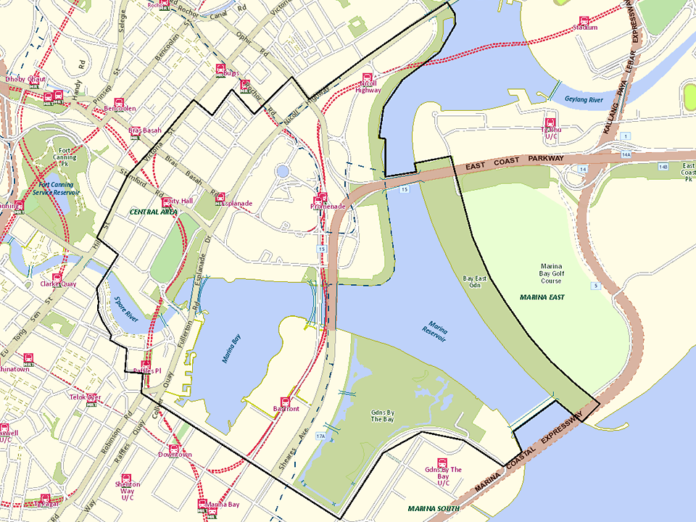
SINGAPORE: National Day Parade 2018, which will be held at The Float @ Marina Bay on Aug 9, has been declared an “enhanced security special event” under the Public Order Act.
The area around Marina Bay has also been designated as a special event area with enhanced security measures, the police announced on Tuesday (Jul 31). Unmanned aerial vehicles or drones will not be allowed in this area.
“It is also an offence to fly a UAV outside of the Special Event Area in a manner that disrupts, interferes with, delays or obstructs the conduct of NDP 2018,” said the police.
Those convicted of the offence may be jailed for up to 12 months, fined up to S$20,000 or both.
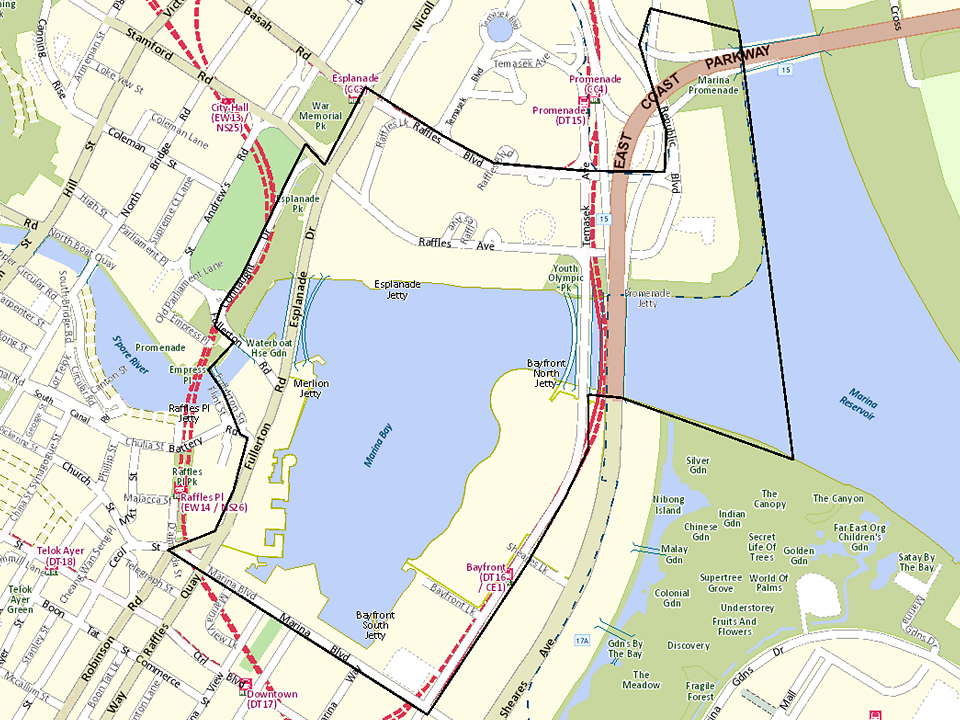
Within the special event area, there is a special zone where stricter security checks will be conducted. All vehicles and anyone entering this area will be screened, and the police will have the power to refuse entry to or remove anyone from the special zone if necessary.
The special event area and special zone will take effect from midnight to 11.59pm on Aug 9. Should the parade take place on the reserve date, Aug 11, the gazette will take effect on that day, the police said.
Authorities also listed items which are prohibited within the special event area:
Any noxious or offensive substance
A marine flare and signal, landing flare, highway fuse, smoke generator, distress signal or other pyrotechnic device intended for signalling, warning, rescue or similar purposes
Any petroleum or flammable material within the meaning of the Fire Safety (Petroleum and Flammable Materials) Regulations (Cap. 109A, Rg 7)
An explosive within the meaning of the Arms and Explosives Act (Cap 13)
Any arms within the meaning of the Arms and Explosives Act
An item capable of attaching a person to an object or another person, or preventing removal of any locking or connecting device
An aerosol paint container or other implement or substance that is capable of being used to mark graffiti
A loud hailer
Any flag or banner which is larger than one metre by one metre, or has a handle longer than one metre
Any public address system, electronic equipment, broadcast equipment or similar device which may interfere with broadcast equipment or similar devices being used by the event organiser of the NDP at or for the special event, or a person authorised by the event organiser or under the Act to use such devices
A remotely piloted aircraft system for a remotely piloted aircraft, comprising the remotely piloted aircraft, every remote pilot station associated with the remotely piloted aircraft containing the equipment used to pilot that aircraft, the command and control links between the remotely piloted aircraft and its remote pilot stations, as well as any other components as specified in the type design of the remotely piloted aircraft system, to fly that aircraft.
Anyone found in possession of these items may be arrested, authorities said. If convicted, the could be jailed for up to 12 months, fined a maximum of S$20,000 or both. The items will also be seized.
“The police seek the cooperation of the public to comply with all orders issued by police officers. Persons who engage in activities that compromise security within the Special Event Area and the Special Zone will be dealt with firmly in accordance with the law,” said the authorities in a media release.
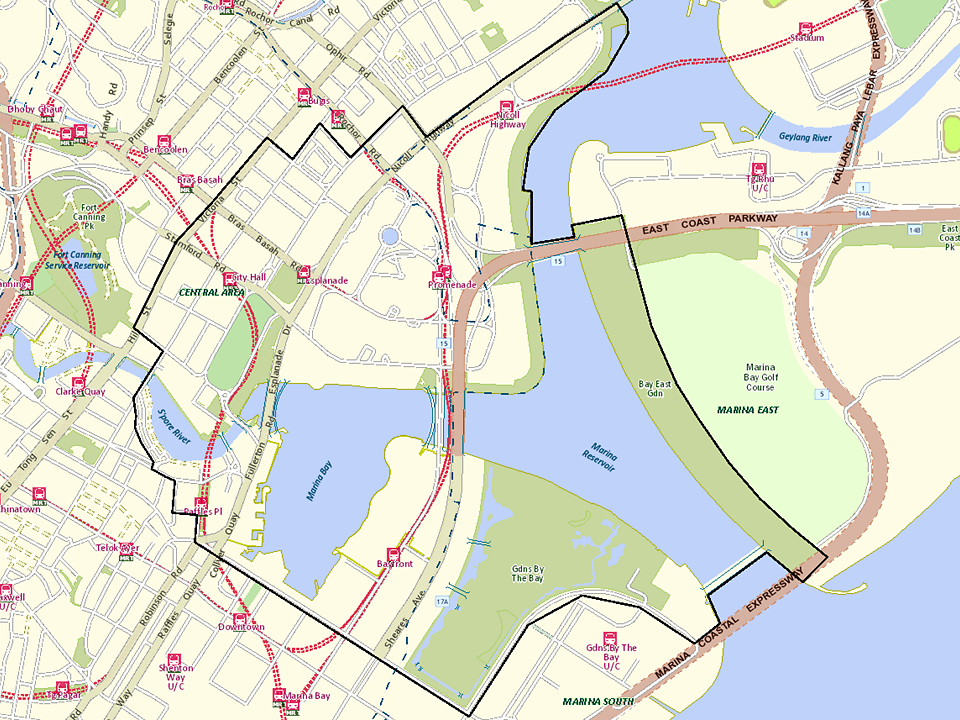
The special event area is marked by the following boundaries:
The special event area (outlined in black) is bounded by the following (commencing from the southern-most point and proceeding in a clockwise manner). (Photo: Singapore Police Force)
Marina Boulevard
Finlayson Green
D’Almeida Street
Malacca Street
Market Street
Chulia Street
South Canal Road
Circular Road
South Bridge Road
North Bridge Road
High Street
Hill Street
Victoria Street
Middle Road
North Bridge Road
Tan Quee Lan Street
Beach Road
Ophir Road
Nicoll Highway
Western bank of the Marina Reservoir
East Coast Parkway
Rhu Cross
Eastern boundary of Gardens by the Bay East
Southern boundary of Gardens by the Bay East
Coastline
Marina Bridge
Coastline
Carpark of Marina Barrage
Marina Gardens Drive
The special zone is marked by the following boundaries:
The special zone (outlined in black) is bounded by the following (commencing from the southern-most point and proceeding in a clockwise manner). (Photo: Singapore Police Force)
SINGAPORE: Work on a stretch of the North-South Corridor tunnel near Novena is expected to begin by the first quarter of 2019, said the Land Transport Authority (LTA).
It announced on Tuesday (Jul 31) that the S$795 million contract to design and construct the stretch of the tunnel has been awarded to a joint venture between Japan’s Penta-Ocean Construction and Bachy Soletanche Singapore.
The Penta-Bachy joint venture will be responsible for a 1.04km tunnel that runs under Thomson Road, stretching from Novena Rise to Sufolk Walk.
Commuter facilities such as an underground pedestrian network, pedestrian overhead bridges, bus stops, sheltered walkways and cycling paths will also be built along this stretch as part of the contract.
LTA highlighted the track record of the companies, noting that Penta-Ocean Construction is also involved in the construction of the Woodlands North and Bright Hill stations along the Thomson-East Coast Line.
The company was also involved in the construction of the Downtown Line Bendemeer station and a section of the Marina Coastal Expressway.
An artist impression of a cross-section of the North-South Corridor tunnel.
Bachy Soletanche Singapore’s projects with LTA included the construction of the Bugis and Telok Ayer stations for the Downtown line.
The 21.5km North-South Corridor, which will include express bus lanes and cycling trunk routes, will connect towns in the northern region to the city centre.
The bus lanes will help reduce commuting times from Woodlands, Sembawang, Yishun and Ang Mo Kio to the city by up to 30 minutes, and also make bus connections between residential towns along the North-South Corridor faster, LTA said previously.
SINGAPORE: Food manufacturers will soon be able to test whether their new products will be successful, without having to face high opportunity costs or purchasing their own equipment.
On Tuesday (Jul 31), Enterprise Singapore, JTC Corp and the Singapore Institute of Technology (SIT) signed an agreement to set up a shared facility for small batch production to support innovation in the food industry.
The facility, expected to open by end-2019, aims to help companies overcome challenges in the development and manufacturing of new food products.
Located at JTC Food Hub @ Senoko and operated by SIT, the 1,130 sqm facility will have eight production rooms, which will be rented out to companies for small batch production. SIT said it is still working out the details of the tenancy agreement.
Food processing equipment such as spray dryers and extruders, as well as advanced equipment that could cost more than S$1 million, will also be available to companies on a pay-per-use basis.
Senior Minister of State for Trade and Industry and Education Chee Hong Tat at JTC Food Hub. (Photo: Vanessa Lim)
The JTC Food Hub @ Senoko, which started operations in July last year, currently houses eight food companies. Two more companies will set up next month.
JTC Food Hub offers shared facilities and services to help to reduce capital and operating costs. One such feature is an integrated cold room and warehouse facility that tenants can tap on a pay-per-use basis.
One company that has benefited from this is Tenderfresh Fried and BBQ Chicken, which said it has seen a 20 per cent increase in productivity.
Mr Jimmy Soh, managing director of Tenderfresh, said: “The modular units at Food Hub has given us the flexibility to combine two factory units for a larger factory floor.
“This has allowed us to consolidate our operations, redesign our production layout and make further investments in automation,” he said.
According to SIT, more than 15 companies have already expressed their interest in the shared facility for small batch food production.
A 3D model of JTC Food Hub @ Senoko. (Photo: Vanessa Lim)
On top of hardware support, the JTC Food Hub will also have workplace training courses, masterclasses and seminars.
Speaking at the official opening ceremony of JTC Food Hub on Tuesday, Senior Minister of State for Trade and Industry and Education Chee Hong Tat said a lack of scale and in-house capabilities could hinder food companies from innovating.
“SMEs (small- and medium-size enterprises) in particular may find it difficult to do small batch production to test their new ideas, as the equipment is expensive and outsourcing to a contract manufacturer requires a larger minimum order size than what they need,” said Mr Chee.
“This increases the cost of experimentation and has resulted in a low commercialisation rate,” he added.
In 2017, the food industry added S$4.3 billion to Singapore’s gross domestic product, a 14 per cent increase from the previous year.
SINGAPORE: It sang to me like a siren to Odysseus. It sat silently in my inbox, but its call was deafening and irresistible.
It was a Groupon voucher for S$38 for a one-time body analysis, consultation and fat reduction session at a spa located in the heart of the city. Guaranteed visible results without the prohibitive cost and hassle of liposuction, I thought.
I’ll be honest about why I was attracted to this. For one, it’s cheap. And the cheapness in me I cannot deny.
For another, a decade of being a stress-fuelled binge eating, beer guzzling twenty-something was long over but the consequences persisted and visibly at that.
And I was lazy. Why spend months sweating it out in the gym or early mornings jogging in the park when an inexpensive session in comfortable settings is all that is required? So I clicked, and that was that.
POSH FACADES
The façade of the spa was posh, with deep maroon and velvety furniture and fixtures, and dim lighting, giving off a sense of comfort and luxury. Music played in the background, and a light breezy scent filled the air, perhaps for the same purpose why frankincense and myrrh were once used, to distinguish patrician from plebeian.
The ladies who greeted me were polite to a fault and very friendly. Indeed, my visual, auditory and olfactory senses were already overpowered; I felt disarmed.
I was casually led to a room and asked to partially disrobe. It was explained to me that the machine used to analyse my body composition required skin contact. The machine had sparkly bits and bobs, and whirred inconspicuously. It was over in a matter of minutes.
A man receiving a massage. (Photo: Unsplash/Toa Heftiba)
The spa clinician sat me down over a cup of tea, steam wisping over the cool air. She said, glancing sternly at the machine printout, there was nothing overtly alarming about the numbers. But things were not ideal either.
I had higher than normal bodily fat deposits in certain key areas, and these may have health implications. The visible consequence was that my body was disproportionate.
The insinuation was that my body was both unhealthy and ugly. I was evidently a walking, expiring, conference pear.
She then took me to an adjacent, posh-looking room. While in my state of semi-undress, she casually mentioned that the trial session I was entitled to would not yield immediate results. Instead, I should consider upgrading to a different and technologically more advanced treatment package.
A fearsome looking machine would then target and shoot invisible beams and freeze my recalcitrant fat cells, and thereafter have them somehow vapourised, she said. Okay, I started to think, Darth Vader was trying to sell me the Death Star.
She passed me a pamphlet with a lot of words. It included a picture of a local celebrity with a lithe body and a charming smile. Wow, if a celebrity endorses the Death Star, it must be true, I interpret the subliminal messaging.
“I” wasn’t a “really bad case”, she said. So all I needed was ten sessions at S$5,888. My eyes widened noticeably.
Within half a breath, Darth Vader added that that was the usual price, but since I got to know them via their Groupon offer, I could get a promotional price of S$3,888. Nobel laureates Daniel Kahneman and Amos Tversky call this technique “anchoring and adjusting”.
MANY OPTIONS – TO PAY
She added that they accepted a dazzling array of credit cards and instalment plans. I looked away towards the dark wood laminate flooring, avoiding her intent gaze.
I flashed her a glance, and noticed she wasn’t looking so confident any longer. Her voice, wavering almost imperceptibly, suggested I trial a session for a top-up of S$88.
Sheepishly I acquiesced. I was embarrassed and wanted to avoid further embarrassment to her. She gave me a crooked smile.
A rod protruded from the machine, with a suction cup on its head. She placed it on my belly where my 19-inch rims were beginning to form. It was cold to the touch and the session was shorter than a mini Thai massage. It ended, I dressed, I paid, I left.
A burning candle at a slimming centre. (Photo: Unsplash/Hans Vivek)
The conclusion was clinical and business-like. Perhaps they did not entertain much optimism I might be a repeat customer. The red silhouette left by the cup remained for a few days.
For every one of those days, I stood religiously before my full-length mirror, willing my eyes to detect even a miniscule of a dent in my Great Wall of Fat. On some days I seemed fitter, on other days, fatter. I seemed to myself the same after the redness disappeared.
For some time after, I wondered whether I should have taken up the package.
I don’t wonder anymore. I wasn’t so much sold a couple of dates with a machine, but a pipe dream. A dream of Aristotelian physical perfection, piping superficial opiates to dull our bodily and emotional insecurities.
If someone were to talk to me about this in a brightly-lit hawker centre, these concerns probably wouldn’t triggered. But entice someone into a carefully curated context and that just might happen.
Did I, at any point in time, feel pressured? Definitely. But was it externally applied or self-induced? Probably both.
What seems apparent to me is that the typical customer who even thinks of going through some kind of beauty treatment already feels some vulnerability. And, once he or she walks through those doors, those vulnerabilities are accentuated and made apparent.
WAS THERE PRESSURE? YES AND NO
We gloss over the suspicion that the clinician also wears the salesperson’s hat, invariably entangling their obligation to advise us what the best treatment plans would be, taking into account our interests, with that of raw, unadulterated commission or profit.
The law says that any contract must be entered into freely. There must be no pressure or influence unduly exerted.
Clearly, if I was detained for hours on end until I signed a ten-session package, or if my credit card was withheld and swiped for a four-digit sum instead of two, the law voids those transactions.
If I came in for a S$38 Groupon session, and embarrassment and alarmist language convinced me into topping up S$88 for a different treatment or S$3,888 for a package, was there undue pressure?
Pressure comes in many forms, and when applied, may be soft in form though hard in its reception. The pressure I certainly felt varied in both intensity and emotional response.
It wasn’t so much I had lost my faculty of decision, but there was to me a significant degree of background noise interfering with my own ability to evaluate what was in my best interest. At some level of generality, what happened to me at the spa is no different than being smooth talked into plunking my pension into Profitable Plots, a scheme that promised many Singapore investors high returns buying UK land.
Both, after all, deliberately arouse our base desires: Greed and vanity. What might differentiate one from the other, then?
There is something to be said about inducing a person to debase his own bodily imperfections in so naked a manner as a sinner before God. If absolution could so easily be bought, who wouldn’t be tempted?
In hindsight, the experience made me feel like an insect fumbling towards a Venus fly trap. I could self-flagellate and say I ought to have known better. That would indeed be true if I were perfectly rational and emotionless. But then, I wouldn’t quite be human, either.
I could blame the law for not protecting me from such practices. Yet I know the law’s limits mean it frequently functions reactively, mopping up the tears spilt lamenting an error already made.
The fact is we all make mistakes; it’s the human condition. For some of us, it is also human to try to take advantage of that condition.
My view? If something is too good to be true, it often is. Don’t take the bait.
If you do, then take heed of Homer’s advice to resist the seducing calls of these spa sirens: Fill your ears to the brim with wax.
Dr Gary Low is presently on faculty at the Singapore Management University School of Law. He is also a consumer advocate. All views expressed are his own. His greatest challenge remains to rest the occasional pint on his belly.
SINGAPORE: With the rise of e-commerce, Ms Sabrina Poh, 25, had few reasons to set foot in a shopping mall in recent years, buying almost everything she needs online.
However, that changed in March when pole dancing studio Brass Barre took up 3,300 sq ft of floor space at Orchard Gateway.
Now, she heads to the mall at least once a week, and finds herself lingering in the shopping centre and picking up a few items every now and then.
“If the studio wasn’t there, I wouldn’t frequent that mall,” said Ms Poh, who works in public relations.
Ms Poh is not alone. Droves of consumers are heading to the malls throughout the week — not primarily to shop but to attend classes, do yoga or work out in the gym.
Of late, studios — teaching anything from pole dancing and pilates to cooking and crafts — as well as mega gyms, for example, have been sprouting up in shopping centres and mixed-use developments. Arcade centres, too, are seeing a revival after they had gone out of vogue.
The influx of such activity-based retailers are no coincidence or a passing fad.
Under siege by e-commerce, retail malls have been forced to shift their strategy to entice people to step through their doors.
The Brass Barre is one of several health and fitness outfits that have been increasing their presence in Singapore’s retail landscape. In particular, mega fitness chains such as Fitness First, Virgin Active and Anytime Fitness have expanded rapidly across the island in the last few years, in developments in the Central Business District as well as suburban malls.
Culinary-themed stores, such as kitchenware retailer ToTT and ABC Cooking Studio, are also popping up in various malls.
In January, Timezone opened its flagship outlet at Vivocity, occupying 12,000 sq ft, and complete with bowling alleys and bumper cars.
An e-commerce Platform.
Property analysts said there is limited data on how much floor space is taken up in malls by activity-based retailers. Nevertheless, the growth of these tenants compared to, say, five years ago, is noticeable, they added.
Depending on the size and location of a mall, these retailers currently take up between 30 per cent and 40 per cent of overall floor space, said Knight Frank’s head of retail Wendy Low.
And it is not just the new tenants. Traditional retailers are also putting a new spin on their offerings.
For example, Japanese fashion retailer Lumine, which opened in The Central in November last year, offers craft workshops in its store; active apparel wear Lululemon conducts yoga classes; and luxury brand Gucci allows customers to personalise their bags with a do-it-yourself section at its Ion Orchard store.
Ms Low also cited Emporium Shokuhin in Marina Square, which has “reinvented the idea of a departmental store”. The shop has a live seafood market, a beef dry-ageing facility, a Japanese grocer and various dining concepts.
It has also sought to personalise the customer experience by letting patrons pick seafood fresh out of the tank, and have a chef prepare it to their individual taste.
With the myriad of offerings online, shoppers are now spoilt for choice, and doorstep deliveries have also meant there is little incentive for consumers to “take the extra step to drop by a mall”, Ms Low said.
“To compete effectively, landlords need to curate a personalised experience for shoppers to attract footfall and incentivise a trip down to the mall,” she said.
People pass closed shops at a section of a mall in Singapore. (File photo: Reuters/Edgar Su)
Ms Christine Li, senior director of research at Cushman & Wakefield, reiterated that the need for landlords to curate better shopping experiences has resulted in more activity-based retail experience at malls to “constantly engage customers”.
“Craft workshops, culinary classes and fitness activities are increasingly popular with landlords as they are able to bring in regular footfalls and keep (consumers) longer in the malls as well,” she added.
Much has been said about the decline of brick-and-mortar retailers around the world, including in Singapore.
Once a famed shopping haven for Singaporeans and tourists alike, Orchard Road, for example, is now a pale shadow of itself. The Republic’s premier shopping belt is the subject of a S$1.3 million study being conducted by Australian urban planning consultancy firm Cistri.
Cistri recently won the tender awarded by the Singapore Tourism Board and the Urban Redevelopment Authority to rejuvenate the 2.2km shopping belt. The six-month study began in April and a blueprint for the area — spanning the next 15 to 20 years — is expected to be unveiled later this year.
While footfall is relatively high in suburban malls, which serve large residential catchment areas, retailers have bemoaned the lack of sales. Many customers, in fact, have taken to browsing at brick-and-mortar stores to check out the items before making their purchases online.
As a reflection of the lacklustre retail scene, rents in the central region have fallen by 17.1 per cent in the second quarter of this year, since they peaked in the fourth quarter of 2014.
Over the same period, vacancy rates have increased from 5.8 per cent to 7.3 per cent, or about 4.8 million sq ft of vacant retail space as of June.
Rents in the central region had declined for 12 consecutive quarters, before seeing a slight uptick of 0.1 per cent in the first quarter of this year. But normal service resumed in the following quarter, as rents dipped by 1.1 per cent between April and June, based on statistics from the Urban Redevelopment Authority released on Friday.
A view of the Orchard road in Singapore on Jun 7, 2018. (Photo: AFP/Roslan Rahman)
In response to the e-commerce threat, malls have turned to food and beverage (F&B) retailers to draw people back through their doors.
But with the proliferation of food delivery services, developers have been forced to come up with something else. At the same time, the falling rents have opened up an opportunity for non-traditional mall retailers — which do not have high sales per square foot — to come in and set up shop.
Ms Li said that landlords used to “place more emphasis” on growing income through higher rents, “which resulted in cookie-cutter malls which are more efficient and are able to fetch higher rental”.
“This has changed with the evolution of shopping,” she added. With more transactions taking place online, malls have to go beyond that and offer an experience desired by shoppers, she noted.
In addition to strategies that malls and retailers have been employing over the last few years – such as pop-up stores and “click and collect services” – one common approach in recent times has been the creation of activity-based spaces for like-minded people to gather, experts say.
For instance, the number of fitness studios in shopping centres has been on the rise.
From new entrants – six-month-old Fight Zone, for instance, is already planning to open two more centres by the end of this year – to established centres, these providers have been expanding to meet demand.
Launched in 2003, Fitness First now has 19 clubs, half of them in malls. Next week, it will open its 20th outlet at SingPost Centre in Paya Lebar, occupying 12,000 sq ft of floor space.
Anytime Fitness, which offers 24/7 gym access, has been expanding aggressively since opening in 2013. Its 50th outlet will open at the end of September.
Each gym has about 1,000 members, said its marketing associate Alicia Ng. That translates to a total of about 50,000 active customers.
Anytime Fitness Bukit Panjang, which is one of the many outlets for the franchise in Singapore. (Photo: Noor Farhan)
Fitness club Virgin Active has grown from its first centre at One Raffles Place in 2013 to five gyms, situated mainly in mixed-use developments and shopping malls. Its total floor area has more than tripled to 109,000 sq ft in five years.
Its Southeast Asia managing director Christian Mason said membership has more than doubled after it opened four clubs in the last two years. As of June, Virgin Active has close to 10,000 members.
He added that Virgin Active has invested up to S$100 million to open at least eight clubs by 2022.
While fitness centres grow from strength to strength, gaming centres are making a comeback at shopping malls as part of the push by developers to offer activity-based retail experiences.
Once a fixture in Singapore’s malls, Timezone — an international chain of family amusement arcade centres — saw a slowdown in its business in the early 2000s due to the popularity of in-home gaming options, said its chief customer officer Caroline Leong.
But business has picked up significantly of late. Since April last year, Timezone has opened five new outlets, doubling its total number across the island.
The latest is its 11,800 sq ft flagship gaming centre in Vivo City. A new outlet will open in Jurong Point at the end of August. There are now over 2 million active customers across all its outlets, a 5 per cent increase over last year, said Ms Leong.
Amid the push by landlords to offer an activity-based retail experience, the introduction of high-tech gaming options, for example, has also led to renewed interest in arcade centres in general.
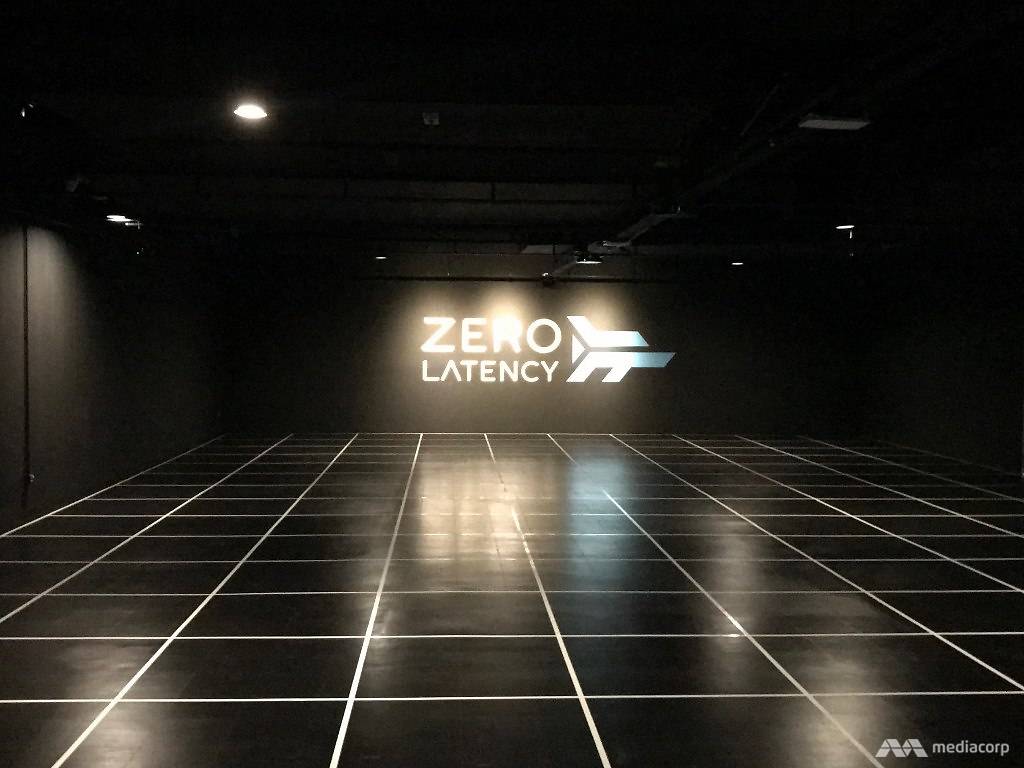
Zero Latency, which opened in November last year, uses virtual reality to bring gamers into a zombie world. Wearing a headset, gamers are able to roam freely in a 2,100 sq ft space. The store has seen over 15,000 customers since launch.
Mr Simon Ogilvie, executive director of Tomorrow Entertainment which brought in Zero Latency from Australia, said there is a rise in commercial-grade entertainment centres as there are limitations to what in-home game consoles can do. “Experience-based tenants are valuable for malls,” he noted.
Zero Latency has seen over 15,000 customers since launch.
Meanwhile, culinary-themed retailers are also making strides in shopping malls.
Beyond its retail services, Kitchenware store Tott — which started out in Bukit Timah six years ago — offers cooking classes for the public and for corporate team bonding activities.
It has two outlets now, both of which are at shopping malls — Suntec City and Century Square.
Its director Grace Tan said there has been a 32 per cent increase in its membership base from 2016 to date. “Besides the convenience and accessibility of shopping malls for our customers, we also appreciate the shopping mall marketing teams who work closely with their tenants to drive traffic,” she said.
ABC Cooking Studio, which opened in Takashimaya three years ago, is opening another outlet in Westgate next month. The school has close to 10,000 members. The number of students it sees each month has increased from 2,000 in the first year, to 5,000.
The firm’s regional marketing manager Karen Chong said:
We see an increasing trend where consumers are actively seeking hands-on activities to gain some experience. … ABC is offering experiences such as face-to-face interaction and the learning of new skills that cannot be replaced by the Internet and social media.
Keen to tap on the growing interest in such experience-based activities, do-it-yourself baking studio Funsiamo will open in August.
Rather than requiring customers to book baking slots, Funsiamo allows customers to walk in anytime to the 1,200 sq ft studio and learn how to bake from recipes provided on iPads, said master franchisee Desmond Ling, who brought in the concept from Taiwan.
Ms Li, from Cushman & Wakefield, noted that some retailers are also using social media to build a more intimate relationship with customers and improve their shopping experience.
Others are also tapping on augmented or virtual reality, she added. Homegrown furniture store Commune, for example, recently introduced VR and 3D-planning services at its retail store, so that shoppers can visualise how the furniture and furnishings look in their homes.
Automation is also another trend hitting the retail scene, with more automated vending machines being seen in shopping malls in recent months, Ms Li said.
‘NOT ENOUGH’ TO TURN THE TIDE
Some consumers were divided over whether the malls are doing enough to draw them back.
The nex shopping mall in Serangoon. (File photo: nex Singapore/Facebook)
Mr Darryl Lim, 28, said the proliferation of activity-based retailers changes the experience of window shopping. “You don’t just walk, but (get to) try new things,” he said.
Ms Nurul Syuhuda, 20, said she was running out of ideas about what she can do with family and friends for leisure, and the hands-on activities could help her bond with her loved ones. “Window shopping is boring,” she added.
However, Ms Koh Xiu Ming, 24, did not think such activities would entice her to make more trips to the malls, adding that they do not make “much of a difference”.
Ms Daphne Lim, 36, said that while she enjoys craft workshops and welcomes such activities being offered, they were not compelling enough to make her frequent the malls.
The experts believe that Singapore’s shopping centres need to do a lot more to transform the retail scene, which is lagging behind places such as Hong Kong, some cities in China and Dubai.
For example, Dubai Square, which opened last week, features fashion stores with smart fitting rooms that come with interactive mirrors and personalised recommendations using artificial intelligence.
Shoppers can order food and drinks from eateries using apps, saving them the need to queue and wait. Via the apps, they can also buy items from the stores — which are described as “showrooms” — and collect them later.
Ernst & Young consumer products and retail leader Chandan Joshi described the Singapore malls’ current game plan of changing their tenant mix as “small, incremental steps”, which have prevented footfalls from declining and stabilised occupancy rates.
But with a significant supply of new retail space coming onstream in the next two to three years, he warned that the sector has to innovate more to stop occupancy rates from falling.
“We are not going as far to innovate on the experiential side … We’re not at the cutting-edge of this experience, rather we’re just followers,” he said. “Truly innovative, revolutionary retail is almost missing in Singapore.”
There is also the question of how sustainable the current strategy is, experts said.
While rentals are expected to stay low as the retail scene tries to get back on its feet, higher rents could make business untenable for activity-based retailers, which do not generate high sales on a per square foot basis.
Nevertheless, experts noted that this would depend on a few factors such as how innovative the affected concept stores are, whether they are smaller retailers or large global brands with deep pockets, as well as the negotiations between landlords and tenants.
Experts also reiterated that there are several obstacles hindering the transformation of the retail sector here, including the payments infrastructure. Said Ms Li:
In Singapore because of payment issues, and malls having different loyalty programmes, people have been slow to embark on the journey (of transformation) … Over the next one or two years, the priority is for Singapore to get onto one single payment platform.
While on the decline, the rentals in malls are still relatively high. And this limits the scope for retailers to experiment with novel concepts, Ms Li added.
Shoppers pass by a Louis Vuitton shop at Orchard Road. (Photo: AFP)
Mr Chandan felt that the need to revolutionise the retail scene has not hit home, because retailers and landlords are not desperate yet.
“To some extent because of the weather and the location, there is almost a compulsive need to go to a mall … There are not many other places to go to (in Singapore), so the families still end up in the malls anyway,” he added.
But he stressed:
A mindset shift is needed… (retailers and landlords) should view retail disruption as an opportunity rather than as a threat.