SINGAPORE: A sensor system that can detect MRT train door faults and alert engineers has been on trial since June this year – one of four projects that will be progressively implemented in phases to enhance rail reliability.
They are part of 13 projects in a joint research collaboration between transport operator SMRT and Nanyang Technological University (NTU), under the S$60 million SMRT-NTU Smart Urban Rail Corporate Laboratory established in May 2016, with support from the National Research Foundation (NRF).
The lab was officially opened on Wednesday (Aug 29) by Minister for Finance and NRF chairman Heng Swee Keat. It focuses on two complementary research tracks – developing real-time monitoring systems and enhancing the reliability of existing rail assets. It pools together NTU researchers and SMRT staff.
Speaking at the launch, Mr Heng said: “This corporate laboratory aims to drive the effective translation of research into solutions that have direct relevance not just to SMRT, but to the global transport industry in anticipation of future needs.
“It looks forward to technical issues that will affect transport systems of tomorrow, and directs the R&D today to develop solutions.”
The Advanced Train Door Sensor System, which detects train door faults, is being tested on the North-South and East-West Lines. (Photo: Elizabeth Neo)
One of the projects being tested on a train on the North-South and East-West Lines is the Advanced Train Door Sensor System.
When mounted onto train doors, the sensors record air pressure, movement speed and power systems. The sensors also come with algorithms that can predict imminent train door failures, and allow engineers to identify faults and reduce the time needed for troubleshooting.
More than half of all train delays are caused by door faults.
Another project is a cladding system that uses laser technology to repair defective rails along the tracks. The system can be mounted on wagon wheels to carry out rail steel repair works in a less labour-intensive manner. It also reduces the time taken to carry out the repairs to a single night compared to three nights currently. The system is expected to be deployed for trial in 2019.
Within the next two years, systems that can pick up defects on the power rail and running rails, as well as one that can inspect train axles, will be tested.
Mr Heng said the projects “will result in better management of train door faults, significant cuts in delays, faster and smarter track repairs, better-maintained trains and higher service levels”.
SMRT chief executive Neo Kian Hong said the company is working to improve rail reliability and sustain the progress made. “At the same time, we will tap top-notch engineering resources in Singapore to solve problems that affect our train services, such as train door, track or power supply issues,” he added.
The SMRT-NTU Smart Urban Rail Corporate Laboratory is one of 12 labs supported by the NRF, which facilitates the setting up of corporate labs via public-private partnerships.
SINGAPORE: Negotiations for the Regional Comprehensive Economic Partnership (RCEP) have reached a “critical stage” and a conclusion is “finally in sight”, said Prime Minister Lee Hsien Loong on Wednesday (Aug 29).
When concluded, it will be the world’s largest trading bloc, covering a third of the world’s gross domestic product (GDP) with tangible benefits to the region and its partners, Mr Lee added as he spoke at the opening ceremony of the 50th ASEAN Economic Ministers’ (AEM) Meeting and Related Meetings.
Singapore, which is the Association of Southeast Asian Nations (ASEAN) chair this year, is hosting the annual series of meetings from Tuesday to Saturday at the Shangri-La Hotel.
In his speech, Mr Lee said regional economic cooperation and integration is key for ASEAN to realise its potential.
This includes pressing on with the implementation of the ASEAN Economic Community (AEC) Blueprint 2025, as well as supporting an open and inclusive multilateral system amid growing trade tensions.
Prime Minister Lee Hsien Loong and Minister for Trade and Industry Chan Chun Sing at the opening ceremony with officials and diplomats from ASEAN. (Photo: Tang See Kit)
Escalating trade friction between the US and its trading partners has put the rules-based multilateral trading system, which has underpinned ASEAN’s growth and prosperity, under pressure, he said.
At the same time, each ASEAN member state is subject to different pulls and pressures from bigger powers.
“In these circumstances, all the more members must stay united and strive to maintain our cohesion and effectiveness,” said Mr Lee.
ASEAN has exerted significant effort to make progress on RCEP, which builds upon the existing 5 ASEAN Plus One Free Trade Agreements (FTAs) to strengthen economic linkages and enhance trade and investment flows.
“Of course, given the diversity of RCEP’s members, we all have to make trade-offs and compromises. But we should weigh these against the significant strategic and economic value of the RCEP,” Mr Lee said.
“The RCEP negotiations have continued for some time, and have now reached a critical stage. After a great deal of work, the possibility of substantively concluding the RCEP negotiations is finally in sight.”
Describing the conclusion as “an important signal to the world”, Mr Lee urged RCEP countries to “take a long term view, keep up the momentum, engage constructively and with maximum flexibility” for the trade pact to be delivered this year.
Mr Lee also stressed on the importance of pressing on with regional economic integration and fully implementing the AEC Blueprint 2025.
“This will enable ASEAN businesses to operate more seamlessly across the region, and make our companies, and economies, more competitive globally,” he said.
ASEAN CANNOT BE DISTRACTED BY POLICY U-TURNS ELSEWHERE: CHAN CHUN SING
Singapore’s Minister for Trade and Industry Chan Chun Sing echoed similar sentiments in his welcome remarks.
He said Singapore’s ASEAN chairmanship comes at a critical juncture as further steps are taken to shape ASEAN into a “cohesive organisation capable of adapting to a more complex and uncertain global environment, and an economic bloc that is prepared to capitalise on future opportunities”.
There has been progress, said Mr Chan.
Singapore’s Minister for Trade and Industry Chan Chun Sing speaking at the event on Wednesday (Aug 29). (Photo: Tang See Kit)
For instance, the development of the ASEAN digital space and a transition to the “live” operation of the ASEAN Single Window in January 2018 for five exchange-ready member states.
ASEAN leaders have also agreed to work on the Digital Trade Standards Cooperation Initiative – a joint development by ASEAN and Australia which will drive the development of seamless digital connectivity in the region, said Mr Chan.
“These achievements are testament to ASEAN’s unwavering vision and commitment to create a more integrated AEC for the continued prosperity of our businesses and people,” he said.
ASEAN must continue to build on these successes, and cannot afford to be distracted by “recent policy U-turns elsewhere”, Mr Chan added.
JAKARTA: At the 2018 Asian Games, contract bridge is a marathon of sorts.
Especially for the men’s team event – the schedule is relentless. Seven hours a day, for seven straight days, competitors sat at tables in a cold room and attempted to baffle their opponents.
“It’s like a long marathon,” said Poon Hua, one of the six members of the Singapore team, who all made history by winning the country’s first gold medal for the sport at the Asian Games.
“For the whole seven days, we had to mentally calculate all the probabilities, all the deductions, trying to decipher what our opponents were trying to do and try to outsmart and outwit them,” said the 37-year-old, who is a full-time professional contract bridge player.
And that was just the competition phase. The team members, four of whom have other full-time jobs, spent an average of 15 hours a week over the last six months training for this tournament.
Zhang Yu Kun balances playing contract bridge with his full time job as a physics teacher at National Junior College. (Photo: Amir Yusof)
Physics teacher Zhang Yu Kun stressed that the hours the team devoted to training was more than many other athletes.
“The career of a bridge player is generally longer than most sports, we can play until we’re 80,” he said.
“So we’re talking about a disciplined effort over the years after work in the evenings – time we could have been spent resting with family. “
The team believed that the effort and sacrifice were necessary because they knew that nothing would hone their skills better than consistent practice.
Fong Kien Hong, who is an electrical engineer, stressed that contract bridge is not a game where one relies on lady luck to win.
“It’s not like mahjong or monopoly … The element of luck is totally eliminated in contract bridge,” said the 41-year-old.
“There are two teams playing duplicated sets of cards at both tables, so you cannot say one team is luckier than the other.”
Fong Kien Hong in action at the 2018 Asian Games. (Photo: Amir Yusof)
He added: “When you talk about mahjong, you talk about the role of the dice. And in games like poker, sometimes you get good cards, there’s some element of luck.
“In contract bridge, when you talk about luck, its about the path to making the contract, not about the cards we are dealt with.”
The team stressed that the “misconception” that contract bridge is not a sport exists in Singapore because many Singaporeans play an alternate version of the game, called floating bridge. This game, commonly termed as bridge, has no fixed partnerships and the cards are dealt randomly.
Kelvin Ong looking at his cards at the contract bridge tournament of the 2018 Asian Games. (Photo: Amir Yusof)
“It has similar mechanics but is different from contract bridge,” said Poon.
“The element of luck is absent in contract bridge. Singaporeans don’t really understand what contract bridge is about; it’s a misconception and they link the game we won gold in to this version of the game they used to play in school.”
MUST YOU PERSPIRE IN SPORT?
The team captain Loo Choon Chou also spoke out against comments by netizens after the team’s triumph.
He pointed out that some people argued that bridge should not be considered a sport at the Asian Games because it does not test physical exertions.
“I think we can all agree that bridge is a mind sport, different from physical sports like football and rugby … I think there should be more recognition (for bridge as a sport),” said the 35-year-old, who is also a full-time contract bridge professional.
Team Singapore’s men contract bridge team pose with their gold medals. The only other athlete who have won gold at the 2018 Asian Games is Joseph Schooling. (Photo: Amir Yusof)
His teammate Poon reiterated that how much one perspires is a narrow way of defining whether an activity can be considered a sport.
“What makes a sport a sport? How about competitiveness against rivals? Team spirit? There’s so many things that defines an activity as a sport.
“We don’t really know where to draw a line. Sports like horse riding and shooting and bowling, you don’t perspire a lot. Perspiration isn’t a good definition,” he said.
When the team was asked if they thought of themselves to be on par with Singapore Olympic champion swimmer Joseph Schooling, the country’s only other gold medallist at the Asian Games, the team chuckled and looked briefly embarrassed.
“If you compare us with Joseph Schooling, definitely we feel very proud to be in the same league as him,” said Poon.
“But when you look at his Olympic gold medal, we then realise that we are far from comparison.”
SINGAPORE: What do traditional Mexican cuisine, Croatian gingerbread-making and Korean traditional kimchi-making have in common?
If you guessed they’re the topics of expensive, popular cook books, I’m sure you’re probably right.
But these three are items inscribed into the UNESCO Intangible Cultural Heritage List.
UNESCO, also known as the United Nations Educational Scientific and Cultural Organisation, is responsible for the World Heritage List, to which the Singapore Botanic Gardens was added in 2015, recognising natural and cultural sites of outstanding and universal value.
Less well-known is the Representative List of the Intangible Cultural Heritage of Humanity, comprising cultural practices and intangible elements which demonstrate the diversity of a place’s heritage. Nominations are put forward by states party to the 2003 Convention and decided on by a committee.
There has been strong citizen support for Singapore’s hawker culture bid for inclusion into the list, which Prime Minister Lee Hsien Loong announced was to be proposed in his National Day Rally speech last week.
FOOD, AN EXPRESSION OF A COUNTRY, A PEOPLE
Food serves purposes besides physical sustenance, having a socio-cultural significance. Culinary customs vary widely worldwide and food can be a marker of identity, helping to define a country and culture. Local and ethnic foods too are seen as an expression of a place and people.
Food is central to identity at an ethnic and national level and has its own heritage, even though defining a national cuisine and determining ownership of national dishes are complicated by the myriad flavours and influences.
Hawker fare in particular represents Singapore’s multiracial and cosmopolitan population, and has a relatively long history. It is a source of affordable food, on which many rely, and hawker centres are democratic and inclusive spaces shared by people of all backgrounds.
Hawkers have clearly made a major contribution to Singapore’s food culture in the past and the integral part they play in current everyday life makes them highly appropriate as a nomination. The fact that they are found elsewhere in Asia and beyond, albeit differing by locality, does not invalidate the UNESCO submission.
CONCERNS ABOUT HOMOGENISATION
Indeed, there may be disagreement about what exactly constitutes these categories of food worth preserving in the UNESCO list, but they are often perceived to be at risk from multinational production and food service companies.
The activities of these businesses generate fears about homogenisation and the imposition of foreign tastes alongside damage to domestic enterprises.
Concerns have prompted endeavours globally to celebrate and conserve indigenous cuisines, although the local and global can co-exist. Globalisation has been shown to strengthen the desire to protect locally distinctive food cultures and the two interact in an ongoing process which is potentially constructive.
The UNESCO list itself makes fascinating reading and confirms the many forms taken by intangible cultural heritage, much of which is under threat in the modern era.
Hence attempts at formal recognition and guardianship so that the world’s rich cultural heritage is available for the appreciation of future generations in a home state and more widely.
These ideas resonate in Singapore where analysis of eating and dining habits sheds light on the history of the country, its geography and contemporary society as well as political and economic systems.
Growing popular and official awareness of the hawker centre’s vital role in Singapore are reflected in initiatives to sustain the trade, but there are uncertainties about what lies ahead. A successful listing might assist the campaign to ensure that hawkers have a future in light of acknowledged problems.
Skills are being lost as older practitioners retire without passing on their expertise and younger Singaporeans tend to shun the job, deterred by the working conditions and remuneration.
At the same time, there are grounds for optimism and young cooks are entering the sector in what the late Anthony Bourdain described as a “hip hawker” movement. Dining environments are also being updated with hawker centres designed to meet 21st century demands.
Admission into the list would underline the significance of hawkers and enhance their status, perhaps encouraging more to consider it as a career.
There are also implications for tourism given that food is a tourist attraction and a theme in tourism promotion. Eating out is an entertainment for visitors, affording insights into a society’s culture and way of life.
Food can be a primary motivation where gastronomy and culinary tourism cover a spectrum of engagement from serious to the more casual. Whatever their position, many tourists are looking for authentic experiences and hawker centre food meets this need.
Singapore already has a reputation for street food, indicated by the featuring of hawker stalls in the Michelin Guide, but UNESCO listing might boost interest among outsiders and would be useful in Singapore Tourism Board’s marketing.
File photo: TODAY
The attitudes of some visitors, however, may be unaffected. The Intangible Cultural Heritage of Humanity is not as well publicised as the World Heritage List, selection for which can be a major stimulus for tourism development at destinations in a way exemplified by the Angor Wat in Cambodia.
NOT ENOUGH TO SAVE HAWKER CULTURE
The plan to propose hawker culture for UNESCO inscription is to be welcomed, yet clearly will not be enough to guarantee its continuation and other efforts should be maintained.
It should also be noted that food cultures, encompassing hawkers, constantly evolve as production and consumption patterns respond to internal and external factors. While they are a type of cultural heritage and part of a living tradition, hawkers cannot and should not be trapped by the past.
Modern hawkers must be allowed to keep up with the times, including raising prices in line with costs which seems to be a move resisted by patrons. Such increases should be accepted and may indeed be essential if hawking is to remain commercially viable.
In addition, younger practitioners should feel free to experiment and innovate as well as specialise in familiar dishes. New hawker centre models should be explored.
Hawking is not only a representation of intangible cultural heritage, but a vital aspect of contemporary life which is of practical relevance to hawkers and their customers.
Securing a balance between continuity, respecting the historical legacy, and change to meet the requirements of the present and future is a formidable challenge.
Joan Henderson is an Associate Professor at Nanyang Business School and specialises in tourism with a particular interest in heritage.
SINGAPORE: A woman in her 30s was taken to hospital on Tuesday (Aug 28) after an encounter with a wild boar in Punggol.
The Singapore Civil Defence Force (SCDF) responded to a call for medical assistance at 5.15pm along the road at 51 Edgefield Plains, near Waterbay condominium.
The woman was knocked over by the boar outside the executive condominium. The animal then ran into the condo’s rubbish collection point, Channel 8 News reported, citing tip-offs from members of the public.
A photo of a woman with a bloodied wound on her leg has also been circulating on social media.
A photo circulating online purportedly shows a woman who was injured by a wild boar in Punggol on Aug 28, 2018.
The Animal Concerns Research and Education Society (ACRES) said it received a call at around 5pm about a wild boar in the area.
“We understand that there was an apparent conflict between the boar and a lady but unfortunately we do not have any information on that,” deputy chief executive Kalai Vanan said. “To our knowledge, the boar subsequently entered a condominium where it found itself stranded.”
The wild boar was sedated and relocated, he said, adding that it was likely that the animal had come from Lorong Halus.
“Development works in that area could have caused this individual to venture out and subsequently finding itself lost in the urban area,” he said.
“Feeding by people may have had a part to play as well to cause the animal to venture out as well.”
Channel NewsAsia has contacted the Agri-Food and Veterinary Authority for comment.
SINGAPORE: A woman in her 30s was taken to hospital on Tuesday (Aug 28) after an encounter with a wild boar in Punggol.
The Singapore Civil Defence Force (SCDF) responded to a call for medical assistance at 5.15pm along the road at 51 Edgefield Plains, near Waterbay condominium.
The woman was knocked over by the boar outside the executive condominium. The creature then ran into the condo’s rubbish collection point, Channel 8 News reported, citing tip-offs from members of the public.
A photo of a woman with a bloodied wound on her leg has also been circulating on social media.
A photo circulating online purportedly shows a woman who was injured by a wild boar in Punggol on Aug 28, 2018.
The Animal Concerns Research and Education Society (ACRES) said it received a call at around 5pm about a wild boar in the area. “We understand that there was an apparent conflict between the boar and a lady,” deputy chief executive Kalai Vanan said.
“We understand that there was an apparent conflict between the boar and a lady but unfortunately we do not have any information on that,” he added. “To our knowledge, the boar subsequently entered a condominium where it found itself stranded.”
The wild boar was sedated and relocated, he said, adding that it was likely that the animal had come from Lorong Halus.
“Development works in that area could have caused this individual to venture out and subsequently finding itself lost in the urban area,” he said.
“Feeding by people may have had a part to play as well to cause the animal to venture out as well.”
Channel NewsAsia has contacted the Agri-Food and Veterinary Authority for comment.
SINGAPORE: More than 1,900 people have signed an online petition against a bus route change along Dover Road which will skip stops by several schools, including Anglo-Chinese School (Independent) and Fairfield Methodist Primary and Secondary.
The petition, titled “revert route change for SBS bus service 14”, had garnered nearly 2,000 signatures as of Tuesday night (Aug 28), four days after it was started on change.org by user Ethan P.
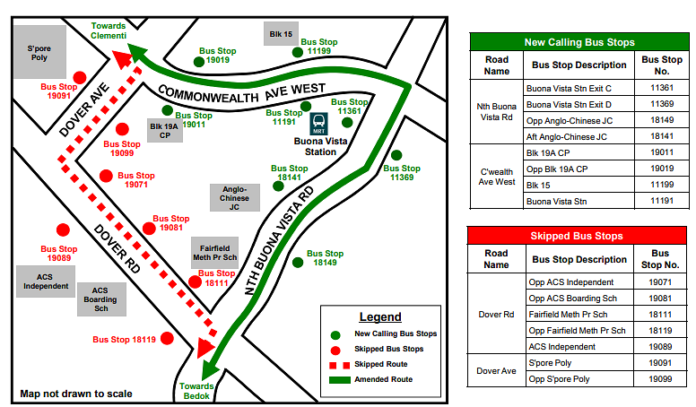
SBS Transit announced last week that bus service 14’s route would be amended from Sep 9 to “enhance commuters’ connectivity to Buona Vista MRT station”.
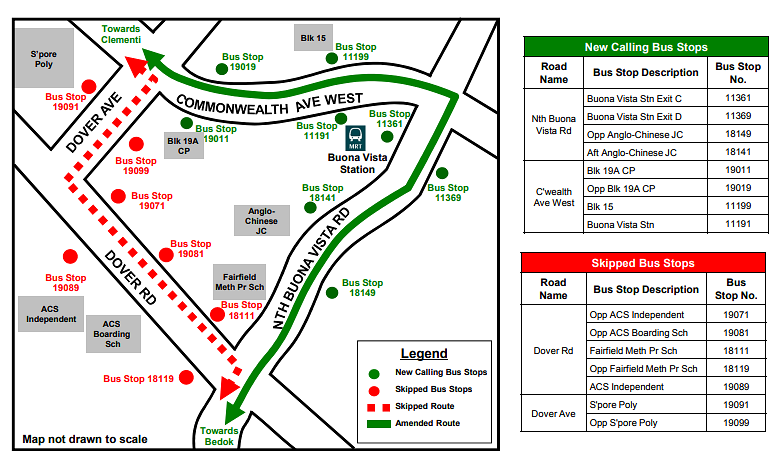
Instead of going along Dover Avenue and Dover Road, the bus service will travel along Commonwealth Avenue West and North Buona Vista Road and call at eight new bus stops along the way.
Seven bus stops will, however, be skipped with the route amendment: Opp ACS Independent, Opp ACS Boarding Sch, Fairfield Meth Pr Sch, Opp Fairfield Meth Pr Sch, ACS Independent, S’pore Poly and Opp S’pore Poly.
“I feel that the announced route change does not help the commuters at Buona Vista MRT station greatly, as announced in the press release, yet it brings great inconvenience to the residents and students living and studying along Dover Road and Dover Avenue,” said the petition.
These changes, according to the petition, might mean that more parents might take their children to school by private transport, leading to traffic jams.
“These changes to service 14 may cause more parents to send their children to school by private transport daily, worsening the already atrocious jam along Dover Road in the morning and afternoon,” it said.
In addition, the petition asserted that the route change would not substantially benefit commuters of Buona Vista MRT station, as “many of the stops covered by service 14 are already covered by other buses stopping at Buona Vista”.
“Most commuters that will benefit from the route change can already take a direct bus from Buona Vista Station, and thus will not greatly benefit from this change.
However, it said that commuters in the affected area would lose travel options to “significant portions of the east of Singapore”, including a direct bus service to East Coast Road and Tanah Merah MRT station.
(Image: SBS Transit)
In response, the Land Transport Authority (LTA) said the new route would benefit residents at new HDB developments in the area.
“The route amendment will primarily benefit residents of the new HDB developments Ghim Moh Edge and Ghim Moh Valley, who currently don’t have (a) direct link to Buona Vista MRT station,” an LTA spokesperson said in response to Channel NewsAsia’s queries.
“The ticketing data show that the number of commuters affected by the skipping of bus stops along Dover Avenue and Dover Road is small,” the spokesperson said.
These commuters can take other services as “direct alternatives” to destinations including Clementi MRT station, Dover MRT station, Alexandra Road and Jalan Bukit Merah, added the spokesperson.
“For further destinations, commuters can take these alternative services to connect to the amended service 14.”
SINGAPORE: While bending over to get her food at the school canteen, this teacher did not realise that a male student was surreptitiously taking an upskirt photo of her – a moment that changed her life.
“I felt very betrayed. This was a student whom I had a proper teacher-student relationship with,” recounted the teacher, who wanted to be known as “Stacy”. “I felt even more insulted that he never bothered to apologise.”
The boy, who was later called into the principal’s office, was part of a WhatsApp group chat with about 10 other boys who had been sharing upskirt photos and videos of teachers and students.
Stacy, who had been a teacher for four years, took two days’ medical leave and five months to get over the incident.
Stacy learned of the upskirt photo only after two younger students informed her.
“I had no say in how the boys would be punished or what consequences they’d face, and it was very quickly swept under the rug,” she said.
No disciplinary action was taken against the boys, and because they were minors, they were not charged either. The teacher has since left the school.
In Singapore, an average of 100 police reports on upskirt crimes have been filed annually since 2013.
More worryingly, there have been more than 500 insult of modesty cases every year, on average, since 2015. These include the use of spy cameras.
A pinhole camera hidden in what looks like a wallet.
The programme Talking Point explores the world of illicit filming, with videos that reveal what happens when such cameras are misused, and how women can protect themselves. (Watch the episode here.)
HIDDEN CAMERAS ABOUND
Being unwittingly filmed by covert cameras is becoming a serious issue here, and for every hidden camera found, there are potentially many more that go undetected. Websites showing such footage of women can easily be found.
One particular site claims to have 30 million visitors a day, with at least 70 videos showing Singaporean women – many of whom were in various stages of undress in public places like toilets and changing rooms.
Presumably these were shot with hidden cameras or smartphones.
Asked if the footage can be taken down, the web administrator replied that it would be considered on a case-by-case basis. This means a complaint must be made, and the victims must be aware of the videos to begin with.
Just last week, a 26-year-old man who was part of a voyeuristic video group pleaded guilty to recording obscene videos of women relieving themselves in the toilet.
Spy cameras are accessible and cheap, and there seems to be no restrictions on buying them, which means they could be dangerous in the wrong hands.
Some of these cameras sell for as low as S$5, and they are readily available online: A search through Amazon generated 7,000 hits, and on Lazada, more than 500,000 hits.
Mr Pieter Tjia, the chief executive officer of OMG Solutions, which sells more than 200 types of spy cameras in its shop, said many spy cameras could be found in the most common items, like clothes hooks and air fresheners.
He has seen a 10 per cent year-on-year increase in sales of hidden cameras, partly because they are less intrusive than closed-circuit television cameras.
His customers are mostly working adults who want to monitor their children, elderly family members or their domestic workers at home.
Those who want cameras for perverted uses typically shop online, he said. “They don’t feel comfortable doing a walk-in because we have so many cameras, and we normally ask them for contact details after their purchase.”
Criminal lawyer Rajan Supramaniam, who has handled over 50 cases involving hidden cameras, has noticed the increasing number of cases of late. “Compared to my early days in practice … maybe it’s about five times more,” he said.
What surprises him is that some perpetrators are unaware that it is illegal to upload, download and share voyeuristic photos and videos of women.
“The law and the courts are, in fact, imposing very stiff sentences because (such cases) require a high degree of premeditation,” he said. But “most of the time, these cases go undetected”.
Criminal lawyer Rajan Supramaniam.
Some have suggested regulating spy cameras, but the law “can’t keep up with the technology”. To regulate it 100 per cent is difficult,” he admitted. “Every country is struggling with this.”
The Talking Point team managed to track down and speak to a perpetrator, an 18-year-old who confessed to uploading multiple upskirt videos on a porn website, and some of his footage has gained over 10,000 views.
He disclosed that he films six to eight upskirt videos monthly and that he has been doing this for two years without being caught. He even tried to give Talking Point host Diana Ser some tips on taking such videos.
Talking Point host Diana Ser’s online chat with the 18-year-old who admitted to producing hidden camera footage of women.
As to why he is continuing with this activity, despite knowing that it is illegal and carries the risk of imprisonment, he said everything has a risk but he was doing it for the thrill.
HOW TO PROTECT YOURSELF
For victims, once video footage of them is shared online, it is virtually impossible to remove all traces. So how does one avoid being caught in a compromising position?
Mr John Seng, a debugging specialist who has been in the business of counter surveillance and covert filming for 30 years, suggested ways to scan a room for spy cameras.
A clothes hook with a pinhole camera.
For example, women should take note of the position of clothes hooks in a changing room. “Most hooks are always fixed at eye level or even higher,” he advised.
“But if you see that the hook is fixed from the shoulder to the thigh level, then have a close examination of this hook, to see whether it’s a hidden camera (with a pinhole) or a real hook.”
Usually, a bona fide clothes hook is screwed tight to the wall, so it would not drop off, whereas a spy camera would be mounted with double-sided tape.
Inside shower cubicles, soap dispensers are popular with voyeurs. While these do dispense solution and look normal, women should be wary of those covered with tape, meant to hide a camera.
Debugging specialist John Seng showing how peeping Toms use dispensers in shower cubicles for their hidden cameras.
To be sure, one can remove the cover of the dispenser, and “if you see electronics, then this is the work of a voyeur,” said Mr Seng.
Ms Anisha Joseph, who manages the Association of Women for Action and Research’s Sexual Assault Care Centre, said victims who discover pictures or videos of themselves should take snapshots of the website as evidence and then file a police report.
They should also report the abuse to these online platforms.
While some people may say that the damage these women suffer cannot be as great as rape, Ms Joseph, whose centre provides support services for those who have experienced sexual assault, disagreed.
Sexual Assault Care Centre head Anisha Joseph.
She said the shame that comes with online sexual abuse can be “much more”.
“There’s a huge sense of loss of control that you feel in these kinds of cases because you just don’t know where your pictures are being shared and who’s doing what with those pictures,” she added.
Watch this episode of Talking Point here. New episodes every Thursday at 9.30pm on Mediacorp Channel 5.
If you are a victim of a hidden camera crime, please call the Sexual Assault Care Centre at 6779 0282 or email sacc@aware.org.sg
Spy cameras could be found in the most common items, such as a pen.
SINGAPORE: It is necessary to plan long-term and expand Singapore’s network of water treatment plants to ensure that the country always has “a good flow of water”, said Deputy Prime Minister Teo Chee Hean on Tuesday (Aug 28).
He spoke during a visit to Changi Water Reclamation Plant, one of three such facilities which collects and treats water from the Deep Tunnel Sewerage System (DTSS).
The DTSS, an underground sewage “superhighway”, conveys used water islandwide to water reclamation plants where it will be treated and purified into NEWater.
Phase 1 of the project was completed in 2008 and phase 2 is expected to be finished in 2025.
“When it is completed in 2025, it would have taken more than 25 years and S$10 billion,” Mr Teo noted. “This is a very important project for us because our water needs continue to grow so we need to plan very very long term.”
The end point of the Deep Tunnel Sewerage System (DTSS) is 25 storeys underground at Changi Water Reclamation Plant. (Photo: Fann Sim)
Mr Teo also said “steady investment” and new technologies are required in order to meet Singapore’s water needs.
He cited the example of the Membrane Bioreactor (MBR) technology, which was retrofitted in existing tanks to allow water to be treated more efficiently.
According to Changi plant’s general manager Low Pei Chin, the new technology allows waste water to be treated in fewer steps compared to conventional methods, and also produces better quality water.
“Bringing in this MBR will increase the flow of the plant as well as provide much cleaner, much better inputs to our NEWater plant, achieving savings in energy and efficiency as well,” said Mr Teo.
“These are some of the things we do on a long-term basis to make sure that we are able to ensure that Singaporeans always have a good flow of water.”
WATER DEAL WITH MALAYSIA
The issue of water security has been in the spotlight recently after Malaysian Prime Minister Mahathir Mohamad said that the price of raw water being sold to Singapore is “ridiculous”.
In an exclusive interview with Channel NewsAsia in June, Dr Mahathir added that Malaysia will study the matter and renegotiate the terms of the water supply deal with Singapore.
When asked on Tuesday if Malaysia has officially approached Singapore regarding the water agreement, Mr Teo said no.
He added that Singapore is not in any talks with Malaysia regarding the water deal.
Under the current water agreement, signed in 1962, Singapore has the right to draw up to 250 million gallons (mgd) of raw water per day from the Johor River for 3 sen per 1,000 gallons of raw water. It sells treated water to Johor at 50 sen per thousand gallons.
This is a “fraction of the cost” to Singapore of treating the water, said Foreign Affairs Minister Vivian Balakrishnan said in Parliament in July.
Following Dr Mahathir’s remarks, Dr Balakrishnan also said that both countries must “fully respect” the sanctity of international agreements.
SINGAPORE: A man who posted an image of a torn Singapore flag on Facebook is no longer an employee of DBS Bank, the bank said on Tuesday (Aug 28).
Mr Avijit Das Patnaik had posted the picture on the Singapore Indians & Expats Facebook page on the eve of India’s Independence Day two weeks ago. The group has 11,000 members.
The post – which showed a picture of a T-shirt with a Singapore flag on it being ripped apart by a pair of hands to reveal an Indian flag underneath – was accompanied with the caption “Phir Bhi Dil Hai …” which roughly translates to “Still my heart is …” in Hindi.
The post went viral with many netizens commenting that it was offensive and insulting to Singapore. The post has since been taken down.
DBS said in a comment to complaints on its Facebook page on Aug 19 that Mr Patnaik had posted the image because he “wanted to show that even as he’s in Singapore, he remains Indian at heart”.
“Upon realising the graphic was offensive, he took it down immediately,” DBS said, adding that it had counselled Mr Patnaik.
On Tuesday, DBS released a statement on its Facebook page, saying that Mr Patnaik was no longer in its employ.
“DBS strongly disapproves of such actions by our employees. At the same time, it is fair and right that all employees are given the benefit of due process,” the bank said in a Facebook post.
“Since the incident, a disciplinary committee has been convened and as of 24 August, he is no longer with the bank.”
When questioned on the circumstances surrounding Mr Patnaik’s departure, including whether he resigned or was sacked, a DBS spokesman declined to elaborate, saying: “We have nothing further to share beyond the post.”
According to the Singapore Arms and Flag National Anthem Act, any person that treats the flag with disrespect may be fined a maximum of S$1,000.
The police confirmed with Channel NewsAsia that a report has been made and that investigations are underway.