SINGAPORE: Workers in Singapore saw their wages grow this year, with the median income rising above S$4,400, according to data released by the Ministry of Manpower (MOM) on Thursday (Nov 29).
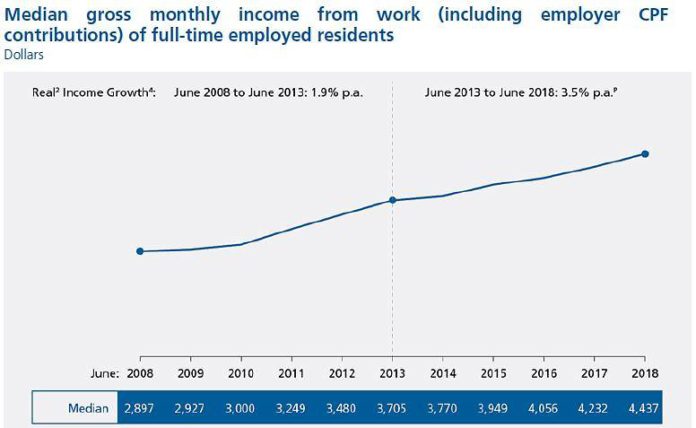
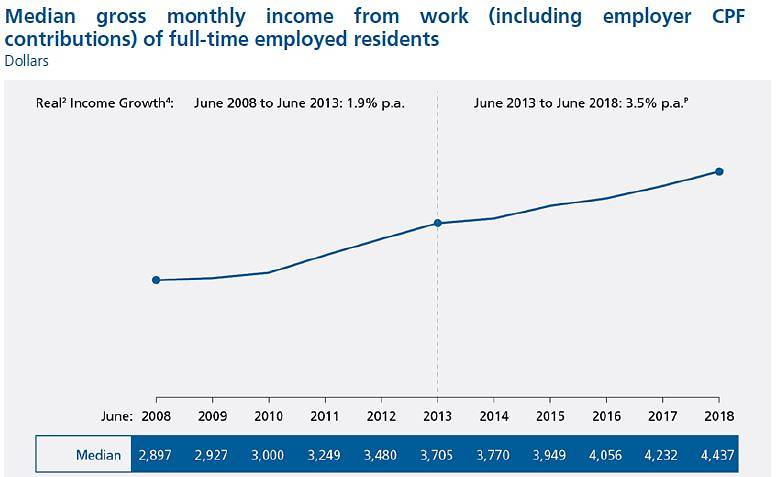
The median gross monthly income among Singaporeans and permanent residents who were employed full-time was S$4,437 this year, including employer contributions to the Central Provident Fund.
This compares to a median income of S$4,232 last year and S$4,056 the previous year.
Source: Ministry of Manpower
The findings were based on the Comprehensive Labour Force Survey conducted in mid-2018 by the ministry’s research and statistics department.
After taking into account inflation, the median gross monthly income grew by 3.5 per cent a year from 2013 to 2018, significantly higher than 1.9 per cent a year from 2008 to 2013, the ministry said.
Lower-income earners – those at the 20th percentile – saw their median income grow 4.2 per cent a year over the past five years. MOM said this could be the result of curbs on foreign hiring and initiatives such as the Wage Credit Scheme, which co-funds wage increases for lower-income Singaporeans.
EMPLOYMENT UP AMONG ELDERLY RESIDENTS
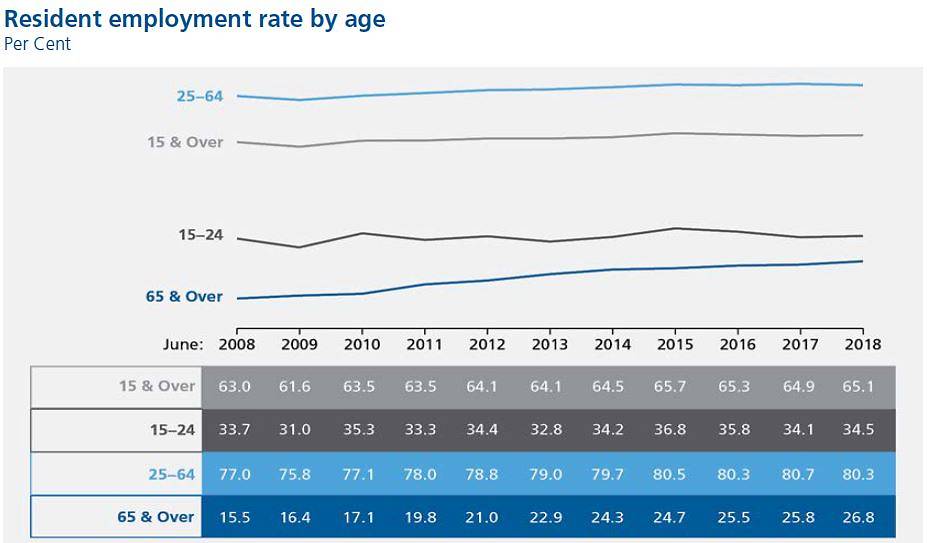
The employment rate among Singaporeans and PRs was 80.3 per cent for those aged 25 to 64, slightly lower than the 80.7 per cent last year. This puts Singapore in the eighth position for employment rate among OECD economies, and fourth for full-time employment, the ministry said.
Among those aged 65 and above, the employment rate rose to 26.8 per cent in June this year compared to 25.8 per cent in the same period last year.
Source: Ministry of Manpower
“Efforts to improve the employability of older workers encouraged more to stay on, and those previously outside the labour force to return to employment,” MOM said.
The rising employment rate among the elderly has helped offset the impact of ageing on the labour force participation rate, the ministry said. The labour force participation rate for residents aged 15 and above was 67.7 per cent in June this year, a figure which has stabilised in the past four years following an earlier uptrend, MOM said.
The non-seasonally adjusted unemployment rate for professionals, managers, executives and technicians (PMETs) declined for the second straight year to 2.9 per cent, from 3 per cent last year.
There was also a broad-based decline in unemployment among non-PMETs in most age groups, the ministry said.
However, the long-term unemployment rate among PMETs rose from 0.7 per cent to 0.8 per cent this year. This was because more unemployed PMETs in their 30s or aged 50 and above took longer to find a job, MOM said.
JAKARTA/SINGAPORE: After making waves at home, where it has over a million drivers, it has set its sights on South-East Asia – with its beta app in Singapore primed for launch today, Bloomberg reported yesterday.
Its investors, eager to accelerate its overseas expansion, include Google and Temasek Holdings.
Its chief executive officer and founder, 34-year-old Nadiem Makarim – who was born in Singapore – proudly claims that Go-Jek is “by far the largest job-creating entity in the history of Indonesia”.
But the country’s go-to ride-hailing option is no longer universally celebrated by its ojek (motorcycle taxi) riders. More and more of them are calling for high fares and tighter regulation of ride-hailing companies.
Since 2016, its disgruntled riders – and those from rival Grab – have taken to the streets to make their unhappiness known.
Riders from Go-Jek and Grab outside Jakarta’s parliament, protesting against low fares. (Photo: Reuters/Darren Whiteside)
“It’s as if we’re forced to work,” one rider, Mr Arif, said. “We work as freelancers without legal protection. We’re helpless if something happens to us while we’re at work.”
How did Go-Jek get to this, from seemingly being the answer to the traffic-clogged roads of Jakarta, one of the world’s most congested cities and where the firm was founded in 2010?
After four months of negotiation, the programme Why It Matters got an interview with the man behind Indonesia’s first unicorn – a start-up valued at more than a billion dollars (its latest valuation was around US$5 billion) – for some answers.
And Mr Nadiem said the drop in earnings – a similar complaint heard among Grab drivers in Singapore – is a necessary reality of a maturing industry. (Watch the episode here.)
Go-Jek is not just a ride-hailing phenomenon. Its app provides a suite of transactions, from shopping and courier deliveries to cleaning and even massage services – so users need not face Jakarta’s notorious traffic.
In the food delivery business, following Foodpanda’s withdrawal from Indonesia in 2016, Go-Jek has gone on to claim 95 per cent of the market.
To date, its app has amassed more than 105 million downloads and is processing over 100 million transactions monthly.
But the “precondition for Go-Jek’s beginning” was Jakarta’s motorcycle taxis, which Mr Nadiem said he took wherever he went in the Indonesian capital because they were a “much faster way of getting from A to B and beating traffic”.
“I was a big believer in ojeks, I think, before a lot of other people were … And because I took ojeks so often, I very quickly realised that these guys are smart, they’re customer-focused (and) they’re reliable,” he said.
“That was kind of the secret faith that we had in the most undervalued segment of society because they could do everything for you … And now that industry is five (times) what it was in the traditional market.”
A Go-Jek rider with food for his customer. (Photo: Reuters/Beawiharta)
Owing to Go-Jek’s diversified model, which includes its cashless payment service Go-Pay, its riders can earn income throughout the day.
“In the morning, they’re picking people up to go to work from their homes. During lunchtime, they’re delivering lunch to offices. During the afternoon, they’re delivering packages for e-commerce companies and then … they’re delivering people back (home),” said Mr Nadiem.
“In the meantime, they’re selling Go-Pay top-ups. So you’ve got a variety of services and revenue possibilities for drivers.”
TAKEN FOR A RIDE?
But are Go-Jek’s riders laughing all the way to the bank, or has it become a race to the bottom for them?
File photo: Reuters/Darren Whiteside
One who has enjoyed it so far is Mr Mas Bangun, a rider of three years. “I can choose whether to ride or not. If not, well, I don’t have to because Go-Jek is a way to earn side income,” he said.
If I’m unwell, I’d choose to take Go-Food orders. The distance is usually shorter; customers can only order food that isn’t too far away.
Others, however, are dissatisfied because of the downsides. Mr Krisna Wiharnanto, for example, said Go-Jek’s touted partnership with riders is now “just a term” because “we aren’t on an equal footing” and the current system “isn’t what was promised before”.
“In the beginning, it wasn’t bad … When the fare started decreasing, the income became insufficient. The bonus was increased, but the target to reach the bonus was also raised,” he said.
“For those who previously worked from 6am to 4pm, now they have to start from midnight to chase after the points … All that risk, just to get that bonus. It’s no wonder there are accidents every day.”
File photo: Reuters/Garry Lotulung
As with other ride-hailing companies, points and performance ratings can earn Go-Jek riders cash bonuses. Longer distances and certain jobs are worth more points.
But the way ride-hailing apps determine prices is generally a mystery. What is known is that their algorithms decide the prices depending on supply and demand. And the companies usually impose systems to ensure a minimum acceptance of rides.
When the Why It Matters team followed a Go-Jek rider for a day, they found that once a booking comes in, it is a race against time: The rider has 10 seconds to accept, otherwise the booking is considered cancelled.
Three cancellations within a minute causes the rider’s app to be suspended for five minutes. And at the stroke of midnight, the data is reset for the next day.
File photo: Reuters/Beawiharta
In the end, the rider had a 67 per cent rating and 16 points, meeting a target of 65 per cent and 12 points set by Go-Jek for a bonus of about 29,400 rupiah (S$2.80). For 10 hours of riding, his total earnings were 117,300 rupiah.
Mr Krisna highlighted that Go-Jek used to say its riders’ income could be as much as eight million rupiah a month. But even that is not the net income, he clarified.
That’s before we deduct the daily expenses: Fuel, phone and data bills, operational fee, bike servicing. We haven’t even talked about (what) if there’s an accident.
Ultimately, a rider keeps about 65 per cent of what he makes.
ANSWERING THE CRITICS
In theory, a ride-hailing app is simply a technology that matches drivers with passengers. In reality, a company like Go-Jek also monitors its riders through feedback and acceptance rates, determining their pay in the process.
To fight for the interests of riders, Mr Krisna co-founded Aspirasi Serikat Ojek Online Indonesia, a trade union that has been behind some of their protests.
“I still want to fight, even if there’s little hope. If we aren’t the ones fighting, who will?” he said.
One of the protests, in April. (Photo: Reuters/Darren Whiteside)
Many Indonesians welcome the convenience of ride-hailing apps, but there is also a need for tighter laws, agrees Jakarta’s former Transportation Agency head Andri Yansyah, who was rotated to a new agency in September.
These are not in place, however, because the status of such apps has not been clearly defined yet. “Is this public transport? Is this special transport rental? Is this private transport? We ourselves aren’t sure,” he said.
Having traditional motorcycle taxis (available) online may have solved transport problems, but the fact is there’s no regulation of the sector yet, and that has become a problem.
While the government tries to lay down the rules of the game, what does Mr Nadiem have to say about the concerns and protests? “We love the dynamism, but it’s also not necessarily reflecting the views of all drivers,” he said.
“A lot of their demands is (about increasing) the price per kilometre. But there are other considerations. A lot of the pricing is also constrained by what your competition dictates.”
Photo: Reuters/Darren Whiteside
Then there is the importance of industry “discipline” through subsidy reduction. “I completely sympathise and empathise with a lot of drivers who used to be making a lot more … but that’s the reality of a maturing industry,” he said.
As for their feeling that they are expected to be subservient to Go-Jek, he pointed to the way the industry is structured.
“They’re using a platform to earn revenue. The great part about that is the flexibility … You can work whenever you want, so you can actually work harder in the times that you need more income,” he said.
“It’s very hard for the drivers to be able to see the macro picture. We as a company can see that: The balancing act … What’s most successful is that both these sides grow, right? More drivers, more customers. We’re perfectly aligned.”
Go-Jek riders waiting for their orders at a food stall in Jakarta. (File photo: Reuters/Beawiharta)
FIRMS ACTING LIKE ‘MINI-GOVERNMENTS’
The growing pains of the ride-hailing industry are not unique to Jakarta. In Singapore, Grab also cut driver incentives after its merger with Uber.
Mr Victor Ang, a Grab driver of three years, said his weekly incentives dropped to S$250, when it used to be S$1,000-plus to S$2,000.
“(Grab) is a commercial company, so definitely it can’t be burning the investors’ money all the way,” he acknowledged, even as he could not but feel under the heel of the firm.
Photo: Grab’s Facebook page
The Competition and Consumer Commission of Singapore has since directed the company to maintain its pre-merger pricing algorithm and driver commission rates. This does not include incentives, but ahead of Go-Jek’s entry, Grab has introduced new ones to retain drivers.
The road ahead, however, could still be bumpy. Insead associate professor of entrepreneurship and family enterprise Jason Davis, who has done field research at Go-Jek’s Jakarta headquarters, is concerned because ride-hailing companies “act like mini-governments”.
“We’re living in a very interesting age when technology and platforms are allowing companies to scale up very quickly. They have their own marketplace, and choices that they can make to encourage some behaviour or other behaviour,” he said.
“The worry is that these companies can grow so fast and the market can tip – that they could then extract all the value through pricing and discourage competition.”
Photo: AFP/GOH Chai Hin
He does not think, however, that private-hire drivers have been misled. Rather, “they were given a system in which they could work, and maybe they couldn’t expect what would happen in that system”.
Asked whether consumers can do anything to negate or minimise the negative spillovers, he said: “Perhaps the stronger levers lie with governments. Smart governments can carefully regulate what’s acceptable on the platforms. They can do things like discourage monopolies.
“There’s a problem though … because these companies are so innovative, they’re so dynamic, they’re creating so much employment, so many improvements in people’s lives, that (governments) don’t want to be overbearing in regulation and discourage that innovation and that entrepreneurship.”
So regulatory frameworks must both keep pace with the ride-hailing industry and have the right system of incentives and laws.
Watch this episode of Why It Matters here. New episodes every Monday at 8pm.
SINGAPORE: Food delivery companies in Singapore have stressed that its riders who use Personal Mobility Devices (PMDs) must comply with the Land Transport Authority’s rules and regulations.
Last week, a 33-year-old food delivery man was stopped by LTA officers for riding an e-scooter which exceeded the maximum allowable weight of 20kg.
The man “became emotional” after he was stopped along Yishun Avenue 2 and was subsequently handcuffed and arrested.
In response to queries from Channel NewsAsia, the four main food delivery companies in Singapore – Foodpanda, Honestbee, GrabFood and Deliveroo – all outlined the importance of adhering to Singapore’s road safety laws.
Managing director for Honestbee Singapore Chris Urban told Channel NewsAsia that its riders are informed of safety standards that they have to adhere to and some good practices they should abide by.
“Delivery ‘bees’ who are found to be using non-compliant PMDs will be taken to task, and we will not hesitate to terminate their contract if we deem necessary after a proper investigation,” said Mr Urban.
For GrabFood, riders who join are required to inform the company about mode of delivery they will use – whether by motorbike, PMD, bicycle or on foot.
This registration process allows the company to verify and ensure that the rider’s PMD is compliant with Singapore law.
All four companies told Channel NewsAsia that they educate their riders on the importance of adhering to PMD regulations during the onboarding process.
A Foodpanda spokesperson said its delivery fleet, which includes riders using PMD and power-assisted bicycles, are trained on “all road safety and regulations as well as code of conduct via a compulsory orientation programme”.
GrabFood said its riders are educated on the Active Mobility Act, a set of rules and a code of conduct for cyclists as well as riders of PMDs and power-assisted bicycles (PABs).
According to the Act, which was passed in Parliament in January 2017, PMDs and PABs used on public paths must not exceed 20kg, has a maximum width of 70cm and the speed is capped at 25kmh.
SOME RIDERS BREAK LAW DUE TO TIME ‘PRESSURE’
Mr Khairul (not his real name), a PMD rider with one of the major food delivery companies, told Channel NewsAsia that while his e-scooter is certified legal, he does “occasionally” ride on roads, instead of public paths.
“It can’t be helped. Sometimes there are delays with the restaurants and we are under pressure to meet the estimated delivery time,” said the 23-year-old.
“I only do this late at night, when the roads are empty. It’s easier to navigate compared to the foot paths,” he added.
File photo of e-scooters impounded by enforcement officers. (Photo: Elizabeth Neo)
Mr Raymond, a rider with GrabFood, said that he has seen fellow riders from different companies use illegal PMDs, modified to travel fast, so that they can make more deliveries.
“They want to meet their incentives or simply do more jobs, so they boost the engines (to increase the speed),” said the 28-year-old.
For Mr Raymond, he recently purchased the Segway Ninebot ES2 an LTA-compliant e-scooter, to make deliveries.
“I don’t want to break the rules. Plus Grab does not have a time limit for riders. If we are late, the app would update the customer that there’s a delay,” he added.
GrabFood and Deliveroo confirmed to Channel NewsAsia their riders are not restricted by a time limit.
Deliveroo Singapore’s General Manager Siddharth Shanker said: “We don’t impose time limits on riders to complete their deliveries, as our priority is safe delivery.”
TRAINING PROGRAMMES TO EDUCATE RIDERS
Additionally, Grab and Deliveroo both said it offers additional training and support to all its riders to educate them on the importance of committing to road safety.
Grab said it recently launched a “Safer Everyday” commitment where it partnered various Government agencies to promote health and occupational safety for its drivers and delivery partners.
One of Grab’s partners is Unique Speed, which offers a programme to ensure that GrabFood riders using PMDs “are conscious of the space they share with other road users and pedestrians”.
Similarly, Deliveroo’s Mr Shanker said it offers its riders additional training and support through a “Safe Riding Programme”, which was launched in August.
He said the programme covers safe riding practices for cyclists, PMD users and power-assisted bicycle riders.
“Two sessions were held this year, and more sessions will be held for riders in the coming months,” he added.
“We actively encourage all our riders to take part and have incorporated key content from the SRP curriculum, as well as the latest rules and regulations into our existing road safety guidelines.”
SINGAPORE: Last month, Prudential made the retirement age a thing of the past.
Employees at Prudential now enjoy the flexibility of staying within the company beyond the retirement age of 62 and can do so under the same terms and conditions as what they currently receive.
Doing away with the retirement age, as exemplified by Prudential, is consistent with changes in the economic and human landscapes.
Chief among these drivers is the global rise in life-expectancy and an ageing yet healthy population. In Singapore, life expectancy has risen from 76.3 in 1995 to 83.1 in 2017 and is projected to reach 85.4 years by 2040.
People walking along Singapore’s Central Business District area. (File photo: Ngau Kai Yan)
This demographic shift will have profound effects on how organisations manage human resources. However, it may also benefit the labour market in various ways.
First, it is widely accepted in policy studies that longevity correlates with better health. Advances in technology, healthcare and lifestyle changes provide people with higher standards of living. In many developed countries, people take better care of themselves, physically, mentally and socially.
Thus, with increasing life expectancy increases and breakthroughs in health literacy and diet, we can expect our labour force, though ageing, to remain productive.
Second, recent studies have shown that longevity encourages human capital accumulation. Increasing life expectancy, with declining risk of mortality, leads to greater education attainment.
This might be because a longer life provides added motivation to individuals to accumulate knowledge. The average person can now boast a longer trajectory to capture the returns to their investments in things like skills training and education – and obtain more educational qualifications in one or more fields.
This trend at the individual level is reaping national manpower dividends, as countries with longer life expectancies tend to have a better trained workforce.
A student helping an elderly woman use a computer at an IDA workshop. (File photo: IDA)
And as economies become more sophisticated, they propel the demand for highly qualified individuals with a diverse set of skills – a virtuous cycle of economic development.
That reason might explain the recent phenomenon of individuals in their 20s or 30s taking a gap year, switching fields or trying out different things.
As longevity reduces the opportunity costs of avoiding a career mismatch and increases the net present value of training and retraining, younger adults may take their time to hone their skills and inform their career choices in this competitive environment.
Third, some skills improve with age. These so-called “age-appreciating” skills include technical, writing, oral and interpersonal skills, and teamworking, skills that are valued in the workplace, and even more so in the future as mature economies move away from physically demanding industries to knowledge and skill-based sectors.
So a 62-year-old today is likely to be healthier, more educated and skilled than the 62-year-old of 20 years ago – and better equipped to meet new demands of employment.
DOES HAVING A RETIREMENT AGE DISADVANTAGE OLDER WORKERS?
Why then, should we re-consider the relevance of the retirement age? Advocates of a defined retirement age argue that it provides opportunities for the young to advance their careers by retiring the “old guard” and providing options for them to step down into part-time or project-based work.
In Singapore, the Retirement and Re-employment Act also makes the retirement age a safeguard for workers, because it makes it illegal for a company to ask an employee to retire before 62.
But from the perspective of the older worker, having a retirement age introduces friction, bias and potentially lower wages and benefits when rehired and put on a new contract after the retirement age – to their detriment.
Employers have to offer re-employment past 62 on a contract basis, yet are not required to do so at the same terms and conditions as before.
Our national discourse on retirement must bear in mind that in the next 10 years, there will be dramatic shifts in our labour market.
Since 1990, the number of individuals aged 60 and above has more than tripled, with this group increasing at a faster rate than the general population. More than ever, people in their 60s will be a large part of our demographic structure.
BENEFITS TO ORGANISATIONS, SOCIETY AND WORKERS
The dividends of a longer working life are for us to harvest. While macroeconomic forces may compel employers to retain older workers, companies reap benefits from having more experienced staff who have industry know-how, skills and experience – and can mentor younger workers.
Working longer also benefits workers and society, where studies have shown that work keeps people physically active, socially connected and mentally challenged.
In particular, the risk of getting dementia is reduced by 3.2 per cent with each additional year of work, according to recent studies by INSERM, the French government’s health research agency.
This statistic alone should drive Singapore to rethink the retirement age as elderly healthcare related to ageing care is projected to increase 10-fold by 2030.
Finally, attitudes are shifting towards fuller working lives. For example, the 2015 British Social Attitudes Survey, which covered approximately 4,300 people aged 18 and over, found that younger people were more likely to say they expect to retire in their 70s.
Although it may be premature to discuss the abolishment of the retirement age, these developments should cause us to reconsider its relevance.
Meanwhile, companies that follow in Prudential’s footsteps here will likely find themselves on the right side of history in time to come.
Dr Nicholas Sim is senior lecturer at the School of Business, Singapore University of Social Sciences.
Dr Sabrina Heng is associate investigator and visiting senior research fellow at the University of Adelaide, Australia, and associate lecturer at at PSB Academy.
SINGAPORE: Singapore bike-sharing firm Anywheel and new player QIQ will soon jostle for space in what could become a crowded electric scooter sharing market in 2019.
They are among seven operators who have confirmed with Channel NewsAsia that they plan to apply to run e-scooter sharing services in public areas when the Land Transport Authority (LTA) opens applications for licences in January.
The others are Beam, Grab, Lime, Neuron and Telepod.
Singapore-based QIQ (pronounced ‘kik’) hopes to install its e-scooter docks within 300 metres of each other in the central area.
Each device will cost S$1 to unlock, and another S$1 for each subsequent 20 minutes.
QIQ hopes to roll out both e-scooter and e-bicycle services in Singapore in mid-2019, with plans to offer shared personal mobility devices in Vietnam, Korea, Gibraltar and the Middle East.
Its CEO Justin Sim said he doesn’t believe in bringing in a huge fleet to capture market share.
“We believe we don’t need to populate that place, that city, with a huge number of assets to serve that community,” said Mr Sim. “We want the system to be running at its optimum. We want the system to be used non-stop, round the clock, by as many people as possible.”
Potential competitor Anywheel already has experience operating shared bicycles in Singapore, which it believes will help the company ease its way into the e-scooter market.
The startup currently operates a fleet of 1,000 bicycles under a regulatory sandbox licence, and said it will apply for the largest possible e-scooter fleet size allowed by LTA when applications open.
“We want to offer more choices for our consumers,” said founder and CEO Htay Aung. “As fun as bicycles get, some female users find it inconvenient, especially when they’re wearing skirts. And because of the humid weather here; if you don’t like being sweaty, consumers will not choose bicycles.
The firm is working with private property owners to roll out “a couple of hundred” e-scooters in December, in areas like school campuses and industrial parks – areas that do not require a licence for operation.
Called JustScoot, the service will begin as a dockless model, before switching to mostly docking systems in future.
Users will be able to book the e-scooters on the Anywheel app, or an upcoming JustScoot app. Each device will cost S$1 to unlock and 10 cents to ride per minute.
The firm plans to roll out services in Australia shortly after its launch in Singapore.
ROPING IN USERS TO CHARGE, REDISTRIBUTE E-SCOOTERS
Other operators are opting for a dockless model.
While this means it could be easier for users to find a scooter anywhere they are, operators will face challenges in getting their devices located in prime locations.
Local startup Beam will pay users to take the devices home to charge overnight, and place them in prime locations in the morning.
“We’re going to see where people want to take trips, where they’re picking up scooters, and try to make sure our scooters are available in those locations,” said Beam’s vice-president of corporate affairs Christopher Hilton.
“At the beginning, we’re going to deploy in areas close to transit points. One of our hopes is that Beam trips are facilitating public transport trips.”
US e-scooter operator Lime – the only foreign entrant so far – is already using this model in other countries and plans to replicate it here.
It has deployed a pilot fleet at Science Park, and plans to roll out e-scooters at Changi Business Park and International Business Park.
Both Beam and Lime will also charge S$1 to unlock the vehicles, but it will cost 15 cents a minute to ride a Beam e-scooter, and 20 cents a minute for Lime.
Meanwhile, homegrown tech firm Grab also hopes to operate a dockless model.
It rolled out a three-month e-scooter sharing trial at the National University of Singapore on Nov 19. During the pilot period, each ride will cost 20 cents per 30 minutes.
A student at NUS unlocks an e-scooter using the GrabWheels beta app. (Photo: NUS)
COMPLIANCE WITH REGULATIONS
As of now, shared e-scooters cannot operate in public areas unless given exemptions.
Several operators have already been caught for breaking this rule.
LTA said on Nov 13 that it had impounded 42 personal mobility devices belonging to operators including local start-ups Telepod and Neuron, whose e-scooters were found available for hire outside permitted areas.
Both firms are only allowed to operate in areas like one-north under partnerships with private landowners like JTC.
A Beam e-scooter was also found available for hire at Bugis MRT station, though the company has not been given an exemption to operate in any part of Singapore.
In response to Channel NewsAsia’s queries, Beam said that it was doing tests and has since complied with regulations.
But there may be repercussions for these operators.
LTA has said it will consider the companies’ track record, including their compliance with the law and regulatory requirements, when evaluating licence applications.
SINGAPORE: Customs officers seized close to 12,000 cartons of duty-unpaid cigarettes in the Tuas industrial area during several raids in November, Singapore Customs said in a media release on Wednesday (Nov 28).
In the first raid on Nov 2, Singapore Customs officers arrested three Singaporean men in an industrial unit at Tuas South Avenue 3. The suspects were retrieving duty-unpaid cigarettes that were hidden in concrete slabs at the time of the raid.
A total of 2,400 cartons of duty-unpaid cigarettes were found.
2,400 cartons of duty-unpaid cigarettes were found hidden in concrete slabs. (Photo: Singapore Customs)
On Nov 7, customs officers raided an industrial unit at Tuas South Street 1 and found 5,431 cartons and 29 packets of duty-unpaid cigarettes hidden in six excavator arms.
Five Malaysian men were arrested.
5,431 cartons and 29 packets of duty-unpaid cigarettes were found hidden in six excavator arms. (Photo: Singapore Customs)
The third raid took place on Nov 24, in a yard at Tuas Avenue 14. Singapore Customs officers saw four men retrieving duty-unpaid cigarettes that were hidden in eight concrete slabs and loading them onto a lorry.
The four men – an Indonesian, a Malaysian and two Singaporeans – were arrested and a total of 4,148 cartons of duty-unpaid cigarettes were seized.
The 4,148 cartons of duty-unpaid cigarettes found hidden in eight concrete slabs were being loaded onto a lorry. (Photo: Singapore Customs)
The total duty and Goods and Services Tax evaded amounted to about S$1,074,390 and S$78,520 respectively, Singapore Customs said.
“We advise owners and managing agents of industrial premises to exercise due diligence to prevent their premises from being used by syndicates for duty-unpaid cigarette activities,” said Singapore Customs Assistant Director-General for intelligence and investigation Yeo Sew Meng.
“They should strengthen access controls at their premises and also look out for red flags such as persons seeking to rent the premises on a short-term basis, paying cash, and not being able to provide a credible business purpose for the rental.”
Those found guilty of buying, selling, conveying, delivering, storing, keeping, having in possession or dealing with duty-unpaid goods will face a fine of up to 40 times the amount of duty and GST evaded, six years’ jail, or both. Vehicles used in the commission of such offences are also liable to be forfeited.
Members of the public with information on such activities can call the Singapore Customs hotline at 1800-2330000, or email customs_intelligence@customs.gov.sg. Alternatively, they can use the Customs@SG mobile app, available for download from the Apple Store or Google Play.
SINGAPORE: Smokers will be prohibited from lighting up in public within the Orchard Road area from January next year.
In a media release, the National Environment Agency (NEA) said on Wednesday (Nov 28) that the Orchard Road precinct will be designated a No Smoking Zone from Jan 1, 2019.
NEA added that smoking will only be allowed at Designated Smoking Areas (DSAs) while smoking corners at food and retail establishments within the No Smoking Zone will also be rescinded by Dec 31, 2018. About 40 DSAs have been set up (see list below).
The transformation of Orchard Road into a smoke-free zone was originally scheduled to start in July 2018.
One month before the implementation, NEA announced that the smoking prohibition will be delayed to the end of the year to give businesses more time to prepare for the transition.
RAISING AWARENESS
NEA said that it will be ramping up publicity on the No Smoking Zone in the next few weeks to raise awareness about the smoking prohibition.
“Community volunteers have already started engaging the public within the precinct. Brochures listing the locations of DSAs will be made available at shopping malls and point-of-sales of tobacco products,” NEA said.
Advertisements will be put up at Orchard, Somerset, Newton and Dhoby Ghaut MRT stations, as well as selected bus stops and on buses that ply Orchard Road.
Signs will also be displayed at lamp posts and dustbins in the area while online mobile banners will be used to extend the campaign reach.
No Smoking Zone at Orchard Road precinct. (Image: National Environment Agency
To keep foreign visitors informed of the No Smoking Zone, NEA and the Singapore Tourism Board (STB) have incorporated relevant information on STB’s Visit Singapore webpage.
Inbound travellers will be alerted through publicity materials displayed at the points of entry such as Changi Airport, Singapore Cruise Centre and Marina Bay Cruise Centre. Travel agents, tourist guides and hotels will also be updated so that they can advise tourists.
SMOKING CORNERS
Smoking corners at food retail establishments within the No Smoking Zone will be rescinded by Dec 31, 2018.
NEA said that it has stopped accepting applications for new smoking corners in food retail establishments island-wide since June 2017.
“Existing smoking corners that had already been approved and which reside outside the No Smoking Zone would be allowed to remain until the current licences of the food retail establishments are terminated or cancelled. No new smoking corners will be approved for subsequent licensees of the same premises,” NEA added.
NEA said that it will take an advisory approach during the first three months of the roll-out and those caught smoking in public areas within the smoke-free zone will receive verbal warnings.
However, those caught smoking in existing smoking prohibited areas, such as covered linkways and bus stops, will continue to face enforcement action. Those who repeatedly flout the law in spite of prior warnings may also be issued a fine.
The new rules will be enforced for all who smoke in public areas within the smoke-free zone from Apr 1.
Operators and managers of premises where smoking is prohibited are also required by law to request smokers to stop smoking or to direct them to the nearest DSA if they wish to continue smoking.
“NEA takes a strict stance against smokers who flout the law and our officers conduct regular enforcement at smoking prohibited areas,” NEA said.
In 2017, about 22,000 tickets were issued for smoking in prohibited areas.
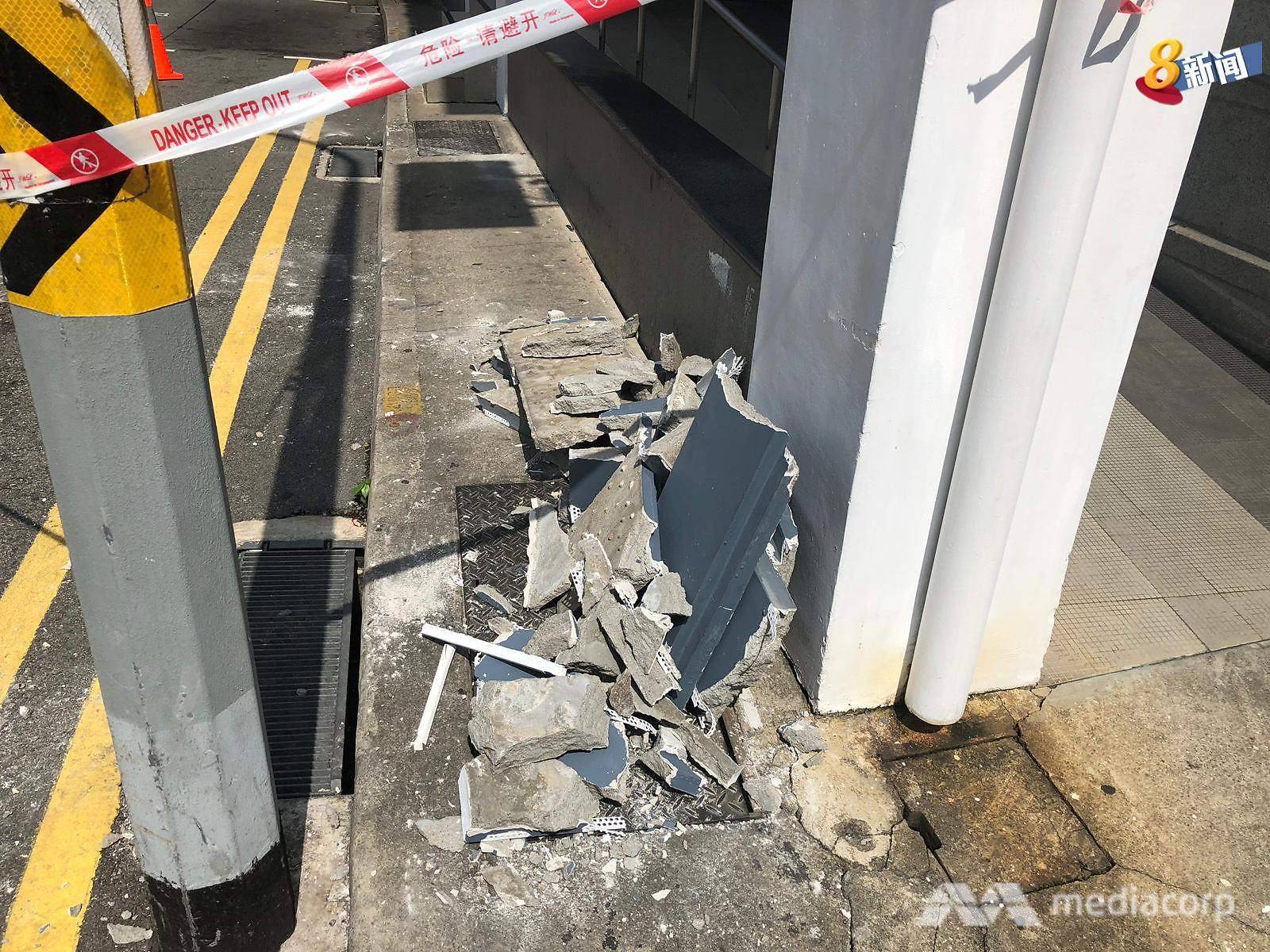
SINGAPORE: A man was injured after being hit by a falling piece of concrete outside Wanderlust Hotel on Dickson Road on Tuesday (Nov 27).
In a video shared on social media, the man – believed to be a 35-year-old Malaysian national – is seen being attended to by personnel from the Singapore Civil Defence Force (SCDF) as he lay on the ground amid the fallen debris.
SCDF said it was alerted to a call for medical assistance at about 11.40pm, adding that the injured man was subsequently taken to Tan Tock Seng Hospital.
It is understood the man, who was sitting outside the hotel when the plaster slab fell on him, sustained spinal injuries and could not move his lower body.
A spokesperson for the Building and Construction Authority (BCA) said the police notified it of “a fallen architectural feature outside Wanderlust Hotel” at 12.30am.
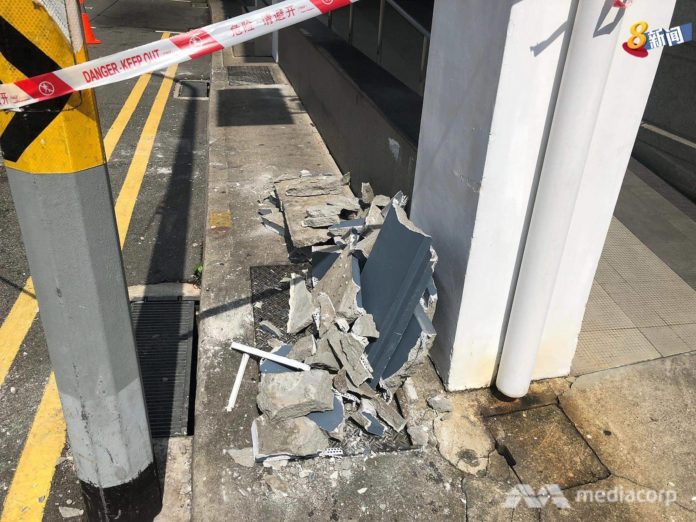
“BCA engineers immediately inspected the incident site and observed that a strip of architectural feature made of plaster, estimated to be 4.0m by 0.3m in size, had fallen off from the second floor of the building,” the spokesperson said.
“As an immediate precautionary measure, the affected area directly below, where the architectural feature had fallen from the building, and other parts of the building facade with the similar feature have been cordoned off.”
Plaster slabs that fell from Wanderlust Hotel in a photo taken on Wednesday (Nov 28), a day after the incident. (Photo: Channel 8 News/Koh Yong Sheng)
The spokesperson added: “BCA has instructed the building owner to appoint a Professional Engineer (PE) to investigate into the cause of the incident and inspect the condition of the rest of the building façade, as well as to carry out permanent rectification works as recommended by the PE.”
The four-storey building, which dates from the 1920s, is part of the Little India Conservation Area.
BCA is conducting further investigations into the incident.
A cordon is seen outside Wanderlust Hotel on Nov 28, 2018. (Photo: Channel 8 News/Koh Yong Sheng)
FACEBOOK has received a lot of flack recently for their involvement in election tampering and dissemination of “fake news” in the lead up to polling days across the world. The problem has been pervasive and universal with no country immune to the power of social media and propaganda.
The social media giant’s vice-president of policy solutions, Richard Allen, was in London on Tuesday to answer questions from international delegates on the Facebook’s plans to tackle the dangerous trend and improve its assessment of incendiary or false posts.
According to Channel News Asia, Allen told members of the Singapore parliament that Facebook now sets up a “War Room” to monitor every “significant election”. These are task forces made up of specialists skilled in monitoring the risks of each individual election and deploying solutions to ensure minimal adverse impact on the vote.
When asked if this would be deployed for all elections, globally, Allen said: “In an ideal world, it’s every election, everywhere, all of the time. Our current resourcing I think allows us to look at all national elections.”
“We are looking at every election whether the country is big or small, at a national level. And then the question is can we expand that also into regional and local elections.”
The company used the same method for the US midterms and the Brazil general elections in October, but have since closed the operation, claiming it was never designed to be permanent.
A still image taken from video footage broadcast by the UK Parliament’s Parliamentary Recording Unit (PRU) on November 27, 2018 shows Richard Allan, Vice President of Policy Solutions, Facebook, giving evidence before an ‘International Grand Committee.’ Source: Ho/AFP/PRU
Facebook is currently embroiled in an ongoing stream of controversy surrounding not just the use of its platforms to sway elections, but also its handling of user data and ill-advised campaigns against critics like billionaire philanthropist and Holocaust survivor George Soros.
While the War Room earned it some favourable coverage when it was launched in October, analysts have questioned its efficacy after a “tsunami” of fake news plagued the Brazil elections.
A recent report in Rolling Stone highlighted a growing perception that Facebook’s efforts have been arbitrary responses to outside political pressure.
Despite their physical War Room being disbanded in the United States, Allen reassured the international hearing that due diligence and similar tactics would be deployed globally. But warned they couldn’t do it alone.
“The people who decide if an election is free and fair is you, and your authorities, and the political parties,” Allan told Singapore MP Pritam Singh. “We want to do whatever is necessary in order for everyone to have the confidence that the election is free and fair – and we can’t do that on our own.
“We can make tools, we can work with you, but ultimately we need to engage with you in order to meet that shared objective that we contribute to positively rather than negatively to the election in your country.”