SINGAPORE: The Land Transport Authority (LTA) said on Monday (Dec 3) that it will soon trial its on-demand public bus (ODPB) services, which allow commuters to request pick-ups and drop-offs at any bus stop within defined areas using mobile applications.
The first part of the trial will kick off on Dec 17.
It allows commuters in the Joo Koon and Marina-Downtown areas to request the on-demand services on weekdays from 11am to 3pm. They can also arrange for pick-ups and drop-offs on weeknights, from 8.30pm to 11.30pm within Joo Koon and until 11.45pm within Marina-Downtown.
These day services will be operated by SBS Transit and are available until Jun 15.
Map showing the route for ODPB services in Joo Koon. (Graphic: LTA)
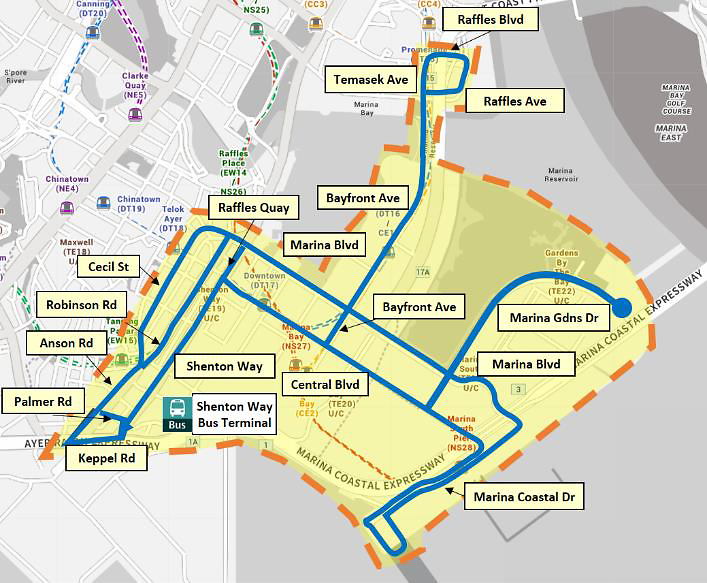
Map showing the route for ODPB services in Marina-Downtown. (Graphic: LTA)
The second part of the trial will make available night services on Fridays, Saturdays and eve of public holidays from 11.30pm to 2am. These will go in one direction only – from the Central Business District (CBD) to Bedok and Tampines via Geylang.
The night services will be operated by SMRT Buses and are available from Jan 4 to Jun 15.
Commuters may download the mobile applications BusGo for the weekday ODPB in Joo Koon and BusNow for the weekday service in Marina-Downtown, as well as the weekend night services serving the CBD to Bedok and Tampines route.
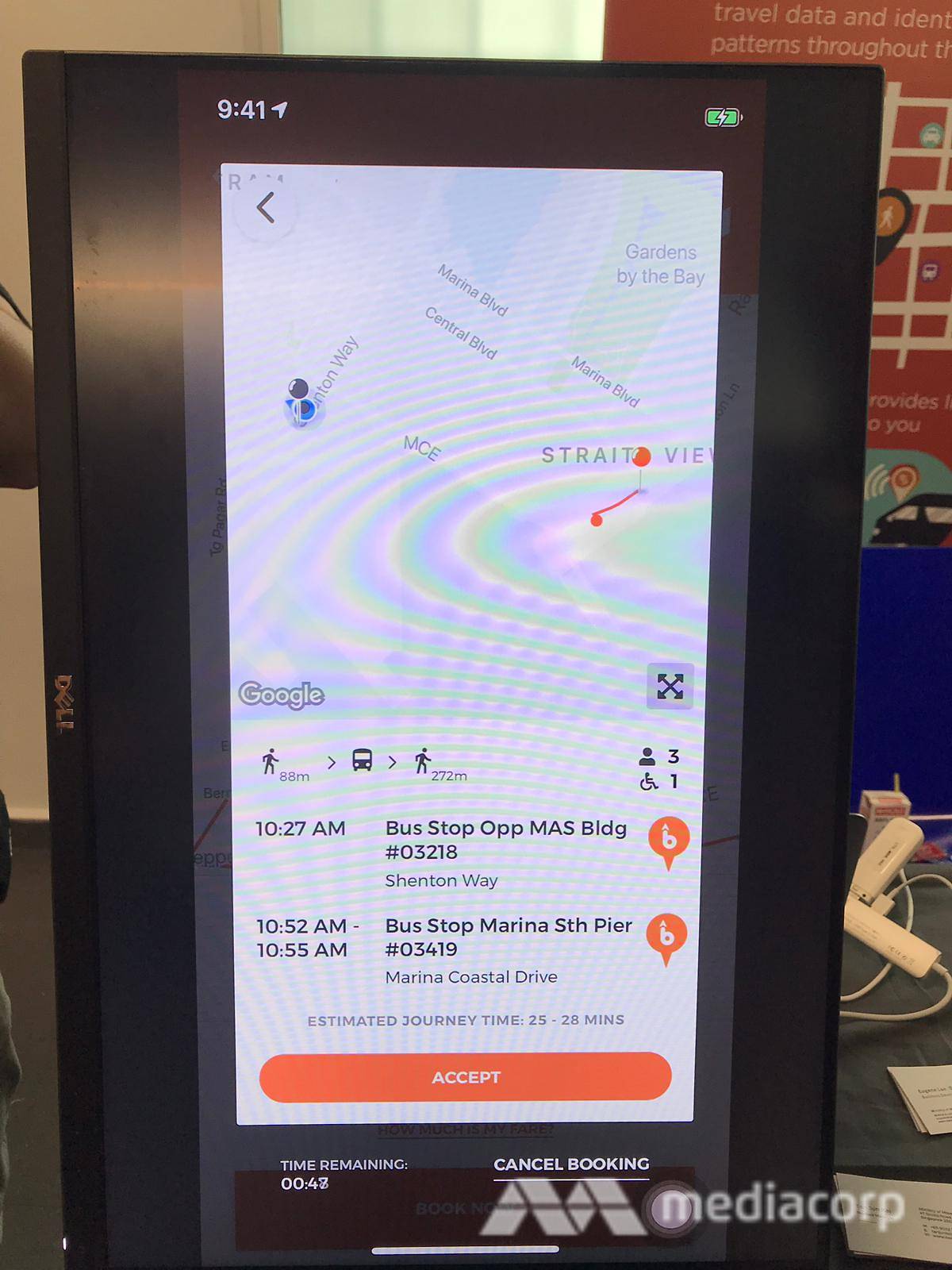
App features include the ability to key in a landmark or drag and drop location pins, walking direction to the boarding bus stop, real-time updates on bus location and arrival time, option to make group bookings, as well as the ability to indicate if passengers need wheelchair space.
These apps will be available for download by the end of Monday.
Map showing the route for ODPB services in CBD area. (Graphic: LTA)
Map showing the route for ODPB services in Bedok area. (Graphic: LTA)
Map showing the route for ODPB services in Tampines area. (Graphic: LTA)
Using the app, commuters may input their pick-up and drop-off points and once a successful booking has been made, an e-boarding ticket will be issued. The passenger can then show the ticket to the bus captain upon boarding, tapping their EZ-Link card when getting on and alighting from the bus.
Commuters may not change their booking details after the booking has been confirmed, according to LTA. Those who miss their rides will also have to re-book.
Passengers trying the weekday on-demand services will pay a promotional adult fare based on a fixed distance of 3.2km, regardless of the actual distance travelled, which is S$0.77 for farecard and S$1.40 for cash before Dec 29, and S$0.83 for farecard and S$1.50 after.
As part of the service, the apps will also provide commuters with walking directions to their bus stops and real-time updates of location and estimated arrival times. (Photo: Elizabeth Neo)
Night services will set commuters back a promotional flat fare of S$4.50, which is the existing fare of the NightRider NR7.
CEPAS cards, supported bank cards and cash are accepted as modes of payment.
The ODPB bus services can be identified by their service numbers. For example, buses serving Joo Koon may sport numbers like JK-1, JK-2, JK-3 and so on. Buses serving the Marina-Downtown area will have numbers like MD-1 and MD-2, while the night buses will be identified by NB-1, NB-2 and so on.
During the trial, regular bus services serving the areas specified will still be available, though at lower frequencies. For example, services 253, 255 and 257 in Joo Koon will operate at intervals of 30 minutes instead of their usual 15 minutes, while services 400 and 402 in Marina-Downtown will operate at intervals of 40 minutes instead of 20 minutes previously.
NR7 will be suspended while the night services are on trial.
IN the next two years, Malaysia is looking to boost green industries and jobs in Southeast Asia as it takes on the chair of the Asean labour sector.
Prime Minister Dr Mahathir Mohamad said the government hopes to influence regional policies on green industries during this period until 2020, working closely with non-Asean member countries such as China, South Korea and Japan to make meaningful headway for corresponding jobs and skills in the continent.
“Let us embark on our journey immediately. Malaysia will do its best to take the labour sector forward by incorporating green jobs and skills into the aegis of our chairmanship,” he said, as quoted by Bernama.
Dr Mahathir said this during a speech read out by Human Resource Minister M. Kula Segaran at the opening of the 25th ASEAN Labour Ministers Meeting.
With the new focus, the prime minister said the Asean labour sector is expected to see significant improvement in the promotion and adoption of green industries, which would invariably create employment opportunities in the field.
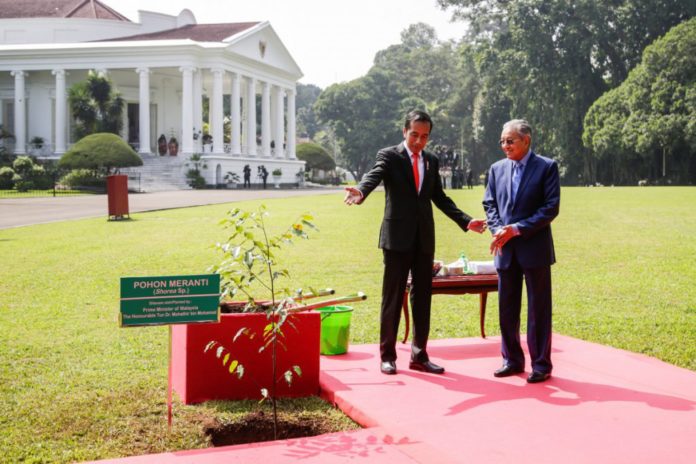
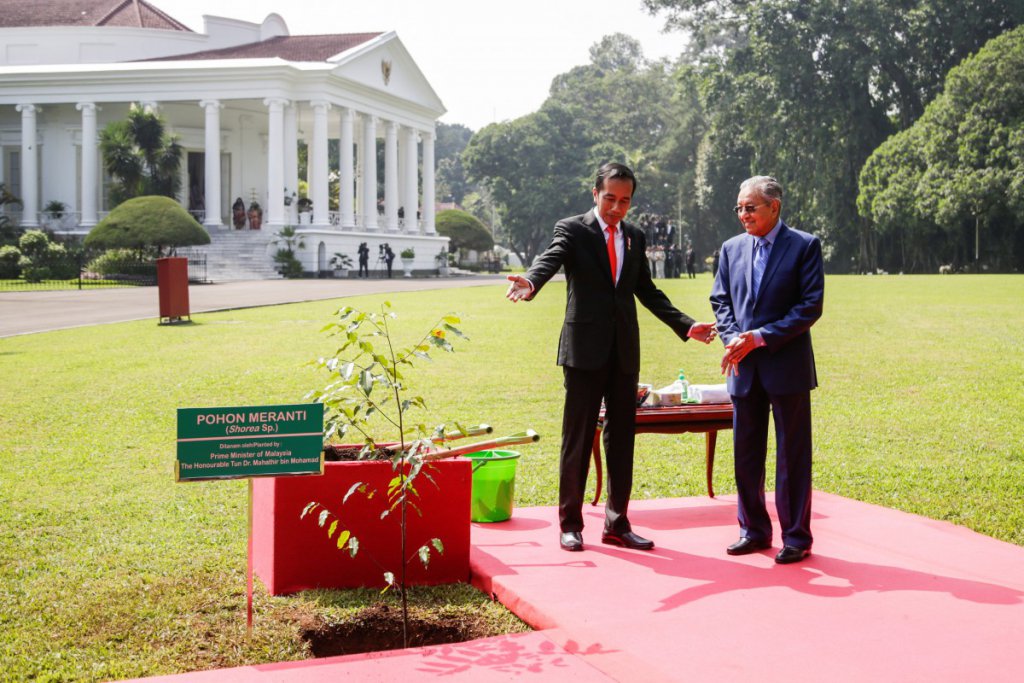
(File) Indonesia’s President Joko Widodo (L) gestures as Malaysia’s Prime Minister Mahathir Mohamad looks on during a tree planting ceremony at the presidential palace in Bogor, West Java, Indonesia, 29 June 2018. Source: Mast Irham/Pool via Reuters
Over the last two years, jobs in the green economy in Asean member countries grew by 3.2 percent amid overall economic growth of five to six percent.
According to the Development Bank of Singapore’s Annual Report 2017 on Green Job Opportunities in Asean, the growth saw 1.4 million new green jobs created.
“In the same vein, we have seen strong growth, particularly in the renewable energy sector such as wind and solar power, as well as the production of equipment and installations for heating and energy saving that subsequently create jobs in the region.
“Looking forward, as technology evolves, we can expect an increase in the creation of new green jobs, and stronger growth in current occupations and greening industries,” he said.
For Malaysia, Dr Mahathir said the government targeted revenue of RM180 billion (US$45 billion) and the creation of 200,000 green jobs by 2030.
With the sector showing good potential, Dr Mahathir said it was important for the government and employers to begin promoting green jobs and skills as the regional ecomony is embracing the trend.
The prime minister added the greening of the regional economy also requires people to specialise in the related skills and adapt to changes.
SINGAPORE: By now, most would have heard of co-working spaces – shared offices that independent knowledge workers, start-ups, small businesses, and increasingly, corporate employees use.
Chances are, you may already have tried out a co-working space. In a recent Channel NewsAsia video which explored the growth trajectory of co-working in Singapore, the flexible workspace market is expected to grow 20 per cent next year.
We are also seeing similar growth trends in major cities across Southeast Asia including Bangkok, Jakarta, Manila, Hanoi and Ho Chi Minh City.
Flexible workspaces (both co-working spaces and serviced offices) in Southeast Asia have shown a compound annual growth rate of around 40 per cent from 2014 to 2017, much higher than in the United States (25.7 per cent) and Europe (21.6 per cent) over the same period, according to investment management firm JLL.
However, co-working, much like the term “sharing economy”, has been applied to such a broad class of arrangements that the word is starting to lose significance.
There are about 50 co-working space locations in Singapore, an increase compared to the 40 from a year ago, according to property consultancy Cushman and Wakefield. (Photo: Spacemob’s Facebook page)
Just as Couchsurfing and Airbnb were initially developed to provide temporary accommodation at affordable rent, co-working emerged from social experiments conducted more than a decade ago in response to new ways of working such as telecommuting and freelancing.
Back then, co-working sought to combine the independence of freelancing with the structure, community and human interaction of an office space.
Today, the term “co-working” barely resembles the early period of its inception. Co-working spaces have evolved to become stylish “serviced” offices catering to a wide range of purposes and interests such as health and wellness, woodwork, photography, and sewing, some even allowing clients to bring their dogs and children.
As the industry has grown, co-working spaces have begun to attract customers beyond the digital nomads and start-up entrepreneurs of the early years. The mix of technology, hospitality, and community has enticed many working mothers, students, yoga practitioners, and corporate employees to use co-working spaces as another location for them to work and mingle with like-minded peers.
As co-working gains popularity across Southeast Asia, we provide a balanced view to the numerous advantages of co-working described in the media.
Mox boasts 3D-printers, woodworking tools, sewing rooms and a fully-equipped photography studio. (Photo: Mox)
DOWNSIDES OF CO-WORKING
While co-working spaces may be conducive for networking and socialising, the diversity that co-working spaces embrace may not be advantageous for some looking to establish business connections or make friends with like-minded peers who share the same values.
For example, what would a fintech start-up entrepreneur have in common with a co-worker who’s setting up a modelling agency? Being part of the wrong community may lead to a mismatch in terms of culture and values, which causes dissatisfaction and stress to individuals using these co-working spaces.
Some individuals may also feel compelled to adjust to the evolved standards and culture. You may have to dress up or make an effort to interact with people, or be open to others jumping into your discussions to offer their opinions even if you have urgent deadlines to meet.
Co-working spaces are also usually designed with open office layouts to support and encourage interactions. Similar to open-plan offices which have been found to be distracting, co-working spaces lack privacy as co-workers create noise through talks, phone calls, and meetings in an open space.
A co-working space might not live up to its hype. One in a prime location can also become too crowded for any work to be done.
Some co-working spaces also don’t have fixed desks, so you would have to move around in search of a free space.
Also, it’s important to know what you want. Do you need to use a conference room? Is occasional privacy important?
We typically have to pay to access co-working spaces. While the price is usually lower compared to maintaining a permanent office space, users of co-working spaces often forget the additional costs to access other facilities such as private meeting rooms, phone booths and printers.
According to a MoneySmart price comparison table compiled in July 2018, a hot desk costs around S$300 to S$500 a month for unlimited access. If you want a dedicated desk or private office for yourself, it costs around S$600 and S$750 or more respectively.
When you think about it, there is not much difference between a co-working space and a library space supplemented with visits to nearby cafes. The only difference is a basic co-working space typically costs a few hundred dollars each month, while a library space is free.
CO-WORKING SPACES AND WORK–LIFE BALANCE
Co-working spaces are all about convenience and making work fun, but are we blending the boundaries between work and life at the cost of productivity and focus?
Interestingly, while we would expect to see an increase in female start-up entrepreneurs with the productivity and creativity benefits that co-working bring, the Startup Muster 2018 survey revealed that the number of female start-up entrepreneurs in Australia has continued its downward trajectory since 2016.
An Australian female entrepreneur we knew remarked that co-working spaces provide spatial flexibility but do not ease the structural tensions working women faced in managing their work and family responsibilities.
Sure, co-working spaces may empower working mothers with networking opportunities and support from a community of like-minded career women, but this does not reduce their responsibilities such as taking on a greater share of parenting and household duties.
As with a traditional office, one still has to travel to co-working spaces, often located in the prime areas of major cities.
Some activities which could previously be done at home (e.g., telecommuting) are now encouraged to be done in co-working spaces, which may not provide the same ease and convenience of managing work and family responsibilities in a home-based office.
Working from home (Photo: Unsplash/Annie Spratt)
The costs of a long-term subscription to co-working spaces also continue to privilege people with the means and capital who can afford the fees over others who may need a co-working space more urgently.
Further, if your start-up expands and you need more space to accommodate your staff, co-working can quickly become a lot more costly than a traditional office space.
In many countries, co-working remains nascent and has yet to gain traction among certain groups with the least work–life balance such as working mothers and full-time employees with care responsibilities.
Thus, it is still premature to claim the many advantages that co-working spaces purport to bring.
Julian Waters-Lynch is Industry Fellow in Innovation and Entrepreneurship at RMIT University. Carys Chan is Lecturer/Assistant Professor in Management at RMIT University.
SINGAPORE: It’s a test more commonly performed at the doctors.
But you can now track your electrocardiography (ECG), which detects cardiac abnormalities, through your mobile phone, by using a T-shirt that connects to an app.
Developed by local start-up KaHa and textile company Tex Line, with the help of the Agency for Science, Technology and Research (A*Star), the smart shirt can also track and record fitness data such as heart rate, calories burned and step counts.
Developers aim to market the product by mid next year, with prices expected to be about 20 to 30 per cent more expensive than a regular sports apparel outfit.
An advanced prototype of the smart wearable was trialed for the first time during the annual one-north Run on Sunday (Dec 2), with about 100 of the 2,500 runners at the event donning it.
The smart fitness T-shirt contains wearable tech to track endurance, heart rate and ECG for optimal performance. (Photo: Ahmad Khan)
Most of the runners Channel NewsAsia spoke to said that the smart functions were useful, but some commented that the design of the outfit could be improved.
“The accuracy of the ECG is quite good, they actually capture the heart rate variance,” said 43-year-old seasoned runner Adrian Mok, who frequently uses heart rate monitors for his runs. “I think the comfort level is okay, and there’s a lot of potential with the product.”
Mr Alvin Tan, a 39-year-old banker, said: “This app is very useful because it really helps me track my heartbeat per minute before my run and while I’m running. It tells me whether I’m taking it too relaxed, or if I’m pushing too much.”
Clothing manufacturer Jereme Tan, 23, said the outfit could be made more comfortable.
“There’s room for improvement. But I think overall the product is good, one step for Singapore to enter this whole market of wearables,” he said.
A sensor connected to the smart T-Shirt syncs up with a mobile app to provide an individual’s vitals. (Photo: Ahmad Khan)
A REVIEW OF THE SMART FITNESS T-SHIRT
The developers of the smart T-Shirt lent one to Channel NewsAsia several days before the race to try it out for a run.
The smart T-shirt has two layers: The outer layer is made of the typical sportswear material, while the inner layer possesses carbon electrodes, the key sensors used to capture one’s vitals.
The electrodes are made at the Nanyang Technological University. The material of the patent-pending product also allows for sustainable washing.
Researchers created the inner layer of the smart fitness T-shirt using a carbon electrode that allows for sustainable washing. (Photo: Ahmad Khan)
Researchers created the inner layer of the smart fitness T-shirt using a carbon electrode that allows for sustainable washing. (Photo: Ahmad Khan)
“We discovered that the current material in the market is not sustainable in high wash environment, so we have a unique formulation that enables to have more than 100 washing cycles,” said Mr Lok Boon Keng, programme manager at the emerging application division in A*Star.
The carbon electrodes on the smart T-shirt that was on loan to Channel NewsAsia peeled off slightly after just one wash, however, indicating that further improvement may need to be done in this area.
T-SHIRT DESIGN & COMFORT
Putting on the smart T-shirt for the first time can be quite tricky with the two layers.
Once it was on, the inner layer felt a little tight and took some getting used to. That said, it was relatively comfortable during the run. The outer layer of the outfit is loose fitting.
“We know that for the apparel out there in the market, most of the designs are very tight fitting. But for the general public, not everyone has the rock solid abs or V-shaped bods,” said Mr Tan Soon Kiat, product manager at Tex Line.
“We came up with a two-layer design to monitor health and performance for sports. At the same time we still look comfortable in our everyday normal T-shirts,” he added.
TRACKING REAL-TIME DATA
The app will prompt runners to check their ECG before and after their run. (Photo: Ahmad Khan)
The smart T-shirt allowed me to monitor real-time physical data such as ECG, heart rate and calories during my run.
The app can also serve as a personal coach. and customise training programmes to suit one’s needs based on fitness level.
Developers of the wearable tech say it can also be used for other purposes other than exercise.
“This application can be used not only in homes but in hospitals for monitoring of patients,” said Ms Sim Seo Lay, head of business development and operations of KaHa.
“It can also be at the corporate uniform industry, which can monitor workers’ performances and health as well. It can also be used for children’s wear as well as for senior citizens and caregivers and so forth.”
The app can detect a runner’s ECG, which can detect cardiac abnormalities. (Photo: Ahmad Khan)
SINGAPORE: Two people were arrested for allegedly stealing a water pump from an aquarium shop in Chinatown on Saturday (Dec 1) evening.
The incident took place at Polyart Aquarium outlet in Chinatown at 4 Sago Lane.
The police said that they received a call for assistance at about 7.40pm on Saturday.
A 27-year-old man and a 25-year-old woman were subsequently arrested for shop theft and drug-related offences, the police said.
Police cars near the Polyart Aquarium in Chinatown on Saturday (Dec 1) evening. (Photo: Channel NewsAsia reader)
It is understood that the pair had stolen a water pump valued at less than S$50, and that the owner of the shop had contacted the police. Drug-related items were found on the pair.
Police investigations are ongoing.
A Channel NewsAsia reader said there were at least six police officers present, with two police vehicles and an ambulance observed at the scene.
SINGAPORE: Kampung Admiralty, the pioneering retirement community, has won World Building of the Year at the World Architecture Festival in Amsterdam.
The project beat 535 others which were shortlisted from 57 countries, at one of the most prestigious awards ceremony recognising architecture.
The results were announced at the event on Friday (Dec 1).
The mixed development by WOHA architects has co-located amenities such as a supermarket, medical centre, community garden, childcare centre and a hawker centre.
File photo of HDB flats in Kampung Admiralty (Photo: HDB)
In September, the project won two Housing and Development Board (HDB) awards in design and construction.
The development, next to Admiralty MRT station, houses about 100 flats for seniors.
It was lauded by Prime Minister Lee Hsien Loong in his National Day message, and is aimed at encouraging active living among seniors, as well as inter-generational bonding.
The community garden at Level 9 is planted with a variety of edible and ornamental plants. (Photo: National Parks Board)
SINGAPORE: My interview with Emeritus Senior Minister Mr Goh Chok Tong following the publication of his authorised biography, Tall Order, happens at a fortuitous time.
We speak three days after the People’s Action Party’s (PAP) announcement on Nov 23 that Mr Heng Swee Keat had been chosen as the party’s presumptive next-generation leader.
Political succession within the PAP today and Mr Goh’s story of his own ascension within the party as told in the book are natural parallels. We therefore start by discussing Mr Heng’s appointment.
The former prime minister gives a solid endorsement – not only of the finance minister’s capabilities and experience – but also of the team that has emerged, with Mr Heng having chosen Mr Chan Chun Sing as his deputy in eventually leading the party.
He agrees with the notion that had it not been for the stroke that Mr Heng suffered in May 2016, the fourth generation of PAP leaders might have come to the decision on their leader earlier.
With the current transition out of the way, I turn to his own experience of political succession, especially in the years where his second generation of PAP leaders began to emerge.
The internal party dynamic is described vividly in Tall Order, involving senior party members such as PAP old guard and one-time Deputy Prime Minister Toh Chin Chye.
Dr Toh left the Cabinet in 1981, before eventually retiring from politics altogether in 1988.
In his own telling, Mr Goh describes in the book that Dr Toh was “against the speed of change whereas Lee Kuan Yew said Toh was against political succession”.
I ask him to explain this bump in the road in the transition from the pioneers of the PAP.
“Well, I think Dr Toh had his reasons, and I understood where he was coming from. He was in his 50s and many of the colleagues of Toh Chin Chye at that time were in their early 50s or late 50s, and we had no interest at that point of time or experience in politics. We came in, within two years or so and we are appointed ministers. From Dr Toh’s perspective, too early. They were too young and it was too early. How could we just assume a position in the ministry without having the experience to be able to win elections? So his point of view was valid.
“Then I began to think deeper into this,” he adds. “I think Mr Lee Kuan Yew was right, from my own experience. Dr Toh was expecting the party naturally to throw up people who could govern. That was not possible.”
Channel NewsAsia’s Chief Editor of Digital News Jaime Ho interviewing Emeritus Senior Minister Goh Chok Tong at the Istana on Nov 26, 2018. (Photo: Hanidah Amin)
I ask if it is an issue with the party itself, the way it identifies, the way it encourages people to contest.
“It was an issue,” he replies.
“Mr Lee said, look at the party – who are the people who can be your backbenchers? You could find a few, but to be your ministers, that was difficult to find. So he had to manage these sentiments on the ground, and also the feelings of the ministers and Dr Toh, and of course the need to bring in people like ourselves.
“Very importantly, we also had to learn how to manage these difficulties, this balance between Dr Toh’s views and Mr Lee’s views … That’s the difficult part,” Mr Goh adds.
DIFFERENT AND DISSENTING VIEWS
I suggest that within any political party, it is always useful to have differing views. Maybe not dissenting views, but differing views. I ask Mr Goh if he thinks the party now has that kind of voice that is able to provide the alternative, to test assumptions.
“I would say that you must have different views in the party, and also dissenting views,” he replies.
He explains that having just differing, but not dissenting views, “means we have more or less decided to agree”, and suggests that within the PAP, there are those who do provide at times, a dissenting voice.
“I do know that many of the ministers whom I know well, not the younger ones but the older ones – (DPMs) Teo Chee Hean, Tharman (Shanmugaratnam), (minister) Shanmugam, they do express their views. Sometimes they dissent; but then they discuss, and in the end they come to a consensus.”
Is he therefore confident that there are enough alternative and dissenting views that will provide for better decisions?
“I’m confident as of now,” he says. “But I am less sure going to the future.”
I ask him why.
“Because if they are unable to attract people from outside the civil service and armed forces, then you’ll have some kind of civil service, public service thinking.”
He admits that “SAF (Singapore Armed Forces) officers, police officers and civil servants” are “very able people”, but points to a “certain kind of group think”.
“And then over time, if you’re attracting only fewer and fewer top civil servants, you end up with many SAF officers, old generals; again the group think is even narrower.”
His fears are not immediate, he qualifies.
Looking forward 20 years, he hopes “we would not be in that situation”.
Emeritus Senior Minister Goh Chok Tong at the launch of his biography Tall Order. (Photo: Facebook/mparader)
MACHIAVELLI AND TAKING OVER WITH A “KINDER AND GENTLER” APPROACH
Early in its narrative, Tall Order describes the role that Machiavelli played in Mr Lee Kuan Yew’s thinking:
“…he passed to Goh a seminal text of political philosophy – The Prince by Niccolo Machiavelli – urging the younger man to subscribe to the tenets of the 16th century book. In short, to govern, it is always better to be feared than loved.”
Mr Goh eventually set the book aside, eschewing Machiavelli.
I ask Mr Goh if he felt he succeeded in injecting his own so-called “kinder and gentler” approach instead.
“I think I’ve caused a change. Mr Lee’s style was appropriate for that part of history of Singapore. We became independent and there were no resources, so he had to use a no-nonsense, tough love approach. Kindness was there, but it was a tough-love kindness approach. But by the time we took over, Singapore was growing into adulthood.
“So I thought we should move into a more relaxed, and yet disciplined kind of society. So I used the term kinder and gentler,” he adds.
“Have I succeeded? This is a process. There’s no end to it, you can make it better and better.”
Things have changed, he says. It is more participative, more consultative.
With Machiavelli in mind, I turn to events in 1984.
I recount events told in Tall Order, where on the night of Dec 30, Dr Tony Tan, who was then a key member of the new generation of PAP leaders, gathers 11 of his other younger cabinet ministers at his home in Bukit Timah to decide on their leader. A young Lee Hsien Loong was part of the group.
Mr Goh himself was late to the party, arriving only when the decision had already been made that he would be their leader.
“You are first deputy prime minister and people know you are the presumptive PM, so to speak … But it’s also the year that Mr Lee Hsien Loong enters politics,” I say.
I ask Mr Goh what was going through his mind at that point, the situation he was in and what he needed to do going forward.
“In 1984, Lee Hsien Loong stood for election. I was the one that spotted him during my work, in the SAF. I invited him and he accepted even though he was going through some personal difficulties. He came in. So I was very happy that I was able to recruit, in my view, a candidate with the potential to be a minister and later on as a prime minister. So that went through my mind,” he replies.
“Did it change your mindset knowing that he was the prime minister’s son,” I ask. “How did you approach that disjuncture in your own head that you’re trying to attract one candidate, but he’s also the prime minister’s son?”
“I never worried about that,” he replies.
“I just look at who could be good candidates. It could be by another surname, that happened to be a Lee … Yes, he was the prime minister’s son, but I knew the system very well, that when he came in there would be others looking at you like a hawk, whether you had received any special treatment just because you’re the prime minister’s son.”
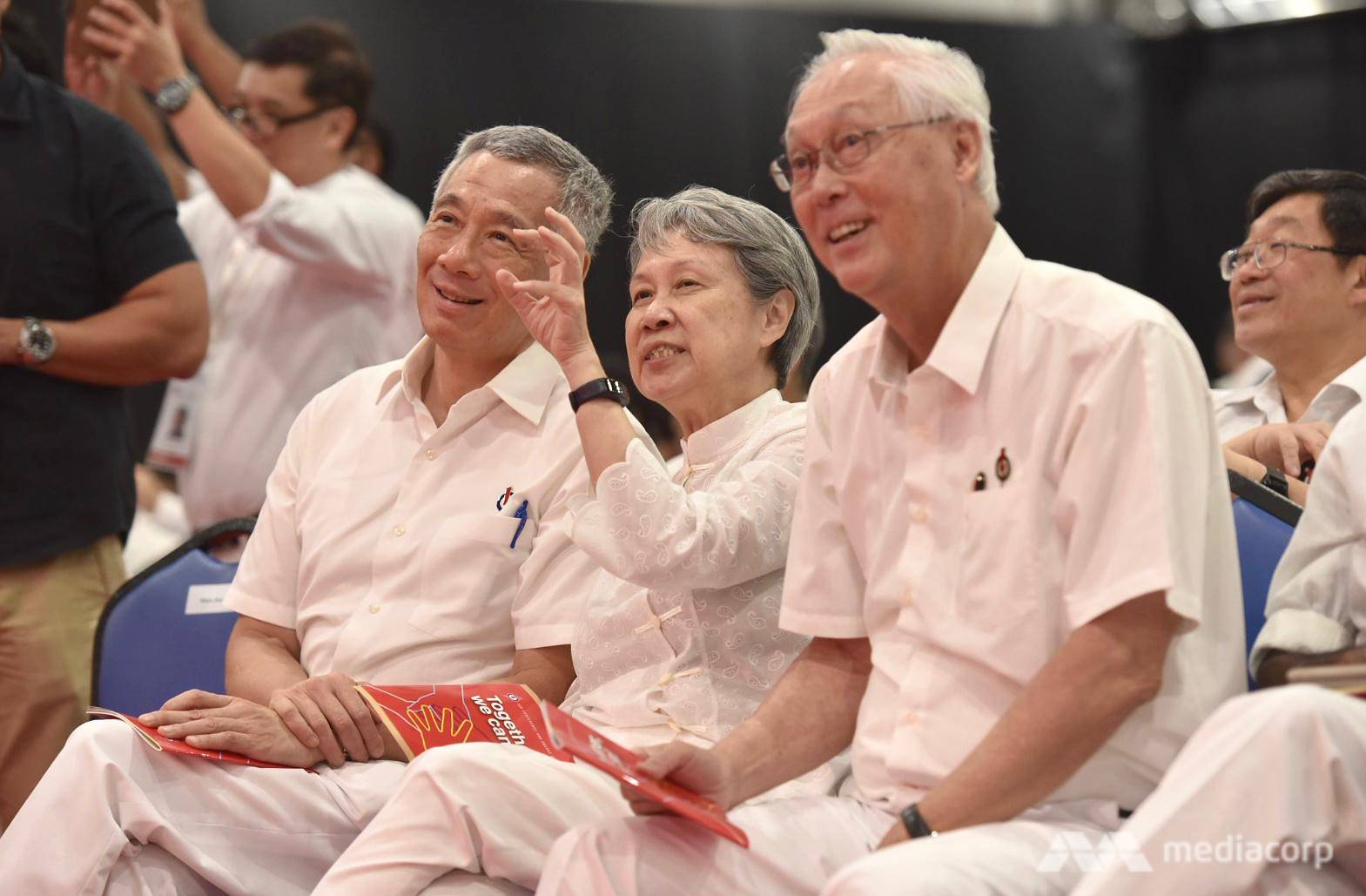
PAP secretary-general Lee Hsien Loong, Mdm Ho Ching and Mr Goh Chok Tong at the PAP Conference and Awards Ceremony at Singapore Expo on Nov 11, 2018. (Photo: Jeremy Long)
I ask if Mr Lee Hsien Loong voiced any misgivings of his own at that time.
“No, we never discussed the fact that he was the prime minister’s son,” he said.
“In the SAF, we had to be very careful when we recruited top civil servants’ children, sons, into the SAF, national service; ministers’ sons, judges’ sons. We had to be very careful they didn’t receive any special favours. (This was) very important because if they received special favours, you can’t expect the other national servicemen to support them. Likewise for Lee Hsien Loong. We have our own views in politics.”
Having been identified as the new leader in 1984, I turn to events in 1988 and Mr Lee Kuan Yew’s National Day Rally speech. The incident is described in detail in Tall Order.
In what was his first public assessment of Mr Goh, then Prime Minister Lee said Mr Goh was not his first choice. Instead, it was Dr Tony Tan.
I ask him to explain what Mr Lee had said, and what his feelings were, sitting in the audience.
“I was enjoying his speech until then. He started comparing Tony Tan, myself … So I was wondering what was happening. And then came the bombshell. Looking back and trying to imagine what I was thinking, I believe I sat down impassively, without showing any feelings whatsoever, listening to him. But of course going through my mind later on – not immediately, but later on – what was he trying to do? What was his intention?”
He suggests, tongue-in-cheek, that it is all described in the book, and says we should read it instead.
I try to push him, and ask if he could at least address whether, after having heard this, he had any regrets. Whether in the privacy of his thoughts later that night, he had questioned whether he was even meant to be prime minister.
If more isn’t already described in the book, he replies, it means that he “didn’t think too much about that”.
“If I had thought very much and lost any sleep, I would have remembered it very well and I would have recorded it in the book, if it had been of interest. As I said in the book, I was very confident in my relationship with Mr Lee. I knew he wanted somebody to succeed him. That somebody need not be me. I thought it was me. He did not say it was not me. He said I was not his first choice.
“But more importantly is the reaction of the younger leaders,” he adds.
“I think almost immediately, maybe within a matter of days, Tony Tan came out to say there would be no change (and) I remained the choice of the second-generation leaders. And Lee Hsien Loong also came out, almost immediately after Tony Tan, to say there would be no change in support. More importantly, which I did not put down in the book, this shows that we were not, shall we say, puppets of Mr Lee Kuan Yew. Each one of us had our own thinking.”
I ask if what he is stressing is that there was significant-enough input and decision-making from the generation of leaders who chose him. And that ultimately, that was the deciding factor.
“Correct,” he says.
“They decided on me and they were not going to change.”
I ask if this new generation of leaders was willing to justify their decision to Mr Lee.
“They didn’t need to justify; they just had to support me, which they did, I think. And that was also Mr Lee’s purpose: Let us choose, then if you have chosen him, it’s not my choice, you have to support him. So there’s a wisdom, as I put it, the wisdom of Mr Lee Kuan Yew in the process and also in expressing his view. It’s very clear – you’ve chosen, you have to support him. To be fair to Mr Lee, even though I was not his choice, he was very supportive of me.”
Mr Goh Chok Tong with Mr Lee Kuan Yew. (Photo: Facebook/mparader)
LEE KUAN YEW – BETTER INSIDE THAN OUTSIDE
Our conversation then turns to 1990, when he became prime minister.
I bring Mr Goh’s attention to his recollection as told in Tall Order, where after Mr Lee says at an early 1990 lunch at the Istana that it is time for him to take over, the elder statesman also suggests that he should stay in the Cabinet.
I ask him what his immediate sentiments were. Did he not feel that he should have had his own say in forming his first Cabinet?
“I think my personality is very different. As you will know … I did not set out to be in politics, and having been in politics, I did not set out to be the prime minister. To be very frank I thought I could serve by helping the country as a minister and I had in mind, minister for finance, because I was invited by Mr Hon Sui Sen. I could do the job, no difficulty.
“When Mr Lee told me after I became PM that he would stay on in the Cabinet, I was very happy. We worked for a long time together after that and I knew his style … I think from early on you knew that we did things differently. We would listen to him, but not to be controlled by him. But having him in Cabinet offered me tremendous, shall we say, backup and a presence internationally. As a new PM, I would not be immediately recognised overseas. I had to establish my credentials, but Mr Lee had the presence … Knowing that Mr Lee was there, it gave tremendous confidence to my dealings with other people,” Mr Goh explains.
He says that Mr Lee never cramped his style, and provides an added insight into his thinking: “And at the back of my mind, I knew it was better to have Mr Lee inside than outside.
“Inside, as a member, he could express dissent, (and if) we overruled him, he would not be able to say it outside, because the Cabinet decides on the basis of collective decision. He could not go out and say: ‘I disagree with the prime minister’.”
I remind Mr Goh that Mr Lee also remained as secretary-general of the PAP as well.
“That’s a bit different,” he says.
“When he opted to remain as secretary-general for another term … I understood his thinking. Singapore was his whole life. He was very fearful that the next prime minister might not have succeeded to carry on Singapore. So even though we had worked for so many years, he knew my strengths, he also knew there were certain areas which I could improve on. The main thing was, could I win elections? That’s number one, you see.”
He explains that Mr Lee stayed on as secretary-general, “in case, as prime minister, I could not carry the ground”.
The realities of politics pervades much of Mr Goh’s further elaboration.
“(If) I could not carry the ministers along, because I was either indecisive or my decisions were wrong, what would he do? As prime minister, I could remove him from Cabinet. So supposing there was something hidden in me. I fake very well as a gentleman, but the moment I became prime minister, I behaved like I’m in charge, I want to decide on everything. I want to put in more people, loyalists – he could remove me as secretary-general. Maybe that suggested a lack of total trust, but I think Singapore was at the back of his mind. He would not allow Singapore to fail. He wanted to watch how I would behave as a prime minister. I mean, I accepted it. He was the man who built Singapore. So, no problem.”
Emeritus Senior Minister Goh Chok Tong at Mr Lee Kuan Yew’s wake.
THE OPPOSITION AND THE TONE OF POLITICS
Mr Goh’s description of, and insights into, various opposition figures in Tall Order had struck my eye.
From the Workers’ Party’s Ms Sylvia Lim to Mr Low Thia Khiang, or Mr Chiam See Tong and Mr Francis Seow and Mr Tang Liang Hong, I suggest that his descriptions of each suggested a certain collegiality and respect. Was this a leadership style that he felt that he wanted to project?
“I think it’s part of me, it’s part of my overall leadership style. I generally see positives in people, I know there are negatives in some people. I mean, I’m not blind. I take a balanced view towards people.”
He adds: “So even though I know some people have certain negatives, I do not just let their negatives overwhelm their positive side. So, in politics it’s the same thing. I mean Chiam See Tong, Low Thia Khiang, I talked to them, I am very collegial. But in politics, elections and democracy by their very definition … means you’ve got to contest, and we try in Singapore to contest in a way that you don’t get very personal, you don’t get politics into a very ugly, rake the mud kind of a style.”
Is he comfortable with the tone now and the position that the opposition is in, I ask.
“Yes, at this stage yes. I think that they do make sharp criticisms; that is not the same as making accusations without facts. So it is better for them to be in Parliament rather than outside. Outside there is no responsibility. In Parliament they could be challenged by the governing party’s MPs. So I am quite comfortable with the tone now.”
THE POLITICS OF RACE
Our discussion turns back to his first electoral victory in Marine Parade in 1976.
Then a single-member constituency, the rookie won with 78.6 per cent of the vote, higher than the national average of 74.1 per cent. As told in Tall Order, Mr Goh was “quite happy” with the result – until Mr Lee Kuan Yew’s nearly four-hour speech at the opening of the next Parliament brought some introspection. In particular, Mr Lee compared the performance of two constituencies: Marine Parade, and a similar new seat in Buona Vista, which the PAP won with 82.8 per cent.
The question was why.
Mr Goh’s answer is told in Tall Order: “You look at the population demography … and it slapped me in my face … The answer is racial.”
I ask him to explain it further. And if there was still a Marine Parade SMC now, would the same issues still be at play? Is race something that’s still a key election issue?
Mr Goh provides some background first: “Like many Singaporeans of my generation, who went to a common neighbourhood school and later on Raffles, where you have lots of friends from the Malay community, Indian community, I myself was not sensitive to this question of how people would vote. So, the first lesson in this issue in politics, was when I sat down in Parliament listening to Mr Lee Kuan Yew.”
Looking at the two constituencies, both had very high votes, he said.
But he goes on to explain the difference.
“What was the reason? They never gave us the answer and we figured it out. I had a higher percentage of Malay population, about 13 to 14 per cent compared to 2 per cent in Buona Vista. Both of us had an opposition, a Malay candidate, so … people were voting along racial grounds.
“Fast forward, have we done better? The answer is yes,” he says.
In 1976, at that point in Singapore’s history, he explains, “there were still many people who came out from different streams of schools. We had vernacular schools. Chinese, Malay, Tamil, English. Thinking was very much related in a way to your language.”
Mr Goh adds that national issues might now be a more “common denominator” in electoral decisions – unlike in 1976.
“But when it comes to the crunch, my sense is that people would still tend to be tribal.”
He notes that while race is not an issue that can be “resolved”, neither should it be “eliminated”.
“If you are Chinese, Malay, Indian, be proud of your own race,” he says, while extolling the need for continual mixing, whether in housing estates, National Service or school, to understand that “common ground is important, that we are all Singaporeans”.
“We have made tremendous progress there and should continue to do so,” he adds.
ESM Goh Chok Tong (centre) speaking to a member of the public during a walkabout on Aug 16, 2015, with PAP candidates for Aljunied GRC. (File photo: TODAY/Robin Choo)
REGRETS
I have mixed feelings whether to ask about his time as prime minister, knowing full well that the anticipated second volume of his biography will address just that. He is never one to let on more than he needs to.
I try a different approach as we come to the end of our interview, and ask if we could talk about regrets instead.
“Maybe if you don’t want to talk about your time as PM, you don’t have to; but personally, in your early years in politics, was there anything you felt that you could have done better,” I ask.
“Of course. Learning the language.”
He adds that he was “never good in languages”, and says that if he had known he was going to be PM, he might have “brushed up earlier on my Chinese and Malay”.
That is one regret. But you can’t solve that, he admits.
How about in politics?
“In politics, always there could have been things that I could have done better,” he lets on.
But no more. “What is in the (next) book, I am not going to tell you now,” he says.
I ask if he might provide a sneak peek. He says no.
The former prime minister does admit, however, that the second volume will be a tougher project.
He recognises that covering his time as leader, the book will have to provide accessible insight into policy.
“I can’t go on talking about my interaction with Mr Lee Kuan Yew,” he also notes.
We leave it there, and I wish him luck for what will no doubt be a much-awaited second instalment.
SINGAPORE: After MOE’s announcement about reducing testing at certain educational milestones, many tuition centres have stepped forward to address parental concerns that the lack of testing would make it harder for them to assess how their child was doing in school.
Singapore families spend a staggering amount of money on education including tuition.
An HSBC survey sets the figure at around S$96,000, from primary school all the way to the undergraduate years. We rank third in such spending, after parents in Hong Kong and the United Arab Emirates.
The drivers behind this trend are diverse, though most parents would say they want to ensure their children keep up in a rigorous education system.
Some also want their children to accelerate their learning, believing that this would either help them to nail the Direct School Admission selection or simply pave the way to a brighter future.
The basic instinct behind these could be fear. Parents are fearful that they are not doing enough and their kids may get left behind, since “everyone else is also doing it.”
Some parents may try to guide their kids with their schoolwork at home, and panic when they meet a Math question they cannot solve.
They also worry about an increasingly volatile and machine-operated world, and are left floundering as to how to future-proof their children.
TUITION IS MULTI-FACETED
There are also practical reasons why parents turn to tuition centres.
Some parents may also feel inadequate to teach their child as the syllabus (especially for Math and Science) has advanced in leaps and bounds, and the mere thought of solving a Primary 6 problem sum may cause us to break a sweat.
Students participating in a mathematics class. (File photo: TODAY)
For some parent-child pairs, coaching the child personally does not seem to work. Either the child is not receptive to the parent, or the parent loses patience with the child; sometimes, both.
Others, like freelance writer Ms Evelyn Tan-Rogers, have counted the costs. It makes more sense to turn to tutors so they can dedicate more time to productive work or self-development.
“Rather than me spending time figuring out the Science syllabus, or how to teach Chinese, I would rather just get a good teacher,” she said.
Tuition need not be confined to just struggling children too; many high-performing kids are having tuition to engage their curious minds and satisfy their thirst for learning. You may even hear of kids asking for tuition themselves, to enhance their learning or prepare for math and science competitions.
Whichever scenario applies, it behoves parents to be aware of the dangers of pushing the child too much. You may damage not only the parent-child relationship but also your child’s self-esteem. They may grow up believing that nothing they do is ever good enough.
As parents, we need to step back and be objective about where each child is at.
We should recognise that they are individuals in their own right, and our job as parents is to nurture their strengths and talents.
THE OPPORTUNITY COSTS OF TUITION
It is interesting that even as MOE is launching initiatives to de-emphasise academic achievement, parents are still jostling for achievement in this arena.
A child in pre-school. (File photo: TODAY)
This goes to show how entrenched and normalised tuition is here. (So much so that when one of your kids has a birthday party, half of your invitees cannot attend as their Saturday and Sunday mornings are packed with classes.)
I was speaking to a fellow mother recently and she raised a pertinent question:
If not tuition, then what else can we do?
Imagine a time when tuition does not exist, or is just one option among many when it comes to family time. What would you and your children be doing?
This question may help us grasp what is actually lost when a disproportionate amount of time is spent on tuition.
When tuition no longer is about plugging real needs and learning gaps, but about chasing an abstract idea of a “brighter future,” there are opportunity costs involved.
In our zeal to shape our kids into better versions of ourselves, we may lose sight of the unique individual standing before us, who possesses unique strengths and weaknesses.
If we allow our perception of the “ideal child” to cloud our decisions, we may forget that they too are individuals who need their own space to grow and develop.
Another risk is learned dependence. While our children may initially need the additional coaching, they may also grow dependent on them over time.
It goes to reason then that the more tuition one receives, the greater the reliance, and the less opportunity to develop a can-do spirit. Also, the less the child feels in control of his learning.
UNDERSTAND YOUR CHILD
Back to the question – what can we do then?
For starters, we can go back to the fundamentals. Invest our limited time on understanding our children, and building a solid parent-child bond that can withstand life’s challenges.
Also, give them space to develop in their own unique areas of interest, and at their own pace.
By understanding your child’s strengths and interests, you can be his greatest advocate and supporter.
If your child is made for academic achievement, by all means go for it. But if his strengths lie in other areas, we should accept that there are different forms of achievement, and avoid forcing a square peg into a round hole.
By seeing your child for who he really is, and supporting his interests, you are enabling a healthy esteem and clear sense of self to blossom. Your child begins to develop clear directions and goals for his life, and is less likely to make impulsive choices.
(Photo: Unsplash/Annie Spratt)
When I was young, I actually enjoyed studying. Although I did well enough to get into one of the top Junior Colleges, I felt a desire to pursue Mass Communications in a polytechnic. My parents supported me even during a time when a Polytechnic diploma wasn’t seen as a desirable course in life.
Even at the young age of 16, I had a clear sense of who or what I wanted to be. Now whether it was for the better or worse I will never know, but the bottom line is, when my parents supported my decision, I felt my identity being affirmed.
Something deep in my teenage personhood was being acknowledged and seen.
To push back on an excessive tuition culture, we will need to deal with the root cause – fear.
We all feel it, to differing extents and consequences. Fear is having to see your child suffer the shame of poor grades or not getting into the course of their choice. Fear is seeing them fail and not knowing what you can do to help.
All parents are worriers, but the first step to overcoming this emotion is to be aware of our fears.
We can then approach tuition with intention – to equip our children with skills or thinking processes that may be lacking, and not just confusion.
Next is to avoid comparison. We may yearn for our children to bring home awards and trophies, like so-and-so who lives next door, but we all know this leaves very little room for our children to succeed on their own terms.
Finally, we can ask ourselves:
What is it that truly matters to us?
If we accept our children for who they are, guide them through their growing-up years, and instil the values of diligence and perseverance, we are not only future-proofing them, we are also building an inner resource of resilience and strength that will help them overcome many challenges in life.
They will have a good shot at becoming the best versions of themselves, which may far exceed our expectations.
June Yong is a mother of three, an educational therapist and owner of Mama Wear Papa Shirt, a blog that discusses parenting and education in Singapore.
SINGAPORE: Buying old properties on the cheap and “doing them up” is an old practice employed by property investors, but it takes some experience to deal with potential downsides. Here is what you need to look out for:
1. If the lease is running out, there may be cash flow considerations
If you are intending to invest in a leasehold property and the remaining lease is less than 60 years, you may have difficulty getting the full loan-to-value (LTV) from the bank when taking out a mortgage.
According to the LTV limit, the maximum amount a bank can lend you for a second property is 55 per cent of the valuation or purchase price, whichever is lower. This means that for a home that costs S$1 million, you would get a maximum of S$550,000.
However, if the bank decides the remaining lease is too short, the maximum loan percentage of the purchase price can drop to 50 per cent or less.
So consider this: Say you are buying a creaky old apartment, a 1,500-sq-ft unit that is being sold for just S$650,000. That is quite a steal. But because of the 50 per cent LTV, however, you would have to fork out a hefty down-payment of S$325,000 or more. We have not even mentioned the stamp duties you need to pay as a buyer.
And chances are, if the loan quantum the bank is willing to grant you is lower, the Central Provident Fund (CPF) may impose further roadblocks if you intend to use your CPF Ordinary Account savings to pay for your property. This could mean a cash outlay of 30 per cent or more of the purchase price.
So while old properties may be value for money, you have to consider more than just the overall price. You need to work out whether you will have cash flow issues, given the higher down payment.
2. Maintenance is an issue if the management council has given up
If you are buying an old condo, it is important to check if the management council has kept up.
In some of the older properties, the management council is no longer “on the ball”, as the property is old and they are resigned to letting things fall apart through wear and tear.
Most of us would already expect renovation costs as it is part and parcel of buying old places. But remember that you can only renovate your own unit.
You have no control over the maintenance of the pool, gym, clubhouse, and other amenities. If the management is content to let the swimming pool turn into a swamp, and leave broken equipment in the gym, it can be a turnoff to potential tenants (or yourself as an owner-occupier).
On a related note, be sure to check the maintenance fees. Older condos can be more expensive to maintain, as more things are breaking down.
3. Check for lead paint
If you are buying a condo that was completed before the mid-1980s, we suggest you get a 3M LeadCheck to inspect the paint.
Lead paint is almost unheard of these days, as it is toxic and poses special health risks to young children and the elderly.
It was common in housing built between the 1950s and 1980s, however, when lead paint was considered superior because it dried faster.
If the unit is slathered in lead paint, you may need to factor in the cost of stripping and repainting.
Buying an old property takes a lot of homework. (Photo: 99.co)
4. For old units with wood flooring, check for mushrooms and wood rot
Look under mats and carpets, which are often used to hide wood rot. Also, beware of any unusual mix of tones and shade in the wood flooring (this suggests some of the wood has recently been replaced).
Because wood is porous, it can become a breeding ground for bacteria and fungi. One of the things to watch for in Singapore is mushrooms. Our humid climate is ideal for fungi, and mushrooms growing on the floorboards or door frame are not an uncommon issue.
If you have this problem, you cannot just pluck away the fungi. They will grow back very quickly, and the problem can spread to other rooms in the house.
You will have to get a contractor to rip up the floorboards or affected door frames, and replace them completely.
Consider that it could set you back as much as five figures to do that for a 1,400-sq-ft apartment, and factor this into the cost before you buy.
5. Check the Internet access
We believe that, by now, most condos are able to get broadband or cable services whatever their age. For some old non-landed properties, however, the required set-up points may not be available.
Of course, the cost to install a set-up point – along with the temporary inconvenience of any drilling – is probably a minor concern. But if you are looking to rent out the place immediately, or want to move in right away and cannot do without Internet access, it is a factor to consider.
6. You have a limited time to re-coup your investment
If you are buying an older leasehold property to rent out, you have a limited time to recoup your investment.
In the interest of playing it safe, look up the historical rental rates for the area, and apply a haircut of 30 per cent.
For example, if the historical rental rate is S$3,700 in the neighbourhood, assume you will be getting S$2,590 a month.
For our aforementioned S$650,000 unit, it would take roughly eight years to break even with the S$260,000 down payment.
It is always best to be pessimistic with regard to expected rental income (and remember that rental rates will be lower because your unit is older, and will fall further with age).
It is best to speak to a qualified wealth manager or financial advisor for the relevant investment advice here. While your property agent can contribute some insight, check with a financial professional to see if an old property is a suitable asset.
7. A change in zoning could make or break your investment
Older residential apartments might have be built in areas that have seen a big transformation through the years.
In Singapore, the Urban Redevelopment Authority is in charge of rezoning these areas if necessary. This might occur anytime, case-in-point being the rezoning of existing residential/institutional land parcels in Geylang to commercial sites in 2015.
Decisions such as these can impact the property buyer in the long-term, and can be for better or worse.
In Geylang’s case, existing residential owners may benefit from being able to collectively sell their units to commercial property developers down the road (land for commercial purposes typically has higher land value than residential land).
In any case, buyers should familiarise themselves with the URA Master Plan, especially it they intend to buy an older property.
Another thing to note is that if the old property is close to many similar properties or unused land parcels, the risk of asset depreciation could be higher.
Authorities may choose to earmark unused land for new residential projects, which will in turn affect the value of the older property, likely for the worse.
Having too many similar older properties in the same area also means greater competition when it comes to attempting to sell your investment in an en bloc down the line.
SINGAPORE: The teacher’s eyes filled with tears as she scrolled through the Facebook post on her mobile phone, reading aloud the heartfelt words penned by one of her former pupils.
“Just happened to come across this news, but why am I not surprised by this?” the post read. “My form teacher back then, the one who stood by my hospital bed when I broke my arm, the one who motivated me to play soccer better and the one who strikes fear and is yet so loving to her students … You have always been an awesome, wonderful teacher, and this is so you.”
They were small gestures by Madam Azlina Hassan, but they had made such a great impact on the student that more than two decades later, he could still remember them. And that affirmation, said the 51-year-old Teck Whye Primary teacher, was what made her eyes well up.
“He’s in his 30s, has children and he can still write that about me,” she said. “It really made my day.”
Such gestures could have slipped under the radar, but for a video taken and shared on Facebook by a parent of one of her pupils. In the video, which was shot during the release of the Primary School Leaving Examination (PSLE) results on Nov 22, Mdm Azlina is seen speaking encouragingly to one of her pupils and giving him a warm hug before going through his results with him.
The pupil, Nur Haqim, had been the last one in his class to receive his results and was visibly nervous and on the verge of tears when he approached Mdm Azlina, she said.
“He was thinking that, maybe I didn’t make it … I’m the last one here and I waited so long. When I saw him coming, I shook his hand, said ‘Congratulations, you’ve passed, I’m very proud of you’,” she recounted. “And he cried … When I hugged him I could feel that he was shaking, because it was really nerve-racking for him.”
Haqim’s mother, Mdm Haryati Mohamad Saleh, told Channel NewsAsia that she was filled with anxiety as she waited and watched as the other students got their results. “I slowly realised that it was taking so long because Mdm Azlina hugged each and every one of her students and said something to them,” she said.
“I actually teared witnessing that.”
THE FIRST THING HER PUPILS TELL HER: “I’M GOING TO FAIL”
With more than 29 years of teaching experience under her belt, Mdm Azlina has come to realise that a hug is the best way to calm a nervous pupil down when they’re receiving their results. She explained that unlike today, where parents typically accompany their children to collect their PSLE results, it was not uncommon for children in the past to show up alone on results day.
“When they came alone, most of them were very nervous, and to them, it was like pass or fail, I’m here without any support,” she said, adding that this was when she decided to start hugging her pupils.
“I just thought the kids needed it,” she said, adding that a hug can go a long way for them particularly when they’re collecting their results.
“They are 12 years old, it’s a national exam and a big thing for them,” she said. “Any child would be nervous.”
But besides encouraging her pupils amid their anxiety, Mdm Azlina, who teaches foundation level English and Mathematics, also stressed the importance of encouraging them to persevere and validating their achievements, no matter what their grades may be.
Mdm Azlina with a pupil when the PSLE results were released. (Photo: Teck Whye Primary School)
She explained that some of her pupils come from troubled backgrounds, and often enter her class with marks in the single digits.
“The first thing they tell me is: ‘Teacher, I’m going to fail’,” she said. “’We have been failing since Primary 1, how can you expect us to pass?’”
“So I always tell them that it’s not about passing, it’s about putting in your best effort. It’s not about getting your four As,” she added. “If this is your best, I accept it and I am still very proud of you.”
And while every pupil has a special place in her heart, she also cited the words of one particular pupil whose words – like those of her former student – moved her.
“There was this boy I taught in Primary 2, who came in shoes with flapping soles,” she said. “I asked him: ‘Do you have a new pair?’ And he said yes, but it never appeared. He just put rubber bands on to tie it up.
“I knew he didn’t have them, so I just decided to buy him a new pair of shoes. And four years later, when he was getting his results, he came up to me and said: ‘Teacher, I’ll never forget you. You were the one who bought me that pair of shoes.'”
HER COLLEAGUES WOULD HAVE DONE THE SAME
She is modest when asked about her new social media fame, smiling shyly and shrugging her shoulders. “What you see is what you get,” she quipped, pointing out that she had no idea she was being filmed, and never expected the video to attract so much attention online.
In fact, she is quick to emphasise that her colleagues in Teck Whye Primary also hugged their pupils on results day, and during the school’s graduation tea – actions that she says barely scratch the surface of the school’s culture of warmth and caring.
Walking through an empty school building with students away for the holidays, it is hard to discern this culture she speaks of. But it became clearer from watching Mdm Azlina and her interactions with her colleagues.
Mdm Azlina with her colleagues. (Photo: Marcus Ramos)
There were her “cheerleaders” – fellow teachers who returned to school during their holiday to cheer her on for this media interview – and who encouraged her with claps and whoops as she confessed to being “slightly nervous” sitting in front of the camera.
There was the school’s principal, Ms Tabitha Wong, who enfolded Mdm Azlina in a tight hug after she completed the interview, congratulating her on a job well done in much the same way that Mdm Azlina herself congratulates her students on results day.
And then there were the former pupils like the father who made the Facebook post about Mdm Azlina: Those who have since graduated and grown up, but do not forget their teachers and the positive impact they had on their lives.
“I have a pupil saying: ‘My father was a Teck Whye Primary pupil, I was a Teck Whye Primary pupil and now my daughter is going to be in Teck Whye next year,'” she recounted. “That sense of pride, when she said that to me … I think that’s an indication that we’re doing something right.”
And that, she says, is the biggest affirmation of all.