Nevertheless, it leaves many looking at the prospect of living in the city wondering how much it typically costs associated with renting an apartment unit or the small country’s infamous HDB flats.
For those unfamiliar with Singapore’s rental rates, the figures could be vague, but local media have given rough numbers to guide your way through to renting a place on the island.
Here are the figures according to property website 99.co.
Core Central Region (CCR) and Sentosa – About S$5,000 (US$3,637) to S$8,000 (US$5,820) per month.
Rest of Central Region (RCR) – About S$3,500 (US$2,546) to S$4,200 (US$3,055) per month
Outside of Central Region (OCR) – About S$2,100 (US$1,527) to S$2,600 (US$1,891) per month
While the numbers give you a general idea of what you should pay on rent, there will, of course, be exceptions. Proximity to public amenities like an MRT Station, Universities, among others, could largely influence the rental rates – it’s no surprise if you see rental for similar units double in the same area.
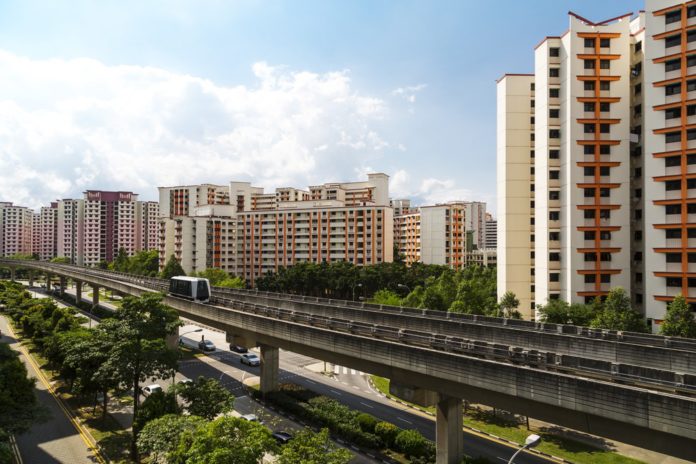
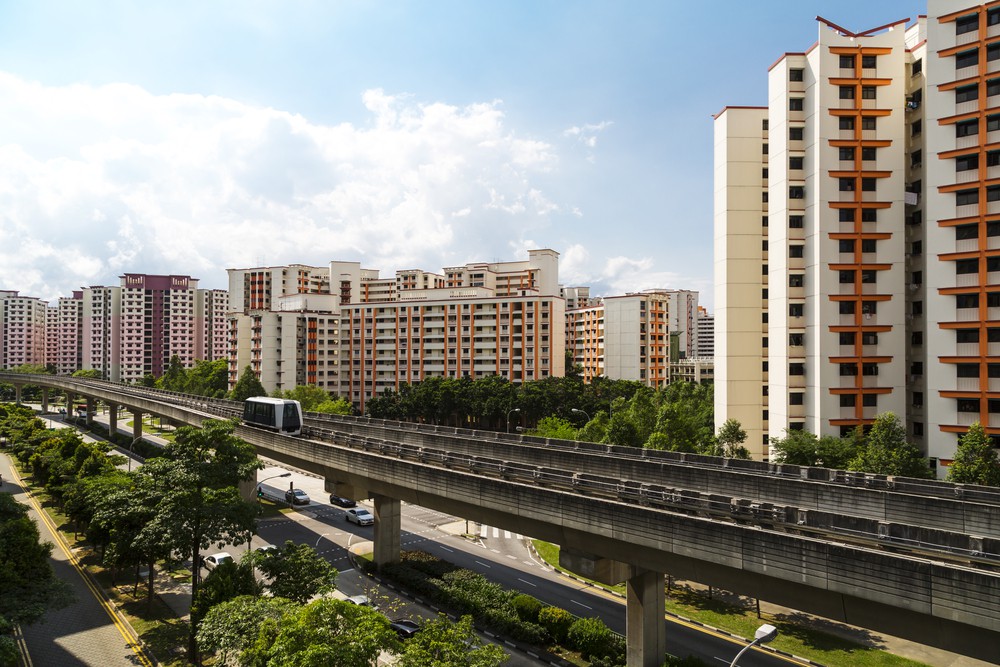
A sky train and track system in a modern Singaporean neighborhood. Source: Shutterstock
In Singapore, landlords are allowed to rent out individual rooms if the unit is at least three rooms, making it the most affordable options for people with a thrifty budget in mind. Depending on the location, the prices can range from S$550 (US$400) to S$1,200 (US$873).
“As for renting out the entire flat, HDB prices are (currently) almost on par with condo prices in the OCR,” the property website said.
“This is because Singapore’s rental market has softened considerably over the past three years. In the more central and mature districts, HDB flats can rent out for around S$3,000 a month (US$2,182).”
However, the website pointed out that this was due to unusually low rental rates for condos in the market.
“The price gap between condos and HDB flats is historically much greater.”
SINGAPORE: For many people caught up in Christmas shopping fever, deciding what gifts to buy for their friends and family is one of the biggest causes of stress during the holiday period. After all, unless you have a real score to settle, nobody wants to give a dud gift.
Yet often, despite the best of intentions, gifts fall flat and recipients end up less than satisfied with what they have received. Many people even go so far as to return unwanted gifts to the store, or “re-gift” them to others or to charity.
In my work at the National University of Singapore Business School, much of my research work focuses on consumer psychology, including how people decide what to buy and how they make decisions when purchasing gifts for others.
In a recent research study with a colleague at the University of Chicago, we looked at why gift givers often choose gifts that fall short of the mark.
Our results showed that when giving gifts, people tend to choose items they expect will trigger the biggest immediate emotional reaction from the recipient – for example a broad smile, a squeal of delight, or even a hug for the gift giver.
However, when placed on the other side, as a gift recipient, people prefer and place greater value on gifts which will bring them greater satisfaction over the long term.
We also found that whether or not the giver would be able to see the recipients open their gifts plays a significant role in making gift decisions. Indeed, when givers learnt they would not be witnessing the recipient’s reaction when unwrapping the gift, their preference for gifts with a higher “wow” factor was significantly reduced.
The reason for this comes down to how humans use non-verbal displays to communicate our emotions – for example, through facial expressions or gestures – and how we interpret and value those displays in others.
(Photo: Unsplash/Jeremy Cai)
Such skills develop from an early age. As we grow we internalise these emotional responses, using them as a guide for anticipating how others will react and make our decisions accordingly.
Several psychological studies, for example, have found that people proactively simulate or forecast how their decisions would impact other people’s emotional reactions and correspondingly adjust their behaviour.
So how does this apply in the process of choosing and giving a gift?
For our study we conducted a series of experiments, each involving around 100 participants or more and across a broad age range, centred on various gift-giving scenarios such as Christmas, a wedding shower and Valentine’s Day.
From our experiments we found consistent evidence that gift givers seek and derive pleasure from the receiver’s anticipated display of emotion when the gift is opened – a process we dubbed “the smile-seeking hypothesis”.
This means that gift givers tend to opt for the gift they expect will trigger the most enthusiastic emotional response from the recipient, even when they know of another option at similar cost that would actually give the recipient greater long term satisfaction.
Another significant factor at play is that a person’s immediate emotional reaction to a gift does not always reflect their deeper satisfaction from receiving it.
Because the receiver’s assessment of satisfaction with a gift is a more deliberative internal process that sometimes bear out only when they use the gift subsequently, it tends not to manifest itself visually or immediately, meaning there are fewer cues for gift givers to pick up on.
Nonetheless, because these emotional signals are valued and actively sought by gift givers, these tend to sway givers’ purchase decisions towards particular choices, such as gifts with that extra “wow” factor.
WE LOOK FOR A RESPONSE
In many situations therefore gift recipients tend to reward givers with signals of gratitude that do not correspond with the long-term value they derive from the gift.
(Photo: Unsplash/freestocks.org)
A case in point is gifts of cash. Many of the participants in our study said that that as recipients they often found that gifts of cash were the most appreciated and satisfying. However, because cash gifts tend to elicit only a low key emotional response – such as, “thanks, that’s very kind” – gift givers try to seek out more impactful gift options instead.
At times of giving, it is often said that it is the thought that counts. Indeed, the phrase is sometimes used as an excuse when a gift is particularly dull or inappropriate – or even, ironically, when very little thought has been put in at all.
What our study shows is that when choosing gifts, we can be swayed into choices that deliver more on our own needs to be immediately rewarded than on maximising value for the recipient.
In other words, even when we do put thought into choosing a gift, we can miss the mark by thinking about the wrong things.
Adelle Yang is an Assistant Professor in the Department of Marketing at the National University of Singapore (NUS) Business School. The opinions expressed are those of the writer and do not represent the views and opinions of NUS.
SINGAPORE: Imagine having a public bus service at your beck and call, all for less than a dollar.
A far-fetched idea to some perhaps, but I had a taste of what that would be like on Monday (Dec 17) as the Land Transport Authority (LTA) began the first part of its trial of on-demand public bus (ODPB) services.
The trial allows commuters in the Joo Koon and Marina-Downtown areas to request pick-ups and drop-offs at any bus stop on weekdays from 11am to 3pm.
They can also arrange for pick-ups and drop-offs on weeknights, from 8.30pm to 11.30pm within Joo Koon and until 11.45pm within Marina-Downtown. These day services will be operated by SBS Transit and are available until Jun 15.
DOWNLOADING THE APPS
Weekday bookings for ODPB services in Joo Koon have to be done via mobile app BusGo. A separate app, BusNow, is required for the weekday service in Marina-Downtown, as well as the weekend night services serving the CBD to Bedok and Tampines route.
Having downloaded the BusNow app, booking a ride of my own within the Marina-Downtown area proved a breeze.
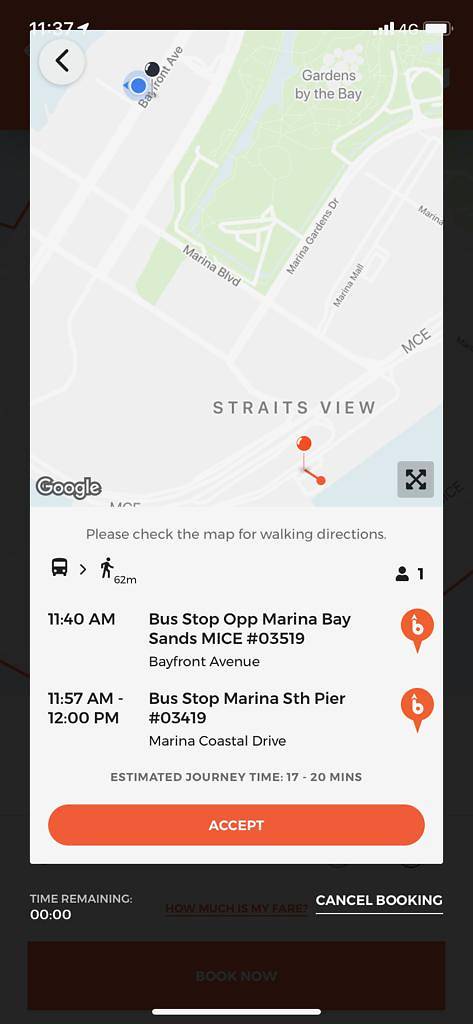
The app accurately detected the bus stop I was at along Bayfront Avenue. After I keyed in my drop-off location – in this case, a bus stop at Marina South Pier – I was matched to an ODPB, which was five minutes away.
Note that should the wait prove to be too long, the app is able to alert passengers to regular services that can get them to their desired location quicker.
The ODPB services are easily identified by their service numbers: for example MD-1 and MD-2 for buses serving the Marina-Downtown route and NB-1, NB-2 for night buses.
The app also include options for group bookings, walking directions to the pick-up point and instructions and allows passengers to indicate if they require wheelchair space
The app interface when making a booking on BusNow. (Photo: Matthew Mohan)
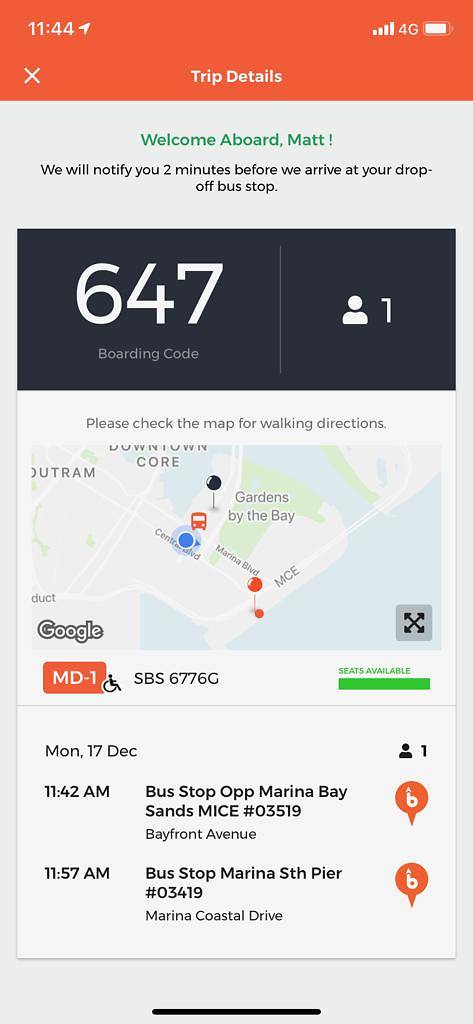
The good thing about the app is the real-time location tracking service, which allowed me to see where the bus I was matched to – in this case, MD-1 – was up to 15 minutes before its arrival.
It also sent me an alert two minutes before we arrived at my drop-off point – useful for those who don’t know where they are going.
The BusNow app interface after boarding an ODPB bus service. (Photo: Matthew Mohan)
Getting on the single-decker bus, all I needed to do was to swipe my phone to produce a boarding code for the bus captain, before tapping my EZ-Link card as per normal.
FEW PASSENGERS
While I knew that the ODPB service is meant for off-peak hours, when there are fewer passengers, I was still surprised to note that I was the only commuter during my first bus ride – apart from personnel from the LTA and staff from local firm Ministry of Movement (Swat), one of the two companies awarded the contracts to carry out the ODPB trials and develop the mobile apps.
But this also meant a quicker ride for me, as there were no other pick-ups or drop-offs during my journey.
With no other passengers, I was able to reach my destination in under 20 minutes – well within the estimated journey time indicated by the app.
The price of my trip? A mere S$0.77, the same amount I would have paid for a normal SBS Transit bus service for a distance of up to 3.2km.
Passengers trying the weekday on-demand services are entitled to a promotional adult fare based on a fixed distance of 3.2km, regardless of the actual distance travelled. This works out to S$0.77 for farecard and S$1.40 for cash before Dec 29, and S$0.83 for farecard and S$1.50 for cash after.
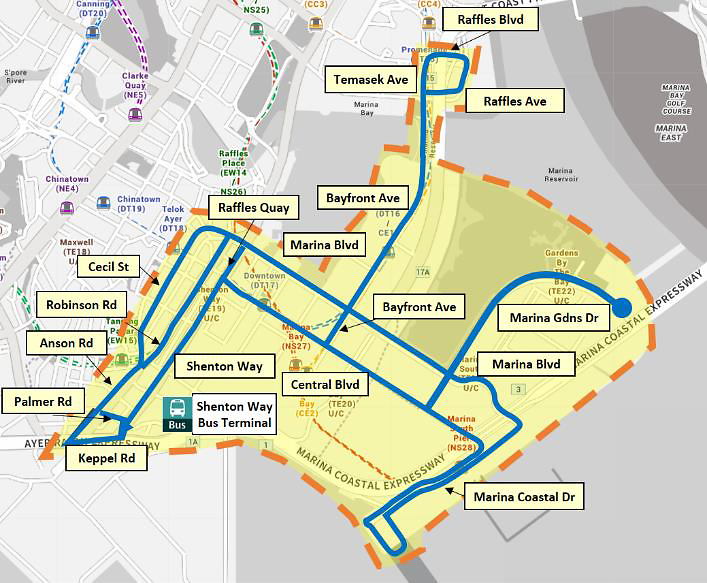
Map showing the route for ODPB services in Marina-Downtown. (Graphic: LTA)
Night services are currently at a promotional flat fare of S$4.50, which is the existing fare of the NightRider NR7.
PASSENGER REVIEWS
Several passengers I spoke to said they were not aware of the apps needed to book the rides, indicating some teething issues with awareness.
One of the commuters who did try the ODPB service was shipping agent Low Chong Gee, who was headed to Shenton Way.
“Today was my first time using the app so I was a little confused as to how it worked,” he said. “But I think after a while, I will get used to it.”
Mr Low, who usually relies on bus service 402, said that the waiting time for an ODPB was similar, but that the on-demand option gives him an added element of convenience.
“I wouldn’t mind trying it again tomorrow,” he said. “To me the most important thing is the waiting time for the bus.
Mr Low Chong Gee tries out the BusNow app. (Photo: Matthew Mohan)
At the International Plaza bus stop, Mr Manikandan Chandrasekaran was the only passenger to board an ODPB. He said he was impressed by the efficiency of the app and how quickly the bus arrived.
“I gave it a try and when I turned around, the bus was there,” said Mr Chandrasekaran, who usually relies on a shuttle bus with a limited number of services to get to and fro from his office.
“The app interface was like using Grab – it was easy,” he said. “It was slick … I think this is better than a taxi.”
Another solo passenger was Mr Hans Ng, who usually relies on bus service 400 to get to his work place at Marina Barrage.
“The interval between each bus is 15 to 20 minutes but with this booking app, the bus reached within five minutes,” said Mr Ng, who had mistakenly downloaded the BusGo app instead of the BusNow app required for the Marina-Downtown area. “I felt the bus ride was also faster because it did not stop at each bus stop.”
During the trial, regular bus services serving the areas specified will still be available, though at lower frequencies. For example, services 253, 255 and 257 in Joo Koon will operate at intervals of 30 minutes instead of their usual 15 minutes, while services 400 and 402 in Marina-Downtown will operate at intervals of 40 minutes instead of 20 minutes previously.
The second part of the trial will make available night services on Fridays, Saturdays and eve of public holidays from 11.30pm to 2am. These will go in one direction only – from the Central Business District (CBD) to Bedok and Tampines via Geylang.
The night services will be operated by SMRT Buses and are available from Jan 4 to Jun 15.
SINGAPORE: The North East Line (NEL) will undergo major enhancement and renewal works which will start in 2019.
“The upgrading of trains is the first major step in this multi-year endeavour,” said the Land Transport Authority (LTA) and SBS Transit in a joint news release on Monday (Dec 17).
They added that upgrading work includes installing a new condition monitoring system to track train performance more closely, upgrading the trains’ air-conditioning, replacing interior fittings such as seats and flooring, as well as detailed inspections of all mechanical and electrical systems.
A contract worth about S$116.7 million has been awarded to CRRC Nanjing Puzhen for the “mid-life” upgrading of all 25 NEL trains.
The 15-year-old North East Line is the third oldest MRT line in Singapore.
“The former SMRT management under-invested in the North-South Line and East-West Line (NSEWL) and they did the minimum when NSEWL needed upgrading,” said Transport Minister Khaw Boon Wan on Monday.
“The cumulative effects of their decisions in those years were only corrected in recent years at great inconvenience to commuters,” he added.
“We have learnt this hard lesson and we are determined not to have it repeated. And that’s why North East Line will be undergoing major enhancement and renewal works.”
To facilitate upgrading work, there will be early station closures starting next month.
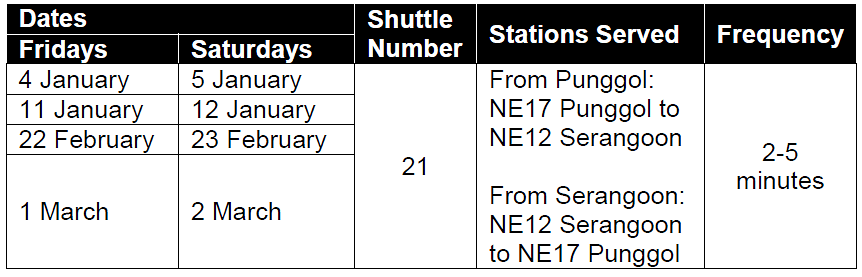
From Jan 4 to Mar 2, Serangoon, Kovan, Hougang, Buangkok, Sengkang and Punggol stations will close earlier at 11pm on Fridays and Saturdays.
Train services for the rest of the NEL, between HarbourFront and Serangoon, will also operate with longer intervals of about nine minutes during the period of early closures.
From Mar 8 to 30, stations between HarbourFront and Dhoby Ghaut will be affected by early closure on Fridays and Saturdays. More details will be announced later, said LTA and SBS Transit.
(Graphic: LTA)
They added that there will be shuttle bus services for affected commuters.
(Table: LTA)
“To facilitate connectivity, southbound train services from NE12 Serangoon to NE1 HarbourFront will be extended to 12.09am. Light Rail Transit (LRT) services will also be extended to 1.10am in Sengkang and 1.20am in Punggol,” said LTA and SBS Transit.
As last train timings may vary for each station, commuters are advised to plan ahead by checking station-specific timings at affected MRT stations, or through SBS Transit’s website and social media platforms.
SINGAPORE: Google has rolled out a new feature in its search engine in Singapore that is meant to make it easier for travellers to compare flight options and explore new travel destinations.
Known as Google Flights, from Monday (Dec 17) users can simply look for the best routes and fare prices by keying in the search terms “Flights to”, followed by the name of the travel destination of their choice, in the Google search bar.
The feature can be accessed via most mobile devices, including tablets and laptops.
On Google Flights, users can compare flight options based on “preferred dates, pricepoint, airlines, connecting airports or even explore flying to alternate airports”, Google said in a news release.
When selecting departure and return dates, Google Flights will also offer users with tips on how to find the best prices for a particular route, which will be prompted in a notifications bar.
Users who need more time to decide on their flights “can choose to track a flight and receive email notifications to monitor price changes and travel tips”, Google added.
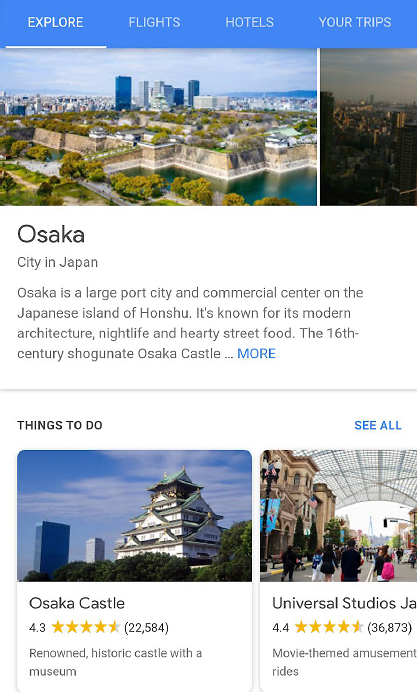
A screenshot showing the Explore section on Google Flights. (Image: Google)
For those who cannot decide on which countries to travel to, they can get inspiration from the Explore section, which offers ideas on where to go based on popular destinations or activities they are interested in.
“If you want to get away for a holiday next month just choose ‘January’ and a trip duration like ‘2 weeks’ to see the dates with the lowest prices to visit each place,” the news release said.
SINGAPORE: A single-storey furniture warehouse caught fire in the early hours of Monday (Dec 17) morning, the Singapore Civil Defence Force (SCDF) said in a Facebook post.
SCDF said it responded to the fire at 3am, deploying a total of 25 emergency vehicles and about 90 firefighters to the scene at 31 Sungei Kadut Street 2.
Up to 12 water jets were used to put out the fire, which did not spread to nearby buildings.
The blaze took four hours to extinguish and there were no injuries in the incident, SCDF added.
Firefighters used water jets to put out the flames. (Photo: Facebook/Singapore Civil Defence Force)
Damping down operations, which is the application of water to burnt surfaces after a fire is put out to prevent potential rekindling, are under way.
Investigations are ongoing to determine the cause of the fire, said SCDF.
About 90 firefighters were dispatched to the scene. (Photo: Facebook/Singapore Civil Defence Force)
The fire took four hours to fully extinguish. (Photo: Facebook/Singapore Civil Defence Force)
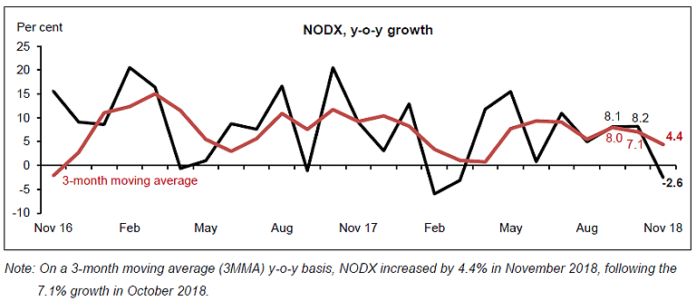
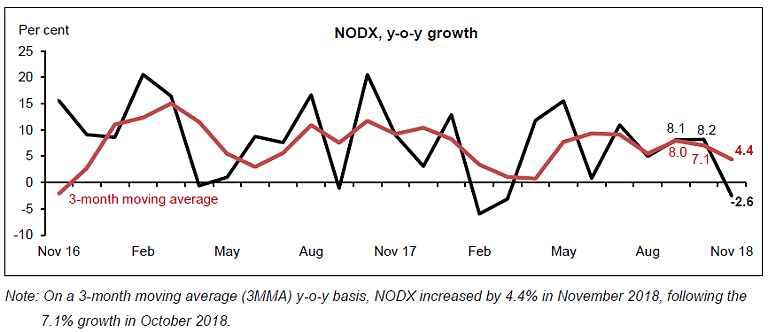
SINGAPORE: Singapore’s non-oil domestic exports (NODX) fell for the first time since March, dragged down by a decline in non-electronic shipments.
Exports fell by 2.6 per cent compared to the previous year, following an 8.2 per cent rise in October, data from trade agency Enterprise Singapore showed on Monday (Dec 17).
On a seasonally adjusted month-on-month basis, exports decreased 4.2 per cent in November, falling from a 4.2 per cent expansion seen in the previous month.
Shipments of non-electronic products fell 5.2 per cent year-on-year, with the biggest contributors to the decline being non-monetary gold (-77.9 per cent), specialized machinery (-12.8 per cent) and petrochemicals (-7.8 per cent).
Electronic exports rose 4.5 per cent in November after a 3.6 per cent decline the previous month.
ICs, consumer electronics and telecommunications equipment grew by 27.9 per cent, 11.5 per cent and 3.4 per cent, respectively.
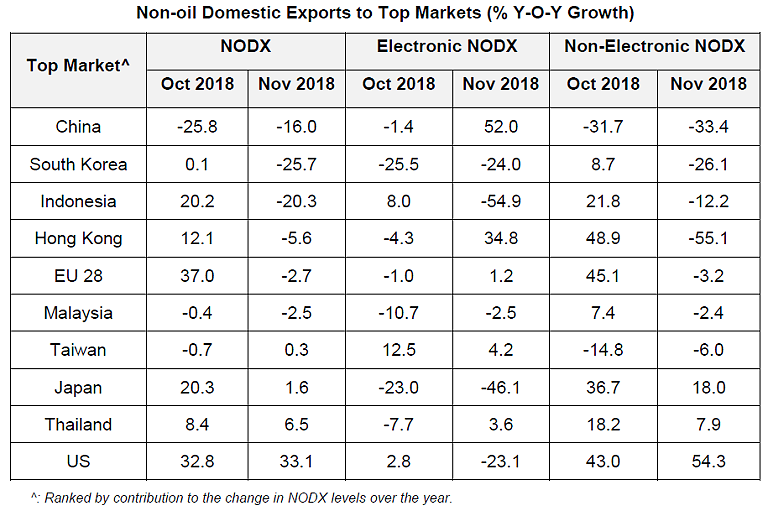
Exports to the majority of the 10 markets declined in November, except the US, Thailand, Japan and Taiwan.
The largest contributors to the NODX decrease were China (-16 per cent), South Korea (-25.7 per cent) and Indonesia (-20.3 per cent).
Total trade rose by 7.7 per cent in November, following the 20.1 per cent growth in the previous month.
SINGAPORE: Last month, Nominated Member of Parliament (NMP) Irene Quay called on the Government to encourage employers to allow their employees to take up to three days of non-consecutive sick leave each year without submitting medical certificates (MCs).
Currently, people who seek medical leave from work must visit a registered medical practitioner to get a MC, even if they need just one or two days to get over a cold.
While some employers in Singapore have embraced such a trust-based honour sick leave system, a vast number of companies still require employees to produce a MC when taking sick leave.
HR experts say the fear of employees malingering and abusing the system seems to be a common concern that holds back employers from exploring an honour system in Singapore.
It might do better that these employers put aside their fears and give themselves an opportunity to trust their employees to embrace the system without abusing it.
After all, employees are considered the most important asset to every company and they are more likely to be engaged at work when they are valued and trusted highly by their employers.
Implementing the system is a good way to tackle this trust issue within companies. But instead of resorting to a hard lever and legislating that companies do so, it’s worth looking at other ways to encourage companies to start modestly with a pilot to test waters before committing to making it official.
After all, they might find it’s in their interests to do so but as the saying goes, you won’t know until you try it.
HONOUR SICK LEAVE SYSTEM FOSTERS TRUST AND COMMITMENT
As organisations move towards flexible working, employees should also be given some flexibility to call in sick without providing a MC.
For common ailments such as a headache or a cold, employees might already have some medication on hand, so they do not need to see a doctor just to obtain a MC. Instead, what they really need is rest.
Leading software developer HubSpot, which has an unlimited honour sick leave system in place since 2010, found that their employees became more engaged and focused because they spent less time on obtaining MCs and more time to rest and recuperate.
This has helped the organisation to attract and retain talents, as employees are given the autonomy to decide if they are fit or unfit for work.
(Photo: Unsplash/Elizabeth Lies)
Having an honour system in place also signals to employees that the organisation trusts them. In turn, employees might be more willing to contribute to the organisation beyond their formal job scope.
DOES NOT NECESSARILY LEAD TO ABUSE OF THE SYSTEM
Although there might be a few inevitable cases of employees abusing the honour system in the early stages of implementation, organisations have found that accountability generally improved over time as employees take responsibility for their own sick leave.
Also, even if a few employees do malinger, it beats having an unwell employee showing up at work and infecting others within the workplace. If employees have the intention to malinger for a day or two, they are less likely to be focused and efficient at work anyway.
Worst still, it can lead to presenteeism, which is costly for the organisation.
Organisations often forget that the current sick leave system doesn’t make it any harder to skip work.
Employees are still able to obtain MC for ailments (such as stomach cramps or headache) that are hard to verify. Organisations then have to cover the incurred medical costs, even though their employees were not ill.
Of course, if an employee tends to call in sick after weekends, the manager should consider having a chat with the employee to understand what’s driving all this.
It is also reasonable for the organisation to have some guidelines in place, such as a no-time-off period, when there is an important event or deadline approaching.
Fundamentally, trust works both ways, but organisations should take the first step in building that relationship as they have the power and means to do so.
FLEXIBILITY LEADS TO POSITIVE IMPACT ON PERFORMANCE
Without the need to produce MCs, the stress of having to head to a GP or polyclinic is significantly reduced, especially for minor ailments. This gives employees ample time to recover, and they might even return to work fully recuperated and earlier than expected.
Most companies in Singapore require medical certificates from approved doctors when employees take sick leave. (Photo: Monica Kotwani)
As with the case of flexible working, organisations should also recognise that an honour sick leave system ultimately ensures that employees are making good use of their time. If employees are well enough to work and have a good sense of responsibility, they will turn up for work.
At the same time, if they are not feeling well, they should be given the autonomy to take a few days off from work. After all, many studies have shown that employees’ productivity and performance are enhanced when they are given the flexibility to telecommute or attend to non-work issues during traditional office hours.
An honour sick leave system also creates a positive workplace culture where employees are treated as responsible working adults who are accountable for their work ethics and moral values. In a trusting work environment, honest working relationships are developed and the employees are less likely to malinger.
It is time Singapore-based organisations implemented an honour sick leave system, as its benefits far outweigh its costs. It is also a win-win situation for both employers and employees.
Employers can foster loyalty and boost productivity through mutual trust and respect, while employees can rest and recuperate without infecting others.
Carys Chan is Lecturer/Assistant Professor in Management at RMIT University. Shirley Tay is a PhD Candidate in the School of Management, RMIT University.
The hit Broadway show will be staging its one and only Asian stop at the Sands Theatre.
Graeme Isaako as Aladdin with Shubshri Kandiah as Jasmine in Aladdin The Musical. (Photo: James Green/Base Entertainment Asia)
(Updated: )
Bookmark
The Broadway sensation Aladdin The Musical will be premiering its Singapore debut at Marina Bay Sands, with performances playing from Jul 21, 2019.
The show, which will run at the Sands Theatre, marks its one and only Asian stop.
Aladdin The Musical made its world premiere four years ago to critical acclaim at Broadway’s New Amsterdam Theatre on Mar 20, 2014. It quickly established itself as one of the biggest new blockbusters in recent years, welcoming close to 10 million people worldwide. It is directed and choreographed by Tony-Award winner Casey Nicholaw, who is known for directing The Book Of Mormon.
Aladdin and Princess Jasmine are certainly not travelling light, featuring 337 glittering costumes – which use 1,225 different fabrics, 712 different styles of beads, and almost 500,000 Swarovski crystals.
The show will also be flying 60 tonnes of automation and staging equipment to Singapore, and 40 tonnes of exotic flying scenery to recreate A Whole New World, such as the fantasy city of Agrabah, the colourful marketplace, the lush palace of the Sultan and his daughter Princess Jasmine, and the legendary Cave Of Wonders.
The cast of 34 is also one of the most diverse in Broadway history.
Based on the Academy Award-winning animated film release by Disney in 1992, Aladdin features music by Tony-Award and eight-time Oscar-winner Alan Menken. The lyrics are by two-time Oscar winner Howard Ashman, three-time Tony-Award and three-time Oscar winner Tim Rice as well as four-time Tony Award nominee Chad Beguelin.
Disney fans can also look forward to the release of the live-action movie adaptation next year, directed by Guy Ritchie, and starring Will Smith as Genie, Mena Massoud in the title role, and Naomi Scott as Princess Jasmine.
The Singapore season of Aladdin The Musical is produced by Disney Theatrical Productions, Australia.