SINGAPORE: Ninety per cent of Immigration and Checkpoints Authority (ICA) officers were on duty and about 500 officers worked overtime last week to manage the high volume of traffic flow at the Woodlands and Tuas Checkpoints during the Christmas holidays, according to Home Affairs Minister K Shanmugam.
Speaking to reporters after visiting Woodlands Checkpoint on Thursday (Dec 27), Mr Shanmugam said officers were “putting in a huge amount of effort” to cope with the end-of-the-year holiday traffic surge at the two land checkpoints.
“On a normal day about 400,000 crossings take place, but during this period it goes up by 10 per cent. While the rest of Singapore is on holiday … a maximum of 10 per cent of our officers (are) allowed to go on leave, (with) 90 per cent manning. Last week alone, around 500 officers (were asked) to do overtime,” he said.
“The starting point is we just don’t have enough manpower. It’s a problem not just for ICA but for industries all over Singapore and other branches of government. So we have to do the best we can with the available manpower,” added Mr Shanmugam.
Last week, ICA said travellers on the Causeway experienced heavy traffic congestion between Dec 14 and 16 due to a bomb hoax, car breakdowns and rampant queue cutting.
Mr Shanmugam said that while most of Singapore slows down during this year-end period, there are areas both in the public and private sector where people have to work extra hard.
“ICA is one of those places, particularly for ICA because demand (at the checkpoints) is very high,” he said.
COUNTERS CLOSED BECAUSE OFFICERS ARE REDEPLOYED
Noting how some commuters observed that some counters were closed during this period, Mr Shanmugam explained that the officers are sometimes redeployed within the Checkpoint to other areas to cope with increasing demand.
He said that if the arrival section had greater demand, officers from the departure will be moved over, and vice versa.
“We are shifting constantly to plug the gap. So you will see some counters closed because the officers have been redeployed,” said Mr Shanmugam.
He also pointed out how ICA would sometimes use the old Woodlands Checkpoint, to cater to the high traffic flow.
“You might see counters closed there because it might be catering exclusively at certain times for lorries … people may not understand how we work,” he added.
Heavy traffic flow at Woodlands Checkpoint on Dec 27. (Photo: Amir Yusof)
“We try as far as possible to clear the backlog, the fact that counters are closed doesn’t mean that some officers are sitting around somewhere doing nothing. All are fully deployed and are working their guts out. It’s a very tough environment,” said Mr Shanmugam.
He also said that ICA has employed technology to alleviate the problem, but pointed out that the Woodlands Checkpoint has physical limitations.
“So if you look at the physical footprint of woodlands checkpoint … there is a a physical limit to how many counters there can be, how many vehicles can be cleared at any given time,” he said.
“We have gone quite a bit on the use of technology. Even as demand has gone up significantly, it has helped us clear and help people travel through. But you know when’s there’s a huge surge, it does impose some limitations.”
He said the Government is thinking of “longer-term solutions” involving the physical footprint of Woodlands Checkpoint to resolve the issue, and that details will be announced in the future.
“Technology is the key enabler, we have to use technology, but you know it’s not a complete solution. In the end you need a officer physically sitting there doing something,” said Mr Shanmugam.
SINGAPORE: A new movement in Singapore that seeks to reduce the amount of consumer waste in the affluent city-state is scavenging for unwanted goods, some in near-mint condition, that migrant workers can send home for the holidays.
“Freegans”, broadly defined as people committed to cutting wasteful production and consumption, have connected with thousands of foreign labourers from lower-income countries, many of whom cannot afford the products sold in the city’s shiny shopping malls.
In Singapore, the luxurious backdrop for the movie Crazy Rich Asians, what passes as trash for one household ends up in a shipping container on its way to the home country of a migrant worker.
“We should give whatever we have in excess to the poor instead of throwing it away,” said Colin Lau, a member of the “Freegan in Singapore” Facebook group whose 6,500 members includes Singaporeans and foreigners.
Filipina domestic workers look through boxes during a giveaway of donated and dumpster dived items outside the house of Singaporean freegan Sarah Ng on Nov 11, 2018. (Photo: Reuters/Natashia Lee)
Some members like Lau search dumpsters and rubbish bins, retrieving discarded items and re-using them or sharing with others in an effort to save money and the environment.
Singapore’s waste is incinerated or shipped to its only landfill on a nearby man-made island. The National Environment Agency (NEA) has estimated that the landfill could reach capacity by 2035, a decade earlier than initially projected.
The freegans often post photos of their discoveries, including barely-worn clothing, jewellery, electronics and luxury goods such as handbags. They also share items with migrant workers at weekly giveaways.
At one such gathering before the year-end holidays, freegans held a lucky draw for discarded luxury items and electronics.
Glendrose Gorriceta, a 45-year-old domestic worker from the Philippines, screamed triumphantly after receiving a Louis Vuitton handbag at her first giveaway.
Filipina domestic worker Glendrose Gorriceta reacts after winning a free Louis Vuitton bag during a giveaway of donated and dumpster dived items at the house of Singaporean freegan Colin Lau on Nov 4, 2018. (Photo: Reuters/Natashia Lee)
Other secondhand items in the lucky draw included a Coach handbag and a set of Sony speakers, both in excellent condition.
Virginia Andrade, 52, said this year she was able to send home two television sets, a laptop for her son, and two wheelchairs for her mother and sister who are unable to walk after suffering strokes.
“Since I have started sending things back we don’t have to buy clothes anymore and we use money for food and school fees instead,” Andrade said.
“I’ve told my family that the items they receive are donated and some are from the dumpster. They are so thankful to Colin and his friends,” she added.
SINGAPORE: In a dramatic rescue on Wednesday (Dec 26) lasting nearly an hour, members of the public banded together to save a kitten trapped between grilles more than five metres above the ground outside Waterway Point in Punggol.
A crowd had gathered outside the mall at about 9.40pm after people heard meowing coming from the the grilles.
Security staff from Waterway Point were alerted to the trapped kitten and contacted a contractor, who brought a ladder and attempted to reach it, but was unsuccessful.
Mr Nicholas Lim, 31, who works in the People’s Association, turned up at the scene after being alerted to the incident via a post in a Facebook group. There, he found others had begun a coordinated rescue effort.
Mr Kim Hock, a 43-year-old hospital worker, had located a ladder nearby that was tall enough to reach the kitten.
The kitten stuck between grilles while Hasan (left) and Nicholas Lim attempt to rescue it. (Photo: Ian Cheng)
At the time, Mr Hasan Md Ashik, a 29-year-old foreign worker from Bangladesh, was waiting for his transport nearby. He noticed the crowd and offered to help, scaling the tall ladder to reach the kitten.
“When I saw a crowd, I thought there were snacks there, but when I asked someone, she said it was a cat,” said Mr Hasan.
“I thought about how to save it and I wanted to ask someone about it. When I finally saw the ladder, I thought that I needed to do it now, and decided to save it.”
Aided by Mr Lim, who also climbed up the ladder to force the grilles open, Mr Hasan was able to reach the kitten and carry it down to safety.
The crowd cheered and clapped for the rescuers while the kitten was swaddled in a cardigan provided by Ms Lyn Zulkifli, 36, a customer service officer from Waterway Point.
(From left) Ms Syarifa Hassan, Mr Nicholas Lim, Ms Lyn Zulkifli, Mr Hasan Md Ashik and Mr Kim Hock, who were instrumental in the rescue of the kitten. (Photo: Ian Cheng)
“Humans can have a good side, you know,” said Mr Lim, who runs a Facebook page called Carpurrdiem, a group that rescues cats.
“A foreign worker saved the kitten. No human is higher or lower in social status; we are all the same.”
Student Samantha Chng, who witnessed the entire ordeal, offered to foster the kitten.
“It was very touching witnessing everyone helping out to rescue the kitten,” said the 22-year-old. “It was really harmonious. Since it’s Christmas, it’s like she’s a Christmas miracle.”
She brought the kitten to the vet immediately and plans to continue taking care of the kitten for the time being.
PARIS: As shopping trends peak over Christmas, this might be a timely moment to gauge the effects of a kind of retail therapy that researchers call compensatory consumption – but one that has a non-conscious process behind it.
Indeed, why precisely do consumers buy products that they don’t really need?
And if shopping is supposed to be therapeutic, to what degree is such consumption helping them to deal with their insecurities?
Most importantly, once they buy the product, does that purchase actually make them feel better?
These are the questions which have driven our research since 2015, absorbed as we are by the hidden impulses driving people’s consumption choices.
What we have discovered is that certain marketing tactics, associated with forms of consumption, including the ones we see around Christmas time, might adversely impact consumer well-being. By bringing these findings to the fore we hope they can help consumers understand and rein in emotional impulses that drive their shopping.
Surveys reveal that the end-of-year holidays encourage a degree of collective over-consumption and binge shopping rarely seen at any other time of the year.
Shoppers in the United States, for example, will spend an average of over US$900 (S$1,235) on their gifts this year (where an average monthly net salary is US$4,158). For American retailers, meanwhile, Christmas represents the year’s largest economic stimulus: In 2018, it is projected to grow to over US$700 billion, a 4.55 per cent growth compared to 2017.
Singaporeans set aside a comparable proportion of an average of S$769 for their Christmas shopping (out of an average monthly net salary of S$3,973).
These trends are reflected elsewhere in Asia as people spend excessively not just at Christmas but pretty much from November to February.
These shopping sprees take in the November 11 Singles’ Day and Lunar New Year in China; the end-of-year holidays travels in the region; and the year-end bonuses in Japan, South Korea, Taiwan and Singapore.
A screen shows the value of goods being transacted at Alibaba Group’s 11.11 Singles’ Day global shopping festival in Shanghai, China, November 11, 2018. (Photo: Reuters/Aly Song)
While there are no available statistics for retail therapy in Singapore, official studies reflect the latest consumption patterns through the Consumer Price Index.
Unquestionably, they reveal Singaporeans’ upward tendency towards brand consumerism. Indeed, the 2014 study shows them spending an average of 22.2 per cent of their global budget on recreation, culture, goods and services, communication and clothing, compared to 22.3 per cent on food.
The next five-yearly survey scheduled for 2019 is likely to see this trend spike up even more sharply.
Among these consumers are people unconsciously seeking to boost a damaged self-worth (their power, intelligence, or even sociability). This compensatory consumption is a well-documented impulse, an action arguably becoming more widespread as consumption becomes available 24/7, thanks to the services on Internet.
So, when Sophie (not her real name), discovers her project’s funding had been slashed by her boss, she suddenly becomes enamoured by the Bottega Veneta leather bag advertisement in her favourite fashion magazine. Meanwhile, after failing his engineering course, Phillip’s first instinct is to buy a marble chess set he never previously dreamt of splurging on.
Both have been drawn into compensatory consumption, which aims to fix damaged aspects of self-identity.
(Photo: Unsplash/Tom Quandt)
Sophie seeks a product symbolic of status and power, to regain her sense of power. Meanwhile, Phillip’s interest in a chess set that is symbolic of intelligence is driven by his need to affirm his intellectual capacity.
Crucially, both are unlikely to be aware of the drivers behind their interest in these products.
But does consumption really manage to repair their self-worth? For three years we have explored the effects of compensatory consumption on self-worth in the US, France and India.
Concomitantly, we analysed what effect marketing tactics have on this retail therapy. Across seven experiments involving over a thousand volunteers, our research reveals that whether compensatory consumption works to fix people’s damaged sense of self-worth depends on the extent to which the connection between the products and aspects of the threatened self-identity is made explicit.
Our conclusions, recently published in Journal of Consumer Research, give us pause for thought.
Yes, consumers compensate for their “self-deficit” by purchasing goods they may not consciously need. However, if brands incite connections to their “self-deficit” in an explicit manner, through their products’ names or marketing slogans, this “compensatory” effect is impeded, even at a subconscious level.
When Sophie is tempted by the Bottega Veneta leather bag, its tagline, “When your own initials are enough”, spells out the product’s connection with power, which is the damaged aspect of her self-identity but might undermine her process of self-repair.
Phillip’s unconscious desire to repair his insecurities about his intelligence through purchasing the chess set could be undermined if the makers use and remind him of slogans like that coined by the 17th century French philosopher Blaise Pascal: “Chess is the gymnasium of the mind”.
In both cases, these explicit messages will remind Sophie and Phillip about their respective failures of power and intelligence, and rumination will impede repair of self-worth.
(Photo: Unsplash/freestocks)
However, our research also reveals that when connections between the product and “self-deficit” are not explicit, it increases the chances for self-repair. Sophie might well restore her self-worth, for example, by splurging on the Bottega Veneta leather bag if there are no taglines explicitly associating it to aspects of power, as luxury products inherently and implicitly symbolise and boost feelings of power and status.
This outcome is not limited to luxury goods alone; it can apply to any goods that symbolise an aspect that a shopper feels strongly about. So, a mere subscription to an intellectual magazine with an explicit tagline could also re-activate negative feelings about one’s own intelligence.
Our research outlines the conditions in which this form of consumption can restore the damaged self. It also questions the marketer’s belief that taglines about the attributes of a brand or product is beneficial for consumers seeking to associate themselves with those attributes.
Artist’s impression of the light-up. (Image: Orchard Road Business Association)
In conclusion, compensating through consumption of products with explicit marketing could have the insidious effect of actually prolonging rather than repairing the damaged self-concept.
So, in this high-octane festive period, should you feel, like Sophie and Phillip, an unexplainable urge to buy a fancy leather bag, high-brow chess set, Rolex watch, upmarket pen, speedy car, or any other symbol of self-worth, you should pause and think again.
Just what is driving this impulse? Should the desire be linked to a life experience that has shaken your confidence, perhaps your purchase will not repair the damage you are trying to overcome – quite the opposite.
Dr Nimish Rustagi holds a PhD in marketing from HEC Paris whose works brings together a combination of academic research and managerial experience. Professor L J Shrum is in HEC’s Marketing Department and is a consumer psychologist. This commentary is based on a paper published in the Journal of Consumer Research.
SINGAPORE: About 260 people, including senior citizens and children, were evacuated after a fire broke out at the Kampung Admiralty retirement complex on Wednesday (Dec 26).
The Singapore Civil Defence Force (SCDF) told Channel NewsAsia that they responded to a fire at 676 Woodlands Drive 71, where the integrated complex is located, at about 1pm.
“The fire involved an electrical device placed in a storeroom on the third floor of the building,” SCDF said. “Fire was extinguished by members of the public using dry powder extinguishers prior to SCDF’s arrival.”
There were no reported injuries and the cause of the fire is still under investigation, according to the SCDF.
Screenshots from videos showing an evacuation at Kampung Admiralty on Dec 26, 2018. (Photos: Vivian Low)
The fire, which is said to have involved an electrical floor scrubber, had triggered the alarm in the building.
Housewife Vivian Low, 29, told Channel NewsAsia that she saw senior citizens, children from the childcare centre as well as staff from Kampung Admiralty’s medical centre and pharmacy, among those who were evacuated.
Ms Low, who was having her lunch there, said the evacuation of the elderly was “really fast”. She added that there were “quite a lot” of them.
Officially opened in May this year, Kampung Admiralty is an 11-storey integrated complex that houses 100 flats for the elderly, a two-storey medical centre and a childcare centre. It also has several dining and retail outlets, including a 900-seater hawker centre.
This story came from a reader tip-off. If you would like to send in photos or videos of something newsworthy, WhatsApp our Mediacorp news hotline at +65 8218 8281 or message us on Facebook.
SINGAPORE: Party-goers out catching a countdown this New Year’s Eve will have the option of taking public transport home.
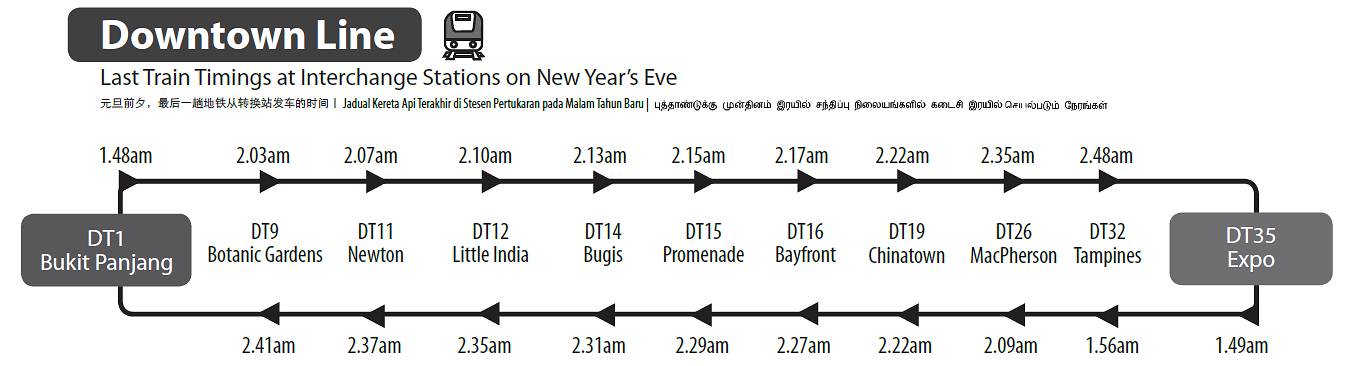
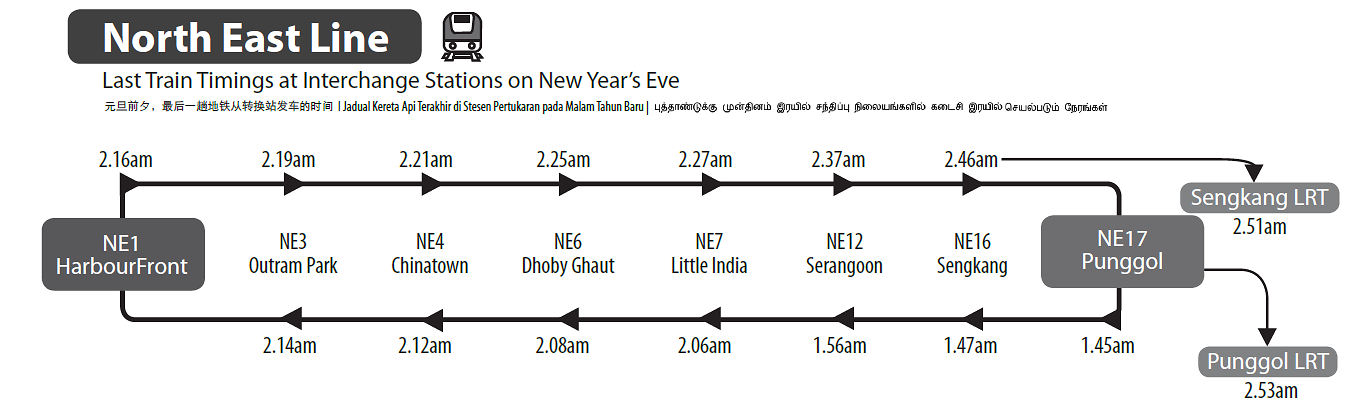
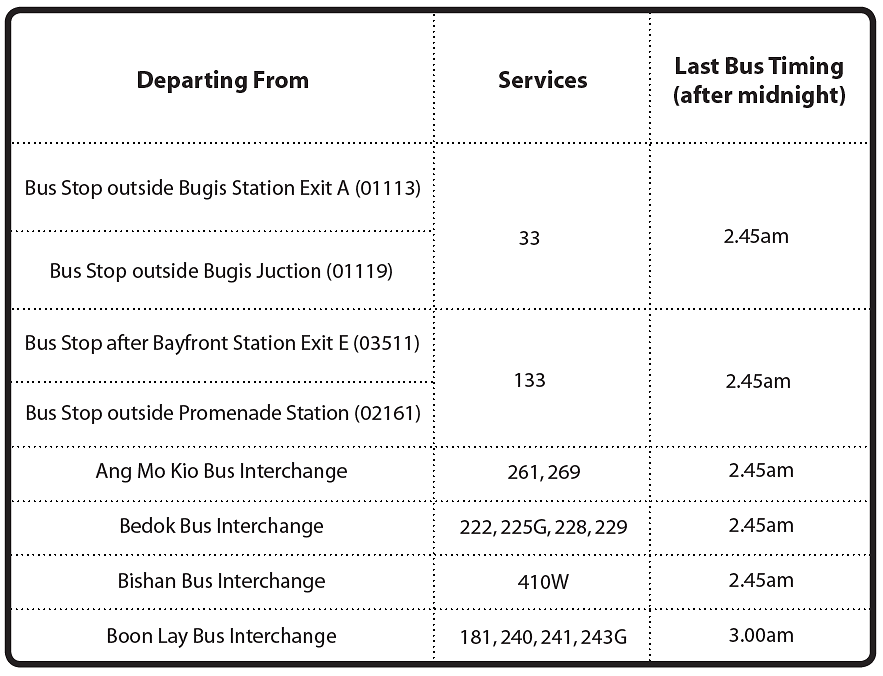
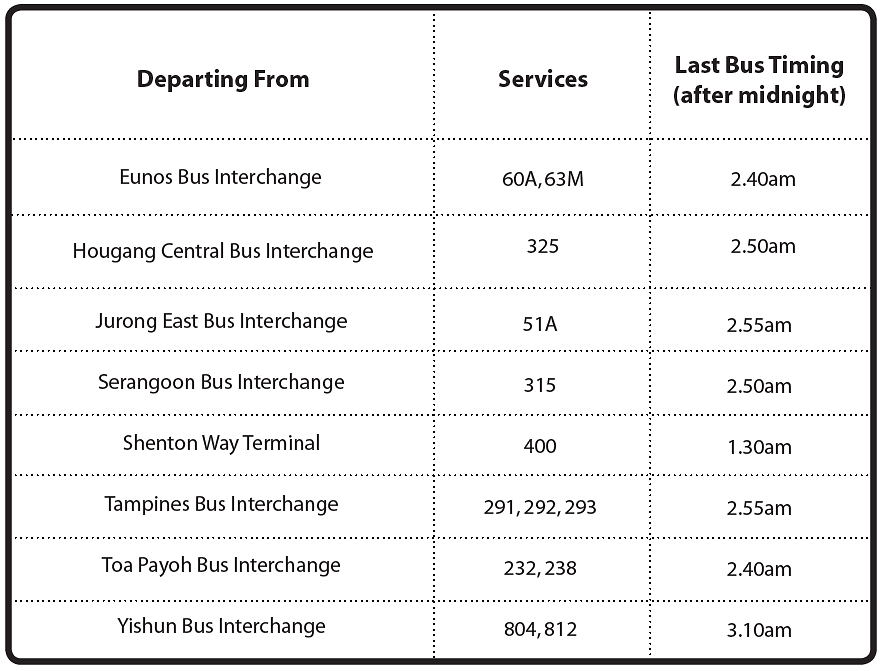
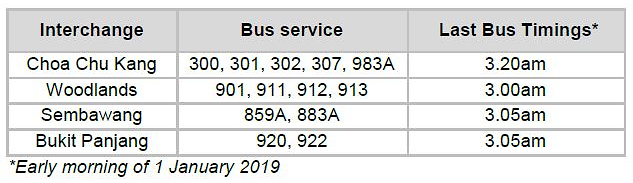
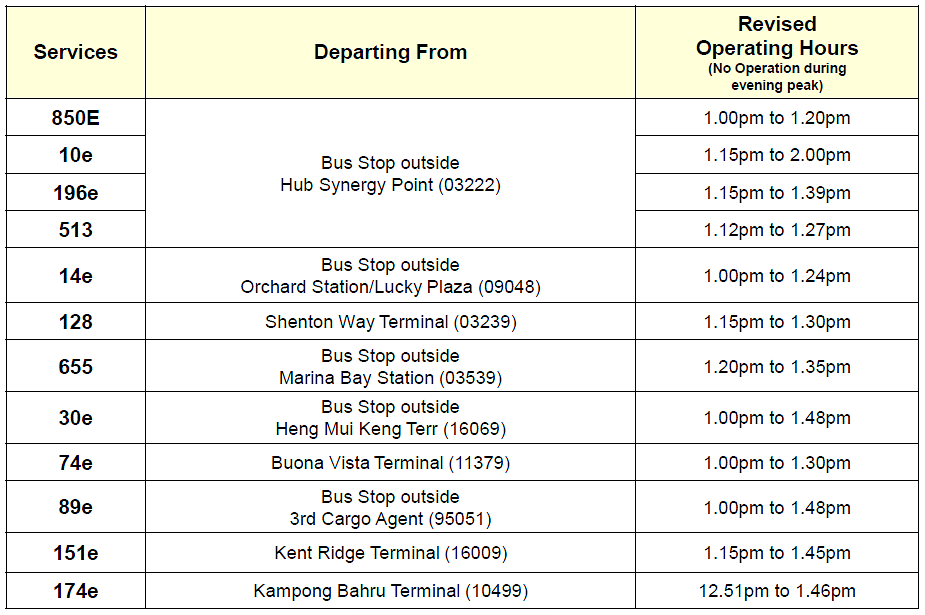
SBS Transit will be extending their train services on the North East Line (NEL) and the Downtown Line (DTL) by at least two hours, the train and bus operator said on Wednesday (Dec 26).
The Sengkang and Punggol LRTs will also run until after the last NEL train arrives at Sengkang and Punggol respectively.
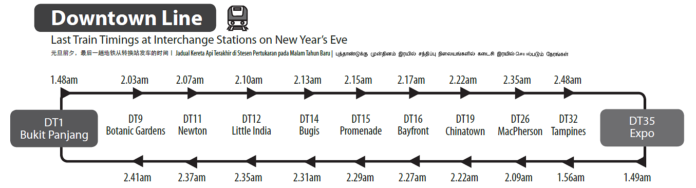
On the Downtown Line, the last trains will be leaving Bayfront Station – the nearest station to the Marina Bay Singapore Countdown site – at 2.17am (on Jan 1) towards Expo Station and at 2.27am towards Bukit Panjang.
The last NEL train towards Punggol will leave HarbourFront at 2.16am, passing by Dhoby Ghaut at 2.25am.
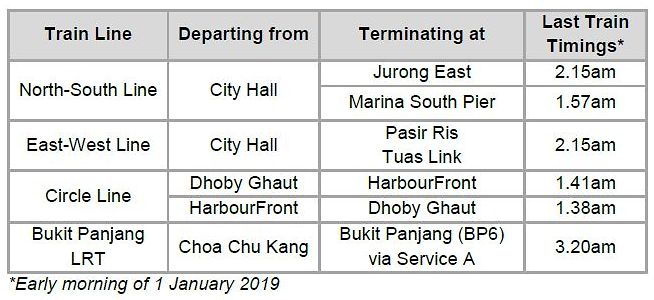
Train services on the East-West Line, North-South Line, Circle Line as well as the Bukit Panjang LRT will also be extended, train and bus operator SMRT said on its website.
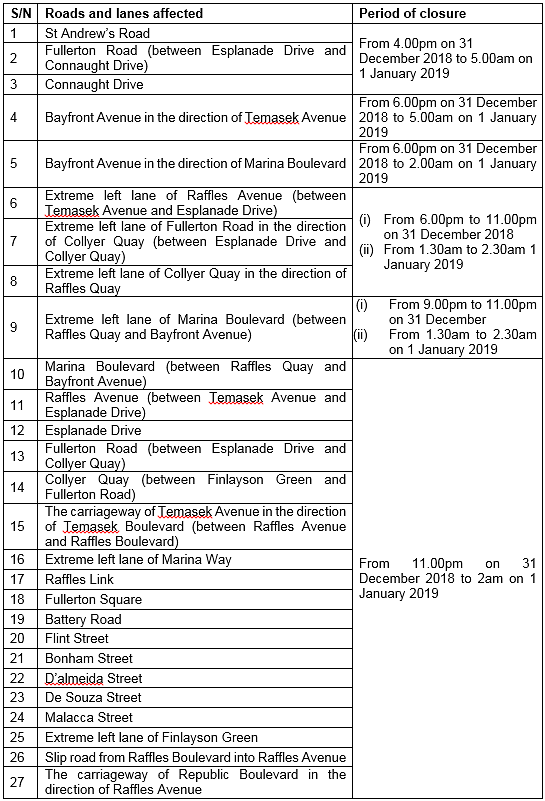
In the event of overcrowding, certain exits of MRT stations around Marina Bay may be closed and the crowd diverted to other areas, the police said on Thursday.
The police added that large crowds may be dispersing slowly after the event and advised the public to be patient and follow security personnel’s instructions.
BUS SERVICES
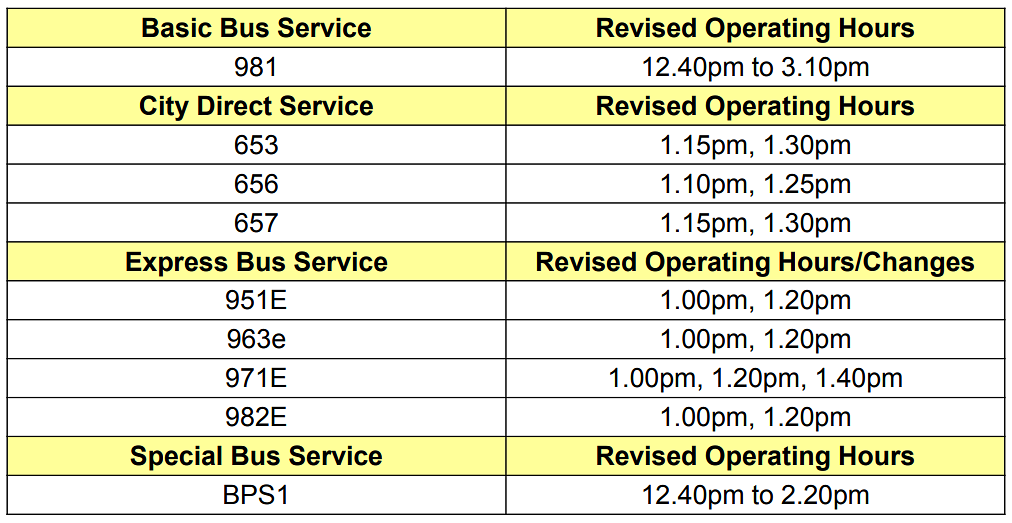
Complementing the extended train hours, the operating hours of at least 26 SBS Transit bus services and 13 SMRT bus services will also be extended.
SINGAPORE: Coin enthusiasts will be able to get their hands on commemorative coins for the Year of the Pig from three other places across Asia, after the Singapore Mint on Wednesday (Dec 26) unveiled the designs for coins from Bhutan, Macau and Cambodia.
Issued by the Royal Monetary Authority of Bhutan, the Happiest Lunar Coin series features zodiac animals and scenic attractions from Bhutan, according to the Singapore Mint.
Bhutan Lunar Boar 1/4oz 999.9 fine gold proof colour coin. (Image: The Singapore Mint)
“The boar is artistically depicted, exuding liveliness and vigour,” it said. “Its legs and ears are portrayed with large swirls and clouds, emphasising its robust features.”
The series is available in ¼ oz 999.9 fine gold as well as 1oz and 5oz 999 fine silver.
The 5oz coin has a limited worldwide mintage of 1,000 pieces. In addition, the series includes 1oz and ½ oz 999 fine silver bullion versions, available in selected markets.
They are priced at S$128 for a 1oz 999 fine silver coin, S$700 for a 5oz 999 fine silver coin and S$720 for a 1/4 oz 999.9 fine gold colour coin.
MACAU COMMEMORATIVE COINS
Meanwhile, the Macau Year of the Pig coins will feature a “lively and robust pig” with hydrangeas on one side and Macau’s Na Tcha Temple, a UNESCO world heritage site, on the other.
Macau 1/4oz 999.9 fine gold proof coin with colour. (Image: The Singapore Mint)
The coins, issued by the Monetary Authority of Macau, are the last issue of the Macau Lunar Commemorative Coins series.
The series comes in three different coin types: 1/4oz 999.9 fine gold (S$1,228) as well as 1oz (S$208) and 5oz 999 fine silver (S$1,128).
CAMBODIA YEAR OF THE PIG COMMEMORATIVE COINS
The National Bank of Cambodia’s commemorative coins has a pig against a background of blooming peony flowers. The country’s famous Angkor Wat temple complex will be depicted on the other side.
Cambodia 1oz 999 fine silver proof coin. (Image: The Singapore Mint)
The coin is of 1oz 999 fine silver and has a face value of 3,000 riels (S$1.02). The coin’s issue price is S$100, according to the Singapore Mint’s catalogue.
All the coins will be issued on Jan 1 next year and will be available at the Singapore Mint’s Year of the Boar Lunar Fair. This will be held from Jan 1 to Jan 13 next year at the HDB Hub’s atrium in Toa Payoh.
Buyers can also purchase the coins online and at other Singapore Mint retail roadshows across Singapore in January and February next year.
SINGAPORE: Mamanda, a Malay fine dining restaurant at Kampong Glam, will close by April 2019 after its lease was terminated by the Malay Heritage Foundation (MHF).
In a statement on Wednesday (Dec 26), an MHF spokesperson said the termination was due to “several regrettable circumstances”.
“We appreciate Mamanda’s efforts at promoting our Malay customs and traditions, as well as our culinary heritage at the premises over the last six years. However, due to several regrettable circumstances, we have proceeded to terminate Mamanda’s lease at 73 Sultan Gate.
“We are unable to disclose these circumstances as they are currently being dealt with by our lawyers. Nonetheless, we continue to applaud their efforts and would like to wish Mamanda continued success in their future endeavours,” the statement said.
The Foundation said that it will be looking for new partners to collaborate with. Kampong Glam is one of several precincts that will form part of the pilot business improvement districts (BID), mooted by the Urban Redevelopment Authority (URA).
A tender notice for the site was published on Dec 14. A tender briefing and visit to the site has been scheduled for Jan 10.
The seven-year-old restaurant on Monday said that the news came at “short notice” and that it was “shocked” to learn that MHF had already advertised open tender offers for the location, a heritage building.
“WE HAVE NEVER NOT PAID OUR RENTAL”
Founder and managing director Zulkarnine Hafiz said that the restaurant was not facing any rental arrears at the time it received the notice of termination.
“We have never not paid our rental,” he stated in a response to a Channel NewsAsia query.
“We did not have any rental arrears when we received the legal letter … We have paid advance rental until Feb 2019. However, MHF still terminated our contract.”
Mamanda restaurant, located at 73 Sultan Gate, is set to close by April 2019. (Photo: Mamanda)
Mr Hafiz also said that communication issues with MHF arose after a change in management.
“Over the years with the previous board management, whenever we had problems, we could easily meet and discuss … but with the new board management, when we received the legal letter, we requested a meeting. We wrote them via email, WhatsApp and even came down to their office, but our request was turned down.
“We were not given a chance to share our concerns, challenges or problems.”
He also added that the restaurant had “always exceeded” MHF’s Key Performance Indicators and that it currently has no plans to relocate.
According to a Berita Harian report, four parties have expressed interest in the location to date – The Landmark Group, Boon Lay Power Nasi Lemak, Islamic Restaurant and Pondok Abang.
Meanwhile. the restaurant is focusing on helping clients who have made wedding and other event bookings after Apr 1, 2019 find other suitable locations, Mr Hafiz confirmed.
“We have since met with all the affected clients and they have agreed to our proposed plan. Some deposits are returned. They have been very understanding and appreciate our help in looking for other suitable locations.”
SINGAPORE: In the classic novella by Charles Dickens, a Christmas Carol, Mr Scrooge is portrayed as a bitter, lonely gentleman who has no Christmas spirit.
He only grudgingly allows his overworked, underpaid clerk, Bob Cratchit, Christmas Day off with pay to conform to social customs.
He refuses an offer by his nephew to join them for Christmas and turns away two gentlemen seeking donations. However, in the end, he sees the consequences of his bitterness and becomes a reformed man.
A POIGNANT MOMENT
As the holiday season gets into full swing, many of us feel uplifted by the festivities happening all around us. Christmas’ universal messages of peace, celebration and gift-giving speak to our inner child and encourage us to look beyond our present circumstances.
A poignant example was during the carnage of World War I, in the week leading up to Christmas, French, German, and British soldiers crossed trenches to exchange season greetings and talk.
In some areas, men from both sides ventured into no man’s land on Christmas Eve and Christmas Day to mingle and exchange food and souvenirs. Men sang Christmas carols together and played games of football with one another, giving us one of the most memorable images of the truce.
A DARKER SIDE TO THE SEASON
Many in Singapore celebrate the holiday season – whether setting up a Christmas tree with decorations, shopping for presents for children, inviting friends over for meals or taking a trip down Orchard Road to view the Disney-themed light up.
It is a time for feasting, gift-giving and catching up with family and friends.
However, for some, the holiday season does have a darker side. In a study done by the American Psychological association in 2006, up to 26 per cent of people reported feeling lonely and 38 per cent felt an increase level of stress during this period.
File photo of shoppers at Orchard Road. (Photo: Aqil Haziq Mahmud)
A number also complained of other symptoms such as fatigue, irritability, sadness and anger.
Some of the stressors included preparing for meals, balancing work with increased social demands, trying to find the appropriate gifts in the midst of the a rush for gifts at the shopping mall. All while trying to create the perfect occasion for family and friends.
In fact, for some, all this is so stressful that I know of some families who avoid this season entirely and use it as an opportunity to travel.
It is also easy to be lonely this season and feel isolated during gatherings. The feeling of one getting lost in the crowds is so much more starkly felt. Parties after parties can lead to ennui and feelings of hollowness.
Then, hidden at the edges of society, there are those who are alone. They may be without friends or family. They might have no home to stay and strive to make their living day by day. It is difficult to feel the joyous holiday spirit when you are struggling.
Feelings of loneliness and stress can trigger or exacerbate underlying conditions. When excessive, feelings of being stressed can become debilitating and possibly trigger anxiety or depressive disorders.
(File photo: AP)
Loneliness, excessive ruminations and comparisons with others can lead to a depressive episode. Other mental health conditions like obsessive compulsive disorder (OCD) may also be triggered.
While we know what loneliness and being stress can feel like, there are also physical manifestations. Poor sleep, irritability, feeling on the edge are part of being stressed and lonely.
Anxiety disorders manifest by persistent feelings of anxiety, ranging from attacks and episodes of severe anxiety to feeling anxious) all the time. They are also associated with a heightened “fight, fright, flight response”.
Sufferers also report feeling irritable and, on the edge, they may experience, tingling sensations in their peripheries, fast heart beats and rapid breathing. They may also complain of vague gastrointestinal symptoms and poor sleep.
Depressive disorders manifest by persistent feelings of low mood.
These may be associated with low energy, poor appetite, poor concentration and memory, feelings of hopelessness as well as an inability to enjoy things. They also may have vague complaints of being in physical pain and poor sleep.
TROUBLE COPING WITH OCD
The recently released Singapore Mental Health Study 2016, OCD or obsessive compulsive disorder was highlighted as a disorder of particular concern. Singaporeans seem to have a higher prevalence of this disorder compared to the global prevalence rates.
OCD is characterised by persistent intrusive thoughts, obsessions and rituals. The sufferer feels compelled to repeat certain behaviours or rituals to assuage some anxieties or fears.
For all these conditions surveyed in the Singapore Mental Health Study 2016, the result of the symptoms is that the individual is unable to function. He or she is unable to work at their usual ability and unable to function as a wife, husband, father, mother or friend.
I have six suggestions for those who might have trouble coping with the festive season.
(Photo: Unsplash/Volkan Olmez)
First, lower your expectations. Things do not have to be perfect. Stop looking for that perfect gift or preparing that perfect dinner party. It may be cliched but it’s the thought that counts.
Second, choose your engagements. You do not have to agree to every gathering or party. Spend time with those who mean something to you.
Third, live healthy. In the midst of all the food temptations, eat in moderation. Find time to exercise. Make sure you have sufficient rest.
Fourth, recognise you are no alone. You are not the only one feeling the way you do. You do not have to be the life of the party.
Fifth, volunteer. Help others. Give not only in terms of material goods but volunteer your previous time.
Finally, seek help. It is alright to admit that you are feeling stressed, depressed or struggling with your emotions. It is alright to admit that you are struggling with thoughts of hopelessness and that life is not worth living, even in the midst of this holiday season.
Whether celebrating the season of peace and goodwill to all mankind or even as a chance to indulge in the year-end sales and food offerings, the holiday season is a joyous occasion but it can be a difficult time as well.
We should take steps to keep ourselves healthy and help those around who need some of the holiday spirit this season.
Dr Mok Yee Ming is Senior Consultant and Chief, Department of Mood and Anxiety at the Institute of Mental Health.
SINGAPORE: As she carried her youngest son to the cold operating theatre, and the anaesthesia was injected, and he closed his eyes, Mdm Carolyn Quek Su Lin felt that she was going to lose him.
In that moment, a question she had asked herself before – because she was “unable to protect” her children from suffering – repeated in her mind: “What have I done to you?”
“My heart just bled,” she said. “Time and time again it’s just so painful. Definitely, this isn’t what I want motherhood to be.”
Her eldest and youngest boys, eight and three years old respectively, suffer from a rare immune deficiency which weakens their ability to fight infection. Her middle child, seven, is clear of the disorder but has autism.
From left: Titus, the youngest; Lucas, the eldest; and Jonas.
It is a daily struggle to care for a child with a disability, let alone three of them, as the programme On The Red Dot finds out in following the lives of three families. (Watch this episode here.)
In Mdm Quek’s case, there is also the question of how is she to overcome her fear, helplessness and guilt as a mother.
‘AS IF I CURSED MY SON’
It was all so different when she quit her job in sales and marketing to pursue her dream of raising a family. She felt “blessed” because the following year, at age 37, she delivered her first-born, Lucas.
Mdm Quek with Lucas.
“He was healthy at birth, and everything was perfect,” said the stay-at-home mum, now 45.
At the age of two, he was due for his measles, mumps and rubella vaccination, which is compulsory for children in Singapore. That was when his body reacted to the vaccine; besides a fever, scars appeared after a few days.
He was rushed to hospital, where doctors gave him a battery of tests to identify the infection.
“They found that the infection had invaded his bone,” she recounted. “And they needed to cut open the foot of his (affected) leg to remove the bacteria.”
Lucas’ sores.
Then they dropped the bombshell: Lucas had X-linked agammaglobulinaemia (XLA), a rare genetic condition. “The next thing I knew, he needed to be on life treatment,” said his mother.
Every four weeks, he needs to go to the hospital for intravenous immunoglobulin therapy in order to fight infections like the common flu. “It’s an eight-hour treatment day,” said Mdm Quek.
She remembers very well that day the doctor explained what immune deficiency was. “I was very lost and felt as if I’d cursed my own son,” she recalled.
“What I aspired to do with my children – to watch them grow, take care of them, laugh with them, embrace with them so many things in life, share with them all my dreams – just came to a standstill.”
Lucas was hospitalised for about three to four weeks.
After he started treatment, she began to search for other solutions, one of which she learnt was a stem cell transplant. But she did not want to push the burden of “such a big operation” onto her second child, Jonas.
“So at that time, I was very naive,” she said. “Probably to ease the burdens, and also to increase the possibility of a match for the stem cell … I decided to try for a third child.”
She and her husband, Mr Teo M K, later decided against a transplant and came to accept lifelong treatment for Lucas, but out of their initial decision, Titus was conceived.
Eventually, as with his eldest brother, he was found to have the same disorder and needed an operation for a bone infection.
Titus, during his infection.
FEELING HELPLESS
Both brothers are now getting the same lifelong treatment, and although the side effects vary from patient to patient, theirs are similar. They have skin conditions like eczema, and they are hyperactive.
“They are so hyper that they can’t control themselves,” said Mdm Quek, who added that she faces the most challenges with Lucas now, as his hyperactivity is coupled with dyslexia.
“It’s the worst combination for anyone studying in a mainstream school … Despite his learning difficulties, he doesn’t qualify for a special school.”
Mdm Quek, with Lucas setting off for school.
If he cannot answer a question in school, he would scratch himself out of anxiety, and any broken skin could give rise to a bacterial infection entering the bloodstream.
So his mother is “in constant touch” with his teachers and allied educators to “brief them on his triggers”. Meanwhile, at home, she has grown more frustrated with getting him to do his schoolwork, as his hyperactivity affects his focus.
“If the teacher has given me four pages, that would take me through the night,” she said exasperatedly.
“When I get so tired … I’d start to say a lot of nasty things like, ‘Why are you so stupid’ or ‘Why can’t you do these things?’”
Mdm Quek helping Lucas with his homework.
She feels helpless not only when she realises that, many a time, she cannot coach him in his studies, but also when she is not the mother she wanted to be.
At a very young age, she lost a sibling, and her mother had “her own baggage” to carry. So growing up, Mdm Quek was looked after by a doting grandmother, while her own mother “was so harsh on discipline”.
“I wanted to be a mother to undo a lot of wrong things that I went through …. But yet I’m repeating all these things to my own child,” she admitted.
“So I started to … resent myself and say that maybe I shouldn’t even be a mother in the first place.”
She has seen Lucas being fearful of her and could “sense his (emotion) that ‘maybe Mummy doesn’t love me’”.
“I want to tell him, ‘No, I love you so much, but I just don’t know how to help you because I couldn’t control myself,’” she added.
“It’s like a … demon in me that’s unleashed. And I need to subdue it. But I don’t know how.”
She has found a way forward, however – through counselling and coaching, especially at parent-child interaction therapy sessions.
Mdm Quek, with Lucas at his monthly therapy.
THE FOUR-LETTER WORD
Besides professional help, Mdm Quek has a few pillars of support: Her faith, her church community and other mothers who have children with rare disorders, such as those she met in the Rare Disorders Society (Singapore).
If not for the listening ear they have provided, she thinks she would have sunk into depression. There is, however, one thing she cannot shake off.
“Ever since I’ve been a mother, I feel that this four-letter word, fear, has been staring me in the face every day,” she said.
Mdm Quek and Lucas, with another mother of a child with a rare disorder.
For example, owing to Jonas’ autism, which he was diagnosed with at the age of three, he lacks an awareness of danger.
So whenever she brings him out, she must “always hold him tight”, even as she admitted that she has “lost him a few times during outings”.
In fact, she must do a “recce” for all her boys’ sakes. “I have to be very mindful of every little detail of their life, mainly because bacterial infection can strike any time,” she said.
“Whenever I see my kids having broken skin, eczema (or) start scratching themselves, I’d be on high alert.”
Mdm Quek running after Titus.
Still, that was not enough to stop Lucas from picking a flower and touching the soil on one occasion after she had parked at a surface car park.
Mdm Quek is also mindful that while her children may look normal, people may not know that they have “invisible” disabilities. Still, the public scorn and criticisms she faces when they act up tears her apart.
Jonas, for instance, is “very fixated (on) things like … the way his toys are being lined up and placed”.
“When he sees his toys being disrupted by his brothers, then he’d melt down, he’d cry, he’d say, ‘The room is a mess, the room is a mess! I have to clean it up, I have to clean it up,’” she cited.
Jonas throwing a tantrum.
To manage that, she may explain that “mess is part of life”, so he need not be upset by it. And if she has to soothe him further, she would hug him closely.
Being in an early intervention programme has helped him, but his future remains a worry to her, especially because of her health. For example, she has a blocked tear duct and thus needs an eye operation.
A fall she had in her 20s caused a tail bone misalignment, and with her frequent bending to carry her children and do household chores, there are times when her slipped disc relapses and she “can’t even function”.
It was only recently that she hired a foreign domestic helper with what spare resources the family has after paying for the children’s special needs expenses of S$2,000 monthly.
Mdm Quek with her new helper, Tata.
A COMMITMENT TO FAMILY
As the sole breadwinner, Mr Teo, an engineer by profession, travels often. And with Mdm Quek busy as the children’s main carer, what “started off wanting a family to journey through life together” has drained both of them, she said.
“He’s so busy working hard and trying to provide for the family … He can’t be there for me if things happen,” she added, admitting that she feels like a single parent in many ways, while she has also neglected him.
“All this learning (of special needs) has robbed us of a lot of time that we could have had for each other … But having children is a choice that I’ve made. And it’s my responsibility to commit to this life.”
An earlier photo of Mdm Quek and Mr Teo.
What the couple, who got married in 2003, cannot offer their children is to bring them overseas – “places I really wish to, like Australia, (to) see the farm stays”, she said.
In lieu of that, the family’s “simple pleasures” include walks in the park, going to the zoo and to Universal Studios Singapore.
“As long as Daddy (and) Mummy are with them, and they have each other, I think to me that’s the experience that … when they grow up, they’ll remember this is the best time they spent with the family,” she said.
There was, however, a surprise in store for them from the On The Red Dot team: Horse-riding (at Gallop Stable), an experience they never had before and something Mdm Quek had wanted for them.
“I always wanted to give my children a happy childhood,” she said. “It’s only at this age that, I feel, they’ll enjoy all these little moments.”
And when that moment came, they were able to ride the horses calmly and follow the instructions. “It made me feel good as a mother. It made me feel achieved,” she beamed.
“It makes me feel very comforted to see them bond well with each other … It gives me hope that these three will be with each other for life.”
Watch this episode here. New episodes of On The Red Dot air on Mediacorp Channel 5 every Friday at 9.30pm.