SOME 900 flat buyers in Singapore cancelled their Build-To-Order (BTO) bookings with the government-run Housing Board last year in yet another sign of a cooling property market in the city-state.
The would-be buyers cancelled the bookings because they could no longer afford the unit, changed their minds about moving or had bought a resale flat, according to the Straits Times.
Thirty-eight percent of the cancelled bookings involved four-room flats, 25 percent were two-room “flexi” or similar units while 22 percent comprised five-room flats.
Three-room homes made up for the remaining 15 percent of the cancelled bookings, National Development Minister Lawrence Wong said on Tuesday.
He said the buyers who cancelled their bookings before signing the lease agreement would lose their booking fees ranging from SGD500 (US$369.22) to SGD2,000 (US$1,476), depending on the type of flats involved.
He added five percent of the booking fees would be forfeited from those who cancel after signing the lease agreement.
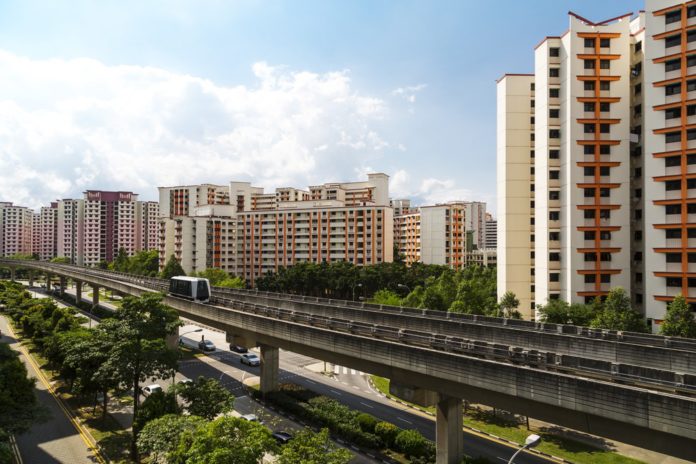
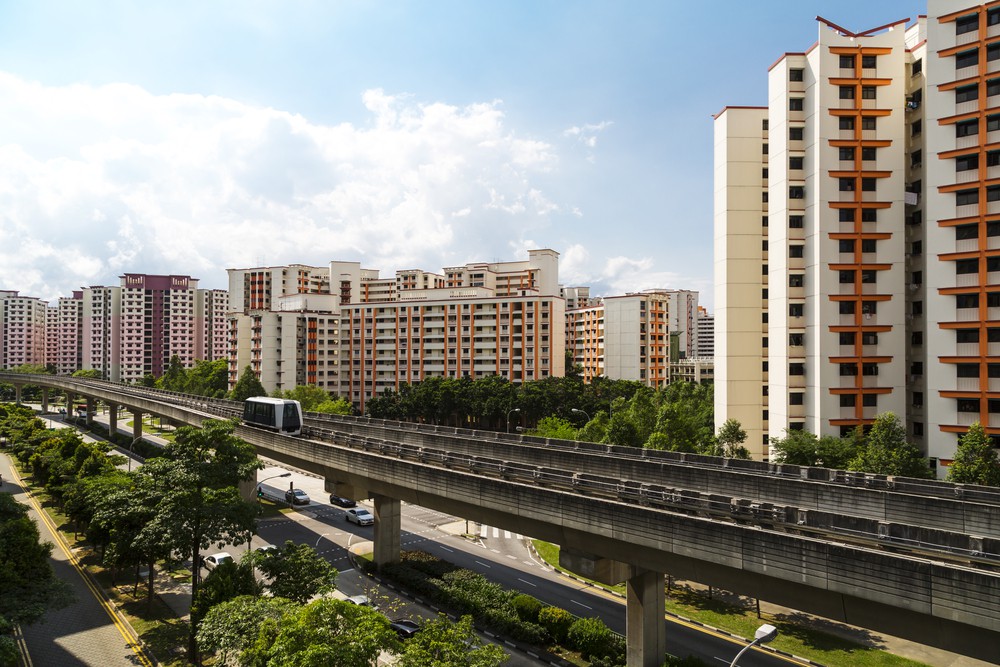
A sky train and track system in a modern Singaporean neighborhood. Source: Shutterstock
“They would also need to wait a year before they may apply for another subsidised flat.”
Wong said the forfeiture of the fees was to ensure that buyers were serious about buying a flat, and so that they do not “deprive others who are in urgent need of buying a flat”.
However, he the government can waiver the forfeiture on valid grounds and on a case-to-case basis.
Brokers predicted the prices of residential properties in city-state would remain stagnant or even dip this year.
While the prices of homes were predicted to increase as much as 10 percent this year, estimates compiled by Bloomberg show a decline of up to three percent next year and home sales below 2017 levels this year may not appreciate any further next year.
Singapore’s regulators saw the need to introduce the measures in wake of a seven percent hike in prices during the first half of the year owing to aggressive land bids from developers and collector or redevelopment transactions.
SINGAPORE: The Diversity Action Committee (DAC) will widen its scope from January, from increasing representation of women on boards of Singapore Exchange (SGX)-listed companies to include organisations in the people and public sectors.
This announced by the Ministry of Social and Family Development (MSF) in a media release on Wednesday (Jan 16).
The committee will also be re-named the Council for Board Diversity and have President Halimah Yacob as its patron.
The DAC was established by MSF in August 2014 after a study initiated by then-Minister of State for Social and Family Development Halimah Yacob showed that Singapore’s business sector trailed behind other countries in terms of women on boards.
It has since worked towards SGX-listed companies increasing the number of women on their boards.
The new council will be chaired by Mr Loh Boon Chye, SGX’s chief executive officer and Mrs Mildred Tan, chairman of the National Volunteer & Philanthropy Centre.
It has 20 members – nine men and 11 women – and will serve for a two-year term from January 2019 to December 2020.
The new council aims to promote a “sustainable increase” in the number of women on boards of listed companies, statutory boards and non-profit organisations by a number of measures.
These include engaging stakeholders on the appointment of women onto boards, undertaking activities to raise public awareness of the importance of board diversity, working to develop a pipeline of board-ready women and working with the Government on policies that impact women on boards.
“Increasing women on boards should be a priority for organisations as this introduces fresh perspectives and enhances corporate governance,” said Mdm Halimah. “Singapore, being a global financial and business hub, is natural ground for having a big pool of highly capable board-ready women.”
She noted that in the past four years, women’s membership on corporate boards for top 100 primary-listed companies on SGX has doubled.
“This is good progress and I commend companies which had taken steps to enhance their board diversity that aligns with company strategy and risk management,” she said. “It is only timely to include organisations in the people and public sectors in the next phase of development.”
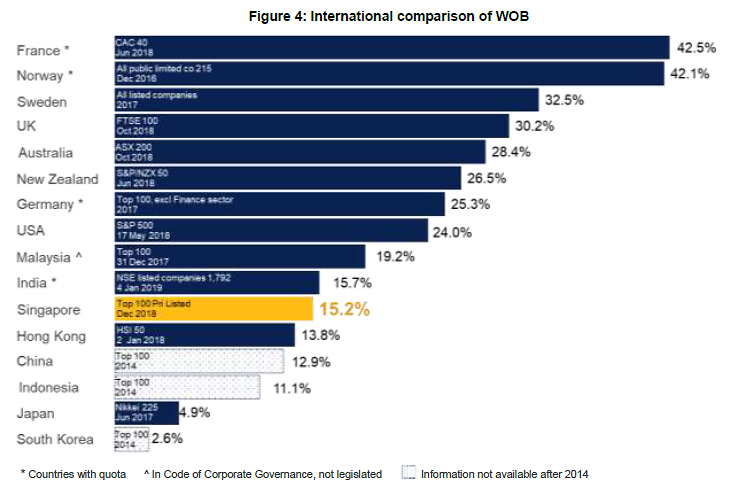
Wednesday’s announcement comes as the proportion of women on boards of the top 100 primary-listed companies on the SGX rose to 15.2 per cent as at December 2018, from 13.1 per cent in the previous year, according to the latest DAC findings.
Meanwhile, the proportion of all-male boards in top 100 companies fell to 25 per cent in 2018 from 32 per cent the previous year. For all listed companies, 48 per cent had all-male boards as at December 2018, a slight decrease from the 50 per cent at the end of 2017.
However, new board seats continue to be mostly filled by men. Among first-time directors for top 100 companies in 2018, 30 per cent were women and 70 per cent men, similar to the previous year.
For all listed companies, 14 per cent of first-time directors were women and 86 per cent men.
(Table: Diversity Action Committee Report)
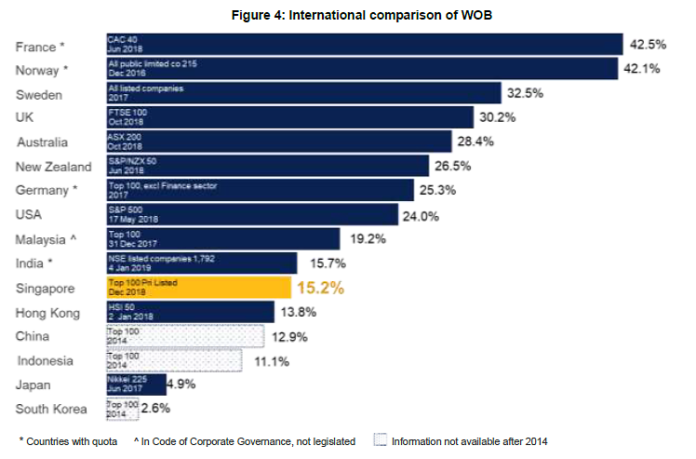
Internationally, Singapore still trails other countries in terms of female board representation according to figures from the DAC, coming behind countries including France (42.5 per cent female representation), Norway (42.1 per cent), Malaysia (19.2 per cent) and India (15.7 per cent) – though some of these countries have quotas for female representation on boards.
SINGAPORE: The owner of a Tampines flat who had a koi tank built on the steps outside his home will appeal against a request by the Housing Development Board (HDB) to have it removed, Tampines Town Council said on Wednesday (Jan 16).
The Tampines Street 41 resident had installed glass panels encasing the space on the steps leading to the entrance of his ground-floor unit, converting it into an aquarium housing about a dozen pet fish.
The owner accesses the flat via an adjacent unit, which he also owns.
Although the aquarium has been around for some years, the owner was not aware he needed a permit for it.
It was only last August that he requested the Tampines Town Council for a permit.
Now, citing safety issues, HDB has said that it cannot allow the resident to keep the koi tank.
According to HDB, there are risks of injury or fatality arising from the entrance steps having been “fundamentally altered”.
For instance, the glass panels can “shatter on impact … and unsupervised children may climb and fall into the tank through the open top,” HDB said in response to queries by Channel NewsAsia.
“Furthermore, there are electrical sockets and cables exposed to the weather elements … the Tampines Town Council has shared these reasons with the flat owner and advised him to remove the koi tank.”
Tampines Town Council confirmed this with Channel NewsAsia on Wednesday, adding that it is facilitating an appeal by the resident with “no immediate deadline at this juncture”.
Although HDB gives town councils the flexibility to manage common spaces, it is guided by the principle that safety must not be compromised.
HDB said: “Hence, town councils would generally allow residents to place small or movable items, such as shoe racks and potted plants along the common corridor, so long as they do not pose any safety concerns.”
The Tampines Town Council is facilitating the resident in his appeal to HDB.
In an interview with Channel NewsAsia last August, Member of Parliament for Tampines GRC Baey Yam Keng noted that there has been no complaint from residents on the koi tank since its installation a few years ago.
“So the town council is prepared to customise a response to it, and see how we could help the resident keep the pond,” he said then.
Mr Baey also noted that while it is obviously against the by-laws, the authorities should be open-minded to look at things on a “case-by-case basis where it warrants”.
However, he urged residents to consult authorities first before going ahead with any modification to their homes.
SOUTHEAST Asian nations have dominated a list of best places in the world to invest in or do business for 2018, highlighting the attractiveness of the growing economies in the region amid a bleak outlook for 2019.
The list by CEOWORLD Magazine recently placed Malaysia in the number one spot followed by Poland.
Other Southeast Asian neighbours Philippines came in third place while Indonesia and Australia were ranked fourth and fifth, respectively out of 50 countries surveyed.
“Malaysia continues to be the most attractive destination for investors and businessmen,” the magazine said.
The magazine based the rankings on 11 different factors, including corruption, freedom (personal, trade, and monetary), workforce, investor protection, and infrastructure.
The factors also included taxes, quality of life, red tape, and technological readiness.
“Each category was equally weighted.”
The magazine based the rankings on 11 different factors, including corruption, freedom (personal, trade, and monetary), workforce, investor protection, and infrastructure. Source: Shutterstock
Singapore came in at sixth place followed by India, Czech Republic, Spain and Thailand.
The world’s leading economies such as the United Kingdom, United States, China and Japan came in at 16th, 18,th, 24th, and 32nd respectively, the magazine found.
A more elaborate survey by the World Bank last year showed more mixed results.
The bank’s East of Doing Business list found Singapore, Hong Kong, and South Korea to be the best places to do business covering the period from June 2 last year to June 1 this year.
The list, which compares business regulations for domestic firms in 190 economies, tracks key indicators for areas such as the ease of starting a business, getting electricity, contract enforcement, taxes and bankruptcy proceedings.
In the list, China was found to be one of this year’s top 10 improvers, advancing more than 30 spots to 46th place in the global rankings, while India became South Asia’s top-ranked economy, advancing 23 spots to 77th place in the global ranking.
Elsewhere, other countries like Taiwan (15th), Malaysia (24th) and Thailand (26th) were also ranked high in the report.
The report said between June 2, 2017, and May 1 this year, 128 governments introduced a record 314 reforms benefitting small and medium business and entrepreneurs, enabling job creation, and stimulating private investment.
SINGAPORE: All they wanted was awareness – of how a mother with a rare disorder can look after her son, of the struggles faced by parents of children with disabilities, and of the realities of growing up with special needs.
But the three families who agreed to open up their lives to the programme On The Red Dot got more than they ever expected.
Hundreds of people have responded to their stories, featured in CNA Insider’s videos and articles, with offers of help of various kinds, requests to meet them and surprise gifts.
The families’ efforts to do their best under challenging circumstances struck a chord with readers and viewers online, who wrote in offering items such as stationery, services such as a daily tingkat delivery and even a sponsored trip overseas.
Singaporeans also opened up their wallets by donating tens of thousands of dollars so far.
More than the money, however, the “kind words and encouragement” from the public has been touching, as Ms Nur Zakiah Jaafar – one of those profiled – said. “The response lifted my spirits,” professed the 34-year-old.
‘IF WE DON’T HELP, WHO WILL?’
Ms Zakiah lives with Buerger’s Disease, an incurable disease of the arteries and veins in the arms and legs. It causes inflammation of the blood vessels, eventually damages skin tissues and may lead to gangrene.
She has lost her toes and all her fingers, except her thumbs, and requires the help of her 68-year-old mother for her daily routine. But despite the constant pain, she is determined to be there for six-year-old son first.
And that motherly love led to an outpouring of support for the family.
“Her story was moving because of her resolve to try and be a present and dedicated mother in spite of her debilitating physical condition,” said Ms Dalvinder Kaur.
“It was a sombre reminder to many of us to firstly appreciate the blessings and stability – no matter how small – we enjoy.”
Explaining why she wanted to donate, Ms Kaur added: “It was heartening to see how Singaporeans learning of her plight on social media were rallying to support her and her family. It made me feel like getting involved in helping.”
Family huddle after the graduation ceremony and performance.
Ms Zakiah was not in any particular need, as she was “coping well with medical support and subsidies” from government agencies and benefactors such as the Islamic Religious Council of Singapore (Muis).
One to two years ago, she also raised about S$40,000 from crowdfunding, which she put into a fixed deposit for her son’s future. But she has since “dipped into it a bit”.
And with the overwhelming response from people who got to know her story recently, she created a new crowdfunding page. In just over a week, it has raised more than S$23,000 from about 460 backers.
The surprised single mother said: “We’re touched that the public came together for us. We’re nobodies, but Singaporeans came out to help us.”
Mr Edgar Chua, one of those who wrote in to offer such help, said that her story “broke (his) heart”. “She’s Singaporean. And if we don’t help her, who will?” he added.
Ms Zakiah, who said she will save most of the money for her son’s future education, admitted that it would make their financial situation “a bit less stressful”.
Doing their best under challenging circumstances.
RAW BUT NO REGRETS
For Mdm Carolyn Quek Su Lin, who has two boys suffering from a rare immune deficiency and one son with autism, the public’s response to her story has given her “inner peace and relief”.
“I’m not someone who really accepts praises because I’m self-critical,” said the 45-year-old. “(But) to have so much … affirmation, it gives me so much comfort that, yes, I’m on the right track.”
She had thought hard about whether to share her family’s story, as she did not know how the “keyboard warriors” would react. But she was hoping to send the message that people should be “inclusive without judgement”.
While her husband, Mr Teo M K, was supportive, he did not want to appear on the show.
His wife has no regrets, however, that the cameras show a very real – and raw – picture of how she struggles to raise her children, especially when she loses her temper with her eldest, Lucas.
“There’s nothing to hide. I’m objective in saying so. I’m not the worst off, not the best, but I’m just human,” she said.
That intimate insight was something that ABR Holdings executive chairman Keith Chua appreciated. “The Teo family’s willingness to candidly share their personal story helps all of us in Singapore better understand the unique challenges some families face,” he said.
“The daily care Carolyn gives to her children and family shows a mother’s love in action. And (with) her … admitting that she, too, has had to learn at each stage, this must be helpful to others caring for loved ones.”
His company has offered to sponsor the family for a trip to Australia, which Mdm Quek cited on the show as a place she could only dream of showing her children.
Mr Chua said that granting this holiday wish was part of his company’s “corporate purpose to practise and encourage caring and sharing”. He added: “We all need to step forward and help each other whenever we find opportunity.”
Others have posted various offers of help online, such as art therapy and free Chinese tuition, which their mother will try to respond to and fit into her boys’ schedules.
For now, she has agreed to ABR’s offer, though no plans have been firmed up. “I was so shocked. It was very overwhelming,” she said of her reaction.
TRUE FEELINGS SHARED
For Mdm Sarina Siregar, being part of this On The Red Dot series gave her something she never fully had while raising her son Tamimi, who has brittle bone disease.
“I was able to know about his feelings when they interviewed him. Because all this while, he hid his feelings about how he was treated, which was not like other students,” said his mother.
“He felt that he was not accepted, not given a chance to do what he can do.”
Getting people to understand how he was feeling was the reason she asked her 13-year-old son whether he would agree to appear on the show, and told him it was “a good idea”.
A reader who has been coping for the past 28 years with the same incurable condition, where the bones are deformed and break easily, said his story “struck a resonant chord”.
“I know school can be a daunting experience, and children may be unkind. However, integration through reasonable accommodation is essential for Tamimi to integrate with society in the long run,” she said.
“The point about the family having to (learn by) trial and error felt very real to me; if my family and I had people to share their experiences, perhaps there could’ve been fewer trials and, following that, perhaps fewer errors.”
Others have also reached out to the family by, for example, offering to buy textbooks and schoolbags. And the biggest worry Tamimi’s parents have had is over for now.
His crowdfunding page set up last year by Mdm Siregar to pay mainly for his transport expenses has seen donations surge past the S$75,000 mark, with well over two-thirds coming in the past month following his story.
The campaign has now been ended. “The funds kept growing. It was so unexpected,” she said. “Thank you so much to the public who were willing to help us.”
All the offers they have received, big or small, have come as a surprise – including an invitation to a PSLE results party a parent was throwing for her daughter. “We did go there to let him enjoy,” said Mdm Siregar.
Things are especially looking up for Tamimi in his new school, which is better able to cater for his needs, she added.
SINGAPORE: The teacher sat beside five of her students, all of them facing a screen and studying a flow chart on the stages of committing a crime they had prepared
“What are some of the actions you can take to reduce the excitement (that comes before committing a crime)?” the teacher asked, raising her voice amid the cacophony of camera clicks that filled the room.
The students glanced quickly at the surrounding media circus and remained silent. “Now distracted. Cannot think already,” one of them blurted out as the room erupted in laughter. The teacher could not resist a smile.
This is no ordinary civics lesson in school, but a class called High on Life conducted in Changi Prison Complex’s Drug Rehabilitation Centre (DRC). The teacher is one of DRC’s in-house counsellors, officially known as a Correctional Rehabilitation Specialist. The students are inmates who are being detained for drug consumption.
This class, called High on Life, teaches inmates to identify and cope with their addictions. (Photo: Marcus Ramos)
High on Life tries to stop inmates from returning to the high of drugs by identifying addictions, teaching coping skills and encouraging the sharing of experiences.
It is just one of a number of psychology-based intervention programmes conducted at the DRC to help inmates address negative thinking patterns related to abuse. For instance, another programme equips them with practical skills – like being more assertive around drug-abusing friends – to prevent relapse.
MORE INMATES
The DRC is in the spotlight after Parliament passed amendments to the Misuse of Drugs Act that would result in more drug abusers going through the DRC regime, which was previously reserved for those who only consume drugs and are arrested for the first or second time. Third-time offenders had to serve long-term imprisonment.
Under the amendments, the regime will be extended to those who have reoffended on three or more occasions, provided they have not committed other concurrent offences. The maximum period of detention in the DRC has also been increased from three to four years.
One of the sections inside the Drug Rehabilitation Centre. (Photo: Marcus Ramos)
Superintendent (SUPT) 1A Soh Yen Li, who oversees a DRC within the Changi Prison Complex, said she will need more hands on deck to help with the expected increase in inmate population.
In 2017, there were 1,360 inmates in the DRC. It is not clear by how much this figure is expected to increase.
“What is really important is to make sure that our officers are adept and ready to provide this rehabilitation support for abusers coming into our system,” SUPT 1A Soh told reporters during a tour of the DRC on Jan 9.
Inmates enjoying a game of takraw during yard time. (Photo: Marcus Ramos)
Chief Warder (CW) 1 Muzakir, who works closely with inmates from admission to release to support their rehabilitation, said his job would definitely become more challenging.
He is one of 13 personal supervisors (casework) (PSC) who holds one-to-one sessions with inmates every month and ensure they have some money and a roof over their heads upon release.
There are a total of 13 PSCs. On average, two PSCs are assigned to 36 high-risk inmates.
With a rising inmate population, it is possible that the PSCs will form three-person teams with some help from their colleagues on the operations side.
“They can actually support us,” CW1 Muzakir said, noting that most of them have been similarly trained in counselling techniques.
The fact that there will be more inmates who have re-offended multiple times despite attending previous DRC regimes also means longer and more intensive intervention programmes, prison officials said. A typical regime lasts six to eight months.
Inmates can go for one-on-one counselling sessions. (Photo: Marcus Ramos)
Ms Lau Kuan Mei, who leads a team of in-house counsellors responsible for developing and implementing the programmes, said a longer regime would give inmates more opportunities to practise the skills, like managing emotions, that help prevent re-offending.
“Regularly, we will review these programmes to see the needs of the drug offenders here,” she added. “Then, we will do our research and design accordingly.”
THE REGIME
In any case, new DRC inmates are first assessed on their risk of re-offending and level of drug dependency, based on factors that include employment, lifestyle and type of peers. This assessment will determine the intensity of their intervention programmes.
After an orientation phase, inmates enter the development phase, which is when the intervention programmes – like High on Life – take place. Classes are usually capped at 12 inmates to facilitate discussion.
Inmates can speak to family members via teleconferencing. (Photo: Marcus Ramos)
Inmates also attend family programmes to help build stronger ties with loved ones, where they are taught to examine the nature of their relationship and how to better communicate. In one such programme, an inmate and his family will attend a two-day course separately before a joint session in the DRC.
“At different milestones, for example, graduating from the programme, we also allow the family to come in and share the success with them,” SUPT 1A Soh said. “At the same time, our specialists will conduct briefings for the family to make them aware of the support they can give.”
Nearer to their emplacement in the community, inmates learn employability skills like time management and interview techniques. (Photo: Marcus Ramos)
Next is the pre-emplacement phase, which is when inmates attend classes focused on employability skills, like practising good workplace communication and managing time and personal finances.
There will also be a job placement exercise for potential employers to interview inmates.
COMMUNITY-BASED PROGRAMME
Inmates will finally serve the rest of their detention in the community to prepare for their reintegration into society. Depending on their suitability and rehabilitation progress, they will be placed in one of three schemes.
The residential scheme allows offenders to stay at home, although they have to observe strict curfew hours and wear and electronic monitoring device throughout. They are also required to work or study during the day.
In the second scheme, offenders are released to work or study in the day before returning to the Lloyd Leas Supervision Centre in the evening. Offenders under the third scheme undergo a structured programme while residing in a halfway house.
Drug Rehabilitation Centre staff (from left) Deputy Superintendent 2 Chng Kuok Leong, Superintendent 1A Soh Yen Li and Ms Lau Kuan Mei. (Photo: Marcus Ramos)
To help with the transition, offenders will also have a reintegration officer and counsellor. Counselling sessions are usually once a month, although they can be more frequent if offenders face issues like low self-esteem and rejection.
“So when they step down to the aftercare phase, they’re not alone,” said Deputy Superintendent 2 Chng Kuok Leong, who oversees a team of reintegration officers.
OFFENDERS ENCOURAGED
One inmate who will soon be transferred to a halfway house is 27-year-old Alan (not his real name), a second-time offender who has spent the past 11 months in DRC for consuming methamphetamine.
Alan said his most valuable takeaways from the DRC include understanding his true self and learning how to say no to drugs more effectively. “The coping skills that they teach us will help us better face our challenges outside,” he added.
Inmates Farhan (left) and Alan with Chief Warder 1 Muzakir. (Photo: Marcus Ramos)
Fellow second-time inmate Farhan (not his real name), who is also going to start his stint at a halfway house, said the DRC regime is more effective than long-term imprisonment.
“It really emphasises self-discipline and identifying our values,” said the 30-year-old, who has been to prison for other penal offences. “There are not many things to go through (during imprisonment). It’s more about free time lock-up.”
SINGAPORE: All it takes is an “idiot driver” hogging the lane to set him off.
“It gets my blood boiling,” said the radio show caller who identified himself as Sin. “And the next thing I’d do is, I’d overtake him. I’d look at him, point the finger at him, call him to the side road, and then we settle it like men.”
Asked by 938NOW host Keith de Souza about facing the consequences, legal or otherwise, of his actions, he said: “I don’t care.”
“If a man is angry, he’s angry,” he said simply.
Sin, who has been driving for over 40 years, is not alone. Videos of road rage incidents on Singapore’s roads have been viral fodder on social media, while related court cases have made the headlines.
According to a survey by insurer AXA, one in two Singaporean drivers feel that the roads have become less safe compared to three years ago – citing more aggressive drivers as the top reason.
So what is it that is setting off seemingly normal people once they get behind the wheel?
In a recent episode, the programme Talking Point delved into the question by getting into a car with a self-professed “road rager”. (Watch the episode here.)
Mac, as he wanted to be known, does not look like an angry person. In fact the 42=year-old project manager’s friend, Siva, described him as “a really awesome dude” – except for his “horrible temper” that “translates into his driving”.
Mac admits that getting angry while driving is normal for him. He said:
I believe that’s how it is on Singapore roads; a lot of people are stressed.
“Sometimes, you start the day with certain emotions after leaving your home or workplace. The first few guys who cut in without signaling, you try to be ‘okay, never mind’.
“But then it happens again – and it hits you to the maximum. You want to show some sign language to tell him that this is not okay.” Once, he even got out of his car to snap at the other driver.
Talking Point host Steven Chia soon got a taste of Mac’s impatience. A bus on his left moved too slowly for Mac, and he sped ahead to cut it off – earning a honk from the bus driver.
Asked if he felt that was “slightly aggressive” driving, Mac sheepishly agreed. “I was also thinking there was a car following behind me… I could be wrong.
ENTITLED DRIVERS
Asked why he thought there was so much road rage in Singapore, ROADS.SG founder Aloysius Fong noted that cars were very expensive here.
“And so, the car will always be a treasured item. If you come close and you threaten my car or me, I will react straightaway,” he said.
Screengrab from another rage video that went viral, at ROADS.SG
His director, Jason Lim, also attributed It to a sense of entitlement.
“Everyone feels like they’re right in these instances. Which is very amusing – it’s why they all send us their videos,” he said. ROADS.SG, which has some 200,000 followers, gets nearly 30 video submissions a day capturing all sorts of incidents on the roads.
Both drivers feel entitled to the fact that they didn’t have to give way to the other person.
ROADS.SG’s Mr Lim and Mr Fong.
One type of driver, in particular, is often generalised as acting entitled: Those who own flashy and expensive cars.
Mr Lester Tang, marcoms director of Sports Car Club (Singapore) – which educates its 120 members to be gracious on the road – agreed that there’s the impression that if one has a high-powered sports car, one must be an aggressive driver. But “sports car or not, road rage is a personality thing,” he said.
Club president Rosalind Choo said she is not an angry driver, but has been the brunt of other drivers’ aggression. Once, she accidentally knocked another car while opening her Lamborghini’s door and apologised for it.
“The next thing (the other driver) said was, ‘Don’t think that driving a supercar is a big deal’. I don’t know where she got that from.”
Rosalind Choo says the Sports Car Club (Singapore) educates its members to be more gracious
TAKE A DEEP BREATH
Can road rage be reined in?
There is no specific law here that deals with road rage, but it is treated as a criminal offence once it becomes a case of voluntarily causing hurt. The number of such cases that involve road rage has actually dropped by nearly 30 per cent – from 90 in 2013 to 66 in 2017.
On a personal level, though, grappling with one’s anger demons can seem daunting. One 938NOW caller described it as something that “takes over” a person. “You’re out of control. When it happens, you are not yourself,” said the man, Mr Chan.
But Mac was open to giving it a go at the Singapore Counselling Centre, which sees more than 70 clients a month who need help managing their anger.
Mr Warton Ong, a professional counsellor, suggested an easy deep breathing technique – inhaling through one’s nose, holding for about four seconds, and exhaling slowly through pursed lips.
“When we’re triggered, our breathing becomes very chaotic,” he explained. “It inhibits the way you think, feel and act.
Once we’re able to stabilise our breathing, then we get the thinking brain back in action.
“And we’ll realise, ‘I need not retaliate, because that will endanger my life’.”
Mr Ong also showed Mac what he calls “thinking traps”, such as “should statements” – telling yourself that things should be the way you hope or expect them to be.
Mac agreed that sometimes he is too quick to judge and blame others. He reckoned that he should focus more on his driving and less on others’.
DID HE IMPROVE?
Mac said he would try to apply Mr Ong’s suggestions in his daily driving routine – and after three weeks, Talking Point put his patience to the test.
With senior instructor Mr Low Kar Yoong from the Singapore Safety Driving Centre secretly taking on the role of a bad driver, Mac was put through a few scenarios.
In one, Mr Low drove slowly and uncertainly in front of Mac, who decided to overtake the road hog. Mr Low sounded his horn and Mac waved him off.
Mac’s patience being tried.
Mr Low then cut into Mac’s lane and jammed on his brakes. Mac high-beamed him and sounded his horn.
Finally, Mr Low cut into Mac’s lane again and made an abrupt left turn, and Mac did not react – he stayed calm.
“I put myself in that position… Sometimes we miss a spot and you want to turn. It could be me,” he reasoned.
Giving his assessment afterward, Mr Low said he thought Mac responded pretty well, pointing out that he “didn’t do any dangerous manoeuvres like overtaking me abruptly”. He added: “Some horning or high beams is fine to prevent accidents from happening.”
Mr Low thinks Mac did well.
Mac shared that he felt calmer than the first time Mr Chia had sat in a car with him. The counsellor’s advice had proven useful.
“Normally I would have used colourful words and pointed my middle finger. But today, I was taking a deep breath and trying to focus on my driving and my safety,” he said.
SINGAPORE: Six men and four women, aged between 17 and 35, were arrested on Friday (Jan 11) during an operation against vice activities along Rowell Road, Upper Cross Street and Beach Road.
The joint operation was conducted by the Central Police Division and Central Narcotics Bureau (CNB).
Three women, aged between 34 and 35, were arrested for offences under the Women’s Charter. These women had allegedly advertised sexual services online and were operating from a rented apartment along Upper Cross Street.
Four men, aged between 23 and 30, were arrested for immigration-related offences. These men had allegedly provided sexual services in shophouses along Rowell Road.
Acting on a tip-off, police and CNB also arrested two men and a woman, aged between 17 and 24, for suspected drug-related offences at a private apartment along Beach Road.
Drug paraphernalia such as improvised drug-smoking apparatuses were seized. (Photo: Singapore Police Force)
Various drugs were recovered from the apartment, including about 21g of Ice, 5g of cannabis and 39 Ecstasy tablets. Drug paraphernalia such as improvised drug-smoking tools and digital weighing scales were also recovered.
Under the Misuse of Drugs Act, any person found guilty of trafficking a Class A controlled drug faces at least five years’ jail and five strokes of the cane.
The police also advised landlords and hotel owners to ensure that tenants do not carry out vice activities in their premises.
Unlicensed brothel operators face a maximum fine of S$10,000 and/or up to five years’ jail. Meanwhile, any person who knowingly lives wholly or in part on the earnings of the prostitution of another person can be jailed up to five years and fined up to S$10,000.