Home Blog Page 861

Last Day at Work: ‘Education is in my DNA’ says school principal as she draws the curtain on a long career

0

SINGAPORE: In her trademark cheongsam, Mrs Chan Kwai Foong treads a familiar path through the school garden.

The ladies’ fingers are planted by the science teachers, she proudly points out. The bananas? A bunch have grown, but not all can be eaten at the moment. And the winter melons? They have slowly sprouted from tiny seedlings to mature plants, and were already harvested.

“I come here as and when I like,” Mrs Chan said laugh. “We are very attached to the garden … It’s something we are quite proud of.”

Mrs Chan is not a gardener, but she might as well be. As principal of MINDS (Movement for the Intellectually Disabled of Singapore) Fernvale Gardens School, she is responsible for the 180 students under her care – all of whom need careful tending and cultivating.

“When you plant the seed, you don’t see the fruit straight away. It takes time,” said the 67-year-old, who has been at the helm of the special education school for five years. “You need to use fertiliser, you need to look after with care, you need to water the plants – all this is part of what we are doing in schools. That’s why I love gardening!”

Mrs Chan knows a thing or two about teaching – having been involved in shaping young minds since she was 19. First a teacher, then a Head of Department (HOD), a vice-principal and finally a principal; she has done and seen it all.

Education, as Mrs Chan pointed out several times, seems to be in her DNA.

A GOOD FOLLOWER WILL BE A GOOD LEADER

It was a word of advice and a twist of happenstance that set Mrs Chan on her career path.

“My late father said this: ‘Teachers have taught you well, go and be a teacher’’,” said Mrs Chan. “And with no second thought I applied … I applied for two jobs, one was a teacher and the other was a nurse … But the letter for the teaching post came in three days earlier – I had actually got both!”

After spending two years at the Teachers’ Training College, Mrs Chan joined the now-defunct Yok See Primary School as a second-language (English) teacher. Her time there would prove valuable, for she would glean a lesson in leadership which she holds dear even decades on.

“What I am today is because I had the influence of my first principal in Yok See,” she explained. “The school had this programme of spring cleaning during June holidays where teachers and even the principal had to do washing.

“The principal came in his pair of shorts. I asked him why he dressed like that and he said he was going to do the washing with us. He was holding the water hose and scrubbing the wall. Then I asked myself if the principal can do all this with us, then why can’t we do a better job?”

Respect is earned, not given, Mrs Chan was keen to emphasise. She reminds her MINDS Fernvale Gardens teachers of this, even on her last day of work.

“To be a leader is not about commanding for respect, it is not about asking people to listen to you and to say that I’m in charge and you have to be listening,” said Mrs Chan during her farewell speech. “Leadership is about working with people, a good follower will be a good leader.”

Mrs Chan Kwai Foong (5)

Mrs Chan Kwai Foong interacts with one of her students from MINDS Fernvale Gardens School. (Photo: Marcus Mark Ramos)

THE SLAP THAT CHANGED A LIFE

As a teacher, and later principal, Mrs Chan has dealt with her fair share of misbehaving students. But she prides herself on being the one who turned them around.

At Bendemeer Primary, her second school, Mrs Chan taught a monolingual class, who could “break bottles and fight like gangsters”.

Incorporating unorthodox teaching tools as the Highway Code to pique students’ interest, she remembers them getting more involved in lessons, swapping the canisters of hair dyes in their backpacks for dictionaries.

And some of those students never forgot her.

Once, a pump attendant at a petrol station would fill her tank with a little extra, his small way of expressing his thanks. Another student turned up at her doorstep, in his hands a small sculpture of a Hindu god of wealth.

“He said: ‘Mrs Chan I know you’re a vice principal now, can you tell me which school are you at? I want to send my children to your school’,” Mrs Chan, who was then a vice principal at Boon Keng Primary School, guffawed.  “My answer to him straightaway was: You already gave me enough of a headache, don’t send your next generation to me!”

A grassroots leader today, Mrs Chan was also approached by a former pupil turned lawyer at a community centre.

“During that time, we could give corporal punishment and he said I slapped him before,” she explained. “I told him – do you know want to sue Mrs Chan? He said no – that slap had changed his life.”

Another challenge as a young vice-principal was to win the respect of some staff. During her time at Boon Keng Primary, Mrs Chan recalls a senior teacher – Mr Lee – who refused to annotate lesson plans, even though it was mandated by the Ministry of Education (MOE).

“He said: ‘I’m so experienced, I taught for the last forty years and everything is in my head’,” she recalled. “MOE gave us three weeks before they came to validate the school – and the first document in that list was the teachers and staff’s lesson plan book. So everyone put it on my table and this man came with nothing.”

In order to help Mr Lee out, Mrs Chan gave him an old record book, asked him to copy the content into a new one and fill that in with his name.

“He felt so guilty for not listening … He became my best teacher,” she said “After this he really appreciated me a lot and became my spokesperson in the staff room.”

Mrs Chan Kwai Foong (2)

Mrs Chan Kwai Foong speaks to new principal Mr Gerard Vaz. (Photo: Hanidah Amin)

As a principal at Fernvale, Mrs Chan’s focus doesn’t lie squarely on the children, she cares deeply for her team of teachers as well.

“The thing I like most about this job is that I could help to mentor teachers, build their potential, groom them to take over the leadership,” she said. “It is a community, you are not alone, you work with everybody and the teachers will give you the support.”

Mr Gerard Vaz, who has taken over from Mrs Chan as school principal, said she took a personal interest in the teachers’ problems.

“Mrs Chan was not just a boss,” he said “For myself, she made it a point to know what’s happening in the family and offered her own little bit of advice, and tried to make herself available whenever she could.”

A “CULTURE SHOCK”

After stints as a principal at Ahmad Ibrahim, Perry and Yishun Primary Schools, retirement loomed for Mrs Chan in late 2013.

Then 62, she wasn’t done with work just yet.

“Retirement age went on to 65 at the time,” she recalled. “MOE said that if you don’t want another job, we’ll give you a lump sum (Employment Assistance Payment).  I was still interested in working with kids so I didn’t want the lump sum!”

“I was at Gold Coast with my family in December that year and I got a call from MOE to say that they were offering me a post to head a special education school. Straight away I said yes – no second thoughts.

“Even in my next life, if you ask me would you want to be, I would still want to be a teacher,” she added.

After passing an interview, it was back to work for Mrs Chan on Jan 2, 2014.  But despite her years of experience, her first day at the school was a “culture shock”, she added.

MINDS Fernvale Gardens School is one of the four special education schools set up in different parts of Singapore by the Voluntary Welfare Organisation (VWO). 

The school serves children with moderate to severe intellectual disabilities, and also those who have conditions such as autism.

“In mainstream schools, I only had one or two students with special needs, but here the whole school consisted of students with special needs,” said Mrs Chan. “Everybody was talking about having a principal coming from MOE … what were they going to expect from her?


Mrs Chan Kwai Foong (4)

Mrs Chan Kwai Foong welcomes her students to school. (Photo: Hanidah Amin)

“But I told myself, since I’m posted here, I need to do something for the students and having been in education for the past 45 years, I told myself there is something to be done. So I decided to engage the teachers, the caregivers and we went on a curriculum journey,” she added.

One of the key priorities on her agenda was to better understand the students under her charge. In order to do so, Mrs Chan had to tap on the expertise of her teachers, some of whom had years of experience in special education.

“I’m not trained in special education, I’m mainstream trained,” she said. “I got the teachers’ buy-in because I told them that I’m learning from them … I told them, I’m trained in school administration, so let’s work together and they took it on board.”

“It’s not just the years of experience being a teacher for so many years but she also offered a different perspective,” added Mr Vaz. “For the other (past) principals who were from MINDS, they saw things from a certain way because they look at things more from what I would call the VWO work lens. 

“Whereas Mrs Chan brings in a slightly more educational perspective.” 

Looking for different ways in which students could learn better was part of Mrs Chan’s personal mandate. For one thing, she helped set up the school’s Spanish Dance co-curricular activity, after noticing the children’s interest.

“Just switch music on and you’ll see the children dancing here,” she said. “I remember the first time when the parents saw the Spanish dance – they were in tears. 

“They were saying that they never knew that their children could dance so well. The parents are very appreciative, when they see their children are able to do certain things which had never happened.”

The students also learn values such as responsibility, teamwork and punctuality through such Co-Curricular Activities, pointed out Mrs Chan.

“This has changed the children, they know they can do it and there is success,” she said. “Parents are very supportive because they see their children able to do and I think it’s very important to help parents see their children being successful.”

The setting up of the school’s community garden was another initiative which the indomitable principal was involved in. 

“This garden is very helpful for us to teach our children, because nothing beats seeing the real thing, and our children all love it,” she said. “When the kids go to their supermarkets and see the vegetables, they can actually link it back to what they’ve planted.

“It gives some hands-on learning, because here we’re not talking about mainstream syllabus, we are talking about daily skills, life skills … However our kids are, if we can think of a way to engage them to help them, they can learn.”

Being a principal is not about being holed up in the office, Mrs Chan is keen to point out.

“I walk around the school, I pay attention to every details and I make sure that children are learning in class, teachers are teaching, school attendants are doing their work,” she said. “The principal doesn’t stop work at 4.30pm and go home. The principal works throughout the day, even sometimes as late as 1am, reading messages, answering emails, attending to emergencies.”

Given her level of involvement in the school – it is only natural that Mrs Chan would find it difficult to finally retire.

“I have grown up in a school, my whole life is around schools, around children, it’s very hard to get out of it.

“Being the last day at work, there is a feeling of loss, I will miss the school, I will miss the children,” she said. “When I see them coming to hug me and say “I’ll miss you’, I really miss them. Hopefully the school allows me to visit them whenever there is an event or function. I would love to be back.”

In her trademark cheongsam, outgoing principal Mrs Chan Kwai Foong treads a familiar path through the school. The seeds have been planted by the teachers, as she proudly points out. Her teachers? Many have grown, equipped with new leadership qualities. And the students? They grow day after day, from tiny seedlings to mature plants, ready for harvest.

This is the fruit of her labour.
Source link

Commentary: Who’s buying private property after last year’s cooling measures?

0

SINGAPORE: Since the last property cooling measures rolled out in July 2018, market sentiments have remained subdued.

The new measures have led to higher acquisition costs for buyers and curbed their ability to take out larger loans to purchase private property, so from a theoretical standpoint, one would expect demand to decline together with prices.

However, the impact on price remains to be seen. In the third quarter of 2018, the Residential Property Price Index (which include executive condominiums) continued to increase albeit at a slower pace. Singapore’s private home segment in 2018 rose nearly 8 per cent, compared with 1.1 per cent growth the year before.

Knightfrank cooling measures 1

All Private Residential Property Price Index (including executive condominiums). (Graph: Lee Nai Jia, Source: Knight Frank, URA REALIS)

SALES POST-COOLING MEASURES MIXED

Residential sales post-cooling measures have been mixed. In 2018, sales plunged by 55.2 per cent year-on-year in August, and 22.4 per cent year-on-year in October. 

But in September and November, we saw an uptick of 18.9 per cent and 50 per cent year-on-year, respectively. The boost in demand in the latter months, however, can be attributed to new project launches with attractive locations and affordable price points.

Overall, total sales volume for the private property market in 2018 was dragged down by a subdued resale market, tempered significantly post-cooling measures. The prime districts (of 9, 10, 11, 1, 2 and 4) and District 5 (Pasir Panjang, Hong Leong Garden, Clementi New Town) witnessed a relatively large drop.

Knightfrank cooling measures 2

Private Residential Property Sales (excluding executive condominiums). (Graph: Lee Nai Jia, Source: Knight Frank, URA REALIS)

Knightfrank cooling measures 3

Changes in volume transacted for private residential property sales (excluding executive condominiums) by postal district (January-November 2018 vs January- November 2017). A darker shade signals higher growth. (Graphic: Lee Nai Jia, Source: Knight Frank, URA REALIS)

The only district that saw an increase in sales was District 7, likely due to the launch of South Beach Residences, which was delicensed after receiving its Certificate of Statutory Completion.

Receiving their Certificate of Statutory Completions meant that subsequent sales of the project are considered resales, and buyers of properties such as this found that more attractive as there is a finished product for viewing and the unit can be moved into immediately.

Additionally, delicensed projects can offer the option of deferred payment schemes and so may have further contributed to the increased sales.  

Despite cautious sentiments, sales picked up in November 2018 – developers sold 1,198 units, higher than the 788 units sold the same month in 2017, according to the Urban Redevelopment Authority (URA). The strong sales in November is significant as market activities historically tend to slow down with the year-end festivities. 

The strong sales reflects Singaporeans’ persistently strong demand for private housing, not just as an asset for investment, but as a home for the future. Private housing continues to hold great appeal for upgraders with their modern amenities, as well as the societal status associated with owning a private property.

KEY GROUPS OF BUYERS

In 2019, we expect HDB upgraders to remain a key group of buyers driving private housing demand. The confluence of fewer interest rate hikes, stable private residential prices and the uncertain impact of the Voluntary Early Redevelopment Scheme (VERS) on HDB flats with expiring leases is likely to encourage more HDB flat owners to upgrade.

READ: Mind the varied impact of HDB schemes on different groups of home owners, a commentary

Separately, while non-landed homes in Singapore remain popular, the market for landed homes is expected to do well, as investors are attracted to this asset class due to limited supply. 

According to URA, the total stock of landed homes grew by 7 per cent in the past decade, since the third quarter of 2008.

Knightfrank cooling measures 5

Stock of landed and non-landed homes. (Graph: Lee Nai Jia, Source: URA, Knight Frank)

There have also been signs indicating that foreign buyers are slowly returning to Singapore’s residential market, from September 2018.

In August, foreign buyer purchases rose to 65 units in September, from 50 units in August 2018. The number of units purchased by foreigners then stayed largely unchanged, till November. 

While the high Additional Buyer’s Stamp Duty (ABSD) may continue to deter foreign buyers to a degree, prices of Singapore residential properties are likely to remain resilient compared to other assets, and continue attracting foreign high net-worth individuals seeking portfolio diversification or wealth preservation.

SINGLES AND SILVER POPULATION MAY ALSO MOVE TO PRIVATE HOUSING?

We should also expect a greater demand for smaller-sized private housing in 2019, from the rising number of singles among Singaporean citizens.

According to the annual Population in Brief report by the Department of Statistics, the proportion of single women aged between 25 and 29 rose from 60.9 per cent in 2007 to 68.1 per cent in 2017. 

Among men, the proportion of the same age who stayed single increased from 77.5 per cent to 80.7 per cent, over the same period. 

READ: The Lease Buyback scheme can give singles more housing options, a commentary

Separately, ageing baby boomers (born between 1946 and 1964), particularly those who have accumulated sufficient wealth, are also expected to contribute to the demand for smaller-sized housing in 2019, through right sizing. 

As at 2016, data from population.sg estimates that approximately 1 million Singaporean citizens fit this profile. Correspondingly, this may give rise to demand for two-bedroom units, with right-sizing likely to occur in both private and public housing.  

condos

General view of private and HDB properties in Singapore. (File photo: TODAY)

GROWTH AREAS WOULD CONTINUE TO ATTRACT BUYERS

Moving forward, we expect demand for private homes to remain exuberant, albeit tempered by the government’s new cooling measures, as buyers continue to be attracted to new neighbourhoods in Singapore.

For instance, despite the implementation of the Total Debt Servicing Ratio in 2013, demand for private residential properties in Jurong East and the Lakeside District surged, as buyers’ interests were spurred by the government plans to develop the area into the second Central Business District.

In the coming years, the next neighbourhood likely to generate huge buyer interest is the Punggol Digital district, which is expected to bring about 28,000 jobs to the Northeast region. As such, prices in the North East region are likely to resist pressure from a slowing market.

Furthermore, sales of executive condominiums are also expected to do well this year. Targeted buyers in this category have not been as affected by cooling measures, and prices for these projects are likely to remain affordable, compared to private projects. 

The projects at Sumang Walk and Anchorvale Crescent will be popular among buyers, given the upcoming Punggol Digital District.

Unfortunately for some, interest rates are projected to increase in 2019, but this is unlikely to cause much direct impact on demand. The necessary upfront costs, down payment and ABSD however, will remain the bigger deterrent to purchasing private homes for equity constrained households.

Dr Lee Nai Jia is Senior Director and Head of Research at Knight Frank Singapore.

Source link

Measures to cut sugar intake should apply across industry, say participants at dialogue session

0

SINGAPORE: Proposed regulations to cut sugar intake in Singapore should be extended across the industry and not just on pre-packaged sweetened drinks, said most participants at a public consultation session on Saturday (Jan 19).

This is to level the playing field, as well as to encourage more to offer a wider range of healthier options.

Saturday’s discussion was one of more than 10 such sessions that have been organised by the Ministry of Health (MOH) since it proposed four measures last month to curb sugar intake.

These include banning and taxing some pre-packaged sweetened drinks, tightening advertising regulations and implementing a mandatory nutrition label on such products.

Professor Teo Yik Ying, dean at the Saw Swee Hock School of Public Health, highlighted the seriousness of the problem, even as Singapore ramps up its fight against diabetes.

“Right now, Singapore has fluoridation in our water. But more than 50 per cent of our pre-schooling children suffer from dental cavities. This indicates that we have a major problem in our society around what we are feeding our children,” he said.

Prof Teo was among the 50 participants at the dialogue session, which was also attended by members of the public as well as representatives from the advertising and F&B industries.

proposed measures to cut sugar intake from pre-packaged sugar-sweetened beverages

The proposed measures come as the Government looks to step up its war on diabetes.

One of the concerns raised was the sustainability of a proposed tax on pre-packaged sweetened drinks. Beverage companies, in particular, said the tax cannot be targeted only at particular sectors.

“It will simply shift the consumer to unregulated products like bubble tea, or those that are served fresh in coffee chains,” said deputy CEO of Pokka International Daniel Teo.

“If you look at the research carefully, 50 per cent of the cause of diabetes is attributed to sugars in food and processed food, so that’s a huge other part that needs to be addressed.”

READ: A commentary on why a tax on sugary drinks not enough on their own to halt obesity in Asia

Instead of a tax, Mr Teo suggested that the Government reward businesses for producing healthier products as they cost more to manufacture.

He added that a tax may not be sustainable in the long run as consumers who already like sweetened drinks may not be deterred by price hikes.

“I used to be from the tobacco industry. There have been taxes on tobacco for 20 years but smoking has not come down, so I really don’t think one single measure will work. I rather create rewards for people making a healthy choice. People love rewards, nobody likes punishments or a punitive approach,” said Mr Teo.

READ: Sweeter than soda? The hidden sugars in bubble tea

The idea of a tax was mooted to spur lifestyle changes, said Senior Minister of State for Health Edwin Tong.

“We want this fiscal measure to influence and shape this behaviour. We want this to shape the behavior of the market that’s consuming it and also the behaviour of the manufacturers who are producing it.

“If we impose taxes, if we do take that step and end up collecting more tax, then I think something is not right. It means that people are willing to pay that tax to consume the same amount of sugar,” he said.

MAKE MORE HEALTHIER OPTIONS AVAILABLE

On the proposal of a ban on the sale of higher sugar pre-packaged drinks – which contain at least 5.5 teaspoons of sugar per 250ml serving – most participants agreed that it would be a draconian measure.

They noted that instead of limiting unhealthy choices, a wider range of healthier options should be made available.

average sugar level of sugar-sweetened beverages singapore

On average, Singaporeans currently consume more than 1,500 teaspoons of sugar from pre-packaged sugar-sweetened beverages every year.

The measure to implement mandatory nutrition labels received more support. MOH had proposed this move to help consumers make informed choices.

Student Muhammad Sufyan Juhari, who attended the dialogue, said: “Most of us have a certain diet and care about how much sugar we are consuming. So these nutrition labels are important. But it would be more effective to make it simple, clear and concise. Only then will we understand what we are putting into our body.”

READ: Diabetes risk, weight gain: The possible bitter effects of too many sugary drinks

Participants also supported the proposal to tighten advertising regulations across mass media channels by banning advertisements of unhealthy food and drinks to children.

However, most acknowledged that it may not produce significant impact as consumers are already aware of established brands.

They suggested instead to regulate alternative platforms like the online space and social media, where media consumption is steadily increasing.

“We do have to grapple with a new forum, a new medium and to find a way to reach out better, but we also don’t want to unfairly prejudice one aspect of advertising over another,” Mr Tong cautioned.

He added that there is no single silver bullet to curb sugar intake, and that the  measures proposed have to be reinforced by a strong educational effort.

“If you’re off sugar or a high sugar content for a while, your palate adjusts. We do want to inculcate that behavior from a young age, we want to shape it as far as possible and that I think that’s one such measure which will be sustainable. And education will underpin all these efforts as we move forward.”

Since public consultations started last December, MOH has reached out to about 3,000 people online and through dialogue sessions.

Source link

Food delivery start-up Plum to cease Singapore operations on Jan 21

0

SINGAPORE: Food delivery start-up Plum will cease operations in Singapore from Jan 21, it said in an email to customers on Saturday (Jan 19).

Plum has been in business here for less than a year, having launched in Singapore in March 2018.

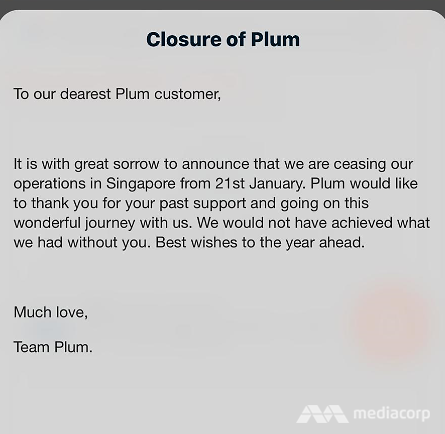
“It is with great sorrow to announce that we are ceasing our operations in Singapore from 21st January,” the company said in its email. “Plum would like to thank you for your past support and going on this wonderful journey with us. We would not have achieved what we had without you. Best wishes to the year ahead.”

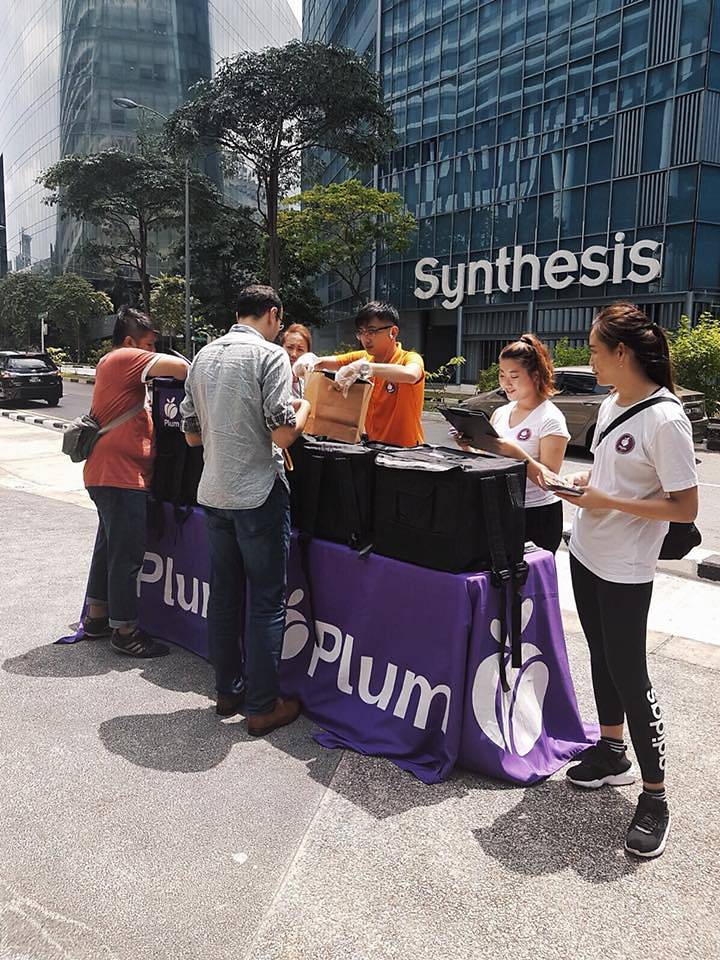
Unlike the typical food delivery service, the Hong Kong-based start-up delivers to specific pick-up points at a fixed time during lunch from Monday to Friday. There is no delivery fee. The menu is curated and changes daily.

Designed for the office crowd, pick-up points include locations in the Marina Bay area, Tanjong Pagar and one-north.

Plum closure app

A notice of closure on Plum’s app. 

Last November, Plum laid off its entire staff in Hong Kong, as reported by the South China Morning Post. Co-founder of Plum Desmond Clinton Cheung told the news portal that the company wanted to “right-size” operations and embark on a more sustainable business model.

Plum at Fusionopolis

A Plum pick-up point in the one-north area. (Photo: Plum Food SG/Facebook)

Customers in Singapore said Plum was still sending Chinese New Year promotions via its app this week. 

App user Koh Kim Joo questioned the short notice given to customers. 

“It seems like they picked the timing to release the notice on a weekend to avoid the influx of customer complaints,” he told Channel NewsAsia. 

The 32-year-old, who uses the app at least once a week, said he has S$30 worth of unused Plum vouchers which he bought in November, adding that he had been planning to use them before they expire on Feb 28. 

“It’s not ethical for companies to do this, and I certainly feel that I have been cheated as there was a false sense that they were still operational,” he said.

Channel NewsAsia has reached out to Plum Singapore for more information.

READ: Amid stiff competition, hawker food delivery start-up Fastbee to end operations on Aug 14

Its decision to end operations here comes amid stiff competition in the food delivery market. Hawker food delivery service Fastbee ended operations last August on the back of difficulties in attracting fresh funding.

Source link

More MRT trains and stations dressed up for Chinese New Year 2019

0

SINGAPORE: Decorations for Chinese New Year are up – in MRT trains and stations as well as buses. 

This year, selected trains on all five MRT lines are decked out in auspicious motifs compared to three lines last year. 

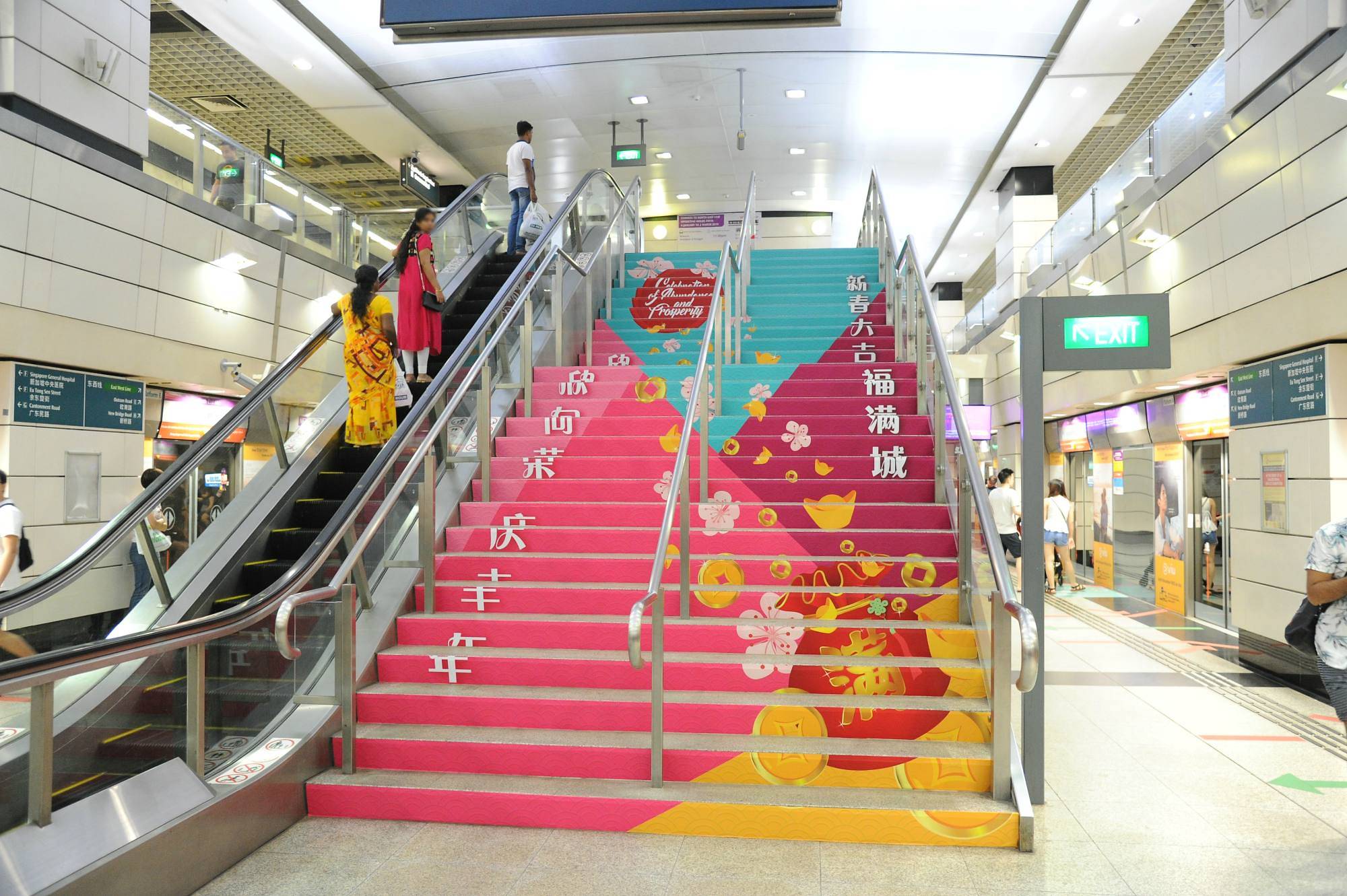
Selected MRT stations such as Outram Park, Bugis and Esplanade also got a pop of festive colour for Chinese New Year, which falls on Feb 5 and 6 this year.

LTA CNY train 2019 floor

A train floor decorated with Chinese New Year motifs. (Photo: Facebook/LTA)

“With the theme Celebration of Abundance and Prosperity, we join commuters in ushering in the Year of the Boar with Zodiac motifs and other auspicious elements such as gold ingots symbolising wealth and prosperity, as well as cherry blossoms which symbolise rebirth, renewal, optimism and new beginnings,” said the Land Transport Authority (LTA) on Saturday (Jan 19).

LTA CNY train piggy

A Chinese New Year-themed train. (Photo: LTA)

LTA MRT station CNY 2019

A staircase decorated with Chinese New Year-themed motifs at Outram Park MRT station (Photo: LTA)

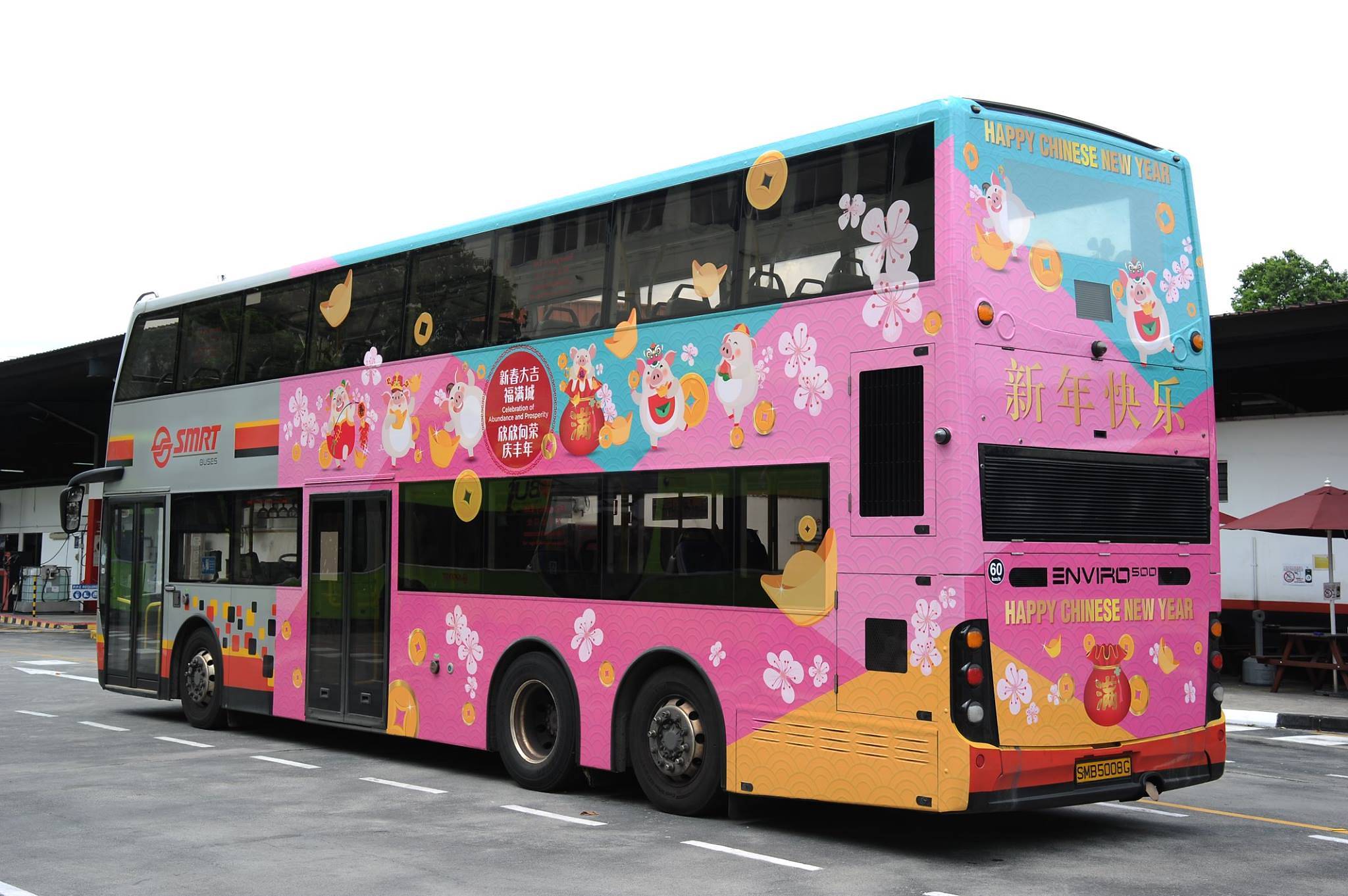
Buses plying services 80, 143, 166, 147 and 174 will be also decorated to the same theme.

READ: Chinese New Year-themed trains, buses in 2018

LTA CNY bus 2019

A Chinese New Year-themed bus. (Photo: LTA)

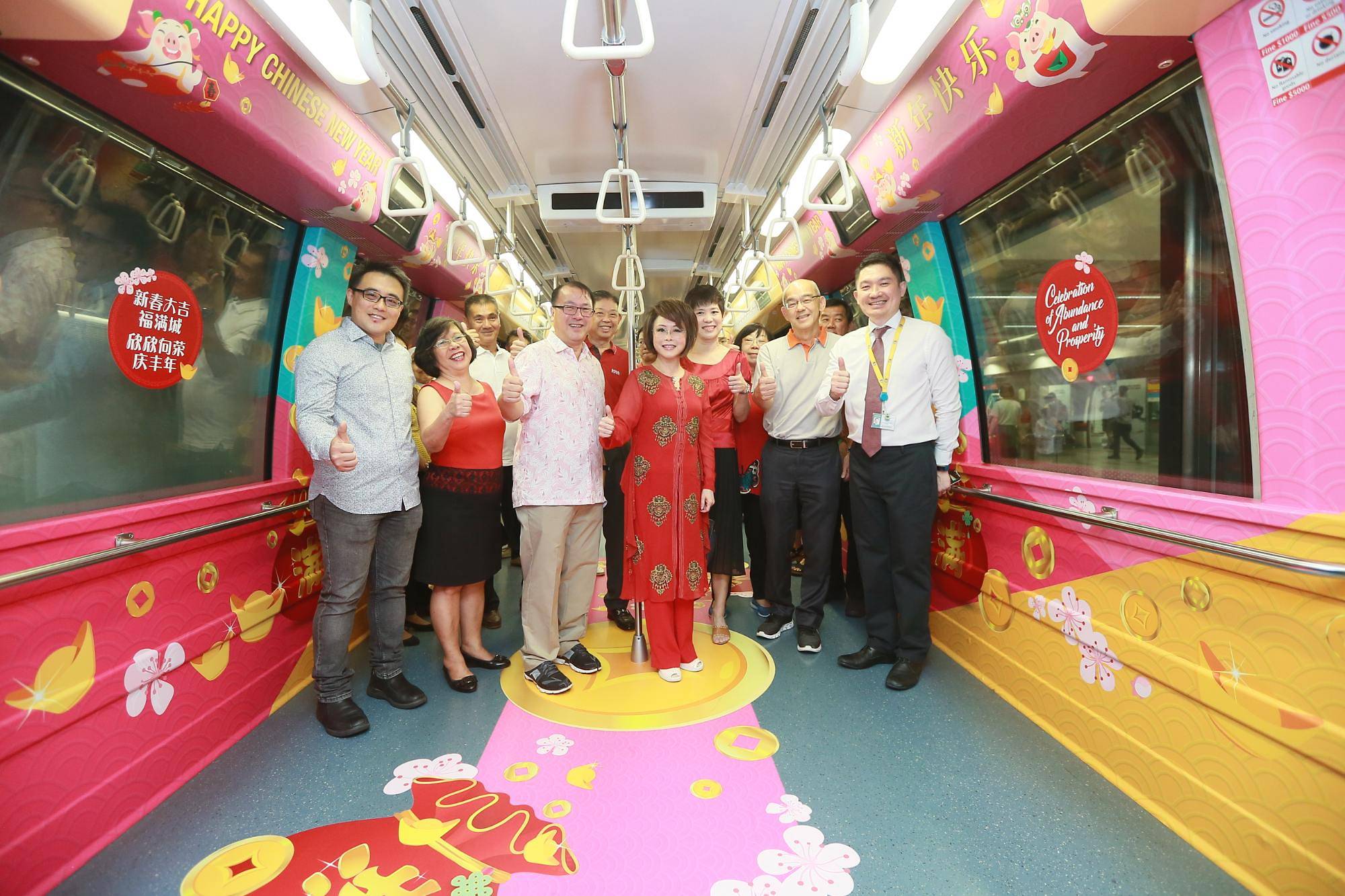
Launching the themed trains and stations, Member of Parliament for Jalan Besar GRC Lily Neo took a decorated train from HarbourFront station to Outram Park station on Saturday.

The decorations are the result of a collaboration between LTA and the Kreta Ayer-Kim Seng Citizens’ Consultative Committee, as well as transport operators SBS Transit and SMRT.

CNY bus 2019

Dr Lily Neo at the launch of Chinese New Year-themed trains and stations in 2019. (Photo: LTA)

“Themed stations, trains and buses are part of LTA’s efforts to liven up the commuting experience during festive seasons, and foster positive commuter culture,” said LTA.

The decorated trains and buses will run from Jan 19 to Feb 19. 

Source link

When it’s life or death: Family members donate livers to relatives despite risks

0

SINGAPORE: As she was being wheeled into an operating theatre at the National University Hospital, the last thing Ms Yvonne Chan heard was her five-year-old daughter crying out for her.

“Mummy, please come out again and see me,” the child said as she wept. 

Ms Chan was also in tears and her heart crushed a little hearing the plea and her two-year-old daughter wailing. But she was resolute, and there was no question in her mind that she was going to go ahead with the surgery.

The 35-year-old engineer was about to donate part ofher liver to her father, who had been given six to 12 months to live.

Speaking to Channel NewsAsia Ms Chan said: “At the time I thought: ‘This is for my daddy, so I don’t think I can have any holding back to say I don’t want to’. It’s not out of gratitude. It’s because of the strong bond I have with him.”

That was in September 2017. Today, her father Casey is healthy and she holds close to her heart the pride of giving him the chance to be “reborn”.

While Ms Chan had every intention to donate her liver from the get-go, tests and discussions with her two older brothers meant that the operation was held nine months after her father was told he would need a liver transplant.

Two “black dots” had been detected on the surface of his liver, and while the doctors could not confirm that he had cancer, the cells were growing, and he was in urgent need of a transplant by the end of 2016.

“CAN I DROP OUT OR NOT?”

Despite that, Mr Chan’s first reaction was to ride it out and face death. While his children were willing to donate to him, Mr Chan was initially not in favour.

Mr Chan, who was at NUH on Dec 19 last year for a follow-up appointment with his daughter, said: “I told myself forget it, never mind. I don’t want them to suffer, and my age is already catching up. If I receive this liver, how long can I live? 10 years? 20 years?”

But he realised he could not stop his children. His second son William lost 20kg in three months so he could be a suitable donor, and his sister had done all the tests that showed she was suitable. In the end, Ms Chan did the donation as her liver would fit into her father’s body better.

Mr Chan had niggling doubts over whether to do it up till the last minute. Ms Chan was already in the operating theatre being prepared for the transplant. Outside, Mr Chan asked his son-in-law: “Can I drop out or not?”

But it was too late for that. They went ahead. A successful transplant later, Ms Chan wears her scar from the surgery as proudly as a badge.

“I am proud to show everyone that I have this scar, because to me it represents my dad. It’s as if he’s with me all the time. We are two in one now,” she said.

However, there were some who expressed doubts. Her husband asked her “Why you?” while others said she was a selfish mother and wife. These did not stop Ms Chan, and she managed to convince them. It was with the full support of her husband and family that the operation happened. 

NOT WANTING THE YOUNGER GENERATION TO BE BURDENED

Mr Chan’s hesitation in getting a donation from his children is not uncommon, doctors from the Liver Transplantation Programme at the National University Hospital (NUH) told Channel NewsAsia.

“The elderly often have this feeling that they shouldn’t burden the younger generation, which is why they refuse,” said the programme’s medical director Dr Lee Guan Huei.

It is not that children do not want to come forward, but the patient or their family so do not want them to take the risk, he said. This is not ideal, he added, giving the examples of countries like South Korea and Taiwan where liver donation among family members is socially acceptable and natural.

In fact, Singapore has a long way to go for liver donation, whether from living or deceased donors, he said.

Despite having the progressive Human Organ Transplant Act (HOTA) in place to encourage people to donate their organs when they die, the number of deceased donors is low, Dr Lee said.

Under the law, someone’s organs can be donated when they die unless they opt out. However, this does not always happen. A typical scenario is one in which someone dies without discussing their preferences with relatives. The family does not know what the deceased wants and is likely to come up with reasons not to donate.

“No matter what the law says about the State owning the rights to use organs from people who have not opted out, it’s hard to push in such situations,” he said. He explained that families will be emotional, and the subject is not easy to broach.

shridar iyer and lee guan huei

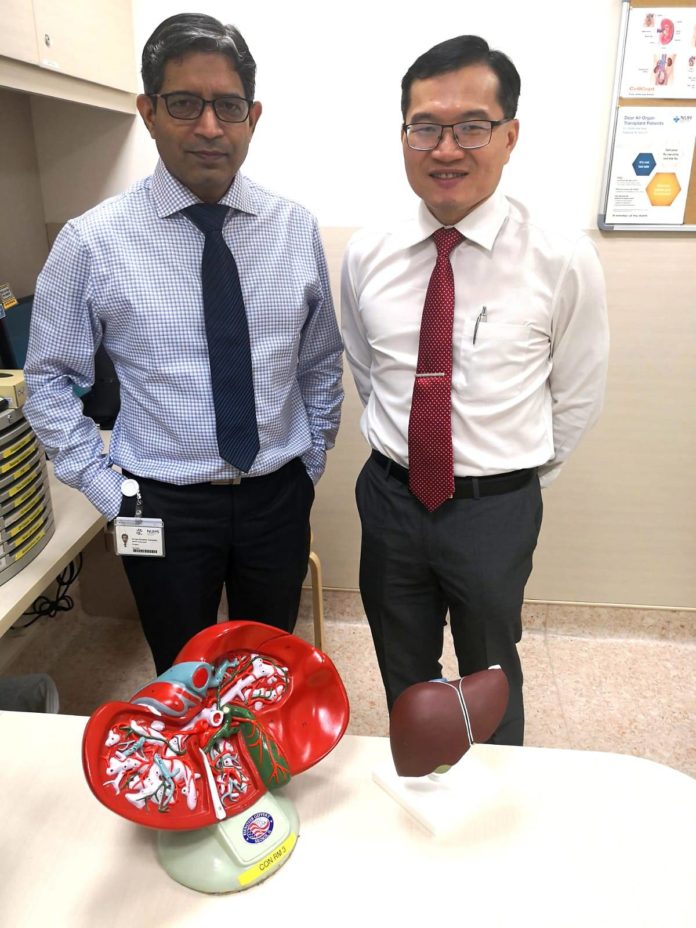
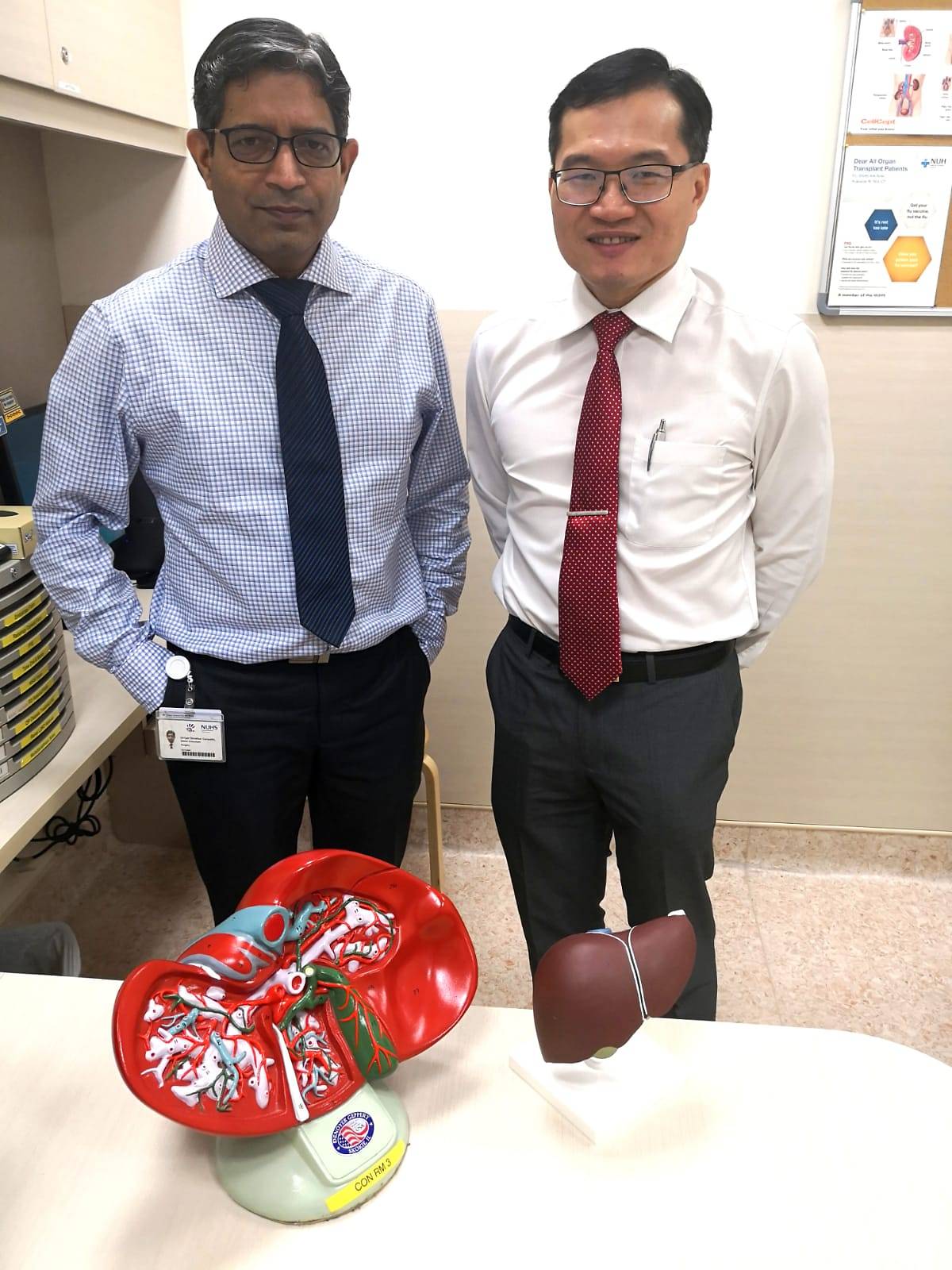
Dr Shridar Iyer and Dr Lee Guan Huei from the Liver Transplantation Programme at the National University Hospital. (Photo: Jalelah Abu Baker)

He urged the public to discuss death and organ donation with family, as one person can collectively add 70 years of life to others. Organs that can be donated include liver, lungs and heart. He said that even if the deceased had certain diseases like diabetes and hypertension while living, if their organs are working, they can still donate them.

40 TO 50 PATIENTS ON WAITING LIST AT ANY ONE TIME

Liver transplantation is needed in a few situations. For children, it could be due to developmental problems and in these cases, the parents would offer their organ without hesitation, the doctors said. Reasons for adults to need liver transplantation include organ failure caused by cancer or metabolic diseases, sudden liver failure, and drug intoxication.

At any one time, there are 40 to 50 patients on the waiting list, an increase from the “20 or so” in 1997 when the transplantation programme started, Dr Lee said.

The wait for a liver can take anywhere between four months to four years, depending on how high a patient is on the list in terms of priority. This is measured medically on how likely he is to survive in the next three months. The sicker the patient, the higher the priority.

A small proportion of people die while waiting for a liver transplantation, while a few people get so much better with treatment that they are taken off the list, Dr Lee added.

Since the National University Centre for Organ Transplantation (NUCOT) started performing liver transplants in 1997, it has completed a total of about 400 child and adult procedures. The one-year success rate is more than 90 per cent, while the five-year success rate is about 80 per cent, said surgical director for liver transplantation Dr Shridar Iyer.

KNOWING WHAT TO EXPECT AS A LIVER DONOR

Some people underestimate the commitment needed for a liver donation, and think it is just like donating blood, Dr Shridar said. However, liver donation requires far more commitment, he said. There are stringent protocols surrounding transplants, which include a battery of tests and being interviewed by an ethics committee, he explained.

Donors will also have to be off work or school for six to eight weeks while they recover from surgery.

Dr Shridar said that a common situation in which people are moved to volunteer themselves, but may not be armed with the relevant information to lead to a fruitful outcome is a social media appeal.

When that happens, about 70 people may come forward at one go. While it is a good thing, it could also cause strain to the system as no one is turned down and every one is tested. Many a time, potential donors are shocked by the information they receive, deciding not to move forward with the process after being tested.

NUH, National University Hospital (new)

File photo of an exterior view of the National University Hospital in Singapore.

For example, they are surprised to find out that donating to an adult would mean donating 60 to 70 per cent of their liver. This comes as a discouraging piece of news to them even with the knowledge that the liver will regenerate, he said.

“Sometimes it is hard to explain to them why not take 50 per cent? It’s not like you’re going to a shop and taking half a kilo of rice. It is more of where the cutting line is drawn,” he said, adding that potential donors are concerned about giving more than what remains.

Risks are also clearly communicated to potential donors. There is a 0.5 per cent risk of death and 15 to 20 per cent risk of complications wordwide.

While he would like more people to come forward to donate their liver, Dr Shridar said that it is best when they are fully aware of the commitment and risks involved.

For Ms Chan, the risks meant little in her dogged determination to give her father a new lease of life.

She had these words for anyone who would like to donate their liver.

“If you think this is the right thing to do, don’t question yourself, because you’re doing something good. Just be proud of yourself, step forward, do what your heart tells you.”

Source link

‘Words just can’t come out’: The challenges of living with a stutter

0

SINGAPORE: Mr Nawaljeet Singh was about 14 years old when he became aware of his stutter.

“I was speaking to a friend and I realised I couldn’t get the words out,” he said.

The senior analyst laughed as he remembered the expectant look on his friend’s face as Mr Singh struggled to finish his sentence.

Now 30, Mr Singh says he has come across different reactions whenever he finds himself tripping on words during a conversation. 

In one incident, a concerned university classmate had patted him on the back and assured him: “It’s fine.”

But with his close friends, Mr Singh good-humoredly pointed out that they would never fail to give him a hard time with their playful jibes.

“I think on the one hand, you want a bunch of loving and caring friends, (but) on the other hand you also want friends that normalise this as well,” he said.

Nawal 1

Mr Nawaljeet Singh (far left) speaking to friends. (Photo: Dean Wong) 

‘PERFECTLY NORMAL PEOPLE WITH NORMAL IDEAS’

Mr Singh is among the 1 per cent of adults worldwide who suffer from a stutter.

Stuttering, also known as stammering, is a speech disorder which commonly appears in 5 per cent of children at the ages of two to five. If not dealt with early on, it can continue past childhood.

Studies have shown that people who stutter may experience negative assumptions by other people about their intelligence, personality or competence, said Dr Elysia Soh, a speech therapist at Sengkang General Hospital.

They are judged as having poor speaking abilities compared to others, and therefore they are seen as being deficient other ways, Dr Soh said, adding that such views do not hold any truth.

“Stuttering is a disorder of speech production. It is not a language disorder, and not a disorder resulting from any emotional or mental conditions,” she stressed.

Dr Valerie Lim, founder of private clinic Planting Speech, echoed similar views: “They are perfectly normal people with normal ideas, normal thoughts.”

However, they are not able to programme their muscles to get the words to come out smoothly, Dr Lim explained.

One of Dr Lim’s patients described the feeling of having a stutter as similar to a blocked tap. 

“Water is trying to flow out but it can’t because of some blockages,” he told her. “Likewise, I know what to say but the words just can’t come out.”

When a doctor once asked Mr Singh if he had trouble forming the words in his head, his response was: “If it’s getting stuck anywhere, it’s right at the tip of my tongue.”

Mr Singh, whose speech dysfluency only crops up during longer conversations, said what helps him power through a stutter is if he has a good understanding of the topic of conversation at hand.

“For every word that I need to say, if … I can’t get it out, I will find a substitute for it,” said Mr Singh.

DAILY TASKS CAN BE A CHALLENGE

While the severity of dysfluency varies from person to person, everyday tasks can be particularly stressful situations for those who stutter.

Dr Lim said she has come across patients who would order juice from a drink stall instead of Coca Cola because it would be too difficult to enunciate the latter.

They would tell her: “I had to order juice again because I couldn’t get the word Coca Cola out, and I don’t even like juice.”

Another patient, who had a moderately severe stutter, even changed his name because he could not pronounce it fluently.

Dr Lim added: “Quite a few of my clients have chosen to do more back end kind of jobs … Some of them will say: ‘Actually if I have it my way, I would love to be a lawyer or a teacher’.”

Avoidance behaviours such as this can be the most “handicapping” aspect of the speech disorder, noted Dr Soh, as it may lead to reduced social and occupational participation. 

This may eventually result in feelings of loss of control, decreased mood and increased anxiety.

Mr Benjamin Seet, a graduate student, acknowledged that his stutter does become a bit of a challenge during phone calls.

“There’s always this anxiety that the person on the phone would not able to hear me well,” said Mr Seet, adding that this would make him constantly second guess himself.

Whenever he felt like his words were “stuck” during phone calls, he would speak slower to make sure his point would come across as clearly as possible.

CONTENT OF SPEECH MORE IMPORTANT, NOT DELIVERY 

Despite the obvious communication challenges, Mr Seet is confident that his stutter has not hampered his career ambitions of becoming a teacher.

“I have been very fortunate that those who I have worked with … they would always care more of what I’m saying and not how I’m saying it,” said the 30-year-old, who previously worked as a teaching assistant in the National University of Singapore.

Mr Singh also agreed that people are usually “almost always more concerned with the content of my presentation than the delivery”.

While Mr Singh has had doubts about how his stutter affects his work, he admitted that his worries have not been significant enough to make a tangible impact on his career.

In his previous job at a social enterprise, Mr Singh was tasked to give a weekly briefing for a project.

“I did that briefing almost continuously, almost always cognisant of my speech impediment,” he said.

“It’s not like I don’t trip on my words … But, it’s okay,” he shrugged.

Offering advice on how one should interact during a conversation with a person who stutters, Dr Soh said it was important to let them complete their sentences.

“As a conversation partner, you may feel uncomfortable with periods of silences that can occur when a person who stutters has a block, or with repeated syllables and sounds,” said Dr Soh.

“However, if you don’t mind, it doesn’t matter,” she added. “Dysfluent speech is simply another person’s way of talking to express themselves”.

Dr Soh added that there is also no need for “advice” such as telling people who stutter to “slow down” or “relax”.

While it might be well-meaning, it could also be more disruptive to the conversation.

Source link

Commentary: Action and caution needed, as business schools respond to disruption

0

SINGAPORE: Global competition and rapid technological changes are disrupting many industries. 

Universities, including business schools, also face disruption in many different areas, particularly in our modus operandi, in the kinds of teaching content and delivery of educational programmes, and especially as student and employer expectations shift.

READ: Disruption is coming for Singapore business schools, a commentary

THE CHANGING BUSINESS OF BUSINESS SCHOOLS

Education has long ceased to be a one-way street for the transfer of facts. The internet and smart technology has put information at everyone’s fingertips.

For students, the internet has become a fountain of information, giving them the tools to challenge long-held models about how the world works, including the body of knowledge on many subjects we teach.

Students will frequently Google to question almost every data point and proposition offered in class. This has led to a sea of changes in the professor-student relationship.

Since no professor can match the internet’s unlimited supply of information, they must refocus and use their wealth of theoretical knowledge and experience in applying information to a variety of contexts.

Their value to student learning comes from providing a strong foundation of paradigms and conceptual frameworks that help students to interpret, understand and respond to developments in their field.

NUS lecture hall

File photo of NUS students attending a lecture.

Equally important, professors can develop students’ ability to apply their knowledge to discern underlying causes and effects, and separate them from symptoms and noise, for solution identification and application.

In this, there has been a gradual but indisputable march towards developing students’ analytical abilities and judgment, and away from the rote accumulation of knowledge.

ACTION, BUT ALSO CAUTION

Paradoxically, in a world of high tech, high touch becomes even more necessary. Rapport between professors and students to encourage idea exchange calls for humility from professors to engage and learn from students, and marry theoretical understanding with developments in a rapidly changing world.

But successful integration also requires a doubling down on research and knowledge development on the part of professors.

There is a debate that selected local universities obsess over research at the expense of teaching and let university rankings determine their research. This zero-sum view that says one must come at the expense of the other is limiting when reality shows a striking relationship among the best universities. Harvard, Stanford and Wharton are research titans yet well known for their teaching excellence.

READ: Singapore and Singaporeans lose when universities chase after world rankings, a commentary

Research excellence feeds into quality teaching as we develop conceptual and applied knowledge on emerging business, industry, economic and societal trends within Singapore and globally. And the process of research – of exploring and discovering, of challenging our limits of knowledge, and of testing hypotheses and sharing findings – contribute to students’ learning, particularly since this journey also involves them.

A student stands in the entranceway of a building at Harvard University in Cambridge

A student stands in the entrance way of a building at Harvard University in Cambridge, Massachusetts November 16, 2012. (Photo: REUTERS/Jessica Rinaldi)

READ: Time for Singapore universities to switch gears, a commentary

We bounce research ideas off students and share with them data to develop their analytics skills as students engage in primary and secondary research for their projects. In doing so, they learn to be systematic in sieving pertinent information from the noise.  

Disruption also places fresh demands on the shoulders of students, who must take on the responsibility of independently cultivating a willingness to learn and to be uncomfortably challenged. The emerging two-way street for learning is exactly that.

While these changes have important pedagogical implications, business schools have long used an interactive, discussion-oriented, case-enhanced and applied approach to developing students.

Current practices extend these trends, through using current “live” cases as problem settings and having students consider unstructured information from multiple sources, so that they recognise change and complexity as core business trends.

The nature of teaching and learning in Singapore’s business schools has changed radically, perhaps more so than is commonly recognised. One of us has not set a single examination in any class in NUS Business School in the last two decades despite having taught many different modules as a full-time member of the school.

Instead, in keeping with the focus on developing critical thinking and judgment, a wider range of interactive assessments, such as case studies, developing strategies for firms, group presentations and debates, learning journals and research practicums for firms, are used to encourage learning and application.

TECH IS STILL NASCENT

While disruption is inevitable, and the opportunities to reach non-Singapore based students multiply, it will take time, experimentation, and much learning to figure out how to harness technology to transform the nature of teaching for more effective learning.

File photo of National University of Singapore (NUS) undergraduates

File photo of National University of Singapore (NUS) undergraduates. (Photo: Alif Amsyar)

There will come a time when location and distance will be irrelevant in the quality of learning but not yet. Technology has not advanced to the point where virtual interactions are good enough to replicate face-to-face learning and nurturing in a classroom for university courses to be fully digitised.

Only half of Massive Open Online Courses (MOOCs) participants enrolled in a course ever got as far as watching a lecture and only a mere 4 per cent complete their course, according to a study of a million users by the University Of Pennsylvania Graduate School Of Education.

EVOLVING CURRICULUM

Evolving as signs of disruption emerge will entail that schools innovate in all aspects of education, including content, learning methods, and student experiences. Singapore’s business schools should continue to benchmark their processes and programmes against those of leading global business schools, and consult with alumni, employers and other stakeholders to understand their needs.

Beyond providing the intellectual foundations necessary for success in students’ early careers, NUS Business School reviews its programmes to equip students with the ability to learn, grow and adapt throughout their careers.

Business schools first emerged to provide skills-based teaching, but now focus on educating for careers, developing judgment for success, and building leaders for society. The shift has required development of almost all aspects of our programmes, including the incorporation of the latest academic and practical ideas and concepts.

One outcome from a recent review provides greater flexibility for students to customise their education to meet personal interests and goals, and grow and adapt. 

Students now undertake broad-based foundation studies and as much as 20 per cent of their classes from outside their faculty. They have a wider range of specialisations and electives to choose from, more advanced electives to challenge themselves, and the option of double majors and degree programmes.

File photo of National University of Singapore (NUS)

File photo of the National University of Singapore (NUS). (Photo: Alif Amsyar)

Practical and experiential opportunities have also increased multiple-fold. Our more senior alumni will envy the learning experiences our current students enjoy.

The launch of programmes such as the Masters in Business Analytics, a joint endeavour with the School of Computing, is evidence of curriculum reviews among business schools. These new programmes aim to expose students to emerging technologies set to become the foundations of the future economy, such as blockchain, data analytics, machine learning and fintech, as well as aspects of entrepreneurship and innovation.

ROPING IN INDUSTRY CAPTAINS

The shortage of professors proficient in these emerging areas is a key challenge.

Business schools and universities are thus reaching out to working professionals to co-teach, and to complement the theory with practical knowledge, beyond traditional adjunct instructors teaching in the evenings. The more progressive universities are able to hire full-time industry leaders to commit to teaching as a career, even if this is not done on a full-time basis.

At NUS Business School, for example, a course on marketing entrepreneurship is taught by a senior Google executive. He is on the cutting-edge of technology and brings with him “live” cases and a wealth of experience and practical perspectives that complement the more academic approach for a well-rounded education. 

Consultants teach our consulting modules, and accounting experts various accounting modules.

READ: University professors must teach more, have industry experience, a commentary

A rigorous yet dynamic curriculum – one that balances strong theoretical understanding with experiential learning, delivered on suitable teaching platforms – offers students an education that puts them in good stead to learn, develop and adapt throughout their careers.

EXPERIENTIAL LEARNING

Another challenge facing business schools is to balance theory with practice. Experiential learning is vital to complement classroom learning as it enables students to apply theory.

Many universities see internships that offer meaningful exposure as a solution and have made it compulsory for graduation, and integral to the core curriculum.

NUS Business School

NUS Business School. (Photo: NUS Business School)

Besides internships, one of the decisions made by NUS Business School is to introduce consulting practicums for students. They consult for companies including small- and medium-sized enterprises for between six months to a year where they get deeply involved in company projects in exchange for programme credits.

Companies, especially small- and medium-sized enterprises, benefit as they are usually short on funding for consultancy and business research. More than 3,000 undergraduates and MBA students have undertaken 1,000 of these projects, involving over 500 companies both in Singapore and around the world.

With the trend towards establishing start-ups upon graduation, some universities take the approach of introducing courses on entrepreneurship. Others, like NUS, build an ecosystem that is university-wide to optimise cross-fertilisation of strengths.

Block 71, the most successful Singapore start-up eco-park is an NUS creation. 

Students can take time off studies to work full-time on their innovations or to gain experience. They can also tap on an established ecosystem of entrepreneurs, venture capitalists, and private equity investors, as they receive support in the form of start-up grants and on-campus incubators.

LEARNING FROM OTHERS

While the world is changing, we need to respect the time-honoured principle that history is the teacher of life, and that fundamental principles in education hold true.

On the one hand, more business schools are using “live” case studies that force students to immerse themselves into on-going business events; the incompleteness, complexity, and uncertainty of information and the lack of obvious answers, mirrors the challenges that business leaders face.

But these should also complement the classic cases relevant in teaching students key principles. The combination injects an element of reality in the application of their knowledge.

Business schools organise case competitions and hackathons to encourage students to solve real business issues. 

Chulalongkorn University and Thammasat University in Thailand, Hong Kong University of Science and Technology, and NUS are internationally renowned for their business case competitions. Students are sent to participate in such global competitions for direct exposure to business challenges.

NUS Case competition 2018

BOC-NUS Case Competion 2018 (Photo: NUS Case Competition Facebook page)

Exchange programmes to leading schools have also become a key element of some business programmes, with a majority of students in each cohort spending a semester or more abroad. Students regularly report that these exchanges are life-changing experiences.

Indeed, business schools and university research have faced extensive technological, financial and pedagogical disruption in recent years.

Local business schools have met these challenges by developing professors’ capabilities, by investing in technology, by working with industry, by raising funds from multiple sources, and by working with students.

This has been a model for how universities will adapt teaching to disruption. We at business schools in Singapore get this.

Ang Swee Hoon is an associate professor in the Department of Marketing and Kulwant Singh is a professor in the Department of Strategy and Policy. Both teach and research at the National University of Singapore (NUS) Business School. The opinions expressed are those of the writers and do not represent the views and opinions of NUS.

Source link

Government looking at grants for caregivers to the elderly to boost support for community care

0

SINGAPORE: As part of the Health Ministry’s review to see how it can better support community care, the Government is looking at providing financial assistance to caregivers of the elderly.

Senior Minister of State for Health Edwin Tong said this on Friday (Jan 18) after a dialogue session with caregiving service providers.

He noted that while there are several financial assistance schemes for people who go to nursing homes or to buy mobility devices, the playing field may not be as level for care in the home and community setting.

“We want our seniors to age in place, to be in the community for as long as they can, to be cared for by people they know and (who) love them,” said Mr Tong. “So we want to see if we can assist that financially, to give them some assistance for expenses, to defray some of the costs they will invariably incur.”

The need for financial assistance came up in Friday’s dialogue session, as well as in focus group discussions with caregivers that were held from September to December last year.

edwin tong caregiver session

Senior Minister of State for Health Edwin Tong at a dialogue with service providers of caregiving services. (Photo: Jalelah Abu Baker)

On top of providing grants, authorities are looking at allowing the flexible use of financial assistance, Mr Tong added.

“No two caregivers are similar, and the care recipients might need different things at different stages of their care journey,” he added, explaining the need for flexibility as a key feature in financial assistance for these caregivers. Examples of what the grants could be used for include domestic help, diapers and medication.

READ: Cost a concern for seniors who want to ‘age in place’: Lien Foundation-NUS study

BETTER RESPITE CARE OPTIONS, WORK ARRANGEMENTS FOR CAREGIVERS

For 61-year-old Siti Hamidah Abdullah Bahashwan, her world turned on its head two years ago after her mother suffered a stroke that left her bedbound. Madam Hamidah, a part-time counsellor, became her mother’s primary caregiver.

“I was not able to cope personally. I guess what would have been helpful is a shoulder to cry on and to be able to know what to do at that critical stage, she said.

She currently spends about S$2,000 on her mother’s needs every month, and while the cost is shared among her and her siblings, financial help will ease the burden, she said.

Mdm Hamidah added that having more options for temporary respite care, which offers short-term relief for caregivers, would go a long way. Although the family copes with the help of a maid, Mdm Hamidah said she still struggles when the maid goes on leave.

These are all areas that the Government is looking into, said Mr Tong.

“We are trying to see whether we can pilot some respite options working with community respite givers to see whether we can give respite care at short notice, and also to broaden options available to caregivers who are in need of respite care,” he said.

Other areas that need improvement which the ministry will be looking at are the navigation of help available to caregivers and flexible work arrangements.

Mr Tong said that the Health Ministry will look at working with the Ministry of Manpower to foster a flexible work culture in a ground-up manner as opposed to imposing it on employers. 

He also suggested bringing caregivers together so that they can share their experience with others who can empathise with their situation.

The Health Ministry had previously said that caregivers play an increasingly important role as Singapore’s population ages, noting that by 2030, one in four Singaporeans will be over 65 years old.

Source link

10kmh riding speed limit on footpaths among new rules to kick in on Feb 1

0

SINGAPORE: The Land Transport Authority (LTA) on Friday (Jan 18) announced that new rules encouraging safer path and road-sharing will be implemented on Feb 1.  

The rules, first announced in September last year, include a lower speed limit for riders on footpaths, the mandatory use of helmets by cyclists on roads, “stop and look” requirement for all active mobility device users and maximum device speed for personal mobility aids (PMAs). 

The rules are “part of ongoing efforts to foster greater rider responsibility and encourage safe sharing of our paths and roads”, the authority said in a news release.

Under the new rules, the speed limit for riding on footpaths will be lowered from the current 15kmh to 10kmh.

“This will allow all path users more time to react to unforeseen circumstances, thus reducing the risk of accidents and severity of injuries should they happen,” said LTA.

Cyclists on roads will also now be required to wear helmets. Those who are crossing the road to get from one public path to another are exempted from this rule.

LTA path and road sharing safety

Additionally, active mobility device users must “stop and look” out for vehicles at road crossings, including zebra and signalised pedestrian crossings. Motorists are similarly expected to slow down and look out for such users as well as pedestrians, and allow them to cross. 

“Overall, this will improve the predictability of behaviour of all users, providing both device users and motorists with more reaction time, thereby reducing the risk of accidents,” said LTA.

Those caught flouting these rules may be fined up to S$1,000 and/or jailed a maximum of three months, for the first offence.

Motorised PMAs, including motorised wheelchairs and mobility scooters, will also be subjected to a maximum device speed of 10kmh on public paths. 

LTA said this is to safeguard the use of such devices by only those who genuinely need them. It is also to “prevent the abuse and modification of such devices to circumvent regulations on PMDs,” it added.

READ: FAQ – What you need to know about the new active mobility regulations

Those convicted of using a non-compliant PMA on public paths may be fined up to S$5,000 and/or given jail time of up to three months for a first offence.

Shops are also required to display warning notices on their premises from Feb 1, under the Active Mobility Act. These notices should state the technical criteria for PMAs and where they are to be used.

Retailers convicted of selling non-compliant devices or modifying any device to a non-compliant state can be fined up to S$5,000 and/or jailed up to three months for the first offence. 

Those caught displaying or advertising non-compliant PMAs can also be fined up to S$1,000 and/or jailed up to three months for the first offence.

Source link