Home Blog Page 831

Secondary school posting from 2024: MOE details range of PSLE scores needed for each scoring band

0

SINGAPORE: The Ministry of Education (MOE) has detailed how students going into Secondary 1 from 2024 will be offered subjects and the levels they will be able to take them at.

On Tuesday (Mar 5), Education Minister Ong Ye Kung announced that the current system of streaming in secondary schools — where students go into the Express, Normal (Academic) or Normal (Technical) streams based on their PSLE results — would be replaced with full Subject-Based Banding (SBB), where students take different subjects at different levels, according to their ability.

Students will still be posted to schools based on their PSLE results across three scoring bands, MOE said.

In a response to queries from Channel NewsAsia, MOE has provided more details on these scoring bands, and indicated the range of PSLE scores a student would need in order to be eligible to take subjects at the various levels at the start of secondary school.

THE NEW SYSTEM

With the earlier announced changes to the PSLE scoring system taking effect from 2021, a student taking the PSLE will receive a new Achievement Level (AL) score of 1-8 in each of their four subjects, with AL1 being the highest a student can score, and AL8 the lowest.

The sum of these ALs will make up the student’s final score, which will be known as the PSLE Score. The range of possible scores will be from 4 to 32.

READ: Subject banding overcomes drawbacks of streaming – PM Lee

Once SSB is implemented, a student with a PSLE score of 4 to 20 will be eligible for subjects at the highest G3 level, MOE said. This means that a student would need to score an AL of at most 5 in each subject to take the entire G3 suite of subjects, which corresponds to the current Express level.

PSLE achievement levels infographic

Meanwhile, a student with a PSLE score of 21 or 22 would be eligible for either the G3 or G2 suite of subjects. The G2 level corresponds to the current Normal (Academic) level.

If the student scores 23 or 24, they would be eligible for the G2 suite of subjects.

A student scoring 25 would be offered either the G2 suite of subjects, or the G1, which corresponds to the current Normal (Technical) level. 

For those who score 26 to 30, the student would be eligible for subjects at the G1 level, if he or she has an AL of 7 and above in English and Mathematics. A student needs a score of at most 30 to have passed the PSLE. 

PSLE scoring band infographic

MOE added that students who excel in specific subjects in the PSLE can take those subjects at a higher level from the start of Secondary 1.

For example, a student with a PSLE score of 23 who did very well for English would take most subjects at the G2 level, but be offered English at a higher G3 level when they enter secondary school.

SUBJECTS AND LEVELS WILL NOT BE CONSTRAINED BY SCORING BAND

MOE added in its response that the PSLE scores will continue to serve as a “good initial gauge” of the pace of learning that students are most suited for at the beginning of Secondary 1. 

However, it stressed that the subjects and levels that students are offered in subsequent years will not be constrained by the scoring band through which they were posted to secondary schools.

“Unlike the current approach where the course that a student is posted to in Secondary 1 determines the bulk of his subject offerings throughout his secondary education, full SBB will allow students to progressively take subjects at more demanding levels over the course of their secondary school years, as they discover their strengths and interests, and take on a combination of subjects across different levels over time,” said MOE.

READ: How streaming has evolved over the years

It added that secondary schools are provided with a set of guidelines with regards to offering subjects to students at a more demanding level. The school will take into account the student’s performance, whether they are able to cope with the more demanding subject, and whether it is in the student’s best interest.

The option to take subjects at different levels will also be provided at “suitable junctures”.

“Our schools will provide the necessary support for students to manage the transition and give them time to adjust,” MOE said.

Additional reporting by Tan Si Hui.

Source link

ANZAC Day – Nurses of the Great War –

0

ANZAC Day is a big deal to Australians and New
Zealanders.

With a different meaning to so many, it’s usually
regarded as an unnecessary and sad loss of life in a British Empire backed
bloodbath, or it’s the most memorable of losing military conflicts that defined
both countries and shaped their futures.

Remembrance celebrations for the ill-fated campaign at Gallipoli began exactly a year after the event on April 25th 1916 and there have been services every single year since in Australia, New Zealand and anywhere on the planet where Aussies and Kiwis live, serve their country, work or travel.

Anzac Day is important to Australians and New Zealanders

Invocations of what has become the ANZAC Legend generally
only include soldiers experiences, but for the more than 4,000 Australian and
New Zealand nurses who volunteered for active service during World War 1, their
story is rarely heard. This was the first time in the two countries histories
that women worked alongside men as equals – and their work was equally
extraordinary and heroic.

Women of this era had only just recently been given the
right to vote but were still, more often than not, confined to housekeeping so
even signing up for active service was an extremely courageous and bold move
for these amazing and inspiring women.

These ANZAC nurses cared for thousands of casualties in
hospitals all over Europe during the conflict from makeshift facilities on
transport ships, remote islands, in churches and underground to proper
hospitals in the UK and Western Europe. Always at risk of attack from the Axis
of Evil the conditions were often gruelling with sadly depleted medical
supplies, lack of fresh running water, rudimentary equipment and an endless
stream of sick and wounded soldiers from all of the allied countries. They performed
their duties with the utmost respect, courage and tenacity and indeed,
thousands would’ve died if not for the ANZAC nurses. The hospital on Lemnos
during the Gallipoli Campaign itself records 7400 patients of which only 143
died, a testament to the will and skill of these incredible ANZACS.

Upon their return to their homes in Australia and New
Zealand many nurses of World War 1 received little to no financial benefits,
little to no recognition and most shockingly, were seemingly omitted from
yearly ANZAC
Day
Commemorations. Many soldiers however, remembered, and the
contributions the nurses (and other women) made to the war effort for the
ANZACS is thankfully, now also remembered each year as well as the service
given by all women in the Great War and in every subsequent conflict where
ANZACS have been present.

LEST WE FORGET!

To find out more about ANZAC Day and to get further
information regarding the Gallipoli Dawn Service
please have a look at the Gallipoli information and links on the
www.anzacdaygallipoli.com website.

Last modified: March 6, 2019

Source link

La Tomatina – The World’s Messiest Food Fight… –

0

La Tomatina always takes place on the last
Wednesday of August in the sleepy village of Bunol some 40kms west of Spain’s
third largest city, Valencia.

This is an EPIC food fight of proportions
you just won’t believe, with seven trucks dumping over 200,000 pounds worth of
ripe tomatoes into the streets for a food war that has to be experienced to be
believed.

Here we cover our top tips for surviving intact, getting the most out of your tomato battle day, and enjoying the festival to its fullest potential.

La Tomatina tomato throwing tours
  • Photography – If you do plan on bringing a camera you need to adhere to a few of the councils guidelines. No tripods, no selfie-sticks and no massive cameras will be permitted in without first gaining permission from the Bunol Council. With phones and smaller cameras for picture and video purposes make sure they are either waterproof, or are in a waterproof container. Even something as ordinary as a plastic sandwich bag can ensure your device is not totally wrecked at the end of the tomato battle.
  • Accommodation – If you are planning on staying in Bunol itself options are very limited so it is best to book well in advance. Most revellers stay in nearby Valencia where there are thousands of accommodation options and plenty more sights and activities to see and get involved with.
  • Clothing/Protection – If you plan on getting into the thick of the action then the clothes that you wear for the tomato fight will be destroyed, you will throw them away, that’s for certain. Make sure you take a change of clothing with you to Bunol and keep in mind that there are no changing rooms so it’s behind a car, rubbish bin or building that you’ll be doing a quick change. Goggles can be a good idea for keeping tomato juice (acid) out of the eyes although you are forever cleaning them. A peaked baseball cap is the best bet in our opinion for protection of the face and eyes. Loose fitting clothing and footwear should be avoided.
  • Tickets – Again, you must get these well in advance through a company such as La Tomatina Tours as they do sell out and there is a 20,000 maximum allocation.
  • Times – The first actual event on the day of La Tomatina is the “Palo-Jabón” where a giant pole is covered with soap/grease and people attempt to climb the pole to reach a hanging slab of ham at the top. Often hilarious to watch. This starts from about 8am in the morning with the tomato fight kicking off around 11am. Please note there are NO EXACT starting times for either of the events. The tomato fight lasts only an hour and a half at most.
  • The Tomatoes – You must crush the tomato in your hand before throwing them as they can do serious damage to someone’s eye otherwise. Do not under any circumstances rip peoples clothing, throw projectiles other than tomatoes, or argue with officials as those are the easiest paths to ejection from the event.
  • After – The best way to clean yourself after the event is to head down to the local river (all roads downhill lead to the river) where the council has erected twenty or so temporary showers. You can also find temporary showers at the train station although these are usually far more crowded. If the showers are full you can always just jump in the river.
  • More – Most importantly enjoy yourself and have fun, respect other revellers and give assistance where required to anyone in any pain or difficulty. La Tomatina is an event for all experience and to enjoy, not just for your enjoyment.
La Tomatina tomato throwing photos and details

Well there we have it, an abridged survival
guide that’ll certainly get you through the day, but like all events we cover there are
plenty of websites out there who provide detailed information on the event with
the highly recommended La Tomatina Tours among the best to check-out for
full La Tomatina event disclosure, day trips and
hotel tour options.

Source link

Bersatu’s Johor chapter to Singaporeans: Ask your government to review water prices

0

JOHOR BAHRU: The Johor chapter of Prime Minister Mahathir Mohamad’s Parti Pribumi Bersatu Malaysia on Wednesday (Mar 6) appealed to Singaporeans to urge their government to review the prices of the water deal with Malaysia, reiterating that the agreement is “morally wrong”.

The media director of Bersatu’s Johor chapter Mohd Solihan Badri was quoted as saying by Malay Mail: “Surely, your conscience will tell you that this is a raw deal for the people of Malaysia and especially Johoreans, many of whom may be your own family members.

“Do you not feel guilty that you are enjoying drinking water that you have bought so cheaply from your kin?

“I appeal to the people of Singapore to take cognisance of this fact and voice to their government how morally wrong it is to benefit from our goodwill through such a lopsided agreement.”

READ: Singapore and Malaysia: The Water Issue

Mr Mohd Solihan, who is also the assemblyman for Tenang, added that Malaysia has been suffering frequent water shortages due to climate change.

Malaysia cannot continue selling water at the “dirt cheap rate” of 3 sen per thousand gallons, he added.

“It is even more ludicrous that we are buying back this treated water from Singapore at the rate of 50 sen per 1,000 gallons,” he said.

The 1962 Water Agreement, which expires in 2061, entitles Singapore to draw up to 250 million gallons a day (mgd) of water from the Johor River.

Singapore pays 3 sen per thousand gallons of raw water and sells treated water back to Johor at 50 sen per thousand gallons, a fraction of the cost of treating the water.

Johor is meanwhile entitled to a daily supply of treated water of up to 2 per cent or 5 mgd of the water supplied to Singapore.

In practice, Singapore has been supplying 16 mgd of treated water to Johor at its request.

READ: Singapore, Malaysia met in December for water talks but discussions ‘overshadowed by new issues’: MFA

Malaysia'sPrime Minister Mahathir Mohamad

Malaysia’s Prime Minister Mahathir Mohamad (File photo: REUTERS/Lai Seng Sin)

Last week, Dr Mahathir urged the Johor government and its people to speak up on what he described as the “morally wrong” water deal with Singapore, a “rich” nation.

“The state government must make their voices heard. The rich are depending on the poor?” Dr Mahathir said. “This is not only illogical but also morally wrong. We must put stress on this issue.”

READ: Johor crown prince claims ‘sovereignty’ over water in the state, prefers ‘no federal interference’ on the issue

Last Friday, Foreign Minister Vivian Balakrishnan said in Parliament that Dr Mahathir’s comments were a “red herring” and “strong, emotive words” that were intended to rouse public opinion.

“The 1962 Water Agreement is not about who is richer or poorer,” Dr Balakrishnan said. “It is about the fundamental principle of respecting the sanctity of agreements.”

The Johor state government has also said that it plans to be self-sufficient in treated water instead of relying on Singapore.

On Sunday, a spokesperson from Singapore’s Ministry of Foreign Affairs said that it noted Johor’s plans to increase its capacity to produce treated water to meet its own needs.

“This does not affect Singapore’s position that all parties, including Johor, must honour the terms of the 1962 Water Agreement, which no party can unilaterally change,” the spokesperson added.

Source link

50 residents evacuated as fire engulfs HDB flat at Bedok North Road

0

SINGAPORE: A fire engulfed an HDB flat in Bedok North Road on Wednesday (Mar 6) afternoon, forcing the evacuation of about 50 residents.

The Singapore Civil Defence Force (SCDF) said they were alerted to a fire on the 18th storey of 180 Bedok North Road at about 1.20pm.

The fire had engulfed the entire unit due to the “vast accumulation of combustible items” within the flat, they said in a Facebook post.

bedok north fire (2)

A fire seen at 180 Bedok North Road. (Photo: Channel NewsAsia reader)

Donning breathing apparatus, firefighters had to force their way into the unit, SCDF said.

Their movement within the unit were impeded as they had to “carefully manoeuvre over the heaps of items”.

The fire was eventually extinguished with two water jets and two compressed air foam backpacks.

bedok north fire (4)

The fire engulfed the entire unit as there was a “vast accumulation of combustible items within it”. (Photo: SCDF)

When Channel NewsAsia arrived at the scene at about 3pm, the fire looked to have been put out, although firefighters were still dousing the blackened unit with water.

One 18th-floor resident, who did not want to be named, told Channel NewsAsia she was alone at home at about 1.30pm when officers knocked on her door and asked her to evacuate. She said she had smelled the fumes, but thought it was haze.

bedok north fire (6)

A fire seen at 180 Bedok North Road. (Photo: Channel NewsAsia reader)

As she made her way down to the ground floor, she witnessed a window at the burning unit shatter and objects fly out.

“We don’t know what started the fire, but according to the officer, no one was at home,” added the woman, who is in her 30s and works in human resource.

When asked if she was worried about her home being affected by the flames, she said: “Of course. You should ask the guy living above. His house turned black already.”

In all, about 50 people from the 16th to 20th storeys of the block were forced to evacuate.

bedok north fire (1)

Bystanders look on after a fire broke out in Bedok North Road on Mar 6, 2019. (Photo: Aqil Haziq Mahmud)

At the void deck, large crowds had gathered, including the elderly in wheelchairs and children in school uniform. Police officers stood guard in the area around the affected block, which had been cordoned off with police tape.

As the smell of smoke lingered in the air, at least two fire engines and one ambulance were on scene, while firefighters and paramedics could be seen at the lift landing of the block.

A woman carrying a toddler looked concerned as she asked an SCDF officer when she would be able to return home.

bedok north fire

Emergency vehicles seen at Bedok North Road after a fire on Mar 6, 2019. (Photo: Aqil Haziq Mahmud)

SCDF said there were no reported injuries, and that they are investigating the cause of the fire.

“Excessive accumulation of combustible items, even within the unit, can block escape paths and hinder firefighting efforts,” said the SCDF. 

“Residents are urged not to accumulate old newspapers, furniture and clothes within their units as these can fuel a fire causing serious damage and may even be life threatening.”

Source link

Mothers seeking employment to get childcare subsidy for up to 6 months

0

SINGAPORE: Mothers who are looking for a job or are full-time caregivers to their younger children will now get more support in the form of enhanced childcare subsidies, the Early Childhood Development Agency (ECDA) announced on Wednesday (Mar 6).

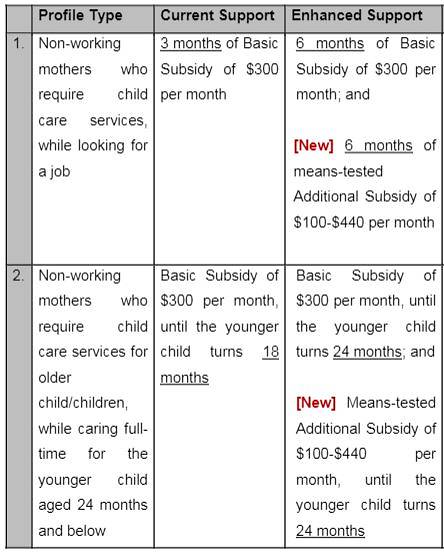
Starting this month, mothers who are not working but are seeking employment will get the basic childcare subsidy of S$300 a month for six months, up from three months currently. 

An additional subsidy for working mothers whose household income falls below a certain level will also be extended to these mothers. This subsidy ranges from S$100 to S$440 a month, depending on household income, for six months.

The rationale for this is to give these mothers “greater peace of mind to secure a job”, said Senior Parliamentary Secretary for Social and Family Development Faishal Ibrahim during his ministry’s Committee of Supply debate on Wednesday.

Mothers who are unable to work because they are caring for an infant or toddler at home will also receive the S$300 childcare subsidy for their older child until their younger child turns two years old – up from 18 months old currently. 

Depending on their household income, they may also be eligible for the additional subsidy of up to S$440.

childcare subsidy table

Source: ECDA


FREQUENCY OF REVIEW OF WORKING STATUS

Changes have also been made on the frequency of updates to mothers’ working status.

Currently, ECDA verifies the working status of mothers annually, in order to review and update infant or childcare subsidies that pre-school children receive.

It will now verify the working status of mothers and their household incomes at the point of pre-school enrolment, upon a change in programme – such as from infant care to childcare – and at the end of Nursery 2, or the year the child turns four.

Parents who may be eligible for more subsidies because of a change in household income may, however, still apply for a review at any time, ECDA said.

“This change will provide parents with greater certainty on the amount of subsidies they will receive, even if they transit between jobs or take on caregiving responsibilities,” Assoc Prof Faishal said.

“It will also reduce the administrative burden on parents as well as pre-schools who assist in administering the subsidies,” he added.

STREAMLINED SUBSIDY APPLICATION

ECDA will also introduce an enhanced centre management system to simplify applications for subsidy and financial assistance, as well as childcare centres’ administrative processes such as licence application and enrolment.

Parents will now need to fill in one form to apply for the various subsidies and financial assistance available, down from the current three.

Pre-schools will also benefit from less manual processing and will no longer need to retain copies of birth certificates and NRICs for subsidy applications.

The new system will “smoothen the application process” for about 20,000 new families annually, and halve the time spent on subsidy applications, Assoc Prof Faishal said.

He also announced that ECDA will collaborate with the Health Promotion Board to commission an occupational health and safety assessment.

“They will appoint a panel of experts this year to holistically examine the well-being of preschool staff, as well as recommend job redesign and workplace enhancements,” he said.

Source link

US court orders Mikhy Brochez to ‘immediately’ return HIV data to Singapore authorities

0

SINGAPORE: American Mikhy Farrera Brochez was ordered by a US court on Monday (Mar 4) to “immediately” surrender to Singapore’s authorities the data obtained from the HIV registry and all other confidential information.

The 34-year-old has been given a Mar 29 deadline to “permanently delete” from any computer, device, storage media or website the information obtained from the Ministry of Health (MOH) and the Singapore Prisons Service, court documents showed.

This follows MOH’s application on Feb 14 for a preliminary injunction and a restraining order to stop Brochez from leaking more data. A temporary restraining order was granted on Feb 19.

In granting the preliminary injunction on Monday, the court also directed Brochez to remove all online posts and references relating to the data and prove that he has done so by Mar 29. 

Brochez has been accused of leaking the data of 14,200 people whose personal details are stored in the confidential registry.

It is alleged that from June 2018 through to at least January 2019, Brochez, while living in Kentucky, had emailed links from the medical database to several media outlets, including Alvinology, Mothership, the Straits Times and CNN.

In an interview with news outlet VICE, he also asked if it would “harm their story” if he released the names.

On Feb 16, the 34-year-old sent a list containing the NRIC numbers of 13 HIV-positive people to Singapore authorities and media outlets.

He previously told the Federal Bureau of Investigation (FBI) he would leak more names and information if the Singapore Government did not release his husband, Singaporean doctor Ler Teck Siang.

District Judge Danny Reeves also ordered anyone who received the data from Brochez to permanently destroy the information.

The judge said: “Any agent, representative, companion, friend or acquaintance of the defendant [Brochez] in possession of the confidential, sensitive, or private information obtained by the defendant from the Singapore Government … shall delete and remove any and all confidential information in his/her/its possession or power, including copies saved or uploaded on any online website, platform, or other database.”

READ: Mikhy Brochez admits threatening Singapore Government over HIV data leak in FBI affidavit

THOSE IDENTIFIED COULD HAVE BEEN HARMED

MOH had, in its application, told the court those identified by Brochez could “be harmed” if their data was leaked.

In the grounds to his decision, Judge Reeves wrote: “The MOH asserted that the individuals on the HIV registry would face irreparable injury because dissemination of the information could lead to their losing jobs and insurance coverage.

“Likewise, the MOH contends that the stigmatisation associated with HIV in Singapore may lead to other harms as a result of being identified as being infected with HIV.”

Mikhy Farrera Brochez in court 1

Mikhy Farrera Brochez at the Clark County District Court in Winchester, Kentucky on Feb 18, 2019. (Photo: Chris Kenning) 

The court said it is “likely” Brochez had broken US law, not just Singapore law, when he leaked the information.

“Brochez has shown that he is willing and capable of giving unreasonable publicity to another’s private life because he has disclosed the prisons list to news outlets,” the judge wrote.

“The information on the prisons list involves confidential information about prisoners’ private lives.

“And simply put, if this information is not recovered but further disseminated it will continue to give unreasonable publicity to the individuals’ private affairs.”  

The court also heard it would be likely Brochez would “continue in his efforts to disseminate this information if a preliminary injunction is not entered”, and had repeatedly threatened to do so.

READ: ‘Practical limits’ to verifying certificates: Low Yen Ling explains how polytechnics hired Mikhy Brochez

DETAINED

Brochez, who is currently held at the Fayette County Detention Centre, is facing charges for the unlawful transfer of stolen identification documents and possession with intent to distribute them.

The FBI has also filed two additional charges of transmitting threats for purposes of extortion and illegally transferring the identification of another person in connection with an unlawful activity.

Those charges carry a possible combined sentence of seven years in prison, and prosecutors could seek more.

A grand jury is set to be called to consider whether to indict him on federal charges, and it could take several weeks or longer before a decision is made.

Source link

Commentary: Of course travel plans will go awry. It’s a foreign country

0

SINGAPORE: “I don’t think I know anyone who doesn’t love Japan,” I declared with confidence during a recent conversation with friends about our favourite travel destinations.

After all, the land of the rising sun holds a special place in the hearts of many Singaporeans – there’s delicious cuisine, incredible shopping, unique culture, jaw-dropping landscapes and most of all, impeccably polite people who will go out of their way to help lost, bumbling tourists despite the language barrier.

Of course, I am proven wrong a few days later when a teenager, Audrey Chong, caused an online stir because she took issue with her trip there in a Facebook post.

She bemoaned the clockwork timing of Japanese public transport, where she might miss a bus if she were just a minute late. She had problems with her Wi-Fi router and could not make sense of Google Maps.

On top of that, she seemed to advise against travel “because no staycation in Singapore will ever prepare you for a trip in a foreign country”.

Cue social media storm. Many took offence that she did not enjoy traveling to a place they ranked among their favourites; others labelled her a snowflake for what they perceived as an entitled attitude.

GETTING LOST IS THE POINT

But something important got buried in all that chatter. It is an essential truth of travel that despite one’s best laid plans, delays, inconveniences and unforeseen obstacles will happen.

And these encounters often end up being the formative experience of a trip, so you might as well just roll with the punches and enjoy the ride instead of fretting about how things have gone wrong.

For as long as I can remember, I’ve had the good fortune of embarking on frequent travels. From budget backpacking holidays as a university student to glampacking sojourns with my partner and luxurious trips in the name of work, I’ve experienced it all.

One of my favourite travel memories is of a high-altitude trek I did in Tibet where I was afflicted with a potentially life-threatening bout of altitude sickness. 

We were two days into a grueling four-day trek across a mountain range that connects two key Buddhist monasteries, which included traversing passes that were over 5,000m above sea level 

That night, I could not breathe without the aid of an oxygen tank. By morning, I could barely walk even a few steps unassisted. I wanted badly to push through and complete the trek, which I regarded as a personal pilgrimage, but for my safety, we had no choice but to descend to a lower altitude.

At a mountain pass in Tibet at over 5,000m above sea level.

At a mountain pass in Tibet at over 5,000m above sea level. (Photo: Karen Tee)

I was bundled onto a yak and spent the better part of the day clinging on for dear life as the obstinate creature took its time meandering along steep, rocky paths and wading through streams of melting ice. 

I may not have completed my track but I suppose I am now one of the few people on this planet who can tell the story of how a yak saved my life. It never fails to entertain.

More meaningfully, I witnessed the famed Tibetan Buddhist tenet of compassion in practice too – our guide took it upon himself to carry the heavy oxygen tank because he wanted to spare the animal the extra weight.

SMALL LESSONS

Not all travel epiphanies involve life and death situations, although I do recall that time when we drove through a massive strike in Oaxaca, Mexico, to get to the region’s famed mezcal distilleries. It was an intimidating sight, especially to travellers from orderly Singapore and we considered turning back.

Instead we decided to make our way through the roadblocks by following other cars through detours along dirt trails leading into small villages that we would have otherwise bypassed on the highway. 

An agave plantation in Oaxaca, Mexico. (Photo: Karen Tee)

An agave plantation in Oaxaca, Mexico. (Photo: Karen Tee)

Not only was it eye-opening to see how the locals lived, we also got a small lesson on the impact of globalisation too.

In recent years, the spirit has gained global popularity, and is now widely exported around the world. In this region, which is one of the poorest in Mexico, many mezcal producers who used to produce the spirit for local consumption are now selling it for international export.

Many have used their earnings to build homes with running water, electricity and plumbing for themselves and their families (an upgrade from the shacks they used to live in), and those who are more successful are investing in their communities too.

At least one particularly successful mezcal producer has even built roads and schools in his village. Knowing this made the tipple I sampled that day taste even better.


Mezcal tasting in Oaxaca.

Mezcal tasting in Oaxaca. (Photo: Karen Tee)

SNAFUS

I’ve had certainly had my fair share of transportation snafus – oh, to always travel to a place, like Japan or Germany, where your biggest worry is that the trains and buses leave on time! Once, a terribly delayed flight to Lima, Peru, put a coveted dinner reservation to Maido, one of the city’s most critically acclaimed restaurants, in grave danger.

I am aware this is a #firstworldproblem but nevertheless, I am forever grateful to my driver, hotel concierge and airport greeter for engineering a complicated series of phone calls and devising multiple driving route options through the city’s infamous traffic snarl to ensure we made it in time for our reservation. 

(Pro tip: If you are arriving in an entirely new destination and it is within budget, make arrangements for an airport transfer. This significantly eases travel-related disorientation.) 

For the record, the meal was well worth the stress of getting there. The restaurant’s chef Mitsuhara Tsumura is a master of Nikkei food, a unique cuisine featuring Peruvian ingredients prepped using Japanese techniques.

I never would have conceived of a dish like guinea pig karaage, much less imagined I would enjoy eating it but there I was, snacking on moreish, crispy and juicy morsels of the fried rodent like any regular bar snack.

Guinea pig karage in Maido.

Guinea pig karage in Maido. (Photo: Karen Tee)

Most recently, all that online ruckus about Japan inspired me to hop on a last minute flight to spend a few days in Tokyo. On my last day, which happened to coincide with the Tokyo Marathon, I had to get to Tokyo Station, which is the finishing point of the race.

I was concerned that the station would be shut down because of this event but besides the presence of many runners wandering its halls after their run, everything seemed to be functioning as normal.

However, for the first time on this trip, Google Maps and my Wi-Fi router did not work, possibly because the network was overloaded and I worried that I would miss my scheduled train because I was lost.

And for the first time in a long time, I looked up from my cellphone to ask people for directions, communicating with hand gestures where necessary. I made it, heavy luggage in tow, to the right train platform, pleased with myself for navigating the complicated train station with the help of kind strangers.

Sometimes, the minuses are actually plusses in disguise.

Karen Tee is a freelance travel and lifestyle writer. Six years ago, people thought she was crazy to leave the security of her full-time job. Today, most want to know how she does it

Source link

Royal Ascot’s Relaxed Dress Code Welcomed

0

Royal Ascot racegoers are certainly accustomed to dressing to impress for this most social of events and in what is a stunning turnabout in policy, as part of what’s being called a ‘diversity drive’, Ascot has relaxed some of the dress codes to be more ‘inclusive’ for some race fans. Co-ordinators of the event have announced that guests will be able to pick a sex clothing regulation they ‘feel most comfortable with’ meaning for the first time ladies will be permitted to dress like men and of course, the other way around – providing the garb they choose still adheres to the Royal Ascot guidelines.

Royal Ascot Ladies Day - what to wear?

Since the Regency times of the early 19th century
in England, Ascot has insisted on a strict dress code for the Royal Ascot
event. It was the iconic Beau Brummell, a one-time close friend of the Prince
Regent (Later King George the 4th) who is remembered as the
preeminent example of a fashionable ‘dandy’ man and as the driving force behind
the dress code for men in the Royal Enclosure. Beau even advised gentlemen that
they should always clean their boots with champagne ‘for a better shine’. Many
of Beau’s influences and dress guidelines for the event unbelievably still
remain to this day.

The exclusive Royal Enclosure, often referred to as ‘the
heart’ of the event, has always had tight rules in regards to dress. But in
2018, the event broke with usual convention by permitting racegoers to wear
jumpsuits in the Royal Enclosure for the first time and organisers this year
have announced they would try to appeal to a wider range of visitor by putting
on a ‘party atmosphere’ and incorporating a ‘more vibrant feel’ to the
enclosure.

The relaxed dress codes have been welcomed by respected LGBT
and Transgender figures here in the UK with Britain’s first transgender jockey
Victoria Smith commenting that it was ‘really positive’ and that racing was
‘starting to become more accepting of difference’.

The commercial director of Ascot, Julie Slot, has said: ‘Fashion and style are an important part of the Royal Ascot experience for all of our customers’ and certainly this year, more than any other, Ascot appears to be embracing change like never before.

Ladies Day Fashion at Royal Ascot

There have been other alterations in the dress code policy
with regards to all enclosures and its recommended that if you are attending Royal Ascot Ladies
Day
or any other day of the horse race festival that you view the all
the information contained in the The
Royal Ascot Style Guide
(In association with Cunard) which can
be viewed and downloaded via the official Royal Ascot Website.

For further information on Royal Ascot including details on
enclosures, great value day trip hospitality options, dress codes and more
please do check out the Ladies
Day Ascot
website.

Source link

Junior college campuses to be rebuilt, upgraded from 2022

0

Three schools will be rebuilt and another upgraded in the first phase of an infrastructure rejuvenation programme for JCs, Education Minister Ong Ye Kung said on Tuesday (Mar 5).

temasek junior college file photo

File photo of Temasek Junior College. (Photo: Temasek Junior College/Facebook) 

SINGAPORE: An infrastructure rejuvenation programme will be carried out for junior colleges (JCs) in phases from 2022, Education Minister Ong Ye Kung said on Tuesday (Mar 5).

Speaking during the Committee of Supply debate, he said that a few of the JCs that were merged this year are among the oldest government JCs, with campuses that have become “somewhat dated”. 

“We have been progressively improving the building infrastructure of our ITE and polytechnics,” he said. “I think our JCs deserve new campuses too.”

In his speech, Mr Ong also explained how the ministry chose which JCs to start with for the rejuvenation programme. MOE took into consideration factors such as the age of the buildings, state of existing facilities and the availability of suitable holding sites.

In the first phase, three JCs – Anderson Serangoon, Jurong Pioneer and Temasek – will be rebuilt, while Yishun Innova JC will be upgraded. This is expected to be completed by 2025.

Anderson Serangoon JC will move temporarily to the former Serangoon JC site while its current campus in Ang Mo Kio is being rebuilt.

READ: Current approach to streaming in secondary schools to be phased out by 2024

Mr Ong explained that it was decided that the merged JC will be located at the former Anderson JC site as it is next to Yio Chu Kang MRT station. “The same consideration is still valid in deciding the future permanent site of Anderson Serangoon JC,” he said.

Temasek JC, which has the oldest campus among the government JCs at 43 years old, will move to the former Tampines JC site while its current campus in Bedok is being rebuilt.

A new campus will be built for Jurong Pioneer JC at the site of the former Jurong JC. Mr Ong explained that the permanent site was chosen for the merged JC as it is near the Jurong Lake District, and will be served by the future Jurong Region MRT Line.

Yishun Innova JC, which is currently located at the former Yishun JC site, will move to upgraded premises at the former Innova JC site. Mr Ong said the permanent site was chosen because it will be served by the new Thomson-East Coast MRT Line.

The second and third phases of the rejuvenation programme will involve the upgrading of the fourth merged JC – Tampines Meridian, as well as Victoria JC and the older government-aided JCs.

“The new premises will support the evolution of JC education, where lessons are a lot more interactive, and learning more holistic,” he said. “So instead of just the classrooms we have today, we will have seminar rooms which are modular and flexible, to support more interactive pedagogies.”

He added that the campuses will be made “more digitally enabled” and also have facilities such as indoor sports halls that will be designed so they can be open for community use.

“The JCs will have campuses that are fit for the future.”

In his speech, Mr Ong also announced that streaming in secondary schools – which was implemented more than three decades ago – will be phased out by 2024.

Source link