SINGAPORE: Stuck on the dashboard of Mr Loh Liang Yong’s blue ComfortDelGro taxi was a laminated card with a picture of him in his 50s alongside his name and license plate number.
The photograph was taken 17 years ago, when Mr Loh started his driving career after a stint in the construction industry.
Now 74, his hair has greyed, and his face is thinner and set with more lines. Yet, Mr Loh still has the same cheerful smile and warmth in his eyes.
“That photo is for people to complain to the company if they’re not happy with me,” said Mr Loh with a chuckle. “I have to put it there.”
Mr Loh posing with his vocational license card and an official letter of praise he received for helping a passenger. (Photo: Jeremy Long)
He joked about the vocational license card being used by passengers to report him for wrongdoing, but they have used it to identify him for praise instead.
In his career, Mr Loh received three official compliment letters from ComfortDelGro.
One was for taking pains to return a passenger her money after she had mistakenly given him a S$100 note instead of a S$10 note, the second for helping an elderly lady fold her wheelchair into the taxi boot, and the third for returning money to a passenger when Mr Loh was given several notes stuck together.
Mr Loh called time on his taxi-driving earlier this month, and these positive memories about his passengers are what he cherishes the most.
Still, despite such moments of humanity, some passengers can be demanding, and Mr Loh had to learn this the hard way.
During his early days as a driver with ComfortDelGro, Mr Loh was involved in an accident after a customer had requested for him to drive more quickly as she was running late.
In a hurried state of mind, he accidentally hit a car in front of him and consequently had to pay for damage to his taxi as well as the other car.
The incident taught Mr Loh not to accept such requests from customers.
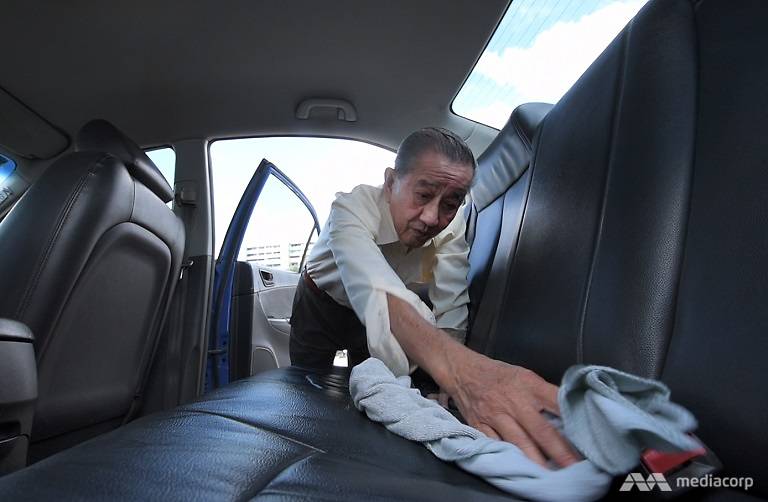
Mr Loh Liang Yong cleans his taxi every day at the end of his shift to ensure that his passengers travel comfortably. (Photo: Jeremy Long)
“If (passengers) tell me to go fast, I will ask them why they are late. If they woke up late, it’s not my problem,” said Mr Loh.
He also related how some passengers think that taxi drivers like to take longer routes to earn extra money.
“This is not true,” he said. “Time is money, we are fighting against time. More job pick-ups mean more money.”
COMPETITION AND LIVELIHOOD
Typically, Mr Loh worked 12 hours a day, seven days a week. He carried about 20 passengers each day, beginning his shift at 8am and ending long after it gets dark.
He started off each day needing to earn about S$95 to break even – a threshold that can take six or seven hours to reach. On some days when passengers were elusive, he lost money.
“If we don’t hit our target we have to continue working. We have to gather enough for rental, fuel, and other expenses,” said Mr Loh.
Mr Loh also related how increased competition from the ride-hailing industry has affected him.
Mr Loh needs to drive for around six hours a day to cover his fuel and rental expenses. (Photo: Jeremy Long)
“Even though I was affected at the start, I made up for it by driving longer. I didn’t mind at all because I’ve always enjoyed driving. The situation got better later.”
Mr Loh took breaks every day. He would stop for coffee and have lunch at his home in Toa Payoh, but he knew that if he was not turning the wheel, he was not making a living.
On top of that, Mr Loh was forced to confront hazards more potent than potholes: His own fatigue, other distracted drivers and getting cheated by his customers.
‘WHAT A BASKET’
On his last day at work, Mr Loh looked back on his experiences and recalled, with a hint of exasperation, a certain passenger he once came across.
“The passenger I will never forget is this man who boarded my taxi and asked to go to two locations. During the journey to the first location, he sat in the front passenger seat, and was so friendly. It was like talking to a friend,” said Mr Loh.
“But he abandoned me at the first location. The fare then was S$34 … And I later realised that he took some cash from the console box in between our seats,” he added.
“I couldn’t believe how someone so friendly could all of a sudden steal from me – what a basket,” said Mr Loh.
Mr Loh encountered a passenger who left his cab without paying, and stole his money. (Photo: Gaya Chandramohan)
He lost about S$50, which was around half of his earnings for the day.
“I became sad and angry, and had no heart to drive. I was thinking whether to report the incident to the company, but I later realised that I would be wasting my time,” said Mr Loh.
“Ultimately, I let it go and carried on with driving. I believe that forgiveness is happiness, and this mantra allows me to feel relaxed when I face life challenges,” he added.
MORE FACE TIME WITH GRANDDAUGHTERS
While Mr Loh loved his job, he admitted that being on the road day in and day out is a lonely endeavour. He would listen to music on the radio but he still missed contact with friends and family.
Now that he will have more time to himself, Mr Loh is looking forward to taking his three granddaughters out during the school holidays and spending more quality time with them.
The three girls study at CHIJ Our Lady of Good Counsel at Burghley Drive and Mr Loh used to occasionally pick them up after school in between his shifts.
Mr Loh picked up his granddaughters from school when he had time in between shifts. (Photo: Jeremy Long)
“I miss them … When I am able to, I’ll take them out during school holidays. Sometimes I like to show them around Singapore,” he said.
Mr Loh said that he has learned a lot from them too, especially on how to use smartphone apps like Instagram.
Mr Loh hopes to spend more time learning about smartphone apps with his granddaughters. (Photo: Jeremy Long)
In particular, he found it amusing when they took pictures with a filter that would mirror animal features to their faces.
“They are bright girls, and very advanced in (using) phone apps. We take photos together of us looking like bulldogs,” he said.
All things considered, Mr Loh has no regrets over his career choice of being a taxi driver.
“I enjoy driving, and it keeps me fit and active. I also like the freedom the job offers,” he said.
However, he is approaching 75, the age limit for someone to hold the Taxi Driver Vocational Licence, as legislated by the Land Transport Authority.
He feels that he has been forced to hang up his keys and is reluctant to call it quits.
Mr Loh joined ComfortDelGro after working for decades in the construction sector. He has not regretted the decision. (Photo: Jeremy Long)
Not wanting to be bored, Mr Loh has already applied to do part-time work as a guide at a hospital in Singapore. He is also looking to do charity work after taking a month off after his retirement.
But the thought of taking the laminated photo of himself from his dashboard and storing it in some box in his home unsettles him slightly.
“I feel sad because I don’t want to retire,” said Mr Loh. “It’s no good to be less active. I’ll just be miserable.”
SINGAPORE: Singapore has gone through such spectacular changes in its bicentennial history that today’s visitors to the country may be forgiven if they think it has always been a glitzy concrete shopping paradise and financial hub.
It was only at the turn of the 19th century that Singapore grew, exported and traded in gambier, nutmeg, cinnamon, among other produce. And until the 1970s, orchards, chicken and pig farms thrived on the main island.
As Singapore accelerated its transformation from Third World to First post-independence, so too did its policy makers confront difficult choices on the use of limited land.
Economic transformation focused on transferring resources from land-intensive agriculture to other more value-adding sectors. Land used for farming then shrunk, and by the 1990s Singapore’s agriculture had become confined to six agro technology parks occupying some 1,500 hectares of land or less than 1 per cent of its total area.
During the 2000s, emphasis was placed on productivity and use of technology to enable increased production of vegetable, fish and eggs in limited spaces.
The Agri-Food and Veterinary Authority of Singapore (AVA), as the Government agency responsible for food, animal and plant health, rolled out initiatives to support farmers and research.
Others in the food science sector chipped in to support Research and Development (R&D) in various aspects of plant agriculture and aquaculture, although an explicit national strategy for research investment was not obvious.
FROM FOOD SECURITY TO FOOD INDUSTRY
Singapore has for a long time had a small food manufacturing and processing sector. In 2017, the sector employed just under 50,000 workers and was worth S$4.3 billion or about 1 per cent of GDP.
Recently more calls for a renascent food production and processing sector have been made, not just to encourage increased production for food security but also as a potential value-adding sector which could foster new livelihoods and even contribute to exports of products and intellectual property.
Packed soups ready for high-pressure processing at a Soup Spoon production facility on Jul 26, 2018. (Photo: TODAY/Chng Shao Kai)
This had in mind not just the Singapore market but the broader Asian and indeed global market.
These aspirations, however, are more closely linked to and take dressing from Singapore’s larger aspirations to be a leading player in advanced technologies and digital applications, agriculture being just one sector.
But a change is underway, as the thinking surrounding agriculture has shifted beyond food security to food industry, reinforcing Singapore’s emergence as a matured economically confident nation and reflecting the changes from labour-intensive to technology-enabled farming and food processing picking up pace in most developed countries.
On Monday (Mar 4), Senior Minister of State for Trade and Industry Dr Koh Poh Koon re-emphasised Singapore’s vision to be “a leading urban agriculture and aquaculture technology hub with a food production model that can be exported to the region”.
This vision was given a concrete domestic target on Thursday (Mar 7) when Environment and Water Resources Minister Masagos Zulkifli announced that the country will aim to produce 30 per cent of Singapore’s nutritional needs by 2030 and laid out the strategy to get there, through the employment of technology, unlocking of physical spaces, developing local talent and getting consumers to support local produce.
In this transformation journey, there are lessons from other countries with similar goals.
NETHERLANDS’ FOOD VALLEY
While large countries like the US and Brazil dominate the global food economy, much smaller countries are also in the top league of food exporters measured by value.
The Netherlands is the second largest food exporter after the US – top Dutch companies include Unilever and Heineken – but ranks first in the world if agricultural land size is accounted for. The next most land-productive country is Belgium.
Both not only export primary produce but also convert imported primary produce into food or other products in varying degrees of sophistication for export.
The Netherlands has a “Food Valley” occupying – an internationally recognised, self-contained, extensive agri-food park that encompasses education and agricultural R&D, food manufacturing and processing entities, distribution networks and financing institutions.
Two decades ago, the Netherlands committed to developing a model of sustainable agriculture, with the goal of producing twice as much food, with half as many resources.
Starting in 2004, a “Food Valley Organisation” (FVO) was formed with support from government and private sector to build on the strengths of individual entities and through derived synergy, propelled the Netherlands into a global food player.
The FVO is sustained by subscriptions from its members and grants from public agencies for services performed. It works with the government but is not a government agency.
Likewise, in Belgium, the analogous area is the Flanders region which has a similar nodal, coordinating entity called “Fevia” working with all players but sits outside government.
Eggs are packed to be sold at a poultry farm in Wortel near Antwerp, Belgium August 8, 2017. (Photo: REUTERS/Francois Lenoir)
Expansive arable land is not a pre-requisite for success in becoming an innovative country with high-value food exports, as seen from the Netherlands and Belgium.
Food industry clusters which are successful do not develop by chance. A spate of enabling factors are discernible.
These include focal organisations which promote coordination, growth and synergies. It appears to have been important in positioning the Netherlands’ and Belgium as top food exporters in terms of land productivity.
Appropriate infrastructure for R&D and enterprises, supportive public policies, a culture of innovation and entrepreneurship, and the presence of an ecosystem are what makes for a successful food industry.
Having relevant human resources – people with the requisite skill sets – is indispensable for the successes enjoyed by major food exporting countries.
In the Netherlands and the Belgium Flanders region, higher education institutes and vocational schools like Wageningen University provide a reliable supply of skilled labour and act as a key source of research powering their countries’ food revolution.
Today’s food systems are made up of supply chains with many parts from farm to fork. Along these parts require a country to have an ecosystem of key ingredients including knowledge, infrastructure or support systems, financing and regulations.
SO WHAT “CHECKS THE BOXES” FOR SINGAPORE?
Singapore does not have the comparative advantage to grow extensive crops like rice, but can develop a niche positioning in intensive, small-area specialty crops.
File photo of vegetable farm in Singapore. (Photo: AFP)
In doing so, it should leverage existing national strengths: Its proven capabilities in research, an educated, adaptive workforce for high-tech agriculture and food processing, and well-supported enterprises.
But it is lacking still in people with the knowhow that can take the food industry to the next level, which hopefully will be addressed by recent new initiatives at Budget 2019 – such as the establishment of a Centre of Innovation in Aquaculture (which will cover marine farming) at Temasek Polytechnic, a school that also offers an applied food science and nutrition diploma.
The global agtech market – the intersection of agricultural and advanced technologies in information technology (artificial intelligence, internet of things), chemical and electronics – presents opportunities for Singapore to attract industry players.
In the expanding plant factory space of indoor vegetables, there is also a silver lining of exporting Singapore branded factory vegetables.
Singapore’s largest indoor vegetable farm of 20,000 sq m is expected to be fully functional by early next year, and will be one of the biggest in the world. Still, surplus production may find new markets in the rest of Asia if accompanied by aggressive, enlightened marketing.
BIRTHING A NEW FOOD INDUSTRY
The goals associated with developing a renascent food industry sector in Singapore are, apart from improving food security, to create jobs, gain economic advantage through value-added exports, and contribute to a culture of innovation and entrepreneurship. To achieve these, some aggressive strategies will be needed.
One strategy is to double down on a laser-sharp focus on high value-add activities within total food systems. The sector could focus on meeting upstream research needs or downstream processing, or generate only high-value, unique and branded produce that can produce a high margin and do not rely on volume sales to be profitable.
Sky Green’s vertical farm in Singapore. (Photo: Sara Grosse)
A second strategy is to establish an independent private-public-partnership food industry nodal entity supported by key stakeholders who have access to funding, expertise and networks including EDB, Temasek Holdings, notable large food enterprises and Singapore food industry groups – to coordinate, catalyse, leverage, and synergise across food industry sectors so as to accelerate progress.
A third strategy is to accelerate the development of a tech-savvy workforce in agriculture and food processing knowhow, backed by appropriate R&D capacity through Singapore higher education institutes and ASEAN centres of expertise in food production and processing.
Putting in place support that is clearly defined can encourage the growth of a new food industry which makes use of Singapore’s comparative strengths.
LAND FARMS IN OUR GARDEN CITY
But, lest it be forgotten, Singapore’s aspirations to be a “City in a Garden” need to have an agriculture sector aligned to it. Not all of Singapore’s food production capacity need or should be indoor, in a controlled environment or use high tech.
There is an existential human need to have some real green farms growing plants and animals like the majority of farms in Asia – which bring quality of life benefits to citizens.
In fact we will be a poorer Singapore if our children do not have at least a small farming countryside to go to and experience how the food we import are grown, and how the soil can bring life to our tables.
This last part is perhaps the most crucial ingredient because knowing more about farming improves the appreciation for food.
Paul Teng is Adjunct Senior Fellow (Food Security) in the S Rajaratnam School of International Studies, Nanyang Technological University in Singapore and concurrently Honorary Senior Fellow, Southeast Asian Regional Centre for Graduate Study and Research in Agriculture (SEARCA/SEAMEO) in the Philippines.
SINGAPORE: Mr Shinichi Takiguchi has visited Singapore several times, and from the windows of his hotel room, all he can see is the sea. He believes that will change in future.
The managing executive officer at construction giant Shimizu Corporation is part of a team working on building a floating city for upwards of 50,000 people. And they have been poring over maps of Singapore, discussing potential locations.
They are sure that what they call the Green Float will be part of the sea view here one day – with homes at the top, offices in the middle, vegetable farms at the bottom and beaches around it.
“The technology required could be realised here and now,” says Mr Takiguchi, who is with Shimizu’s Emerging Frontiers Division. “I won’t have to wait till my grandchildren’s generation. I’ll be able to see it while I’m still alive.”
Mr Shinichi Takiguchi.
Building on water is one of the possibilities for Singapore as it looks for new spaces where people can live, work and play.
Based on the Land Use Plan, an additional 5,600 hectares of land are needed by 2030 to cater for a population expected to grow to between 6.5 and 6.9 million.
And the city state is leaving no stone unturned in these efforts. “We’re using every possible surface and expanding our options,” says Economic Development Board managing director Chng Kai Fong.
“We have to examine every single option that’s available. We need to pick up every stone and seize those opportunities.”
The Green Float might be an option.
Besides the sea, the options include building in the air, such as above roads, canals and existing structures, as the show Land Unlimited discovers.
The series showcases how other land-scarce cities are using unusual locations to overcome limited land, and what Singapore – the 20th-smallest country in the world and the second smallest in Asia – can learn from their experiences. (Watch it here.)
‘COSTS THE SAME AS RECLAMATION’
At all of 724 square kilometres, the Republic is less than half the size of London. Throughout its existence, it has fought back the sea to create more land, with its first reclamation carried out in 1822, on Boat Quay.
Now, Shimizu Corporation believes it has a new, comparable solution. “Building a Float would cost the same as reclamation,” claims senior architect and project leader Masaki Takeuchi.
Mr Masaki Takeuchi pointing at a model of the Green Float.
It would take about 10 years to construct a Green Float with a 1-km-high tower and a base that is 3 km in diameter. Once completed, it is expected to last 100 years.
At Shimizu’s Institute of Technology in Tokyo, scientists have achieved breakthroughs in creating suitable concrete for structures on the sea, bringing the concept closer and closer to reality.
They have also erected an experimental structure, half floating on water, which they have kept a close watch on, to apply what they learn to building the Float.
And Singapore’s calm equatorial waters may be one of the best places in the world for them to construct a Green Float.
The Shimizu team, looking at a potential Green Float on the equator.
“The wind and water currents around Singapore are much weaker in comparison (to Japan). Thus we can safely say that safety won’t be a concern,” says Mr Takeuchi.
It also makes use of solar energy to be more eco-friendly, and there’s a lot of sun around Singapore.
AN IDEA FROM LONDON’S ROOFTOPS
In London, architects have proposed a floating building on the River Thames to house parliamentarians when it is time to refurbish the Houses of Parliament.
Meanwhile, another idea for overcoming the city’s land shortage is already being put into practice: Rooftop property development.
New storeys are being added on roofs to build homes.
One of the first to specialise in this is Apex Airspace, which expects to build about 100 homes this year by adding a storey above suitable buildings.
In fact, the company’s research found that it is possible to have 180,000 such homes in London, a city where 66,000 new homes are needed annually to meet demand after years of underinvestment.
Developers must secure the rights to the airspace above a building before they can place a structure on it, which was an unusual concept when Apex chief executive officer Arshad Bhatti founded the firm in 2015.
Banks brushed him off when he tried to secure a loan. But he persevered and turned his idea into a reality, starting out by putting a storey on top of a three-storey building.
The building where it all started for Mr Arshad Bhatti.
“We were able to show that these spaces can be used for a valuable purpose,” he says. “It’s 732 acres of land. That’s what the roofs are across London. We’re bringing a new land supply into equation.”
Each home is manufactured in modules in factories, then transported to the site, where it is assembled in a day without major disturbances to residents.
“We have new technologies to enhance the structural integrity of these buildings, which not only will build new units which are safe to live in, but also enhance the integrity of the existing buildings,” says Mr Bhatti.
“Because they’re being built in the factory environment, they’re more precision-made. They’re of better quality.”
In a home developed by Apex Airspace.
He has had enquiries from other cities in the United Kingdom, as well as from New Zealand and Abu Dhabi. Elsewhere, architects and developers have found similar solutions to the challenge of making better use of land.
In Hamburg, Germany, a concert hall was designed to sit above a warehouse built in the 1960s, as a way of creating a cultural venue without straining the land supply. It opened in 2017 and has become a city landmark.
In Singapore, a study has proposed adding new levels above shophouses. “Technology is available. You build on it. There shouldn’t be a problem,” says National University of Singapore civil engineering professor Yong Kwet Yew.
“Our land is so precious. So it doesn’t make sense to have three- to four-storey structures.”
Prof Yong Kwet Yew.
Any such decision, however, must be weighed against other priorities such as leaving low-rise heritage areas as they are. “Whether we build above existing structures, it’s a matter of policy and, of course, societal acceptance,” he adds.
‘UNDERUSED LAND POTENTIAL’
Mr Michael Shaw, who develops rooftop homes in London, spotted another kind of opportunity during his trips to Singapore, where his son Cameron worked for a few years. He wants to build apartments above drainage canals.
“It’s only when they have heavy rainfall that they come into their own. But the rest of the time, they’re basically land space that’s unused,” says the director of Pent Developments.
What you have is land potential that’s being underused in a small country where land is at such a premium. It’s a wasted land resource.
Mr Michael Shaw.
A frame laid over a canal would form the support structure for apartments with modular components made in factories. According to his plan, each development would have six storeys and 60 units of various sizes, from one to three bedrooms.
“You’re not having to buy the land, and that’s a huge saving. So even if the construction method is slightly more expensive, the overall savings would be huge,” says the 64-year-old. “It’s something that we could build tomorrow.”
Transport infrastructure is another that takes up lots of space. But architects are finding ways to respond to that challenge facing many cities.
“There are always opportunities to create new spaces in and above existing infrastructure, whether that’s railway lines or roads or stations,” says Mr Max Farrell, a partner at architecture and urban design firm Farrells.
A concept design for homes created above a road.
One of his firm’s signature projects is Embankment Place, a nine-storey office building on a roof constructed over Charing Cross, one of London’s busiest railway stations.
“The trains didn’t stop once. It’s a piece of London that was never thought to be possible,” he says.
The space above roads could be just as productive. An expressway running through Hamburg, for example, is getting roof covers that will be turned into land for parks and other facilities. It will also connect communities separated by the expressway.
This idea of building over major roads has been carried out in Singapore with the S$16 million Eco-Link@BKE, opened in 2013 to restore the ecological connection between the Bukit Timah Nature Reserve and the Central Catchment Nature Reserve.
An aerial shot of the Eco-Link@BKE, the first ecological bridge of its kind in Southeast Asia. (Photo: NParks)
In future, such bridge-like structures might be a way to inject new spaces into business districts, serving as areas on which low-rise offices or community facilities could stand.
ON THE ROAD TO CHANGE
A more immediate task is to find ways for spaces to serve a double duty, especially those that are underutilised at certain times.
If vehicles are all that roads are used for, then Singapore is missing out on the full potential of the 12 per cent of land they occupy, as some roads have varying levels of usage at different times.
(Photo: TODAY)
“We need to be able to think creatively about how we can use roads in a more multifunctional way,” says Mr Farrell. “There’s a much more intelligent programming of roads that can mean roads can become public spaces.”
In the Central Business District, for example, if public buses are diverted when traffic is nearly non-existent, say, on Sundays, then roads could be available for other uses – such as pop-up cinema, yoga or tai chi, he suggests.
In the coming years, road infrastructure will evolve because of autonomous vehicles “going mainstream”.
“We can get something like 30 per cent of the current road space back, and 80 percent of the car parks. Though I think it’s something that people don’t recognise will be a game changer,” he says.
Nanyang Technological University and Volvo launched on March 5 a 12m-long autonomous electric bus said to be a world first for its size and engine type. (Photo: AFP/Roslan Rahman)
The authorities, however, are watching closely. “Very likely we’ll see, in future, automated vehicles for fleets, for example public buses. This will change the way roads are used,” says Urban Redevelopment Authority group director (strategic planning) Adele Tan.
“Right now, because the future isn’t so clear, we’re keeping an open mind. We’re trying to see how we can plan ahead that will cater for these different scenarios.”
As new technologies will have an impact on land use, Prof Yong agrees that “the plan should always be dynamic”.
“We may have a plan for what we can see now. Twenty years (later), it could be a totally different plan,” he says. “I see tremendous opportunities if we allow our imagination to go unhindered.”
SINGAPORE: Singaporeans are not, if anything, dispassionate about our food. We go into a social media frenzy when other countries claim our food as theirs.
We are willing to spend an inordinate amount of time in food queues just to satisfy our palates. And so as we hear of more of our old favourites biting the dust and shuttering, we mourn deeply over the loss of yet another childhood fare – or is it another alternative to our national pastime?
It befuddles many minds why popular eateries like Moi Lum, one of Singapore’s oldest Cantonese restaurants, would serve its last dish in March after feeding many satisfied diners for 100 years.
Then there are also the last suppers served by 55-year-old Chakey’s Serangoon Salt Baked Chicken and 63-year-old vegetarian restaurant Zen Fut Sai Kee.
All these businesses have taken the route to shut down because age has caught up with the owners and their children don’t want to take on the business.
There is also an element of pride that has led to many closures. Without the next generation to hand age-old recipes down to, many proprietors would rather see the end of the road than to have their secrets commercialised or, worse adulterated.
It was reported that the owners of a popular dim sum restaurant, Hua Nam, closed its doors in 2016 after making the traditional goodies from scratch for three generations. With no family members willing to take over, the owners opted to shut down to preserve the original recipe.
The dilemma for these traditional restauranteurs whether to continue the business is further complicated by the extremely challenging landscape quite unlike what they had experienced when they took over from their fathers in the 60s and 70s.
High rentals, shortage of manpower, a saturated market with a smorgasbord of choices for the consumer make survival for small outfits with limited scale increasingly challenging.
(Photo: Unsplash/Khachik Simonian)
The issue of succession is both an emotional and a professional decision for family businesses. There are two broad areas in every business entity – management and ownership.
Ownership refers to the shareholding while management, the operations. In most small businesses, ownership and management are one and the same.
In its simplest terms, succession can take three forms: First, it can take the happy outcome of ownership and management remaining in the hands of the family when the next generation are willing and competent enough to helm operations.
Second, proprietors can employ professionals to run the daily operations while ownership and major decision-making remain in the family.
Third, it can include other shareholders outside of the family who can steer operations and implement systems to ensure the company not only continues but is able to scale up.
As the options go down the wire, owners will likely feel threatened by the reduced control and share of profits.
The nature of the food business lends itself to a certain pride of craftsmanship that makes relinquishing control akin to an identity crisis. Unlike manufacturing or property outfits, for instance, food businesses are typically started by chefs, not businessmen. In the early years, it was a matter of using their skills to survive.
As time passed and as their renown grew, however, much pride and passion were instilled in their art, more than their business. Chefs can be fixated on their product. Quality takes precedence over quantity.
Expansion, for them, ought to focus on an elevation of their menu rather than the increase in the number of outlets.
But for the art to thrive, the platform on which it operates is just as crucial. For operations to grow there needs to be a driver who can focus on taking risks, expanding networks and exploring opportunities.
(Photo: Unsplash/Ash Edmonds)
In many of my conversations with Asia’s top entrepreneurs, passion in the product itself plays a small role in the growth of their businesses.
It’s often the adrenaline rush they get when the business expands, when they solve an intractable problem, when they create successful brands, when opportunity arrives to play a bigger role in philanthropy, or when innovation opens new doors. The combination of businessman and chef in one is a rare find.
The way forward if the business is to feed another generation is to take a leaf out of the books of those who’ve made a name from themselves as food entrepreneurs – or foodpreneurs.
EMBRACE SYSTEMS AND PROCESSES
International dim sum restaurant Din Tai Fung, famed for its xiao long bao, presents many lessons. The restaurant was started by Yang Bin Yi in 1972 in Taiwan. Word of his delicious wrapped soupy dumplings spread so rapidly that the seating expanded from half of their shopfront to all four floors of the lot in no time.
But it would take 24 years before the next outlet would open – in Shinjuku, Japan. A few years and further expansion in Japan led the food chain to finally open its own central kitchen back home in 2000.
With the processes fine-tuned, outlets sprung up in quick succession throughout Taiwan. Consistency across all outlets was key, right down to each of their famous dumplings standardised with 16 grams of dough, five grams of pork and folded in no less than 18 pleats.
Across their 150 outlets in 15 countries, Din Tai Fung is instantly recognisable with its glass-encased kitchens with chefs busily doling out the dumplings and other items on the menu almost by muscle memory. But all this clockwork precision takes effort. Owner Yang Chi-hua, the founder’s son, keeps tabs on operations by holding court in video conferences with branch managers daily.
Xiao long bao (steamed soup dumplings) from Din Tai Fung. (Photo: Din Tai Fung Singapore/Facebook)
Yang is of the rare breed of chef and businessman rolled into one. Not only has he been instrumental in expanding the business over the years, but he had also worked in the kitchen in the early years with the chef his father employed to start the business with.
Yang has successfully balanced his penchant for maintaining the highest standards in food quality with the pragmatism of scaling up the operations at opportune times.
FINDING THE RIGHT PARTNERS
It’s said that Yang receives dozens of proposals a week from suitors looking to take the Din Tai Fung name to various parts of the world, as far as Russia and Mongolia. Most don’t get beyond his in-tray.
For the owner, growth is not as much a priority as maintaining high standards. Finding the right partners along the journey is an instinct Yang seems to have honed over the years.
One such franchisee that Yang has partnered with in the last 16 years is Singaporean George Quek of the BreadTalk Group. Quek has led the charge since 2003 for Din Tai Fung in Singapore, Thailand and most recently in the UK, with close to 30 outlets.
Perhaps the key to Quek’s success is that he is both a franchisee and a franchisor, with his own stable of popular brands and an excellent feel of the markets he operates in.
Known as the King of Food Courts, Quek introduced Singaporeans to themed food courts in 1992 with Food Junction and has since fed the food fancies of Singaporeans with another food court, Food Republic, local coffeeshop chain Toast Box and of course, the company’s eponymous bakery, BreadTalk.
Today the Group runs 1,000 outlets in 16 countries with numerous food brands under its management. Its last full year revenue was close to S$600 million.
A Toast Box outlet in Singapore. (File photo: Facebook/Toast Box Singapore)
Here is a man who understands food trends, has an instinctive feel for consumer tastes and preferences and dares to push the envelope in food presentation and experience. Quek’s innate feel of the food business began in Taiwan after dropping out of art college from a lack of funds.
To make ends meet, he made and sold dragon beard candy in kiosks. He later learnt to make noodles and introduced the Taiwanese to Singaporean hawker fare.
As a chef and business owner, Quek has developed the ability to sniff out a good brand and create his own, and he has proven time and again, that he can serve up delectable returns for his partners and shareholders.
THE SCIENCE OF BUSINESS OPERATIONS, THE ART OF FOOD
To sustain the food business for the long haul, owners must have the courage to operate apart from family members. While people are key to the success of any business, so are systems. Just as there’s an art to food creation, there is also a science to business operations.
Restaurant owners need to recognise the limitations of their gene pool and their own abilities and have the courage to share the responsibility of growing the business. They must also entertain the idea that quality and quantity can co-exist.
This can be a deeply emotional experience for one who has emerged from the shadow of the family business and who has retained sole ownership and decision-making for decades. But done with the right people and processes, heritage restaurants can continue to thrive and perpetuate not just the family legacy, but their gastronomic delights for generations to come.
Karen Lam was the host and producer of Power List Asia and author of Power Talk: Insights from Asia’s Top Entrepreneurs. She is also a presentation and media trainer.
SINGAPORE: Senior enforcement officials from around the world identified cyberterrorism as a key concern during an inaugural international security sharing programme organised by the Home Team Academy.
The Phoenix International Programme, which ran from Mar 5 to 8, saw 18 officials from 12 countries discuss security threats and the ways to effectively manage them.
One of the keynote speakers at the event was a former senior security advisor during the Bush administration between 2005 and 2009.
Mr Juan Zarate, who was also the former deputy assistant to the former US president George W Bush, spoke about how countries are increasingly dependent on cyberinfrastructure to connect and run economies.
This has created vulnerabilities that cybercriminals can exploit, he said.
Mr Juan Zarate was a former senior security advisor during America’s Bush administration between 2005 and 2009. He was also the former deputy assistant to the president.
“The reality is we are going to continue to see cases of cyberbreaches, hacks, exfiltration of data and even destruction of systems, it’s inevitable,” Mr Zarate said.
“That said, we can continue to do more. A key dimension in security in the 21st century security model will be how public and private sectors collaborate much more dynamically, much more in real time, to actively defend key systems and data against the kinds of sophisticated attacks we have seen and continue to see.”
THOUGHTFUL APPROACH TO SINGAPORE’S CYBERDEFENCE
Singapore has not been spared from cyberattacks in its quest to become a Smart Nation.
But Mr Zarate said that Singapore has done uniquely well in its approach to cyberdefence.
“It’s been thoughtful in how it thinks about its security,” he said.
“It’s not a knee-jerk reaction. Whether it’s a terrorist incident or a cyber incident in the past, the ability of the authorities to take a step back and reflect on what the strategy, process and decision making should be, and to do it in a rather methodical way is pretty unique to Singapore.
“The US and UK do a good job, but Singapore is always thoughtful.”
However, Mr Zarate said there are certain aspects in cyberterrorism that Singapore struggles with, which is similar to what other countries are facing.
“We’re facing a cyberarms race where barriers to entry for the bad guys are very low, and the resource and requirements for authorities to defend systems and the private sectors are very high.
“That’s common around the world. How to think about defensive systems in the private sectors hands, and how government and private sector interact in an active defense model is an international debate happening around the world.”
Mr Zarate, who is currently the chairman and co-founder of Financial Integrity Network, an advisory firm that helps companies strengthen their financial integrity in the global security environment, also spoke about emerging global security challenges and global terrorist financing strategies during the event.
Senior Assistant Commissioner Mr Adrian Quek, commander security command, Singapore Police Force, said that the programme was enlightening.
“It has provided us with an excellent platform and opportunity to network and forge closer ties with our regional and international counterparts, which is crucial in our fight against transnational security threats,” he said.
INDIA-PAKISTAN RELATIONS
In his interview with the media, Mr Zarate also said that terrorism must not be allowed to become a flashpoint that triggers bilateral conflict.
Protests in Kashmir where violence continues to rage, with both India and Pakistan firing mortars and artillery over the Line of Control (LoC) frontier. (Photo: AFP/Tauseef Mustafa)
His comments come amid increased tension between India and Pakistan. The two nuclear-armed rivals have launched strikes at each other after February’s suicide bombing in Kashmir – claimed by a Pakistan-based militant group – killed 40 Indian paramilitaries, escalating tensions.
Mr Zarate called for cool heads to prevail. “It’s incumbent on the Pakistanis to control terrorist groups that may be operating from their territory and may be attacking Indian interest.”
He added: “It’s incumbent on Indians not to overreact to what the terrorists may do. And it’s certainly incumbent on the international community and countries like United States to try and not only help in the terrorism domain but also to calm the tension.”
SINGAPORE: Baihakki Khaizan has retired from Singapore’s national football team after 134 matches over 16 years, he announced on Thursday (Mar 7).
“Thank you all the fans for your support … I hope I have given my best during my 12,240 minutes outing.
“I’ll be joining you soon in the stands doing the Kallang roar together as one Singapore,” former captain Baihakki said on Facebook.
Reminiscing about the first time he played for the Lions, he said: “4th August 2003 was the day I first donned the national colours and deep inside I couldn’t explain how proud I was getting my first international cap against Hong Kong.”
He thanked former coaches Radojko Avramovic, who was “a father figure to many of us”, and Bernd Stange, for introducing European passing-style football to the team.
The Football Association of Singapore (FAS) on Friday posted a video of the veteran defender scoring a goal at the 2012 AFF Championship final, helping Singapore to become champions that year.
To his former teammates, he said: “I’ve enjoyed every single moment we had together.”
Baihakki also thanked his family, in particular his mother, his wife and his children, for their support.
“We can plan our holidays properly from next year onwards.”
Baihakki and his children donning football jerseys. (Photo: Facebook/Baihakki Khaizan)
SINGAPORE: A total of 136 suspected drug offenders were arrested during an islandwide operation by the Central Narcotics Bureau (CNB), the authority said in a news release on Friday (Mar 8).
The 11-day operation, which ended on Friday morning, covered several areas, including Balestier, Bukit Merah, Geylang, Hougang, Jurong, Serangoon, Tampines and Woodlands.
About 3.8kg of heroin was seized during the operation, together with 96g of Ice, 88g of cannabis, 83g of new psychoactive substance (NPS), a gramme of cocaine, 56 Ecstasy tablets, five packets of LSDs and two Erimin-5 tablets.
In one of the cases, CNB officers arrested two Singaporeans – a 61-year-old man and a 62-year-old woman – at Woodlands Drive 62 on Feb 27. A total of S$16,840 in cash was recovered from the man.
CNB officers also raided the male suspect’s rented unit in the area, where a 45-year-old Singaporean woman was arrested. Officers found about 3.75kg of heroin, 89g of Ice, 54 Ecstasy tablets, two Erimin-5 tablets and 36 bottles of methadone in the unit.
According to CNB, 3.75kg of heroin is enough to feed the addiction of 1,786 abusers for a week.
Drugs and drug paraphernalia found within the unit located in the vicinity of Woodlands Drive 62 on Feb 27, 2019. (Photo: CNB)
Drug paraphernalia, such as improvised drug-smoking utensils, digital weighing scales and empty plastic sachets were also discovered in the unit.
Investigations into the drug activities of all arrested suspects are ongoing, the authority added.
SINGAPORE: Cebu Pacific flight 5J803 from Manila to Singapore had to be diverted to Brunei on Friday morning (Mar 8) due to a technical problem, the airline said on its Twitter page.
The flight was diverted to Bandar Seri Begawan at 1.45am after a technical problem was detected in the aircraft en route to Singapore, it said in a statement.
The Airbus A330-343 jet was scheduled to arrive in Singapore at 2.05am, according to flightradar24.
“Another aircraft has been dispatched from Manila to take affected passengers to Singapore,” Cebu Pacific said.
“Meanwhile, the return flight, 5J804 (Singapore to Manila), will be delayed. We apologise for the inconvenience as the safety of our passengers is our utmost priority.”
Affected passengers were provided meals and refreshments, the airline said.
A screenshot from Flightradar 24 showing the route taken by Cebu Pacific flight 5J803 on Mar 8, 2019.
Saul de Jesus, 33, was among the passengers on board flight 5J803.
He said that passengers were alerted to the emergency descent before the aircraft landed in Brunei.
“I wasn’t able to get the exact message of the pilot during the announcement but I was sure of the words ’emergency descent’ and then it was announced that we would be diverted to Brunei,” he told Channel NewsAsia from Brunei International Airport.
“I was only half awake because the flight was in the wee hours in the morning but it may have been announced that there was a problem with pressure on the plane,” the social media professional said.
He added that all passengers were safe and waiting for a flight from Manila to pick them up to go to Singapore.
In his tweets, De Jesus also wrote that passengers had to stay on board for several hours after the plane landed as documents had to be processed.
At around 6am, passengers were asked to leave the plane and board a separate aircraft to Singapore, his tweets said.
“3:50AM Captain announced that documents are still being processed and that next update would be made after around 30 minutes to an hour. Still no way to communicate to people outside the plane for us,” he wrote.
“6:06AM Captain finally said that our plane cannot fly us to Singapore anymore and we have to be deplaned. Cebu Pacific will be sending another plane from Manila which would leave at a little past 7am.”
Timeline for @CebuPacificAir flight 5J 803 Manila to Singapore Original schedule: March 7, 2019 – 10PM to March 8, 2019 – 205AM #5J803