How To Increase Traffic And Make Sales -Online Course- Singapore
Monday, January 6, 2020 at 3:00 PM
Monday, January 6, 2020 at 3:00 PM
Singapore
71 Ubi Road 1, Singapore, Singapore
SINGAPORE: A fire broke out at Geylang Road early on Sunday (Mar 17) and is currently under control, said the Singapore Civil Defence Force (SCDF).
“SCDF has been alerted to a fire at 643 Geylang Road. SCDF is at scene conducting firefighting operations,” it said in a Twitter post at about 1.50am.

Firefighters use an aerial water monitor to combat the fire at Geylang Road. (Photo: Facebook/SCDF)
A video of the fire sent to Channel NewsAsia showed several-storey-high flames engulfing roadside shophouses as SCDF personnel battle the inferno. At one point an explosion was heard.
SCDF said it was alerted to the fire at about 1.10am.
“The raging fire involved 5 shophouse units and threatening to spread. SCDF is currently at work with 8 handheld jets and an aerial water monitor to bring the fire under control,” it said in a Facebook post.
“Due to the structure of the shophouse units, which share a common roof, the fire has spread quickly from unit to unit.”
The scene of the fire at Geylang Road. (Photo: Facebook/SCDF)
In a Twitter update at around 3.20am, SCDF said the fire had been put under control.

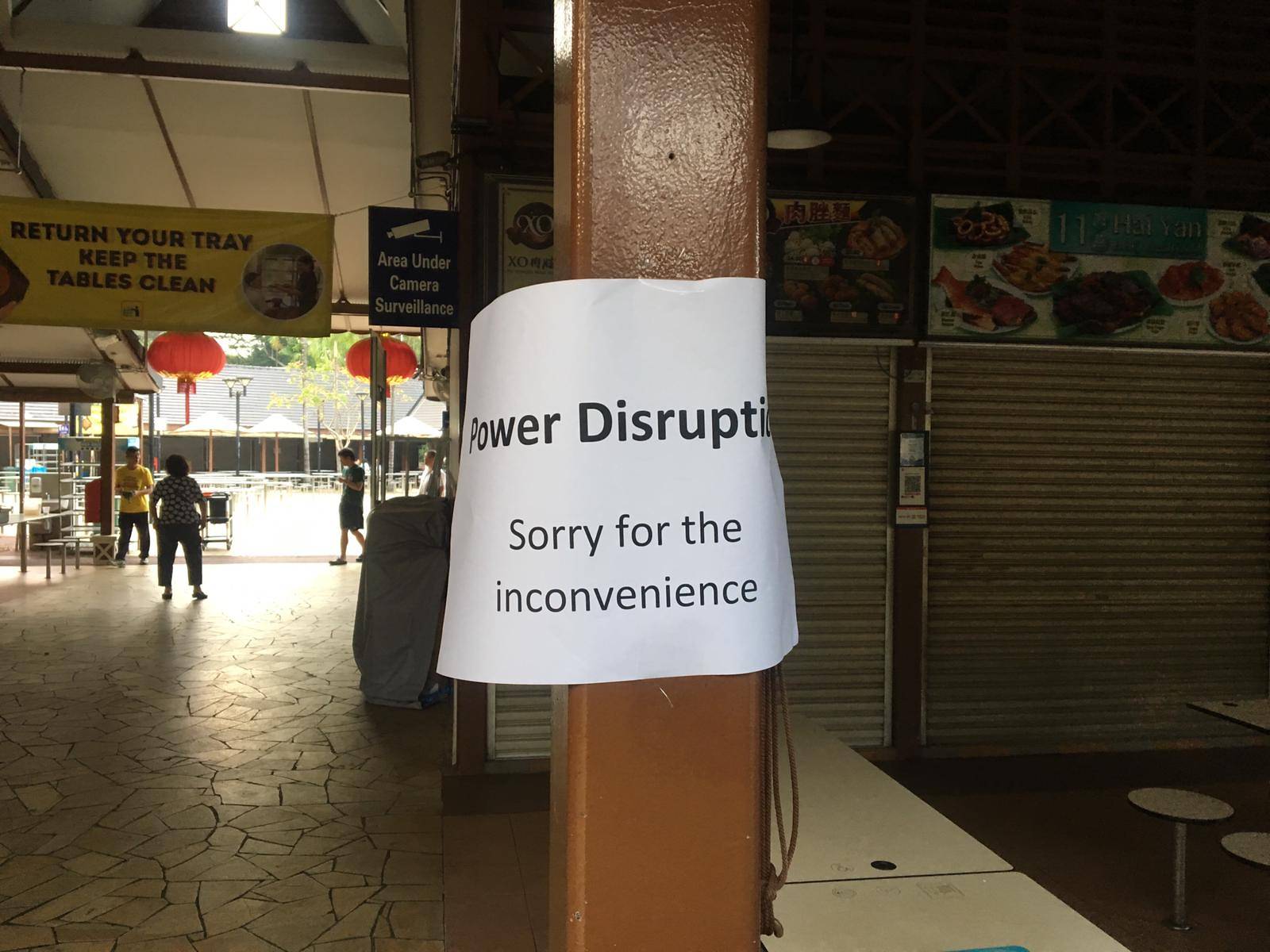
SINGAPORE: A fire at Newton Food Centre on Saturday morning (Mar 16) caused a power outage at the hawker centre and forced stalls to close for the day.
The Singapore Civil Defence Force (SCDF) said it was alerted to a fire at Newton Food Centre at 9.45am.
The fire involved an electrical switch room and was extinguished using two compressed air foam backpacks and a fire extinguisher, it said.
A sign at Newton Food Centre apologising for the inconvenience caused by a power outage. (Photo: Gary Haris)
SP Group, which supplies electricity to the centre, said that the power outage was traced to the food centre’s electrical equipment.
“At around 10am today, we were alerted that electricity supply to the Newton Food Centre was disrupted,” said SP Group.
“This has been traced to the food centre’s own electrical equipment. We confirm that SP Group’s network is in order.”
SP Group added that it dispatched its officers to the site and offered its assistance to the National Environment Agency (NEA), which manages Newton Food Centre.
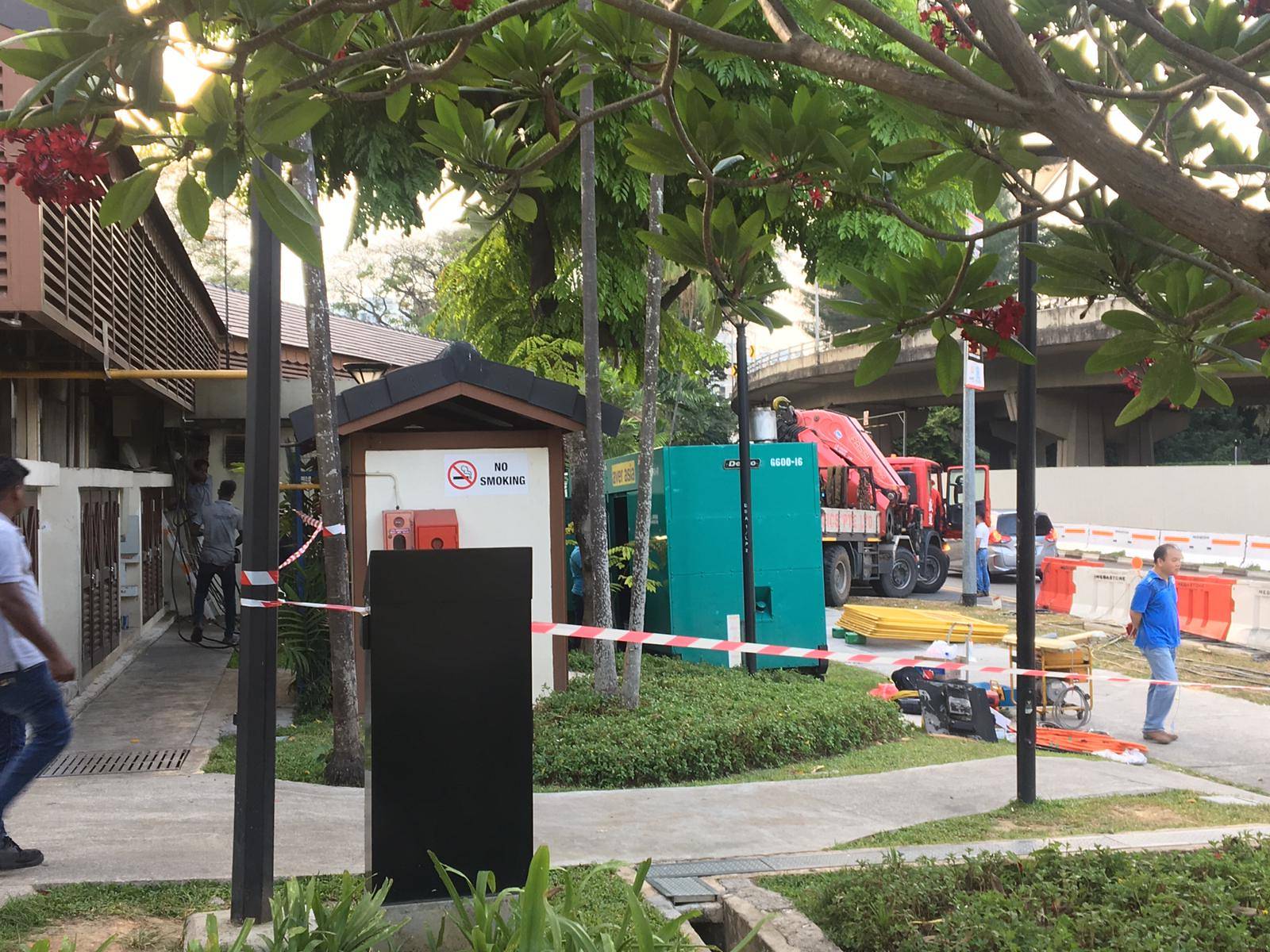
A fire at Newton Food Centre on Mar 16, 2019 started in an electric switch room. (Photo: Gary Haris)
Mr Gary Haris who had wanted to dine at the hawker centre told Channel NewsAsia that the stalls were still closed at 6.30pm.
“I went (to Newton Food Centre) for my dinner and was surprised unusually many stalls were closed and many people coming out of the hawker centre looking disappointed,” he said.
“One of the cleaners told me earlier in the day there was a fire at the main switch room, and they are currently investigating and trying to repair the burnt switch room equipment.”
A fire at Newton Food Centre on Mar 16, 2019 started in an electric switch room. (Photo: Gary Haris)
The SCDF reported no injuries in the incident and is investigating the cause of the fire.
Channel NewsAsia has contacted NEA for more information.
This story came from a reader tip-off. If you would like to send in photos or videos of something newsworthy, WhatsApp our Mediacorp news hotline at +65 8218 8281 or message us on Facebook.
ABU DHABI: As their fellow half-marathoners stood on the podium with gleaming smiles and glittering medals, Singapore’s Ahmad Sutrisno Suratman and Lim Boon Chin stood on the sidelines, their expressions blank.
They ran fast, fought hard, and finished strong. But a wrong turn along the route robbed them of a medalled finish.
Competing in the M1 division of the Special Olympics half-marathon on Saturday (Mar 16), the duo were on track for personal bests and a place among the medallists in Abu Dhabi.
The winds were brisk, the weather was cool and they looked strong after their first lap.
“Based on their first lap, they were on course to finish well. Given the same amount of effort, they were due to finish in 2h 20min,” said head coach Norman Koh.
But a wrong turn to join the 2.5km running route meant that Ahmad and Lim finished an hour before they would probably have. Spotters along the route had noticed the duo making the turn, but failed to alert them, said Koh.
“I was waiting at the finishing line and they came in about an hour earlier,” said Koh. “I couldn’t comprehend how and just wanted to celebrate their finish. But it started to sink in that it was not possible for them to finish so early.
“My heart sank, given the amount of training that has gone into preparation for this event. This was one of the biggest events of their lives.”
But for Ahmad and Lim, medals were always a bonus and never the goal, said Koh.
“What we do is always try our best. If it reaps good results, it’s a bonus,” said Koh, who has been their head coach for five years. “It is the journey that matters more than the results.”
(From left) Lim Boon Chin, head coach Norman Koh and Ahmad Sutrisno Suratman pose for a photograph. (Photo: Matthew Mohan)
The duo have been through their own battles of endurance in their daily lives.
Both Ahmad and Boon Chin have intellectual disability, and have had to grapple with the struggles of losing their parents and the unfamiliarity of a new phase of life after.
Participating in a sport like running gave the duo a chance to expand their horizons and learn life lessons, added Koh.
“Over the years, we’ve tried to improve not just their performance … They find it a challenge to understand what societal norms are, and we started to change the approach of just focusing on training but be a life coach to them.
“It’s not easy to change behaviour, because it comes with their conditions … But we are always there to mentor them.”
The Special Olympics World Games, held from Mar 14-21, is a meet for athletes with intellectual disabilities, and this year marks Singapore’s 10th occasion participating.
At least 7,500 athletes from more than 190 nations will feature in this edition, the largest number of participants in the event’s history.
At the Special Olympics, athletes are separated into different divisions based on factors such as their age, gender as well as level of ability.
After an hour of being cloistered in a room waiting on the confirmation of their results and a protest Team Singapore lodged, Koh finally broke the news to his two athletes.
There are no tears, no complaints, no tantrums. The duo donned their Team Singapore jackets and patiently waited for their turn to receive participation ribbons.
“(What happened) may not necessarily have reached them yet,” said Koh. “They might think that as long as somebody put the ribbon over their heads, they have finished it. They are just as straightforward as that. Regardless of results, they are still happy with receiving that ribbon.”
They stood one rung below the podium, but with the ribbons hanging from their necks, both Ahmad and Lim had something to show for their efforts.
“I feel good after today’s race,” said Lim. “I am excited for our next race (the duo will compete in the 5km race on Monday).”
After all, for Ahmad and Lim, life has been a marathon rather than a sprint – and they are just getting started.
SINGAPORE: Negotiations for the Regional Comprehensive Economic Partnership (RCEP) trade agreement covering ASEAN and six other economies (notably China, India, Japan, Korea, Australia and New Zealand), were launched in November 2012.
The proposed regional pact offers an integrated market of 3.6 billion people that contributes to a third of the global GDP, 29 per cent of global trade and 26 per cent of the world’s foreign direct investment flows.
Covering 18 chapters, negotiations over the last six years have managed to reach an accord for seven chapters, five of which were only concluded last year, despite efforts to wind up negotiations in 2018.
HERCULEAN TASK
Nevertheless, in recognition of the RCEP’s potential to boost regional growth, especially under the pressure of heightened global uncertainties due to the ongoing trade war between the US and China, Thailand as the ASEAN chair for 2019 has listed the conclusion of the RCEP talks as one of its economic deliverables for the year.
However, Thailand faces a severe time constraint as upcoming national elections in the country itself in March, as well as in India (over April to May), Indonesia (April) and the Philippines (May), is likely to lead to a slower pace of negotiations in the first half of the year due to the potential involvement of new ministers post-elections.
Thailand, as the ASEAN Chair, thus faces a Herculean task of pulling together a consensus on outstanding yet highly sensitive issues, which includes the scrapping of tariffs on agricultural products, the facilitation of cross-border movement of labour and the establishment of common rules for e-commerce.
Reaching a higher possibility of concluding the RCEP negotiations will therefore require the 16 member countries to reconsider the single undertaking approach taken thus far.
In this approach, the RCEP can only be concluded when an accord is reached in all 18 chapters and concurrently implemented among these 16 countries.
A man drives his motorbikes near an election campaign poster in Bangkok, Thailand February 15, 2019. REUTERS/Soe Zeya Tun
TWO OTHER APPROACHES
The history of negotiations in ASEAN shows the use of two other approaches to move cooperation and liberalisation forward. The first is the “minus X approach”.
Within ASEAN, using the case of the ASEAN Single Window (ASW) as an example, five ready ASEAN member states have proceeded to implement the ASEAN Trade in Goods Agreement first in 2018.
Likewise, the ASEAN-Korea Trade in Goods Agreement was signed in August 2006 by all ASEAN member states, except Thailand. Thailand subsequently acceded to the ASEAN-Korea Free Trade Agreement (AKFTA) in October 2009.
The second approach used is the “sequential approach”. The Framework Agreement on Comprehensive Economic Cooperation between ASEAN and Korea was signed by the leaders at the ASEAN-Korea Summit in December 2005 in Kuala Lumpur and came into force in July 2006.
But it is important to note that the main elements of the agreement were not achieved at one go.
Instead, the ASEAN-Korea Trade in Goods Agreement was signed in August 2006 and took effect in 2007; while the ASEAN-ROK Trade in Services Agreement was signed in November 2007 and took effect in May 2009. The ASEAN-ROK Investment Agreement was signed in June 2009 and took effect in September 2009.
While both of these alternative approaches are imperfect, they serve as a pragmatic response to cater to the diversity among ASEAN economies and their varying abilities to commit to lower trade barriers and higher levels of cooperation.
This diversity has widened with the inclusion of the six other economies, thereby making it even harder to reach a consensus within the 16 RCEP member countries.
File photo of ASEAN flag and flags of ASEAN member countries. (Photo: AFP/Romeo Gacad)
The choice facing policymakers is therefore between concluding the RCEP agreement, albeit on a smaller scale, or dragging on negotiations for an indefinite period and risking the RCEP losing all credibility as a potential regional pact.
Tham Siew Yean is Senior Fellow at ISEAS-Yusof Ishak Institute.
SINGAPORE: It is a sunny afternoon at the Sunlove-Kampong Chai Chee Senior Activity Centre, and 72-year-old Mohd Ali Abdullah is hard at work, his eyes fixed on the wheelchair lying on its side in front of him. With practised skill, he unscrewed the front wheel and removed it.
“You see?” he said, pointing to the tufts of hair and dirt caught in the wheel’s hub. “Stuck.”
As he used a brush to carefully dislodge the hair and sprayed some lubricant onto the wheel, he invited this reporter to give the wheel a spin. “See?” he said, smiling proudly as the wheel spun smoothly. “Just take the hair out, spray a bit and it’s okay already.”
A regular at the Senior Activity Centre (SAC), Mr Ali would have whiled his days away playing games and chatting with his friends at the centre – other retirees in the community.
But slightly over a year ago, he was recruited to join what is fondly known as the “wheelchair brigade”: Active seniors who volunteer their time and effort to service the wheelchairs of their needy peers.
Dirt and hair tends to get trapped in the wheel with regular use. (Photo: Lianne Chia)
HELPING OTHERS, WHILE LEARNING A NEW SKILL
Mr Ali joined the WHEELS programme which is administered by the Agency for Integrated Care (AIC) and charity Kampung Senang, with funding from Temasek Foundation Cares. As part of the programme, seniors like Mr Ali are trained to service the wheelchairs of needy seniors in the community.
“Wheelchairs are a key device frail seniors need to move around,” explained Woon Saet Nyoon, chief executive of Temasek Foundation Cares. “We realised that there were many times when they needed some help with their wheelchairs – either the tyres got flat, or it didn’t move around very well, or the nuts and bolts got loose – and they didn’t know where to go for help.”
“Then at the same time, we saw a lot of seniors who were not doing much with their time … so we thought, why not get them to learn a new skill?”
The three-year pilot programme was first launched in 2017 at five SACs in Bedok and Tampines. It has since been expanded to seven centres, including two eldercare centres. They are assessing the outcome of the pilot before expanding it to other areas.
Ms Woon explained that prior to the launch of the pilot, Kampung Senang volunteers had already been servicing wheelchairs for elderly beneficiaries. But with the pilot, the programme has been expanded to get active seniors on board.
A structured training programme was also developed, where seniors are sent to a centralised training centre in the Tampines area to be trained by Kampung Senang volunteers.
The programme includes six hours of theory lessons and supervised practical sessions, and covers topics like understanding the wheelchair components, maintenance, inspection and safety evaluation.
The seniors then return to the SACs where their services are readily accessible to those who need them.
“When they go through the course, they feel that they’re doing something good, and they get to learn a new skill, instead of just sitting there chit-chatting or playing games,” she said. “And when they know they are doing something to help another resident, they are even more willing to learn.”
So far, they have trained more than 35 seniors as wheelchair technicians, and they hope that at least 600 frail seniors can benefit from the scheme.
HELP IS JUST A CALL AWAY
68-year-old Jamilah Gulam is one of them. She has been wheelchair-bound for more than a decade after suffering a nasty fall.
But this has not stopped her from going out and about: She enjoys going about her daily activities like visiting the market or mosque, or spending time with her grandchildren at the beach.
What can put a brake on her daily activities, however, is if issues crop up with her wheelchair. The tyres do get worn down and the screws do become loose and need tightening from time to time.
Without the wheelchair, Mdm Jamilah is confined to her bed, dependent on her children or relatives to fulfil her needs.
“It was very difficult,” she said in Malay through a translator. “The wheelchair is very important.”
But she smiled as she caught Mr Ali’s eye and gave him a thumbs-up: Two years ago, she was invited to the launch of the WHEELS pilot programme, and it was there that she met Mr Ali, who has been making sure that her wheelchair is in good order ever since.
“I will just call him, and he will come right away,” she said. “He also taught me how to do simple checks, like if the screw is loose.”
“Sometimes I ask him if I should pay him,” she added. “But he always says no need, free one.”
“So I just buy him coffee or water, ok lah.”
It takes about 30 minutes on average for Mr Ali to fix a single wheelchair, which includes basic servicing such as cleaning and tightening of loose screws. (Photo: Lianne Chia)
“Yes, no need money,” Mr Ali chimed in.
He is enthusiastic about his role, talking animatedly about the people he has met since he started out almost two years ago. And it turns out that Mdm Jamilah and Mr Ali were in fact old friends: they are neighbours and he was friends with Mdm Jamilah’s husband.
“I will try my best to help them,” he said.
“I saw some people with spoilt wheelchairs … they have to wait for their daughter or son, and they cannot go jalan-jalan,” he said.
“I like making them happy when I fix their wheelchairs.”
It takes him about 30 minutes to fix a single wheelchair, which involves basic servicing such as cleaning and tightening of loose screws. More complex tasks, such as fixing the brakes and tyres, can take about two to three hours and also requires the help of another person.
There are scheduled monthly servicing sessions, but Mr Ali says he is available to help whenever he is needed.
“I am here every day,” he said. “If people see me here, they ask me, and I will help.”
“They know that if they have wheelchair problems, they can come and find me.”
And ultimately, he shows no sign of stopping.
“I will do (this) as long as I can,” he said, a broad grin lighting up his face. “If you help other people, the god will help you back.
“So you must go on helping people.”
SINGAPORE: We are heading into the first term break of the year and I can almost hear every parent heaving a sigh of relief. No more spelling, homework and ting xie to contend with. No need to wake before dawn for an entire week.
Sometimes I wonder who’s really looking forward to the holidays – the kids or the parents.
While most of us can’t wait to catch up on rest, the super-planner in us has probably also kicked in. We’ve probably shortlisted and signed up our little ones for a few holiday camps.
If you’re not busy planning, you may be busy worrying. Questions such as “How do I keep my child entertained or suitably engaged?” may flood your mind.
The day I learned to relax about the holidays was the day I realised two things. First, it is not my responsibility to keep my children entertained. Second, the holidays are not empty slots that you must rush to fill in.
CURB THE SUPER PLANNER-PARENT IN YOU
Even as I write this, I’ve already planned for my eldest to attend an art holiday programme. We also have an excursion to a museum planned with their Chinese tutor. Plus a couple of play dates.
The week looks set to be meaningfully engaging but also with a couple of free hours each day.
Singaporeans tend to wear busy-ness as a badge of honour. As if some idle time is going to get us slapped with the label “lazy”.
Perhaps a deep fear of missing out has been hardwired in our parental brains. Perhaps it’s the Singaporean productivity mindset – we must always keep moving and learning otherwise we risk being left behind.
Two boys at a playground. (Photo: Unsplash/Hisu lee)
But what about balance? What about the value of rest?
After working hard for an entire term, surely our kids deserve a good break?
That said, I too struggle with leaving their holidays alone, untouched.
Will they get into my hair when I’m rushing for a deadline? Will they start fighting among themselves? Will they keep bargaining for extra screen time?
All these “hassles” and “what-ifs” do make the idea of a completely empty holiday schedule seem utterly unpalatable.
COPING WITH BOREDOM
The biggest bugbear of the holiday season has to be boredom. Whenever my kids finish their stash of fresh library books, they start to get fidgety and restless.
They start asking for more screen time, more snacks or another trip to the library.
They start to irritate one another; tempers rise and fall.
But I see good things as well being born out of boredom.
My kids are avid collectors of Book Bug cards from the library. One fine day, all of them didn’t any have homework so my elder two decided to design their own Book Bug characters. It was nice watching them conjure up their own unique characters, each with different superpowers.
Playing with blocks can help children develop many skills. (Photo: AFP/Yoshikazu Tsuno)
At other times, they may start to deconstruct their old Lego sets and make new creations.
Or they’d ask me to look up the Internet for new cake or cookie recipes so we can whip up a storm in the kitchen.
As a child, I recall having to accompany my godmother to the office and staying alone with a book or activity pad in a meeting room for hours. I had no idea at the time and probably complained, but those hours may well have honed my patience and uncanny ability to self-entertain.
What happens when their schedules are filled to the brim with classes, meet-ups, and all manner of activities?
Fast forward some 30 years and our children’s schedules are looking even busier than their parents’.
How did we get here?
Yes, the activities are fun and beneficial no doubt, but I do wonder: What happens when a child is rushed through childhood at the speed of a Tokyo bullet train? How does this wire their brains to seek life experiences as a grown-up.
File photo of children using tablet computers. (Photo: AFP / FREDERICK FLORIN)
THE ABILITY TO THINK FOR THEMSELVES
This holiday break, it might be interesting to try out this challenge: Leave a day or two untouched and get the kids to plan what to do on those days.
Obviously some boundaries will need to be drawn so that they don’t end up watching TV or playing games from morning till night.
For the younger set or for children who are at a loss as to where to start, you can provide some ideas for them to choose from. Maybe there’s a project that they really want to do, like dabbling in a science experiment or illustrating their own comic book. Or a place of interest they’d like to explore. If it’s within reasonable limits, why not?
While they’re at it, get them to think about the time they’ll likely need to complete the task, as well as the things to prepare or buy in advance.
This will activate their planning and organisational skills, and give them a chance to be in charge.
If there are siblings, then all the better as negotiation and perspective taking comes into play. After all, as a family we need to work as a team and find solutions acceptable to everyone.
When the day is over, we can also ask them how they felt about being able to plan and direct their day’s activities. This will encourage them to reflect on their choices and imagine what they’d do differently in the future.
In her book Mind in the Making, Ellen Galinsky visited three early childhood programmes in America that were deemed “gold standard”.
These programmes took in high-risk children from low-income families, but longitudinal studies have found that they (now adults) demonstrate better grade retention, higher high school graduation rates, and higher employment rates and monthly earnings than children from similar backgrounds who did not participate in the programmes.
Her discovery? Each of the programmes presupposed children to be active learners who were expected to take increasing responsibility for their own learning. They made their own plans, carried them out, and then reviewed them at the end of the day.
Students participating in a mathematics class. (File photo: TODAY)
This kind of goal-directed behaviour helps children grow to become self-directed adults – which are the kind of people we’d want to see leaving our nests 10 to 20 years down the road.
As 21st century parents, we have shown remarkable prowess at planning and structuring our children’s lives, down to a T.
But starting from this holiday, let’s choose to exercise some restraint and leave some space for our children to take over the reins. It might result in a couple of delightful creations and important life skills learnt along the way.
June Yong is a mother of three, an educational therapist and owner of Mama Wear Papa Shirt, a blog that discusses parenting and education in Singapore.

Considering
every city, town and village in Spain hosts a
yearly celebration of some kind, 1000 is an obvious gross understatement when
it comes to numbering the amount of actual Spanish Fiestas that are held each
year.
Every single day sees townsfolk somewhere in Spain,
celebrating like there’s no tomorrow, spilling out onto the streets to party as
families, as friends, with their neighbours and with total strangers, all as
part of their local yearly festivities. From new-borns to the oldest members of
their communities the Spanish people embrace a party like no other culture on
earth and the way they party has to be seen and experienced to be believed.
Most Fiestas in Spain have their history and traditions culturally entwined with paganism and religion but there are plenty of crazy, bizarre and downright unbelievable celebrations in Spain that have their basis in agriculture, the seasons, animals and other parts of everyday life. Indeed there are some festivals that not even the locals know of their true origins.
Here
is our list of the 5 most bizarre Spanish Fiestas to attend:

The absolute best way of getting to know Spain a little
better and to briefly immerse yourself in Spanish culture is to travel around
Spain and try to discover some of these lesser known festivals for yourself. We
promise you, you’ll never forget the enriching life experiences you’ll be able
to enjoy in Spain, all the while learning a little of the language and gaining
a better understanding of a different culture and way of life.
Many people who plan on taking part in some sort of Spanish
Festivity or Celebration use reputable tour companies such as PP Travel to assist with their travel planning to Spain. PP Travel are
specialists tour group operators to La Tomatina, San Fermin and the Haro Wine
Fight and will ensure your fiesta experience is an experienced to be remembered
for a lifetime.
Hurra Por España (Hooray for
Spain)!
SINGAPORE: A new property launch touted as Singapore’s largest private residential project opened for preview on Friday (Mar 15), amid signs of a rebound in home-buying activity.
Treasure at Tampines, which sits on the sprawling 650,000 sq ft site of former Tampines Court HUDC estate, will offer 2,203 units. This makes it the biggest condominium development here, said developer Sim Lian Group which acquired the collective sale site for S$970 million in 2017.
Sales are slated to start later this month for its one to five-bedroom units at approximately S$1,280 per square foot (psf).
Mega condominium development, Treasure at Tampines, has 2,203 units ranging from one to five-bedroom units. (Photo: Jeremy Long)
This follows the launch of another mega project earlier this month – Florence Residences, a 1,410-unit leasehold project in Hougang with an average selling price of nearly S$1,400 psf. Developed by Logan Property, this takes the site of another HUDC estate Florence Regency that was also sold en bloc in 2017.
A few more juggernaut projects offering more than 1,000 units are in the pipeline, according to market observers. These include Parc Clematis, Avenue South Residences and the former Normanton Park, said Huttons Asia’s research head Lee Sze Teck, though Treasure at Tampines could remain the biggest in terms of units on offer.
Echoing that, CBRE’s research head for Singapore and Southeast Asia Desmond Sim said: “Mega developments are not surprising because we’ve already seen some of these major sites being transacted in previous en bloc sales.”
For the whole of 2019, some analysts expect about 40 to 60 new launches, totalling as many as 17,000 private housing units, to be announced.
“GENUINE” DEMAND?
This buffet of new projects hopes to capture “genuine” home buyers that remain in the market despite last year’s cooling measures, lingering worries about rising interest rates and economic uncertainties, analysts said.
They cited latest figures from the Urban Redevelopment Authority, which showed 455 private homes sold by developers in February. That marked a year-on-year increase of 18.5 per cent and was 4.4 per cent higher than the previous month – a “pretty encouraging” result, noted Mr Sim.
“I wouldn’t say there haven’t been any effect. Some buyers are taking longer to make a decision,” said Hutton’s Mr Lee, referring to the property curbs that have raised acquisition costs for buyers and curbed their ability to take out larger loans to purchase private property.
Aspiring home buyers with a tight budget, in particular, would have to reconsider given how they may have to fork out S$35,000 to S$50,000 more under the new measures. “Some of these borderline buyers who face a shortfall of cash will need to save up again before they can enter the market,” said Mr Lee.
Nonetheless, there remains “genuine demand in the market, especially for projects that are well-located and attractively-priced”, said Mr Lee.
He brought up Affinity at Serangoon and Riverfront Residences, both of which were February’s top-sellers after receiving a boost from news of the upcoming Cross Island Line.
“(They) were already selling but the announcement of the Cross Island Line boosted demand even more. To capture this demand, they have released more units.”
And even as the pending supply onslaught could increase competition, mega projects may be able to hold their own when it comes to success rates, said Mr Sim.
“Mega developments usually come with a lot more facilities that boutique projects lack. The cost of operation is also shared by a larger pool of residents so the conservancy charges are going to be cheaper too.”
Echoing that, Mr Lee noted that some mega projects launched before last year’s property curbs have continued to receive interest from buyers. “Some are still clocking in double-digit sales every month, and are now about 50 per cent sold.”
LOCATION AND PRICE
For now, while some developers have increased commissions to incentivise their agents, they have stopped short at doling out goodies for buyers given the demand.
Still, analysts said that may change as more supply comes on and buyers opt to take their time to pick and choose.
“A lot of buyers know they are spoilt for choices so they may want to sit back and wait,” said Mr Sim. “There are buyers, such as the HDB upgraders, but it’s a matter of whether they will be making the decision as quickly so pricing and location will have to be competitive.”
Mr Stanley Lin is one home buyer who is keeping his options open.
The 38-year-old has been looking around for a new home for the past six months given that his flat has reached its minimum occupation period. Treasure at Tampines was the third condominium project he’s visited with his family.
“We stay in Tampines and Treasure happens to be one of the locations we frequent, especially with the market just beside it. So we thought we’ll come and check it out.”
Location tops his list of considerations, said Mr Lin, while the heftier duties have not been a major deterrent thus far. “As long as it’s not too much, it’s fine.”
Home buyers seen at the sales gallery of Treasure at Tampines – the mega condominium development which opened for preview on Mar 15, 2019. (Photo: Jeremy Long)
Speaking to Channel NewsAsia at the Treasure’s sales gallery on Friday, OrangeTee & Tie’s managing director Steven Tan said he is “very optimistic” about sales given the new development’s “attractive” pricing and other unique selling points.
These include its “strategic location” near employment clusters at the Tampines Regional Centre and Changi Business Park. Its size also means “flexible” design for unique facilities, such as a co-working space.
“We got feedback that our prices fall within the affordability range of many potential buyers, including HDB upgraders and investors … Because of this attractive pricing and other positive factors, we think the take-up rate will be high.”
Being among the first few mega projects to be launched will also help it to “capitalise on the market”, Mr Tan said. Orange Tee and Tie is one of the three marketing agencies for the Treasure at Tampines.
SINGAPORE: The Government will cut red tape and remove barriers to help local businesses innovate and grow.
In an interview with 938NOW, Senior Minister of State for Trade and Industry Chee Hong Tat referred to initiatives announced in this year’s Budget which are aimed at helping local companies.
He said the Government wants to help businesses survive and thrive so that they can transform Singapore’s economy and create good jobs.
The senior minister of state is encouraging businesses to try out their ideas. If they work, they can be rolled out to the rest of Singapore.
“But if the idea fails, then at least it can be ‘ring-fenced’,” he said.
“This strikes a good balance between having sufficient safeguards and protection, and at the same time being flexible and open to new ideas.”
Budget 2019 included a S$1 billion package to help firms be more enterprising through the Innovation Agents and Scale-up SG programmes.
Scale-up SG will work with local firms of high-growth potential to help them build new capabilities and to increase the opportunities for them to innovate, grow and go international, said Mr Chee.
At the same time, Innovation Agents will match new firms seeking advice on innovation opportunities with experienced industry experts.
The senior minister of state also wants feedback from local businesses on how to improve the regulatory environment here.
Since 2000, the Pro Enterprise Panel (PEP) has reviewed around 2,000 suggestions, helping Singapore become more business-friendly.
As an example, Mr Chee pointed to local craft beer makers Binjai Brew.
They suggested that Singapore reviews its licensing framework to make it easier for start-ups to enter the food and beverage market.
Binjai Brew told Mr Chee the requirement for new microbreweries to pay the full annual fee of S$8,400 upfront to Singapore Customs was a huge obstacle for young entrepreneurs.
After reviewing the feedback, Singapore Customs agreed to change. From May, new microbreweries can choose to pay a pro-rated licence fee of S$2,100 every four months. If they decide to call it quits after three months, Singapore Customs will refund the unused fee.
This is just one example of how changes can be made to boost the confidence of entrepreneurs, said Mr Chee.
“We believe that this is an important part of supporting entrepreneurship and innovation, which are critical elements if we want to achieve economic transformation in Singapore,” he added.
He also touched on cuts to the foreign worker quota in the services sector.
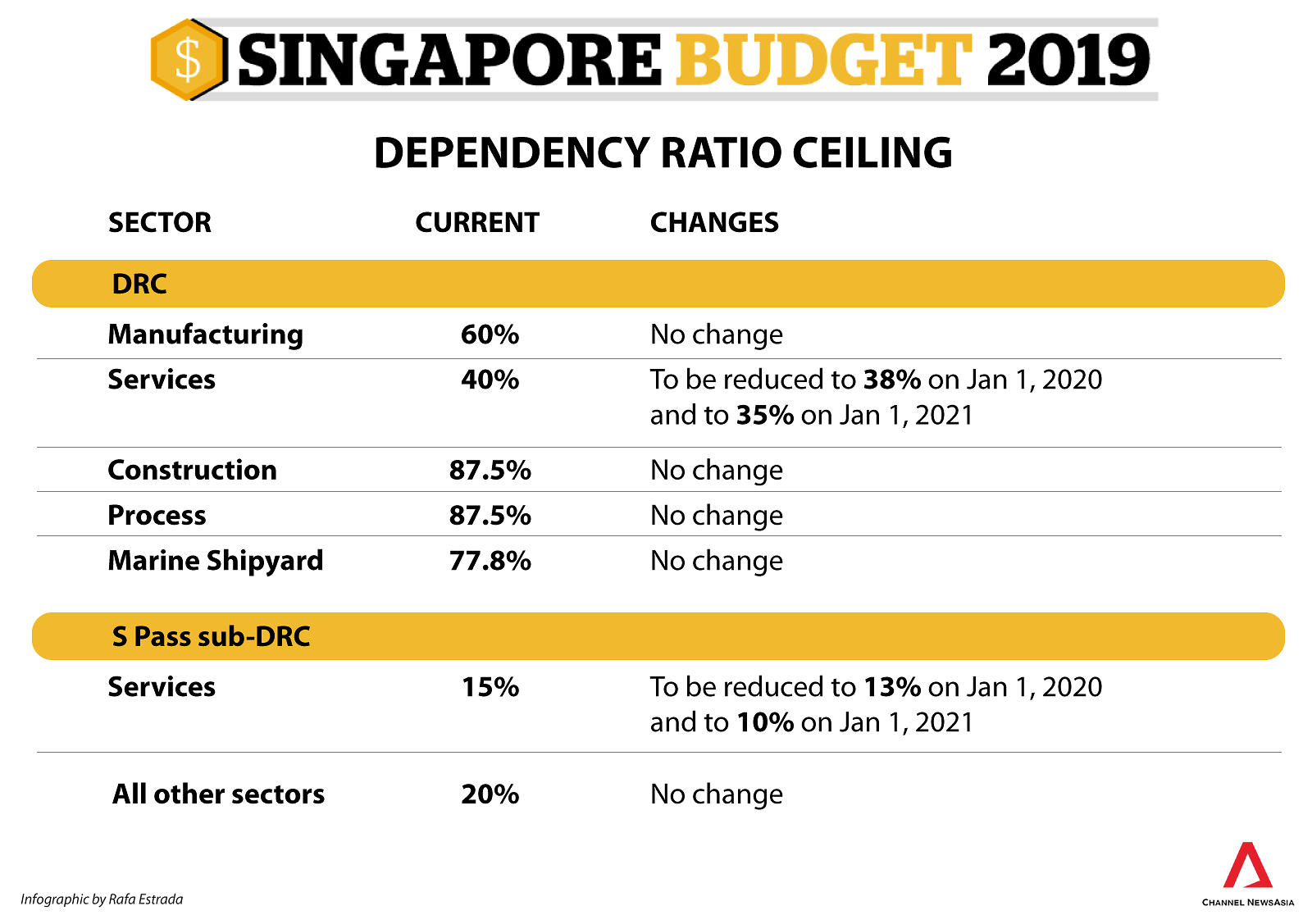
The Dependency Ratio Ceiling (DRC) quota will be cut in two stages from the current 40 per cent to 35 per cent by 2021.
The S Pass sub-DRC for mid-skilled foreign workers will also be lowered from 15 per cent to 10 per cent.
Mr Chee said that the decision was a difficult one as the Government is aware of the constraints and challenges faced by companies involved, including in the accommodation, food services, retail, information and communications, as well as professional services sectors.
“We had to do it because the number of S-Pass and work permit holders in the service sector has increased by 34,000 in the last three years,” he said.
“In fact, the S-Pass numbers are the highest in the last five years. If we do not moderate this growth, the concern is that it will affect the employment outcomes of local workers, and lead to socio-political problems. We have seen this happen in other countries.”
He added that fewer foreign workers taking up services sector jobs means that these same roles will be available to locals. These jobs will also be redesigned to attract Singaporean employees, and the Government will help local companies to achieve this.
“The Government agencies and industry associations – we will walk this journey together with our companies,” he said.
“Our commitment is that if you want to transform, and you’re willing to put in the effort to do so, we will certainly help you.”
Mr Chee Hong Tat, the Senior Minister of State for Trade and Industry, was speaking to 938NOW on the new weekly interview series “Question Time” which airs every Friday. To listen to the interview, go to facebook.com/938Now/ or download the MeRadio app.