Home Blog Page 812

A walk on the wild side: Singapore’s upcoming nature attractions

0

SINGAPORE: Singapore may be known as a thriving modern city, but it is also home to a diverse, rich ecosystem. 

In January, the National Parks Board (NParks) announced a 10-year action plan to strengthen Singapore’s rainforests and facilitate regeneration in secondary forests in buffer nature parks.

Additionally, more green spaces will be introduced across the island and a series of new park connectors and trails will make these areas more accessible than ever.

If you’re looking for an adventure in nature or a mere change in scenery, away from the bustling cityscape, you may want to plan a visit to these new and upcoming sites.

COAST TO COAST (C2C) TRAIL

Jurong Lake Gardens

Jurong Lake Gardens. (Photo: Ministry of National Development)

Opened on Mar 30, this trail stretches from Jurong Lake Gardens in the west to Coney Island Park in the north-east.

The 36km trek will see you traverse parks and nature areas such as the Bukit Batok Nature Park, Bishan-Ang Mo Kio Park and Jurong Lake Gardens.

Some highlights of the trail include Adam Road Food Centre, Punggol Waterway Park’s Adventure Bridge and the upcoming water facilities at the Jurong Lake Gardens. And you’ll be happy to note that are also numerous shelters and restrooms along the way. 

Visitors can choose to follow NParks’ trail guide or download the Coast to Coast (C2C) app, NPark’s first augmented reality (AR) app, to explore the parks and nature areas with a DIY trail guide.
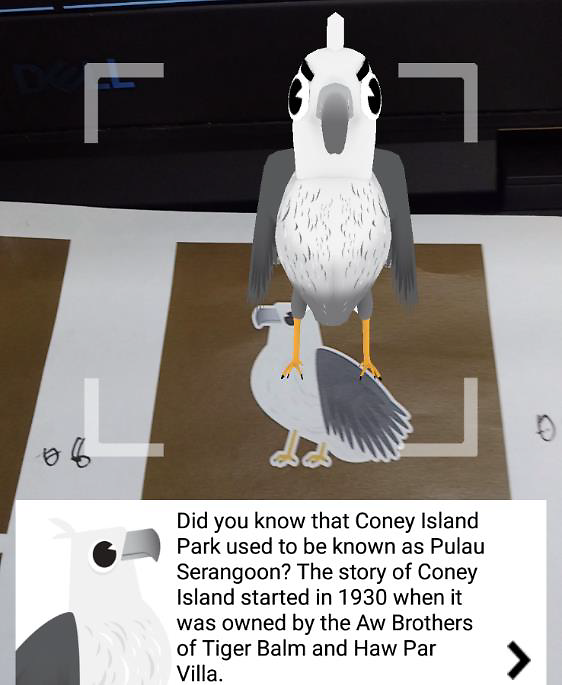
C2C AR app

The C2C app features interactive AR elements such as 3D-animated characters. (Image: NParks)

Using the AR scanning mode at various checkpoints will launch 3D animated animal characters that gives visitors information on the native flora and fauna that can be found along the trail, as well as surrounding places of interest.

Additionally, visitors can take part in activities within the app to earn points, which can be used to redeem rewards such as F&B vouchers, products and services.

RIFLE RANGE NATURE PARK

Rifle Range Park freshwater habitat

An artist’s impression of the freshwater habitat at Rifle Range National Park. (Photo: National Parks Board)

Located south of Bukit Timah Nature Reserve, this 67ha park will serve as a buffer to reduce edge effects on the nature reserve, as well as an alternative venue for visitors to connect with nature.

A ramble through this forest habitat may see you chancing upon its eclectic inhabitants – native fauna species such as the Sunda pangolin and Horsfield’s flying squirrel can be found here. Crabs, frogs, fish and snakes can also be seen in the streams.

Restoration works on habitats in the park began in January this year, to be completed in 2020. 

As part of the Forest Restoration Action Plan, the regenerating secondary rainforests will be “enhanced with native plants to improve the habitat for native biodiversity in the area”, said NParks in a press release.

To help animals cross to neighbouring parks safely and aid their chances of long-term survival, aerial rope bridges and underground culverts will be installed across Rifle Range Road. Nest-boxes for flying squirrels will also be set up as part of habitat enhancement works.

Aerial bridges at Rifle Range Nature Park

An artist’s impression of the aerial rope bridges planned for Rifle Range National Park. (Photo: National Parks Board)

In addition to these, the former Sin Seng Quarry will be restored. 

This is to allow visitors to learn more about Singapore’s native biodiversity, said NParks. Visitors will be able to access the quarry via an elevated walkway, which will be “sensitively implemented”, the authority added.

Existing trails will also be improved to stop soil erosion and compaction. Designated trails will be bordered by railings to discourage visitors from straying away. Doing so can help prevent footpath widening into the forest, as well as minimise soil impaction on tree roots and trampling on leaf litter organisms.

RAIL CORRIDOR

Rail Corridor 2021

Artist impression of the improved steel girdle bridge across Hindhede Road. (Graphic: URA)

If heritage sites interest you, take a walk along the 24km Rail Corridor, which runs from Woodlands in the north to Tanjong Pagar in the south.

Enhancement works on the railway will be completed in phases by 2021, starting with Rail Corridor (Central), located between the Hillview and King Albert Park MRT stations on the Downtown Line.

This area is known for lush natural landscapes and elements of rich wildlife heritage.

Following the handover of the railway land to Singapore authorities in 2011, the Urban Redevelopment Authority has been collecting feedback from the community on how it could be improved to suit their needs.

A number of landmarks along the trail, including the Bukit Timah Railway Station, have been gazetted for conservation. 

The railway station will be converted into a heritage gallery and visitor centre, while an F&B outlet will be housed at the nearby station master’s quarters. Railway artefacts will also be restored and adapted for reuse.

Want more than just a nice selfie along the tracks? The railway can also be used for activities such as learning journeys, heritage walks and nature walks.

rail corridor

A stream at the Rail Corridor. (Photo: Gwyneth Teo)

Here you can also find a diverse cast of animals, from birds such as the Sunda Scops Owl and Laced Woodpecker to pangolins.

Flora complementing the existing vegetation around the nearby Bukit Timah Nature Reserve will also be planted on the Rail Corridor (Central)’s landscape.  Additionally, habitats of existing flora and fauna will be enhanced to create an environment that would help them thrive.

MANDAI MANGROVE AND MUDFLAT

Mandai Mangrove and Mudflat

The Mandai Mangrove and Mudflat will be conserved as a nature park and is expected to open in mid-2022. (Photo: National Parks Board)

Bird watchers will want to break out their gear and make a stop at this upcoming site, located about 3km east of Sungei Buloh Wildlife Reserve.

Mandai Mangrove and Mudflat is one of the richest wetlands in Singapore, and one of the few mangrove habitats left in Singapore with an extensive mudflat exposed at low tide. 

In 2018, NParks announced that it will be conserved as a nature park that will act as an outdoor education, learning and research centre. This is slated to open in mid-2022.

According to NParks, this site is home to 20 mangrove plant species, of which 16 is threatened, as well as threatened species of seagrass and horseshoe crabs.

Visitors can expect to see migratory shorebirds feed on the diverse and abundant supply of mollusks, crustaceans and worms found on the mudflat.

To minimise impact on the mudflat, visitor amenities at the site will be kept to a minimum. These include bicycle racks, a nature trail and bird hides, which will be strategically placed so that visitors can watch these migratory birds without disturbing them.

The 72.8ha nature park is ecologically linked to the wildlife reserve. These two sites, together with the Kranji Marshes, safeguard a variety of complementary wetland habitats to strengthen the conservation of wetland biodiversity in north-western Singapore, said NParks. 

These habitats include mangroves, freshwater marshes and mudflats.

NParks added that it will “sensitively provide opportunities for research and education” in the park, to allow visitors to learn more about the biodiversity in the wetland and to play a part in its conservation.

As part of the upcoming Round Island Route (RIR) and Rail Corridor, the park will be accessible to users exploring both routes. 

Those keen to explore more of the area can make their way along the RIR, as the park will be located at a section designated as an eco-discovery corridor. This corridor highlights lesser known ecological locations in Singapore.

ROUND ISLAND ROUTE

Sengkang Riverside Park

Ever wanted to walk from one end of Singapore to another?

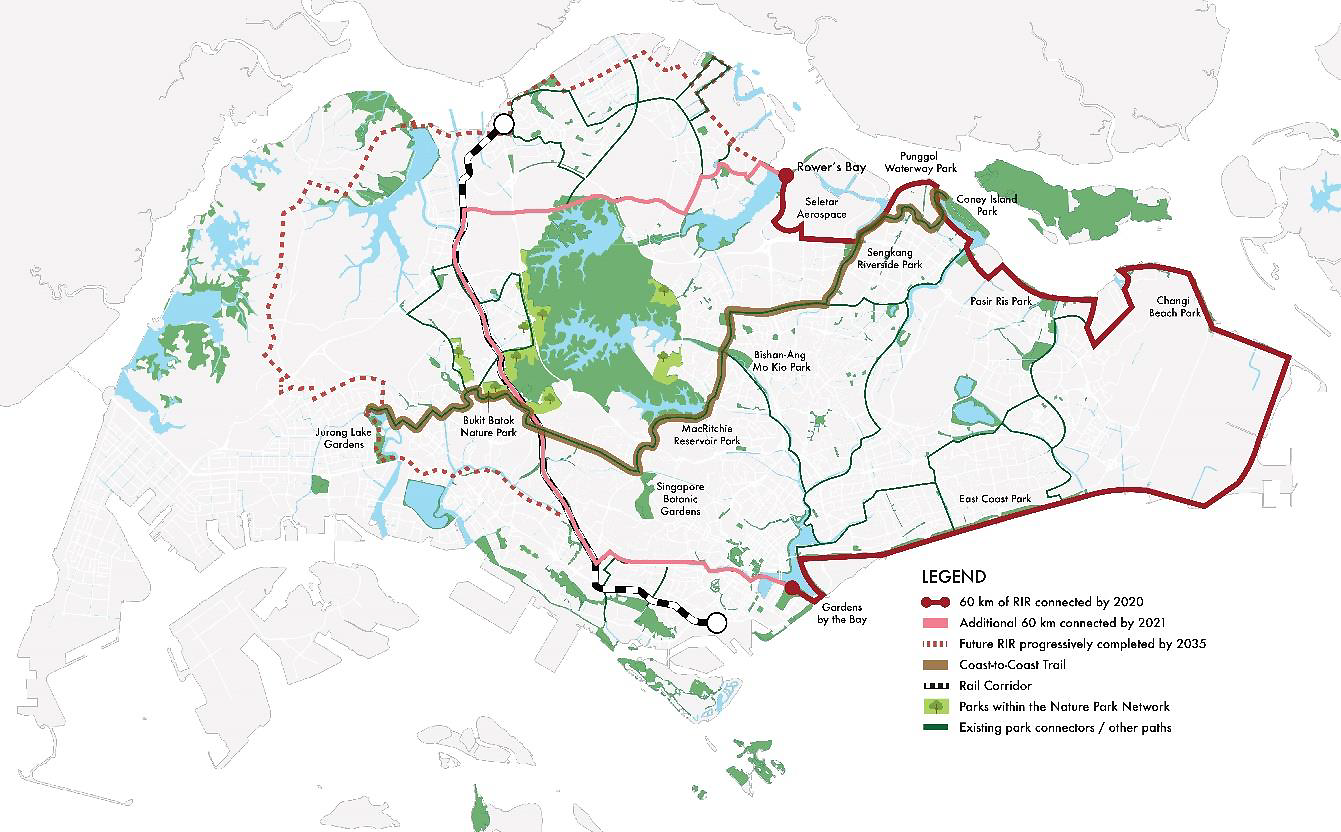
The Round Island Route (RIR) is a continuous park connector that goes around the island. It will link existing sites and provide opportunities for recreational activities such as cycling, jogging and skating, said NParks. This, it added, will enhance the “City in a Garden” experience for residents.

Coastal Adventure Corridor 3

The 150km route was conceptualised in 2011, after members of the public suggested a green corridor that goes around Singapore that will link parks and park connectors. The next year, plans to develop the route were announced.

On Mar 30, NParks launched Rower’s Bay, part of the route’s first phase of works. Rower’s Bay features a wetland, lookout pavilion and a boardwalk.

Mahogany Heritage Tree

A broad-leafed Mahogany Heritage Tree near Seletar Aerospace Park. (Photo: NParks)

Three heritage trees and a shelter with charging points are located along a 3km path connecting this area to Seletar Aerospace Park. When completed by 2020, this phase will connect Rower’s Bay to Gardens by the Bay via Changi Beach Park and East Coast Park.

By the following year, another 60km of paths between Rower’s Bay and Gardens by the Bay will be connected, making a loop of 120km. Part of this will run along the upcoming Rail Corridor.

The RIR is expected to be progressively fully completed by 2035.
Source link

Walking the NParks 36km Coast-to-Coast trail: Worth the effort?

0

SINGAPORE: If you want the chance to really stretch your legs in Singapore, the new 36-kilometre Coast-to-Coast (C2C) Trail could be just what you’re looking for.

Launched by NParks last week, the trail links Jurong Lake with Coney Island, taking in a variety of parks and nature areas along the way. 

But what is it like to undertake this long walk? Beautiful or boring? Tiring or terrific? I was given the job of road-testing the trail to help you decide if putting in the hard effort is worth it.

READ: NParks launches 36km trail linking Coney Island with Jurong Lake

For such a long walk, preparation is key. I gathered a hydration pack with a 2-litre capacity and three granola bars. My pack also included a cap, batteries for my GoPro and an extra water bottle. With that (and a good night’s sleep), I was ready. 

THE BEGINNING: 7.3KM FROM CHINESE GARDEN TO BUKIT BATOK NATURE PARK

trail2

The Coast-to-Coast Trail’s Chinese Garden, with its twin pagodas. (Photo: Alif Amsyar)

I began the journey at Chinese Garden at 10am, with my original plan of leaving at 7am being scrapped by an early morning thunderstorm. As I walked my first trail steps, the beautiful twin pagodas on Jurong Lake created a pleasing view amid all the construction, with their tangerine tiling and white concrete walls standing out from the greenery. 

trail3

The journey towards Bukit Batok Nature Park was filled with underpasses and railway tracks. (Photo: Alif Amsyar)

From the relative peace and quiet of Jurong Lake, I made my way to the busy metropolis of Jurong East.

Being a multi-line MRT and bus interchange, Jurong East was buzzing with action and people. It was far-removed from being a charming nature spot, but walking through the area as a sightseer rather than a busy commuter allowed me to experience its charms in a different way. 

trail4

Halfway through Bukit Timah Nature Park, a pair of dogwalkers and their pets offered a friendly greeting. (Photo: Alif Amsyar)

Proceeding on to Bukit Batok Nature Park, I went through several highway underpasses. These underbellies of Singapore were mostly damp and dark, with few signs of life except a few pigeons who seemed to eye me with suspicion as if they felt I was intruding on their territory.

Traffic rumbled overhead, loud enough to occasionally startle the pigeons into life before settling again.

After the urban sprawl of Jurong East, Bukit Batok Nature Park was a pleasant contrast.

I was greeted by the sight of tall, slender trees with roosters crowing a cheery welcome. However, following the NParks C2C app meant that I had to go around the park instead of through it to get to my checkpoint: Beauty World.

trail5

Bukit Timah Shopping Centre is a prominent feature along the trail. (Photo: Alif Amsyar)

Reaching Beauty World at around 1pm, there was one thing on my mind: Lunch. I decided to take a pit-stop at the nearby eatery Al Azhar, before carrying on.

CARRYING ON: 7.4KM FROM BEAUTY WORLD TO MACRITCHIE RESERVOIR

trail6

The Bukit Timah railway track is popular with photographers. (Photo: Darius Boey)

As the day wore on, the grey clouds and damp air changed into clear blue skies and a scorching hot environment. Not the most pleasant walking conditions on those stretches of the trail with little shade and not much to see.

Still, I powered on.

The path from Botanic Gardens to MacRitchie was more or less a straightforward 7.4km march stretching into central Singapore.

Compared with the early part of the trail, the trip from Beauty World to MacRitchie did not hold much appeal, with long, hot stretches of road, old-fashioned tyre sellers and nondescript semi-detached houses.  

trail7

The trail has many underpasses, including this one before Bukit Brown Cemetery. (Photo: Alif Amsyar)

However, things changed about 3km away from the reservoir when I reached Bukit Brown Cemetery. All of a sudden, the trail went quiet and not a single car passed by. Even at 5pm in the afternoon, the atmosphere was a little eerie. 

As it was edging close to sundown, I trotted along. 

trail8

MacRitchie Reservoir is an aquatic oasis along the trail. (Photo: Alif Amsyar)

The trail started to get a little more attractive as I approached MacRitchie Reservoir. Along with its captivating views, MacRitchie offered some wildlife to keep me company, with frolicking monkeys and colourful birds.

There were lots of people enjoying the reservoir too. There were canoeists in bright orange vests paddling furiously in red canoes, shouting “left, right, left” as they powered through the dark, green water.

Families had also gathered for picnics, despite it being a weekday. Toddlers played on the grass while parents and grandparents enjoyed their food in the cooler late afternoon air.    

trail9

The evening sunlight bathed Bishan in a soft glow. (Photo: Darius Boey)

After the beautiful views at MacRitchie, I proceeded on to Bishan-Ang Mo Kio Park. By then, the buildings along Bishan were being given a soft glow from the evening sun. This was a pleasing contrast to the crowded roads, where peak hour traffic was creating a constant din.

The stretch to my next destination was a lengthy one, and by the time I reached it, it was about 7pm. With about another 15km to go to complete the trail, I decided to continue the next day. 

DAY 2: PICKING UP WHERE WE LEFT OFF

trail10

The stretch from Ang Mo Kio to Sengkang proved a long one. (Photo: Alif Amsyar)

The next day, I returned to Bishan-Ang Mo Kio Park at 12.40pm, giving myself the afternoon to finish the trail. 

For this stretch, I was heading to Sengkang. Along the path, it was much hotter than the day before. With the sun beating down, walking conditions were not pleasant.

trail11

The lotus garden at Ang Mo Kio Town Garden West. (Photo: Alif Amsyar)

Ang Mo Kio seemed huge. Even after walking for an hour-and-a-half, through the nearby Town Garden and Linear Park, I still found myself within its sprawl and was beginning to question whether I was lost. Then suddenly I reached Sengkang Riverside Park and I knew I was still on the right track. 

Nparks mega map

Map of recreational connections. (Map: NParks)

And at that moment, I realised how important the NParks C2C app was to complete the trail, as there were tricky stretches when the guiding posters were quite far apart from each other. But as helpful as it was, there were some moments when I got a little lost because of the App’s limited navigation features.

But to those who want to give this trail a try, I would suggest downloading it as it at least points you broadly in the right direction.

THE LAST STRETCH TO CONEY ISLAND

trail12

A piece of art titled “Accident”, along the way from Sengkang to Punggol. (Photo: Darius Boey)

Back to Sengkang, and its Riverside Park provided a great view of Sungei Punggol, with emerald green water guiding me through the northeast of Singapore. 

After walking through the tranquil greenery by the river for quite some time, signs of another neighbourhood started to appear, with highways, grey and white high-rise buildings, and LRT tracks popping up as I walked.

Not long after, the pathway from Riverside Park connected me to beautiful Punggol Waterway Park. In comparison to the other parks, this offers visitors larger, more open space. The bridges, wide expanses of water and play areas made it very appealing.

With a stream in the middle that runs through the entire park, coupled with a stunning view of the Singaporean skyline, the park was a highlight of the trail.

trail13

The 133-hectare Coney Island provides visitors with ample space. (Photo: Darius Boey)

At that point in time, I hurriedly picked up the pace, as it was about 6pm and also because I was less than 2km away from the trail’s final destination:  Coney Island. I wanted to get there before sunset.

Its tall and slender trees stood on the horizon, with calm seawater separating it from Waterway Park.

I continued on for the final 400m. Cyclists and runners went by, blasting workout music as they got on with their lives. And for me, it was good to reach the green gates of Coney Island.

I had finished the trail.

trail14

Sunset over Coney Island at the end of the trail. (Photo: Darius Boey)

With the sun setting in the background, I was pleased to have completed the 36km walk across Singapore. While some stretches were definitely much nicer than others, overall the hike was worth it. 

I saw some parts of Singapore I had never visited before. And for those areas I was more familiar with, experiencing them as a hiker rather than a commuter or shopper let me see them in a fresh light.

The sweat and sore legs were a small price to pay.

Source link

In-house cooking preferred to ‘mass production’ catering, say childcare centres

0

SINGAPORE: Hiring in-house cooks to prepare meals for pre-school children is the preferred option as it is cleaner and healthier, said childcare centres CNA spoke to.  

It is an issue that has come under the spotlight recently after a spate of food poisoning cases at 13 PCF Sparkletots centres, which affected 251 people, including 12 members of staff.

The outbreak has been traced to the consumption of food prepared by Kate’s Catering, which has had 30 years of experience as caterers.

READ: All PCF Sparkletots pre-schools to use in-house cooks following food poisoning outbreak

Of the three childcare centres CNA spoke to, St James Kindergarten (Gilstead Campus) uses a caterer. Mulberry Learning and Twinklekidz Playhouse (Toa Payoh) employ in-house cooks.

All three, however, agree that in-house cooking is preferred to using a caterer, as it allows the centre to have more control over the quality of food served. 

“We chose not to (cater food) in order to have proper control over the source and type of ingredients used, as well as the safety of the entire food preparation process,” said chief operating officer of Mulberry Learning Peh Yi Han.

“When it comes to food safety, there’s really no compromise, so we do what we can to ensure our children are given the best nutrition possible,” he added.

Mulberry Learning 1

A cook at Mulberry Learning’s Tanjong Pagar centre chops potatoes. (Photo: Gaya Chandramohan)

Other than following the Health Promotion Board’s prescribed meal guidelines, Mulberry Learning also works with qualified nutritionists from health and nutrition firm GNC to create its menus.

Twinklekidz Playhouse (Toa Payoh) principal Wendy Lee believes that catered food will not be able to provide for the individual needs of each childcare centre.

“Caterers have to be fast, while in-house cooks don’t have that issue of time,” she said, describing the catering process as “mass production”.

She also observed that parents generally indicated their preference for meals to be prepared in-house.

One of them is sales executive Paul Ong, father of a five-year-old who has been attending Mulberry Learning for three years.

“Catering will have additional costing,” he said. “Sometimes catering does not mean more clean.”

READ: 222 affected by gastroenteritis outbreak across 12 PCF Sparkletots centres

Human resources advisor Fanny Neo said she remains concerned about food safety and hygiene standards at her four-year-old son’s PCF Sparkletots pre-school, even though it was not affected by the recent food poisoning outbreak. 

“The food in school is very important from a nutritional standpoint and a health and safety standpoint,” she said, adding that in-house cooking is preferred as the food is “fresh” and there is a lower risk of it “getting sour”.

Mulberry Learning 2

A staff member at Mulberry Learning’s Tanjong Pagar outlet serves lunch for the students. (Photo: Gaya Chandramohan)

​​​​​​​At St James Kindergarten’s Gilstead Campus, principal Alison Wah said she has been sourcing for an in-house cook. The school had to cater food for students after its previous cook resigned.

It is difficult to find a replacement, she said, due to the workload of cooking for a centre with about 400 students.

“It’s definitely not easy (for the cooks) for the volume of children we have, as we are a big school,” she said. “The cook has to do the preparation and the washing of pots and utensils.”

At the moment, they are using two to three caterers on a trial basis, but have not settled on any one.

Source link

Malaysia-Singapore leaders’ retreat next week to discuss ‘unresolved’ issues: PM Mahathir

0

PUTRAJAYA: Malaysia Prime Minister Mahathir Mohamad said on Friday (Apr 5) that “unresolved” bilateral issues will be discussed in a “friendly manner”, when he meets Prime Minister Lee Hsien Loong in an upcoming leaders’ retreat.

“All of the things that are still unresolved, including the water problem, the central provident fund, the borderline with our waters – what is Singapore waters? what is Malaysia waters? – the flight over our area, who is going to control it,” he said when asked during a press conference on the agenda for the Apr 8 to 9 meeting.

“All these things will be discussed in a friendly manner. We are not going to confront them. But I believe that even Singapore understand(s) the need to revise the price of water,” Dr Mahathir added. 

During a meeting between Mr Lee and Dr Mahathir on Nov 12 last year, both sides expressed their differing views on the right to review the price of water under 1962 Water Agreement.

Singapore has been clear and consistent in its position that Malaysia has lost the right to review the price of water.

The 1962 Water Agreement, which expires in 2061, entitles Singapore to draw up to 250 million gallons a day (mgd) of water from the Johor River.

Singapore pays 3 sen per thousand gallons of raw water and sells treated water back to Johor at 50 sen per thousand gallons, a fraction of the cost of treating the water.

Johor is meanwhile entitled to a daily supply of treated water of up to 2 per cent or 5 mgd of the water supplied to Singapore. In practice, however, Singapore has been supplying 16 mgd of treated water to Johor at its request.

Malaysia has previously acknowledged that it chose not to ask for a review of the agreement in 1987 because it benefited from the pricing arrangement.

Last month, it was announced that the attorneys-general of Singapore and Malaysia will continue discussions to “better understand each other’s position” on the right to review the price of water.

READ: Singapore and Malaysia – The Water Issue

READ: Measures to de-escalate Singapore-Malaysia maritime tension first step in long journey: Vivian Balakrishnan

1MDB-LINKED FUNDS

Dr Mahathir was also asked if Malaysia was looking for more money linked to 1Malaysia Development Berhad (1MDB) to be repatriated from Singapore.

“We will have to depend on Singapore information. That money was given back after Singapore investigated,” he noted.

“Our job is to receive the money, of course, but to be sure that this money (is) coming from 1MDB. We cannot accept money that is not ours,” he added.

A man covers his mouth as he walks past a 1 Malaysia Development Berhad (1MDB) billboard at the fun

FILE PHOTO: A man covers his mouth as he walks past a 1 Malaysia Development Berhad (1MDB) billboard at the funds flagship Tun Razak Exchange development in Kuala Lumpur, Malaysia on Feb 27, 2015. (Photo: Reuters)

​​​​​​​​​​​​​​

A day earlier, he said one reason why Putrajaya has managed to reduce national debt was due to the recovery of “quite a lot of money that was lost, that was kept by Singapore”. He did not give an exact figure.

READ: Malaysia’s debt now more manageable, but government may sell more assets: PM Mahathir

In 2016, Singapore authorities said they seized S$240 million in cash and properties as a result of investigations into 1MDB-related fund flows through Singapore

Last September, a Singapore court ordered the return of around S$15.3 million to Malaysia. The funds were to be transferred to a special 1MDB recovery account in Kuala Lumpur.

The annual leaders’ retreat was supposed to take place last November, but was postponed. This will be the first leaders’ retreat hosted by Pakatan Harapan after it came into power last May.

During the press conference on Friday, Dr Mahathir also announced Malaysia’s withdrawal from ratifying the Rome Statute of the International Criminal Court.

Source link

All PCF Sparkletots pre-schools to use in-house cooks following food poisoning outbreak

0

SINGAPORE: All 35 PCF Sparkletots pre-school centres previously served by external caterers will make a permanent shift to using in-house cooks, said PAP Community Foundation (PCF) in a briefing on Friday (Apr 5).

The move comes in the wake of a spate of food poisoning cases at 13 Sparkletots centres. A total of 251 people were affected, including 12 members of staff. 

PCF Sparkletots food preparation

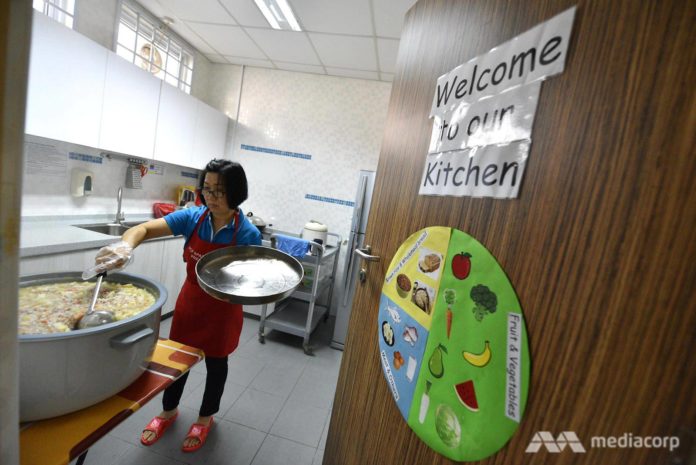
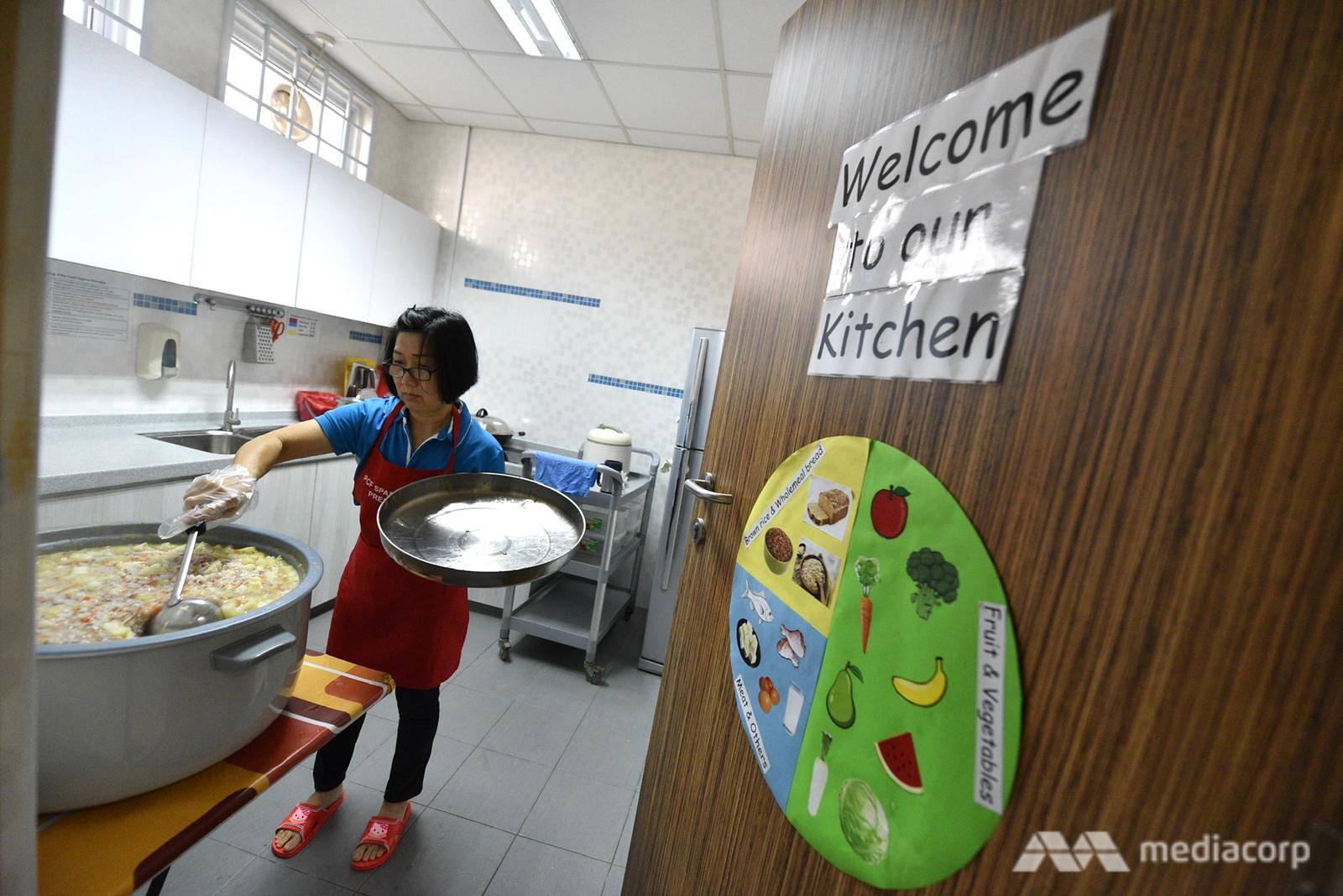
A PCF Sparkletots preschool in-house cook preparing chicken porridge for breakfast. (Photo: Jeremy Long)

As of Friday, all 31 hospitalised children have been discharged. Ninety per cent of the reported cases have since returned to school.

A spokesperson from PCF Sparkletots previously confirmed that all the affected centres had used the services of Kate’s Catering.

PCF on Friday said that 18 of the 35 pre-schools have made the switch to in-house cooks. These include 15 of the 16 centres that were served by Kate’s Catering. 

PCF Sparkletots food

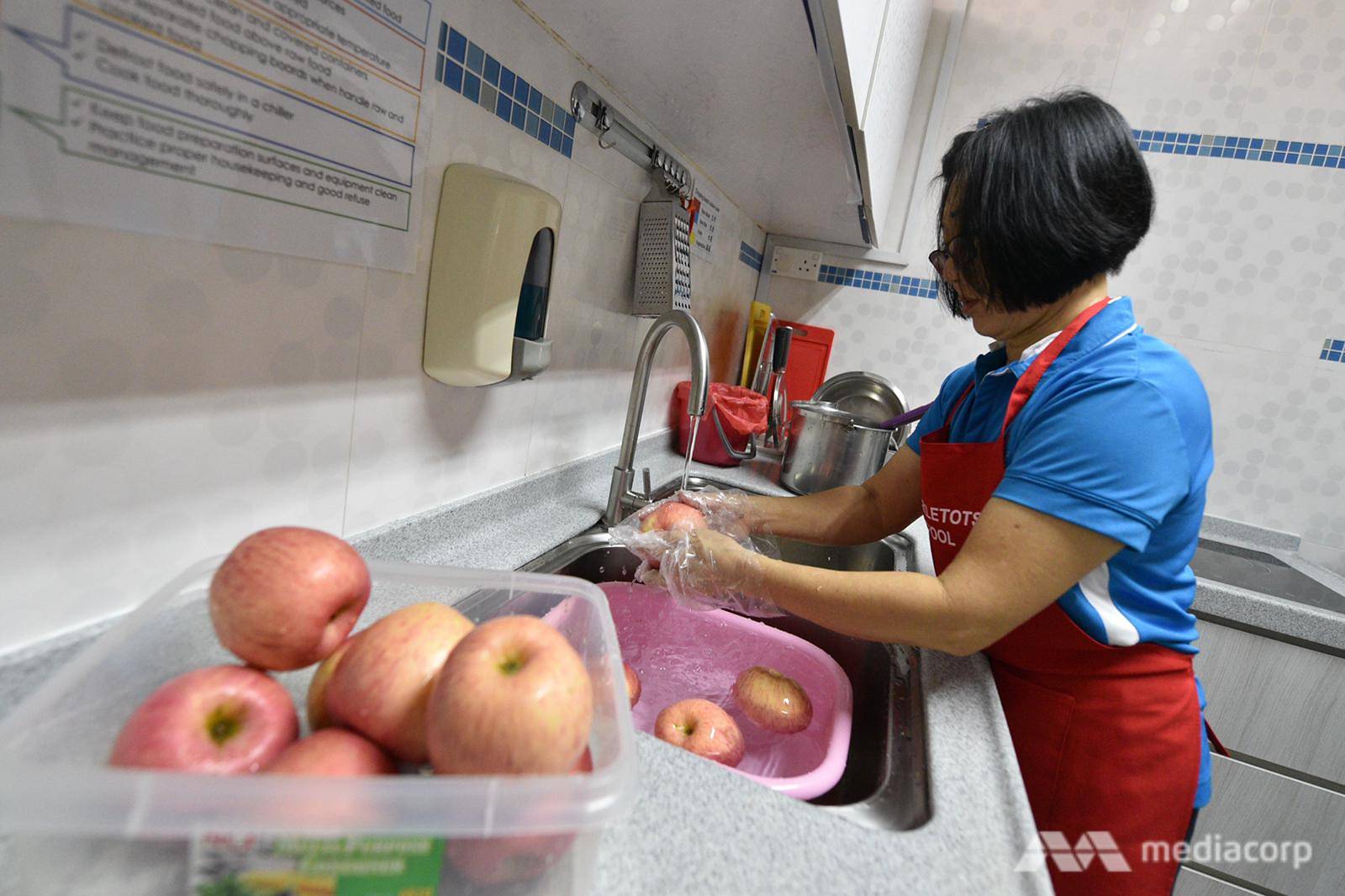
Apples are rinsed thoroughly before being chopped up. (Photo: Jeremy Long)

There is no set time frame for all pre-school centres to complete the transition, said PCF, adding that catering services at the remaining centres will stop once in-house cooks are hired or existing cooks redeployed. 

PCF Sparkletots lunch

A PCF Sparkletots pre-school student eats lunch. (Photo: Jeremy Long)

PCF Sparkletots students eating

PCF Sparkletots students having lunch. (Photo: Jeremy Long)

While PCF had engaged external caterers, it always intended to eventually use in-house cooks at its pre-schools, said the foundation. 

It first started using caterers during a six-month pilot programme in January 2018 as part of efforts to boost productivity. PCF said it had also faced difficulty in sourcing qualified cooks for its pre-schools. 

PCF Sparkletots meal times

Porridge being served for lunch at a PCF Sparkletots pre-school. (Photo: Jeremy Long)

Currently, PCF requires all their in-house cooks and kitchen helpers to complete a basic food hygiene course conducted by trainers accredited by the National Environment Agency. This is in addition to PCF’s own in-house training.

Those who are part of the kitchen staff are also required to be physically fit.

Source link

Grab wants to help you feel less lost when getting to your pick-up point

0

SINGAPORE: Ever made a booking on the ride-hailing Grab app, only to realise you are unsure where the pick-up point is?

READ: Singapore map tech company, GPS Lands, wants to navigate its way to global success

Grab’s data flagged this as problem not just for commuters but for drivers as well, leading to longer wait times and cancellations, Mr Ajay Bulusu, the regional head of Mapping Operations at Grab, told Channel NewsAsia in an interview on Thursday (Apr 4).

“Our data shows that people open our app in indoor locations like malls to make their bookings,” Mr Bulusu said. “And when this happens, we’ve found that drivers’ wait time becomes higher and cancellation rates are higher.”

He said, on average, the wait time can increase by 5 per cent to 15 per cent, while cancellation rates also go up by 5 to 10 per cent.

Grab Venues screengrabs

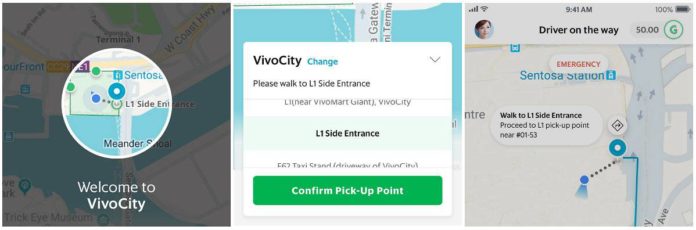
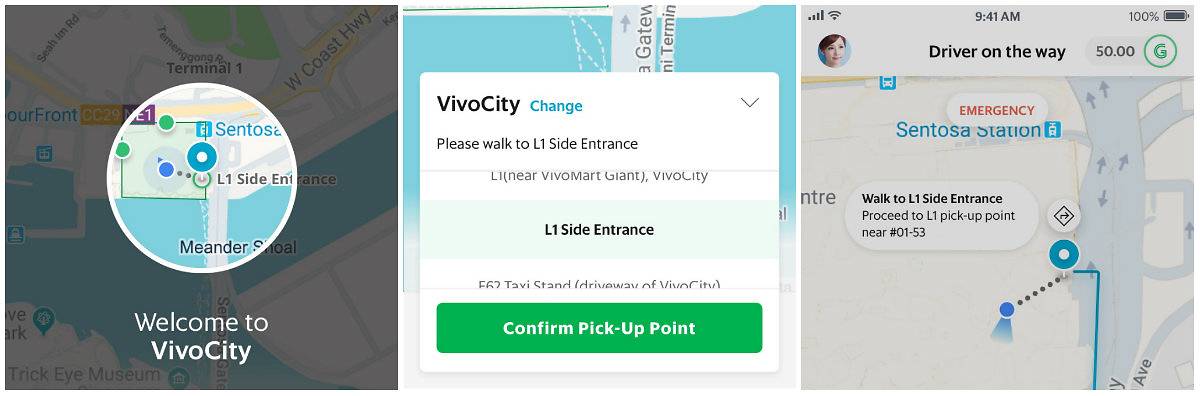
Besides picking one’s pick-up point, Grab users can also tap on an arrow icon on the map interface, which would launch the directions to the stated pick-up point. (Screengrabs: Grab)

It is also a challenge for tourists who may have little knowledge of the common pick-up points at the places they are at – particularly for malls like VivoCity or the Singapore Sports Hub, where there are multiple pick-up points, he said.

Mr Bulusu, who is from India, shared a personal anecdote of how he had left his parents after helping them book a ride at VivoCity.

“They didn’t know how to walk to the pick-up point (at the other end of the mall) when the ride came,” he recounted.

To address the issue, Mr Bulusu shared that a new feature called Venues will be added to the app. It is an extension to the “little green dots” feature called Entrances which was rolled out a year ago.

READ: Choose me! The secrets of picky GrabHitch drivers revealed

Entrances help commuters find their pick-up point with a dotted line on a map indicating where they are in relation to the pick-up point. Venues provide step-by-step instructions of how to navigate to that point when an arrow icon near the pick-up point on the map is clicked.

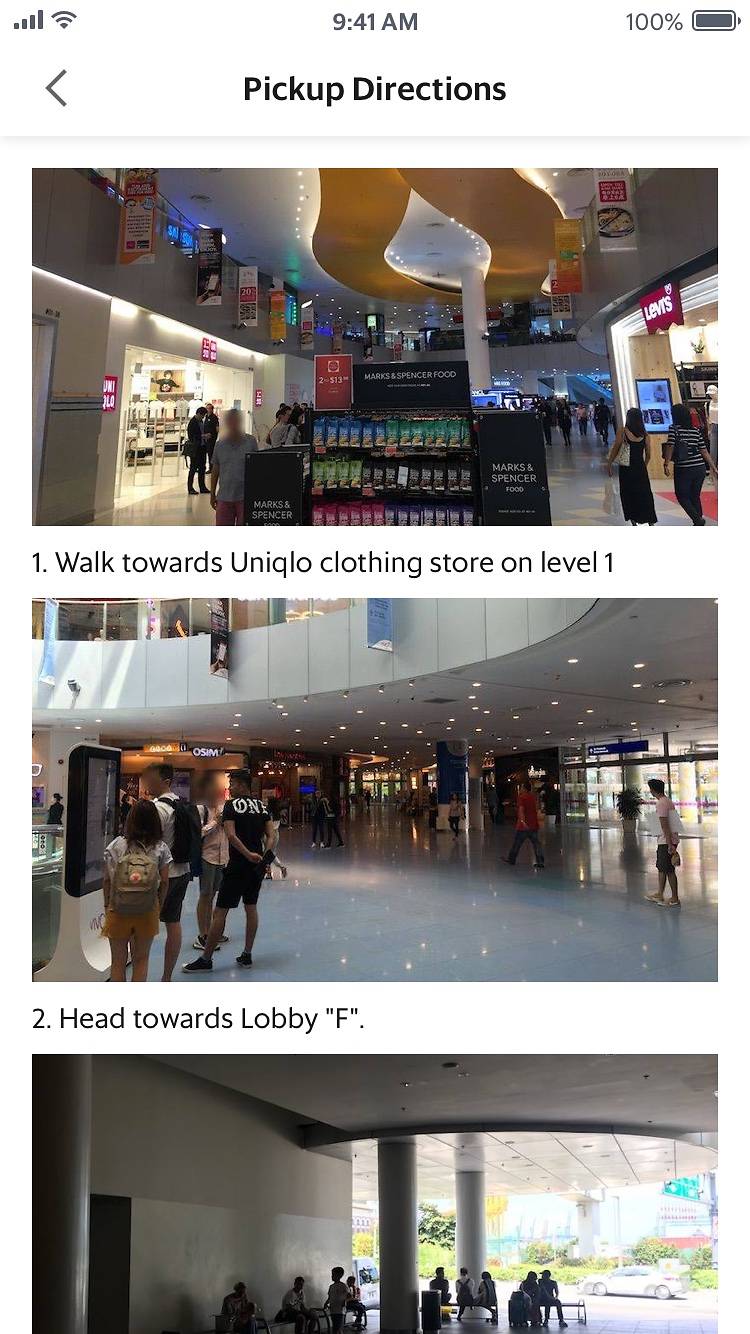
For example, at VivoCity, which Grab’s data identified as one of the more complex places for picking up passengers, there would be visual and text guides to help people get to their chosen pick-up points.

These routes are worked out by dedicated map teams in each of Grab’s markets. 

On average, it takes the team about five to six hours to survey a location, gather information and take pictures, as well as the writing of the directions, Mr Bulusu explained.

In Singapore, a team of four worked on the initiative. They have mapped out about “50-plus” locations here aside from VivoCity, such as Changi Airport, VivoCity, Ion Orchard and Singapore Sports Hub, the executive said.

Grab Venues directions screengrab

An example of how the Venues feature will guide commuters to their pick-up points using key landmarks from within a location, which in this instance is VivoCity. (Image: Grab)

More than 3,000 man-hours have gone into the feature which will be gradually launched in Singapore and other markets from Apr 9. The full roll-out here will be done by mid-April, he said.

Mr Bulusu acknowledged that the process currently is labour-intensive. But once the first phase is completed and a better idea is had of how people are using the feature, it will be easier to scale and include some automation and crowdsourcing into the process, he added.

For instance, users may be able to share their preferred pick-up points at their residences, such as at condominiums, and easiest ways to get there, he said.

“We hope to help passengers locate pick up locations seamlessly, and to become a virtual guide for them, especially in complex and unfamiliar locations,” Mr Bulusu said. 

Source link

Singapore Badminton Open 2019 Press Conference @ Wisma Atria

0

Singapore Badminton Open 2019 Press Conference @ Wisma Atria
Tuesday, April 9, 2019 at 11:30 AM

Wisma Atria

435 Orchard Road , #04-02/38 Food Republic (GOEN – Stall 11), Singapore, Singapore

Source link

Commentary: What next in Singapore’s bid to protect against falsehoods and manipulation?

0

SINGAPORE: The Protection from Online Falsehoods and Manipulation Bill will eventually become law. 

With the Bill already tabled in Parliament for its first reading on Apr 1, it will get a second reading at the next sitting of Parliament, and thereafter, be passed into law.

It is therefore important that eyes be already set on the future, on how the Government will eventually implement and enforce the new laws in the first weeks and months after it comes into force.

With the expectedly deep political undertones in early criticisms and international scrutiny, each step that the Government takes will have fundamental impacts on its credibility – both domestically and internationally. At its core, shaping and assessing truths is about trust, and the Government will do well to be mindful that with its next steps, it could either gain or lose that currency.

The coming weeks and the next time Parliament considers the Bill should also not be seen as a foregone conclusion either. The Bill will be read a second and third time, and for such groundbreaking legislation, there is still much for legislators to do.

READ: Singapore Government rejects Human Rights Watch’s criticisms of new law targeting online falsehoods

READ: Internet trade body, Facebook ‘concerned’ over proposed law targeting online falsehoods

WILL GOVERNMENT OVER-REACH?

In its press release on the Bill, the Ministry of Law stated that “corrections will be the primary (emphasis added) response to a harmful online falsehood that is actively spreading”.

In a toolbox that includes various other tools from take-downs to disabling of inauthentic accounts and criminal sanctions, corrections – which are not criminal sanctions – are an admittedly calibrated option.

Questions, however, remain on the thresholds that the Government will have in moving from the “primary” action of corrections towards other tools in its toolbox.

In its sections dealing with the so-called “Correction Direction” and “Stop Communication Direction” mechanisms, the legislation does not currently provide any guiding criteria to dictate how decisions should be made on either route to take.

Absent such crucial information, the proof will only be in its implementation through policy and subsequent reviews.

In the meantime, while the Government has already taken pains to differentiate between falsehoods and opinion in outlining what would not fall under the ambit of the new law, more can be done to also clarify defining lines that may exist between falsehoods that will need correction versus those that will need to be taken down.

READ: Singapore proposes multi-pronged law to combat online falsehoods

READ: New law tackling online falsehoods not meant to create ‘chilling effect’ in public discussions: Edwin Tong

WILL THE GOVERNMENT UNDER-REACH?

On the flip side, eyes will also be on whether and how the Government deals with the daily drip-feed of inconsequential lies and misrepresentations that have come to define social media.

Will the Government intervene on a cleverly taken photograph that claims a block of public housing apartments has collapsed? Or will it intervene on another photo that shows a packet of non-halal meat residing in the halal shelves of a local supermarket?

The bar must be set high on what deserves Government attention, precisely to retain the requisite seriousness of the real issues that the legislation aims to address. As it stands, most casual lies and misrepresentations are often self-corrected by others on social media.

READ: Commentary: On falsehoods, clumsy corrections might backfire

THE SHAPE OF GOVERNMENT ACTIONS

The language defining “public interest” as a threshold for governmental action involves the following:

  • Maintaining security
  • Protecting public health, public safety, public tranquility or public finances
  • Protecting foreign relations
  • Protecting elections
  • Preventing “incitement of feelings of enmity, hatred or ill-will between different groups of people”, and
  • Preventing “a diminution of public confidence in the performance of any duty or function of, or in the exercise of any power by, the Government, an Organ of State, a statutory board” and their parts thereof

The scope is large, but by dint of its early actions, the Government will eventually reveal which of the above will be key priorities in tackling falsehoods.

It will do well not to be seen to overly lean on any one particular area of concern.

In particular, how the Government interprets the scope for its action in the last category will be carefully watched, with each step potentially politically charged.

As it seeks to address falsehoods via corrections, the new law also offers a unique opportunity for the Government to take a significant step forward in terms of transparency and openness.

For example, if a false statement is made in the form of an allegation, how far and how quickly will the Government move in providing information to the public to prove the contrary? To maintain trust in the process, the imperative must necessarily lie in erring on the side of providing more, rather than less information.

Protection from Online Falsehoods and Manipulation Bill - Graphic 1

 WILL THE GOVERNMENT MAKE MISTAKES?

As the Government seeks to correct and counteract falsehoods, the point has been reiterated that final decisions – where necessary – will be left to the courts.

In the draft legislation, the High Court will be able to set aside a Direction from the Government if: (i) the person concerned did not communicate in Singapore the issue concerned, (ii) it is not technically possible to comply, or (iii) the statement is not a statement of fact, or if it is a true statement of fact.

For the latter condition, there are therefore two grounds for the High Court to act: firstly, on interpretation, e.g. that the statement was found to be an opinion or satire; or secondly that upon further examination, the alleged falsehood was found to be true.

The possibility for decisions against the Government therefore exist, and where these do occur, will be of significant political signature.

In short, one court decision against a Government direction may be sufficient to cast doubt, and undermine trust in the enforcement of the new law.

The challenges for the Government are stark. As it ramps up its own internal processes and ability to detect and appropriately address fast-moving viral statements, it would do well to calibrate its reactions based on the range of considerations outlined above, and bear in mind the consequences of mis-steps and error.

Protection from Online Falsehoods and Manipulation Bill - Graphic 2

WHAT CAN PARLIAMENTARIANS DO?

Even as the Government has its work cut out after the Bill’s passage, much work can still be done now, by legislators, before and during its second reading in Parliament. 

For example, in lieu of another Select Committee which could now examine the legislative text, will legislators engage deeply on the specifics of the draft legislation, and provide not just deep arguments of principle based on the text, but delve into language and argue amendments when the Bill is committed to a Committee of the whole Parliament and read a third time?

There is no doubt clarifications can be made, and alternatives may arise.

A case in point is in the “General Interpretations” of the Bill, where:

  • “a statement is false if it is false or misleading, whether wholly or in part, and whether on its own or in the context in which it appears”

As it stands, a statement will be false if it is false (a tautology) or misleading (potentially vague).

Besides dealing with the tautology, can more be done to provide clarity on what a “misleading” statement can be? For example, to address the range of benign or malign intents behind an intentionally deceptive statement versus one that might simply provide for differing interpretations.

There are other areas where clarifications might potentially be useful.

The Bill currently provides for a Minister to appoint an “alternate authority” – a public officer – to act on his behalf in exercising the powers provided under the Bill, during election periods, as well as at other times.

Can more be done to refine the language in this section to deal with potential conflicts of interest, e.g. if potential falsehoods involve a specific Minister, or are in fact published by any Minister?

READ: FAQ – How will the new law stop deliberate online falsehoods from spreading?

LOOKING TO THE LONG TERM

Given its fundamental importance, the Bill is one that Parliament must not only examine carefully, but equally importantly, be seen to examine it with due care.

Governments change, but the laws of the land are meant to endure, to be interpreted, implemented and enforced by different governments with different philosophies.

For example, while the Ministry of Law may, as a matter of policy, now aim to use corrections as its main course of action, how can the law protect against misuse by a different government in the future, formed by an altogether different party or type of party?

The Protection from Online Falsehoods and Manipulation Bill will also not only provide for the immediate purposes of dealing with false statements of fact, but will form an indelible part of Singapore’s legal system, and become the basis for future laws.

Any government and Parliament must necessarily have this long-term perspective in mind, as it deals with the current threat of online falsehoods.

Source link

Singapore to invest over $6 billion in booming tourism industry

0

THE skyscraper-filled island city-state of Singapore may be relatively insignificant when it comes to its size as compared to other Southeast Asian destination but it welcomes at least 1.1 million tourist arrivals from both business and leisure travelers monthly.

This is because it is a thriving economic and business hub, and it boasts sights, sounds, and a plethora of activities from luxury experiences to its humble hawker food culture. It is without a doubt that tourism is a major industry and contributor to the Singaporean economy.

And the country’s Ministry of Trade and Industry is ramping up efforts to keep them coming.

SEE ALSO: These destinations are Asia Pacific’s rising tourism stars

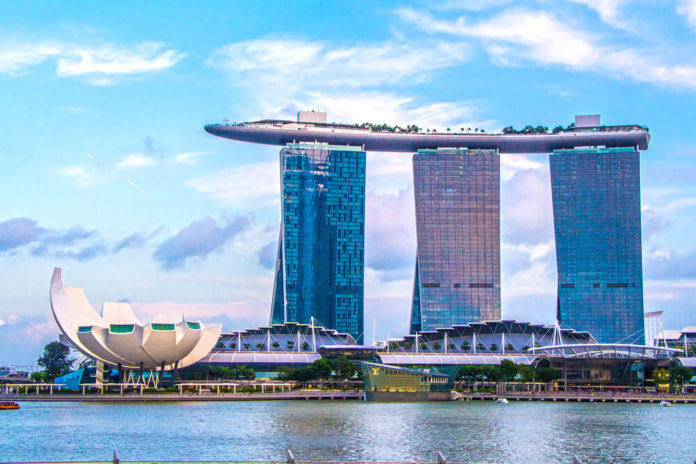
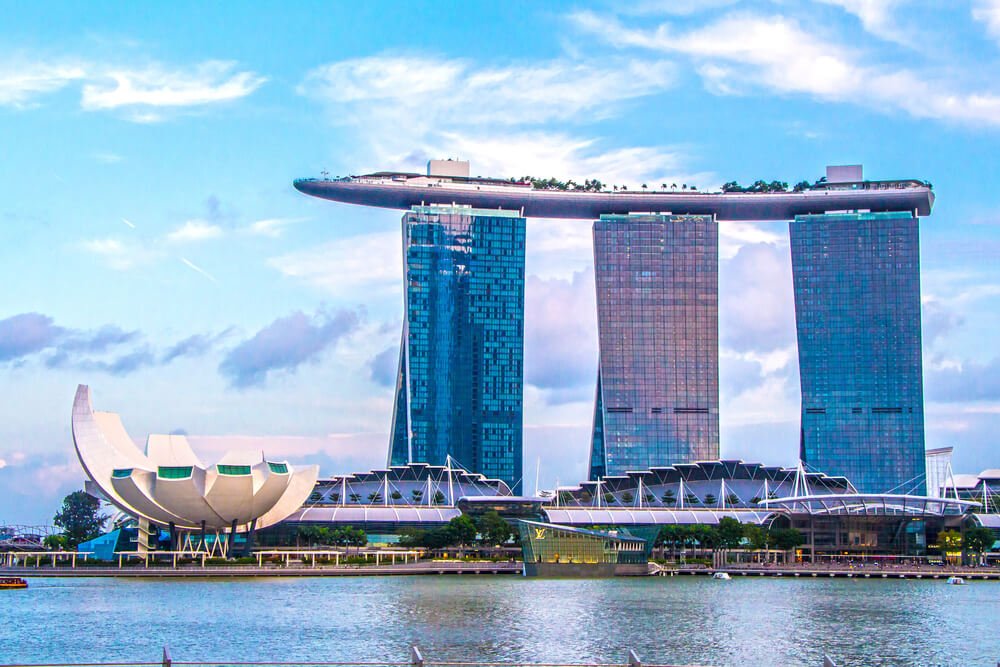
The ministry announced it will be investing a whopping total of SGD9 billion (US$6.66 billion) in its tourism. This includes the construction of a fourth tower at the Marina Bay Sands hotel and the expansion of resorts owned by Genting on Sentosa island.

For the uninitiated, Marina Bay Sands is an integrated resort owned by as Vegas Sands Corp Chairman and CEO Sheldon G. Adelson and a premier entertainment destination with its vibrant diversity of attractions.

It screams luxury with its floor-to-ceiling windows offering magnificent views of Singapore’s glittering city district and is home to the world’s highest and longest infinity pool with its unrivaled panoramic views.

Last year, it was very prominently featured in the top-grossing romantic comedy flick, Crazy Rich Asians.

Marina-Bay-Sands-Singapore

Source: Shutterstock.

Other enhancements are also being planned for the island’s top tourist attractions. The Genting Singapore-owned Universal Studios Singapore located within Resorts World Sentosa will see two new attractions added to its already impressive portfolio.

Universal Studios Singapore is the second Universal Studios theme park to open in Asia (Japan being the first) and the first in Southeast Asia. Currently, the theme park features 28 rides, shows, and attractions in seven themed zones.

But it will soon see a major change which will expand the park by more than 40 acres and the addition of two of Universal’s biggest theme park franchises: Minion Park and Super Nintendo World.

Super Nintendo World is also currently being added to Universal Studios Japan in Osaka and Universal Studios Hollywood in the US. Plans are currently underway to construct the video game-themed land in Universal Orlando.

Resorts World at Sentosa will also triple the size of its SEA Aquarium, home to 100,000 marine animals of more than 1,000 species, and it will be rebranded as Singapore Oceanarium.

Two new hotels with an additional 1,100 rooms for resort visitors will be added as well.

This article originally appeared on our sister site Travel Wire Asia

Source link

Nearly 13 tonnes of pangolin scales worth S$52 million seized in Singapore

0

SINGAPORE: An illegal shipment carrying nearly 13 tonnes of pangolin scales, worth S$52.3 million, was intercepted and seized by Singapore authorities on Wednesday (Apr 3).

It was the largest seizure of pangolin scales globally in five years, said the Singapore Customs and National Parks Board (NParks). Around 17,000 pangolins were killed to make up the shipment.

The shipment was also carrying 177kg of cut up and carved elephant ivory, worth US$88,500, said Singapore Customs and NParks in a news release on Thursday.

Seized elephant ivory (2)

The seized elephant ivory is estimated to be worth US$88,500 (S$120,000). (Photo: Fann Sim)

The haul, which was en route from Nigeria to Vietnam, was discovered in a 40-footer container at the Pasir Panjang Export Inspection Station. It was declared to contain frozen beef. 

The seizure was based on information received by Singapore Customs. 

The scales come from four pangolin species that are native to Africa, namely the White-Bellied Tree Pangolin, Black-Bellied Tree Pangolin, Temminck’s Ground Pangolin and Giant Ground Pangolin. 

Seized pangolin scales (2)

The shipment was on the way to Vietnam from Nigeria, said authorities. (Photo: Fann Sim)

Both pangolins and elephants are protected species and international trade in elephant ivory and pangolins are not allowed. 

Under the Endangered Species (Import & Export) Act, the maximum penalty for illegal import, export and re-export of wildlife is a fine of up to S$500,000 and two years’ imprisonment. 

The same penalties apply to transit or transhipment of illegal wildlife species, including their parts and derivatives. 

The scales and ivory pieces will be destroyed following the seizure. 

Source link