There are lots of food ordering apps on the market these days, but one that is attempting to grab a slice of the pizza market is…Slice!
The app, which used to be known as MyPizza, allows the user to order from up to 10,000 different pizzerias. This allows smaller independent pizzerias the opportunity to get online without having to set up their own website and deal with payments.
The ultimate aim of Slice is to make it as simple as possible for you to order and enjoy pizza in the comfort of your own home on your phone.
When we tried the app out, we were able to view a list of available nearby pizzerias. Once you have chosen your favorite pizza retailer, you can then go ahead and choose your pizza, as well as making any customizations. If you have a friend or family member that doesn’t want pizza, there may be pasta for sale, or other yummy alternatives to get their taste buds flowing.
If you order the same pizza every time from the same pizzeria, you can easily re-order with the tap of a button. But, sometimes it is good to try new pizzerias and new toppings!
The CEO of Slice, Ilir Sela, said that Slice is very useful for those who don’t reside in a city. The reason being that there may not be any restaurants close by that offer delivery through a service such as Seamless. There is a far greater chance that there is a local pizzeria who will be able to offer delivery through Slice.
For your first order, make sure you visit https://slicelife.com and on the homepage, enter your phone number in when prompted to do so, and you can enter the promo code APP3 to enjoy $3 off your first order. This is a great way to try the app out whilst saving money.
Slice is also good from the pizzerias point of view. It allows them to escape the clutches of other more expensive online ordering platforms, allowing them to grow and stay in business. If you are a pizzeria, you may wish to check out https://slicelife.com/pages/about-restaurants for more details.
There have been many great reviews of the Slice app. In fact, it has been reviewed over 35,000 times on the iOs app store, and 6,500 times on the Android app store.
Have you tried out the Slice app? If so, let us know what you think of it!
KUALA LUMPUR: Civil aviation authorities from both Singapore and Malaysia will work together to develop GPS-based instrument approach procedures for Seletar Airport, replacing the Instrument Landing System (ILS) procedures which were withdrawn over the weekend, the transport ministers from both countries said on Monday (Apr 8).
Speaking at a joint press conference held at the Kuala Lumpur International Airport, Singapore’s Minister for Transport Khaw Boon Wan emphasised that the new procedures will ensure safety for flights departing and landing at Seletar Airport.
“We will introduce GPS-based instrument approaches from both the north over Pasir Gudang and south over Singapore island,” said Mr Khaw.
“This is because airplanes take off and land into the wind. With north-east and south-west wind directions at different times of the year, both approaches are needed,” he added.
Singapore Transport Minister Khaw Boon Wan speaks at a joint news conference with his Malaysian counterpart Anthony Loke on Apr 8, 2019.
Mr Khaw added that the GPS-based instrument approach procedures will be finalised and its procedures will be published soon.
“This will enhance safety for flights using the Seletar Airport,” he said.
Last December, Malaysia said it wanted to reclaim its “delegated airspace” in southern Johor, citing concerns over sovereignty and national interest.
It also raised concerns about the ILS procedures for Singapore’s Seletar Airport, saying that the flight path will impact developments and shipping operations at Johor’s Pasir Gudang.
The ILS procedure refers to an assisted navigational aviation facility at the airport which provides vertical and horizontal guidance to pilots while the flight is descending and approaching the runway.
It provide a point of entry which guarantees the accuracy and efficiency of flights and increases the probability of landing a plane in an airport.
However, Singapore has said that the ILS simply puts on paper the existing flight paths, making safety rules clearer and more transparent.
Singapore’s Ministry of Transport (MOT) has also said that the procedures do not impose any additional impact on other airspace users as well as businesses and residents in Johor.
SINGAPORE TO APPROACH AIRSPACE ARRANGEMENT REVIEW WITH “OPEN MIND”
At the press conference on Monday, the transport ministers said that a “high-level committee”, co-chaired by both Singapore Permanent Secretary of Transport and Malaysia Secretary General of Transport, has been set up to review the existing airspace arrangement under which provision of air traffic services over southern Peninsular Malaysia has been delegated to Singapore.
Mr Khaw noted that Malaysia has expressed its wish to take over control of air traffic service provision in the airspace concerned.
Malaysian Transport Minister Anthony Loke speaks at a joint news conference with his Singapore counterpart Khaw Boon Wan on Apr 8, 2019.
“I explained to Minister Loke that the current arrangement was brokered by ICAO (International Civil Aviation Organisation) at a 1973 Regional Air Navigation Meeting. It was agreed upon by States in the region, and approved by the ICAO Council,” he said.
“Minister Loke stressed that the review was important to Malaysia. I assured him that Singapore would approach the review with an open mind, bearing in mind the many stakeholders involved and the critical need to ensure safety and efficiency in a busy airspace.”
“With goodwill and compromise, I am sure that a win-win solution which does not undermine each other’s core interests can be found,” Mr Khaw added.
SINGAPORE: Train service on the Circle Line was briefly delayed during the morning rush hour on Monday (Apr 8) after a commuter’s leg became trapped in the gap between the platform and a train.
This happened at about 8.45am at Buona Vista MRT station, said SMRT vice president of corporate communications Margaret Teo.
“The emergency stop feature located at the platform was immediately activated. Our station staff and other commuters went to her assistance and freed her leg,” Ms Teo said in response to CNA’s queries.
“As a result of the incident, train service was delayed for around 10 minutes. Commuters were informed of the service delay via in-train and station announcements.”
The woman was taken to hospital, Ms Teo said, adding that SMRT’s care team is reaching out to her.
An announcement of the delay seen on a Circle Line train, shared with CNA by a commuter.
Commuter Brandon Wong took to Facebook to describe the incident at Buona Vista MRT station.
He said the train was “full to the brim” and that passengers were rushing to get out when the woman was pushed and fell.
“Her right leg got caught in the gap and was stuck from the knee downwards,” he said.
According to Mr Wong, other passengers could have done more to help the woman.
“I had to shout ‘Press the emergency button!’ three times before another passenger activated the emergency stop button. Those precious seconds could have determined life or death,” he wrote.
“Make way for any first responders to help, make way for the SMRT service staff rushing down to assist the lady, make way for the injured party when a safe space is required.”
He also said that while SMRT employees at the station were “wonderfully helpful” and reacted as fast as they could, they were not adequately trained to handle such situations.
“I understand that the morning crowd at Buona Vista can get pretty unmanageable, but there has to be more urgency. Furthermore, any talk of an ambulance wasn’t even initiated until more than 10 mins later. In my view, that’s far too slow,” Mr Wong wrote on Facebook.
He added that one of SMRT’s employees grew “anxious” and raised his voice at the woman to move her leg.
“I am not trying to vilify your organisation, I just wish there would be no more incidents like these,” he continued.
“Your staff were wonderfully helpful but were obviously not trained for such situations. To the poor lady who was caught, I hope you feel much better and have not sustained any serious injuries.”
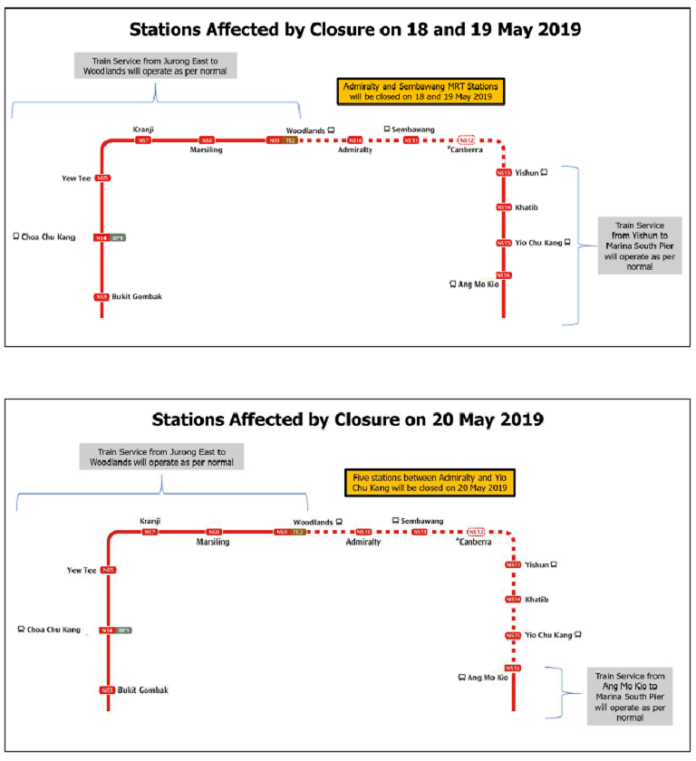
SINGAPORE: Five MRT stations along the North-South Line (NSL) will be closed for three days in May in a staggered manner to facilitate the construction of the new Canberra Station, the Land Transport Authority (LTA) said on Monday (Apr 8) in a news release.
The closure involving Admiralty, Sembawang, Yishun, Khatib and Yio Chu Kang stations is scheduled over the Vesak Day long weekend between May 18 and May 20.
On May 18 and 19, Admiralty and Sembawang stations will be closed to facilitate the removal of existing tracks and installation of the new crossover track, LTA said.
On May 20, all five stations will be closed to carry out testing and commissioning of the signalling software for the newly installed track sectors.
Train services are expected to resume their normal schedules on May 21, LTA added.
Canberra station will be the first station in Singapore to have an above-ground direct entry to a train platform. This will be for city-bound trains.
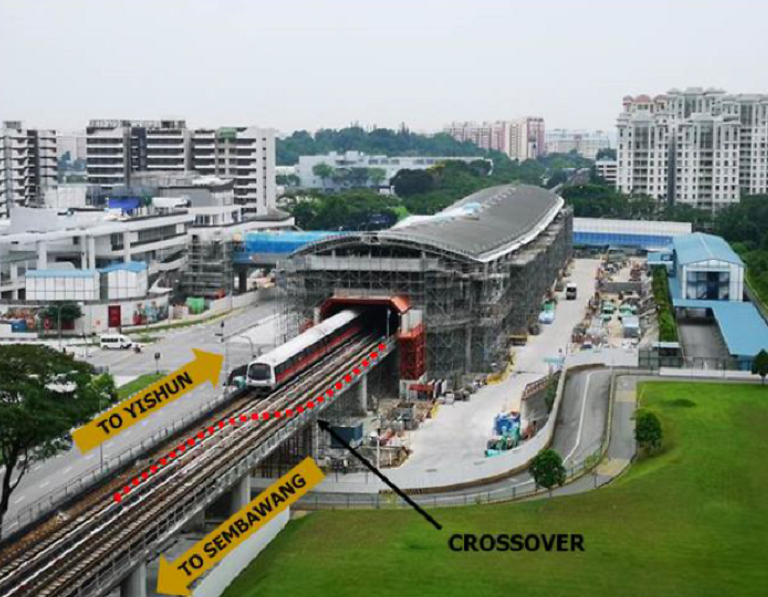
With 75 per cent of construction complete, LTA said the next step involves connecting the two existing tracks to and from Canberra station with a new 72m crossover track.
(Photo: LTA)
LTA said this “will enhance the resilience of the North-South Line” by allowing trains to cross from one track to another.
“If the northbound taxi is faulty, affected trains can use the crossover to bypass the faulty stretch by travelling on the southbound track. This allows train service for both directions to remain available.”
During the planned closures, LTA will provide shuttle bus services between Woodlands and Yishun stations on May 18 and 19, and between Woodlands and Ang Mo Kio stations on May 20.
Concurrently, an express bus service will be provided between Woodlands and Bukit Panjang stations over the three days.
Canberra station is scheduled to be operational in the fourth quarter of this year, LTA said.
SINGAPORE: In the middle of last year, two of the biggest names in bike sharing, Ofo and Mobike, were grabbing headlines with valuations topping US$2 billion. This put them squarely among the ranks of the so-called “unicorns” – start-ups with a value over a billion dollars.
What a difference a few months makes.
Now, as we witness the bike-sharing boom fizzle, both firms are in spectacular retreat, maybe near total collapse. Ofo is on the verge of declaring bankruptcy while Mobike recently announced it was quitting Singapore and most of its other Asian ventures, retreating to its home market in China to lick its wounds and try to consolidate.
So, what happened? How did firms recently “valued” highly see that value evaporate so quickly?
MOVE FAST AND BREAK THINGS
It’s an issue that is not confined only to bike-sharing. The move-fast-and-break-things tech industry is littered with examples of start-ups that became the darling of the moment, drawing multi-billion dollar valuations, yet months later collapsed into nothing.
Most of these failures occurred not because of some act of god or other unforeseen misfortune, but because of fundamental problems with either the firm’s business model or its capabilities – factors that you might think would be central to determining its value.
Of course, on the flipside we have also seen many highly-valued start-ups that have lived up to their valuation. Some have gone on to deliver solid, or even outstanding performance. Yet in some ways these successes only add to the confusion.
Impounded bicycles from the bike-sharing schemes Mobike and Ofo (Photo: AFP/Johannes Eisele)
This raises obvious questions about what meaning such valuations really have. Indeed, do valuations have any real “value” to them?
Look back a few decades and valuations of firms used to be based on tangible hard facts – costs, output of products, sales and cash flows. So what dictated the valuation was the flow of money.
Today valuations are frequently based on ideas, inspiring or compelling stories, and on other often nebulous, hard-to-grasp concepts. Often a firm’s purported “value” is the result of bagging attention, capturing eyeballs, and visions – glitzily presented by the firm’s founders – of how some new revolutionary software or device will be perceived.
Putting it differently, it is based on expected growth of the company – yet, time and again we have seen the expected never materialise.
One stark example of an overblown valuation is the now defunct California-based biotech firm Theranos, the story of which is the subject of a recent HBO documentary.
Launched by Stanford dropout Elizabeth Holmes, Theranos attracted more than US$700 million in funding on a promise to revolutionise preventative medicine using a compact in-home bloodtesting machine called the Edison. Theranos and its founder gave slick presentations and attracted huge media coverage, luring in many high-profile investors.
The firm was touted by some as ”the Apple of healthcare” and Holmes even went as far as copying Steve Jobs clothing choices by sporting his trademark black polo neck.
FILE PHOTO: Theranos Chief Executive Officer Elizabeth Holmes speaks on stage at the Glamour Women of the Year Awards where she receives an award, in the Manhattan borough of New York, US, November 9, 2015. (Photo: REUTERS/Carlo Allegri/File Photo)
At its peak in 2014, the firm was valued at more than US$10 billion.
But a year later a newspaper investigation exposed the truth behind the company’s “breakthrough” technology. Behind all the hype, and behind a wall of secrecy, it was using routine medical equipment to carry out tests that were supposedly done by its Edison machine.
Theranos rapidly collapsed and the firm’s founder and senior executives now face a raft of fraud charges.
Now, by no means are all overvalued start-ups as potentially fraudulent as Theranos. Neither are all failed, formerly highly valued firms, necessarily criminal. But the case sends a cautionary message about valuations and the conditions that can fuel them.
One important factor has been a decade of near zero interest rates, leading to a mountain of excitable investor cash eager to find “the next big thing”.
Fed by gushing headlines about soaring valuations, this frenzy has led to a “get big fast” approach to business development, based on a race to build market share and a blind faith that overlooks or obscures key fundamentals such as revenue growth.
This has produced an ecosystem of unicorns, none of which have to reveal detailed results, talk to analysts or open their books because they haven’t gone public. As a result transparency has plunged and the potential for outright fraud, as was seen with Theranos, is much higher.
Of course, overhyped investments are nothing particularly new. The Dutch had their own experience with the tulip craze back in the seventeenth century. But in the scenarios we see playing out today, technology has played a major role in fuelling the scope, speed and scale at which the hype spreads.
In the boom-to-bust tale of bike sharing, many firms built their business models on the promise of vast amounts of supposedly valuable data they would collect about users.
Not onions but tulip bulbs at the Bloemenmarket. (Photo: Pixabay/Public Domain Pictures)
Riding on the back of slick, social media-driven marketing campaigns, they raced to build market share, flooding cities with bikes which were too cheap, too heavy and unreliable, and too poorly maintained to build any kind of loyal user base. They also failed to anticipate the regulatory backlash from authorities fed up with the rash of bikes littering their streets.
On top of this, firms were unable to establish barriers to entry, meaning other players were able to enter the market easily. Driven by a hyped-up frenzy of investor interest around bike sharing, many firms did exactly that.
That these issues might undermine their initial business model now seems rather obvious. Indeed, as one Chinese bike share founder revealingly told Reuters late last year:
It now appears bike sharing is the stupidest business, but the smartest brains of China all tried to get in.
The lesson then is to take valuations with a large fist-full of salt.
In the meantime if you find yourself dazzled by the megabucks valuations for a start-up that has yet to turn a single cent in profit, it might be wise to remember one important thing about unicorns.
They are mythical creatures.
Professor Sumit Agarwal is Head of the Department of Finance and Low Tuck Kwong Distinguished Professor at the National University of Singapore (NUS) Business School. The opinions expressed are those of the writer and do not represent the views and opinions of NUS.
SINGAPORE: It might seem like a routine chore – and one that could easily be generated by a computer.
But preparing school timetables for students and teachers is in fact a complex task, requiring meticulous data entry, manual adjustments and even a fair amount of creativity from the team of teachers in charge of the task. And with the rollout of full subject-based banding (SBB) in all schools by 2024, some schools say this already complex task is set to become even more complicated.
In March, Education Minister Ong Ye Kung announced that the current system of streaming, where students go into the Normal (Technical), Normal (Academic) and Express streams based on their PSLE results, would be replaced by full SBB, where students take different subjects at different levels according to their ability.
The model was prototyped in 12 secondary schools in 2014, where students in the Normal (Technical) and Normal (Academic) streams can take English, Mathematics, Science or Mother Tongue Languages at a higher level if they perform well in these subjects at the PSLE.
This was later rolled out to all secondary schools in 2018.
The increased flexibility for students, however, also meant that schools have had to exercise their creativity in coming up with customised timetables to cater to the many different subject combinations each student took.
Prior to the introduction of SBB at Jurong West Secondary in 2014, timetables took at most about a week to a week and a half to generate, according to a member of the school’s timetabling committee Ms Orry Zhang. Today, however, this process takes about three weeks on average.
Ms Zhang, who is also a Chemistry and Literature teacher, explained that the timetabling process usually begins towards the end of the preceding school year, over the school holidays.
The school uses a software to generate timetables that show the lesson periods scheduled for all the classes every day. But prior to this, she said, manual data entry is required to create each individual lesson period, where details such as subject teachers and venue has to be entered before the actual generation can begin.
Logistics considerations aside, timetabling committees also need to take into account issues such as the welfare of teachers, the comfort and suitability of each teacher to straddle different levels and subjects, as well as the ability of students to focus and learn.
At Pei Hwa Secondary, which is also one of the first 12 secondary schools to implement SBB in 2014, the timetabling committee tries to offer students more double period lessons of 70 minutes. This is so, explained timetabling committee member and chemistry teacher Teo Si Hui, that students have fewer subjects per day, which would allow them to consolidate their learning better.
“With a double period, some of the learning spaces – such as the computer labs – can also be better optimised,” she said.
Then, there are various other considerations that would need to be factored in and included. These could be limits on the number of consecutive periods each teacher can take, or lessons, such as science practical lessons, requiring a particular venue.
“It usually takes quite a number of days to do all the data entry, because we really need to make sure everything is correct with no mistakes,” said Jurong West’s Ms Zhang, adding that it would be laborious to unravel the mistake once the software has started running.
“The more constraints we set, the more difficult it is for the timetable to generate,” she added.
To ease the process, Pei Hwa’s Ms Teo added that the school uses past data and experience – such as the number of students taking each subject at the different levels – to generate a preliminary timetable, which will be finalised after confirming the Sec 1 posting information.
It takes about six hours for the software to run before a draft timetable is generated, following which the committee would then need to make manual adjustments to the timetable to resolve remaining conflicts, which are represented by loose cards at the bottom of the timetable that need to be individually dragged into the generated timetable.
This, said Ms Zhang, is where creative solutions need to come in.
A draft timetable at Jurong West Secondary. The coloured “cards” at the bottom represent the conflicts, or “collisions” that need to be manually adjusted. (Photo: Lianne Chia)
NEED FOR CREATIVE SOLUTIONS TO RESOLVE CONFLICTS
Committee members from both schools stressed the importance of having creative ideas and solutions to make these manual adjustments.
For instance, Jurong West made the decision to place subjects with fewer students at the end of the school day, so the majority of students would not need to stay back.
“That’s one way we look after the welfare of the students,” said Ms Zhang. “To ensure we are not taxing the other students, while allowing our students to learn and develop all the ways that they can.”
She added that the committee had to accept that some things would have to give, in order to optimise the timetable for all students and teachers.
“Things were initially quite neat prior to SBB … such as the dismissal timing,” she said. “But now, we’ve had to accept that it might not be so clean-cut.
“We could have classes ending at different timings, so some would end at 3pm, while others would end at 3.35…we just had to accept that the timetable won’t look so “neat” anymore,” she said.
Creating more venues for lessons, too, is one other possibility.
“Special rooms, such as music rooms, which are not being used outside of music lessons, can become multi-purpose if we just add a few tables and chairs,” said Mr Wong Liang Soon, another member of Pei Hwa’s timetabling committee. “We also have a few classrooms with partitions, so we can use that too, to create new venues.”
“There are also teachers who like to use the open spaces in the school for lessons,” added Ms Teo. “Like if the lesson’s a drama, they don’t need tables and chairs, so they bring the students to the foyer.”
MORE IDEAS NEEDED
With the implementation of full SBB, students would also be able to take humanities subjects at different levels. And this, said both schools, would undoubtedly further complicate the timetable generation process.
But Jurong West’s Ms Zhang noted that the primary ideas and concepts remain the same.
“We’ll still need to be flexible and creative in the way we deploy teachers, we still need to be mindful and plan in advance for venues, and of course we will also need to continue leveraging on our Education and Career Guidance programme, so the students make informed choices,” she said.
“We hope that some of our past experiences can help us,” added Choy Chee Ping, Jurong West’s second-in-charge in the timetabling committee. “It helps that we’re not starting from scratch.”
Jurong West Secondary’s timetabling committee second-in-charge Mr Choy Chee Ping, in-charge Ms Sharron Chiam (centre) and member Ms Orry Zhang (right). (Photo: Lianne Chia)
The teachers from both schools, however, also highlighted the importance of getting input from other schools.
“It would help a lot if MOE could facilitate the exchange of ideas across different schools,” said Pei Hwa’s vice principal Philip Tan. “Because what we really need is ideas.
There might be other schools that might have done things we’ve never tried out before … so it would be good to learn.”
“We can only come up with so many ideas,” added Yang Ser Yee, the school’s SBB coordinator. “More brains are definitely better.”
It may be a complex task ahead of them, but the teachers remain optimistic.
“It’s hard work, but we’ve seen a lot of success stories,” said Jurong West’s Ms Zhang. “That’s one factor that really keeps us going.”
“It’s like fixing a jigsaw puzzle … challenging, but interesting”, added Mr Choy. “It’s not about the complexity, but about whether we can find the right formula or combination.”
SINGAPORE: There has been much discussion recently about the power wielded by large tech companies such as Google and Facebook as well as calls for governments to step in by either regulating or even breaking up the companies.
One of my fellow academics Matthew Liao at the New York University has argued in the New York Times that it is immoral to have a Facebook account.
Senator Elizabeth Warren, a Presidential aspirant in the 2020 election has called for a breakup of the big tech companies including Google, Facebook and Amazon, an idea that has received support from several different quarters.
Today, I am going to admit to something that I find to be perfectly moral and good for me. I love Google and several of its products. Let me explain why.
VALUABLE FOR TEACHING AND RESEARCH
I have been a user of Google search for as long as I can remember, because I find it to be extremely valuable in my teaching and research. When I am doing either of those tasks, I value the quality of results such as interesting data on business phenomenon (including charts available through search of Google images) and relevant academic papers.
Google search gives me the most accurate and wide-ranging results. Most importantly, it costs me nothing.
I use it several times a day for work as well as for my other interests including sports trivia (especially Cricket trivia), history and increasingly for searching flights and for checking flight status (which is often faster and more accurate than the airline website itself).
As an academic, I am interested in how many people have cited my work. The higher this number, the greater the (supposed) impact of my work.
Google, again, comes to the rescue. Google Scholar is free and the most comprehensive among the different alternative citation databases, many of which (e.g., databases from various publishers) are subscription based.
Google’s search results are prized internet real estate with the US giant controlling roughly 90 per cent of the search market in Europe, according to EU data. (AFP/Ben STANSALL)
A third product I use is Gmail. It gives me a large storage capacity, separates “real” mail from promotions and social mails and is extremely quick in delivering my emails to the intended recipient.
While I started out using Gmail for personal use, I am increasingly using it for my work as well, primarily because my employer-provided email is clunky, not as quick in delivering messages and its search (within the email box) function is far worse than Gmail.
WHAT’S WRONG WITH MONOPOLIES?
When I was doing my economics courses, I was taught that one way a monopolist captures consumer welfare is by reducing supply which will lead to higher prices (e.g., the OPEC cartel which tries to act like a monopolist, attempts (unsuccessfully) to hold back the oil production).
Neither reduced supply, nor elevated prices are relevant for arguing that Google is a monopoly — its products are widely available to users without any restrictions on supply and are free.
Google does charge money to advertisers, however. It is almost impossible to determine whether these prices are monopolistic. My guess would be that they are not.
According to recent data provided by Statista, search advertising is a much smaller market than display advertising online. There are clearly many more players in display online advertising – e.g., almost any content provider such as news sites (including the Financial Times), sports sites (espn.com), financial information sites (fool.com) – than Google.
Thus any advertiser has many options besides Google and if one extends the boundaries of the market to offline advertisements (e.g., TV, print etc.), Google’s position becomes even less dominant.
SHIFTING GOALPOSTS
Google sceptics want to shift the goalposts and define monopoly based on criteria other than the usual metrics of supply and prices. I will argue below that the case against Google as a monopoly doesn’t hold, whatever definition of monopoly one adopts.
Google is marked its 20th anniversary with an event in San Francisco devoted to the future of online search (Photo: AFP/Elijah Nouvelage)
A firm with great market power (e.g. a monopolist) can “hurt” (extract value from) the other stakeholders. Some years ago, detractors of Walmart which then enjoyed significant market power argued that while Walmart provided low prices to customers, it paid its employees poorly.
This clearly isn’t true in Google’s case. Google is among the best paymasters. I will be delighted if my son, who is pursuing a degree in Computer Science, gets an offer from Google when he graduates.
Google doesn’t harm the environment either, other than in a very indirect way by helping us use computers and Internet more. But, if one wishes to pursue this line of reasoning that greater use of computers is bad for the environment, then we, as users, are more at fault than Google.
Another argument proposed by Google sceptics is that with its market power, Google may be able to restrict competition and stifle new entrants. I find this argument to be hollow. From a business perspective, Google search is essentially an advertising platform.
Since Google became dominant, many new players have emerged that use advertising to generate revenues. Facebook, an alternative advertising platform, has in fact twice the number of sites linking into it versus Google, which on paper makes it more powerful.
According to data compiled by Amazon, there are several sites such as Yahoo.com, Wikipedia.org (no advertising), Twitter.com, Live.com (operated by Microsoft, a Google rival), besides the e-commerce giant Amazon.com, which are among the top 15 sites.
E-commerce titan Amazon has deployed some of the most advanced instruments in the rapidly growing field of robots capable of collaborating with humans AFP/Johannes EISELE
In fact, collectively, the number of users visiting these sites is far greater than Google, making it difficult to argue that Google is dominant. China based sites such as Baidu.com Qq.com and Taobao.com were not even included in the above list and their inclusion would further dilute Google’s alleged market power.
If Google was omnipotent and really able to exclude potential competition, then it would be successful in almost everything it tried. But, Google has failed many times.
Its social network Google+ was a failure and was disbanded recently. Other failed initiatives include Google Glass, Google Answers (have you heard of it?) and Google Health.
Apparently, the wealth of information that Google collects through its dominant search engine puts it in a better position to launch new products. If this were true (that is, the information was a huge advantage), Google’s above-mentioned failures would be very difficult to explain.
It is a fact that a company needs information to come up with innovative products, but to translate that information into innovation, a company needs a lot of other things including a clever strategy and good execution.
File photo of a woman wearing a Google Glass. (Photo: AFP/Joel Saget)
In my view, the reports of Google’s alleged market power are greatly exaggerated. Though Google does dominate search-based advertising, there is a lot more to Internet, online advertising and e-commerce than search-based advertising. I think Google is simply very good at many things and users love its products which are mostly free for them.
It would indeed be a travesty if this company (or any other company that offered excellent products at low or zero prices) was regulated based on wrong analysis and reasoning, and hampered from providing consumers the products they appreciate.
Nitin Pangarkar is an Associate Professor in the Department of Strategy and Policy at the National University of Singapore (NUS) Business School. He owns a small number of Google shares which account for approximately 0.25 per cent of his total assets. The opinions expressed are those of the writer and do not represent the views and opinions of NUS.
SINGAPORE: The first quarter of this year saw a three-fold increase in the number of dengue cases compared to the same period in 2018, the National Environment Agency (MEA) said in a media release on Sunday (Apr 7).
More than 2,000 cases have been reported since January.
NEA said even though it detected seven per cent less Aedes aegypti mosquitoes in March 2019, compared to in March 2018, it found from its Gravitrap surveillance system that the mosquito population remained high.
“Our neighbouring countries have also reported sharp increases in dengue cases in recent months. The warmer months of June to October usually see higher transmission of dengue in Singapore, due to the accelerated development of the Aedes mosquito and the shorter incubation period of the dengue virus,” NEA said.
It expects an increasing trend in dengue cases in the warmer months ahead, if active steps are not taken to keep the mosquito population in check.
Minister for the Environment and Water Resources Masagos Zulkifli urged members of the public and stakeholders to stay vigilant and not let their guard down.
Speaking at the main launch of the National Dengue Prevention Campaign 2019 at the North West District, Mr Masagos made the call for a concerted effort to step up mosquito and dengue prevention efforts, to keep dengue transmission under control in the run up to the peak dengue season.
USING TECHNOLOGY, INNOVATION
NEA also added that it intends to progressively deploy Gravitraps at newly completed HDB blocks, and expand the Gravitrap surveillance system to landed housing estates, in the second half of 2019.
The Gravitrap, developed by NEA’s Environmental Health Institute (EHI), is designed to attract and trap female Aedes mosquitoes that are looking for sites to lay their eggs.
Such mosquitoes are not looking for a blood meal and hence will not bite people.
Female mosquitoes attempting to lay their eggs in these containers will be captured and thus prevented from biting other people subsequently. The Gravitrap also traps and prevents the emergence of any mosquitoes from eggs that are laid in the trap.
About 50,000 Gravitraps have been deployed islandwide by NEA to monitor the Aedes mosquito population in Singapore.
The data on mosquitoes caught in these traps has been used to guide NEA’s inspection efforts to focus on areas with high Aedes mosquito populations, thus enabling more efficient deployment of limited manpower resources, the agency said.
Through the deployment of the Gravitrap surveillance system, NEA said it was able to remove 21 per cent more mosquito breeding habitats last year, compared to 2017.
Separately, the agency has also begun the Phase 3 field study of Project Wolbachia – Singapore at the expanded Tampines West and Nee Soon East study sites, to determine if suppression of the urban Aedes aegypti mosquito population can be sustained in larger areas.
In the recently concluded Phase 2 field study, 80 per cent and 70 per cent suppression of the urban Aedes aegypti mosquito population were achieved at the Nee Soon East and Tampines West study sites respectively, NEA said.
The results thus far show that a larger release site yields better results, and community effort in keeping the mosquito population low will enhance the effectiveness of Wolbachia technology, the agency added.
SINGAPORE: For some Singaporeans living abroad, the thing they miss most isn’t family or friends.
It’s food.
No matter how hard they look, they can’t find anywhere that serves chicken rice or char kway teow with the authentic, cooked-in-a-heartlands-coffee-shop Singapore taste.
For 52-year-old Jasni Zakaria, it started when he was frustrated with the food options available in Finland where he has been living for the last 23 years. He resides in Jyväskylä, about four hours away from Helsinki.
“In Finland, it’s very difficult to get Asian food and they sell Chinese and Indian food but it’s not original,” said Jasni.
According to him, fried rice would often be too oily and curries would come from pre-packaged jars. It is also not spicy enough for his Singaporean taste buds.
“I cannot get the real taste. … I don’t care about the price, I just want good food that I cannot get!” he added.
Jasni Zakaria taking part in Restaurant Day in Jyväskylä, Finland where anybody can set up a stall to sell their food to raise money. He told mee goreng, chicken curry, spring rolls and curry puffs. (Photo: Jasni Zakaria)
The self-professed foodie said that he has been searching all over Finland for authentic Asian food. There are only a handful of restaurants that have been able to give him what he is looking for in capital Helsinki and Oulu.
His desperation led him to cook for himself, and this eventually led him to start selling his offerings.
“I made curry puffs for my work friends to try. They liked it so I turned it into a business. I also made fried rice but it’s the Malay way; the fried rice that my father used to make,” said Jasni, whose full-time job is assembling hydraulic cylinders.
He sold them by standing outside hotels, pubs and outside football matches. Curry puffs usually go for between €1 (S$1.52) to €2.50 each, while a serving of his fried rice is priced at €3 to €5.
He has also sold his food at food festivals, and most of his customers are local Finns.
“One night, I can earn about €1,200 from selling fried rice. After paying for the ingredients and the place to cook, I still make about €1,000 a night,” Jasni said.
GERMANY
For Singaporean Angie Tan and German Fabian Böddecker, both 33, getting into the F&B industry was always a dream. Without culinary backgrounds, both of them would experiment with recipes and post them on their food blog called riceandbread.
After going to a supper club in Cuba in 2016, Angie and Fabian wanted to replicate the experience but with Southeast Asian food served communally. They started hosting private three-course dinners at their home in Düsseldorf last year.
“There also wasn’t any other place that offered Singaporean food. The closest we could find was Malaysian food but they were also under the disguise of a Chinese restaurant in Düsseldorf. We thought it would also be really interesting to see how people would react to Singaporean food as well,” Angie added.
Fabian Böddecker and Angie Tan runs riceandbread, and they sell Singaporean food at pop-up events all over Düsseldorf. (Photo: Angie Tan)
From there, the couple started tackling food festivals and pop-up restaurants.
For two weeks at a pop-up restaurant in November last year, they served curry puffs, ngor hiang and otak-otak as snacks, as well as nasi lemak, lor bak, curry chicken and laksa as main dishes. There was even kueh salat for dessert.
“We didn’t have family recipes so I was basically collecting them from the Internet, testing it out and coming up with our own recipes. These are recipes that we’ve used to cook for our friends and supper clubs,” Angie said.
The response from their customers was “overwhelmingly positive” but some dishes sold better than others.
“What was a bit difficult was to get people to order something else other than curry.”
“For Germans, chicken curry is something they can process and understand what it is. But having them to order something else like laksa or nasi lemak is actually not as easy as we thought but the people who tried it liked it,” Fabian said.
Laksa sold by riceandbread. (Photo: Angie Tan)
But even so, Fabian and Angie have not tried to localise the dishes to suit the German taste buds. Dishes like their chicken curry or laksa are served spicy in general but when customers tell them that it’s too spicy, they will add a little coconut milk to make the dish more palatable.
To make these dishes, they have had to do significant research on where to source their ingredients. For example, laksa is a challenging dish to replicate in Germany because of the lack of availability of dried shrimps and the correct noodles.
“Dried shrimps are very, very difficult to come by. If you make laksa paste, you need dried shrimps for it. A hundred grams over here costs €8. So that makes cooking with it very expensive. What we struggled with too at the beginning was laksa noodles because the laksa noodles that we know is a Singaporean brand and there is only one place that we know that we can buy from in the Netherlands,” Fabian said.
The other ingredients are easily available in Düsseldorf because of its large Asian community.
Another German resident, Tang Pin-Ji, 33, sells kaya from her home in Berlin. Owing to an abundance of Asian supermarkets in Berlin, she is able to get fresh pandan leaves for her kaya.
Pin-Ji started making kaya to bring them to house parties and office parties to share a piece of home with her friends and colleagues 1.5 years ago.
Homemade kaya made in Berlin by Tang Pin-Ji. (Photo: Tang Pin-Ji)
It was only late last year that she started getting her first paid orders, with those who have tried her kaya wanting to share it with their friends. Half of her customers are Singaporeans and Malaysians while the other half are Germans and other Europeans.
“They find it delicious and the feedback has been positive so far, although for very different reasons. For the Singaporeans and Malaysians, it’s a feeling of nostalgia. For the Germans and Europeans, it’s either a novelty or it’s because they’d tried it on holiday in Singapore or Malaysia,” Pin-Ji said.
“I generally feel that Singaporean food is severely underrepresented in a global city like Berlin and many locals can’t tell the differences between Asian cuisines. You could say that making kaya is my way of telling them this is where I’m from and this is what people back home love,” she added.
UNITED STATES
Faridah Zee Jusuf, 57, who goes by Zee, moved to the United States in 2002 and went into the food business in 2017 after retiring from the real estate industry. She started Zippy Zee Kitchen as she moved into semi-retirement and can be found at pop-up events or farmer’s markets all over Florida.
“Nasi Lemak sells because everybody here loves coconut. They like spicy food like buffalo wings. Coconut rice and chicken rendang always sells,” Zee said.
Faridah Zee Yusuf (in red) in front of her pop-up stall. (Photo: Faridah Zee Yusuf)
To make Singaporean food more accessible to Americans, she has even created her own version of a burrito – a rendang wrap – that is made with shredded beef rendang and roti prata as a wrap.
According to her, she is the only one selling Singaporean food in Florida. But wherever it is in the US, it is hard to find Singapore fare.
“Not even in Los Angeles. There are a lot of Malaysian places. It’s not so different from Singaporean food but I think our food is better than theirs,” Zee joked.
To make her food, she has to search high and low to find the right ingredients.
Zee returns to Singapore two times every year and on those trips, she packs over up to 70kg of ingredients to bring back to Florida. It includes kerisik, ikan bilis, and a frozen chilli paste that she makes in Singapore so that she can bring it through customs.
Zee’s pop-up stall Zippy Zee Kitchen moves all over Florida. (Photo: Faridah Zee Jusuf)
In the US, she also has her own garden where she grows herbs and spices like chilli, lemongrass, lime leaves and galangal used in her cooking.
For her food, Zee has been invited to participate in food events because they know her food is “different” and “unique”. “They didn’t know about Singaporean food and now they do,” she said.
When new customers visit, Zee takes the time to explain where Singapore is and shares her knowledge of Singapore’s history.
“I have changed a lot of my customers … Even those who have not travelled can appreciate Singapore food and know that it consists of Chinese, Indian, Malay, Eurasian cuisine and also flavours from the region.
“When I have time I will also tell them how it came to that, why it is multi-racial. Everybody contributes to the cuisine. Even Singaporean Chinese food has Malay influences and so on,” Zee said.
SINGAPORE: Hailed as a bright spot in 2017, the strong recovery in the en bloc sector received a rude shock after the property market was slapped with a fresh round of property cooling measures in July 2018.
On the surface, the latest casualty of this sledgehammer were the more than 1,000 residential unit owners of Mandarin Gardens, who seemed to be making steady progress towards what would have been Singapore’s priciest collective sale agreement – until it came to a grinding halt last week, leaving many readers wondering whether the en bloc fever has finally cooled.
The 99-year leasehold condominium failed to garner enough signatures to start the tender process.
But there were warning signs the deal was already on shaky ground.
The Mandarin Gardens’ en bloc sales committee raised the asking price twice from an initial S$2.478 billion to S$2.788 billion, and then again to S$2.927 billion.
Despite the record-high asking price, the committee obtained only 68 per cent falling short of the requisite 80 per cent consensus, when the collective sale agreement expired.
DEVELOPERS ARE THINKING TWICE TOO
The residential private property market has softened considerably since the cooling measures were rolled out. More than 30 collective sale tenders have ended without successful bids.
The raised Additional Buyer’s Stamp Duty (ABSD) and tightened Loan-to-Value limits have increased transaction costs when residential properties change hands, making it deliberately painful especially for those thinking of buying a second or subsequent residential property for investment.
The additional ABSD imposed on developers snapping up land for en bloc redevelopment has also made it more costly if they fail to sell all units within five years.
These measures have already claimed their first victims in halting other en bloc projects – developer Tee Land called off Upper East Coast’s Teck Guan Ville’s collective sale in late July 2018 after redoing their sums, and Lafe Corp backed out from buying over Sophia Road’s Fairhaven in October 2018.
Fairhaven. (Photo: JLL)
STOP, PAUSE, THINK
While many observers have highlighted the additional costs in terms of stamp duty and limits on loans imposed on buyers, sellers and developers, which have no doubt dampened the private property market, less talked about are the effects of the measures in cooling speculative sentiments and forcing these actors to think twice.
The effects of the ABSD measures on en bloc activities are two-fold. Owners of en bloc properties will have to pay a higher ABSD when purchasing a replacement property, and will therefore need a higher reserve price to be incentivised to move out and recoup their costs.
But a higher asking price will now put off developers who have to consider their additional ABSD costs as well as whether a high selling price will deter potential buyers facing additional hurdles. Developers, in thinking about en bloc acquisitions, face a double whammy of a non-remissible ABSD and dwindling demand as local and foreign buyers are more cautious.
EN BLOC FEVERS OVER THE LAST 20 YEARS
The fact is land demand in the private property market had been relatively sanguine in the 1990s. An en bloc frenzy broke out in the early 2000s but was cooled quickly by the US subprime crisis in 2007. This external shock put the world in a grave economic crisis and killed demand, as banks and governments struggled to stimulate their economies.
But as market sentiment picked up, reaching another fever pitch in 2011, the Government stepped in to cool speculation by introducing ABSD for the first time, targeting foreigners and corporate entities, as well as Singaporeans buying for investment purposes.
But as land banks were drawn down over the last six years, and the market got accustomed to factoring in ABSD costs, developers started sniffing around to acquire land in late 2016 and the en bloc market picked up.
Figure of en bloc sales and government land sales (GLS) over the last 20 years, not including landed collective sales. (Graphic: Sing Tien Foo, Chia Liu Ee. Source: URA)
SPECULATIVE EFFECTS IN EN BLOC PROPERTIES
The fact is that en bloc sales artificially push up the prices of apartments in a development.
We have examined transaction prices of private properties for over 20 years. In our study spanning January 1995 to August 2018, we have seen a consistent pattern of prices rising over the year leading up to the en bloc sale.
In particular, compared to transactions occurring more than a year from the en bloc date, transactions in the three months leading to the en bloc date command a 15 per cent premium on average.
The road to a successful en bloc sales is long and winding from the setting-up of a collective sale committee, appointing consultants, and soliciting consensus from residents. However, the effects of an anticipated en bloc may be enough to stir demand, without the development reaching a collective sale.
Private property prices have been on the rise in the long term. Scatterplot showing the transacted price of an apartment in a private property over 300 months leading up to the en bloc sale. The darkened straight line shows the price trend leading to the actual en bloc date (Graphic: Sing Tien Foo, Chia Liu Ee. Source: URA)
THE EN BLOC PREMIUM
In our decades-long study of property prices, we matched properties sold en bloc with those that do not have plans for an en bloc sale and are similar in characteristics – including property age, distance to MRT, distance to primary schools and other location attributes – and found a significant difference in transacted prices of 5.4 per cent.
The results imply that the mere anticipation of an en bloc sale could trigger increases in both volume and price in resale activities in these developments. The effects are stronger closer to the en bloc date.
Speculators drive transactions occurring closer to the en bloc dates. Most are willing to pay higher prices and bear the risks the collective sale deal may not go through. They also incur seller’s stamp duty if en bloc deals are concluded within three years from their purchase dates. Many buyers become activist residents who proactively persuade other residents to support the en bloc proposition.
Blue line denotes the average transacted price PSF for Mandarin Gardens apartments. Dotted brown line denotes the average transacted PSF for other non-landed, non-en- bloc properties in the same postal sector. (Graphic: Sing Tien Foo, Chia Liu Ee. Source: URA)
But the promise of an en bloc has a dark underbelly – as residents are hit harder with the introduction of cooling measures. When the 2011 cooling measures were imposed, en bloc properties suffered a steeper decline of 3.8 per cent in average resale transacted prices compared to non-en bloc properties.
THE EN BLOC FACTOR IN MANDARIN GARDENS SALE PRICE
A similar story looms behind Mandarin Gardens. When a first en bloc sale attempt was made in 2008, apartments in Mandarin Gardens started transacting at higher average prices than other properties in surrounding non-en bloc projects, suggesting significant anticipatory, speculative effects.
The development is an attractive candidate for en bloc – it has a low existing built-up plot ratio of 1.4. An almost double permissible plot ratio of 2.8 suggests redevelopment can be a handsomely profitable exercise.
But its large plot size could be a hindrance to a successful sale, as the number of owners the collective sale committee has to persuade is relatively large. In fact, our study has shown that the probability of en bloc decreases by 0.02 per cent with each additional apartment unit in a development.
Part of this arises also because large en bloc sites are also more difficult to sell, as they attract a small group of interested developers with strong financial backing.
Pearl Bank Apartments, which was built in 1976. After previous failed attempts at an en bloc, it finally came to pass this year. (Photo: Darren Soh)
ENDING THE EN BLOC FRENZY
En bloc redevelopments drive the urban renewal process in land-scarce Singapore. Old and under-developed properties are demolished and redeveloped into higher density properties.
2018 marks the most eventful year for the en bloc market after the last two bouts of en bloc fever in 2007 and 2011. Strong en bloc sale activities coupled with record-breaking transaction prices risked spill-over effects into the residential property market and excessive price inflation.
The new ABSD rates imposed in July 2018 brought the en bloc frenzy emerging in 2017 to an abrupt halt leaving many hopefuls with a bleak outlook of finding potential buyers.
But the game of musical chairs isn’t quite over.
Far from it – though the beat might not be as fast-paced, the slowdown in the en bloc market provides a chance for developers, property owners, and even speculators to rethink their private property purchases, to shape a more sustainable residential private property redevelopment process.
Chia Liu Ee is a researcher and Associate Professor Sing Tien Foo is the Dean’s Chair and the Director at the Institute of Real Estate and Urban Studies (IREUS), National University of Singapore.