Home Blog Page 800

Best Gym Mirror Installation Practices

0

Home and commercial gyms are common in modern society. They are constructed to offer people an opportunity to keep fit.  Engaging in daily gym exercise is a practice that every individual should embrace so that they can stay healthy and fit. For most home gyms, various accessories are added to make it more comfortable to workout. Mirrors are some of the popular additions that cannot miss in a modern gym. Wall mirrors are installed using different techniques so that the interior décor of a   gym is entirely transformed. A gym that has uniquely designed wall mirrors looks elegant and comfortable. There are many ways through which you can install the mirrors to look more modernized and comfortable. Ideally, there are gym mirror installation practices that you should follow to avoid damaging them and achieve a uniquely designed interior décor. Mirrors are essential in helping the trainers and trainees to check on their daily practice routines and how their bodies change.  

gym mirror installation

Why
gym is incomplete without mirror

If there are no mirrors in the gym, it would be difficult for the trainees to observe the changes in their bodies. Most of the times when working out, the gym wall mirrors are used as a reflection by the trainees to check on how they are doing. If they find out that they are not doing the right thing, they can change right away and start doing what is required to keep a fit body. If you have a   home or commercial gym, you need to understand the installation practices that will help you get the right interior décor for your space. This article focuses on discussing the various practices that will help you achieve the best interior décor with mirrors in your home.
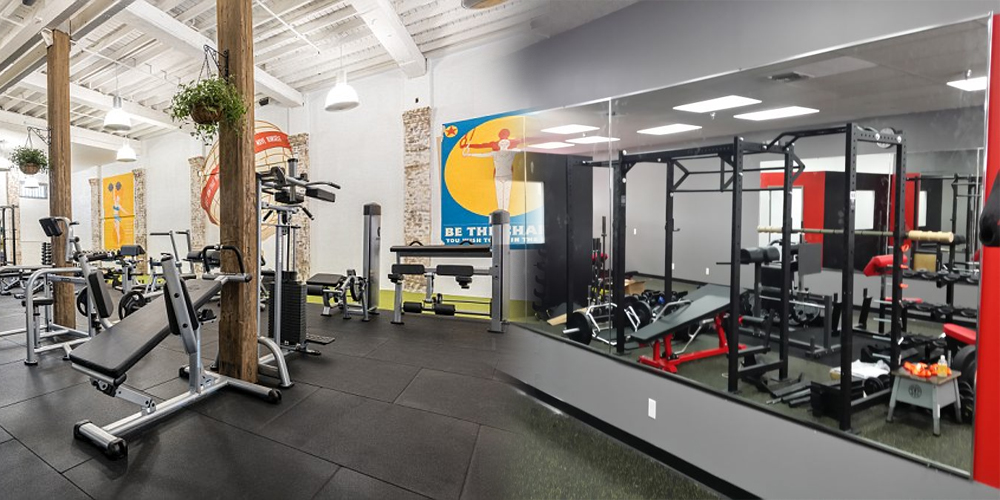
gymnasium mirror

Install
floor to ceiling wall mirrors

Having enough mirrors in the gym is one of the factors that make it more comfortable and modernized.  Gym mirrors that run from the floor to ceiling are more appealing to the trainees than just a small mirror on the wall. The floor to ceiling wall mirrors cover the entire body of the gym users, and they can see what they are doing with the entire body. The advantage of the large work out mirrors running from the floor to the ceiling is that they create an illusion of a bigger ace. Also, they may be useful in keeping the ugly walls hidden away. When adding a floor to ceiling workout mirrors, you should ensure that they are installed using the most appropriate method. You could use wall adhesives, hooks or suspend them with artistic ropes or cables. The choice is yours depending on the look you want to achieve for your interior.

mirror for a gym

Only install
highly reflective mirrors

The reflective index of mirrors affects the quality of the image that is produced. Most mirrors that have a reflective index of below 50% are not suitable for use as a workout mirror. Mostly, they do not produce quality images which are not comfortable for the users. When you need adding workout mirrors in your modern gym, you will need to check on their reflective index which should be more than 50%. Gym mirrors with a reflective index of more than 50% produce high-quality images which are appealing and comfortable for the eye. If you already have workout mirrors that do not produce high-quality images, it is time to upgrade to better quality with a reflective index of more than 50%.  

Keep
the gym well lighted  

Having enough lighting in a gym makes the environment more comfortable and attractive to work in. You could have large glass windows that allow sufficient natural light to pass through. The large glass windows make the gym remain bright thus affecting the mood of the people using it. The mood of the gym can be changed by adding more artificial overhead lighting. Usually, the lighting should be bright enough to keep the gym more comfortable and attractive.  When you do not have enough lighting coming from the windows, consider adding overhead or wall lights in the gym. A common practice is adding LED lights around the workout mirrors to make them more attractive and brighter. The brighter a room is, the more comfortable are the users and the environment in general.

gym mirrors and equpipment

Keep
a considerable distance between the gym equipment and the workout mirrors

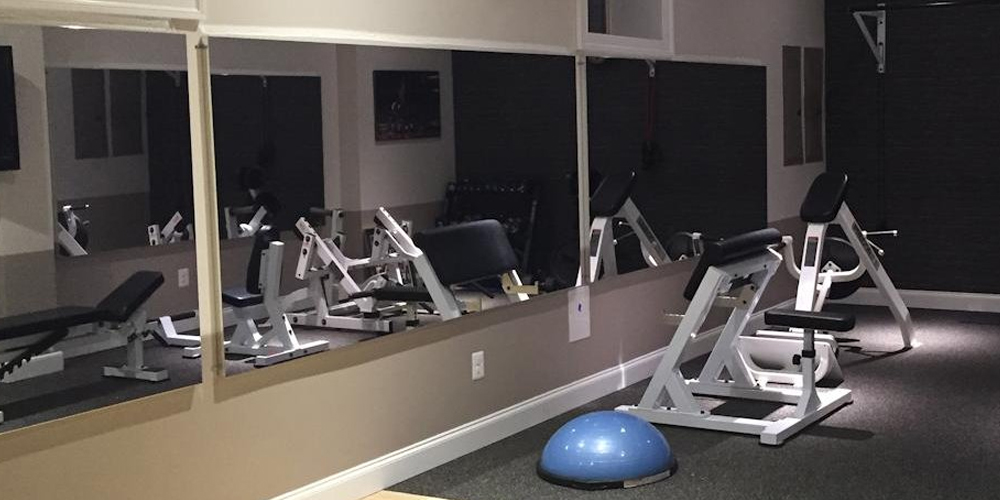
There are different types of gym equipment that are found within a modern gym. They are mostly considered the fundamental tools that make the attractive gym ad modernized. When adding gym mirrors to a modern gym, you are required to check the distance between the equipment and the wall mirrors. Usually, when the equipment is placed too close to the mirrors, they may cause damages to them in case of accidents. Mostly, if you do not have a distance between them, the mirrors might get scratched or shattered when the gym equipment hits them. To avoid such occurrences, you should ensure that you have a carefully determined distance from the wall mirrors to the equipment.
Maintain a   bright theme within the gym environment

The colors used
in decorating the gym can affect the mood of the users. When the environment is
dull-colored, it may have a negative effect on the mood of the gym users as
compared to the brightly colored space. When installing the gym mirrors, you
should ensure that you have a bright color that is more attractive and has a
positive effect on the mood of the users. If you are not an expert in
identifying bright colors, then you can consider contacting a professional
interior designer.  

Use
the most economical installation method that does not damage your walls

Installing
mirrors in a gym can be done using various techniques. Mostly, using adhesives
can be damaging to the wall. Therefore, you should be selective on the method
of installation that you use. Mostly, you should go for the hooks since they
are easier to customize and they can be easily moved to new positions. However,
ones attached to the walls using adhesives may be damaging to the walls during
upgrades.
Source link

Global economic uncertainty continues to cloud Singapore’s outlook: MAS

0

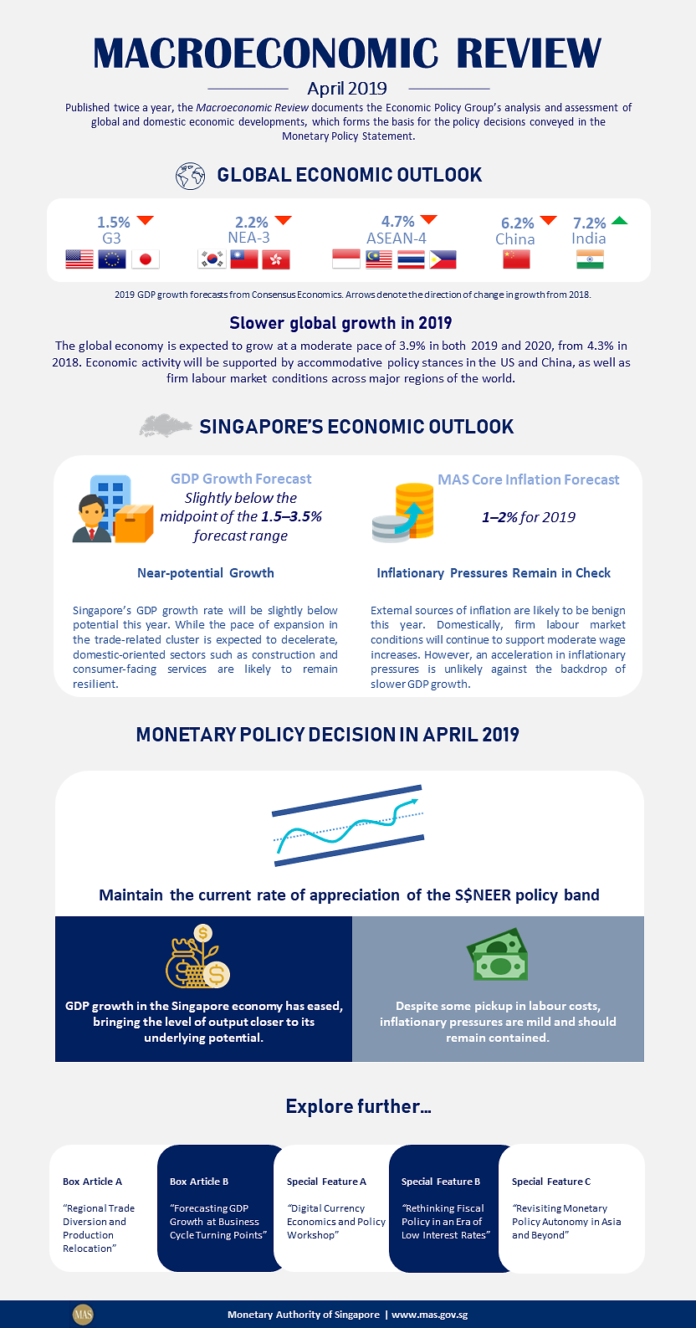
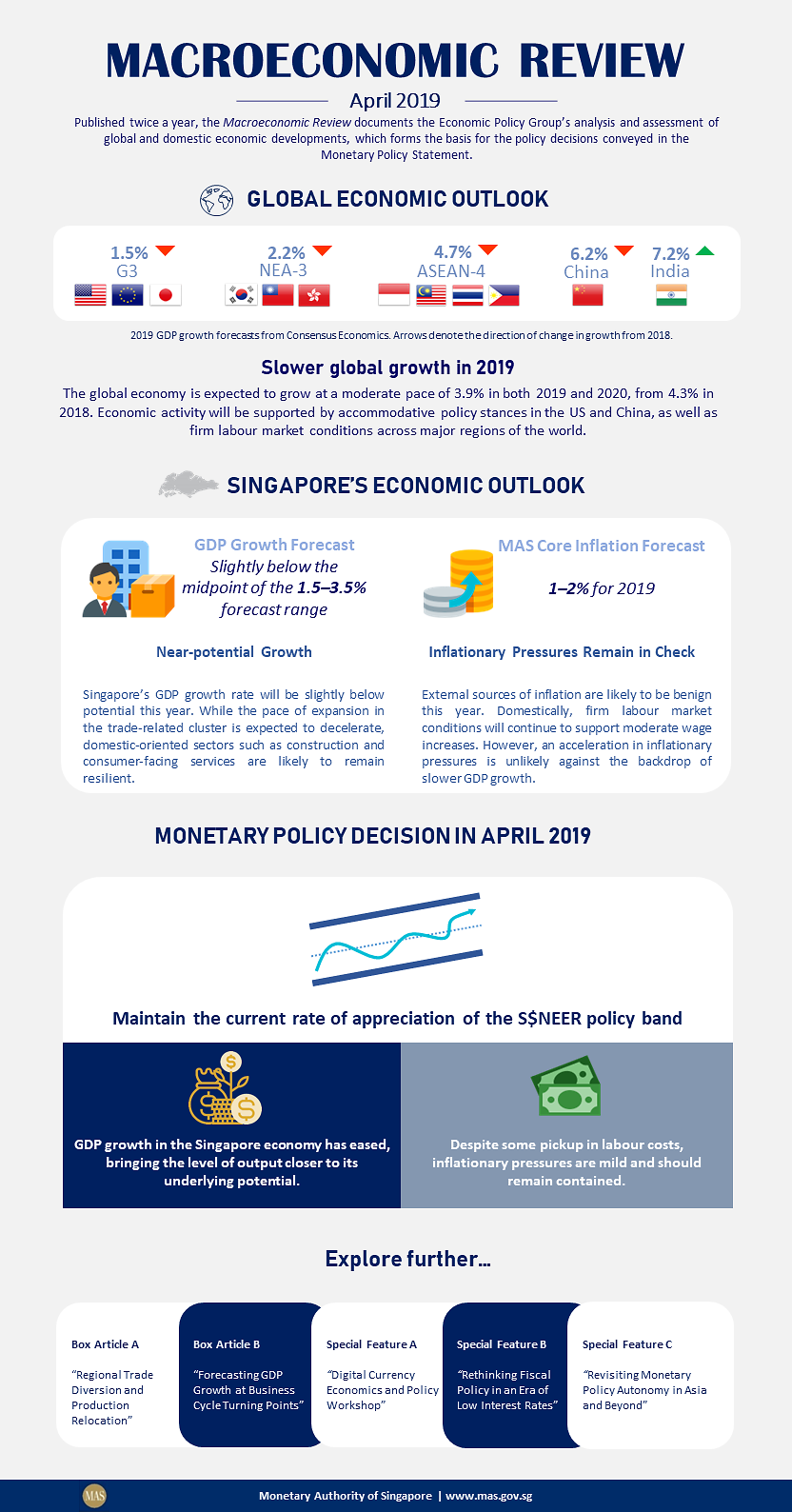
SINGAPORE: Singapore’s economic growth in 2019 is expected to come in slightly below the mid-point of the 1.5 to 3.5 per cent forecast range, barring an external setback, said the Monetary Authority of Singapore (MAS) in its latest macroeconomic review released on Friday (Apr 26).

This is down from the 3.2 per cent growth in 2018.

The domestic economic outlook over the next few quarters continues to be clouded by uncertainty in the global economy, the report said.

The slowdown was already felt in the fourth quarter of 2018 and first quarter of 2019. 

READ: Singapore’s GDP growth slows to 1.3% in Q1: MTI advance estimates

“Broadly, the subdued prospects for global growth will weigh on the externally-oriented segments in Singapore,” it said.

“Further, the global electronics sector faces significant headwinds owing to market oversupply, exacerbated by the softening of demand due to the uncertain business environment.”

The step-down in growth was mainly driven by weakness in the trade-related cluster, notably in electronics-related production and trade, as well as certain pockets in the modern services cluster such as the externally-oriented segments of financial intermediation.

Given the external challenges, MAS said the Singapore economy will have to turn towards domestic drivers for growth this year.

DIGITAL SERVICES, CONSTRUCTION ACTIVITIES TO SUPPORT GROWTH

This will be led by the ongoing expansion in services arising from the digital transformation of the economy.

“Activities of payment services players should continue to pick up as Singapore progresses towards a more cashless society. Competition, improved product offerings amongst incumbents, and entry of newer players will drive the momentum of this segment,” the central bank said.

Elsewhere in modern services, ICT and business services will benefit from the ongoing push towards a Smart Nation. Public investment in digitalisation, in accord with the “Digital Government Blueprint”, will provide a further fillip to these sectors, it added.

The domestic-oriented cluster saw an uptick in activity, alongside the recovery of the construction sector.

MAS said the recovery in the construction sector is expected to continue, led by public sector projects such as JTC’s upcoming developments at Punggol Digital District and Bulim, NEA’s Integrated Waste Management Facility, as well as civil engineering projects such as the Jurong Regional Line and North South Corridor. 

Private sector construction is also expected to gain momentum in 2019, spurred by the redevelopment of en-bloc residential sites and institutional building activities, it added.

Meanwhile, the broadly supportive conditions in the domestic labour market should benefit consumer-facing industries.

Macroeconomic review infographic

(Graphic: MAS)

LABOUR MARKET, INFLATION OUTLOOK

MAS said despite the moderation in economic growth in 2019, the labour market is expected to remain firm.

In 2018, retrenchments declined, job vacancies rose and the resident unemployment rate fell by 0.2 per cent to 2.9 per cent.

READ: Jobless rate for Singaporeans in Q1 grows slightly to 3.2%: MOM

This improvement translated to higher resident wage growth of 3.5 per cent in 2018, compared to 3.1 per cent in the previous year.

“With changes in labour demand and supply being broadly balanced, wage growth is projected to ease only slightly,” said MAS.

Friday’s report comes two weeks after the MAS kept its exchange rate-based monetary policy unchanged after tightening twice last year.

It reiterated the central bank’s expectations for core inflation to fall in the 1 to 2 per cent range this year.

It said while other sources of external inflation are likely to remain benign, there are domestic cost pressures given the firm labour market conditions.

Source link

E-scooter rider killed in bus accident in Woodlands

0


SINGAPORE: An electric scooter rider died after an accident involving a bus in Woodlands on Friday morning (Apr 26). The police and Singapore Civil Defence Force (SCDF) said they were alerted to the accident along Woodlands Avenue 6 at around 9am. The rider, a 39-year-old woman, was unconscious when taken to Khoo Teck Puat Hospital where she subsequently died of her injuries. The bus driver, 60, is assisting in police investigations. A CNA reporter at the scene near Block 680 said the e-scooter rider was pinned under the back wheel of the bus. Photos of the scene show SCDF officers tending to the victim while members of the public watched on.


Bus driver arrested after fatal accident with e-scooter rider


The accident happened near Block 680 Woodlands Avenue 6. (Photo: Fann Sim)


Editor’s note: An earlier version of this story said, based on information from the police, that the bus driver was arrested. The police have since clarified that he is assisting with police investigations.
Read more at
Source link

Private property prices dip slightly in Q1: URA

0

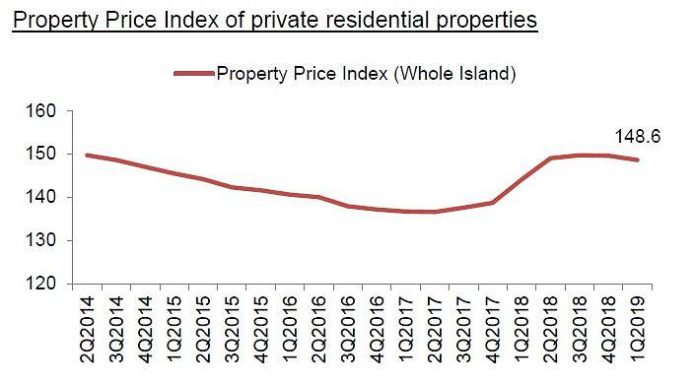
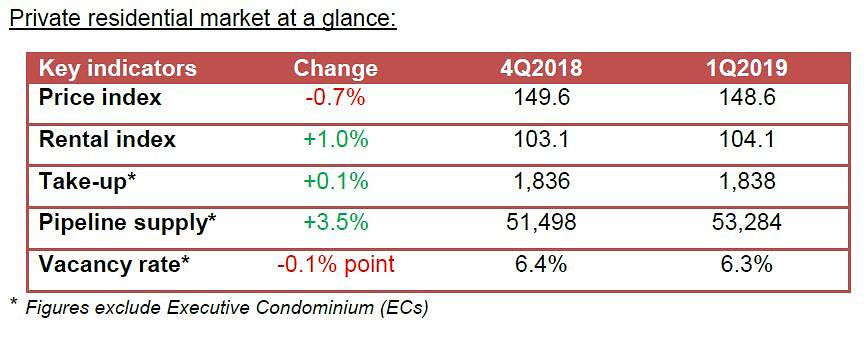
SINGAPORE: Prices of private residential properties in Singapore decreased 0.7 per cent in the first quarter of 2019, the Urban Redevelopment Authority (URA) said on Friday (Apr 26).

The previous quarter saw a 0.1 per cent decrease. 

The dip this quarter is a notch higher than the 0.6 per cent decrease in URA’s flash estimates released on Apr 1. 

Property price index Q1 2019

Prices of landed properties rose by 1.1 per cent during this period, up from the 2 per cent decrease in the last quarter of 2018. Non-landed property prices declined 1.1 per cent, compared with the 0.5 per cent increase in the previous quarter.

In the Core Central Region (CCR), prices of non-landed properties decreased by 3 per cent, higher than the 1 per cent decrease in the previous quarter. In the Rest of Central Region (RCR), non-landed home prices fell 0.7 per cent, while it increased 0.2 per cent in the Outside Central Region (OCR).

READ: Private home prices rise by 7.9% in 2018, while HDB resale prices fall
READ: Commentary: Who’s buying private property after last year’s cooling measures

PRIVATE HOME RENTS UP 1 PER CENT

Rentals of private residential properties increased 1 per cent in the first quarter of 2019, up from a 1 per cent decrease in the previous quarter.

Landed property rental prices rose 0.2 per cent this quarter, up from the 2.1 per cent decrease in Q4 2019. Non-landed property rentals also increased, by 1.1 per cent, compared with the 0.8 per cent decrease in the previous quarter.

Non-landed property rentals in the CCR and OCR went up, by 1.6 per cent and 1.7 per cent respectively. Meanwhile, rentals in the RCR declined 0.3 per cent.

Private residential market Q1 2019

Developers launched 2,989 uncompleted private residential units for sale in the first quarter of 2019, more than the 1,657 units launched in the previous quarter. This number excludes executive condominiums (ECs).

Of these, 1,838 private residential units were sold, slightly higher than the 1,836 in the previous quarter.

No executive condominiums were launched for sale, but developers sold 10 units from previous launches.

There were 1,858 properties resold in the first quarter of 2019, a slight dip from the previous quarter’s 1,971. Resale transactions accounted for 49.6 per cent of all private property sales, down from 51.1 per cent in the previous quarter.

Additionally, there were 47 sub-sale transactions in the last quarter, a decrease from the 53 units transacted in the previous quarter. Sub-sale transactions made up 1.3 per cent of all sale transactions, compared with 1.4 per cent the previous quarter.

A total of 53,284 uncompleted private residential units (excluding ECs) are in the pipeline with planning approvals as at the end of the first quarter of 2019, more than the 51,498 in the previous quarter.

By the end of the latest quarter, 36,839 of these units remain unsold, up from 34,824 units in the previous quarter.

URA said 7,745 units (including ECs) will be completed by the end of 2019, based on the expected completion dates reported by developers.

Source link

Commentary: Go-Jek and Grab’s two competing visions are knocking heads in Asia

0

LONDON: In mid-March, the board of directors of Go-Jek, Indonesia’s homegrown, ride-hailing, delivery and payments company, met in Jakarta to discuss one pressing item of business. 

Arch rival Grab had just raised US$4.5 billion, massively strengthening its financial muscle. Just weeks earlier, Go-Jek had raised US$1 billion, an amount that originally seemed adequate but by comparison suddenly appeared puny, leaving Go-Jek with half as much money in the bank as Grab.

The dilemma for Go-Jek, said one board member, is: 

If the other guy keeps putting money in, you have to do the same.

The gap in the funding behind the two regional competitors (Grab is based in Singapore) reflects big philosophical differences between their respective investors — whether market share or profitability matters more; if capital or innovation confers a decisive competitive advantage; whether consumer internet companies are natural monopolies or duopolies.

In Singapore, Grab cut driver incentives after its merger with Uber.

Photo: Grab’s Facebook page

READ: Grab, the new ruler in town, and the paradox of scaling a business, a commentary

The two competing visions are playing out in Southeast Asia and beyond. The outcome will provide clues as to which template is more successful and consequently, which companies are most likely to emerge as champions from Bangalore to Beijing.

WINNER TAKES ALL

Grab’s biggest backer, SoftBank’s Masayoshi Son, believes in winner takes all when it comes to consumer internet companies. That in turn means there is no such thing as too much money; the game is all about bleeding your adversary until they either die or surrender. 

The loser is whoever runs out of money first, not whoever has the weaker business model and execution skills.

It is a vision that makes sense for Mr Son who has the largest war chest of any venture investor, with the US$93 billion Vision Fund and SoftBank itself, his highly levered Japanese telecoms empire.

READ: Ride-sharing should reduce congestion, not increase it, a commentary

“SoftBank’s capital is offensive capital,” says one Singapore-based investor with a large New York buyout company. 

They give their companies money meant for a rainy day — and to intimidate the opposition.

Go-Jek’s board meanwhile disputes this approach. Its non-executive directors and investors include some of the best-known tech investors in the world; such as Sequoia Capital, KKR, Tencent, Warburg Pincus, and Ray Zage, originally of Farallon and now founder of Singapore-based Tiga Investment. It also has strategic investors such as Google, JD.com and Meituan.

Most of these directors say they believe that the natural state of affairs — especially in ride sharing and other consumer services — is a duopoly. 

For example, after Grab vanquished Uber in its home market of Singapore, there was a wave of complaints from consumers about the speed with which Grab’s customer service deteriorated and its prices rose. The Singapore Government then appealed to Go-Jek to expand to Singapore, according to Go-Jek executives and directors.

FILE PHOTO: Uber's logo is displayed on a mobile phone in London, Britain

Uber’s logo is displayed on a mobile phone in London, Britain, September 14, 2018. (Photo: REUTERS/Hannah Mckay/File Photo)

READ: Grab-Uber saga shows even with disruption, comes great responsibility, a commentary

“Consumers will always want choice and governments will always want competition,” said one director.

TOO MUCH CAPITAL IS A ‘DRUG’

Just as importantly, by contrast with Grab’s backers, which include Alibaba as well as SoftBank, Go-Jek’s directors think too much capital is a drug; it enables founders to become profligate and lazy, to burn cash at a faster rate. Having fewer resources makes entrepreneurs work harder and innovate more quickly.

In part, the fight for dominance in Indonesia — and elsewhere — reflects the ability of dedicated local businesses to execute with far fewer financial resources than their more deep-pocketed international rivals.

The gap between Grab’s valuation of US$12 billlion to US$13 billion and Go-Jek’s valuation at about US$10 billion, a third investor says, is narrower than the relative financial resources of the two, a reflection investors assert of Go-Jek’s greater efficiency — and of its good judgment.

“We want to be underfunded,” Go-Jek’s co-founder Nadiem Makarim said. 

It forces discipline. We will survive through innovation and monetisation and talent. We want to under-promise and over-deliver.

In some cases, consumer internet companies Mr Son backed have survived because he helped orchestrate mergers and acquisitions. 

So far, though, that has not worked in this case. Mr Son met Mr Makarim last year with an offer to invest in Go-Jek but Mr Makarim turned him down, investors said.

SoftBank denied they had made such an offer.

Nadiem Makarim, founder of the Indonesian ride-hailing and online payment firm Go-Jek listens durin

Nadiem Makarim, founder of the Indonesian ride-hailing and online payment firm Go-Jek listens during an interview with Reuters at the Go-Jek offices in Jakarta, Indonesia, August 15, 2018. (Photo: REUTERS/Darren Whiteside)

“Maintaining independence is most important,” Mr Makarim said. 

We have turned down capital when we felt the agenda and terms pushed against our interest.

In the end, the outcome in this case will partly depend on whether SoftBank’s massive piggy bank proves essentially limitless or whether it will ultimately run out of money, as many predict is inevitable.

Competitors will be relieved if the latter proves to be the case.

Source link

How to Create a Free Website

0

In this day and age, it is imperative for all businesses to
have their own online presence. Most prospective customers will want to do a
search online for your business, and if they see no website, they will be unlikely
to make use of your services. But fear not! Building your own website doesn’t
need to cost you the earth. In fact, it is possible to create a free website if you spend the time
and effort to make it happen.

How to Get Started…

First of all, choose a domain name (website address). Domains
can be registered for around $10 from websites such as Godaddy.com. You will
then need to get a website hosting account. Prices vary depending on what
features you would like, but it is possible to get website hosting for as low
as $10 per month. When you have these basics in place, you are ready to start building.

What Website Platform Should You Base Your Website On?

When you create a website, you need to choose a platform on
which to build it. We would recommend WordPress as the best and easiest content
management system to work with. Plus, it is free to use. It is flexible enough
to be used by one-man businesses and large organizations alike.

Select a WordPress Theme

Once you have installed WordPress on your website hosting
package, you can then choose a theme. This is basically the design of the
website that you would like. There are many pre-made themes available, which
you can then customize. There are plenty of free themes available, as well as
premium themes that offer a more professional look.

Customize the Theme

Once you have installed a theme, you can them customize the
theme to match your exact requirements. This may sound difficult, but most
Wordpress themes are easy to work with and can be modified rather easily. Most
themes come with instructions, and you will find a wealth of information online
to help you further.

Setup Email Addresses

Once the site is ready to go, make sure your business email
addresses are working. Make sure these are tested. Many new businesses struggle
to get their email working, so take your time to set the email up properly, so
you don’t miss out on any custom.

There are many services out there that can help you create a
website, such as Hpage. They are certainly
worth checking out. Do you have your own suggestions? Let us know!

Last modified: April 25, 2019

Source link

Belt and Road must remain ‘open’ for free flow of trade, investments: Chan Chun Sing

0

BEIJING: Given the need to uphold the current rules-based trading system, China’s Belt and Road Initiative (BRI) should continue to be an “open platform” that allows free flow of trade and investments, said Singapore’s Trade and Industry Minister Chan Chun Sing on Thursday (Apr 25).

To do so, enhancements in areas, such as data connectivity, will be necessary. Mr Chan was speaking at a thematic forum on trade connectivity, held as part of the second Belt and Road Forum in Beijing.

“The BRI should continue to be an open platform through which trade and investments can flow freely and seamlessly,” he said.

After focusing on infrastructure connectivity over the last five years, the China-led infrastructure plan should be enhanced with the “softer” aspects of trade connectivity, such as data, talent, technology and finance.

According to Mr Chan, this can be done by leveraging comparative advantages and seeking synergy with partners, while strengthening trade facilitation and enhancing data connectivity.

For the former, he cited the example of the Chongqing Connectivity Initiative (CCI) – a joint project between Singapore and China with an international land-sea transport connectivity (CCI-ILSTC) that provides a direct and shorter trade route from Western China to Southeast Asia.

“As an open and inclusive network, the CCI-ILSTC has evolved from promoting point-to-point connectivity to region-to-region connectivity. It has also effectively cut the shipping time between the two regions by two-thirds,” he said.

READ: China seeks to allay fears over Belt and Road debt risks

READ: PM Lee to attend Belt and Road Forum in Beijing, witness signing of MOUs with China

In the same speech, Mr Chan urged all countries to uphold the global trading system. 

Governments must resist the rise of anti-globalisation and nativism so as to make way for greater economic integration, he said.

Global trade rules, such as those of the World Trade Organisation, should also be updated to keep pace with the new realities of the global economy, particularly in the area of digital economy.

Mr Chan also called for help to be given to domestic businesses and workers to help them adjust, rather than resist, changes “that are inevitable and necessary”.

“An inclusive, open and rules-based trade architecture has been the bedrock of our economic development and success in the past few decades, lifting millions out of poverty and growing a substantial middle income class,” he said. 

“We have a shared interest to uphold this system that has brought us prosperity and progress all these years.” 

FUTURE PLANNING

At another forum on Thursday where he spoke about policy connectivity, Mr Chan stressed the need for joint responsibility as one of the three guiding principles to bring BRI’s projects to the next phase. 

“We all have the shared duty to ensure that the projects adhere to market discipline and steer clear of non-economic considerations,” he said. “There must be clear accountability, transparency and value for money for the public.”

Projects will also need to adhere to the rule of law so as to generate business confidence, while long-term financial and environmental sustainability must be considered.

The latter will encourage “healthier risk management, and create more prudent and viable projects”, said Mr Chan. “This would ensure that the success of the BRI projects serve, not just the current, but also the future generations.” 

READ: China’s island cities: Treasure or trouble for Asia?

Environment and Water Resources Minister Masagos Zulkifli at Belt and Road Forum on Apr 25, 2019

Singapore’s Environment and Water Resources Minister Masagos Zulkifli attends the Green Silk Road Forum in Beijing on Apr 25, 2019. (Photo: Ministry of Environment and Water Resources)


Sustainability was also a key message from Environment and Water Resources Minister Masagos Zulkifli, who spoke at another thematic forum dubbed the Green Silk Road Forum.

While Asia as a whole has made tremendous progress over the decades, its rate of consumption and production has become unsustainable.

“Our planet’s resources are finite but our population is growing, with strong urbanisation pressures. Climate change is posing new risks,” said Mr Masagos, who stressed the need to build sustainably and innovatively, while forging partnerships.

The BRI’s International Green Development Coalition is an important and timely initiative.

“It brings countries together to deliberate on how we can develop sustainably, and deliver tangible benefits for our peoples and planet,” he added. 

“We have to jointly explore how this can be done in a manner that balances social, economic and environmental objective.” 

On Thursday, Senior Minister of State for Trade and Industry Koh Poh Koon also shared his views at another thematic forum on how to unlock the potential of infrastructure connectivity and achieve economic growth. 

The ministers are in Beijing as part of the delegation accompanying Prime Minister Lee Hsien Loong at the Belt and Road Forum. The summit will officially open on Friday.

Source link

Asia’s Largest Maternity & Baby Expo – SUPER SIZED Edition

0

Asia’s Largest Maternity & Baby Expo – SUPER SIZED Edition
from Friday, August 30, 2019 at 11:00 AM to Friday, August 30, 2019 at 9:00 PM

Singapore Expo

1 Expo Drive, #02-10, Singapore, 486150 Singapore

Source link

Construction, building maintenance activities ‘areas of concern’ in Singapore’s fight against corruption

0

CPIB says it received 358 corruption-related reports in 2018, a 3 per cent dip from a year before.

Singapore construction

File photo of a construction site in Singapore. (Photo: AFP/Roslan Rahman)

SINGAPORE: Two construction industry business leaders bribed a former Resorts World Sentosa director in order to advance their business interests, but they were eventually found out by the Corrupt Practices Investigation Bureau (CPIB).

Tan Keng Huat, managing director of Shanghai Chong Kee Furniture and Construction, and Teo Wee Liap, director of Superiortec, had given former RWS director Soh Yew Meng S$300,000 as a reward for addition and alteration works at the hotel, according to the agency. 

Using computer forensics and prolonged interviews with the perpetrators, CPIB officers managed to crack the case. Tan was sentenced to nine months’ jail in August last year. Teo was given six months’ jail last June, it added. 

Construction activities was one of two areas flagged by CPIB as “areas of concern” in its annual corruption statistics press release on Thursday (Apr 25).

Building maintenance work was the other area.

The agency pointed out that private-sector individuals made up the majority of individuals prosecuted in court in 2018. There were 112 charged for offences investigated by CPIB during this time, with the private-sector individuals making up 96 per cent of cases prosecuted.

By comparison, five public sector employees were prosecuted in court, it added. 

One of these was Immigration and Checkpoints Authority (ICA) officer Chin Peng Sum, who obtained sexual favours in return for tipping off immigration offenders of impending raids. He was sentenced to three years’ jail this January. 

READ: ICA officer gets jail for obtaining sexual favours from immigration offenders

KEEPING CORRUPTION LOW

CPIB said, however, that Singapore continues to see a low incidence of corruption. It received 358 corruption-related reports last year, which is a 3 per cent dip from the previous year. Of these, investigations were conducted on 107 cases, which is a 4 per cent climb from 2017’s 103 cases, the figures showed. 

READ: Corruption cases registered for investigation at ‘all-time low’, says CPIB

A report is registered for investigation if the information received is pursuable, the agency said. 

It takes more than CPIB’s efforts to eradicate corruption here though.

Support and commitment from different segments of the society and strong partnerships with communities are necessary to keep corruption at bay, the agency said. 

To this end, it cited the launch of the Anti-Corruption Partnership Network in September last year as an example of promoting ownership over the prevention of corruption in the private sector.

“The strongest deterrent is a public that continues to eschew corrupt acts and individuals,” CPIB said.   

Source link

Second Singaporean man charged in Pasir Gudang chemical dumping

0

JOHOR BAHRU: The Singaporean company director who surrendered to police in connection with last month’s chemical pollution in Sungai Kim Kim was charged on Thursday (Apr 25).

Illegal dumping of chemicals into the river in Johor led to more than 2,700 people being taken ill and 111 schools in Pasir Gudang to temporarily close.

On Wednesday, Sim Wei Der, 50, turned himself in at the Seri Alam district police headquarters at 11.17am and was detained in the police lockup, according to Johor police deputy chief Mohd Kamaruddin Md Din.

READ: Bail granted for Singaporean involved in Pasir Gudang chemical dumping after High Court intervenes

READ: New Johor executive council expected to prioritise river pollution, Causeway congestion: Analyst

Sim pleaded not guilty after he was charged on Thursday with abetting three others to dispose chemical waste into the river.

Three people, including Singaporean Wang Jing Chao, 34, director of a used tyre-processing company, have pleaded not guilty in relation to the case. 

Sim, who was represented by lawyer Joshua Tay, was charged with abetting lorry driver N Maridass, 35, Malaysian Yap Yoke Liang, 42, and Wang to dispose oil waste and sludge using a lorry and a semi-trailer tank into Sungai Kim Kim.

He had allegedly committed the offence near the Sungai Kim Kim bridge-widening project site, between 12am and 1am on Mar 7, according to the charge sheet.

Pasir Gudang chemical pollution

Forty-six additional potential sources of pollution have been identified in Pasir Gudang. (File photo: Bernama)

​​​​​​​

The waste was disposed into Sungai Kim Kim without prior approval from the director-general of Environment Quality.

Mr Sim was allowed bail of RM250,000 (S$82,500) with two local sureties and ordered to report to the Pasir Gudang police station on the 15th of every month.

His case is set for mention on May 23.

If found guilty, Mr Sim faces a maximum punishment of five years’ jail and RM500,000 fine.

Source link