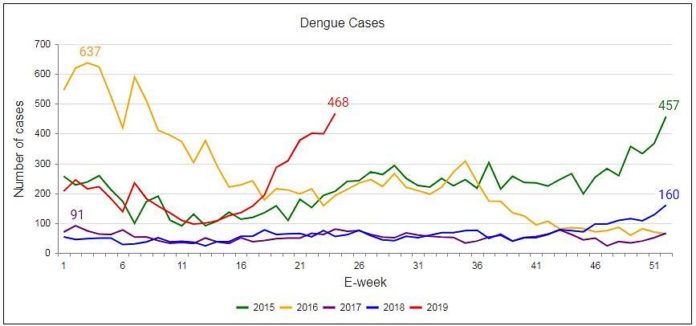
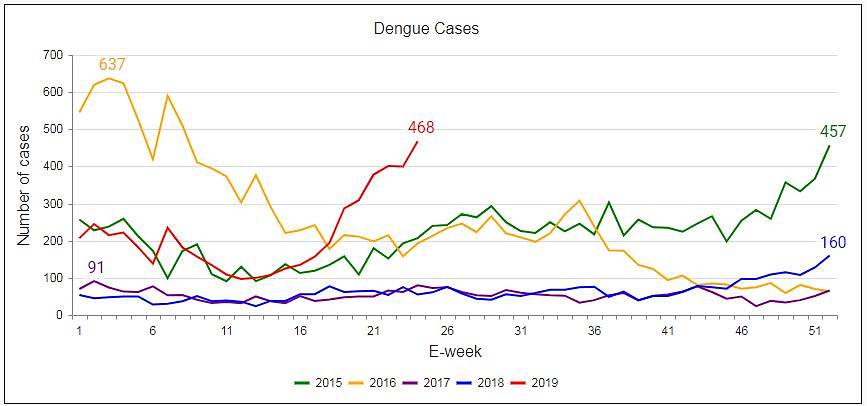
SINGAPORE: There were a total of 468 reported dengue cases in the week ending Jun 15, the highest since March2016, according to data by the National Environment Agency (NEA).
“The number of weekly reported dengue cases have more than quadrupled in the past three months,” the agency said on its website.
As of 3pm on Monday (Jun 17), there were 5,261 reported cases, more than the 3,285 cases reported in the whole of 2018 and 2,772 cases in all of 2017.
The number of active dengue clusters has also more than doubled in the past month to 112, as of Monday.
There are 31 high-risk areas with 10 or more cases, including areas in Woodlands, Chai Chee and Geylang.
Parts of Bedok, Jurong East and Hougang are also among the high-risk areas. You can find the full list, including the streets and blocks, on NEA’s website.
Number of dengue cases per e-week. (Graph: NEA)
Four people have died from dengue this year amid the spike in the number of cases. In May, a 63-year-old man became the fourth person to die from dengue in 2019.
In March, a 71-year-old woman who lived in Ang Mo Kio Avenue 4 also died from dengue.
A 74-year-old man, who stayed in Bedok Reservoir Road, died on Feb 3, while a 77-year-old man, who stayed at Hougang Avenue 3, died on Feb 7.
TRADITIONAL DENGUE PEAK SEASON
The gravitrap surveillance system deployed by NEA showed a 25 per cent increase in the Aedes mosquito population in April 2019, compared to the month before, NEA said.
“We are in the traditional dengue peak season and a collective national effort is critical to keep the dengue situation under control,” the agency said. It previously noted the warmer months of June to October would see a higher transmission of dengue.
“Every individual, whether living in a cluster or not, needs to take action to prevent more people from being infected with the dengue virus,” the agency added.
It is urging members of the public to take “immediate action” to eradicate potential mosquito breeding habitats and to step up housekeeping measures.
People can help stem dengue transmission by removing stagnant water through ways like tipping vases and loosening hardened soil.
Using Wolbachia technology, NEA aims to reduce the Aedes mosquito population and fight dengue, and the project was expanded this year to include areas like Nee Soon and Tampines.
Under the project, male Wolbachia-Aedes mosquitoes, which have been infected with the Wolbachia bacterium will be released into the test sites. When they mate with female Aedes mosquitoes, the eggs the females lay will not hatch, said NEA.
SINGAPORE: A S$768 million plant to produce methionine – an essential additive in animal feed – was officially opened in Singapore on Tuesday (Jun 18).
The new complex by German speciality chemicals manufacturer Evonik Industries is the company’s second in Singapore and was constructed next to its existing plant on Jurong Island, which has been in operation since 2014.
Evonik’s new plant will help the company double its capacity in Asia – from 150,000 metric tonnes to about 300,000 metric tonnes, making up approximately 40 per cent of its 730,000 metric tonnes global output.
Aside from Singapore, Evonik has four similar plants in Belgium, Germany and the United States. The combined investment in both Singapore plants – more than S$1.5 billion – is the company’s largest investment outside Germany to date.
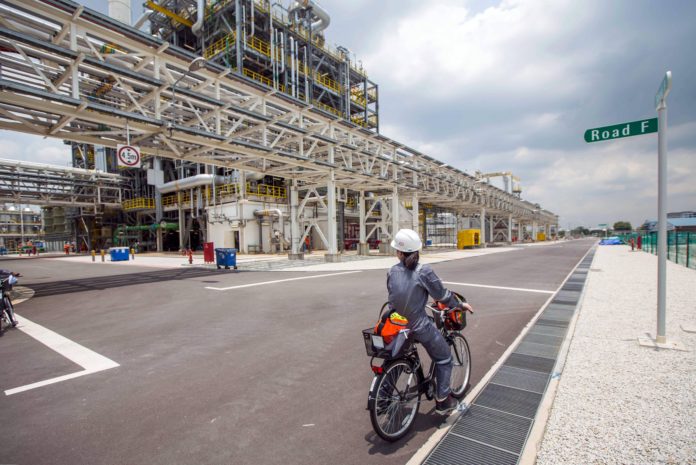
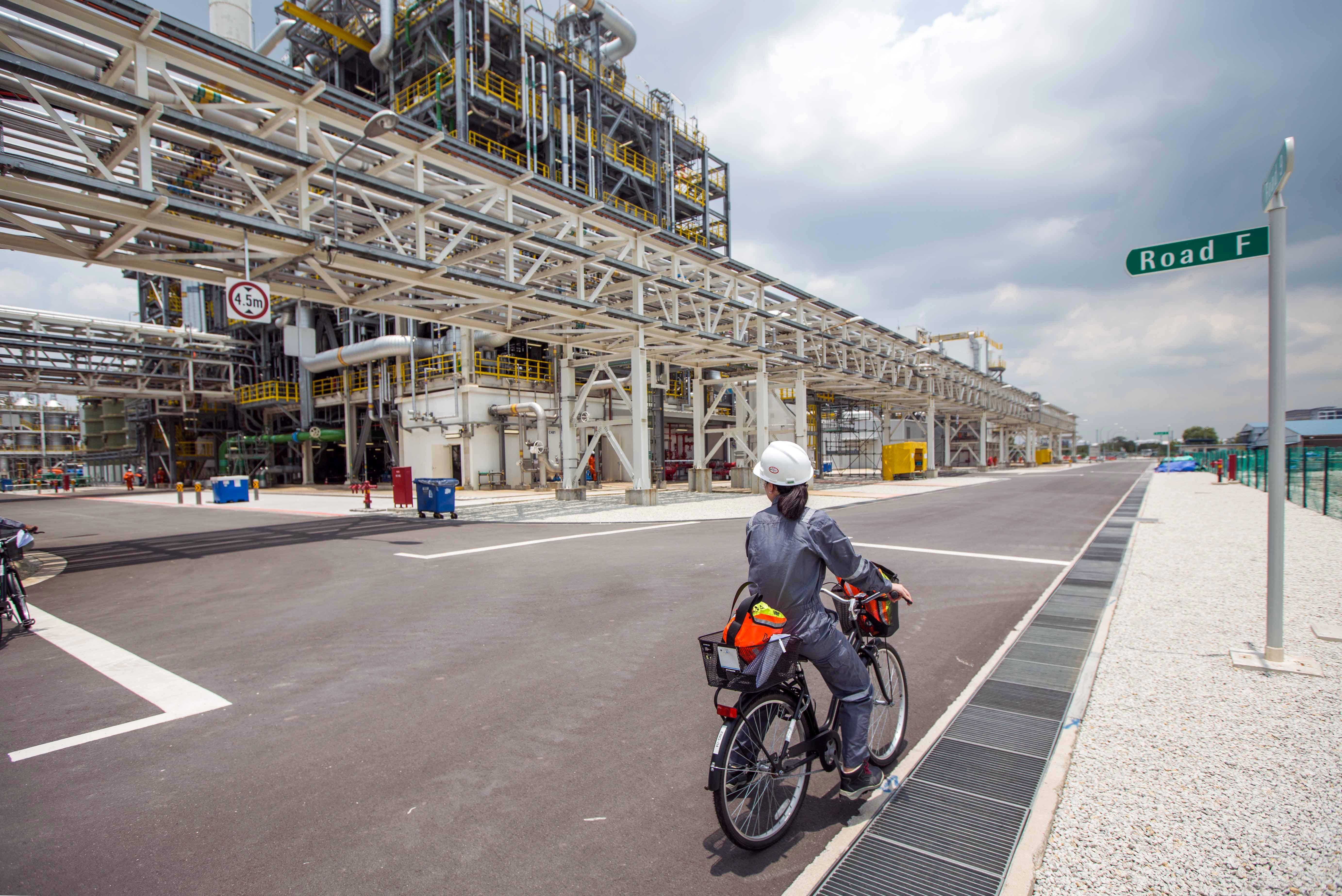
The new complex was constructed next to its existing plant on Jurong Island, which has been operating since 2014. (Photo: Evonik)
Evonik is hoping to grow its business in the region on the back of the increasing number of middle-class families in Asia.
“On the one hand, the growing consumer affluence in Asia supports the increasing demand for animal protein. On the other, producers are increasingly focusing on more sustainable production of meat, eggs, milk, and fish,” said Mr Johann Caspar-Gammelin, chairman of the Board of Management of Evonik Nutrition and Care.
Speaking at the launch in Capitol Theatre on Tuesday, Deputy Prime Minister and Finance Minister Heng Swee Keat highlighted that Asia’s demand for meat and seafood is set to grow by 78 per cent by 2050. He also noted that climate change has posed a challenge to food security.
“Global food security is becoming an increasingly pressing issue,” Mr Heng added. “We will require new and innovative ways to meet these needs sustainably.”
Products like methionine is one such example, he added.
The S$768-million plant to produce methionine – an essential additive in animal feed – was officially launched on Jun 18, 2019. (Photo: Evonik)
Methionine, when added to animal feed, can enable “healthier, more sustainable and more resource-efficient protein production”.
Evonik’s facility also presents an opportunity for good jobs and upskilling of workers in the energy and chemicals industry, Mr Heng noted.
“Over the years, Evonik’s growth in Singapore has also created other new kinds of jobs beyond manufacturing jobs. For example, Evonik’s Asia Research Hub in Singapore hires scientists and researchers, who work on cutting-edge developments in 3D printing and other areas,” the Deputy Prime Minister added.
More than 100 new jobs are expected to be created at the new plant. They range from lab and process technicians, to engineers in the maintenance, environmental, safety and health domains.
With plans to improve the capabilities of companies through the Energy and Chemicals Industry Transformation Map (ITM), the sector is expected to create S$12.7 billion in value-add and 1,400 new jobs by 2025.
SINGAPORE: The Esplanade is launching a series of new fundraising initiatives to raise the remaining S$9 million needed for its S$30 million waterfront theatre.
The project, first announced in Apr 2017, will be named Singtel Waterfront Theatre at Esplanade for 15 years from its opening in 2021, in appreciation of the telco’s S$10 million donation last year.
The Ministry of Culture, Community and Youth (MCCY) has also committed S$10 million to kickstart the effort.
Another S$1 million was raised through various events such as the Esplanade Gala fundraising dinner last year, and the Backstage Pass With… fundraising tours in 2017.
Construction of the new 550-seat theatre began on Tuesday (Jun 18). In conjunction with the groundbreaking ceremony, the Esplanade is rolling out a series of initiatives to reach out to a spectrum of supporters, from the general public to philanthropists and foundations.
Esplanade chairman Lee Tzu Yang (left), Singtel CEO Chua Sock Koong (centre) and Minister for Culture, Community and Youth Grace Fu putting a construction vest on Gwyneth Loy for the initiation of the groundbreaking ceremony. (Photo: The Esplanade)
A public fundraising campaign called Ground Up will allow members of the public to play a game to virtually “dig up” 5,000 plots. Each plot represents one square metre of land for the upcoming theatre and players can choose to donate S$10 per plot.
It aims to raise S$100,000, with donor Bowen Enterprises contributing a dollar-for-dollar matching donation of up to S$50,000.
The Esplanade is also launching a separate campaign which allows donors to adopt or gift a limited number of seats in the Singtel Waterfront Theatre for a minimum sum of S$2,800 per seat.
An artist’s impression of the Esplanade’s upcoming Waterfront Theatre. (Image: The Esplanade)
Philanthropists and companies can also adopt various spaces such as its sheltered waterfront linkway, dressing rooms and a green room where artists mingle and rest.
Esplanade chairman Lee Tzu Yang said that the reason for these initiatives to raise funds is to “be less reliant over time on government support for recurrent funding needs”.
“This is challenging as most perceive the arts as less of a priority than other charitable causes such as children and youth, the elderly, education and healthcare,” Mr Lee added.
Minister for Culture, Community and Youth Grace Fu said that the medium-sized theatre is a response to a call from local artists and arts groups, who may find moving from performing in a 200 to 300 seater to staging a show in a 1,000-seat theatre “too ambitious at one go”.
Currently, the Esplanade has two main performing venues, the 1,600-seat Concert Hall and 2,000-seat Theatre, and two smaller venues, the 220-seat Theatre Studio and 245-seat Recital Studio.
“With 550 seats and a highly modular configuration which can be customised to a range of needs, the new waterfront theatre caters to the needs of such groups, without having to leave the ‘comforts’ of the Esplanade,” she added.
Illustration of a theatre-in-the-round inside the Singtel Waterfront Theatre. (Image: The Esplanade)
Elaborating on the versatility of the theatre, Esplanade CEO Yvonne Tham said that it is “semi-flexible”, and can go from a traditional proscenium theatre to a theatre-in-the-round or even a flat-floor performance space with no seats.
The grassy lawn outside that connects to the foyer allows the Esplanade to programme informal activities outdoors during festivals.
“In some ways, this waterfront theatre is very much about life at street level,” said Ms Tham.
“We want to be able to expose people who just walk by the waterfront to the fact that there are arts happening around you. You are part of the life of this arts centre as well.”
SINGAPORE: Scientists in Singapore have discovered two new variants of the Epstein-Barr Virus (EBV) associated with cancers, in a study that can make it easier to identify individuals at high risk of developing Cantonese cancer, hence allowing for early detection.
Cantonese cancer refers to nasopharyngeal carcinoma (NPC), the most common head and neck cancer in Singapore.
It is named so because EBV-infected individuals from the Cantonese dialect group are 20 times more at risk of developing NPC than those from other regions or populations.
The study, published in the journal Nature Genetics on Monday (Jun 17), involved scientists from the Agency for Science, Technology and Research’s (A*STAR) Genome Institute of Singapore (GIS), Sun Yat-sen University Cancer Center, Institute of Zoology of Chinese Academy of Sciences, as well as several other collaborating research institutes.
They sequenced a large batch of viral genomes from NPC patients and healthy controls (EBV-infected individuals that did not contract NPC) from both NPC-endemic and non-endemic regions, and discovered a unique EBV strain made that is associated with increased risk of developing NPC.
Cantonese infected with high-risk Epstein-Barr virus (EBV) strains are susceptible to nasopharyngeal carcinoma (NPC). (Graphic: A*STAR’s GIS)
Individuals infected by this unique EBV strain, which carries the two variants, have 11 times higher risk of developing NPC than non-carriers.
Currently, more than 40 per cent of individuals in southern China are infected by the high-risk EBV strain and about 80 per cent of the NPC cases in the Cantonese dialect group are driven by the high-risk EBV strain.
“This unique strain seems to have originated in Asia, followed by expansion in NPC-endemic regions,” said A* STAR.
EARLY DETECTION OF NPC
Lead author of the study, Dr Liu Jian Jun, said: “The importance of the EBV viral variants in the development of NPC and its striking epidemic among Cantonese dialect group have been poorly explored in the past.”
Dr Liu, who is also deputy executive director at GIS, added that the study “provided novel insights into the NPC endemic” and “potentially provides the basis for implementing effective intervention programmes to reduce its incidences”.
Professor Ng Huck Hui, executive director at GIS, said that the discovery of these high-risk EBV viral variants has important implications for public health efforts to reduce the burden of NPC, particularly among Cantonese speakers.
“Testing for these variants enables the identification of high-risk individuals for routine clinical monitoring to detect NPC early. Primary prevention through the development of vaccines against high-NPC-risk EBV strains is expected to greatly reduce the incidence rate of Cantonese cancer,” said Prof Ng.
SINGAPORE: When Miss Halida Thanveer Asana Marican started hunting for a job last December, she sent out only one or two applications.
But when she did not get any replies, the final-year student at the National University of Singapore (NUS) panicked and began to send out a batch of job applications every two weeks.
After applying for about 30 job positions in all, the 24-year-old who majored in Life Sciences eventually landed a contract role as a research assistant after getting replies from four companies in April.
Fellow Life Sciences graduate Sankar Ananthanarayanan, 24, was luckier — landing a job on his first try. Describing his job hunt experience as “straightforward”, Mr Sankar applied in January for an administrative role at a local university after hearing about the opening from a friend.
“I heard back from the employers within a month and was offered the job in March,” he said.
However, like Miss Halida, Mr Sankar too will be on a year-long contract rather than a permanent appointment.
Short-term contracts, along with multiple rejections or even non-replies to job applications, as well as having to lower their job and salary expectations — these are what some fresh graduates like Miss Halida and Mr Sankar are experiencing, as their job hunt this year coincides with the United States-China trade war, which has cast a pall on the global economy and threatens to dampen Singapore’s economic growth in the months ahead.
While trade tensions between the US and China began in earnest last year, the situation escalated last month when the US increased tariffs from 10 to 25 per cent on US$200 billion worth of Chinese goods. China retaliated by slapping tariff hikes on US$60 billion worth of US goods.
The US also placed Chinese phone manufacturing giant Huawei on its export blacklist, amid concerns in Washington that Huawei’s devices could be used by China to spy on Americans.
Singapore, whose economy is highly dependent on global trade, will not be able to escape unscathed if the US-China trade spat is prolonged.
Singapore Business Federation (SBF) chairman Teo Siong Seng said that apart from US-China trade tensions, the Brexit saga will also affect business, and consequently hiring sentiments. He said:
If trade tensions continue for a long time, it may affect global economic growth. Business sentiments will be more careful and hiring will slow.
Job prospects for fresh graduates, in particular, will be “tougher”. He added:
I think businesses will only hire if they need to replace (staff), but not for expansion. You can also expect to see more contract jobs being offered to new hires.
Indeed, the job market situation appears to have turned. On Thursday (Jun 13), the Ministry of Manpower (MOM) issued its labour market report on the first three months of this year.
The report noted that while there continued to be more vacancies than job seekers, the demand for labour had eased following seven preceding quarters of increases. The seasonally adjusted number of job vacancies declined from 62,300 last December to 57,100 in March.
A view of the central business district area. (Photo: AFP/Roslan Rahman)
It also said that more workers were retrenched in the first quarter of this year, compared to the previous quarter as well as a year ago. The increase was driven by manufacturing and affected workers in production and electronics.
ON THE JOB HUNT
Given the rising economic headwinds, fresh graduates we spoke to had varying degrees of success in their job hunts, with several finding the going tough.
NUS graduate Jessica Ng sent out a grand total of 60 job applications between January and March, and heard back from only six companies — three public and three private.
The 23-year-old political science graduate said she became increasingly anxious when she had yet to secure a job by March, which her seniors described as a time when most graduates would know if their job applications were successful. Miss Ng eventually accepted an offer for a civil servant position in April.
Miss Halida, who also felt that she was taking longer than her peers to secure a job, had to change her strategy after realising that she was not getting any responses.
“I was applying for management executive positions in the beginning which were not directly related to what I studied. I soon realised that it was very broad and you had to compete with graduates from other faculties,” she said.
She then narrowed her job search to positions related to her field of study, such as clinical research assistant posts, to increase her chances of securing a job. She also lowered her expectations and began applying to companies that offered lower starting salaries and positions that she was not keen on.
While she was lucky enough to eventually secure a 21-month contract job that met her pay expectations, Mr Abhiram Subramaniam, 25, was less so.
Mr Abhiram, who started applying for jobs in the media sector in April, said that he had sent up to 30 job applications within that month alone.
The political science graduate, who had briefly worked in the media sector after his National Service, shared that the process had been “tougher than expected”.
Given that I had prior work experience, I thought it would be easier for me to get a job in the media sector after graduation. But I still ended up receiving a lot of rejections and non-replies.
Mr Abhiram, who eventually found a three-month contract job in a media company, said that he is getting “quite below the average pay” compared to peers from his university course. He added that he is “biting the bullet” as it will allow him to grow his skill set and open doors to better job opportunities.
In comparison, some graduates from finance and accountancy courses had an easier time securing employment.
Miss Sandhya Rangarajan, a 22-year-old accountancy graduate from Nanyang Technological University, was able to secure a job with one of the Big Four accounting firms within three months of applying.
Her experience is typical of accounting graduates from public universities in Singapore, who could usually get a job with one of the Big Four by the time they graduate, said Mr Alvin Ang, the founder and director of talent acquisition at recruitment firm Quantum Leap Career Consultancy.
NUS Career Fest 2018 saw more than 260 employers offer about 4,000 job opportunities in 21 industries. (PHOTO: National University of Singapore)
Meanwhile, several others who have yet to embark on their job hunt remain confident about their prospects despite the uncertain economic climate.
Mr Tan Shao Yun, a graduate from NUS’ School of Computing, said that he is expecting a “relatively easy” job hunt as he has heard from career talks and news reports that there is a high demand for computing students.
Sounding unperturbed that he is only just starting his job hunt while most of his peers have already found employment, Mr Tan, 25, is also considering overseas opportunities and will hold out on offers until he finds a role in data science or data analytics which will allow him to make “visible social change”.
Among the dozen fresh graduates from various fields whom we spoke to, most of them said they had applied for both permanent and contract-based jobs. To date, six of them have managed to snag a job, with half of them accepting contract-based roles.
The increased prevalence of contract jobs, due to a variety of factors including the rise of the gig economy, is well-documented.
In its latest annual report on the labour market released last November, the Ministry of Manpower (MOM) found that between June 2017 and June 2018, the proportion of workers in permanent jobs dipped from 90.1 per cent to 89.4 per cent. Conversely, the proportion of those on fixed-term contracts went up from 6.4 per cent to 7.2 per cent over the same period.
The MOM report said that companies were more cautious with the economy undergoing restructuring, and they preferred hiring workers on a short-term basis.
Mr Ang from Quantum Leap Career Consultancy noted that employers are becoming more open to giving out contracts for one to two years, as this allows them to react quickly to changing business conditions.
Workers in Singapore’s CBD. (Photo: Sutrisno Foo)
“If there is a sudden economic downturn, and I, as an employer, realise there are some staff that I do not need, I can (let go of) the contract staff so that I can keep my permanent staff,” he said.
Decisions like this enable a firm to ensure its survival during bad times, he added.
Ms Linda Teo, the country manager of recruitment company ManpowerGroup Singapore, reiterated that in today’s business landscape, an agile and flexible workforce is “critical” to a company’s success.
“Hiring employees, especially in-demand talent, to fill permanent positions take longer in today’s talent-short climate and may cost more,” she said. “Hiring contract workers is a way for companies to ‘borrow’ external talent to complement the skills of their existing permanent headcount for urgent, short-term projects.”
Despite the possibility that those in contract roles could be easily let go by companies when the going gets tough, some of the fresh graduates interviewed said they are open to taking up contract jobs, prioritising other factors such as job scope or work environment in their employment pursuit.
For NUS chemical engineering graduate Meera Sundar, 22, it was not “a big deal” for her whether an available position is permanent or on contractual basis.
“The only major difference is that if my contract runs out, I will probably have to find another job in two years or so. But I know if I do well in the company, I can still get converted to a permanent position,” said Miss Meera, who sent out 40 job applications over six months.
Her foremost concern then was to secure a position that is relevant to her field of study, and she eventually managed to find a suitable full-time job.
Her sentiments were echoed by Miss Aisha, a 21-year old student from the Singapore University of Technology and Design who will be graduating in August.
Miss Aisha, who only wanted to be known by her first name, said her main concern is getting a job that is related to her field of study in information systems, regardless of whether it is a contract or full-time role.
“It’s experience either way,” said Miss Aisha, who has yet to find a suitable job. “I still welcome that at this stage. If I have financial commitments in future, then I will not say no to a permanent job.”
For Miss Halida, the contract position which she snagged gives her the flexibility to decide on future options, such as pursuing further studies.
Ms Teo from ManpowerGroup said there appears to be a shift in mindset towards contract work among job seekers, including fresh graduates.
“Fresh graduates like working in contract jobs as they can experience different job roles and environments while building up their skills. For existing workers, working in contract jobs enable them to better manage their time,” she said.
Mr Ken Ong, a manager at recruitment firm Michael Page, pointed out that there has also been a corresponding shift in how firms perceive contract positions: When these roles started emerging three years ago, those who held contract positions were mainly hired to clear the backlog of work or cover certain roles temporarily.
File photo of office workers at Raffles Place. (Photo: TODAY)
Those hired on contract did not have a sense of purpose in their work or belonging for the company. However, this has changed with companies extending equivalent benefits to both contract and permanent staff, said Mr Ong.
Fresh graduates are now attracted to contract roles as these allow them to experience a spectrum of roles, rather than to specialise in one for a long time, he reiterated. They also see such roles as opportunities to gain “deeper understanding of the job responsibilities and working culture” before committing to a longer term career, he said.
There are also tangible advantages of having a contract job, said Quantum Leap’s Mr Ang. For one, employers are prepared to pay more to attract talent to fill contract jobs. Those in contract roles are also in a better position to negotiate for a pay rise when their contracts are due for a renewal.
OVERALL JOB MARKET OUTLOOK
As fresh graduates continue to look for jobs, their hunt is unlikely to be aided by US-China tensions.
A periodic survey of 3,600 Singapore-based small and medium enterprises (SMEs) showed that there was an easing of business sentiment and increased caution among SMEs.
Published in March by the SBF and DP Info, the latest SBF-DP SME Index — which measures the business sentiments of SMEs from April to September this year — showed a dip from 50.7 to 50.4 from the first to second quarter of this year. This was the fourth consecutive quarter with a lower reading.
In particular, business sentiments of SMEs in the manufacturing sector contracted for the first time in the past eight quarters, with the index dipping from 50 to 49.7. The next index will be released in July.
Mr Kurt Wee, head of the Association of Small and Medium Enterprises (ASME), said that there are signs of overall global trade shrinking, which do not bode well for Singapore’s economy.
However, the impact of the trade war on the job market will only be evident one or two quarters down the road, he said.
He added that while companies that are growing are still keen to hire and groom young talent, the increasingly cautious outlook could dampen the rise of starting salaries rather than the number of jobs available.
Mr Wee said that companies which are currently looking for regional opportunities— to hedge against any downsides in the trade war over the next two to three quarters — could also defer hiring until their operational structures are more defined for the longer term.
The manufacturing and logistics sectors are likely to be more cautious than others in hiring, given that these sectors are likely to be most affected by the trade war, he said.
Workers at a manufacturing facility in Singapore. (File photo: TODAY)
WHAT COMPANIES SAY
Apart from the banking and finance sectors, the public sector, as well as companies in the business process outsourcing services, system integration, and information and communication technology sectors are particularly open to hiring fresh graduates, according to Ms Teo from ManpowerGroup.
Mr Alwin Liang, founder and chief executive of logistics firm Roadbull Logistics, said that the US-China trade war has the potential to create uncertainty within the local logistics sector and may result in logistics companies reducing their intake of employees.
However, he felt that there are benefits to be reaped from the situation. For one, the trade war could motivate local companies to improve efficiencies within their own companies to counter the volatility in prices.
Also, some Chinese companies could relocate their production to Southeast Asian countries, including Thailand and Vietnam. This will allow logistics businesses in Singapore to benefit from higher maritime activities, transportation, and storage from neighbouring countries. This could in turn drive up hiring in the industry, Mr Liang said.
Responding to media queries, several members of the Singapore Manufacturing Federation (SMF) noted the potential impact of the US-China trade war on job prospects for fresh graduates.
Mr John Kong, group chief executive of construction company M Metal, said the electronics industry would be the first to be affected in Singapore, given that it mainly produces chips for electronic devices.
With the US banning its companies from doing business with Huawei, companies in the electronic industry will hold back their investments to see how the trade conflict plays out, he said.
He added that eventually, the manufacturing sector could be affected — specifically, companies that are part of the electronics industry supply chain, such as precision engineering and component engineering manufacturers.
Mr Edwin Tay, business development manager at medical technology company NeuMed, said that manufacturing companies would prefer to hire experienced workers who can hit the ground running. As a result, some fresh graduates could have difficulty finding jobs for some time, he noted.
Nevertheless, Mr Sanjay Trivedi, the chief executive of medical technology company Technithion International, believes that with Chinese companies expanding into regional markets, hiring in the manufacturing sector could be sustained if Singapore companies expanded overseas, including into other Southeast Asian countries.
SMF president Mr Douglas Foo stressed that despite challenging times, there are opportunities for fresh graduates in the manufacturing sector, so long as they are willing to learn and prepared to work in an environment of constant change and technological advancement.
ADVICE FOR FRESH GRADS
Given that the region might benefit to some extent from the US-China trade war, SBF’s Mr Teo urged fresh graduates to consider working overseas — not just in “nice countries” but also the “tough ones” among the members of the Association of Southeast Asian Nations (Asean).
“ASEAN is a bright spot in the world economy. It offers a lot of good prospects and I encourage young people to take it on, even if it is just an internship stint,” he said.
Mr Ang from the Quantum Leap Career Consultancy reiterated that the Singapore economy is not in such a bad shape that fresh graduates have to start looking overseas for job opportunities. Nevertheless, they could still explore working in companies based in the Asia-Pacific such as Hong Kong or China to broaden their horizons, he said.
Michael Page’s Mr Ong called on fresh graduates to value exposure over stability, although their decision on whether to work out of Singapore should depend on the industry.
Those who wish to be in the manufacturing industry can remain in Singapore, which is the hub for high-end manufacturing, while those keen on banking and finance could also consider Hong Kong, he said.
Exploring different markets to gain experience and skills could be even more important these days, given the rising prevalence of contract jobs.
Ms Teo from ManpowerGroup noted that in such an environment, fresh graduates should aim to build up their repertoire of hard and soft skills which would allow them to adapt to shorter skill cycles and changing work demands.
For those who are concerned that they may be seen as “job-hoppers” by taking on contract roles, Ms Teo said that employers are aware of the growing trend and are open to candidates who have taken on multiple contract roles.
Nevertheless, job seekers should be upfront with prospective employers about their contract roles and emphasise their skills in order to appeal to them, she added.
However, Mr Ong believes there are still employers who view those who held contract jobs previously as “job-hoppers”. The onus is on hirers to learn more about the candidate’s previous job performance and his or her rationale in leaving the role, he said.
Whether a person is in a contract or permanent role, companies will strive to retain the individual so long as he or she performs well.
“If you are deemed valuable in the company, hiring managers from different departments will try to place you because no company will simply want to lose a good employee,” said Mr Ong.
SINGAPORE: A new guide has been launched to help companies better integrate those with special needs in the workplace.
The Job Redesign Guide for Inclusive Employers was developed by SG Enable, in collaboration with the Ministry of Manpower. The 29-page guide provides information on what job redesign is and how to implement it.
For example, companies can reassign roles and responsibilities, make changes to the work processes or arrangements, modify the workspace or use assistive technology devices and software.
Employers can refer to the guide for information about grants available for them to hire and support people with disabilities. Existing initiatives include the Open Door Programme and Career Trial.
The job redesign guide was launched by Minister of State for Manpower Zaqy Mohamad, during a visit to social enterprise Foreword Coffee on Monday (Jun 17).
He said the launch of the guide is timely, as Singapore has reached the point of maturity where it should be able to look at helping people with special needs gain dignified employment.
“I hope that more customers, more Singaporeans will be more understanding as they consume, as they become customers to such establishments,” said Mr Zaqy. “And I think over time, we must give them some space to learn to be productive, and at the same time as well, look after their well-being too.”
Foreword Coffee is one of four organisations featured in the guide to showcase best practices. Of its 18 employees, 14 have special needs.
The cafe realised that different employees with special needs had different challenges associated with their particular disability.
For example, those with cerebral palsy could not stand for a long time, while those who were deaf struggled to communicate effectively with their colleagues and customers.
To tackle these challenges, Foreword Coffee organised cafe operations into four different stations, and specific job tasks at each station were carved out for the employees according to difficulty level.
Assistant outlet manager Melvin Sii demonstrates how to make coffee. (Photo: Jeraldine Yap)
The menu was also simplified – for instance, an Americano is listed as black coffee – to help staff members understand and process orders more easily.
“We want to make the workflow as efficient and as simple as possible for our people. We see that our people enjoy their work and also still (can) be productive in whatever they do. So it’s been really good for us,” said Mr Lim Wei Jie, founder of Foreword Coffee.
Examples of signs to help staff members remember what to do. (Photo: Jeraldine Yap)
He added there are plans to train the employees to take up jobs beyond barista work, such as marketing and designing.
Since January 2016, about 750 companies have employed about 2,000 persons with special needs.
“This is something I think is promising, and with the redesign guide, I hope we can expand this much further,” said Mr Zaqy. “The Ministry of Manpower is keen to support SG Enable and others to see how we can expand this and encourage more companies to take up our schemes.”
SINGAPORE: During Chinese New Year last year, retiree Kenneth Tang wanted to visit his sister-in-law at her home in Upper Bukit Timah, in a relatively secluded area he was unfamiliar with.
Instead of getting driving directions with a few taps of his smartphone, the 64-year-old sat in his living room, put on his reading glasses and studied the route on the pages of his 2018 street directory.
“I think GPS is more convenient and better in many ways, but I use road directories because I can have a better idea of how to get to the place I am going to,” he told CNA.
Mr Tang said the directory allows for more flexible alternative route planning in the event of congestion, and gives a clearer picture of nearby car parks – crucial for peak times when every lot has been snapped up.
“I use road directories also because I have been using it for years, long before GPS was available,” he added. “My friends and I who are from the older generation have been dependent on them.”
Mr Tang is not alone. Some people argue that street directories are more up-to-date and safer to use than online maps. They can also show a bigger picture and more detail than their virtual counterparts.
This detail includes address numbers, building occupants, as well as future developments and roads, said Amarjeet Singh, publishing manager at Mighty Minds, currently the sole producer of local street directories.
“Malaysian delivery drivers like this very much,” the 61-year-old told CNA at his office in Toa Payoh. “Because they do a lot of deliveries to industrial areas.”
Besides logistics workers, Mr Singh said other customers include Government agencies like the police and civil defence, and property agents who market homes to potential clients by showing nearby amenities.
DWINDLING DEMAND
But the numbers don’t lie. With the advent of GPS and online maps, Mr Singh admitted that circulation has gone down. The company, which produced its first edition in 2000, used to distribute about 100,000 copies every year. Now the figure hovers around 30,000.
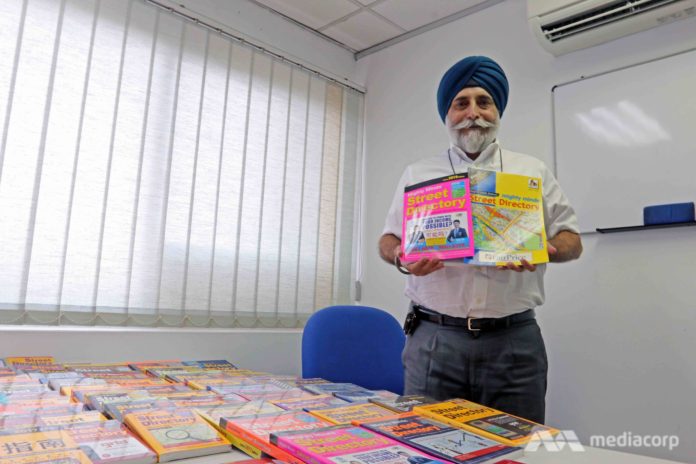
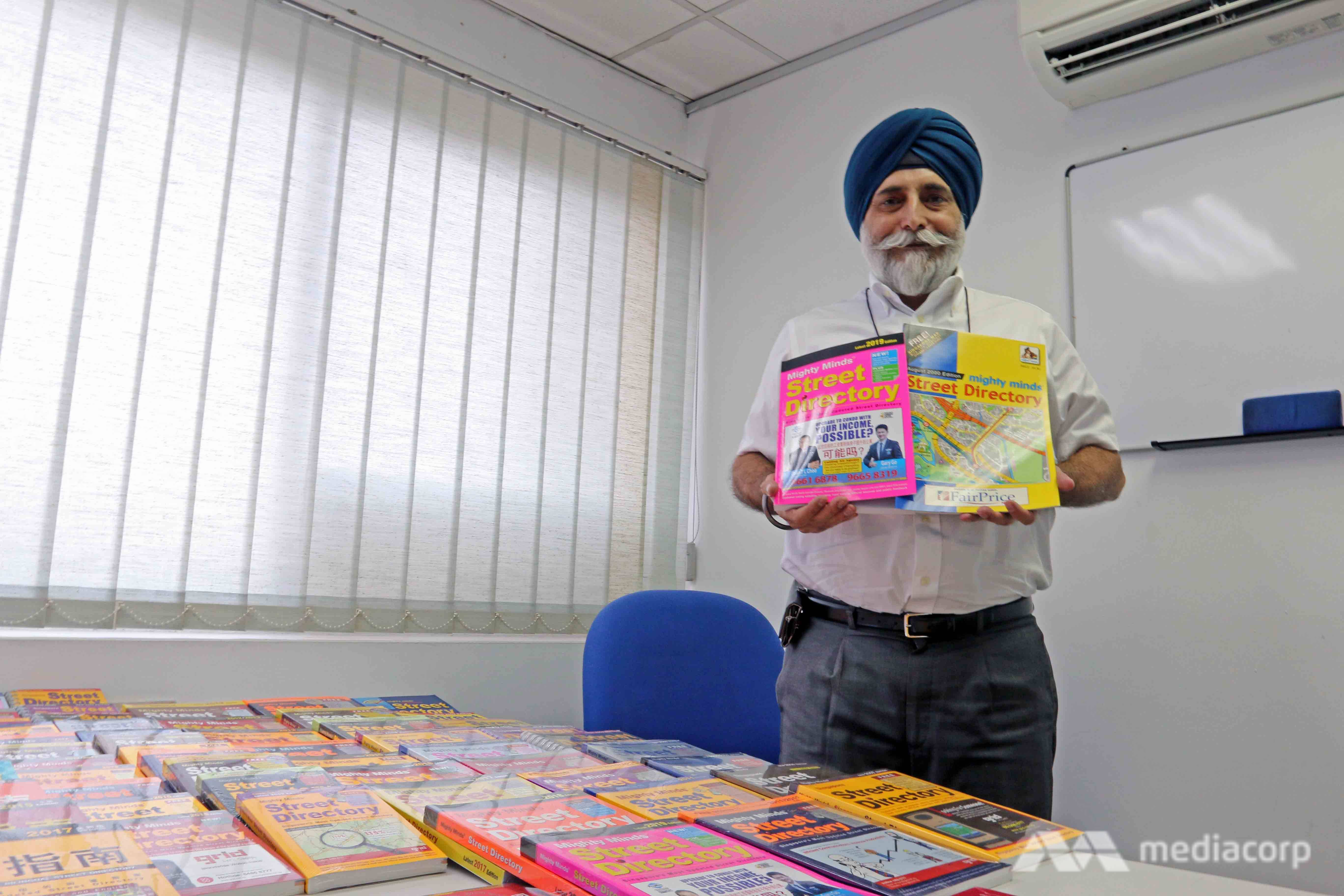
Mr Amarjeet Singh holding the 2019 (left) and 2000 Mighty Minds street directories, the newest and oldest editions in the series. (Photo: Aqil Haziq Mahmud)
Mapping consultant Mok Ly Yng told CNA that web-based maps started to appear in the late 90s, allowing the tech-savvy younger generation to go online for directions. “I think it’s the demographic and exposure,” the 51-year-old said. “You don’t use these kind of paperbacks already.”
He said that even cabbies, previously one of the largest users of street directories, have stopped using them. “Every time I take a taxi, I will ask if they have a street directory,” he added. “They would have to think when was the last time they bought one.”
Mr Mok Ly Yng with a 1954 map of Singapore, used to create the “new series” of street directories. (Photo: Aqil Haziq Mahmud)
Mr Mok, who has been researching Singapore maps for more than a decade, is “very sad” about this. While street directories are growing less relevant as navigational tools, outdated versions help chart Singapore’s constantly evolving landscape.
“It’s a rare resource,” he said, noting that they keep track of changes in the streets and buildings of Singapore. “You get to see updates in our terrain and landscape.”
FIRST-EVER STREET DIRECTORY
This is especially as street directories go back to the pre-war days of 1936, when the British government published the first ever Singapore Gazetteer.
Cover page of the 1936 Singapore Gazetteer, the first ever official street directory produced. (Photo: Mok Ly Yng)
The hardcover contained a simple road index and two attached maps: One of Singapore and another of its town centre. While the first map only showed major roads and a few rural areas, the second was sufficiently detailed, with different colour schemes for parks, buildings and water features.
The town map attached to the 1936 gazetteer. (Photo: Mok Ly Yng)
These directories were in high demand, Mr Mok said, given that Singapore was already at the time a “very famous” tourist destination. The island stood on the trading route for ships heading to the other British colonies of Australia and New Zealand.
“People would have nothing to do as their ships were reloaded with fuel and food,” he added. “So, they would go out and wander around.”
The Singapore map attached to the 1936 gazetteer. (Photo: Mok Ly Yng)
When the war came, officials were ordered to burn the directories so the Japanese could not use them. And by the time the war ended, years of changes to Singapore’s landscape had gone unrecorded.
1936 vs 2019: The red line indicates where the coastline would have been. (Photo: Mok Ly Yng, Google Maps)
So in 1950, the British government commissioned new land and air surveys for a fresh set of maps and directories. Previous editions were produced only using land surveys.
The 1950 street directory was the first produced in the post-war era. (Photo: Aqil Haziq Mahmud)
In the meantime, the cash-strapped government revived the old series of street directories, scrimping on costs by printing maps stripped down to mere outlines.
The 1950 edition, which contains a sparse town map, was when postal districts were first introduced. (Photo: Aqil Haziq Mahmud)
THE NEW SERIES
After completing the surveys in 1954, the government finally printed the new set of standalone maps. These flew off the shelves like hotcakes, Mr Mok said. People used them to travel and start businesses as motor cars gained popularity and trade restrictions were lifted.
“Chinese companies also bought licenses to reprint government maps for tourist use,” he added.
The highly detailed 1954 Singapore map was so big it had to be divided into multiple sections. (Photo: Aqil Haziq Mahmud)
When the government realised the demand for a steady stream of up-to-date maps, it made them the main feature of the street directory, instead of attaching them at the back as usual.
This was when the modern street directory known today was born: In atlas format with pages of cross-sectional maps.
The 1954 street directory was the first to use cross-sectional maps. (Photo: Aqil Haziq Mahmud)
As the maps were divided into pages, workers would also find it less daunting to update and redraw them after daily trips to the ground noting changes to buildings and streets. This process takes a much shorter time than the more accurate land and air surveys, which use proper equipment to produce high-grade topographical maps.
Mr Mok said the simplified process was good enough for street directories, as they were used for simple navigation without the need for extremely accurate positions and distances.
The 1954 edition also had a section dedicated to bus routes (right), with services from different companies going as far as Johor. (Photo: Aqil Haziq Mahmud)
As expected, the “new series” of street directories – which included short write-ups of tourist attractions and postal box locations – was a hit. Records show that the first edition was reprinted twice in four months.
A NEW CHALLENGER
As the years went by, the government introduced new features in street directories, including one-way traffic maps in 1961, luminous orange colour schemes in 1973, and blue ink and metric scales in 1975.
The first edition Mighty Minds street directory contained a large, pull-out Singapore map and had a slim design “for fast and easy reach”. (Photo: Aqil Haziq Mahmud)
In 2000, Mighty Minds entered the market with its own version of the street directory, based off a Singapore map it had bought from an Irish company. “We thought there was a big market,” Mr Singh said. “We could do a better job and become the market leaders.”
And indeed it did.
The Government stopped producing street directories in 2009, with industry players citing reasons like dwindling demand and digitisation. Mighty Minds stuck with its product, coming up with pocket editions that could fit in handbags and delivery pouches, and A3-size editions for people who could not see clearly.
Mr Amarjeet Singh has been at Mighty Minds since it was formed in 1988 as a publisher of children’s books. (Photo: Aqil Haziq Mahmud)
Mr Singh said his team is constantly finding new ways to make it quicker and easier for users to find places and navigate routes. The newer editions include a coloured street index, bus stop numbers and zoomed-in insets for major junctions.
On the technological front, the team uses software that can automatically cut a map into pages based on a specific scale, and a machine that logs in geocodes when workers on the ground record changes in street or building data.
Mr Mok said the latter process of updating information has remained largely the same over the years. “You can’t run away,” Mr Singh added. “You have to do the legwork.”
EXHAUSTING BUT REWARDING
At Mighty Minds, this updating of information is done by two teams of two surveyors almost every day. They will spend a few days covering each page of the street directory, with the aim of surveying the whole of Singapore at least once a year.
Work involves driving through every road, physically looking out and ensuring that every bit of information – road names, block numbers, building occupants – on the page is up to date. Changes are logged into a system together with their geocodes.
“In Singapore, people change names like changing clothes,” said Tee Singh, 62, a surveyor who has worked with Mighty Minds for more than 20 years.
In the Mighty Minds 2007/2008 street directory, this enlarged map of the Central Business District clearly indicates building occupants. (Photo: Aqil Haziq Mahmud)
Mr Tee said the day usually starts anywhere between 6am to 8am and runs till 11.30am. Then it’s lunch before work resumes at 2pm till 4pm. This is so surveyors can avoid the traffic, especially as they often need to stop the car.
For heavily congested areas like industrial estates and the Central Business District, weekends and public holidays are their best bet.
“It’s quite interesting and challenging,” Mr Tee added of his job. “Life is not boring.”
In the 2007/2008 edition, the page on the new estate of Punggol shows upcoming roads in light shadings and future developments like a proposed town centre. (Photo: Aqil Haziq Mahmud)
This is because it’s not just a case of sitting in a car. In areas with heavy development like Bayshore, Tengah and Bidadari, Mr Tee will visit construction sites as soon as they pop up to get information on future roads and developments.
There, he will try speaking to contractors and studying their maps to find out what roads and buildings are coming up. If they decline to give details, he would have to “go in deeper” and check the signs put up there for names and contact numbers.
“There’s a whole list of 10 to 15 people,” he said. “You call all, somebody, somewhere will give you that information.”
Mr Tee said he’s visited almost every condominium showroom in Singapore to include upcoming condos in the street directory. He’s walked all of the new Jurong Lake Gardens to see how the roads and paths there have changed. He’s driven in circles around Jewel Changi Airport for almost a day just to find the new drop-off point.
“Our business is about giving people the information before they can get it from anywhere else,” he added.
The work does not stop there. Back at the office, Mr Tee will go online to cross-check the updated information. This could involve searching for contact numbers and calling businesses to verify if they’re really occupying a building.
Mighty Minds has billed its street directories as the “most updated”, even in the age of highly mobile online maps. (Photo: Aqil Haziq Mahmud)
While Mr Tee acknowledged that his job is exhausting, he thoroughly enjoys it. He was a serious runner and he’s always dressed in cotton clothes and comfortable shoes, so the physical part doesn’t faze him.
“What makes me happy is that we dare to write that we are the most updated street directory,” he said, adding that some online maps contain data that’s more than three years old. “Everybody says oh, just use GPS, but the information is not up to date.”
Mighty Minds publisher Mr Singh said drivers should still pick street directories over online maps for reasons of safety.
“People are spending their time looking at their GPS device rather than focusing on the road,” he said, pointing out that delayed instructions could cause drivers to swerve or brake abruptly and lead to accidents. “I call these drivers GPS robots.”
Regardless, Mr Singh said he’ll never stop producing street directories, noting that they’re still used as course material for taxi and private hire drivers in Singapore. “The figures have reduced, but it won’t go obsolete,” he stated.
FROM STREET DIRECTORY TO AUGMENTED REALITY
But keeping things relevant comes at a cost.
Labour, printing and rental fees have all gone up, Mr Singh said, meaning Mighty Minds’ latest edition street directory costs S$16.90, compared to its first edition price of S$4.90. “All that has to come from somewhere,” he added. “We have no choice but to pass it on to the consumer.”
Despite the rise of online maps, Mr Amarjeet Singh has never thought of giving up on street directories. “There are very few players who can do mapping,” he said. “It’s a specialty subject.” (Photo: Aqil Haziq Mahmud)
As production costs for older products keep increasing, mapping consultant Mr Mok believes the future of street directories lies in augmented reality. This includes glasses that visually tunnel through structures to give users directions in real time.
“That’s how street directories will evolve,” Mr Mok said. “Google Glass was a viable thing, but it was too advanced for its time. It will come back, in another form maybe.”
Google has already introduced augmented reality for its maps app. (Photo: Mark Brooks)
Mr Mok pointed out that the technology already exists, noting that it was only a matter of ironing out issues like cost, comfort and speed of connectivity. “If people don’t like the design, that’s it,” he said. “So, it’s hard to predict very accurately in terms of the trajectory of technology and the adoption by humans.”
Nevertheless, Mr Mok said the mapping industry, despite never being at the forefront of cutting-edge technology, has always evolved by “assimilating” different advancements.
“This is a tradition in mapping,” he added. “Mapping is not a leader in technology, but it adopts many leading technologies to make it work.”
(Readers who want to see how their neighbourhood used to look on a map of 1966 compared with a more contemporary version can click here.)
SINGAPORE: Following two deadly crashes in less than five months, aviation regulators have yet to give an indication of when the Boeing 737 Max will be allowed to fly again.
Since mid-March, more than 380 aircraft around the world have been grounded, 96 of them in China alone and six in Singapore, part of the SilkAir fleet. For the Singapore Airlines subsidiary, that meant reshuffling flight schedules, extending leases on aircraft and delaying the transfer of older planes to its sister airline Scoot.
But regulatory approval is just one step in getting the 737 Max back in the sky. The real challenge will be winning back confidence among airlines, pilots and, of course, passengers.
The 737 MAX 8 was grounded by US authorities in March following the footsteps of several other countries (Photo: AFP/Mark RALSTON)
In one recent survey of US air travellers, 20 per cent said they would definitely avoid flying on the 737 Max in the first six months after flights resume.
Another 40 per cent said they would be willing to take pricier or less convenient routes to fly on other aircraft.
The business cost for Boeing itself is also beginning to show with the firm reporting no new orders for any of its commercial aircraft for the past two months.
There have been incidents of grounded aircraft before, but the case of the 737 Max is in a different league: A challenge not just of restoring trust but navigating the complicated process by which that trust was lost in the first place.
TRUST WAS LOST WHEN PILOTS WERE BLAMED
In the immediate aftermath of both crashes, Boeing was quick to point to pilot error as the likely cause. The Federal Aviation Administration (FAA), the US regulator, backed Boeing, insisting the 737 Max was safe to fly – only backtracking after other regulators around the world issued their own orders grounding the plane.
FILE PHOTO: A police officer stands guard outside the FAA air traffic control center in Aurora, Illinois September 26, 2014. (Photo: REUTERS/Karl Plume/File Photo)
What has subsequently emerged, however, is a troubling picture of a close relationship between regulator and manufacturer, with the FAA effectively outsourcing much of the aircraft’s testing and certification process to Boeing itself.
It’s a story that has its roots in the design and development stages of the 737 Max and the intense competition between US-based Boeing and Europe’s Airbus.
In its fierce rivalry with Airbus, Boeing was determined to make its latest iteration of the 737 as competitive as possible. In terms of units sold, it is the most successful commercial passenger aircraft ever built, yet much of its basic design and control system dates back to the late 1960s.
In part this is what has made the 737 so successful. Familiarity keeps pilot training costs down and makes servicing and maintaining the aircraft easier and cheaper.
In order to maximise fuel efficiency, Boeing focused on updating the 737’s power plant – its engines. Because these are larger, they have to be positioned further forward from the wings, which affects the balance of the aircraft.
However, in order to appeal to airlines, the jets actual flight controls were designed to require minimal retraining for pilots who were familiar with flying earlier models of the 737.
FILE PHOTO: The cockpit of Jet Airways Boeing 737 MAX 8 aircarft is pictured during its induction ceremony at the Chhatrapati Shivaji International airport in Mumbai, India, June 28, 2018. Picture taken June 28, 2018. (Photo: REUTERS/Abhirup Roy/File Photo)
To bridge the gap, engineers developed special software to manage the way the larger engines altered the jet’s handling and to prevent stalling.
As a result Boeing was able to build a training programme that would see most pilots transferring from earlier 737 models needing only to spend a few hours doing a course on an iPad, rather than in a costly simulator, in order to fly.
Such an approach undoubtedly makes sense when looking at numbers on accounting spreadsheets. But after two deadly crashes, it isn’t hard to see why some observers have interpreted this as cutting corners on safety.
Compounding this have been further revelations; for example, that a system for alerting pilots to problems with information from the plane’s angle-of-attack (AoA) sensors was made an optional feature on the 737 Max for which airlines were charged extra.
Investigators believe that faulty information from the AoA sensors caused the anti-stall software to repeatedly override pilot commands, ultimately forcing both jets into a fatal dive.
However, because the optional warning indicator was not installed, the theory is that pilots were either unaware of what was triggering the software or that Boeing’s training programme had not been rigorous enough for them to know how to override it.
BOEING PLEDGES TO DO BETTER
As it tries to get the 737 Max flying again, Boeing CEO Dennis Muilenburg has pledged to “do everything possible to earn and re-earn that trust and confidence from our airline customers and the flying public”.
Boeing employees in March 2019 build a 737 MAX in Washington State. (AFP/Jason Redmond)
Its engineers are working on a software overhaul of the aircraft’s systems and a revised training plan for pilots.
But the Chicago-based firm will find it hard to shake off the perception that it has tried to deflect responsibility and been arrogant in its approach to safety. Critics, including some major shareholders, have been pressing Boeing to restructure its senior management and how its board oversees operations.
Meanwhile the FAA, following criticism that it has been unduly close to Boeing, is pledging to take a tougher line and announced last month that it would take “as long as it takes” to ensure the jets are safe.
It has also said it will work with other international regulators to evaluate Boeing’s fixes, but that it won’t try to force them to agree with its findings.
With more than 30 other regulators involved though, building consensus will be vital. For example, if the FAA re-certifies the 737 Max as safe to fly but another regulator elsewhere in the world disagrees, confidence in the jet will only be further undermined.
OTHER COMPLICATIONS
There are also political risks and considerations that might come into play – particularly in the context of the ongoing trade war between China and the US.
With China by far Boeing’s most important market – and Chinese airlines the largest customers for the 737 Max – Beijing could see an opportunity to score some points by pressing the Chinese regulator to block or delay any re-certification of the plane.
Then there are the peculiarities of the global aircraft market to consider – primarily one that is effectively a duopoly between Boeing and Airbus.
For airlines in need of new aircraft, it is not possible to simply switch to another alternative, as consumers might do with, say, a brand of washing detergent. Aircraft orders have long lead times, production capacity is extremely inelastic and choice is limited.
CONVINCING PILOTS
Ultimately, when regulators do eventually give the green light, returning the 737 Max to flight will depend on the confidence of passengers and – crucially – pilots.
Pilots take safety extremely seriously and are acutely aware of the responsibility they face when flying planes carrying hundreds of passengers. As a community, pilots also talk with other pilots – particularly in online forums.
In the wake of the two 737 crashes and subsequent revelations about its design and software, many complained they felt betrayed and mislead by Boeing.
With this in mind, airlines and regulators will need to work closely with pilots to ensure all questions are answered and residual doubts overcome. Any impression that pilots are being coerced to fly the 737 Max or are otherwise misinformed will only do further damage.
Once pilots are convinced, that will undoubtedly help to reassure passengers. Airlines would do well to ensure that this message is communicated clearly in the run up to bringing the aircraft back into service.
FILE PHOTO: Pilots talk as they look at the tail of an American Airlines aircraft, at Dallas-Ft Worth International Airport February 14, 2013. (Photo: REUTERS/Mike Stone)
In the jet set days of the 1960s and 70s, a popular cliché doing the rounds was “if it isn’t a Boeing, I’m not going”. It was even adopted by Boeing for some of its advertising campaigns.
The controversy over the 737 Max has cast a dark shadow over that confident image.
The lingering question is what Boeing will do to address the root causes that brought us to this point and how it, as a company, will change its culture to ensure that similar incidents don’t happen again.
Jochen Wirtz is Professor of Marketing and Vice Dean (Graduate Studies) at National University of Singapore (NUS) Business School. The opinions expressed are those of the writer and do not represent the views and opinions of NUS.
Or at least that’s what I thought picking up former President of the Singapore Association for the Visually Handicapped Tan Guan Heng would feel like.
Mr Tan is blind, and needed help with transportation to Mediacorp’s studios for a recording of The Pulse podcast.
While I was excited to meet Mr Tan, seeing this as an opportunity to know more about the 2010 President’s Social Service Award recipient, I was slightly worried and couldn’t help but think: What if I say something that may sound rude or inconsiderate?
Author and former President of the Singapore Association of the Visually Handicapped, Mr Tan Guan Heng (R) (Photo: Facebook/CNA938)
Would asking him about his disability be intrusive?
However, when I picked up Mr Tan that Wednesday, our conversation was far from awkward.
WE’RE MORE THE SAME THAN DIFFERENT
In striped shirt and blue pants, and a cane in his hand, Mr Tan was already waiting for me at the front lobby where he live.
As soon as I greeted him, he turned towards my direction and gave a smile.
He then almost immediately handed over a book that he was holding onto. It was a copy of his latest work, Pioneering Disabled And The Able, and it was a gift for me, he said. This somehow became our ice breaker.
On the journey to the studio, we talked about the other books that he had written – four in total and a fifth, he said, is on its way. We also talked about recent news, programmes that he listened to, and even our families.
Mr Tan was open to answering all my questions – I was most curious about his daily activities, through which I found out he’s very much like every other men his vintage. Apart from working on his new book, he tunes in to some TV, exercises, listens to music, takes naps, and goes for walks.
The more I spoke to Mr Tan, the sillier the thoughts I had prior to meeting him seemed, and the more I started to realise how much we had in common and how our similarities outstripped our differences.
BLIND AND INDEPENDENT
Like many others, I had some misconceptions about the blind: That they can’t live or work independently, or enjoy the small things like TV shows because of their disability.
A blind student at a school in Phnom Penh, Cambodia (Photo: Pichayada Promchertchoo)
A 2014 study from self-help group the Hong Kong Blind Union that looked into general public perceptions of the visually handicapped in Hong Kong found that many still hold stereotypical concepts towards the visually handicapped. This included the idea that they need to rely on others for all daily activities like eating and using the washroom, and that they lock themselves at home and stay idle.
While vision loss can lead to some limitations, the blind are just as capable of doing many things the average person does, and live full and independent lives.
Mr Tan, for example, is more than just walking proof of this – he’s a champion in the community.
Despite losing his sight in his late 20s, Mr Tan went on to publish several books. He became the first blind person to be a member of Singapore Association of the Blind executive committee, and later president of the association, now known as the Singapore Association of the Visually Handicapped. Mr Tan also started a low-vision clinic and library for the blind.
The late Theresa Chan who, despite losing her hearing and sight in her early teens to meningitis, showed that one’s limitation shouldn’t stop them from living a purposeful life.
Ms Chan learnt to fingerspell, read Braille, speak and pronounce English words – by feeling and touching the speaker’s lips and throat. She took up many sports during her time in the US where she studied, and travelled extensively to countries including England, Germany and India.
In the 1970s she became a craft teacher at the Singapore School for the Blind where she taught until 1990. Ms Chan story inspired Eric Khoo’s 2005 film, Be With Me, which she also starred in.
There are scores of leaders who don’t let their visual handicap curb their dreams.
The late Theresa Chan, deaf and blind since her teens, played herself in Eric Khoo’s critically-acclaimed “Be With Me”. (Photo: Zhao Wei Films)
Famed activist and Youtuber Molly Burke has been showing others for years that the blind have more similarities with the average person than differences.
Molly, who completely lost her eyesight at 14 to a rare eye disease, upload and share videos of her doing a myriad things such as make-up, swimming (with a mermaid tail), and skydiving, to her over-a-million subscribers on Youtube. Her recent vlog shows her trying her hand at babysitting with guidance from the baby’s mother.
Molly is also a Paralympic torch bearer, a Miss Teen Canada International winner and a face of Dove’s 2017 ad campaign.
LEARNING FROM PERSONS WITH DISABILITIES
The blind and other persons with disabilities (PWDs) are often seen as less than capable. Professor Tommy Koh, Ambassador-at-large wrote in Pioneering Disabled And The Able, that “many Singaporeans mistakenly think that the disabled are not as intelligent, not as well educated and not as capable as able people”.
But these myths and misconception many of us have of PWDs can be debunked if we make an effort to interact more with them.
On that same episode of The Pulse that Mr Tan was on, Marissa Lee Medjeral-Mills, executive director at the Disabled People’s Association highlighted how we need to break out of our narrow mindsets when it comes to persons living with disability.
She said she sees PWDs as “problem solvers (and) innovators,” who “have to get around a world that is not designed for them”, and that we can all learn a lot from them.
She added that others should be interested to learn from them “to see what (they) don’t know as a person who hasn’t live those experiences”.
Molly Burke (R) carrying fellow Youtuber Colleen Ballinge’s (L) baby in her arms (Photo: Instagram/mollyburkeofficial)
I may have met Mr Tan for only a short while, but I’ve learnt a lot about how important it is that we shouldn’t jump to conclusions and form our impressions about what it means to be someone living with a disability.
After the podcast was recorded, I dropped Mr Tan off at his place.
Before we parted, Mr Tan thanked me for giving him a “break” from his daily routine to chat on The Pulse.
SINGAPORE: For two years now, the master bedroom in their four-room flat has remained largely untouched. No one sleeps there any more.
Mohd Nur Azmi sometimes goes inside to be alone, but he feels too “uneasy” to sleep there. So he sleeps with his teenage sons, who joined their beds to accommodate him. That gives him a sense of comfort.
“I told them I’m so used to hugging someone when I sleep,” the single father says candidly.
His boys have grown used to it, even though the younger one dislikes being hugged in his sleep. “So I ask him to hug my brother,” says 15-year-old Syafiez. And the elder sibling does not mind.
“He has no one else to hug. It’s a small thing — whatever makes him happy,” says Sofyan, 17.
Their father has always hugged them since they were little, but things were a lot different then, not least because he was not home much.
He was a heavy vehicle driver for 13 years and used to work until late at night. And when he had time off, he was often away spending it on his favourite hobby: Fishing.
“We couldn’t get close to him,” recalls Syafiez. Everything changed, however, when their parents’ marriage hit the skids.
Nur’s divorce in 2017 was the lowest point in his life. But it was when he became a single parent, after being awarded care and control of his sons, that he rediscovered what it meant to truly be a father.
Mohd Nur Azmi.
Raising children solo can be an uphill struggle, but with grit and a whole lot of love, single fathers like him have found ways to rise to the challenge.
In his case, not only has he grown closer to his sons, they have also been his pillars of support. “These two guys are the main reason I stay strong,” he says. “Without them, I might be going crazy.”
BUILDING UP THE BONDS
When they were younger, his sons may not have seen as much of him as they do now, but to them he was always a “caring father”. As Syafiez says, “He’s the one who always cheered us up.”
Syafiez when he was younger.
And as he was the sole breadwinner, not earning much, they understood why he worked long hours.
“He has to support the family,” says Sofyan. “He knows how much … he had to work to cover our expenses every month. I understand him.”
Nur still works hard, spending up to 16 hours a day on the road during the week, but now as a private-hire car driver.
In fact, after going to bed with his sons, he is up in two hours to drive the night shift. When he returns home, there is little time to recharge, for he must be up as they get ready for school.
Waiting for his sons to get ready in the morning.
“People say my kids are … big boys — they can take care of themselves,” he says. “I say no. Whatever it is, I have to … spend time with them.
“Now (it’s) just the three of us. If anything were to happen to my sons, I can’t forgive myself.”
So he sends the younger one to school and picks him up in the afternoon. He would do the same for Sofyan, except that the latter usually wants some “personal time” on the bus and with his friends.
Nur switched jobs precisely to have more time and flexibility to be with his children. And joining a ride-hailing platform “is like (being) your own boss”.
Nur is a Gojek driver.
“I loved driving the big trucks but … I didn’t have spare time,” he says. “If I wanted to … see my kids for a while, (it) would’ve been so troublesome.”
In the case of 44-year-old Eric Kwek, ensuring that he did not miss any milestones in his daughter Kylie’s life has been especially important.
“The important ones I told myself (were) the first day of school, her graduation … her birthday,” says the divorcee. “I put everything aside just to be with her.”
Kylie’s first day in kindergarten, for example, was a “dramatic” experience, as she was “crying all the way”.
Eric Kwek and his daughter Kylie.
“Even though I left the school, my mind was … wondering if she was okay — whether she was crying or not,” he recalls. “In fact, I kept coming back to peep through the windows, although they were fully shut.”
After the first few days, things got better and then “she liked going to school”.
UNFAMILIAR GROUND
His divorce in 2011, when Kylie was just a year old, landed him in uncertainty as a first-time father.
Nur, on the other hand, had been married for 15 years when he finalised his divorce. And the process took a toll on his state of mind and health.
“I tried to save my marriage … I begged, because I didn’t want to see a broken family,” he recounts.
And his ex-wife’s words in response — “I see no future in you; you can’t even afford to buy your sons’ school books” — still “play in (his) mind”.
He admits that “money was always the problem” in their marriage because he had no savings when they got married, and his salary as a heavy vehicle driver was low.
“I don’t blame my wife … (but) I still settled (the payment for) my kids’ books.”
At the divorce proceedings, the court heard from his sons and awarded joint custody, with the order that they should live with him.
He had no idea what the court’s ruling would be, but “even my ex-wife knew I loved my kids so much”, he tells CNA Insider.
The hard work, however, had only just begun. There were household chores to do, which his ex-wife used to do. There were the meals he had to get for his sons. And there were school matters to be sorted.
It was a new situation for him, but he did not flinch from these tasks. Slowly but surely, he found his footing as a hands-on parent. And he is earning more too.
Shopping for groceries.
The challenge of being a single father can manifest in different ways. It can be literally as simple as not knowing how to tie a daughter’s hair other than in a simple knot, as Kwek discovered.
Or as he is experiencing now as Kylie grows older, she has “begun to voice what she wants”, instead of “just listening to Daddy and the helper”.
At the same time, “she wants to follow me everywhere I go”, says the property agent. And while that is not possible, he understands why, “when she’s going through such a childhood”.
“I need to give her a lot of assurance that she isn’t alone,” he notes.
WHAT THEY MUST COPE WITH
He knows, however, that he is one of the fortunate ones — so far.
Lakeside Family Services executive director Teo Tee Loon has seen fathers who “aren’t able to cope with the strain” and who “may leave the children to the care of their relatives or domestic helpers, while they focus on their breadwinner role”.
“Generally, single fathers also have to learn how to meet the emotional needs of children,” says Teo. “Children may need answers to very difficult questions like, ‘Why can’t you and mummy live together any more?’
“In particular, many single fathers aren’t equipped to cope with the needs of teenage daughters. We had a case of a widowed father who faced challenges relating to his teenage daughter when she went through puberty.”
The proportion of single-parent households in Singapore has remained fairly stable, at around 7 per cent of all resident households between 2000 and 2017, according to the Social and Family Development Ministry.
And of these single-parent households — be they a divorced/separated, widowed or never-married parent — about one in five were headed by males in what has remained a fairly consistent trend throughout that period.
Though single fathers are the minority, Teo also highlights that his professionals have seen “many single fathers who are committed to bringing up their children”.
Kwek took his inspiration from his father, a widower who single-handedly raised three children since he was two.
“(My father) wasn’t highly educated. He was a driver, he worked hard for the family, and this was something I learned from him,” says the proud son. “Anything I want to I do, I’ll always work hard.”
His father still lives with him. In contrast, Nur’s immediate family relocated overseas before his life took a drastic turn.
His brother resides in China, while his parents and sister live in the United States, where his 62-year-old mother, Saadiah Harun, runs a small food business in Massachusetts.
The decision not to return home was a difficult one for Saadiah to take, but she “trusted he could handle everything on his own”. Her faith was not misplaced, but Nur had to first get through his emotional distress.
Praying as a family.
And that is a common challenge for single fathers, notes George Yeo, executive director of the Thye Hua Kwan Centre for Family Harmony @ Commonwealth.
“Divorcing fathers go through a grieving process and may need support to adjust well,” he says. “Informal support from friends and families, as well as professional counselling, plays an important part for such fathers.”
PILLARS OF STRENGTH
Ultimately, Nur’s children were instrumental in his healing process. And their intervention on the day of the divorce marked the turning point.
Sofyan (left) and Syafiez.
Before that, their usually happy-go-lucky father was not mixing with people because he was “always desperate to go home” to win their mother back. Their heavy-set dad also lost his appetite — and 30 to 40 kilogrammes.
On the way to sign the papers, he asked them: “Can Papa try again?”
Sofyan’s reply was imprinted on his memory. “My elder one said, ‘Papa, she doesn’t love you any more. So what’s the point of you pressuring her to come back?’” he recounts. “My son said, ‘Pa, please proceed (with the divorce).’”
The three of them have since “become better”, says Syafiez. “I don’t get complaints from my mother any more. So my father is more peaceful. He gets to work peacefully.”
Nur leaving home to start work.
The boys also pitch in with the housework, especially when their father is tired. And for all they have done, he says gratefully: “They give me the moral support (that has) stayed with me … My two sons make me stronger.”
They now spend many of their weekends fishing at the beach — a pastime he stopped engaging in shortly after his divorce until that passion was rekindled with his sons’ support.
“Some people say fishing is a waste of time. But people who like fishing know how it feels,” he muses.
“Fishing is one of the best times (to) relax, with the wind, the sand … the beautiful sky, and then you have time to just talk to your kids.”
His sons know the beach is still his favourite place. “We go fishing with him to make him happy and … not feel alone,” says Syafiez. “We have our time together.”
And for Father’s Day today, Sofyan promises to give his dad “the best fishing experience” in the next few years, “whether it’s the location or the equipment that he uses”. He adds: “I just want him to keep thinking forward.”
Syafiez agrees. “In 10 years’ time, we hope to be succeeding in life and helping each other,” he says. “The only thing we want is to make our family happy and proud.”