SINGAPORE: There has been a re-emergence of the China officials impersonation scam this year, with at least S$4.8 million cheated in 65 cases between January and April, police said in a news release on Monday (Jul 1).
Mr Soh, who wanted to be known only by his last name, would have been a victim had police officers not spotted him at a bitcoin machine in Liang Court shopping mall, looking distressed while on the phone.
On May 31, the 33-year-old was at home when he received a call from a local phone number, with a woman purporting to be calling from Singtel.
According to Mr Soh, the caller addressed him by name and told him in Mandarin that his phone number had been stolen and misappropriated for illegal activities, and that his line will be terminated before noon.
She told him that officials from China will continue to investigate him, and he received a call about 20 minutes later from a phone number with a China calling code.
The scammer, who claimed to be a police officer, told Mr Soh that an unknown lady was arrested in China and that his contact number was found in her contact list, implicating him in her crimes.
To convince Mr Soh, the scammer sent a picture of a police warrant card via Whatsapp and said that the crime involved an unspecified amount of money being deposited into Mr Soh’s account and that the Chinese police would have to check the cash.
The victim was sent a photo of a police warrant card from China. (Image: SPF)
A set of detailed instructions with pictures was sent to Mr Soh guiding him to transfer all his savings to China using a bitcoin machine located in Liang Court.
If he did not do so, his mobile phone plan would be terminated and he would not be unable to return home to Malaysia, the scammer said. Mr Soh received a QR code that he was told to scan at the bitcoin machine.
“I was afraid that I will be arrested in Singapore, and I was also afraid that I wouldn’t be able to return home,” recounted Mr Soh.
“At that point in time, I just wanted to prove my innocence and that I wasn’t connected to the lady’s crime.”
Flustered, Mr Soh booked a taxi and travelled down to Liang Court from his home in Woodlands. Throughout the whole journey, he was on the phone with the ‘Chinese official’.
When he arrived at the bitcoin machine, the scammer warned Mr Soh about uniformed police officers at the scene. If sighted, Mr Soh was to update him accordingly.
Just as he was about to transfer his savings of S$1,200, Mr Soh was spotted by two officers from Orchard Neighbourhood Police Centre (NPC). They managed to stop him in time and prevented him from making the transfer.
When asked about the tell-tale signs of someone being scammed, Inspector Chang Lian Seng, deputy-in-charge of Orchard NPC’s Community Policing Unit, said Mr Soh’s behaviour was out of the ordinary and that he was “on the phone at all times”.
“He was behaving in a really panicky manner,” said INSP Chang. “I don’t think anyone would rush to withdraw money and head straight to the bitcoin machine, so that was a very obvious tell-tale sign.”
He also declined to reveal how often such operations are conducted, as scammers keep a close eye on the news.
“They asked him (Mr Soh) to avoid uniformed police officers, so they know that we actually deploy officers there,” he added.
The Singapore Police Force (SPF) warn that the scammers have been modifying their mode of operations from using just bank transfers to using bitcoin machines.
Mr Soh said he would not have picked up the call if the first phone call he received came from a foreign phone number.
“I picked it up because the first call was from a local number, and she said she was from Singtel and knew my name,” he said. “I would have ignored the call if I saw a foreign number first.”
The police are advising members of the public to take precautions when they receive unsolicited calls, especially from unknown parties:
Don’t panic – Ignore the calls and caller’s instructions. No government agency will request for personal details or transfer of money over the phone or through automated voice machines. Call a trusted friend or talk to a relative before you act as you may be overwhelmed by emotion and err in your judgement.
Don’t believe – Scammers may use caller ID spoofing technology to mask the actual phone number and display a different number. Calls that appear to be from a local number may not actually be from Singapore. If you receive a suspicious call from a local number, hang up, wait a while, then call the number back to check the validity of the request.
Don’t give – Do not provide your name, identification number, passport details contact details, bank account or credit card details. Such information is useful to criminals.
SINGAPORE: The Health Sciences Authority (HSA) on Monday (Jul 1) warned people against buying or using four skin creams with “undeclared potent ingredients” after an infant was hospitalised.
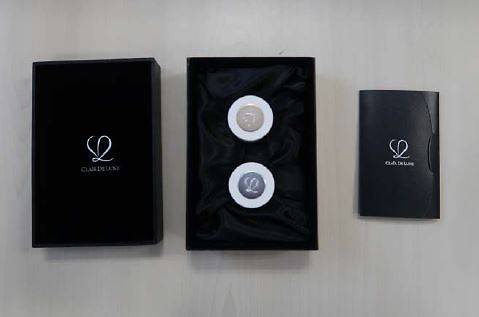
These include three creams which customers bought to treat eczema, namely D’Splendid Kidzema Cream, CLAĺR DE LUNE P Tuberose Day Cream, CLAĺR DE LUNE S Involcurata Night Cream.
The fourth was an “unlabelled diaper cream supplied by a traditional practitioner in Malaysia”, which was used on an infant to treat her diaper rash.
The infant then developed Cushing’s syndrome, and suffered symptoms such as “moon-face”, “buffalo hump” on the back due to fat accumulation, excessive hair growth on the body and thinning of the skin, said HSA.
“The steroid also led to recurrent infections as it suppressed her immune system and caused poor developmental growth,” the authority added in its press release.
The product was tested and found to contain a “potent steroid” called betamethasone valerate and an antifungal medicine known as clotrimazole.
The infant, who was hospitalised, has since been discharged and is currently undergoing outpatient treatment, added HSA.
INAPPROPRIATE USE OF ANTIBIOTICS
The other three creams were used by people to treat eczema, but while users experienced “rapid relief” of their condition, it worsened when they stopped using the creams, said HSA.
A mother who purchased D’Splendid Kidzema Cream to treat her child’s eczema observed that it cleared up after only two applications of the cream, but the child’s condition deteriorated three days after she stopped using the cream.
“It was labelled to relieve skin rashes, eczema, haemorrhoids and mosquito bites for babies and children up to 14 years old,” HSA said.
Tests by HSA found that the cream contained ciprofloxacin – a prescription-only antibiotic – and terbinafine, an antifungal medicine not recommended for use in children under the age of 12.
“Inappropriate use of antibiotics and antifungals can lead to decreased effectiveness for future infections,” said the authority.
“HSA has directed the company to stop the sale of D’Splendid Kidzema Cream and to recall the affected product from retail outlets.”
HSA finds undeclared potent medicinal ingredients in four skin creams. (Table: HSA)
Another consumer, who used both CLAĺR DE LUNE products, also reported that her eczema flared when she stopped using them.
The creams were tainted with multiple potent ingredients including a steroid in the day cream and an antihistamine in the night cream. Antibiotics and antifungal medicines were also found in both creams, said HSA.
“Use of creams with these potent ingredients can lead to adverse effects, such as thinning of the skin (from prolonged steroid use), skin rash and skin irritation,” it added.
A user of CLAĺR DE LUNE skin products reported that her eczema flared up after she stopped using them. (Photo: HSA)
The packaging of CLAĺR DE LUNE skin cream products. (Photo: HSA)
“The products also carried false and misleading claims of ‘all natural plant-based ingredients’ and ‘zero chemical’.
“Website administrators of the local e-commerce platforms have been directed to remove the postings for these creams.”
Anyone who supplies adulterated products which contain undeclared potent medicinal ingredients is liable to prosecution and if convicted, may be imprisoned for up to three years, fined up to S$100,000, or both.
HSA advised consumers to do the following:
See a doctor as soon as possible if you or your child are using these products for eczema as sudden stopping of the cream may result in worsening of the condition, or if you or your child have experienced any adverse effects.
Exercise caution when purchasing health products for use in babies and children, including those that are applied on the skin, such as creams.
Do not use unlabelled products or purchase from unfamiliar overseas sources, unknown or dubious websites or from persons posting offers on online platforms. Babies and children are more vulnerable to serious adverse effects, especially if exposed to potent controlled ingredients.
Be wary that not all products that claim to be “all natural plant-based product” or “zero chemical” actually are what they claim to be.
SINGAPORE: About 930,000 Singaporean households living in Housing and Development Board (HDB) flats will receive the next instalment of the GST Voucher – Utilities-Save (U-Save) rebate in July, announced the Ministry of Finance (MOF) on Monday (Jul 1).
The rebate, which is part of the permanent GST Voucher scheme, is distributed every three months to help households with their utilities bills. S$300 million in U-Save rebates is expected to be given out this year.
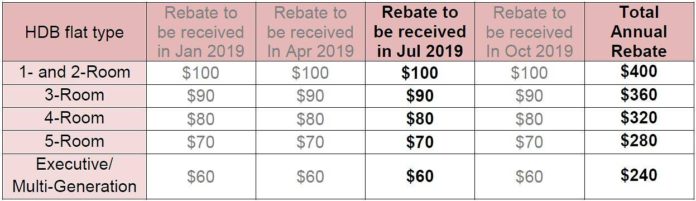
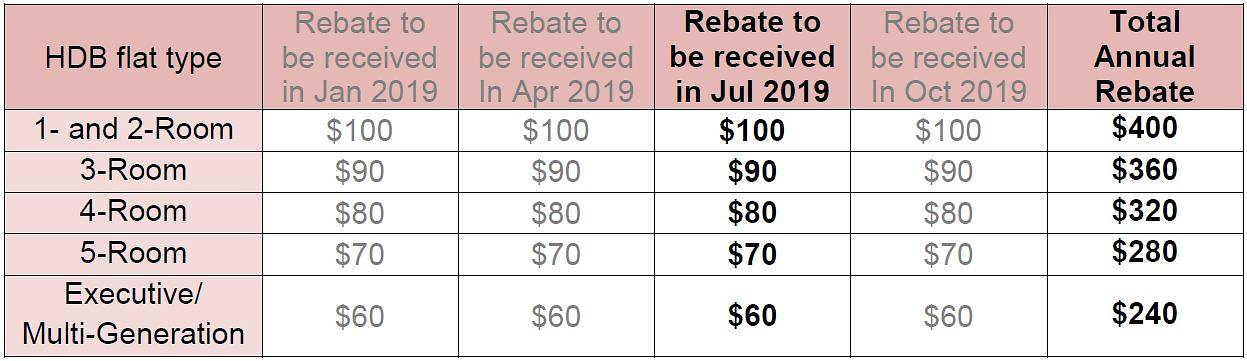
Eligible households will get between S$60 and S$100, depending on their HDB flat type.
GST voucher – U-Save for July 2019. (Table: MOF)
“Annually, the GST Voucher – U-Save has enabled households in one- and two-room HDB flats to receive support which is equivalent to about three to four months of their utilities bill on average,” said MOF.
For households living in three-room and four-room flats, the rebate is equivalent to about one to two months of their utilties billl, it added.
With the launch of the Open Electricity Market, all eligible households will continue to receive the U-Save rebate regardless of their electricity provider.
Households whose members own more than one property are not eligible for the U-Save rebate.
SP Group on Saturday announced that the electricity tariff for households will increase by 6.4 per cent, or 1.43 cents per kilowatt hour (kWh), in the July to September period to the highest in nearly five years.
The increase is mainly due to the higher cost of natural gas for electricity generation, said the company.
City Gas also announced on Saturday that gas tariffs for households will rise by 1.6 per cent or 0.30 cent per kWh in July to September.
SINGAPORE: Prices of resale flats for the second quarter of this year fell 0.2 per cent from the first quarter, according to flash estimates released by the Housing and Development Board (HDB) on Monday (Jul 1).
The resale price index – which provides information on the general price movements in the resale public housing market – is estimated to have dipped slightly from 131 to 130.8.
Resale prices for HDB flats have been on the decline for the last three quarters.
Prices fell 0.1 per cent in the third quarter and 0.2 per cent in the fourth quarter of last year and dipped 0.3 per cent in the first quarter of this year.
HDB also announced on Monday that it will offer about 3,300 Build-to-Order (BTO) flats in Punggol and Tampines in August, and about 4,500 BTO flats in Ang Mo Kio, Tampines and Tengah in November.
There will also be a concurrent Re-Offer of Balance Flats (ROF) exercise and Sales of Balance Flats exercise in August and November respectively.
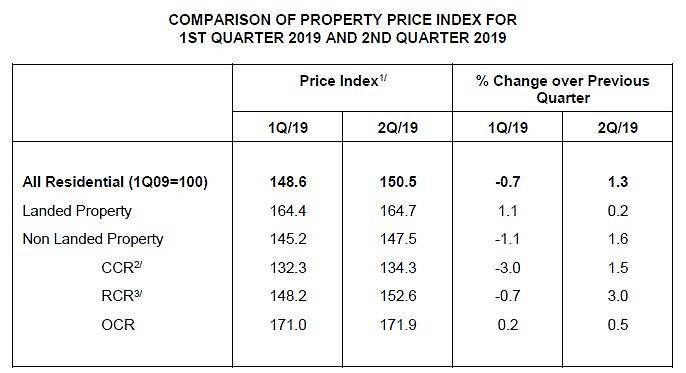
SINGAPORE: Private home prices in Singapore rose 1.3 per cent in the second quarter, reversing two straight quarters of decline, according to flash estimates released by the Urban Redevelopment Authority (URA) on Monday (Jul 1).
The private residential property index increased 1.9 points from 148.6 points in the first quarter to 150.5 points in the second quarter. This is an increase of 1.3 per cent compared to the 0.7 per cent decrease in the previous quarter.
Prices for non-landed private homes saw increases across all regions.
In the Core Central Region, prices of non-landed private homes increased by 1.5 per cent compared to the 3 per cent decrease in the previous quarter.
Prices in the Rest of Central Region increased by 3 per cent after registering a decrease of 0.7 per cent in the previous quarter, while prices in the Outside Central Region increased by 0.5 per cent following a 0.2 per cent increase in the previous quarter.
(Source: Urban Redevelopment Authority)
In the landed property market, prices rose 0.2 per cent compared to the 1.1 per cent rise in the previous quarter.
The flash estimates are compiled based on transaction prices given in contracts submitted for stamp duty payment and data on units sold by developers up until mid-June.
The statistics will be updated on Jul 26 when URA releases its full set of real estate statistics for the second quarter of the year.
SINGAPORE: Catered food, whether served at buffets or through bento boxes, has left a bitter aftertaste after some firms serving up such items were found to be behind recent food poisoning incidents.
In November last year, a 38-year-old man died after eating contaminated catered food from Spize Restaurant @ River Valley. The restaurant is no longer operating.
Spize was not the only culprit. Four other mass food poisoning cases were reported between October and December 2018 involving Team Catering, Tung Lok Catering, FoodTalks Caterer & Manufacturer and the Mandarin Orchard Hotel.
More recently, in April this year, 230 pupils at Zhenghua Primary School in Bukit Panjang suffered gastroenteritis.
A joint inspection of the school canteen was conducted and 16 food handlers were sent for stool screening as part of the investigations.
The Ministry of Health and Singapore Food Agency also said on Jun 22 that two catering companies, Chilli Api Catering and Pro*3 Institutional Catering, have had their food hygiene grade cut to “C” after 45 people fell ill in separate incidents of food poisoning.
In one case, employees of Jurong Polyclinic fell ill in Dec last year, while in the other, people from the National Junior College Boarding School were affected.
But what are the chances of you getting food poisoning from eating catered food and meals bought from eateries?
CNA put three food options to the test with the help of a food safety expert at Nanyang Polytechnic (NYP).
The items were a salmon salad ordered through a delivery service, a catered bento box comprising fish with ginger and spring onion, and a chicken and cabbage mixed rice set bought from a hawker stall.
The food was measured at three different times for the amount of bacteria in them – at “zero” hours when they were received for testing, with further testing again at the four and six hour marks.
WHAT WE FOUND
At zero hours, the cooked food had a bacteria count of just 300, the bento box had 64,000, and the salmon salad already had a count exceeding the 100,000 “safe” threshold, beyond which there is a potential health risk for those with lower immunity, with the possibility that consuming the food could cause diarrhoea or vomiting.
The bacteria count continued to rise as the hours passed. At four hours, the cooked food bacteria count doubled to 600, and the bento set had exceeded the 100,000 safe level.
At six hours, the mixed rice still only had a bacteria count of 920 – while the count for the bento set and salmon salad continued to accelerate further past the “safe” point.
WHAT THE RESULTS MEAN
Healthy people may consume food which has a bacteria count exceeding 100,000 without suffering any ill-effects, explained Mr Richard Khaw, deputy director of Nanyang Polytechnic’s (NYP) School of Chemical & Life Sciences. But it can result in unpleasant consequences for those with lower immunity, he added.
“People with weak immune system, for example, the elderly, young kids, those who have been though treatment like chemotherapy, their immune system is weaker. With this sudden load of 100,000 or above bacteria count, they may have symptoms of stomach upset,” he said.
File photo of a toilet.
The fact that the salmon salad had a bacteria count of more than 100,000 even at zero hours came as no surprise to infectious diseases expert Dr Leong Hoe Nam. He pointed to the presence of uncooked ingredients in that dish.
“Even if you wash the vegetables, that does not clear the bacteria. Give it time, and the bacteria will reestablish itself,” he said.
The bento set was in the safe zone at zero hours, but the bacteria count crossed into the unsafe zone at the four-hour mark.
“Pre-packed boxes are a very, very poor choice. Between preparation and the food entering the mouth, the lead time is long,” said Dr Leong.
This is why guidelines recommend that catered food be consumed within four hours, Mr Khaw said.
On why the mixed rice set had the lowest bacteria count at all three testing points, he said this was due to the food being piping hot when bought, adding that most bacteria would be killed by cooking at temperatures of 75 degrees Celsius and above.
However, Dr Leong cautioned that buying the same mixed rice at the end of the day when the dishes have been left to cool down without a heat source would likely show a much higher bacteria count.
The experts said a high bacteria count alone would not necessarily cause a healthy individual to suffer a stomach upset.
But even they would suffer symptoms such as nausea or vomiting if bacteria known to cause food poisoning, such as salmonella, e-coli, and listeria are present. The symptoms would be worse for someone with compromised immunity.
The three food options tested were negative for salmonella and listeria.
These pathogens are introduced into foods through contamination.
“The problem usually is that the raw ingredient has been contaminated with the pathogen and the food may not be prepared properly, may not be heated up high enough to kill the pathogen, or it may have cross-contamination between the raw ingredient and cooked food, which then allows these pathogens to survive in the food samples,” Mr Khaw said.
Salmonella is usually present in poultry products and in milk and dairy products, he added.
“Poultry, when they are in the farm and contaminated with salmonella, don’t show any symptoms, because it doesn’t affect them. They will appear healthy. (But) when we consume it, we will suffer,” he said.
Listeria and e-coli could be present in water used in growing vegetables and fruits and could be ingested if they are not washed thoroughly.
Other pathogens, like the staphylococcus bacteria commonly found on the skin can also cause food poisoning when they are transferred to food when handlers do not wear gloves.
A pathogen which can be found in rice, cereals, or other dry ingredients is the bacillus cereus bacteria, which Dr Leong said is one of the top causes of food poisoning. While the bacteria can be killed in high heat, it forms spores which are heat-resistant and can survive cooking.
As the food cools, bacteria regrows from the spores and may release toxins that cause food poisoning, he explained. Testing for such toxins is not common and detecting them is tough, he said.
Whether a person falls ill from ingesting such toxins also depends on the amount consumed and the individual’s health, he said.
Dr Leong suggested eating such foods when they are freshly cooked, or storing them in the fridge, as bacteria will not be able to regrow from the spores in a cold environment. Keeping the food hot with a strong heat source will also guard against the bacillus threat, he added.
HOW TO PREVENT FOOD POISONING
Because it is hard to say when catered food is prepared, Mr Khaw advised that eating it immediately would be best, despite the four-hour guideline by authorities.
The allowance for freshly cooked food is higher for healthy adults, and they can leave it for one or two hours before eating, he said.
Food sellers, including caterers, should use tongs and gloves to maintain hygiene, and make sure that shared utensils are washed properly, Dr Leong said.
Hygiene should also be maintained at home, the experts said, starting with thoroughly washing hands.
Mr Khaw said that food should be cooked at temperatures of 75 degrees Celsius and above. As most people at home do not use thermometers, a good indication of this would be cooking it to boiling temperature.
Frozen food should also be completely defrosted before cooking, he advised.
“We should not cook food that is partially defrosted. The core of the food may still be in a frozen state and when you see the surface at a boiling temperature, it doesn’t mean that the inner temperature has reached 75 degrees Celsius,” he said.
He also said it is good to have different chopping boards for cooked and raw food.
“The rough surfaces on chopping boards will allow bacteria to grow, and the bacteria will hide in the crevices,” Dr Leong said.
SINGAPORE: At the age of 44, Lorbert Tay is well built and athletic, with photos in his office displaying his achievements in international triathlons.
So it is hard to imagine him as a pre-school teacher.
But for every photo of him competing in a triathlon or posing with a medal, there are others which showcase his love for children and passion for shaping young minds.
In one, he is taking a group of children on a hike, all of them clad in multicoloured ponchos. In another, he is in a supermarket, holding a fish and letting the children touch it.
It is clear that he is in his element when he is with the children. And likewise for them.
Screams of “Teacher Lorbert!” fill the air as he makes his rounds in the pre-school. They run to him with brightened faces, some of them try to clamber onto his back while others reach for him, looking for a hug.
WATCH: Meet the male pre-school teacher (7:05)
A boy pulls a face at him. Tay grins and reciprocates, earning a giggle. Some children, he says later, even call him ‘Papa’ or ‘Daddy’.
Tay, a centre manager at pre-school chain Carpe Diem, is one of about 150 male pre-school educators in Singapore. They make up fewer than 1 per cent of the total pool of early childhood educators.
HALF THE CLASS WANTED TO WITHDRAW
As a man in a female-dominated environment and working with young children on a daily basis, Tay is well aware that his presence can raise parents’ suspicions.
Counting down to nap time.
He remembers the first time he took a class on his own. It was 2010, and he was working for PAP Community Foundation (PCF) Sparkletots, Singapore’s largest pre-school operator.
“A lot of parents were very skeptical … What’s this guy doing here?” he says. “Their imagination went wild, and they thought I was some kind of weirdo or sicko, coming into the industry and trying to be a predator.
“The following day, I heard from my principal … Half the class wanted to withdraw.”
It was a sad moment for him. But he also remembers his principal encouraging him not to give up, and convincing the parents to give him a chance.
His first year in the industry was the toughest. “Parents were worried, so every small thing … even if it was a scratch or mosquito bite, was my fault,” he recounts. “I had to explain what my intentions were, from the start to the end, and build trust with them.”
He made an effort to think of novel ways to engage the children and help them learn.
“There were sleepless nights,” he says. “I felt as if I needed to work extra hard to prove myself, so I dug up all the different YouTube videos to look for interesting things that I didn’t really see other teachers doing.
“For the rest of the year, I had a lot of fun with the children, so much so that they didn’t want to end the day. By the end of the year, even the parents in the other classes wanted to ask for a transfer to my class.”
ALLAYING PARENTS’ CONCERNS
Today, Tay is careful to ensure that nothing he does can be misconstrued by a parent.
As a male educator, he does not do routine care, such as showering the children or changing their diapers. He also has several unspoken rules, for example not entering the children’s bathroom unless necessary, so that he does not see a child in a state of undress.
He also limits his physical contact with the children, and over the years has developed guidelines for himself and any male teacher who might join the centre. For example, he uses only one arm to hug the children — and that hug is limited to a pat on the back.
When he first joined the sector, he did not have specific guidelines setting out what he could or could not do as a male educator. He decided to develop his own to not only protect the children, but also himself.
“I was very stressed,” he says. “I had to watch over my back to make sure that I didn’t do things that parents would feel awkward or upset about.”
He remembers once, early in his career, when he forgot himself and gave a child a full-on hug. “When I turned around, the parent was staring at me like a hawk,” he recalls. “That’s when I realised … oh no, I made the mistake I told myself not to do.”
To parents such as Elise Cheng, whose younger daughter attends Tay’s centre, it is clear that he makes the effort to minimise contact when he is with the children.
“With two girls, I’ll always have this fear of physical contact,” she says. “We’ll always be worried about paedophiles or predators … especially when you read the news about people waiting outside schools to prey on girls.
“But over time, when I saw (Tay) work, my trust increased, and now I’m very comfortable with him being with my two girls.”
Adhering to his guidelines can be challenging, and even saddening at times, but he knows there are lines he cannot cross. “As much as I want to pour my love out to them, I have to control myself,” he says.
HIRED ON THE SPOT
Amid these challenges Tay has faced, he persevered because he had always known he wanted to teach.
Following graduation with an information technology degree, even as he tried out different jobs — from IT to operations to sales — he would without fail apply to join the Ministry of Education (MOE) as a primary school teacher.
“My friends believed I had a gift for touching the hearts of children,” he says. “They noticed that even their children who didn’t socialise well with strangers would simply enjoy my company, even when they saw me for the first time.”
For 10 years, there was no response from the MOE. But the chance to live out his dream arrived in 2009, when he came across a PCF booth at a job fair.
“There was this man standing there who asked me if I was interested in becoming a pre-school teacher,” he recounts. “I told him I wanted to … shape (children’s) characters, and the best time to do it is when they’re young.”
The two continued talking. And suddenly, the man told him: “You’re hired.”
“I hadn’t even brought my certificates or anything, and I didn’t even apply for the job proper,” Tay says, chuckling. He later found out that the man he had met was the PCF head.
“The funny thing was, after I accepted the job, MOE called me back,” he adds.
He joined Sparkletots in 2010, juggling his work at the centre with his diploma studies in early childhood education. Despite the 50 per cent pay cut he had taken, the hard work and the challenges along the way, he was happy.
Tay worked his way up, joining various operators before taking on a more administrative role at Carpe Diem, making sure his centre runs smoothly.
He still enjoys the time he has with the children, and makes a point of greeting them by name every morning.
“They appreciate these small gestures … and they’d feel happy and proud,” he explains. “I noticed that if they’re happy when they come in, they’d be happy throughout the day.”
NOT THEIR FIRST CHOICE
Male pre-school teachers are valued, according to the Early Childhood Development Agency (ECDA), as they can “help to bring different strengths and perspectives to the sector”.
But the proportion of male educators in the sector has remained below 1 per cent for the past three years.
“Some pre-school educators have shared that there may be a perception that the pre-school sector is more suited to women, and this may deter men from joining,” the ECDA said in an email response to CNA Insider.
Muhammad Hadi Kamal realised he was a “rose among the thorns” when he entered Temasek Polytechnic in 2010 to do his early childhood diploma course: Of the 60-odd students in the cohort, five were male.
And for three of the five, the course was not their first choice, which had been psychology. “In early childhood, there are overlaps with psychology,” explains Hadi, 25 and now a teacher at NTUC First Campus – My First Skool.
While he had always wanted to join the sector since he was a teenager, another teacher, 23-year-old Darius Ng, admits that he ended up in early childhood because his O-Level results did not make the cut for psychology. But he has, he said, since fallen in love with the job.
At school, they were “the centre of attention”, but Hadi shares how different it was after graduation: While pre-schools were inviting his female batchmates for centre tours or interviews, eight out of 10 times he received no response to his job applications.
One centre told him it “doesn’t accept male teachers at all”, he recalls. “I was taken aback.”
But today, Hadi is confident that the situation has improved. “The mindset has changed,” he says. “A lot of centres are taking in male teachers, especially those who are making a mid-career switch.”
According to the ECDA, the proportion of full-time male students enrolled in the pre-employment training diploma courses has doubled from about 4 per cent in 2014 to 8 per cent in 2017, and remained stable last year.
PCF Sparkletots and NTUC First Campus — both government-appointed anchor operators — said male educators are welcome in their centres.
“The feedback from parents and fellow educators at PCF Sparkletots has been positive so far, as the presence of male pre-school educators contribute to gender balance in the classroom and enable children to be exposed to positive male role models,” stated the PCF.
As for guidelines, the ECDA said the Early Childhood Development Centres Regulations do not prescribe duties that male educators should or should not perform. Pre-schools may, however, develop their own guidelines on the duties of different groups of staff.
Gender-specific dos and don’ts were made clear to both Hadi and Ng at their respective centres.
And while the latter, who is at NTUC First Campus – Little Skool-House, stresses the importance of building trust with parents, he does not recall any negative experiences.
“There was one parent of twin girls who asked my principal if I’d be bringing her daughters to the toilet. But I think she just needed the assurance that I wouldn’t be doing routine care,” he says.
“Most parents just approach me with a smile and tell me that I’m rare.”
MAKING A DIFFERENCE
Over at Carpe Diem, where it is mealtime — with the clatter of spoons and clamour of children eating their pumpkin cake — Tay is in the thick of the action, seated on one of the child-sized chairs and helping the teachers spoon food into the children’s mouths.
“I usually come over to de-stress,” he says as he cajoles a child to open her mouth. “Feeding the young ones is actually very therapeutic.”
“Papa!” squeaks a child from across the table.
“Someone has called me,” he says with a wistful smile. “The whole class … they’re all my children.”
It is a sad irony for him because instilling values and shaping the lives of the children in his care is the closest he can come to being a father: He is unable to have children of his own.
Tay explains that after a few years of trying for a child, he and his wife found out that she had developed a cancer in her womb. In 2014, the couple made the difficult decision to remove the womb to stop the cancer from spreading.
His wife broke down when she heard the news, he recounts. He was sad himself, but kept his emotions in check because he did not want to upset her further.
“She knew how much I wanted to have my own children, but I had to show her that it’s okay,” he says. “Her health is more important.”
But even though he works with children all day, Tay has made his peace, and says he is content with the role he plays in the lives of the children.
“(My time with them) starts at 18 months, till they are six years old. That’s a very long time,” he says. “So from seeing them grow from crying babies to mature boys and girls ready for primary school … that’s the biggest satisfaction I get.”
Because he knows he has made a difference in their lives.
The other worker, Mr Tian Yongmin, is “almost fully recovered and in the company’s care”, said MWC.
He was discharged from SGH the morning after the fire.
“MWC will continue to maintain contact with both workers and the company to ensure that any assistance required, concerning their recovery or employment, is promptly provided to them,” said the centre in a Facebook post.
WIFE OF DEAD WORKER TO RECEIVE CASH TOKEN OF CONDOLENCE
Another worker, Mr Wei Xiaoyong, also a Chinese national, died in the fire.
“With our assistance, the company was able to expedite travel arrangements for the spouse and child of the deceased worker, Mr Wei Xiaoyong, to fly in to Singapore on Thursday,” said MWC.
Mr Wei’s remains were collected by his next of kin on Saturday morning.
Funeral rites, last respects and the cremation for Mr Wei will also be conducted later on the same day, added MWC.
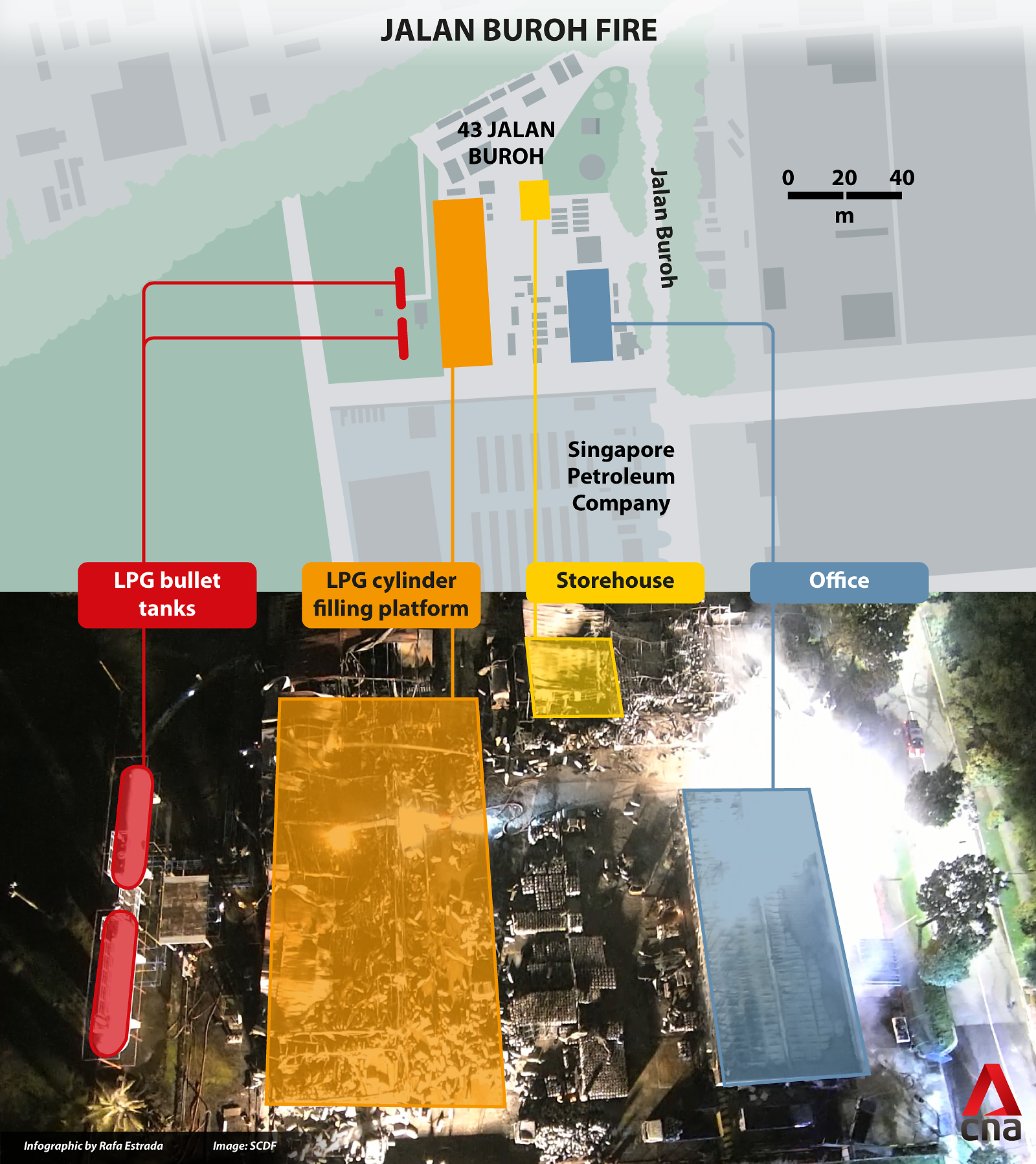
Aftermath of a massive fire that broke out at a LPG facility in Jalan Buroh in Jurong on Jun 21, 2019. (Photo: Facebook/SCDF)
“The company has been forthcoming with the needs of Mr Wei’s loved ones, and responsible in undertaking all the necessary formalities.
“Furthermore, we have been told that the company is preparing a cash token of condolence to be given to Mr Wei’s spouse before her departure back to China,” said the centre.
“This amount will be more than adequate to help the loved ones tide through till the Work Injury Compensation is paid out.”
REPLACEMENT OF PASSPORTS, COUNSELLING FOR AFFECTED WORKERS
MWC said that to ensure there was no “unnecessary hindrance or delay in the subsequent injury assessments and compensation payments” for the workers affected in the fire, it has coordinated with PRC Embassy officials, company representatives and MOM’s work injury compensation department.
This is so that necessary claim applications, information, forms and identification documents have and will be submitted as soon as possible, said MWC.
MWC added that it has helped with the process of replacing the workers’ passports which were destroyed in the fire.
The workers of the facility will also be receiving emotional counselling.
MWC said that all workers affected by the Jalan Buroh accident “will continue to have their physical and employment well-being taken care of”.
“We offer our sympathy to all those affected and to the loved ones and family of Mr Wei Xiaoyong, we offer our deepest condolences.”
OSAKA: Prime Minister Lee Hsien Loong on Saturday (Jun 29) reaffirmed bilateral relations with Brazil, Netherlands and India on the sidelines of the G20 Summit that was held in Osaka, Japan over two days.
Mr Lee and Netherlands Prime Minister Mark Rutte had a “good discussion” on their bilateral ties and regional developments, the Prime Minister’s Office (PMO) said.
The leaders, who last met at the G20 Summit in Buenos Aires last year, welcomed the ratification of the EU-Singapore Free Trade Agreement in February and look forward to it coming into force later this year, the PMO added.
“Singapore and the Netherlands are both open and like-minded outward-looking countries which share similar views on the importance of the multilateral trading system,” a spokesperson for the PMO said.
Mr Lee also discussed such a system with India’s Prime Minister Narendra Modi on Saturday.
The leaders agreed that the conclusion of the Regional Comprehensive Economic Partnership would send a strong signal of commitment to the multilateral trading system amidst US-China trade tensions and protectionism around the world, the spokesperson said.
The partnership is a free trade agreement under negotiation among ASEAN countries and partners which the organisation has existing agreements with.
Mr Lee and Mr Modi also discussed the “excellent bilateral relations and cooperation” under the India-Singapore Strategic Partnership, particularly in the areas of trade and investment, defence, Fintech and innovation, the PMO said.
Mr Lee also reaffirmed warm bilateral ties with Brazilian President Jair Bolsonaro.
The leaders welcomed recent milestones in their relations, like the abolition of visa requirements for diplomatic and official passport holders, and the signing of the Avoidance of Double Taxation Agreement.
Prime Minister Lee Hsien Loong with Brazilian President Jair Bolsonaro. (Photo: MCI)
Both leaders look forward to the early ratification and early conclusion of the agreement, which would facilitate trade and investment flows between our two countries and regions, the PMO spokesperson said.
They also agreed to continue working together to strengthen the bilateral relationship, with President Bolsonaro welcoming the investments by Singapore companies in Brazil in sectors such as oil and gas, infrastructure and real estate.
Mr Lee also invited more Brazilian companies to establish their Asian operations in Singapore.
Earlier during his working visit that started on Thursday, Mr Lee also met Saudi Arabian Crown Prince Mohammad Bin Salman and Japanese Prime Minister Shinzo Abe, who invited Singapore to Japan’s G20 Summit.
The leaders reaffirmed their relations and noted that they were pursuing new areas of bilateral cooperation, including infrastructure development in third countries.
SINGAPORE: This year’s National Day Parade (NDP) will pay tribute to the first ever Mobile Column that took to the stage at the Padang 50 years ago in 1969.
The Mobile Column – which shows off hardware and other assets from the Singapore Armed Forces, the Singapore Police Force and Singapore Civil Defence Force – last featured in NDP 2015.
This year, it will see participants across generations. Spectators can look forward to a display of a whopping 171 assets performing a nearly 15-minute drive-past.
A JOY RIDE WITH THE MOBILE COLUMN
As part of a media opportunity, CNA got a sense of what it was like to ride in one of the 13 Leopard 2SG Main Battle Tanks participating in the Mobile Column.
Weighing 55,150kg and standing at a height of 2.99m, the tank appeared menacing up close.
Leopard 2SG Main Battle Tanks in a row. (Photo: Gaya Chandramohan)
Reporters were told that while the other vehicles had ramps to walk up, the Leopard 2SG Main Battle Tanks required strength to swing oneself up onto it. We were also cautioned to be careful while climbing up as the surfaces of the tank was rough with anti-slip covering that could scrape skin right off.
A demonstration on how to climb up on to the Leopard 2SG Main Battle Tank. (Photo: Gaya Chandramohan)
This reporter really had chosen the wrong day to wear jeans.
After the gargantuan task of hauling myself up onto the green behemoth, I was given a safety briefing on stable standing positions when the tank was moving and what to do in case the tank overturned.
We also had to wear tight-fitting helmets that had a communications link to the crew in our tanks and the rest of the Leopard Tanks that were in the convoy.
A vehicle commander sitting in his station as he awaits the signal to go. (Photo: Gaya Chandramohan)
My tank’s commander. (Photo: Gaya Chandramohan)
As I lowered myself into the gunner’s station, I noted how small and compact the inside was. I watched and listened as my tank’s vehicle commander communicated and executed drills with the driver who was situated somewhere below us.
The view from the gunner’s station on a Leopard 2SG Main Battle Tank. (Photo: Gaya Chandramohan)
As part of a media opportunity, journalists were invited to experience what it was like to ride in a Leopard 2SG Main Battle Tank. (Photo: Gaya Chandramohan)
Before I knew it, the signal was given over the headset and we were off. Though slightly bumpy, riding in a tank felt exactly like riding in a truck – except you are standing and half of you is exposed.
As we cruised through to the Padang, I turned around to marvel at the sight of the Leopard tanks leading the 1.3km long convoy of 158 other vehicles.
In the procession were other assets such as the Hunter Armoured Fighting Vehicle from the Singapore Army and the ASTER-30 Missile System from the Republic of Singapore Air Force that will make an appearance for the first time during NDP 2019.
Alongside crowd favourites like the Terrex Infantry Carrier Vehicle and the Light Strike Vehicle, spectators will also get to see naval assets that have not appeared in previous Mobile Columns, such as the Combatant Craft Medium.
HONOURING THE MERDEKA GENERATION
The final segment of Act 2 of the parade will also feature a salute to the Merdeka Generation for their service and contributions in building National Service.
Speaking to reporters at a doorstop, chairman of the Mobile Column committee, Lieutenant-Colonel Wu Jianmin said the strength of the Mobile Column was not only in the hardware or platforms, but in the operational standards and commitment of Singapore’s servicemen and women as well.
“The Mobile Column 2019 will end with a special segment to pay tribute to our Merdeka Generation servicemen. The SAF and Home Team stand strong today because of their sacrifices and their commitments towards Singapore’s security,” he said.
“We hope that this final segment will also inspire Singaporeans to inherit the spirit of the Merdeka Generation and continue to be committed to defending Singapore, protecting our loved ones and our way of life because we are now pioneers of our future.”
One of the Merdeka Generation participants is retired Cpt Loh Kwan Boh, 63, who is participating in the National Day Parade alongside his son, Cpt Charles Loh who will be commanding a Hunter Armoured Fighting Vehicle during the parade.
“It is a significant milestone for us. We get to participate in National Day for the first time and also that this being Singapore’s bicentennial year as well as 50 years since we rolled down Padang in 1969, it’s a very big thing for us,” said 26-year-old Cpt Loh.
Captain (RET) Loh Kwan Boh and his son, Captain Charles Loh. (Photo: Gaya Chandramohan)
When asked about paying tribute to his father’s generation, Cpt Loh said: “I see this as one of the ways to make him proud. He has actually passed the baton down to me as an armour officer. So it’s my duty to carry on the legacy and continue to work hard in armour.”
Cpt (RET) Loh, who was from the early batches of the 40 Singapore Armoured Regiment (40 SAR) that trained in the AMX-13 tanks, had made sure to expose his young son to the SAF by bringing him to every open house.
“I would say in a way, it must have nurtured some of his interest over the years … I was very proud of him that he wanted to sign on and that he chose Armour. I was a tank officer so I am very proud that he is also a tank officer,” he said.
Despite the pair working with different tanks, Cpt Loh said his father and him still share their experiences with each other.
“Although the training knowledge cannot be passed on, the things like values like leadership, responsibility – he will try to give me pep talks to do well in what I do in my training,” he said.