SINGAPORE: Six men and two women have been arrested in connection with a case of murder after a man collapsed at Orchard Towers on Tuesday morning (Jul 2).
The police said they received a call for assistance at 6.25am, adding that a 31-year-old man was found motionless at the scene.
He was taken unconscious to Tan Tock Seng Hospital, where he was pronounced dead.
The suspects are aged between 22 and 27, said the police.
Five of them will be charged in court on Thursday for murder with common intention, which carries the death penalty.
Pieces of tissue paper soaked in blood seen at the entrance of Orchard Towers on Tuesday (Jul 2). (Photo: 8world News/Cai Youxia)
CCTV footage obtained by 8world News showed a man walking slowly in front of an escalator before collapsing, prompting onlookers to rush forward to check on him.
Photos taken by the news outlet also showed a pool of blood on the floor near the building’s entrance.
Police were seen cordoning off an area outside Orchard Towers.
Police officers standing guard at the entrance of Orchard Towers on Tuesday (Jul 2). (Photo: 8world News)
Burning incense sticks at the scene of the incident at Orchard Towers. (Photo: 8world News/Cai Youxia)
Police said investigations against three of the eight suspects are ongoing.
SINGAPORE: A total of 7,500 sachets of chewing tobacco were found hidden under curry puffs transported by a Malaysia-registered van at Tuas Checkpoint last Saturday (Jun 29).
The consignment was declared as curry puffs, said the Immigration and Checkpoints Authority (ICA).
Further checks, however, revealed sachets of chewing tobacco under the fried pastries.
The Malaysia-registered van was stopped at the Tuas Checkpoint for further checks. (Photos: Facebook/Immigration and Checkpoints Authority)
Two Malaysian men, the 32-year-old driver and his 30-year-old passenger, were referred to the Health Sciences Authority for follow-up actions, ICA said.
“Our borders are our first line of defence in safeguarding Singapore’s security. ICA will continue to conduct security checks on passengers and vehicles to prevent smuggling attempts of undesirable persons, drugs, weapons, explosives or other contrabands,” said the agency.
SINGAPORE: Riders on Watch (ROW), an initiative tapping Singapore’s large community of commuters to be first responders to potential threats on public transport, was launched on Tuesday (Jul 2).
As part of the scheme, volunteers can sign up to be part of a team of commuters tasked with keeping a lookout for suspicious characters or items, and alert the police for follow-up.
These riders will receive information on the latest crime trends, as well as real-time SMS alerts on “persons of interest”, said Senior Parliamentary Secretary at the Ministry of Home Affairs and the Ministry of Health, Mr Amrin Amin.
Announcing the initiative at the Public Transport Security Command’s (Transcom) Public Spiritedness Award ceremony, Mr Amrin said: “Public transport ridership is expected to grow further with the addition of more train lines and bus routes in the coming years.
Commuters who sign up for Riders on Watch will each receive a limited edition EZ-Link card. (Photo: Darius Boey)
“The large readership will make our public transport system an even more attractive target for terror and crime.”
Mr Amrin said that when a crime is committed, the Singapore Police Force (SPF) will disseminate – via SMS or Whatsapp – information such as a suspect’s possible whereabouts and appearance, as well as CCTV footage.
The information can be shared with family, friends and neighbours to create “a more informed community”, he added.
“The police cannot be everywhere, and to look at it, the police have been successful in partnering with the community to fight crime. So we thought that Transcom, being the sub-unit to the police, should try to do something that is similar, tapping on community volunteerism to help us fight crime, to be our eyes and ears,” said Assistant Commissioner (AC) of Police Koh Wei Keong, who commands Transcom.
ROW draws inspiration from a similar scheme undertaken by the British Transport Police called Project Salvatore, and hopes to achieve at least 3,000 sign-ups by the end of the year.
(From left) Assistant Commissioner Koh Wei Keong, Public Spiritedness Award recipients Paul Yoke Teow and Giralt Julia Suñer, and Mr Amrin Amin, Senior Parliamentary Secretary at the Ministry of Home Affairs and Ministry of Health. (Photo: Darius Boey)
Members of the public may sign up on the SPF website or approach Transcom officers on patrol at MRT stations and bus interchanges.
Those who want to contribute more and patrol with police may also consider volunteering for other schemes such as Citizens on Patrol and the Volunteer Special Constabulary.
ROW recruits will each receive a limited edition EZ-Link card.
One recruit, 35-year-old Paul Yoke Teow, hailed the scheme as a good move.
“It’s very natural for me to step out and help … (when I see something) incorrect,” said Mr Teow, who was one of several riders who received a Public Spiritedness Award on Tuesday, after he helped authorities apprehend a perpetrator in an outrage of modesty case at Hillview MRT station in March.
“I have friends who have been molested and (when) asked why they didn’t do anything, they said they were scared of what the other party would do to them. This can happen to anyone, including my family members and if it were to happen to them, I’d also want someone to help,” said Mr Teow.
Riders on Watch also acts as a warning to potential offenders, said AC Koh.
“We hoping that the scheme, besides (engaging) volunteers (as) our eyes and ears, will be a deterrence to would-be perpetrators,” he said.
SINGAPORE: A new charity fund has been set up to help Singaporeans with rare diseases who cannot afford treatment costs.
Jointly established by the Ministry of Health (MOH) and the SingHealth Fund, the Rare Disease Fund will combine community donations and Government-matched contributions to financially support Singapore citizens with specific rare diseases, MOH announced in a press release on Tuesday (Jul 2).
Rare diseases are conditions that affect a very small number of people. They are often diagnosed during childhood and are mostly genetic in origin.
Many rare diseases do not have available treatments and patients often have shorter lifespans as a result, but for some rare diseases, effective treatments are available which can increase patients’ life expectancies and improve their quality of life.
These medicines can cost up to hundreds of thousands of dollars a year, explained MOH, and patients often need to take them for their whole lives.
As such, the new fund aims to encourage community donations to support Singaporeans with rare diseases who are treated in public healthcare institutions, but cannot afford treatment costs. For every S$1 the public donates, the Government will provide S$3 in matching contributions.
In addition, the Government will also fund the operating expenses of the Rare Disease Fund to ensure all donations received are used solely for supporting patients.
“This will give support to patients whose treatment costs remain unaffordable even after Government subsidies, insurance and financial assistance (such as Medication Assistance Fund, MediFund) have been provided, due to the high-cost nature of the treatments,” said MOH.
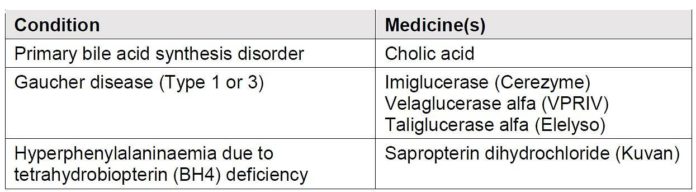
The fund’s committee has approved an initial list of five medicines treating three rare diseases for funding.
These are:
(Table: Ministry of Health)
Applications for patients with these three conditions have started.
Singaporeans undergoing treatment at public healthcare institutions for these rare diseases who need additional financial assistance can apply through the medical social workers at their public healthcare institution.
A committee made up of volunteers with “diverse expertise, experiences and perspectives” will assess patient applications as well as the list of medicines to be covered under the fund. So far, the fund has approved applications from two patients.
To date about S$18 million has been raised, according to MOH. Taking into account Government matching, the fund currently stands at S$70 million.
“By providing three-to-one donation matching, we hope that the larger community including philanthropists, companies, community groups and individuals will come together to jointly support these patients and their families as part of our caring and inclusive society,” said Senior Minister of State for Health Edwin Tong.
The Rare Disease Fund will have Institution of Public Character status, which means all donations to the fund will be eligible for a 250 per cent tax reduction.
It has adopted an endowment approach, where the interest income generated is used to support patients.
SINGAPORE: Faced with money issues and a gambling problem, a 41-year-old man wrapped a towel around his pregnant wife’s neck and strangled her two years ago, before doing the same to his four-year-old daughter.
Teo Ghim Heng then allegedly tried to kill himself in various ways, failing in all of them. He purportedly placed the bodies side by side and set fire to them, before lying down next to them.
However, he left the flat when he felt the fire was too hot, and allegedly turned on the air-conditioner and sealed the windows to delay the decomposition process.
The charred bodies were found only eight days later, on the first day of Chinese New Year in 2017.
In the eight days before the grisly discovery, Teo slept beside the bodies and surfed the Internet, with suicide searches found in his Internet history. During this time he lied to his family to explain his family’s absence at Chinese New Year reunion dinners and visits, and avoided his employer.
Teo, now 43, claimed trial on Tuesday (Jul 2) to two charges of murder, with a third charge involving the unborn six-month-old foetus stood down for the time being.
The wake of Mdm Choong Pei Shan and her daughter on Jan 31, 2017. (Photo: TODAY/Wee Teck Hian)
ACCUSED IN SERIOUS FINANCIAL DEBT
The court heard that Teo and his wife, 39-year-old housewife Choong Pei Shan, were both in their second marriages.
Teo was a long-time property agent, previously working at Savills Residential, SLP Scotia Property Agency, HSR and Propnex Singapore. However, he made a career switch in October 2016, taking up a job as sales coordinator with Carpentry Design Works, as he was not faring well in the trade.
He was in “serious financial debt” of about S$70,000, having borrowed money from his colleagues over the years and racking up credit card debts and overdue kindergarten school fees.
On top of this, he spent several hundred dollars a week on 4D and was being chased for the money he owed. In the period leading up to Chinese New Year, he knew there would be expenses for the festive season.
On the fateful day of Jan 20, 2017, Teo was home with his wife and did not take his child to kindergarten that day as the school had reminded him of the school fees he owed.
Teo began arguing with his wife about the school fees. He had told her two days earlier about his debts and that he could not pay the fees.
Angered by his wife, Teo looped a towel around her neck and strangled her for about 15 minutes. As she was still breathing faintly, he continued the deed with his bare hands until she stopped moving.
After this, he turned to the child, who was in the room with her parents, and killed her in the same way.
The child cannot be named as she is a minor.
SUICIDE ATTEMPTS, LIES AND EXCUSES TO FAMILY, COLLEAGUES
In the days after, Teo claimed he attempted suicide, but failed. He switched off his phone so that he could not be contacted by the people he owed money to, and sent a text message to his daughter’s kindergarten teachers to say she was unwell.
To his family and in-laws, Teo gave excuses for not attending Chinese New Year activities, and dodged requests by his wife’s family to speak to her.
In the eight days before the bodies were found, Teo claimed that he slept on the same bed as the charred bodies of his wife and daughter, leaving the flat only to buy food and air fresheners.
During the week that followed, his colleagues and brother-in-law visited the Woodlands flat on three occasions and knocked on the door repeatedly to no avail.
VICTIM’S BROTHER GROWS SUSPICIOUS, RETURNS TO FLAT WITH HELP
However, on Jan 28, the first day of Chinese New Year, Madam Choong’s brother Gordon Choong visited the flat again.
He found the door and metal gate locked, and the windows closed. He called his sister’s name but received no response.
After comparing the lies Teo had told various family members, Mr Choong grew suspicious as he had not heard from his sister for some time.
Mr Choong returned to the flat that evening with his brother-in-law, Mr Chris Lam Kwek Fah, and again knocked on the doors and windows and rang the doorbell, shouting the victims’ names.
Mr Choong then forced open one of the windows and noticed a pungent odour, which smelled like a gas leak. He called the police, saying: “There is no respond (sic) from my sister and I can smell gas coming out from the unit.”
Officers responded to the call and requested help from the Singapore Civil Defence Force. Just as the firefighters were about to force their way into the flat, Teo opened the door, surprising the police officers as they had been knocking for some time with no response.
Mr Choong demanded to know where his sister was, and Teo lied that she had gone out. The deceased’s brother continued shouting at Teo to account for his lies, while the firefighters asked Teo to unlock the gate.
He refused to do so at first, complying only when told that the firefighters would break open the gate if they needed to.
While firefighters were entering the flat, Mr Choong shouted angrily at Teo, asking him where his sister was. Teo then walked very close to his brother-in-law and told him in “a calm and soft voice” that his sister was dead, court documents said.
The crime scene at Woodlands Drive 52 on Jan 28, 2017. (Photo: Leong Wai Kit)
TEO TRIED TO DASH PAST BROTHER-IN-LAW
Mr Choong shouted at Teo in disbelief, and Teo dashed past him towards the lift lobby, but his brother-in-law grabbed his shirt as he tried to flee.
Police officers and firefighters pinned both men down along the common corridor, just as firefighters from inside the flat said they found a charred body lying on the bed in the master bedroom.
When a police officer asked Teo what had happened, Teo replied in Mandarin: “It was my fault.”
He added that he had poured thinner and set his wife and child ablaze as they slept earlier that day, and the officers realised there was a second body. They found the body of the child, with the feet completely burnt, and arrested Teo for murder.
While waiting for officers from the Criminal Investigation Department’s Special Investigation Section, Teo lied to the police that he had made a suicide pact with his wife a few weeks before and setting his family on fire was part of this pact.
He later allegedly admitted in statements to the police that he had killed his wife and child by strangling them.
VICTIMS DIED FROM STRANGULATION, SMOTHERING
Autopsies conducted on Mdm Choong and her daughter found bruises on their necks. A forensic pathologist certified Mdm Choong’s cause of death as strangulation, with burns to the body inflicted post-mortem.
The cause of death of the foetus, who was a little more than six months in gestational age, was the death of its mother.
The four-year-old child had died due to smothering, with injuries to her lower face and neck indicative of blunt force sufficient to cause death.
A fire investigation report found that the flames originated from the bed in the master bedroom, ruling out fires of electrical origin or from embers from smouldering materials.
A laptop seized from the flat revealed suicide-related searches and website visits, including searches for “commit suicide”, “suicide preparation checklist” and “how to cut wrist to commit suicide”.
The prosecution will call about 60 witnesses over the course of the trial, which is set to run for the rest of this week and into next week.
Deputy Public Prosecutors Han Ming Kuang, Dillon Kok and Ng Jun Chong said they plan to call a consultant from the Institute of Mental Health who will testify that Teo was examined while remanded and found to have no mental disorder.
However, lead defence lawyer Eugene Thuraisingam told the court that a report from Changi General Hospital, where Teo was warded a day after his arrest, states that the hospital’s psychiatric team said Teo had depression with homicidal intent and persistent suicidal intent.
The defence is likely to rely on general exceptions to murder – that there was grave and sudden provocation, a sudden fight and or diminished responsibility.
If found guilty of murder, Teo faces the death penalty.
SINGAPORE: International crime-fighters need “major reinforcements” in their arsenal to better tackle changing security landscapes, and three areas of innovation – biometrics, data analytics and digital forensics – could be key, said Second Minister for Home Affairs Josephine Teo on Tuesday (Jul 2).
Global connectivity, technology and polarisation in societies are three reasons driving changes in the world’s security landscape, Mrs Teo said in her opening speech at Interpol World 2019. Of these, she highlighted polarisation of societies as the “most worrying development” as extremists now have tools of mass propagation at very low cost.
“The result is self-radicalisation, a previously unheard of phenomenon. In this new landscape, otherwise ordinary citizens can become explosive nodes of destruction without anyone noticing,” Mrs Teo, who is also Manpower Minister, added.
Minister of Manpower and Second Minister for Home Affairs Josephine Teo speaks at Interpol World 2019, Jul 1, 2019 (Photo: Kevin Kwang)
Given today’s situation, crime-fighters’ arsenal needs major reinforcements and not just incremental upgrades. “Policing needs to get better,” the minister said.
Three areas of innovation “hold promise”, she added, highlighting biometrics, data analytics and digital forensics.
For biometrics, Mrs Teo said Singapore and several other airports are conducting trials for contactless immigration clearance systems, which uses a combination of iris and facial recognition to enhance operational efficiency and border security.
Changi Airport, for one, handles more than 220,000 passengers on its busiest day, the minister pointed out, so the question of managing heightened security risks yet still provide the experience of a world-class air hub has to be answered.
Biometrics also has the potential to rapidly solve crime, with facial recognition technology being able to scan through thousands of video footages to identify criminals, she added.
The facial recognition cameras are located at entrances, queue lines and immigration counters. (Photo: Marcus Ramos)
Data analytics is another area of potential. Mrs Teo said digitalisation is allowing police agencies around the world to obtain enormous amounts of data, but the information is useless without insight.
“If we can improve sense-making, then predictive policing can become a reality much as predictive maintenance helps to avoid breakdowns of critical infrastructure,” she said.
Citing the example of the Netherlands, she said Dutch police are working on the City Pulse project that uses a network of sensors to measure noise levels and even emotional tones in people’s voices.
This, in turn, could potentially trigger police to proactively intervene to moderate crime risks. The trial is ongoing and if it works, police resources can be better used, she said.
Digital forensics was another area mooted, with police now needing the ability to extract and analyse digital evidence from the latest Internet of Things (IoT) devices, among others.
She said criminals these days are “always ahead of the game”, reiterating a point made by Interpol Secretary-General Jurgen Stock in his speech on Tuesday. This is why there is a need to have research and development (R&D) into new investigative tools and techniques, she added.
Interpol Secretary-General Jurgen Stock.
The Ministry of Home Affairs (MHA), on its part, has made it a priority to reinforce its science and technology capabilities and is in the process of setting up a new Home Team Science and Technology Agency, Mrs Teo said.
The Singapore Police Force (SPF) is exploring the use of autonomous technology like robots and unmanned aerial vehicles (UAVs) to support officers in incident response.
It will also start testing the use of Sky Aerial Response Command (Sky ARC) – a fleet of drone-equipped vehicles – to help officers with better decision-making and response, she added.
BUILDING BRIDGES
Interpol’s Mr Stock said the aim of this year’s Interpol World conference is to bridge the present and the future, so as to find solutions to emerging crimes.
He said the “innovation tempo has soared” in recent years, and urged the global police community to collectively foresee, anticipate and prepare for the next breakthroughs and disruptions to come. The society at large is counting on this, he added.
This international collaboration was also picked up by Mrs Teo in her speech, saying that crime and terrorism are increasingly borderless and inventive.
“If we are to win this fight, we must support each other and become better together,” she said.
The Singapore Police Force (SPF) will start testing the use of Sky Aerial Response Command (Sky ARC); Sky ARC can carry up to three drones which could be deployed for surveillance over large areas. (Photo: Hanidah Amin)
One way Singapore is doing so is supporting Interpol’s Regional Counter-Terrorism Node (RCTN) initiative. The minister said a Singapore officer was seconded to the RCTN Asia and South Pacific unit, which is housed in the Interpol Global Complex for Innovation (IGCI) based here.
Singapore and Brunei officers are also seconded to staff the ASEAN Cyber Capability Desk, which was launched last July. The desk drives regional operations to build capacity and enhance threat-related intelligence on cybercrime within Southeast Asia, she added.
“Each of us, on our own, will only learn so much and progress so far,” Mrs Teo said in closing.
“When we share notes and learn with each other, we can do so much more.”
SINGAPORE: A video of Mr Chee Chu Siong leaping onto the bonnet of a private-hire car at St James Power Station in May last year not only made him infamous online — it led to his eventual prosecution in court.
After a drunken birthday celebration at the now-defunct nightspot, the 26-year-old stepped on the BMW’s windscreen, climbed on its roof, then jumped off and walked away. The elderly Grab driver caught all of his antics on his in-car camera.
The driver’s son subsequently posted the dashcam footage on Facebook, which went viral. Meanwhile, Mr Chee’s alcohol-fuelled folly became a police case.
In March, he was fined the maximum S$2,500 after pleading guilty to committing a rash act that endangered the personal safety of others.
While he has paid his dues in the eyes of the law, he is still paying a heavy personal price more than a year after his misdemeanour: He has lost his job as an event management executive, and now gets by with occasional jobs from his friends, such as being a public relations manager, and doing part-time work at a shop.
Mr Chee said he feels “sad and disappointed” at what he described as public humiliation online.
Because his name and face had been all over the Internet, he has found it “quite hard” to find steady employment. His friends’ friends recognise him when they meet, asking why he did such a thing.
“Everyone does make mistakes and everyone deserves a second chance … Why make someone’s life so miserable?” Mr Chee said in a mix of Mandarin and English.
These days, he does not dare to drink anymore, save for the occasional glass of beer. He has also fully compensated his victim with S$12,300 for the repairs needed.
Another former offender, who did not wish to be named, has been similarly affected. After being sentenced to a jail term and slapped with a driving ban for her role in a fatal car accident some time back, online articles and discussion have made it “way harder” for her to deal with the guilt and get over what happened. She said:
Suddenly, something you should be dealing with in private becomes public and you receive judgment from everyone else … But some would also argue that I deserve everything that’s happening to me right now.
File photo of a gavel (Photo: Jeremy Long)
Her reputation has taken a hit as well, causing her to constantly worry whether acquaintances know about the accident. It has become so bad that she has considered moving overseas or changing her name.
“I feel like when people Google my name, the results will mostly be about the accident, (which) is way more damaging to me emotionally and mentally than the punishment itself,” she said.
She tried asking news outlets to take down her photos online or consider archiving articles — effectively removing them online after a while — about cases like hers which do not involve a long period of incarceration. But they did not accede to her requests.
Over the years, similar pleas from ex-offenders or their lawyers have reached newsrooms.
The reality is that these days, offenders — and even those who are charged but not convicted — have to live with the fact that news reports of their cases, sometimes accompanied by viral videos of their criminal acts, will remain forever on the World Wide Web, easily retrieved by anyone doing an online search of their names.
Indeed, the digital age has made it harder for individuals who had brushes with the law to reboot their lives with a clean slate.
Interviews with former offenders, criminal lawyers and human resources experts showed that the indelible records of someone with a criminal past in cyberspace could have wide-ranging consequences, from employment prospects being affected, tarnished reputations, to their loved ones being harassed.
Another ex-convict, Mr Yang Kaiheng, 30, knows all too well how public scrutiny of his past actions will continue to haunt his future.
A few years ago, Mr Yang co-founded the now-defunct sociopolitical site The Real Singapore with his Australian-Japanese wife, Ms Ai Takagi. In 2016, he was sentenced to eight months’ jail after admitting to deliberately sowing discord between Singaporeans and foreigners through articles published on the website.
The Real Singapore editors Yang Kaiheng (left) and Ai Takagi leave court on Monday (May 4), after Yang’s application to leave Singapore for Australia is approved. (Photo: Calvin Oh)
Mr Yang, who has a degree in environmental science, said that he chose to start his own business precisely because he knew employers could easily search for his name online and find out about his past.
He now runs Takagi Ramen, which has a few outlets island-wide.
I originally thought that I might apply for a job in NParks (National Parks Board), but because of that shame and the knowledge that potential employers would know about my case and may reject me due to this, I actually didn’t even bother applying.
A young offender, who only wanted to be known by his initials R O, considers himself lucky for having escaped media attention when he was hauled to the courts last year.
The law student was given 21 months’ probation for cheating people out of S$1,800 on online marketplace Carousell, as well as threatening one of his female accomplices. He was eventually nabbed when a few victims reported to the police that he had not delivered the goods as promised.
The 23-year-old said that if his crimes had been splashed online, he could have lost his place in law school.
“I was afraid I couldn’t pursue law in the future … I didn’t have a back-up plan either. I was worried that my batch mates, friends and other relatives would know also. Only my mother knows about this,” he added.
In 2012, Law and Home Affairs Minister K Shanmugam responded to a parliamentary question on whether he would consider introducing a law to ban the publication of accused persons’ photographs and details before they are convicted.
“On balance it is probably better to have trials in open court in the majority of cases,” he said then.
He added: “Justice must not only be done, it must be seen to be done; and there needs to be good grounds to make exceptions to this rule. The solution to adverse publicity during ongoing proceedings must be to increase public awareness that a charge is not the same as a conviction, and that an accused person is presumed to be innocent until he is found guilty by a court of law.”
Home Affairs and Law Minister K Shanmugam. (File photo: TODAY)
For those who have been convicted, there seems to be less argument — as far as public sentiments go — with the notion that they deserve the negative publicity.
Lawyer Luke Lee noted that court proceedings are generally open to the media and public for transparency, and to send a message to would-be lawbreakers that “enforcement authorities in Singapore are effective and no-nonsense”.
Some court proceedings, however, are closed to the media and public. These are called “in-camera” hearings, which are held when a vulnerable victim gives testimony on the witness stand, for example.
In certain cases, judges may impose a court gag order on the names of accused persons, often to prevent victims of sexual crimes from being identified and embarrassed. For offences under the Children and Young Persons Act, reporting details that could identify the young victims is also banned under the law.
According to lawyers, gag orders can be issued to protect mentally depressed individuals as well. However, Mr Sunil Sudheesan, who heads the Association of Criminal Lawyers of Singapore, noted that the orders are victim-centric and would not apply to mentally-ill accused persons.
Once the courts are involved, lawyers said there is little they can do to stop the media or online users from reporting or discussing their clients’ cases, apart from speaking to journalists to persuade them not to include certain details or publish photographs of their clients.
They also advise their clients on certain steps that can be taken to minimise the damage.
One such piece of advice is to privatise or deactivate all their social media accounts, or remove existing digital information before they are charged in court, said criminal lawyer Josephus Tan of Invictus Law Corporation.
Mr Tan has taken on many high-profile cases in his legal career, such as the Yishun cat killer and the couple convicted of physically and psychologically abusing Annie Ee, an intellectually-disabled waitress, who later died from her injuries.
The common corridor leading to the flat where Annie Ee Yu Lian died after 8 months of abuse. (Photo: Lianne Chia)
Another option available to ex-offenders is a legal name change through a deed poll after their case has concluded, he said, adding:
Ultimately, the media is not prevented by law from reporting (a case) objectively and factually from the start to the end regardless of the outcome, unless there is a gag order or in-camera hearing imposed by the court. Lawyers can try and informally persuade media personnel from omitting certain personal or professional information such as their employment details, but there is no guarantee of success.
While the laws relating to deleting online information are vague in many countries, the European Court of Justice had in 2014 ruled that search engines such as Google must, in some cases, honour requests from users to delete links to personal information.
Thus, while information would still exist on websites, court documents and newspapers’ online archives, people would not necessarily know it was there, reported The New York Times.
In its 2014 ruling, Europe’s highest court also said that a search engine “as a general rule” should place the right of privacy over the right of the public to find information.
IMPACT OF INTERNET, SOCIAL MEDIA
Ms Tania Chin from Withers KhattarWong said she had successfully appealed to journalists not to publish pictures of her clients in the past, which “made a difference”. However, the lawyer added that “there are a lot of things you can’t escape (from), especially things said in open court”.
She noted that crimes of a sexual nature are likely to receive greater media coverage and generate more public discussions, compared to, for example, financial crimes that are “more dry and factual”.
One high profile case which she had handled in 2012 involved a pimp who ran an online vice ring and recruited escorts, including an underage 17-year-old girl. Nearly 50 men were also dealt with in the case.
She was acting for the pimp, and her client was “very affected by the entire episode”, which stretched on for more than a year till his appeal against his sentence concluded.
“He lived with his aged parents, and they were badgered very frequently at home. That was something we had very little control over, except for making a few calls (to the media) to say: ‘Hey, can you please try to limit that?’,” she said.
File photo of handcuffs. (Photo: TODAY)
Criminal lawyer John Koh of Populus Law Corporation echoed Ms Chin’s concerns, adding that many of his clients have found the online publication of their crimes “more harrowing than traditional media”.
“The Internet, especially social media, has opened the avenue of discussion at another level … and social media allows the public to locate these accused persons with ease. Some of my clients have received very distasteful comments and even death threats from strangers,” he said.
In one case, Mr Koh represented a local actor accused of molesting his maid. His client was granted a discharge amounting to an acquittal on all criminal charges last year after they settled it out of court.
This case has shown me that even if the court finds you innocent, the public can still think you are guilty and that you have used some ‘under the table’ method to get out of trouble.
Mr Koh added that he would tell his clients, especially those who have been convicted, to accept the possibility that being reported on is “very real”. He also asks them to look out for inaccuracies and offers to clarify facts with media outlets if necessary.
When it comes to the problems her clients face when their crimes are reported and discussed online, Ms Chin said that the biggest issue is a blow to their reputation. Their spouses and children could be bullied too.
Those charged but not convicted could lose their jobs as well, which she felt was “quite unfair”. Without a steady income, they would not be able to pay their legal fees or support their families, even though they had not been found guilty, she said.
File photo of a gavel (Photo: Jeremy Long)
Mr Tan of Invictus noted that his clients face such issues too, especially those who are relatively young and fear they might not able to find jobs in the future.
The online sphere has added another dimension to their work, he added, as lawyers now have to advise their clients and families on how to manage their emotions and prevent online harassment. Some would “constantly seek assurance” from their lawyers.
“In this regard, the law on doxxing is a great development and is to be lauded. It will go a long way to protect not only the accused, the convicted or the acquitted, but also the ones who stood beside them,” Mr Tan noted.
Doxxing involves the publishing of someone’s personal information such as their photos, contact numbers or employment details with the intention of harassing the person. Under the Protection from Harassment Act, doxxing is a crime and punishable by jail time, a fine of up to S$5,000, or both.
A lawyer who did not wish to be named pointed to another problem which accused persons face – from their banks.
Many of my clients who were charged with white-collar offences and whose cases were reported in the media, had informed me that their banks had called them up and asked them to close their bank accounts.
“Perhaps the financial institutions may think that the white-collar criminal might use the bank accounts to do monkey business, so they decide to play safe by closing the bank accounts,” he added.
EMPLOYERS ‘MORE OPEN’ TO GIVING SECOND CHANCES
While some ex-offenders may now find it harder to leave behind their chequered past, a silver lining is that employers today are more open to the idea of hiring these individuals, even as an increasing number of firms conduct background checks on potential recruits.
Nevertheless, much depends on the sort of crime committed and the nature of the job which the ex-offenders are applying for, said employers and human resource experts who were interviewed.
Mr Koh Juan Kiat, executive director of the Singapore National Employers Federation, noted that a 2018 survey showed that about two-thirds of 200 employer respondents said they would do some form of background checks on potential employees. These cover their employment history, submitted references and educational qualifications.
(Photo: Unsplash/rawpixel)
Some employers would also conduct online searches, so ex-offenders should come clean about their past crimes to build a level of trust with their potential employer, said Mr Erman Tan, former president of the Singapore Human Resources Institute.
He added: “HR professionals might look at your Facebook page, your LinkedIn page and all these, because they need to understand more about you. Some of them might ask if it’s okay to take a look at it, or for you to show them. Some, because it’s public information, they (just) go in and search because it’s the social norm now.”
There remain “certain challenges” in hiring ex-offenders, as HR professionals might not want to take the risk of them re-offending. It is up to the ex-offenders to present themselves in the right way and “be realistic” about their chances, Mr Tan said.
As a boss at Takagi Ramen now, Mr Yang recently hired someone to fill a senior management position “even though our checks unveiled some not-so-nice history”.
“I know just how revealing (background checks and Google searches) can sometimes be,” he said. “(But) especially given our own history, we make sure (assessment is) based on (the applicant’s) more recent working history and the responses given during the interview, as I have been on the other side of the fence.”
Mr David Ang, director of corporate services at Human Capital Singapore, noted that ex-offenders can fill gaps in certain industries, especially those facing a labour crunch.
Unfortunately, some of them might not be able to use the skills which they have due to their criminal history, he said.
For example, an accountant who serves prison time for financial offences might find it hard to find work as employers will not trust him or her to handle money again.
Mr Ang also expressed concern about accused persons being prevented from getting hired or retaining their jobs after they have been charged, but not convicted in court yet.
“If you’re prosecuting these people, you need to find the evidence, prove beyond doubt that the person is guilty. Even if the case is thrown out of court or discharged, sometimes these cases hang over your head and also deprive you of opportunities. People look at you (differently),” Mr Ang added.
When you start a new job, your employer tends to make a series of promises to you that are not necessarily part of your written contract. (Photo: REUTERS/Jason Reed)
HELPING OFFENDERS GET BACK ON THEIR FEET
Before convicts are released from prison here, they undergo training conducted by the Singapore Corporation of Rehabilitative Enterprises (SCORE).
The most recent statistics from SCORE released in February show that 5,307 employers are currently registered with them. Almost all (96 per cent) of inmates referred to Score had secured a job before they were released.
A SCORE spokesperson said these jobs were primarily in the food and beverage, hospitality, logistics and manufacturing industries. As of May, the three-month retention rate of these ex-offenders was 81 per cent, while the six-month retention rate was 63 per cent.
“Ex-offenders who have secured jobs through placement exercises are assigned a job coach. To help ex-offenders stay and grow on the job, SCOREjob coaches also engage ex-offenders, their supervisors and employers regularly to provide assistance and support,” the spokesperson added.
Offenders also have the chance to legally clear their criminal records under the Registration of Criminals Act, if they commit certain minor offences and do not re-offend in five years, among other criteria.
The most recent statistics available show that from 2001 to 2015, a total of 157,369 of such convicted offenders had their records rendered “spent”.
However, for some ex-offenders, this is not enough as they seek redemption — the Internet never forgets.
Over 7,000 runners took part in the Yellow Ribbon Prison Run this year, part of the Yellow Ribbon Project that aims to raise public awareness of the difficulties and challenges facing ex-offenders and their families. (Photo: Mediacorp)
Said the woman who was involved in the fatal car accident: “Imagine 10 years from now, my record is spent so I can legally say I don’t have a criminal record, but a prospective employer Googles my name and comes to their own conclusion that I’m lying and doesn’t offer me a chance.”
Despite the troubles ex-offenders like him can face, Mr Yang stressed that it is “important that ex-convicts also help themselves”.
“It is easy to fall back on excuses and say that you missed out on a job opportunity ‘because you are an ex-convict’, but there are so many opportunities out there … and you just have to work extra hard to find them,” he added.
SINGAPORE: Singapore Armed Forces (SAF) personnel commemorated SAF Day on Monday (Jul 1) evening with a parade at the SAFTI Military Institute.
Led by Chief of Defence Force Melvyn Ong, more than 3,000 operationally ready national servicemen (NSMen), full-time national servicemen and regulars recited the SAF pledge to reaffirm their loyalty to Singapore and their commitment to its defence.
Chief of Defence Force Lieutenant-General Melvyn Ong leading SAF personnel in reciting the SAF Pledge. (Photo: MINDEF)
The parade was officiated by President Halimah Yacob, who presented the State Colours to this year’s Best Combat Unit at the parade.
Defence Minister Ng Eng Hen was at the event, where he presented 29 Best Unit and Best National Service Unit awards.
Lieutenant-Colonel Fabian Pwi, commanding officer of the 1st Commando Battalion, received the State Colours from President Halimah after his unit won the Best Combat Unit award. (Photo: MINDEF)
Senior Ministers of State for Defence Heng Chee How and Dr Mohamad Maliki Bin Osman were also present.
SAF Day combined re-dedication ceremonies were also held at four locations – the University Cultural Centre, Temasek Polytechnic, Trade Association Hub, and Gateway.
About 500 NSmen, their employers and colleagues from businesses in the area attended the ceremonies, which were organised by civilian partner organisations.
Dr Ng officiated at the East Zone re-dedication ceremony organised by the Singapore Manufacturing Federation at the University Cultural Centre.
He stressed the importance of a capable SAF at the ceremony, saying: “Without security there can be no economic progress. You only get to keep what you can protect. You can build and build and build, but if you can’t protect it you will lose it.”
In line with SAF Day, it was announced last week that NSMen will receive discounts at some hawker stalls, restaurant and shops from Monday to Aug 31.
SINGAPORE: Most Grabusers will soon be able to get an estimated arrival time prior to booking a ride, while changes will also be made to its car-pooling service GrabShare, the company announced on Monday (Jul 1).
One of these changes includes GrabShare users getting two options when they book a ride.
The first option matches passengers to their ride immediately, while the new option requires users to wait up to five minutes before they are allocated their ride.
During this time, GrabShare’s system will optimise travelling routes by “matching passengers’ rides with other parties up-front”, said the company.
Options on GrabShare. (Images: Grab)
“With pre-matched pick-up/drop-off points and pre-planned routes, the new option will minimise detours for a more efficient and lower fare ride,” said the company. “Driver-partners will also benefit as it further reduces idle time and will provide more assured earnings.”
In addition, all Grab options – with the exception of GrabHitch – will show an estimated time of arrival prior to users booking their ride.
The updates will be progressively rolled out from Jul 8.
These changes to its service come on the back of passengers’ and drivers’ feedback to make Grab rides more efficient, the company said.
First launched in Singapore in 2016, GrabShare is a car-pooling service which lets passengers share a ride and split the fare, while drivers can take on multiple jobs for passengers travelling in the same direction.
The service has seen a 20 per cent growth in the number of rides since the end of 2018, according to Grab.
“We believe GrabShare is a good fit for commuters who typically spend more than 40 minutes on public transport and have to make at least one transfer,” said Country Head of Grab Singapore Yee Wee Tang. “The new GrabShare option will provide greater value to these commuters with a more affordable and comfortable journey.”
Southeast Asia’s biggest ride-hailing company is looking to ramp up expansion, announcing just last week that it had received an additional US$300 million investment from asset manager Invesco, as part of plans to raise US$6.5 billion in total capital this year.