Last month was also the second warmest July on record in Singapore, Met Service data shows.
Sun shining over blocks of flats in Singapore. (File photo: Gaya Chandramohan)
(Updated: )
Bookmark
SINGAPORE: Last month was the driest July in Singapore since rainfall records began in 1869, said the Meteorological Service Singapore on Thursday (Aug 1).
At the Changi climate station, the total rainfall recorded for the month was 12.2mm, breaking the previous record of 18.6mm set in July 1997.
Last July was also the second warmest since temperature records began in 1929, said the Met Service in its advisory.
The daily maximum temperature ranged between 28.7 degrees Celsius and 34.5 degrees Celsius.
The monthly average temperature recorded at the climate station in Changi was 29 degrees Celsius, ranking it just below July 2015 when the average temperature was 29.1 degrees Celsius.
Last month’s average minimum temperature was 26.9 degrees Celsius, surpassing the July record-high temperature of 26.7 degrees Celsius in 2015.
The Met Service said that the first fortnight of August is expected to be as warm as the last one of July, with the daily temperature forecast to range between 26 degrees Celsius and 33 degrees Celsius though it could exceed 34 degrees Celsius on some days.
Those in Singapore can also expect some warm and humid nights with minimum temperatures of around 28 degrees Celsius, as well as the occasional haze.
“Hotspots with smoke plumes have been observed in central Sumatra and southern Kalimantan in recent days.
“Depending on the direction of the prevailing winds and location of the fires, Singapore may experience occasional haze in the first fortnight of August 2019,” said the Met Service.
SINGAPORE: About 3.7 million customer records “likely to be related” to the Sephora data breach are on sale on the Dark Web, according to one cybersecurity vendor.
Singapore-headquartered company Group-IB said in a news release on Thursday (Aug 1) its threat intelligence team found two databases with customer data on underground forums, with the leak dating back to as early as February this year.
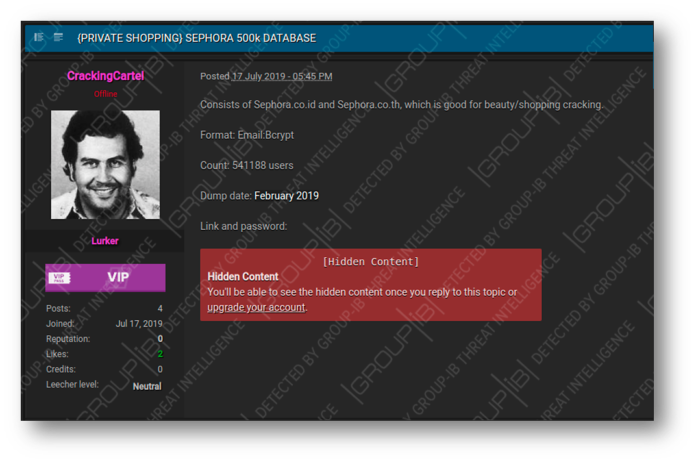
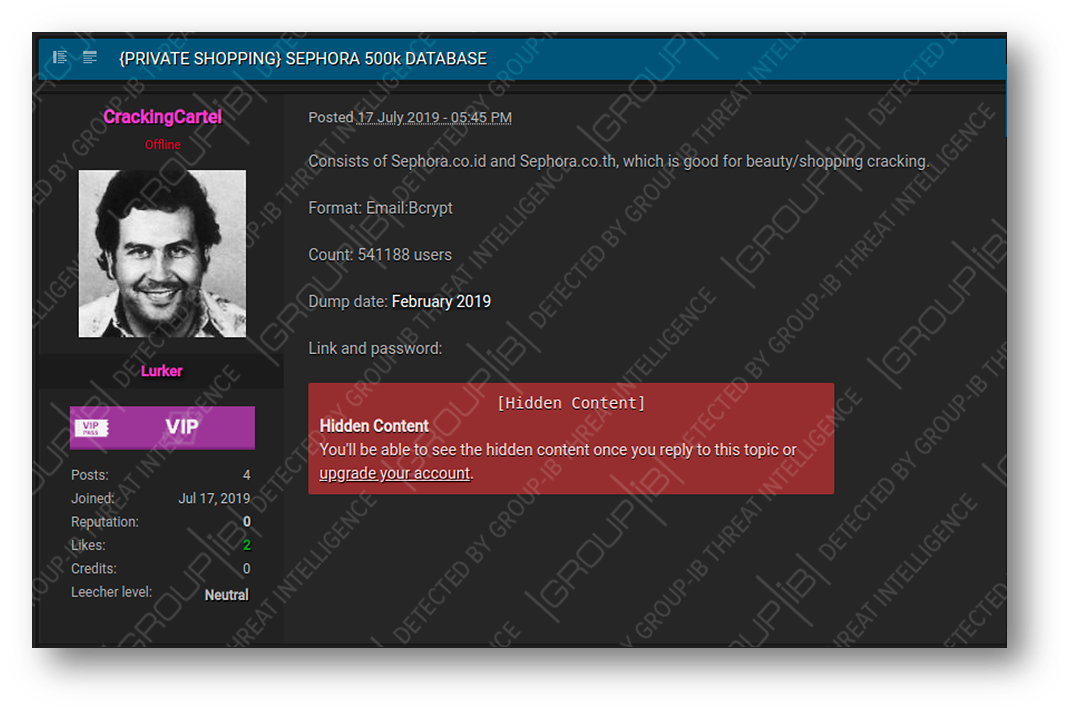
CEO Ilya Sachkov said in the release that the first database was advertised on two underground forums on Jul 6 and Jul 17, respectively. According to the seller, the database consists of 500,000 records including the user names and hashed passwords from Sephora’s Indonesia and Thailand websites.
(Screengrab: Group-IB)
The listing said the data was from February this year, he added.
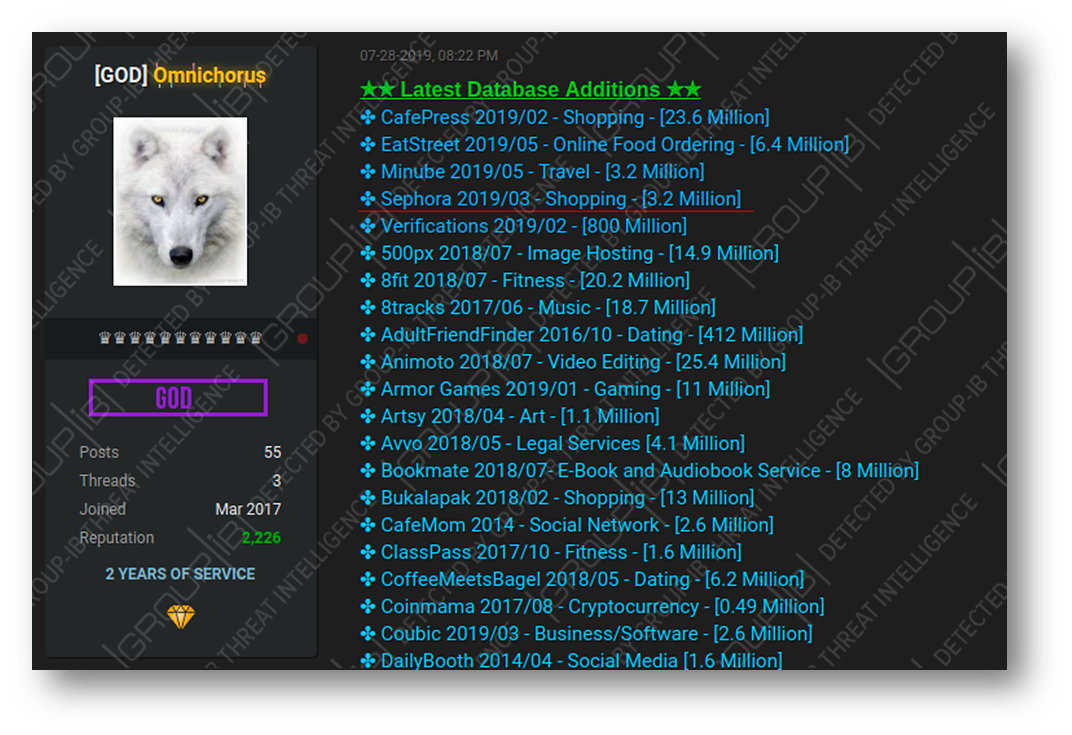
The second database surfaced on an underground forum on Jul 28 this year, a day before news of the breach broke. The database name – “Sephora 2019/03 – Shopping – [3.2 million]” – contained 3.2 million records and was leaked in March this year, the company said.
(Screengrab: Group-IB)
The CEO said his team used its proprietary tools to “infiltrate sources in closed hacking communities” to contact the seller, who then provided the sample of the data being sold.
The sample showed the databases contains login, encrypted password, date of registration and last activity, IP of registration, last IP, gender, name, surname, ethnicity, eye color, skin tone, skin type, hair color, hair concerns, makeup essentials, and skincare routines, he said, adding the set of data was being sold for US$1,900 (S$2,613).
“Even though the records do not include any payment information or decrypted passwords, such detailed information about the customers can be used to carry out social engineering or targeted phishing attacks. That is why the scale of the breach shouldn’t be underestimated,” Mr Sachkov said.
CNA has contacted Sephora for its comments on Group-IB’s findings.
The international beauty retailer said on Monday personal details of Sephora’s online customers in Singapore, Malaysia, Indonesia, Thailand, the Philippines, Hong Kong, Australia and New Zealand have been leaked but did not disclose the number of affected customers.
It added that no credit card information was accessed and it has no reason to believe that any personal data has been misused. It also contracted external experts, who concluded that there was no major vulnerability found on Sephora’s Southeast Asia websites and found no trace of a cyberattack.
However, these statements drew criticism from another cybersecurity vendor. Mr Nabil Hannan, managing principal at Synopsys Software Integrity Group, questioned Sephora’s claim that it found no reason any personal data has been misused.
“This is very hard to claim given they have made a statement that user data has been breached, including things like first and last name, date of birth and gender,” Mr Hannan said. “It’s not possible to determine how this data may have been misused after the breach.”
He also pointed out that while no major vulnerability was found, this may not be required for a breach to happen.
“Organisations also need to consider that potential malicious insider threats may exist,” Mr Hannan said. “For example, when looking at where the database was breached, it’s important to understand the threat model of the system, and determine things like who had access to the database and if they really needed to have access.”
The Personal Data Protection Commission of Singapore (PDPC) said it has been notified by Sephora Digital SEA of the incident and is “looking into it”.
SINGAPORE: Vulnerable youths, seniors and persons with disabilities (PWDs) may get stronger support as well as access to sporting programmes with the help of a new S$12 million fund by SportCares, the philanthropic arm of Sport Singapore.
Culture, Community and Youth Minister Grace Fu, who announced the Communities of Care Fund at this year’s Inclusive Sports Festival, said this will go some way to improve their physical and socio-emotional wellbeing.
Under the fund, organisations that wish to design and develop inclusive sports-based programmes can tap on a starter grant to kickstart their project.
“The fund aims to support more ground-up initiatives; whether you are a volunteer group or a group of basketball players who want to extend the sport to at-risk youths. If you want to start something and don’t know how to do that, to provide some basic amenities and facilities, the fund is there to support,” said Ms Fu.
Ms Grace Fu at the Inclusive Sports Festival, where the SportCares Communities of Care Fund was announced on Aug 1, 2019. (Photo: Sport Singapore)
Social enterprise Glyph, which focuses on helping youths from low-income or disadvantaged households, told CNA that the fund can also be used to expand its programme offerings.
“From squash to ice skating to rock climbing; it’s really just giving these kids something they might not have experienced in school or might not (be able) to afford,” said Mr Shaun Wang, one of the directors of Glyph.
Mr Wang added that it could also be used to expand the group’s outreach efforts.
“Right now we are centrally located, and we want to get out to the northern, eastern and the western parts of Singapore, where there are not that many Voluntary Welfare Organisations that provide sports programmes for youths. We want to give them the opportunity to find something that they can be passionate about,” he said.
Ms Grace Fu participating in a group photo-taking session at the Inclusive Sports Festival. (Photo: Sport Singapore)
Those in sports teams believe that the fund can help them get access to more training resources such as better equipment.
“We really struggled a lot with running the Wheelchair Rugby games – the training, the maintenance of chairs. Previously, we didn’t have anything. But things have improved over the years,” said Mr Danial Bawthan, a member of the Wheelchair Rugby team.
“We do want to win some medals, we do want to throw ourselves out there and compete. But, you know, due to a lot of limitations, we are not really capable of doing it yet. If the money is properly budgeted and allocated to the key areas, then we will see growth,” he said.
The Communities of Care Fund was established to provide greater access to sporting programmes and support for vulnerable individuals. (Photo: Sport Singapore)
Part of the fund will be set aside for bursaries so that more can get equal access to sports programmes.
The initiative is expected to benefit more than 100,000 people by 2023.
This year’s Inclusive Sports Festival features more than 10 workshops and talks will touch uponvarious adapted and disability sport topics to help the public understand from the perspective of persons with special needs or disabilities.
One highlight is the Dialogue in the Dark experience, which allows participants to understand total vision loss.
SINGAPORE: National water agency PUB will carry out inspections and fogging near Pandan Reservoir to control the rising midge population, it said on Thursday (Aug 1).
“There has been an increase in midges around the HDB blocks near Pandan Reservoir recently due to the hot and wet weather,” said PUB in a Facebook post.
PUB officers carrying out fogging operations near Pandan Reservoir. (Photo: Facebook/PUB)
Midges, which are commonly mistaken for mosquitos, are small insects which exist in and near water bodies.
“While these midges do not bite or spread diseases, they can be a nuisance when present in large numbers,” said PUB.
“PUB has been closely monitoring the situation and has stepped up measures at the reservoir to control the midge population.”
Such measures include the removal of midge egg masses that are attached to floating structures and rocks along the edges of the reservoir, as well as using biological larvicide in the reservoir to kill the larvae.
Fogging is also being carried out twice daily, in the morning and afternoon, around the reservoir dyke, drains and surrounding vegetation, PUB said.
“Strong spotlights at the Pandan Reservoir pumping station are turned on daily from 7pm to 7am to attract the adult midges and deter them from flying into nearby residential estates,” added PUB.
Additionally, extended fogging will be carried out at nearby HDB void decks and inspection checks will be done at the affected blocks and surrounding areas.
To facilitate such operations, from Aug 1, Pandan Reservoir and the Amenities Centre toilets will be closed from 6pm to 9am. The second floor of the Amenities Centre will also be closed until further notice.
Midges, which occur naturally in ponds, waterways and reservoirs, cannot be eradicated completely, said PUB.
It added that residents may wish to install insect screens across windows and doors to prevent midges from entering their homes.
Midges in Singapore are more active during the cooler parts of the days, including early mornings and late evenings, according to an FAQ on PUB’s website.
There are approximately 57 species of non-biting midges in Singapore’s reservoirs.
SINGAPORE: Singapore scientists have discovered a new antibody drug that could potentially be used as an alternative for chemotherapy in treating cancer.
In a scientific advisory issued on Thursday (Aug 1), the Agency for Science, Technology and Research’s (A*STAR) Institute of Molecular and Cell Biology (IMCB) announced the findings of a study that had been published in scientific journal Nature Communications on Jun 6.
The findings revealed the scientists had generated PRL3-zumab, a humanised antibody. Using antibodies to attack cancer cells in the body is a form of cancer immunotherapy that harnesses the immune system to kill cancer cells.
PRL3-zumab targets the PRL-3 protein, a tumour antigen that promotes cancer growth and is found in about 80 per cent of 11 common cancers the researchers examined.
This targeted treatment does not damage surrounding healthy cells that do not express PRL-3.
The immunofluorescence image depicts cancer cells expressing PRL-3 tumour antigen, which the PRL3-zumab antibody drug binds to (green); healthy cells with Tiam antibody labelling as control (red). (Image: Professor Qi Zeng, Research Director, Institute of Molecular and Cell Biology (IMCB), A*STAR)
Professor Qi Zeng, research director at IMCB and lead researcher of the study, said: “PRL3-zumab represents an innovative and disruptive approach to cancer therapy, as it is highly targeted to cancer cells and has less side effects compared to traditional cancer drugs.”
Traditionally, chemotherapy targets cells that grow and divide quickly. This means that other than killing cancer cells, it can also affect other fast-growing healthy cells, like those of the hair, skin, intestines and bone marrow.
The IMCB research team first tested on animal models and found that the PRL-3 mouse antibody could suppress tumour growths that expressed the PRL-3 antigen in gastric, liver, lung, ovary, breast, acute myeloid leukaemia (AML) and kidney cancers.
The team has also been testing the PRL3-zumab on human tumour samples since 2012 and results showed that the antibody can be used against a broad spectrum of common cancers, including those of the liver, lung, gastric, breast, colon and kidney.
In 2018, PRL3-zumab completed Phase 1 clinical trials at the National University Cancer Institute and will soon be undergoing Phase 2 to test for efficacy and proof of concept of the therapy.
SINGAPORE: There were warning signs before a section of a viaduct under construction gave way in the early morning of Jul 14, 2017, killing a worker and injuring 10 others who were on top of it.
A month before the incident, employees of builder Or Kim Peow (OKP) Contractors were aware of cracks in support structures, but did not inform the registered professional engineer of the project, Robert Arianto Tjandra.
When cracks were found a second time, Tjandra ordered checks and learned about errors in the initial design of corbels – support structures meant to distribute the vehicular load – but did not inform OKP.
On the day of the incident, the project engineer saw cracks on the corbels at the section of the viaduct that later collapsed, and sent photos of them to the project director, but neither of them stopped the construction works.
This was part of the case that the prosecution will build against OKP and three other accused individuals over the collapse of the viaduct from Tampines Expressway to the Pan Island Expressway and Upper Changi Road East, it was revealed in court at the opening of the trial on Thursday (Aug 1).
CHARGES FACED BY BUILDER AND THREE MEN
The three men contesting charges are: Tjandra, 46, who was employed by CPG consultants and acted as the qualified person for design and supervision of the project; Wong Kiew Hai, 31, the project engineer working for OKP; and OKP project director Yee Chee Keong, 49.
Tjandra faces the most number of charges – four charges under the Building Control Act and one charge under the Workplace Safety and Health Act.
Wong and Yee face a charge each of recklessly endangering the safety of everyone on the portion of the viaduct that collapsed – between piers 40 and 41 – when they discovered cracks on the corbels on the day of the incident but failed to cease all works.
Both men are also accused of obstructing the course of justice by deleting a WhatsApp conversation between the two of them that contained photographs of the cracks on corbels at piers 40 and 41.
OKP Holdings, of which Or Kim Peow Contractors is a wholly owned subsidiary. (Photo: Justin Ong)
The Land Transport Authority-appointed builder OKP faces a single charge under the Workplace Safety and Health Act for failing to take necessary measures to ensure the safety and health of its workers who were casting the deck slab on the day of the incident.
The prosecution, led by deputy public prosecutors Kristy Tan and Yang Ziliang, detailed in its opening address how various parties involved in the project allegedly acted when they discovered potential problems in construction.
CRACKS FOUND AS EARLY AS A MONTH BEFORE INCIDENT
The viaduct was designed to be 1.8km long, with 50 spans in between piers, and each span divided into eight flyovers.
The section that collapsed was the 43.5m-long span between piers 40 and 41, in flyover 7. This was also the longest span in the flyover. The corbels that failed were support structures connecting columns to the girders between piers, and the ends of each girder rested on one corbel.
Cracks in corbels were discovered as early as a month before the incident, said the prosecution. OKP employees discovered the cracks on the face of the pier 41 corbel on Jun 16, 2017, after launching precast girders between piers 40 and 41.
Yee was among those allegedly aware of these cracks. OKP’s technical director and registered professional engineer Yeung Chun Keung assessed the cracks on-site and found that they were structural cracks due to bearing failure.
The builder joined two plinths – segments that rested on top of the corbels – into a single piece to increase contact surface based on Mr Yeung’s recommendation.
However, OKP did not inform Tjandra of these cracks.
More cracks were found later that month, this time on the corbels of pier 42. One of OKP’s project engineers, Goh Ee Hui, saw the cracks on Jun 30, 2017.
Mr Goh immediately reported the cracks to Yee. Mr Yeung returned to the site again and assessed the cracks, finding them once again to be structural cracks. He told Yee to ask Tjandra to check on the adequacy of the design of the crossheads.
After Yee told Tjandra about the cracks, Tjandra conducted a site inspection on Jul 3, 2017 and instructed CPG’s design engineers to check on the adequacy of the corbel designs for the entire project.
ERRORS IN INITIAL CORBEL DESIGN UNCOVERED
It is the prosecution’s case that the CPG design engineers discovered by early July 2017 that the wrong corbel width assumption had been used in the design of the corbels, including those used in the span that later collapsed.
They had wrongly assumed that the effective width of the corbel was longer than what it should be, and as a result of this error, the capacity of many corbels was inadequate for the loads they were intended to carry.
The site of an accident at an uncompleted viaduct along the PIE, where a structure collapsed on Jul 14, 2017. (Photo: Gaya Chandramohan)
Tjandra had not picked up these errors at the time of the initial design, said the prosecution. However, he became aware of them by early July 2017 after the CPG design engineers conducted checks, and did not tell OKP of the errors in the design.
He also did not redesign the corbels in piers 40 and 41 to ensure they would have the adequate capacity, the prosecution claimed.
TJANDRA DID NOT TELL OKP ABOUT ERRORS, TOOK OTHER STEPS
However, Tjandra did take other steps. On Jul 5, 2017, he sent Yee a revised construction sequence for the deck slab casting works for piers 40 and 41. He instructed the erection of 12 props under each of the crossheads at both piers, and directed OKP to cast 50 per cent of the length of the deck slab during the first stage casting instead of 75 per cent, which was what had been done for deck slabs between other piers.
Tjandra also directed OKP to stitch precast girders to the crosshead before the second stage casting, so that the load would not go down to the corbel but go to the crosshead that had been stitched to the precast girders.
Even though he revised the construction sequence in three ways, Tjandra did not inspect the installation of the props and checked the installation remotely by exchanging WhatsApp messages with Yee four days before the collapse.
He also issued a series of instructions to OKP to insert additional rebars into other corbels to reinforce them, which the builder did.
DESPITE STEPS TAKEN, STRUCTURE COLLAPSED AFTER CASTING
On the day of the incident, OKP began the first stage deck slab casting for the segment between piers 40 and 41 at 1.30am.
Less than two hours later at 2.53am, cracks appeared on the corbels at piers 40 and 41. They were seen by project engineer Wong, CPG’s resident engineer Sivanathan Shenthan, OKP’s safety supervisor Victor Tan and LTA site supervisor Syed Mohammed Farique Feshal Syed Salim Alattas.
(Image: LTA)
Wong called Yee, who was not at the site, and sent him photos of the cracks via WhatsApp. Other personnel at the site, including Mr Farique, urged Wong to stop the casting works.
However, they continued.
At around 3.25am, the corbels at piers 40 and 41 gave away, resulting in the collapse of the structure and the concrete that had been poured between the two piers that morning.
After the accident, Wong and Yee deleted the conversation “in haste to bury their responsibility”, said the prosecution.
WARNING SIGNS UNHEEDED PLACED WORKERS IN DANGER
The prosecution on Thursday told the court in its opening address that there were warning signs prior to the collapse that had not been heeded.
“Had the works been promptly halted, the workers could have been out of danger,” said the prosecutors.
Instead, 31-year-old China national Chen Yinchuan was pronounced dead at the scene at 4.35am that morning, and 10 other workers suffered injuries ranging from fractures of the spine, pelvis and limbs to lacerations and abrasions.
The prosecution intends to call expert witnesses to testify that the collapse was caused by the failure of corbels at piers 40 and 41 due to overloading, and that there was a failure in the design, as the corbels were not designed to take the bending and shear induced by loads during the casting of the deck slab.
Tjandra is defended by a team of lawyers from Rajah & Tann, led by Senior Counsel Lee Eng Beng, while Wong and Yee are represented by lawyers from Tan Rajah & Cheah, led by Senior Counsel Chelva R Rajah.
OKP has appointed a team from WongPartnership as its lawyers, headed by Senior Counsel Alvin Yeo.
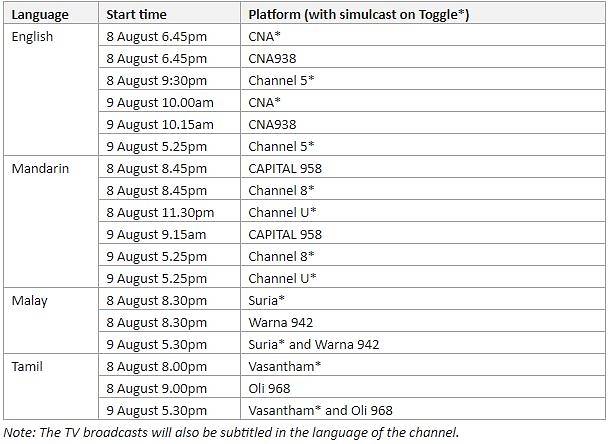
SINGAPORE: Mediacorp will broadcast a host of National Day content in August, including the parade at the Padang, Prime Minister Lee Hsien Loong’s National Day Rally and a special concert at Gardens by the Bay.
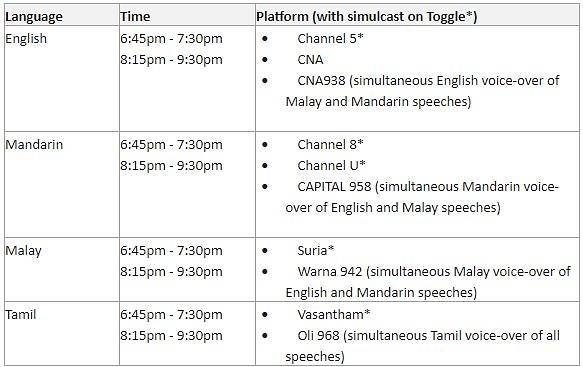
On Aug 8, Mr Lee’s National Day message will be broadcast across Mediacorp’s free-to-air channels, radio stations and digital platform Toggle.
The message will be delivered by the Prime Minister in English. Deputy Prime Minister Heng Swee Keat will speak in Mandarin, Minister for the Environment and Water Resources Masagos Zulkifli will speak in Malay, while the message in Tamil will be delivered by Minister for Communications and Information S Iswaran.
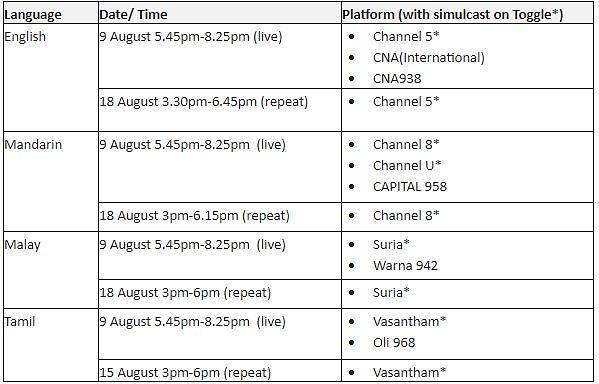
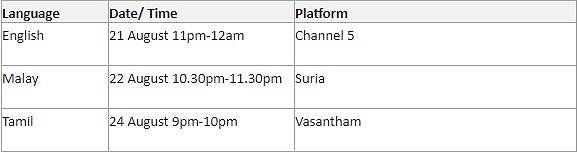
The broadcast schedule is as follows:
NATIONAL DAY PARADE
The National Day Parade 2019 will be shown live on Aug 9 across multiple platforms.
TV and radio:
There will be live captions on Channel 5. For Toggle viewers, this can be enabled or disabled via Settings on Toggle’s video player.
Live streaming will be available on CNA’s YouTube channel from 5.45pm to 8.25pm. It will also be shown on the following websites:
Those who are on the move can also catch NDP 2019 on out-of-home (OOH) screens:
Singapore’s largest outdoor digital screen (18m X 10m) at Mediacorp Campus by one-north Park: Mediapolis;
Seven outdoor screens managed by Mediacorp OOH Media at Bugis Street, Chinatown Point, JCube, Junction 8, Orchardgateway, The Star Vista and Westgate.
Watch NDP 2019 live in 4K resolution:
For the first time, Mediacorp will telecast the 54th National Day Parade in 4K resolution on Toggle.
The public can join a special viewing party at SAFRA Punggol to experience this year’s celebration in crystal-clear images with enhanced visual details and colour intensity.
This is part of SAFRA’s Rediscovering Our National Identity series of events, which includes games and other activities happening from 3pm to 8pm.
GARDENS BY THE BAY AND MEDIACORP NATIONAL DAY CONCERT
Over the National Day weekend, on Aug 10 and 11, a special two-day concert will be held at The Meadow at Gardens by the Bay.
Visitors can look forward to family-friendly fringe activities starting from 4pm on both afternoons, including workshops, celebrity meet-and-greet sessions and live broadcasts by Mediacorp radio deejays from various stations, just to name a few.
From 6.30pm on both evenings, the public can enjoy performances by local artistes.
The line-up for Aug 10 includes Kit Chan, singer-composer Dick Lee and Rahimah Rahim. Performers on Aug 11 include powerhouse vocalist Aisyah Aziz, singer-songwriter Jasmine Sokko, Singapore-born singer Gen Neo and Mandopop band AL4HA among others.
The concert will be hosted by deejays Jean Danker, Kun Hua, Farhana M Noor and Eswari Gunasagar.
Admission to the concert is free.
Highlights from the two-day concert will be shown on Channel 5 on Aug 18 in two parts, at 7.30pm to 8.15pm, and 10pm to 11pm. It will also be available on Toggle as VOD and Channel 5’s YouTube.
SINGAPORE: National Day Parade 2019, which will be held at the Padang on Aug 9, has been declared an “enhanced security special event” under the Public Order Act.
The area around the Padang has also been designated as a special event area with enhanced security measures, the police announced on Thursday (Aug 1).
Unmanned aerial vehicles or drones will not be allowed in this area without a valid permit. Offenders will have their drones seized and may be jailed for up to 12 months, fined up to S$20,000 or both.
Within the special event area, there is a special zone where stricter security checks will be conducted. All vehicles and anyone entering this area will be screened, and the police will have the power to refuse entry to or remove anyone from the special zone if necessary.
The special event area and special zone will take effect from midnight to 11.59pm on Aug 9. Should the parade take place on the reserve date, Aug 10, the gazette will take effect on that day, the police said.
The police also listed items that are prohibited within the special event area:
Any noxious or offensive substance;
A marine flare and signal, landing flare, highway fuse, smoke generator, distress signal or other pyrotechnic device intended for signalling, warning, rescue or similar purposes;
Any petroleum or flammable material within the meaning of the Fire Safety (Petroleum and Flammable Materials) Regulations (Cap. 109A, Rg 7);
An explosive within the meaning of the Arms and Explosives Act (Cap 13);
Any arms within the meaning of the Arms and Explosives Act;
An item capable of attaching a person to an object or another person, or preventing removal of any locking or connecting device;
An aerosol paint container or other implement or substance that is capable of being used to mark graffiti;
Any sound amplification device, such as a loud hailer;
Any of the following things that contains or displays any message, picture or image, or any explicit or implicit reference or comment that can reasonably be regarded as intended to demonstrate support for or opposition to the views or actions of any person, group of persons or any government, to publicise a cause or campaign, or to mark or commemorate any event: A banner, flag, placard, T-shirt or any other article of apparel, an umbrella or an inflatable object;
Any public address system, electronic equipment, broadcast equipment or similar device which may interfere with broadcast equipment or similar devices being used by the event organiser of the NDP at or for the special event, or a person authorised by the event organiser or under the Act to use such devices;
A remotely piloted aircraft system for a remotely piloted aircraft, comprising the remotely piloted aircraft, every remote pilot station associated with the remotely piloted aircraft containing the equipment used to pilot that aircraft, the command and control links between the remotely piloted aircraft and its remote pilot stations, as well as any other components as specified in the type design of the remotely piloted aircraft system, to fly that aircraft.
Anyone found in possession of these items may be arrested, the police said. If convicted, they could be jailed for up to 12 months, fined a maximum of S$20,000 or both. The items will also be seized.
“The police seek the cooperation of the public to comply with all orders issued by police officers. Persons who engage in activities that compromise security within the special event area and the special zone will be dealt with firmly in accordance with the law,” the police said.
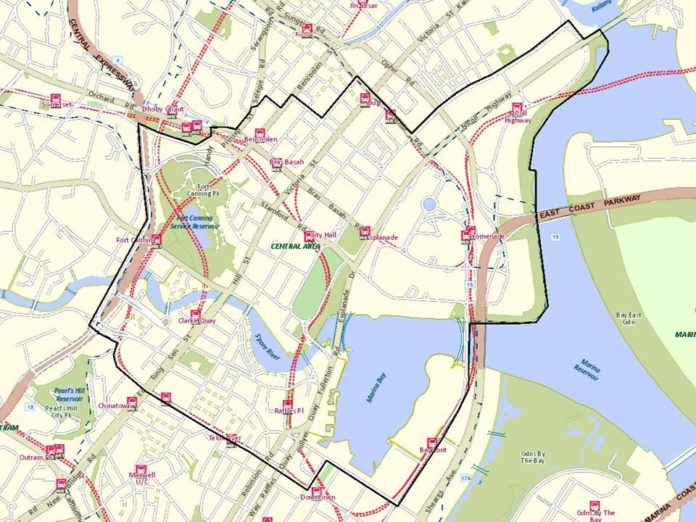
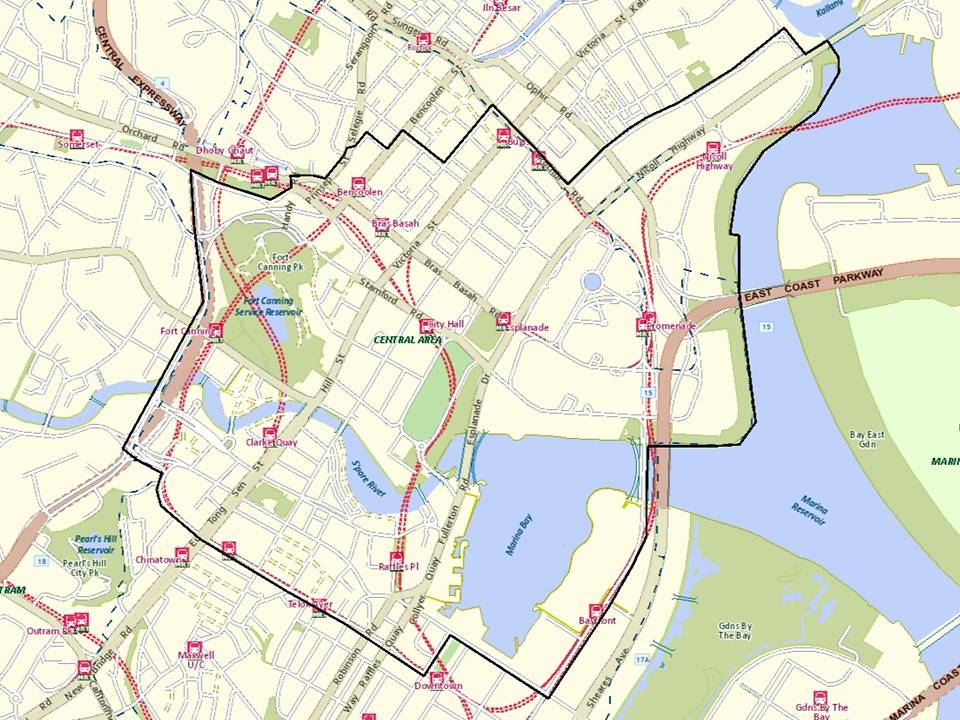
The special event area is marked by the following boundaries:
The special event area for NDP2019, outlined in black. (Map: SPF)
1. Marina Boulevard 2. Marina View 3. Central Boulevard 4. Cross Street 5. Upper Cross Street 6. Clemenceau Avenue 7. Penang Road 8. Handy Road 9. Orchard Road 10. Prinsep Street 11. Prinsep Link 12. Bencoolen Street 13. Middle Road 14. Queen Street 15. Rochor Road 16. Beach Road 17. Republic Avenue 18. Nicoll Highway 19. Western bank of the Marina Reservoir 20. Bayfront Bridge 21. Bayfront Avenue
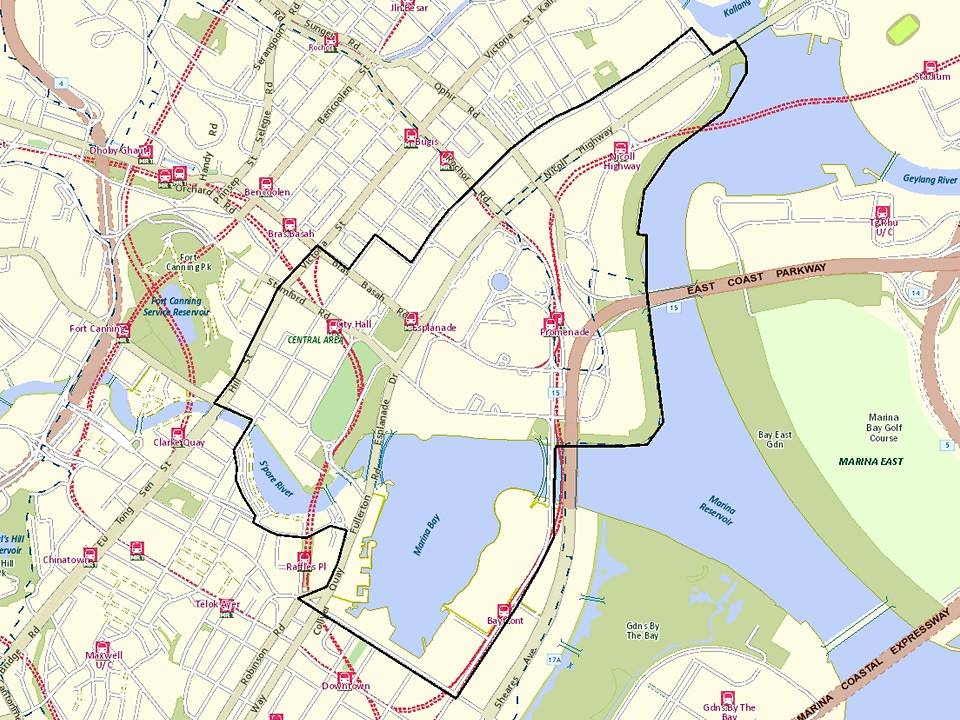
The special zone is marked by the following boundaries:
The special zone for NDP2019, outlined in black. (Map: SPF)
1. Marina Boulevard 2. Finlayson Green 3. Collyer Quay 4. Battery Road 5. Chulia Street 6. South Canal Road 7. Circular Road 8. South Bridge Road 9. North Boat Quay 10. Hill Street 11. Victoria Street 12. Bras Basah Road 13. North Bridge Road 14. Seah Street 15. Beach Road 16. Republic Avenue 17. Nicoll Highway 18. Western bank of the Marina Reservoir 19. Bayfront Bridge 20. Bayfront Avenue
SINGAPORE: Can’t separate your rubbish because you don’t have a recycling bin at home? That excuse will no longer hold for 18,000 households, who will get a free recycling bin in a joint initiative by the National Environment Agency (NEA) and IKEA Singapore.
The initiative aims to help more households recycle regularly by making it easier for them, said NEA and IKEA in a news release on Thursday (Aug 1).
“The recycling bin allows households to accumulate their recyclables at home, and it also serves as a visual reminder to encourage regular and correct recycling habits,” the release said.
Over the next few months, residents of Build-to-Order flats in new Housing and Development Board (HDB) precincts – such as MacPherson, Bidadari, Sembawang and Sengkang – will receive a voucher by mail to redeem the recycling bin.
About 18,000 households will receive the voucher, which can be used from Aug 24 at either of the furniture retailer’s two outlets at Tampines and Alexandra.
Residents can redeem a recycling bin from IKEA with this voucher.
For these households, convenience was cited as an important factor for recycling. For residents who did not recycle, the most common reason was that they had too few items to recycle. Respondents also said habits play a major role in their recycling behaviour.
“New habits and routines are more likely to be cultivated when there is a change in one’s life circumstances or environment, such as when moving in to a new home,” NEA said. “This would include new homeowners, who are likely to be more receptive to making changes to their routines and establishing new recycling habits.”
RECYCLING BIN TAKES INTO ACCOUNT PUBLIC’S FEEDBACK: NEA
NEA also conducted six focus group discussions with members of the public from February to March to find out their preferences for recycling receptacles – an adhesive hook, a standard S-hook and a cardboard box. The cardboard box was the preferred option, the agency said.
Respondents generally preferred a recycling receptacle that was durable, washable, functional and in neutral colours, it added.
“The recycling bin takes into account this feedback, and further improves on the form of the recycling receptacle to be rolled out. The bin provided by IKEA Singapore is also made from 60 per cent recycled plastic with a design that easily fits into any home,” NEA said.
A typical household can accumulate recyclables for at least a few days before depositing them into the blue recycling bins found at the bottom of HDB blocks or recycling chutes on common floor landings, it said.
A prominent blue recycling label will be affixed to the bins, with recycling tips such as ensuring that recyclables are free from food and liquid, and rinsing bottles and containers before recycling them. Fridge magnets will also be given out to guide households on what can or cannot be recycled.
NEA chief executive Tan Meng Dui said the agency hopes to encourage households to make recycling a daily routine.
“For the HDB households which will benefit from this new initiative, the in-home recycling bin makes recycling things more convenient than disposing them as garbage. This is happening for the first time in an HDB living environment,” he said.
NEA said it will also improve the design of the labels on the blue recycling bins to help people recycle right. More details on the new label will be announced later this year, it said.
SINGAPORE: Financial services firm NETS has apologised for a recent advertisement of its electronic payments app E-Pay, which drew a backlash online for its stereotypical portrayals of the different races in Singapore.
“NETS would like to apologise for any hurt that its campaign has caused,” the company said in a statement on Thursday (Aug 1).
In the ad, Mediacorp actor and deejay Dennis Chew, who is Chinese, appeared in “brownface” – the act of darkening one’s fair skin to mimic that of another race – as an Indian character and as a Malay woman wearing a headscarf. It also showed him cross-dressing as a Chinese woman.
NETS said the intent of the campaign “was to communicate that e-payment is for everyone”.
It added: “The campaign was in connection with the unified e-payment initiative, a multi-agency effort led by Enterprise Singapore, where NETS was appointed as the master acquirer to handle payment transactions and drive adoption of e-payment in small food businesses.”
Amid the online flak, local Internet star Preeti Nair, who goes by the name Preetipls, posted an online video on Monday in response to the ad. Police on Tuesday said it was investigating the video for “offensive content”, after a report was lodged against it.
In the video titled K Muthusamy, shot outside a food court featuring the e-payment ad, Ms Preeti and her brother Subhas rapped about racial stereotypes faced by the Indian and minority communities in Singapore.
The video was laced with profanity, targeting the Chinese.
It was watched more than 40,000 times on Facebook. It was also uploaded on YouTube and a portion of it was posted on Instagram.
Screengrab of the video posted by Internet star Preetipls.
The Infocomm Media Development Authority (IMDA) issued a takedown for the video on the three online platforms, saying that it “is objectionable on grounds of public interest and national harmony”.
Law and Home Affairs Minister K Shanmugam said on Tuesday that a line has to be drawn on videos that “attack another race”.
“This rap video insults Chinese Singaporeans, uses four-letter words on Chinese Singaporeans. Vulgar gestures, pointing of middle finger to make minorities angry with Chinese Singaporeans,” Mr Shanmugam told reporters.
“When you use four-letter words, vulgar language, attack another race, put it out in public, we have to draw the line and say not acceptable.”
Mr Shanmugam said he could also understand the flak received by the E-pay ad.
“You need the cultural sensitivity,” he said. “You have a Chinese brown out the face and pass off as an Indian or Malay, there’s going to be a lot of distaste. Similar things have happened in other countries and really should have taken a reference from that to see how people will react.”
NETS had engaged creative agency HAVAS Worldwide for the publicity campaign, who then engaged Mediacorp’s celebrity management arm, The Celebrity Agency, to cast Chew as the face of the campaign.
Both HAVAS Worldwide and The Celebrity Agency have apologised for “any hurt that was unintentionally caused”.
“The message behind this advertising campaign is that e-payment is for everyone. For that reason, Dennis Chew, well-known for his ability to portray multiple characters in a single production in a light-hearted way, was selected as the face of the campaign,” the agencies said in a statement on Monday.
When contacted, Mediacorp said in a statement on Tuesday that the portrayal of some races in the advertisement was “done in an insensitive fashion”.
“We take full responsibility and apologise unreservedly,” it added. “We will have more stringent safeguards in place to prevent a repeat of such a mistake.”