SINGAPORE: Most Singaporeans accept that immigration is important, but many also feel that immigrants can do more to integrate into Singapore.
This is according to an Institute of Policy Studies (IPS) survey of about 4,000 Singapore citizens and permanent residents last year. The findings were released at the National Integration Council (NIC) Convention on Saturday (Aug 3).
About nine in 10 of those surveyed felt that it was good to have people of different nationalities living in the same neighbourhood. They also said they can learn a lot from the immigrants’ cultures.
But more than six in 10 said immigrants are not doing enough to integrate into Singapore.
Dr Mathew Mathews, senior research fellow at IPS, said this could be a matter of perception.
“Few people see some of the community kind of activities, some of the attempts of the neighbourhood, in the workplace to do that. Also, sometimes it also points out the fact that there might be issues that immigrants may need to be more informed. Maybe there are cultural practices, local norms which they may not be so familiar with,” he said.
Culture, Community and Youth Minister Grace Fu speaking at the National Integration Council Convention on Aug 3, 2019. (Photo: Jeraldine Yap)
SINGAPORE NEEDS TO REMAIN OPEN TO NEWCOMERS: GRACE FU
Speaking at the convention, Culture, Community and Youth Minister Grace Fu said that being open and integrating immigrants in Singapore is a part of the country’s evolution.
And while there are challenges to integration, Singapore must remain open to newcomers, especially given its ageing population, increasing numbers of transnational families and a low replacement rate.
“In fact, our openness and ability to work with people from different backgrounds has become our competitive advantage and a strength to our economy. These qualities will help us as we strive to be a hub in areas such as technology, infrastructure development, and research and innovation. We also benefit when people with resources and ideas continue to invest in Singapore, injecting vibrancy in our economy, and creating more opportunities for Singaporeans and our businesses,” she said.
NEW WORKGROUP TO LOOK AT WHAT IT MEANS TO BE SINGAPOREAN
Ms Fu announced that a new workgroup will be formed with Singaporeans to refresh the content of the Singapore Citizenship Journey. The programme helps new citizens deepen their knowledge of Singapore’s history and culture, and also gives them opportunities for meaningful interaction with the community.
“The workgroup will develop content that explains our values and obligations as Singaporeans, the norms of our society, and create a common understanding of our culture and national history. Citizens will have a say in what it means to be a Singaporean,” she said.
Ms Fu noted a series of dialogues were held from March to June to seek ideas on what more the NIC should do.
“For instance, we picked up that one of the major stumbling blocks is the limiting beliefs and perceptions about each other due to stereotypes, fear of rejection and lack of trust. To overcome this, many of our participants agreed that daily interactions at the personal level is the best place to start from, but we need to first overcome our initial inertia,” she said.
She called on individuals and organisations to do their part in their respective spheres to help improve integration.
Sixteen individuals and organisations were recognised at the National Integration Council (NIC) Convention on Aug 3, 2019, for their efforts to promote social integration. (Photo: Jeraldine Yap)
16 RECOGNISED FOR PROMOTING SOCIAL INTEGRATION
More than 200 participants from organisations such as community groups, immigrant associations and businesses attended the convention.
Sixteen organisations and individuals were recognised for their efforts to promote social integration between Singaporeans and foreigners. They include Republic Polytechnic, PwC Singapore and KK Women’s and Children’s Hospital.
A commemorative book was also launched to mark the 10th anniversary of the NIC. Titled Notes of Gratitude, it chronicles the council’s efforts and celebrates contributions from the people, public and private sectors to social integration.
A commemorative book titled Notes of Gratitude, which documents the National Integration Council’s efforts and celebrates contributions to social integration. (Photo: Jeraldine Yap)
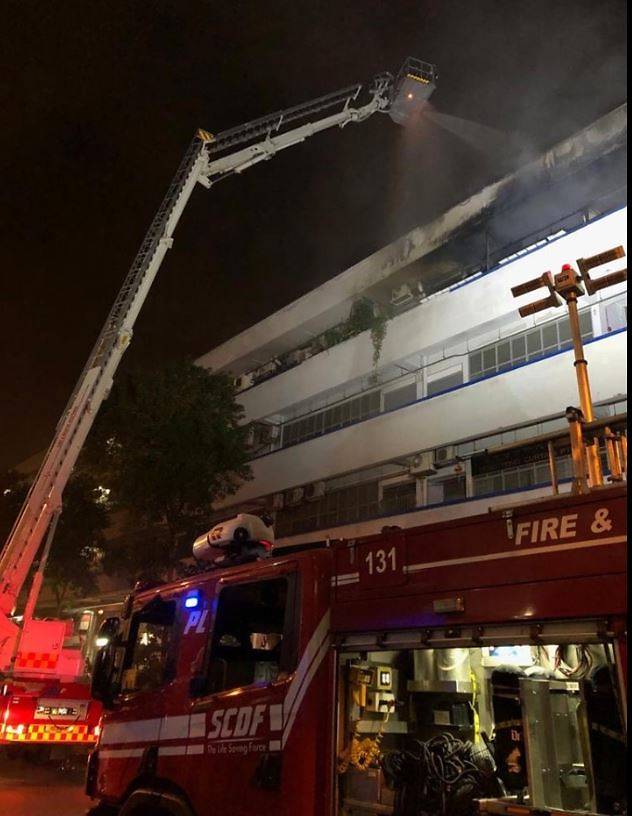
SINGAPORE: A raging fire ravaged two warehouse units in Bukit Batok early on Saturday (Aug 3) morning, the Singapore Civil Defence Force (SCDF) said in a Facebook post.
The units, located on the fourth floor of an industrial building at 2024 Bukit Batok Street 23, were used to store personal mobility devices and electrical items.
SCDF officers had to force their way into the units to contain the fire, they said.
A fire ravaged two warehouse units in Bukit Batok early on Saturday (Aug 3) morning, the Singapore Civil Defence Force (SCDF) said. (Photo: Facebook/Singapore Civil Defence Force)
“The fire was extinguished in about three hours,” SCDF said of the fire, which they responded to at about 1.20am.
A fire ravaged two warehouse units in Bukit Batok early on Saturday (Aug 3) morning, the Singapore Civil Defence Force (SCDF) said. (Photo: Facebook/Singapore Civil Defence Force)
Three handheld water jets and an aerial water monitor were used to bring the fire under control.
There were no reported injuries and the cause of the fire is under investigation.
The number of reported fires involving power-assisted bicycles (PAB) and PMDs has more than doubled in the first half of 2019, compared to the same period last year.
The SCDF said in a Facebook post on Jul 26 that there were a total of 54 reported fires involving such mobility devices from January to June this year, compared with 24 such fires during the same period last year.
SINGAPORE: Creating jobs, helping displaced workers find jobs and lowering the voting age are among the issues the new Progress Singapore Party (PSP) – which held its public luanch on Saturday (Aug 3) – aims to champion at the next General Election (GE).
PSP, founded by former People’s Action Party (PAP) member Tan Cheng Bock, organised two sessions of its launch event on Saturday at Swissotel Merchant Court.
Dr Tan Cheng Bock, secretary-general of the Progress Singapore Party (PSP), giving a speech at the official launch of the party on Aug 3, 2019. (Photo: Darius Boey)
During the launch, the party again introduced its central executive committee members, which included secretary-general Dr Tan, assistant secretary-general Lee Yung Hwee, S Nallakaruppan and Abdul Rahman.
Ms Hazel Poa and Ms Michelle Lee, both of whom have contested in previous General Elections under the National Solidarity Party (NSP) and Singapore Democratic Party (SDP) banners, rounded off the team.
Dr Tan said that the creation of jobs is the party’s “top priority” during this time of transition and uncertainty in the global economic landscape.
During the question-and-answer segment of the event, the 79-year-old said this meant creating jobs as well as making sure policies are created to help workers already in jobs.
Dr Tan Cheng Bock, secretary-general of the Progress Singapore Party (PSP), giving a speech at the official launch of the party on Aug 3, 2019. (Photo: Darius Boey)
During his speech, he had also made the case for more to be done to match worker training and jobs.
“We suggest that more in-depth training be linked to jobs. So that after completing the training programmes, trainees are matched with secure jobs.”
He added: “For vocational workers, their pay should reflect their skills and difficulty of labour. To be skilled in a craft should be accepted as an alternative path.”
Mr Nallakaruppan added that as technology displaces those in “middleman jobs” such as stockbrokers and insurance and property agents, who are usually workers in their 40s, 50s and 60s, it is good that the Government has provided subsidies for them to be retrained.
“But we must move beyond that. What’s the point if you’re in your late 50s and you get a certificate? There’s no point collecting certificates when there’s no job,” he said.
Progress Singapore Party (PSP) treasurer S Nallakaruppan answers a question from the audience at the official launch of the party on Aug 3, 2019. (Photo: Darius Boey)
What PSP is proposing is for workers to be recruited first, then go for retraining and be retooled for the new job, said the party treasurer.
Another issue PSP highlighted at the launch is the need to include Singapore’s youths in the political decision-making process, and proposed lowering the voting age to 18 from 21 currently.
“At 18, they’re old enough to drive. The girls enter university, and the boys enter into National Service. Since they have a duty to defend our country, these 18-year-olds should also have the right to elect their leaders. They are mature enough,” said Dr Tan in his speech.
Ms Lee added that Singapore is “already behind the times”, given that many countries’ voting age is 18, while neighbouring Malaysia on Jul 16 approved a Bill to do so this year.
Progress Singapore Party (PSP) CEC member Michelle Lee answers a question from the audience at the official launch of the party on Aug 3, 2019. (Photo: Darius Boey)
“GET US INTO PARLIAMENT”
The party also touched on the India-Singapore Comprehensive Economic Cooperation Agreement (CECA), which Dr Tan noted was negotiated by current Deputy Prime Minister Heng Swee Keat.
This agreement needs to be reviewed, said Dr Tan, adding that the PSP is asking for the Government to publish a balance sheet to see how Singapore has benefited from the agreement.
There is a need for accountability, he argued.
Besides these, Dr Tan also mentioned a laundry list of issues that PSP wants to champion: Accountability, independence of key institutions, transparency, income inequality, retirement adequacy, lower cost of living, educating people for the future economy and make public housing affordable.
However, he said that while PSP wants to review these issues extensively, this needs to be done with data.
“We have to have the data. And to have those data, there’s no other way – you have to get us into Parliament. That is important,” Dr Tan said.
He added that the party will reveal more of their proposals when GE comes.
“This is politics. In politics, you only show the cake but not the ingredients. The time will come when I show you the cake and the ingredients,” he said.
A member of the public asks a question at the official launch of the Progress Singapore Party (PSP) on Aug 3, 2019. (Photo: Darius Boey)
He had said at last week’s press briefing that PSP will not be disclosing any policy proposals in detail as part of its strategy. If he did reveal all, PAP would know everything, the veteran politician explained.
“If I told the whole world what I want to do, the PAP will know everything so I have to keep some issues close to my heart and we’ll reveal it as close when the GE comes,” Dr Tan said then.
SINGAPORE: The National Heritage Board (NHB) intends to gazette the Padang and the Singapore River Bridges as national monuments, Deputy Prime Minister Heng Swee Keat said on Saturday (Aug 3).
Mr Heng made the announcement to commemorate the nation’s bicentennial this year, “in light of the significance that the Singapore River Bridges and the Padang have to our growth and development as a nation”, said NHB in a news release.
This will also accord these sites with the “highest level of preservation in view of their national significance”, it added.
Singapore currently has 72 national monuments, including the Istana, Esplanade Park Memorials and Raffles Hotel.
The Padang is one of the oldest open spaces in Singapore for public recreation, NHB said, and has been a commemorative space for people to gather and participate in key milestones of Singapore’s history.
The Padang in 1966 where the first National Day Parade was held. (Photo: National Archives of Singapore/Ministry of Information and the Arts collection)
The Padang has borne witness to key events throughout Singapore’s history, including the swearing-in of Singapore’s first President Yusof Ishak in 1959.
Several National Day Parades, including the first in August 1966, were held at the Padang as well.
The venue is bordered by other national monuments such as the Cenotaph, former Supreme Court and Victoria Theatre and Concert Hall.
The Singapore River Bridges – which consist of the Cavenagh, Anderson and Elgin bridges – will be collectively gazetted as they are “the three most historic and architecturally impressive bridges spanning the Singapore River”, said NHB.
“Apart from the vital role they played in Singapore’s growth as a trading port and city, the Singapore River bridges represent the progression of engineering technology in bridge construction from the mid-19th to the mid-20th centuries,” NHB added.
Cavenagh Bridge, the oldest surviving bridge across the Singapore River, was completed and opened in 1869. (Photo: National Heritage Board)
Elgin Bridge is the site of the first footbridge to be built in Singapore in the 1820s. The present bridge was rebuilt and opened in 1929. (Photo: National Heritage Board)
“The Padang and the Singapore River bridges have been pivotal to Singapore’s early years,” said Ms Jean Wee, director of the Preservation of Sites and Monuments division at NHB.
“Both these impending gazettes will contribute to the architectural and cultural diversity of our nation’s built heritage and together with our 72 other national monuments, preserve and celebrate the many places and stories that define Singapore and our people,” she added.
SINGAPORE: Reversing into a gravel-laden road, the first glimpse of Mr Makoto Koike’s cucumber farm came into view. It was a sight for sore eyes, having travelled more than three hours from Tokyo to reach the sleepy town of Shirasuka in the Shizuoka Prefecture.
As greenhouse farms go, it looked pretty unremarkable, with transparent tarpaulin covering the 38-year-old farmer’s prized produce – the Japanese cucumber.
But behind the scenes, strange things were happening. The visionary farmer is using technology to help transform the way a decades-old family business operates.
Every day at around this time of year, the farm produces about 100kg – or about 1,200 cucumbers – and this could go up to 500kg during the peak harvesting season. These then have to be sorted according to nine different quality grades depending on the cucumber’s attributes like size, shape, consistency and colour, Mr Makoto explained when CNA visited the farm last month as part of a Google-organised media trip.
A discoloured or out-of-shape cucumber is deemed inferior to one that is consistently straight and dark green all the way through.
This sorting process is crucial to the family’s business given that premium-quality Japanese cucumbers are highly sought after, particularly by sushi establishments around the country. During the winter peak season, 5kg of these cucumbers can go for anything between 1,000 yen (S$12.54) and 2,000 yen (S$25.10), he said, adding that its value drops to about 800 yen (S$10) for the same amount during the off-peak summer season.
Yet the bulk of the sorting process has been carried out by his 64-year-old mother Masako, who needs about 2-3 hours to sort about 50kg of cucumbers at any sitting, Mr Makoto pointed out. During the peak season, he said she could spend eight hours straight just identifying the different grades of cucumbers and throwing them into the various boxes in the family’s musky, cluttered shed.
To alleviate her workload, he turned to artificial intelligence (AI) for help. In 2016, the former auto industry engineer leaned on his programming language skills and picked up AI – specifically Google’s open source machine learning tool TensorFlow – to figure out how to automate the very tedious and manual process of sorting the cucumbers.
The first iteration of his AI-enabled cucumber sorting machine achieved an accuracy rate of 60 per cent when benchmarked against his mother’s judgement, he said.
The second was even more accurate – at 80 per cent – but he said it required too many cameras (three) and the process involved putting each cucumber in a container for detection before the vegetable is dropped on a conveyor belt and packed off in boxes of different grades.
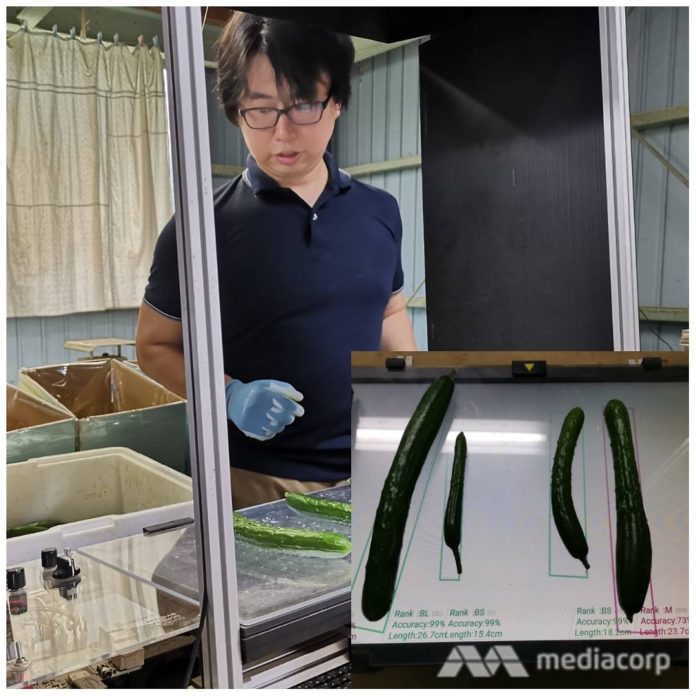
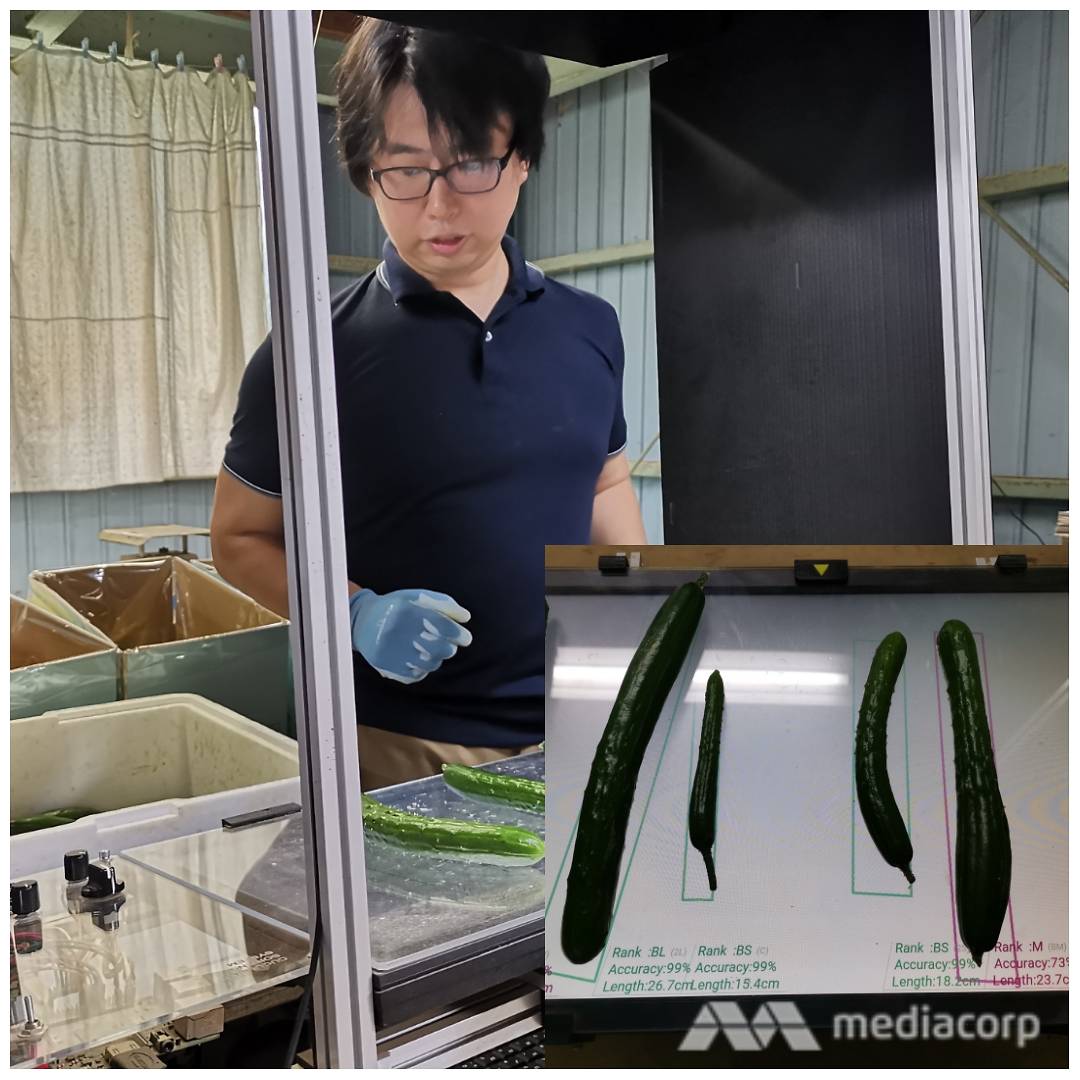
His latest generation contraption can sort up to 10 cucumbers at a go using just one camera, but this meant accuracy suffered – it is now at 70 per cent, the second-generation farmer shared even as he continues to fine-tune the home-brewed mechanism that cost about US$200 to put together.
So why is he investing so much time and effort developing this sorting equipment?
“We needed some consistency. Previously, my mother was the only one doing (the sorting) … but now anyone can help out,” Mr Makoto explained.
“My mum is not very interested in this (AI), but she was impressed by its accuracy,” he added with a laugh.
As a result, the farm’s yield has improved by 140 per cent. The extra time saved from sorting is used on other aspects of farming like researching how other data like temperature and watering of the crop could be automated, Mr Makoto said.
Mr Makoto Koike showcasing the third generation of his homebrewed cucumber sorting machine, which he says has an accuracy of 70 per cent.
PESKY PEST PROBLEMS
Mr Makoto’s cucumber-sorting machine is but one of many AI-driven projects sprouting up to solve some of the world’s agricultural problems.
Over in India, the battle lines have been drawn against the pink bollworm, whose innocent-looking larvae can wreak havoc on the country’s cotton fields on a scale which belies its miniscule size.
The Wadhwani AI institute, set up by brothers Romesh and Sunil Wadhwani last year, identified cotton farming as a problem area it wants to solve. Vice president for Products and Programs Raghu Dharmaraju explained why, citing the example of 2013 when about 50 per cent of the country’s crop was lost due to an infestation of pink bollworm despite the fact that 55 per cent of all pesticides used in India are by cotton farmers.
The pink bollworm is a highly invasive insect whose larvae damages the cotton fibres and reduces its yield and quality, according to the US Department of Agriculture’s website.
Yet, many of the farmers in the field who are leading the battle against the pesky bollworm are fighting with one hand tied behind their back – they simply don’t have access to enough information to destroy the larvae. They are reliant on field staff deployed by a centralised agriculture agency, but they are themselves over-worked and under-resourced, Mr Raghu said.
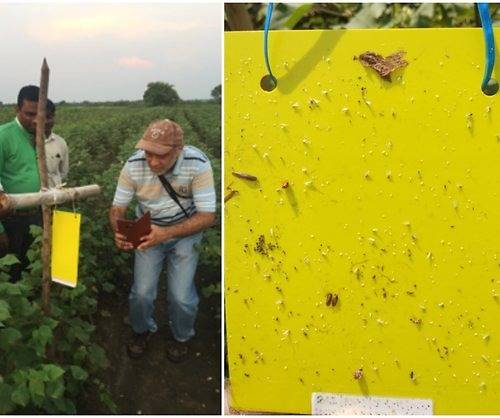
A field worker inspecting the pest trap on one of the cotton farms in India. (Image: Wadhwani AI’s website)
Each field staff would have a smartphone and have to visit every farm under his or her care to check on pest traps. They then have to manually count the pests and submit the findings, after which an expert assigned to them will provide advice on the next steps to take, Mr Raghu explained during an interview.
To address the manual process and field workers’ inability to recognise all types of pests, the Wadhwani AI institute is working on a machine learning tool that can recognise three of six most common pests that afflict cotton crops – pink bollworm, American bollworm and jassids, Mr Raghu said.
With this AI model integrated to the app the field staff are already using, they can send the relevant information back in a more timely and efficient manner, he said.
“(This means) the identification (of pests) can be more accurate and the counts are more accurate,” he said.
And every second counts in the fight against these invasive pests, given that the bollworm eggs hatch in three to seven days.
“You want to catch it as soon as possible, right? We want to know immediately.”
The data would also better guide the farmers’ pesticide use so they don’t err on the side of caution and over-spray.. “Too much pesticides spoils soil,” said the vice president.
Mr Raghu said his team recently scaled the model down to a size that can be downloaded to most phones, thus allowing for offline use. It is preparing to equip about 50 to 100 field staff, also known as extension workers, with the AI tool for the coming crop season, he added.
AI, MISUNDERSTOOD?
While AI can offer solutions to many of today’s problems, one fear may be holding up its more widespread use: That robots and technology are stealing people’s jobs and cannot be trusted. Frequent news headlines playing up the possibility of humans losing jobs to automatons add to such concerns.
Experts advocating the benefits of the technology say it is important for people to understand more about it and how it’s being used, instead of succumbing to commonly held misconceptions.
AI expert Luis Gonzalez acknowledges that while worries about a dystopian future dominated by rogue robots may be unjustified, for some people these concerns are very real. To break down such perceptions, the Elements AI managing director for Asia Pacific suggests thinking of AI as like teaching a kid how to boil an egg.
“Machine learning would be you taking the seven-year-old along and then showing them how you would cook an egg,” he said. “With the machine learning model, that seven-year-old will be able to learn from how you do it and repeat that same learning. But it requires that you show how you cook the egg.”
The other method is to use a neural network, widely known as deep learning, to achieve the same outcome, Mr Gonzalez said. This method has been used since 2012 and shot into prominence with AlphaGo, the programme developed by Google’s DeepMind unit that defeated top Go player Lee Se-dol, back in 2016.
Returning to the egg cooking example, he said: “The latest iteration of artificial intelligence is you not showing the seven-year-old how to cook an egg. We’re just giving them the function, saying: ‘Cook an egg.’ And then the seven-year-old goes and looks at videos of people cooking eggs, gets data about what eggs need to be cooked, what utensils there are and then comes up with its own procedure.
“Why is deep learning powerful? When you have enough computing power and data, that seven-year-old is going to outperform you in cooking that egg. It’s going to cook a much better egg, it’s going to do it faster and it can cook a thousand within five minutes. No human alone can do (this).”
He also pointed out when AI should be tapped on ahead of humans: Any decision that requires two seconds or less.
“Those decisions, at some point, whether it’s how you cook or how your appliances purchase your food or which train you take and which taxi you flag down – these should not be done by humans anymore. Because the machines can a much better job at making those decisions,” Mr Gonzalez said.
He cited the mundane task of getting groceries as an example.
If you have just S$50 a month for groceries, and want to stretch that amount as far as possible, you can simply tell your refrigerator to solve this problem. You can then get your groceries from whichever source, but always within your budget, he explained.
(Illustration: Kenneth Choy)
WHEN AI BECOMES A BAD MYSTERY
Like with any other technology, AI is considered neither good or bad until someone actually makes use of it.
Take one’s personal health data, for instance.
If the machine is just fed a stream of data that includes your health condition, lifestyle and diet to analyse, it would be able to recommend the amount and type of exercise to do to ease that hip pain or the type of food to take to reduce one’s acid reflux, Mr Gonzalez elaborated.
The danger is when consumers – the ones who provide their personal data – don’t know how companies are developing these algorithms and coming up with the suggestions, and if profits was the primary consideration.
“Imagine I’m in a world where data of my daily morning routine gives me a sense of what I should eat that day or how I should exercise,” Mr Gonzalez said.
“My biggest fear is that because Big Pharma sponsors that platform and the recommendation, there will be a prioritisation for me to be sick of a particular illness so as to maximise (the pharma company’s) drug sales and profits … in spite of my own health.”
He cautioned: “This is where ethics and explainability really matter a lot.”
The AI expert is not alone in his concerns. AI ethics and explainability are top of the agenda for many industry groups and regulators around the world given its vulnerability to support unscrupulous business practices like those mentioned earlier and authoritarian governments.
For example, the European Commission (EC) said this April that companies working with AI need to install accountability mechanisms to prevent it from being misused under new ethical guidelines. AI projects should be transparent, have human oversight, have secure and reliable algorithms and be subject to privacy and data protection rules, it said.
“The ethical dimension of AI is not a luxury feature or an add-in. It is only with trust that our society can fully benefit from technologies,” said the EC’s digital chief Andrus Ansip.
Singapore, too, is keeping a close eye on this matter.
AI’s ethical considerations could perhaps take a reference point from another technology CRISPR that, when used wrongly, has wide-ranging ramifications.
Last November, a Chinese scientist He Jiankui revealed that he used the CRISPR gene-editing technology to alter the embryonic genes of twin girls to protect them from being infected with HIV, the virus that causes AIDS. The revelation created an uproar within the research community, prompting more than 100 scientists to denounce the deed as “crazy” a day after he had posted the news on YouTube.
Critics said the twins could now face increased risks from other viruses and, down the line, potentially pass on harmful side effects to their offspring.
Investigations have since been carried out against He, and also prompted Chinese president Xi Jinping to call for new regulations on gene editing at the start of this year.
IMMENSE POTENTIAL FOR GOOD
It is clear the ethical considerations and rules governing the development and use of artificial intelligence should not be neglected. Equally, there is a need to give space to innovative, well-meaning entities the space to play in this space and come up with new solutions to age-old problems.
Take climate change and, specifically, global warming. Most people know that this phenomenon is taking place and changing how the Earth is functioning. One of the main reasons for this is the increasing lack of green cover caused in part by deforestation.
This is where a San Francisco-based non-government organisation (NGO) hopes to play its part in combating illegal logging activities with the use of AI. Rainforest Connection, started in 2012 by engineer Topher White, is turning to used handphones to create a real-time monitoring system based on the sounds it captures in order to alert the local community and enforcement agents of when such logging activities are carried out.
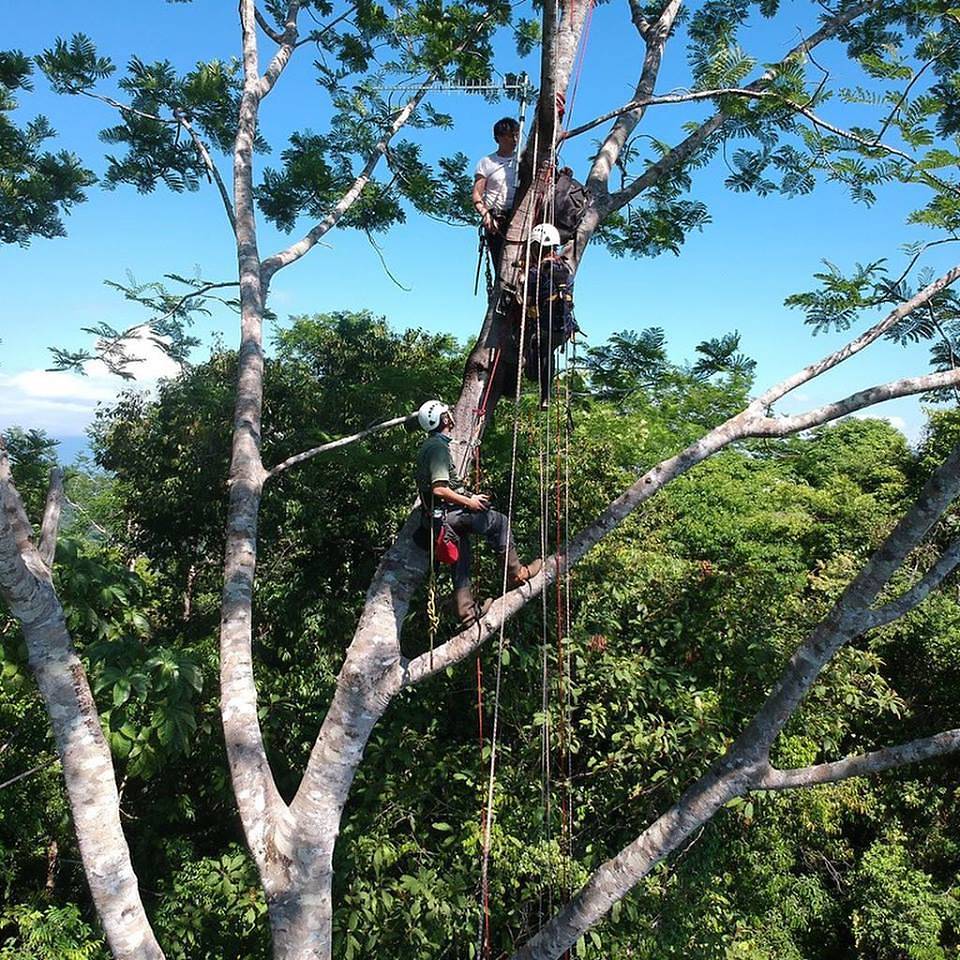
Rainforest Connection founder Topher White (in white) up in the forest canopy installing one of its re-purposed used Android phones and, through such devices, detect noises like chainsaws to detect illegal logging activities. (Photo: Facebook/Rainforest Connection)
Mr White combines used smartphones with solar panels to create an always-on beacon – called “Guardians” – that are embedded in tree canopies to collect the sounds in a forest. When its platform discerns sounds like chainsaws or trucks on the spectrogram, this would prompt an alert to the relevant authorities or local communities to act on the information.
In the Peruvian area of the Amazon rainforest, for example, the company is working with groups like the Conservation International and local government rangers to test out the sound-based warning system.
Speaking to CNA recently, Mr White shared that he did not expect to work with lawyers there, given that its justice system is “very slow to get a case going” and it usually takes years if at all.
However, it found a lawyer group called the Peruvian Society of Environmental Law or SPDA, that has the trust of the local community. Once SPDA receives the alert, of say chainsaw sounds detected, the lawyers would file a case immediately and call the police. Since a case has been filed, the police will have to do something, he said.
At the same time, SPDA will also call the local defenders on the ground to stop these illegal loggers and hold them till the police reach the scene, he added.
This is where the human element plays a crucial role of what could otherwise be seen as a lofty tech solution for a real world problem. For every partner Rainforest Connection works with, it usually starts off with a rejection.
Mr White shared that while these partners start off sincere in wanting to use the alerts, they can become unresponsive when he and his team are on the ground working on the deployment.
“A lot of times they can be very sincere, but in the moment, it’s really dangerous and scary work, especially if they are not (teamed up with) para-military.”
The key, he later realised, is when the local defenders know what to do after they stop the immediate illegal logging activities.
“What we realised that when the people (local defenders) know that they are only having to hold these loggers for like two or three hours, or whatever it is, they are far more confident,” Mr White shared.
“It never occurred to me that one of the things holding them back (from making use of our alerts) could be: ‘What do we do next?’ So trying to understand the social pressures and elements and how these overlap, that’s pretty important for us.”
HUMANS MUST EVOLVE TOO
For Massachusetts Institute of Technology (MIT) professor Tonio Buonassisi, removing the human element from the use of AI is akin to the story idea he would tell if he was given an opportunity to direct an episode of Black Mirror, a science fiction TV series with a generally dystopian take on high-tech innovations like AI.
Using another sci-fi series Stargate as his inspiration, Associate Professor Buonassisi said his story would feature a civilisation that stopped thinking for themselves and relied solely on technology as a form of collective memory and decision-making. While this system has its short-term advantages, the lack of diversity in thought would prove to be a challenge too, he revealed in an email interview.
“I’m a big believer that the human spirit must evolve together with technology — that we must continue investing in our own personal growth, so we can continue to direct technology development in ways that are societally beneficial,” said the professor, who is also a principal investigator at the Singapore-MIT Alliance for Research and Technology (SMART).
He shared how a former MIT president was at a crossroads in terms of whether the school would pursue bioengineering despite its potential for misuse. In the end, he decided to go ahead as the then-president reasoned that more than 99 per cent of people are good and will use the technology in the same spirit. They then have to invest in these people to guard against those who might misuse it, said Assoc Prof Buonassisi.
“The same applies now for the development of AI. We must continue investing in education to make sure everyone has access to the means to learn about AI, what it is capable of and its potential,” he said.
“We are more likely to harness peoples’ creativity to solve societal problems faster than ever before, when everyone shares a common knowledge of how they can create change.”
Perhaps the day Mdm Masako can put her legs up and let a machine sort out the thousands of cucumbers daily is coming sooner than expected.
SINGAPORE: Singapore’s factory activity contracted for a third consecutive month in July as global trade uncertainties caused costly disruptions to the current supply chains of local manufacturers, according to data released by Singapore Institute of Purchasing and Materials Management (SIPMM) on Friday (Aug 2).
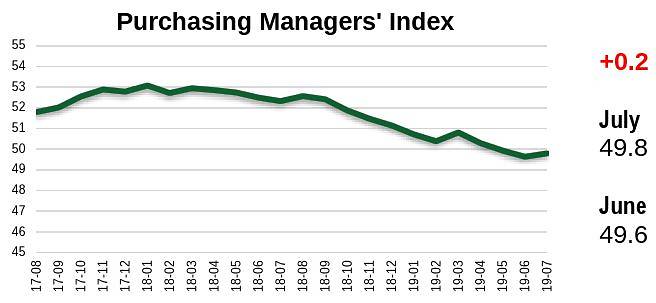
But the pace of contraction slowed, with July’s Purchasing Managers’ Index (PMI) – which measures manufacturing activity and sentiment – at 49.8, edging up 0.2 points from June.
Singapore’s PMI index up to July 2019. (Graphic: SIPMM)
“The slight improvement of the PMI reading was attributed to the marginal expansion posted in new orders and factory output, as well as a continued expansion of new exports,” SIPMM said.
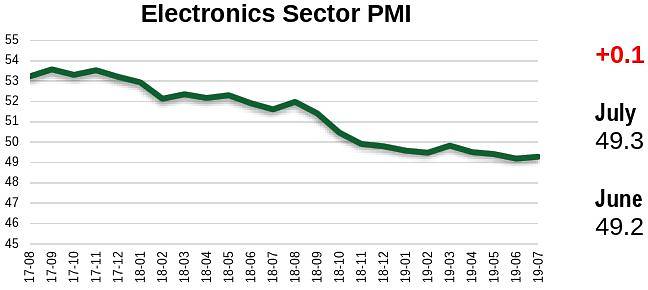
While the electronics sector contracted for the ninth straight month, the sector’s PMI improved slightly by 0.1 to 49.3. This was attributed to slower contraction of new orders, new exports, inventory and employment level, said SIPMM.
Singapore’s electronics PMI index up to July 2019. (Graphic: SIPMM)
GLOBAL RECESSION FEARED
Manufacturing also contracted across Asia and Europe last month, fuelling worries that a prolonged US-China trade war and an economic slowdown could tilt the world toward recession.
US President Donald Trump announced on Thursday he will hit China with punitive tariffs on another US$300 billion in goods, escalating the trade war.
That means the two largest economies in the world have now erected trade barriers covering virtually all of their US$660 billion in annual two-way merchandise trade.
China’s manufacturing activity contracted for a third month in a row, official data showed on Wednesday, with July’s PMI coming in at 49.7, slightly up from June’s figure of 49.4. Economists surveyed by Bloomberg had predicted a reading of 49.6.
Manufacturing activity in the euro zone fell at its steepest rate since late 2012 last month as demand sank, a survey compiled by IHS Markit showed on Thursday.
Forward-looking indicators in the survey suggested that manufacturing will not rebound anytime soon, and is likely to embolden policymakers at the European Central Bank, who last week all but promised to ease policy further as the bloc’s growth outlook deteriorates.
SINGAPORE: SkillsFuture Singapore (SSG) has improved its ability to detect and act against suspected fraudulent claims, but it might need “intermediate options” to enforce, investigate and take errant training providers to court, Senior Minister of State for Education Chee Hong Tat said.
Speaking on Friday (Aug 2) at a briefing on the statutory board’s fraud risk management system, Mr Chee said only cases of suspected fraud are handled by the Commercial Affairs Department (CAD).
For cases of abuse or non-compliance, SkillsFuture will terminate or suspend the training provider.
Mr Chee added: “Something which we are currently reviewing – what are our legislative powers, what enforcement actions can we take, what are the penalties.
“Today if we look at it, we have, on one hand, some of the contractual powers that we have, with training providers, and on the other hand, we can refer cases of suspected fraud to CAD.
“Whether in between, we need some intermediate options for SSG to be able to have the powers to enforce, investigate and to impose penalties to take some of the errant providers to court, this is something which my colleagues and I are now reviewing and if we need to change the law, we will table a Bill and go to Parliament.”
SkillsFuture is currently testing an attendance-taking system that uses QR codes.
SSG has taken action on 22 cases of abuse or non-compliance to its terms and conditions from January to June this year.
There were 33 cases for the whole of 2018, including two cases of fraud which are currently being investigated by the CAD.
SSG’s fraud management and enforcement division was set up in November last year after an Inter-Agency Process Review Task Force conducted a review of its processes.
The 20-member team conducts checks on organisations that register with SSG, as well as every claim that comes through. SSG receives more than 600,000 claims every year.
Each claim is scored for risk using a machine learning-based fraud analytics system. This allows for suspicious activity to be quickly detected, such as if an organisation receives a huge spike in claims in a short period of time.
A pilot trial of a QR code attendance taking system is also underway. It will replace pen-and-paper attendance marking, making it tougher to abuse the system, especially as each check-in location will be logged.
SSG aims to have a full roll-out of this attendance taking system by next year.
Mr Chee said “beefing up” the fraud management system will make sure the SkillsFuture scheme is not “tarnished by the actions of a small number of black sheep who are trying to cheat and abuse the system”.
In 2016, Singaporeans were given S$500 in SkillsFuture credit, which can be used for training courses. Since then, reports of abuse have surfaced.
In 2017, 4,400 people were caught making bogus SkillsFuture credit claims amounting to S$2.2 million. In that same year, a syndicate was found to have used nine shell companies to illegally claim almost S$40 million from SSG.
In June, Kaplan Professional was suspended as an approved training organisation under the Singapore Workforce Skills Qualifications (WSQ) due to “serious lapses”. SSG did not elaborate on the lapses.
SINGAPORE: Screams and gunshots filled the air in the early hours of the morning, as the Singapore Police Force (SPF) showcased its counter-terrorism capabilities in a security exercise at the Padang in the lead up to National Day.
More than 200 officers from the Clementi Police Division, Public Transport Security Command (TransCom), Special Operations Command, Gurkha Contingent and the Singapore Civil Defence Force (SCDF) took part in the exercise on Friday (Aug 2).
Three scenarios with knife-wielding attackers and multiple gunmen were carried out during the security exercise to “test the response to terrorist attacks”, said SPF in a press release.
SLASHERS, GUNMEN, HOSTAGES
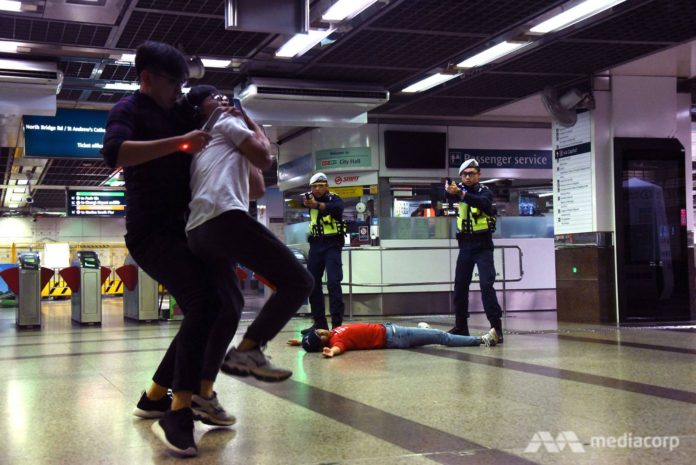
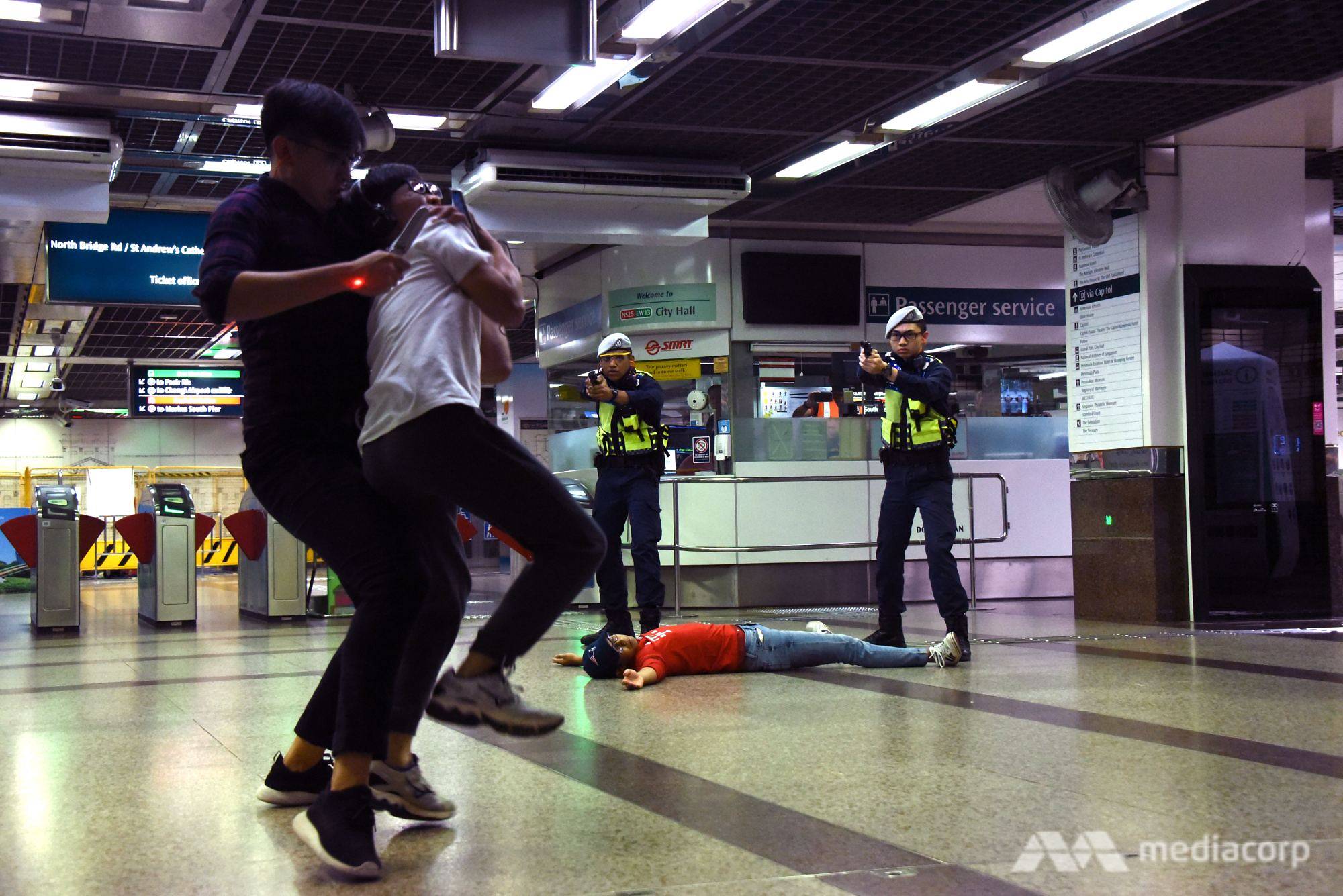
The first scenario involved TransCom officers taking down attackers armed with knives at a crowded MRT station.
Public Transport Security Command (TransCom) police officers taking down a “slasher” in an NDP counter-terrorism exercise on Aug 2, 2019 at City Hall MRT station. (Photo: Try Sutrisno Foo)
At 2.30am, a “fight” erupts at City Hall MRT station between a commuter and a man wielding a knife.
Two TransCom officers take down the man when he charges towards them, but a second attacker grabs another commuter as a hostage – before he is quickly taken down by another pair of TransCom officers.
The second and third scenarios are set in the Padang, a simulated terrorist attack at the National Day Parade (NDP).
Ground Response Force police officers moving towards a “gunman” at an NDP counter-terrorism exercise at the Padang. (Photo: Try Sutrisno Foo)
Spectators dressed in red and white are waving small Singapore flags from the stands when the crack of gunfire rings out. Three gunmen shoot several civilians before SPF’s first responders – the Ground Response Force and Emergency Response Team – appear almost immediately in full gear.
In single file, the officers storm the stands and take down all three gunmen in a matter of minutes.
Emergency Response Team officers at a simulated shooting during an NDP counter-terrorism exercise. (Photo: Try Sutrisno Foo)
The scene then moves to the spectator stands across the road from the Padang.
This time, there are four gunmen who emerge in the stands. Several spectators are shot, while others scream and duck out of the way.
Rapid Deployment Troop officers aiming their weapons at a “gunman” during an NDP counter-terrorism exercise at the Padang. (Photo: Try Sutrisno Foo)
Twenty officers from the Rapid Deployment Troops, Armed Strike Team and Gurkha Contingent arrive on four Tactical Response Motorcycles and two Armoured Personnel Vehicles and enter the stands from the lower level, shooting two of the gunmen.
An officer from the Gurkha Contingent at the NDP counter-terrorism exercise on Aug 2, 2019. (Photo: Try Sutrisno Foo)
From the top level, more officers from the Special Tactics and Rescue unit corner the last two gunmen.
Once all the gunmen have been neutralised, the officers secure the stands and wait for SCDF to arrive and tend to the casualties.
SCDF rescuers carrying stretchers to the scene of a “shooting” in a counter-terrorism exercise with the Singapore Police Force on Aug 2, 2019. (Photo: Try Sutrisno Foo)
The three simulated attacks were carried out under the watchful eye of Law and Home Affairs Minister K Shanmugam.
“NDP is classified as a high-security event each year. It’s one of the events for which very substantial forces are deployed by the police,” he said.
“It’s a very important event, it’s an iconic event for Singapore. And the forces take it – the police force takes it extremely seriously.”
Home Affairs and Law Minister K Shanmugam speaking to officers at the end of a counter-terrorism exercise conducted by the Singapore Police Force and the Singapore Civil Defence Force on Aug 2, 2019. (Photo: Try Sutrisno Foo)
Within the special event area, there will also be a special zone with stricter security checks. These enhanced security measures are expected to take effect from midnight to 11.59pm on Aug 9.
SINGAPORE: Jonathan*, 47, sought treatment with us as he was experiencing bad moods, high irritability and could not hold on to a job for long.
Sessions with his psychologist soon uncovered that he felt upset with himself because he couldn’t regulate his emotions.
He was not able to control his anger. Small things would trigger intense anger, and provoke him to throw objects he was holding, break items close to him, or yell loudly.
His anger also made it impossible to maintain a romantic relationship for a long time.
In fact, Jonathan shared there were many times when he came very close to getting into trouble with the law, as he had intense urges to hurt people because he felt that they had wronged him.
(Photo: Unsplash/Siavash Ghanbari)
He realised he needed help when his ex-girlfriend who was pregnant with their child left him because she did not want to bring up a child in such a hostile and unloving environment.
That event, while it initially triggered a lot of anger in Jonathan, helped him realise that he had to change his ways if he were to have a family in the future.
HURTING HER GRANDMOTHER
Samantha, a 25-year old executive shared that she came very close to hurting her 80-year old grandmother when she did not feel understood.
They would get into constant arguments over simple things such as where washed cups ought to be placed, or when her grandmother forgets to turn off light switches.
Samantha would shout at her grandmother to get her point across. She has also broken numerous plates and cups in an effort to get her grandmother to understand how much her actions was impacting her.
While she still works, Samantha is aware that her anger outbursts have killed off many friendships as her friends were unable to tolerate her harsh words and behaviour, especially in public.
Her intense outbursts, including the ones that happened in church, prompted one of her church leaders to convince her she needed help.
While Samantha was not keen on seeing a psychiatrist, her close friends rallied with her church leaders to help make her first visit less daunting.
(Photo: Unsplash/Chuttersnap)
WHAT IS ANGER?
A spate of events some months back suggest we have some way to go in keeping our anger in check.
In April, a man was jailed for attacking bus drivers two days in a row over bus fares to Yishun. Another got jail and caning after swinging a plank in a 60-person riot. And five men were arrested after a fight along Orchard Road.
Anger reflects a healthy sense of self. When we feel that our sense of self and worth is threatened, we react in anger.
The intensity of anger can range from mild annoyance to extreme rage. While it is normal to experience anger from time to time depending on the situation, one may need to get help when they feel that the slightest provocation triggers uncontrollable rage.
Some symptoms that anger is a problem would include: Anger affecting social relationships and work performance; constantly feeling impatient, irritated and hostile; frequent arguments with others and often getting angrier in the process; being physically violent when angry; and difficulty or an inability to control anger or being impulsive when angry.
The Diagnostic and Statistical Manual of Mental Disorders has also classified sudden episodes of unwarranted anger as Intermittent Explosive Disorder (IED).
Affecting 7.4 per cent of people globally, those with IED essentially “explode” into a rage despite minimal or lack of provocation or reason. They often share that they feel a lack of control over their emotions.
(Photo: Unsplash/Ayo Ogunseinde)
Apart from genetics and neurobiology, environmental factors especially early adverse childhood experiences, harsh parenting, poor social skills and poor empathy can lead to outbursts of anger.
ABUSIVE PARENTS
At times, the presence of physical or mental illness and addiction to drugs or alcohol can also fuel anger issues.
Both Jonathan and Samantha recalled growing up with harsh parents who were physically punitive. They were also bullied in school.
When Jonathan developed depressive symptoms because he could not sustain relationships and work, he resorted to alcohol to cope.
Samantha coped with her past by throwing herself into work, but her angry responses and high expectations caused her close friends and family members to shun her.
NOT THINKING RATIONALLY
Scientists have highlighted that when we are angry, we bypass our ability to plan, think rationally and respond in a way that benefits common humanity.
Renowned psychiatry expert Dan Siegel explains in his book Mindsight that when a person has sudden, irrational and emotional eruptions, the lower limbic and brain stem layers can explode out of control resulting in a meltdown.
Lack of sleep, hunger, and the way we perceive certain events can also fuel episodes of explosive anger.
In such episodes, part of the brain stops regulating the energy being stirred up, disrupting coordination and balance – meaning we become less flexible, less thoughtful and more reactive. Our anger impairs decision-making and judgement.
There are many situations that can trigger one’s anger. Like thermostats, each of us has a different threshold for such triggers.
Not getting one’s way, or hearing “no” can set someone off. Getting stuck in traffic and being the receiving end of other drivers’ actions on the road, or when someone bumps or pushes you, even if it was an accident – all these can cause us to lose our cool.
Some of us can shrug it off while these same situations can trigger a major outburst in others.
MANAGING YOUR ANGER
The good news is anger can be tamed. While you cannot control or choose your emotions, you can always control how you express your anger.
There are three big steps in managing anger, namely identifying triggers, pausing, responding and not reacting.
1. Identifying triggers
Anger brings about physical changes. Adrenaline rushes through your body and you may experience an increased heart rate, heavier breathing, and your body (particularly your shoulders) becoming tense. In some people, their fists and arms become more fidgety.
(Photo: Unsplash/Michael McAuliffe)
Anger is usually a cover-up for other feelings, to mask embarrassment, insecurity, hurt, shame or vulnerability.
People who grew up in environments where the expression of emotions was discouraged, or in families that placed a high emphasis on “saving face”, may have a harder time acknowledging the emotions underlying their anger.
Recognising these signs is an important first step to creating some space where we can choose our next course of action. The more we practise noticing ourselves and how we are feeling, the easier it gets to manage our anger.
2. Pause
Taking time to analyse and understand your reaction to situations that trigger you is an important step in managing your anger.
Some common negative thoughts including overgeneralising what’s happening. Watch for thoughts like “You always interrupt me! He never listens to me. No one ever respects me”.
Others might start mind-reading to make assumptions about what others are thinking or feeling. Thoughts like “he did it on purpose because he does not like me” or “they intentionally ignored me” can be unhelpful.
It is important to own our emotions. When you notice that your thoughts and bodily changes reflect anger, take some time to pause and pay attention to yourself.
(Photo: Unsplash/Noah Silliman)
3. Responding, not reacting
Awareness of our emotions gives us the power to choose our actions. There are many ways that can help you cool down and keep your anger thermostat in check.
First, remove yourself away from the physical triggers. If you know that certain situations or people trigger you, reduce your contact accordingly. For example, avoid hanging out with the buddy who often puts you down or avoid that busy expressway.
Second, focus on your breath. Tuning in to your body actually helps to bring awareness to the pace of your breathing, and doing mindful breathing helps to reduce a racing heart.
Third, get more exercise. Releasing pent-up energy by exercising (i.e. walking, running, swimming or even kick-boxing) helps to calm a person down.
Fourth, think of the consequences. Try to identify the consequences of your action to help you to choose an alternative action.
Throwing things in anger will only result in broken items and increased expenses. Hitting someone in rage may feel good for the moment, but will only result in longer-term damage and potentially a fine or a jail term.
(Photo: Unsplash/Rostyslav Savchyn)
Jonathan and Samantha are both actively working on their anger management problems by identifying their triggers and employing different strategies to cope with their emotions.
Samantha took up kickboxing. She has also been attending family therapy to improve her relationship with her grandmother. The help from her close friends and church members has been very helpful in her recovery.
Jonathan, on the other hand, has been practicing yoga and mindfulness, and is currently working as a fitness instructor in a gym, doing what he really enjoys.
Haanusia Prithivi Raj is Senior Clinical Psychologist at the Institute of Mental Health.