SINGAPORE: More than 9 in 10 Singaporeans and Permanent Residents (PR) said they are concerned by climate change and will do their part to minimise its impact, findings from a Mediacorp survey showed on Wednesday (Aug 7).
According to the findings, 96 per cent of respondents also either “agree” or “strongly agree” that the Government must do more to minimise the impact of climate change.
About 1,000 individuals aged 18 and older took part in the self-administered online survey aimed at understanding public perception of climate change in Singapore and the Government’s actions towards it.
The survey, conducted between Jul 20 and 24, comes after Environment and Water Resources Minister Masagos Zulkifli said that Singapore has a “pressing priority” to tackle climate change and warned that “time is running out”.
According to a January 2019 Ecosperity Conversations report by Temasek, Singapore is “particularly vulnerable” to the negative impact of climate change and rising sea level.
“The warning is loud and unmistakable: We must act now or we may well face the ultimate threat to human survival … the end of ‘life as usual’,” Mr Masagos said.
He also announced that Singapore will up set a new office to strengthen Singapore’s capabilities in climate science, and spend an additional S$400 million to upgrade and maintain drains over the next two years.
The country has also launched its first seed back to protect local and regional plant diversity against threats like climate change.
When it comes to funding efforts to tackle climate change, just over half (53 per cent) of the survey respondents indicated that efforts to tackle the issue should be funded by current or future taxes.
Forty-seven per cent of respondents said the Government should fund these efforts by dipping into the national reserves.
YOUNGER PEOPLE MORE CONCERNED ABOUT CLIMATE CHANGE?
The survey did not find any significant differences in climate change perceptions across age, gender, ethnicity, education level or monthly personal income.
For example, in response to the statement “I am concerned about the impact of climate change on Singapore”, 91 per cent of the 112 respondents making up the youngest age group (18 to 24) said they “agree” or “strongly agree”.
Ninety-five per cent of the 170 respondents making up the oldest age group (above 65) gave a similar response.
Eighty-eight per cent of respondents in the youngest age group agreed with “I will do my part to minimise the impact of climate change”, compared to 94 per cent of the oldest age group.
Meanwhile, the survey also found that respondents aged 65 and older, as well as those without a monthly personal income, are less likely to suggest that future generations be taxed to fund efforts against climate change. Instead, they pointed to the use of national reserves.
SINGAPORE: All ride-hail and street-hail service providers with a fleet size of more than 800 vehicles will have to be licensed from June 2020, after Parliament passed the Point-to-Point (P2P) Passenger Transport Industry Bill on Tuesday (Aug 6).
The licensing scheme focuses on larger operators due to the wider impact they have, and manages regulatory costs for smaller ride-hail service operators, allowing small and innovative services to emerge, said Senior Minister of State for Transport Dr Janil Puthucheary in Parliament as he presented the second reading of Bill.
Licence applications for street-hail and ride-hail service operators, including carpool operators, will open in February 2020. Major players such as Grab and Go-Jek will have to apply for the ride-hail licence, while existing taxi operators will be deemed to have a street-hail licence.
Ride-hail service operators with fewer than 800 vehicles will be exempted. Under the new rules, it will be an offence for any person to provide street-hail or ride-hail services without a licence or an exemption.
If convicted, these unlicensed operators may face a fine of up to S$10,000 or imprisonment of up to six months, or both, and a further fine of up to S$500 may be imposed for each day that the offence continues after conviction. It will also be an offence to drive for these illegal operators.
The framework will allow the Land Transport Authority (LTA) regulatory oversight over all major P2P operators in Singapore, said Dr Puthucheary.
He added: “This will help to facilitate an open market to support the development of responsive P2P services, while also providing sufficient regulatory oversight to protect the safety and interests of commuters and drivers.
“It is a necessary piece in our long term vision for a well-connected and convenient land transport network.”
In line with the revised regulatory framework, the Public Transport Council (PTC) will be given powers to ensure that taxi and private-hire car fares are clear and transparent, said Dr Puthucheary.
Licensed ride-hail service operators will be required to provide the flat fares for taxi and private-hire car bookings upfront to commuters, but they will be allowed to set the flat fares independently. PTC said LTA and PTC “will leave market forces to set appropriate fares”, and they do not intend to regulate how operators set dynamic, or surge pricing.
Commuters pass by a Gojek advertisement in Singapore. (File photo: Reuters/Edgar Su)
Dr Puthucheary said: “Dynamic fares have allowed better matching of supply and demand – with higher prices during peak hours and also lower prices during off-peak hours.
“This allows commuters to have a range of options at different price points.”
LTA also confirmed that these flat fares do not include ERP charges, although ride-hail service operators are required to inform commuters of the possible ERP charges on their trip.
There will be no changes to existing fare regulations for street-hail trips, with operators still required to charge metered fares.
Without sufficient regulatory oversight, the benefits of market-driven innovation can easily be lost, said Dr Puthucheary.
“For example, operators may compromise commuter and driver safety at the expense of profits,” he added.
He also introduced the new safety requirements on licensed operators as part of the new regulatory framework. Industry stakeholders and members of the public consulted on the Bill agreed that enhanced safety measures are necessary and important, said Dr Puthucheary.
All private-hire vehicles will undergo an annual safety inspection.
A spokesperson for LTA said: “Licensed operators are required to meet certain safety standards, including a minimum first inspection passing rate, and accident and offence rates.”
“LTA will track the number of accidents and driver offences that occur when a driver carries out a trip for a particular operator. Operators whose drivers have committed too many accidents or offences can be penalised through regulatory sanctions,” said Dr Puthucheary.
“This is to ensure that operators play their part to encourage safe driving behaviour and reduce driver offences.”
Grab offers a host of services, including food delivery and bill payments. (Photo: AFP/ROSLAN RAHMAN)
In emergency situations, LTA can issue emergency directives to all P2P service operators, including those exempted from licensing. These directives include suspending the use of defective vehicle models.
Singapore now has about 20,000 taxis and 45,000 private-hire cars, said Dr Puthucheary, adding that more than two-thirds of all point-to-point commutes were made via ride-hailing apps, with the rest being street-hails.
According to LTA, taxis and private-hire cars made 276 million trips last year. Dr Puthucheary noted that the P2P commuter experience has improved significantly since the entry of third-party taxi and private-hire car booking service providers.
“Commuters today have more P2P options and enjoy better service standards than before. With better matching of demand and supply enabled by technology and a flexible driver pool, commuters now enjoy shorter waiting times for both street-hail and ride-hail journeys,” he said.
He added that LTA will adopt a “light regulatory approach” towards service standards, to allow market forces to drive service delivery and improvement.
Under the new regulations, operators will be prohibited from offering exclusive arrangements to drivers that prevent them from driving for other operators.
“This is because such arrangements make it difficult for new players to enter the market, and naturally favour incumbent operators. This is detrimental to driver and commuter interests,” he said.
Exceptions will be made for operators who directly employ drivers.
MINIMUM AGE FOR PRIVATE-HIRE DRIVERS?
Members of Parliament (MPs) who spoke during Tuesday’s debate supported the Bill, noting that the changes will help to level the playing field between the taxi and the private-hire car industries.
They raised several questions, with one being whether a minimum age should be put in place for private-hire car drivers.
Unlike taxi drivers who need to be at least 30 years old, there is no minimum age for private-hire drivers, who are only required to have at least two years of driving experience.
This means that a private-hire car driver can be as young as 20 years old, assuming one takes the driving test soon after turning 18, MPs said.
“So now, we have a situation (where) we would not trust a 20-year-old to act wisely when voting, but he is trusted to ferry our children and loved ones from point to point in a private-hire car,” said Chua Chu Kang GRC MP Yee Chia Hsing.
Mr Yee suggested a minimum age requirement of 25 years old for private-hire car drivers, while Ang Mo Kio GRC MP Ang Hin Kee recommended setting it at 30 years old instead.
This suggestion came amid concerns about having young adults take up full-time driving in the long run.
Non-Constituency MP Dennis Tan, for one, highlighted the risk of young drivers, especially those who drive full-tine, “becoming obsolete” given the possibility of autonomous vehicles in the near future.
If so, these young drivers may find themselves unemployable early in their working life and would need to be retrained, said Mr Tan.
On this, Dr Puthucheary said only about 4 per cent of private-hire car drivers are between the ages of 20 to 25, while another 12 per cent were between 25 and 29 years old. Many of these drivers are also “light part-time drivers”.
Having a minimum age could affect the number of drivers in the P2P market, which may limit the number of rides available to commuters, he added.
Nevertheless, the Government is looking to review the number of drivers against the needs of the P2P market, and will study the age of drivers “carefully”, said Dr Puthucheary.
MPs also supported allowing PTC to have oversight of fares, although they had differing views on whether more should be done.
While those like Nee Soon GRC MP Louis Ng stressed the need to not “overreach”, Tanjong Pagar GRC MP Joan Pereira suggested having upper limits for dynamic pricing so as to protect commuters’ interests.
“Given the breadth of service offerings and the dynamic nature of these conditions, I think we best leave it to market forces,” Dr Puthucheary said in his reply.
Safety was also a hot issue, with MPs asking if there is a need to set and enforce standards for reporting emergency situations during rides, as well as require street-hail services to have child safety seats.
Under the Road Traffic Act, it is illegal for cars to carry passengers under 1.35m tall without a booster seat or a child restraint. Taxis are excluded from this ruling as they are considered “public service vehicles”, while private-hire car services are not.
Taxis on an expressway in Singapore. (File photo)
“A Toyota Vios is a Toyota Vios, regardless of whether it was registered as a street-hail service or ride-hail service. This inconsistency in application of the law is not in the interest of the child,” said Mr Ng.
To that, Dr Puthucheary explained that the public and industry stakeholders were engaged “extensively” on this issue during the consultation period for the Bill. However, opinions “were very divided” among all groups and a compromise was not able to be reached in time.
The Government will continue to study it further, he added.
SINGAPORE: NTUC FairPrice on Tuesday (Aug 6) launched its largest supermarket and pharmacy yet, featuring new retail concepts like a food preparation service and in-store vegetable harvesting, in a bid to compete with online grocers.
The supermarket chain said the new take on traditional brick-and-mortar shopping was its way of responding to the changing needs and behaviour of customers, and staying relevant.
“We noticed … that our customers are changing … the needs, the wants and the lifestyles that they lead,” said deputy CEO Elaine Heng.
The bakery at FairPrice Xtra at VivoCity. (Photo: NTUC)
For example, customers who are time-starved can take advantage of the food preparation service at FairPrice Xtra, which allows them to pick from an assortment of vegetables in-store and get them cut, sliced or diced at no charge.
Patrons can also choose their meat and seafood, and have them either pre-marinated or grilled in-store for immediate consumption.
Roasted meat section at FairPrice Xtra at VivoCity. (Photo: NTUC)
On the back of Singapore’s push to grow its urban agriculture industry and to increase its food sustainability efforts, the outlet also dedicated a space to showcase how indoor hydroponics farming works.
“More and more Singaporeans will be eating hydroponics-grown vegetables and I think it is a good job to be here trying to educate them and giving them a sense of what the future would look like,” chairman of Comcrop Allan Lim said.
Eight varieties of vegetables are grown in the showcase, with a total yield of up to 3kg. Mr Lim said his workers visit the store once every two days to harvest the vegetables for sale, with additional supply of crops being sent from the Comcrop’s rooftop greenhouses in Woodlands.
Indoor farm at FairPrice Xtra at VivoCity. (Photo: NTUC)
The new 90,000 sq ft retail space also carries more than 35,000 products from all over the world.
Speaking at the launch, Trade and Industry Minister Chan Chun Sing said the extensive array of products available helps diversify Singapore’s food supply chain and contributes to national food security.
“Every day, there are many disruptions to the supply chains, but for the average Singaporean, we will never even have the chance to feel it,” Mr Chan said. “In many parts of the world, when something happens, you will find the shelf being emptied or the products not coming in for months, but this is something we’ve avoided.”
Other highlights of the store include bicycle and luggage repair services, as well as a dedicated play area for children.
SINGAPORE: Two Malaysian women were arrested on Monday (Aug 5) after they were caught trying to smuggle a man out of Singapore in the boot of a car, said the Immigration and Checkpoints Authority (ICA).
ICA officers found the man in the boot of a Malaysia-registered car when they stopped the vehicle for checks at the Woodlands Checkpoint at about 8.20pm.
The car was driven by a 28-year-old Malaysian woman, who was accompanied by a 33-year-old Malaysian woman, said ICA in the media release.
Anyone convicted of engaging in the business of conveying prohibited immigrants out of Singapore will face two to five years in jail and a minimum of three strokes of the cane.
The vehicles used in such offences are liable to be forfeited, said ICA.
This is not the first reported attempt to smuggle a person in a car boot this year. Four Malaysians had been arrested for trying to take a Myanmar national out of Singapore on Feb 28.
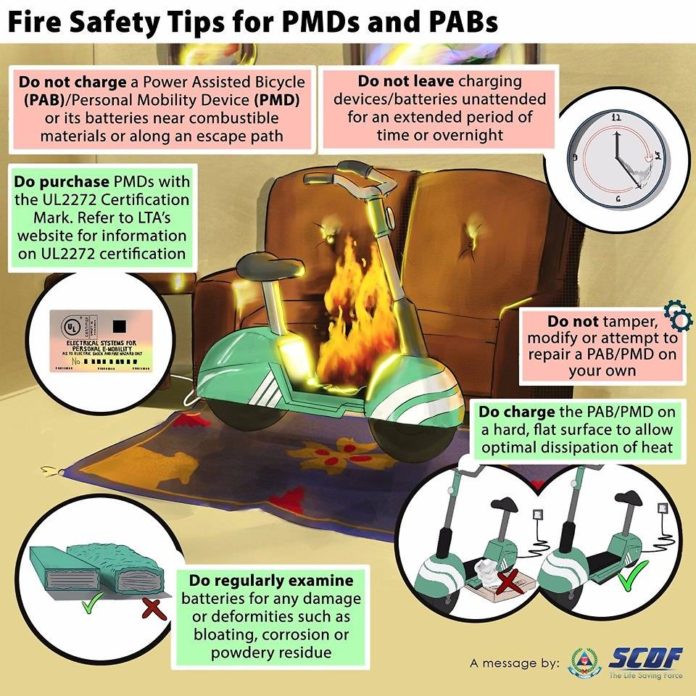
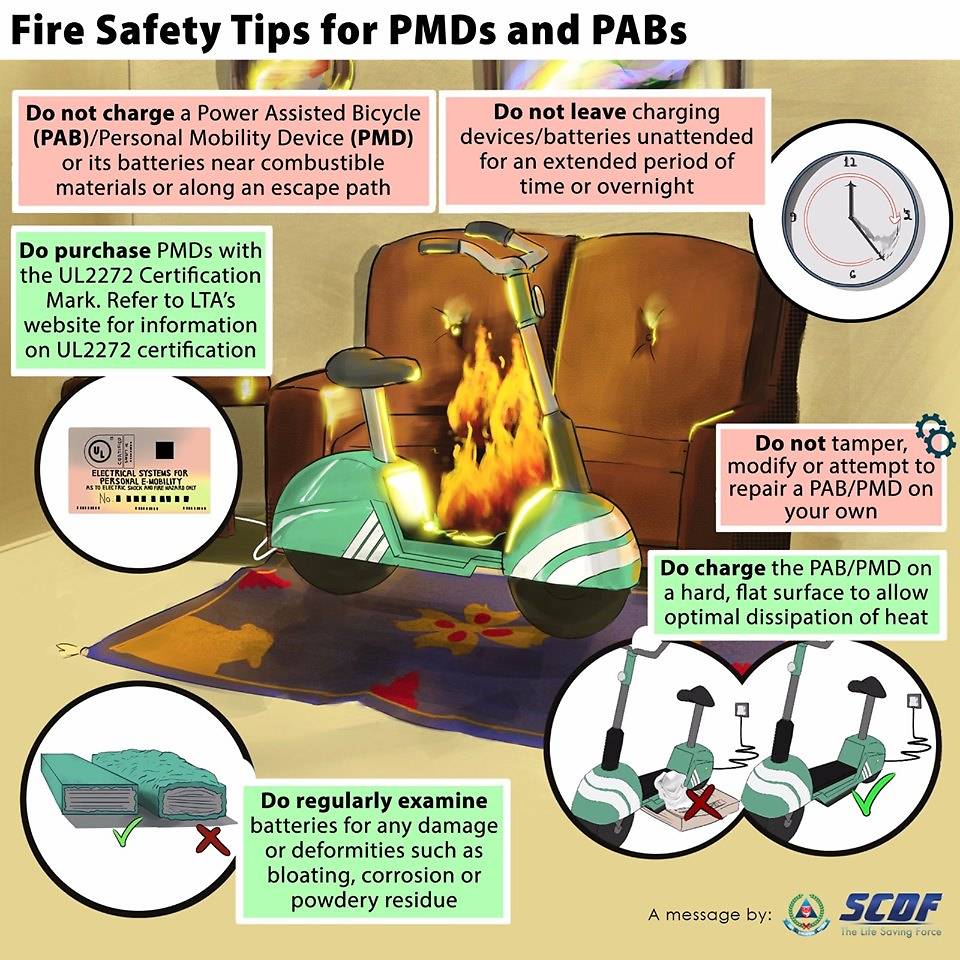
Fire safety tips on preventing PMD fires. (Graphic: Facebook/SCDF)
An adult and a child were taken to National University Hospital, while another adult was taken to Ng Teng Fong General Hospital. All three suffered from smoke inhalation.
Seven people evacuated from the flat before firefighters arrived.
“Preliminary investigation into the cause of the fire indicates that it was of electrical origin from the PMD which was charging at the time of the fire,” SCDF said.
SINGAPORE: A total of 119 companies have been prosecuted for illegally discharging trade effluent, or liquid waste, into sewers since 2014, said Senior Minister of State for Environment and Water Resources Amy Khor in Parliament on Tuesday (Aug 6).
Twenty-one of those companies are second-time offenders, while another 23 committed the offence three or more times.
Dr Khor was responding to questions from Non-constituency Member of Parliament Daniel Goh on the number of companies that have been taken to task for such offences in the last five years.
“Under the Sewage and Drainage Act, companies have to obtain written approvals from PUB before they can discharge industrial used water or trade effluent into the sewers,” said Dr Khor.
“Any discharge has to comply with stipulated quality requirements.”
Dr Khor said that about 5,000 companies have been given written approval by PUB to discharge trade effluent into sewers.
“Majority actually comply with the requirements under which they can discharge trade effluent into the public sewers,” she added. “But from time to time, there are some who do not comply. And PUB takes this very seriously.”
In June, it was announced that 38 companies were prosecuted by national water agency PUB between June 2018 and May 2019 for the illegal discharge of trade effluent into public sewers.
The companies were fined a total of S$253,700.
Bakery and food manufacturing company BreadTalk was given the highest fine among the 38 companies for multiple instances of discharging liquid waste into sewers.
MEASURES IN PLACE
According to Dr Khor, PUB has a “comprehensive programme” to deal with discharge that do not comply with quality requirements, such as online sensors in public sewers for monitoring and early detection, regular inspections and engagement with companies to comply with quality requirements.
Senior Minister of State for Environment and Water Resources Amy Khor speaking in Parliament on Aug 6, 2019.
When companies are found to have discharged waste illegally, PUB may suspend or revoke the written approval granted to the company, she said.
“For severe cases where the discharge contains toxic, dangerous or hazardous substances, PUB will issue an immediate stop-order notice to prevent the company from further discharging trade effluent into the public sewers.
“The order will be lifted only when the company has implemented remedial measures,” Dr Khor added.
“If (companies without written approval) want to continue business, they will have to engage the services of a licensed toxic industrial waste collector.”
Repeat offenders, apart from facing harsher penalties, will be subject to increase surveillance and unannounced visits of up to twice a month.
Some companies will be required to install their own online water quality monitoring sensors, explained Dr Khor.
“We take a serious view of illegal discharge of trade effluent into our sewers,” she said. “We will not hesitate to take enforcement action against companies that threaten the quality of our water supply.”
SINGAPORE: The International Technical Committee for the Prevention and Extinction of Fire publishes statistics on fire safety regularly, collated from about 30 to 40 countries each year.
Singapore’s fire casualty rates consistently rank among the safest worldwide. From 2013 to 2017, Singapore reported an average of 0.76 fires per 1,000 people – significantly lower than the average of about 2 per 1000.
The impact of our fires on human life was also less severe, with only 0.04 fire deaths per 100,000 people; the average is about 1.4 per 100,000.
But there is an area where we can do more. With the powers under the amended Fire Safety Act, the Government should mandate that all HDB flats install home fire alarms, with the initial installation costs in existing HDB flats paid for by the Government.
As of 2018, we have nearly 1 million owner-occupied HDB flats in Singapore. Nearly all were built before home fire alarm devices became mandatory for new flats in June 2018.
File photo of HDB flats. (Photo: Hester Tan)
Like many Singaporeans, I live in an older HDB flat. Home fire alarms were not common in Singapore when my flat was built.
They were not a consideration for my parents or the older generation when they moved in. So it is reasonable to assume that the vast majority of HDB flats have no fire alarms.
REASONABLE COSTS
The costs of installing such devices in one million HDB flats will be significant, but reasonable compared to other large social welfare programmes.
The published equipment costs range from S$50 to S$80 for a fire alarm with a 10-year battery. If we conservatively assume costs at the upper end of this range, we can budget S$80 million for equipment, and that amount again for installation costs and public education, for a total programme cost of about S$160 million.
The Government has the financial capacity to undertake this programme. It is clearly prepared to spend even larger sums than S$160 million on the welfare of Singaporeans. After all, the S$1.1 Billion Bicentennial Bonus gave lower-income Singaporeans cash payouts of up to S$300 each.
HELP SINGAPOREANS MAKE WISE CHOICES ON HOME FIRE SAFETY
As an economist, I usually presume Government should spend money cautiously, and should avoid interfering unnecessarily with private markets. But there are inherent market failures in the private provision of fire safety.
First, many Singaporeans lack the information and experience to make wise choices on home fire safety. In some developed countries, home fire alarms have been mandatory for many years. However, Singaporeans have only recently been introduced to this concept.
A fire broke out at a Tampines HDB flat when a PMD battery was being charged. (Photo: Facebook/SCDF)
There is a learning curve, and education is necessary to help Singaporeans understand why fire alarms are important and how to keep them in working order. There will be nuisance alarms.
Homeowners may have to adjust their cooking habits, such as ensuring that ventilation prevents cooking smoke from triggering the alarm. Because of our general ignorance of the benefits of home fire alarms, we may not invest appropriately in home fire safety if we leave it to the market.
Second, there are real benefits of installing fire alarms to homeowners and the community. Homes with working fire alarms had half the death rates from fire compared to homes without working fire alarms, according to a paper published in the Fire Safety Journal in 2016.
Elderly residents would especially benefit from Government-installed fire alarms. Even in countries where home fire alarms are common, research finds that fire alarms are less likely to be installed or working in the homes of the elderly.
Our ageing population faces higher fire risks. Cooking fires are more likely to be forgotten by the elderly. Physical limitations make it more likely that accidents will happen with oil lamps and incense.
Some psychological conditions often found in the elderly, such as hoarding disorders, may also contribute to fire risks. Our ageing population also tends to live in older flats, which have older wiring and electrical infrastructure.
The fire in Bukit Batok, which involved contents of a living room and corridor, was extinguished by SCDF with a water jet. (Photo: Facebook / SCDF)
Assistance devices for the elderly, such as motorised wheelchairs, rely on lithium batteries with their attendant risks. If a fire does break out, an older population is less able to react quickly to put out the fire or to escape. The extra seconds or minutes that an alarm gives for warning could be critical.
Third, light-touch interventions – as an alternative to mandatory installation – may not help improve fire safety.
Programmes that educate the public on fire alarms only result in a modest increase in installation rates, a study in the Cochrane Database of Systematic Reviews in 2001 found. Community programmes that gave away home fire alarms had no effect.
Perhaps there is a psychological explanation. For most of us, a home fire is a remote risk which simply isn’t salient.
It isn’t a financial cost issue for many. It is a mental bandwidth issue. We have other things to do and installing a home fire alarm is a low priority.
If we aspire towards a high rate of installation, I am forced to the conclusion that only a mandatory, Government-funded programme is likely to have significant effects.
Finally, cost. If we agree that installation of fire alarms will benefit HDB residents and the community, then we should do so as efficiently as possible. There will be considerable economies of scale from having installation carried out by contractors appointed through a rigorous tender process.
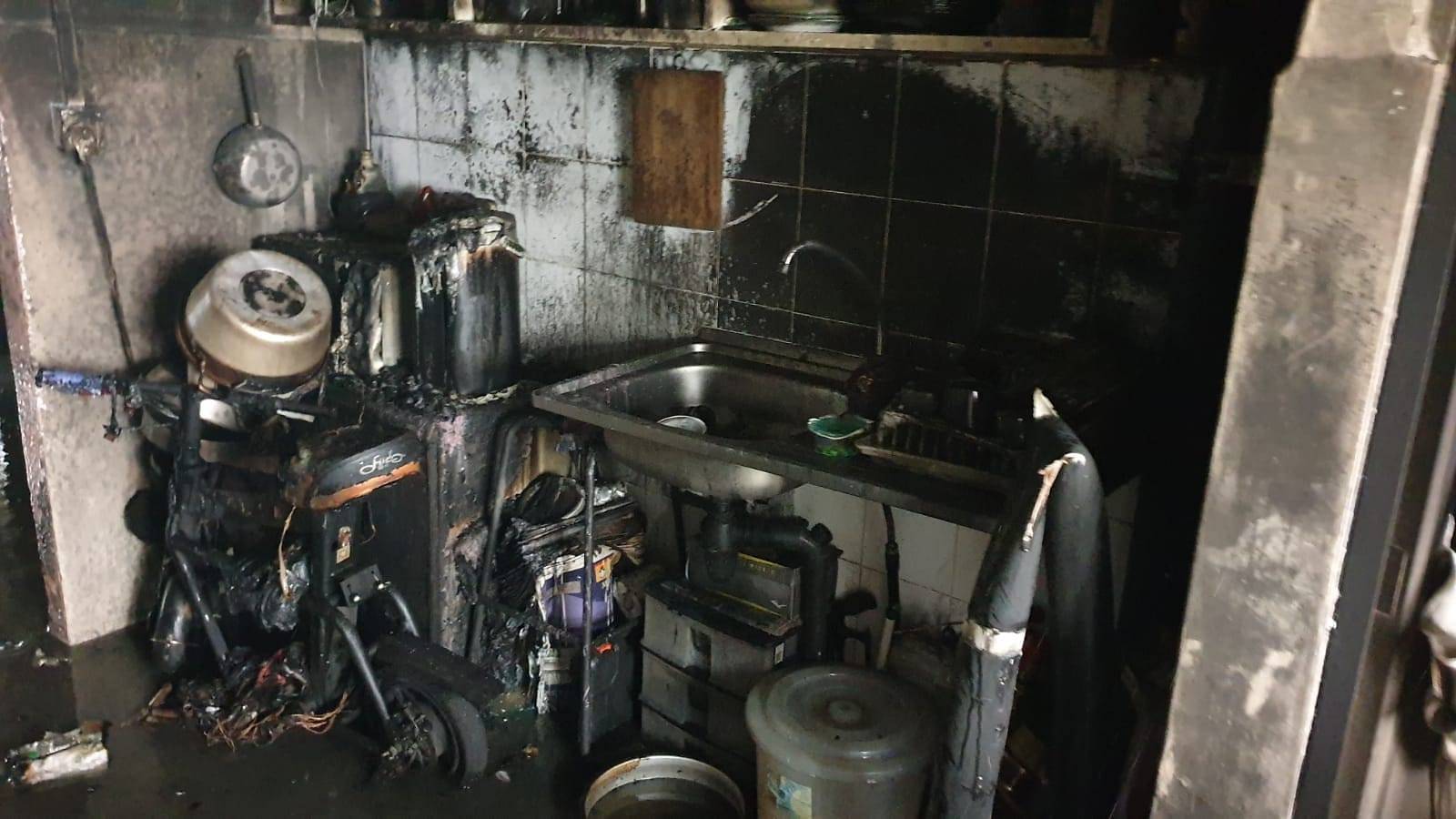
A personal mobility device (PMD) that was placed in the kitchen was the cause of the fire in Ang Mo Kio on Jul 22, 2019, according to preliminary investigations. (Photo: Facebook/SCDF)
The contractors will buy in bulk and develop standardised processes for installation. This will be much cheaper than having residents individually engage contractors.
We should be particularly wary of rent-seekers who exploit fire safety to make private profits. Many residents have encountered door-to-door salesmen selling fire protection equipment.
Some of these salesmen have falsely claimed to be agents of the SCDF, the local Member of Parliament, or other authorities. The equipment may be sold at grossly marked-up prices.
Education is no barrier to exploitation. A friend, who has a PhD, bought a fire extinguisher, thinking the salespeople were acting with the support of the authorities. So everyone can be fooled.
But without proper education, it is unlikely that an installed fire alarm will be maintained effectively.
A resident who experiences false alarms because the device is installed next to the cooking stove may just disable the device instead of relocating it. We cannot rely on these private opportunists to educate the public.
WHAT ABOUT PRIVATE HOMES?
Mandating home fire alarms in our private condominiums and private property may be more challenging. The safety of residents in private property is also important, but the economies of scale are different.
A fire at St Regis residences on Feb 20, 2019 involved the contents of a bedroom in a 12th-floor unit, SCDF says. (Photo: Gillian Tan)
There are a huge variety of floor plans and designs of private condominiums and homes. The economies of scale from a centralised, coordinated programme are likely to be much smaller, compared to HDB housing where a standardised process for installation can be developed.
If we can work out a plan for supporting private property owners, we should also consider mandating installation in all residential private property, to make the nation fire safe.
While we sometimes have an unhealthy obsession with performance measurement, I encourage the Ministry of Home Affairs and the Singapore Civil Defence Force to set as a Key Performance Indicator the percentage of Singapore homes with working home fire alarm devices.
With the amended Fire Safety Act, we can mandate that all HDB flats install fire alarms, and to ensure that installation rates are high, we should use public funds to pay for the installation.
Walter Theseira is a Nominated Member of Parliament and Associate Professor at the Singapore University of Social Sciences.
SINGAPORE: As tensions escalated in Hong Kong on Monday (Aug 5) with police firing tear gas and rubber bullets at demonstrators, some Singaporeans based in the financial hub have raised their concerns about the future of the city, with one even considering if it is time he moves back home.
“Hong Kong has no future like this,” said Hung Leung Chee, a 33-year-old Singaporean who moved to Hong Kong three years ago.
“(The protests) have restricted my movements greatly since the unrest started back in June.
“I have been worrying about my way to work since last night. I have been keeping a close eye on the news since I woke up – mostly on traffic information,” he said, referring to the disruptions on Monday morning that left the city at a standstill.
“I’m very much considering moving back to Singapore,” he said.
A protester blocks the MTR underground train from closing as protesters blocked the train doors at Fortress Hill station in Hong Kong in their efforts to disrupt the morning rush hour commute. (Photo: AFP/Anthony Wallace)
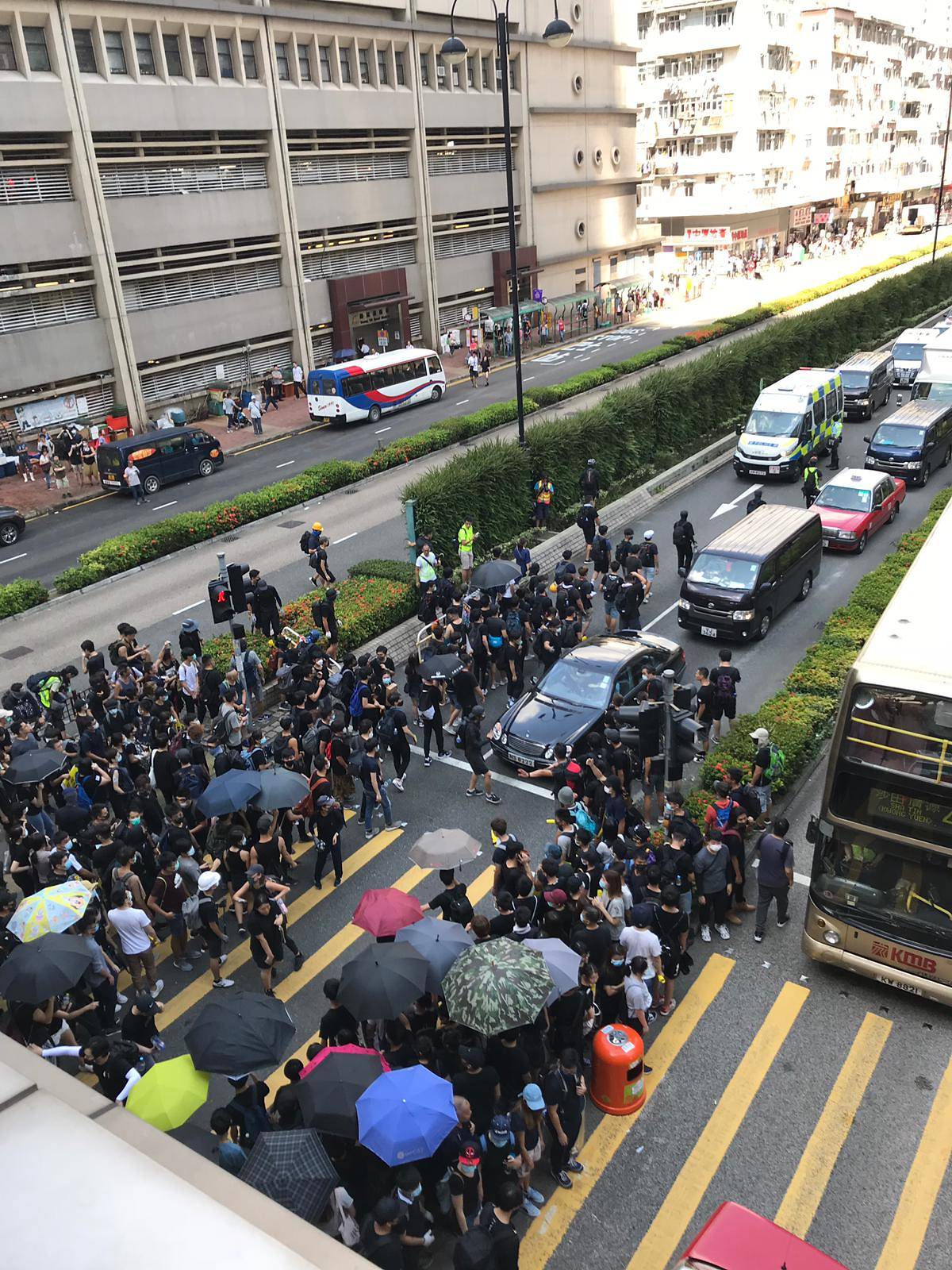
Hong Kong protesters at Tsuen Wan on Aug 5, 2019.
AN “EERIE FEELING”
Others, like 27-year-old Elissa, said it was an “eerie feeling” seeing the clashes across Hong Kong.
“Hong Kong has always been such a safe and efficient place. If you told me just three months ago that this would happen, I would have never believed it,” she said.
“It’s almost a norm now to expect some clashes and protests to happen somewhere every day.
“I’ve stopped making plans to do activities or see friends over the past few days due to the uncertainty of what may happen and risk being stuck,” she said.
One expectant mother said she was worried about being caught up in the violence during her commutes.
“I worry about … violence during the commute. I think as long as one avoids the main protest areas, the probability of violence is low. But more and more disruptions and protests are happening during the morning commute and I do worry that it can escalate to violence,” the 32-year-old Singaporean said.
Police fire tear gas at protesters in the Admiralty area during a general strike in Hong Kong on August 5, 2019, as simultaneous rallies were held across seven districts. (Photo: AFP/Anthony WALLACE)
Protesters hold improvised shields and umbrellas as police fire tear gas in the Admiralty area during a general strike in Hong Kong on August 5, 2019. (Photo: AFP/Anthony WALLACE)
NOT FEARFUL “FOR NOW”, CONCERNS ARE OVER LONG-TERM IMPACT
While some Singaporeans expressed their concerns over issues of security and violence, others told CNA the situation has yet to affect them significantly.
“Other than trying to stay at home on weekends when planned protests have been announced. I would say that it has not caused any major inconvenience to my lifestyle as of yet,” said 34-year-old Nick, who works in finance.
“I do have to say though that there is a constant worry on how long more the protests will stay and evolve, seeing how there still has been no clear resolution in sight,” he added.
One reader told CNA that while she was affected by the closures and disruptions, she was not bothered by the protest-related “inconveniences” and was more concerned about the impact on Hong Kong’s financial sector and the reputation of the city.
A protester carries a banner during a demonstration to support the city-wide strike and to call for democratic reforms in Mong Kok area in Hong Kong, China, August 5, 2019. The banner reads “Anti-extradition bill to China”. REUTERS/Kim Kyung-Hoon
Another Singaporean said although he is not fearful “for now”, he will be keeping a close eye on developments.
“In general, up to yesterday, Singaporeans in Hong Kong have been able to keep track of protest areas and avoid those areas for safety,” said James Teo, a Singaporean lawyer living in Hong Kong.
“However, with protests now springing up spontaneously, like the occupation of Causeway Bay yesterday, we no longer know which is the next area to be hit by protests and tear gas,” he said.
“Especially since police do not seem to take into account the neighbourhood surroundings when releasing tear gas, we now no longer know where the next danger area will be,” he said.
“I’m keeping a watchful eye on developments, and staying safe.”
On Monday, protesters in Hong Kong congregated in several different districts in the city, amping up their demonstrations in scale and intensity in an effort to ramp up pressure on the financial hub’s leaders and bring more attention to their demands.
During the morning rush hour, activists descended on multiple Mass Transit Railway (MTR) lines, deliberately keeping doors open to stop trains from departing, causing long queues and triggering occasional scuffles between angry commuters and protesters.
Mr Teo described the situation as a “total transport paralysis on the MTR”.
Passengers wait for the resumption of Mass Transit Railway (MTR) services during a disruption by protesters at Fortress Hill station in Hong Kong, China, Aug 5, 2019. (Photo: Reuters/Kim Kyung-hoon)
Rail operator MTR Corp announced the suspension of services between the bustling shopping district of Causeway Bay and Quarry Bay on Hong Kong Island. Services from Kowloon Tong to stations close to the border with mainland China were also disrupted, Hong Kong media reported.
More than 200 flights at the city’s airport – one of the world’s busiest – were also listed as cancelled on Monday morning after aviation authorities warned passengers about potential disruptions.
Hong Kong’s leader Carrie Lam in a news conference hours later warned that the city was on the verge of an “extremely dangerous situation”, a signal to Ms Elissa that planned protests for Monday afternoon would be disruptive.
“From her speech, we knew the rallies this afternoon would be bad and were told by HR and managers to leave the office at noon and work from home to avoid being stranded,” said Ms Elissa, adding that her usual 15-minute bus ride to work turned out to be almost an hour-long instead.
Some companies, anticipating the disruptions, had already made alternative work arrangements in preparation for Monday’s planned rallies.
A Singaporean working in the banking industry told CNA: “We were advised to work from home with our manager’s approval.”
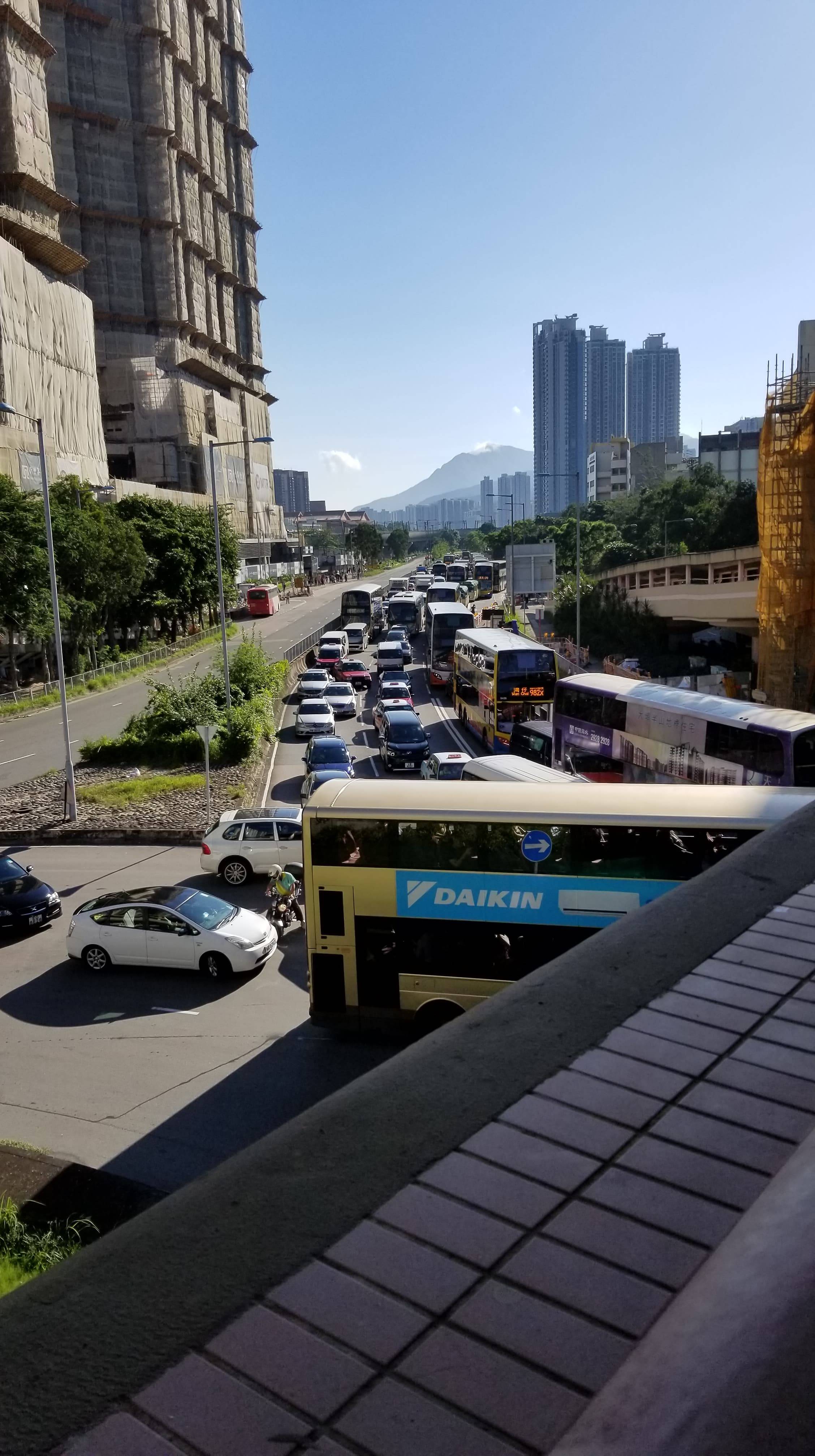
Traffic seen in the district of Tai Wai in Hong Kong on Aug 5, 2019. (Photo: Hung Leung Chee)
Others, like Mr Hung, who had attempted to go into the office, were forced to abandon those plans.
“The lines to the buses were crazy long and there was no telling how long I had to wait to get on one.
“So I took a couple of pictures of the jam and chaos to show my boss and returned home,” he said.
“Furthermore people are gathering in several districts as we speak and from experience, these gatherings mostly end up in a riot. So I think it is safer to remain at home,” he said.
RIOT POLICE FIRE TEAR GAS
The concerns expressed by the Singaporeans were not unfounded, with riot police firing tear gas at protesters at several locations across Hong Kong after some demonstrators besieged police stations and hurled umbrellas and other items at officers.
The police said that they had repeatedly warned the demonstrators to stop the “illegal acts” and used tear gas and the “least force” to disperse the crowd.
Protesters prevent the doors of a MTR underground train from closing at Fortress Hill station as they disrupt the rush hour commute in Hong Kong on Aug 5, 2019. (Photo: AFP)
A commuter argues with a protester as a train is stalled during disruption of the Mass Transit Railway (MTR) services by protesters, in Hong Kong, China, Aug 5, 2019. (Photo: Reuters/Kim Kyung-hoon)
The demonstrators also blocked key roads, including three tunnels, cutting major arteries linking Hong Kong Island and the Kowloon Peninsula. In Yuen Long district, a car rammed through a barricade, knocking down protesters.
Thousands of black-clad protesters later occupied roads in Admiralty district near government buildings for several hours before moving to other areas. By nightfall, protests continued across the city.
SINGAPORE: From bringing forward the safety certification deadline for personal mobility devices (PMDs) to trialling pedestrian-only zones, several measures were announced in Parliament on Monday (Aug 5) to improve safety for riders and the public.
During the hour-long debate on the issue, 14 Members of Parliament (MPs) brought up other suggestions such as banning PMDs from footpaths and introducing mandatory third-party insurance for riders.
They also asked about using more technology to help in enforcement efforts, and whether PMDs which are not UL2272 certified can be banned immediately.
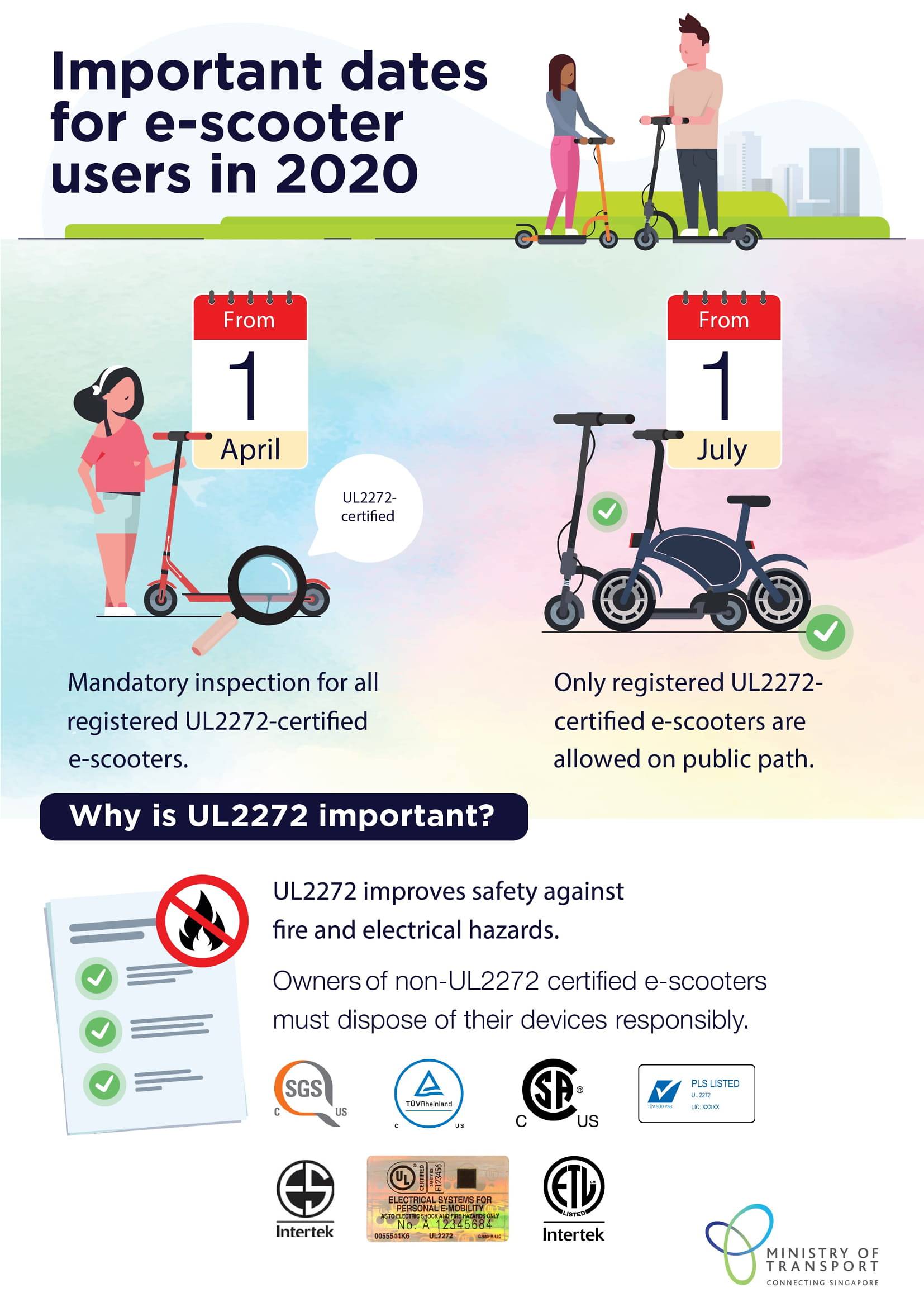
The suggestions came after Senior Minister of State for Transport Lam Pin Min announced in his ministerial statement that the deadline for PMDs to comply with the UL2272 safety certification has been brought forward by six months to July 2020.
He also said that from April next year, all e-scooters – both new and currently registered – will have to go through a mandatory inspection that includes checks on a device’s width, weight and speed limits.
But MP for Marsiling-Yew Tee GRC Alex Yam asked if the ban on PMDs that are not UL2272 compliant can come immediately, given that such devices have been identified as a fire hazard.
“Indeed, non-UL2272 devices have been identified as one of the possible reasons why we have this spate of fire incidents recently,” Dr Lam said.
“But we also understand that there are multiple factors that can lead to a fire incident.”
These include overcharging, improper charging practices and the use of incompatible chargers or adaptors, said Dr Lam.
“We also are cognisant of the fact that there are many Singaporeans out there that rely on such devices not only for their daily commuting but also as a way to sustain their livelihood,” he added, noting that an immediate ban will “definitely impose a lot of hardship and inconvenience to many Singaporeans”.
“So, we are quite careful in not doing that.”
Dr Lam said discussions with PMD retailers have also shown that the new deadline is a “reasonable timeline” as it gives them enough time to bring in the certified devices.
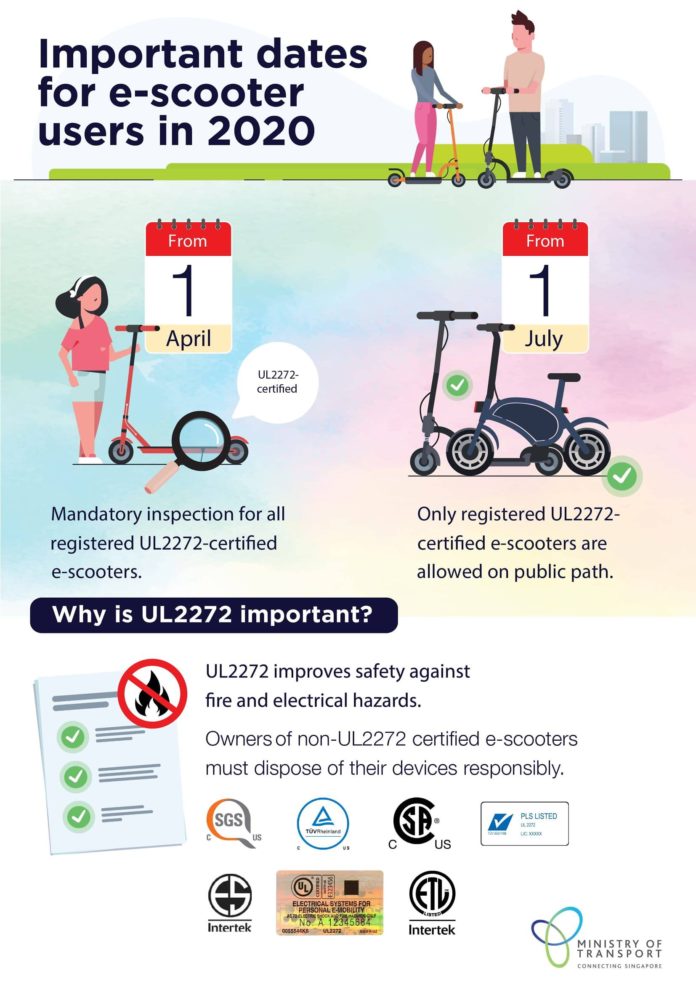
(Graphic: MOT)
COMPLETE BAN FROM FOOTPATHS
Taking things a step further, MP for Mountbatten SMC Lim Biow Chuan suggested banning PMDs from footpaths until safety improvements to infrastructure have been made.
However, Dr Lam said a complete ban on footpaths would only mean pushing PMDs onto the roads. This would likely lead to more deaths because buses, cars and lorries are travelling at faster speeds on the same road, he said.
“We could have taken the path of least resistance at the beginning to completely ban PMDs on pavements and shared paths,” Dr Lam said.
“I think PMDs still have a role to play in providing active mobility options as well as providing the first and last mile connectivity.
“What we have done is to implement a very comprehensive regime to ensure that PMDs are used in a safe and responsible manner.”
COMPULSORY COURSE AND LICENSING
Mr Yam and MP for Bukit Panjang SMC Teo Ho Pin suggested making it mandatory for PMD users to attend the Safe Riding Programme (SRP) and go through a licensing regime.
Dr Lam replied that authorities “strongly encourage” riders to attend the programme, adding that more than 57,000 riders have already done so.
“We have also asked ourselves if we should make it mandatory for all PMD users, but we concluded that at this point in time it may not be necessary to do so,” he said.
“To encourage the take up, we have made it free of charge for the first two years until December 2019,” he added. “We will continue to work with active mobility interest groups, schools, companies – especially food delivery companies – to encourage all their cyclists and PMD riders to attend the SRP.”
As for the licensing regime, Dr Lam said authorities have no intention of implementing it “at this point in time”. “But let us bring this back to study and see whether this will be necessary in the future,” he added.
COMPULSORY INSURANCE
MP for Tanjong Pagar GRC Melvin Yong also reiterated his position that PMD users should get compulsory third-party liability insurance, noting that a market study has indicated that costs “may not be exorbitant” – at S$50 to S$80 per year.
In response, Dr Lam said he has asked the Active Mobility Advisory Panel to study the issue, adding that it will submit its recommendations later this year after consulting relevant stakeholders.
“At this point in time, we will likely start off by requiring PMD-sharing operators to have mandatory third-party liability insurance, and major food delivery companies – Deliveroo, GrabFood and Foodpanda – will also provide third party insurance,” he stated.
“In the meantime, we are also working with the insurance companies to see whether we can come up with more affordable insurance plans for the individual users so that the cost of the insurance will not be a great barrier for them to purchase one if they want to at this point in time.”
TECHNOLOGY FOR ENFORCEMENT
On the issue of enforcement, Fengshan SMC MP Cheryl Chan asked if authorities will consider fixing speed-tracking devices on PMDs to complement ground enforcement.
Dr Lam had earlier announced that the Land Transport Authority will double its enforcement team to about 200 by the end of this year. They will be helped by a new app function which allows the public to report and take a photo of errant PMD riders.
While Dr Lam acknowledged that this technology might have its limitations when it comes to identification, he said it allows authorities to identify potential hotspots and step up enforcement in these areas.
“Whenever there are new technologies that are available in the future, we will consider using technology to enhance our enforcement action,” he continued.
“But in the interim, I think it is necessary to have sufficient manpower on the ground, which is one of the many feedback we have received from advisers, that there is very few in the past physical bodies on the ground to do enforcement.”
AUTHORITIES BEING REACTIVE?
With that, Mr Lim questioned if authorities were being “reactive” in the introduction of the safety measures, adding that the situation did not seem to be getting better.
Dr Lam responded that the measures showed that authorities understood concerns on the ground, and will not hesitate to take appropriate action when necessary.
Furthermore, he said Singapore remains the only country that has implemented the UL2272 standard for PMDs, calling it “a bold and decisive move” to improve fire safety.
“As with the introduction of any new technology, our regulatory regime has to be nimble and responsive,” he continued. “We will have to evolve with the needs according to the situation and feedback on the ground.”
Dr Lam noted that irresponsible users make up only a “small number” of the PMD community.
“We don’t want to just ban the use of PMDs just because of this small group of irresponsible users while affecting the rest who are responsible,” he added.
“The reason why we promote active mobility is because we believe that it is good for Singaporeans and for Singapore, and that helps with our vision of a car-lite society.”
SINGAPORE: The Singapore Civil Defence Force (SCDF) will be able to compel building owners to install critical fire safety upgrades after Parliament passed amendments to the Fire Safety Act on Monday (Aug 5).
The SCDF regularly reviews the fire code, which specifies fire safety standards for buildings. However, changes to the code only apply to new buildings, and to existing ones that undergo addition and alteration works.
With the introduced changes, the commissioner of Civil Defence can issue an order to require building owners to install fire safety measures, if these measures are necessary for public safety, said Senior Parliamentary Secretary for Home Affairs Sun Xueling.
These include fire alarm systems and fire hose reels, MHA had said previously.
“SCDF will be judicious, and will take a risk-based approach in identifying buildings and the fire safety upgrades that will be required of them,” she added.
Around 500 buildings have been identified based on factors such as their age and the profile of the occupants, said Ms Sun. These are mostly commercial, industrial and government buildings.
While Members of Parliament (MPs) voiced their approval for the changes, a number suggested that safety could be further bolstered by the installation of warning systems in local residences.
MP Chia Shi-Lu said he particularly would like to see wider adoption of smoke detection and sprinkler systems in all buildings.
“Fire is a horrific event, and the amendments to this Act are timely and will strike a balance between … ensuring public safety as well as managing the costs for building owners and industry stakeholders,” he said.
“The ministry has indicated that it is prepared to be flexible and may accept alternative solutions for buildings which encounter technical problems installing such features.
“I appeal to SCDF to adhere to its high standards. Understandably, all owners will be concerned with costs but alternatives which compromise on safety should not be permitted.”
MPs also pointed out that an additional way to beef up fire safety would be to make installation of warning systems mandatory in all homes, particularly Housing Board flats.
“My question is, if we agree that having a fire alarm system saves lives, why do we not have it for our HDB flats?” asked MP Louis Ng.
“It seems even stranger that we have fire alarm systems for our HDB multi-story car parks where nobody lives and not in our HDB flats where hundreds of people live? Why?”
The majority of fire injuries in 2018 were caused by fires in residential buildings, Mr Ng pointed out.
Since June last year, the installation of smoke detectors or Home Fire Alarm Devices (HFADs) has been made mandatory for all new homes. Existing homes which undergo fire safety works are also required to install them.
The HFADs provide occupants with an early warning so that they can extinguish the fire or evacuate, according to SCDF.
This is a “commendable” move, said Mr Ng, but he pointed out that a centralised fire alarm system in each block would make it even more efficient to warn the residents of other units.
Mr Ng also asked if MHA had plans to require all other HDB units to install HFADs.
This was echoed by NMP Walter Theseira, who suggested that it be made mandatory for all HDB flats to install HFADs, with the initial installation costs in existing HDB flats paid for by the Government.
“As of 2018, we have nearly one million owner-occupied HDB flats in Singapore. Nearly all were built before Home Fire Alarm Devices (HFADs) became mandatory for new flats in June 2018 … The costs of installing Home Fire Alarm Devices in one million HDB flats will be significant, but reasonable compared to other large social welfare programmes,” said Dr Theseira.
Smoke detectors decrease the probability of fatal fire incidents “dramatically”, added NMP Anthea Ong.
If mandating the installation is not possible, she suggested incentivising home owners to equip homes with fire extinguishers and smoke alarms through offering discounts for conservancy charges or for home fire insurance premiums.
However, Ms Sun pointed out that HFADs may give off false alarms, leading to undue stress and disturbances for residents. She explained that having the HFAD linked to a central fire alarm system would also have “downsides”.
“To give members a sense of the potential challenge that we will face from false alarms, SCDF’s records showed that for buildings with central fire alarm systems now, there were about 47,000 alarm activations per year – out of which less than one per cent involved a real fire,” said Ms Sun.
As such, a balanced approach needs to be taken, she added.
“False alarms could be due to reason such as non-maintenence of the central fire alarm system, failure of the building owner to request for the alarm system to be temporarily disabled while engaging in fogging activities, or just simply prank actions by some ill-intentioned persons,” she explained
“Regardless, regular citizens are affected. While we’re not mandating that all existing home owners install HFADs in their homes at this point, we strongly encourage our residents to do so.”
AUTHORISED THIRD-PARTY INSPECTIONS
Senior Parliamentary Secretary for Home Affairs Sun Xueling speaking in Parliament on Mon (Aug 5).
As part of the amendments to the Bill, the SCDF will also be able to appoint authorised third parties to conduct routine fire safety enforcement checks and building inspections.
This “will optimise SCDF’s capabilities and resources, by allowing them to focus on complex areas which pose higher fire safety risks, and outsource more routine and straightforward functions,” explained Ms Sun.
These third parties can conduct fire safety building inspections and exercise certain enforcement powers, such as the issuance of Fire Hazard Abatement Notices, for simple and straightforward cases.
“SCDF will exercise careful discretion in the scope of work to be outsourced, and retain control over all fire safety enforcement actions,” said Ms Sun. “SCDF will also implement safeguards, such as random audits, and require appointed officers to wear body-worn cameras when they carry out inspections.
“This will ensure that the appointed officers conduct their inspections professionally, and minimise the risk of any abuse of authority.”
In response, MP Sylvia Lim questioned whether there are concerns over the SCDF losing “valuable ground knowledge by outsourcing routine inspections”.
“Would these third party officers be restricted to Singaporeans and Permanent Residents or would foreigners also be eligible for deployment? At the steady state, how large a force of third-party officers does SCDF expect to maintain?” she added.
To begin with, the SCDF is only looking to appoint a small team of about five third-party officers said Ms Sun in response.
She added that only “simple checks” would be outsourced, with the SCDF continuing to issue composition notices and collect fines till confident that these officers are competent in their duties.
Added Ms Sun: “We will ensure that our officers continue to walk the ground and keep a finger on the pulse of the situation.”
Giving the examples of the 2017 Grenfell fire in London and as well as the Notre Dame cathedral fire in Paris this year, Ms Sun said that these incidents highlighted the importance of “strong regulatory regimes” as prevention.
While Singapore’s fire fatality rate remains low compared to other major cities around the world, it is not invulnerable, she added.
“We have succeeded in reducing it by half from 0.15 fatalities per 100,000 population in 2014, to 0.07 in 2018. In comparison, New York’s fire fatality rate was 15 times higher in 2018, and Tokyo’s was nine times higher,” said Ms Sun.
“That said, we should not be complacent, and think we are immune.”