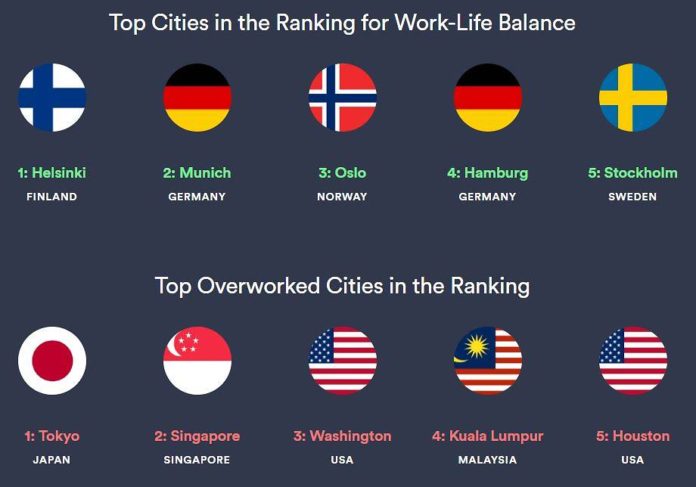
SINGAPORE: Singapore was among the bottom 10 for work-life balance and ranked the second most overworked city in a study of 40 cities released on Wednesday (Aug 7).
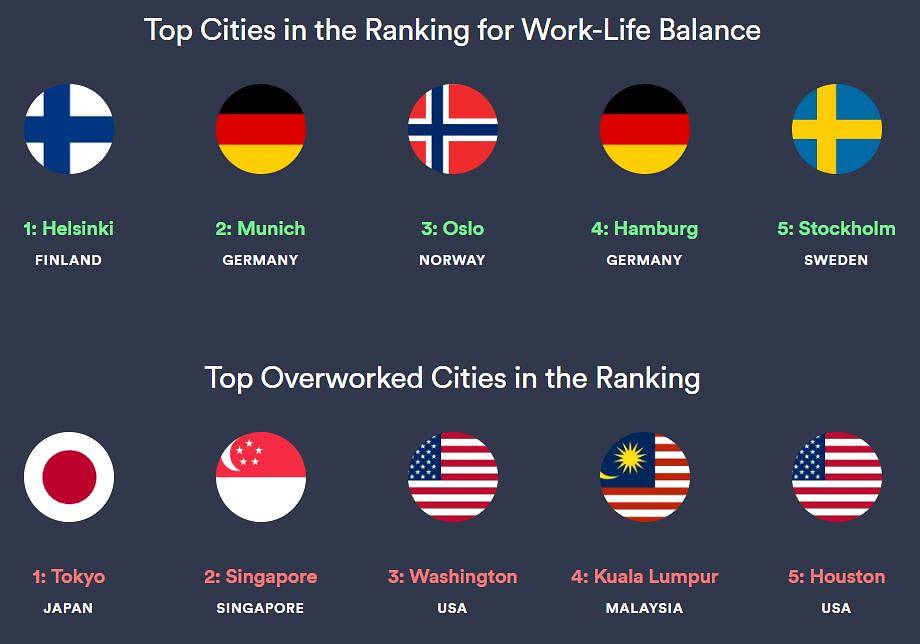
The study by tech company Kisi showed Singapore came in 32nd among the 40 cities on the list for work-life balance. Helsinki nabbed the top spot, followed by Munich, Oslo, Hamburg and Stockholm. Kuala Lumpur was ranked last, with Tokyo close behind.
Singapore was second only to Tokyo in a ranking for the most overworked cities.
(Source: Kisi)
The cities included in the 2019 Work–Life Balance Index are “known for attracting professionals and families for their work opportunities and diverse lifestyle offerings”, the study said.
They were ranked based on factors like the average number of hours worked per week, minimum number of vacation days offered, average amount of time spent travelling to work, gender parity, and perceived level of happiness.
In Singapore, 23 per cent of people worked more than 48 hours per week and workers began their work day at 9.34am on average, the study showed.
Workers in Singapore worked an average of 44.6 hours a week, exceeded only by employees in Kuala Lumpur with 46 hours, according to the survey. In contrast, people in Oslo worked 38.9 hours a week, the fewest among the 40 cities.
Workers were offered seven minimum vacation days and took 14 vacation days on average.
The city ranked 11 for gender equality and had the highest safety score. It was ranked seventh for perceived happiness and 17th for “stress-inducing factors”, such as a city’s population density, transport and infrastructure, climate, and local economy.
The study drew on sources like Kisi’s own internal data, the International Labour Organisation and Expedia.
CEO of Kisi Bernhard Mehl said: “It is important for us to note that our professional and personal lives are not, and should not be, mutually exclusive.
“Despite living in an era where unprecedented advancements have been made in technology and connectivity, we have failed to address the most everyday aspect of enhancing our everyday lives – finding the balance between work and leisure.
“Whether it’s the long hours, unrealistic expectations from bosses or job insecurity, workplace stress has proven to affect our physical and mental health.
“As long as employees are stressed, they will not take advantage of the safeguards created for their well-being – no matter how progressive government and company reforms are.”
The company added the index was not designed to be a city livability index, nor is it intended to highlight the best cities to work in.
“Iinstead, it aims to be a guideline for cities to benchmark their ability to support the fulfilment of residents’ lives by improving the aspects of life that help relieve work-related stress and intensity,” Kisi said.
“All states benefit from an international world order that is based on the rule of law,” says Deputy Prime Minister Heng Swee Keat.
Deputy Prime Minister Heng Swee Keat speaking at a gala dinner on the Singapore Convention on Mediation.
(Updated: )
Bookmark
SINGAPORE: The new international treaty on mediation named after Singapore is “crucial” now, given that the rules-based international order which has underpinned global peace and stability is “coming under pressure”, Deputy Prime Minister Heng Swee Keat said on Wednesday (Aug 7).
Speaking at the Singapore Convention gala dinner for delegates, Mr Heng said that beyond strengthening international dispute resolution, the Singapore Convention on Mediation bears testament to the continued commitment by countries to a rules-based international order.
He reiterated Prime Minister Lee Hsien Loong’s sentiment that the new treaty is a “powerful statement in support of multilateralism”. Forty-six countries, including the United States and China, signed the treaty on Wednesday.
“All states benefit from an international world order that is based on the rule of law. It allows for predictability and the management of relations and issues based on agreed principles,” said Mr Heng, who is also Singapore’s Finance Minister.
“This, in turn, assures countries big and small that their interests will be taken into account.”
He said the new treaty was the outcome of three years of “hard work and perseverance” by all parties involved, such as the United Nations Commission on International Trade Law (UNCITRAL) Working Group II. It also shows Singapore’s efforts to better serve the needs of companies in the region when they have differences in their business dealings.
Mr Heng noted that businesses traditionally rely on litigation and arbitration when differences arise, and that these mechanisms appeal because there is certainty that judgments and arbitral awards can be enforced internationally.
That said, mediation has risen in prominence in recent years, he added.
“Mediation is cheaper and faster. It preserves harmony and business relationships, which is in line with many cultures, particularly in Asia,” Mr Heng said, adding that it gives firms an extra option for dealing with cross-border disputes.
Citing infrastructure projects as an example, the Deputy Prime Minister said there is a big demand for such projects around the world but that these are inherently complex. They span many years, multiple parties and over various jurisdictions, and the stakes are high because of the large sums involved and wide-ranging economic and socio-political impact, he elaborated.
“Beyond structuring these projects well at the onset, it is equally important to have good dispute resolution mechanisms that can resolve issues when they arise across the lifetime of the projects,” Mr Heng said.
“Mediation is therefore a good option for such disputes, because it focuses on solving the problem rather than on deciding who is right. It seeks to resolve the problem in a way that will preserve relationships and allow the project to go on,” he added.
He acknowledged that mediation’s effectiveness is limited if parties are not assured the agreement will be enforced.
This is why the Singapore Convention on Mediation is critical to the adoption of international commercial mediation as a dispute resolution option as it will make it easier for businesses to enforce settlement agreements with cross-border counterparts, the minister said.
This is not the first time Mr Heng has highlighted the challenges of infrastructure projects.
SINGAPORE: Prudential Singapore has raised its Central Provident Fund (CPF) contribution rate for older workers above the age of 55 to match that of their younger colleagues, the insurance company announced on Wednesday (Aug 7).
It becomes the first financial institution to do so, after it scrapped the retirement age for employees in October last year.
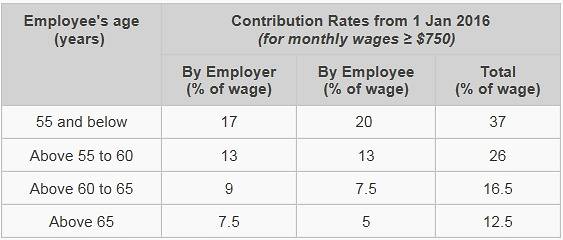
Currently, the government-mandated CPF contribution rate for workers below 55 is 17 per cent by employers and 20 per cent by employees, making up a total contribution rate of 37 per cent.
For older workers above 55, the total CPF contribution rate drops to between 12.5 per cent and 26 per cent, depending on their age bracket, with employers contributing between 7.5 per cent and 13 per cent and employees contributing between 5 per cent and 13 per cent.
Table of CPF contribution rates. (Graphic: CPF website)
But with Prudential’s new CPF scheme, the company will raise its contribution to 17 per cent if the employee chooses to raise their individual CPF contribution rates to 20 per cent.
“Prudential’s new CPF scheme for its older employees is an opt-in scheme as the insurer recognises that some individuals may prefer to have more disposable income to meet their current needs,” the insurance firm said in its media release.
According to Prudential’s calculations, a 61-year-old employee with a monthly salary of S$5,000 could save S$1,025 in CPF funds each month, equating to S$12,300 a year. There are currently 46 Prudential employees who stand to benefit from this scheme, the company said.
“It was a bonus when the company scrapped the retirement age as I can continue to work for as long as I am able to,” said Ms Sue Li, a 63-year-old customer service officer who has been working with Prudential for 24 years.
“Now, they are going a step further by contributing more money to my CPF funds. Although I must top up my CPF account as well, I am more than happy to do so. The additional savings would help finance my retirement years and potential healthcare expenses.”
Prudential Singapore CEO Wilf Blackburn said the new CPF scheme, introduced in close consultation with the Singapore Insurance Employees’ Union, aims to create a more “age-friendly workplace”.
“We believe in rewarding our people based on performance. It is with this in mind that we have decided to make equal our CPF contributions for all employees, regardless of age,” he added.
Prudential Singapore removed the retirement age in October last year to allow its older employees to continue working.
“Additionally, with rising lifespan and healthcare costs, we recognise that our employees will need to save more to fund their extended years,” Mr Blackburn added. “The additional CPF (money) could help them build a bigger retirement nest egg so they will be more financially ready for the future.”
According to a Prudential survey of 1,214 Singapore residents, about 50 per cent of respondents said they were not financially ready to live to 100 years old.
In February last year Member of Parliament Intan Azura Mokhtar called on the Government to review the CPF contribution rates for those above 55, saying it “does not make sense” that CPF rates are cut at 56 when the average life expectancy is at least 80 years old.
SINGAPORE: Singapore’s first velodrome, a speed climbing wall, as well as a football hub are among some of the ideas that were unveiled on Tuesday (Aug 6) as part of recommendations to redevelop the Kallang area.
The Kallang Alive project is among 15 recommendations that were unveiled in a Vision 2030 report, Sport Singapore (SportSG) said in its media release. This followed a year-long review in 2018 to gather feedback from Singaporeans.
The Kallang Alive precinct aims to be “a destination where Singaporeans can participate in community sports activities and enjoy world-class entertainment and sporting action”, SportSG added.
The national sports agency said it was currently completing a feasibility study with the National Youth Sports Institute to build the velodrome.
An aerial view of the Kallang Alive project. (Image: SportSG)
“Should this come to fruition, the Youth Hub at Kallang Alive could be a possible location to site this velodrome to capitalise on its appeal to youths,” said the agency.
The velodrome would serve as the national training centre for track cycling and also help to promote the sport to the wider cycling fraternity.
It would be built in the Youth Hub, which would also be a space for extreme and unique sport such as speed climbing and parkour, the agency added in its Vision 2030 report.
Kallang Alive Gateway and Loop. (Image: SportSG)
Another key infrastructure proposal is a football hub, which will house the national training centre and ActiveSG Football Academy.
“The KFH (Kallang Football Hub) would comprise one full-sized natural turf pitch, two full-sized artificial turf pitches, one half-sized pitch for five-a-side or seven a-side training and matches, as well as four sheltered futsal pitches,” said SportSG.
The proposed football hub at Kallang. (Image: SportSG)
Training facilities will also be available, said the agency.
For tennis buffs, a tennis centre, which would be open for the public, is also set to feature both sheltered and open courts.
The proposed tennis centre at Kallang. (Image: SportSG)
Called the Singapore Tennis Centre (STC), it would house the national training centre for the sport and also be home to the ActiveSG Tennis Academy.
“We hope that the STC will transform the local tennis scene through world-class programming and pathway development,” said SportSG.
An artist’s impression of the Youth Hub at Kallang Alive. (Image: Sport SG)
Other plans include the redevelopment of the existing Kallang Theatre and its adjoining areas.
This includes a multi-purpose indoor arena for eSports, a themed hotel, an international sports medicine centre, hospitality and event suites, as well as office spaces.
Running trails, park connectors and play areas along Geylang River and Jalan Benaan Kapal could also be in the works.
A connectivity route is also set to link all venues across Kallang Alive, said SportSG.
“This route could possibly trace the original circular airfield of the Kallang Airport and reintegrate the Old Kallang Airport site with the overall Kallang Alive precinct.”
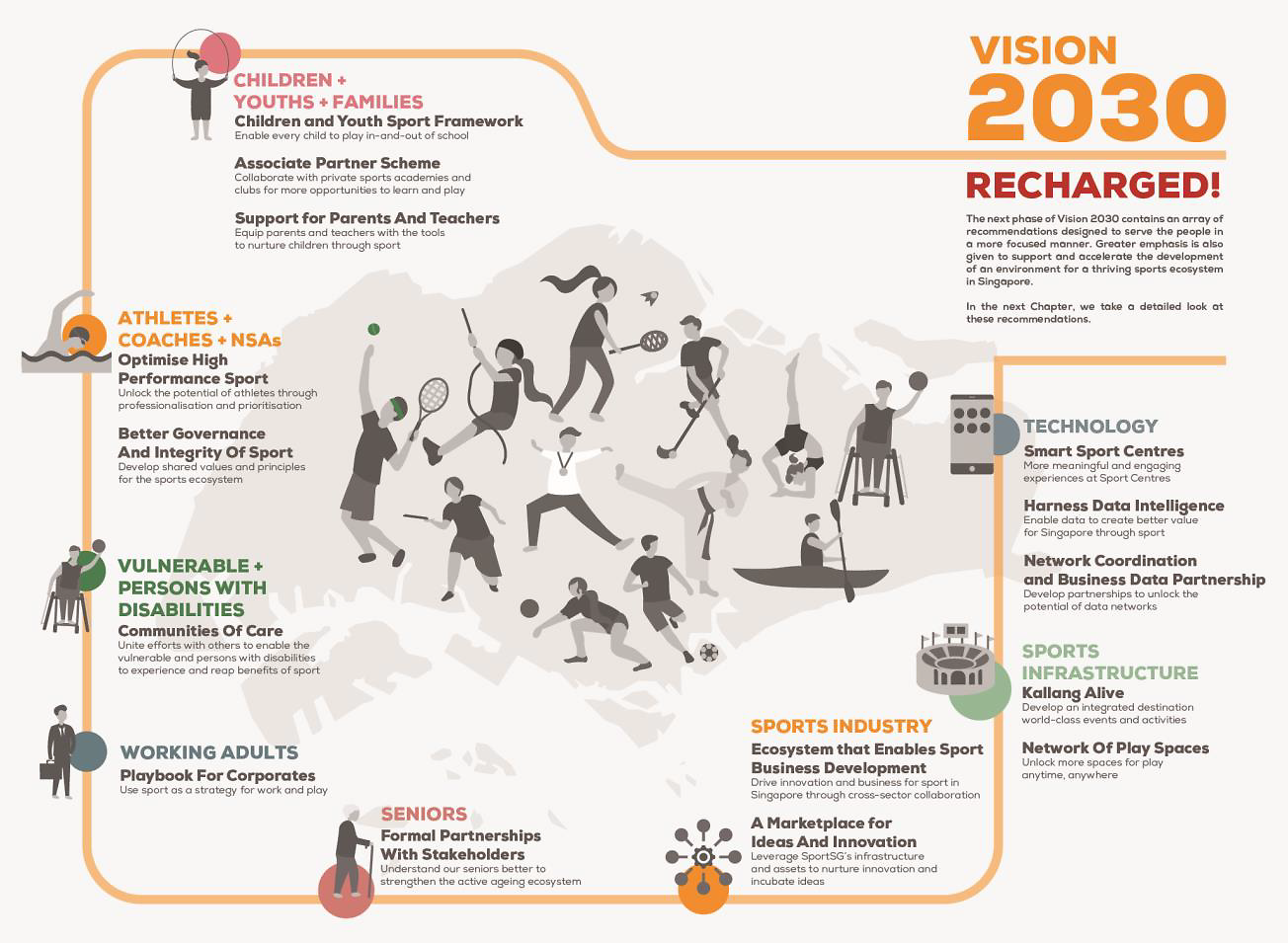
An infographic of the recommendations for Vision 2030. (Image: Sports SG)
Vision 2030 is the national blueprint for sport that was launched in 2012.
The latest review under the masterplan involved more than 3,000 people from focus group discussions, surveys and research studies, SportSG said.
Other recommendations in the report include providing more play spaces for children, facilitating development of the sports industry through innovation, establishing formal partnerships with stakeholders to strengthen the active ageing ecosystem for seniors and working with the Ministry of Education and schools to expand opportunities for sports participation within and beyond schools.
SINGAPORE: E-sports athlete Figo Chua will play in an international tournament after being granted deferment from National Service (NS), but the deferment was not specifically for the tournament, the Ministry of Defence (MINDEF) clarified on Wednesday (Aug 7).
“The basis for Mr Figo ‘Azalea’ Chua’s deferment from full-time NS was not for participation in the Overwatch World Cup, as reported,” the ministry said in a statement to CNA.
Media articles have said that Chua, 18, was given a deferment to take part in the Overwatch World Cup 2019, which is taking place in November. He was due to enlist on Aug 14, according to a post on the Overwatch Singapore Facebook page.
Overwatch is a team-based first-person shooter game created by Blizzard Entertainment.
Chua was granted deferment to enrol for a NITEC course in January 2020, MINDEF said.
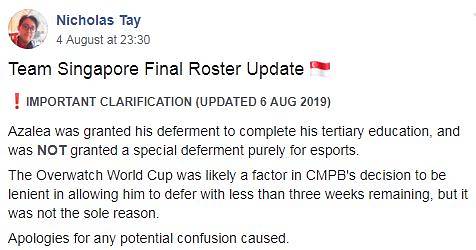
A post on Overwatch Singapore’s Facebook page clarifying the terms of Chua’s deferment from NS.
“Under current policy, deferment from full-time NS is generally granted to enlistees to pursue educational qualifications up to ‘A’ Levels, polytechnic diploma or their equivalent, including the NITEC,” the statement said.
Overwatch Singapore also clarified on its Facebook page on Tuesday, a day after its initial announcement, that the deferment was not to take part in the e-sports competition but for “tertiary education”.
But the post also stated: “The Overwatch World Cup was likely a factor in CMPB’s decision to be lenient in allowing him to defer with less than three weeks remaining, but it was not the sole reason.”
CMPB refers to the Central Manpower Base, which manages the enlistment of servicemen.
FEW DEFERMENTS FOR SPORTS
Mr Nicholas Tay, who is the community lead for the Overwatch Singapore team, also suggested in the Facebook post that “getting a deferment from National Service for esports-related reasons is practically unheard of”.
This was why they had asked a backup player to stand in for Chua in the event that he had to serve NS in August.
Special deferments for sports competitions are unusual and rarely granted.
Last year, footballer Ben Davis’ application to defer his NS enlistment was denied. The teen, who had signed with English Premier League club Fulham, was the first Singaporean to sign a professional contract with a top-tier English club.
MINDEF said then that “very few applications have been approved over the years and based on criteria which are made known to the public. In sports, deferments are granted only to those who represent Singapore in international competitions like the Olympic Games and are potential medal winners for Singapore. In the last 15 years, only three have met this criteria”.
Swimmers Joseph Schooling and Quah Zheng Wen, and sailor Maximilian Soh, were previously given deferments to train for and compete in the Olympics.
SINGAPORE: Forty-six countries, including the United States and China, signed a new international treaty on mediation named after Singapore on Wednesday (Aug 7) – which Prime Minister Lee Hsien Loong described as a “powerful statement in support of multilateralism”.
The new treaty will enable the enforcement of mediated settlement agreements among the signatory countries.
Singapore, represented by Minister for Home Affairs and Minister for Law K Shanmugam, was the first signatory of the United Nations Convention on International Settlement Agreements Resulting from Mediation, also known as the Singapore Convention on Mediation, on Wednesday.
More than 1,500 delegates from around the world attended the Singapore Convention Signing Ceremony and Conference, co-organised by the Singapore Ministry of Law and the United Nations Commission on International Trade Law.
Speaking at the event held at Shangri-La Hotel, Mr Lee said that the treaty, which he described as a “breakthrough”, demonstrates that countries are capable of achieving consensus with effort, creativity and leadership.
“The Singapore Convention is also a powerful statement in support of multilateralism,” said Mr Lee, who added that the treaty would help advance international trade, commerce and investment at a time when multilateralism was under pressure.
Mr Lee said that while many existing multilateral institutions were in need of urgent reform, suffer from a loss of confidence, or have practices and structures that were no longer fit for purpose, the solution was not to abandon multilateralism, but to improve it.
“We must recognise that these institutions have collectively brought the world growth and prosperity, and contributed to the peace, security and international order we have enjoyed over decades,” he said.
The alternative of a world without multilateral institutions and widely accepted international rules where “might is right” disadvantages all countries, and would be especially challenging for countries like Singapore, he added.
“That is why international treaties and the rule of law are especially important to us: Every word makes a difference, and when we sign a treaty, we will rigorously uphold what we have solemnly committed to,” he said.
“Today, a group of states have come together to recommit ourselves to multilateralism and to declare that we remain open for business, we are prepared to make binding commitments, and we are committed to preserving our relationships.”
THE “MISSING THIRD PIECE”
Mr Lee called the Singapore Convention on Mediation the “missing third piece” in the international dispute resolution enforcement framework, as today, for cross border disputes, many businesses rely either on arbitration, enforced via the New York Convention, or on litigation.
The signing of the Singapore Convention marks the start of a long-term commitment by Singapore to promote the Convention and see to its adoption, Mr Lee said.
The Singapore Convention was adopted by the UN General Assembly last December. More than 100 delegations, including country representatives and technical experts, worked on the convention between 2015 and 2018.
“Lengthy commercial disputes can ‘severely disrupt’ normal business operations, damage reputations, hurt share prices and make it harder for companies to raise capital, and dampen the confidence and morale of employees, shareholders and other stakeholders,” Mr Lee said.
“A robust framework to manage such conflicts can prevent such disputes from escalating unnecessarily or causing unintended consequences.”
Prime Minister Lee Hsien Loong and UN Assistant Secretary-General for Legal Affairs Stephen Mathias. (Photo: Ministry of Law)
“EFFECTIVE MECHANISM” FOR ENFORCEMENT
UN Assistant Secretary-General for Legal Affairs Stephen Mathias, who also attended the event, said uncertainty surrounding the enforcement of settlement agreements was identified as a main obstacle to the greater use of mediation.
Calling the treaty “innovative”, Mr Mathias echoed Mr Lee’s remarks and said that it was what was missing in the international framework for dispute settlement.
“The convention establishes mediation as a credible and effective path for commercial parties, to not only resolve commercial disputes, but to preserve their long-term relationships,” he said.
By unifying the rules related to enforcement, the convention provides for clearer and simpler mechanisms on enforcement, he said.
He added that the convention would “undoubtedly” enhance the use of mediation, and therefore foster access to justice.
The convention is the first in the field to bridge legal systems and reflect a worldwide consensus beyond cultural differences, he said.
Among the 46 initial signatories for the convention – which was adopted by the United Nations General Assembly last December – are South Korea, India and Brunei. A treaty needs at least three countries to sign and ratify it for it to come into force.
“It is our hope that many states will adopt the Singapore Convention on Mediation and thereby contribute to further strengthening the rule of law, the development of international trade, and sustainable development in all regions,” said Mr Mathias.
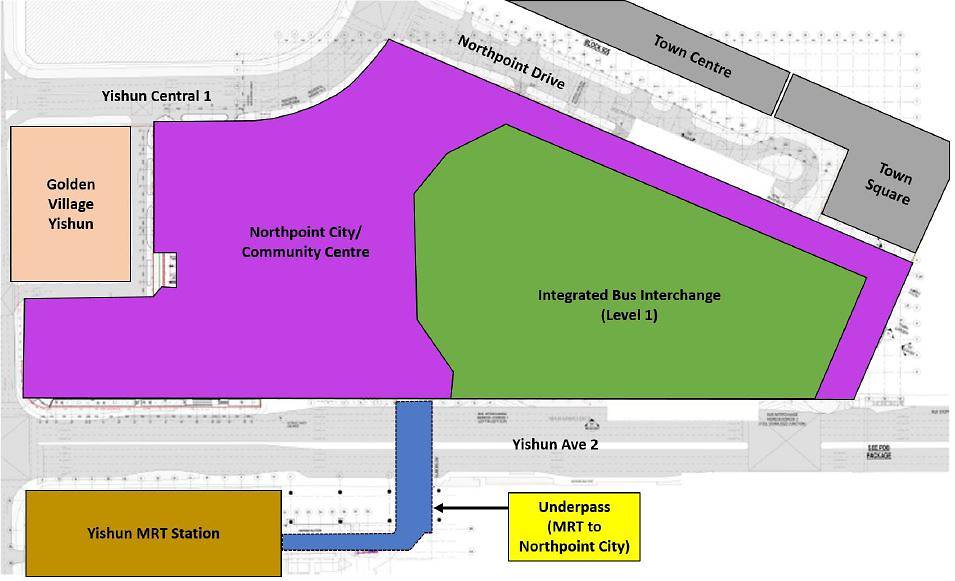
SINGAPORE: An integrated transport hub will open in Yishun on Sep 8, linking a new air-conditioned bus interchange, MRT station and the Northpoint City shopping centre.
The transport hub, the 10th in Singapore, will be fully barrier-free and have facilities to cater to the elderly, less mobile and families with young children, the Land Transport Authority (LTA) said on Wednesday (Aug 7).
To facilitate boarding by passengers in wheelchairs, the transport hub will have boarding points at each berth and graduated kerb edges. There are also barrier-free alighting areas, priority queue zones with seats, a nursing room and barrier-free toilets.
It will be the first transport hub to have Heart Zones – designated areas where commuters such as the elderly and visually impaired can seek help. A room will also be set aside for special needs commuters who need access to a quiet and calming space.
Close to 600 bicycle lots will be available in the vicinity of the bus interchange, which is connected to Yishun MRT station via a new barrier-free underpass.
The new air-conditioned bus interchange will be linked to Yishun MRT station via an underpass. (Photo: LTA)
The transport hub will be managed by SMRT Buses, which plans to introduce an interactive and open-concept passenger services counter where commuters can obtain transport information, LTA said.
Bus drivers and other employees will also get upgraded facilities, including an air-conditioned staff canteen, dedicated staff toilets and lounge. To improve safety, the bus interchange is equipped with a reverse warning system to detect movement of buses from parking lots into the driveway.
From Sep 8, the stopping points of all bus services that currently operate from the temporary bus interchange will be adjusted when they begin operating from the new transport hub. Details of the changes are available at all affected bus stops, bus interchanges, on buses and at LTA’s and SMRT’s websites.
A location map of the Yishun integrated transport hub. (Image: LTA)
SINGAPORE: The taxi driver whose actions led to a crash that killed teenager Kathy Ong and seriously injured three of her NUS friends had committed a series of serious traffic offences previously.
Yap Kok Hua, a Premier Taxis driver, was jailed for eight weeks and banned from driving for five years on Friday (Aug 2) after he pleaded guilty to one charge of causing death by a negligent act not amounting to culpable homicide and a second of causing grievous hurt to three other passengers.
Two other counts were taken into consideration for sentencing.
According to court documents and police records, Yap – who held a valid Taxi Driver’s Vocational Licence (TDVL) at the time of the accident – had several traffic offences in his name, including running red lights on three occasions, speeding twice, and driving carelessly twice, among others.
At the time of the fatal crash, 55-year-old Yap had 12 points on his driving licence – again for running a red light.
His driving record surfaced during his recent court hearings. Deputy Public Prosecutor (DPP) Timotheus Koh said Yap clearly did not give “due regard or consideration to the safety of fellow road users”.
In sentencing, Second Principal District Judge Victor Yeo said Yap’s previous offences were “not minor traffic transgressions” and that it reflected his attitude to road safety.
The crash happened at the junction of Commonwealth Avenue West and Clementi Road at around 7.30pm on Apr 19, 2018.
Yap took a discretionary right turn when the green right-turn arrow was unlit and collided with an oncoming car going straight. The driver of the other vehicle, 21-year-old Ng Li Ning, was going at a speed between 92kmh and 97kmh, according to the statement of facts issued during Yap’s trial.
Ng has been charged with dangerous driving.
19-year-old Kathy Ong was described by her friends as someone who loved life and who made deep connections with those around her. (Photo: Kathy Ong’s family)
NUS undergraduate Kathy Ong was sitting in the left rear passenger seat. The collision left her with multiple injuries, and she died a few hours later in hospital.
The three other victims, all 22, suffered serious injuries. The first had several cuts with glass in his wounds as well as a head injury.
The second man had a spine fracture and was given medical leave for 144 days, while the third man, who was seated next to Kathy, suffered traumatic brain injury and was vegetative after the crash. He also had injuries to his lungs, pelvis, kidney and abdomen.
Yap, who admitted he had seen Ng coming towards him, decided to make the right turn. The court was told that visibility was good, the weather was clear, the road surface dry and traffic lights working at that time.
Mr Koh told the court that Yap’s driving record was relevant in the case because it “reflects his attitude towards road safety as well as his unwillingness to comply with the law”.
Of the offences on record, seven were flagged as “serious” by the police:
According to a police document provided to the court, his record includes:
Nov 1992, speeding, S$130 fine, 4 demerit points
July 2000, running a red light, S$200 fine, 12 demerit points
November 2000, running a red light, S$200 fine, 12 demerit points
January 2003, careless driving, S$200 fine, 6 demerit points
May 2003, parking on double yellow lines, S$70 fine, no points
September 2010, careless driving, S$150, 6 demerit points
September 2010, waiting at no waiting sign, no fine, no points
August 2014, speeding, S$130 fine, 4 demerit points
July 2016, running a red light, S$200 fine, 12 demerit points
Given his previous convictions, Yap “ought to know” that traffic rules are “not flouted with impunity”, the prosecutor added.
But despite this, Yap decided to approach traffic safety with “the same nonchalance as he did in the past”, this time causing a teenager to die and three others to be seriously injured.
Judge Yeo added: “As rightly pointed out by the learned DPP, these are not minor traffic transgressions, and (Yap’s) bad driving record is relevant in that it reflects (Yap’s) attitude towards road safety as well as his unwillingness to comply with traffic laws.
“I did not think that the culpability of the accused could be said to be reduced in this case, as quite clearly (Yap) through his own negligent conduct, had caused a serious collision which resulted in the death of one of his passengers and caused grievous injuries to the three other passengers through no fault of theirs.”
REQUIREMENTS TO BECOME A TAXI DRIVER
Anyone with a valid driving licence can apply for a TDVL. The Land Transport Authority (LTA) approaches the traffic police for the applicant’s driving record and LTA will make the final decision on the application. The driver will have to undergo a taxi driver’s test.
Taxi driver Yap Kok Hua, 55, at the state court on Jan 11, 2019. (Photo: TODAY/Raj Nadarajan)
An applicant with a suspended or disqualified driving licence can be considered, after the period of suspension or disqualification is over, according to the Government’s One Motoring website.
“Applicants for a Vocational Licence must comply with LTA’s requirements before being issued with the licence. They must also continue to maintain acceptable records in order to renew their Vocational Licences,” LTA said on its website.
The vocational licence has its own demerit points system.
According to the law, a vocational licence may be revoked if the total number of demerit points awarded within 24 months of the first offence exceeds 20.
Once a driver receives a TDVL, they can approach a taxi firm to rent a cab, although the company can conduct its own checks.
LTA has been approached for comment about Yap’s driving record.
Premier Taxis said on its website it sets “the highest standards for our drivers” and that they should have “good driving skills and record”.
A spokesperson for Premier Taxis said it would reserve comment on the issue.
SINGAPORE: When dusk falls, the place comes alive — turning into a vibrant nightspot lined with pubs and clubs, as revellers spill over onto the streets and music blares in the background.
There is the odd flasher and fights occasionally break out, along with other unsavoury incidents commonly associated with partying spots everywhere.
But in the day, the place becomes much quieter — and more wholesome, playing host to cartoon character mascots like SpongeBob and Dora, as well as families with eager children in tow looking for a good time at the carnival games and Nickelodeon-themed festivals.
Welcome to the two worlds of Clarke Quay, different as night and day, amid efforts to widen the appeal of the area which has one of the highest concentrations of clubs and bars in the city-state.
Since 2012, about 1 million visitors go to Clarke Quay every month. In response to queries, Mr Adrian Lai, the centre manager for Clarke Quay, said:
Beyond catering to the night economy, Clarke Quay’s positioning as a must-visit destination for locals and tourists of all ages, day or night, is further reinforced with exciting family-friendly activities.
In recent times, CapitaLand, which manages the site, has been bringing in a raft of wholesome and family-friendly activities. For example, the Singapore Festival of Fun, held during the March school holidays and meant to provide entertainment for the whole family, was first brought in three years ago. There is also a day-time carnival on the first Sunday of every month.
While the efforts seek to address Clark Quay’s daytime “ghost town” problem — and widen the historical site’s appeal beyond late night revellers — they have led some experts and tenants interviewed to question the area’s schizophrenic identity.
Nevertheless, other experts and nightlife industry players believe there is much room to grow Clarke Quay’s daytime business, and segmenting the different customer groups by day and night is a feasible strategy — which could include paying greater homage to the area’s historical roots.
THE CHANGING FACES OF CLARKE QUAY
Clarke Quay was named after Sir Andrew Clarke, Governor of the Straits Settlements from November 1873 to May 1875. As one of the quays along the Singapore River, Clarke Quay’s history is inseparable from the early traders and coolies who plied the river in the 1800s, moving and transporting goods from boats to warehouses, some of which still stand today.
Due to its historical significance, Clarke Quay was gazetted as a heritage conservation district by the Urban Redevelopment Authority in 1989 and the area was opened for private development, according to the National Library Board’s web encyclopedia Infopedia.
A view of Clarke Quay.
DBS Land, which was one-half of the predecessor of CapitaLand, won the tender with a bid of S$54 million and Clarke Quay was reopened in 1993 with a family-friendly focus — boasting more than 170 retail shops, 17 food and beverage outlets and a S$25-million adventure ride that included heritage elements from the country’s past.
Some of its more iconic tenants in the 1990s were food stallholders from the Satay Club, who had to vacate their premises at the waterfront location earmarked to build what is known today as the Esplanade – Theatres on the Bay.
Unfortunately, the Clarke Quay project was not a commercial success, with an accumulated loss of S$4.42 million just a year after the re-opening, according to NLB’s Infopedia page.
The adventure ride closed in the mid-1990s. The number of visitors fell due to reasons such as the area’s relative inaccessibility, the lack of shelter and the absence of a coherent identity with its eclectic mix of tenants.
In 2003, Clarke Quay underwent another S$80-million makeover after CapitaLand — which became the site’s manager following the merger of DBS Land and Pidemco — commissioned a British architectural firm to refresh the area’s image and infrastructure.
To give visitors a pleasant experience regardless of the weather, the makeover involved the construction of pod-like dining platforms and the installation of silent fans and overhead canopies along Clarke Quay’s main walkways.
Moving away from the family-oriented positioning, new tenants including French cabaret Crazy Horse and nightclubs such as Attica and Ministry of Sound were brought in.
Clarke Quay’s image as a nightlife destination in Singapore was cemented following the completion of this exercise in 2006, which saw tenants moving into five blocks of restored 19th century shophouses and warehouses.
In its heyday, Clarke Quay was one of the top nightlife destinations in Asia, if not the world, said industry veteran Dennis Foo, who used to own now-defunct nightclubs St James Power Station and Shanghai Dolly.
Members of the Crazy Horse Paris cabaret perform an act from their upcoming Forever Crazy performance during a media preview in Singapore Oct 11, 2017. (Photo: REUTERS/Edgar Su)
Shanghai Dolly was located in Clarke Quay, before it closed in April last year. He said:
At the height of it, (Clarke Quay) was the envy of many cities in the region. Everyone was trying to emulate (it).
Despite the success of Clarke Quay, the nature of the nightlife business — where customers are always looking for the next big thing — meant that many pubs and clubs in the area have come and gone, including high-profile ones such as Crazy Horse, Ministry of Sound and Zirca.
One of the most popular nightclubs in Singapore, Zouk, has taken over the tenancy of the space previously occupied by the Ministry of Sound and Zirca.
Over the years, eateries such as Hai Di Lao, Motorino and Prive have also moved in. Some of Clarke Quay’s latest tenants include family-friendly F&B outlets such as Holey Moley, a mini golf club and bar; Hong Kong cafe Tsui Wah; and bubble tea store HeyTea.
Clarke Quay is among the riverside areas that are being managed by Singapore River One (SRO). A private sector-led initiative, SRO was set up in 2012 to manage the Singapore River precinct, which includes Boat Quay, Clarke Quay and Robertson Quay.
In 2017, the areas managed by SRO was officially designated as Singapore’s first Business Improvement District in 2017 as part of a pilot scheme, which now includes nine other precincts, including Marina Bay and Kampong Glam.
Responding to queries, SRO said Clarke Quay has always positioned itself as a “destination for good food and entertainment”. “Some of the restaurants do open for lunch so it is good for the office crowd working around the area. Food brings everybody together so families are welcome too,” said an SRO spokesperson.
MIXED PICTURE FOR BUSINESSES
Tenants interviewed said that from their observations, about three to four tenants move out every year on average, with new ones coming in. This could be partly attributed to the harsh business environment for nightlife establishments in particular.
Nevertheless, existing tenants gave a mixed picture of how their business is doing.
Some, such as Le Noir, Bayang and Harry’s, said that their business was generally fine. But others such as The Connoisseur Concerto (TCC), Prive and Highlander said that sales have gone down compared with last year.
HaiDiLao’s outlet in Clarke Quay. (Photo: Facebook/HaiDiLao Singapore)
They cited various reasons: The uncertain economic outlook, the tightening of alcohol licensing hours, the slump in the oil and gas industry which substantially accounts for Clarke Quay’s clientele, as well as competition from F&B outlets and nightspots elsewhere.
“It’s very hard to keep business here,” said Ms Lui Concina, manager of bar and restaurant Highlander.
Before regulatory changes were introduced in 2013, most establishments in Clarke Quay could sell alcohol until 6am. The new licensing restrictions mean that most can sell only until 3am on most days.
“The biggest problem is the alcohol ban. A lot of places used to operate later at Clarke Quay,” said Mr Cedric Siah, assistant manager at Prive’s Clarke Quay outlet.
Mr Foo’s son, Gordon, who took over operations of Shanghai Dolly, had previously told the media that the nightclub’s closure was due to the new alcohol licensing restrictions.
Overall, tenants say the area continues to attract healthy crowds in the evenings, especially on Wednesday, Friday and Saturday.
While there is much life at night in Clarke Quay, it is a totally different story in the day, with tenants complaining of poor footfall, even on weekends.
Some tourists described daytime Clarke Quay as “empty”, “quiet”, and even “creepy”.
Lamenting that business this year has been “challenging”, the outlet manager of TCC, who only wanted to be known as Mr Ogie, said that it “seldom” gets customers in the day.
The lack of crowds in the daytime also means that some tenants do not see much point in doing business in the day.
“No one comes here in the day. You can extend (to cater to the day crowd) but at what operational cost to outlets? Am I going to open at 1pm or 2pm? No, our costs are already so high. Rental is high, manpower cost is high. It doesn’t make economic sense. Most of us won’t,” said a tenant who declined to be named.
Nevertheless, a few F&B outlets in Clarke Quay are offering special lunch-time promotions in a bid to draw more customers before dark.
A spokesperson for Tsui Wah said the cafe has a “consistent footfall of customers throughout the day”, with its weekday set lunch that costs S$25 for two people being “well-received among the working crowd”.
Hutong, which serves traditional Northern Chinese cuisine, offers a three-course set lunch at about S$15, while American restaurant chain Hooters is selling its set lunch at about S$10.
Screengrab from Google Maps showing the Read Bridge at Clarke Quay.
About two weeks ago, Rodizio Do Brazil moved up its opening hours from 6pm to noon. Its main draw? A S$15 set lunch, which includes a starter, a main course, a dessert and a drink. Its operations manager Shawn Loh said that the restaurant is still testing the viability of longer opening hours but he noted that there is “not much traffic”, except for the few tourists stopping by to take a break from the blazing sun.
Mr Loh said he also tries to chat and build rapport with customers in the day, hoping that they might patronise the place again in the evening.
EXPERTS DIVIDED ON GOING THE FAMILY-FRIENDLY ROUTE
While CapitaLand’s strategy to bring in more family-friendly activities would help to improve business in the day, some experts felt that this could backfire and dilute Clarke Quay’s well-established nightlife branding.
Mr Kevin Wee, senior tourism lecturer at Nanyang Polytechnic, said the family segment should be Clarke Quay’s secondary target customers. While it should continue to bring in family-friendly events on an ad hoc basis, these should not be permanent features, he added.
“If they want to get extra money in the daytime, then don’t push it too hard. If (they) push too hard, it might start changing the tenant mix, and this might affect the nightlife (business),” said Mr Wee. He added:
Clarke Quay has to make a clear decision as to whether it should stay primarily as a nightspot. If they do, then don’t change too much, it might mess up what’s working now.
In any case, some experts pointed out that despite the best efforts, there are limits to Clarke Quay’s allure as a family-friendly destination. Mr Wee said:
They need something of sufficient quality to make (families) want to go all the way to Clarke Quay, which besides F&B, is irrelevant for families.
Ms Steffi Oh, a business lecturer at Singapore Polytechnic, noted that Clarke Quay’s current slate of family-friendly events, such as the annual Singapore Festival of Fun, would not be able to draw crowds there on a longer-term basis.
Moreover, there are already plenty of family-friendly attractions in Singapore, such as the Singapore Zoo, Gardens By The Bay or the Botanic Gardens, said some experts, who questioned what Clarke Quay can offer to compete against these places.
“I don’t think that trying to make it family-friendly is going to make a difference,” said Mr Benjamin Cassim, manager of Temasek Polytechnic’s hospitality and tourism diploma programme.
Still, other experts pointed out that there are places in other countries which have successfully blended family-friendly and nightlife offerings.
File photo of Clarke Quay. PHOTO: WIKIMEDIA COMMONS
For example, the Sydney Harbour in Australia is lined with several drinking establishments but many families can be spotted walking along the harbour to enjoy the view of the Sydney Opera House, said Ngee Ann Polytechnic’s tourism lecturer Michael Chiam.
Some experts and industry players said it is about getting the right mix of tenants and programmes, as well as separating the different crowds to avoid a clash of images which Clarke Quay is trying to portray.
Mr Chiam believes that Clarke Quay can leverage its rich history in order to attract families with young children.
(In the daytime), parents can bring children there to explain Singapore’s history. At night, the partygoers come for a different purpose.
Mr Foo said the family segment would provide a much-needed boost to the area’s F&B outlets, beyond catering to late night revellers. He added:
F&B today is competitive, the cost of operations is not low … night business alone is not a strong enough proposition. Day component comes to play.
Whether Clarke Quay can succeed in pulling in the family segment would also depend on its image as a nightlife hotspot.
While some observers felt that the area has developed a bit of a seedy reputation, others including Mr Foo disagreed.
Mr Foo reiterated: “There is no sleaze (at Clarke Quay). It makes a lot of difference. If there is sleaze, families won’t come.”
Several tenants were unconvinced by CapitaLand’s to widen the appeal to families.
“To me, it doesn’t make sense,” said Mr Ogie of TCC.
Some tenants said they hope to see more events organised for the nightlife crowd, such as concerts or parties on the river.
“It’s not going to work if you don’t have the tenants to come in and help. And most tenants (at Clarke Quay) are geared towards nightlife … If you’re good at nightlife and that’s what you’re known for, stick to it,” said the tenant who wished to remain anonymous.
In response to the tenants’ concerns, Mr Lai — the centre manager for Clarke Quay — stressed that the area’s marketing efforts are “predominantly geared towards profiling its exciting nightlife, entertainment and F&B offerings”.
“The remainders are daytime family-friendly events and promotions that serve crowds who patronise Clarke Quay in the day,” he said.
MAKING CLARKE QUAY GREAT AGAIN
Even as Clarke Quay seeks to woo a different segment of visitors, some nightlife industry veterans believe that the area has lost its shine as Singapore’s top nightlife destination amid stiff competition from Marina Bay Sands (MBS) in particular.
The Marina Bay Sands integrated resort in Singapore. (File photo: Melissa Zhu)
In the face of licensing restrictions and competition from other nightlife establishments, Clarke Quay’s reputation is “a shade off its heyday”, said Mr Foo.
He suggested that tenants should work with the landlord to enhance the area’s safety and security. This could then give the authorities greater confidence in easing the alcohol licensing restrictions, he added.
While Clarke Quay still has “a lot of growth potential”, the journey back to the top will be quite “tough”, said Mr Andrew Ing, chief operating officer of hospitality company Lo and Behold and former marketing manager of Zouk. Mr Ing added:
I don’t think it’s going to be easy but it is worth a try.
With the recent opening of Marquee at MBS, operators at Clarke Quay need to raise their game with “good ideas, good entertainment and good training for staff” in the face of tough competition, he added.
SINGAPORE: There are five principles I bear in mind when it comes to thinking about e-scooters and other personal mobility devices (PMDs).
First, mobility (or, the ease and ability with which one can go from Point A to Point B) can make or break a city.
Second, walking is a fundamental human right.
Third, Singapore needs more options for environmentally sustainable, affordable and convenient transportation.
Fourth, cities have been shaped around cars to the detriment of the above three principles.
And lastly, to maintain a high quality of life, the status quo for mobility is not good enough.
HELP PEOPLE MOVE AROUND THE CITY
In truth, I’m relatively ambivalent about PMDs as a specific mode of transport. What I am less ambivalent about is that we should do our utmost to enable people to move around their city.
This is not only because there is a functional need for people to go to jobs, schools, appointments and make deliveries, but because mobility is an essential component of a quality urban experience.
Having the freedom to visit friends and family, drop by the local kopitiam, or enjoy an evening stroll is what makes us human and connects us with our community.
How do we make sure that people have that ability? Here is where the PMD comes into the picture. It’s part of a class of transport that is slower and cheaper than vehicles, faster than walking, and more independent than public transport.
File photo of a man riding an e-scooter. (File photo: AFP/Tobias Schwarz)
In the past, there were rickshaws and trishaws. Now, it’s e-scooters, bicycles and other PMDs. In the future, it could be jetpacks, flying hoverboards, who knows?
E-SCOOTERS, BICYCLES, VITAL FOR URBAN MOBILITY
These “middle modes” of transport are vital for urban mobility. However, their continued fringe status reinforces a long-standing problem in urban transportation: How to negotiate and balance the needs of different users, and how to serve the existing system while also envisioning a new, potentially disruptive system.
It would be naive to say this exercise isn’t laden with judgement and values about which users matter more than others. This fundamental question forms the basis of every city’s mobility strategy.
The topic of the moment is what position PMDs should occupy in that strategy. The current practice of sharing pedestrian footpaths has resulted in conflict and discord, leading to Senior Minister of State for Transport Dr Lam Pin Min’s announcement in Parliament on Monday (Aug 5) that 15 town councils have decided to ban PMDs from void decks and common corridors.
An e-scooter rider on a shared path. (File photo: TODAY)
Pedestrians feel annoyed and fearful. PMD users feel inconvenienced and misunderstood.
And with good reason – the latest figures show that in 2017 and 2018, there were 228 reported accidents involving PMDs on public paths, 196 of them resulting in injury. Viral videos of altercations between pedestrians and PMD riders further highlight the underlying tension.
One obvious solution is to create dedicated pathways for PMDs. Separated bicycle lanes, bicycle-only roads and bicycle highways have popped up in Seoul, Beijing, and Taipei.
Often, people use land scarcity as an excuse for why that’s not possible in Singapore. Yet we always seem to be able to find land for more and wider car lanes, car parks and car drop-off and pick-up points.
In the meantime, PMDs have been relegated to already cramped pedestrian spaces.
This can be a self-reinforcing cycle – as it becomes less comfortable to be a pedestrian, more people might opt for car ownership, creating demand for more roads, and less priority for pedestrians, and so it continues. The premise of this commentary is that the opposite would also hold true.
File photo of e-scooters impounded by enforcement officers. (Photo: Elizabeth Neo)
Instead, much of the current dialogue is focused on educating and regulating e-scooter riders. This is important and effective.
But it does not change the fact that the vast majority of Singapore’s footpaths were not designed to accommodate pedestrians, cyclists and an increasing array of motorised devices.
Squeezing everyone together on what is oftentimes a one-metre wide piece of concrete is a problem that cannot be solved entirely through soft measures.
The Transport Ministry’s announcement that they will set aside funds to widen footpaths, put up clear warning signs and install speed regulating strips at accident-prone hotspots is welcomed.
But we will need to go further to create a truly robust and inclusive transport system. PMDs need to have their own dedicated space.
MAKE TRANSPORT ENJOYABLE
Dedicated infrastructure for PMDs wouldn’t just create safer conditions for everyone. It would also help to stimulate a more vibrant and liveable city.
People ride on an e-scooter along the Marina Bay in Singapore on Feb 19, 2019. (Photo: AFP/Roslan Rahman)
One could make the argument that the current system of shared pathways is functional. Technically speaking, it’s generally feasible to get from Point A to Point B on foot or on a PMD.
But are the people walking, cycling and scooting on those shared pathways happy? Do they enjoy the experience? Do they want to do it more often? Or do they just do it because they have no other good options?
This is important because research on behaviour change shows that if an activity is enjoyable, people are more likely to continue with it in the long-term.
It’s one thing to legally allow e-scooters to operate in Singapore. It’s another to create an environment where PMDs can thrive as a valued and enjoyable mode of transport, without taking away from the comfort and rights of the pedestrian.
If the Government wants to achieve a car-lite future, then this is a critical issue that should be thoroughly resolved, not just regulated into relative obscurity or non-existence.
I can’t help but think about last year’s experience with bike-share.
First, we complained, then we regulated, and finally the bicycles all but disappeared. Sure, it’s nice that they’re no longer strewn about everywhere.
But let’s also look at what we lost. For the first time, I saw neighbours and colleagues riding a bicycle – not just for recreation, but to go to work and run errands – refuting the common refrain that it’s too hot to cycle in Singapore.
It was a unique opportunity to catalyse community cycling, and for people to start seeing cycling as a viable alternative to crowding into packed MRT carriages or shelling out for a COE.
A man with an oBike at a bicycle parking lot in Ang Mo Kio. (Photo: Kenneth Lim)
Unfortunately, instead of fanning those embers – supporting the necessary infrastructure for people to safely and enjoyably cycle – we got hung up on how it was disrupting our pre-existing conception of the city, and slowly but surely, bike-sharing was choked out of existence.
For me, PMDs represent a second bite at the apple, a chance to take a different approach this time around.
We could be on the cusp of something really exciting in Singapore’s urban mobility story. But the city needs to decide if it wants to channel that energy into a transformative solution to realise the full potential of active mobility.
The alternative is that we continue with the existing system of shared pathways, a tolerable solution at best, believing that “a good compromise is one in which neither side is happy”. Except for the cars that continue to reign supreme over our cityscape, that is.
Julienne Chen is a research fellow at the Lee Kuan Yew Centre for Innovative Cities at the Singapore University of Technology and Design, where she focuses on urban processes and systems.