SINGAPORE: Some MRT stations on the North-South Line (NSL) will open late and close early from in August and September to facilitate power supply system renewal and maintenance works, SMRT said in a media release on Tuesday (Aug 13).
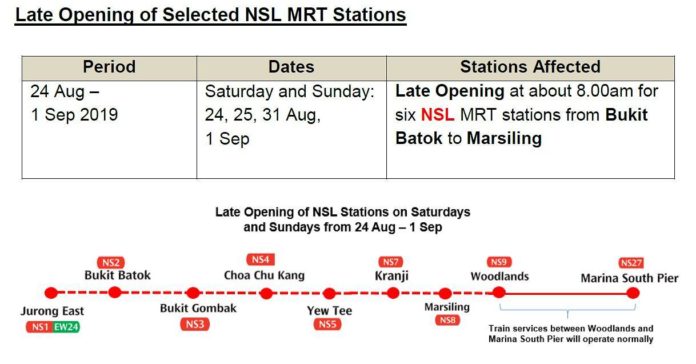
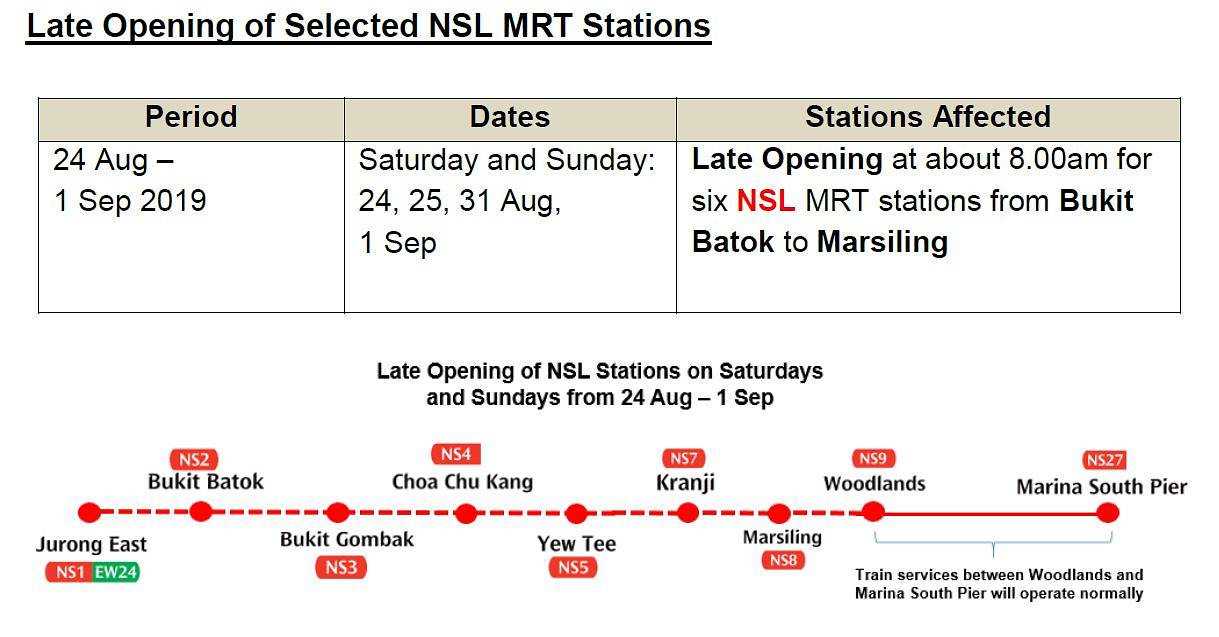
Six stations between Bukit Batok and Marsiling will open at about 8am on weekends from Aug 24 to Sep 1.
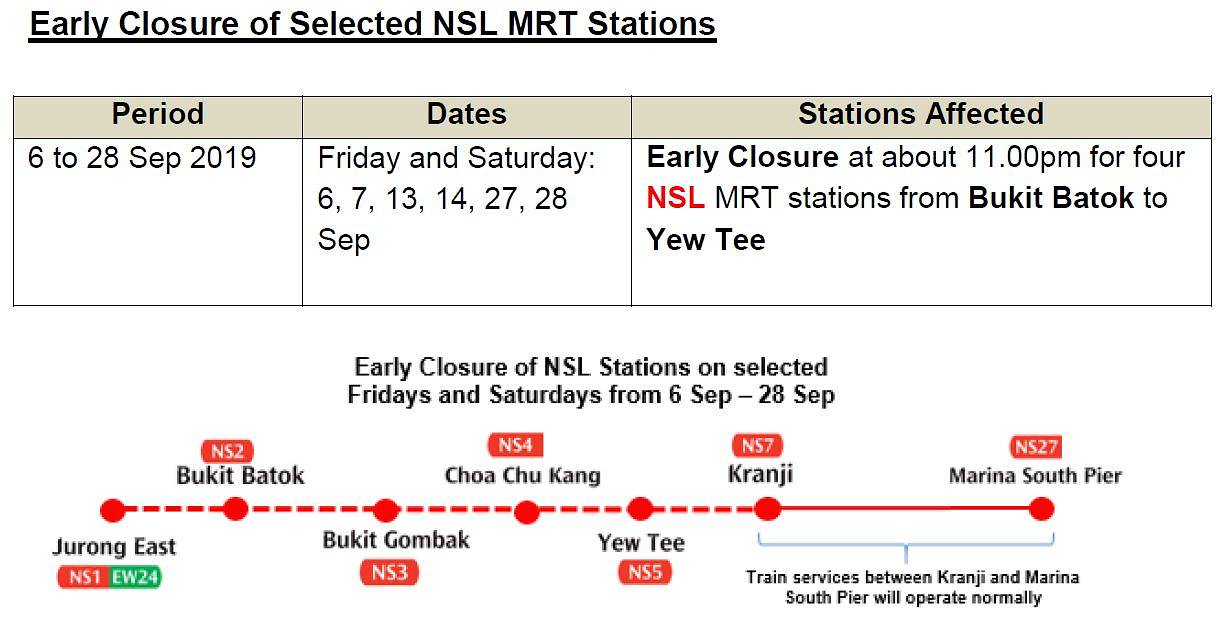
From Sep 6 to Sep 28, four stations between Bukit Batok and Yew Tee will close earlier, at 11pm, on selected Fridays and Saturdays.
“The additional engineering hours will be used to carry out viaduct bearing replacement works and installation of 22kV cables as part of the power supply system renewal works,” SMRT said.
During these days, shuttle buses will be available for commuters travelling between affected MRT stations, it added. “The buses will stop at designated bus stops near the affected MRT stations to pick up and drop off passengers.”
In its release, SMRT also advised commuters to plan their commute and check the departure times at affected MRT stations. “The timing of the last trains’ departure from each station during the planned closures will vary,” it said.
“More time may also be needed to travel between MRT stations using the shuttle bus services.”
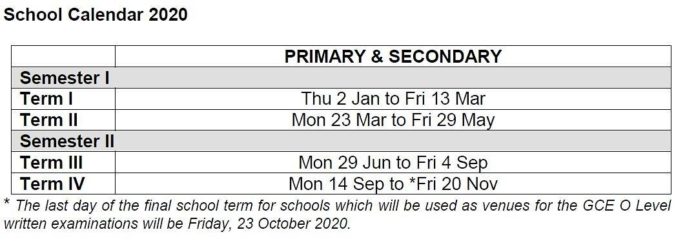
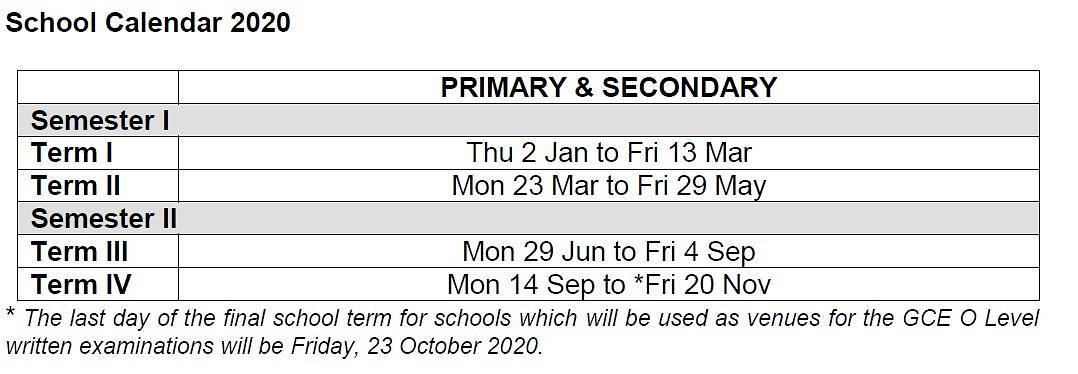
SINGAPORE: The 2020 school year for all primary and secondary schools will start on Thursday, Jan 2, and end on Friday, Nov 20, the Ministry of Education (MOE) announced on Wednesday (Aug 15).
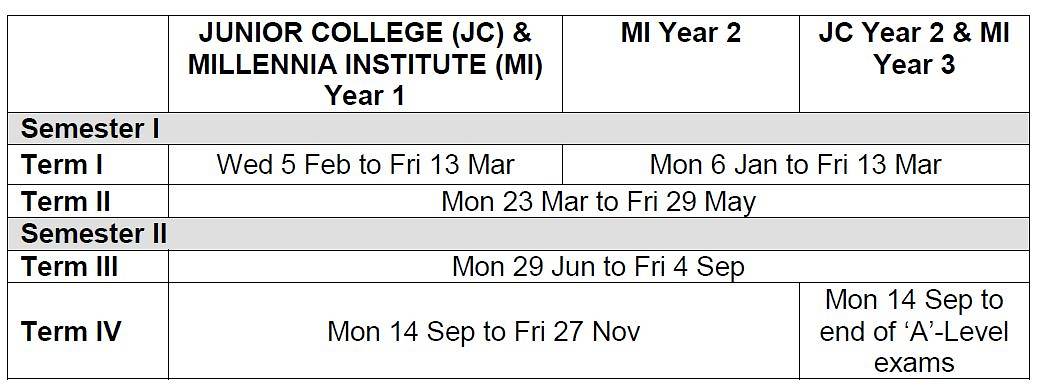
Students in their first year at junior colleges and at the Millennia Institute will start on Wednesday, Feb 5, while the rest of the students will start school on Monday, Jan 6.
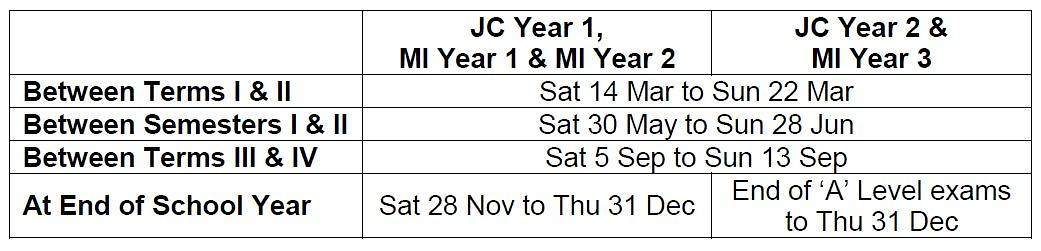
The four vacation periods next year are as follows:
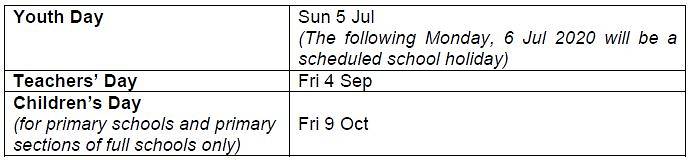
In addition, there will be three scheduled school holidays in 2020:
SINGAPORE: SG Bike could soon be the largest bike-sharing operator in Singapore, if an arrangement with Chinese company Mobike is approved.
The two companies announced on Tuesday (Aug 13) an agreement for Mobike to transfer its bike-sharing licence to SG Bike.
The deal is expected to be completed by Sep 13, they added in a joint media release.
In addition, the application to transfer Mobike’s licence, bicycles and users needs to be approved by the Land Transport Authority (LTA).
“The agreement secures the future of Mobike’s bicycle fleet in Singapore and ensures that residents will benefit from a combined world-class bike sharing scheme in the city,” the two operators said.
“If the licence transfer is approved, SG Bike will be able to enlarge its customer base and service areas to offer even more first and last mile journeys to commuters.”
It was the third Chinese bike-sharing company to face problems in the Singapore market, after Ofo’s suspension in February 2019 and oBike’s exit in 2018.
If the application is approved by LTA, users of SG Bike and Mobike will have a “seamless” transition period, said the operators.
SG Bike users will be able to use its app to unlock both SG Bike and Mobike bicycles. Existing Mobike users with account balances and ride passes will also be able to transfer them to SG Bike by downloading the SG Bike app.
“Our goal has always been to provide Singapore with a highly-efficient bike-sharing scheme, and we remain committed to connect even more people and their destinations in a safe, affordable and convenient way following LTA’s approval,” said Albert Teng, managing director of SG Bike.
The head of Mobike International PR Steve Milton called the agreement “the ideal solution for Mobike in Singapore”.
“Combining Mobike and SG Bike is the ideal solution for Mobike in Singapore as it maintains the continuity that has been established since Mobike launched in Singapore in 2017.
“We have trust and confidence that SG Bike will be able to grow the bike sharing culture and industry and we look forward to its contribution towards the nation’s progress for a car-lite society,” he said.
Mobike’s shared bikes are lined up in Shenzhen, Guangdong province, China. (Photo: REUTERS/Stringer/Files)
For now, Mobike users can continue to request a refund of their deposits from the operator.
Following the completion of the deal, Mobike user deposits will be converted into SG Bike account credits without expiry. Users will also have the option to opt out and collect their refund from SG Bike.
SINGAPORE: Maintaining racial and religious harmony is always a work in progress and Singapore must continue to build on its multiculturalism, especially in a time of increased polarisation around the world, said Deputy Prime Minister Heng Swee Keat on Monday (Aug 12).
Speaking at a dialogue session, Mr Heng hailed the progress Singapore has made over the past decades in preserving racial and religious harmony.
“We have made tremendous progress, but it is a work that we must always continue because there is no final destination. It is always a work in progress, we must always continue to build on it all the time,” he said.
“We must be deeply committed to preserving this racial and religious harmony.”
He stressed that Singapore’s racial harmony should not be taken for granted.
“Every day when you open the newspaper, you’ll find conflict of one form or another in at least one of the pages, which is linked to either race, language or religion,” said Mr Heng. “So for us to maintain harmony in a society that is so multiracial, multicultural and multireligious, is always an act in progress.”
Mr Heng added that Singapore can turn its diversity into “great strength” and share its experiences in building peace and harmony with others around the world.
“The fact that our people, our ancestors come from all over the world, that we are so diverse in terms of religious diversity, racial diversity, cultural diversity, we have new citizens, old citizens, permanent residents and so on, ought to be a great source of advantage,” he said.
“So we should think harder, to see how we can continue to push the envelope, to turn that diversity into a great strength, and to turn smallness into a great strength.”
NEW INTERFAITH HERITAGE PROGRAMME
The dialogue session was part of a new programme called Faithful Footprints. Organised by Temasek Foundation and non-government organisation Humanity Matters, it aims to help Singaporeans appreciate the country’s diversity and foster a sense of cohesion.
The half-day programme includes a heritage trail that covers places of worship in the historical Bencoolen area, as well as a tour through the Harmony in Diversity Gallery which focuses on religious harmony.
Participants of the heritage trail posing for a photo in the Maghain Aboth Synagogue. (Photo: Humanity Matters)
More than 60 residents from the South East District participated in the first run of the programme, including new citizens, permanent residents and students. Temasek Foundation said it hopes to have about 25 runs of the programme to reach out to more Singaporeans.
South East District Mayor Maliki Osman said he hopes the programme will help participants appreciate Singapore’s diversity.
“A lot of people talk about the importance of religious and racial harmony, and we cannot take it for granted, we must make sure that it continues to be in our blood, it continues to be appreciate by all Singaporeans as well as new citizens, native Singaporeans, so that in future we can continue to prosper within the backdrop of a harmonious Singapore society,” he said.
SINGAPORE: A fire broke out near East Coast Park on Monday night (Aug 12).
The Singapore Civil Defence Force (SCDF) said it was alerted to a case of “vegetation fire” at about 9pm at the junction of Marina East Drive and East Coast Park Service Road.
Photos and videos sent to CNA show flames and thick smoke rising from the area.
The Singapore Civil Service Force (SCDF) was attending to a fire near East Coast Park on Aug 12, 2019. (Photo: CNA reader)
The fire was still raging at 10pm, said CNA reader Chris Ngu Dow Lon, who saw the fire from an overhead bridge at East Coast Park.
SCDF said in an update at 10.30pm that the fire is under control.
Five fire engines, one red rhino and two supporting vehicles were deployed to the scene.
No injuries were reported, said SCDF.
This story came from a reader tip-off. If you would like to send in photos or videos of something newsworthy, WhatsApp our Mediacorp news hotline at +65 8218 8281 or message us on Facebook.
SINGAPORE: A Scoot flight to Hong Kong had to return to Singapore on Monday (Aug 12) due to the shutdown at Hong Kong International Airport.
It was among several flights to and from Singapore that were affected by protests at the Hong Kong airport.
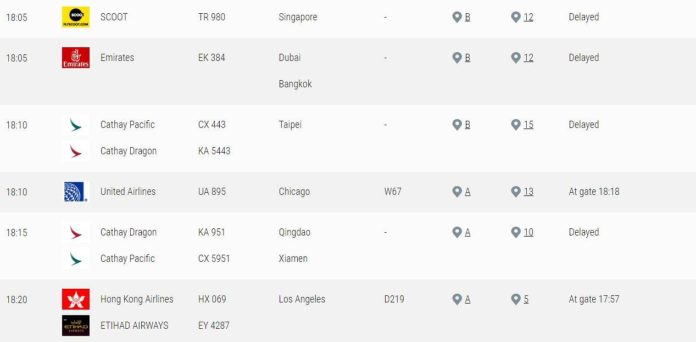
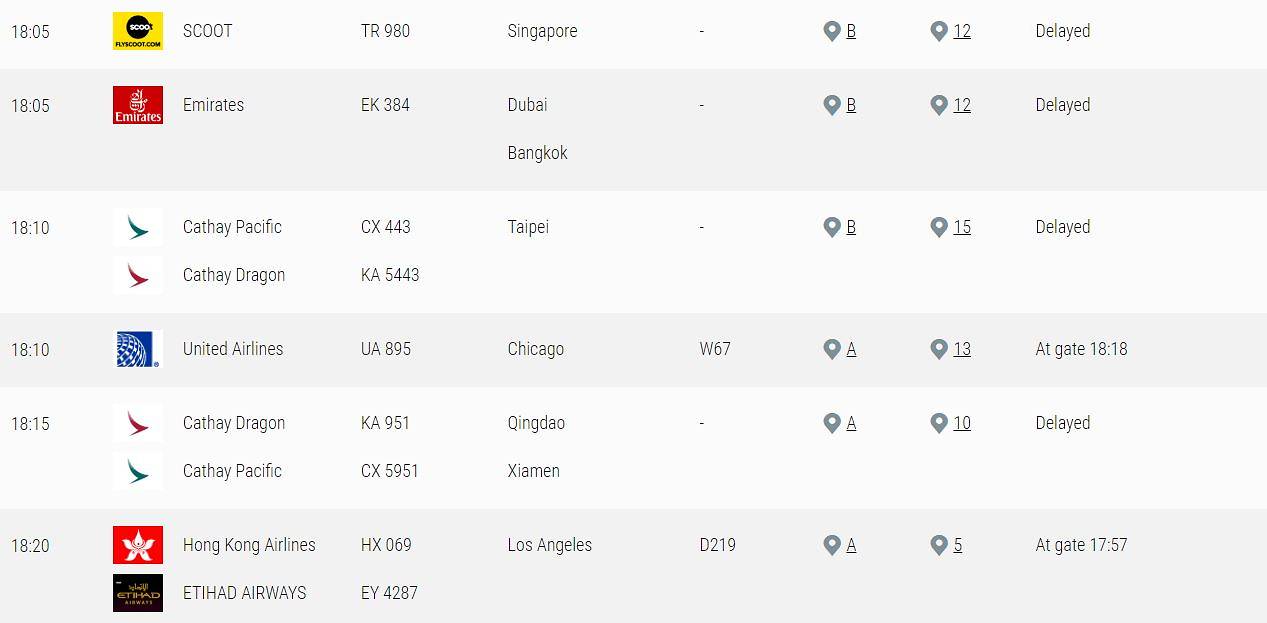
“The flight (TR980), originally scheduled to arrive in Hong Kong at 6.05pm local time, will land at Singapore Changi Airport at approximately 9.10pm local time,” said Scoot in response to CNA’s queries.
A screengrab from Hong Kong International Airport’s website showing a delay for Scoot flight TR980.
It added that affected customers can rebook their flight to Hong Kong at no additional charge.
Alternatively, they can book Singapore-Macau/Macau-Singapore flights operated by Scoot within 14 days of the original flight, at no additional charge.
Passengers also have the option of getting a full refund via a Scoot travel voucher, said the airline.
Apart from TR980, three other flights were cancelled. They are – TR974 from Singapore to Hong Kong, as well as TR981 and TR975 from Hong Kong to Singapore.
“In total, about 500 passengers were affected for today’s flights,” said the airline. “Scoot sincerely apologises for the inconvenience caused.”
SEVERAL FLIGHTS TO AND FROM SINGAPORE AFFECTED
At Changi Airport, six flights from Singapore to Hong Kong were affected – three by Cathay Pacific, two by Singapore Airlines and one by Scoot, said Changi Airport Group (CAG).
“Singapore residents have been advised to return home or not to leave for the airport given the current situation. Those who had checked in have been allowed to collect their baggage,” said a CAG spokesperson.
“Non-residents have been advised to check with their airline regarding options available to them which may include alternate flights to their final destination for those who were going to transit in HKG.”
A check on Changi Airport’s website at about 8.30pm showed that one flight, SQ868, has been retimed to 4am on Tuesday. It was originally scheduled to depart Singapore at 7.55pm on Monday.
“Due to unexpected circumstances at Hong Kong International Airport (HKIA), flights to and from HKG may be affected. Please check with your airline for the latest information and status of your flight,” read an advisory on Changi Airport’s website.
Anti-extradition bill protesters rally at the departure hall of Hong Kong airport in Hong Kong, China August 12, 2019. REUTERS/Thomas Peter
Anti-extradition bill protesters wave flags with Chinese calligraphy that reads “Liberate Hong Kong, the revolution of our times”, at a mass demonstration after a woman was shot in the eye during a protest at Hong Kong International Airport, in Hong Kong, China August 12, 2019. REUTERS/Tyrone Siu
Singaporean Nicole Lim was among the passengers affected by the flight cancellations. She was travelling from New York to Singapore with Cathay Pacific and was in transit in Hong Kong.
“There were no announcements made by the airport about the cancellations. I got my information online,” said the 23-year-old.
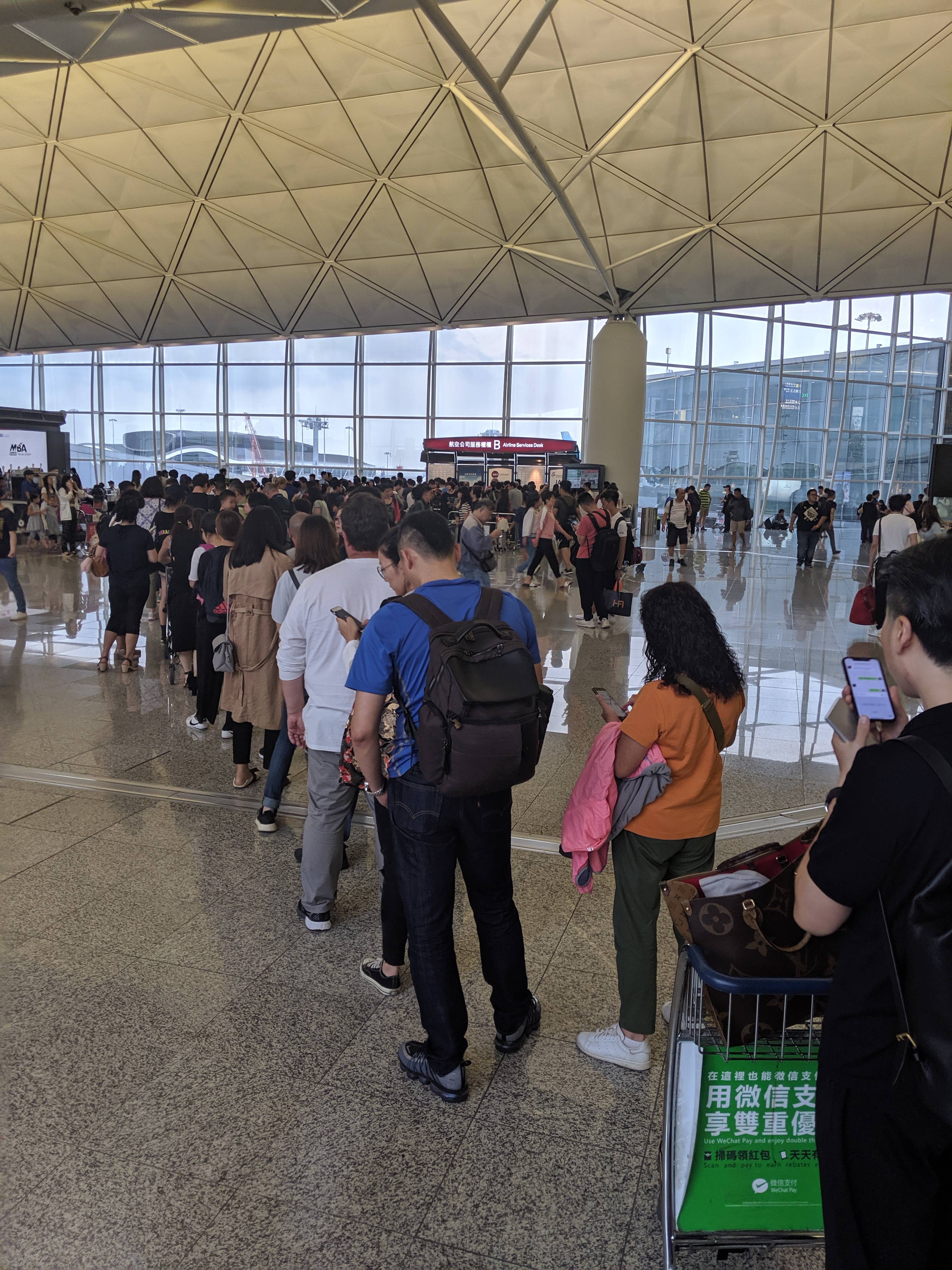
“It’s not really chaotic in here, but people are trying to find out what’s happening. I’ve been stuck in the queue for the service desks for about an hour,” she told CNA.
Passengers at Hong Kong International Airport on Aug 12, 2019 after flights were cancelled due to the protests. (Photo: Nicole Lim)
She later said she was instructed by a Cathay Pacific employee to head to Shenzhen to get another flight from there instead.
Ms Lim said she was told passengers would have to bear the cost of the new flight from Shenzhen, and that their checked-in luggage would be at Hong Kong airport until further notice.
Asked if she would make the trip to Shenzhen, she said she did not want to take the risk.
“I don’t think its safe for me to leave and I don’t want to take the risk either. I’m concerned about my luggage being here,” she added.
The Hong Kong airport authority said it was working with airlines to resume flights from 6am on Tuesday.
Hong Kong was hit by another weekend of violent clashes between police and protesters.
It was the 10th consecutive weekend that protesters have taken to the streets in a movement that began over opposition to a Bill allowing extradition to mainland China.
The protests have morphed into a broader bid to reverse a slide of democratic freedoms in the southern Chinese city.
They have been seen as the biggest threat to Beijing’s rule since Britain handed Hong Kong over in 1997.
Mr Tan Eng Soon, 52, and Ms Puah Geok Tin, 64, drifted off from a group of 13 other Singaporeans while kayaking near the Endau islands on Thursday, the Star reported.
In a briefing session on Sunday, police informed their families that Mr Tan and Ms Puah are yet to be sighted.
Mr Tan Eng Soon and Ms Puah Geok Tin are yet to be sighted, said the Malaysian Maritime Enforcement Agency. (Photo: Melissa Goh)
First Admiral Aminuddin Abdul Rashid, director of MMEA, said that search areas have been expanded to 500 nautical miles north of Pulau Seri Buat to the north-west of Tioman Island.
Manpower was also increased to 50 people and an additional boat has been deployed.
He added that the helicopter search has covered 300 nautical miles, while the one at sea covered 200.
On Saturday, the Ministry of Foreign Affairs said the Singapore Consulate-General in Johor Bahru has been in close contact with the Malaysian authorities.
“A team from our Consulate-General is currently on the ground to provide assistance and close support,” said MFA.
“MFA and the Consulate-General will continue to render consular assistance to the next-of-kin of the missing Singaporeans and support the ongoing search operations.”
SINGAPORE: The Immigration and Checkpoints Authority (ICA) on Saturday (Aug 10) thwarted an attempt to smuggle 815 birds through Woodlands Checkpoint.
The Malaysia-registered bus was stopped for security checks upon arrival at the checkpoint at around 7am on Saturday, ICA and National Parks said in a joint news release.
During the inspection, officers found signs of modification around the rear tyres of the bus.
“Their suspicions were further aroused when they heard chirping sounds coming from within the bus,” the news release added.
“Upon scrutiny, officers uncovered 15 containers of 815 birds from modified compartments above the rear tyres of the bus, making it the largest seizure of ornamental birds in Singapore in recent years.”
The 35-year-old Malaysian driver, who did not have a valid health certificate and import permits, was referred to the National Parks Board (NParks) for investigations, it added.
Only about 600 of the birds survived and are being cared for and quarantined at NParks’ facilities.
The birds comprise of five species, including a songbird that is becoming increasingly rare in the region. (Photo: ICA)
The 815 birds consisted of five species: 38 white-rumped Shamas, 10 oriental magpie-robins, 141 oriental white-eyes and 626 munias.
Among these, the white-rumped Shama is notably becoming rarer in the region because of its popularity in the pet trade.
“Animals that are smuggled into Singapore are of unknown health status and may introduce exotic diseases, such as bird flu, into the country,” the authorities said. “The well-being of the animals will also be affected by poor conditions during the transportation process.
“In addition, the illegal wildlife trade impacts the biodiversity and ecosystems of both source countries and countries where the wildlife ends up in.”
Anyone who imports any animal without a permit faces a fine of up to S$10,000 and/or a jail term of up to one year. Additionally, anyone found guilty of causing unnecessary pain or suffering to any animal can be fined up to S$15,000 and/or be jailed up to 18 months.
SINGAPORE: Bay Song Lin is an artist whose subjects are somewhat unusual. Her work does not capture scenic landscapes, beautiful views or lovely sunsets.
Instead, she works with the body parts of the dead.
“The faces will affect me more, especially if the eyes are open,” said Song Lin as she guided CNA through the only Anatomy Museum in Singapore.
The 5,520 sq ft museum in the NUS Yong Loo Lin School of Medicine holds around 400 body parts displayed in clear acrylic jars.
Cross-section of a face.
Since 1983, this is where aspiring doctors have come to learn the workings of the human body. Samples of every body part are stored here, kept in pristine condition to help students understand textbook theories.
“This is one whole body, dissected,” she said as she walked over to a row of rectangular plates.
Gently lifting up one and placing it on a metal stand, she started to identify various parts in the greyish mass of the cross-section.
“This one, that’s the lung over here. This one is the heart,” said Song Lin with the easy familiarity of a museum curator who has spent a lifetime getting to know the objects on display.
The cross-section of a once-living human body.
She picked up another plate.
“This is the rectum. This is the thigh, the lower limb and this is the bone.”
While she seems to have a medical expert’s familiarity with the anatomy of the human body, Song Lin is not a doctor by training. The 50-year-old works as a medical illustrator.
However, as well as creating images of body parts, she also has to make sure that every specimen in the museum is well-preserved by checking the levels of preserving solution in every jar. If it falls too low, the tissue will start to rot and decay.
Song Lin checks the level of formaldehyde in each jar as they drop in volume over time.
Even though she has spent 17 years working here, the humanity behind the specimens still has the power to shake her emotionally.
“This one affects me the most, because it is a full-grown baby,” she said suddenly, stopping in front of a preserved foetus.
“It could have survived and grown, just like anyone of us, but it didn’t make it and this little fella ended up here … dissected for the students to study the spine, the brain.”
A preserved foetus with its spine exposed.
“You can see how the structure grows. A lot of details,” added Song Lin as her fingers trailed along the jar that the foetus is suspended in.
“Everything here is art.”
ILLUSTRATING THE HUMAN BODY
Outside of the museum, most of Song Lin’s time is dedicated to creating detailed pictures of the human anatomy. Whenever professors require teaching material for a class, they will go to Song Lin to commission a new artwork.
“Let’s say the professor finds something interesting, he will instruct me to take photos of the specimens,” said Song Lin.
Armed with a camera and tripod, she headed down to the room where dissection classes were taking place.
The Anatomy Hall.
Hanging heavy in the air inside was the pungent smell of the formaldehyde used to preserve the silent mentors – a term coined for the people who willingly donate their bodies for medical research and teaching.
“This heart was just taken out from one of the silent mentors,” Song Lin said as she carefully placed the organ on a rotating platform.
“I’m taking photos of the heart in 360 degrees, about 15 degrees apart, so that after that I can combine them into a video.”
Song Lin documenting a heart which had a triple bypass.
The reason for documenting this heart was that it had three bypasses – something that has not been seen before in dissection classes here, according to Associate Professor Ng Yee Kong, who was overseeing the session.
“When they (the students) took the heart from the thoracic cavity, we were so surprised to see a very nicely done triple bypass,” said Dr Ng. “We have taught them so much, but we have not seen one heart with a bypass.
“The best sort of alternative is to archive this in a 3D (video), which Song Lin helps to capture, so that we can share it with our future students.”
Video is not the only medium in which Song Lin works.
Using Adobe Flash and Photoshop, she creates still and moving graphics of body parts.
One of Song Lin’s interactive animations.
Sometimes, a graphic can be more useful in the teaching process compared with a photograph or video, Song Lin said: “After dissecting, the specimens that you see are all very similar in colour. Very often, the students are not able to identify which is the artery and the vein.
“That’s why if I draw them into illustrations or animations, they are able to understand the form and relations of each organ much more easily.”
Medical student Zachariah Ow Gene Wing recalled how an animation of the different layers of the scalp helped him in a dissection class.
Medical student Zachariah Ow Gene Wing talking to Song Lin about his dissection techniques.
“It’s really important because to me, anatomy was just always about building a good mental picture and I think for a lot of people, it’s hard to build that good mental picture just by using words,” he said.
“You can’t convey the same sort of spatial realisation as you can when you have animations, when you appreciate how different structures relate to each other in the body.”
THE BRIDGE BETWEEN ART AND SCIENCE
While Song Lin’s illustrations have been used to teach many generations of aspiring doctors, the former graphic and web designer doesn’t have a background in medicine.
Graduating from the Nanyang Academy of Fine Arts, Song Lin worked at a multimedia firm until she saw the newspaper advert for a medical illustrator’s job in 2002. With a personal interest in medicine, she thought the job would be a natural fit for her.
On the day of her interview, she was taken on a tour of the museum and the hall where the silent mentors are stored to test her ability to cope with working in an environment full of dead people’s remains.
The sign outside the anatomy hall.
“To work here, you definitely cannot have a weak heart … we have students who fainted at first sight,” said Song Lin.
Courage is not the only prerequisite for the job.
Having no medical background meant that she had to spend hours studying anatomical pictures so that she knew how to draw body parts accurately.
Song Lin sketching at her office.
Professors also work closely with her to ensure her work delivers what they need in a particular illustration.
“They will sit beside me. As they describe to me, I will do the storyboard,” said Song Lin. “They explain it to me as if I were a student.”
And in some ways, she is.
“When the students are having classes, I will go and sit in,” she said.
“All of us are learning. They learn and I learn, and the professors are learning too,” she said, attributing this learning environment as the biggest reason why she has continued in the job for so long.
As a mother, the illustration that she has produced which left the deepest impression on her was the formation of a baby in a mother’s womb.
Song Lin’s sketch of the formation of a baby, which eventually became an animation.
“Seeing how the embryo changes as it grows, it’s honestly not pretty,” Song Lin laughed before changing her tone. “But at the point when it slowly changed to the form of a baby, I felt that it is a miracle.”
“Basically it started from a cell … how did this tiny life form inside the mother? To me, it’s really very miraculous.”
HUMANISING A ‘COLD’ SUBJECT
However, Song Lin admitted that analysing bodies in such detail can make someone detached from the humanity behind them to the point where the samples are seen as nothing more than useful educational tools.
“When I look at these, you can say these are all specimens,” she said, pointing at the preserved body parts.
“It is only when we go down to the dissection class and they (the students) are dissecting, then you will feel that these are still humans, that they were alive before this.”
To ensure that students remember that the body they are working with was once somebody’s parent, spouse or child, a photograph is placed next to each corpse showing the person when he or she was alive, along with their name, age and cause of death.
Song Lin placing a photo of a silent mentor in front of his body.
“Song Lin actually is the one who prepared photos of our silent mentors, which is extremely important because we wanted our students to know that behind all these cadavers they are facing, there’s an identity, there’s a name,” said Dr Ng.
Photographs are usually provided by the family members but if there isn’t one, Song Lin doesn’t leave the photo frame blank.
“If they don’t have (a photo), then there’s always a basic identity card I can use.”
Dr Ng added that what Song Lin is doing “adds a human aspect”, which is something that wasn’t previously emphasised.
“Dissection of a human cadaver used to be very cold, but since we started the Silent Mentors Programme, we try to humanise it,” he revealed.
In 2003, NUS Yong Loo Lin School of Medicine stopped its dissection classes when faced with a shortage of human cadavers, which were traditionally unclaimed bodies.
After a gap of 13 years, the class was reintroduced due to a surge in the number of donated bodies to the school as more people grew aware of the Silent Mentor Programme that was started in 2012.
Every year, Song Lin adds photos of their faces to an animated memorial board that was put up to honour each person who has given their body to help medical students.
The memorial board outside the anatomy hall.
“Some family members actually visit this board to pay respects, especially on the special day of the silent mentors like their death anniversaries (and) their birthdays,” added Dr Ng. “Sometimes we see that the family members left a bouquet of flowers outside the board.”
Stressing the importance of the photographs, Song Lin said: “We want to let the students know that every silent mentor has his or her own story. And they are so noble to donate their own bodies, so we really need to learn humbly.”
WATCH: How human donors and an artist help train future doctors (7:27)
LIFE AND DEATH
The silent mentors do not stay at the school forever.
Liu Shangda died at the age of 73, and entered the school two years ago as a silent mentor. Now, the time had come to return his remains to his family.
One Friday last month, the school’s usually quiet reception office was bustling. Four silent mentors were leaving for Mandai Columbarium, where they would be cremated.
The four silent mentors that were cremated on 26 July 2019.
The school helps families to arrange final rites for all silent mentors. Together with family members, staff from the Department of Anatomy, as well as the medical students who worked with the bodies, are present at each ceremony.
“Without our four silent mentors, you’d have realised that our education will be incomplete,” said Dr Ng as he addressed the students.
“They have made the ultimate sacrifice of the body for us to understand more about the complexity and intricacy of the human body.”
Mr Liu’s daughter, 40-year-old Liu Xin, who had been standing calmly on the side, started weeping at Dr Ng’s words.
Liu Xin, Liu Shangda’s daughter.
“Before he retired, he was a professor in physical education. He’s worked more than 40 years in education,” the clinical research coordinator told CNA.
“I wrote an article two years ago in memory of my dad. He was a teacher when he was alive and he’s still a teacher when he passed on.”
The service at Mandai was a calm and sombre affair. There were no heavy tears or cries of denial – only a sense of peace that filled the hall.
Surrounding their father’s coffin, Shah Chandrakant Mohanlal’s family sung a Jain prayer song in harmony before the cremation began.
For them, this day was “a closure” after two long years.
The Shah family reciting a Jain prayer before the cremation of silent mentor Shah Chandrakant Mohanlal.
In the beginning, the family admitted that Mr Shah’s decision to donate his body to science was “difficult to swallow”, as it is part of their culture to cremate the body immediately after death.
“He said, according to Jainism, everything is to do with the soul so why should you worry about the body after that?” recalled Mr Shah’s daughter-in-law Kenna Damani, 56.
Eventually, they accepted his decision because of the dignified way the school treats the bodies of loved ones.
“Because I saw how the school respects them, the way the embalmer came out and explained everything, it was just very inspiring,” said Mr Shah’s eldest daughter Naina Shah, 62, who was also his main caretaker.
“I’m really very thankful for them to give so much respect to these silent mentors.”
Throughout the whole ceremony, Song Lin maintained her role as a documentarian of human life as she photographed the significant moments till the end.
“Looking at how the students treated the silent mentors with respect and how the family members mourn for their loved ones, I can empathise with them,” she reflected.
“In the whole process, I will try my best to document their memories of the silent mentors.”
However, not everyone receives a send-off.
A lab technician filling the formaldehyde solution for a specimen at the museum.
Bodies that went unclaimed from the Mortuary@HSA may be immortalised at the Anatomy Museum. Since Song Lin started working here, around 100 body parts have been added to the collection.
“They are quite pitiful (as) no one claimed them,” said Song Lin. “But I still feel that it’s noble to have these.”
For Song Lin, being able to be a part of the education of medical science even without medical training is something that she remains grateful for.
“To be able to contribute something to them, I feel it is something to be happy about because this is like recognition to me, and most importantly, I have learnt a lot myself,” she reflected.
“The body is just an empty shell. Sometimes it feels like you may not wake up after you go to sleep tonight. So I feel that what I do today should be answerable to myself and live my days honestly.”
SINGAPORE: After the cooling measures slapped on in July 2018, many have wondered whether Singapore property remains a good investment bet.
To be sure, the measures targeted speculators and hot foreign money, and aimed to cool speculative sentiments.
Investing in overseas real estate is not traditionally a popular option for investors because managing foreign properties is costly and time-intensive, not to mention the risks of dealing with exchange rate fluctuations.
This explains the “home bias” characteristic of property investments and why investors tend to invest repeatedly in local markets they are familiar with overtime. Hefty transaction costs including stamp duties, legal fees and inspections may deter many from entering into foreign markets.
In recent years, Singapore Government introduced cooling measures to tame the demand for property (File photo: TODAY)
However, there are upsides to investing in real estate, which usually appreciates in tandem with the country’s economic growth that can hedge against inflation at the very least.
Residential property, as a key pillar of Singapore’s social compact that gives a home-owning population a stake in the country, is also seen as stable and less volatile. It is also a familiar asset class that appeal to different investors from institutional buyers to individuals.
The attractiveness of the Singapore property market also in turn attracts foreign developers wanting a slice of the “pie”.
THE CURIOUS CASE OF CHINESE DEVELOPERS IN SINGAPORE
News over the past few months have raised questions about the role of Chinese developers and investors who have been active in the Singapore property market. On the back of the Hong Kong protests, there are also anecdotal accounts of Hong Kongers exploring new homes and offices in Singapore.
China developers have made in-roads into Singapore’s residential property market as early as 2009, on the back of the economic recovery in the aftermath of the global financial crisis.
In more recent years, the spotlight has been shone on this group, especially after a plot of land at Stirling Road got snapped up for S$1.003 billion in May 2017, in a joint bid by Logan Property, a Hong Kong listed developer founded in Shantou, Guangdong, and the Nanshan Group, a conglomerate headquartered in Longkou, Shandong.
Location of the Stirling Road site. (Photo: URA)
They outbid the second-highest bidder, MCL Land, by S$77 million for the 21,109.5 sq m site. The final price also turned out to be an unusual S$289 million (about 29 per cent) higher than the lowest bid price.
Most recently, another Chinese developer Kingsford Hurray Development acquired Normanton Park in an en bloc sale deal, also at a record-breaking S$830.1 million (excluding the estimated S$231.1 million upgrading premium to top up the lease to 99 years).
Kingsford was later slapped with a “no-sale” restriction on the acquired site by the URA’s Controller of Housing in April. They can commence construction but will not be able to sell units before obtaining a Temporary Occupation Permit (TOP). Concerns about construction quality might have afoot.
This greater interest in Singapore from Chinese developers is in keeping with larger trends of outbound foreign investments from China into local real estate markets. Many Chinese firms are enthusiastic to expand overseas amid a hotly competitive domestic market.
Capital flows by China (inclusive of Hong Kong) into global commercial real estate were estimated at US$31.3 billion in 2017 according to Real Capital Analytics. These investments dipped by 27 per cent in 2018, but remained substantial at US$22.8 billion.
Still, questions about whether aggressive land bidding strategies of Chinese developers will crowd out local developers and push up private residential housing market prices in Singapore remain.
AGGRESSIVE ACQUIRING OF LAND
Chinese developers have been assertive in this recent land bank race, acquiring many government sale sites and en bloc sites.
Normanton Park was sold to Kingsford Huray Development for S$830.1 million, on Oct 5, 2017. (Photo: Knight Frank)
Their forays into Singapore’s property market have no doubt intensified competition in the local residential property market, but it’s useful to keep in mind this highly oligopolistic market that has been dominated by few big developers even before their entry.
The top 10 largest developers took up more than 76 per cent of the market share by the private property sales between 1995 and 2009, estimated in our earlier studies with the University of Irvine’s Edward Coulson and University of Auckland’s Dong Zhi.
The question is a balance. On one hand, healthy competition improves efficiency in price discovery, curbs potential collusion in land sales and encourages competitive land bids. On the other hand, excessive speculation is undesirable, causing unsustainable upward price spirals in the private property market.
As the former President of the Real Estate Developers’ Association of Singapore (REDAS) Augustine Tan said in 2017:
Every piece of land sold sets a benchmark for the next piece of land sale. That is the concern. I fear that land prices will run to a situation that may not be healthy. We may not see it now but in few years’ times we will.
There is evidence of such a dynamic at play.
Based on Government Land Sales and en bloc data from 2009 to 2018, Chinese developers have been found to have bought land at a significant premium of 12.5 per cent relative to local developers, holding other factors such as site attributes and location characteristics constant.
A view of private residential homes and executive condominiums in Singapore. (File photo: Reuters)
Facing intense pressure, local developers have counteracted with similarly aggressive acquisitions in order to retain a firm foothold in the home market.
Fears of fewer land plots on the back of a bullish en bloc market may have driven local developers, such as Sim Lian, to acquire Tampines Court for S$970 million in 2017, and GuocoLand and Hong Leong Group to purchase Pacific Mansion for S$980 million in 2018.
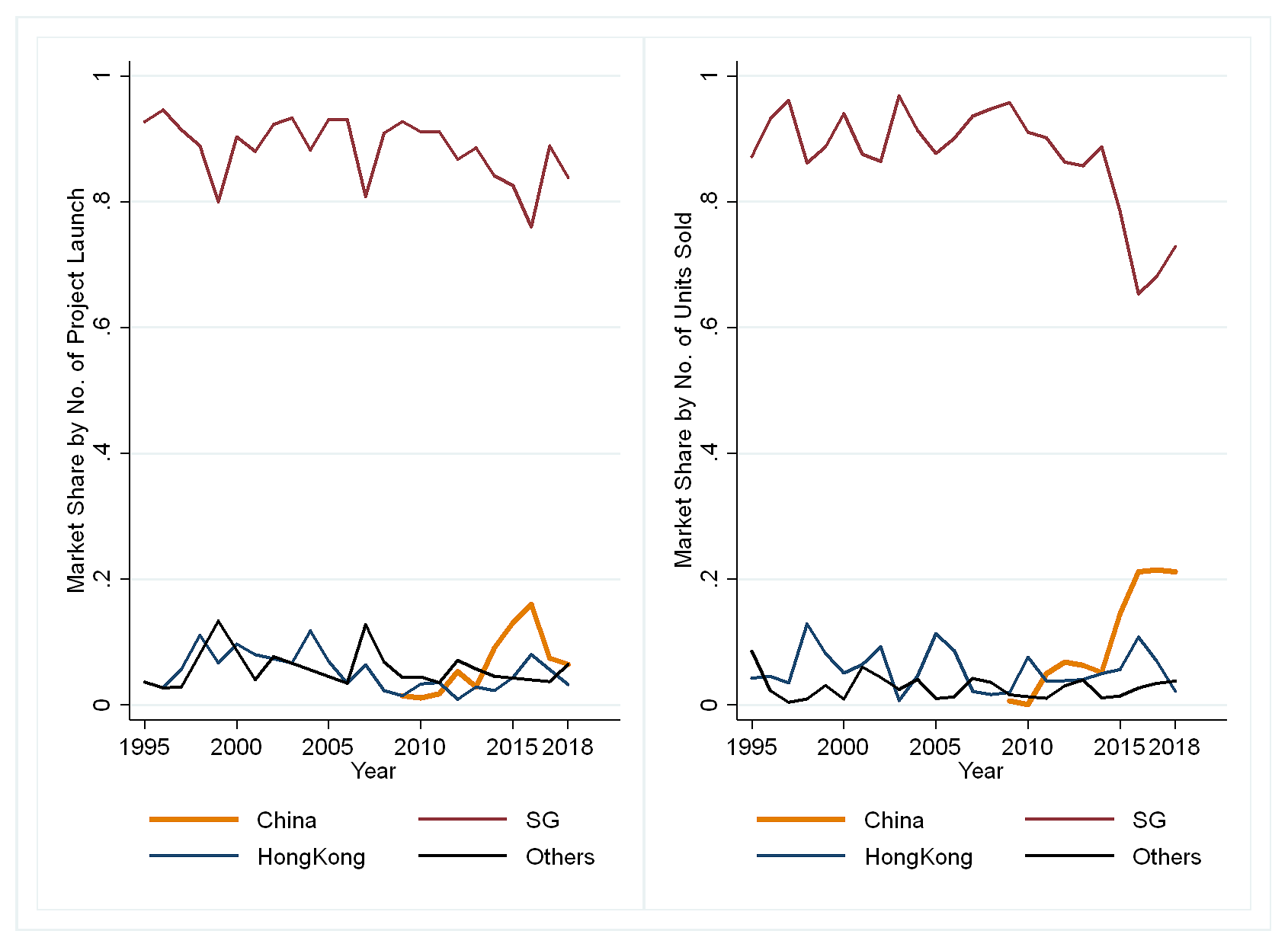
But the high-profile nature of launches by Chinese developers may have obscured a more nuanced picture. The market share of local developers has been hovering around 80 per cent based on market launches – so there is little sign that cash-rich Chinese developers are crowding out local developers.
This is notwithstanding that the number of condominium units sold by Chinese developers in the primary market has seen a surge in the share from 5 per cent in 2011 to 20 per cent since 2015, signifying their expanding influence in recent years.
FOREIGN COMPETITIONS
Two hypotheses may explain the high price premium paid by the Chinese developers.
First, Chinese developers pay higher prices because of information asymmetry, due to the lack of local market knowledge. However, learning through repeated acquisitions may narrow their information disadvantages over time.
Figures of developers’ market share in the Singapore private residential market over the years. The graph on the left shows developer’s market share by number of condominium project launch; while graph on the right is based on the number of units sold in the primary market. (Graphic: Sing Tien Foo, Chia Liu Ee. Source: URA)
Second, Chinese developers are able to keep their construction costs low, such that their profit margin remains intact after paying for high land costs.
In a study with Coulson and Dong, we have found that the most experienced developers can reduce construction costs by harnessing technology and economics of scale. Material and labour costs can be kept low by reducing wastage through effective project management, and by buying material in bulk directly from source countries at lower costs.
While some may have accused Chinese developers of driving up property prices, because they have been purchasing land at a premium, we have found that their new residential property launches sell at 3 per cent lower than those by local developers, controlling for property characteristics, spatial attributes and the timing of property sale.
If these lower prices are the results of competition and increased development efficiency, then the entry of foreign developers into the local property market brings more good than harm to local homeowners.
However, if lower prices correlate with lower housing quality, then the keen competition in prices may have led to undesirable outcomes. Developers risk damaging their reputation if they resort to lowering construction costs at the expense of shoddy workmanship and cheap material.
ARE FOREIGN INVESTORS PUSHING UP PRICES?
Recent news has also reported the influx of wealthy foreign investors, especially those from China, flocking to Singapore and buying up units in the luxury segment.
Still, these anecdotes seem to be less representative when the data shows that the share of Chinese buyers in foreign buyer transactions in the local property market has been constantly below 4 per cent throughout the years.
There was a small uptick in 2006, but this share reverted in 2013 and 2017 respectively.
Prospective buyers at a condominium showroom. (Photo: TODAY)
Additionally, foreign buyers pay a 2.7 per cent price premium relative to comparable transactions by local buyers. Aside from information disadvantage, the price differential can be explained by the greater liquidity well-heeled foreign investors have.
The uptick in demand for residential property by foreign investors meanwhile have been curbed by the slew of cooling measures since December 2011, and have come under control especially after the Additional Buyers’ Stamp Duty revisions in 2013.
A POSITIVE OUTLOOK AHEAD
Despite foreign competition ramping up prices in the GLS and en bloc markets, there is no evidence showing that high land costs have translated into higher prices in the private property market.
As competition in Singapore’s property market heats up, more local developers are also extending their wings and diversifying their real estate businesses to other foreign markets. Overseas investments by Singapore-based developers have almost doubled from 2013 to 2015 compared to 2010 to 2012.
The entry of foreign developers into the Singapore residential property market may have benefitted average Singaporean private homeowners. The outlook remains positive if innovation and efficiency gains, through the introduction of new smart technologies and fresh housing concepts, can be further realised.
Chia Liu Ee is a researcher and Associate Professor Sing Tien Foo is the Dean’s Chair and the Director of Institute of Real Estate and Urban Studies, NUS.