A wheelchair rental service is being inundated by a wave of negative reviews on its Facebook page after an event organiser accused the company of irresponsibly backing out of a job at the last minute.
Unable to find a suitable replacement on the day of the event — an excursion at Jurong Bird Park — the elderly attendees were said to have been forced to walk for a significant amount of time due to the lack of wheelchairs to go around.
A Facebook user who goes by the name of Nafiz SerbaBoleh went onto the “Carousell – Singapore” group page to allege that the company Revwheelchair were “unreliable” in providing its services. According to his post, he arranged to rent 40 wheelchairs from the company (which had advertised its services on Carousell) for an event organised by welfare organisation Happy People Helping People Community.
SINGAPORE: The recent news of a teenager going blind from living on chips and crisps for years have taken readers by storm.
Is this just an extreme case of a food oddity, or could this happen to more individuals?
From the eyes of a nutrition professional, this is a classic case of micronutrient deficiencies, or simply put, a lack of essential vitamins and minerals required by the body for proper growth and development.
THE PENDULUM SWINGS TO THE OTHER SIDE
While shocking to see in this day and age, micronutrient deficiencies was commonplace a century ago, when our forefathers lived on a staple diet of mostly refined white rice and little meat.
Treating medical conditions arising from insufficient intake of various vitamins and minerals was the norm. This included impaired vision, night blindness from vitamin A deficiency, anemia from iron or folate deficiencies, neurological impairments from vitamin B12 deficiency, to name a few.
As society progressed, food became more abundant and affordable, allowing people to consume a greater variety more likely to meet their needs for these micronutrients. Ironically, this has also swung the pendulum to the other end.
Plentiful food choices have also led to overconsumption of calories, particularly from highly processed foods, which are high in added sugars and fats and low in micronutrients – otherwise known as “junk food”.
Intake of micronutrient-rich fruits and vegetables have meanwhile been sorely neglected. While issues of malnourishment from insufficient vitamin and minerals intakes have been sidelined, looming concerns of lifestyle-related conditions like obesity, diabetes, heart disease, cancer have taken over.
Man eating food with disposable chopsticks from a styrofoam container. (File photo: Unsplash)
In recent years, problems related to micronutrient deficiencies are creeping back.
Typical diets in both developed and developing countries are falling short of nutritional recommendations, and while inadequate micronutrient intake was typically observed in underweight and undernourished individuals, there is now evidence this is also increasingly occurring in overweight or obese individuals.
UNDERNOURISHED BUT OVERWEIGHT
As such, the World Health Organisation (WHO) now recognises the coexistence of undernutrition along with overweight and obesity – the double burden of malnutrition – as a global health issue.
The challenge faced in dealing with micronutrient deficiencies is that they are not easily recognised. Unlike changes in body weight, which can be noticeable through clothes or from a weighing scale, signs of a lack of micronutrients are less visible.
There may be tell-tale signs such as dry skin, hair loss, fatigue, slower wound healing, but these are often brushed off as passing inconveniences.
As the body taps into its own reserves, it can sometimes take extended periods to become depleted of certain micronutrients.
For example, it can take as long as three years to deplete the liver of vitamin B12. However, during this time, the diminishing amounts of B12 can gradually damage vital functions, including the permanent damage of our nervous system, traveling up from the spine and into the brain.
The only way to reveal one’s levels of vitamins and minerals is through blood tests, but these are not typically included in routine blood checks, which test for test for high blood cholesterol and blood sugar levels, unless requested.
(Photo: Carles Rabada / Unsplash)
EXCESS NUTRIENTS CAN BE PROBLEMATIC TOO
Can taking dietary supplements solve the problems related to micronutrient deficiencies?
Taking multivitamin and mineral supplements can help supplement our diet, particularly for vegetarians or vegans who exclude meat from the diet and are thus at higher risk of vitamin B12 deficiency.
However, dietary supplements should not be a substitute for eating a healthy, balanced and varied diet.
Too much of certain micronutrients may interfere with nutrient absorption, cause side effects or lead to toxicity, which can be dangerous.
In fact, unlike micronutrients and other substances found in fruits, vegetables, fish and other healthy foods that work together to keep us healthy, those found in pills will not provide the same synergistic effect.
TOO MUCH REFINED STARCHES AND SUGARS
Today, we are constantly being bombarded with new, trendy food products including fast foods, snacks and fanciful sweetened drinks being advertised and rolled out into the market.
It is easy to be swept away and live on a diet rich in refined starches and sugars and lacking in nutrient-dense foods. Ironically, despite the abundance of food, the quality of our diet have regressed to standards similar to decades back.
When faced with too many food choices, we have to be even more discerning and conscious of what we choose to have on our plate.
Trendy foods can often blind us from good “old-fashioned” meals comprising of a staple, some meat, some vegetables and fruits – a varied, balanced combination more likely to help us meet our nutritional needs.
As the adage goes “You are what you eat”. If we eat junk constantly, why should we expect our health to turn out any differently?
Mary Chong is a nutritional expert and assistant professor at the NUS Saw Swee Hock School of Public Health.
They were enjoying a day out at Sentosa, but little did this elderly couple know that their granddaughter had a surprise in store for them.
When she led them to an outdoor terrace overlooking the sea on Saturday (Sept 7), Ong Soh Lim, 80, and Teo Soh Bee, 74, realised they had walked into their own wedding party.
They beamed from ear to ear as family and friends greeted them with hugs.
Mr and Mrs Ong were visibly moved as they listened to their children’s speeches and watched a montage of their many years together.
The couple then swopped their casual attire for a suit and a wedding gown before walking down the aisle to renew their vows.
“Thank you for being with me all these years, I’ll walk with you till the end of time,” Mrs Ong said.
Her sentiment was echoed by her husband of 54 years, who told her “Thank you for staying by my side and taking care of me,” and sealed their vows with a kiss.
Police said on Monday (Sept 9) that the 32-year-old was arrested for dangerous driving. She had previously been assisting them with investigations.
The police were alerted last Friday at 10.24pm to the case of dangerous driving in Upper Cross Street in the direction of South Bridge Road.
No injuries were reported.
In videos posted on Facebook, a black Mercedes Benz car can be seen moving in a direction opposite to the flow of traffic, on the leftmost lane.
A separate clip subsequently shows that the car has mounted the pavement. The driver steps out of the vehicle and utters Hokkien expletives at onlookers before returning to her car.
One of the posts has been shared over 5,200 times.
A clip of the incident posted on the Roads.sg Facebook group has been viewed more than 124,000 times since it was posted on Sunday.
You just can’t stop the rise of the global competitive gaming industry as it undergoes constant explosive growth, with esports and gaming culture going mainstream, reaching out to new corners of the market.
Closer to home, local professional gamers have been creating ripples in Singapore’s esports scene. Soon, they’ll stand a chance to make some waves globally following a major investment by gaming hardware firm Razer. Min-Liang Tan, the company’s affable co-founder and CEO, today pledged to drop $10 million into his country’s gaming industry across the next 12 months. Whoa.
The massive funding extends to supporting and investing in local esports teams and gaming companies based here or founded by Singaporeans. This includes Team Singapore, which will be participating in the medalled esports events of the SEA Games this year.
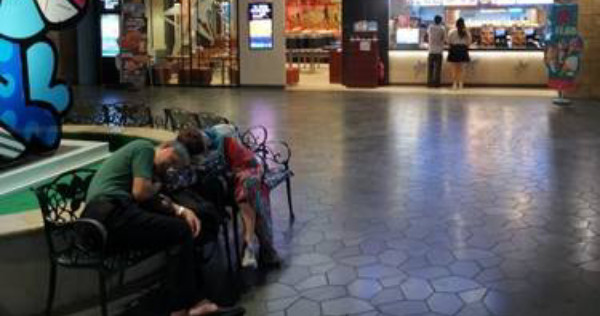
The Stomp contributor contributed photos and told Stomp that he sees the elderly couple almost every day at about 1am.
He told Stomp: “I always go past the area to buy food and have been seeing them at the benches outside RWS’s Texas Chicken for about two years already. They’re always sleeping in the same position and with bags.
“I’ve never approached them because they’re always sleeping when I pass by.
“Hope that by sharing this with Stomp, maybe their relatives or someone who knows them can see.”
Responding to a Stomp query, a MSF spokesperson said: “MSF is working with RWS to engage the couple and we have reached out to the elderly man.
HARARE, Zimbabwe: Close relatives and government officials flew out of Zimbabwe on Monday (Sep 9) to collect the body of ex-president Robert Mugabe from Singapore where he died last week, his nephew said.
Mugabe, a guerrilla leader who swept to power after Zimbabwe’s independence from Britain and went on to rule for 37 years until he was ousted in 2017, died on Friday, aged 95.
A charter flight left Harare at 3pm Singapore time on Monday and was expected to return home on Wednesday at 9pm, Leo Mugabe told AFP.
On arrival, the body will be taken straight to his rural village in Zvimba, about 90km west of the capital Harare, for an overnight wake.
On Thursday and Friday the body will lie in state at Rufaro Stadium in Mbare township in Harare for the public to pay their final respects, he said.
The 35,000-seater stadium is where Mugabe took his oath of office at a colourful ceremony when colonial Rhodesian prime minister Ian Smith handed over the country to Mugabe.
There Mugabe hoisted the new Zimbabwe flag and lit the independence flame on Apr 18, 1980 – bringing hope for a new era after a long guerrilla war.
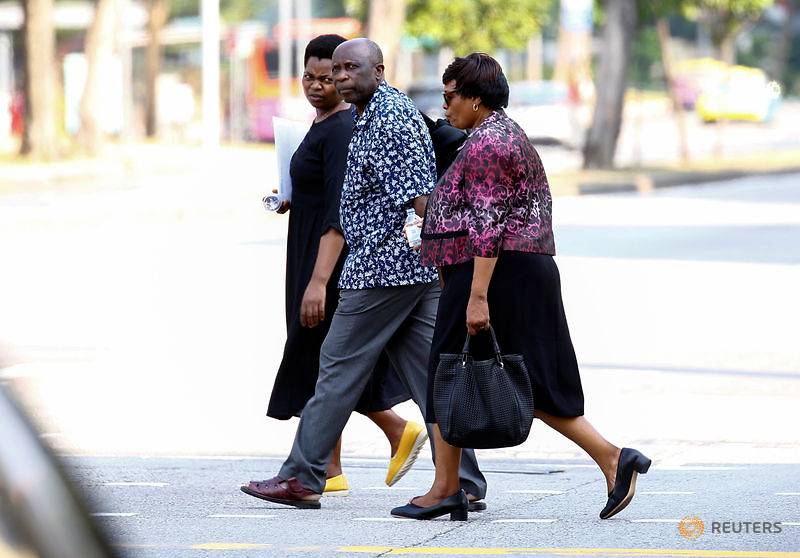
Visitors embrace as they leave Singapore Casket, the funeral parlour where the body of the late former Zimbabwe’s President Robert Mugabe is being held in Singapore, on Sep 8, 2019. (REUTERS/Feline Lim)
The body will be kept at his Harare house known as the Blue Roof overnight Thursday and Friday.
The official funeral will be on Saturday at the giant 60,000-seater National Sports Stadium in Harare.
“Then the (traditional) chiefs will bury him on Sunday, where I don’t know,” said Leo Mugabe.
Visitors leave after attending a private religious service at Singapore Casket, the funeral parlour where the body of the late former Zimbabwe’s President Robert Mugabe is being held in Singapore, September 8, 2019. REUTERS/Feline Lim
Visitors arrive with their luggage at Singapore Casket, the funeral parlour where the body of the late former Zimbabwe’s President Robert Mugabe is being held in Singapore, September 8, 2019. REUTERS/Feline Lim
The location of the burial remains unclear, with Mugabe’s family and President Emmerson Mnangagwa’s government apparently at odds over whether it would be at his homestead northwest of Harare or at a shrine for liberation heroes in the capital.
His nephew said that in line with native Shona customs, traditional chiefs from Zvimba will have a final say on where the former leader will be buried.
As a national president he did not excercise the role of a traditional ruler, but Mugabe held the respected title of traditional chief of Zvimba rural district.
A priest leads Sunday Mass at Zimbabwe’s founding father Robert Mugabe’s church in Harare, Zimbabwe, September 8, 2019. REUTERS/Philimon Bulawayo
Congregants attend Sunday Mass at Zimbabwe’s founding father Robert Mugabe’s church in Harare, Zimbabwe, September 8, 2019. REUTERS/Philimon Bulawayo
Mugabe’s health deteriorated after he was toppled by the military in November 2017, ending his increasingly tyrannical rule.
He had been travelling to Singapore for treatment since April.
SINGAPORE: A 35-year-old man has been fined S$99,000 – a record sum – for illegally selling electronic vaporisers online.
In a press release on Monday (Sep 9), the Health Sciences Authority (HSA) said that it discovered Chong Weisheng’s unlawful activities through online surveillance and investigation. His home at Gangsa Road was raided in March 2015.
Chong had bought the vaporisers from various overseas suppliers, advertising and reselling them on the website huntersbrew.net.
Screenshot of the website Chong used to advertise and sell electronic vaporisers. (Photo: Health Sciences Authority)
Electronic vaporisers include e-cigarettes, e-pipes, e-cigars and any battery-operated devices that deliver vaporised nicotine.
Chong took measures to avoid detection from HSA inspectors, such as changing his website domain name twice and requiring a password to access the site. Chong was also selective with his customers.
All sale transactions were titled “computer IT services” as a cover-up, HSA said.
Since 2014, the authority has prosecuted 20 people for selling electronic vaporisers. Chong’s fine is the largest such penalty since 2014, when an offender was fined S$64,500.
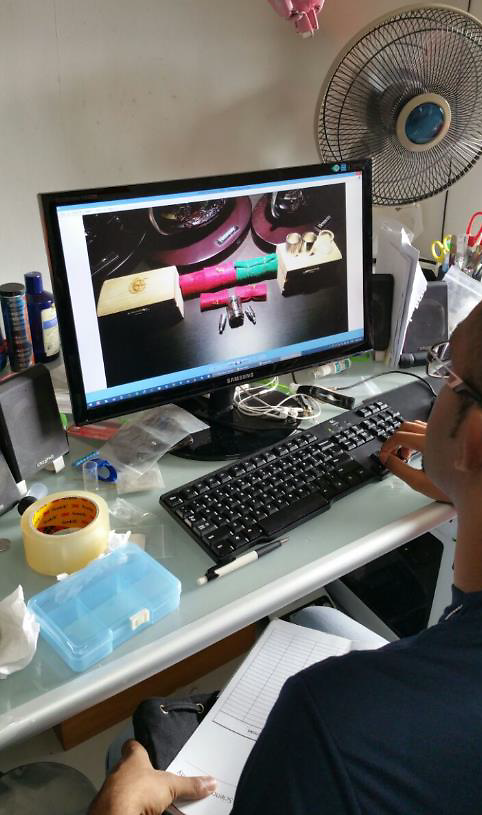
Electronic vaporisers and related paraphernalia seized from Chong Weisheng’s residence. (Photo: Health Sciences Authority)
Electronic vaporisers and related paraphernalia seized from Chong Weisheng’s residence. (Photo: Health Sciences Authority)
Anyone convicted of selling, importing or distributing electronic vaporisers can be fined up to S$10,000, jailed for up to six months, or both for each offence. The punishment is doubled for second and repeat offenders.
The use, purchase or possession of electronic vaporisers is also punishable with a fine of up to S$2,000.